
A English
Alkali metals Questions in English
Class 11 Chemistry · s-Block Elements · Alkali metals
994+
Questions
English
Language
100%
With Solutions
Showing 35 of 994 questions in English
951
MediumMCQ
Which one of the following options is correct pertaining to the below transformations?
$Na + NH_{3(l)} \longrightarrow$ Coloured solution $\xrightarrow{\text{on standing}} X + Y$
$Na + NH_{3(l)} \longrightarrow$ Coloured solution $\xrightarrow{\text{on standing}} X + Y$
A
| $A$. Colour of the solution: Yellow | $X = NaNH_2, Y = \frac{1}{2} H_2$ |
B
| $B$. Colour of the solution: Orange | $X = NaN_3, Y = \frac{9}{2} H_2$ |
C
| $C$. Colour of the solution: Blue | $X = NaNH_2, Y = \frac{1}{2} H_2$ |
D
| $D$. Colour of the solution: Red | $X = NaN_3, Y = \frac{9}{2} H_2$ |
Solution
(C) When $Na$ dissolves in liquid ammonia $(NH_{3(l)})$,it forms a deep blue coloured solution due to the presence of ammoniated electrons $(e^-(NH_3)_x)$.
The reaction is: $Na + (x+y)NH_3 \longrightarrow [Na(NH_3)_x]^+ + [e(NH_3)_y]^-$.
On standing,this solution reacts to form sodium amide $(NaNH_2)$ and hydrogen gas $(H_2)$:
$Na + NH_3 \longrightarrow NaNH_2 + \frac{1}{2} H_2$.
Thus,the solution is blue,$X$ is $NaNH_2$,and $Y$ is $\frac{1}{2} H_2$.
The reaction is: $Na + (x+y)NH_3 \longrightarrow [Na(NH_3)_x]^+ + [e(NH_3)_y]^-$.
On standing,this solution reacts to form sodium amide $(NaNH_2)$ and hydrogen gas $(H_2)$:
$Na + NH_3 \longrightarrow NaNH_2 + \frac{1}{2} H_2$.
Thus,the solution is blue,$X$ is $NaNH_2$,and $Y$ is $\frac{1}{2} H_2$.
0 likes
View Solution952
MediumMCQ
The correct statements are:
$I$. The low solubility of $LiF$ is due to its high lattice enthalpy.
$II$. $LiBr$ is soluble in acetone.
$III$. $LiCl$ is soluble in pyridine.
$IV$. The order of melting points of alkali metal halides is $MF > MCl > MBr > MI$.
$I$. The low solubility of $LiF$ is due to its high lattice enthalpy.
$II$. $LiBr$ is soluble in acetone.
$III$. $LiCl$ is soluble in pyridine.
$IV$. The order of melting points of alkali metal halides is $MF > MCl > MBr > MI$.
A
$I$,$II$ and $III$
B
$II$,$III$ and $IV$
C
$I$,$II$ and $IV$
D
$I$,$III$ and $IV$
Solution
(D) $I$. $LiF$ has a very high lattice enthalpy due to the small size of both $Li^+$ and $F^-$ ions,which makes it sparingly soluble in water. This is a correct statement.
$II$. $LiBr$ is soluble in acetone due to its covalent character (Fajans' rule),which makes this statement incorrect as it claims it is not soluble.
$III$. $LiCl$ is soluble in pyridine due to its covalent character,which makes this statement correct.
$IV$. The melting point of alkali metal halides follows the order $MF > MCl > MBr > MI$ because the lattice energy decreases as the size of the halide ion increases. This is a correct statement.
Therefore,statements $I$,$III$,and $IV$ are correct.
$II$. $LiBr$ is soluble in acetone due to its covalent character (Fajans' rule),which makes this statement incorrect as it claims it is not soluble.
$III$. $LiCl$ is soluble in pyridine due to its covalent character,which makes this statement correct.
$IV$. The melting point of alkali metal halides follows the order $MF > MCl > MBr > MI$ because the lattice energy decreases as the size of the halide ion increases. This is a correct statement.
Therefore,statements $I$,$III$,and $IV$ are correct.
0 likes
View Solution953
EasyMCQ
What is the increasing order of hydration enthalpies of alkali metal ions?
A
$Cs^{+} < Rb^{+} < K^{+} < Na^{+} < Li^{+}$
B
$Cs^{+} < Rb^{+} < K^{+} < Li^{+} < Na^{+}$
C
$Li^{+} < Na^{+} < K^{+} < Rb^{+} < Cs^{+}$
D
$Cs^{+} < Rb^{+} < Na^{+} < K^{+} < Li^{+}$
Solution
(A) The hydration enthalpy of ions depends on their ionic size. Smaller ions have higher charge density and thus higher hydration enthalpy. The ionic size of alkali metal ions increases down the group as $Li^{+} < Na^{+} < K^{+} < Rb^{+} < Cs^{+}$. Therefore,the hydration enthalpy decreases as the size increases. The correct increasing order of hydration enthalpies is $Cs^{+} < Rb^{+} < K^{+} < Na^{+} < Li^{+}$.
0 likes
View Solution954
EasyMCQ
Which alkali metal emits blue colour light in a flame test?
A
$Cs$
B
$Li$
C
$Na$
D
$K$
Solution
(A) In a flame test,different alkali metals impart characteristic colours to the flame due to the excitation of electrons to higher energy levels.
$Li$ imparts a crimson red colour.
$Na$ imparts a golden yellow colour.
$K$ imparts a lilac (pale violet) colour.
$Cs$ (Caesium) imparts a blue colour to the flame.
Therefore,the correct answer is $Cs$.
$Li$ imparts a crimson red colour.
$Na$ imparts a golden yellow colour.
$K$ imparts a lilac (pale violet) colour.
$Cs$ (Caesium) imparts a blue colour to the flame.
Therefore,the correct answer is $Cs$.
0 likes
View Solution955
EasyMCQ
Which of the following statement$(s)$ are correct,when alkali metals burn in the presence of oxygen?
$I$. Lithium forms monoxide
$II$. Sodium forms peroxide
$III$. Potassium,rubidium and cesium form superoxide
$I$. Lithium forms monoxide
$II$. Sodium forms peroxide
$III$. Potassium,rubidium and cesium form superoxide
A
$I$ and $II$
B
Only $III$
C
$I$ and $III$
D
$I, II$ and $III$
Solution
(D) When alkali metals burn in the presence of oxygen,they form different oxides depending on their size and polarizing power:
$I$. Lithium,being the smallest,forms monoxide $(Li_2O)$.
$II$. Sodium,due to its size,forms peroxide $(Na_2O_2)$.
$III$. Larger alkali metals like Potassium,Rubidium,and Cesium form superoxides ($MO_2$,where $M = K, Rb, Cs$).
Therefore,all three statements are correct.
$I$. Lithium,being the smallest,forms monoxide $(Li_2O)$.
$II$. Sodium,due to its size,forms peroxide $(Na_2O_2)$.
$III$. Larger alkali metals like Potassium,Rubidium,and Cesium form superoxides ($MO_2$,where $M = K, Rb, Cs$).
Therefore,all three statements are correct.
0 likes
View Solution956
EasyMCQ
The frequency of the radiation emitted by alkali metals in the flame test follows the order:
A
$Li > Na > K > Cs$
B
$Li > K > Na > Cs$
C
$K > Na > Li > Cs$
D
$K > Cs > Na > Li$
Solution
(A) In the flame test,the energy of the emitted radiation corresponds to the excitation of electrons from the ground state to higher energy levels. The energy difference $(\Delta E)$ between these levels decreases as the size of the alkali metal atom increases down the group $(Li < Na < K < Rb < Cs)$. Since energy is directly proportional to frequency $(\Delta E = h\nu)$,the frequency of the emitted radiation follows the same order as the energy difference. Therefore,the order of frequency is $Li > Na > K > Cs$.
0 likes
View Solution957
EasyMCQ
Which pair of elements on combustion in air give superoxides?
A
$Li, Cs$
B
$K, Rb$
C
$Li, Rb$
D
$K, Li$
Solution
(B) Alkali metals react with oxygen to form different types of oxides depending on their size and ionization energy.
$Li$ forms only the monoxide $(Li_2O)$.
$Na$ forms the peroxide $(Na_2O_2)$.
$K$,$Rb$,and $Cs$ form superoxides $(MO_2)$ when burnt in excess of air.
Therefore,the pair of elements that form superoxides is $K$ and $Rb$.
$Li$ forms only the monoxide $(Li_2O)$.
$Na$ forms the peroxide $(Na_2O_2)$.
$K$,$Rb$,and $Cs$ form superoxides $(MO_2)$ when burnt in excess of air.
Therefore,the pair of elements that form superoxides is $K$ and $Rb$.
0 likes
View Solution958
EasyMCQ
Assertion $(A)$: $K$,$Rb$,and $Cs$ form superoxides.
Reason $(R)$: The stability of the superoxides increases from $K$ to $Cs$ due to the decrease in lattice energy.
The correct answer is:
Reason $(R)$: The stability of the superoxides increases from $K$ to $Cs$ due to the decrease in lattice energy.
The correct answer is:
A
Both $(A)$ and $(R)$ are true and $(R)$ is the correct explanation of $(A)$
B
Both $(A)$ and $(R)$ are true but $(R)$ is not the correct explanation of $(A)$
C
$(A)$ is true but $(R)$ is not true
D
$(A)$ is not true but $(R)$ is true
Solution
(C) Assertion $(A)$ is true: Alkali metals $K$,$Rb$,and $Cs$ react with excess oxygen to form superoxides of the type $MO_2$.
Reason $(R)$ is false: The stability of superoxides increases from $K$ to $Cs$ because the large size of the alkali metal cation stabilizes the large superoxide anion $(O_2^-)$ through a decrease in lattice energy,but the statement claims stability increases *due to* the decrease in lattice energy,which is a misinterpretation of the thermodynamic stability factor. More accurately,the stability increases due to the increasing size of the cation which matches the size of the large anion,reducing the lattice energy and making the formation more favorable. However,the reason provided is scientifically incorrect in its causal link.
Therefore,$(A)$ is true but $(R)$ is false.
Reason $(R)$ is false: The stability of superoxides increases from $K$ to $Cs$ because the large size of the alkali metal cation stabilizes the large superoxide anion $(O_2^-)$ through a decrease in lattice energy,but the statement claims stability increases *due to* the decrease in lattice energy,which is a misinterpretation of the thermodynamic stability factor. More accurately,the stability increases due to the increasing size of the cation which matches the size of the large anion,reducing the lattice energy and making the formation more favorable. However,the reason provided is scientifically incorrect in its causal link.
Therefore,$(A)$ is true but $(R)$ is false.
0 likes
View Solution959
MediumMCQ
Which of the following statements are correct for alkali metal compounds?
$(i)$ Superoxides are paramagnetic in nature.
(ii) The basic strengths of hydroxides increase down the group.
(iii) The conductivity of chlorides in their aqueous solutions decreases down the group.
(iv) The basic nature of carbonates in aqueous solutions is due to cationic hydrolysis.
$(i)$ Superoxides are paramagnetic in nature.
(ii) The basic strengths of hydroxides increase down the group.
(iii) The conductivity of chlorides in their aqueous solutions decreases down the group.
(iv) The basic nature of carbonates in aqueous solutions is due to cationic hydrolysis.
A
$(i)$,(ii) and (iii) only
B
$(i)$ and (ii) only
C
(ii),(iii) and (iv) only
D
(iii) and (iv) only
Solution
(B) $(i)$ Superoxides contain the $O_2^-$ ion,which has one unpaired electron,making them paramagnetic. This statement is correct.
(ii) As we move down the group,the size of the metal ion increases,which decreases the lattice energy and increases the solubility/dissociation of hydroxides,thus increasing basic strength. This statement is correct.
(iii) Conductivity in aqueous solutions depends on ionic mobility. As we move down the group,the size of the hydrated ion decreases (due to less hydration),leading to higher ionic mobility and higher conductivity. Thus,conductivity increases down the group. This statement is incorrect.
(iv) The basic nature of carbonates is due to anionic hydrolysis (hydrolysis of the $CO_3^{2-}$ ion),not cationic hydrolysis. This statement is incorrect.
Therefore,only statements $(i)$ and $(ii)$ are correct.
(ii) As we move down the group,the size of the metal ion increases,which decreases the lattice energy and increases the solubility/dissociation of hydroxides,thus increasing basic strength. This statement is correct.
(iii) Conductivity in aqueous solutions depends on ionic mobility. As we move down the group,the size of the hydrated ion decreases (due to less hydration),leading to higher ionic mobility and higher conductivity. Thus,conductivity increases down the group. This statement is incorrect.
(iv) The basic nature of carbonates is due to anionic hydrolysis (hydrolysis of the $CO_3^{2-}$ ion),not cationic hydrolysis. This statement is incorrect.
Therefore,only statements $(i)$ and $(ii)$ are correct.
0 likes
View Solution960
MediumMCQ
Sodium is heated in air at $300^{\circ} C$ to form $X$. $X$ absorbs $CO_2$ and forms $Na_2CO_3$ and $Y$. Which of the following is $Y$?
A
$H_2$
B
$O_2$
C
$H_2O_2$
D
$O_3$
Solution
(B) When sodium is heated in air at $300^{\circ} C$,it forms sodium peroxide $(X = Na_2O_2)$.
$2Na + O_2 \xrightarrow{300^{\circ} C} Na_2O_2$
Sodium peroxide reacts with $CO_2$ to form sodium carbonate and oxygen gas $(Y = O_2)$.
$2Na_2O_2 + 2CO_2 \rightarrow 2Na_2CO_3 + O_2$
Therefore,$Y$ is $O_2$.
$2Na + O_2 \xrightarrow{300^{\circ} C} Na_2O_2$
Sodium peroxide reacts with $CO_2$ to form sodium carbonate and oxygen gas $(Y = O_2)$.
$2Na_2O_2 + 2CO_2 \rightarrow 2Na_2CO_3 + O_2$
Therefore,$Y$ is $O_2$.
0 likes
View Solution961
EasyMCQ
By using which process,sodium carbonate is generally prepared?
A
Deacon's process
B
Castner-Kellner process
C
Nelson cell process
D
Solvay process
Solution
(D) Sodium carbonate $(Na_2CO_3)$ is industrially prepared by the $Solvay$ process.
In this process,$CO_2$ and $NH_3$ are passed through a concentrated solution of sodium chloride (brine).
The reaction involves the formation of sodium bicarbonate $(NaHCO_3)$,which is then heated to obtain sodium carbonate.
In this process,$CO_2$ and $NH_3$ are passed through a concentrated solution of sodium chloride (brine).
The reaction involves the formation of sodium bicarbonate $(NaHCO_3)$,which is then heated to obtain sodium carbonate.
0 likes
View Solution962
EasyMCQ
Which of the following gives more number of oxides on reacting with $HCl$?
A
$Na_2CO_3$
B
$NaNO_2$
C
$Na_2SO_3$
D
$NaHCO_3$
Solution
(B) Let us analyze the reaction of each compound with $HCl$:
$1$. $Na_2CO_3 + 2HCl \rightarrow 2NaCl + H_2O + CO_2$ (Produces $1$ oxide: $CO_2$)
$2$. $NaNO_2 + HCl \rightarrow NaCl + HNO_2$ (Further decomposes to $H_2O + NO + NO_2$. Produces $2$ oxides: $NO$ and $NO_2$)
$3$. $Na_2SO_3 + 2HCl \rightarrow 2NaCl + H_2O + SO_2$ (Produces $1$ oxide: $SO_2$)
$4$. $NaHCO_3 + HCl \rightarrow NaCl + H_2O + CO_2$ (Produces $1$ oxide: $CO_2$)
Comparing the products,$NaNO_2$ produces $2$ oxides ($NO$ and $NO_2$),which is more than the others.
$1$. $Na_2CO_3 + 2HCl \rightarrow 2NaCl + H_2O + CO_2$ (Produces $1$ oxide: $CO_2$)
$2$. $NaNO_2 + HCl \rightarrow NaCl + HNO_2$ (Further decomposes to $H_2O + NO + NO_2$. Produces $2$ oxides: $NO$ and $NO_2$)
$3$. $Na_2SO_3 + 2HCl \rightarrow 2NaCl + H_2O + SO_2$ (Produces $1$ oxide: $SO_2$)
$4$. $NaHCO_3 + HCl \rightarrow NaCl + H_2O + CO_2$ (Produces $1$ oxide: $CO_2$)
Comparing the products,$NaNO_2$ produces $2$ oxides ($NO$ and $NO_2$),which is more than the others.
0 likes
View Solution963
EasyMCQ
Which of the following set of metals have a strong tendency to form superoxides?
A
$Li, Na, Be$
B
$Be, Mg, Ca$
C
$K, Rb, Cs$
D
$Li, Be, Mg$
Solution
(C) The alkali metals react with oxygen to form different types of oxides depending on their size.
$Li$ forms only the monoxide $(Li_2O)$.
$Na$ forms the peroxide $(Na_2O_2)$.
$K, Rb,$ and $Cs$ have a strong tendency to form superoxides $(MO_2)$ due to the stabilization of the large superoxide anion $(O_2^-)$ by the large alkali metal cations.
$Li$ forms only the monoxide $(Li_2O)$.
$Na$ forms the peroxide $(Na_2O_2)$.
$K, Rb,$ and $Cs$ have a strong tendency to form superoxides $(MO_2)$ due to the stabilization of the large superoxide anion $(O_2^-)$ by the large alkali metal cations.
0 likes
View Solution964
MediumMCQ
Potassium superoxide on hydrolysis gives
A
$K^{+} + OH^{-} + O_{2}$
B
$K^{+} + K_{2}O + O_{2} + OH^{-}$
C
$K^{+} + H_{2}O_{2} + O_{2} + OH^{-}$
D
$K^{+} + H_{2}O_{2} + OH^{-}$
Solution
(C) Potassium superoxide $(KO_{2})$ reacts with water to give potassium hydroxide,hydrogen peroxide,and oxygen gas.
The balanced chemical equation for the hydrolysis is:
$2KO_{2} + 2H_{2}O \rightarrow 2K^{+} + 2OH^{-} + H_{2}O_{2} + O_{2}$
The balanced chemical equation for the hydrolysis is:
$2KO_{2} + 2H_{2}O \rightarrow 2K^{+} + 2OH^{-} + H_{2}O_{2} + O_{2}$
0 likes
View Solution965
EasyMCQ
Which gas/gases evolve$(s)$ when sodium metal is reacted with water at room temperature?
A
Oxygen only
B
Hydrogen only
C
Sodium vapour and hydrogen
D
Hydrogen and water vapour
Solution
(D) When sodium metal $(Na)$ reacts with water $(H_2O)$ at room temperature,it undergoes a vigorous exothermic reaction.
The chemical equation for this reaction is: $2Na(s) + 2H_2O(l) \rightarrow 2NaOH(aq) + H_2(g)$.
As shown in the equation,hydrogen gas $(H_2)$ is evolved.
Due to the highly exothermic nature of the reaction,some water also evaporates,resulting in the evolution of hydrogen gas along with water vapour.
The chemical equation for this reaction is: $2Na(s) + 2H_2O(l) \rightarrow 2NaOH(aq) + H_2(g)$.
As shown in the equation,hydrogen gas $(H_2)$ is evolved.
Due to the highly exothermic nature of the reaction,some water also evaporates,resulting in the evolution of hydrogen gas along with water vapour.
0 likes
View Solution966
EasyMCQ
When sodium $(Na)$ metal is dissolved in liquid ammonia $(NH_3)$,it imparts a blue colour to the solution. This blue coloration is due to:
A
Liquid $NH_3$
B
$[Na(NH_3)_x]^+$
C
$NaNH_2$
D
$[e(NH_3)_x]^-$
Solution
(D) When sodium $(Na)$ metal is dissolved in liquid ammonia $(NH_3)$,it undergoes ionization to form ammoniated cations and ammoniated electrons:
$Na + (x+y)NH_3 \rightarrow [Na(NH_3)_x]^+ + [e(NH_3)_y]^-$
The blue colour of the solution is due to the excitation of the ammoniated electrons $[e(NH_3)_y]^-$ to higher energy levels,which absorb light in the visible region.
$Na + (x+y)NH_3 \rightarrow [Na(NH_3)_x]^+ + [e(NH_3)_y]^-$
The blue colour of the solution is due to the excitation of the ammoniated electrons $[e(NH_3)_y]^-$ to higher energy levels,which absorb light in the visible region.
0 likes
View Solution967
EasyMCQ
Which one of the following elements reduces $NaOH$ to $Na$?
A
$Si$
B
$Pb$
C
$C$
D
$Sn$
Solution
(C) The reduction of $NaOH$ to $Na$ is a highly endothermic and difficult process because $Na$ is a very strong reducing agent. Among the given options,$C$ (carbon) is capable of reducing $NaOH$ to $Na$ at high temperatures. The reaction is: $2NaOH + 2C \rightarrow 2Na + 2CO + H_2$.
0 likes
View Solution968
MediumMCQ
In which of the following reactions is hydrogen gas not liberated?
A
Reaction of fused $NaOH$ with $C$
B
Reaction of $NaOH$ with sulphur
C
Heating the concentrated $NaOH$ with $Si$
D
Reaction of zinc with $NaOH$
Solution
(B) Let us analyze each reaction:
$1$. Reaction of fused $NaOH$ with $C$: $2NaOH + C \rightarrow Na_2CO_3 + H_2$. Hydrogen is liberated.
$2$. Reaction of $NaOH$ with sulphur: $6NaOH + 3S \rightarrow 2Na_2S + Na_2SO_3 + 3H_2O$. No hydrogen gas is liberated.
$3$. Heating concentrated $NaOH$ with $Si$: $Si + 2NaOH + H_2O \rightarrow Na_2SiO_3 + 2H_2$. Hydrogen is liberated.
$4$. Reaction of zinc with $NaOH$: $Zn + 2NaOH \rightarrow Na_2ZnO_2 + H_2$. Hydrogen is liberated.
Therefore,the correct option is $B$.
$1$. Reaction of fused $NaOH$ with $C$: $2NaOH + C \rightarrow Na_2CO_3 + H_2$. Hydrogen is liberated.
$2$. Reaction of $NaOH$ with sulphur: $6NaOH + 3S \rightarrow 2Na_2S + Na_2SO_3 + 3H_2O$. No hydrogen gas is liberated.
$3$. Heating concentrated $NaOH$ with $Si$: $Si + 2NaOH + H_2O \rightarrow Na_2SiO_3 + 2H_2$. Hydrogen is liberated.
$4$. Reaction of zinc with $NaOH$: $Zn + 2NaOH \rightarrow Na_2ZnO_2 + H_2$. Hydrogen is liberated.
Therefore,the correct option is $B$.
0 likes
View Solution969
EasyMCQ
Solvay process is used in the manufacture of
A
$K_2CO_3$
B
$KHCO_3$
C
$Na_2CO_3$
D
$CaCl_2$
Solution
(C) The Solvay process is an industrial method used for the large-scale production of sodium carbonate $(Na_2CO_3)$,commonly known as soda ash.
0 likes
View Solution970
MediumMCQ
Which of the following reactions does not liberate a gaseous product?
A
$AlCl_3 + NaOH \longrightarrow Al(OH)_3 + NaCl$
B
$P_4 + 3NaOH + 3H_2O \longrightarrow PH_3(g) + 3NaH_2PO_2$
C
$2Al + 2NaOH + 2H_2O \longrightarrow 2NaAlO_2 + 3H_2(g)$
D
$Zn + 2NaOH \longrightarrow Na_2ZnO_2 + H_2(g)$
Solution
(A) $1$. In option $A$,the reaction is $AlCl_3 + 3NaOH \longrightarrow Al(OH)_3(s) + 3NaCl(aq)$. This reaction produces a precipitate of aluminum hydroxide and aqueous sodium chloride; no gas is evolved.
$2$. In option $B$,white phosphorus reacts with $NaOH$ to produce phosphine gas $(PH_3)$.
$3$. In option $C$,aluminum reacts with $NaOH$ to produce sodium aluminate and hydrogen gas $(H_2)$.
$4$. In option $D$,zinc reacts with $NaOH$ to produce sodium zincate and hydrogen gas $(H_2)$.
Therefore,the reaction that does not liberate a gaseous product is $A$.
$2$. In option $B$,white phosphorus reacts with $NaOH$ to produce phosphine gas $(PH_3)$.
$3$. In option $C$,aluminum reacts with $NaOH$ to produce sodium aluminate and hydrogen gas $(H_2)$.
$4$. In option $D$,zinc reacts with $NaOH$ to produce sodium zincate and hydrogen gas $(H_2)$.
Therefore,the reaction that does not liberate a gaseous product is $A$.
0 likes
View Solution971
EasyMCQ
In the extraction of sodium by Down's process,cathode and anode respectively are
A
copper and nickel
B
copper and chromium
C
nickel and chromium
D
iron and graphite
Solution
(D) In the extraction of sodium by Down's process,the electrolytic cell consists of an iron cathode and a graphite anode. The molten $NaCl$ is electrolyzed to produce sodium metal at the cathode and chlorine gas at the anode.
0 likes
View Solution972
MediumMCQ
Which of the following statements is not correct?
A
Carbonates of alkaline earth metals are insoluble in water.
B
$Beryllium$ halides are covalent in nature.
C
The superoxides of alkali metals are colourless.
D
Alkali metal halides have high negative enthalpies of formation.
Solution
(C) $1$. Carbonates of alkaline earth metals $(MgCO_3, CaCO_3, SrCO_3, BaCO_3)$ are generally insoluble in water.
$2$. $Beryllium$ halides (e.g.,$BeCl_2$) are covalent due to the small size and high polarizing power of the $Be^{2+}$ ion.
$3$. Alkali metal superoxides (e.g.,$KO_2, RbO_2, CsO_2$) are paramagnetic and coloured (usually yellow or orange) due to the presence of the unpaired electron in the $\pi^* 2p$ molecular orbital.
$4$. Alkali metal halides have high negative enthalpies of formation due to high lattice energy.
Therefore,the statement that superoxides of alkali metals are colourless is incorrect.
$2$. $Beryllium$ halides (e.g.,$BeCl_2$) are covalent due to the small size and high polarizing power of the $Be^{2+}$ ion.
$3$. Alkali metal superoxides (e.g.,$KO_2, RbO_2, CsO_2$) are paramagnetic and coloured (usually yellow or orange) due to the presence of the unpaired electron in the $\pi^* 2p$ molecular orbital.
$4$. Alkali metal halides have high negative enthalpies of formation due to high lattice energy.
Therefore,the statement that superoxides of alkali metals are colourless is incorrect.
0 likes
View Solution973
MediumMCQ
Calcium on heating in $N_2$ yields an ionic compound $A$,which reacts with water to give $Ca(OH)_2$ and a gas $B$. Identify $A$ and $B$.
A
$CaN_2, NO$
B
$Ca_3N_2, NH_3$
C
$CaN_2, NH_3$
D
$Ca_3N_2, NO$
Solution
(B) When calcium is heated in an atmosphere of $N_2$,it forms calcium nitride,$Ca_3N_2$,which is the ionic compound $A$.
$3Ca + N_2 \xrightarrow{\Delta} Ca_3N_2 (A)$
Calcium nitride reacts with water to produce calcium hydroxide and ammonia gas,$B$.
$Ca_3N_2 + 6H_2O \rightarrow 3Ca(OH)_2 + 2NH_3 (B)$
Therefore,$A$ is $Ca_3N_2$ and $B$ is $NH_3$.
$3Ca + N_2 \xrightarrow{\Delta} Ca_3N_2 (A)$
Calcium nitride reacts with water to produce calcium hydroxide and ammonia gas,$B$.
$Ca_3N_2 + 6H_2O \rightarrow 3Ca(OH)_2 + 2NH_3 (B)$
Therefore,$A$ is $Ca_3N_2$ and $B$ is $NH_3$.
0 likes
View Solution974
MediumMCQ
In which of the following reactions,$MgO$ is not formed?
A
$Mg + CO_2 \longrightarrow$
B
$Mg + \text{dil. } HNO_3 \longrightarrow$
C
$Mg + NO \xrightarrow{\Delta}$
D
$Mg + B_2O_3 \longrightarrow$
Solution
(B) The reactions are as follows:
$1$. $2Mg + CO_2 \longrightarrow 2MgO + C$ ($MgO$ is formed).
$2$. $Mg + 2HNO_3 \text{ (dil.)} \longrightarrow Mg(NO_3)_2 + H_2$ ($MgO$ is not formed; $Mg(NO_3)_2$ is formed).
$3$. $2Mg + 2NO \xrightarrow{\Delta} 2MgO + N_2$ ($MgO$ is formed).
$4$. $3Mg + B_2O_3 \longrightarrow 3MgO + 2B$ ($MgO$ is formed).
Therefore,the correct option is $B$.
$1$. $2Mg + CO_2 \longrightarrow 2MgO + C$ ($MgO$ is formed).
$2$. $Mg + 2HNO_3 \text{ (dil.)} \longrightarrow Mg(NO_3)_2 + H_2$ ($MgO$ is not formed; $Mg(NO_3)_2$ is formed).
$3$. $2Mg + 2NO \xrightarrow{\Delta} 2MgO + N_2$ ($MgO$ is formed).
$4$. $3Mg + B_2O_3 \longrightarrow 3MgO + 2B$ ($MgO$ is formed).
Therefore,the correct option is $B$.
0 likes
View Solution975
MediumMCQ
Identify the compound which gives $CO_2$ more readily on heating.
A
$CaCO_3$
B
$Na_2CO_3$
C
$NaHCO_3$
D
$Li_2CO_3$
Solution
(C) The thermal stability of carbonates and bicarbonates determines how easily they release $CO_2$ upon heating.
$NaHCO_3$ (sodium bicarbonate) decomposes at a much lower temperature compared to the others: $2NaHCO_3 \rightarrow Na_2CO_3 + H_2O + CO_2$.
$CaCO_3$ and $Li_2CO_3$ require significantly higher temperatures for decomposition,while $Na_2CO_3$ is thermally very stable and does not decompose easily.
$NaHCO_3$ (sodium bicarbonate) decomposes at a much lower temperature compared to the others: $2NaHCO_3 \rightarrow Na_2CO_3 + H_2O + CO_2$.
$CaCO_3$ and $Li_2CO_3$ require significantly higher temperatures for decomposition,while $Na_2CO_3$ is thermally very stable and does not decompose easily.
0 likes
View Solution976
MediumMCQ
When compared with alkaline earth metals,the alkali metals have
A
Greater hardness
B
Higher boiling points
C
Smaller ionic radii
D
Lower ionization enthalpy
Solution
(D) Alkali metals $(Group \ 1)$ have only one valence electron per atom,which leads to weaker metallic bonding compared to alkaline earth metals $(Group \ 2)$,which have two valence electrons.
As a result,alkali metals are softer,have lower boiling points,and larger atomic/ionic radii than their corresponding alkaline earth metal counterparts.
Furthermore,due to their larger atomic size and lower effective nuclear charge,alkali metals have lower ionization enthalpy values compared to alkaline earth metals.
As a result,alkali metals are softer,have lower boiling points,and larger atomic/ionic radii than their corresponding alkaline earth metal counterparts.
Furthermore,due to their larger atomic size and lower effective nuclear charge,alkali metals have lower ionization enthalpy values compared to alkaline earth metals.
0 likes
View Solution977
MediumMCQ
Which one of the following statements is not correct?
A
Molecular formula of calgon is $Na_2[Na_4(PO_3)_6]$
B
Beryllium halides are soluble in organic solvents
C
Among alkali metals,the reducing property of sodium is least in aqueous solution
D
White metal is an alloy of Lithium
Solution
(C) The correct statement analysis is as follows:
$1$. The molecular formula of calgon is $Na_2[Na_4(PO_3)_6]$,which is correct.
$2$. Beryllium halides are covalent in nature due to the small size and high polarizing power of $Be^{2+}$ ions,making them soluble in organic solvents,which is correct.
$3$. Among alkali metals,Lithium $(Li)$ has the highest reducing property in aqueous solution due to its high hydration energy. Sodium $(Na)$ does not have the least reducing property; the trend is $Li > K > Rb > Cs > Na$. Thus,the statement is incorrect.
$4$. White metal (also known as Babbitt metal) is an alloy typically composed of tin,copper,and antimony,not Lithium. This statement is also incorrect.
However,in the context of standard competitive chemistry questions,the most widely recognized incorrect statement regarding the specific properties of alkali metals is that sodium has the least reducing property,as it contradicts the standard electrochemical series behavior in aqueous media.
$1$. The molecular formula of calgon is $Na_2[Na_4(PO_3)_6]$,which is correct.
$2$. Beryllium halides are covalent in nature due to the small size and high polarizing power of $Be^{2+}$ ions,making them soluble in organic solvents,which is correct.
$3$. Among alkali metals,Lithium $(Li)$ has the highest reducing property in aqueous solution due to its high hydration energy. Sodium $(Na)$ does not have the least reducing property; the trend is $Li > K > Rb > Cs > Na$. Thus,the statement is incorrect.
$4$. White metal (also known as Babbitt metal) is an alloy typically composed of tin,copper,and antimony,not Lithium. This statement is also incorrect.
However,in the context of standard competitive chemistry questions,the most widely recognized incorrect statement regarding the specific properties of alkali metals is that sodium has the least reducing property,as it contradicts the standard electrochemical series behavior in aqueous media.
0 likes
View Solution978
EasyMCQ
Identify $X$ and $Y$,respectively in the following reactions:
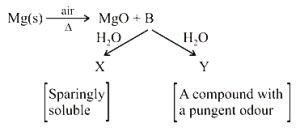
A
$MgO ; C$
B
$Mg(OH)_2 ; MgO$
C
$MgO ; NH_3$
D
$Mg(OH)_2 ; NH_3$
Solution
(D) When $Mg$ is heated in air,it reacts with both $O_2$ and $N_2$ to form $MgO$ and $Mg_3N_2$ (which is $B$).
$2Mg + O_2 \xrightarrow{\Delta} 2MgO$
$3Mg + N_2 \xrightarrow{\Delta} Mg_3N_2 (B)$
Now,the hydrolysis of $Mg_3N_2$ occurs as follows:
$Mg_3N_2 + 6H_2O \rightarrow 3Mg(OH)_2 + 2NH_3$
Here,$Mg(OH)_2$ $(X)$ is sparingly soluble in water,and $NH_3$ $(Y)$ is a gas with a pungent odour.
Therefore,$X = Mg(OH)_2$ and $Y = NH_3$.
$2Mg + O_2 \xrightarrow{\Delta} 2MgO$
$3Mg + N_2 \xrightarrow{\Delta} Mg_3N_2 (B)$
Now,the hydrolysis of $Mg_3N_2$ occurs as follows:
$Mg_3N_2 + 6H_2O \rightarrow 3Mg(OH)_2 + 2NH_3$
Here,$Mg(OH)_2$ $(X)$ is sparingly soluble in water,and $NH_3$ $(Y)$ is a gas with a pungent odour.
Therefore,$X = Mg(OH)_2$ and $Y = NH_3$.
0 likes
View Solution979
DifficultMCQ
The metal-pair that can produce nascent hydrogen in alkaline medium is
A
$Zn, Al$
B
$Fe, Ni$
C
$Al, Mg$
D
$Mg, Zn$
Solution
(A) Amphoteric metals like $Zn$ and $Al$ react with strong bases (alkaline medium) to produce hydrogen gas.
For example,$Zn + 2NaOH \rightarrow Na_2ZnO_2 + H_2$ and $2Al + 2NaOH + 2H_2O \rightarrow 2NaAlO_2 + 3H_2$.
Thus,the pair $Zn$ and $Al$ is capable of producing hydrogen in an alkaline medium.
For example,$Zn + 2NaOH \rightarrow Na_2ZnO_2 + H_2$ and $2Al + 2NaOH + 2H_2O \rightarrow 2NaAlO_2 + 3H_2$.
Thus,the pair $Zn$ and $Al$ is capable of producing hydrogen in an alkaline medium.
0 likes
View Solution980
EasyMCQ
"Electron" is an alloy of
A
$Mg$ and $Zn$
B
$Fe$ and $Mg$
C
$Ni$ and $Zn$
D
$Al$ and $Zn$
Solution
(A) Electron is a magnesium-based alloy.
It typically consists of $Mg (95 \%)$,$Zn (4.5 \%)$,and $Cu (0.5 \%)$.
Therefore,the correct option is $A$.
It typically consists of $Mg (95 \%)$,$Zn (4.5 \%)$,and $Cu (0.5 \%)$.
Therefore,the correct option is $A$.
0 likes
View Solution981
EasyMCQ
Which of the following represents the composition of Carnallite mineral?
A
$K_2O \cdot Al_2O_3 \cdot 6SiO_2$
B
$KNO_3$
C
$K_2SO_4 \cdot MgSO_4 \cdot MgCl_2 \cdot 6H_2O$
D
$KCl \cdot MgCl_2 \cdot 6H_2O$
Solution
(D) Carnallite is a hydrated potassium magnesium chloride mineral with the chemical formula $KCl \cdot MgCl_2 \cdot 6H_2O$.
It is an important source of potassium and magnesium.
It is an important source of potassium and magnesium.
0 likes
View Solution982
EasyMCQ
Nitrogen dioxide is not produced on heating:
A
$KNO_{3}$
B
$Pb(NO_{3})_{2}$
C
$Cu(NO_{3})_{2}$
D
$AgNO_{3}$
Solution
(A) Only $KNO_{3}$ on heating does not produce $NO_{2}$. The thermal decomposition reactions are as follows:
$(a)$ $2 KNO_{3} \xrightarrow{\Delta} 2 KNO_{2} + O_{2}$
$(b)$ $2 Pb(NO_{3})_{2} \xrightarrow{\Delta} 2 PbO + 4 NO_{2} + O_{2}$
$(c)$ $2 Cu(NO_{3})_{2} \xrightarrow{\Delta} 2 CuO + 4 NO_{2} + O_{2}$
$(d)$ $2 AgNO_{3} \xrightarrow{\Delta} 2 Ag + 2 NO_{2} + O_{2}$
Alkali metal nitrates (like $KNO_{3}$) decompose to form nitrites and oxygen,whereas heavy metal nitrates decompose to form metal oxides (or metal),nitrogen dioxide,and oxygen.
$(a)$ $2 KNO_{3} \xrightarrow{\Delta} 2 KNO_{2} + O_{2}$
$(b)$ $2 Pb(NO_{3})_{2} \xrightarrow{\Delta} 2 PbO + 4 NO_{2} + O_{2}$
$(c)$ $2 Cu(NO_{3})_{2} \xrightarrow{\Delta} 2 CuO + 4 NO_{2} + O_{2}$
$(d)$ $2 AgNO_{3} \xrightarrow{\Delta} 2 Ag + 2 NO_{2} + O_{2}$
Alkali metal nitrates (like $KNO_{3}$) decompose to form nitrites and oxygen,whereas heavy metal nitrates decompose to form metal oxides (or metal),nitrogen dioxide,and oxygen.
0 likes
View Solution983
EasyMCQ
$NO_2$ is not obtained on heating:
A
$AgNO_3$
B
$KNO_3$
C
$Cu(NO_3)_2$
D
$Pb(NO_3)_2$
Solution
(B) The thermal decomposition of metal nitrates follows specific patterns based on the reactivity of the metal.
$1$. Alkali metal nitrates like $KNO_3$ decompose to form metal nitrites and oxygen gas: $2KNO_3 \xrightarrow{\Delta} 2KNO_2 + O_2$.
$2$. Heavy metal nitrates like $AgNO_3$,$Cu(NO_3)_2$,and $Pb(NO_3)_2$ decompose to form metal oxides,nitrogen dioxide $(NO_2)$,and oxygen gas.
For example: $2Cu(NO_3)_2 \xrightarrow{\Delta} 2CuO + 4NO_2 + O_2$.
Therefore,$KNO_3$ does not produce $NO_2$ upon heating.
$1$. Alkali metal nitrates like $KNO_3$ decompose to form metal nitrites and oxygen gas: $2KNO_3 \xrightarrow{\Delta} 2KNO_2 + O_2$.
$2$. Heavy metal nitrates like $AgNO_3$,$Cu(NO_3)_2$,and $Pb(NO_3)_2$ decompose to form metal oxides,nitrogen dioxide $(NO_2)$,and oxygen gas.
For example: $2Cu(NO_3)_2 \xrightarrow{\Delta} 2CuO + 4NO_2 + O_2$.
Therefore,$KNO_3$ does not produce $NO_2$ upon heating.
0 likes
View Solution984
EasyMCQ
$Na_2CO_3$ is prepared by the Solvay process,but $K_2CO_3$ cannot be prepared by the same process because:
A
$K_2CO_3$ is highly soluble in $H_2O$
B
$KHCO_3$ is sparingly soluble
C
$KHCO_3$ is appreciably soluble
D
$KHCO_3$ decomposes
Solution
(C) In the Solvay process,$NaHCO_3$ is precipitated because it is sparingly soluble in water and can be easily separated by filtration.
However,in the case of potassium,the reaction is: $(NH_4)HCO_3 + KCl \longrightarrow KHCO_3(aq) + NH_4Cl(aq)$.
Since $KHCO_3$ is appreciably soluble in water,it does not precipitate out of the solution.
Therefore,it cannot be isolated from the reaction medium to be converted into $K_2CO_3$ by heating.
However,in the case of potassium,the reaction is: $(NH_4)HCO_3 + KCl \longrightarrow KHCO_3(aq) + NH_4Cl(aq)$.
Since $KHCO_3$ is appreciably soluble in water,it does not precipitate out of the solution.
Therefore,it cannot be isolated from the reaction medium to be converted into $K_2CO_3$ by heating.
0 likes
View Solution985
MediumMCQ
The white precipitate $(Y)$,obtained on passing a colourless and odourless gas $(X)$ through an ammoniacal solution of $NaCl$,loses about $37 \%$ of its weight on heating and a white residue $(Z)$ of basic nature is left. Identify $(X)$,$(Y)$,and $(Z)$ from the following sets.
A
$N_{2}, (NH_{4})_{2}CO_{3}, NH_{4}Cl$
B
$O_{2}, NaNH_{4}CO_{3}, NaHCO_{3}$
C
$CO_{2}, NH_{4}HCO_{3}, (NH_{4})_{2}CO_{3}$
D
$CO_{2}, NaHCO_{3}, Na_{2}CO_{3}$
Solution
(D) The process described is the Solvay process for the manufacture of sodium carbonate.
Passing $CO_{2}$ $(X)$ through an ammoniacal brine solution $(NaCl + NH_{3} + H_{2}O)$ yields sodium bicarbonate $(Y)$ as a white precipitate.
$NH_{3} + CO_{2} + H_{2}O \longrightarrow NH_{4}HCO_{3}$
$NH_{4}HCO_{3} + NaCl \longrightarrow NaHCO_{3} \downarrow (Y) + NH_{4}Cl$
Upon heating,$NaHCO_{3}$ decomposes: $2NaHCO_{3} \xrightarrow{\Delta} Na_{2}CO_{3} (Z) + CO_{2} + H_{2}O$.
The weight loss percentage for $2NaHCO_{3} (2 \times 84 = 168 \ g)$ to $Na_{2}CO_{3} (106 \ g)$ is $\frac{168 - 106}{168} \times 100 \approx 36.9 \% \approx 37 \%$.
Thus,$(X) = CO_{2}$,$(Y) = NaHCO_{3}$,and $(Z) = Na_{2}CO_{3}$.
Passing $CO_{2}$ $(X)$ through an ammoniacal brine solution $(NaCl + NH_{3} + H_{2}O)$ yields sodium bicarbonate $(Y)$ as a white precipitate.
$NH_{3} + CO_{2} + H_{2}O \longrightarrow NH_{4}HCO_{3}$
$NH_{4}HCO_{3} + NaCl \longrightarrow NaHCO_{3} \downarrow (Y) + NH_{4}Cl$
Upon heating,$NaHCO_{3}$ decomposes: $2NaHCO_{3} \xrightarrow{\Delta} Na_{2}CO_{3} (Z) + CO_{2} + H_{2}O$.
The weight loss percentage for $2NaHCO_{3} (2 \times 84 = 168 \ g)$ to $Na_{2}CO_{3} (106 \ g)$ is $\frac{168 - 106}{168} \times 100 \approx 36.9 \% \approx 37 \%$.
Thus,$(X) = CO_{2}$,$(Y) = NaHCO_{3}$,and $(Z) = Na_{2}CO_{3}$.
0 likes
View Solutions-Block Elements — Alkali metals · Frequently Asked Questions
1Are these s-Block Elements questions useful for JEE and NEET?
Yes. All questions in this section are mapped to JEE Main and NEET exam patterns. Previous year questions from JEE Main, NEET, GUJCET and state-level exams are included with full solutions.
2Can I switch to Hindi or Gujarati for these questions?
Yes. Use the language tabs in the hero section or the sidebar to view the same questions and solutions in English, Hindi or Gujarati.
3How do I generate a question paper from this subtopic?
Use the Vedclass Exam Paper Generator — select the chapter and subtopic, set difficulty, and generate Sets A, B, C, D automatically. First 3 chapters of every subject are free.
Vedclass Products
For Students
Vedclass Test Series
Mock tests in real JEE/NEET style with performance analysis. 5-day free trial.
Start Free TrialFor Teachers
Exam Paper Generator
Generate Set A/B/C/D papers from this chapter in 2 minutes. 3 chapters free.
Try FreeFor Institutes
Online Exam Module
Live online exams with unlimited students, 360° analytics & white-label branding.
See DemoFor Teachers & Institutes
Generate a s-Block Elements Exam Paper in 2 Minutes
Select subtopic & difficulty — Sets A, B, C, D auto-generated with No Repeat logic.
First 3 chapters of every subject are free — no payment required.