
A English
Alkali metals Questions in English
Class 11 Chemistry · s-Block Elements · Alkali metals
994+
Questions
English
Language
100%
With Solutions
Showing 50 of 994 questions in English
601
MediumMCQ
Assertion : $KOH$ is more soluble in water than $NaOH$.
Reason : $NaOH$ is a stronger base than $KOH$.
Reason : $NaOH$ is a stronger base than $KOH$.
A
If both Assertion and Reason are correct and the Reason is a correct explanation of the Assertion.
B
If both Assertion and Reason are correct but Reason is not a correct explanation of the Assertion.
C
If the Assertion is correct but Reason is incorrect.
D
If both the Assertion and Reason are incorrect.
Solution
(C) The Assertion is correct because $KOH$ has a higher solubility in water compared to $NaOH$ due to the smaller hydration energy of $Na^+$ compared to $K^+$ and the lattice energy differences.
However,the Reason is incorrect because $KOH$ is a stronger base than $NaOH$. This is because the $K-OH$ bond is weaker than the $Na-OH$ bond,allowing $KOH$ to dissociate more readily into $K^+$ and $OH^-$ ions in aqueous solution.
However,the Reason is incorrect because $KOH$ is a stronger base than $NaOH$. This is because the $K-OH$ bond is weaker than the $Na-OH$ bond,allowing $KOH$ to dissociate more readily into $K^+$ and $OH^-$ ions in aqueous solution.
0 likes
View Solution602
MediumMCQ
Which property of sodium is being used in street lights?
A
It shows photoelectric effect
B
It has low melting point
C
Sodium atom emits photons in the yellow region of visible spectrum,due to electrically stimulated transitions
D
Sodium vapours show golden colour
Solution
(C) The property of sodium atom to emit photons in the yellow region of the visible spectrum,due to electrically stimulated electron transitions,is used in street lights. This is why sodium vapor lamps emit a characteristic yellow light.
0 likes
View Solution603
DifficultMCQ
Which of the following reactions is not correct?
A
$2Li_2O \xrightarrow[673 \ K]{\text{heat}} Li_2O_2 + 2Li$
B
$2K_2O \xrightarrow[673 \ K]{\text{heat}} K_2O_2 + 2K$
C
$2Na_2O \xrightarrow[673 \ K]{\text{heat}} Na_2O_2 + 2Na$
D
$2Rb_2O \xrightarrow[673 \ K]{\text{heat}} Rb_2O_2 + 2Rb$
Solution
(A) The reaction $2M_2O \xrightarrow[673 \ K]{\text{heat}} M_2O_2 + 2M$ is generally not a standard method for preparing peroxides of alkali metals.
Specifically,$Li$ is the smallest alkali metal and its oxide $Li_2O$ is very stable.
$Li$ does not form a peroxide $(Li_2O_2)$ under these conditions; it primarily forms the monoxide $Li_2O$ upon combustion in excess air.
Therefore,the reaction shown in option $A$ is chemically incorrect.
Specifically,$Li$ is the smallest alkali metal and its oxide $Li_2O$ is very stable.
$Li$ does not form a peroxide $(Li_2O_2)$ under these conditions; it primarily forms the monoxide $Li_2O$ upon combustion in excess air.
Therefore,the reaction shown in option $A$ is chemically incorrect.
0 likes
View Solution604
DifficultMCQ
Assertion : Magnesium continues to burn in nitric oxide.
Reason : During burning heat evolved does not decompose $NO$.
Reason : During burning heat evolved does not decompose $NO$.
A
If both Assertion and Reason are correct and the Reason is a correct explanation of the Assertion.
B
If both Assertion and Reason are correct but Reason is not a correct explanation of the Assertion.
C
If the Assertion is correct but Reason is incorrect.
D
If both the Assertion and Reason are incorrect.
Solution
(C) Magnesium $(Mg)$ continues to burn in nitric oxide $(NO)$ because the heat evolved during the combustion of $Mg$ is sufficient to decompose $NO$ into $N_2$ and $O_2$.
The reaction is: $2Mg + 2NO \rightarrow 2MgO + N_2$.
Since the heat evolved decomposes $NO$,the Reason provided is incorrect.
The reaction is: $2Mg + 2NO \rightarrow 2MgO + N_2$.
Since the heat evolved decomposes $NO$,the Reason provided is incorrect.
0 likes
View Solution605
DifficultMCQ
Assertion : Potassium and caesium are used in photoelectric cells.
Reason : Potassium and caesium emit electrons on exposure to light.
Reason : Potassium and caesium emit electrons on exposure to light.
A
If both Assertion and Reason are correct and the Reason is a correct explanation of the Assertion.
B
If both Assertion and Reason are correct but Reason is not a correct explanation of the Assertion.
C
If the Assertion is correct but Reason is incorrect.
D
If both the Assertion and Reason are incorrect.
Solution
(A) Potassium $(K)$ and caesium $(Cs)$ are alkali metals with very low ionisation enthalpy.
Due to this low ionisation enthalpy,they can easily emit electrons when exposed to light (photoelectric effect).
Because of this property,they are widely used in photoelectric cells.
Therefore,the Reason correctly explains the Assertion.
Due to this low ionisation enthalpy,they can easily emit electrons when exposed to light (photoelectric effect).
Because of this property,they are widely used in photoelectric cells.
Therefore,the Reason correctly explains the Assertion.
0 likes
View Solution606
DifficultMCQ
Assertion : $K$,$Rb$ and $Cs$ (all belonging to group $1$) can also form superoxides.
Reason : The ionic radii of $K$,$Rb$ and $Cs$ show the following trend $Cs^{+} < Rb^{+} < K^{+}$.
Reason : The ionic radii of $K$,$Rb$ and $Cs$ show the following trend $Cs^{+} < Rb^{+} < K^{+}$.
A
If both Assertion and Reason are correct and the Reason is a correct explanation of the Assertion.
B
If both Assertion and Reason are correct but Reason is not a correct explanation of the Assertion.
C
If the Assertion is correct but Reason is incorrect.
D
If both the Assertion and Reason are incorrect.
Solution
(C) The Assertion is correct because $K$,$Rb$,and $Cs$ are large alkali metals that can stabilize the superoxide ion $(O_2^-)$ in their superoxides ($KO_2$,$RbO_2$,$CsO_2$).
The Reason is incorrect because the ionic radii of alkali metals increase down the group as the number of shells increases. Therefore,the correct trend is $K^{+} < Rb^{+} < Cs^{+}$.
The Reason is incorrect because the ionic radii of alkali metals increase down the group as the number of shells increases. Therefore,the correct trend is $K^{+} < Rb^{+} < Cs^{+}$.
0 likes
View Solution607
DifficultMCQ
Assertion : Lithium carbonate is not so stable to heat.
Reason : Lithium being very small in size polarizes large $CO_3^{2-}$ ion leading to the formation of more stable $Li_2O$ and $CO_2$.
Reason : Lithium being very small in size polarizes large $CO_3^{2-}$ ion leading to the formation of more stable $Li_2O$ and $CO_2$.
A
If both Assertion and Reason are correct and the Reason is a correct explanation of the Assertion.
B
If both Assertion and Reason are correct but Reason is not a correct explanation of the Assertion.
C
If the Assertion is correct but Reason is incorrect.
D
If both the Assertion and Reason are incorrect.
Solution
(A) Lithium carbonate $(Li_2CO_3)$ is thermally unstable compared to other alkali metal carbonates.
Due to the very small size of the $Li^+$ ion,it has a high polarizing power.
It polarizes the large $CO_3^{2-}$ ion,which weakens the $C-O$ bond and facilitates the decomposition into the more stable oxide $Li_2O$ and carbon dioxide gas $(CO_2)$: $Li_2CO_3 \xrightarrow{\Delta} Li_2O + CO_2$.
Due to the very small size of the $Li^+$ ion,it has a high polarizing power.
It polarizes the large $CO_3^{2-}$ ion,which weakens the $C-O$ bond and facilitates the decomposition into the more stable oxide $Li_2O$ and carbon dioxide gas $(CO_2)$: $Li_2CO_3 \xrightarrow{\Delta} Li_2O + CO_2$.
0 likes
View Solution608
MediumMCQ
Crude sodium chloride obtained by crystallisation of brine solution does not contain
A
$MgSO_4$
B
$Na_2SO_4$
C
$MgCl_2$
D
$CaSO_4$
Solution
(A) Crude $NaCl$ obtained by crystallisation of brine solution typically contains impurities like $Na_2SO_4$,$CaCl_2$,$MgCl_2$,and $CaSO_4$.
$MgSO_4$ is not typically present as an impurity in this process.
$MgSO_4$ is not typically present as an impurity in this process.
0 likes
View Solution609
MediumMCQ
Which of the alkali metal chloride $(MCl)$ forms its dihydrate salt $(MCl.2H_2O)$ easily?
A
$LiCl$
B
$CsCl$
C
$RbCl$
D
$KCl$
Solution
(A) Among alkali metal ions,$Li^{+}$ has the smallest ionic size and the highest charge density.
Due to this,$Li^{+}$ has the maximum hydration enthalpy and the strongest tendency to form hydrated salts.
Therefore,$LiCl$ readily forms its dihydrate salt,$LiCl \cdot 2H_2O$.
Due to this,$Li^{+}$ has the maximum hydration enthalpy and the strongest tendency to form hydrated salts.
Therefore,$LiCl$ readily forms its dihydrate salt,$LiCl \cdot 2H_2O$.
0 likes
View Solution610
AdvancedMCQ
$A$ metal $(A)$ on heating in nitrogen gas gives compound $(B)$. $(B)$ on treatment with $H_{2}O$ gives a colourless gas which when passed through $CuSO_{4}$ solution gives a dark blue-violet coloured solution. $(A)$ and $(B)$ respectively,are
A
$Mg$ and $Mg_{3}N_{2}$
B
$Na$ and $NaNO_{3}$
C
$Mg$ and $Mg(NO_{3})_{2}$
D
$Na$ and $Na_{3}N$
Solution
(A) $3Mg (A) + N_{2} \xrightarrow{\Delta} Mg_{3}N_{2} (B)$
$Mg_{3}N_{2} + 6H_{2}O \rightarrow 3Mg(OH)_{2} + 2NH_{3} \text{ (colourless gas)}$
$CuSO_{4} + 4NH_{3} \rightarrow [Cu(NH_{3})_{4}]SO_{4} \text{ (deep blue solution)}$
Thus,$(A)$ is $Mg$ and $(B)$ is $Mg_{3}N_{2}$.
$Mg_{3}N_{2} + 6H_{2}O \rightarrow 3Mg(OH)_{2} + 2NH_{3} \text{ (colourless gas)}$
$CuSO_{4} + 4NH_{3} \rightarrow [Cu(NH_{3})_{4}]SO_{4} \text{ (deep blue solution)}$
Thus,$(A)$ is $Mg$ and $(B)$ is $Mg_{3}N_{2}$.
0 likes
View Solution611
MediumMCQ
Among the statements $(a)-(d)$ the correct ones are
$(a)$ Lithium has the highest hydration enthalpy among the alkali metals.
$(b)$ Lithium chloride is insoluble in pyridine.
$(c)$ Lithium cannot form ethynide upon its reaction with ethyne.
$(d)$ Both lithium and magnesium react slowly with $H_2O$.
$(a)$ Lithium has the highest hydration enthalpy among the alkali metals.
$(b)$ Lithium chloride is insoluble in pyridine.
$(c)$ Lithium cannot form ethynide upon its reaction with ethyne.
$(d)$ Both lithium and magnesium react slowly with $H_2O$.
A
$(a), (c)$ and $(d)$ only
B
$(b)$ and $(c)$ only
C
$(a), (b)$ and $(d)$ only
D
$(a)$ and $(d)$ only
Solution
(A) Lithium has the highest hydration enthalpy among alkali metals due to its smallest ionic size.
$(b)$ Lithium chloride $(LiCl)$ is soluble in pyridine because it possesses significant covalent character due to polarization (Fajans' rule).
$(c)$ Lithium reacts with ethyne $(C_2H_2)$ to form lithium ethynide $(Li_2C_2)$. Thus,statement $(c)$ is incorrect.
$(d)$ Both lithium and magnesium react slowly with $H_2O$ due to their high ionization energy and protective oxide layers. Thus,statements $(a), (c)$ and $(d)$ are correct.
$(b)$ Lithium chloride $(LiCl)$ is soluble in pyridine because it possesses significant covalent character due to polarization (Fajans' rule).
$(c)$ Lithium reacts with ethyne $(C_2H_2)$ to form lithium ethynide $(Li_2C_2)$. Thus,statement $(c)$ is incorrect.
$(d)$ Both lithium and magnesium react slowly with $H_2O$ due to their high ionization energy and protective oxide layers. Thus,statements $(a), (c)$ and $(d)$ are correct.
0 likes
View Solution612
EasyMCQ
What is the oxidation state of $K$ in $KO_{2}$?
A
$+1$
B
$+2$
C
$+4$
D
$-1$
Solution
(A) The compound $KO_{2}$ is a superoxide,where the superoxide ion is $O_{2}^{-}$.
Since the overall compound $KO_{2}$ is neutral,the sum of oxidation states must be zero.
Let the oxidation state of $K$ be $x$.
$x + 2(-0.5) = 0$ or $x + (-1) = 0$.
Therefore,$x = +1$.
Since the overall compound $KO_{2}$ is neutral,the sum of oxidation states must be zero.
Let the oxidation state of $K$ be $x$.
$x + 2(-0.5) = 0$ or $x + (-1) = 0$.
Therefore,$x = +1$.
0 likes
View Solution613
Medium
What are the common physical and chemical features of alkali metals?
Solution
(N/A) Physical properties of alkali metals:
$1$. They are quite soft and can be cut easily. Sodium metal can be easily cut using a knife.
$2$. They are light-coloured and are mostly silvery-white in appearance.
$3$. They have low density because of the large atomic sizes. The density increases down the group from $Li$ to $Cs$. The only exception to this is $K$,which has lower density than $Na$.
$4$. The metallic bonding present in alkali metals is quite weak. Therefore,they have low melting and boiling points.
$5$. Alkali metals and their salts impart a characteristic colour to flames. This is because the heat from the flame excites the electron present in the outermost orbital to a high energy level. When this excited electron reverts back to the ground state,it emits excess energy as radiation that falls in the visible region.
$6$. They also display the photoelectric effect. When metals such as $Cs$ and $K$ are irradiated with light,they lose electrons.
Chemical properties of alkali metals:
Alkali metals are highly reactive due to their low ionization enthalpy. As we move down the group,the reactivity increases.
$1$. They react with water to form their respective hydroxides and dihydrogen gas. The general reaction is: $2M + 2H_2O \longrightarrow 2M^{+} + 2OH^{\ominus} + H_2$.
$2$. They react with dihydrogen to form metal hydrides. These hydrides are ionic solids and have high melting points: $2M + H_2 \longrightarrow 2M^{+}H^{-}$.
$3$. Almost all alkali metals,except $Li$,react directly with halogens to form ionic halides: $2M + Cl_2 \longrightarrow 2MCl$ $(M = Li, K, Rb, Cs)$. Lithium halides are covalent in nature due to the high polarizing power of the small $Li^{+}$ ion.
$4$. They are strong reducing agents. The reducing power generally increases down the group,with $Li$ being the strongest reducing agent due to its high hydration energy.
$5$. They dissolve in liquid ammonia to form deep blue-coloured solutions,which are conducting and paramagnetic: $M + (x + y)NH_3 \to [M(NH_3)_x]^+ + [e(NH_3)_y]^-$. The blue colour is due to ammoniated electrons.
$1$. They are quite soft and can be cut easily. Sodium metal can be easily cut using a knife.
$2$. They are light-coloured and are mostly silvery-white in appearance.
$3$. They have low density because of the large atomic sizes. The density increases down the group from $Li$ to $Cs$. The only exception to this is $K$,which has lower density than $Na$.
$4$. The metallic bonding present in alkali metals is quite weak. Therefore,they have low melting and boiling points.
$5$. Alkali metals and their salts impart a characteristic colour to flames. This is because the heat from the flame excites the electron present in the outermost orbital to a high energy level. When this excited electron reverts back to the ground state,it emits excess energy as radiation that falls in the visible region.
$6$. They also display the photoelectric effect. When metals such as $Cs$ and $K$ are irradiated with light,they lose electrons.
Chemical properties of alkali metals:
Alkali metals are highly reactive due to their low ionization enthalpy. As we move down the group,the reactivity increases.
$1$. They react with water to form their respective hydroxides and dihydrogen gas. The general reaction is: $2M + 2H_2O \longrightarrow 2M^{+} + 2OH^{\ominus} + H_2$.
$2$. They react with dihydrogen to form metal hydrides. These hydrides are ionic solids and have high melting points: $2M + H_2 \longrightarrow 2M^{+}H^{-}$.
$3$. Almost all alkali metals,except $Li$,react directly with halogens to form ionic halides: $2M + Cl_2 \longrightarrow 2MCl$ $(M = Li, K, Rb, Cs)$. Lithium halides are covalent in nature due to the high polarizing power of the small $Li^{+}$ ion.
$4$. They are strong reducing agents. The reducing power generally increases down the group,with $Li$ being the strongest reducing agent due to its high hydration energy.
$5$. They dissolve in liquid ammonia to form deep blue-coloured solutions,which are conducting and paramagnetic: $M + (x + y)NH_3 \to [M(NH_3)_x]^+ + [e(NH_3)_y]^-$. The blue colour is due to ammoniated electrons.
0 likes
View Solution614
Easy
Why are alkali metals not found in nature?
Solution
(N/A) Alkali metals include $Li$,$Na$,$K$,$Rb$,$Cs$,and $Fr$. These metals have only one electron in their valence shell,which they lose easily due to their low ionization energies. Consequently,alkali metals are highly reactive and are not found in nature in their elemental state.
0 likes
View Solution615
Easy
Explain why is sodium less reactive than potassium?
Solution
(N/A) In alkali metals,on moving down the group,the atomic size increases and the effective nuclear charge decreases. Because of these factors,the outermost electron in potassium can be lost more easily as compared to sodium. Hence,potassium is more reactive than sodium.
0 likes
View Solution616
Medium
In what ways does lithium show similarities to magnesium in its chemical behaviour?
Solution
(N/A) $i$. Both $Li$ and $Mg$ react slowly with cold water.
$ii$. The oxides of both $Li$ and $Mg$ are much less soluble in water and their hydroxides decompose at high temperature:
$2LiOH \xrightarrow{\Delta} Li_2O + H_2O$
$Mg(OH)_2 \xrightarrow{\Delta} MgO + H_2O$
$iii$. Both $Li$ and $Mg$ react with $N_2$ to form nitrides:
$6Li + N_2 \xrightarrow{\Delta} 2Li_3N$
$3Mg + N_2 \xrightarrow{\Delta} Mg_3N_2$
$iv$. Neither $Li$ nor $Mg$ form peroxides or superoxides.
$v$. The carbonates of both are covalent in nature and decompose on heating:
$Li_2CO_3 \xrightarrow{\Delta} Li_2O + CO_2$
$MgCO_3 \xrightarrow{\Delta} MgO + CO_2$
$vi$. $Li$ and $Mg$ do not form solid bicarbonates.
$vii$. Both $LiCl$ and $MgCl_2$ are soluble in ethanol due to their covalent nature.
$viii$. Both $LiCl$ and $MgCl_2$ are deliquescent and crystallize from aqueous solutions as hydrates,e.g.,$LiCl \cdot 2H_2O$ and $MgCl_2 \cdot 6H_2O$.
$ii$. The oxides of both $Li$ and $Mg$ are much less soluble in water and their hydroxides decompose at high temperature:
$2LiOH \xrightarrow{\Delta} Li_2O + H_2O$
$Mg(OH)_2 \xrightarrow{\Delta} MgO + H_2O$
$iii$. Both $Li$ and $Mg$ react with $N_2$ to form nitrides:
$6Li + N_2 \xrightarrow{\Delta} 2Li_3N$
$3Mg + N_2 \xrightarrow{\Delta} Mg_3N_2$
$iv$. Neither $Li$ nor $Mg$ form peroxides or superoxides.
$v$. The carbonates of both are covalent in nature and decompose on heating:
$Li_2CO_3 \xrightarrow{\Delta} Li_2O + CO_2$
$MgCO_3 \xrightarrow{\Delta} MgO + CO_2$
$vi$. $Li$ and $Mg$ do not form solid bicarbonates.
$vii$. Both $LiCl$ and $MgCl_2$ are soluble in ethanol due to their covalent nature.
$viii$. Both $LiCl$ and $MgCl_2$ are deliquescent and crystallize from aqueous solutions as hydrates,e.g.,$LiCl \cdot 2H_2O$ and $MgCl_2 \cdot 6H_2O$.
0 likes
View Solution617
Easy
Explain why alkali and alkaline earth metals cannot be obtained by chemical reduction methods?
Solution
(N/A) In the process of chemical reduction,metal oxides are reduced using a stronger reducing agent.
Alkali metals and alkaline earth metals are themselves among the strongest reducing agents.
Since there are no available reducing agents that are stronger than these metals,their oxides cannot be reduced by chemical reduction methods.
Therefore,they are typically obtained by electrolytic reduction of their fused salts.
Alkali metals and alkaline earth metals are themselves among the strongest reducing agents.
Since there are no available reducing agents that are stronger than these metals,their oxides cannot be reduced by chemical reduction methods.
Therefore,they are typically obtained by electrolytic reduction of their fused salts.
0 likes
View Solution618
Easy
Why are potassium and cesium,rather than lithium,used in photoelectric cells?
Solution
(N/A) All three elements,$Li$,$K$,and $Cs$,are alkali metals. However,$K$ and $Cs$ are used in photoelectric cells,while $Li$ is not.
This is because $Li$ has a smaller atomic size compared to $K$ and $Cs$,which results in a higher ionization energy,making it difficult to remove an electron.
On the other hand,$K$ and $Cs$ have lower ionization energies,allowing them to lose electrons easily when exposed to light. This property makes them suitable for use in photoelectric cells.
This is because $Li$ has a smaller atomic size compared to $K$ and $Cs$,which results in a higher ionization energy,making it difficult to remove an electron.
On the other hand,$K$ and $Cs$ have lower ionization energies,allowing them to lose electrons easily when exposed to light. This property makes them suitable for use in photoelectric cells.
0 likes
View Solution619
Medium
When an alkali metal dissolves in liquid ammonia,the solution can acquire different colours. Explain the reasons for this type of colour change.
Solution
(N/A) When an alkali metal is dissolved in liquid ammonia,it results in the formation of a deep blue coloured solution.
$M + (x+y) NH_3 \longrightarrow M^{+}(NH_3)_x + e^{-}(NH_3)_y$
The ammoniated electrons absorb energy corresponding to the red region of visible light. Therefore,the transmitted light is blue in colour.
At a higher concentration $(> 3 \, M)$,clusters of metal ions are formed. This causes the solution to attain a copper-bronze colour and a characteristic metallic lustre.
$M + (x+y) NH_3 \longrightarrow M^{+}(NH_3)_x + e^{-}(NH_3)_y$
The ammoniated electrons absorb energy corresponding to the red region of visible light. Therefore,the transmitted light is blue in colour.
At a higher concentration $(> 3 \, M)$,clusters of metal ions are formed. This causes the solution to attain a copper-bronze colour and a characteristic metallic lustre.
0 likes
View Solution620
Medium
Discuss the various reactions that occur in the Solvay process.
Solution
The Solvay process is used for the industrial preparation of sodium carbonate $(Na_2CO_3)$.
Step $1$: Brine solution ($NaCl$ solution) is saturated with ammonia $(NH_3)$.
$2NH_3 + H_2O + CO_2 \longrightarrow (NH_4)_2CO_3$
Step $2$: Carbon dioxide is passed through the ammoniated brine to form insoluble sodium hydrogen carbonate $(NaHCO_3)$.
$NH_3 + H_2O + CO_2 \longrightarrow NH_4HCO_3$
$NaCl + NH_4HCO_3 \longrightarrow NaHCO_3 \downarrow + NH_4Cl$
Step $3$: The $NaHCO_3$ crystals are separated by filtration.
Step $4$: $NaHCO_3$ is heated strongly to obtain sodium carbonate $(Na_2CO_3)$.
$2NaHCO_3 \longrightarrow Na_2CO_3 + CO_2 + H_2O$
Step $5$: Ammonia is recovered by treating the filtrate (containing $NH_4Cl$) with calcium hydroxide $(Ca(OH)_2)$.
$Ca(OH)_2 + 2NH_4Cl \longrightarrow 2NH_3 + 2H_2O + CaCl_2$
The overall reaction is:
$2NaCl + CaCO_3 \longrightarrow Na_2CO_3 + CaCl_2$
Step $1$: Brine solution ($NaCl$ solution) is saturated with ammonia $(NH_3)$.
$2NH_3 + H_2O + CO_2 \longrightarrow (NH_4)_2CO_3$
Step $2$: Carbon dioxide is passed through the ammoniated brine to form insoluble sodium hydrogen carbonate $(NaHCO_3)$.
$NH_3 + H_2O + CO_2 \longrightarrow NH_4HCO_3$
$NaCl + NH_4HCO_3 \longrightarrow NaHCO_3 \downarrow + NH_4Cl$
Step $3$: The $NaHCO_3$ crystals are separated by filtration.
Step $4$: $NaHCO_3$ is heated strongly to obtain sodium carbonate $(Na_2CO_3)$.
$2NaHCO_3 \longrightarrow Na_2CO_3 + CO_2 + H_2O$
Step $5$: Ammonia is recovered by treating the filtrate (containing $NH_4Cl$) with calcium hydroxide $(Ca(OH)_2)$.
$Ca(OH)_2 + 2NH_4Cl \longrightarrow 2NH_3 + 2H_2O + CaCl_2$
The overall reaction is:
$2NaCl + CaCO_3 \longrightarrow Na_2CO_3 + CaCl_2$
0 likes
View Solution621
Easy
Potassium carbonate $(K_2CO_3)$ cannot be prepared by the Solvay process. Why?
Solution
(N/A) The Solvay process involves the reaction of $NH_3$,$CO_2$,and $NaCl$ to form $NaHCO_3$,which precipitates out because it is sparingly soluble in water.
In the case of potassium,$KHCO_3$ (potassium bicarbonate) is fairly soluble in water.
Therefore,it does not precipitate out of the solution,making it impossible to isolate the intermediate product required to produce $K_2CO_3$ via this method.
In the case of potassium,$KHCO_3$ (potassium bicarbonate) is fairly soluble in water.
Therefore,it does not precipitate out of the solution,making it impossible to isolate the intermediate product required to produce $K_2CO_3$ via this method.
0 likes
View Solution622
Easy
Why is $Li_{2}CO_{3}$ decomposed at a lower temperature whereas $Na_{2}CO_{3}$ at a higher temperature?
Solution
(N/A) As we move down the alkali metal group,the electropositive character increases,which leads to an increase in the thermal stability of alkali metal carbonates.
Lithium ion $(Li^{+})$ has a very small size and a high charge density,which allows it to polarize the large carbonate ion $(CO_{3}^{2-})$ effectively.
This polarization makes $Li_{2}CO_{3}$ covalent in nature and thermally unstable,causing it to decompose at a lower temperature:
$Li_{2}CO_{3} \xrightarrow{\Delta} Li_{2}O + CO_{2}$
In contrast,$Na_{2}CO_{3}$ is more ionic and stable,requiring a much higher temperature for decomposition.
Lithium ion $(Li^{+})$ has a very small size and a high charge density,which allows it to polarize the large carbonate ion $(CO_{3}^{2-})$ effectively.
This polarization makes $Li_{2}CO_{3}$ covalent in nature and thermally unstable,causing it to decompose at a lower temperature:
$Li_{2}CO_{3} \xrightarrow{\Delta} Li_{2}O + CO_{2}$
In contrast,$Na_{2}CO_{3}$ is more ionic and stable,requiring a much higher temperature for decomposition.
0 likes
View Solution623
Difficult
Starting with sodium chloride,how would you proceed to prepare:
$(i)$ sodium metal
$(ii)$ sodium hydroxide
$(iii)$ sodium peroxide
$(iv)$ sodium carbonate?
$(i)$ sodium metal
$(ii)$ sodium hydroxide
$(iii)$ sodium peroxide
$(iv)$ sodium carbonate?
Solution
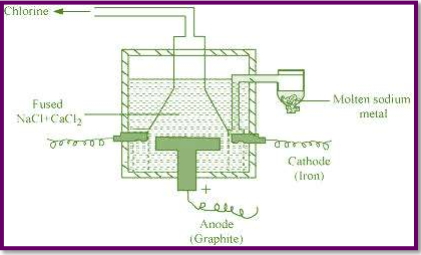
(N/A) $(i)$ Sodium metal can be extracted from sodium chloride by the Downs process. This process involves the electrolysis of fused $NaCl$ $(40 \%)$ and $CaCl_{2}$ $(60 \%)$ at a temperature of $1123 \ K$ in a Downs cell.
Steel is the cathode and a block of graphite acts as the anode. Metallic $Na$ is formed at the cathode. Molten sodium is taken out of the cell and collected over kerosene.
$NaCl \xrightarrow{\text{Electrolysis}} Na^{+} + Cl^{-}$
At Cathode: $Na^{+} + e^{-} \longrightarrow Na$
At Anode: $2Cl^{-} \longrightarrow Cl_{2} + 2e^{-}$
$(ii)$ Sodium hydroxide can be prepared by the electrolysis of an aqueous solution of sodium chloride (brine). This is called the Castner-Kellner process. In this process,the brine solution is electrolysed using a carbon anode and a mercury cathode.
The sodium metal,which is discharged at the cathode,combines with mercury to form an amalgam.
Cathode: $Na^{+} + e^{-} \xrightarrow{Hg} Na-\text{amalgam}$
Anode: $Cl^{-} \longrightarrow \frac{1}{2} Cl_{2} + e^{-}$
$(iii)$ Sodium peroxide: First,$NaCl$ is electrolysed to result in the formation of $Na$ metal (Downs process). This sodium metal is then heated on aluminium trays in air (free of $CO_{2}$) to form its peroxide.
$2Na + O_{2(air)} \longrightarrow Na_{2}O_{2}$
$(iv)$ Sodium carbonate is prepared by the Solvay process. Sodium hydrogen carbonate is precipitated in a reaction of sodium chloride and ammonium hydrogen carbonate.
$NH_{3} + H_{2}O + CO_{2} \longrightarrow NH_{4}HCO_{3}$
$NH_{4}HCO_{3} + NaCl \longrightarrow NH_{4}Cl + NaHCO_{3}$
These sodium hydrogen carbonate crystals are heated to give sodium carbonate.
$2NaHCO_{3} \longrightarrow Na_{2}CO_{3} + CO_{2} + H_{2}O$
Steel is the cathode and a block of graphite acts as the anode. Metallic $Na$ is formed at the cathode. Molten sodium is taken out of the cell and collected over kerosene.
$NaCl \xrightarrow{\text{Electrolysis}} Na^{+} + Cl^{-}$
At Cathode: $Na^{+} + e^{-} \longrightarrow Na$
At Anode: $2Cl^{-} \longrightarrow Cl_{2} + 2e^{-}$
$(ii)$ Sodium hydroxide can be prepared by the electrolysis of an aqueous solution of sodium chloride (brine). This is called the Castner-Kellner process. In this process,the brine solution is electrolysed using a carbon anode and a mercury cathode.
The sodium metal,which is discharged at the cathode,combines with mercury to form an amalgam.
Cathode: $Na^{+} + e^{-} \xrightarrow{Hg} Na-\text{amalgam}$
Anode: $Cl^{-} \longrightarrow \frac{1}{2} Cl_{2} + e^{-}$
$(iii)$ Sodium peroxide: First,$NaCl$ is electrolysed to result in the formation of $Na$ metal (Downs process). This sodium metal is then heated on aluminium trays in air (free of $CO_{2}$) to form its peroxide.
$2Na + O_{2(air)} \longrightarrow Na_{2}O_{2}$
$(iv)$ Sodium carbonate is prepared by the Solvay process. Sodium hydrogen carbonate is precipitated in a reaction of sodium chloride and ammonium hydrogen carbonate.
$NH_{3} + H_{2}O + CO_{2} \longrightarrow NH_{4}HCO_{3}$
$NH_{4}HCO_{3} + NaCl \longrightarrow NH_{4}Cl + NaHCO_{3}$
These sodium hydrogen carbonate crystals are heated to give sodium carbonate.
$2NaHCO_{3} \longrightarrow Na_{2}CO_{3} + CO_{2} + H_{2}O$
0 likes
View Solution624
Medium
Describe two important uses of each of the following: $(i)$ caustic soda,$(ii)$ sodium carbonate,$(iii)$ quicklime.
Solution
(N/A) $(i)$ Uses of caustic soda:
$(a)$ It is used in the soap industry.
$(b)$ It is used as a reagent in the laboratory.
$(ii)$ Uses of sodium carbonate:
$(a)$ It is generally used in the glass and soap industry.
$(b)$ It is used as a water softener.
$(iii)$ Uses of quicklime:
$(a)$ It is used as a starting material for obtaining slaked lime.
$(b)$ It is used in the manufacture of glass and cement.
$(a)$ It is used in the soap industry.
$(b)$ It is used as a reagent in the laboratory.
$(ii)$ Uses of sodium carbonate:
$(a)$ It is generally used in the glass and soap industry.
$(b)$ It is used as a water softener.
$(iii)$ Uses of quicklime:
$(a)$ It is used as a starting material for obtaining slaked lime.
$(b)$ It is used in the manufacture of glass and cement.
0 likes
View Solution625
Easy
Why are lithium salts commonly hydrated and those of the other alkali metal ions usually anhydrous?
Solution
(N/A) Lithium is the smallest in size among the alkali metals.
Hence,$Li^{+}$ ion can polarize water molecules more easily than other alkali metals due to its high charge density.
As a result,water molecules get attached to lithium salts as water of crystallization.
Hence,lithium salts such as $LiCl \cdot 3H_{2}O$ are commonly hydrated.
As the size of the ions increases,their polarizing power decreases.
Therefore,other alkali metal ions usually form anhydrous salts.
Hence,$Li^{+}$ ion can polarize water molecules more easily than other alkali metals due to its high charge density.
As a result,water molecules get attached to lithium salts as water of crystallization.
Hence,lithium salts such as $LiCl \cdot 3H_{2}O$ are commonly hydrated.
As the size of the ions increases,their polarizing power decreases.
Therefore,other alkali metal ions usually form anhydrous salts.
0 likes
View Solution626
Medium
Explain the significance of sodium,potassium,magnesium,and calcium in biological fluids.
Solution
(N/A) Importance of sodium,potassium,magnesium,and calcium in biological fluids:
$(i)$ Sodium $(Na^+)$:
Sodium ions are found primarily in the blood plasma and in the interstitial fluids surrounding the cells.
$(a)$ Sodium ions participate in the transmission of nerve signals.
$(b)$ They help in regulating the flow of water across cell membranes.
$(c)$ They assist in the transport of sugars and amino acids into cells.
$(ii)$ Potassium $(K^+)$:
Potassium ions are found in the highest concentration within the intracellular fluids.
$(a)$ $K^+$ ions activate many enzymes.
$(b)$ They participate in the oxidation of glucose to produce $ATP$.
$(c)$ They are essential for the transmission of nerve signals.
$(iii)$ Magnesium $(Mg^{2+})$ and Calcium $(Ca^{2+})$:
Magnesium and calcium are macro-minerals,indicating their high abundance in the human body.
$(a)$ $Mg^{2+}$ is involved in muscle relaxation and nerve function.
$(b)$ $Mg^{2+}$ is a cofactor for many enzymes and is involved in bone structure.
$(c)$ $Ca^{2+}$ is essential for blood coagulation.
$(d)$ $Ca^{2+}$ plays a critical role in maintaining homeostasis and muscle contraction.
$(i)$ Sodium $(Na^+)$:
Sodium ions are found primarily in the blood plasma and in the interstitial fluids surrounding the cells.
$(a)$ Sodium ions participate in the transmission of nerve signals.
$(b)$ They help in regulating the flow of water across cell membranes.
$(c)$ They assist in the transport of sugars and amino acids into cells.
$(ii)$ Potassium $(K^+)$:
Potassium ions are found in the highest concentration within the intracellular fluids.
$(a)$ $K^+$ ions activate many enzymes.
$(b)$ They participate in the oxidation of glucose to produce $ATP$.
$(c)$ They are essential for the transmission of nerve signals.
$(iii)$ Magnesium $(Mg^{2+})$ and Calcium $(Ca^{2+})$:
Magnesium and calcium are macro-minerals,indicating their high abundance in the human body.
$(a)$ $Mg^{2+}$ is involved in muscle relaxation and nerve function.
$(b)$ $Mg^{2+}$ is a cofactor for many enzymes and is involved in bone structure.
$(c)$ $Ca^{2+}$ is essential for blood coagulation.
$(d)$ $Ca^{2+}$ plays a critical role in maintaining homeostasis and muscle contraction.
0 likes
View Solution627
Medium
Comment on each of the following observations:
$(a)$ The mobilities of the alkali metal ions in aqueous solution are
$Li^{+} < Na^{+} < K^{+} < Rb^{+} < Cs^{+}$
$(b)$ Lithium is the only alkali metal to form a nitride directly.
$(c)$ $E^{\circ}$ for $M^{2+}_{(aq)} + 2e^{-} \longrightarrow M_{(s)}$ (where $M = Ca, Sr$ or $Ba$) is nearly constant.
$(a)$ The mobilities of the alkali metal ions in aqueous solution are
$Li^{+} < Na^{+} < K^{+} < Rb^{+} < Cs^{+}$
$(b)$ Lithium is the only alkali metal to form a nitride directly.
$(c)$ $E^{\circ}$ for $M^{2+}_{(aq)} + 2e^{-} \longrightarrow M_{(s)}$ (where $M = Ca, Sr$ or $Ba$) is nearly constant.
Solution
(A) On moving down the alkali group,the ionic sizes of the metals increase as: $Li^{+} < Na^{+} < K^{+} < Rb^{+} < Cs^{+}$. Smaller ions have a higher charge density and are more extensively hydrated in aqueous solution. Since $Li^{+}$ is the smallest,it is the most heavily hydrated,while $Cs^{+}$ is the least hydrated. The mobility of an ion in water depends on the size of the hydrated ion; larger hydrated ions move more slowly. Thus,the order of mobility is $Li^{+} < Na^{+} < K^{+} < Rb^{+} < Cs^{+}$.
$(b)$ Unlike other group $1$ elements,$Li$ reacts directly with nitrogen to form lithium nitride $(Li_{3}N)$. This is because the small size of the $Li^{+}$ ion is highly compatible with the $N^{3-}$ ion,resulting in a very high lattice energy that compensates for the energy required to form the $N^{3-}$ ion.
$(c)$ The standard electrode potential $(E^{\circ})$ for the reduction $M^{2+} + 2e^{-} \longrightarrow M$ depends on the sum of the enthalpy of sublimation,ionization enthalpy,and hydration enthalpy. For $Ca, Sr$,and $Ba$,the combined effect of these factors remains approximately constant,leading to nearly identical $E^{\circ}$ values.
$(b)$ Unlike other group $1$ elements,$Li$ reacts directly with nitrogen to form lithium nitride $(Li_{3}N)$. This is because the small size of the $Li^{+}$ ion is highly compatible with the $N^{3-}$ ion,resulting in a very high lattice energy that compensates for the energy required to form the $N^{3-}$ ion.
$(c)$ The standard electrode potential $(E^{\circ})$ for the reduction $M^{2+} + 2e^{-} \longrightarrow M$ depends on the sum of the enthalpy of sublimation,ionization enthalpy,and hydration enthalpy. For $Ca, Sr$,and $Ba$,the combined effect of these factors remains approximately constant,leading to nearly identical $E^{\circ}$ values.
0 likes
View Solution628
Medium
State the reasons for the following:
$(a)$ Why is a solution of $Na_{2}CO_{3}$ alkaline?
$(b)$ Why are alkali metals prepared by the electrolysis of their fused chlorides?
$(c)$ Why is sodium found to be more useful than potassium in biological systems?
$(a)$ Why is a solution of $Na_{2}CO_{3}$ alkaline?
$(b)$ Why are alkali metals prepared by the electrolysis of their fused chlorides?
$(c)$ Why is sodium found to be more useful than potassium in biological systems?
Solution
(N/A) When $Na_{2}CO_{3}$ is dissolved in water,it undergoes hydrolysis to form $NaHCO_{3}$ and $NaOH$. Since $NaOH$ is a strong base,the resulting solution becomes alkaline.
$Na_{2}CO_{3} + H_{2}O \longrightarrow NaHCO_{3} + NaOH$
$(b)$ Alkali metals are strong reducing agents and cannot be prepared by the chemical reduction of their oxides. They cannot be obtained by displacement reactions because they are highly electropositive. Electrolysis of aqueous solutions is also not feasible because the liberated metals react with water. Therefore,they are prepared by the electrolysis of their fused chlorides.
$(c)$ Sodium ions $(Na^+)$ are primarily found in blood plasma and interstitial fluids,playing a crucial role in nerve signal transmission,regulating water flow across cell membranes,and transporting sugars and amino acids into cells. While potassium ions $(K^+)$ are essential within cells,sodium's specific extracellular functions make it highly significant for physiological processes.
$Na_{2}CO_{3} + H_{2}O \longrightarrow NaHCO_{3} + NaOH$
$(b)$ Alkali metals are strong reducing agents and cannot be prepared by the chemical reduction of their oxides. They cannot be obtained by displacement reactions because they are highly electropositive. Electrolysis of aqueous solutions is also not feasible because the liberated metals react with water. Therefore,they are prepared by the electrolysis of their fused chlorides.
$(c)$ Sodium ions $(Na^+)$ are primarily found in blood plasma and interstitial fluids,playing a crucial role in nerve signal transmission,regulating water flow across cell membranes,and transporting sugars and amino acids into cells. While potassium ions $(K^+)$ are essential within cells,sodium's specific extracellular functions make it highly significant for physiological processes.
0 likes
View Solution629
Medium
Write balanced equations for reactions between
$(a)$ $Na_{2}O_{2}$ and water
$(b)$ $KO_{2}$ and water
$(c)$ $Na_{2}O$ and $CO_{2}$
$(a)$ $Na_{2}O_{2}$ and water
$(b)$ $KO_{2}$ and water
$(c)$ $Na_{2}O$ and $CO_{2}$
Solution
(N/A) The balanced chemical equation for the reaction between $Na_{2}O_{2}$ and water is:
$2Na_{2}O_{2(s)} + 2H_{2}O_{(l)} \longrightarrow 4NaOH_{(aq)} + O_{2(g)}$
$(b)$ The balanced chemical equation for the reaction between $KO_{2}$ and water is:
$2KO_{2(s)} + 2H_{2}O_{(l)} \longrightarrow 2KOH_{(aq)} + H_{2}O_{2(aq)} + O_{2(g)}$
$(c)$ The balanced chemical equation for the reaction between $Na_{2}O$ and $CO_{2}$ is:
$Na_{2}O_{(s)} + CO_{2(g)} \longrightarrow Na_{2}CO_{3(s)}$
$2Na_{2}O_{2(s)} + 2H_{2}O_{(l)} \longrightarrow 4NaOH_{(aq)} + O_{2(g)}$
$(b)$ The balanced chemical equation for the reaction between $KO_{2}$ and water is:
$2KO_{2(s)} + 2H_{2}O_{(l)} \longrightarrow 2KOH_{(aq)} + H_{2}O_{2(aq)} + O_{2(g)}$
$(c)$ The balanced chemical equation for the reaction between $Na_{2}O$ and $CO_{2}$ is:
$Na_{2}O_{(s)} + CO_{2(g)} \longrightarrow Na_{2}CO_{3(s)}$
0 likes
View Solution630
EasyMCQ
Which of the alkali metals has the lowest melting point?
A
$Na$
B
$K$
C
$Rb$
D
$Cs$
Solution
(D) The atomic size of alkali metals increases as we move down the group from $Li$ to $Cs$.
As the atomic size increases,the strength of metallic bonding decreases because the valence electrons are further from the nucleus.
Consequently,the melting point decreases down the group.
Among the given options,$Cs$ (Cesium) is the largest atom and therefore has the lowest melting point.
As the atomic size increases,the strength of metallic bonding decreases because the valence electrons are further from the nucleus.
Consequently,the melting point decreases down the group.
Among the given options,$Cs$ (Cesium) is the largest atom and therefore has the lowest melting point.
0 likes
View Solution631
EasyMCQ
Which one of the following alkali metals gives hydrated salts?
A
$Li$
B
$Na$
C
$K$
D
$Cs$
Solution
(A) The extent of hydration depends on the size of the ion; the smaller the size of the ion,the higher is its degree of hydration.
Among the given alkali metals,$Li^+$ has the smallest ionic size.
Due to its small size,$Li^+$ possesses the highest charge density and the highest polarising power.
Consequently,it attracts water molecules more strongly than other alkali metals,leading to the formation of hydrated salts such as $LiCl \cdot 2H_2O$.
The other alkali metals $(Na, K, Rb, Cs)$ have larger ionic radii and lower charge densities,and therefore,they generally do not form hydrated salts.
Among the given alkali metals,$Li^+$ has the smallest ionic size.
Due to its small size,$Li^+$ possesses the highest charge density and the highest polarising power.
Consequently,it attracts water molecules more strongly than other alkali metals,leading to the formation of hydrated salts such as $LiCl \cdot 2H_2O$.
The other alkali metals $(Na, K, Rb, Cs)$ have larger ionic radii and lower charge densities,and therefore,they generally do not form hydrated salts.
0 likes
View Solution632
Medium
Which elements of group $1$ and $2$ differ from the other elements of the same group? Give a brief explanation of the diagonal relationship.
Solution
(N/A) Lithium $(Li)$ and beryllium $(Be)$,the first elements of Group $1$ and Group $2$ respectively,exhibit anomalous properties that differ from the other members of their respective groups.
In these anomalous properties,they resemble the second element of the following group. Thus,lithium shows similarities to magnesium $(Mg)$ and beryllium shows similarities to aluminium $(Al)$ in many of their properties.
This type of diagonal similarity is referred to as the diagonal relationship in the periodic table. The diagonal relationship arises due to the similarity in ionic sizes and/or the charge/radius ratio $(ionic \ potential)$ of the elements.
Monovalent sodium $(Na^+)$ and potassium $(K^+)$ ions,and divalent magnesium $(Mg^{2+})$ and calcium $(Ca^{2+})$ ions are found in large proportions in biological fluids. These ions perform important biological functions such as the maintenance of ion balance and nerve impulse conduction.
In these anomalous properties,they resemble the second element of the following group. Thus,lithium shows similarities to magnesium $(Mg)$ and beryllium shows similarities to aluminium $(Al)$ in many of their properties.
This type of diagonal similarity is referred to as the diagonal relationship in the periodic table. The diagonal relationship arises due to the similarity in ionic sizes and/or the charge/radius ratio $(ionic \ potential)$ of the elements.
Monovalent sodium $(Na^+)$ and potassium $(K^+)$ ions,and divalent magnesium $(Mg^{2+})$ and calcium $(Ca^{2+})$ ions are found in large proportions in biological fluids. These ions perform important biological functions such as the maintenance of ion balance and nerve impulse conduction.
0 likes
View Solution633
Medium
Give the general electronic configuration of alkali metals and provide the electronic configuration for each element of the alkali metal group.
Solution
(N/A) All alkali metals have one valence electron,$ns^{1}$,outside the noble gas core.
The loosely held $s$-electron in the outermost valence shell of these elements makes them the most electropositive metals.
They readily lose an electron to form monovalent $M^{+}$ ions. Hence,they are never found in a free state in nature.
The loosely held $s$-electron in the outermost valence shell of these elements makes them the most electropositive metals.
They readily lose an electron to form monovalent $M^{+}$ ions. Hence,they are never found in a free state in nature.
| Element | Electronic Configuration |
| Lithium $(Li)$ | $1s^{2} 2s^{1}$ |
| Sodium $(Na)$ | $1s^{2} 2s^{2} 2p^{6} 3s^{1}$ |
| Potassium $(K)$ | $1s^{2} 2s^{2} 2p^{6} 3s^{2} 3p^{6} 4s^{1}$ |
| Rubidium $(Rb)$ | $1s^{2} 2s^{2} 2p^{6} 3s^{2} 3p^{6} 3d^{10} 4s^{2} 4p^{6} 5s^{1}$ |
| Caesium $(Cs)$ | $[Xe] 6s^{1}$ |
| Francium $(Fr)$ | $[Rn] 7s^{1}$ |
0 likes
View Solution634
Medium
Give brief information on the atomic and ionic radius of alkali metals (Group $I$).
Solution
(N/A) The alkali metal atoms have the largest sizes in a particular period of the periodic table. With an increase in atomic number,the atom becomes larger.
The monovalent ions $(M^{+})$ are smaller than the parent atom because the number of electrons decreases while the nuclear charge remains the same,leading to greater effective nuclear attraction.
The atomic and ionic radii of alkali metals increase on moving down the group,i.e.,they increase in size while going from $Li$ to $Cs$.
The monovalent ions $(M^{+})$ are smaller than the parent atom because the number of electrons decreases while the nuclear charge remains the same,leading to greater effective nuclear attraction.
The atomic and ionic radii of alkali metals increase on moving down the group,i.e.,they increase in size while going from $Li$ to $Cs$.
0 likes
View Solution635
Medium
Give brief information on Ionization Enthalpy and Hydration Enthalpy of alkali metal (Group $I$).
Solution
(N/A) The ionization enthalpies of the alkali metals are considerably low and decrease down the group from $Li$ to $Cs$. This is because the effect of increasing size outweighs the increasing nuclear charge,and the outermost electron is very well screened from the nuclear charge.
The hydration enthalpies of alkali metal ions decrease with an increase in ionic size.
$Li^{+} > Na^{+} > K^{+} > Rb^{+} > Cs^{+}$
$Li^{+}$ has the maximum degree of hydration,and for this reason,lithium salts are mostly hydrated,e.g.,$LiCl \cdot 2H_{2}O$.
The hydration enthalpies of alkali metal ions decrease with an increase in ionic size.
$Li^{+} > Na^{+} > K^{+} > Rb^{+} > Cs^{+}$
$Li^{+}$ has the maximum degree of hydration,and for this reason,lithium salts are mostly hydrated,e.g.,$LiCl \cdot 2H_{2}O$.
0 likes
View Solution636
MediumMCQ
Which one of the following alkali metals gives hydrated salts?
A
$Li$
B
$Na$
C
$K$
D
$Rb$
Solution
(A) Smaller the size of an ion,the more highly is it hydrated. Among the given alkali metals,$Li^+$ is the smallest in size.
Also,it has the highest charge density and highest polarising power. Hence,it attracts water molecules more strongly than the other alkali metals.
As a result,it forms hydrated salts such as $LiCl \cdot 2H_2O$. The other alkali metals are larger than $Li^+$ and have weaker charge densities. Hence,they usually do not form hydrated salts.
Also,it has the highest charge density and highest polarising power. Hence,it attracts water molecules more strongly than the other alkali metals.
As a result,it forms hydrated salts such as $LiCl \cdot 2H_2O$. The other alkali metals are larger than $Li^+$ and have weaker charge densities. Hence,they usually do not form hydrated salts.
0 likes
View Solution637
Easy
Why are alkali metals not found in nature?
Solution
(N/A) Alkali metals include lithium $(Li)$,sodium $(Na)$,potassium $(K)$,rubidium $(Rb)$,cesium $(Cs)$,and francium $(Fr)$.
These metals have only $1$ electron in their valence shell,which they lose easily due to their low ionization energies.
Because of this high reactivity,they readily react with other elements like oxygen,water,and halogens,and thus are not found in nature in their free elemental state.
These metals have only $1$ electron in their valence shell,which they lose easily due to their low ionization energies.
Because of this high reactivity,they readily react with other elements like oxygen,water,and halogens,and thus are not found in nature in their free elemental state.
0 likes
View Solution638
EasyMCQ
Which of the alkali metals has the least melting point?
A
$Li$
B
$Na$
C
$K$
D
$Cs$
Solution
(D) Atomic size increases as we move down the alkali metal group. As a result,the binding energies of their atoms in the crystal lattice decrease.
Also,the strength of metallic bonds decreases on moving down a group in the periodic table. This causes a decrease in the melting point.
Among the alkali metals,$Cs$ $(Cesium)$ has the largest atomic size and the weakest metallic bonding,resulting in the least melting point.
Also,the strength of metallic bonds decreases on moving down a group in the periodic table. This causes a decrease in the melting point.
Among the alkali metals,$Cs$ $(Cesium)$ has the largest atomic size and the weakest metallic bonding,resulting in the least melting point.
0 likes
View Solution639
Difficult
Write a note on the physical properties of alkali metal elements (group $1$).
Solution
(N/A) All the alkali metals are silvery-white,soft,and light metals.
Because of their large atomic size,these elements have low density,which generally increases down the group from $Li$ to $Cs$,although $K$ is lighter than $Na$.
The melting and boiling points of the alkali metals are low,indicating weak metallic bonding due to the presence of only a single valence electron.
The alkali metals and their salts impart a characteristic color to an oxidizing flame because the heat from the flame excites the outermost orbital electron to a higher energy level.
When the excited electron returns to the ground state,it emits radiation in the visible region as shown in the table below:
Because of their large atomic size,these elements have low density,which generally increases down the group from $Li$ to $Cs$,although $K$ is lighter than $Na$.
The melting and boiling points of the alkali metals are low,indicating weak metallic bonding due to the presence of only a single valence electron.
The alkali metals and their salts impart a characteristic color to an oxidizing flame because the heat from the flame excites the outermost orbital electron to a higher energy level.
When the excited electron returns to the ground state,it emits radiation in the visible region as shown in the table below:
| Metal | $Li$ | $Na$ | $K$ | $Rb$ | $Cs$ |
| Color | Crimson red | Yellow | Violet | Red violet | Blue |
| $\lambda / nm$ | $670.8$ | $589.2$ | $766.5$ | $780.0$ | $455.5$ |
0 likes
View Solution640
Advanced
Explain the chemical properties of alkali metal elements (Group $I$).
Solution
(N/A) The alkali metals are highly reactive due to their large atomic size and low ionization enthalpy. The reactivity of these metals increases down the group.
Reactivity towards air: The alkali metals tarnish in dry air due to the formation of their oxides,which react with moisture to form hydroxides.
They burn vigorously in oxygen to form oxides. Lithium forms monoxide $(Li_{2}O)$,sodium forms peroxide $(Na_{2}O_{2})$,and other metals form superoxides $(MO_{2})$. The superoxide $(O_{2}^{-})$ ion is stable only in the presence of large cations such as $K^{+}$,$Rb^{+}$,and $Cs^{+}$.
Equations: $4Li + O_{2} \rightarrow 2Li_{2}O$,$2Na + O_{2} \rightarrow Na_{2}O_{2}$,$M + O_{2} \rightarrow MO_{2}$ (where $M = K, Rb, Cs$).
Lithium shows exceptional behavior by reacting directly with nitrogen to form nitride $(Li_{3}N)$.
Reactivity towards water: Alkali metals react with water to form hydroxides and dihydrogen gas: $2M + 2H_{2}O \rightarrow 2M^{+} + 2OH^{-} + H_{2}$.
Although lithium has the most negative $E^{\ominus}$ value,its reaction with water is less vigorous than sodium due to lithium's small size and high hydration energy.
Reactivity towards dihydrogen: Alkali metals react with dihydrogen at high temperatures (e.g.,$673 \ K$) to form ionic hydrides $(M^{+}H^{-})$.
Reactivity towards halogens: They react vigorously with halogens to form ionic halides $(M^{+}X^{-})$. Lithium halides are somewhat covalent due to the high polarizing power of the $Li^{+}$ ion.
Reactivity towards air: The alkali metals tarnish in dry air due to the formation of their oxides,which react with moisture to form hydroxides.
They burn vigorously in oxygen to form oxides. Lithium forms monoxide $(Li_{2}O)$,sodium forms peroxide $(Na_{2}O_{2})$,and other metals form superoxides $(MO_{2})$. The superoxide $(O_{2}^{-})$ ion is stable only in the presence of large cations such as $K^{+}$,$Rb^{+}$,and $Cs^{+}$.
Equations: $4Li + O_{2} \rightarrow 2Li_{2}O$,$2Na + O_{2} \rightarrow Na_{2}O_{2}$,$M + O_{2} \rightarrow MO_{2}$ (where $M = K, Rb, Cs$).
Lithium shows exceptional behavior by reacting directly with nitrogen to form nitride $(Li_{3}N)$.
Reactivity towards water: Alkali metals react with water to form hydroxides and dihydrogen gas: $2M + 2H_{2}O \rightarrow 2M^{+} + 2OH^{-} + H_{2}$.
Although lithium has the most negative $E^{\ominus}$ value,its reaction with water is less vigorous than sodium due to lithium's small size and high hydration energy.
Reactivity towards dihydrogen: Alkali metals react with dihydrogen at high temperatures (e.g.,$673 \ K$) to form ionic hydrides $(M^{+}H^{-})$.
Reactivity towards halogens: They react vigorously with halogens to form ionic halides $(M^{+}X^{-})$. Lithium halides are somewhat covalent due to the high polarizing power of the $Li^{+}$ ion.
0 likes
View Solution641
Difficult
$(a)$ Describe the chemical properties of alkali metals with air,water,dihydrogen,and halogens.
$(b)$ Explain the reduction potential of alkali metal elements.
$(c)$ Which type of solutions are formed on the reaction of alkali metals with liquid ammonia?
$(b)$ Explain the reduction potential of alkali metal elements.
$(c)$ Which type of solutions are formed on the reaction of alkali metals with liquid ammonia?
Solution
(A) The alkali metals are highly reactive due to their large size and low ionization enthalpy. The reactivity of these metals increases down the group.
$(a)$ Reactivity towards air: Alkali metals tarnish in dry air due to the formation of oxides,which react with moisture to form hydroxides. They burn vigorously in oxygen: $4Li + O_2 \rightarrow 2Li_2O$ (oxide),$2Na + O_2 \rightarrow Na_2O_2$ (peroxide),and $M + O_2 \rightarrow MO_2$ (superoxide,where $M = K, Rb, Cs$). Lithium also forms $Li_3N$ with nitrogen.
Reactivity towards water: They react with water to form hydroxides and dihydrogen: $2M + 2H_2O \rightarrow 2M^+ + 2OH^- + H_2$. Lithium is less vigorous than sodium due to its high hydration energy.
Reactivity towards dihydrogen: They react at high temperatures to form ionic hydrides: $2M + H_2 \rightarrow 2M^+H^-$.
Reactivity towards halogens: They react vigorously to form ionic halides $M^+X^-$,though lithium halides are covalent due to high polarization.
$(b)$ Reduction potential: Alkali metals have high negative standard electrode potentials $(E^{\ominus})$,making them strong reducing agents. Lithium has the most negative $E^{\ominus}$ value due to its high hydration energy.
$(c)$ Reaction with liquid ammonia: Alkali metals dissolve in liquid ammonia to form deep blue,conducting,and paramagnetic solutions containing ammoniated cations and electrons: $M + (x+y)NH_3 \rightarrow [M(NH_3)_x]^+ + [e(NH_3)_y]^-$. The blue color is due to the excitation of ammoniated electrons.
$(a)$ Reactivity towards air: Alkali metals tarnish in dry air due to the formation of oxides,which react with moisture to form hydroxides. They burn vigorously in oxygen: $4Li + O_2 \rightarrow 2Li_2O$ (oxide),$2Na + O_2 \rightarrow Na_2O_2$ (peroxide),and $M + O_2 \rightarrow MO_2$ (superoxide,where $M = K, Rb, Cs$). Lithium also forms $Li_3N$ with nitrogen.
Reactivity towards water: They react with water to form hydroxides and dihydrogen: $2M + 2H_2O \rightarrow 2M^+ + 2OH^- + H_2$. Lithium is less vigorous than sodium due to its high hydration energy.
Reactivity towards dihydrogen: They react at high temperatures to form ionic hydrides: $2M + H_2 \rightarrow 2M^+H^-$.
Reactivity towards halogens: They react vigorously to form ionic halides $M^+X^-$,though lithium halides are covalent due to high polarization.
$(b)$ Reduction potential: Alkali metals have high negative standard electrode potentials $(E^{\ominus})$,making them strong reducing agents. Lithium has the most negative $E^{\ominus}$ value due to its high hydration energy.
$(c)$ Reaction with liquid ammonia: Alkali metals dissolve in liquid ammonia to form deep blue,conducting,and paramagnetic solutions containing ammoniated cations and electrons: $M + (x+y)NH_3 \rightarrow [M(NH_3)_x]^+ + [e(NH_3)_y]^-$. The blue color is due to the excitation of ammoniated electrons.
0 likes
View Solution642
Difficult
Comment on each of the following observations:
$(a)$ The mobilities of the alkali metal ions in aqueous solution are $Li^{+} < Na^{+} < K^{+} < Rb^{+} < Cs^{+}$
$(b)$ Lithium is the only alkali metal to form a nitride directly.
$(c)$ The standard electrode potential $E^{\circ}$ for the reaction $M^{2+}_{(aq)} + 2e^{-} \to M_{(s)}$ (where $M = Ca, Sr$ or $Ba$) is nearly constant.
$(a)$ The mobilities of the alkali metal ions in aqueous solution are $Li^{+} < Na^{+} < K^{+} < Rb^{+} < Cs^{+}$
$(b)$ Lithium is the only alkali metal to form a nitride directly.
$(c)$ The standard electrode potential $E^{\circ}$ for the reaction $M^{2+}_{(aq)} + 2e^{-} \to M_{(s)}$ (where $M = Ca, Sr$ or $Ba$) is nearly constant.
Solution
(N/A) On moving down the alkali group,the ionic sizes of the metals increase in the order: $Li^{+} < Na^{+} < K^{+} < Rb^{+} < Cs^{+}$. Smaller ions have a higher charge density and are more heavily hydrated in aqueous solution. Thus,the extent of hydration decreases as: $Li^{+} > Na^{+} > K^{+} > Rb^{+} > Cs^{+}$. Since a larger hydrated ion moves more slowly,the ionic mobility increases as the size of the hydrated ion decreases,resulting in the order: $Li^{+} < Na^{+} < K^{+} < Rb^{+} < Cs^{+}$.
$(b)$ $Li$ is the only alkali metal that reacts directly with nitrogen to form lithium nitride $(Li_{3}N)$. This is because the small size of the $Li^{+}$ ion is highly compatible with the small $N^{3-}$ ion,leading to a very high lattice energy that compensates for the energy required to form the $N^{3-}$ ion.
$(c)$ The standard electrode potential $(E^{\circ})$ for $M^{2+}/M$ depends on the sum of sublimation enthalpy,ionization enthalpy,and hydration enthalpy. For $Ca, Sr,$ and $Ba$,the combined effect of these energy terms remains nearly constant,resulting in similar electrode potentials.
$(b)$ $Li$ is the only alkali metal that reacts directly with nitrogen to form lithium nitride $(Li_{3}N)$. This is because the small size of the $Li^{+}$ ion is highly compatible with the small $N^{3-}$ ion,leading to a very high lattice energy that compensates for the energy required to form the $N^{3-}$ ion.
$(c)$ The standard electrode potential $(E^{\circ})$ for $M^{2+}/M$ depends on the sum of sublimation enthalpy,ionization enthalpy,and hydration enthalpy. For $Ca, Sr,$ and $Ba$,the combined effect of these energy terms remains nearly constant,resulting in similar electrode potentials.
0 likes
View Solution643
Easy
Write the reaction of thermal decomposition of sodium azide.
Solution
(N/A) Thermal decomposition of sodium azide $(NaN_3)$ results in the formation of sodium metal and dinitrogen gas.
The chemical equation is:
$2 NaN_3 \rightarrow 2 Na + 3 N_2$
The chemical equation is:
$2 NaN_3 \rightarrow 2 Na + 3 N_2$
0 likes
View Solution644
Difficult
Provide the names,symbols,and electronic configurations of the elements in the $1^{st}$ group.
Solution
(N/A) Elements in the same vertical column or group have similar valence shell electronic configurations,the same number of electrons in the outer orbitals,and similar chemical properties. The group $1$ elements (alkali metals) have a general valence shell electronic configuration of $ns^{1}$. The details are provided in the table below:Thus,it is evident that the properties of an element have a periodic dependence upon its atomic number.
| Element (Atomic number) | Symbol and Electronic configuration |
| Lithium $(3)$ | $Li: [He] 2s^{1}$ |
| Sodium $(11)$ | $Na: [Ne] 3s^{1}$ |
| Potassium $(19)$ | $K: [Ar] 4s^{1}$ |
| Rubidium $(37)$ | $Rb: [Kr] 5s^{1}$ |
| Cesium $(55)$ | $Cs: [Xe] 6s^{1}$ |
| Francium $(87)$ | $Fr: [Rn] 7s^{1}$ |
0 likes
View Solution645
Medium
Explain the trend of ionisation enthalpy of alkali metals as we move from top to bottom in the group.
Solution
Ionisation enthalpy and atomic radius are inversely related.
As we move from top to bottom in a group,the atomic radius increases due to the addition of new shells.
Consequently,the outermost electron is located further away from the nucleus,which increases the shielding effect of the inner electrons.
This increased shielding effect outweighs the increase in nuclear charge,resulting in a weaker electrostatic attraction between the nucleus and the valence electron.
Therefore,less energy is required to remove the valence electron,leading to a decrease in ionisation enthalpy as we move down the group.
As we move from top to bottom in a group,the atomic radius increases due to the addition of new shells.
Consequently,the outermost electron is located further away from the nucleus,which increases the shielding effect of the inner electrons.
This increased shielding effect outweighs the increase in nuclear charge,resulting in a weaker electrostatic attraction between the nucleus and the valence electron.
Therefore,less energy is required to remove the valence electron,leading to a decrease in ionisation enthalpy as we move down the group.
0 likes
View Solution646
MediumMCQ
Among alkali metals,which element do you expect to be least electronegative and why?
A
Lithium $(Li)$
B
Sodium $(Na)$
C
Potassium $(K)$
D
Caesium $(Cs)$
Solution
(D) Electronegativity decreases as we move down a group in the periodic table because the atomic size increases and the effective nuclear charge decreases.
Among the alkali metals $(Li, Na, K, Rb, Cs)$,$Cs$ is at the bottom of the group.
Therefore,$Cs$ has the largest atomic size and the lowest electronegativity.
Among the alkali metals $(Li, Na, K, Rb, Cs)$,$Cs$ is at the bottom of the group.
Therefore,$Cs$ has the largest atomic size and the lowest electronegativity.
0 likes
View Solution647
Easy
Give the uses of alkali metal elements (group-$I$).
Solution
(N/A) Lithium metal is used to make useful alloys,for example with lead to make 'white metal' bearings for motor engines,aluminium to make aircraft parts,and with magnesium to make armour plates. It is used in thermonuclear reactions.
Lithium is also used to make electrochemical cells.
Sodium is used to make a $Na/Pb$ alloy needed to make $PbEt_4$ and $PbMe_4$. These organolead compounds were earlier used as anti-knock additives to petrol,but nowadays vehicles use lead-free petrol.
Liquid sodium metal is used as a coolant in fast breeder nuclear reactors.
Potassium has a vital role in biological systems. Potassium chloride is used as a fertilizer.
Potassium hydroxide is used in the manufacture of soft soap. It is also used as an excellent absorbent of carbon dioxide.
Lithium is also used to make electrochemical cells.
Sodium is used to make a $Na/Pb$ alloy needed to make $PbEt_4$ and $PbMe_4$. These organolead compounds were earlier used as anti-knock additives to petrol,but nowadays vehicles use lead-free petrol.
Liquid sodium metal is used as a coolant in fast breeder nuclear reactors.
Potassium has a vital role in biological systems. Potassium chloride is used as a fertilizer.
Potassium hydroxide is used in the manufacture of soft soap. It is also used as an excellent absorbent of carbon dioxide.
0 likes
View Solution648
EasyMCQ
Write the decreasing order of hydration enthalpy of alkali metal ions.
A
$Li^{+} > Na^{+} > K^{+} > Rb^{+} > Cs^{+}$
B
$Cs^{+} > Rb^{+} > K^{+} > Na^{+} > Li^{+}$
C
$Na^{+} > Li^{+} > K^{+} > Rb^{+} > Cs^{+}$
D
$Li^{+} > K^{+} > Na^{+} > Rb^{+} > Cs^{+}$
Solution
(A) The hydration enthalpy of alkali metal ions is inversely proportional to their ionic radius.
As the ionic radius increases down the group,the charge density decreases,leading to a decrease in hydration enthalpy.
Since $Li^{+}$ has the smallest ionic radius,it has the highest hydration enthalpy,and $Cs^{+}$ has the largest ionic radius,resulting in the lowest hydration enthalpy.
The correct decreasing order is: $Li^{+} > Na^{+} > K^{+} > Rb^{+} > Cs^{+}$.
As the ionic radius increases down the group,the charge density decreases,leading to a decrease in hydration enthalpy.
Since $Li^{+}$ has the smallest ionic radius,it has the highest hydration enthalpy,and $Cs^{+}$ has the largest ionic radius,resulting in the lowest hydration enthalpy.
The correct decreasing order is: $Li^{+} > Na^{+} > K^{+} > Rb^{+} > Cs^{+}$.
0 likes
View Solution649
MediumMCQ
What type of oxides do alkali metals form? Discuss some of the physical properties of these oxides.
A
Basic oxides
B
Acidic oxides
C
Amphoteric oxides
D
Neutral oxides
Solution
(A) Alkali metals react with oxygen to form different types of oxides depending on the metal.
Lithium forms mainly the oxide $Li_{2}O$ (with some peroxide $Li_{2}O_{2}$).
Sodium forms the peroxide $Na_{2}O_{2}$ in excess air.
Potassium,rubidium,and cesium form superoxides of the type $MO_{2}$ in excess air.
The stability of peroxides and superoxides increases as the size of the metal ion increases,due to the stabilization of large anions by large cations through lattice energy effects.
In their pure state,oxides and peroxides are colorless,whereas superoxides are yellow or orange in color.
Superoxides are paramagnetic in nature. Sodium peroxide is widely used as an oxidizing agent.
Lithium forms mainly the oxide $Li_{2}O$ (with some peroxide $Li_{2}O_{2}$).
Sodium forms the peroxide $Na_{2}O_{2}$ in excess air.
Potassium,rubidium,and cesium form superoxides of the type $MO_{2}$ in excess air.
The stability of peroxides and superoxides increases as the size of the metal ion increases,due to the stabilization of large anions by large cations through lattice energy effects.
In their pure state,oxides and peroxides are colorless,whereas superoxides are yellow or orange in color.
Superoxides are paramagnetic in nature. Sodium peroxide is widely used as an oxidizing agent.
0 likes
View Solution650
Medium
Give brief explanations on hydroxides of alkali metals.
Solution
Oxides of alkali metals are easily hydrolysed by water to form hydroxides.
$M_{2}O + H_{2}O \rightarrow 2 M^{+} + 2 OH^{-}$
$M_{2}O_{2} + 2 H_{2}O \rightarrow 2 M^{+} + 2 OH^{-} + H_{2}O_{2}$
$2 MO_{2} + 2 H_{2}O \rightarrow 2 M^{+} + 2 OH^{-} + H_{2}O_{2} + O_{2}$
The hydroxides obtained by the reaction of these oxides with water are all white crystalline solids.
Alkali metal hydroxides are the strongest of all bases and dissolve freely in water with the evolution of a large amount of heat due to intense hydration.
$M_{2}O + H_{2}O \rightarrow 2 M^{+} + 2 OH^{-}$
$M_{2}O_{2} + 2 H_{2}O \rightarrow 2 M^{+} + 2 OH^{-} + H_{2}O_{2}$
$2 MO_{2} + 2 H_{2}O \rightarrow 2 M^{+} + 2 OH^{-} + H_{2}O_{2} + O_{2}$
The hydroxides obtained by the reaction of these oxides with water are all white crystalline solids.
Alkali metal hydroxides are the strongest of all bases and dissolve freely in water with the evolution of a large amount of heat due to intense hydration.
0 likes
View Solutions-Block Elements — Alkali metals · Frequently Asked Questions
1Are these s-Block Elements questions useful for JEE and NEET?
Yes. All questions in this section are mapped to JEE Main and NEET exam patterns. Previous year questions from JEE Main, NEET, GUJCET and state-level exams are included with full solutions.
2Can I switch to Hindi or Gujarati for these questions?
Yes. Use the language tabs in the hero section or the sidebar to view the same questions and solutions in English, Hindi or Gujarati.
3How do I generate a question paper from this subtopic?
Use the Vedclass Exam Paper Generator — select the chapter and subtopic, set difficulty, and generate Sets A, B, C, D automatically. First 3 chapters of every subject are free.
Vedclass Products
For Students
Vedclass Test Series
Mock tests in real JEE/NEET style with performance analysis. 5-day free trial.
Start Free TrialFor Teachers
Exam Paper Generator
Generate Set A/B/C/D papers from this chapter in 2 minutes. 3 chapters free.
Try FreeFor Institutes
Online Exam Module
Live online exams with unlimited students, 360° analytics & white-label branding.
See DemoFor Teachers & Institutes
Generate a s-Block Elements Exam Paper in 2 Minutes
Select subtopic & difficulty — Sets A, B, C, D auto-generated with No Repeat logic.
First 3 chapters of every subject are free — no payment required.