
A English
Mix Examples - Classification of Elements and Periodicity in Properties Questions in English
Class 11 Chemistry · Classification of Elements and Periodicity in Properties · Mix Examples - Classification of Elements and Periodicity in Properties
187+
Questions
English
Language
100%
With Solutions
Showing 50 of 187 questions in English
101
MediumMCQ
Select the correct order for the elements $B, C, N, O$:
A
$B < C < N < O$ (Ionization Potential)
B
$B < C < N < O$ (Electronegativity)
C
$B < C < N < O$ (Atomic Size)
D
$B < C < N < O$ (Electron Affinity)
Solution
(B) In the periodic table,as we move from left to right across a period,the effective nuclear charge increases and the atomic size decreases.
$1$. Ionization Potential $(IP)$ generally increases from $B$ to $O$.
$2$. Electronegativity $(EN)$ increases from $B$ to $O$ $(B=2.0, C=2.5, N=3.0, O=3.5)$.
$3$. Atomic size decreases from $B$ to $O$,so the order $B < C < N < O$ is incorrect for size.
$4$. Electron Affinity $(EA)$ does not follow a strictly increasing trend from $B$ to $O$ due to stable configurations (e.g.,$N$ has a half-filled $p$-orbital).
Both $IP$ and $EN$ follow the increasing trend $B < C < N < O$.
$1$. Ionization Potential $(IP)$ generally increases from $B$ to $O$.
$2$. Electronegativity $(EN)$ increases from $B$ to $O$ $(B=2.0, C=2.5, N=3.0, O=3.5)$.
$3$. Atomic size decreases from $B$ to $O$,so the order $B < C < N < O$ is incorrect for size.
$4$. Electron Affinity $(EA)$ does not follow a strictly increasing trend from $B$ to $O$ due to stable configurations (e.g.,$N$ has a half-filled $p$-orbital).
Both $IP$ and $EN$ follow the increasing trend $B < C < N < O$.
0 likes
View Solution102
MediumMCQ
Which of the following statements is incorrect?
A
$I^{+} < I < I^{-}$ (Radii)
B
$CO, N_2, CN^{-}$ (Isoelectronic)
C
$F_2 > Cl_2 > Br_2 > I_2$ (Bond energy)
D
$Cl > F > Br > I$ (Electron Affinity)
Solution
(C) The correct order of bond energy for halogens is $Cl_2 > Br_2 > F_2 > I_2$. The bond dissociation energy of $F_2$ is lower than $Cl_2$ and $Br_2$ due to high inter-electronic repulsion between the lone pairs of the small $F$ atoms. Therefore,the statement $F_2 > Cl_2 > Br_2 > I_2$ is incorrect.
0 likes
View Solution103
MediumMCQ
$(a)$ $Be$ and $Mg$ are alkaline earth metals.
$(b)$ $K^{+}$ has larger radii than $Ca^{2+}$.
$(c)$ All $d$-block elements are transition elements.
$(d)$ $H^{-}$ ion is larger than $F^{-}$.
Incorrect statement is/are
$(b)$ $K^{+}$ has larger radii than $Ca^{2+}$.
$(c)$ All $d$-block elements are transition elements.
$(d)$ $H^{-}$ ion is larger than $F^{-}$.
Incorrect statement is/are
A
$a, c$ and $d$
B
$b$ and $c$
C
$a$ and $d$
D
$a$ and $c$
Solution
$(B)$ $Be$ and $Mg$ belong to Group $2$, which are alkaline earth metals. This statement is correct.
$(b)$ $K^{+}$ ($18$ electrons) and $Ca^{2+}$ ($18$ electrons) are isoelectronic. For isoelectronic species, the ionic radius decreases as the nuclear charge $(Z)$ increases. Since $Z$ of $Ca$ $(20)$ is greater than $K$ $(19)$, $Ca^{2+}$ has a smaller radius than $K^{+}$. Thus, $K^{+}$ has a larger radius than $Ca^{2+}$. This statement is correct.
$(c)$ Transition elements are defined as elements having partially filled $d$-orbitals in their ground state or any common oxidation state. Elements like $Zn$, $Cd$, and $Hg$ have fully filled $d^{10}$ configurations and are not considered transition elements, even though they are $d$-block elements. This statement is incorrect.
$(d)$ The ionic radius of $H^{-}$ is approximately $208 \ pm$, while the ionic radius of $F^{-}$ is approximately $133 \ pm$. Thus, $H^{-}$ is larger than $F^{-}$. This statement is correct.
Therefore, only statement $(c)$ is incorrect.
$(b)$ $K^{+}$ ($18$ electrons) and $Ca^{2+}$ ($18$ electrons) are isoelectronic. For isoelectronic species, the ionic radius decreases as the nuclear charge $(Z)$ increases. Since $Z$ of $Ca$ $(20)$ is greater than $K$ $(19)$, $Ca^{2+}$ has a smaller radius than $K^{+}$. Thus, $K^{+}$ has a larger radius than $Ca^{2+}$. This statement is correct.
$(c)$ Transition elements are defined as elements having partially filled $d$-orbitals in their ground state or any common oxidation state. Elements like $Zn$, $Cd$, and $Hg$ have fully filled $d^{10}$ configurations and are not considered transition elements, even though they are $d$-block elements. This statement is incorrect.
$(d)$ The ionic radius of $H^{-}$ is approximately $208 \ pm$, while the ionic radius of $F^{-}$ is approximately $133 \ pm$. Thus, $H^{-}$ is larger than $F^{-}$. This statement is correct.
Therefore, only statement $(c)$ is incorrect.
0 likes
View Solution104
DifficultMCQ
Consider the following values of $IE$ $(eV)$ for elements $W$ and $X$:
Other two elements $Y$ and $Z$ have outer electronic configuration $ns^2 np^4$ and $ns^2 np^5$ respectively. According to the given information,which of the following compound$(s)$ is/are not possible?
$(a) W_2Y_3, (b) X_2Y_3, (c) WZ_2, (d) XZ_2$
| Element | $IE_1$ | $IE_2$ | $IE_3$ | $IE_4$ |
| $W$ | $10.5$ | $15.5$ | $24.9$ | $79.8$ |
| $X$ | $8$ | $14.8$ | $78.9$ | $105.8$ |
Other two elements $Y$ and $Z$ have outer electronic configuration $ns^2 np^4$ and $ns^2 np^5$ respectively. According to the given information,which of the following compound$(s)$ is/are not possible?
$(a) W_2Y_3, (b) X_2Y_3, (c) WZ_2, (d) XZ_2$
A
$a, b$
B
$b, c$
C
$c, d$
D
$a, d$
Solution
(B) For element $W$,the jump in $IE$ occurs between $IE_3$ and $IE_4$ ($24.9 \ eV$ to $79.8 \ eV$),indicating that $W$ has $3$ valence electrons. Thus,$W$ exhibits a valency of $+3$.
For element $X$,the jump in $IE$ occurs between $IE_2$ and $IE_3$ ($14.8 \ eV$ to $78.9 \ eV$),indicating that $X$ has $2$ valence electrons. Thus,$X$ exhibits a valency of $+2$.
Element $Y$ has configuration $ns^2 np^4$,requiring $2$ electrons to complete its octet,so its valency is $-2$.
Element $Z$ has configuration $ns^2 np^5$,requiring $1$ electron to complete its octet,so its valency is $-1$.
Possible compounds:
$W$ $(+3)$ and $Y$ $(-2)$ form $W_2Y_3$.
$X$ $(+2)$ and $Y$ $(-2)$ form $XY$.
$W$ $(+3)$ and $Z$ $(-1)$ form $WZ_3$.
$X$ $(+2)$ and $Z$ $(-1)$ form $XZ_2$.
Comparing with the given options: $(a) W_2Y_3$ is possible,$(b) X_2Y_3$ is not possible,$(c) WZ_2$ is not possible,$(d) XZ_2$ is possible.
Therefore,the compounds that are not possible are $(b)$ and $(c)$.
For element $X$,the jump in $IE$ occurs between $IE_2$ and $IE_3$ ($14.8 \ eV$ to $78.9 \ eV$),indicating that $X$ has $2$ valence electrons. Thus,$X$ exhibits a valency of $+2$.
Element $Y$ has configuration $ns^2 np^4$,requiring $2$ electrons to complete its octet,so its valency is $-2$.
Element $Z$ has configuration $ns^2 np^5$,requiring $1$ electron to complete its octet,so its valency is $-1$.
Possible compounds:
$W$ $(+3)$ and $Y$ $(-2)$ form $W_2Y_3$.
$X$ $(+2)$ and $Y$ $(-2)$ form $XY$.
$W$ $(+3)$ and $Z$ $(-1)$ form $WZ_3$.
$X$ $(+2)$ and $Z$ $(-1)$ form $XZ_2$.
Comparing with the given options: $(a) W_2Y_3$ is possible,$(b) X_2Y_3$ is not possible,$(c) WZ_2$ is not possible,$(d) XZ_2$ is possible.
Therefore,the compounds that are not possible are $(b)$ and $(c)$.
0 likes
View Solution105
MediumMCQ
Consider the following statements:
$I.$ The radius of an anion is larger than that of the parent atom.
$II.$ The ionization energy generally increases with increasing atomic number in a period.
$III.$ The electronegativity of an element is the tendency of an isolated atom to attract an electron.
Which of the above statements is/are correct?
$I.$ The radius of an anion is larger than that of the parent atom.
$II.$ The ionization energy generally increases with increasing atomic number in a period.
$III.$ The electronegativity of an element is the tendency of an isolated atom to attract an electron.
Which of the above statements is/are correct?
A
$I$ alone
B
$II$ alone
C
$I$ and $II$
D
$II$ and $III$
Solution
(C) $I.$ Correct. An anion is formed by the gain of electrons,which increases electron-electron repulsion and decreases the effective nuclear charge per electron,leading to a larger ionic radius compared to the parent atom.
$II.$ Correct. Across a period,the atomic size decreases due to an increase in effective nuclear charge,making it harder to remove an electron,thus increasing the ionization energy.
$III.$ Incorrect. Electronegativity is defined as the tendency of an atom in a chemical compound to attract a shared pair of electrons,not an isolated atom.
$II.$ Correct. Across a period,the atomic size decreases due to an increase in effective nuclear charge,making it harder to remove an electron,thus increasing the ionization energy.
$III.$ Incorrect. Electronegativity is defined as the tendency of an atom in a chemical compound to attract a shared pair of electrons,not an isolated atom.
0 likes
View Solution106
DifficultMCQ
Assertion : Best diagonal relationship is shown between $Be$ and $Al$.
Reason : Ionization energy of $Be$ is almost the same as that of $Al$.
Reason : Ionization energy of $Be$ is almost the same as that of $Al$.
A
If both Assertion and Reason are correct and the Reason is a correct explanation of the Assertion.
B
If both Assertion and Reason are correct but Reason is not a correct explanation of the Assertion.
C
If the Assertion is correct but Reason is incorrect.
D
If both the Assertion and Reason are incorrect.
Solution
(A) The diagonal relationship between $Be$ and $Al$ arises due to their similar ionic potential (charge/size ratio) and similar electronegativity values.
The ionization energy of $Be$ $(9.32 \ eV)$ is very close to that of $Al$ ($5.98 \ eV$ for first,but the overall properties are governed by charge density).
Actually,the similarity in their charge-to-size ratio (ionic potential) is the primary reason for their diagonal relationship,which is directly related to their ionization energies and electronegativities.
Therefore,both the assertion and the reason are correct,and the reason explains the assertion.
The ionization energy of $Be$ $(9.32 \ eV)$ is very close to that of $Al$ ($5.98 \ eV$ for first,but the overall properties are governed by charge density).
Actually,the similarity in their charge-to-size ratio (ionic potential) is the primary reason for their diagonal relationship,which is directly related to their ionization energies and electronegativities.
Therefore,both the assertion and the reason are correct,and the reason explains the assertion.
0 likes
View Solution107
EasyMCQ
What is the basic difference between the terms electron gain enthalpy and electronegativity?
A
Electron gain enthalpy refers to an isolated atom,while electronegativity refers to an atom in a compound.
B
Electron gain enthalpy is an energy value,while electronegativity is a relative tendency.
C
Both $A$ and $B$ are correct.
D
None of the above.
Solution
(C) Electron gain enthalpy is the measure of the tendency of an isolated gaseous atom to accept an electron to form an anion,and it is an energy value measured in $kJ \ mol^{-1}$.
Electronegativity is the measure of the tendency of an atom in a chemical compound to attract a shared pair of electrons towards itself,and it is a relative,dimensionless value.
Electronegativity is the measure of the tendency of an atom in a chemical compound to attract a shared pair of electrons towards itself,and it is a relative,dimensionless value.
0 likes
View Solution108
Medium
Use the periodic table to answer the following questions.
$(a)$ Identify an element with five electrons in the outer subshell.
$(b)$ Identify an element that would tend to lose two electrons.
$(c)$ Identify an element that would tend to gain two electrons.
$(d)$ Identify the group having metal,non-metal,liquid as well as gas at room temperature.
$(a)$ Identify an element with five electrons in the outer subshell.
$(b)$ Identify an element that would tend to lose two electrons.
$(c)$ Identify an element that would tend to gain two electrons.
$(d)$ Identify the group having metal,non-metal,liquid as well as gas at room temperature.
Solution
(D) The electronic configuration of an element having $5$ electrons in its outermost $p$-subshell is $ns^{2} np^{5}$. This corresponds to the halogen group $(Group \ 17)$. Examples include $F, Cl, Br, I$.
$(b)$ An element with $2$ valence electrons $(ns^{2})$ tends to lose two electrons to attain a stable noble gas configuration. This is characteristic of $Group \ 2$ (alkaline earth metals) such as $Mg$ or $Ca$.
$(c)$ An element with $6$ valence electrons $(ns^{2} np^{4})$ needs $2$ more electrons to complete its octet. This is characteristic of the oxygen family $(Group \ 16)$ such as $O$ or $S$.
$(d)$ $Group \ 17$ (halogens) contains elements in different states at room temperature: $F$ and $Cl$ are gases,$Br$ is a liquid,and $I$ and $At$ are solids (non-metals/metalloids).
$(b)$ An element with $2$ valence electrons $(ns^{2})$ tends to lose two electrons to attain a stable noble gas configuration. This is characteristic of $Group \ 2$ (alkaline earth metals) such as $Mg$ or $Ca$.
$(c)$ An element with $6$ valence electrons $(ns^{2} np^{4})$ needs $2$ more electrons to complete its octet. This is characteristic of the oxygen family $(Group \ 16)$ such as $O$ or $S$.
$(d)$ $Group \ 17$ (halogens) contains elements in different states at room temperature: $F$ and $Cl$ are gases,$Br$ is a liquid,and $I$ and $At$ are solids (non-metals/metalloids).
0 likes
View Solution109
EasyMCQ
Anything that influences the valence electrons will affect the chemistry of the element. Which one of the following factors does not affect the valence shell?
$(a)$ Valence principal quantum number $(n)$
$(b)$ Nuclear charge $(Z)$
$(c)$ Nuclear mass
$(d)$ Number of core electrons.
$(a)$ Valence principal quantum number $(n)$
$(b)$ Nuclear charge $(Z)$
$(c)$ Nuclear mass
$(d)$ Number of core electrons.
A
Valence principal quantum number $(n)$
B
Nuclear charge $(Z)$
C
Nuclear mass
D
Number of core electrons.
Solution
(C) The chemistry of an element is primarily determined by its valence electrons.
$(a)$ The principal quantum number $(n)$ determines the energy and size of the valence shell.
$(b)$ The nuclear charge $(Z)$ determines the effective nuclear charge experienced by the valence electrons.
$(d)$ The number of core electrons determines the shielding effect,which influences the effective nuclear charge.
$(c)$ Nuclear mass depends on the number of protons and neutrons in the nucleus. While it affects the physical properties like density or isotopic behavior,it does not significantly influence the electronic configuration or the chemical behavior of the valence shell.
$(a)$ The principal quantum number $(n)$ determines the energy and size of the valence shell.
$(b)$ The nuclear charge $(Z)$ determines the effective nuclear charge experienced by the valence electrons.
$(d)$ The number of core electrons determines the shielding effect,which influences the effective nuclear charge.
$(c)$ Nuclear mass depends on the number of protons and neutrons in the nucleus. While it affects the physical properties like density or isotopic behavior,it does not significantly influence the electronic configuration or the chemical behavior of the valence shell.
0 likes
View Solution110
Difficult
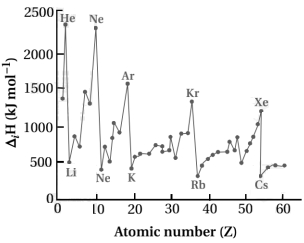
Describe the periodicity of the first ionization enthalpy for elements with atomic numbers $1$ to $60$.
Solution
(N/A) Generally,ionization enthalpy refers to the first ionization enthalpy.
The first ionization enthalpies of elements with atomic numbers up to $60$ are plotted in the graph.
The periodicity of the graph is quite striking.
Maxima are observed at the noble gases,which have closed electron shells and very stable electron configurations.
Conversely,minima occur at the alkali metals,and their low ionization enthalpies can be correlated with their high reactivity.
Within a period,as we move from left to right,the ionization enthalpy generally increases.
Within a group,as we move from top to bottom,the ionization enthalpy generally decreases.
The first ionization enthalpies of elements with atomic numbers up to $60$ are plotted in the graph.
The periodicity of the graph is quite striking.
Maxima are observed at the noble gases,which have closed electron shells and very stable electron configurations.
Conversely,minima occur at the alkali metals,and their low ionization enthalpies can be correlated with their high reactivity.
Within a period,as we move from left to right,the ionization enthalpy generally increases.
Within a group,as we move from top to bottom,the ionization enthalpy generally decreases.
0 likes
View Solution111
Difficult
What is the basic difference between the terms electron gain enthalpy and electronegativity?
Solution
(N/A)
| Electron gain enthalpy | Electronegativity |
| $1$. It can be measured. | $1$. It cannot be measured. |
| $2$. The change in enthalpy when $1$ electron is added to a gaseous atom is known as electron gain enthalpy. | $2$. The capacity to attract a shared pair of electrons in a covalent bond is known as electronegativity. |
| $3$. It represents the enthalpy change of the reaction $X_{(g)} + e^{-} \rightarrow X^{-}_{(g)}$. | $3$. Its value is relative and denoted by scales like Pauling's scale (electronegativity of fluorine is $4.0$). |
| $4$. It indicates the energy released or absorbed when an electron is added. | $4$. It indicates the relative tendency of an atom to attract shared electrons. |
| $5$. Its value is a property of an isolated gaseous atom. | $5$. Electronegativity is not constant; it depends on the chemical environment and the atom it is bonded to. |
0 likes
View Solution112
Medium
Represent different types of periodic properties in the periodic table.
Solution
(N/A) The trends in periodic properties are as follows:
$1$. Across a period (left to right):
- Atomic radius decreases.
- Ionization enthalpy,electron gain enthalpy,and electronegativity generally increase.
- Non-metallic character increases,while metallic character decreases.
$2$. Down a group (top to bottom):
- Atomic radius increases.
- Ionization enthalpy,electron gain enthalpy,and electronegativity generally decrease.
- Metallic character increases,while non-metallic character decreases.
$1$. Across a period (left to right):
- Atomic radius decreases.
- Ionization enthalpy,electron gain enthalpy,and electronegativity generally increase.
- Non-metallic character increases,while metallic character decreases.
$2$. Down a group (top to bottom):
- Atomic radius increases.
- Ionization enthalpy,electron gain enthalpy,and electronegativity generally decrease.
- Metallic character increases,while non-metallic character decreases.
0 likes
View Solution113
Difficult
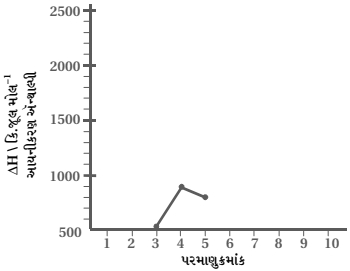
The ionisation enthalpies of elements of the second period are given below: Ionisation enthalpy / $kcal \, mol^{-1}$: $520, 899, 801, 1086, 1402, 1314, 1681, 2080$. Match the correct enthalpy with the elements and complete the graph given in Fig. Also,write the symbols of the elements with their atomic numbers.
Solution
(N/A) The elements of the second period ($Z=3$ to $10$) and their corresponding first ionisation enthalpies $(IE_1)$ in $kcal \, mol^{-1}$ are as follows:
$1$. $Li$ $(Z=3)$: $520$
$2$. $Be$ $(Z=4)$: $899$
$3$. $B$ $(Z=5)$: $801$
$4$. $C$ $(Z=6)$: $1086$
$5$. $N$ $(Z=7)$: $1402$
$6$. $O$ $(Z=8)$: $1314$
$7$. $F$ $(Z=9)$: $1681$
$8$. $Ne$ $(Z=10)$: $2080$
General Trend: As we move from left to right across a period,the atomic radius decreases and the effective nuclear charge increases,leading to a general increase in ionisation enthalpy.
Exceptions:
- $Be$ $(2s^2)$ has a higher $IE_1$ than $B$ $(2s^2 2p^1)$ because the $2s$ orbital is fully filled and more stable.
- $N$ $(2s^2 2p^3)$ has a higher $IE_1$ than $O$ $(2s^2 2p^4)$ because the $2p$ subshell is half-filled,providing extra stability.
$1$. $Li$ $(Z=3)$: $520$
$2$. $Be$ $(Z=4)$: $899$
$3$. $B$ $(Z=5)$: $801$
$4$. $C$ $(Z=6)$: $1086$
$5$. $N$ $(Z=7)$: $1402$
$6$. $O$ $(Z=8)$: $1314$
$7$. $F$ $(Z=9)$: $1681$
$8$. $Ne$ $(Z=10)$: $2080$
General Trend: As we move from left to right across a period,the atomic radius decreases and the effective nuclear charge increases,leading to a general increase in ionisation enthalpy.
Exceptions:
- $Be$ $(2s^2)$ has a higher $IE_1$ than $B$ $(2s^2 2p^1)$ because the $2s$ orbital is fully filled and more stable.
- $N$ $(2s^2 2p^3)$ has a higher $IE_1$ than $O$ $(2s^2 2p^4)$ because the $2p$ subshell is half-filled,providing extra stability.
1 likes
View Solution114
Medium
Among the elements $B$,$Al$,$C$,and $Si$,
$(a)$ which element has the highest first ionisation enthalpy?
$(b)$ which element has the most metallic character? Justify your answer in each case.
$(a)$ which element has the highest first ionisation enthalpy?
$(b)$ which element has the most metallic character? Justify your answer in each case.
Solution
(A) The elements are placed in the periodic table as follows:
$(a)$ Ionisation enthalpy increases from left to right across a period due to a decrease in atomic size and increases from bottom to top within a group. Among the given elements,$C$ is the furthest to the right and in the $2^{nd}$ period,making it have the highest first ionisation enthalpy.
$(b)$ Metallic character decreases from left to right across a period and increases from top to bottom within a group. $Al$ is in the $3^{rd}$ period and Group-$13$,which makes it the most metallic element among the four.
| $2^{nd}$ Period | $B$ (Group-$13$),$C$ (Group-$14$) |
| $3^{rd}$ Period | $Al$ (Group-$13$),$Si$ (Group-$14$) |
$(a)$ Ionisation enthalpy increases from left to right across a period due to a decrease in atomic size and increases from bottom to top within a group. Among the given elements,$C$ is the furthest to the right and in the $2^{nd}$ period,making it have the highest first ionisation enthalpy.
$(b)$ Metallic character decreases from left to right across a period and increases from top to bottom within a group. $Al$ is in the $3^{rd}$ period and Group-$13$,which makes it the most metallic element among the four.
0 likes
View Solution115
Medium
Nitrogen has positive electron gain enthalpy whereas oxygen has negative. However,oxygen has lower ionisation enthalpy than nitrogen. Explain.
Solution
(N/A) The electronic configuration of ${}_{7}N$ is $1s^{2}, 2s^{2}, 2p^{3}$. Nitrogen has a stable half-filled $p$-orbital configuration,which makes the addition of an extra electron unfavorable,resulting in a positive electron gain enthalpy.
The electronic configuration of ${}_{8}O$ is $1s^{2}, 2s^{2}, 2p^{4}$. Adding an electron to oxygen leads to a more stable half-filled $p$-orbital $(2p^{3})$,making the process exothermic (negative electron gain enthalpy).
Regarding ionisation enthalpy,oxygen $(1s^{2}, 2s^{2}, 2p^{4})$ has a lower value than nitrogen $(1s^{2}, 2s^{2}, 2p^{3})$ because removing an electron from oxygen results in a stable half-filled $2p^{3}$ configuration. Conversely,nitrogen has a stable half-filled configuration,making the removal of an electron more difficult.
The electronic configuration of ${}_{8}O$ is $1s^{2}, 2s^{2}, 2p^{4}$. Adding an electron to oxygen leads to a more stable half-filled $p$-orbital $(2p^{3})$,making the process exothermic (negative electron gain enthalpy).
Regarding ionisation enthalpy,oxygen $(1s^{2}, 2s^{2}, 2p^{4})$ has a lower value than nitrogen $(1s^{2}, 2s^{2}, 2p^{3})$ because removing an electron from oxygen results in a stable half-filled $2p^{3}$ configuration. Conversely,nitrogen has a stable half-filled configuration,making the removal of an electron more difficult.
0 likes
View Solution116
Medium
Arrange the elements $N$,$P$,$O$,and $S$ in the order of:
$(i)$ Increasing first ionisation enthalpy.
$(ii)$ Increasing non-metallic character.
Give reasons for the arrangement assigned.
$(i)$ Increasing first ionisation enthalpy.
$(ii)$ Increasing non-metallic character.
Give reasons for the arrangement assigned.
Solution
(N/A) The positions of the elements in the periodic table are as follows:
$(i)$ Ionisation enthalpy of nitrogen $(N: 1s^2, 2s^2, 2p^3)$ is greater than oxygen $(O: 1s^2, 2s^2, 2p^4)$ due to the extra stability of the exactly half-filled $2p$-orbitals. Similarly,the ionisation enthalpy of phosphorus $(P: 1s^2, 2s^2, 2p^6, 3s^2, 3p^3)$ is greater than sulphur $(S: 1s^2, 2s^2, 2p^6, 3s^2, 3p^4)$.
On moving down a group,ionisation enthalpy decreases due to an increase in atomic size. Therefore,the order of increasing first ionisation enthalpy is: $S < P < O < N$.
$(ii)$ Non-metallic character increases across a period (left to right) and decreases down a group. Therefore,the order of increasing non-metallic character is: $P < S < N < O$.
| Period | Group $15$ and $16$ |
| $2$nd period | $N$ (Group $15$),$O$ (Group $16$) |
| $3$rd period | $P$ (Group $15$),$S$ (Group $16$) |
$(i)$ Ionisation enthalpy of nitrogen $(N: 1s^2, 2s^2, 2p^3)$ is greater than oxygen $(O: 1s^2, 2s^2, 2p^4)$ due to the extra stability of the exactly half-filled $2p$-orbitals. Similarly,the ionisation enthalpy of phosphorus $(P: 1s^2, 2s^2, 2p^6, 3s^2, 3p^3)$ is greater than sulphur $(S: 1s^2, 2s^2, 2p^6, 3s^2, 3p^4)$.
On moving down a group,ionisation enthalpy decreases due to an increase in atomic size. Therefore,the order of increasing first ionisation enthalpy is: $S < P < O < N$.
$(ii)$ Non-metallic character increases across a period (left to right) and decreases down a group. Therefore,the order of increasing non-metallic character is: $P < S < N < O$.
0 likes
View Solution117
Difficult
Explain the following:
$(a)$ Electronegativity of elements increases on moving from left to right in the periodic table.
$(b)$ Ionisation enthalpy decreases in a group from top to bottom.
$(a)$ Electronegativity of elements increases on moving from left to right in the periodic table.
$(b)$ Ionisation enthalpy decreases in a group from top to bottom.
Solution
(N/A) As we move from left to right across a period,the atomic number increases,which means the nuclear charge increases while the number of shells remains the same. This leads to a stronger attraction between the nucleus and the valence electrons,causing the atomic radius to decrease and the electronegativity to increase.
$(b)$ As we move down a group,the number of shells increases,which increases the atomic radius. The valence electrons are placed at a greater distance from the nucleus,and the shielding effect of inner electrons increases. Consequently,the effective nuclear charge experienced by the valence electrons decreases,making it easier to remove an electron,which results in a decrease in ionisation enthalpy.
$(b)$ As we move down a group,the number of shells increases,which increases the atomic radius. The valence electrons are placed at a greater distance from the nucleus,and the shielding effect of inner electrons increases. Consequently,the effective nuclear charge experienced by the valence electrons decreases,making it easier to remove an electron,which results in a decrease in ionisation enthalpy.
0 likes
View Solution118
EasyMCQ
Which blocks of the periodic table contain the representative elements?
A
$s$-block
B
$p$-block
C
$s$-block and $p$-block
D
$d$-block
Solution
(C) The elements belonging to the $s$-block and $p$-block are collectively known as representative elements or main group elements.
0 likes
View Solution119
Easy
To which block do the elements with the following outer electronic configurations belong?
$(i)$ $6s^2 4f^3$
$(ii)$ $3s^2 3p^4$
$(iii)$ $3s^1$
$(iv)$ $3d^2 4s^2$
$(i)$ $6s^2 4f^3$
$(ii)$ $3s^2 3p^4$
$(iii)$ $3s^1$
$(iv)$ $3d^2 4s^2$
Solution
(N/A) $(i)$ $6s^2 4f^3$: The last electron enters the $4f$ orbital,so it belongs to the $f$-block.
$(ii)$ $3s^2 3p^4$: The last electron enters the $3p$ orbital,so it belongs to the $p$-block.
$(iii)$ $3s^1$: The last electron enters the $3s$ orbital,so it belongs to the $s$-block.
$(iv)$ $3d^2 4s^2$: The last electron enters the $3d$ orbital,so it belongs to the $d$-block.
$(ii)$ $3s^2 3p^4$: The last electron enters the $3p$ orbital,so it belongs to the $p$-block.
$(iii)$ $3s^1$: The last electron enters the $3s$ orbital,so it belongs to the $s$-block.
$(iv)$ $3d^2 4s^2$: The last electron enters the $3d$ orbital,so it belongs to the $d$-block.
0 likes
View Solution120
Easy
What is meant by diagonal relationship?
Solution
(N/A) The elements of the second period,such as $Li$,$Be$,and $B$,show similarities in properties with the elements of the third period,such as $Mg$,$Al$,and $Si$,respectively. This similarity in properties between elements placed diagonally in the periodic table is known as the $diagonal \ relationship$.
0 likes
View Solution121
MediumMCQ
Which elements in groups $1$ to $17$ differ in many respects from the other elements of their respective groups?
A
The first element of each group
B
The last element of each group
C
The middle element of each group
D
The transition elements
Solution
(A) The first element of each group differs in many respects from the other members of its group.
For example,the first element of group-$1$ is Lithium $(Li)$.
The first element of group-$2$ is Beryllium $(Be)$.
Similarly,the first elements of groups-$13$ to $17$ (from Boron to Fluorine) show anomalous properties compared to the rest of their group members.
For example,the first element of group-$1$ is Lithium $(Li)$.
The first element of group-$2$ is Beryllium $(Be)$.
Similarly,the first elements of groups-$13$ to $17$ (from Boron to Fluorine) show anomalous properties compared to the rest of their group members.
0 likes
View Solution122
Medium
What are the differences between the first element of a group and the subsequent elements in the same group?
Solution
(N/A) The first element of a group differs from the subsequent elements due to its small size,high electronegativity,and the absence of $d$-orbitals in its valence shell. The differences are summarized below:
| First element of the group | Other elements of the group |
|---|---|
| Forms covalent compounds. | Forms ionic compounds. |
| Small atomic/ionic size. | Larger atomic/ionic size. |
| High charge/radius ratio. | Low charge/radius ratio. |
| High electronegativity. | Low electronegativity. |
| Only $4$ orbitals available in the valence shell ($s$ and $p$). | $9$ orbitals available in the valence shell ($s, p,$ and $d$). |
0 likes
View Solution123
Easy
In what properties do the first elements of a group differ from the subsequent elements of the same group?
Solution
(N/A) The first elements of a group (e.g.,$Li, Be, B, C, N, O, F$) exhibit anomalous properties compared to the rest of the elements in their respective groups due to their small size,high electronegativity,and absence of $d$-orbitals.
| $1$. First element of the group | $2$. Subsequent elements of the group |
| They can form a maximum of $4$ bonds (e.g.,$[BF_4]^-$). | They can form more than $4$ covalent bonds (e.g.,$[Al(H_2O)_6]^{3+}$). |
| They form multiple bonds with themselves and other elements (e.g.,$C=C, N=N, C\equiv C, N\equiv N, C=O, C\equiv N, N=O$). | They do not typically form multiple bonds. |
0 likes
View Solution124
Medium
Fill in the blanks:
$(i)$ Atoms and ions having the same number of electrons are known as ........... .
$(ii)$ The quantitative measure of the tendency of an element to lose an electron is called ........... .
$(iii)$ The screening effect is also known by the name ........... .
$(iv)$ The enthalpy change when a gaseous neutral atom forms a negative ion is called ........... .
$(i)$ Atoms and ions having the same number of electrons are known as ........... .
$(ii)$ The quantitative measure of the tendency of an element to lose an electron is called ........... .
$(iii)$ The screening effect is also known by the name ........... .
$(iv)$ The enthalpy change when a gaseous neutral atom forms a negative ion is called ........... .
Solution
(N/A) $(i)$ Isoelectronic species
$(ii)$ Ionization enthalpy
$(iii)$ Shielding effect
$(iv)$ Electron gain enthalpy
$(ii)$ Ionization enthalpy
$(iii)$ Shielding effect
$(iv)$ Electron gain enthalpy
0 likes
View Solution125
Easy
Fill in the blanks given below:
$(i)$ The most widely used scale for measuring electronegativity is ........ .
$(ii)$ The similarity observed in periodic properties is known as .............. .
$(iii)$ The elements located in the middle of the periodic table form .......... type of oxides.
$(i)$ The most widely used scale for measuring electronegativity is ........ .
$(ii)$ The similarity observed in periodic properties is known as .............. .
$(iii)$ The elements located in the middle of the periodic table form .......... type of oxides.
Solution
(N/A) $(i)$ Pauling scale
$(ii)$ Diagonal relationship
$(iii)$ Amphoteric or neutral
$(ii)$ Diagonal relationship
$(iii)$ Amphoteric or neutral
0 likes
View Solution126
Medium
State whether the following statements are true or false:
$(i)$ Higher the ionization enthalpy,lower the screening effect.
$(ii)$ The ionization enthalpy of $Be$ is higher than that of $B$.
$(iii)$ The shielding effect increases as we move from left to right in a period.
$(iv)$ The increasing order of the first ionization energy is $B < Be < O < N$.
$(i)$ Higher the ionization enthalpy,lower the screening effect.
$(ii)$ The ionization enthalpy of $Be$ is higher than that of $B$.
$(iii)$ The shielding effect increases as we move from left to right in a period.
$(iv)$ The increasing order of the first ionization energy is $B < Be < O < N$.
Solution
(A) $(i)$ True. Higher ionization enthalpy implies stronger nuclear attraction,which is often associated with a lower screening effect.
$(ii)$ True. $Be$ $(1s^2 2s^2)$ has a fully filled $2s$ orbital,which is more stable than the $2p^1$ configuration of $B$.
$(iii)$ False. The shielding effect remains approximately constant as we move across a period because electrons are added to the same shell.
$(iv)$ True. The order $B < Be < O < N$ is correct due to the stability of fully filled and half-filled orbitals.
$(ii)$ True. $Be$ $(1s^2 2s^2)$ has a fully filled $2s$ orbital,which is more stable than the $2p^1$ configuration of $B$.
$(iii)$ False. The shielding effect remains approximately constant as we move across a period because electrons are added to the same shell.
$(iv)$ True. The order $B < Be < O < N$ is correct due to the stability of fully filled and half-filled orbitals.
0 likes
View Solution127
Medium
State whether the following statements are true or false:
$(i)$ As the atomic number increases in a period,the nuclear charge increases,therefore the ionization enthalpy increases.
$(ii)$ As the metallic character of elements increases,the atomic radius generally increases.
$(iii)$ $Mn$ $(Z = 25)$ is a transition element. Although it is a $3d$-orbital element,its position in the periodic table is in the $4^{th}$ period.
$(i)$ As the atomic number increases in a period,the nuclear charge increases,therefore the ionization enthalpy increases.
$(ii)$ As the metallic character of elements increases,the atomic radius generally increases.
$(iii)$ $Mn$ $(Z = 25)$ is a transition element. Although it is a $3d$-orbital element,its position in the periodic table is in the $4^{th}$ period.
Solution
(A) $(i)$ True: Across a period,the effective nuclear charge increases,which pulls the electrons closer,making it harder to remove an electron,thus increasing ionization enthalpy.
$(ii)$ True: Metallic character is associated with the ability to lose electrons,which correlates with larger atomic radii as one moves down a group.
$(iii)$ True: $Mn$ has the electronic configuration $[Ar] 3d^5 4s^2$. The principal quantum number $n = 4$ indicates it belongs to the $4^{th}$ period.
$(ii)$ True: Metallic character is associated with the ability to lose electrons,which correlates with larger atomic radii as one moves down a group.
$(iii)$ True: $Mn$ has the electronic configuration $[Ar] 3d^5 4s^2$. The principal quantum number $n = 4$ indicates it belongs to the $4^{th}$ period.
0 likes
View Solution128
Easy
Match the items in List-$A$ with the items in List-$B$.
| List-$A$ | List-$B$ |
| $(1)$ $He$ | $(A)$ High electron gain enthalpy |
| $(2)$ $Cl$ | $(B)$ Electropositive element |
| $(3)$ $Ca$ | $(C)$ Strong reducing agent |
| $(4)$ $Li$ | $(D)$ High ionization enthalpy |
Solution
(A) $(1-D), (2-A), (3-B), (4-C)$
$1$. $He$ (Helium) is a noble gas with a stable electronic configuration,resulting in a very high ionization enthalpy $(D)$.
$2$. $Cl$ (Chlorine) is a halogen with a high tendency to gain an electron,resulting in a high electron gain enthalpy $(A)$.
$3$. $Ca$ (Calcium) is an alkaline earth metal,which is electropositive in nature $(B)$.
$4$. $Li$ (Lithium) is an alkali metal and acts as a strong reducing agent $(C)$.
$1$. $He$ (Helium) is a noble gas with a stable electronic configuration,resulting in a very high ionization enthalpy $(D)$.
$2$. $Cl$ (Chlorine) is a halogen with a high tendency to gain an electron,resulting in a high electron gain enthalpy $(A)$.
$3$. $Ca$ (Calcium) is an alkaline earth metal,which is electropositive in nature $(B)$.
$4$. $Li$ (Lithium) is an alkali metal and acts as a strong reducing agent $(C)$.
0 likes
View Solution129
MediumMCQ
Match the properties of elements given in List-$I$ with List-$II$.
| List-$I$ | List-$II$ |
| $(1)$ Active non-metal with high electron gain enthalpy. | $(A)$ $Na$ |
| $(2)$ Soft metal with low ionization enthalpy. | $(B)$ $Sb$ |
| $(3)$ Metalloid that forms ${M_2}{O_3}$ type oxide. | $(C)$ $He$ |
| $(4)$ Chemically inert gas. | $(D)$ $Cl$ |
A
$1-D, 2-A, 3-B, 4-C$
B
$1-A, 2-D, 3-B, 4-C$
C
$1-D, 2-A, 3-C, 4-B$
D
$1-B, 2-A, 3-D, 4-C$
Solution
(A) $(1)$ Chlorine $(Cl)$ is a highly reactive non-metal with a very high negative electron gain enthalpy.
$(2)$ Sodium $(Na)$ is a soft alkali metal with a low first ionization enthalpy.
$(3)$ Antimony $(Sb)$ is a metalloid that forms oxides of the type ${M_2}{O_3}$.
$(4)$ Helium $(He)$ is a noble gas and is chemically inert.
Therefore,the correct matching is $(1-D, 2-A, 3-B, 4-C)$.
$(2)$ Sodium $(Na)$ is a soft alkali metal with a low first ionization enthalpy.
$(3)$ Antimony $(Sb)$ is a metalloid that forms oxides of the type ${M_2}{O_3}$.
$(4)$ Helium $(He)$ is a noble gas and is chemically inert.
Therefore,the correct matching is $(1-D, 2-A, 3-B, 4-C)$.
0 likes
View Solution130
Medium
Compare the ionization enthalpy and electron gain enthalpy values of the elements given below:
| Element Description | Element | $\Delta_{i}H_1$ | $\Delta_{i}H_2$ | $\Delta_{eg}H$ |
| $(i)$ Most reactive non-metal | $(A)$ | $419$ | $3051$ | $-48$ |
| $(ii)$ Most reactive metal | $(B)$ | $1681$ | $3374$ | $-328$ |
| $(iii)$ Least reactive element | $(C)$ | $738$ | $1451$ | $-40$ |
| $(iv)$ Metal forming dihalide | $(D)$ | $2372$ | $5251$ | $+48$ |
Solution
(A) $(i)$ The most reactive non-metal has a high negative electron gain enthalpy. Element $B$ has $\Delta_{eg}H = -328 \ kJ/mol$,which is the most negative.
$(ii)$ The most reactive metal has the lowest first ionization enthalpy $(\Delta_{i}H_1)$. Element $A$ has $\Delta_{i}H_1 = 419 \ kJ/mol$,which is the lowest.
$(iii)$ The least reactive element is a noble gas,which has very high ionization enthalpies and a positive electron gain enthalpy. Element $D$ has $\Delta_{i}H_1 = 2372 \ kJ/mol$ and $\Delta_{eg}H = +48 \ kJ/mol$.
$(iv)$ Metals forming dihalides are alkaline earth metals. Element $C$ has $\Delta_{i}H_1 = 738 \ kJ/mol$ and $\Delta_{i}H_2 = 1451 \ kJ/mol$,which is characteristic of group $2$ elements.
$(ii)$ The most reactive metal has the lowest first ionization enthalpy $(\Delta_{i}H_1)$. Element $A$ has $\Delta_{i}H_1 = 419 \ kJ/mol$,which is the lowest.
$(iii)$ The least reactive element is a noble gas,which has very high ionization enthalpies and a positive electron gain enthalpy. Element $D$ has $\Delta_{i}H_1 = 2372 \ kJ/mol$ and $\Delta_{eg}H = +48 \ kJ/mol$.
$(iv)$ Metals forming dihalides are alkaline earth metals. Element $C$ has $\Delta_{i}H_1 = 738 \ kJ/mol$ and $\Delta_{i}H_2 = 1451 \ kJ/mol$,which is characteristic of group $2$ elements.
0 likes
View Solution131
Medium
What are the properties associated with individual particles of matter?
Solution
(N/A) The main properties associated with individual particles of matter are:
$(i)$ Atomic size
$(ii)$ Ionization enthalpy
$(iii)$ Electron charge density
$(iv)$ Molecular shape
$(v)$ Molecular polarity,etc.
$(i)$ Atomic size
$(ii)$ Ionization enthalpy
$(iii)$ Electron charge density
$(iv)$ Molecular shape
$(v)$ Molecular polarity,etc.
0 likes
View Solution132
MediumMCQ
In general,the property (magnitudes only) that shows an opposite trend in comparison to other properties across a period is
A
Electronegativity
B
Electron gain enthalpy
C
Ionization enthalpy
D
Atomic radius
Solution
(D) Across a period,the effective nuclear charge $(Z_{eff})$ increases,which leads to a decrease in the atomic radius.
Conversely,properties like ionization enthalpy,electron gain enthalpy,and electronegativity increase across a period due to the stronger attraction between the nucleus and the valence electrons.
Therefore,atomic radius shows an opposite trend compared to the other three properties.
Conversely,properties like ionization enthalpy,electron gain enthalpy,and electronegativity increase across a period due to the stronger attraction between the nucleus and the valence electrons.
Therefore,atomic radius shows an opposite trend compared to the other three properties.
0 likes
View Solution133
MediumMCQ
The set of elements that differ in mutual relationship from those of the other sets is:
A
$Li-Mg$
B
$B-Si$
C
$Be-Al$
D
$Li-Na$
Solution
(D) The pairs $Li-Mg$,$B-Si$,and $Be-Al$ exhibit a diagonal relationship in the periodic table.
$Li$ and $Na$ belong to the same group $(Group \ 1)$ and do not show a diagonal relationship,as they are placed vertically relative to each other.
$Li$ and $Na$ belong to the same group $(Group \ 1)$ and do not show a diagonal relationship,as they are placed vertically relative to each other.
0 likes
View Solution134
EasyMCQ
Outermost electronic configuration of a group $13$ element,$E$,is $4s^2 4p^1$. The electronic configuration of an element of $p$-block,period $5$,placed diagonally to element $E$ is:
A
$[Xe] 5d^{10} 6s^2 6p^2$
B
$[Kr] 4d^{10} 5s^2 5p^2$
C
$[Kr] 3d^{10} 4s^2 4p^2$
D
$[Ar] 3d^{10} 4s^2 4p^2$
Solution
(B) The element $E$ with configuration $4s^2 4p^1$ is Gallium $(Ga)$,which belongs to period $4$ and group $13$.
Diagonal relationship exists between elements of period $2$ and $3$,and period $3$ and $4$. However,the question asks for an element in period $5$ placed diagonally to $E$ $(Ga)$.
In the periodic table,the element placed diagonally to $Ga$ $(Z=31)$ in the next period (period $5$) is Tin ($Sn$,$Z=50$).
$Sn$ is a group $14$ element in period $5$.
The electronic configuration of $Sn$ $(Z=50)$ is $[Kr] 4d^{10} 5s^2 5p^2$.
Diagonal relationship exists between elements of period $2$ and $3$,and period $3$ and $4$. However,the question asks for an element in period $5$ placed diagonally to $E$ $(Ga)$.
In the periodic table,the element placed diagonally to $Ga$ $(Z=31)$ in the next period (period $5$) is Tin ($Sn$,$Z=50$).
$Sn$ is a group $14$ element in period $5$.
The electronic configuration of $Sn$ $(Z=50)$ is $[Kr] 4d^{10} 5s^2 5p^2$.
0 likes
View Solution135
MediumMCQ
Match List-$I$ with List-$II$:
Choose the correct answer from the options given below:
| List-$I$ (Atomic Number) | List-$II$ (Block of periodic table) |
|---|---|
| $A$. $37$ | $I$. $p$-block |
| $B$. $78$ | $II$. $d$-block |
| $C$. $52$ | $III$. $f$-block |
| $D$. $65$ | $IV$. $s$-block |
Choose the correct answer from the options given below:
A
$A-II, B-IV, C-I, D-III$
B
$A-I, B-III, C-IV, D-II$
C
$A-IV, B-III, C-II, D-I$
D
$A-IV, B-II, C-I, D-III$
Solution
(D) To determine the block of an element from its atomic number,we look at the last orbital filled:
$1$. Atomic number $37$ is Rubidium $(Rb)$,which belongs to the $s$-block (Group $1$). Thus,$A-IV$.
$2$. Atomic number $78$ is Platinum $(Pt)$,which is a transition metal belonging to the $d$-block. Thus,$B-II$.
$3$. Atomic number $52$ is Tellurium $(Te)$,which belongs to the $p$-block (Group $16$). Thus,$C-I$.
$4$. Atomic number $65$ is Terbium $(Tb)$,which is a lanthanoid belonging to the $f$-block. Thus,$D-III$.
Therefore,the correct matching is $A-IV, B-II, C-I, D-III$.
$1$. Atomic number $37$ is Rubidium $(Rb)$,which belongs to the $s$-block (Group $1$). Thus,$A-IV$.
$2$. Atomic number $78$ is Platinum $(Pt)$,which is a transition metal belonging to the $d$-block. Thus,$B-II$.
$3$. Atomic number $52$ is Tellurium $(Te)$,which belongs to the $p$-block (Group $16$). Thus,$C-I$.
$4$. Atomic number $65$ is Terbium $(Tb)$,which is a lanthanoid belonging to the $f$-block. Thus,$D-III$.
Therefore,the correct matching is $A-IV, B-II, C-I, D-III$.
0 likes
View Solution136
MediumMCQ
Which of the following statements are not correct?
$A.$ The electron gain enthalpy of $F$ is more negative than that of $Cl$.
$B.$ Ionization enthalpy decreases in a group of the periodic table.
$C.$ The electronegativity of an atom depends upon the atoms bonded to it.
$D.$ $Al_2O_3$ and $NO$ are examples of amphoteric oxides.
Choose the most appropriate answer from the options given below:
$A.$ The electron gain enthalpy of $F$ is more negative than that of $Cl$.
$B.$ Ionization enthalpy decreases in a group of the periodic table.
$C.$ The electronegativity of an atom depends upon the atoms bonded to it.
$D.$ $Al_2O_3$ and $NO$ are examples of amphoteric oxides.
Choose the most appropriate answer from the options given below:
A
$A, B, C$ and $D$
B
$A, C$ and $D$ Only
C
$B$ and $D$ Only
D
$A, B$ and $D$ Only
Solution
(B) Statement $A$ is incorrect because the electron gain enthalpy of $Cl$ is more negative than that of $F$ due to the small size and interelectronic repulsion in $F$.
Statement $B$ is correct because ionization enthalpy generally decreases down a group due to an increase in atomic size and shielding effect.
Statement $C$ is incorrect because electronegativity is a property of an atom in a molecule and it depends on the hybridization and the nature of the atoms bonded to it.
Statement $D$ is incorrect because $Al_2O_3$ is amphoteric,but $NO$ is a neutral oxide.
Therefore,statements $A, C,$ and $D$ are incorrect.
Statement $B$ is correct because ionization enthalpy generally decreases down a group due to an increase in atomic size and shielding effect.
Statement $C$ is incorrect because electronegativity is a property of an atom in a molecule and it depends on the hybridization and the nature of the atoms bonded to it.
Statement $D$ is incorrect because $Al_2O_3$ is amphoteric,but $NO$ is a neutral oxide.
Therefore,statements $A, C,$ and $D$ are incorrect.
0 likes
View Solution137
DifficultMCQ
Consider the following elements arranged in a periodic table segment as shown in the image.
Which of the following is/are true about $A^{\prime}, B^{\prime}, C^{\prime}$ and $D^{\prime}$?
$A$. Order of atomic radii: $B^{\prime} < A^{\prime} < D^{\prime} < C^{\prime}$
$B$. Order of metallic character: $B^{\prime} < A^{\prime} < D^{\prime} < C^{\prime}$
$C$. Size of the element: $D^{\prime} < C^{\prime} < B^{\prime} < A^{\prime}$
$D$. Order of ionic radii: $B^{\prime+} < A^{\prime+} < D^{\prime+} < C^{\prime+}$
Choose the correct answer from the options given below:
Which of the following is/are true about $A^{\prime}, B^{\prime}, C^{\prime}$ and $D^{\prime}$?
$A$. Order of atomic radii: $B^{\prime} < A^{\prime} < D^{\prime} < C^{\prime}$
$B$. Order of metallic character: $B^{\prime} < A^{\prime} < D^{\prime} < C^{\prime}$
$C$. Size of the element: $D^{\prime} < C^{\prime} < B^{\prime} < A^{\prime}$
$D$. Order of ionic radii: $B^{\prime+} < A^{\prime+} < D^{\prime+} < C^{\prime+}$
Choose the correct answer from the options given below:
A
$A$ only
B
$A, B$ and $D$ only
C
$A$ and $B$ only
D
$B, C$ and $D$ only
Solution
(B) Based on the provided image,the elements are arranged as follows:
Row $1$: $A^{\prime}, B^{\prime}$ (left to right)
Row $2$: $C^{\prime}, D^{\prime}$ (left to right)
$1$. Atomic Radii: In a period,size decreases from left to right. In a group,size increases from top to bottom.
Thus,$B^{\prime} < A^{\prime}$ and $D^{\prime} < C^{\prime}$. Also,elements in the second row are larger than those in the first row ($A^{\prime} < C^{\prime}$ and $B^{\prime} < D^{\prime}$).
The correct order is $B^{\prime} < A^{\prime} < D^{\prime} < C^{\prime}$. Statement $A$ is true.
$2$. Metallic Character: Metallic character decreases from left to right in a period and increases from top to bottom in a group.
Thus,$B^{\prime} < A^{\prime}$ and $D^{\prime} < C^{\prime}$. Also,$A^{\prime} < C^{\prime}$ and $B^{\prime} < D^{\prime}$.
The correct order is $B^{\prime} < A^{\prime} < D^{\prime} < C^{\prime}$. Statement $B$ is true.
$3$. Size of the element: As established,$B^{\prime} < A^{\prime} < D^{\prime} < C^{\prime}$. Statement $C$ is false.
$4$. Ionic Radii: For cations,the trend follows the atomic radii trend. Thus,$B^{\prime+} < A^{\prime+} < D^{\prime+} < C^{\prime+}$. Statement $D$ is true.
Therefore,statements $A, B,$ and $D$ are true.
Row $1$: $A^{\prime}, B^{\prime}$ (left to right)
Row $2$: $C^{\prime}, D^{\prime}$ (left to right)
$1$. Atomic Radii: In a period,size decreases from left to right. In a group,size increases from top to bottom.
Thus,$B^{\prime} < A^{\prime}$ and $D^{\prime} < C^{\prime}$. Also,elements in the second row are larger than those in the first row ($A^{\prime} < C^{\prime}$ and $B^{\prime} < D^{\prime}$).
The correct order is $B^{\prime} < A^{\prime} < D^{\prime} < C^{\prime}$. Statement $A$ is true.
$2$. Metallic Character: Metallic character decreases from left to right in a period and increases from top to bottom in a group.
Thus,$B^{\prime} < A^{\prime}$ and $D^{\prime} < C^{\prime}$. Also,$A^{\prime} < C^{\prime}$ and $B^{\prime} < D^{\prime}$.
The correct order is $B^{\prime} < A^{\prime} < D^{\prime} < C^{\prime}$. Statement $B$ is true.
$3$. Size of the element: As established,$B^{\prime} < A^{\prime} < D^{\prime} < C^{\prime}$. Statement $C$ is false.
$4$. Ionic Radii: For cations,the trend follows the atomic radii trend. Thus,$B^{\prime+} < A^{\prime+} < D^{\prime+} < C^{\prime+}$. Statement $D$ is true.
Therefore,statements $A, B,$ and $D$ are true.
0 likes
View Solution138
MediumMCQ
Given below are two statements:
Statement $I$ : The correct order of first ionization enthalpy values of $Li, Na, F$ and $Cl$ is $Na < Li < Cl < F$.
Statement $II$ : The correct order of negative electron gain enthalpy values of $Li, Na, F$ and $Cl$ is $Na < Li < F < Cl$.
In the light of the above statements,choose the correct answer from the options given below :
Statement $I$ : The correct order of first ionization enthalpy values of $Li, Na, F$ and $Cl$ is $Na < Li < Cl < F$.
Statement $II$ : The correct order of negative electron gain enthalpy values of $Li, Na, F$ and $Cl$ is $Na < Li < F < Cl$.
In the light of the above statements,choose the correct answer from the options given below :
A
Both Statement $I$ and Statement $II$ are true
B
Both Statement $I$ and Statement $II$ are false
C
Statement $I$ is false but Statement $II$ is true
D
Statement $I$ is true but Statement $II$ is false
Solution
(A) Statement $I$: The first ionization enthalpy $(IE_1)$ increases across a period and decreases down a group. The values are: $Na$ $(496 \ kJ/mol)$,$Li$ $(520 \ kJ/mol)$,$Cl$ $(1256 \ kJ/mol)$,$F$ $(1681 \ kJ/mol)$. Thus,the order $Na < Li < Cl < F$ is correct.
Statement $II$: The negative electron gain enthalpy $(-\Delta_{eg}H)$ generally increases across a period and decreases down a group. However,due to the small size of $F$,the electron-electron repulsion is high,making its electron gain enthalpy less negative than that of $Cl$. The values are: $Na$ $(-53 \ kJ/mol)$,$Li$ $(-60 \ kJ/mol)$,$F$ $(-328 \ kJ/mol)$,$Cl$ $(-349 \ kJ/mol)$. Thus,the order $Na < Li < F < Cl$ is correct.
Both statements are true.
Statement $II$: The negative electron gain enthalpy $(-\Delta_{eg}H)$ generally increases across a period and decreases down a group. However,due to the small size of $F$,the electron-electron repulsion is high,making its electron gain enthalpy less negative than that of $Cl$. The values are: $Na$ $(-53 \ kJ/mol)$,$Li$ $(-60 \ kJ/mol)$,$F$ $(-328 \ kJ/mol)$,$Cl$ $(-349 \ kJ/mol)$. Thus,the order $Na < Li < F < Cl$ is correct.
Both statements are true.
0 likes
View Solution139
MediumMCQ
Match List-$I$ with List-$II$.
Choose the correct answer from the options given below:
| List-$I$ (Elements) | List-$II$ (Properties) |
| $A. Cl, S$ | $I. \text{Elements with highest electronegativity}$ |
| $B. Ge, As$ | $II. \text{Elements with largest atomic size}$ |
| $C. Fr, Ra$ | $III. \text{Elements which show properties of both metals and non-metals}$ |
| $D. F, O$ | $IV. \text{Elements with highest negative electron gain enthalpy}$ |
Choose the correct answer from the options given below:
A
$A-II, B-III, C-IV, D-I$
B
$A-III, B-II, C-I, D-IV$
C
$A-IV, B-III, C-II, D-I$
D
$A-II, B-I, C-IV, D-III$
Solution
(C) $A. Cl, S$ are elements with the highest negative electron gain enthalpy $(IV)$.
$B. Ge, As$ are metalloids,showing properties of both metals and non-metals $(III)$.
$C. Fr, Ra$ are elements with the largest atomic size in their respective groups $(II)$.
$D. F, O$ are elements with the highest electronegativity $(I)$.
Therefore,the correct matching is $A-IV, B-III, C-II, D-I$.
$B. Ge, As$ are metalloids,showing properties of both metals and non-metals $(III)$.
$C. Fr, Ra$ are elements with the largest atomic size in their respective groups $(II)$.
$D. F, O$ are elements with the highest electronegativity $(I)$.
Therefore,the correct matching is $A-IV, B-III, C-II, D-I$.
0 likes
View Solution140
DifficultMCQ
Match List-$I$ with List-$II$:
Choose the correct answer from the options given below:
| List-$I$ | List-$II$ |
| $A$. $Al^{3+} < Mg^{2+} < Na^{+} < F^{-}$ | $I$. Ionisation Enthalpy |
| $B$. $B < C < O < N$ | $II$. Metallic character |
| $C$. $B < Al < Mg < K$ | $III$. Electronegativity |
| $D$. $Si < P < S < Cl$ | $IV$. Ionic radii |
Choose the correct answer from the options given below:
A
$A-IV, B-I, C-III, D-II$
B
$A-II, B-III, C-IV, D-I$
C
$A-IV, B-I, C-II, D-III$
D
$A-III, B-IV, C-II, D-I$
Solution
(C) . $Al^{3+} < Mg^{2+} < Na^{+} < F^{-}$ represents the order of ionic radii for isoelectronic species,where size increases as nuclear charge decreases. Thus,$A-IV$.
$B$. $B < C < O < N$ represents the order of first ionisation enthalpy,where $N$ has a higher value than $O$ due to stable half-filled $p$-orbitals. Thus,$B-I$.
$C$. $B < Al < Mg < K$ represents the order of metallic character,which increases down a group and decreases across a period. Thus,$C-II$.
$D$. $Si < P < S < Cl$ represents the order of electronegativity,which increases across a period. Thus,$D-III$.
Therefore,the correct match is $A-IV, B-I, C-II, D-III$.
$B$. $B < C < O < N$ represents the order of first ionisation enthalpy,where $N$ has a higher value than $O$ due to stable half-filled $p$-orbitals. Thus,$B-I$.
$C$. $B < Al < Mg < K$ represents the order of metallic character,which increases down a group and decreases across a period. Thus,$C-II$.
$D$. $Si < P < S < Cl$ represents the order of electronegativity,which increases across a period. Thus,$D-III$.
Therefore,the correct match is $A-IV, B-I, C-II, D-III$.
0 likes
View Solution141
DifficultMCQ
Which of the following statements are $NOT$ true about the periodic table?
$A.$ The properties of elements are a function of atomic weights.
$B.$ The properties of elements are a function of atomic numbers.
$C.$ Elements having similar outer electronic configuration are arranged in the same period.
$D.$ An element's location reflects the quantum numbers of the last filled orbital.
$E.$ The number of elements in a period is the same as the number of atomic orbitals available in the energy level that is being filled.
Choose the correct answer from the options given below:
$A.$ The properties of elements are a function of atomic weights.
$B.$ The properties of elements are a function of atomic numbers.
$C.$ Elements having similar outer electronic configuration are arranged in the same period.
$D.$ An element's location reflects the quantum numbers of the last filled orbital.
$E.$ The number of elements in a period is the same as the number of atomic orbitals available in the energy level that is being filled.
Choose the correct answer from the options given below:
A
$A, C$ and $E$ only
B
$D$ and $E$ only
C
$A$ and $E$ only
D
$B, C$ and $E$ only
Solution
(A) The modern periodic law states that the properties of elements are a periodic function of their atomic numbers,making statement $A$ incorrect.
Elements with similar outer electronic configurations are placed in the same group,not the same period,making statement $C$ incorrect.
The number of elements in a period is determined by the number of electrons that can be accommodated in the subshells being filled,which is twice the number of available orbitals,making statement $E$ incorrect.
Statements $B$ and $D$ are true.
Therefore,statements $A, C,$ and $E$ are not true.
Elements with similar outer electronic configurations are placed in the same group,not the same period,making statement $C$ incorrect.
The number of elements in a period is determined by the number of electrons that can be accommodated in the subshells being filled,which is twice the number of available orbitals,making statement $E$ incorrect.
Statements $B$ and $D$ are true.
Therefore,statements $A, C,$ and $E$ are not true.
0 likes
View Solution142
DifficultMCQ
Consider the following elements $In$,$Tl$,$Al$,$Pb$,$Sn$ and $Ge$. The most stable oxidation states of elements with highest and lowest first ionisation enthalpies,respectively,are
A
$+2$ and $+3$
B
$+4$ and $+3$
C
$+4$ and $+1$
D
$+1$ and $+4$
Solution
(B) The first ionisation enthalpy $(IE_1)$ generally decreases down a group and increases across a period. Among the given elements ($Al$,$In$,$Tl$,$Ge$,$Sn$,$Pb$),$Ge$ (Germanium) has the highest $IE_1$ and $In$ (Indium) has the lowest $IE_1$.
For $Ge$ (Group $14$),the most stable oxidation state is $+4$.
For $In$ (Group $13$),the most stable oxidation state is $+3$.
Therefore,the most stable oxidation states for the elements with the highest and lowest $IE_1$ are $+4$ and $+3$,respectively.
For $Ge$ (Group $14$),the most stable oxidation state is $+4$.
For $In$ (Group $13$),the most stable oxidation state is $+3$.
Therefore,the most stable oxidation states for the elements with the highest and lowest $IE_1$ are $+4$ and $+3$,respectively.
0 likes
View Solution143
MediumMCQ
An element $E$ has an ionisation enthalpy value of $374 \ kJ \ mol^{-1}$. $E$ reacts with elements $A, B, C$ and $D$ with electron gain enthalpy values of $-328, -349, -325$ and $-295 \ kJ \ mol^{-1}$,respectively. The correct order of the products $EA, EB, EC$ and $ED$ in terms of ionic character is $:$
A
$EB > EA > EC > ED$
B
$ED > EC > EA > EB$
C
$EA > EB > EC > ED$
D
$ED > EC > EB > EA$
Solution
(A) The ionic character of a bond is related to the electronegativity difference between the bonded atoms.
In the formation of an ionic bond between $E$ and a non-metal,the ionic character increases as the electron gain enthalpy of the non-metal becomes more negative (i.e.,the non-metal becomes more electronegative).
Given electron gain enthalpy values:
$B (-349 \ kJ \ mol^{-1}) < A (-328 \ kJ \ mol^{-1}) < C (-325 \ kJ \ mol^{-1}) < D (-295 \ kJ \ mol^{-1})$.
Since $B$ has the most negative electron gain enthalpy,it is the most electronegative,resulting in the highest ionic character for $EB$.
Thus,the order of ionic character is $EB > EA > EC > ED$.
In the formation of an ionic bond between $E$ and a non-metal,the ionic character increases as the electron gain enthalpy of the non-metal becomes more negative (i.e.,the non-metal becomes more electronegative).
Given electron gain enthalpy values:
$B (-349 \ kJ \ mol^{-1}) < A (-328 \ kJ \ mol^{-1}) < C (-325 \ kJ \ mol^{-1}) < D (-295 \ kJ \ mol^{-1})$.
Since $B$ has the most negative electron gain enthalpy,it is the most electronegative,resulting in the highest ionic character for $EB$.
Thus,the order of ionic character is $EB > EA > EC > ED$.
0 likes
View Solution144
MediumMCQ
Given below are two statements $:$
Statement $(I) :$ The radii of isoelectronic species increase in the order $Mg^{2+} < Na^{+} < F^{-} < O^{2-}$.
Statement $(II) :$ The magnitude of electron gain enthalpy of halogens decreases in the order $Cl > F > Br > I$.
In the light of the above statements,choose the most appropriate answer from the options given below $:$
Statement $(I) :$ The radii of isoelectronic species increase in the order $Mg^{2+} < Na^{+} < F^{-} < O^{2-}$.
Statement $(II) :$ The magnitude of electron gain enthalpy of halogens decreases in the order $Cl > F > Br > I$.
In the light of the above statements,choose the most appropriate answer from the options given below $:$
A
Statement $I$ is incorrect but Statement $II$ is correct
B
Both Statement $I$ and Statement $II$ are incorrect
C
Statement $I$ is correct but Statement $II$ is incorrect
D
Both Statement $I$ and Statement $II$ are correct
Solution
(D) $(i)$ For isoelectronic species,as the negative charge increases,the ionic radius increases due to a decrease in effective nuclear charge. Thus,the order $Mg^{2+} < Na^{+} < F^{-} < O^{2-}$ is correct.
$(ii)$ The magnitude of electron gain enthalpy for halogens is $Cl > F > Br > I$. Due to the small size of $F$,there is high inter-electronic repulsion,making its electron gain enthalpy less negative than that of $Cl$. Thus,the order is correct.
$(ii)$ The magnitude of electron gain enthalpy for halogens is $Cl > F > Br > I$. Due to the small size of $F$,there is high inter-electronic repulsion,making its electron gain enthalpy less negative than that of $Cl$. Thus,the order is correct.
0 likes
View Solution145
DifficultMCQ
Which of the following statements are correct?
$A.$ The process of the addition of an electron to a neutral gaseous atom is always exothermic.
$B.$ The process of removing an electron from an isolated gaseous atom is always endothermic.
$C.$ The $1^{st}$ ionization energy of boron is less than that of beryllium.
$D.$ The electronegativity of $C$ is $2.5$ in $CH_4$ and $CCl_4$.
$E.$ $Li$ is the most electropositive among elements of group $I$.
Choose the correct answer from the options given below:
$A.$ The process of the addition of an electron to a neutral gaseous atom is always exothermic.
$B.$ The process of removing an electron from an isolated gaseous atom is always endothermic.
$C.$ The $1^{st}$ ionization energy of boron is less than that of beryllium.
$D.$ The electronegativity of $C$ is $2.5$ in $CH_4$ and $CCl_4$.
$E.$ $Li$ is the most electropositive among elements of group $I$.
Choose the correct answer from the options given below:
A
$B$ and $C$ only
B
$A, C$ and $D$ only
C
$B$ and $D$ only
D
$B, C$ and $E$ only
Solution
(A) Incorrect: The process of adding an $e^-$ to a neutral gaseous atom is not always exothermic; it can be endothermic for elements like noble gases or nitrogen.
$(B)$ Correct: Removing an electron requires energy to overcome the electrostatic attraction between the nucleus and the electron,making it always endothermic.
$(C)$ Correct: $Be$ $(1s^2 2s^2)$ has a fully filled $2s$ subshell,which is more stable than $B$ $(1s^2 2s^2 2p^1)$. Thus,the $1^{st}$ ionization energy of $Be > B$.
$(D)$ Incorrect: Electronegativity is not a constant value; it depends on the oxidation state and hybridization. In $CCl_4$,the carbon atom is bonded to highly electronegative $Cl$ atoms,which increases its effective nuclear charge and thus its electronegativity compared to $C$ in $CH_4$.
$(E)$ Incorrect: Electropositive character increases down the group. $Cs$ is the most electropositive element in group $I$.
Therefore,only statements $B$ and $C$ are correct.
$(B)$ Correct: Removing an electron requires energy to overcome the electrostatic attraction between the nucleus and the electron,making it always endothermic.
$(C)$ Correct: $Be$ $(1s^2 2s^2)$ has a fully filled $2s$ subshell,which is more stable than $B$ $(1s^2 2s^2 2p^1)$. Thus,the $1^{st}$ ionization energy of $Be > B$.
$(D)$ Incorrect: Electronegativity is not a constant value; it depends on the oxidation state and hybridization. In $CCl_4$,the carbon atom is bonded to highly electronegative $Cl$ atoms,which increases its effective nuclear charge and thus its electronegativity compared to $C$ in $CH_4$.
$(E)$ Incorrect: Electropositive character increases down the group. $Cs$ is the most electropositive element in group $I$.
Therefore,only statements $B$ and $C$ are correct.
0 likes
View Solution146
DifficultMCQ
Which of the following statements are true?
$A.$ Unlike $Ga$ that has a very high melting point,$Cs$ has a very low melting point.
$B.$ On Pauling scale,the electronegativity values of $N$ and $Cl$ are not the same.
$C.$ $Ar$,$K^{+}$,$Cl^{-}$,$Ca^{2+}$,and $S^{2-}$ are all isoelectronic species.
$D.$ The correct order of the first ionization enthalpies of $Na$,$Mg$,$Al$,and $Si$ is $Si > Al > Mg > Na$.
$E.$ The atomic radius of $Cs$ is greater than that of $Li$ and $Rb$.
Choose the correct answer from the options given below
$A.$ Unlike $Ga$ that has a very high melting point,$Cs$ has a very low melting point.
$B.$ On Pauling scale,the electronegativity values of $N$ and $Cl$ are not the same.
$C.$ $Ar$,$K^{+}$,$Cl^{-}$,$Ca^{2+}$,and $S^{2-}$ are all isoelectronic species.
$D.$ The correct order of the first ionization enthalpies of $Na$,$Mg$,$Al$,and $Si$ is $Si > Al > Mg > Na$.
$E.$ The atomic radius of $Cs$ is greater than that of $Li$ and $Rb$.
Choose the correct answer from the options given below
A
$A, B$ and $E$ only
B
$C$ and $E$ only
C
$C$ and $D$ only
D
$A, C$ and $E$ only
Solution
(B) $A.$ $Ga$ (Gallium) has a low melting point $(303 \ K)$,while $Cs$ (Cesium) also has a low melting point $(302 \ K)$. This statement is false.
$B.$ On the Pauling scale,both $N$ and $Cl$ have an electronegativity value of $3.0$. This statement is false.
$C.$ $Ar$ $(18e^-)$,$K^+$ $(19-1=18e^-)$,$Cl^-$ $(17+1=18e^-)$,$Ca^{2+}$ $(20-2=18e^-)$,and $S^{2-}$ $(16+2=18e^-)$ all have $18$ electrons. They are isoelectronic. This statement is true.
$D.$ The correct order of first ionization enthalpy is $Si > Mg > Al > Na$. $Mg$ has a higher value than $Al$ due to its stable $3s^2$ configuration. This statement is false.
$E.$ Atomic radius increases down the group. Thus,$Cs > Rb > Li$. This statement is true.
Therefore,only $C$ and $E$ are true.
$B.$ On the Pauling scale,both $N$ and $Cl$ have an electronegativity value of $3.0$. This statement is false.
$C.$ $Ar$ $(18e^-)$,$K^+$ $(19-1=18e^-)$,$Cl^-$ $(17+1=18e^-)$,$Ca^{2+}$ $(20-2=18e^-)$,and $S^{2-}$ $(16+2=18e^-)$ all have $18$ electrons. They are isoelectronic. This statement is true.
$D.$ The correct order of first ionization enthalpy is $Si > Mg > Al > Na$. $Mg$ has a higher value than $Al$ due to its stable $3s^2$ configuration. This statement is false.
$E.$ Atomic radius increases down the group. Thus,$Cs > Rb > Li$. This statement is true.
Therefore,only $C$ and $E$ are true.
0 likes
View Solution147
MediumMCQ
The electronic configurations of four elements are $:-$
$(I) \ [Xe] 6s^1$
$(II) \ [Xe] 4f^{14} 5d^1 6s^2$
$(III) \ [Ar] 4s^2 4p^5$
$(IV) \ [Ar] 3d^7 4s^2$
Select the incorrect statement about these elements $:-$
$(I) \ [Xe] 6s^1$
$(II) \ [Xe] 4f^{14} 5d^1 6s^2$
$(III) \ [Ar] 4s^2 4p^5$
$(IV) \ [Ar] 3d^7 4s^2$
Select the incorrect statement about these elements $:-$
A
$(I)$ is a strong reducing agent
B
$(II)$ is a $d-$block element
C
$(III)$ has high electron affinity
D
$(IV)$ exhibits variable oxidation state
Solution
(B) Let us identify the elements based on their electronic configurations $:-$
$(I) \ [Xe] 6s^1$ is Cesium $(Cs)$,an alkali metal. Alkali metals are strong reducing agents.
$(II) \ [Xe] 4f^{14} 5d^1 6s^2$ is Lutetium $(Lu)$. Although it has a $5d^1$ electron,it is classified as an $f-$block element (lanthanoid) because the $4f$ subshell is completely filled.
$(III) \ [Ar] 4s^2 4p^5$ is Bromine $(Br)$,a halogen. Halogens have high electron affinity.
$(IV) \ [Ar] 3d^7 4s^2$ is Cobalt $(Co)$,a transition metal. Transition metals exhibit variable oxidation states.
Therefore,the statement that $(II)$ is a $d-$block element is incorrect,as it is an $f-$block element.
$(I) \ [Xe] 6s^1$ is Cesium $(Cs)$,an alkali metal. Alkali metals are strong reducing agents.
$(II) \ [Xe] 4f^{14} 5d^1 6s^2$ is Lutetium $(Lu)$. Although it has a $5d^1$ electron,it is classified as an $f-$block element (lanthanoid) because the $4f$ subshell is completely filled.
$(III) \ [Ar] 4s^2 4p^5$ is Bromine $(Br)$,a halogen. Halogens have high electron affinity.
$(IV) \ [Ar] 3d^7 4s^2$ is Cobalt $(Co)$,a transition metal. Transition metals exhibit variable oxidation states.
Therefore,the statement that $(II)$ is a $d-$block element is incorrect,as it is an $f-$block element.
0 likes
View Solution148
MediumMCQ
Which has maximum $EA$,$EN$ and $IP$ respectively $:-$
$A = 1s^2 \ 2s^2 \ 2p^6$
$B = 1s^2 \ 2s^2 \ 2p^6 \ 3s^2 \ 3p^5$
$C = 1s^2 \ 2s^2 \ 2p^5$
$D = 1s^2 \ 2s^2 \ 2p^6 \ 3s^1$
$A = 1s^2 \ 2s^2 \ 2p^6$
$B = 1s^2 \ 2s^2 \ 2p^6 \ 3s^2 \ 3p^5$
$C = 1s^2 \ 2s^2 \ 2p^5$
$D = 1s^2 \ 2s^2 \ 2p^6 \ 3s^1$
A
$C, B, A$
B
$B, C, A$
C
$D, C, A$
D
$A, C, B$
Solution
(B) First,identify the elements based on their electronic configurations:
$A = 1s^2 \ 2s^2 \ 2p^6$ (Neon,$Ne$,noble gas)
$B = 1s^2 \ 2s^2 \ 2p^6 \ 3s^2 \ 3p^5$ (Chlorine,$Cl$,halogen)
$C = 1s^2 \ 2s^2 \ 2p^5$ (Fluorine,$F$,halogen)
$D = 1s^2 \ 2s^2 \ 2p^6 \ 3s^1$ (Sodium,$Na$,alkali metal)
$1$. $EA$ (Electron Affinity): Fluorine $(C)$ has a high $EA$,but Chlorine $(B)$ has the highest $EA$ among all elements due to smaller size and inter-electronic repulsion in $F$.
$2$. $EN$ (Electronegativity): Fluorine $(C)$ is the most electronegative element in the periodic table.
$3$. $IP$ (Ionization Potential): Neon $(A)$ is a noble gas with a stable octet configuration,hence it has the highest $IP$ among these.
Thus,the order is $B, C, A$.
$A = 1s^2 \ 2s^2 \ 2p^6$ (Neon,$Ne$,noble gas)
$B = 1s^2 \ 2s^2 \ 2p^6 \ 3s^2 \ 3p^5$ (Chlorine,$Cl$,halogen)
$C = 1s^2 \ 2s^2 \ 2p^5$ (Fluorine,$F$,halogen)
$D = 1s^2 \ 2s^2 \ 2p^6 \ 3s^1$ (Sodium,$Na$,alkali metal)
$1$. $EA$ (Electron Affinity): Fluorine $(C)$ has a high $EA$,but Chlorine $(B)$ has the highest $EA$ among all elements due to smaller size and inter-electronic repulsion in $F$.
$2$. $EN$ (Electronegativity): Fluorine $(C)$ is the most electronegative element in the periodic table.
$3$. $IP$ (Ionization Potential): Neon $(A)$ is a noble gas with a stable octet configuration,hence it has the highest $IP$ among these.
Thus,the order is $B, C, A$.
0 likes
View Solution149
MediumMCQ
Which of the following sets is incorrect?
A
$(a) \ IE \ (Na < Li < B < Be)$
B
$(b) \ EA \ (N < P < O < S)$
C
$(c) \ EN \ (S < O < Cl < F)$
D
$(d) \ \text{Atomic radius} \ (F < O < N < Na)$
Solution
(C) Let us analyze each set:
$(a) \ IE \ (Na < Li < B < Be)$: The ionization energy order is $Na < Li < B < Be$. This is correct because $Na$ is in period $3$,while $Li, B, Be$ are in period $2$. Within period $2$,$Be$ has a higher $IE$ than $B$ due to its stable fully-filled $2s^2$ configuration.
$(b) \ EA \ (N < P < O < S)$: The electron affinity order is $N < P < O < S$. This is correct. $N$ has a very low $EA$ due to its stable half-filled $2p^3$ configuration. Generally,$EA$ increases across a period and decreases down a group,but $S > O$ and $P > N$ due to inter-electronic repulsions in smaller atoms.
$(c) \ EN \ (S < O < Cl < F)$: The electronegativity order is $S (2.58) < C (2.55)$ is incorrect,but here $S (2.58) < Cl (3.16) < O (3.44) < F (3.98)$. The given order $S < O < Cl < F$ is incorrect because $Cl$ is more electronegative than $S$,but $O$ is more electronegative than $Cl$. The correct order is $S < Cl < O < F$.
$(d) \ \text{Atomic radius} \ (F < O < N < Na)$: The atomic radius order is $F < O < N < Na$. This is correct as $F, O, N$ are in the same period $(2)$ where radius decreases from left to right $(N > O > F)$,and $Na$ is in period $3$,making it the largest.
$(a) \ IE \ (Na < Li < B < Be)$: The ionization energy order is $Na < Li < B < Be$. This is correct because $Na$ is in period $3$,while $Li, B, Be$ are in period $2$. Within period $2$,$Be$ has a higher $IE$ than $B$ due to its stable fully-filled $2s^2$ configuration.
$(b) \ EA \ (N < P < O < S)$: The electron affinity order is $N < P < O < S$. This is correct. $N$ has a very low $EA$ due to its stable half-filled $2p^3$ configuration. Generally,$EA$ increases across a period and decreases down a group,but $S > O$ and $P > N$ due to inter-electronic repulsions in smaller atoms.
$(c) \ EN \ (S < O < Cl < F)$: The electronegativity order is $S (2.58) < C (2.55)$ is incorrect,but here $S (2.58) < Cl (3.16) < O (3.44) < F (3.98)$. The given order $S < O < Cl < F$ is incorrect because $Cl$ is more electronegative than $S$,but $O$ is more electronegative than $Cl$. The correct order is $S < Cl < O < F$.
$(d) \ \text{Atomic radius} \ (F < O < N < Na)$: The atomic radius order is $F < O < N < Na$. This is correct as $F, O, N$ are in the same period $(2)$ where radius decreases from left to right $(N > O > F)$,and $Na$ is in period $3$,making it the largest.
0 likes
View Solution150
MediumMCQ
Match the column-$I$ with column-$II$
Correct match is $:-$
| $A. S \rightarrow S^{-}$ | $P. \text{Endothermic process}$ |
| $B. N^{-} \rightarrow N$ | $Q. \text{Exothermic process}$ |
| $C. O^{-} \rightarrow O^{2-}$ | $R. \text{Inert gas configuration in product}$ |
| $D. P \rightarrow P^{-}$ | $S. \text{Half filled configuration in product}$ |
A
$A$ $\rightarrow Q, B$ $\rightarrow P, R, C$ $\rightarrow Q, S, D$ $\rightarrow P$
B
$A$ $\rightarrow Q, B$ $\rightarrow Q, S, C$ $\rightarrow Q, R, D$ $\rightarrow Q, S$
C
$A$ $\rightarrow Q, B$ $\rightarrow Q, S, C$ $\rightarrow P, R, D$ $\rightarrow Q$
D
$A$ $\rightarrow Q, R, B$ $\rightarrow Q, S, C$ $\rightarrow P, R, D$ $\rightarrow P$
Solution
(C) $1$. $S \rightarrow S^{-}$: Addition of an electron to $S$ releases energy (exothermic,$Q$) and results in a stable configuration.
$2$. $N^{-} \rightarrow N$: Removal of an electron from $N^{-}$ $(2p^4)$ to form $N$ $(2p^3)$ is exothermic $(Q)$ and results in a half-filled stable configuration $(S)$.
$3$. $O^{-} \rightarrow O^{2-}$: Addition of an electron to $O^{-}$ is endothermic $(P)$ due to inter-electronic repulsion,and $O^{2-}$ achieves a stable inert gas configuration $(R)$.
$4$. $P \rightarrow P^{-}$: Addition of an electron to $P$ $(3p^3)$ is exothermic $(Q)$ as it moves towards a more stable state,but does not reach inert gas or half-filled configurations.
Thus,the correct match is $A$ $\rightarrow Q, B$ $\rightarrow Q, S, C$ $\rightarrow P, R, D$ $\rightarrow Q$.
$2$. $N^{-} \rightarrow N$: Removal of an electron from $N^{-}$ $(2p^4)$ to form $N$ $(2p^3)$ is exothermic $(Q)$ and results in a half-filled stable configuration $(S)$.
$3$. $O^{-} \rightarrow O^{2-}$: Addition of an electron to $O^{-}$ is endothermic $(P)$ due to inter-electronic repulsion,and $O^{2-}$ achieves a stable inert gas configuration $(R)$.
$4$. $P \rightarrow P^{-}$: Addition of an electron to $P$ $(3p^3)$ is exothermic $(Q)$ as it moves towards a more stable state,but does not reach inert gas or half-filled configurations.
Thus,the correct match is $A$ $\rightarrow Q, B$ $\rightarrow Q, S, C$ $\rightarrow P, R, D$ $\rightarrow Q$.
0 likes
View SolutionClassification of Elements and Periodicity in Properties — Mix Examples - Classification of Elements and Periodicity in Properties · Frequently Asked Questions
1Are these Classification of Elements and Periodicity in Properties questions useful for JEE and NEET?
Yes. All questions in this section are mapped to JEE Main and NEET exam patterns. Previous year questions from JEE Main, NEET, GUJCET and state-level exams are included with full solutions.
2Can I switch to Hindi or Gujarati for these questions?
Yes. Use the language tabs in the hero section or the sidebar to view the same questions and solutions in English, Hindi or Gujarati.
3How do I generate a question paper from this subtopic?
Use the Vedclass Exam Paper Generator — select the chapter and subtopic, set difficulty, and generate Sets A, B, C, D automatically. First 3 chapters of every subject are free.
Vedclass Products
For Students
Vedclass Test Series
Mock tests in real JEE/NEET style with performance analysis. 5-day free trial.
Start Free TrialFor Teachers
Exam Paper Generator
Generate Set A/B/C/D papers from this chapter in 2 minutes. 3 chapters free.
Try FreeFor Institutes
Online Exam Module
Live online exams with unlimited students, 360° analytics & white-label branding.
See DemoFor Teachers & Institutes
Generate a Classification of Elements and Periodicity in Properties Exam Paper in 2 Minutes
Select subtopic & difficulty — Sets A, B, C, D auto-generated with No Repeat logic.
First 3 chapters of every subject are free — no payment required.