
A English
Atomic and Ionic radii Questions in English
Class 11 Chemistry · Classification of Elements and Periodicity in Properties · Atomic and Ionic radii
291+
Questions
English
Language
100%
With Solutions
Showing 50 of 291 questions in English
151
MediumMCQ
Atomic radii of $Be, O, C, N, B$ are respectively (in $pm$):
A
$74, 88, 111, 77, 66$
B
$111, 88, 77, 74, 66$
C
$111, 66, 77, 74, 88$
D
$111, 66, 88, 77, 74$
Solution
(D) Across a period from left to right, the effective nuclear charge $(Z_{eff})$ increases, which leads to a decrease in atomic radius $(A.R.)$.
For the elements $Be, B, C, N, O$ (all in period $2$), the order of atomic radii is $Be > B > C > N > O$.
The corresponding values in $pm$ are $111, 88, 77, 74, 66$ respectively.
Thus, the correct sequence for $Be, O, C, N, B$ is $111, 66, 88, 77, 74$.
For the elements $Be, B, C, N, O$ (all in period $2$), the order of atomic radii is $Be > B > C > N > O$.
The corresponding values in $pm$ are $111, 88, 77, 74, 66$ respectively.
Thus, the correct sequence for $Be, O, C, N, B$ is $111, 66, 88, 77, 74$.
0 likes
View Solution152
MediumMCQ
Which of the following cases has the maximum size ratio of anion to neutral atom?
A
$O^{-}/O$
B
$H^{-}/H$
C
$Na^{-}/Na$
D
$F^{-}/F$
Solution
(B) The size ratio of an anion to its corresponding neutral atom is determined by the increase in electron-electron repulsion upon adding an electron to the valence shell.
For $H$, the addition of an electron to the $1s$ orbital doubles the electron cloud size, resulting in a very high ratio.
Comparing the ratios:
$1$. For $H^{-}/H$, the radius increases from $37 \text{ pm}$ to $208 \text{ pm}$ (ratio $\approx 5.6$).
$2$. For $O^{-}/O$, the radius increases from $66 \text{ pm}$ to $140 \text{ pm}$ (ratio $\approx 2.1$).
$3$. For $F^{-}/F$, the radius increases from $64 \text{ pm}$ to $133 \text{ pm}$ (ratio $\approx 2.0$).
$4$. For $Na^{-}/Na$, the ratio is significantly smaller as the electron enters a new shell but the nuclear charge is high.
Thus, the maximum ratio is observed for $H^{-}/H$.
For $H$, the addition of an electron to the $1s$ orbital doubles the electron cloud size, resulting in a very high ratio.
Comparing the ratios:
$1$. For $H^{-}/H$, the radius increases from $37 \text{ pm}$ to $208 \text{ pm}$ (ratio $\approx 5.6$).
$2$. For $O^{-}/O$, the radius increases from $66 \text{ pm}$ to $140 \text{ pm}$ (ratio $\approx 2.1$).
$3$. For $F^{-}/F$, the radius increases from $64 \text{ pm}$ to $133 \text{ pm}$ (ratio $\approx 2.0$).
$4$. For $Na^{-}/Na$, the ratio is significantly smaller as the electron enters a new shell but the nuclear charge is high.
Thus, the maximum ratio is observed for $H^{-}/H$.
0 likes
View Solution153
EasyMCQ
Which element has a larger atomic size compared to oxygen $(O)$?
A
$F$
B
$He$
C
$Ne$
D
None of these
Solution
(D) In the periodic table,atomic radius decreases across a period from left to right due to an increase in effective nuclear charge.
Oxygen $(O)$ is in Group $16$ and Period $2$.
Fluorine $(F)$ is to the right of oxygen in the same period,so its atomic size is smaller than oxygen.
Neon $(Ne)$ is a noble gas in the same period,but its atomic radius is generally considered larger than oxygen due to the van der Waals radius,but in terms of covalent radius,it is not typically compared directly.
However,looking at the options provided,$F$ is smaller,and $Ne$ is a noble gas.
Actually,moving down a group increases size. Since no element from the same group below oxygen is provided,and $F$ is smaller,the correct answer is none of these.
Oxygen $(O)$ is in Group $16$ and Period $2$.
Fluorine $(F)$ is to the right of oxygen in the same period,so its atomic size is smaller than oxygen.
Neon $(Ne)$ is a noble gas in the same period,but its atomic radius is generally considered larger than oxygen due to the van der Waals radius,but in terms of covalent radius,it is not typically compared directly.
However,looking at the options provided,$F$ is smaller,and $Ne$ is a noble gas.
Actually,moving down a group increases size. Since no element from the same group below oxygen is provided,and $F$ is smaller,the correct answer is none of these.
0 likes
View Solution154
EasyMCQ
Which of the following has the largest ionic radius?
A
$Na^{+}$
B
$Cs^{+}$
C
$Ca^{2+}$
D
$Mg^{2+}$
Solution
(B) The ionic radius increases as we move down a group in the periodic table due to the addition of new electron shells.
$Na^{+}$ and $Mg^{2+}$ belong to the $3^{rd}$ period,while $Ca^{2+}$ belongs to the $4^{th}$ period and $Cs^{+}$ belongs to the $6^{th}$ period.
Since $Cs^{+}$ has the highest number of electron shells (principal quantum number $n=6$),it has the largest ionic radius among the given options.
$Na^{+}$ and $Mg^{2+}$ belong to the $3^{rd}$ period,while $Ca^{2+}$ belongs to the $4^{th}$ period and $Cs^{+}$ belongs to the $6^{th}$ period.
Since $Cs^{+}$ has the highest number of electron shells (principal quantum number $n=6$),it has the largest ionic radius among the given options.
0 likes
View Solution155
EasyMCQ
Which of the following has the smallest size?
A
$N^{3-}$
B
$O^{2-}$
C
$F^{-}$
D
$Na^{+}$
Solution
(D) The given ions $N^{3-}$,$O^{2-}$,$F^{-}$,and $Na^{+}$ are isoelectronic species,meaning they all have the same number of electrons ($10$ electrons).
For isoelectronic species,the ionic radius decreases as the nuclear charge (atomic number,$Z$) increases.
The atomic numbers are: $N (Z=7)$,$O (Z=8)$,$F (Z=9)$,and $Na (Z=11)$.
Since $Na^{+}$ has the highest nuclear charge $(Z=11)$,it exerts the strongest attraction on the electrons,resulting in the smallest ionic radius.
For isoelectronic species,the ionic radius decreases as the nuclear charge (atomic number,$Z$) increases.
The atomic numbers are: $N (Z=7)$,$O (Z=8)$,$F (Z=9)$,and $Na (Z=11)$.
Since $Na^{+}$ has the highest nuclear charge $(Z=11)$,it exerts the strongest attraction on the electrons,resulting in the smallest ionic radius.
0 likes
View Solution156
EasyMCQ
In which of the following pairs is the second atom larger than the first?
A
$Br, Cl$
B
$Na, Mg$
C
$Sr, Ca$
D
$N, P$
Solution
(D) Atomic radius generally increases down a group due to the addition of a new electron shell.
In the case of $N$ and $P$,both belong to Group $15$.
$N$ is in the $2^{nd}$ period and $P$ is in the $3^{rd}$ period.
Since $P$ is below $N$ in the group,the atomic radius of $P$ is larger than that of $N$.
For other options:
$Br$ ($4^{th}$ period) is larger than $Cl$ ($3^{rd}$ period).
$Na$ ($1^{st}$ group) is larger than $Mg$ ($2^{nd}$ group) due to decreasing size across a period.
$Sr$ ($5^{th}$ period) is larger than $Ca$ ($4^{th}$ period).
In the case of $N$ and $P$,both belong to Group $15$.
$N$ is in the $2^{nd}$ period and $P$ is in the $3^{rd}$ period.
Since $P$ is below $N$ in the group,the atomic radius of $P$ is larger than that of $N$.
For other options:
$Br$ ($4^{th}$ period) is larger than $Cl$ ($3^{rd}$ period).
$Na$ ($1^{st}$ group) is larger than $Mg$ ($2^{nd}$ group) due to decreasing size across a period.
$Sr$ ($5^{th}$ period) is larger than $Ca$ ($4^{th}$ period).
0 likes
View Solution157
MediumMCQ
Which of the following orders of atomic/ionic radii is $NOT$ correct?
A
$I^{-} > I > I^{+}$
B
$N^{3-} < N^{5+}$
C
$P^{5+} < P^{3+}$
D
$Li > Be > B$
Solution
(B) $1$. For a given element,the ionic radius follows the order: $Anion > Neutral \ atom > Cation$. Thus,$I^{-} > I > I^{+}$ is correct.
$2$. For isoelectronic species or ions of the same element,the radius decreases as the positive charge increases. $N^{3-}$ has a larger radius than $N^{5+}$ because $N^{3-}$ has more electrons and greater electron-electron repulsion,while $N^{5+}$ has fewer electrons and higher effective nuclear charge. Therefore,the order $N^{3-} < N^{5+}$ is incorrect.
$3$. Similarly,$P^{5+} < P^{3+}$ is correct as the cation with higher positive charge is smaller.
$4$. Across a period from left to right,atomic radius decreases due to an increase in effective nuclear charge. Thus,$Li > Be > B$ is correct.
$5$. The incorrect order is $N^{3-} < N^{5+}$.
$2$. For isoelectronic species or ions of the same element,the radius decreases as the positive charge increases. $N^{3-}$ has a larger radius than $N^{5+}$ because $N^{3-}$ has more electrons and greater electron-electron repulsion,while $N^{5+}$ has fewer electrons and higher effective nuclear charge. Therefore,the order $N^{3-} < N^{5+}$ is incorrect.
$3$. Similarly,$P^{5+} < P^{3+}$ is correct as the cation with higher positive charge is smaller.
$4$. Across a period from left to right,atomic radius decreases due to an increase in effective nuclear charge. Thus,$Li > Be > B$ is correct.
$5$. The incorrect order is $N^{3-} < N^{5+}$.
0 likes
View Solution158
MediumMCQ
The atomic radii of $F$ and $Ne$ in $\mathring{A}$ units are respectively .......
A
$0.72, 1.60$
B
$1.60, 1.60$
C
$0.572, 0.72$
D
$1.60, 0.72$
Solution
(A) The atomic radius generally decreases across a period from left to right due to an increase in effective nuclear charge.
$F$ (Fluorine) is a halogen with atomic number $9$,and $Ne$ (Neon) is a noble gas with atomic number $10$.
For noble gases,the atomic radius is defined as the van der Waals radius,which is significantly larger than the covalent radius of other elements in the same period.
The covalent radius of $F$ is approximately $0.72 \ \mathring{A}$.
The van der Waals radius of $Ne$ is approximately $1.60 \ \mathring{A}$.
Therefore,the values are $0.72 \ \mathring{A}$ and $1.60 \ \mathring{A}$ respectively.
$F$ (Fluorine) is a halogen with atomic number $9$,and $Ne$ (Neon) is a noble gas with atomic number $10$.
For noble gases,the atomic radius is defined as the van der Waals radius,which is significantly larger than the covalent radius of other elements in the same period.
The covalent radius of $F$ is approximately $0.72 \ \mathring{A}$.
The van der Waals radius of $Ne$ is approximately $1.60 \ \mathring{A}$.
Therefore,the values are $0.72 \ \mathring{A}$ and $1.60 \ \mathring{A}$ respectively.
0 likes
View Solution159
MediumMCQ
Match $Column\, A$ with $Column\, B$:
| $Column\, A$ (ion) | $Column\, B$ (radius) |
| $(i)$ $Li^{+}$ | $(p)$ $216\, pm$ |
| $(ii)$ $Na^{+}$ | $(q)$ $195\, pm$ |
| $(iii)$ $Br^{-}$ | $(r)$ $60\, pm$ |
| $(iv)$ $I^{-}$ | $(s)$ $95\, pm$ |
A
$i-p, ii-q, iii-s, iv-r$
B
$i-q, ii-r, iii-p, iv-s$
C
$i-r, ii-s, iii-q, iv-p$
D
$i-s, ii-r, iii-q, iv-p$
Solution
(C) The ionic radii of the given ions are as follows:
$Li^{+}$: $60\, pm$
$Na^{+}$: $95\, pm$
$Br^{-}$: $195\, pm$
$I^{-}$: $216\, pm$
Matching these values:
$(i) Li^{+} \rightarrow (r) 60\, pm$
$(ii) Na^{+} \rightarrow (s) 95\, pm$
$(iii) Br^{-} \rightarrow (q) 195\, pm$
$(iv) I^{-} \rightarrow (p) 216\, pm$
Therefore, the correct matching is $i-r, ii-s, iii-q, iv-p$.
$Li^{+}$: $60\, pm$
$Na^{+}$: $95\, pm$
$Br^{-}$: $195\, pm$
$I^{-}$: $216\, pm$
Matching these values:
$(i) Li^{+} \rightarrow (r) 60\, pm$
$(ii) Na^{+} \rightarrow (s) 95\, pm$
$(iii) Br^{-} \rightarrow (q) 195\, pm$
$(iv) I^{-} \rightarrow (p) 216\, pm$
Therefore, the correct matching is $i-r, ii-s, iii-q, iv-p$.
0 likes
View Solution160
MediumMCQ
Select the correct statement regarding atomic radii.
A
Van der Waals radii are larger than covalent radii because Van der Waals forces are much weaker than the forces between atoms connected by covalent bonds.
B
Metallic radii are smaller than Van der Waals radii because the forces in a metallic crystal are stronger than Van der Waals forces.
C
Both are correct.
D
None of the above.
Solution
(C) The atomic radius is defined based on the type of bonding between atoms.
$1$. $Van \ der \ Waals$ radius is the distance between two non-bonded atoms in adjacent molecules,which is determined by weak $Van \ der \ Waals$ forces.
$2$. Covalent radius is half the distance between the nuclei of two atoms bonded by a single covalent bond. Since covalent bonds are much stronger and involve electron sharing,the internuclear distance is shorter than in $Van \ der \ Waals$ interactions. Thus,$Van \ der \ Waals$ radius > covalent radius.
$3$. Metallic radius is half the internuclear distance between two adjacent metal atoms in a metallic lattice. Metallic bonds are stronger than $Van \ der \ Waals$ forces,making metallic radii smaller than $Van \ der \ Waals$ radii.
Therefore,both statements are correct.
$1$. $Van \ der \ Waals$ radius is the distance between two non-bonded atoms in adjacent molecules,which is determined by weak $Van \ der \ Waals$ forces.
$2$. Covalent radius is half the distance between the nuclei of two atoms bonded by a single covalent bond. Since covalent bonds are much stronger and involve electron sharing,the internuclear distance is shorter than in $Van \ der \ Waals$ interactions. Thus,$Van \ der \ Waals$ radius > covalent radius.
$3$. Metallic radius is half the internuclear distance between two adjacent metal atoms in a metallic lattice. Metallic bonds are stronger than $Van \ der \ Waals$ forces,making metallic radii smaller than $Van \ der \ Waals$ radii.
Therefore,both statements are correct.
0 likes
View Solution161
DifficultMCQ
Which of the following is the correct order of the ionic radii of the given ions?
A
$Cl^{-} < S^{2-} < P^{3-}$
B
$P^{3-} < S^{2-} < Cl^{-}$
C
$S^{2-} < Cl^{-} < P^{3-}$
D
$S^{2-} < P^{3-} < Cl^{-}$
Solution
(A) The given ions $P^{3-}$,$S^{2-}$,and $Cl^{-}$ are isoelectronic species,as they all have $18$ electrons.
For isoelectronic species,the ionic radius increases as the nuclear charge (atomic number) decreases.
The atomic numbers are: $P = 15$,$S = 16$,and $Cl = 17$.
Since the nuclear charge follows the order $P < S < Cl$,the ionic radius follows the inverse order: $P^{3-} > S^{2-} > Cl^{-}$.
Therefore,the correct increasing order is $Cl^{-} < S^{2-} < P^{3-}$.
For isoelectronic species,the ionic radius increases as the nuclear charge (atomic number) decreases.
The atomic numbers are: $P = 15$,$S = 16$,and $Cl = 17$.
Since the nuclear charge follows the order $P < S < Cl$,the ionic radius follows the inverse order: $P^{3-} > S^{2-} > Cl^{-}$.
Therefore,the correct increasing order is $Cl^{-} < S^{2-} < P^{3-}$.
0 likes
View Solution162
DifficultMCQ
Which of the following represents the correct order of atomic radii?
A
$F < O < C < Cl < Br$
B
$F < C < O < Br < Cl$
C
$F < Cl < Br < O < C$
D
$C < O < F < Cl < Br$
Solution
(A) Atomic radius generally increases down a group and decreases across a period from left to right.
$1$. Comparing elements in the same period ($2^{nd}$ period): $C > O > F$.
$2$. Comparing elements in the same group ($17^{th}$ group): $Br > Cl > F$.
$3$. Combining these trends: $F$ is the smallest (top-right),followed by $O$ and $C$. $Cl$ and $Br$ are larger than elements of the $2^{nd}$ period.
$4$. The correct order is $F < O < C < Cl < Br$.
$1$. Comparing elements in the same period ($2^{nd}$ period): $C > O > F$.
$2$. Comparing elements in the same group ($17^{th}$ group): $Br > Cl > F$.
$3$. Combining these trends: $F$ is the smallest (top-right),followed by $O$ and $C$. $Cl$ and $Br$ are larger than elements of the $2^{nd}$ period.
$4$. The correct order is $F < O < C < Cl < Br$.
0 likes
View Solution163
DifficultMCQ
Identify the wrong statement in the following.
A
Atomic radius of the elements increases as we move down the first group of the periodic table.
B
Atomic radius of the elements decreases as one moves across from left to right in the $2^{nd}$ period of the $P.T$.
C
Amongst isoelectronic species,smaller the positive charge on the cation,smaller is the ionic radius.
D
Amongst isoelectronic species,greater the negative charge on the anion,larger is the ionic radius.
Solution
(C) For isoelectronic species (species having the same number of electrons),the ionic radius depends on the effective nuclear charge $(Z_{eff})$.
As the positive charge on a cation increases,the number of protons remains the same while the number of electrons decreases,leading to a higher $Z_{eff}$ and a smaller ionic radius.
Conversely,as the negative charge on an anion increases,the number of electrons increases relative to the number of protons,leading to a lower $Z_{eff}$ and a larger ionic radius.
Therefore,for a cation,a smaller positive charge means a larger ionic radius,not a smaller one.
Thus,statement $C$ is incorrect.
As the positive charge on a cation increases,the number of protons remains the same while the number of electrons decreases,leading to a higher $Z_{eff}$ and a smaller ionic radius.
Conversely,as the negative charge on an anion increases,the number of electrons increases relative to the number of protons,leading to a lower $Z_{eff}$ and a larger ionic radius.
Therefore,for a cation,a smaller positive charge means a larger ionic radius,not a smaller one.
Thus,statement $C$ is incorrect.
0 likes
View Solution164
MediumMCQ
$Na^+$,$Mg^{2+}$,$Al^{3+}$,and $Si^{4+}$ are isoelectronic. What is the order of their ionic radii?
A
$Na^+ > Mg^{2+} > Al^{3+} < Si^{4+}$
B
$Na^+ < Mg^{2+} < Al^{3+} < Si^{4+}$
C
$Na^+ > Mg^{2+} > Al^{3+} > Si^{4+}$
D
$Na^+ < Mg^{2+} > Al^{3+} < Si^{4+}$
Solution
(C) For isoelectronic species,the ionic radius decreases as the nuclear charge (atomic number) increases.
All the given ions ($Na^+$,$Mg^{2+}$,$Al^{3+}$,$Si^{4+}$) have $10$ electrons.
The atomic numbers are: $Na (11)$,$Mg (12)$,$Al (13)$,and $Si (14)$.
As the nuclear charge increases,the electrostatic attraction between the nucleus and the electrons increases,causing the ionic radius to decrease.
Therefore,the order of ionic radii is $Na^+ > Mg^{2+} > Al^{3+} > Si^{4+}$.
All the given ions ($Na^+$,$Mg^{2+}$,$Al^{3+}$,$Si^{4+}$) have $10$ electrons.
The atomic numbers are: $Na (11)$,$Mg (12)$,$Al (13)$,and $Si (14)$.
As the nuclear charge increases,the electrostatic attraction between the nucleus and the electrons increases,causing the ionic radius to decrease.
Therefore,the order of ionic radii is $Na^+ > Mg^{2+} > Al^{3+} > Si^{4+}$.
0 likes
View Solution165
DifficultMCQ
The largest difference in atomic radii is found in the case of which pair?
A
$Li, Na$
B
$Na, K$
C
$K, Rb$
D
$Rb, Cs$
Solution
(B) Atomic radii increase as we move down the group due to the addition of an extra energy shell.
Although the nuclear charge also increases,the effect of the addition of a new energy shell predominates.
The increase in atomic radius is most significant when moving from $Na$ ($Z=11$,$3s^1$) to $K$ ($Z=19$,$4s^1$) because the transition from the $n=3$ shell to the $n=4$ shell involves a substantial increase in shielding and distance from the nucleus compared to subsequent transitions in the group.
Therefore,the largest difference in radii is observed for the pair $Na, K$.
Although the nuclear charge also increases,the effect of the addition of a new energy shell predominates.
The increase in atomic radius is most significant when moving from $Na$ ($Z=11$,$3s^1$) to $K$ ($Z=19$,$4s^1$) because the transition from the $n=3$ shell to the $n=4$ shell involves a substantial increase in shielding and distance from the nucleus compared to subsequent transitions in the group.
Therefore,the largest difference in radii is observed for the pair $Na, K$.
0 likes
View Solution166
DifficultMCQ
Assertion : Atomic radius of gallium is higher than that of aluminium.
Reason : The presence of additional $d$-electrons offers poor screening effect for the outer electrons from increased nuclear charge.
Reason : The presence of additional $d$-electrons offers poor screening effect for the outer electrons from increased nuclear charge.
A
If the Assertion is correct but Reason is incorrect.
B
If both Assertion and Reason are correct but Reason is not a correct explanation of the Assertion.
C
If both Assertion and Reason are correct and the Reason is a correct explanation of the Assertion.
D
If both the Assertion and Reason are incorrect.
Solution
$(D)$ The atomic radius of $Al$ is $143 \ pm$ and that of $Ga$ is $135 \ pm$.
Thus, the atomic radius of $Ga$ is actually smaller than that of $Al$.
This occurs because, in $Ga$, the $3d^{10}$ electrons provide poor shielding of the nuclear charge, leading to a higher effective nuclear charge which pulls the valence shell closer to the nucleus.
Since the Assertion is false and the Reason is true, the correct option is $D$.
Thus, the atomic radius of $Ga$ is actually smaller than that of $Al$.
This occurs because, in $Ga$, the $3d^{10}$ electrons provide poor shielding of the nuclear charge, leading to a higher effective nuclear charge which pulls the valence shell closer to the nucleus.
Since the Assertion is false and the Reason is true, the correct option is $D$.
0 likes
View Solution167
DifficultMCQ
The increasing order of the atomic radii of the following elements is
$a. C, b. O, c. F, d. Cl, e. Br$
$a. C, b. O, c. F, d. Cl, e. Br$
A
$b < c < a < d < e$
B
$c < b < a < d < e$
C
$a < b < c < d < e$
D
$d < c < b < a < e$
Solution
(B) Atomic radius decreases across a period from left to right and increases down a group.
For the given elements:
$1.$ In the second period,the order of atomic radii is $C > O > F$.
$2.$ In the halogen group,the order is $F < Cl < Br$.
Combining these trends,the atomic radii follow the order: $F < O < C < Cl < Br$.
Thus,the increasing order is $c < b < a < d < e$.
For the given elements:
$1.$ In the second period,the order of atomic radii is $C > O > F$.
$2.$ In the halogen group,the order is $F < Cl < Br$.
Combining these trends,the atomic radii follow the order: $F < O < C < Cl < Br$.
Thus,the increasing order is $c < b < a < d < e$.
0 likes
View Solution168
EasyMCQ
Which of the following species will have the largest and the smallest size?
$Mg$,$Mg^{2+}$,$Al$,$Al^{3+}$
$Mg$,$Mg^{2+}$,$Al$,$Al^{3+}$
A
$Mg$ (largest),$Al^{3+}$ (smallest)
B
$Al$ (largest),$Mg^{2+}$ (smallest)
C
$Mg^{2+}$ (largest),$Al^{3+}$ (smallest)
D
$Mg$ (largest),$Al$ (smallest)
Solution
(A) Atomic radii decrease across a period from left to right. Thus,$Mg$ is larger than $Al$.
Cations are always smaller than their parent neutral atoms due to the loss of electrons and increased effective nuclear charge. Therefore,$Mg > Mg^{2+}$ and $Al > Al^{3+}$.
Comparing $Mg^{2+}$ and $Al^{3+}$,both have $10$ electrons (isoelectronic). $Al^{3+}$ has a higher nuclear charge $(Z = 13)$ compared to $Mg^{2+}$ $(Z = 12)$,resulting in a stronger pull on the electrons,making $Al^{3+}$ smaller than $Mg^{2+}$.
Comparing all,$Mg$ is the largest and $Al^{3+}$ is the smallest.
Cations are always smaller than their parent neutral atoms due to the loss of electrons and increased effective nuclear charge. Therefore,$Mg > Mg^{2+}$ and $Al > Al^{3+}$.
Comparing $Mg^{2+}$ and $Al^{3+}$,both have $10$ electrons (isoelectronic). $Al^{3+}$ has a higher nuclear charge $(Z = 13)$ compared to $Mg^{2+}$ $(Z = 12)$,resulting in a stronger pull on the electrons,making $Al^{3+}$ smaller than $Mg^{2+}$.
Comparing all,$Mg$ is the largest and $Al^{3+}$ is the smallest.
0 likes
View Solution169
Medium
What do atomic radius and ionic radius mean?
Solution
Atomic radius is the distance from the center of the nucleus to the outermost shell of electrons in an atom. It measures the size of an atom.
For metals,it is the metallic radius,defined as half the internuclear distance between two adjacent metal atoms in a metallic crystal. For example,the internuclear distance in solid copper is $256 \, pm$,so the metallic radius is $\frac{256}{2} \, pm = 128 \, pm$.
For nonmetals,it is the covalent radius,defined as half the distance between the nuclei of two atoms bonded by a single covalent bond. For example,the distance between two chlorine atoms in a $Cl_2$ molecule is $198 \, pm$,so the covalent radius is $\frac{198}{2} \, pm = 99 \, pm$.
Ionic radius is the effective distance from the center of the nucleus to the outer shell of an ion. Cations are smaller than their parent atoms due to the loss of electrons and increased effective nuclear charge (e.g.,$Na^+$ is $95 \, pm$ vs $Na$ is $186 \, pm$). Anions are larger than their parent atoms due to increased electron-electron repulsion and decreased effective nuclear charge (e.g.,$F^-$ is $136 \, pm$ vs $F$ is $64 \, pm$).
For metals,it is the metallic radius,defined as half the internuclear distance between two adjacent metal atoms in a metallic crystal. For example,the internuclear distance in solid copper is $256 \, pm$,so the metallic radius is $\frac{256}{2} \, pm = 128 \, pm$.
For nonmetals,it is the covalent radius,defined as half the distance between the nuclei of two atoms bonded by a single covalent bond. For example,the distance between two chlorine atoms in a $Cl_2$ molecule is $198 \, pm$,so the covalent radius is $\frac{198}{2} \, pm = 99 \, pm$.
Ionic radius is the effective distance from the center of the nucleus to the outer shell of an ion. Cations are smaller than their parent atoms due to the loss of electrons and increased effective nuclear charge (e.g.,$Na^+$ is $95 \, pm$ vs $Na$ is $186 \, pm$). Anions are larger than their parent atoms due to increased electron-electron repulsion and decreased effective nuclear charge (e.g.,$F^-$ is $136 \, pm$ vs $F$ is $64 \, pm$).
0 likes
View Solution170
Easy
How does atomic radius vary in a period and in a group? How do you explain the variation?
Solution
(N/A) Atomic radius generally decreases from left to right across a period. This is because within a period,the outer electrons are present in the same valence shell and the atomic number increases from left to right,resulting in an increased effective nuclear charge. As a result,the attraction of electrons to the nucleus increases.
On the other hand,the atomic radius generally increases down a group. This is because down a group,the principal quantum number $(n)$ increases,which results in an increase of the distance between the nucleus and valence electrons.
On the other hand,the atomic radius generally increases down a group. This is because down a group,the principal quantum number $(n)$ increases,which results in an increase of the distance between the nucleus and valence electrons.
0 likes
View Solution171
Medium
Consider the following species: $N^{3-}, O^{2-}, F^{-}, Na^{+}, Mg^{2+}$ and $Al^{3+}$
$(a)$ What is common in them?
$(b)$ Arrange them in the order of increasing ionic radii.
$(a)$ What is common in them?
$(b)$ Arrange them in the order of increasing ionic radii.
Solution
(N/A) Each of the given species (ions) has the same number of electrons ($10$ electrons). Hence,the given species are isoelectronic.
$(b)$ The ionic radii of isoelectronic species increase with a decrease in the magnitude of nuclear charge.
The arrangement of the given species in order of their increasing nuclear charge is as follows:
$N^{3-} < O^{2-} < F^{-} < Na^{+} < Mg^{2+} < Al^{3+}$
Nuclear charge $= +7, +8, +9, +11, +12, +13$
Therefore,the arrangement of the given species in order of their increasing ionic radii is as follows:
$Al^{3+} < Mg^{2+} < Na^{+} < F^{-} < O^{2-} < N^{3-}$
$(b)$ The ionic radii of isoelectronic species increase with a decrease in the magnitude of nuclear charge.
The arrangement of the given species in order of their increasing nuclear charge is as follows:
$N^{3-} < O^{2-} < F^{-} < Na^{+} < Mg^{2+} < Al^{3+}$
Nuclear charge $= +7, +8, +9, +11, +12, +13$
Therefore,the arrangement of the given species in order of their increasing ionic radii is as follows:
$Al^{3+} < Mg^{2+} < Na^{+} < F^{-} < O^{2-} < N^{3-}$
0 likes
View Solution172
Easy
Explain why cations are smaller and anions larger in radii than their parent atoms?
Solution
(N/A) cation has fewer electrons than its parent atom,while its nuclear charge remains the same. As a result,the attraction of electrons to the nucleus is stronger in a cation than in its parent atom,leading to a smaller size.
On the other hand,an anion has more electrons than its parent atom,resulting in increased electron-electron repulsion and a decrease in the effective nuclear charge. As a result,the distance between the valence electrons and the nucleus increases,making the anion larger in radius than its parent atom.
On the other hand,an anion has more electrons than its parent atom,resulting in increased electron-electron repulsion and a decrease in the effective nuclear charge. As a result,the distance between the valence electrons and the nucleus increases,making the anion larger in radius than its parent atom.
0 likes
View Solution173
Medium
Describe the theory associated with the radius of an atom as it:
$(a)$ gains an electron
$(b)$ loses an electron
$(a)$ gains an electron
$(b)$ loses an electron
Solution
(N/A) When an atom gains an electron,it forms an anion. The addition of an electron increases the interelectronic repulsion,while the nuclear charge remains constant. This causes the electron cloud to expand,leading to an increase in the ionic radius compared to the atomic radius.
$(b)$ When an atom loses an electron,it forms a cation. The removal of an electron decreases the interelectronic repulsion,while the nuclear charge remains constant. This results in a stronger pull by the nucleus on the remaining electrons,leading to a decrease in the ionic radius compared to the atomic radius.
$(b)$ When an atom loses an electron,it forms a cation. The removal of an electron decreases the interelectronic repulsion,while the nuclear charge remains constant. This results in a stronger pull by the nucleus on the remaining electrons,leading to a decrease in the ionic radius compared to the atomic radius.
0 likes
View Solution174
EasyMCQ
The size of isoelectronic species $F^{-},$ $Ne$ and $Na^{+}$ is affected by
$(a)$ Nuclear charge $(Z)$
$(b)$ Valence principal quantum number $(n)$
$(c)$ Electron-electron interaction in the outer orbitals
$(d)$ None of the factors because their size is the same.
$(a)$ Nuclear charge $(Z)$
$(b)$ Valence principal quantum number $(n)$
$(c)$ Electron-electron interaction in the outer orbitals
$(d)$ None of the factors because their size is the same.
A
Nuclear charge $(Z)$
B
Valence principal quantum number $(n)$
C
Electron-electron interaction in the outer orbitals
D
None of the factors because their size is the same.
Solution
(A) Isoelectronic species have the same number of electrons but different nuclear charges $(Z).$
The size of isoelectronic species is primarily determined by the magnitude of the nuclear charge $(Z).$
As the nuclear charge $(Z)$ increases,the force of attraction between the nucleus and the electrons increases,which pulls the electron cloud closer to the nucleus,resulting in a decrease in ionic/atomic size.
For the given species:
$F^{-} (Z=9), Ne (Z=10), Na^{+} (Z=11)$
Since the nuclear charge increases from $F^{-}$ to $Na^{+},$ the size decreases in the order: $F^{-} > Ne > Na^{+}.$
Thus,the size is affected by the nuclear charge $(Z).$
The size of isoelectronic species is primarily determined by the magnitude of the nuclear charge $(Z).$
As the nuclear charge $(Z)$ increases,the force of attraction between the nucleus and the electrons increases,which pulls the electron cloud closer to the nucleus,resulting in a decrease in ionic/atomic size.
For the given species:
$F^{-} (Z=9), Ne (Z=10), Na^{+} (Z=11)$
Since the nuclear charge increases from $F^{-}$ to $Na^{+},$ the size decreases in the order: $F^{-} > Ne > Na^{+}.$
Thus,the size is affected by the nuclear charge $(Z).$
0 likes
View Solution175
Difficult
How does atomic radius vary in a period and in a group? How do you explain the variation?
Solution
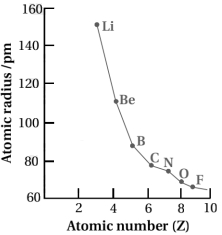
(N/A) The atomic radius decreases as we move from left to right in a period. This is because, as we move along a period, the nuclear charge increases while the electrons are added to the same principal energy shell. This leads to an increase in the effective nuclear charge, which pulls the electrons closer to the nucleus, thereby decreasing the atomic size.
Within a group, the atomic radius increases as we move down the group. This is because a new principal energy shell is added at each succeeding element, which increases the distance between the nucleus and the outermost electrons, outweighing the effect of increased nuclear charge.
Within a group, the atomic radius increases as we move down the group. This is because a new principal energy shell is added at each succeeding element, which increases the distance between the nucleus and the outermost electrons, outweighing the effect of increased nuclear charge.
| Atom (Period $II$) | $Li, Be, B, C, N, O, F$ |
| Atomic radius $(pm)$ | $152, 111, 88, 77, 74, 66, 64$ |
| Atom (Period $III$) | $Na, Mg, Al, Si, P, S, Cl$ |
| Atomic radius $(pm)$ | $186, 160, 143, 117, 110, 104, 99$ |
0 likes
View Solution176
Medium
Explain the measurement methods of atomic radius.
Solution
(N/A) There is no direct method to measure the absolute size of an individual atom.
The size of an atom is extremely small,approximately $1.2 \ \mathring{A}$ (i.e.,$1.2 \times 10^{-10} \ m$).
Since the electron cloud surrounding the nucleus does not have a sharp,well-defined boundary,the determination of an exact atomic size is not possible.
Consequently,there is no practical way to measure the size of an isolated atom.
Instead,atomic radius is defined as covalent or metallic radius,which is determined experimentally using techniques such as $X$-ray diffraction or spectroscopic methods.
The size of an atom is extremely small,approximately $1.2 \ \mathring{A}$ (i.e.,$1.2 \times 10^{-10} \ m$).
Since the electron cloud surrounding the nucleus does not have a sharp,well-defined boundary,the determination of an exact atomic size is not possible.
Consequently,there is no practical way to measure the size of an isolated atom.
Instead,atomic radius is defined as covalent or metallic radius,which is determined experimentally using techniques such as $X$-ray diffraction or spectroscopic methods.
0 likes
View Solution177
Medium
What is the method to estimate the volume of an individual atom?
Solution
(N/A) There is no direct practical way to measure the size or volume of an individual atom because the electron cloud does not have a sharp boundary.
However,the size of an atom can be estimated by measuring the distance between atoms in a bonded state. The three common methods are:
$1$. Metallic radius: Used for metals,defined as half the internuclear distance between two adjacent metal atoms in a metallic lattice.
$2$. Covalent radius: Used for non-metals,defined as half the distance between the nuclei of two atoms bonded by a single covalent bond.
$3$. Van der Waals radius: Used for noble gases and non-bonded atoms,defined as half the distance between the nuclei of two identical non-bonded atoms in a solid state.
However,the size of an atom can be estimated by measuring the distance between atoms in a bonded state. The three common methods are:
$1$. Metallic radius: Used for metals,defined as half the internuclear distance between two adjacent metal atoms in a metallic lattice.
$2$. Covalent radius: Used for non-metals,defined as half the distance between the nuclei of two atoms bonded by a single covalent bond.
$3$. Van der Waals radius: Used for noble gases and non-bonded atoms,defined as half the distance between the nuclei of two identical non-bonded atoms in a solid state.
0 likes
View Solution178
Difficult
Explain covalent radius and ionic radius with examples.
Solution
(N/A) Covalent Radius: It is defined as one-half of the distance between the nuclei of two identical atoms bonded by a single covalent bond in a molecule.
Example: The bond length of $Cl-Cl$ in a $Cl_{2}$ molecule is $198 \ pm$. Therefore, the covalent radius of chlorine is $\frac{198}{2} = 99 \ pm$.
Ionic Radius: It is defined as the effective distance from the center of the nucleus of an ion up to which it has an influence on its electron cloud.
Example: In an ionic crystal like $NaCl$, the distance between the nuclei of $Na^{+}$ and $Cl^{-}$ ions is $276 \ pm$. If the ionic radius of $Cl^{-}$ is $181 \ pm$, then the ionic radius of $Na^{+}$ is $276 - 181 = 95 \ pm$.
Example: The bond length of $Cl-Cl$ in a $Cl_{2}$ molecule is $198 \ pm$. Therefore, the covalent radius of chlorine is $\frac{198}{2} = 99 \ pm$.
Ionic Radius: It is defined as the effective distance from the center of the nucleus of an ion up to which it has an influence on its electron cloud.
Example: In an ionic crystal like $NaCl$, the distance between the nuclei of $Na^{+}$ and $Cl^{-}$ ions is $276 \ pm$. If the ionic radius of $Cl^{-}$ is $181 \ pm$, then the ionic radius of $Na^{+}$ is $276 - 181 = 95 \ pm$.
0 likes
View Solution179
Difficult
What do atomic radius and ionic radius mean? Describe them.
Solution
(N/A) Atomic radius:
- $\rightarrow$ Atomic radius is defined as one-half of the distance between the nuclei of two covalently bonded atoms of the same element in a molecule.
- In the case of metals,the atomic radius is referred to as the metallic radius,which corresponds to one-half of the distance between two adjacent atoms in a metallic crystal lattice.
Ionic radius:
- $\rightarrow$ Ionic radius refers to the effective size of an ion (cation or anion).
- It represents the distance from the nucleus of the ion to the point where it exerts an influence in an ionic bond.
- The size of a cation is always smaller than its parent atom due to the loss of electrons and increased effective nuclear charge,whereas the size of an anion is always larger than its parent atom due to increased electron-electron repulsion.
- $\rightarrow$ Atomic radius is defined as one-half of the distance between the nuclei of two covalently bonded atoms of the same element in a molecule.
- In the case of metals,the atomic radius is referred to as the metallic radius,which corresponds to one-half of the distance between two adjacent atoms in a metallic crystal lattice.
Ionic radius:
- $\rightarrow$ Ionic radius refers to the effective size of an ion (cation or anion).
- It represents the distance from the nucleus of the ion to the point where it exerts an influence in an ionic bond.
- The size of a cation is always smaller than its parent atom due to the loss of electrons and increased effective nuclear charge,whereas the size of an anion is always larger than its parent atom due to increased electron-electron repulsion.
0 likes
View Solution180
Medium
Explain why cations are smaller and anions larger in radii than their parent atoms.
Solution
(N/A) Radius of positive ion $(cation)$: An atom loses electrons to form a positive ion. The size of the positive ion is smaller than its parent atom.
This is because the positive ion has fewer electrons than the parent atom, while the nuclear charge remains the same. Consequently, the remaining electrons experience a greater effective nuclear charge, pulling them closer to the nucleus.
Example: The radius of a sodium atom is $186 \ pm$, whereas the radius of a $Na^{+}$ ion is $95 \ pm$.
Radius of negative ion $(anion)$: When an atom gains an electron, it becomes a negative ion. The size of the negative ion is larger than its parent atom.
This is because when one or more electrons are added to the parent atom, the inter-electronic repulsion increases, and the effective nuclear charge per electron decreases, causing the electron cloud to expand.
Example: The radius of a fluorine atom is $95 \ pm$, whereas the radius of a fluoride ion $(F^{-})$ is $136 \ pm$.
This is because the positive ion has fewer electrons than the parent atom, while the nuclear charge remains the same. Consequently, the remaining electrons experience a greater effective nuclear charge, pulling them closer to the nucleus.
Example: The radius of a sodium atom is $186 \ pm$, whereas the radius of a $Na^{+}$ ion is $95 \ pm$.
Radius of negative ion $(anion)$: When an atom gains an electron, it becomes a negative ion. The size of the negative ion is larger than its parent atom.
This is because when one or more electrons are added to the parent atom, the inter-electronic repulsion increases, and the effective nuclear charge per electron decreases, causing the electron cloud to expand.
Example: The radius of a fluorine atom is $95 \ pm$, whereas the radius of a fluoride ion $(F^{-})$ is $136 \ pm$.
0 likes
View Solution181
Medium
Consider the following species: $N^{3-}, O^{2-}, F^{-}, Na^{+}, Mg^{2+}, Al^{3+}$
$(a)$ What is common in them?
$(b)$ Arrange them in the order of increasing ionic radii.
$(a)$ What is common in them?
$(b)$ Arrange them in the order of increasing ionic radii.
Solution
(N/A) All these ions have the same number $(10)$ of electrons. Therefore,these are called isoelectronic species.
$(b)$ Since the number of electrons is the same,the ionic size decreases with an increase in nuclear charge. Therefore,the ions can be arranged in increasing order of ionic radii as $Al^{3+} < Mg^{2+} < Na^{+} < F^{-} < O^{2-} < N^{3-}$.
$(b)$ Since the number of electrons is the same,the ionic size decreases with an increase in nuclear charge. Therefore,the ions can be arranged in increasing order of ionic radii as $Al^{3+} < Mg^{2+} < Na^{+} < F^{-} < O^{2-} < N^{3-}$.
0 likes
View Solution182
Medium
Describe the theory associated with the radius of an atom as it:
$(a)$ Gains an electron
$(b)$ Loses an electron
$(a)$ Gains an electron
$(b)$ Loses an electron
Solution
(N/A) The atomic radius is defined based on the nature of the bond,such as metallic radius or covalent radius,which is half the internuclear distance between bonded atoms.
$(a)$ When an atom gains an electron,it forms a negative ion (anion). The radius of an anion is always larger than that of its parent neutral atom. This is because the addition of one or more electrons increases the electron-electron repulsion,while the effective nuclear charge $(Z_{eff})$ decreases,causing the electron cloud to expand.
$(b)$ When an atom loses an electron,it forms a positive ion (cation). The radius of a cation is always smaller than that of its parent neutral atom. This is because the loss of electrons results in a higher effective nuclear charge per remaining electron,pulling the electron cloud closer to the nucleus.
In summary,for isoelectronic species: $\text{radius of cation} < \text{radius of neutral atom} < \text{radius of anion}$.
$(a)$ When an atom gains an electron,it forms a negative ion (anion). The radius of an anion is always larger than that of its parent neutral atom. This is because the addition of one or more electrons increases the electron-electron repulsion,while the effective nuclear charge $(Z_{eff})$ decreases,causing the electron cloud to expand.
$(b)$ When an atom loses an electron,it forms a positive ion (cation). The radius of a cation is always smaller than that of its parent neutral atom. This is because the loss of electrons results in a higher effective nuclear charge per remaining electron,pulling the electron cloud closer to the nucleus.
In summary,for isoelectronic species: $\text{radius of cation} < \text{radius of neutral atom} < \text{radius of anion}$.
0 likes
View Solution183
Medium
Arrange $K^{+}$,$Cl^{-}$,$S^{2-}$,and $Ca^{2+}$ in decreasing order of their ionic radii with an explanation.
Solution
(A) The ions $K^{+}$,$Cl^{-}$,$S^{2-}$,and $Ca^{2+}$ are isoelectronic,meaning they all contain $18$ electrons.
For isoelectronic species,the ionic radius decreases as the nuclear charge (number of protons) increases.
$S^{2-}$ has $16$ protons.
$Cl^{-}$ has $17$ protons.
$K^{+}$ has $19$ protons.
$Ca^{2+}$ has $20$ protons.
As the number of protons increases,the effective nuclear charge increases,which pulls the electron cloud closer to the nucleus,resulting in a smaller ionic radius.
Therefore,the decreasing order of ionic radii is: $S^{2-} > Cl^{-} > K^{+} > Ca^{2+}$.
For isoelectronic species,the ionic radius decreases as the nuclear charge (number of protons) increases.
$S^{2-}$ has $16$ protons.
$Cl^{-}$ has $17$ protons.
$K^{+}$ has $19$ protons.
$Ca^{2+}$ has $20$ protons.
As the number of protons increases,the effective nuclear charge increases,which pulls the electron cloud closer to the nucleus,resulting in a smaller ionic radius.
Therefore,the decreasing order of ionic radii is: $S^{2-} > Cl^{-} > K^{+} > Ca^{2+}$.
0 likes
View Solution184
MediumMCQ
Choose the correct order of atomic radii of fluorine and neon (in $pm$) out of the options given below and justify your answer.
A
$F < Ne$
B
$F > Ne$
C
$F = Ne$
D
$F \approx Ne$
Solution
(A) The atomic radius of $F$ is measured as a covalent radius, whereas the atomic radius of $Ne$ is measured as a van der Waals' radius.
By definition, the van der Waals' radius is always larger than the covalent radius for a given element.
Therefore, the atomic radius of $F$ is smaller than the atomic radius of $Ne$ ($F = 72 \ pm$, $Ne = 160 \ pm$).
The correct order is $F < Ne$.
By definition, the van der Waals' radius is always larger than the covalent radius for a given element.
Therefore, the atomic radius of $F$ is smaller than the atomic radius of $Ne$ ($F = 72 \ pm$, $Ne = 160 \ pm$).
The correct order is $F < Ne$.
0 likes
View Solution185
Medium
The radius of $Na^{+}$ cation is less than that of $Na$ atom. Give reason.
Solution
(N/A) For the formation of a cation, there is a loss of an electron, which means its radius decreases. Due to the decrease in the number of electrons, the nuclear pull per electron increases.
As a result, the radius of the cation decreases as the effective nuclear charge increases. For example, the ionic radius of $Na^{+}$ is smaller than that of the parent atom $Na$.
$Na \longrightarrow Na^{+} + 1e^{-}$
Electrons: $11, 10$
Nuclear charge: $11, 11$
Ionic size: $186 \text{ pm}, 95 \text{ pm}$
$(1 \text{ pm} = 10^{-12} \text{ m})$
As a result, the radius of the cation decreases as the effective nuclear charge increases. For example, the ionic radius of $Na^{+}$ is smaller than that of the parent atom $Na$.
$Na \longrightarrow Na^{+} + 1e^{-}$
Electrons: $11, 10$
Nuclear charge: $11, 11$
Ionic size: $186 \text{ pm}, 95 \text{ pm}$
$(1 \text{ pm} = 10^{-12} \text{ m})$
0 likes
View Solution186
Difficult
Explain covalent radius and van der Waals radius.
Solution
(N/A) Covalent radius:
- The covalent radius is defined as one-half of the distance between the nuclei of two identical atoms bonded by a single covalent bond in a molecule.
- For a heteronuclear molecule $AB$, the bond length $d_{AB}$ is given by $d_{AB} = r_A + r_B$, where $r_A$ and $r_B$ are the covalent radii of atoms $A$ and $B$ respectively.
- Example: The bond length in $Cl_2$ is $198 \ pm$, so the covalent radius of $Cl$ is $198 \div 2 = 99 \ pm$.
van der Waals radius:
- The van der Waals radius represents the overall size of an atom, including its valence shell, in a non-bonded state.
- It is defined as one-half of the distance between the nuclei of two identical atoms belonging to neighboring molecules of an element in the solid state.
- The covalent radius is defined as one-half of the distance between the nuclei of two identical atoms bonded by a single covalent bond in a molecule.
- For a heteronuclear molecule $AB$, the bond length $d_{AB}$ is given by $d_{AB} = r_A + r_B$, where $r_A$ and $r_B$ are the covalent radii of atoms $A$ and $B$ respectively.
- Example: The bond length in $Cl_2$ is $198 \ pm$, so the covalent radius of $Cl$ is $198 \div 2 = 99 \ pm$.
van der Waals radius:
- The van der Waals radius represents the overall size of an atom, including its valence shell, in a non-bonded state.
- It is defined as one-half of the distance between the nuclei of two identical atoms belonging to neighboring molecules of an element in the solid state.
0 likes
View Solution187
EasyMCQ
Arrange all elements of group $1$ in increasing order of their ionic radius.
A
$Li^{+} < Na^{+} < K^{+} < Rb^{+} < Cs^{+} < Fr^{+}$
B
$Fr^{+} < Cs^{+} < Rb^{+} < K^{+} < Na^{+} < Li^{+}$
C
$Li^{+} < K^{+} < Na^{+} < Rb^{+} < Fr^{+} < Cs^{+}$
D
$Na^{+} < Li^{+} < K^{+} < Cs^{+} < Rb^{+} < Fr^{+}$
Solution
(A) In a group,as we move from top to bottom,the number of shells increases,which leads to an increase in the atomic and ionic size.
Therefore,the ionic radius increases with an increase in the atomic number.
The correct order of ionic radius for group $1$ elements is:
$Li^{+} < Na^{+} < K^{+} < Rb^{+} < Cs^{+} < Fr^{+}$
Therefore,the ionic radius increases with an increase in the atomic number.
The correct order of ionic radius for group $1$ elements is:
$Li^{+} < Na^{+} < K^{+} < Rb^{+} < Cs^{+} < Fr^{+}$
0 likes
View Solution188
EasyMCQ
How would you explain the lower atomic radius of $Ga$ as compared to $Al$?
A
Due to higher nuclear charge
B
Due to poor shielding effect of $3d$-electrons
C
Due to lanthanoid contraction
D
Due to smaller size of $Ga$ atom
Solution
(B) Although $Ga$ has one shell more than $Al$,its atomic radius is slightly smaller than that of $Al$.
This is due to the poor shielding effect of the $3d$-electrons.
The $d$-electrons do not shield the valence electrons effectively from the nuclear charge.
Consequently,the effective nuclear charge experienced by the valence electrons in $Ga$ is significantly higher than in $Al$,which pulls the valence shell closer to the nucleus.
This is due to the poor shielding effect of the $3d$-electrons.
The $d$-electrons do not shield the valence electrons effectively from the nuclear charge.
Consequently,the effective nuclear charge experienced by the valence electrons in $Ga$ is significantly higher than in $Al$,which pulls the valence shell closer to the nucleus.
0 likes
View Solution189
Easy
Why are the radii of $_{11}Na$ and $_{20}Ca$ larger compared to $_{12}Mg$?
Solution
(N/A) $1$. Across a period from left to right,the effective nuclear charge increases,which causes the atomic and ionic radii to decrease. Since $_{11}Na$ is to the left of $_{12}Mg$ in the same period,$_{11}Na$ has a larger radius than $_{12}Mg$.
$2$. Down a group,the number of shells increases,leading to an increase in atomic and ionic radii. Since $_{20}Ca$ is in the same group as $_{12}Mg$ but is located below it,$_{20}Ca$ has a larger radius than $_{12}Mg$.
$2$. Down a group,the number of shells increases,leading to an increase in atomic and ionic radii. Since $_{20}Ca$ is in the same group as $_{12}Mg$ but is located below it,$_{20}Ca$ has a larger radius than $_{12}Mg$.
0 likes
View Solution190
MediumMCQ
How does the atomic radius change across a period in the periodic table?
A
It increases
B
It decreases
C
It remains constant
D
It first increases then decreases
Solution
(B) Across a period from left to right,the atomic radius decreases.
This is because the nuclear charge increases as the number of protons increases,while the electrons are added to the same principal energy shell.
The increased nuclear attraction pulls the electron cloud closer to the nucleus,resulting in a smaller atomic radius.
This is because the nuclear charge increases as the number of protons increases,while the electrons are added to the same principal energy shell.
The increased nuclear attraction pulls the electron cloud closer to the nucleus,resulting in a smaller atomic radius.
0 likes
View Solution191
MediumMCQ
How does the atomic radius change down a group in the periodic table?
A
It increases.
B
It decreases.
C
It remains constant.
D
It first increases and then decreases.
Solution
(A) As we move down a group in the periodic table,a new principal energy shell $(n)$ is added for each successive element.
This increases the distance between the nucleus and the outermost valence electrons.
Although the nuclear charge increases,the effect of the additional shell (shielding effect) outweighs the increase in nuclear charge,resulting in an increase in the atomic radius.
This increases the distance between the nucleus and the outermost valence electrons.
Although the nuclear charge increases,the effect of the additional shell (shielding effect) outweighs the increase in nuclear charge,resulting in an increase in the atomic radius.
0 likes
View Solution192
EasyMCQ
Define covalent radius and metallic radius.
A
Covalent radius is the distance between the nuclei of two bonded atoms in a molecule,while metallic radius is half the distance between the nuclei of two adjacent metal atoms in a metallic lattice.
B
Covalent radius is the radius of an atom in a crystal lattice,while metallic radius is the radius of an atom in a covalent bond.
C
Both radii are identical and represent the distance between the nuclei of two atoms.
D
Covalent radius is the distance between the nucleus and the outermost shell,while metallic radius is the distance between the nucleus and the valence electrons.
Solution
(A) $1$. $Covalent \ radius$: It is defined as one-half of the distance between the nuclei of two identical atoms bonded by a single covalent bond in a molecule. For example,in $Cl_2$ molecule,the distance between two $Cl$ nuclei is $198 \ pm$,so the covalent radius is $99 \ pm$.
$2$. $Metallic \ radius$: It is defined as one-half of the internuclear distance between two adjacent metal atoms in a metallic crystal lattice. For example,the distance between two adjacent $Cu$ atoms in a metallic crystal is $256 \ pm$,so the metallic radius is $128 \ pm$.
$2$. $Metallic \ radius$: It is defined as one-half of the internuclear distance between two adjacent metal atoms in a metallic crystal lattice. For example,the distance between two adjacent $Cu$ atoms in a metallic crystal is $256 \ pm$,so the metallic radius is $128 \ pm$.
0 likes
View Solution193
Medium
How is the atomic radius measured? Describe it.
Solution
(N/A) The atomic radius is measured using $X$-ray diffraction or spectroscopic methods. These techniques allow for the determination of the internuclear distance between bonded atoms,from which the atomic radius can be calculated.
0 likes
View Solution194
Medium
Arrange the following elements in the increasing order of their atomic radii:
$(i)$ $O, N, F, B, Be, Li, C$
$(ii)$ $P, S, Mg, Na, Al, Si, Cl$
$(iii)$ $K, Na, Li, Cs, Rb$
$(iv)$ $Cl, F, I, At, Br$
$(i)$ $O, N, F, B, Be, Li, C$
$(ii)$ $P, S, Mg, Na, Al, Si, Cl$
$(iii)$ $K, Na, Li, Cs, Rb$
$(iv)$ $Cl, F, I, At, Br$
Solution
(A) Atomic radius decreases across a period from left to right and increases down a group.
$(i)$ These elements belong to the $2^{nd}$ period. The order of increasing atomic radius is: $F < O < N < C < B < Be < Li$.
$(ii)$ These elements belong to the $3^{rd}$ period. The order of increasing atomic radius is: $Cl < S < P < Si < Al < Mg < Na$.
$(iii)$ These elements belong to Group $1$. The order of increasing atomic radius is: $Li < Na < K < Rb < Cs$.
$(iv)$ These elements belong to Group $17$. The order of increasing atomic radius is: $F < Cl < Br < I < At$.
$(i)$ These elements belong to the $2^{nd}$ period. The order of increasing atomic radius is: $F < O < N < C < B < Be < Li$.
$(ii)$ These elements belong to the $3^{rd}$ period. The order of increasing atomic radius is: $Cl < S < P < Si < Al < Mg < Na$.
$(iii)$ These elements belong to Group $1$. The order of increasing atomic radius is: $Li < Na < K < Rb < Cs$.
$(iv)$ These elements belong to Group $17$. The order of increasing atomic radius is: $F < Cl < Br < I < At$.
0 likes
View Solution195
EasyMCQ
Arrange the elements $S, O, Na,$ and $Li$ in the decreasing order of their atomic radii.
A
$Na > Li > S > O$
B
$Li > Na > S > O$
C
$O > S > Li > Na$
D
$Na > S > Li > O$
Solution
(A) The atomic radius increases down a group and decreases across a period from left to right.
$Na$ $(Group \ 1, Period \ 3)$ has the largest radius.
$Li$ $(Group \ 1, Period \ 2)$ is smaller than $Na$.
$S$ $(Group \ 16, Period \ 3)$ is smaller than $Li$ because it is to the right of $Na$ in the same period.
$O$ $(Group \ 16, Period \ 2)$ is the smallest as it is at the top right of the given elements.
Thus,the decreasing order is $Na > Li > S > O$.
$Na$ $(Group \ 1, Period \ 3)$ has the largest radius.
$Li$ $(Group \ 1, Period \ 2)$ is smaller than $Na$.
$S$ $(Group \ 16, Period \ 3)$ is smaller than $Li$ because it is to the right of $Na$ in the same period.
$O$ $(Group \ 16, Period \ 2)$ is the smallest as it is at the top right of the given elements.
Thus,the decreasing order is $Na > Li > S > O$.
0 likes
View Solution196
EasyMCQ
What is atomic radius in reality?
A
Distance between the nucleus and the outermost shell.
B
It is the metallic radius in metals,covalent radius in non-metals,and van der Waals radius in noble gases.
C
The radius of an atom in its gaseous state.
D
The radius of an atom in its ionic state.
Solution
(B) In reality,atomic radius is defined based on the nature of the element:
$1$. In metals,it is the $ \text{metallic radius} $.
$2$. In non-metals,it is the $ \text{covalent radius} $.
$3$. In noble gases,it is the $ \text{van der Waals radius} $.
$1$. In metals,it is the $ \text{metallic radius} $.
$2$. In non-metals,it is the $ \text{covalent radius} $.
$3$. In noble gases,it is the $ \text{van der Waals radius} $.
0 likes
View Solution197
EasyMCQ
The bond length in $Cl_2$ is $198 \ pm$. Calculate the atomic radius of chlorine. (in $pm$)
A
$99$
B
$198$
C
$396$
D
$49.5$
Solution
(A) Chlorine is a non-metal, so its atomic radius is defined as the covalent radius, which is half of the bond length of the $Cl-Cl$ bond in the $Cl_2$ molecule.
$\text{Atomic radius} = \frac{\text{Bond length}}{2}$
$\text{Atomic radius} = \frac{198 \ pm}{2} = 99 \ pm$
$\text{Atomic radius} = \frac{\text{Bond length}}{2}$
$\text{Atomic radius} = \frac{198 \ pm}{2} = 99 \ pm$
0 likes
View Solution198
Easy
Among metals,non-metals,and noble gases,which one has the largest atomic radius? Why?
Solution
(C) Noble gases have the largest atomic radius.
This is because the atomic radius of noble gases is measured as the $Van der Waals$ radius.
Since noble gases exist as monoatomic gases,their $Van der Waals$ radius is significantly larger than the covalent or metallic radii of other elements.
This is because the atomic radius of noble gases is measured as the $Van der Waals$ radius.
Since noble gases exist as monoatomic gases,their $Van der Waals$ radius is significantly larger than the covalent or metallic radii of other elements.
0 likes
View Solution199
EasyMCQ
Between $Mg$ and $Mg^{2+}$,which has a smaller size? Why?
A
$Mg$
B
$Mg^{2+}$
C
Both are equal
D
Cannot be determined
Solution
(B) $Mg^{2+}$ has a smaller size than $Mg$.
This is because $Mg^{2+}$ is a cation formed by the loss of two electrons from the neutral $Mg$ atom.
As the number of electrons decreases while the nuclear charge remains the same,the effective nuclear charge per electron increases,causing the remaining electrons to be pulled more strongly towards the nucleus,resulting in a smaller ionic radius.
This is because $Mg^{2+}$ is a cation formed by the loss of two electrons from the neutral $Mg$ atom.
As the number of electrons decreases while the nuclear charge remains the same,the effective nuclear charge per electron increases,causing the remaining electrons to be pulled more strongly towards the nucleus,resulting in a smaller ionic radius.
0 likes
View Solution200
Easy
Between $Al$ and $Al^{3+}$,which has a smaller radius and why?
Solution
(B) $Al^{3+}$ has a smaller radius. This is because $Al$ is the parent atom of $Al^{3+}$,and $Al^{3+}$ is formed by the removal of $3$ electrons from $Al$. Consequently,the effective nuclear charge increases in $Al^{3+}$,which results in a smaller size compared to the neutral $Al$ atom.
0 likes
View SolutionClassification of Elements and Periodicity in Properties — Atomic and Ionic radii · Frequently Asked Questions
1Are these Classification of Elements and Periodicity in Properties questions useful for JEE and NEET?
Yes. All questions in this section are mapped to JEE Main and NEET exam patterns. Previous year questions from JEE Main, NEET, GUJCET and state-level exams are included with full solutions.
2Can I switch to Hindi or Gujarati for these questions?
Yes. Use the language tabs in the hero section or the sidebar to view the same questions and solutions in English, Hindi or Gujarati.
3How do I generate a question paper from this subtopic?
Use the Vedclass Exam Paper Generator — select the chapter and subtopic, set difficulty, and generate Sets A, B, C, D automatically. First 3 chapters of every subject are free.
Vedclass Products
For Students
Vedclass Test Series
Mock tests in real JEE/NEET style with performance analysis. 5-day free trial.
Start Free TrialFor Teachers
Exam Paper Generator
Generate Set A/B/C/D papers from this chapter in 2 minutes. 3 chapters free.
Try FreeFor Institutes
Online Exam Module
Live online exams with unlimited students, 360° analytics & white-label branding.
See DemoFor Teachers & Institutes
Generate a Classification of Elements and Periodicity in Properties Exam Paper in 2 Minutes
Select subtopic & difficulty — Sets A, B, C, D auto-generated with No Repeat logic.
First 3 chapters of every subject are free — no payment required.