
A English
Types of bonding and Forces in solid Questions in English
Class 11 Chemistry · Chemical Bonding and Molecular Structure · Types of bonding and Forces in solid
161+
Questions
English
Language
100%
With Solutions
Showing 50 of 161 questions in English
101
MediumMCQ
In silicon dioxide $(SiO_2)$:
A
Each $Si$ atom is surrounded by four $O$ atoms and each $O$ atom is bonded to two $Si$ atoms.
B
Each $Si$ atom is surrounded by two $O$ atoms and each $O$ atom is bonded to two $Si$ atoms.
C
Each $O$ atom is bonded to only one $Si$ atom.
D
There are double bonds between $Si$ and $O$ atoms.
Solution
(A) Silicon dioxide $(SiO_2)$ is a covalent network solid.
In its structure,each $Si$ atom is $sp^3$ hybridized and is tetrahedrally bonded to four oxygen atoms.
Each oxygen atom is bonded to two silicon atoms,forming a three-dimensional network structure.
Therefore,the correct statement is that each $Si$ atom is surrounded by four $O$ atoms and each $O$ atom is bonded to two $Si$ atoms.
In its structure,each $Si$ atom is $sp^3$ hybridized and is tetrahedrally bonded to four oxygen atoms.
Each oxygen atom is bonded to two silicon atoms,forming a three-dimensional network structure.
Therefore,the correct statement is that each $Si$ atom is surrounded by four $O$ atoms and each $O$ atom is bonded to two $Si$ atoms.
0 likes
View Solution102
MediumMCQ
Sodium sulfate is soluble in water,whereas barium sulfate is sparingly soluble because,...
A
$Na_2SO_4$ has a hydration energy greater than its lattice energy,while $BaSO_4$ has a lattice energy greater than its hydration energy.
B
Lattice energy has no significance in the case of solubility.
C
The lattice energy of $Na_2SO_4$ is greater than its hydration energy.
D
None of these
Solution
(A) The solubility of an ionic compound in water depends on the balance between its lattice energy and hydration energy.
For a compound to be soluble,the hydration energy must be greater than the lattice energy.
In the case of $Na_2SO_4$,the hydration energy of the ions is sufficient to overcome the lattice energy,making it soluble.
In the case of $BaSO_4$,the lattice energy is significantly higher than the hydration energy due to the high charge density and size factors,making it sparingly soluble.
For a compound to be soluble,the hydration energy must be greater than the lattice energy.
In the case of $Na_2SO_4$,the hydration energy of the ions is sufficient to overcome the lattice energy,making it soluble.
In the case of $BaSO_4$,the lattice energy is significantly higher than the hydration energy due to the high charge density and size factors,making it sparingly soluble.
0 likes
View Solution103
MediumMCQ
The compound,found in nature in gas phase but ionic in solid state is
A
$PCl_5$
B
$CCl_4$
C
$PCl_3$
D
$POCl_3$
Solution
(A) $PCl_5$ exists as a covalent molecule in the gas phase.
However,in the solid state,it exists in an ionic form as $[PCl_4]^+ [PCl_6]^-$.
The cation $[PCl_4]^+$ has a tetrahedral geometry,while the anion $[PCl_6]^-$ has an octahedral geometry.
However,in the solid state,it exists in an ionic form as $[PCl_4]^+ [PCl_6]^-$.
The cation $[PCl_4]^+$ has a tetrahedral geometry,while the anion $[PCl_6]^-$ has an octahedral geometry.
0 likes
View Solution104
MediumMCQ
Inert gases are mixed in iodine vapours. Then there are . . . . . . between them.
A
$H$-bonding
B
van der Waals forces
C
Electrostatic forces
D
Metallic bonds
Solution
(B) All molecules exhibit short-range London dispersion forces,which are a type of van der Waals forces.
When inert gases are mixed with iodine vapours,these short-range London dispersion forces exist between them.
When inert gases are mixed with iodine vapours,these short-range London dispersion forces exist between them.
0 likes
View Solution105
MediumMCQ
The relative strength of interionic/ intermolecular forces in decreasing order is:
A
$Ion-dipole > Ion-ion > Dipole-dipole$
B
$Dipole-dipole > Ion-dipole > Ion-ion$
C
$Ion-dipole > Dipole-dipole > Ion-ion$
D
$Ion-ion > Ion-dipole > Dipole-dipole$
Solution
(D) The strength of interionic/intermolecular forces is directly proportional to the magnitude of the charges involved.
$1$. $Ion-ion$ interactions involve full ionic charges,which are the strongest.
$2$. $Ion-dipole$ interactions involve a full ionic charge and a partial dipole charge.
$3$. $Dipole-dipole$ interactions involve only partial charges,making them the weakest among the three.
Therefore,the decreasing order of strength is $Ion-ion > Ion-dipole > Dipole-dipole$.
Hence,option $D$ is correct.
$1$. $Ion-ion$ interactions involve full ionic charges,which are the strongest.
$2$. $Ion-dipole$ interactions involve a full ionic charge and a partial dipole charge.
$3$. $Dipole-dipole$ interactions involve only partial charges,making them the weakest among the three.
Therefore,the decreasing order of strength is $Ion-ion > Ion-dipole > Dipole-dipole$.
Hence,option $D$ is correct.
0 likes
View Solution106
MediumMCQ
$X$ melts at a low temperature and is a bad conductor of electricity in both liquid and solid states. $X$ is:
A
$Carbon$ $tetrachloride$ $(CCl_4)$
B
$Mercury$ $(Hg)$
C
$Silicon$ $carbide$ $(SiC)$
D
$Zinc$ $sulphide$ $(ZnS)$
Solution
(A) $CCl_4$ is a molecular solid held together by weak van der Waals forces,which explains its low melting point.
Since it consists of neutral molecules and lacks free ions or delocalized electrons,it is a poor conductor of electricity in both solid and liquid states.
Since it consists of neutral molecules and lacks free ions or delocalized electrons,it is a poor conductor of electricity in both solid and liquid states.
0 likes
View Solution107
Difficult
What are intermolecular forces and van der Waals forces? Which forces are not included in them? Explain their types and uses.
Solution
(N/A) Intermolecular forces are the forces of attraction and repulsion between interacting particles.
These forces do not include electrostatic forces between oppositely charged ions (ion-ion interactions) and the forces that hold atoms together within a molecule (covalent bonds).
Van der Waals forces are attractive intermolecular forces named after the Dutch scientist Johannes van der Waals $(1837-1923)$,who used them to explain the deviation of real gases from ideal behavior.
The following forces are not considered van der Waals forces:
$(i)$ Ion-dipole forces (attraction between an ion and a dipole).
$(ii)$ Intramolecular forces (covalent bonds).
Types of van der Waals forces:
$(i)$ Dispersion forces or London forces: Arise due to temporary dipoles in non-polar molecules.
$(ii)$ Dipole-dipole forces: Exist between molecules with permanent dipoles.
$(iii)$ Dipole-induced dipole forces: Exist between a polar molecule and a non-polar molecule.
Uses: These forces are fundamental in explaining the physical states of matter,the deviation of real gases from the ideal gas law,and the properties of liquids and solids.
These forces do not include electrostatic forces between oppositely charged ions (ion-ion interactions) and the forces that hold atoms together within a molecule (covalent bonds).
Van der Waals forces are attractive intermolecular forces named after the Dutch scientist Johannes van der Waals $(1837-1923)$,who used them to explain the deviation of real gases from ideal behavior.
The following forces are not considered van der Waals forces:
$(i)$ Ion-dipole forces (attraction between an ion and a dipole).
$(ii)$ Intramolecular forces (covalent bonds).
Types of van der Waals forces:
$(i)$ Dispersion forces or London forces: Arise due to temporary dipoles in non-polar molecules.
$(ii)$ Dipole-dipole forces: Exist between molecules with permanent dipoles.
$(iii)$ Dipole-induced dipole forces: Exist between a polar molecule and a non-polar molecule.
Uses: These forces are fundamental in explaining the physical states of matter,the deviation of real gases from the ideal gas law,and the properties of liquids and solids.
0 likes
View Solution108
Medium
Explain the formation of London forces.
Solution
(N/A) Atoms and nonpolar molecules are electrically symmetrical and have no dipole moment because their electronic charge cloud is symmetrically distributed.
However,a dipole may develop momentarily even in such atoms and molecules.
Suppose we have two atoms $A$ and $B$ in the close vicinity of each other.
In the initial state,there is a symmetrical distribution of the electronic charge cloud (see figure $a$).
It may so happen that momentarily,the electronic charge distribution in one of the atoms,say $A$,becomes unsymmetrical,i.e.,the charge cloud is more on one side than the other. This creates an instantaneous dipole in atom $A$.
This instantaneous dipole in atom $A$ distorts the electronic charge cloud of the neighboring atom $B$,thereby inducing a dipole in it. This is called an induced dipole.
The temporary attractive force between the instantaneous dipole and the induced dipole is known as the London dispersion force (see figures $b$ and $c$).
However,a dipole may develop momentarily even in such atoms and molecules.
Suppose we have two atoms $A$ and $B$ in the close vicinity of each other.
In the initial state,there is a symmetrical distribution of the electronic charge cloud (see figure $a$).
It may so happen that momentarily,the electronic charge distribution in one of the atoms,say $A$,becomes unsymmetrical,i.e.,the charge cloud is more on one side than the other. This creates an instantaneous dipole in atom $A$.
This instantaneous dipole in atom $A$ distorts the electronic charge cloud of the neighboring atom $B$,thereby inducing a dipole in it. This is called an induced dipole.
The temporary attractive force between the instantaneous dipole and the induced dipole is known as the London dispersion force (see figures $b$ and $c$).
0 likes
View Solution109
Medium
What is London force? Give its characteristics.
Solution
(N/A) London force: The weak attractive forces present between symmetric atoms or non-polar molecules are known as London forces or dispersion forces.
This force of attraction was first proposed by the German physicist Fritz London, and for this reason, the force of attraction between two temporary dipoles is known as London force.
Characteristics:
- Another name for this force is dispersion force.
- It is present between symmetric atoms or non-polar molecules, e.g., $H_2, Cl_2, P_4, CH_4, CCl_4, C_6H_6$.
- These are always attractive in nature.
- The interaction energy is inversely proportional to the sixth power of the distance between two interacting particles, i.e., $E \propto 1/r^6$, where $r$ is the distance between two particles.
- These forces are significant only at short distances $(\sim 500 \ pm)$ and their magnitude depends on the polarisability of the particle.
This force of attraction was first proposed by the German physicist Fritz London, and for this reason, the force of attraction between two temporary dipoles is known as London force.
Characteristics:
- Another name for this force is dispersion force.
- It is present between symmetric atoms or non-polar molecules, e.g., $H_2, Cl_2, P_4, CH_4, CCl_4, C_6H_6$.
- These are always attractive in nature.
- The interaction energy is inversely proportional to the sixth power of the distance between two interacting particles, i.e., $E \propto 1/r^6$, where $r$ is the distance between two particles.
- These forces are significant only at short distances $(\sim 500 \ pm)$ and their magnitude depends on the polarisability of the particle.
0 likes
View Solution110
Medium
Explain London dispersion forces in detail.
Solution
(N/A) London dispersion forces are weak intermolecular forces that arise due to the motion of electrons in atoms and nonpolar molecules.
$1$. Atoms and nonpolar molecules are electrically symmetrical and have no permanent dipole moment because their electronic charge cloud is symmetrically distributed.
$2$. However,a dipole may develop momentarily even in such atoms and molecules. Suppose we have two atoms '$A$' and '$B$' in close proximity.
$3$. It may happen that momentarily,the electronic charge distribution in one of the atoms,say '$A$',becomes unsymmetrical,meaning the charge cloud is more concentrated on one side than the other. This creates an 'instantaneous dipole'.
$4$. This instantaneous dipole in atom '$A$' creates an electric field that distorts the electron cloud of the neighboring atom '$B$',inducing a dipole in it. This is called an 'induced dipole'.
$5$. The attraction between the instantaneous dipole and the induced dipole is known as the London dispersion force. These forces are always attractive and their magnitude depends on the polarizability of the atoms or molecules.
$1$. Atoms and nonpolar molecules are electrically symmetrical and have no permanent dipole moment because their electronic charge cloud is symmetrically distributed.
$2$. However,a dipole may develop momentarily even in such atoms and molecules. Suppose we have two atoms '$A$' and '$B$' in close proximity.
$3$. It may happen that momentarily,the electronic charge distribution in one of the atoms,say '$A$',becomes unsymmetrical,meaning the charge cloud is more concentrated on one side than the other. This creates an 'instantaneous dipole'.
$4$. This instantaneous dipole in atom '$A$' creates an electric field that distorts the electron cloud of the neighboring atom '$B$',inducing a dipole in it. This is called an 'induced dipole'.
$5$. The attraction between the instantaneous dipole and the induced dipole is known as the London dispersion force. These forces are always attractive and their magnitude depends on the polarizability of the atoms or molecules.
0 likes
View Solution111
Medium
Write a note on Dipole-Induced Dipole forces.
Solution
(N/A) Dipole-induced dipole forces are attractive forces that operate between polar molecules (having a permanent dipole) and non-polar molecules (lacking a permanent dipole).
Formation: When a polar molecule with a permanent dipole approaches a non-polar molecule,it distorts the electronic cloud of the non-polar molecule. This induces a dipole in the previously neutral non-polar molecule.
Mechanism: The permanent dipole of the polar molecule induces a dipole on the electrically neutral molecule by deforming its electronic cloud. Consequently,polarity is developed in the non-polar molecule,leading to attractive forces between the polar molecule $(AB)$ and the induced dipole molecule $(X_2)$.
Characteristics:
- The interaction energy is proportional to $1/r^6$,where $r$ is the distance between the two molecules.
- The induced dipole moment depends on the dipole moment of the permanent dipole and the polarisability of the electrically neutral molecule.
- Higher polarisability increases the strength of attractive interactions.
- In such systems,there is a cumulative effect of dispersion forces and dipole-induced dipole interactions.
Formation: When a polar molecule with a permanent dipole approaches a non-polar molecule,it distorts the electronic cloud of the non-polar molecule. This induces a dipole in the previously neutral non-polar molecule.
Mechanism: The permanent dipole of the polar molecule induces a dipole on the electrically neutral molecule by deforming its electronic cloud. Consequently,polarity is developed in the non-polar molecule,leading to attractive forces between the polar molecule $(AB)$ and the induced dipole molecule $(X_2)$.
Characteristics:
- The interaction energy is proportional to $1/r^6$,where $r$ is the distance between the two molecules.
- The induced dipole moment depends on the dipole moment of the permanent dipole and the polarisability of the electrically neutral molecule.
- Higher polarisability increases the strength of attractive interactions.
- In such systems,there is a cumulative effect of dispersion forces and dipole-induced dipole interactions.
0 likes
View Solution112
Medium
Explain dipole-induced dipole forces.
Solution
(N/A) Dipole-induced dipole forces are attractive forces that arise between a polar molecule (having a permanent dipole) and a non-polar molecule.
When a polar molecule approaches a non-polar molecule,the electric field of the polar molecule distorts the electron cloud of the non-polar molecule.
This distortion causes a temporary separation of charge in the non-polar molecule,creating an induced dipole.
The interaction between the permanent dipole of the polar molecule and the induced dipole of the non-polar molecule results in an attractive force known as dipole-induced dipole force.
The strength of this interaction depends on the dipole moment of the polar molecule and the polarizability of the non-polar molecule.
When a polar molecule approaches a non-polar molecule,the electric field of the polar molecule distorts the electron cloud of the non-polar molecule.
This distortion causes a temporary separation of charge in the non-polar molecule,creating an induced dipole.
The interaction between the permanent dipole of the polar molecule and the induced dipole of the non-polar molecule results in an attractive force known as dipole-induced dipole force.
The strength of this interaction depends on the dipole moment of the polar molecule and the polarizability of the non-polar molecule.
0 likes
View Solution113
Medium
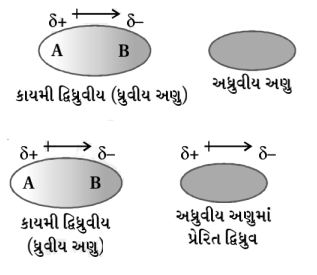
What are dipole-induced dipole forces? Give their characteristics.
Solution
(N/A) Dipole-induced dipole forces occur when a polar molecule (having a permanent dipole) approaches a non-polar molecule.
The permanent dipole of the polar molecule induces a dipole in the non-polar molecule by distorting its electron cloud. This creates a temporary dipole in the previously non-polar molecule.
Characteristics:
$1$. These forces arise due to the interaction between a permanent dipole and an induced dipole.
$2$. The strength of these forces depends on the strength of the permanent dipole (dipole moment) and the polarizability of the non-polar molecule.
$3$. The interaction energy is proportional to $1/r^6$,where $r$ is the distance between the two molecules.
$4$. These forces are generally weaker than dipole-dipole forces but stronger than London dispersion forces.
The permanent dipole of the polar molecule induces a dipole in the non-polar molecule by distorting its electron cloud. This creates a temporary dipole in the previously non-polar molecule.
Characteristics:
$1$. These forces arise due to the interaction between a permanent dipole and an induced dipole.
$2$. The strength of these forces depends on the strength of the permanent dipole (dipole moment) and the polarizability of the non-polar molecule.
$3$. The interaction energy is proportional to $1/r^6$,where $r$ is the distance between the two molecules.
$4$. These forces are generally weaker than dipole-dipole forces but stronger than London dispersion forces.
0 likes
View Solution114
Medium
Give the types of van der Waals forces and explain any one.
Solution
(N/A) The van der Waals forces are primarily categorized into the following types:
$1$. London dispersion forces
$2$. Dipole-dipole forces
$3$. Dipole-induced dipole forces
Explanation of Dipole-Dipole forces:
Dipole-dipole forces act between molecules possessing a permanent dipole. For example,$HCl$,$HF$,$CO$,$NO$,and $NH_{3}$ exhibit these forces.
The ends of the dipoles possess "partial charges" denoted by the Greek letter delta $(\delta)$. These partial charges are always less than the unit electronic charge $(1.6 \times 10^{-19} \ C)$.
Formation: Neighbouring polar molecules interact with each other. Figure $(a)$ shows the electron cloud distribution in a hydrogen chloride dipole,and Figure $(b)$ shows the dipole-dipole interaction between two $HCl$ molecules.
Characteristics:
- This interaction is stronger than London forces but weaker than ion-ion interaction because only partial charges are involved.
- The attractive force decreases as the distance between the dipoles increases.
- The interaction energy is inversely proportional to the distance between polar molecules.
- Dipole-dipole interaction energy between stationary polar molecules (as in solids) is proportional to $1/r^{3}$,and for rotating polar molecules,it is proportional to $1/r^{6}$,where $r$ is the distance between molecules.
- Note: Polar molecules also exhibit London forces; thus,the total intermolecular force is the sum of dipole-dipole and London forces:
$\text{Total attraction} = \text{Dipole-Dipole attraction} + \text{London attraction forces}$
$1$. London dispersion forces
$2$. Dipole-dipole forces
$3$. Dipole-induced dipole forces
Explanation of Dipole-Dipole forces:
Dipole-dipole forces act between molecules possessing a permanent dipole. For example,$HCl$,$HF$,$CO$,$NO$,and $NH_{3}$ exhibit these forces.
The ends of the dipoles possess "partial charges" denoted by the Greek letter delta $(\delta)$. These partial charges are always less than the unit electronic charge $(1.6 \times 10^{-19} \ C)$.
Formation: Neighbouring polar molecules interact with each other. Figure $(a)$ shows the electron cloud distribution in a hydrogen chloride dipole,and Figure $(b)$ shows the dipole-dipole interaction between two $HCl$ molecules.
Characteristics:
- This interaction is stronger than London forces but weaker than ion-ion interaction because only partial charges are involved.
- The attractive force decreases as the distance between the dipoles increases.
- The interaction energy is inversely proportional to the distance between polar molecules.
- Dipole-dipole interaction energy between stationary polar molecules (as in solids) is proportional to $1/r^{3}$,and for rotating polar molecules,it is proportional to $1/r^{6}$,where $r$ is the distance between molecules.
- Note: Polar molecules also exhibit London forces; thus,the total intermolecular force is the sum of dipole-dipole and London forces:
$\text{Total attraction} = \text{Dipole-Dipole attraction} + \text{London attraction forces}$
0 likes
View Solution115
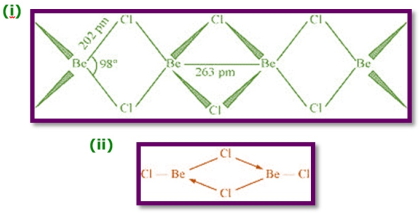
Medium
Draw the structure of
$(i)$ $BeCl_2$ (Solid)
$(ii)$ $BeCl_2$ (Vapour)
$(i)$ $BeCl_2$ (Solid)
$(ii)$ $BeCl_2$ (Vapour)
Solution
(N/A) $(i)$ Structure of $BeCl_2$ (solid):
$BeCl_2$ exists as a polymeric chain structure in the solid state,where each $Be$ atom is $sp^3$ hybridized and bonded to four $Cl$ atoms through chlorine bridges.
$(ii)$ Structure of $BeCl_2$ (vapour):
In the vapour state at high temperatures (around $1200 \ K$),$BeCl_2$ exists as a monomer with a linear structure,where $Be$ is $sp$ hybridized.
$BeCl_2$ exists as a polymeric chain structure in the solid state,where each $Be$ atom is $sp^3$ hybridized and bonded to four $Cl$ atoms through chlorine bridges.
$(ii)$ Structure of $BeCl_2$ (vapour):
In the vapour state at high temperatures (around $1200 \ K$),$BeCl_2$ exists as a monomer with a linear structure,where $Be$ is $sp$ hybridized.
0 likes
View Solution116
Easy
Diamond is covalent,yet it has a high melting point. Why?
Solution
(N/A) Diamond possesses a rigid,three-dimensional network structure where each carbon atom is covalently bonded to four other carbon atoms. This extensive network of strong $C-C$ covalent bonds requires a significant amount of energy to break,resulting in a very high melting point.
0 likes
View Solution117
Easy
Suggest the most important type of intermolecular attractive interaction in the following pairs.
$(i)$ $n$-hexane and $n$-octane
$(ii)$ $I_{2}$ and $CCl_{4}$
$(iii)$ $NaClO_{4}$ and water
$(iv)$ methanol and acetone
$(v)$ acetonitrile $(CH_{3}CN)$ and acetone $(C_{3}H_{6}O)$
$(i)$ $n$-hexane and $n$-octane
$(ii)$ $I_{2}$ and $CCl_{4}$
$(iii)$ $NaClO_{4}$ and water
$(iv)$ methanol and acetone
$(v)$ acetonitrile $(CH_{3}CN)$ and acetone $(C_{3}H_{6}O)$
Solution
(N/A) $(i)$ London dispersion forces (a type of Van der Waal's forces).
$(ii)$ London dispersion forces (a type of Van der Waal's forces).
$(iii)$ Ion-dipole interaction.
$(iv)$ Dipole-dipole interaction.
$(v)$ Dipole-dipole interaction.
$(ii)$ London dispersion forces (a type of Van der Waal's forces).
$(iii)$ Ion-dipole interaction.
$(iv)$ Dipole-dipole interaction.
$(v)$ Dipole-dipole interaction.
0 likes
View Solution118
EasyMCQ
In a diamond,how many other $C$ atoms is each $C$ atom bonded to?
A
$2$
B
$3$
C
$4$
D
$6$
Solution
(C) In the structure of diamond,each carbon atom is $sp^3$ hybridized.
Each carbon atom is covalently bonded to $4$ other carbon atoms,forming a three-dimensional tetrahedral network.
Therefore,the coordination number of carbon in diamond is $4$.
Each carbon atom is covalently bonded to $4$ other carbon atoms,forming a three-dimensional tetrahedral network.
Therefore,the coordination number of carbon in diamond is $4$.
0 likes
View Solution119
Medium
What is lattice enthalpy? Give an example.
Solution
(N/A) Lattice enthalpy of an ionic solid is defined as the energy required to completely separate one mole of a solid ionic compound into its gaseous constituent ions.
Example: The lattice enthalpy of $NaCl$ is $788 \ kJ \ mol^{-1}$. This means that $788 \ kJ$ of energy is required to separate one mole of solid $NaCl$ into one mole of $Na_{(g)}^{+}$ and one mole of $Cl_{(g)}^{-}$ ions at an infinite distance.
Example: The lattice enthalpy of $NaCl$ is $788 \ kJ \ mol^{-1}$. This means that $788 \ kJ$ of energy is required to separate one mole of solid $NaCl$ into one mole of $Na_{(g)}^{+}$ and one mole of $Cl_{(g)}^{-}$ ions at an infinite distance.
0 likes
View Solution120
Difficult
Explain the Born-Haber Cycle.
Solution
Lattice Enthalpy: The lattice enthalpy of an ionic compound is the enthalpy change that occurs when one mole of an ionic compound dissociates into its ions in the gaseous state.
$Na^{+}Cl_{(s)}^{-} \rightarrow Na_{(g)}^{+} + Cl_{(g)}^{-}; \Delta_{\text{lattice}}H^{\ominus} = +788 \ kJ \ mol^{-1}$
The different steps of the formation of $NaCl$ and their related enthalpies can be explained by the Born-Haber cycle as follows:
$(1)$ Sublimation of sodium: $Na_{(s)} \rightarrow Na_{(g)}; \Delta_{\text{sub}}H^{\ominus} = 108.4 \ kJ \ mol^{-1}$
$(2)$ Ionization enthalpy: $Na_{(g)} \rightarrow Na_{(g)}^{+} + e_{(g)}^{-}; \Delta_{\text{i}}H^{\ominus} = 496 \ kJ \ mol^{-1}$
$(3)$ Dissociation of chlorine: $\frac{1}{2} Cl_{2(g)} \rightarrow Cl_{(g)}; \frac{1}{2} \Delta_{\text{bond}}H^{\ominus} = 121 \ kJ \ mol^{-1}$
$(4)$ Electron gain enthalpy: $Cl_{(g)} + e^{-} \rightarrow Cl_{(g)}^{-}; \Delta_{\text{eg}}H^{\ominus} = -348.6 \ kJ \ mol^{-1}$
$(5)$ Lattice enthalpy: $Na_{(g)}^{+} + Cl_{(g)}^{-} \rightarrow Na^{+}Cl_{(s)}^{-}; \Delta_{U}H^{\ominus} = ?$
$(6)$ Enthalpy of formation of $NaCl$: $Na_{(s)} + \frac{1}{2} Cl_{2(g)} \rightarrow NaCl_{(s)}; \Delta_{\text{f}}H^{\ominus} = -411.2 \ kJ \ mol^{-1}$
Applying Hess's law,we get:
$\Delta_{\text{f}}H^{\ominus} = \Delta_{\text{sub}}H^{\ominus} + \Delta_{\text{i}}H^{\ominus} + \frac{1}{2} \Delta_{\text{bond}}H^{\ominus} + \Delta_{\text{eg}}H^{\ominus} + \Delta_{U}H^{\ominus}$
Rearranging for lattice enthalpy $(\Delta_{\text{lattice}}H^{\ominus} = -\Delta_{U}H^{\ominus})$:
$\Delta_{\text{lattice}}H^{\ominus} = \Delta_{\text{f}}H^{\ominus} - (\Delta_{\text{sub}}H^{\ominus} + \Delta_{\text{i}}H^{\ominus} + \frac{1}{2} \Delta_{\text{bond}}H^{\ominus} + \Delta_{\text{eg}}H^{\ominus})$
$= -411.2 - (108.4 + 496 + 121 - 348.6) = -411.2 - 376.8 = -788 \ kJ \ mol^{-1}$ (for formation from ions).
Thus,the lattice enthalpy for dissociation is $+788 \ kJ \ mol^{-1}$.
$Na^{+}Cl_{(s)}^{-} \rightarrow Na_{(g)}^{+} + Cl_{(g)}^{-}; \Delta_{\text{lattice}}H^{\ominus} = +788 \ kJ \ mol^{-1}$
The different steps of the formation of $NaCl$ and their related enthalpies can be explained by the Born-Haber cycle as follows:
$(1)$ Sublimation of sodium: $Na_{(s)} \rightarrow Na_{(g)}; \Delta_{\text{sub}}H^{\ominus} = 108.4 \ kJ \ mol^{-1}$
$(2)$ Ionization enthalpy: $Na_{(g)} \rightarrow Na_{(g)}^{+} + e_{(g)}^{-}; \Delta_{\text{i}}H^{\ominus} = 496 \ kJ \ mol^{-1}$
$(3)$ Dissociation of chlorine: $\frac{1}{2} Cl_{2(g)} \rightarrow Cl_{(g)}; \frac{1}{2} \Delta_{\text{bond}}H^{\ominus} = 121 \ kJ \ mol^{-1}$
$(4)$ Electron gain enthalpy: $Cl_{(g)} + e^{-} \rightarrow Cl_{(g)}^{-}; \Delta_{\text{eg}}H^{\ominus} = -348.6 \ kJ \ mol^{-1}$
$(5)$ Lattice enthalpy: $Na_{(g)}^{+} + Cl_{(g)}^{-} \rightarrow Na^{+}Cl_{(s)}^{-}; \Delta_{U}H^{\ominus} = ?$
$(6)$ Enthalpy of formation of $NaCl$: $Na_{(s)} + \frac{1}{2} Cl_{2(g)} \rightarrow NaCl_{(s)}; \Delta_{\text{f}}H^{\ominus} = -411.2 \ kJ \ mol^{-1}$
Applying Hess's law,we get:
$\Delta_{\text{f}}H^{\ominus} = \Delta_{\text{sub}}H^{\ominus} + \Delta_{\text{i}}H^{\ominus} + \frac{1}{2} \Delta_{\text{bond}}H^{\ominus} + \Delta_{\text{eg}}H^{\ominus} + \Delta_{U}H^{\ominus}$
Rearranging for lattice enthalpy $(\Delta_{\text{lattice}}H^{\ominus} = -\Delta_{U}H^{\ominus})$:
$\Delta_{\text{lattice}}H^{\ominus} = \Delta_{\text{f}}H^{\ominus} - (\Delta_{\text{sub}}H^{\ominus} + \Delta_{\text{i}}H^{\ominus} + \frac{1}{2} \Delta_{\text{bond}}H^{\ominus} + \Delta_{\text{eg}}H^{\ominus})$
$= -411.2 - (108.4 + 496 + 121 - 348.6) = -411.2 - 376.8 = -788 \ kJ \ mol^{-1}$ (for formation from ions).
Thus,the lattice enthalpy for dissociation is $+788 \ kJ \ mol^{-1}$.
0 likes
View Solution121
Difficult
The lattice enthalpy of an ionic compound is the enthalpy change when one mole of an ionic compound in its solid state dissociates into its ions in the gaseous state. It is impossible to determine it directly by experiment. Suggest and explain an indirect method to measure the lattice enthalpy of $NaCl_{(s)}$.
Solution
(A) The lattice enthalpy of an ionic compound is the enthalpy change that occurs when one mole of an ionic compound dissociates into its ions in the gaseous state. For the reaction:
$NaCl_{(s)} \rightarrow Na_{(g)}^{+} + Cl_{(g)}^{-}$; $\Delta_{lattice} H^{\ominus} = +788 \ kJ \ mol^{-1}$
Since it is impossible to determine lattice enthalpies directly by experiment,we use an indirect method by constructing an enthalpy diagram known as the $Born-Haber$ cycle.
We calculate the lattice enthalpy of $NaCl_{(s)}$ using the following steps:
$(I)$ $Na_{(s)} \rightarrow Na_{(g)}$; Sublimation of sodium metal,$\Delta_{sub} H^{\ominus} = 108.4 \ kJ \ mol^{-1}$
$(II)$ $Na_{(g)} \rightarrow Na_{(g)}^{+} + e_{(g)}^{-}$; Ionization of sodium atoms,$\Delta_{i} H^{\ominus} = 496 \ kJ \ mol^{-1}$
$(III)$ $\frac{1}{2} Cl_{2(g)} \rightarrow Cl_{(g)}$; Dissociation of chlorine,$\frac{1}{2} \Delta_{bond} H^{\ominus} = 121 \ kJ \ mol^{-1}$
$(IV)$ $Cl_{(g)} + e_{(g)}^{-} \rightarrow Cl_{(g)}^{-}$; Electron gain by chlorine atoms,$\Delta_{eg} H^{\ominus} = -348.6 \ kJ \ mol^{-1}$
According to Hess's Law,the total enthalpy change for the formation of $NaCl_{(s)}$ from its elements is the sum of these individual steps,allowing us to solve for the lattice enthalpy.
$NaCl_{(s)} \rightarrow Na_{(g)}^{+} + Cl_{(g)}^{-}$; $\Delta_{lattice} H^{\ominus} = +788 \ kJ \ mol^{-1}$
Since it is impossible to determine lattice enthalpies directly by experiment,we use an indirect method by constructing an enthalpy diagram known as the $Born-Haber$ cycle.
We calculate the lattice enthalpy of $NaCl_{(s)}$ using the following steps:
$(I)$ $Na_{(s)} \rightarrow Na_{(g)}$; Sublimation of sodium metal,$\Delta_{sub} H^{\ominus} = 108.4 \ kJ \ mol^{-1}$
$(II)$ $Na_{(g)} \rightarrow Na_{(g)}^{+} + e_{(g)}^{-}$; Ionization of sodium atoms,$\Delta_{i} H^{\ominus} = 496 \ kJ \ mol^{-1}$
$(III)$ $\frac{1}{2} Cl_{2(g)} \rightarrow Cl_{(g)}$; Dissociation of chlorine,$\frac{1}{2} \Delta_{bond} H^{\ominus} = 121 \ kJ \ mol^{-1}$
$(IV)$ $Cl_{(g)} + e_{(g)}^{-} \rightarrow Cl_{(g)}^{-}$; Electron gain by chlorine atoms,$\Delta_{eg} H^{\ominus} = -348.6 \ kJ \ mol^{-1}$
According to Hess's Law,the total enthalpy change for the formation of $NaCl_{(s)}$ from its elements is the sum of these individual steps,allowing us to solve for the lattice enthalpy.
0 likes
View Solution122
Medium
Draw the structure of
$(i)$ $BeCl_2$ (vapour)
$(ii)$ $BeCl_2$ (solid).
$(i)$ $BeCl_2$ (vapour)
$(ii)$ $BeCl_2$ (solid).
Solution
(N/A) $(i)$ In the vapour state,$BeCl_2$ exists as a monomer with a linear structure: $Cl-Be-Cl$.
$(ii)$ In the solid state,$BeCl_2$ exists as a polymeric chain structure where $Be$ atoms are linked by chlorine bridges.
$(ii)$ In the solid state,$BeCl_2$ exists as a polymeric chain structure where $Be$ atoms are linked by chlorine bridges.
0 likes
View Solution123
Easy
Give reasons: Graphite is used as a lubricant.
Solution
(N/A) Graphite has a layered structure where different layers are held together by weak van der Waals' forces. These layers can easily slide over one another,making graphite soft and slippery. Due to this property,it is used as a lubricant.
0 likes
View Solution124
MediumMCQ
What are the intermolecular forces present between $H_2$ and $HCl$ molecules? Why?
A
London dispersion forces only
B
Dipole-dipole forces only
C
London dispersion forces and dipole-induced dipole forces
D
Hydrogen bonding and London dispersion forces
Solution
(C) $(i)$ $London$ dispersion forces: These are universal and exist between all atoms and molecules.
$(ii)$ Dipole-induced dipole forces: These occur because $HCl$ is a polar molecule with a permanent dipole,while $H_2$ is a non-polar molecule. The permanent dipole of $HCl$ induces a dipole in the non-polar $H_2$ molecule.
$(ii)$ Dipole-induced dipole forces: These occur because $HCl$ is a polar molecule with a permanent dipole,while $H_2$ is a non-polar molecule. The permanent dipole of $HCl$ induces a dipole in the non-polar $H_2$ molecule.
0 likes
View Solution125
MediumMCQ
In which types of substances are intermolecular (van der Waals) forces present?
A
Non-polar molecules
B
Polar molecules
C
Between non-polar and polar molecules
D
All of the above
Solution
(D) Intermolecular (van der Waals) forces are present in all types of molecular substances:
$1$. Non-polar molecules: e.g.,$He, Ne, H_2, Cl_2, Br_2$.
$2$. Polar molecules: e.g.,$HCl, HF, CO, NO$.
$3$. Between non-polar and polar molecules (induced dipole-dipole interactions).
$1$. Non-polar molecules: e.g.,$He, Ne, H_2, Cl_2, Br_2$.
$2$. Polar molecules: e.g.,$HCl, HF, CO, NO$.
$3$. Between non-polar and polar molecules (induced dipole-dipole interactions).
0 likes
View Solution126
MediumMCQ
On what factors does the magnitude of London dispersion forces depend?
A
Distance between particles
B
Polarizability of particles
C
Both $(A)$ and $(B)$
D
None of the above
Solution
(C) $(i)$ London dispersion forces decrease as the distance between the particles increases.
$(ii)$ The magnitude of these forces depends on the polarizability of the particles.
$(ii)$ The magnitude of these forces depends on the polarizability of the particles.
0 likes
View Solution127
Medium
What is the dependence of interaction energy on the distance $(r)$ between molecules for the following forces?
$(i)$ London forces
$(ii)$ Dipole-dipole forces (stationary)
$(iii)$ Dipole-induced dipole forces
$(i)$ London forces
$(ii)$ Dipole-dipole forces (stationary)
$(iii)$ Dipole-induced dipole forces
Solution
(N/A) The interaction energy $(V)$ between molecules depends on the distance $(r)$ as follows:
$(i)$ For London dispersion forces,$V \propto \frac{1}{r^{6}}$.
$(ii)$ For stationary dipole-dipole forces,$V \propto \frac{1}{r^{3}}$.
$(iii)$ For dipole-induced dipole forces,$V \propto \frac{1}{r^{6}}$.
$(i)$ For London dispersion forces,$V \propto \frac{1}{r^{6}}$.
$(ii)$ For stationary dipole-dipole forces,$V \propto \frac{1}{r^{3}}$.
$(iii)$ For dipole-induced dipole forces,$V \propto \frac{1}{r^{6}}$.
0 likes
View Solution128
Medium
Identify the types of intermolecular forces present between the molecules of the following substances: $HF-HF$,$O_2-O_2$,$CH_4-CH_4$,$HF-H_2$,$CO$,$NO$,and $H_2O-H_2O$.
Solution
(N/A) The intermolecular forces are categorized as follows:
$1$. London Dispersion Forces: These occur in non-polar molecules like $O_2-O_2$ and $CH_4-CH_4$.
$2$. Dipole-Dipole Forces: These occur in polar molecules like $CO$,$NO$,$HF-HF$,and $H_2O-H_2O$.
$3$. Hydrogen Bonding (a special type of dipole-dipole interaction): Present in $HF-HF$ and $H_2O-H_2O$.
$4$. Dipole-Induced Dipole Forces: These occur between a polar molecule and a non-polar molecule,such as $HF-H_2$.
$1$. London Dispersion Forces: These occur in non-polar molecules like $O_2-O_2$ and $CH_4-CH_4$.
$2$. Dipole-Dipole Forces: These occur in polar molecules like $CO$,$NO$,$HF-HF$,and $H_2O-H_2O$.
$3$. Hydrogen Bonding (a special type of dipole-dipole interaction): Present in $HF-HF$ and $H_2O-H_2O$.
$4$. Dipole-Induced Dipole Forces: These occur between a polar molecule and a non-polar molecule,such as $HF-H_2$.
0 likes
View Solution129
Medium
Explain the repulsive forces between two molecules.
Solution
(N/A) When two molecules are brought close to each other,the repulsive forces between the electron clouds and the nuclei of the two molecules become effective.
As the distance separating the molecules decreases,the magnitude of the repulsive forces increases much more rapidly.
This is the reason why solids and liquids are difficult to compress.
As the distance separating the molecules decreases,the magnitude of the repulsive forces increases much more rapidly.
This is the reason why solids and liquids are difficult to compress.
0 likes
View Solution130
MediumMCQ
Arrange the following forces in the increasing order of their interaction energy:
London forces,Covalent bond,Hydrogen bond,Dipole-dipole forces
London forces,Covalent bond,Hydrogen bond,Dipole-dipole forces
A
London forces < Dipole-dipole forces < Hydrogen bond < Covalent bond
B
Dipole-dipole forces < London forces < Hydrogen bond < Covalent bond
C
London forces < Hydrogen bond < Dipole-dipole forces < Covalent bond
D
Covalent bond < Hydrogen bond < Dipole-dipole forces < London forces
Solution
(A) The interaction energies of the given forces are as follows:
$1$. London forces (Dispersion forces): $1$ to $10 \ kJ \ mol^{-1}$
$2$. Dipole-dipole forces: $1$ to $3 \ kcal \ mol^{-1}$ (approx. $4$ to $12 \ kJ \ mol^{-1}$)
$3$. Hydrogen bond: $10$ to $40 \ kJ \ mol^{-1}$
$4$. Covalent bond: $50$ to $100 \ kcal \ mol^{-1}$ (approx. $200$ to $400 \ kJ \ mol^{-1}$)
Comparing these values,the increasing order of interaction energy is:
$London \ forces < Dipole-dipole \ forces < Hydrogen \ bond < Covalent \ bond$
$1$. London forces (Dispersion forces): $1$ to $10 \ kJ \ mol^{-1}$
$2$. Dipole-dipole forces: $1$ to $3 \ kcal \ mol^{-1}$ (approx. $4$ to $12 \ kJ \ mol^{-1}$)
$3$. Hydrogen bond: $10$ to $40 \ kJ \ mol^{-1}$
$4$. Covalent bond: $50$ to $100 \ kcal \ mol^{-1}$ (approx. $200$ to $400 \ kJ \ mol^{-1}$)
Comparing these values,the increasing order of interaction energy is:
$London \ forces < Dipole-dipole \ forces < Hydrogen \ bond < Covalent \ bond$
0 likes
View Solution131
MediumMCQ
Match the type of interaction in Column $I$ with the distance dependence of their interaction energy in Column $II$:
| $I$. Ion-ion | $a$. $1/r$ |
| $II$. Dipole-dipole | $b$. $1/r^{2}$ |
| $III$. London dispersion | $c$. $1/r^{3}$ |
| $d$. $1/r^{6}$ |
A
$I-a, II-b, III-c$
B
$I-a, II-c, III-d$
C
$I-a, II-b, III-d$
D
$I-b, II-d, III-c$
Solution
(B) The interaction energy $(E)$ depends on the distance $(r)$ between particles as follows:
$1$. Ion-ion interaction: $E \propto \frac{1}{r}$
$2$. Dipole-dipole interaction: $E \propto \frac{1}{r^{3}}$
$3$. London dispersion forces: $E \propto \frac{1}{r^{6}}$
Therefore,the correct matching is $I-a, II-c, III-d$.
$1$. Ion-ion interaction: $E \propto \frac{1}{r}$
$2$. Dipole-dipole interaction: $E \propto \frac{1}{r^{3}}$
$3$. London dispersion forces: $E \propto \frac{1}{r^{6}}$
Therefore,the correct matching is $I-a, II-c, III-d$.
0 likes
View Solution132
DifficultMCQ
The structure of $PCl_{5}$ in the solid state is
A
square pyramidal
B
tetrahedral $[PCl_{4}]^{+}$ and octahedral $[PCl_{6}]^{-}$
C
square planar $[PCl_{4}]^{+}$ and octahedral $[PCl_{6}]^{-}$
D
trigonal bipyramidal
Solution
(B) In the solid state,$PCl_{5}$ exists as an ionic solid composed of $[PCl_{4}]^{+}$ and $[PCl_{6}]^{-}$ ions.
The $[PCl_{4}]^{+}$ cation has a tetrahedral geometry with $sp^{3}$ hybridization.
The $[PCl_{6}]^{-}$ anion has an octahedral geometry with $sp^{3}d^{2}$ hybridization.
The $[PCl_{4}]^{+}$ cation has a tetrahedral geometry with $sp^{3}$ hybridization.
The $[PCl_{6}]^{-}$ anion has an octahedral geometry with $sp^{3}d^{2}$ hybridization.
0 likes
View Solution133
EasyMCQ
The correct set from the following in which both pairs are in correct order of melting point is :-
A
$LiF > LiCl ; MgO > NaCl$
B
$LiCl > LiF ; NaCl > MgO$
C
$LiF > LiCl ; NaCl > MgO$
D
$LiCl > LiF ; MgO > NaCl$
Solution
(A) The melting point $(M.P.)$ of ionic compounds is directly proportional to their lattice energy $(L.E.)$.
Lattice energy depends on the charge of the ions and the distance between them $(L.E. \propto \frac{q_1 q_2}{r_+ + r_-})$.
For the pair $LiF$ and $LiCl$,$LiF$ has a smaller anion $(F^-)$ compared to $Cl^-$,resulting in a shorter interionic distance and higher lattice energy,so $LiF > LiCl$.
For the pair $MgO$ and $NaCl$,$MgO$ consists of $Mg^{2+}$ and $O^{2-}$ ions (charges $\pm 2$),while $NaCl$ consists of $Na^+$ and $Cl^-$ ions (charges $\pm 1$). Higher charges in $MgO$ lead to significantly higher lattice energy,so $MgO > NaCl$.
Therefore,the correct order is $LiF > LiCl$ and $MgO > NaCl$.
Lattice energy depends on the charge of the ions and the distance between them $(L.E. \propto \frac{q_1 q_2}{r_+ + r_-})$.
For the pair $LiF$ and $LiCl$,$LiF$ has a smaller anion $(F^-)$ compared to $Cl^-$,resulting in a shorter interionic distance and higher lattice energy,so $LiF > LiCl$.
For the pair $MgO$ and $NaCl$,$MgO$ consists of $Mg^{2+}$ and $O^{2-}$ ions (charges $\pm 2$),while $NaCl$ consists of $Na^+$ and $Cl^-$ ions (charges $\pm 1$). Higher charges in $MgO$ lead to significantly higher lattice energy,so $MgO > NaCl$.
Therefore,the correct order is $LiF > LiCl$ and $MgO > NaCl$.
0 likes
View Solution134
EasyMCQ
The structures of beryllium chloride in solid state and vapour phase,are:
A
Chain and dimer,respectively
B
Linear in both
C
Dimer and linear,respectively
D
Chain in both
Solution
(A) In the solid state,$BeCl_2$ exists as a polymeric chain structure where each $Be$ atom is $sp^3$ hybridized and bonded to four $Cl$ atoms.
In the vapour phase,at high temperatures $(1200 \ K)$,$BeCl_2$ exists as a monomeric linear molecule,while at lower temperatures $(1000 \ K)$,it exists as a dimeric structure $(Be_2Cl_4)$.
In the vapour phase,at high temperatures $(1200 \ K)$,$BeCl_2$ exists as a monomeric linear molecule,while at lower temperatures $(1000 \ K)$,it exists as a dimeric structure $(Be_2Cl_4)$.
0 likes
View Solution135
MediumMCQ
The molecule,which is not hydrolysed by water at $25^{\circ} C$ is $......$
A
$AlCl_{3}$
B
$SiCl_{4}$
C
$BF_{3}$
D
$SF_{6}$
Solution
(D)
The molecule,which is not hydrolysed by water at $25^{\circ} C$ is $SF_{6}$. This is because it is kinetically stabilised,attack at $S$ is impossible due to steric hindrance and also because of the coordination saturation of $S$ atom by $6$ $F$ atoms.
The hydrolysis reactions of other molecules are as follows:
$AlCl_{3} + 3H_{2}O \longrightarrow Al(OH)_{3} + 3HCl$
$SiCl_{4} + 2H_{2}O \longrightarrow 4HCl + SiO_{2}$
$BF_{3} + 3H_{2}O \longrightarrow H_{3}BO_{3} + 3HF$
The molecule,which is not hydrolysed by water at $25^{\circ} C$ is $SF_{6}$. This is because it is kinetically stabilised,attack at $S$ is impossible due to steric hindrance and also because of the coordination saturation of $S$ atom by $6$ $F$ atoms.
The hydrolysis reactions of other molecules are as follows:
$AlCl_{3} + 3H_{2}O \longrightarrow Al(OH)_{3} + 3HCl$
$SiCl_{4} + 2H_{2}O \longrightarrow 4HCl + SiO_{2}$
$BF_{3} + 3H_{2}O \longrightarrow H_{3}BO_{3} + 3HF$
0 likes
View Solution136
MediumMCQ
Structure of $BeCl_2$ in solid state,vapour phase and at very high temperature respectively are :-
A
Dimeric,Polymeric,Monomeric
B
Polymeric,Dimeric,Monomeric
C
Monomeric,Dimeric,Polymeric
D
Polymeric,Monomeric,Dimeric
Solution
(B) In the solid state,$BeCl_2$ exists as a chain polymer.
In the vapour phase,it exists as a chloro-bridged dimer $(Be_2Cl_4)$.
At very high temperatures (above $1200 \ K$),it exists as a linear monomeric molecule $(BeCl_2)$.
In the vapour phase,it exists as a chloro-bridged dimer $(Be_2Cl_4)$.
At very high temperatures (above $1200 \ K$),it exists as a linear monomeric molecule $(BeCl_2)$.
0 likes
View Solution137
MediumMCQ
Which one of the following pairs is an example of polar molecular solids?
A
$SO_{2(s)}, NH_{3(s)}$
B
$SO_{2(s)}, CO_{2(s)}$
C
$HCl_{(s)}, AlN_{(s)}$
D
$MgO_{(s)}, SO_{2(s)}$
Solution
(A) Polar molecular solids consist of molecules held together by dipole-dipole interactions.
$SO_2$ has a bent geometry and a net dipole moment,making it polar.
$NH_3$ has a trigonal pyramidal geometry and a net dipole moment,making it polar.
Therefore,the pair $SO_{2(s)}$ and $NH_{3(s)}$ represents polar molecular solids.
$SO_2$ has a bent geometry and a net dipole moment,making it polar.
$NH_3$ has a trigonal pyramidal geometry and a net dipole moment,making it polar.
Therefore,the pair $SO_{2(s)}$ and $NH_{3(s)}$ represents polar molecular solids.
1 likes
View Solution138
DifficultMCQ
Intermolecular forces are forces of attraction and repulsion between interacting particles that will include :
$A$. dipole-dipole forces $B$. dipole-induced dipole forces $C$. hydrogen bonding $D$. covalent bonding $E$. dispersion forces
Choose the most appropriate answer from the options given below :
$A$. dipole-dipole forces $B$. dipole-induced dipole forces $C$. hydrogen bonding $D$. covalent bonding $E$. dispersion forces
Choose the most appropriate answer from the options given below :
A
$A, C, D, E$ are correct
B
$B, C, D, E$ are correct
C
$A, B, C, D$ are correct
D
$A, B, C, E$ are correct
Solution
(D) Intermolecular forces are the forces of attraction and repulsion between interacting molecules.
$A$. Dipole-dipole forces,$B$. Dipole-induced dipole forces,$C$. Hydrogen bonding,and $E$. Dispersion forces (London forces) are types of intermolecular forces.
$D$. Covalent bonding is an intramolecular force that holds atoms together within a molecule,not between molecules.
Therefore,$A, B, C,$ and $E$ are correct.
$A$. Dipole-dipole forces,$B$. Dipole-induced dipole forces,$C$. Hydrogen bonding,and $E$. Dispersion forces (London forces) are types of intermolecular forces.
$D$. Covalent bonding is an intramolecular force that holds atoms together within a molecule,not between molecules.
Therefore,$A, B, C,$ and $E$ are correct.
0 likes
View Solution139
MediumMCQ
The hydration energies of $K^{+}$ and $Cl^{-}$ are $-x$ and $-y$ $kJ / mol$ respectively. If the lattice energy of $KCl$ is $-z$ $kJ / mol$,then the heat of solution of $KCl$ is $:$
A
$+x-y-z$
B
$x+y+z$
C
$z-(x+y)$
D
$-z-(x+y)$
Solution
(C) According to the Born-Haber cycle for the dissolution of an ionic solid,the heat of solution $(\Delta H_{sol})$ is the sum of the lattice energy $(L.E.)$ and the hydration energies $(H.E.)$ of the constituent ions.
$\Delta H_{sol} = L.E. + (H.E.)_{K^{+}} + (H.E.)_{Cl^{-}}$
Given:
$L.E. = -z \ kJ / mol$
$(H.E.)_{K^{+}} = -x \ kJ / mol$
$(H.E.)_{Cl^{-}} = -y \ kJ / mol$
Substituting these values into the equation:
$\Delta H_{sol} = (-z) + (-x) + (-y)$
$\Delta H_{sol} = -z - x - y$
$\Delta H_{sol} = -(z + x + y)$
Wait,let us re-evaluate the standard definition. Usually,$L.E.$ is defined as the energy released when gaseous ions form a solid,so $L.E. = +z$ (energy required to break the lattice). If $L.E.$ is given as $-z$ (energy released),then the energy to break the lattice is $+z$.
Thus,$\Delta H_{sol} = z + (-x) + (-y) = z - (x + y)$.
$\Delta H_{sol} = L.E. + (H.E.)_{K^{+}} + (H.E.)_{Cl^{-}}$
Given:
$L.E. = -z \ kJ / mol$
$(H.E.)_{K^{+}} = -x \ kJ / mol$
$(H.E.)_{Cl^{-}} = -y \ kJ / mol$
Substituting these values into the equation:
$\Delta H_{sol} = (-z) + (-x) + (-y)$
$\Delta H_{sol} = -z - x - y$
$\Delta H_{sol} = -(z + x + y)$
Wait,let us re-evaluate the standard definition. Usually,$L.E.$ is defined as the energy released when gaseous ions form a solid,so $L.E. = +z$ (energy required to break the lattice). If $L.E.$ is given as $-z$ (energy released),then the energy to break the lattice is $+z$.
Thus,$\Delta H_{sol} = z + (-x) + (-y) = z - (x + y)$.
0 likes
View Solution140
EasyMCQ
Solid $PCl_5$ exists as $:$
A
$[PCl_4]^{+} \& [PCl_6]^{-}$
B
$PCl_3 \& Cl_2$
C
$[PCl_4]^{-} \& [PCl_6]^{+}$
D
$[PCl_3]^{+} \& [PCl_3]^{-}$
Solution
(A) In the solid state,$PCl_5$ exists as an ionic compound due to the auto-ionization process.
The solid structure consists of a tetrahedral $[PCl_4]^{+}$ cation and an octahedral $[PCl_6]^{-}$ anion.
The reaction is represented as: $2 PCl_{5(s)} \rightleftharpoons [PCl_4]^{+}[PCl_6]^{-}_{(s)}$.
The solid structure consists of a tetrahedral $[PCl_4]^{+}$ cation and an octahedral $[PCl_6]^{-}$ anion.
The reaction is represented as: $2 PCl_{5(s)} \rightleftharpoons [PCl_4]^{+}[PCl_6]^{-}_{(s)}$.
0 likes
View Solution141
MediumMCQ
Which of the following has minimum lattice energy $:-$
A
$LiF$
B
$LiCl$
C
$LiBr$
D
$LiI$
Solution
(D) Lattice energy is inversely proportional to the inter-ionic distance between the cation and the anion.
As the size of the anion increases from $F^-$ to $I^-$,the inter-ionic distance increases.
Therefore,the lattice energy decreases as the size of the anion increases.
The order of lattice energy is $LiF > LiCl > LiBr > LiI$.
Thus,$LiI$ has the minimum lattice energy.
As the size of the anion increases from $F^-$ to $I^-$,the inter-ionic distance increases.
Therefore,the lattice energy decreases as the size of the anion increases.
The order of lattice energy is $LiF > LiCl > LiBr > LiI$.
Thus,$LiI$ has the minimum lattice energy.
0 likes
View Solution142
MediumMCQ
Which of the following processes is exothermic?
A
$S_{(g)} + 2e^- \rightarrow S^{2-}_{(g)}$
B
$N_{(g)} + e^- \rightarrow N^-_{(g)}$
C
$Al^{2+}_{(g)} \rightarrow Al^{3+}_{(g)} + e^-$
D
$Na^+_{(g)} + Cl^-_{(g)} \rightarrow NaCl_{(s)}$
Solution
(D) An exothermic process is one that releases energy,resulting in a negative enthalpy change $(\Delta H < 0)$.
$A$. The addition of two electrons to sulfur is endothermic overall due to electron-electron repulsion.
$B$. The addition of an electron to nitrogen is endothermic because nitrogen has a half-filled $2p$ subshell.
$C$. Ionization energy is always endothermic as energy is required to remove an electron.
$D$. The formation of an ionic lattice from gaseous ions $(Na^+_{(g)} + Cl^-_{(g)} \rightarrow NaCl_{(s)})$ is highly exothermic,as it releases lattice energy.
$A$. The addition of two electrons to sulfur is endothermic overall due to electron-electron repulsion.
$B$. The addition of an electron to nitrogen is endothermic because nitrogen has a half-filled $2p$ subshell.
$C$. Ionization energy is always endothermic as energy is required to remove an electron.
$D$. The formation of an ionic lattice from gaseous ions $(Na^+_{(g)} + Cl^-_{(g)} \rightarrow NaCl_{(s)})$ is highly exothermic,as it releases lattice energy.
0 likes
View Solution143
MediumMCQ
Identify the type of intermolecular force present between benzene $(C_6H_6)$ and ammonia $(NH_3)$.
A
Hydrogen bonding
B
Dipole - dipole interaction
C
Dipole - induced dipole interaction
D
Ion - dipole interaction
Solution
(C) Benzene $(C_6H_6)$ is a non-polar molecule with no permanent dipole moment.
Ammonia $(NH_3)$ is a polar molecule with a permanent dipole moment.
When a polar molecule approaches a non-polar molecule,it induces a dipole in the non-polar molecule by distorting its electron cloud.
Therefore,the interaction between a permanent dipole $(NH_3)$ and an induced dipole (benzene) is known as a dipole - induced dipole interaction.
Ammonia $(NH_3)$ is a polar molecule with a permanent dipole moment.
When a polar molecule approaches a non-polar molecule,it induces a dipole in the non-polar molecule by distorting its electron cloud.
Therefore,the interaction between a permanent dipole $(NH_3)$ and an induced dipole (benzene) is known as a dipole - induced dipole interaction.
0 likes
View Solution144
EasyMCQ
The attractive interactions between cations and mobile electrons in metallic solid is called
A
ionic bond
B
covalent bond
C
weak dipole-dipole interactions
D
metallic bond
Solution
(D) In a metallic solid,the metal atoms lose their valence electrons to form a sea of mobile electrons. The electrostatic force of attraction between these positively charged metal ions (cations) and the surrounding sea of delocalized electrons is known as a metallic bond.
0 likes
View Solution145
EasyMCQ
Which of the following forces is involved in dinitrogen $(N_2)$?
A
Dipole $-$ dipole interaction
B
Dipole $-$ induced dipole interaction
C
London dispersion force
D
Hydrogen bonding
Solution
(C) Dinitrogen $(N_2)$ is a non-polar homonuclear diatomic molecule.
In non-polar molecules,the only intermolecular forces present are London dispersion forces (also known as induced dipole $-$ induced dipole interactions).
Therefore,the correct option is $C$.
In non-polar molecules,the only intermolecular forces present are London dispersion forces (also known as induced dipole $-$ induced dipole interactions).
Therefore,the correct option is $C$.
0 likes
View Solution146
MediumMCQ
What type of intermolecular force is present between magnesium chloride and water?
A
Dipole-dipole interaction
B
Ion-dipole interaction
C
Dipole-induced dipole interaction
D
Hydrogen bonding
Solution
(B) The correct answer is $B$ (Ion-dipole interaction).
Magnesium chloride $(MgCl_2)$ dissociates in water into $Mg^{2+}$ and $Cl^-$ ions.
Water $(H_2O)$ is a polar molecule with a partial negative charge on the oxygen atom and a partial positive charge on the hydrogen atoms.
The interaction between the $Mg^{2+}$ ion and the partial negative charge on the oxygen atom of the water molecule is known as an ion-dipole interaction.
This is an attractive force between an ion and a polar molecule.
Magnesium chloride $(MgCl_2)$ dissociates in water into $Mg^{2+}$ and $Cl^-$ ions.
Water $(H_2O)$ is a polar molecule with a partial negative charge on the oxygen atom and a partial positive charge on the hydrogen atoms.
The interaction between the $Mg^{2+}$ ion and the partial negative charge on the oxygen atom of the water molecule is known as an ion-dipole interaction.
This is an attractive force between an ion and a polar molecule.
0 likes
View Solution147
MediumMCQ
Which among the following molecules exhibits strong London forces?
A
$neo$-pentane
B
$n$-pentane
C
isobutane
D
isopentane
Solution
(B) London dispersion forces are directly proportional to the surface area of the molecule.
For isomers,the strength of London forces decreases with an increase in branching because the molecule becomes more spherical,reducing the surface area available for intermolecular contact.
$n$-pentane is a straight-chain isomer with the largest surface area among the given pentane isomers,leading to the strongest London forces.
$neo$-pentane is the most branched and has the smallest surface area,resulting in the weakest London forces.
For isomers,the strength of London forces decreases with an increase in branching because the molecule becomes more spherical,reducing the surface area available for intermolecular contact.
$n$-pentane is a straight-chain isomer with the largest surface area among the given pentane isomers,leading to the strongest London forces.
$neo$-pentane is the most branched and has the smallest surface area,resulting in the weakest London forces.
0 likes
View Solution148
EasyMCQ
Which among the following forces of attraction is developed between polar and non-polar molecules?
A
Dipole-induced dipole interaction
B
Ion-dipole interaction
C
Dipole-dipole interaction
D
van der Waals forces
Solution
(A) Dipole-induced dipole interaction occurs between polar and non-polar molecules.
When a polar molecule approaches a non-polar molecule,it distorts the electron cloud of the non-polar molecule,inducing a temporary dipole in it.
This results in an attractive force known as dipole-induced dipole interaction.
When a polar molecule approaches a non-polar molecule,it distorts the electron cloud of the non-polar molecule,inducing a temporary dipole in it.
This results in an attractive force known as dipole-induced dipole interaction.
0 likes
View Solution149
EasyMCQ
Dry ice is an example of
A
covalent solid
B
ionic solid
C
molecular solid
D
metallic solid
Solution
(C) Dry ice is solid $CO_2$.
In solid $CO_2$,the constituent particles are $CO_2$ molecules held together by weak van der Waals forces.
Therefore,it is classified as a molecular solid.
In solid $CO_2$,the constituent particles are $CO_2$ molecules held together by weak van der Waals forces.
Therefore,it is classified as a molecular solid.
0 likes
View Solution150
MediumMCQ
What type of bonds are present in molecular crystals?
A
Metallic bond
B
Ionic bond
C
Various intermolecular forces of attraction
D
Covalent bond
Solution
(C) Molecular crystals are composed of molecules held together by various intermolecular forces of attraction,such as London dispersion forces,dipole-dipole interactions,or hydrogen bonding.
0 likes
View SolutionChemical Bonding and Molecular Structure — Types of bonding and Forces in solid · Frequently Asked Questions
1Are these Chemical Bonding and Molecular Structure questions useful for JEE and NEET?
Yes. All questions in this section are mapped to JEE Main and NEET exam patterns. Previous year questions from JEE Main, NEET, GUJCET and state-level exams are included with full solutions.
2Can I switch to Hindi or Gujarati for these questions?
Yes. Use the language tabs in the hero section or the sidebar to view the same questions and solutions in English, Hindi or Gujarati.
3How do I generate a question paper from this subtopic?
Use the Vedclass Exam Paper Generator — select the chapter and subtopic, set difficulty, and generate Sets A, B, C, D automatically. First 3 chapters of every subject are free.
Vedclass Products
For Students
Vedclass Test Series
Mock tests in real JEE/NEET style with performance analysis. 5-day free trial.
Start Free TrialFor Teachers
Exam Paper Generator
Generate Set A/B/C/D papers from this chapter in 2 minutes. 3 chapters free.
Try FreeFor Institutes
Online Exam Module
Live online exams with unlimited students, 360° analytics & white-label branding.
See DemoFor Teachers & Institutes
Generate a Chemical Bonding and Molecular Structure Exam Paper in 2 Minutes
Select subtopic & difficulty — Sets A, B, C, D auto-generated with No Repeat logic.
First 3 chapters of every subject are free — no payment required.