
A English
Polarisation and Fajan’s rule Questions in English
Class 11 Chemistry · Chemical Bonding and Molecular Structure · Polarisation and Fajan’s rule
145+
Questions
English
Language
100%
With Solutions
Showing 50 of 145 questions in English
51
EasyMCQ
Amongst the following species,maximum covalent character is exhibited by
A
$FeCl_2$
B
$ZnCl_2$
C
$HgCl_2$
D
$CdCl_2$
Solution
(C) According to $Fajan's$ rule,covalent character increases with the polarising power of the cation.
Polarising power is directly proportional to the charge density of the cation.
For the given species,all cations have a $+2$ charge ($Fe^{2+}$,$Zn^{2+}$,$Hg^{2+}$,$Cd^{2+}$).
Among these,$Hg^{2+}$ has a pseudo-noble gas configuration ($18$ electrons in the outermost shell),which makes it more effective at polarizing the electron cloud of the $Cl^-$ anion compared to the others.
Therefore,$HgCl_2$ exhibits the maximum covalent character.
Polarising power is directly proportional to the charge density of the cation.
For the given species,all cations have a $+2$ charge ($Fe^{2+}$,$Zn^{2+}$,$Hg^{2+}$,$Cd^{2+}$).
Among these,$Hg^{2+}$ has a pseudo-noble gas configuration ($18$ electrons in the outermost shell),which makes it more effective at polarizing the electron cloud of the $Cl^-$ anion compared to the others.
Therefore,$HgCl_2$ exhibits the maximum covalent character.
0 likes
View Solution52
MediumMCQ
$AgF, AgCl, NaCl, NaBr, NaI$ are colourless but $AgBr$ and $AgI$ are coloured because
A
$Ag^{+}$ polarises $Br^{-}$ and $I^{-}$ and is not able to polarise $Cl^{-}$ and $F^{-}$
B
$AgBr$ has unpaired electrons
C
$AgBr$ has defects
D
All of these
Solution
(A) According to Fajan's rule,the polarising power of a cation $(Ag^{+})$ is high.
Due to the larger size and higher polarisability of $Br^{-}$ and $I^{-}$ ions compared to $F^{-}$ and $Cl^{-}$,the $Ag^{+}$ ion can effectively polarise the electron cloud of $Br^{-}$ and $I^{-}$.
This polarisation leads to a decrease in the energy gap between the highest occupied molecular orbital and the lowest unoccupied molecular orbital,allowing for electronic transitions in the visible region,which results in the observed colour.
Due to the larger size and higher polarisability of $Br^{-}$ and $I^{-}$ ions compared to $F^{-}$ and $Cl^{-}$,the $Ag^{+}$ ion can effectively polarise the electron cloud of $Br^{-}$ and $I^{-}$.
This polarisation leads to a decrease in the energy gap between the highest occupied molecular orbital and the lowest unoccupied molecular orbital,allowing for electronic transitions in the visible region,which results in the observed colour.
0 likes
View Solution53
MediumMCQ
Which of the following molecules is the most covalent?
A
$ZnCl_2$
B
$CdCl_2$
C
$HgCl_2$
D
$CuCl$
Solution
(C) According to Fajan's rule,the covalent character of an ionic bond increases with the polarising power of the cation.
Polarising power is directly proportional to the charge density of the cation,which is determined by its size and charge.
Among the given cations ($Zn^{2+}$,$Cd^{2+}$,$Hg^{2+}$,$Cu^+$),the $Hg^{2+}$ ion has the highest polarising power due to its large size and the presence of a pseudo-noble gas configuration ($18$ electrons in the outermost shell),which is more effective at distorting the electron cloud of the $Cl^-$ anion.
Therefore,$HgCl_2$ exhibits the most covalent character.
Polarising power is directly proportional to the charge density of the cation,which is determined by its size and charge.
Among the given cations ($Zn^{2+}$,$Cd^{2+}$,$Hg^{2+}$,$Cu^+$),the $Hg^{2+}$ ion has the highest polarising power due to its large size and the presence of a pseudo-noble gas configuration ($18$ electrons in the outermost shell),which is more effective at distorting the electron cloud of the $Cl^-$ anion.
Therefore,$HgCl_2$ exhibits the most covalent character.
0 likes
View Solution54
MediumMCQ
Which one of the following is a covalent molecule?
A
$NaCl$
B
$BeCl_2$
C
$LiCl$
D
$RbF$
Solution
(B) According to Fajan's rule,small cations with high charge have high polarizing power,leading to covalent character in ionic bonds.
$Be^{2+}$ is a small cation with a high charge density compared to $Na^+$,$Li^+$,and $Rb^+$.
Therefore,$BeCl_2$ exhibits significant covalent character,whereas $NaCl$,$LiCl$,and $RbF$ are predominantly ionic compounds.
$Be^{2+}$ is a small cation with a high charge density compared to $Na^+$,$Li^+$,and $Rb^+$.
Therefore,$BeCl_2$ exhibits significant covalent character,whereas $NaCl$,$LiCl$,and $RbF$ are predominantly ionic compounds.
0 likes
View Solution55
DifficultMCQ
Which is the correct order of covalent nature?
A
$SiCl_4 < AlCl_3 < CaCl_2 < MgCl_2$
B
$SiCl_4 > CaCl_2 > MgCl_2 > AlCl_3$
C
$SiCl_4 > AlCl_3 > CaCl_2 > MgCl_2$
D
$SiCl_4 > AlCl_3 > MgCl_2 > CaCl_2$
Solution
(D) According to Fajan's rule,covalent character increases with an increase in the charge on the cation and a decrease in the size of the cation.
For the given compounds,the charges on the cations are: $Si^{4+}$,$Al^{3+}$,$Mg^{2+}$,and $Ca^{2+}$.
As the positive charge on the cation increases,its polarizing power increases,leading to greater covalent character.
The order of charge is $Si^{4+} > Al^{3+} > Mg^{2+} > Ca^{2+}$.
Therefore,the correct order of covalent nature is $SiCl_4 > AlCl_3 > MgCl_2 > CaCl_2$.
For the given compounds,the charges on the cations are: $Si^{4+}$,$Al^{3+}$,$Mg^{2+}$,and $Ca^{2+}$.
As the positive charge on the cation increases,its polarizing power increases,leading to greater covalent character.
The order of charge is $Si^{4+} > Al^{3+} > Mg^{2+} > Ca^{2+}$.
Therefore,the correct order of covalent nature is $SiCl_4 > AlCl_3 > MgCl_2 > CaCl_2$.
0 likes
View Solution56
MediumMCQ
Polarisability of halide ions increases in the order:
A
$F^{-}, I^{-}, Br^{-}, Cl^{-}$
B
$Cl^{-}, Br^{-}, I^{-}, F^{-}$
C
$I^{-}, Br^{-}, Cl^{-}, F^{-}$
D
$F^{-}, Cl^{-}, Br^{-}, I^{-}$
Solution
(D) According to $Fajan's$ rule,the polarisability of an anion depends on its size.
As the size of the anion increases,the valence electrons are held less tightly by the nucleus,making them more easily distorted by a cation.
Therefore,polarisability increases as the ionic radius increases.
The ionic radii of halide ions follow the order: $F^{-} < Cl^{-} < Br^{-} < I^{-}$.
Thus,the order of polarisability is $F^{-} < Cl^{-} < Br^{-} < I^{-}$.
As the size of the anion increases,the valence electrons are held less tightly by the nucleus,making them more easily distorted by a cation.
Therefore,polarisability increases as the ionic radius increases.
The ionic radii of halide ions follow the order: $F^{-} < Cl^{-} < Br^{-} < I^{-}$.
Thus,the order of polarisability is $F^{-} < Cl^{-} < Br^{-} < I^{-}$.
0 likes
View Solution57
DifficultMCQ
Which of the following order is incorrect?
A
Ionic character $\to MCl > MCl_2 > MCl_3$
B
Polarizability $\to F^{-} < Cl^{-} < Br^{-} < I^{-}$
C
Polarising power $\to Na^{+} < Ca^{2+} < Mg^{2+} < Al^{3+}$
D
Covalent character $\to LiF < LiCl < LiBr < LiI$
Solution
(A) According to $Fajan's$ rule,the covalent character of an ionic compound increases as the polarising power of the cation increases or the polarizability of the anion increases.
$1$. Ionic character is inversely proportional to covalent character. As the oxidation state of the metal increases $(MCl < MCl_2 < MCl_3)$,the polarising power of the cation increases,leading to higher covalent character and lower ionic character. Thus,$MCl > MCl_2 > MCl_3$ is correct.
$2$. Polarizability of anions increases with size: $F^{-} < Cl^{-} < Br^{-} < I^{-}$. This is correct.
$3$. Polarising power of cations increases with charge density (charge/size ratio): $Na^{+} (1/r) < Ca^{2+} (2/r) < Mg^{2+} (2/r') < Al^{3+} (3/r'')$. Since $Mg^{2+}$ is smaller than $Ca^{2+}$,its polarising power is higher. Therefore,the correct order is $Na^{+} < Ca^{2+} < Mg^{2+} < Al^{3+}$. This is correct.
$4$. Covalent character increases as the size of the anion increases for a fixed cation $(Li^{+})$. The order should be $LiF < LiCl < LiBr < LiI$. This is correct.
Wait,re-evaluating option $C$: The charge density of $Ca^{2+}$ is lower than $Mg^{2+}$ because $Ca^{2+}$ has a larger ionic radius. So $Na^{+} < Ca^{2+} < Mg^{2+} < Al^{3+}$ is correct. All options appear correct based on standard chemical principles. However,if we re-examine the options provided in typical textbooks for this specific question,often the intended incorrect order is related to the comparison of $Ca^{2+}$ and $Mg^{2+}$. Given the standard set,all are technically correct. If forced to choose,check for typos in the source.
$1$. Ionic character is inversely proportional to covalent character. As the oxidation state of the metal increases $(MCl < MCl_2 < MCl_3)$,the polarising power of the cation increases,leading to higher covalent character and lower ionic character. Thus,$MCl > MCl_2 > MCl_3$ is correct.
$2$. Polarizability of anions increases with size: $F^{-} < Cl^{-} < Br^{-} < I^{-}$. This is correct.
$3$. Polarising power of cations increases with charge density (charge/size ratio): $Na^{+} (1/r) < Ca^{2+} (2/r) < Mg^{2+} (2/r') < Al^{3+} (3/r'')$. Since $Mg^{2+}$ is smaller than $Ca^{2+}$,its polarising power is higher. Therefore,the correct order is $Na^{+} < Ca^{2+} < Mg^{2+} < Al^{3+}$. This is correct.
$4$. Covalent character increases as the size of the anion increases for a fixed cation $(Li^{+})$. The order should be $LiF < LiCl < LiBr < LiI$. This is correct.
Wait,re-evaluating option $C$: The charge density of $Ca^{2+}$ is lower than $Mg^{2+}$ because $Ca^{2+}$ has a larger ionic radius. So $Na^{+} < Ca^{2+} < Mg^{2+} < Al^{3+}$ is correct. All options appear correct based on standard chemical principles. However,if we re-examine the options provided in typical textbooks for this specific question,often the intended incorrect order is related to the comparison of $Ca^{2+}$ and $Mg^{2+}$. Given the standard set,all are technically correct. If forced to choose,check for typos in the source.
0 likes
View Solution58
MediumMCQ
Out of the following,which one has the highest value of covalent character?
A
$ZnCl_2$
B
$CdCl_2$
C
$HgCl_2$
D
$CuCl$
Solution
(C) According to Fajan's rule,covalent character increases with the polarising power of the cation.
Polarising power is directly proportional to the charge density of the cation.
For the given compounds,we compare the cations: $Zn^{2+}$,$Cd^{2+}$,$Hg^{2+}$,and $Cu^+$.
$Hg^{2+}$ has a pseudo-noble gas configuration $(n-1)d^{10}$ and a high effective nuclear charge,which makes it highly polarising.
Among the given options,$HgCl_2$ exhibits the highest covalent character due to the high polarising power of the $Hg^{2+}$ ion.
Polarising power is directly proportional to the charge density of the cation.
For the given compounds,we compare the cations: $Zn^{2+}$,$Cd^{2+}$,$Hg^{2+}$,and $Cu^+$.
$Hg^{2+}$ has a pseudo-noble gas configuration $(n-1)d^{10}$ and a high effective nuclear charge,which makes it highly polarising.
Among the given options,$HgCl_2$ exhibits the highest covalent character due to the high polarising power of the $Hg^{2+}$ ion.
0 likes
View Solution59
EasyMCQ
The melting point of $FeCl_3$ and $FeCl_2$ is:
A
$FeCl_3 > FeCl_2$
B
$FeCl_3 < FeCl_2$
C
$FeCl_3 = FeCl_2$
D
Data Insufficient
Solution
(B) The melting point depends on the ionic character of the compound.
According to Fajan's rule,$Fe^{3+}$ has a higher charge density than $Fe^{2+}$,which leads to greater polarization of the chloride ion.
This gives $FeCl_3$ more covalent character compared to $FeCl_2$.
Since ionic compounds generally have higher melting points than covalent compounds,$FeCl_2$ (more ionic) has a higher melting point than $FeCl_3$ (more covalent).
Therefore,the correct order is $FeCl_3 < FeCl_2$.
According to Fajan's rule,$Fe^{3+}$ has a higher charge density than $Fe^{2+}$,which leads to greater polarization of the chloride ion.
This gives $FeCl_3$ more covalent character compared to $FeCl_2$.
Since ionic compounds generally have higher melting points than covalent compounds,$FeCl_2$ (more ionic) has a higher melting point than $FeCl_3$ (more covalent).
Therefore,the correct order is $FeCl_3 < FeCl_2$.
0 likes
View Solution60
MediumMCQ
Which of the following represents the correct solubility order?
A
$MgF_2 < MgCl_2$
B
$BaF_2 < BaCl_2$
C
$LiF < LiCl$
D
$Ag_2O > Ag_2S$
Solution
(D) The solubility of ionic compounds depends on the balance between lattice energy and hydration energy.
$1$. For $MgF_2$ and $MgCl_2$: $MgF_2$ is sparingly soluble due to high lattice energy,while $MgCl_2$ is highly soluble. Thus,$MgF_2 < MgCl_2$.
$2$. For $BaF_2$ and $BaCl_2$: $BaF_2$ is less soluble than $BaCl_2$ due to the high lattice energy of the fluoride ion. Thus,$BaF_2 < BaCl_2$.
$3$. For $LiF$ and $LiCl$: $LiF$ has very high lattice energy due to the small size of both $Li^+$ and $F^-$,making it less soluble than $LiCl$. Thus,$LiF < LiCl$.
$4$. For $Ag_2O$ and $Ag_2S$: According to Fajan's rule,$Ag_2S$ is more covalent than $Ag_2O$ due to the higher polarizability of the $S^{2-}$ ion compared to $O^{2-}$. Increased covalency leads to decreased solubility. Therefore,$Ag_2O > Ag_2S$ is the correct order.
$1$. For $MgF_2$ and $MgCl_2$: $MgF_2$ is sparingly soluble due to high lattice energy,while $MgCl_2$ is highly soluble. Thus,$MgF_2 < MgCl_2$.
$2$. For $BaF_2$ and $BaCl_2$: $BaF_2$ is less soluble than $BaCl_2$ due to the high lattice energy of the fluoride ion. Thus,$BaF_2 < BaCl_2$.
$3$. For $LiF$ and $LiCl$: $LiF$ has very high lattice energy due to the small size of both $Li^+$ and $F^-$,making it less soluble than $LiCl$. Thus,$LiF < LiCl$.
$4$. For $Ag_2O$ and $Ag_2S$: According to Fajan's rule,$Ag_2S$ is more covalent than $Ag_2O$ due to the higher polarizability of the $S^{2-}$ ion compared to $O^{2-}$. Increased covalency leads to decreased solubility. Therefore,$Ag_2O > Ag_2S$ is the correct order.
0 likes
View Solution61
AdvancedMCQ
Which of the following diagrams shows the correct change in the ionic character of the given compounds according to Fajans' rule?
A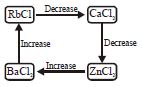
B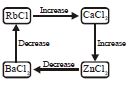
C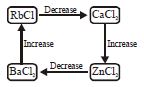
D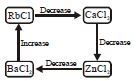
Solution
(A) According to Fajans' rule,the covalent character increases with the polarising power of the cation.
Polarising power $\propto \text{charge density} \propto \frac{\text{charge}}{\text{size}}$.
Ionic character is inversely proportional to covalent character.
Therefore,ionic character $\propto \frac{1}{\text{polarising power}}$.
Comparing the cations:
$Rb^+$ (charge $+1$,large size) has the lowest polarising power,so $RbCl$ is the most ionic.
$Ca^{2+}$ (charge $+2$,smaller size) has higher polarising power than $Rb^+$.
$Zn^{2+}$ (charge $+2$,pseudo-noble gas configuration,small size) has the highest polarising power among these,so $ZnCl_2$ is the most covalent (least ionic).
$Ba^{2+}$ (charge $+2$,large size) has lower polarising power than $Ca^{2+}$.
Order of ionic character: $RbCl > BaCl_2 > CaCl_2 > ZnCl_2$.
Looking at the cycle:
$RbCl \rightarrow CaCl_2$ (Decrease)
$CaCl_2 \rightarrow ZnCl_2$ (Decrease)
$ZnCl_2 \rightarrow BaCl_2$ (Increase)
$BaCl_2 \rightarrow RbCl$ (Increase)
This matches diagram $A$.
Polarising power $\propto \text{charge density} \propto \frac{\text{charge}}{\text{size}}$.
Ionic character is inversely proportional to covalent character.
Therefore,ionic character $\propto \frac{1}{\text{polarising power}}$.
Comparing the cations:
$Rb^+$ (charge $+1$,large size) has the lowest polarising power,so $RbCl$ is the most ionic.
$Ca^{2+}$ (charge $+2$,smaller size) has higher polarising power than $Rb^+$.
$Zn^{2+}$ (charge $+2$,pseudo-noble gas configuration,small size) has the highest polarising power among these,so $ZnCl_2$ is the most covalent (least ionic).
$Ba^{2+}$ (charge $+2$,large size) has lower polarising power than $Ca^{2+}$.
Order of ionic character: $RbCl > BaCl_2 > CaCl_2 > ZnCl_2$.
Looking at the cycle:
$RbCl \rightarrow CaCl_2$ (Decrease)
$CaCl_2 \rightarrow ZnCl_2$ (Decrease)
$ZnCl_2 \rightarrow BaCl_2$ (Increase)
$BaCl_2 \rightarrow RbCl$ (Increase)
This matches diagram $A$.
0 likes
View Solution62
EasyMCQ
According to Fajan's rule,electrovalent bond formation is favoured by
A
Small size of cations and large size of anions
B
Large size of cations and small size of anions
C
Large size of cations and large size of anions
D
Small size of cations and small size of anions
Solution
(B) According to Fajan's rule,the covalent character in an ionic bond increases with the small size of the cation,large size of the anion,and high charge on the ions.
Conversely,the formation of an electrovalent (ionic) bond is favoured by conditions that minimize polarization,which are:
$1$. Large size of the cation.
$2$. Small size of the anion.
$3$. Low charge on the ions.
Therefore,the correct condition for electrovalent bond formation is the large size of cations and small size of anions.
Conversely,the formation of an electrovalent (ionic) bond is favoured by conditions that minimize polarization,which are:
$1$. Large size of the cation.
$2$. Small size of the anion.
$3$. Low charge on the ions.
Therefore,the correct condition for electrovalent bond formation is the large size of cations and small size of anions.
0 likes
View Solution63
DifficultMCQ
How many of the following orders of covalent character are $TRUE$?
$(i)$ $LiF < LiCl < LiBr < LiI$ (Fajans' rule: covalent character increases with increasing size of anion)
$(ii)$ $CaCl_2 < FeCl_2 < FeCl_3$ (Fajans' rule: covalent character increases with increasing charge on cation)
$(iii)$ $Hg_2Cl_2 < HgCl_2$ (Fajans' rule: covalent character increases with increasing charge on cation)
$(iv)$ $ZnCl_2 < CdCl_2 < HgCl_2$ (Fajans' rule: covalent character increases with increasing polarizability of cation)
$(v)$ $CuCl < AgCl < AuCl$ (Fajans' rule: covalent character increases with increasing polarizability of cation)
$(vi)$ $AlN > Al_2O_3 > AlF_3$ (Fajans' rule: covalent character increases with increasing charge on anion)
$(vii)$ $CaF_2 < CaCl_2 < CaBr_2 < CaI_2$ (Fajans' rule: covalent character increases with increasing size of anion)
$(i)$ $LiF < LiCl < LiBr < LiI$ (Fajans' rule: covalent character increases with increasing size of anion)
$(ii)$ $CaCl_2 < FeCl_2 < FeCl_3$ (Fajans' rule: covalent character increases with increasing charge on cation)
$(iii)$ $Hg_2Cl_2 < HgCl_2$ (Fajans' rule: covalent character increases with increasing charge on cation)
$(iv)$ $ZnCl_2 < CdCl_2 < HgCl_2$ (Fajans' rule: covalent character increases with increasing polarizability of cation)
$(v)$ $CuCl < AgCl < AuCl$ (Fajans' rule: covalent character increases with increasing polarizability of cation)
$(vi)$ $AlN > Al_2O_3 > AlF_3$ (Fajans' rule: covalent character increases with increasing charge on anion)
$(vii)$ $CaF_2 < CaCl_2 < CaBr_2 < CaI_2$ (Fajans' rule: covalent character increases with increasing size of anion)
A
$4$
B
$5$
C
$6$
D
$7$
Solution
(D) According to Fajans' rule,covalent character increases with:
$1$. Increasing size of the anion.
$2$. Increasing charge on the cation.
$3$. Increasing polarizability of the cation (pseudo-noble gas configuration).
Let us evaluate each order:
$(i)$ $LiF < LiCl < LiBr < LiI$: $TRUE$ (Anion size increases: $F^- < Cl^- < Br^- < I^-$).
$(ii)$ $CaCl_2 < FeCl_2 < FeCl_3$: $TRUE$ (Cation charge increases: $Ca^{2+} < Fe^{2+} < Fe^{3+}$).
$(iii)$ $Hg_2Cl_2 < HgCl_2$: $TRUE$ (Cation charge increases: $Hg_2^{2+} < Hg^{2+}$).
$(iv)$ $ZnCl_2 < CdCl_2 < HgCl_2$: $TRUE$ (Cation polarizability increases: $Zn^{2+} < Cd^{2+} < Hg^{2+}$).
$(v)$ $CuCl < AgCl < AuCl$: $TRUE$ (Cation polarizability increases: $Cu^+ < Ag^+ < Au^+$).
$(vi)$ $AlN > Al_2O_3 > AlF_3$: $TRUE$ (Anion charge increases: $N^{3-} > O^{2-} > F^-$).
$(vii)$ $CaF_2 < CaCl_2 < CaBr_2 < CaI_2$: $TRUE$ (Anion size increases: $F^- < Cl^- < Br^- < I^-$).
All $7$ statements are $TRUE$.
$1$. Increasing size of the anion.
$2$. Increasing charge on the cation.
$3$. Increasing polarizability of the cation (pseudo-noble gas configuration).
Let us evaluate each order:
$(i)$ $LiF < LiCl < LiBr < LiI$: $TRUE$ (Anion size increases: $F^- < Cl^- < Br^- < I^-$).
$(ii)$ $CaCl_2 < FeCl_2 < FeCl_3$: $TRUE$ (Cation charge increases: $Ca^{2+} < Fe^{2+} < Fe^{3+}$).
$(iii)$ $Hg_2Cl_2 < HgCl_2$: $TRUE$ (Cation charge increases: $Hg_2^{2+} < Hg^{2+}$).
$(iv)$ $ZnCl_2 < CdCl_2 < HgCl_2$: $TRUE$ (Cation polarizability increases: $Zn^{2+} < Cd^{2+} < Hg^{2+}$).
$(v)$ $CuCl < AgCl < AuCl$: $TRUE$ (Cation polarizability increases: $Cu^+ < Ag^+ < Au^+$).
$(vi)$ $AlN > Al_2O_3 > AlF_3$: $TRUE$ (Anion charge increases: $N^{3-} > O^{2-} > F^-$).
$(vii)$ $CaF_2 < CaCl_2 < CaBr_2 < CaI_2$: $TRUE$ (Anion size increases: $F^- < Cl^- < Br^- < I^-$).
All $7$ statements are $TRUE$.
0 likes
View Solution64
DifficultMCQ
Amongst $LiCl$,$RbCl$,$BeCl_2$,and $MgCl_2$,the compounds with the greatest and the least ionic character,respectively,are:
A
$LiCl$ and $RbCl$
B
$RbCl$ and $BeCl_2$
C
$MgCl_2$ and $BeCl_2$
D
$RbCl$ and $MgCl_2$
Solution
(B) According to Fajan's rules,the ionic character of a compound depends on the polarizing power of the cation.
Smaller and highly charged cations have greater polarizing power,leading to higher covalent character and lower ionic character.
Larger and less charged cations have lower polarizing power,leading to higher ionic character.
Comparing the cations: $Rb^+$ (largest size,$+1$ charge),$Li^+$ ($+1$ charge),$Mg^{2+}$ ($+2$ charge),and $Be^{2+}$ (smallest size,$+2$ charge).
$RbCl$ has the largest cation with the lowest charge,making it the most ionic.
$BeCl_2$ has the smallest cation with a high charge,making it the most covalent (least ionic).
Therefore,the compound with the greatest ionic character is $RbCl$ and the one with the least ionic character is $BeCl_2$.
Smaller and highly charged cations have greater polarizing power,leading to higher covalent character and lower ionic character.
Larger and less charged cations have lower polarizing power,leading to higher ionic character.
Comparing the cations: $Rb^+$ (largest size,$+1$ charge),$Li^+$ ($+1$ charge),$Mg^{2+}$ ($+2$ charge),and $Be^{2+}$ (smallest size,$+2$ charge).
$RbCl$ has the largest cation with the lowest charge,making it the most ionic.
$BeCl_2$ has the smallest cation with a high charge,making it the most covalent (least ionic).
Therefore,the compound with the greatest ionic character is $RbCl$ and the one with the least ionic character is $BeCl_2$.
0 likes
View Solution65
MediumMCQ
Which of the following orders is incorrect?
A
Ionic character $MCl > MCl_2 > MCl_3$
B
Polarizability $F^{-} < Cl^{-} < Br^{-} < I^{-}$
C
Polarising power $Na^{+} < K^{+} < Mg^{+2} < Al^{+3}$
D
Polarising power $Li^{+} < Be^{+2} < B^{+3}$
Solution
(C) According to Fajan's rule,the polarising power of a cation is directly proportional to its charge and inversely proportional to its size.
In option $C$,the order of polarising power is $Na^{+} < K^{+} < Mg^{+2} < Al^{+3}$.
Comparing $Na^{+}$ and $K^{+}$,$Na^{+}$ is smaller than $K^{+}$,so $Na^{+}$ has higher polarising power than $K^{+}$.
Therefore,the correct order should be $K^{+} < Na^{+} < Mg^{+2} < Al^{+3}$.
Thus,the order given in option $C$ is incorrect.
In option $C$,the order of polarising power is $Na^{+} < K^{+} < Mg^{+2} < Al^{+3}$.
Comparing $Na^{+}$ and $K^{+}$,$Na^{+}$ is smaller than $K^{+}$,so $Na^{+}$ has higher polarising power than $K^{+}$.
Therefore,the correct order should be $K^{+} < Na^{+} < Mg^{+2} < Al^{+3}$.
Thus,the order given in option $C$ is incorrect.
0 likes
View Solution66
MediumMCQ
Which of the following is a covalent compound?
A
$Al_2O_3$
B
$AlF_3$
C
$AlCl_3$
D
$Al_2(SO_4)_3$
Solution
(C) According to Fajan's rule,the polarizing power of $Al^{3+}$ is high,which leads to significant covalent character in its bonds with less electronegative anions like $Cl^-$.
$AlCl_3$ exhibits covalent character in the anhydrous solid state due to the small electronegativity difference between $Al$ and $Cl$ and the high charge density of $Al^{3+}$.
In contrast,$Al_2O_3$,$AlF_3$,and $Al_2(SO_4)_3$ are predominantly ionic compounds.
$AlCl_3$ exhibits covalent character in the anhydrous solid state due to the small electronegativity difference between $Al$ and $Cl$ and the high charge density of $Al^{3+}$.
In contrast,$Al_2O_3$,$AlF_3$,and $Al_2(SO_4)_3$ are predominantly ionic compounds.
0 likes
View Solution67
EasyMCQ
In an ionic compound $A^{+} X^{-}$,the degree of covalent bonding is greatest when
A
$A^{+}$ and $X^{-}$ ions are small
B
$A^{+}$ is small and $X^{-}$ is large
C
$A^{+}$ and $X^{-}$ ions are approximately of the same size
D
$X^{-}$ is small and $A^{+}$ is large
Solution
(B) According to $Fajan's$ rule,the covalent character in an ionic bond increases when the cation distorts the electron cloud of the anion.
This distortion is favored by a small cation (high polarising power) and a large anion (high polarisability).
Therefore,the degree of covalent bonding is greatest when $A^{+}$ is small and $X^{-}$ is large.
This distortion is favored by a small cation (high polarising power) and a large anion (high polarisability).
Therefore,the degree of covalent bonding is greatest when $A^{+}$ is small and $X^{-}$ is large.
0 likes
View Solution68
DifficultMCQ
Which of the following statements about $LiCl$ and $NaCl$ is wrong?
A
$LiCl$ has lower melting point than $NaCl$
B
$LiCl$ dissolves more in organic solvents whereas $NaCl$ does not
C
$LiCl$ would ionise in water less than $NaCl$
D
Fused $LiCl$ would be less conducting than fused $NaCl$
Solution
(NONE) According to Fajan's rule,the small size of the $Li^+$ ion gives it high polarising power,which induces covalent character in the $Li-Cl$ bond.
Due to this covalent character,$LiCl$ has a lower melting point than $NaCl$.
$LiCl$ is more soluble in organic solvents due to its covalent nature,while $NaCl$ is ionic and insoluble in organic solvents.
$LiCl$ is more covalent,so it ionises less in water compared to $NaCl$.
Fused $LiCl$ is less conducting than fused $NaCl$ because of the covalent character of $LiCl$,which reduces the number of free ions available for conduction.
All the given statements are correct. However,in the context of typical multiple-choice questions where one must be selected,if we re-evaluate the options,all are scientifically accurate descriptions of the differences between $LiCl$ and $NaCl$.
Due to this covalent character,$LiCl$ has a lower melting point than $NaCl$.
$LiCl$ is more soluble in organic solvents due to its covalent nature,while $NaCl$ is ionic and insoluble in organic solvents.
$LiCl$ is more covalent,so it ionises less in water compared to $NaCl$.
Fused $LiCl$ is less conducting than fused $NaCl$ because of the covalent character of $LiCl$,which reduces the number of free ions available for conduction.
All the given statements are correct. However,in the context of typical multiple-choice questions where one must be selected,if we re-evaluate the options,all are scientifically accurate descriptions of the differences between $LiCl$ and $NaCl$.
0 likes
View Solution69
DifficultMCQ
Amongst $LiCl$,$BeCl_2$,$MgCl_2$,and $RbCl$,the compounds with the greatest and least ionic character,respectively,are:
A
$LiCl$ and $RbCl$
B
$RbCl$ and $BeCl_2$
C
$RbCl$ and $MgCl_2$
D
$MgCl_2$ and $BeCl_2$
Solution
(B) According to $Fajans'$ rule,the ionic character of a compound depends on the polarizing power of the cation.
As the size of the cation increases,its polarizing power decreases,which leads to an increase in the ionic character of the bond.
Among the given cations ($Li^+$,$Be^{2+}$,$Mg^{2+}$,$Rb^+$),$Rb^+$ has the largest size,resulting in the greatest ionic character for $RbCl$.
Conversely,$Be^{2+}$ has the smallest size and highest charge density,giving it the highest polarizing power,which results in the least ionic (most covalent) character for $BeCl_2$.
Therefore,the compound with the greatest ionic character is $RbCl$ and the one with the least ionic character is $BeCl_2$.
Hence,option $B$ is correct.
As the size of the cation increases,its polarizing power decreases,which leads to an increase in the ionic character of the bond.
Among the given cations ($Li^+$,$Be^{2+}$,$Mg^{2+}$,$Rb^+$),$Rb^+$ has the largest size,resulting in the greatest ionic character for $RbCl$.
Conversely,$Be^{2+}$ has the smallest size and highest charge density,giving it the highest polarizing power,which results in the least ionic (most covalent) character for $BeCl_2$.
Therefore,the compound with the greatest ionic character is $RbCl$ and the one with the least ionic character is $BeCl_2$.
Hence,option $B$ is correct.
0 likes
View Solution70
MediumMCQ
The compound with the highest degree of covalency is
A
$NaCl$
B
$MgCl_2$
C
$AgCl$
D
$CsCl$
Solution
(C) According to Fajan's rule,the degree of covalency increases with the polarizability of the anion and the polarizing power of the cation.
$Ag^+$ has a pseudo-noble gas configuration $(n-1)d^{10}ns^0$,which makes it more polarizing than alkali metal ions like $Na^+$ or $Cs^+$ and alkaline earth metal ions like $Mg^{2+}$.
Therefore,$AgCl$ exhibits the highest degree of covalency among the given options.
$Ag^+$ has a pseudo-noble gas configuration $(n-1)d^{10}ns^0$,which makes it more polarizing than alkali metal ions like $Na^+$ or $Cs^+$ and alkaline earth metal ions like $Mg^{2+}$.
Therefore,$AgCl$ exhibits the highest degree of covalency among the given options.
0 likes
View Solution71
MediumMCQ
Covalency is favoured in which of the following cases?
A
Smaller cation
B
Larger anion
C
Large charge on cation and anion
D
All of these
Solution
(D) According to $Fajans'$ rule,covalency is favoured by the following factors:
$1$. Smaller size of the cation: $A$ smaller cation has high charge density,which causes greater polarization of the anion.
$2$. Larger size of the anion: $A$ larger anion is more polarizable due to the weaker hold of its nucleus on the valence electrons.
$3$. Large charge on the cation or anion: Higher charges increase the electrostatic attraction between the cation and the electron cloud of the anion,leading to greater polarization.
Therefore,all the given conditions favour covalency.
$1$. Smaller size of the cation: $A$ smaller cation has high charge density,which causes greater polarization of the anion.
$2$. Larger size of the anion: $A$ larger anion is more polarizable due to the weaker hold of its nucleus on the valence electrons.
$3$. Large charge on the cation or anion: Higher charges increase the electrostatic attraction between the cation and the electron cloud of the anion,leading to greater polarization.
Therefore,all the given conditions favour covalency.
0 likes
View Solution72
AdvancedMCQ
If $CdI_2$ is pink in colour,the $CdCl_2$ will be ........... coloured.
A
yellow
B
red
C
blue
D
cannot be predicted
Solution
(D) $CdI_2$ exhibits a pink colour due to the high polarizability of the large $I^{-}$ ion by the $Cd^{2+}$ cation,which possesses a pseudo-noble gas configuration $(d^{10})$.
In $CdCl_2$,the $Cl^{-}$ ion is much smaller and less polarizable than the $I^{-}$ ion.
Therefore,the extent of polarization by $Cd^{2+}$ is significantly less in $CdCl_2$,and it does not exhibit the same colour as $CdI_2$.
Thus,the colour of $CdCl_2$ cannot be predicted based on the colour of $CdI_2$.
In $CdCl_2$,the $Cl^{-}$ ion is much smaller and less polarizable than the $I^{-}$ ion.
Therefore,the extent of polarization by $Cd^{2+}$ is significantly less in $CdCl_2$,and it does not exhibit the same colour as $CdI_2$.
Thus,the colour of $CdCl_2$ cannot be predicted based on the colour of $CdI_2$.
0 likes
View Solution73
DifficultMCQ
Which compound has the lowest melting point?
A
$LiCl$
B
$CsCl$
C
$RbCl$
D
$KCl$
Solution
(A) The melting point of alkali metal halides is determined by the nature of the bond and lattice energy.
$LiCl$ exhibits significant covalent character due to the high polarizing power of the small $Li^+$ ion (Fajans' rule).
In contrast,$NaCl$,$KCl$,$RbCl$,and $CsCl$ are predominantly ionic,and their melting points are governed by their lattice energy.
Since $LiCl$ is predominantly covalent,it has the lowest melting point among the given options.
$LiCl$ exhibits significant covalent character due to the high polarizing power of the small $Li^+$ ion (Fajans' rule).
In contrast,$NaCl$,$KCl$,$RbCl$,and $CsCl$ are predominantly ionic,and their melting points are governed by their lattice energy.
Since $LiCl$ is predominantly covalent,it has the lowest melting point among the given options.
0 likes
View Solution74
AdvancedMCQ
Magnesium cation $(Mg^{2+})$ has a polarising power close to that of:
A
$Li^{+}$
B
$Na^{+}$
C
$K^{+}$
D
$Cs^{+}$
Solution
(A) The polarising power of a cation is determined by its ionic potential,which is the ratio of charge to size $(Z/r)$.
Lithium $(Li^{+})$ and Magnesium $(Mg^{2+})$ exhibit a diagonal relationship in the periodic table.
This diagonal relationship arises due to their similar ionic potential values,which results in similar polarising power and electronegativity.
Therefore,the polarising power of $Mg^{2+}$ is very close to that of $Li^{+}$.
Lithium $(Li^{+})$ and Magnesium $(Mg^{2+})$ exhibit a diagonal relationship in the periodic table.
This diagonal relationship arises due to their similar ionic potential values,which results in similar polarising power and electronegativity.
Therefore,the polarising power of $Mg^{2+}$ is very close to that of $Li^{+}$.
0 likes
View Solution75
MediumMCQ
The correct order of decreasing ionic nature of lead dihalides is
A
$PbF_2 > PbCl_2 > PbBr_2 > PbI_2$
B
$PbF_2 > PbBr_2 > PbCl_2 > PbI_2$
C
$PbF_2 < PbCl_2 > PbBr_2 < PbI_2$
D
$PbI_2 < PbBr_2 < PbCl_2 < PbF_2$
Solution
(A) According to Fajan's rule,the covalent character increases as the size of the anion increases $(F^- < Cl^- < Br^- < I^-)$.
Since covalent character increases from $PbF_2$ to $PbI_2$,the ionic character must decrease in the same order.
Therefore,the correct order of decreasing ionic nature is $PbF_2 > PbCl_2 > PbBr_2 > PbI_2$.
Since covalent character increases from $PbF_2$ to $PbI_2$,the ionic character must decrease in the same order.
Therefore,the correct order of decreasing ionic nature is $PbF_2 > PbCl_2 > PbBr_2 > PbI_2$.
0 likes
View Solution76
MediumMCQ
Which of the following orders is correct when arranged in increasing order of ionic character?
A
$PbCl_2 < SnCl_4 < KCl < MgCl_2$
B
$SnCl_4 < PbCl_2 < KCl < MgCl_2$
C
$SnCl_4 < PbCl_2 < MgCl_2 < KCl$
D
$PbCl_2 < SnCl_4 < MgCl_2 < KCl$
Solution
(C) According to Fajan's rule,the ionic character decreases as the covalent character increases.
Covalent character increases with higher charge density on the cation (polarizing power).
Comparing the compounds:
$SnCl_4$ $(Sn^{4+})$ has the highest covalent character due to the high charge on the $Sn$ ion.
$PbCl_2$ $(Pb^{2+})$ has more covalent character than $MgCl_2$ due to the larger size and inert pair effect.
$MgCl_2$ $(Mg^{2+})$ is more ionic than $PbCl_2$ and $SnCl_4$.
$KCl$ $(K^+)$ is the most ionic among these as it is an alkali metal halide.
Thus,the increasing order of ionic character is: $SnCl_4 < PbCl_2 < MgCl_2 < KCl$.
Covalent character increases with higher charge density on the cation (polarizing power).
Comparing the compounds:
$SnCl_4$ $(Sn^{4+})$ has the highest covalent character due to the high charge on the $Sn$ ion.
$PbCl_2$ $(Pb^{2+})$ has more covalent character than $MgCl_2$ due to the larger size and inert pair effect.
$MgCl_2$ $(Mg^{2+})$ is more ionic than $PbCl_2$ and $SnCl_4$.
$KCl$ $(K^+)$ is the most ionic among these as it is an alkali metal halide.
Thus,the increasing order of ionic character is: $SnCl_4 < PbCl_2 < MgCl_2 < KCl$.
0 likes
View Solution77
MediumMCQ
In which of the following orders does the ionic character of the metal-halogen $(M - X)$ bond decrease?
A
$M - Br > M - Cl > M - F > M - I$
B
$M - I > M - Br > M - Cl > M - F$
C
$M - Cl > M - Br > M - I > M - F$
D
$M - F > M - Cl > M - Br > M - I$
Solution
(D) The ionic character of the metal-halogen bond depends on the electronegativity difference between the metal and the halogen.
As we move down the group from $F$ to $I$,the electronegativity of the halogen decreases,leading to a decrease in the ionic character of the $M - X$ bond.
Additionally,according to Fajan's rule,as the size of the halide ion increases,the covalent character increases,which implies that the ionic character decreases in the order $M - F > M - Cl > M - Br > M - I$.
As we move down the group from $F$ to $I$,the electronegativity of the halogen decreases,leading to a decrease in the ionic character of the $M - X$ bond.
Additionally,according to Fajan's rule,as the size of the halide ion increases,the covalent character increases,which implies that the ionic character decreases in the order $M - F > M - Cl > M - Br > M - I$.
0 likes
View Solution78
MediumMCQ
In the case of alkali metal halides,the covalent character decreases in the order:
A
$MF > MCl > MBr > MI$
B
$MF > MCl > MI > MBr$
C
$MI > MBr > MCl > MF$
D
$MCl > MI > MBr > MF$
Solution
(C) According to Fajan's rule,the covalent character of an ionic bond increases with the increase in the size of the anion.
As the size of the halide ion increases in the order $F^- < Cl^- < Br^- < I^-$,the polarizability of the anion increases.
Therefore,the covalent character follows the order $MI > MBr > MCl > MF$.
As the size of the halide ion increases in the order $F^- < Cl^- < Br^- < I^-$,the polarizability of the anion increases.
Therefore,the covalent character follows the order $MI > MBr > MCl > MF$.
0 likes
View Solution79
MediumMCQ
The correct order of polarizability for the given halide ions is:
A
$I^{-} > Br^{-} > Cl^{-} > F^{-}$
B
$I^{-} > Br^{-} = Cl^{-} > F^{-}$
C
$I^{-} = Br^{-} = Cl^{-} > F^{-}$
D
$I^{-} = Br^{-} < Cl^{-} = F^{-}$
Solution
(A) According to Fajan's rule,the polarizability of an anion depends on its size. Larger anions are more polarizable because the valence electrons are further from the nucleus and are held less tightly. As we move down the group in the periodic table,the size of the halide ions increases in the order $F^{-} < Cl^{-} < Br^{-} < I^{-}$. Therefore,the order of polarizability is $I^{-} > Br^{-} > Cl^{-} > F^{-}$.
0 likes
View Solution80
MediumMCQ
Which compound has the highest covalent character?
A
$LiCl$
B
$LiF$
C
$LiBr$
D
$LiI$
Solution
(D) According to Fajan's rule,the covalent character of an ionic compound increases with the increase in the size of the anion.
For a given cation $(Li^+)$,the polarizability of the anion determines the covalent character.
The size of the halide ions follows the order: $F^- < Cl^- < Br^- < I^-$.
Since $I^-$ is the largest anion,it is the most polarizable,leading to the highest covalent character in $LiI$.
For a given cation $(Li^+)$,the polarizability of the anion determines the covalent character.
The size of the halide ions follows the order: $F^- < Cl^- < Br^- < I^-$.
Since $I^-$ is the largest anion,it is the most polarizable,leading to the highest covalent character in $LiI$.
0 likes
View Solution81
DifficultMCQ
Which of the following compounds is the least ionic?
A
$AgCl$
B
$KCl$
C
$BaCl_2$
D
$CaCl_2$
Solution
(A) According to $Fajans'$ rule,the covalent character in an ionic bond increases with the increase in the polarizing power of the cation.
Polarizing power is higher for cations with smaller size,higher charge,and pseudo-noble gas configuration $(ns^2 np^6 nd^{10})$.
$Ag^+$ has a pseudo-noble gas configuration $([Kr] 4d^{10})$,which makes it more polarizing than the alkali or alkaline earth metal cations like $K^+$,$Ba^{2+}$,or $Ca^{2+}$.
Therefore,$AgCl$ has the highest covalent character and the least ionic character among the given options.
Polarizing power is higher for cations with smaller size,higher charge,and pseudo-noble gas configuration $(ns^2 np^6 nd^{10})$.
$Ag^+$ has a pseudo-noble gas configuration $([Kr] 4d^{10})$,which makes it more polarizing than the alkali or alkaline earth metal cations like $K^+$,$Ba^{2+}$,or $Ca^{2+}$.
Therefore,$AgCl$ has the highest covalent character and the least ionic character among the given options.
0 likes
View Solution82
MediumMCQ
Which of the following chlorides shows the most covalent character?
A
$KCl$
B
$CaCl_2$
C
$BeCl_2$
D
$BaCl_2$
Solution
(C) According to Fajan's rule,the covalent character of an ionic bond increases with:
$1$. Smaller size of the cation.
$2$. Higher charge on the cation.
$3$. Larger size of the anion.
In the given options,all have the same anion $(Cl^-)$.
Comparing the cations: $K^+$,$Ca^{2+}$,$Be^{2+}$,and $Ba^{2+}$.
$Be^{2+}$ has the smallest ionic radius among these cations.
Therefore,$BeCl_2$ has the highest polarizing power and exhibits the most covalent character.
$1$. Smaller size of the cation.
$2$. Higher charge on the cation.
$3$. Larger size of the anion.
In the given options,all have the same anion $(Cl^-)$.
Comparing the cations: $K^+$,$Ca^{2+}$,$Be^{2+}$,and $Ba^{2+}$.
$Be^{2+}$ has the smallest ionic radius among these cations.
Therefore,$BeCl_2$ has the highest polarizing power and exhibits the most covalent character.
0 likes
View Solution83
MediumMCQ
Which of the following has the lowest ionic character?
A
$FeCl_2$
B
$ZnCl_2$
C
$CdCl_2$
D
$MgCl_2$
Solution
(C) According to Fajan's rule,the ionic character decreases as the covalent character increases.
Covalent character increases with the polarising power of the cation.
Polarising power is directly proportional to the charge density (charge/size ratio) and is also influenced by the electronic configuration of the cation.
Cations with a pseudo-noble gas configuration $(ns^2 np^6 nd^{10})$ have a higher polarising power than those with a noble gas configuration $(ns^2 np^6)$.
Among the given options,$Mg^{2+}$ has a noble gas configuration $([Ne])$,while $Fe^{2+}$,$Zn^{2+}$,and $Cd^{2+}$ have different configurations.
$Cd^{2+}$ has a larger size compared to $Zn^{2+}$,but it has a $4d^{10}$ configuration which is highly polarising.
Comparing $FeCl_2$,$ZnCl_2$,$CdCl_2$,and $MgCl_2$,$CdCl_2$ exhibits the highest covalent character due to the high polarising power of the $Cd^{2+}$ ion (pseudo-noble gas configuration and larger size compared to $Zn^{2+}$),thus it has the lowest ionic character.
Covalent character increases with the polarising power of the cation.
Polarising power is directly proportional to the charge density (charge/size ratio) and is also influenced by the electronic configuration of the cation.
Cations with a pseudo-noble gas configuration $(ns^2 np^6 nd^{10})$ have a higher polarising power than those with a noble gas configuration $(ns^2 np^6)$.
Among the given options,$Mg^{2+}$ has a noble gas configuration $([Ne])$,while $Fe^{2+}$,$Zn^{2+}$,and $Cd^{2+}$ have different configurations.
$Cd^{2+}$ has a larger size compared to $Zn^{2+}$,but it has a $4d^{10}$ configuration which is highly polarising.
Comparing $FeCl_2$,$ZnCl_2$,$CdCl_2$,and $MgCl_2$,$CdCl_2$ exhibits the highest covalent character due to the high polarising power of the $Cd^{2+}$ ion (pseudo-noble gas configuration and larger size compared to $Zn^{2+}$),thus it has the lowest ionic character.
0 likes
View Solution84
EasyMCQ
According to $Fajan's \, rule$,covalent character is favoured by:
A
Large cation and small anion
B
Large cation and large anion
C
Small cation and small anion
D
Small cation and large anion
Solution
(D) $Fajan's \, rule$ states that the covalent character in an ionic bond increases with:
$1$. Smaller size of the cation.
$2$. Larger size of the anion.
$3$. Higher charge on either the cation or the anion.
Therefore,a small cation and a large anion favour covalent character.
$1$. Smaller size of the cation.
$2$. Larger size of the anion.
$3$. Higher charge on either the cation or the anion.
Therefore,a small cation and a large anion favour covalent character.
0 likes
View Solution85
MediumMCQ
How does the covalent character vary in $LiCl, BeCl_2, BCl_3$ and $CCl_4$?
A
$LiCl < BeCl_2 > BCl_3 > CCl_4$
B
$LiCl > BeCl_2 > BCl_3 > CCl_4$
C
$LiCl < BeCl_2 < BCl_3 < CCl_4$
D
$LiCl < BeCl_2 < BCl_3 > CCl_4$
Solution
(C) According to Fajan's rule,the covalent character of an ionic bond increases with an increase in the polarizing power of the cation.
Polarizing power is directly proportional to the charge density of the cation (charge/size ratio).
As we move from $Li^+$ to $Be^{2+}$ to $B^{3+}$ to $C^{4+}$,the positive charge on the cation increases and the ionic size decreases.
Therefore,the polarizing power increases in the order: $Li^+ < Be^{2+} < B^{3+} < C^{4+}$.
Consequently,the covalent character increases in the order: $LiCl < BeCl_2 < BCl_3 < CCl_4$.
Polarizing power is directly proportional to the charge density of the cation (charge/size ratio).
As we move from $Li^+$ to $Be^{2+}$ to $B^{3+}$ to $C^{4+}$,the positive charge on the cation increases and the ionic size decreases.
Therefore,the polarizing power increases in the order: $Li^+ < Be^{2+} < B^{3+} < C^{4+}$.
Consequently,the covalent character increases in the order: $LiCl < BeCl_2 < BCl_3 < CCl_4$.
0 likes
View Solution86
MediumMCQ
Which of the following halides has the highest melting point?
A
$AgI$
B
$AgF$
C
$AgBr$
D
$AgCl$
Solution
(B) The melting point of ionic compounds is determined by the lattice energy and the degree of covalent character.
According to Fajan's rule,as the size of the anion increases,the covalent character of the bond increases.
Among the given silver halides,$AgF$ has the smallest anion $(F^-)$,which makes it the most ionic in nature.
Since $AgF$ has the highest ionic character,it possesses the strongest electrostatic forces of attraction,resulting in the highest melting point compared to $AgCl$,$AgBr$,and $AgI$.
According to Fajan's rule,as the size of the anion increases,the covalent character of the bond increases.
Among the given silver halides,$AgF$ has the smallest anion $(F^-)$,which makes it the most ionic in nature.
Since $AgF$ has the highest ionic character,it possesses the strongest electrostatic forces of attraction,resulting in the highest melting point compared to $AgCl$,$AgBr$,and $AgI$.
0 likes
View Solution87
EasyMCQ
Which of the following has the highest polarising power?
A
Large $-ve$ ion
B
Small,highly $-ve$ ion
C
Large $+ve$ ion
D
Small,highly $+ve$ ion
Solution
(D) According to $Fajans'$ rule,the polarising power of a cation is directly proportional to its charge density.
Polarising power $\propto \frac{\text{charge}}{\text{size}}$.
$A$ small cation with a high positive charge has the highest charge density and thus the highest polarising power.
Therefore,a small,highly $+ve$ ion has the highest polarising power.
Polarising power $\propto \frac{\text{charge}}{\text{size}}$.
$A$ small cation with a high positive charge has the highest charge density and thus the highest polarising power.
Therefore,a small,highly $+ve$ ion has the highest polarising power.
0 likes
View Solution88
MediumMCQ
Which of the following compounds contains a covalent bond?
A
$NaH$
B
$AlCl_3$
C
$Na_2S$
D
$MgCl_2$
Solution
(B) In $AlCl_3$,the electronegativity difference between $Al$ $(1.61)$ and $Cl$ $(3.16)$ is $1.55$. According to Fajan's rule,a small,highly charged cation like $Al^{3+}$ has a high polarizing power,which causes significant polarization of the electron cloud of the $Cl^-$ anion,resulting in substantial covalent character in the $Al-Cl$ bond. The other options ($NaH$,$Na_2S$,and $MgCl_2$) are primarily ionic compounds.
0 likes
View Solution89
MediumMCQ
The bond between two non-metallic elements having maximum covalent character is ...........
A
between atoms of equal size
B
between chemically similar atoms
C
between identical atoms
D
between atoms having a large difference in electronegativity
Solution
(C) According to $Fajans'$ rule,covalent character is maximum when the electronegativity difference between the bonded atoms is minimum. $When$ the atoms are identical,the electronegativity difference is zero,resulting in a purely covalent bond (e.g.,$H-H$,$Cl-Cl$). Therefore,the bond between identical atoms exhibits the maximum covalent character.
0 likes
View Solution90
MediumMCQ
Which of the following is the correct decreasing order of polarizability of the given ions?
A
$Cl^{-}, Br^{-}, I^{-}, F^{-}$
B
$F^{-}, I^{-}, Br^{-}, Cl^{-}$
C
$F^{-}, Cl^{-}, Br^{-}, I^{-}$
D
$I^{-}, Br^{-}, Cl^{-}, F^{-}$
Solution
(D) According to Fajan's rule,the polarizability of an anion increases with an increase in its size.
As we move down the group in the periodic table,the size of the halide ions increases in the order: $F^{-} < Cl^{-} < Br^{-} < I^{-}$.
Therefore,the polarizability also increases in the same order: $F^{-} < Cl^{-} < Br^{-} < I^{-}$.
The decreasing order of polarizability is $I^{-} > Br^{-} > Cl^{-} > F^{-}$.
As we move down the group in the periodic table,the size of the halide ions increases in the order: $F^{-} < Cl^{-} < Br^{-} < I^{-}$.
Therefore,the polarizability also increases in the same order: $F^{-} < Cl^{-} < Br^{-} < I^{-}$.
The decreasing order of polarizability is $I^{-} > Br^{-} > Cl^{-} > F^{-}$.
0 likes
View Solution91
DifficultMCQ
Which of the following orders is incorrect?
A
Ionic character $\Rightarrow MCl > MCl_2 > MCl_3$
B
Polarizability $\Rightarrow F^{-} < Cl^{-} < Br^{-} < I^{-}$
C
Polarizing power $\Rightarrow Ca^{2+} < Mg^{2+} < Al^{3+}$
D
Covalent character $\Rightarrow LiF < LiCl < LiBr < LiI$
Solution
(A) According to Fajan's rule, the covalent character of an ionic compound increases with an increase in the polarizing power of the cation and the polarizability of the anion.
$1$. Ionic character: As the oxidation state of the metal increases, the covalent character increases, so the ionic character decreases. Thus, $MCl > MCl_2 > MCl_3$ is correct.
$2$. Polarizability: As the size of the anion increases, the electron cloud becomes more loosely held and more easily distorted. Thus, $F^{-} < Cl^{-} < Br^{-} < I^{-}$ is correct.
$3$. Polarizing power: Polarizing power is directly proportional to charge density $(charge/size)$. $Ca^{2+}$ $(r = 99 \text{ pm})$, $Mg^{2+}$ $(r = 72 \text{ pm})$, $Al^{3+}$ $(r = 54 \text{ pm})$. The charge-to-size ratio increases as $Ca^{2+} < Mg^{2+} < Al^{3+}$. Thus, this order is correct.
$4$. Covalent character: According to Fajan's rule, as the size of the anion increases, the covalent character increases. For the same cation $(Li^{+})$, the order of covalent character is $LiF < LiCl < LiBr < LiI$. This is also correct.
Wait, re-evaluating the options: All provided options are scientifically correct. However, if this is a multiple-choice question where one must be incorrect, there might be a typo in the question or options provided. Given the standard chemistry principles, all listed trends are correct.
$1$. Ionic character: As the oxidation state of the metal increases, the covalent character increases, so the ionic character decreases. Thus, $MCl > MCl_2 > MCl_3$ is correct.
$2$. Polarizability: As the size of the anion increases, the electron cloud becomes more loosely held and more easily distorted. Thus, $F^{-} < Cl^{-} < Br^{-} < I^{-}$ is correct.
$3$. Polarizing power: Polarizing power is directly proportional to charge density $(charge/size)$. $Ca^{2+}$ $(r = 99 \text{ pm})$, $Mg^{2+}$ $(r = 72 \text{ pm})$, $Al^{3+}$ $(r = 54 \text{ pm})$. The charge-to-size ratio increases as $Ca^{2+} < Mg^{2+} < Al^{3+}$. Thus, this order is correct.
$4$. Covalent character: According to Fajan's rule, as the size of the anion increases, the covalent character increases. For the same cation $(Li^{+})$, the order of covalent character is $LiF < LiCl < LiBr < LiI$. This is also correct.
Wait, re-evaluating the options: All provided options are scientifically correct. However, if this is a multiple-choice question where one must be incorrect, there might be a typo in the question or options provided. Given the standard chemistry principles, all listed trends are correct.
0 likes
View Solution92
MediumMCQ
Which of the following represents the correct order of ionic character?
A
$AlCl_3 > MgCl_2 > NaCl$
B
$MgO > NaCl > CaCl_2$
C
$RbCl > CsCl > NaCl$
D
$CsCl > RbCl > NaCl$
Solution
(D) The ionic character of a compound depends on the electronegativity difference between the bonded atoms. According to Fajan's rule,as the size of the cation increases,the polarizing power decreases,leading to an increase in ionic character.
For the compounds $NaCl$,$RbCl$,and $CsCl$,the anion $(Cl^-)$ is the same.
The ionic character increases as the size of the alkali metal cation increases $(Na^+ < Rb^+ < Cs^+)$.
Therefore,the correct order of ionic character is $NaCl < RbCl < CsCl$ or $CsCl > RbCl > NaCl$.
For the compounds $NaCl$,$RbCl$,and $CsCl$,the anion $(Cl^-)$ is the same.
The ionic character increases as the size of the alkali metal cation increases $(Na^+ < Rb^+ < Cs^+)$.
Therefore,the correct order of ionic character is $NaCl < RbCl < CsCl$ or $CsCl > RbCl > NaCl$.
0 likes
View Solution93
DifficultMCQ
The correct order of the increasing ionic character is
A
$BeBr_2 < MgBr_2 < CaBr_2 < BaBr_2$
B
$BeBr_2 < MgBr_2 < BaBr_2 < CaBr_2$
C
$BeBr_2 < BaBr_2 < MgBr_2 < CaBr_2$
D
$BaBr_2 < MgBr_2 < CaBr_2 < BeBr_2$
Solution
(A) According to Fajan's rule,the polarising power of a cation is inversely proportional to its size.
As the size of the cation increases down the group $(Be^{2+} < Mg^{2+} < Ca^{2+} < Ba^{2+})$,its polarising power decreases.
Since lower polarising power leads to higher ionic character,the ionic character increases as the size of the cation increases.
Therefore,the correct order of increasing ionic character is $BeBr_2 < MgBr_2 < CaBr_2 < BaBr_2$.
As the size of the cation increases down the group $(Be^{2+} < Mg^{2+} < Ca^{2+} < Ba^{2+})$,its polarising power decreases.
Since lower polarising power leads to higher ionic character,the ionic character increases as the size of the cation increases.
Therefore,the correct order of increasing ionic character is $BeBr_2 < MgBr_2 < CaBr_2 < BaBr_2$.
0 likes
View Solution94
MediumMCQ
Which of the following metal chlorides will have the highest covalent character?
A
$NaCl$
B
$AlCl_3$
C
$CsCl$
D
$BaCl_2$
Solution
(B) According to Fajan's rule,the covalent character of an ionic bond increases with:
$1$. Smaller size of the cation.
$2$. Higher charge on the cation.
Comparing the cations: $Na^+$,$Al^{3+}$,$Cs^+$,and $Ba^{2+}$.
$Al^{3+}$ has the smallest ionic radius and the highest positive charge among the given options.
Therefore,$AlCl_3$ exhibits the highest polarizing power,leading to the highest covalent character.
$1$. Smaller size of the cation.
$2$. Higher charge on the cation.
Comparing the cations: $Na^+$,$Al^{3+}$,$Cs^+$,and $Ba^{2+}$.
$Al^{3+}$ has the smallest ionic radius and the highest positive charge among the given options.
Therefore,$AlCl_3$ exhibits the highest polarizing power,leading to the highest covalent character.
0 likes
View Solution95
MediumMCQ
Which of the following substances is the most ionic?
A
$CCl_4$
B
$SbCl_3$
C
$PbCl_2$
D
$SiCl_2$
Solution
(C) The ionic character of a compound depends on the electronegativity difference between the bonded atoms.
According to Fajan's rule,larger cations with lower charge density exhibit more ionic character.
Among the given options,$Pb^{2+}$ is a larger cation compared to $C^{4+}$,$Si^{2+}$,or $Sb^{3+}$.
$PbCl_2$ shows significant ionic character due to the inert pair effect and the relatively lower polarizing power of the $Pb^{2+}$ ion compared to the other highly covalent species listed.
Therefore,$PbCl_2$ is the most ionic among the choices.
According to Fajan's rule,larger cations with lower charge density exhibit more ionic character.
Among the given options,$Pb^{2+}$ is a larger cation compared to $C^{4+}$,$Si^{2+}$,or $Sb^{3+}$.
$PbCl_2$ shows significant ionic character due to the inert pair effect and the relatively lower polarizing power of the $Pb^{2+}$ ion compared to the other highly covalent species listed.
Therefore,$PbCl_2$ is the most ionic among the choices.
0 likes
View Solution96
MediumMCQ
In the compounds $LiCl$,$RbCl$,$BeCl_2$,and $MgCl_2$,which of the following are the most and least ionic in nature,respectively?
A
$LiCl$ and $RbCl$
B
$RbCl$ and $BeCl_2$
C
$RbCl$ and $MgCl_2$
D
$MgCl_2$ and $BeCl_2$
Solution
(B) According to $Fajans'$ rule,the ionic character of a compound depends on the polarizing power of the cation.
Smaller cations with higher charge have higher polarizing power,leading to greater covalent character and lower ionic character.
Larger cations with lower charge have lower polarizing power,leading to greater ionic character.
Comparing the cations: $Rb^+$ (largest,$+1$ charge),$Li^+$ ($+1$ charge),$Mg^{2+}$ ($+2$ charge),and $Be^{2+}$ (smallest,$+2$ charge).
$RbCl$ has the largest cation with the lowest charge,making it the most ionic.
$BeCl_2$ has the smallest cation with the highest charge,making it the least ionic (most covalent).
Therefore,the most ionic is $RbCl$ and the least ionic is $BeCl_2$.
Smaller cations with higher charge have higher polarizing power,leading to greater covalent character and lower ionic character.
Larger cations with lower charge have lower polarizing power,leading to greater ionic character.
Comparing the cations: $Rb^+$ (largest,$+1$ charge),$Li^+$ ($+1$ charge),$Mg^{2+}$ ($+2$ charge),and $Be^{2+}$ (smallest,$+2$ charge).
$RbCl$ has the largest cation with the lowest charge,making it the most ionic.
$BeCl_2$ has the smallest cation with the highest charge,making it the least ionic (most covalent).
Therefore,the most ionic is $RbCl$ and the least ionic is $BeCl_2$.
0 likes
View Solution97
MediumMCQ
Which of the following is the correct decreasing order of the melting points of calcium halides?
A
$CaF_2 > CaCl_2 > CaBr_2 > CaI_2$
B
$CaI_2 > CaBr_2 > CaCl_2 > CaF_2$
C
$CaF_2 > CaI_2 > CaBr_2 > CaCl_2$
D
$CaCl_2 > CaBr_2 > CaI_2 > CaF_2$
Solution
(A) The melting point of ionic compounds depends on the lattice energy and the nature of the bond.
According to Fajan's rule,as the size of the anion increases $(F^- < Cl^- < Br^- < I^-)$,the covalent character of the bond increases.
Greater covalent character leads to a decrease in the melting point.
Therefore,the melting point decreases as the size of the halide ion increases.
The correct order is $CaF_2 > CaCl_2 > CaBr_2 > CaI_2$.
According to Fajan's rule,as the size of the anion increases $(F^- < Cl^- < Br^- < I^-)$,the covalent character of the bond increases.
Greater covalent character leads to a decrease in the melting point.
Therefore,the melting point decreases as the size of the halide ion increases.
The correct order is $CaF_2 > CaCl_2 > CaBr_2 > CaI_2$.
0 likes
View Solution98
DifficultMCQ
Which of the following substances has the least covalent character?
A
$Cl_2O$
B
$NCl_3$
C
$PbCl_2$
D
$BaCl_2$
Solution
(D) According to Fajan's rule,the covalent character of an ionic bond is directly proportional to the polarizing power of the cation and the polarizability of the anion.The polarizing power of a cation increases as its size decreases and its charge increases.Comparing the cations in the given compounds: $N^{3+}$ (in $NCl_3$),$O^{2+}$ (in $Cl_2O$),$Pb^{2+}$ (in $PbCl_2$),and $Ba^{2+}$ (in $BaCl_2$).Among these,$Ba^{2+}$ has the largest ionic radius and the lowest charge density.Since $Ba^{2+}$ has the lowest polarizing power,$BaCl_2$ exhibits the least covalent character and the highest ionic character.
0 likes
View Solution99
DifficultMCQ
The order of solubility of lithium halides in non-polar solvents follows the order:
A
$LiI > LiBr > LiCl > LiF$
B
$LiF > LiI > LiBr > LiCl$
C
$LiCl > LiF > LiI > LiBr$
D
$LiBr > LiCl > LiF > LiI$
Solution
(A) According to Fajan's rule,as the size of the anion increases from $F^{-}$ to $I^{-}$,the polarizability of the anion increases,which leads to an increase in the covalent character of the lithium halide bond.
Since non-polar solvents dissolve covalent compounds more readily than ionic compounds,the solubility in non-polar solvents increases as the covalent character increases.
Therefore,the order of solubility is $LiI > LiBr > LiCl > LiF$.
Since non-polar solvents dissolve covalent compounds more readily than ionic compounds,the solubility in non-polar solvents increases as the covalent character increases.
Therefore,the order of solubility is $LiI > LiBr > LiCl > LiF$.
0 likes
View Solution100
DifficultMCQ
Assertion : $LiCl$ is predominantly a covalent compound.
Reason : Electronegativity difference between $Li$ and $Cl$ is too small.
Reason : Electronegativity difference between $Li$ and $Cl$ is too small.
A
If both Assertion and Reason are correct and the Reason is a correct explanation of the Assertion.
B
If both Assertion and Reason are correct but Reason is not a correct explanation of the Assertion.
C
If the Assertion is correct but Reason is incorrect.
D
If both the Assertion and Reason are incorrect.
Solution
(C) $LiCl$ is a covalent compound due to the high polarizing power of the small $Li^+$ cation,which causes polarization of the electron cloud of the large $Cl^-$ anion (Fajans' rule).
The electronegativity difference between $Li$ $(1.0)$ and $Cl$ $(3.0)$ is $2.0$,which is significant,not small.
Therefore,the Assertion is correct,but the Reason is incorrect.
The electronegativity difference between $Li$ $(1.0)$ and $Cl$ $(3.0)$ is $2.0$,which is significant,not small.
Therefore,the Assertion is correct,but the Reason is incorrect.
0 likes
View SolutionChemical Bonding and Molecular Structure — Polarisation and Fajan’s rule · Frequently Asked Questions
1Are these Chemical Bonding and Molecular Structure questions useful for JEE and NEET?
Yes. All questions in this section are mapped to JEE Main and NEET exam patterns. Previous year questions from JEE Main, NEET, GUJCET and state-level exams are included with full solutions.
2Can I switch to Hindi or Gujarati for these questions?
Yes. Use the language tabs in the hero section or the sidebar to view the same questions and solutions in English, Hindi or Gujarati.
3How do I generate a question paper from this subtopic?
Use the Vedclass Exam Paper Generator — select the chapter and subtopic, set difficulty, and generate Sets A, B, C, D automatically. First 3 chapters of every subject are free.
Vedclass Products
For Students
Vedclass Test Series
Mock tests in real JEE/NEET style with performance analysis. 5-day free trial.
Start Free TrialFor Teachers
Exam Paper Generator
Generate Set A/B/C/D papers from this chapter in 2 minutes. 3 chapters free.
Try FreeFor Institutes
Online Exam Module
Live online exams with unlimited students, 360° analytics & white-label branding.
See DemoFor Teachers & Institutes
Generate a Chemical Bonding and Molecular Structure Exam Paper in 2 Minutes
Select subtopic & difficulty — Sets A, B, C, D auto-generated with No Repeat logic.
First 3 chapters of every subject are free — no payment required.