
A English
Overlaping - s and p- bonds Questions in English
Class 11 Chemistry · Chemical Bonding and Molecular Structure · Overlaping - s and p- bonds
108+
Questions
English
Language
100%
With Solutions
Showing 50 of 108 questions in English
1
MediumMCQ
The bond in the formation of fluorine molecule will be
A
Due to $s - s$ overlapping
B
Due to $s - p$ overlapping
C
Due to $p - p$ overlapping
D
Due to hybridization
Solution
(C) The atomic number of fluorine $(F)$ is $9$. Its electronic configuration is $1s^2 2s^2 2p_x^2 2p_y^2 2p_z^1$.
In the formation of a fluorine molecule $(F_2)$,the half-filled $2p_z$ orbital of one fluorine atom overlaps with the half-filled $2p_z$ orbital of another fluorine atom.
This is an example of $p - p$ overlapping along the internuclear axis,resulting in the formation of a sigma bond.
In the formation of a fluorine molecule $(F_2)$,the half-filled $2p_z$ orbital of one fluorine atom overlaps with the half-filled $2p_z$ orbital of another fluorine atom.
This is an example of $p - p$ overlapping along the internuclear axis,resulting in the formation of a sigma bond.
0 likes
View Solution2
MediumMCQ
Which type of overlapping results in the formation of a $\pi$ bond?
A
Axial overlapping of $s-s$ orbitals
B
Lateral overlapping of $p-p$ orbitals
C
Axial overlapping of $p-p$ orbitals
D
Axial overlapping of $s-p$ orbitals
Solution
(B) The correct answer is $B$.
$\pi$-bonds are formed by the lateral (sideways) overlapping of unhybridised $p-p$ orbitals.
Axial overlapping of orbitals results in the formation of a $\sigma$-bond.
$\pi$-bonds are formed by the lateral (sideways) overlapping of unhybridised $p-p$ orbitals.
Axial overlapping of orbitals results in the formation of a $\sigma$-bond.
0 likes
View Solution3
MediumMCQ
$\pi$ bond is formed by:
A
Overlapping of atomic orbitals on the axis of nuclei
B
Mutual sharing of $\pi$ electrons
C
Sidewise overlapping of half-filled $p-$orbitals
D
Overlapping of $s-$orbitals with $p-$orbitals
Solution
(C) $\pi$ bond is formed by the lateral or sidewise overlapping of half-filled atomic orbitals (typically $p-$orbitals) that are parallel to each other and perpendicular to the internuclear axis.
This type of overlapping results in the formation of two electron clouds,one above and one below the plane of the nuclei.
Therefore,the correct statement is that it is formed by the sidewise overlapping of half-filled $p-$orbitals.
This type of overlapping results in the formation of two electron clouds,one above and one below the plane of the nuclei.
Therefore,the correct statement is that it is formed by the sidewise overlapping of half-filled $p-$orbitals.
0 likes
View Solution4
EasyMCQ
The double bond between the two carbon atoms in ethylene $(CH_2=CH_2)$ consists of:
A
Two sigma bonds at right angles to each other
B
One sigma bond and one pi bond
C
Two pi bonds at right angles to each other
D
Two pi bonds at an angle of $60^o$ to each other
Solution
(B) In ethylene $(CH_2=CH_2)$,each carbon atom is $sp^2$ hybridized.
One $sp^2$ orbital of each carbon atom overlaps head-on to form a $C-C$ sigma $(\sigma)$ bond.
The remaining unhybridized $p$-orbital on each carbon atom overlaps laterally (sideways) to form a pi $(\pi)$ bond.
Therefore,a double bond consists of one sigma $(\sigma)$ bond and one pi $(\pi)$ bond.
One $sp^2$ orbital of each carbon atom overlaps head-on to form a $C-C$ sigma $(\sigma)$ bond.
The remaining unhybridized $p$-orbital on each carbon atom overlaps laterally (sideways) to form a pi $(\pi)$ bond.
Therefore,a double bond consists of one sigma $(\sigma)$ bond and one pi $(\pi)$ bond.
0 likes
View Solution5
MediumMCQ
In a $\sigma$ bond,
A
Sidewise as well as end to end overlap of orbitals take place
B
Sidewise overlap of orbitals takes place
C
End to end overlap of orbitals takes place
D
None of the above
Solution
(C) $\sigma$ bond is a covalent bond formed by the head-on (end-to-end) overlap of atomic orbitals along the internuclear axis.
This type of overlap allows for the maximum electron density to be concentrated between the two nuclei.
This type of overlap allows for the maximum electron density to be concentrated between the two nuclei.
0 likes
View Solution6
MediumMCQ
Which of the following statements is not correct?
A
$A$ $\sigma$ bond is weaker than a $\pi$ bond.
B
$A$ $\sigma$ bond is stronger than a $\pi$ bond.
C
$A$ double bond is stronger than a single bond.
D
$A$ double bond is shorter than a single bond.
Solution
(A) $\sigma$ bond is formed by head-on overlapping of atomic orbitals, resulting in greater electron density between the nuclei, which makes it stronger than a $\pi$ bond formed by lateral overlapping.
Therefore, the statement that a $\sigma$ bond is weaker than a $\pi$ bond is incorrect.
Therefore, the statement that a $\sigma$ bond is weaker than a $\pi$ bond is incorrect.
0 likes
View Solution7
MediumMCQ
The strongest bond is formed when atomic orbitals undergo:
A
Maximum overlap
B
Minimum overlap
C
No overlap
D
None of these
Solution
(A) The strength of a covalent bond is directly proportional to the extent of overlapping of the atomic orbitals.
When atomic orbitals undergo maximum overlapping,a greater amount of energy is released,which leads to the formation of a more stable and stronger bond.
When atomic orbitals undergo maximum overlapping,a greater amount of energy is released,which leads to the formation of a more stable and stronger bond.
0 likes
View Solution8
MediumMCQ
The $p-p$ orbital overlapping is present in the following molecule:
A
$H_2$
B
$HBr$
C
$HCl$
D
$Cl_2$
Solution
(D) The $p-p$ orbital overlapping occurs when the $p$-orbitals of two atoms overlap along the internuclear axis.
In the $Cl_2$ molecule,each chlorine atom has an unpaired electron in its $3p_z$ orbital.
The bond is formed by the head-on overlapping of the $3p_z$ orbital of one chlorine atom with the $3p_z$ orbital of another chlorine atom.
Therefore,$Cl_2$ exhibits $p-p$ orbital overlapping.
In the $Cl_2$ molecule,each chlorine atom has an unpaired electron in its $3p_z$ orbital.
The bond is formed by the head-on overlapping of the $3p_z$ orbital of one chlorine atom with the $3p_z$ orbital of another chlorine atom.
Therefore,$Cl_2$ exhibits $p-p$ orbital overlapping.
0 likes
View Solution9
EasyMCQ
In $N_2$ molecule,the atoms are bonded by
A
$1$ $\sigma$,$2$ $\pi$
B
$1$ $\sigma$,$1$ $\pi$
C
$2$ $\sigma$,$1$ $\pi$
D
$3$ $\sigma$ bonds
Solution
(A) The electronic configuration of nitrogen $(N)$ is $1s^2 2s^2 2p^3$.
To complete its octet,each nitrogen atom shares $3$ electrons with another nitrogen atom,forming a triple bond $(N \equiv N)$.
$A$ triple bond consists of $1$ $\sigma$ bond (formed by head-on overlap of $p_z$ orbitals) and $2$ $\pi$ bonds (formed by lateral overlap of $p_x$ and $p_y$ orbitals).
Therefore,the $N_2$ molecule contains $1$ $\sigma$ and $2$ $\pi$ bonds.
To complete its octet,each nitrogen atom shares $3$ electrons with another nitrogen atom,forming a triple bond $(N \equiv N)$.
$A$ triple bond consists of $1$ $\sigma$ bond (formed by head-on overlap of $p_z$ orbitals) and $2$ $\pi$ bonds (formed by lateral overlap of $p_x$ and $p_y$ orbitals).
Therefore,the $N_2$ molecule contains $1$ $\sigma$ and $2$ $\pi$ bonds.
0 likes
View Solution10
MediumMCQ
Which of the following is correct for the $N_2$ triple bond?
A
$3s$
B
$1p, 2s$
C
$2p, 1s$
D
$3p$
Solution
(C) The nitrogen molecule $(N_2)$ has a triple bond between the two nitrogen atoms.
According to valence bond theory,the triple bond consists of one sigma $(\sigma)$ bond and two pi $(\pi)$ bonds.
Therefore,the correct composition is $1\sigma$ and $2\pi$ bonds,which corresponds to $1s$ and $2p$ orbitals involved in the bonding.
According to valence bond theory,the triple bond consists of one sigma $(\sigma)$ bond and two pi $(\pi)$ bonds.
Therefore,the correct composition is $1\sigma$ and $2\pi$ bonds,which corresponds to $1s$ and $2p$ orbitals involved in the bonding.
0 likes
View Solution11
MediumMCQ
Select the molecule which has only one $\pi$-bond.
A
$CH \equiv CH$
B
$CH_2 = CHCHO$
C
$CH_3CH = CH_2$
D
$CH_3CH = CHCOOH$
Solution
(C) $H-C \equiv C-H$ has $2 \pi$-bonds.
$(b)$ $CH_2=CH-CHO$ has $2 \pi$-bonds (one in $C=C$ and one in $C=O$).
$(c)$ $CH_3CH=CH_2$ has $1 \pi$-bond.
$(d)$ $CH_3CH=CH-COOH$ has $2 \pi$-bonds (one in $C=C$ and one in $C=O$).
$(b)$ $CH_2=CH-CHO$ has $2 \pi$-bonds (one in $C=C$ and one in $C=O$).
$(c)$ $CH_3CH=CH_2$ has $1 \pi$-bond.
$(d)$ $CH_3CH=CH-COOH$ has $2 \pi$-bonds (one in $C=C$ and one in $C=O$).
0 likes
View Solution12
EasyMCQ
$A$ carbon-carbon triple bond in ethyne $(HC \equiv CH)$ consists of:
A
All $\sigma$ bonds
B
Two $\sigma$ bonds and one $\pi$ bond
C
One $\sigma$ bond and two $\pi$ bonds
D
All $\pi$ bonds
Solution
(C) In a carbon-carbon triple bond,the first bond formed is a $\sigma$ bond due to the head-on overlap of $sp$ hybrid orbitals.
The remaining two bonds are formed by the lateral overlap of unhybridized $p$-orbitals,resulting in two $\pi$ bonds.
Therefore,a triple bond consists of one $\sigma$ bond and $2 \pi$ bonds.
The remaining two bonds are formed by the lateral overlap of unhybridized $p$-orbitals,resulting in two $\pi$ bonds.
Therefore,a triple bond consists of one $\sigma$ bond and $2 \pi$ bonds.
0 likes
View Solution13
MediumMCQ
In a double bond between two carbon atoms of ethene,there are
A
Two sigma bonds perpendicular to each other
B
One sigma and one pi bond
C
Two pi bonds perpendicular to each other
D
Two pi bonds at an angle of $60^o$
Solution
(B) In the structure of ethene $(CH_2=CH_2)$,the carbon-carbon double bond is formed by the overlap of atomic orbitals.
One bond is a $\sigma$ (sigma) bond formed by the head-on overlap of $sp^2$ hybrid orbitals.
The second bond is a $\pi$ (pi) bond formed by the lateral (sideways) overlap of unhybridized $p$-orbitals.
Therefore,a double bond consists of one $\sigma$ bond and one $\pi$ bond.
One bond is a $\sigma$ (sigma) bond formed by the head-on overlap of $sp^2$ hybrid orbitals.
The second bond is a $\pi$ (pi) bond formed by the lateral (sideways) overlap of unhybridized $p$-orbitals.
Therefore,a double bond consists of one $\sigma$ bond and one $\pi$ bond.
0 likes
View Solution14
MediumMCQ
The total number of sigma $(\sigma)$ and pi $(\pi)$ bonds in an ethylene molecule are
A
$4\sigma, 2\pi$
B
$4\sigma, 1\pi$
C
$5\sigma, 2\pi$
D
$5\sigma, 1\pi$
Solution
(D) The chemical formula of ethylene is $CH_2=CH_2$.
In this molecule,there are $4$ $C-H$ sigma bonds and $1$ $C-C$ sigma bond,totaling $5$ sigma $(\sigma)$ bonds.
There is $1$ $C-C$ pi $(\pi)$ bond present in the double bond.
Therefore,the total number of bonds is $5\sigma$ and $1\pi$.
In this molecule,there are $4$ $C-H$ sigma bonds and $1$ $C-C$ sigma bond,totaling $5$ sigma $(\sigma)$ bonds.
There is $1$ $C-C$ pi $(\pi)$ bond present in the double bond.
Therefore,the total number of bonds is $5\sigma$ and $1\pi$.
0 likes
View Solution15
MediumMCQ
The angle between $p$-orbitals is ......
A
$90^{\circ}$
B
$180^{\circ}$
C
$120^{\circ}$
D
$109^{\circ} 28'$
Solution
(A) The $p$-orbitals $(p_x, p_y, p_z)$ are oriented along the $x, y,$ and $z$ axes respectively.
Since these axes are mutually perpendicular to each other,the angle between any two $p$-orbitals is $90^{\circ}$.
Since these axes are mutually perpendicular to each other,the angle between any two $p$-orbitals is $90^{\circ}$.
0 likes
View Solution16
EasyMCQ
Which of the following types of orbital overlapping results in the formation of a $\pi$ bond?
A
Parallel $P-P$ orbitals
B
$S-P$ orbitals
C
Sideways overlapping of $P-P$ orbitals
D
$S-S$ orbitals
Solution
(C) $\pi$ bond is formed by the lateral or sideways overlapping of $P-P$ orbitals that are perpendicular to the internuclear axis.
0 likes
View Solution17
MediumMCQ
What is the number of $\sigma$ and $\pi$ bonds in the resonance structure of benzene?
A
$3\pi, 12\sigma$
B
$3\sigma, 12\pi$
C
$6\pi, 6\sigma$
D
$12\pi, 12\sigma$
Solution
(A) The chemical formula of benzene is $C_6H_6$.
In the structure of benzene,there are $6$ $C-C$ $\sigma$ bonds and $6$ $C-H$ $\sigma$ bonds,making a total of $12$ $\sigma$ bonds.
Additionally,there are $3$ $C=C$ double bonds,each containing one $\pi$ bond,resulting in a total of $3$ $\pi$ bonds.
Therefore,the structure contains $12$ $\sigma$ bonds and $3$ $\pi$ bonds.
In the structure of benzene,there are $6$ $C-C$ $\sigma$ bonds and $6$ $C-H$ $\sigma$ bonds,making a total of $12$ $\sigma$ bonds.
Additionally,there are $3$ $C=C$ double bonds,each containing one $\pi$ bond,resulting in a total of $3$ $\pi$ bonds.
Therefore,the structure contains $12$ $\sigma$ bonds and $3$ $\pi$ bonds.
0 likes
View Solution18
EasyMCQ
In a diatomic molecule,the internuclear axis is $Z$. Which of the following bonds will be formed by the overlap of $P_x$ and $P_y$ orbitals?
A
$\pi$ molecular orbital
B
$\sigma$ molecular orbital
C
$\delta$ molecular orbital
D
No bond will be formed
Solution
(D) The internuclear axis is $Z$. The $P_x$ orbital has its electron density along the $X$-axis,and the $P_y$ orbital has its electron density along the $Y$-axis. Since these orbitals are perpendicular to each other and to the internuclear axis,they have different symmetries with respect to the internuclear axis. Therefore,they cannot overlap to form a bond. Thus,no bond will be formed.
0 likes
View Solution19
MediumMCQ
Which of the following statements is $NOT$ true regarding the sigma and pi bonds formed between two carbon atoms?
A
The sigma bond determines the direction of the bond between carbon atoms,but the pi bond has no primary effect on this.
B
The sigma bond is weaker than the pi bond.
C
The bond energies of the sigma bond and pi bond are $264 \ kJ/mol$ and $347 \ kJ/mol$ respectively.
D
Free rotation of atoms around a sigma bond is possible,but it is not possible in the case of a pi bond.
Solution
(B) The statement that the sigma bond is weaker than the pi bond is incorrect. In reality,the sigma bond is stronger than the pi bond because of the greater extent of orbital overlap in a head-on collision compared to the lateral overlap in a pi bond. Furthermore,the bond energy values provided in option $C$ are also incorrect as the sigma bond energy is typically higher than the pi bond energy.
0 likes
View Solution20
MediumMCQ
The $F_2$ molecule is formed by which of the following?
A
$p-p$ axial overlapping
B
$p-p$ side-wise overlapping
C
$s-p$ axial overlapping
D
$sp^2$ hybrid orbital overlapping
Solution
(A) The electronic configuration of $F$ $(Z=9)$ is $1s^2 2s^2 2p_x^2 2p_y^2 2p_z^1$.
In the $F_2$ molecule,the half-filled $2p_z$ orbital of one $F$ atom overlaps with the half-filled $2p_z$ orbital of another $F$ atom along the internuclear axis.
This is known as $p-p$ axial overlapping,which results in the formation of a $\sigma$ bond.
In the $F_2$ molecule,the half-filled $2p_z$ orbital of one $F$ atom overlaps with the half-filled $2p_z$ orbital of another $F$ atom along the internuclear axis.
This is known as $p-p$ axial overlapping,which results in the formation of a $\sigma$ bond.
0 likes
View Solution21
MediumMCQ
In which of the following ions is $p\pi - d\pi$ overlap present?
A
$NO_3^-$
B
$PO_4^{3-}$
C
$CO_3^{2-}$
D
$NO_2^-$
Solution
(B) In $PO_4^{3-}$,the central atom is Phosphorus $(P)$,which has vacant $d$-orbitals available for bonding.
Oxygen atoms have $p$-orbitals that can overlap with the $d$-orbitals of Phosphorus to form $p\pi - d\pi$ bonds.
In $NO_3^-$,$CO_3^{2-}$,and $NO_2^-$,the central atoms are Nitrogen $(N)$ and Carbon $(C)$,which belong to the second period and do not have $d$-orbitals.
Therefore,only $PO_4^{3-}$ exhibits $p\pi - d\pi$ overlap.
Oxygen atoms have $p$-orbitals that can overlap with the $d$-orbitals of Phosphorus to form $p\pi - d\pi$ bonds.
In $NO_3^-$,$CO_3^{2-}$,and $NO_2^-$,the central atoms are Nitrogen $(N)$ and Carbon $(C)$,which belong to the second period and do not have $d$-orbitals.
Therefore,only $PO_4^{3-}$ exhibits $p\pi - d\pi$ overlap.
0 likes
View Solution22
MediumMCQ
Which of the following orbital overlaps is involved in the $HCl$ molecule?
A
$s - s$
B
$p - p$
C
$s - d$
D
$s - p$
Solution
(D) The $HCl$ molecule is formed by the overlap of the $1s$ orbital of the hydrogen atom and the $3p_z$ orbital of the chlorine atom. Therefore,the overlap involved is $s - p$.
0 likes
View Solution23
MediumMCQ
Which of the following represents the most effective overlapping?
A
$sp^2 - sp^2$
B
$s - s$
C
$sp^3 - sp^3$
D
$sp - sp$
Solution
(D) The effectiveness of overlapping depends on the $s$-character in the hybrid orbitals. Higher $s$-character leads to more effective overlapping. The $s$-character in $sp$,$sp^2$,and $sp^3$ hybrid orbitals is $50\%$,$33.3\%$,and $25\%$ respectively. Therefore,$sp - sp$ overlapping is the most effective.
0 likes
View Solution24
EasyMCQ
Which of the following bonds is formed by the lateral overlap of $p-p$ orbitals?
A
Sigma bond
B
Pi bond
C
Coordinate bond
D
Hydrogen bond
Solution
(B) The lateral (side-by-side) overlap of $p-p$ orbitals results in the formation of a pi $(\pi)$ bond.
0 likes
View Solution25
EasyMCQ
Which type of bond is formed by the linear overlap of two hybrid orbitals,each containing one electron,associated with two different atoms?
A
Sigma bond
B
Pi bond
C
Double bond
D
Coordinate bond
Solution
(A) The linear overlap of two hybrid orbitals results in the formation of a $Sigma$ bond.
0 likes
View Solution26
MediumMCQ
Where is the nodal plane of the $\pi$-bond in ethene located?
A
In the molecular plane
B
Parallel to the molecular plane
C
In a plane perpendicular to the molecular plane and perpendicular to the $C-C$ $\sigma$-bond
D
In a plane perpendicular to the molecular plane containing the $C-C$ $\sigma$-bond
Solution
(A) The $\pi$-bond is formed by the lateral overlap of $p$-orbitals perpendicular to the molecular plane.
Since the electron density of the $\pi$-bond is zero in the molecular plane,the molecular plane itself acts as the nodal plane for the $\pi$-bond in ethene.
Since the electron density of the $\pi$-bond is zero in the molecular plane,the molecular plane itself acts as the nodal plane for the $\pi$-bond in ethene.
0 likes
View Solution27
MediumMCQ
The ratio of the number of $\sigma$ and $\pi$ bonds in benzene is equal to:
A
$2$
B
$4$
C
$6$
D
$8$
Solution
(B) The chemical formula of benzene is $C_6H_6$.
In the structure of benzene,there are $6$ $C-C$ $\sigma$ bonds and $6$ $C-H$ $\sigma$ bonds,making a total of $12$ $\sigma$ bonds.
There are $3$ $\pi$ bonds present in the ring due to the alternating double bonds.
The ratio of $\sigma$ bonds to $\pi$ bonds is $\frac{12}{3} = 4$.
In the structure of benzene,there are $6$ $C-C$ $\sigma$ bonds and $6$ $C-H$ $\sigma$ bonds,making a total of $12$ $\sigma$ bonds.
There are $3$ $\pi$ bonds present in the ring due to the alternating double bonds.
The ratio of $\sigma$ bonds to $\pi$ bonds is $\frac{12}{3} = 4$.
0 likes
View Solution28
MediumMCQ
Which type of orbitals overlap with each other in benzene?
A
$sp^2-sp^2$
B
$sp^3-sp^3$
C
$sp-sp$
D
$p-p$
Solution
(A) In benzene $(C_6H_6)$,each carbon atom is $sp^2$ hybridized.
These $sp^2$ hybridized orbitals overlap with each other to form the $C-C$ sigma bonds in the hexagonal ring.
Additionally,the unhybridized $p$-orbitals on each carbon atom overlap laterally to form the $\pi$-electron cloud above and below the plane of the ring.
However,the question asks for the overlap that forms the backbone of the ring structure,which is the $sp^2-sp^2$ overlap.
These $sp^2$ hybridized orbitals overlap with each other to form the $C-C$ sigma bonds in the hexagonal ring.
Additionally,the unhybridized $p$-orbitals on each carbon atom overlap laterally to form the $\pi$-electron cloud above and below the plane of the ring.
However,the question asks for the overlap that forms the backbone of the ring structure,which is the $sp^2-sp^2$ overlap.
0 likes
View Solution29
EasyMCQ
The triple bond between two carbon atoms in ethyne is formed by.......
A
$1$ sigma,$2$ pi
B
$1$ pi,$2$ sigma
C
$3$ sigma
D
$3$ pi
Solution
(A) Ethyne $(HC \equiv CH)$ contains a triple bond between the two carbon atoms.
In a triple bond,there is $1$ sigma $(\sigma)$ bond and $2$ pi $(\pi)$ bonds.
The sigma bond is formed by the head-on overlap of $sp$ hybridized orbitals,while the two pi bonds are formed by the lateral overlap of two unhybridized $p$-orbitals on each carbon atom.
In a triple bond,there is $1$ sigma $(\sigma)$ bond and $2$ pi $(\pi)$ bonds.
The sigma bond is formed by the head-on overlap of $sp$ hybridized orbitals,while the two pi bonds are formed by the lateral overlap of two unhybridized $p$-orbitals on each carbon atom.
0 likes
View Solution30
MediumMCQ
Which of the following represents the nodal plane in the $\pi$-bond of ethene $(C_2H_4)$?
A
The molecular plane
B
$A$ plane parallel to the molecular plane
C
$A$ plane perpendicular to the molecular plane containing the $C-C$ $\sigma$-bond
D
$A$ plane perpendicular to the molecular plane and perpendicular to the $C-C$ $\sigma$-bond
Solution
(A) In the ethene molecule $(C_2H_4)$,the two carbon atoms are $sp^2$ hybridized.
The $C-C$ $\sigma$-bond and the four $C-H$ $\sigma$-bonds lie in the same plane,known as the molecular plane.
The $\pi$-bond is formed by the lateral overlap of the unhybridized $2p_z$ orbitals of the carbon atoms,which are perpendicular to the molecular plane.
$A$ nodal plane is a plane where the probability of finding an electron is zero.
For the $\pi$-bond in ethene,the molecular plane itself acts as the nodal plane because the electron density of the $\pi$-bond is concentrated above and below this plane.
The $C-C$ $\sigma$-bond and the four $C-H$ $\sigma$-bonds lie in the same plane,known as the molecular plane.
The $\pi$-bond is formed by the lateral overlap of the unhybridized $2p_z$ orbitals of the carbon atoms,which are perpendicular to the molecular plane.
$A$ nodal plane is a plane where the probability of finding an electron is zero.
For the $\pi$-bond in ethene,the molecular plane itself acts as the nodal plane because the electron density of the $\pi$-bond is concentrated above and below this plane.
0 likes
View Solution31
EasyMCQ
What is the total number of $\pi$ bonds in the compound $CH_2=CH-CH=CH-COOH$?
A
$1$
B
$2$
C
$3$
D
$4$
Solution
(C) The structure of the compound is $CH_2=CH-CH=CH-C(=O)OH$.
Counting the $\pi$ bonds:
$1$. There is one $\pi$ bond in the first $C=C$ double bond.
$2$. There is one $\pi$ bond in the second $C=C$ double bond.
$3$. There is one $\pi$ bond in the $C=O$ double bond of the carboxylic acid group.
Total number of $\pi$ bonds = $1 + 1 + 1 = 3$.
Counting the $\pi$ bonds:
$1$. There is one $\pi$ bond in the first $C=C$ double bond.
$2$. There is one $\pi$ bond in the second $C=C$ double bond.
$3$. There is one $\pi$ bond in the $C=O$ double bond of the carboxylic acid group.
Total number of $\pi$ bonds = $1 + 1 + 1 = 3$.
0 likes
View Solution32
EasyMCQ
What is the number of $\pi$ bonds and $\sigma$ bonds respectively in the given structure?

A
$8, 5$
B
$8, 6$
C
$3, 8$
D
$5, 13$
Solution
(D) The given structure is benzonitrile $(C_6H_5CN)$.
Structure analysis:
- The benzene ring has $3$ $\pi$ bonds.
- The $-CN$ group has a triple bond,which contains $2$ $\pi$ bonds.
- Total $\pi$ bonds = $3 + 2 = 5$.
Counting $\sigma$ bonds:
- Benzene ring $(C_6H_6)$: $6$ $C-C$ $\sigma$ bonds + $5$ $C-H$ $\sigma$ bonds = $11$ $\sigma$ bonds.
- Bond between ring and $-CN$ group: $1$ $\sigma$ bond.
- $C \equiv N$ group: $1$ $\sigma$ bond.
- Total $\sigma$ bonds = $11 + 1 + 1 = 13$.
Thus,the number of $\pi$ bonds is $5$ and $\sigma$ bonds is $13$.
Structure analysis:
- The benzene ring has $3$ $\pi$ bonds.
- The $-CN$ group has a triple bond,which contains $2$ $\pi$ bonds.
- Total $\pi$ bonds = $3 + 2 = 5$.
Counting $\sigma$ bonds:
- Benzene ring $(C_6H_6)$: $6$ $C-C$ $\sigma$ bonds + $5$ $C-H$ $\sigma$ bonds = $11$ $\sigma$ bonds.
- Bond between ring and $-CN$ group: $1$ $\sigma$ bond.
- $C \equiv N$ group: $1$ $\sigma$ bond.
- Total $\sigma$ bonds = $11 + 1 + 1 = 13$.
Thus,the number of $\pi$ bonds is $5$ and $\sigma$ bonds is $13$.
0 likes
View Solution33
MediumMCQ
How many $\sigma$ and $\pi$ bonds are there in the molecule of tetracyanoethylene $(CN)_2C=C(CN)_2$?
A
Nine $\sigma$ and nine $\pi$
B
Five $\sigma$ and nine $\pi$
C
Nine $\sigma$ and seven $\pi$
D
Five $\sigma$ and eight $\pi$
Solution
(A) The structure of tetracyanoethylene is $(NC)_2C=C(CN)_2$.
$\sigma$ bonds:
- $1$ bond from the central $C=C$ double bond.
- $4$ bonds from the $C-C$ single bonds connecting the central carbons to the cyano groups.
- $4$ bonds from the $C-N$ triple bonds (one $\sigma$ bond per triple bond).
Total $\sigma$ bonds = $1 + 4 + 4 = 9$.
$\pi$ bonds:
- $1$ bond from the central $C=C$ double bond.
- $8$ bonds from the $4$ $C \equiv N$ triple bonds (two $\pi$ bonds per triple bond).
Total $\pi$ bonds = $1 + 8 = 9$.
Thus,there are $9$ $\sigma$ and $9$ $\pi$ bonds.
$\sigma$ bonds:
- $1$ bond from the central $C=C$ double bond.
- $4$ bonds from the $C-C$ single bonds connecting the central carbons to the cyano groups.
- $4$ bonds from the $C-N$ triple bonds (one $\sigma$ bond per triple bond).
Total $\sigma$ bonds = $1 + 4 + 4 = 9$.
$\pi$ bonds:
- $1$ bond from the central $C=C$ double bond.
- $8$ bonds from the $4$ $C \equiv N$ triple bonds (two $\pi$ bonds per triple bond).
Total $\pi$ bonds = $1 + 8 = 9$.
Thus,there are $9$ $\sigma$ and $9$ $\pi$ bonds.
0 likes
View Solution34
MediumMCQ
Bond which is formed by sidewise overlapping of $2p$-orbitals of chalcogen atom is present in :
A
$CH_3O^{-} Na^{+}$
B
$CS_3^{2-}$
C
$H_3O^{+}$
D
$SO_3^{2-}$
Solution
(B) The sidewise overlapping of $p$-orbitals leads to the formation of a $\pi$-bond.
In the given options,we look for a species containing a $p\pi-p\pi$ bond involving a chalcogen (Group $16$) atom.
In $CS_3^{2-}$ (trithiocarbonate ion),the structure involves a central carbon atom double-bonded to sulfur atoms.
The $C=S$ bond is formed by the sidewise overlapping of the $2p$-orbital of carbon and the $2p$-orbital of sulfur.
Therefore,$CS_3^{2-}$ contains a bond formed by the sidewise overlapping of $2p$-orbitals.
In the given options,we look for a species containing a $p\pi-p\pi$ bond involving a chalcogen (Group $16$) atom.
In $CS_3^{2-}$ (trithiocarbonate ion),the structure involves a central carbon atom double-bonded to sulfur atoms.
The $C=S$ bond is formed by the sidewise overlapping of the $2p$-orbital of carbon and the $2p$-orbital of sulfur.
Therefore,$CS_3^{2-}$ contains a bond formed by the sidewise overlapping of $2p$-orbitals.
0 likes
View Solution35
MediumMCQ
If the internuclear axis is the $z$-axis,then in which of the following cases are $\sigma$ and $\pi$ bonds not possible?
A
$d_{xy} + d_{xz}$
B
$p_y + p_y$
C
$d_{z^2} + d_{z^2}$
D
$p_z + p_z$
Solution
(A) For the $z$-axis as the internuclear axis:
$1$. $p_z + p_z$ orbitals overlap head-on to form a $\sigma$-bond.
$2$. $p_y + p_y$ orbitals overlap laterally to form a $\pi$-bond.
$3$. $d_{z^2} + d_{z^2}$ orbitals overlap head-on to form a $\sigma$-bond.
$4$. $d_{xy} + d_{xz}$ orbitals do not have the correct symmetry for effective overlap along the $z$-axis,hence no $\sigma$ or $\pi$ bond is formed.
$1$. $p_z + p_z$ orbitals overlap head-on to form a $\sigma$-bond.
$2$. $p_y + p_y$ orbitals overlap laterally to form a $\pi$-bond.
$3$. $d_{z^2} + d_{z^2}$ orbitals overlap head-on to form a $\sigma$-bond.
$4$. $d_{xy} + d_{xz}$ orbitals do not have the correct symmetry for effective overlap along the $z$-axis,hence no $\sigma$ or $\pi$ bond is formed.
0 likes
View Solution36
MediumMCQ
$A$ $\pi$-bond may be formed between two $p_x$-orbitals containing one unpaired electron each when they approach each other appropriately along:
A
$x$-axis
B
$y$-axis
C
$z$-axis
D
any direction
Solution
(C) $\pi$-bond is formed by the lateral or side-by-side overlapping of atomic orbitals.
For $p_x$-orbitals,the electron density is concentrated along the $x$-axis.
If the orbitals approach along the $x$-axis,they undergo head-on overlapping,which results in the formation of a $\sigma$-bond.
If the $p_x$-orbitals approach each other along the $y$-axis or $z$-axis,they will overlap laterally (side-by-side),resulting in the formation of a $\pi$-bond.
Therefore,the correct axis for $\pi$-bond formation between $p_x$-orbitals is the $y$-axis or $z$-axis.
For $p_x$-orbitals,the electron density is concentrated along the $x$-axis.
If the orbitals approach along the $x$-axis,they undergo head-on overlapping,which results in the formation of a $\sigma$-bond.
If the $p_x$-orbitals approach each other along the $y$-axis or $z$-axis,they will overlap laterally (side-by-side),resulting in the formation of a $\pi$-bond.
Therefore,the correct axis for $\pi$-bond formation between $p_x$-orbitals is the $y$-axis or $z$-axis.
0 likes
View Solution37
MediumMCQ
Select the $CORRECT$ statement if the internuclear axis is the $y-$ axis.
A
$d_{xy}$ and $d_{xy}$ orbitals of two atoms form a $\pi -$ bond.
B
$p_z$ and $p_z$ orbitals of two atoms form a $\sigma$ bond.
C
$d_{x^2 - y^2}$ and $d_{x^2 - y^2}$ orbitals of two atoms form a $\pi -$ bond.
D
$p_y$ and $d_{zx}$ orbitals of two atoms form a $\pi -$ bond.
Solution
(A) If the internuclear axis is the $y-$ axis:
$1$. Orbitals overlapping along the $y-$ axis form $\sigma$ bonds (e.g.,$p_y - p_y$,$s - p_y$,$d_{y^2} - d_{y^2}$).
$2$. Orbitals overlapping perpendicular to the $y-$ axis form $\pi$ bonds.
$3$. For option $A$: $d_{xy}$ orbitals have lobes in the $xy$ plane. When two $d_{xy}$ orbitals approach along the $y-$ axis,they overlap sideways to form a $\pi$ bond.
$4$. For option $B$: $p_z$ orbitals are perpendicular to the $y-$ axis,so they form $\pi$ bonds,not $\sigma$ bonds.
$5$. For option $C$: $d_{x^2 - y^2}$ orbitals have lobes along the $x$ and $y$ axes. Overlap along the $y-$ axis results in a $\sigma$ bond due to the $y$ component.
$6$. For option $D$: $p_y$ (along $y$) and $d_{zx}$ (in $zx$ plane) have no effective overlap symmetry for a $\pi$ bond.
$1$. Orbitals overlapping along the $y-$ axis form $\sigma$ bonds (e.g.,$p_y - p_y$,$s - p_y$,$d_{y^2} - d_{y^2}$).
$2$. Orbitals overlapping perpendicular to the $y-$ axis form $\pi$ bonds.
$3$. For option $A$: $d_{xy}$ orbitals have lobes in the $xy$ plane. When two $d_{xy}$ orbitals approach along the $y-$ axis,they overlap sideways to form a $\pi$ bond.
$4$. For option $B$: $p_z$ orbitals are perpendicular to the $y-$ axis,so they form $\pi$ bonds,not $\sigma$ bonds.
$5$. For option $C$: $d_{x^2 - y^2}$ orbitals have lobes along the $x$ and $y$ axes. Overlap along the $y-$ axis results in a $\sigma$ bond due to the $y$ component.
$6$. For option $D$: $p_y$ (along $y$) and $d_{zx}$ (in $zx$ plane) have no effective overlap symmetry for a $\pi$ bond.
0 likes
View Solution38
EasyMCQ
How many $\sigma$ and $\pi$ bonds are present in $CH_3COOH$?
A
$1, 7$
B
$5, 2$
C
$7, 1$
D
$3, 2$
Solution
(C) The structure of acetic acid $(CH_3COOH)$ is $CH_3-C(=O)-OH$.
Counting the bonds:
- There are $3$ $C-H$ $\sigma$ bonds.
- There is $1$ $C-C$ $\sigma$ bond.
- There is $1$ $C=O$ bond,which consists of $1$ $\sigma$ and $1$ $\pi$ bond.
- There is $1$ $C-O$ $\sigma$ bond.
- There is $1$ $O-H$ $\sigma$ bond.
Total $\sigma$ bonds = $3 + 1 + 1 + 1 + 1 = 7$.
Total $\pi$ bonds = $1$.
Thus,there are $7$ $\sigma$ and $1$ $\pi$ bond.
Counting the bonds:
- There are $3$ $C-H$ $\sigma$ bonds.
- There is $1$ $C-C$ $\sigma$ bond.
- There is $1$ $C=O$ bond,which consists of $1$ $\sigma$ and $1$ $\pi$ bond.
- There is $1$ $C-O$ $\sigma$ bond.
- There is $1$ $O-H$ $\sigma$ bond.
Total $\sigma$ bonds = $3 + 1 + 1 + 1 + 1 = 7$.
Total $\pi$ bonds = $1$.
Thus,there are $7$ $\sigma$ and $1$ $\pi$ bond.
0 likes
View Solution39
MediumMCQ
Which of the following would result in the formation of the strongest $\pi-$ bond if the molecular axis is the $x-$axis?
A
$2p_x + 2p_x$
B
$2p_y + 2p_y$
C
$2p_y + 3d_{xy}$
D
$2p_z + 4p_z$
Solution
(B) If the molecular axis is the $x-$axis,then the $\pi-$ bond is formed by the lateral overlap of orbitals perpendicular to this axis,such as $p_y$ or $p_z$ orbitals.
For the strongest $\pi-$ bond,the overlap should involve orbitals with the same principal quantum number and effective spatial orientation.
$2p_x + 2p_x$ results in a $\sigma-$ bond because the orbitals are oriented along the molecular axis.
$2p_y + 2p_y$ results in a $\pi-$ bond with effective overlap due to the same principal quantum number $(n=2)$.
$2p_y + 3d_{xy}$ and $2p_z + 4p_z$ involve orbitals with different principal quantum numbers,leading to weaker overlap compared to $2p_y + 2p_y$.
For the strongest $\pi-$ bond,the overlap should involve orbitals with the same principal quantum number and effective spatial orientation.
$2p_x + 2p_x$ results in a $\sigma-$ bond because the orbitals are oriented along the molecular axis.
$2p_y + 2p_y$ results in a $\pi-$ bond with effective overlap due to the same principal quantum number $(n=2)$.
$2p_y + 3d_{xy}$ and $2p_z + 4p_z$ involve orbitals with different principal quantum numbers,leading to weaker overlap compared to $2p_y + 2p_y$.
0 likes
View Solution40
MediumMCQ
Which of the following orbital overlaps leads to bonding?
A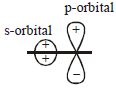
B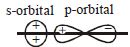
C
D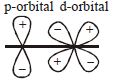
Solution
(B) For bonding to occur,the overlapping orbitals must have the same phase (sign) in the region of overlap.
In option $(A)$,the $s$-orbital $(+)$ overlaps with the negative lobe of the $p$-orbital,leading to anti-bonding.
In option $(B)$,the $s$-orbital $(+)$ overlaps with the positive lobe of the $p$-orbital,which results in constructive interference and thus leads to bonding.
In option $(C)$,the $p$-orbitals overlap with opposite signs,leading to anti-bonding.
In option $(D)$,the $p$-orbital and $d$-orbital overlap with opposite signs,leading to anti-bonding.
Therefore,option $(B)$ represents a bonding interaction.
In option $(A)$,the $s$-orbital $(+)$ overlaps with the negative lobe of the $p$-orbital,leading to anti-bonding.
In option $(B)$,the $s$-orbital $(+)$ overlaps with the positive lobe of the $p$-orbital,which results in constructive interference and thus leads to bonding.
In option $(C)$,the $p$-orbitals overlap with opposite signs,leading to anti-bonding.
In option $(D)$,the $p$-orbital and $d$-orbital overlap with opposite signs,leading to anti-bonding.
Therefore,option $(B)$ represents a bonding interaction.
0 likes
View Solution41
MediumMCQ
Which of the following molecules possesses a bond formed by $sp^2-sp$ orbital overlap?
A
Butenyne
B
Butadiyne
C
But$-2-$yne
D
But$-2-$ene
Solution
(A) To determine the hybridization of carbon atoms in the given molecules,we look at the structure of $CH_2=CH-C\equiv CH$ (Butenyne).
In Butenyne,the structure is $CH_2=CH-C\equiv CH$.
The carbon atoms are numbered as $C_1=C_2-C_3\equiv C_4$.
$C_1$ is $sp^2$ hybridized,$C_2$ is $sp^2$ hybridized,$C_3$ is $sp$ hybridized,and $C_4$ is $sp$ hybridized.
The bond between $C_2$ and $C_3$ is formed by the overlap of an $sp^2$ orbital from $C_2$ and an $sp$ orbital from $C_3$.
Therefore,Butenyne contains an $sp^2-sp$ sigma bond.
In Butenyne,the structure is $CH_2=CH-C\equiv CH$.
The carbon atoms are numbered as $C_1=C_2-C_3\equiv C_4$.
$C_1$ is $sp^2$ hybridized,$C_2$ is $sp^2$ hybridized,$C_3$ is $sp$ hybridized,and $C_4$ is $sp$ hybridized.
The bond between $C_2$ and $C_3$ is formed by the overlap of an $sp^2$ orbital from $C_2$ and an $sp$ orbital from $C_3$.
Therefore,Butenyne contains an $sp^2-sp$ sigma bond.
0 likes
View Solution42
MediumMCQ
Which of the following molecules has two $\sigma$ and two $\pi$ bonds?
A
$C_2H_4$
B
$N_2F_2$
C
$C_2H_2Cl_2$
D
$HCN$
Solution
(D) In the molecule $HCN$,the structure is $H-C \equiv N$.
There is one $\sigma$ bond between $H$ and $C$.
There is one $\sigma$ bond and two $\pi$ bonds between $C$ and $N$.
Total bonds in $HCN$: $2\,\sigma$ bonds and $2\,\pi$ bonds.
Therefore,the correct option is $D$.
There is one $\sigma$ bond between $H$ and $C$.
There is one $\sigma$ bond and two $\pi$ bonds between $C$ and $N$.
Total bonds in $HCN$: $2\,\sigma$ bonds and $2\,\pi$ bonds.
Therefore,the correct option is $D$.
0 likes
View Solution43
EasyMCQ
The $d_{xy}$ orbital can form a $\pi$ bond with another $d_{xy}$ orbital along which axis?
A
$x$ axis only
B
$y$ axis only
C
Both $x$ and $y$ axis
D
$z$ axis
Solution
(D) The $d_{xy}$ orbital has lobes lying in the $xy$ plane between the $x$ and $y$ axes.
For two $d_{xy}$ orbitals to form a $\pi$ bond,they must approach each other such that their lobes overlap laterally.
If they approach along the $z$ axis,the lobes of the two $d_{xy}$ orbitals are parallel to each other,allowing for effective lateral overlap to form a $\pi$ bond.
Therefore,the $d_{xy}$ orbital forms a $\pi$ bond with another $d_{xy}$ orbital along the $z$ axis.
For two $d_{xy}$ orbitals to form a $\pi$ bond,they must approach each other such that their lobes overlap laterally.
If they approach along the $z$ axis,the lobes of the two $d_{xy}$ orbitals are parallel to each other,allowing for effective lateral overlap to form a $\pi$ bond.
Therefore,the $d_{xy}$ orbital forms a $\pi$ bond with another $d_{xy}$ orbital along the $z$ axis.
0 likes
View Solution44
DifficultMCQ
The nodal plane in the $\pi-$bond of ethene is located in
A
the molecular plane
B
a plane parallel to the molecular plane
C
a plane perpendicular to the molecular plane which bisects the carbon-carbon $\sigma$ bond at right angle
D
a plane perpendicular to the molecular plane which contains the carbon-carbon bond
Solution
(A) In ethene $(C_2H_4)$,the carbon atoms are $sp^2$ hybridized. The three $sp^2$ hybrid orbitals of each carbon atom lie in the same plane (the molecular plane) and form $\sigma$ bonds with hydrogen atoms and the other carbon atom.
The unhybridized $p_z$ orbitals are perpendicular to this molecular plane and overlap laterally to form the $\pi$ bond.
$A$ nodal plane is a plane where the probability of finding an electron is zero.
For a $\pi$ bond formed by the lateral overlap of $p$ orbitals,the molecular plane itself acts as the nodal plane because the electron density of the $\pi$ bond is concentrated above and below this plane,not within it.
The unhybridized $p_z$ orbitals are perpendicular to this molecular plane and overlap laterally to form the $\pi$ bond.
$A$ nodal plane is a plane where the probability of finding an electron is zero.
For a $\pi$ bond formed by the lateral overlap of $p$ orbitals,the molecular plane itself acts as the nodal plane because the electron density of the $\pi$ bond is concentrated above and below this plane,not within it.
0 likes
View Solution45
EasyMCQ
The fluorine molecule is formed by
A
$p-p$ orbitals (sideways overlap)
B
$p-p$ orbitals (end-to-end overlap)
C
$sp-sp$ orbitals
D
$s-s$ orbitals
Solution
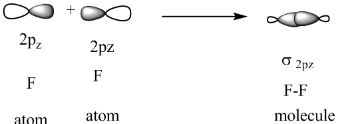
(B) The fluorine molecule $(F_2)$ is formed by the axial overlap of $2p_z$ orbitals of two fluorine atoms.
This axial overlap is known as end-to-end overlap,which results in the formation of a sigma $(\sigma)$ bond.
Therefore,the correct description is $p-p$ orbitals (end-to-end overlap).
This axial overlap is known as end-to-end overlap,which results in the formation of a sigma $(\sigma)$ bond.
Therefore,the correct description is $p-p$ orbitals (end-to-end overlap).
0 likes
View Solution46
MediumMCQ
Which of the following overlaps is incorrect (assuming $Z$-axis is the internuclear axis)?
$(A)$ $2p_y + 2p_y \to \pi$-bond formation
$(B)$ $2p_x + 2p_x \to \sigma$-bond formation
$(C)$ $3d_{xy} + 3d_{xy} \to \pi$-bond formation
$(D)$ $2s + 2p_y \to \pi$-bond formation
$(E)$ $3d_{xy} + 3d_{xy} \to \delta$-bond formation
$(F)$ $2p_z + 2p_z \to \sigma$-bond formation
$(A)$ $2p_y + 2p_y \to \pi$-bond formation
$(B)$ $2p_x + 2p_x \to \sigma$-bond formation
$(C)$ $3d_{xy} + 3d_{xy} \to \pi$-bond formation
$(D)$ $2s + 2p_y \to \pi$-bond formation
$(E)$ $3d_{xy} + 3d_{xy} \to \delta$-bond formation
$(F)$ $2p_z + 2p_z \to \sigma$-bond formation
A
$A, B, C$
B
$C, F$
C
$B, E$
D
$B, C, D$
Solution
(D) Given the internuclear axis is the $Z$-axis:
$(A)$ $2p_y + 2p_y$ overlap leads to $\pi$-bond formation (Correct).
$(B)$ $2p_x + 2p_x$ overlap leads to $\pi$-bond formation,not $\sigma$ (Incorrect).
$(C)$ $3d_{xy} + 3d_{xy}$ overlap leads to $\delta$-bond formation,not $\pi$ (Incorrect).
$(D)$ $2s + 2p_y$ overlap results in no bond formation because of symmetry mismatch (Incorrect).
$(E)$ $3d_{xy} + 3d_{xy}$ overlap leads to $\delta$-bond formation (Correct).
$(F)$ $2p_z + 2p_z$ overlap leads to $\sigma$-bond formation (Correct).
Therefore,the incorrect overlaps are $(B)$,$(C)$,and $(D)$.
$(A)$ $2p_y + 2p_y$ overlap leads to $\pi$-bond formation (Correct).
$(B)$ $2p_x + 2p_x$ overlap leads to $\pi$-bond formation,not $\sigma$ (Incorrect).
$(C)$ $3d_{xy} + 3d_{xy}$ overlap leads to $\delta$-bond formation,not $\pi$ (Incorrect).
$(D)$ $2s + 2p_y$ overlap results in no bond formation because of symmetry mismatch (Incorrect).
$(E)$ $3d_{xy} + 3d_{xy}$ overlap leads to $\delta$-bond formation (Correct).
$(F)$ $2p_z + 2p_z$ overlap leads to $\sigma$-bond formation (Correct).
Therefore,the incorrect overlaps are $(B)$,$(C)$,and $(D)$.
0 likes
View Solution47
DifficultMCQ
The strength of bonds formed by $2s-2s$,$2p-2p$ and $2p-2s$ overlap has the order
A
$s-s > p-p > p-s$
B
$s-s > p-s > p-p$
C
$p-p > p-s > s-s$
D
$p-p > s-s > p-s$
Solution
(C) The strength of a covalent bond depends on the extent of overlapping of atomic orbitals.
Greater the extent of overlapping,stronger is the bond.
For orbitals with the same principal quantum number $(n=2)$,the directional nature of the orbitals determines the extent of overlap.
The $p-p$ overlap (coaxial) is more effective than $p-s$ overlap,which in turn is more effective than $s-s$ overlap due to the directional character of $p$ orbitals.
Therefore,the order of bond strength is $p-p > p-s > s-s$.
Greater the extent of overlapping,stronger is the bond.
For orbitals with the same principal quantum number $(n=2)$,the directional nature of the orbitals determines the extent of overlap.
The $p-p$ overlap (coaxial) is more effective than $p-s$ overlap,which in turn is more effective than $s-s$ overlap due to the directional character of $p$ orbitals.
Therefore,the order of bond strength is $p-p > p-s > s-s$.
0 likes
View Solution48
DifficultMCQ
Which of the following statements is incorrect for sigma and $\pi$-bonds formed between two carbon atoms?
A
Sigma-bond is stronger than a $\pi$-bond
B
Bond energies of sigma and $\pi$-bonds are of the order of $264 \ kJ/mol$ and $347 \ kJ/mol$
C
Free rotation of surrounding atoms about a sigma-bond is allowed but not in case of a $\pi$-bond
D
Sigma-bond determines the direction between carbon atoms but a $\pi$-bond has no primary effect in this regard
Solution
(B) sigma bond is stronger than a $\pi$-bond because the extent of overlap is greater in sigma bond formation. This statement is correct.
$(B)$ The bond energy of a sigma bond is typically higher (approx. $347 \ kJ/mol$) than that of a $\pi$-bond (approx. $264 \ kJ/mol$). The statement in the option reverses these values,making it incorrect.
$(C)$ Free rotation of atoms about a sigma bond is allowed due to cylindrical symmetry,whereas a $\pi$-bond restricts rotation. This statement is correct.
$(D)$ A sigma bond determines the molecular geometry and direction between carbon atoms,while a $\pi$-bond does not. This statement is correct.
$(B)$ The bond energy of a sigma bond is typically higher (approx. $347 \ kJ/mol$) than that of a $\pi$-bond (approx. $264 \ kJ/mol$). The statement in the option reverses these values,making it incorrect.
$(C)$ Free rotation of atoms about a sigma bond is allowed due to cylindrical symmetry,whereas a $\pi$-bond restricts rotation. This statement is correct.
$(D)$ A sigma bond determines the molecular geometry and direction between carbon atoms,while a $\pi$-bond does not. This statement is correct.
0 likes
View Solution49
AdvancedMCQ
Assuming the bond direction is along the $z$-axis,which of the following overlaps of atomic orbitals of two atoms $(A)$ and $(B)$ will result in bonding?
$I$. $s$-orbital of $A$ and $p_x$-orbital of $B$
$II$. $s$-orbital of $A$ and $p_z$-orbital of $B$
$III$. $p_y$-orbital of $A$ and $p_z$-orbital of $B$
$IV$. $s$-orbital of both $(A)$ and $(B)$
$I$. $s$-orbital of $A$ and $p_x$-orbital of $B$
$II$. $s$-orbital of $A$ and $p_z$-orbital of $B$
$III$. $p_y$-orbital of $A$ and $p_z$-orbital of $B$
$IV$. $s$-orbital of both $(A)$ and $(B)$
A
$I$ and $IV$
B
$I$ and $II$
C
$III$ and $IV$
D
$II$ and $IV$
Solution
(D) The $s$-orbital is spherically symmetric and non-directional,allowing it to overlap with any orbital to form a bond.
For a bond formed along the $z$-axis,the orbitals must have a component along the $z$-axis.
$I$. $s$ and $p_x$ overlap: $p_x$ is perpendicular to the $z$-axis,resulting in zero net overlap.
$II$. $s$ and $p_z$ overlap: $p_z$ is directed along the $z$-axis,resulting in effective head-on overlap (bonding).
$III$. $p_y$ and $p_z$ overlap: These orbitals are mutually perpendicular,resulting in zero net overlap.
$IV$. $s$ and $s$ overlap: Both are spherically symmetric,resulting in effective overlap (bonding).
Therefore,combinations $II$ and $IV$ result in bonding.
For a bond formed along the $z$-axis,the orbitals must have a component along the $z$-axis.
$I$. $s$ and $p_x$ overlap: $p_x$ is perpendicular to the $z$-axis,resulting in zero net overlap.
$II$. $s$ and $p_z$ overlap: $p_z$ is directed along the $z$-axis,resulting in effective head-on overlap (bonding).
$III$. $p_y$ and $p_z$ overlap: These orbitals are mutually perpendicular,resulting in zero net overlap.
$IV$. $s$ and $s$ overlap: Both are spherically symmetric,resulting in effective overlap (bonding).
Therefore,combinations $II$ and $IV$ result in bonding.
0 likes
View Solution50
DifficultMCQ
Calculate the ratio of $\sigma$ and $\pi$ bonds for the following compounds and determine the correct order:
$A$: Tetracyanomethane $(C(CN)_4)$
$B$: Carbon dioxide $(CO_2)$
$C$: Benzene $(C_6H_6)$
$D$: $1, 3$-Butadiene $(CH_2=CH-CH=CH_2)$
$A$: Tetracyanomethane $(C(CN)_4)$
$B$: Carbon dioxide $(CO_2)$
$C$: Benzene $(C_6H_6)$
$D$: $1, 3$-Butadiene $(CH_2=CH-CH=CH_2)$
A
$A = B < C < D$
B
$A = B < D < C$
C
$A = B = C = D$
D
$C < D < A < B$
Solution
(A) $1$. For $A$ (Tetracyanomethane,$C(CN)_4$): Structure is $C(CN)_4$. It has $4$ $C-C$ $\sigma$ bonds,$4$ $C\equiv N$ $\sigma$ bonds,and $8$ $\pi$ bonds. Total $\sigma = 8$,$\pi = 8$. Ratio $\sigma/\pi = 8/8 = 1$.
$2$. For $B$ (Carbon dioxide,$CO_2$): Structure is $O=C=O$. It has $2$ $\sigma$ bonds and $2$ $\pi$ bonds. Ratio $\sigma/\pi = 2/2 = 1$.
$3$. For $C$ (Benzene,$C_6H_6$): It has $12$ $\sigma$ bonds and $3$ $\pi$ bonds. Ratio $\sigma/\pi = 12/3 = 4$.
$4$. For $D$ ($1, 3$-Butadiene,$CH_2=CH-CH=CH_2$): It has $9$ $\sigma$ bonds and $2$ $\pi$ bonds. Ratio $\sigma/\pi = 9/2 = 4.5$.
Comparing the ratios: $A(1) = B(1) < C(4) < D(4.5)$.
Thus,the correct order is $A = B < C < D$.
$2$. For $B$ (Carbon dioxide,$CO_2$): Structure is $O=C=O$. It has $2$ $\sigma$ bonds and $2$ $\pi$ bonds. Ratio $\sigma/\pi = 2/2 = 1$.
$3$. For $C$ (Benzene,$C_6H_6$): It has $12$ $\sigma$ bonds and $3$ $\pi$ bonds. Ratio $\sigma/\pi = 12/3 = 4$.
$4$. For $D$ ($1, 3$-Butadiene,$CH_2=CH-CH=CH_2$): It has $9$ $\sigma$ bonds and $2$ $\pi$ bonds. Ratio $\sigma/\pi = 9/2 = 4.5$.
Comparing the ratios: $A(1) = B(1) < C(4) < D(4.5)$.
Thus,the correct order is $A = B < C < D$.
0 likes
View SolutionChemical Bonding and Molecular Structure — Overlaping - s and p- bonds · Frequently Asked Questions
1Are these Chemical Bonding and Molecular Structure questions useful for JEE and NEET?
Yes. All questions in this section are mapped to JEE Main and NEET exam patterns. Previous year questions from JEE Main, NEET, GUJCET and state-level exams are included with full solutions.
2Can I switch to Hindi or Gujarati for these questions?
Yes. Use the language tabs in the hero section or the sidebar to view the same questions and solutions in English, Hindi or Gujarati.
3How do I generate a question paper from this subtopic?
Use the Vedclass Exam Paper Generator — select the chapter and subtopic, set difficulty, and generate Sets A, B, C, D automatically. First 3 chapters of every subject are free.
Vedclass Products
For Students
Vedclass Test Series
Mock tests in real JEE/NEET style with performance analysis. 5-day free trial.
Start Free TrialFor Teachers
Exam Paper Generator
Generate Set A/B/C/D papers from this chapter in 2 minutes. 3 chapters free.
Try FreeFor Institutes
Online Exam Module
Live online exams with unlimited students, 360° analytics & white-label branding.
See DemoFor Teachers & Institutes
Generate a Chemical Bonding and Molecular Structure Exam Paper in 2 Minutes
Select subtopic & difficulty — Sets A, B, C, D auto-generated with No Repeat logic.
First 3 chapters of every subject are free — no payment required.