
A English
Overlaping - s and p- bonds Questions in English
Class 11 Chemistry · Chemical Bonding and Molecular Structure · Overlaping - s and p- bonds
108+
Questions
English
Language
100%
With Solutions
Showing 50 of 108 questions in English
51
AdvancedMCQ
Nodal planes of $\pi$-bond$(s)$ in $CH_2=C=C=CH_2$ are located in
A
all are in molecular plane
B
two in molecular plane and one in a plane perpendicular to molecular plane which contains $C-C$ $\sigma$-bond
C
one in molecular plane and two in plane perpendicular to molecular plane which contains $C-C$ $\sigma$-bonds
D
two in molecular plane and one in a plane perpendicular to molecular plane which bisects $C-C$ $\sigma$-bonds at right angle
Solution
(C) The molecule $CH_2=C=C=CH_2$ is an allene derivative (specifically,buta$-1,2,3-$triene).
In this molecule,the terminal $CH_2$ groups are perpendicular to each other.
The two $\pi$-bonds are formed by the overlap of $p$-orbitals.
One $\pi$-bond is formed by the overlap of $p_y$ orbitals,and the other $\pi$-bond is formed by the overlap of $p_z$ orbitals.
The nodal plane of a $\pi$-bond is the plane containing the internuclear axis and perpendicular to the plane of the $p$-orbitals.
For the two $\pi$-bonds in this system,one nodal plane lies in the molecular plane (containing the $C-C$ $\sigma$-bonds),and the other nodal plane is perpendicular to the molecular plane.
In this molecule,the terminal $CH_2$ groups are perpendicular to each other.
The two $\pi$-bonds are formed by the overlap of $p$-orbitals.
One $\pi$-bond is formed by the overlap of $p_y$ orbitals,and the other $\pi$-bond is formed by the overlap of $p_z$ orbitals.
The nodal plane of a $\pi$-bond is the plane containing the internuclear axis and perpendicular to the plane of the $p$-orbitals.
For the two $\pi$-bonds in this system,one nodal plane lies in the molecular plane (containing the $C-C$ $\sigma$-bonds),and the other nodal plane is perpendicular to the molecular plane.
0 likes
View Solution52
EasyMCQ
What are the number of $\sigma$ and $\pi$ bonds in a sulfuric acid molecule,respectively?
A
$6\sigma, 2\pi$
B
$6\sigma, 0\pi$
C
$2\sigma, 4\pi$
D
$2\sigma, 2\pi$
Solution
(A) The structure of sulfuric acid $(H_2SO_4)$ is:
$HO-S(=O)_2-OH$.
In this structure,there are $6$ single bonds (each being a $\sigma$ bond) and $2$ double bonds (each containing one $\sigma$ and one $\pi$ bond).
Total $\sigma$ bonds = $4$ (from $S-O$ and $S-OH$ bonds) + $2$ (from $O-H$ bonds) = $6\sigma$ bonds.
Total $\pi$ bonds = $2$ (from the two $S=O$ double bonds).
Therefore,the number of $\sigma$ and $\pi$ bonds are $6$ and $2$ respectively.
$HO-S(=O)_2-OH$.
In this structure,there are $6$ single bonds (each being a $\sigma$ bond) and $2$ double bonds (each containing one $\sigma$ and one $\pi$ bond).
Total $\sigma$ bonds = $4$ (from $S-O$ and $S-OH$ bonds) + $2$ (from $O-H$ bonds) = $6\sigma$ bonds.
Total $\pi$ bonds = $2$ (from the two $S=O$ double bonds).
Therefore,the number of $\sigma$ and $\pi$ bonds are $6$ and $2$ respectively.
0 likes
View Solution53
EasyMCQ
Which of the following contains $p\pi - p\pi$ bonding?
A
$NO_3^-$
B
$SO_3^{2-}$
C
$BO_3^{3-}$
D
$CO_3^{2-}$
Solution
(A, C, D) In $NO_3^-$,$CO_3^{2-}$,and $BO_3^{3-}$,the central atoms ($N$,$C$,$B$) belong to the second period and form $p\pi - p\pi$ bonds with oxygen atoms ($2p$ orbitals).
However,in $SO_3^{2-}$,the sulfur atom belongs to the third period and forms $d\pi - p\pi$ bonds with oxygen atoms.
Therefore,all options except $B$ contain $p\pi - p\pi$ bonding.
Given the standard nature of this question,it is often asked to identify which species does $NOT$ contain $p\pi - p\pi$ bonding,or the question implies identifying the species with $d\pi - p\pi$ bonding.
Assuming the question asks for the species with $d\pi - p\pi$ bonding,the answer is $B$.
However,in $SO_3^{2-}$,the sulfur atom belongs to the third period and forms $d\pi - p\pi$ bonds with oxygen atoms.
Therefore,all options except $B$ contain $p\pi - p\pi$ bonding.
Given the standard nature of this question,it is often asked to identify which species does $NOT$ contain $p\pi - p\pi$ bonding,or the question implies identifying the species with $d\pi - p\pi$ bonding.
Assuming the question asks for the species with $d\pi - p\pi$ bonding,the answer is $B$.
0 likes
View Solution54
MediumMCQ
The nodal plane in an ethylene $(C_2H_4)$ molecule is:
A
Parallel to the bond axis
B
Perpendicular to the bond axis
C
In the molecular plane
D
None of these
Solution
(C) In an ethylene $(C_2H_4)$ molecule,the carbon atoms are $sp^2$ hybridized.
The $p_z$ orbitals of both carbon atoms overlap sideways to form a $\pi$ bond.
The nodal plane of this $\pi$ bond is the molecular plane itself,which contains the two carbon nuclei and the four hydrogen nuclei.
The $p_z$ orbitals of both carbon atoms overlap sideways to form a $\pi$ bond.
The nodal plane of this $\pi$ bond is the molecular plane itself,which contains the two carbon nuclei and the four hydrogen nuclei.
0 likes
View Solution55
DifficultMCQ
Among the following ions,the $p\pi - d\pi$ overlap could be present in:
A
$NO_2^-$
B
$NO_3^-$
C
$PO_4^{3-}$
D
$CO_3^{2-}$
Solution
(C) In the $PO_4^{3-}$ ion,the central phosphorus atom has vacant $d$-orbitals available for bonding.
The $\pi$-bond in the $P=O$ bond is formed by the sidewise overlapping of the $d$-orbital of $P$ and the $p$-orbital of oxygen,which is a $p\pi - d\pi$ overlap.
In $NO_2^-$,$NO_3^-$,and $CO_3^{2-}$,the central atoms ($N$ and $C$) belong to the second period and do not have vacant $d$-orbitals,so they cannot form $p\pi - d\pi$ bonds.
The $\pi$-bond in the $P=O$ bond is formed by the sidewise overlapping of the $d$-orbital of $P$ and the $p$-orbital of oxygen,which is a $p\pi - d\pi$ overlap.
In $NO_2^-$,$NO_3^-$,and $CO_3^{2-}$,the central atoms ($N$ and $C$) belong to the second period and do not have vacant $d$-orbitals,so they cannot form $p\pi - d\pi$ bonds.
0 likes
View Solution56
MediumMCQ
Which of the following combinations forms the strongest bond by head-on overlapping?
A
$2s$ and $2s$ orbitals
B
$2p$ and $2p$ orbitals
C
$2s$ and $2p$ orbitals
D
$1s$ and $1s$ orbitals
Solution
(D) The strength of a covalent bond formed by head-on overlapping depends on the extent of overlapping.
Greater the extent of overlapping,stronger is the bond.
For $s$ and $p$ orbitals,the $1s$ orbital is the smallest and closest to the nucleus,leading to the maximum extent of overlapping.
Therefore,the $1s-1s$ overlapping is the strongest among the given options.
Greater the extent of overlapping,stronger is the bond.
For $s$ and $p$ orbitals,the $1s$ orbital is the smallest and closest to the nucleus,leading to the maximum extent of overlapping.
Therefore,the $1s-1s$ overlapping is the strongest among the given options.
0 likes
View Solution57
MediumMCQ
The nodal plane of the $\pi$-bond in ethene is located in:
A
The molecular plane
B
$A$ plane parallel to the molecular plane
C
$A$ plane perpendicular to the molecular plane which bisects the $C-C$ $\sigma$-bond at a right angle
D
$A$ plane perpendicular to the molecular plane which contains the $C-C$ $\sigma$-bond
Solution
(A) In ethene $(CH_2=CH_2)$,the carbon atoms are $sp^2$ hybridized.
The three $sp^2$ hybrid orbitals of each carbon atom lie in the same plane (the molecular plane) and form $\sigma$-bonds.
The unhybridized $2p_z$ orbitals are perpendicular to this molecular plane.
The $\pi$-bond is formed by the lateral overlap of these $2p_z$ orbitals.
$A$ nodal plane is a plane where the probability of finding an electron is zero.
For a $\pi$-bond,the molecular plane itself acts as the nodal plane because the electron density of the $\pi$-bond is concentrated above and below this plane.
The three $sp^2$ hybrid orbitals of each carbon atom lie in the same plane (the molecular plane) and form $\sigma$-bonds.
The unhybridized $2p_z$ orbitals are perpendicular to this molecular plane.
The $\pi$-bond is formed by the lateral overlap of these $2p_z$ orbitals.
$A$ nodal plane is a plane where the probability of finding an electron is zero.
For a $\pi$-bond,the molecular plane itself acts as the nodal plane because the electron density of the $\pi$-bond is concentrated above and below this plane.
0 likes
View Solution58
MediumMCQ
Which of the following statements is $NOT$ correct?
A
The $\sigma$ bond determines the direction between carbon atoms,while the $\pi$ bond has no primary effect in this context.
B
The $\sigma$ bond is stronger than the $\pi$ bond.
C
The bond energies of $\sigma$ and $\pi$ bonds are of the order of $264 \, kJ/mol$ and $347 \, kJ/mol$ respectively.
D
Free rotation of atoms around a $\sigma$ bond is possible,but this is not possible in the case of a $\pi$ bond.
Solution
(C) The correct statement regarding bond energies is that the $\sigma$ bond is stronger than the $\pi$ bond.
Typically,the bond energy of a $\sigma$ bond is higher than that of a $\pi$ bond.
Option $C$ states that the bond energy of a $\sigma$ bond is $264 \, kJ/mol$ and a $\pi$ bond is $347 \, kJ/mol$,which is factually incorrect as it reverses the values and their relative strengths.
Therefore,statement $C$ is not correct.
Typically,the bond energy of a $\sigma$ bond is higher than that of a $\pi$ bond.
Option $C$ states that the bond energy of a $\sigma$ bond is $264 \, kJ/mol$ and a $\pi$ bond is $347 \, kJ/mol$,which is factually incorrect as it reverses the values and their relative strengths.
Therefore,statement $C$ is not correct.
0 likes
View Solution59
MediumMCQ
If the internuclear axis of a diatomic molecule is $z$,then the overlap of $p_x$ and $p_y$ orbitals results in the formation of ........
A
$\pi$ molecular orbital
B
$\sigma$ molecular orbital
C
$\delta$ molecular orbital
D
no bond formation
Solution
(D) In a diatomic molecule,if the internuclear axis is the $z$-axis,then the $p_z$ orbitals undergo head-on overlap to form a $\sigma$ bond.
The $p_x$ and $p_y$ orbitals are oriented perpendicular to the $z$-axis.
Since $p_x$ and $p_y$ orbitals are orthogonal to each other and to the $z$-axis,they cannot overlap effectively to form a bond.
Therefore,the overlap of $p_x$ and $p_y$ orbitals results in no bond formation.
The $p_x$ and $p_y$ orbitals are oriented perpendicular to the $z$-axis.
Since $p_x$ and $p_y$ orbitals are orthogonal to each other and to the $z$-axis,they cannot overlap effectively to form a bond.
Therefore,the overlap of $p_x$ and $p_y$ orbitals results in no bond formation.
0 likes
View Solution60
MediumMCQ
How is the $F_2$ molecule formed?
A
By axial overlap of $p-p$ orbitals
B
By lateral overlap of $p-p$ orbitals
C
By axial overlap of $s-p$ orbitals
D
By overlap of two $sp^2$ hybrid orbitals
Solution
(A) The atomic number of fluorine $(F)$ is $9$. Its electronic configuration is $1s^2 2s^2 2p_x^2 2p_y^2 2p_z^1$.
In the formation of the $F_2$ molecule,the half-filled $2p_z$ orbital of one fluorine atom overlaps axially with the half-filled $2p_z$ orbital of another fluorine atom.
This axial overlap results in the formation of a sigma $(\sigma)$ bond.
Therefore,the $F_2$ molecule is formed by the axial overlap of $p-p$ orbitals.
In the formation of the $F_2$ molecule,the half-filled $2p_z$ orbital of one fluorine atom overlaps axially with the half-filled $2p_z$ orbital of another fluorine atom.
This axial overlap results in the formation of a sigma $(\sigma)$ bond.
Therefore,the $F_2$ molecule is formed by the axial overlap of $p-p$ orbitals.
0 likes
View Solution61
EasyMCQ
Number of $\sigma$ and $\pi$ bonds present in $CH_3-CH=CH-C\equiv CH$ are
A
$10\sigma, 3\pi$
B
$10\sigma, 2\pi$
C
$9\sigma, 2\pi$
D
$8\sigma, 3\pi$
Solution
(A) The structure is $CH_3-CH=CH-C\equiv CH$.
Counting the bonds:
$C-H$ bonds: $3$ (in $CH_3$) $+ 1$ (in $CH$) $+ 1$ (in $CH$) $+ 1$ (in $CH$) $= 6$ $\sigma$ bonds.
$C-C$ bonds: $1$ $(C-C)$ $+ 1$ $(C=C)$ $+ 1$ $(C-C)$ $+ 1$ $(C\equiv C)$ $= 4$ $\sigma$ bonds.
Total $\sigma$ bonds $= 6 + 4 = 10$.
$\pi$ bonds: $1$ (in $C=C$) $+ 2$ (in $C\equiv C$) $= 3$ $\pi$ bonds.
Therefore,the total is $10\sigma$ and $3\pi$ bonds.
Counting the bonds:
$C-H$ bonds: $3$ (in $CH_3$) $+ 1$ (in $CH$) $+ 1$ (in $CH$) $+ 1$ (in $CH$) $= 6$ $\sigma$ bonds.
$C-C$ bonds: $1$ $(C-C)$ $+ 1$ $(C=C)$ $+ 1$ $(C-C)$ $+ 1$ $(C\equiv C)$ $= 4$ $\sigma$ bonds.
Total $\sigma$ bonds $= 6 + 4 = 10$.
$\pi$ bonds: $1$ (in $C=C$) $+ 2$ (in $C\equiv C$) $= 3$ $\pi$ bonds.
Therefore,the total is $10\sigma$ and $3\pi$ bonds.
0 likes
View Solution62
DifficultMCQ
The correct order of the extent of overlapping is:
A
$1s-1s < 2s-2s < 2s-2p$
B
$2p-2p \text{ (axial)} < 2p-2p \text{ (collateral)}$
C
$1s-1s > 2p-2p \text{ (axial)} > 2s-2p > 2s-2s$
D
$1s-1s > 2s-2p > 2s-2s > 2p-2p \text{ (axial)}$
Solution
(C) The extent of overlapping depends on the size of the orbitals and the type of overlap.
Smaller orbitals overlap more effectively than larger orbitals because the electron density is closer to the nucleus.
Thus,the order of size is $1s < 2s < 2p$.
For the same shell,the order of overlapping strength is $p-p \text{ (axial)} > s-p > s-s$.
Comparing $1s-1s$ with others,$1s$ is the smallest orbital,leading to the strongest overlap.
Therefore,the correct order is $1s-1s > 2p-2p \text{ (axial)} > 2s-2p > 2s-2s$.
Smaller orbitals overlap more effectively than larger orbitals because the electron density is closer to the nucleus.
Thus,the order of size is $1s < 2s < 2p$.
For the same shell,the order of overlapping strength is $p-p \text{ (axial)} > s-p > s-s$.
Comparing $1s-1s$ with others,$1s$ is the smallest orbital,leading to the strongest overlap.
Therefore,the correct order is $1s-1s > 2p-2p \text{ (axial)} > 2s-2p > 2s-2s$.
0 likes
View Solution63
MediumMCQ
Which overlap results in the formation of the strongest bond?
A
$s-s$
B
$p-p$ (axial)
C
$s-p$
D
$p-p$ (sidewise)
Solution
(B) The strength of a covalent bond depends on the extent of overlapping of atomic orbitals.
Axial overlapping is always stronger than sidewise overlapping.
Among axial overlaps,the $p-p$ (axial) overlap is stronger than $s-p$ and $s-s$ overlaps because $p-$orbitals are more directional in nature,allowing for a greater extent of overlap compared to the spherical $s-$orbitals.
Axial overlapping is always stronger than sidewise overlapping.
Among axial overlaps,the $p-p$ (axial) overlap is stronger than $s-p$ and $s-s$ overlaps because $p-$orbitals are more directional in nature,allowing for a greater extent of overlap compared to the spherical $s-$orbitals.
0 likes
View Solution64
EasyMCQ
The number of $\sigma$ and $\pi$ bonds in sulfuric acid $(H_2SO_4)$ are respectively:
A
$6, 2$
B
$6, 0$
C
$2, 4$
D
$2, 2$
Solution
(A) The structure of sulfuric acid $(H_2SO_4)$ consists of a central sulfur atom bonded to two hydroxyl groups $(-OH)$ and two oxygen atoms via double bonds $(S=O)$.
Specifically,there are $2$ $S-OH$ bonds and $2$ $S=O$ bonds.
Each single bond is a $\sigma$ bond,and each double bond contains one $\sigma$ bond and one $\pi$ bond.
Counting the $\sigma$ bonds: $2$ $(S-OH)$ + $2$ ($S-O$ single part of $S=O$) + $2$ $(O-H)$ = $6$ $\sigma$ bonds.
Counting the $\pi$ bonds: $2$ $\pi$ bonds (one from each $S=O$ bond).
Thus,the number of $\sigma$ and $\pi$ bonds are $6$ and $2$ respectively.
Specifically,there are $2$ $S-OH$ bonds and $2$ $S=O$ bonds.
Each single bond is a $\sigma$ bond,and each double bond contains one $\sigma$ bond and one $\pi$ bond.
Counting the $\sigma$ bonds: $2$ $(S-OH)$ + $2$ ($S-O$ single part of $S=O$) + $2$ $(O-H)$ = $6$ $\sigma$ bonds.
Counting the $\pi$ bonds: $2$ $\pi$ bonds (one from each $S=O$ bond).
Thus,the number of $\sigma$ and $\pi$ bonds are $6$ and $2$ respectively.
0 likes
View Solution65
MediumMCQ
Assertion : Sigma $(\sigma)$ is a strong bond,while pi $(\pi)$ is a weak bond.
Reason : Atoms rotate freely about pi $(\pi)$ bond.
Reason : Atoms rotate freely about pi $(\pi)$ bond.
A
If both Assertion and Reason are correct and the Reason is a correct explanation of the Assertion.
B
If both Assertion and Reason are correct but Reason is not a correct explanation of the Assertion.
C
If the Assertion is correct but Reason is incorrect.
D
If both the Assertion and Reason are incorrect.
Solution
(C) The Assertion is correct because a sigma $(\sigma)$ bond is formed by the axial overlap of atomic orbitals,which is more extensive than the lateral overlap that forms a pi $(\pi)$ bond. Therefore,the sigma $(\sigma)$ bond is stronger than the pi $(\pi)$ bond.
The Reason is incorrect because atoms cannot rotate freely around a pi $(\pi)$ bond. The presence of a pi $(\pi)$ bond restricts rotation,as rotation would require breaking the lateral overlap of the $p$-orbitals.
The Reason is incorrect because atoms cannot rotate freely around a pi $(\pi)$ bond. The presence of a pi $(\pi)$ bond restricts rotation,as rotation would require breaking the lateral overlap of the $p$-orbitals.
0 likes
View Solution66
Medium
What is the total number of sigma $(\sigma)$ and pi $(\pi)$ bonds in the following molecules?
$(a)$ $C_{2}H_{2}$
$(b)$ $C_{2}H_{4}$
$(a)$ $C_{2}H_{2}$
$(b)$ $C_{2}H_{4}$
Solution
(N/A) single bond is a result of the axial overlap of bonding orbitals. Hence,it contributes a sigma $(\sigma)$ bond.
$A$ multiple bond (double or triple bond) is always formed as a result of the sidewise overlap of orbitals,which contributes a pi $(\pi)$ bond.
$1.$ Structure of $C_{2}H_{2}$ (Ethyne): $H-C \equiv C-H$
In $C_{2}H_{2}$,there are $3$ sigma $(\sigma)$ bonds ($2$ $C-H$ and $1$ $C-C$) and $2$ pi $(\pi)$ bonds.
$2.$ Structure of $C_{2}H_{4}$ (Ethene): $CH_{2}=CH_{2}$
In $C_{2}H_{4}$,there are $5$ sigma $(\sigma)$ bonds ($4$ $C-H$ and $1$ $C-C$) and $1$ pi $(\pi)$ bond.
$A$ multiple bond (double or triple bond) is always formed as a result of the sidewise overlap of orbitals,which contributes a pi $(\pi)$ bond.
$1.$ Structure of $C_{2}H_{2}$ (Ethyne): $H-C \equiv C-H$
In $C_{2}H_{2}$,there are $3$ sigma $(\sigma)$ bonds ($2$ $C-H$ and $1$ $C-C$) and $2$ pi $(\pi)$ bonds.
$2.$ Structure of $C_{2}H_{4}$ (Ethene): $CH_{2}=CH_{2}$
In $C_{2}H_{4}$,there are $5$ sigma $(\sigma)$ bonds ($4$ $C-H$ and $1$ $C-C$) and $1$ pi $(\pi)$ bond.
0 likes
View Solution67
Medium
Considering the $x$-axis as the internuclear axis,which of the following will not form a sigma $(\sigma)$ bond and why?
$(a)$ $1s$ and $1s$
$(b)$ $1s$ and $2p_{x}$
$(c)$ $2p_{y}$ and $2p_{y}$
$(d)$ $1s$ and $2s$
$(a)$ $1s$ and $1s$
$(b)$ $1s$ and $2p_{x}$
$(c)$ $2p_{y}$ and $2p_{y}$
$(d)$ $1s$ and $2s$
Solution
(C) $2p_{y}$ and $2p_{y}$ orbitals will not form a sigma $(\sigma)$ bond.
Since the $x$-axis is the internuclear axis,the $2p_{y}$ orbitals are oriented perpendicular to the internuclear axis.
Therefore,$2p_{y}$ and $2p_{y}$ orbitals will undergo lateral (sideways) overlapping,resulting in the formation of a pi $(\pi)$ bond instead of a sigma $(\sigma)$ bond.
Since the $x$-axis is the internuclear axis,the $2p_{y}$ orbitals are oriented perpendicular to the internuclear axis.
Therefore,$2p_{y}$ and $2p_{y}$ orbitals will undergo lateral (sideways) overlapping,resulting in the formation of a pi $(\pi)$ bond instead of a sigma $(\sigma)$ bond.
0 likes
View Solution68
Medium
Distinguish between a sigma and a pi bond.
Solution
The following are the differences between sigma and pi-bonds:
| Sigma $(\sigma)$ Bond | Pi $(\pi)$ Bond |
| $(a)$ It is formed by the end-to-end overlap of orbitals. | $(a)$ It is formed by the lateral overlap of orbitals. |
| $(b)$ The orbitals involved in the overlapping are $s-s, s-p,$ or $p-p$. | $(b)$ These bonds are formed by the overlap of $p-p$ orbitals only. |
| $(c)$ It is a strong bond. | $(c)$ It is a weak bond. |
| $(d)$ The electron cloud is symmetrical about the line joining the two nuclei. | $(d)$ The electron cloud is not symmetrical about the internuclear axis. |
| $(e)$ It consists of one electron cloud,which is symmetrical about the internuclear axis. | $(e)$ There are two electron clouds lying above and below the plane of the atomic nuclei. |
| $(f)$ Free rotation about $\sigma$ bonds is possible. | $(f)$ Rotation is restricted in case of $\pi$ bonds. |
0 likes
View Solution69
Medium
How many $\sigma$ and $\pi$ bonds are present in each of the following molecules?
$(a)$ $HC \equiv C-CH=CH-CH_3$
$(b)$ $CH_2=C=CH-CH_3$
$(a)$ $HC \equiv C-CH=CH-CH_3$
$(b)$ $CH_2=C=CH-CH_3$
Solution
(N/A) For $(a)$ $HC \equiv C-CH=CH-CH_3$:
Total $\sigma$ bonds = $4$ ($C$-$C$) + $6$ ($C$-$H$) = $10$ $\sigma$ bonds.
Total $\pi$ bonds = $2$ ($\pi$ in $C \equiv C$) + $1$ ($\pi$ in $C=C$) = $3$ $\pi$ bonds.
For $(b)$ $CH_2=C=CH-CH_3$:
Total $\sigma$ bonds = $3$ ($C$-$C$) + $6$ ($C$-$H$) = $9$ $\sigma$ bonds.
Total $\pi$ bonds = $2$ ($\pi$ in $C=C=C$) = $2$ $\pi$ bonds.
Total $\sigma$ bonds = $4$ ($C$-$C$) + $6$ ($C$-$H$) = $10$ $\sigma$ bonds.
Total $\pi$ bonds = $2$ ($\pi$ in $C \equiv C$) + $1$ ($\pi$ in $C=C$) = $3$ $\pi$ bonds.
For $(b)$ $CH_2=C=CH-CH_3$:
Total $\sigma$ bonds = $3$ ($C$-$C$) + $6$ ($C$-$H$) = $9$ $\sigma$ bonds.
Total $\pi$ bonds = $2$ ($\pi$ in $C=C=C$) = $2$ $\pi$ bonds.
0 likes
View Solution70
Medium
Indicate the $\sigma$ and $\pi$ bonds in the following molecules:
$C_{6}H_{6}, C_{6}H_{12}, CH_{2}Cl_{2}, CH_{2}=C=CH_{2}, CH_{3}NO_{2}, HCONHCH_{3}$
$C_{6}H_{6}, C_{6}H_{12}, CH_{2}Cl_{2}, CH_{2}=C=CH_{2}, CH_{3}NO_{2}, HCONHCH_{3}$
Solution
(A) $(i)$ $C_{6}H_{6}$: There are $6$ $C-C$ $\sigma$ bonds,$6$ $C-H$ $\sigma$ bonds,and $3$ $\pi$ bonds.
$(ii)$ $C_{6}H_{12}$: There are $6$ $C-C$ $\sigma$ bonds and $12$ $C-H$ $\sigma$ bonds.
$(iii)$ $CH_{2}Cl_{2}$: There are $2$ $C-H$ $\sigma$ bonds,$2$ $C-Cl$ $\sigma$ bonds,and $2$ $C-H$ $\sigma$ bonds (total $4$ $\sigma$ bonds).
$(iv)$ $CH_{2}=C=CH_{2}$: There are $4$ $C-H$ $\sigma$ bonds,$2$ $C-C$ $\sigma$ bonds,and $2$ $\pi$ bonds.
$(v)$ $CH_{3}NO_{2}$: There are $3$ $C-H$ $\sigma$ bonds,$1$ $C-N$ $\sigma$ bond,$1$ $N-O$ $\sigma$ bond,and $1$ $N=O$ $\pi$ bond.
$(vi)$ $HCONHCH_{3}$: There are $4$ $C-H$ $\sigma$ bonds,$1$ $N-H$ $\sigma$ bond,$1$ $C-N$ $\sigma$ bond (in $C-N$),$1$ $C-N$ $\sigma$ bond (in $C-NH$),$1$ $C-O$ $\sigma$ bond,and $1$ $C=O$ $\pi$ bond.
$(ii)$ $C_{6}H_{12}$: There are $6$ $C-C$ $\sigma$ bonds and $12$ $C-H$ $\sigma$ bonds.
$(iii)$ $CH_{2}Cl_{2}$: There are $2$ $C-H$ $\sigma$ bonds,$2$ $C-Cl$ $\sigma$ bonds,and $2$ $C-H$ $\sigma$ bonds (total $4$ $\sigma$ bonds).
$(iv)$ $CH_{2}=C=CH_{2}$: There are $4$ $C-H$ $\sigma$ bonds,$2$ $C-C$ $\sigma$ bonds,and $2$ $\pi$ bonds.
$(v)$ $CH_{3}NO_{2}$: There are $3$ $C-H$ $\sigma$ bonds,$1$ $C-N$ $\sigma$ bond,$1$ $N-O$ $\sigma$ bond,and $1$ $N=O$ $\pi$ bond.
$(vi)$ $HCONHCH_{3}$: There are $4$ $C-H$ $\sigma$ bonds,$1$ $N-H$ $\sigma$ bond,$1$ $C-N$ $\sigma$ bond (in $C-N$),$1$ $C-N$ $\sigma$ bond (in $C-NH$),$1$ $C-O$ $\sigma$ bond,and $1$ $C=O$ $\pi$ bond.
0 likes
View Solution71
Medium
Explain the characteristics of $\pi$ bonds. Or,give the requirements for the formation of $\pi$ bonds and explain the active centers.
Solution
(N/A) In a $\pi$ bond formation,parallel orientation of the two $p$-orbitals on adjacent atoms is necessary for a proper sideways overlap.
Example: For the formation of a $\pi$ bond in $H_2C=CH_2$:
- All the atoms must be in the same plane.
- The $p$-orbitals are mutually parallel.
- Both $p$-orbitals are perpendicular to the plane of the molecule.
Effect of rotation on $C-C$ bond: In $CH_2=CH_2$,the rotation of one $CH_2$ fragment with respect to the other interferes with the maximum overlap of $p$-orbitals; therefore,such rotation about the carbon-carbon double bond $(C=C)$ is restricted.
Availability of electrons by $\pi$ bond and reactive centers: The electron charge cloud of the $\pi$ bond is located above and below the plane of the bonding atoms. This results in the electrons being easily available to attacking reagents. In general,$\pi$ bonds provide the most reactive centers in molecules containing multiple bonds.
Example: For the formation of a $\pi$ bond in $H_2C=CH_2$:
- All the atoms must be in the same plane.
- The $p$-orbitals are mutually parallel.
- Both $p$-orbitals are perpendicular to the plane of the molecule.
Effect of rotation on $C-C$ bond: In $CH_2=CH_2$,the rotation of one $CH_2$ fragment with respect to the other interferes with the maximum overlap of $p$-orbitals; therefore,such rotation about the carbon-carbon double bond $(C=C)$ is restricted.
Availability of electrons by $\pi$ bond and reactive centers: The electron charge cloud of the $\pi$ bond is located above and below the plane of the bonding atoms. This results in the electrons being easily available to attacking reagents. In general,$\pi$ bonds provide the most reactive centers in molecules containing multiple bonds.
0 likes
View Solution72
Difficult
What is the overlapping of atomic orbitals? When is a covalent bond formed?
Solution
(N/A) The overlapping of atomic orbitals is the partial interpenetration of atomic orbitals of two atoms when they come close to each other to achieve a state of minimum energy.
$A$ covalent bond is formed between two atoms by the pairing of electrons present in the valence shells that have opposite spins.
The extent of this overlap determines the strength of the covalent bond; greater the overlap,the stronger is the bond.
$A$ covalent bond is formed between two atoms by the pairing of electrons present in the valence shells that have opposite spins.
The extent of this overlap determines the strength of the covalent bond; greater the overlap,the stronger is the bond.
0 likes
View Solution73
Difficult
Explain the types of overlapping of atomic orbitals with diagrams.
Solution
(N/A) Atomic orbital overlapping is classified based on the sign of the wave function ($+$ or $-$) and the orientation of the orbitals:
$1$. Positive Overlapping (Bonding): Occurs when orbitals with the same sign ($+$ with $+$ or $-$ with $-$) overlap. This leads to a lower energy state and bond formation.
$2$. Negative Overlapping (Antibonding): Occurs when orbitals with opposite signs ($+$ with $-$) overlap. This leads to a higher energy state and no bond formation.
$3$. Zero Overlapping: Occurs when the orientation of orbitals is such that there is no net overlap (e.g.,$p_x$ and $s$ or $p_x$ and $p_y$ in certain orientations). The net overlap is zero.
$1$. Positive Overlapping (Bonding): Occurs when orbitals with the same sign ($+$ with $+$ or $-$ with $-$) overlap. This leads to a lower energy state and bond formation.
$2$. Negative Overlapping (Antibonding): Occurs when orbitals with opposite signs ($+$ with $-$) overlap. This leads to a higher energy state and no bond formation.
$3$. Zero Overlapping: Occurs when the orientation of orbitals is such that there is no net overlap (e.g.,$p_x$ and $s$ or $p_x$ and $p_y$ in certain orientations). The net overlap is zero.
0 likes
View Solution74
Difficult
State the differences between sigma $(\sigma)$ and pi $(\pi)$ bonds.
Solution
(N/A)
| $\sigma$ bond | $\pi$ bond |
| This type of covalent bond is formed by the head-on (end-to-end) overlapping of atomic orbitals along the internuclear axis. | This type of covalent bond is formed by the lateral (sideways) overlapping of atomic orbitals,where the axes of the orbitals remain parallel to each other and perpendicular to the internuclear axis. |
| The electron cloud is cylindrically symmetrical around the internuclear axis. | The electron cloud is distributed above and below the plane of the internuclear axis. |
| $\sigma$ molecular orbitals are symmetrical around the internuclear axis. | $\pi$ molecular orbitals are not symmetrical around the internuclear axis. |
| $\sigma$ bonds are formed by $s-s$,$s-p$,and $p-p$ (axial) overlapping. | $\pi$ bonds are formed by $p-p$,$p-d$,and $d-d$ (lateral) overlapping. |
| Such a bond is not broken by rotation around the bond axis. | Such a bond breaks upon rotation around the bond axis. |
| $\sigma$ bonds are stronger due to greater extent of overlapping. | $\pi$ bonds are weaker due to less effective lateral overlapping. |
| $A$ single bond between two atoms is always a $\sigma$ bond. | In multiple bonds,the additional bonds are $\pi$ bonds ($1$ in double,$2$ in triple). |
0 likes
View Solution75
Advanced
Explain $\sigma$ and $\pi$ bonds,and mention the orbital overlapping involved in their formation.
Solution
(N/A) The covalent bond formed by the overlapping of atomic orbitals can be classified into two types:
$\sigma$-bond: This type of covalent bond is formed by the end-to-end (head-on) overlapping of two atomic orbitals along the internuclear axis. This is also known as axial overlapping. It occurs in the following ways:
- $s-s$ overlapping: Overlapping of two half-filled $s$-orbitals.
- $s-p$ overlapping: Overlapping between a half-filled $s$-orbital and a half-filled $p$-orbital.
- $p-p$ overlapping: Overlapping of two half-filled $p$-orbitals along the internuclear axis.
$\pi$-bond: This type of covalent bond is formed by the sidewise (lateral) overlapping of atomic orbitals. In this case,the axes of the overlapping atomic orbitals remain parallel to each other and perpendicular to the internuclear axis.
$\sigma$-bond: This type of covalent bond is formed by the end-to-end (head-on) overlapping of two atomic orbitals along the internuclear axis. This is also known as axial overlapping. It occurs in the following ways:
- $s-s$ overlapping: Overlapping of two half-filled $s$-orbitals.
- $s-p$ overlapping: Overlapping between a half-filled $s$-orbital and a half-filled $p$-orbital.
- $p-p$ overlapping: Overlapping of two half-filled $p$-orbitals along the internuclear axis.
$\pi$-bond: This type of covalent bond is formed by the sidewise (lateral) overlapping of atomic orbitals. In this case,the axes of the overlapping atomic orbitals remain parallel to each other and perpendicular to the internuclear axis.
0 likes
View Solution76
Difficult
Explain $\sigma$ bond formed by $s-s$,$s-p$ and $p-p$ overlapping.
Solution
(N/A) The covalent bond formed by the overlapping of atomic orbitals can be classified into two types:
$1$. $\sigma$-bond: This type of covalent bond is formed by the end-to-end (head-on) overlapping of two atomic orbitals along the internuclear axis. It is also known as axial overlapping.
$a$. $s-s$ overlapping: This involves the overlapping of two half-filled $s$-orbitals along the internuclear axis.
$b$. $s-p$ overlapping: This involves the overlapping between a half-filled $s$-orbital of one atom and a half-filled $p$-orbital of another atom along the internuclear axis.
$c$. $p-p$ overlapping: This involves the head-on overlapping of two half-filled $p$-orbitals along the internuclear axis.
$2$. $\pi$-bond: In this type of covalent bond formation,the axes of the overlapping atomic orbitals remain parallel to each other and perpendicular to the internuclear axis,resulting in lateral (side-wise) overlapping.
$1$. $\sigma$-bond: This type of covalent bond is formed by the end-to-end (head-on) overlapping of two atomic orbitals along the internuclear axis. It is also known as axial overlapping.
$a$. $s-s$ overlapping: This involves the overlapping of two half-filled $s$-orbitals along the internuclear axis.
$b$. $s-p$ overlapping: This involves the overlapping between a half-filled $s$-orbital of one atom and a half-filled $p$-orbital of another atom along the internuclear axis.
$c$. $p-p$ overlapping: This involves the head-on overlapping of two half-filled $p$-orbitals along the internuclear axis.
$2$. $\pi$-bond: In this type of covalent bond formation,the axes of the overlapping atomic orbitals remain parallel to each other and perpendicular to the internuclear axis,resulting in lateral (side-wise) overlapping.
0 likes
View Solution77
Medium
Which one is stronger,$\sigma$ bond or $\pi$ bond? Why?
Solution
(A) The $\sigma$ bond is stronger than the $\pi$ bond.
The strength of a covalent bond depends on the extent of overlapping of atomic orbitals.
In the formation of a $\sigma$ bond,the atomic orbitals overlap along the internuclear axis (head-on overlap),which results in a greater extent of overlapping.
In the formation of a $\pi$ bond,the atomic orbitals overlap sideways (lateral overlap),which results in a smaller extent of overlapping.
Since the strength of a bond is directly proportional to the magnitude of overlapping,the $\sigma$ bond is stronger than the $\pi$ bond.
The strength of a covalent bond depends on the extent of overlapping of atomic orbitals.
In the formation of a $\sigma$ bond,the atomic orbitals overlap along the internuclear axis (head-on overlap),which results in a greater extent of overlapping.
In the formation of a $\pi$ bond,the atomic orbitals overlap sideways (lateral overlap),which results in a smaller extent of overlapping.
Since the strength of a bond is directly proportional to the magnitude of overlapping,the $\sigma$ bond is stronger than the $\pi$ bond.
0 likes
View Solution78
Medium
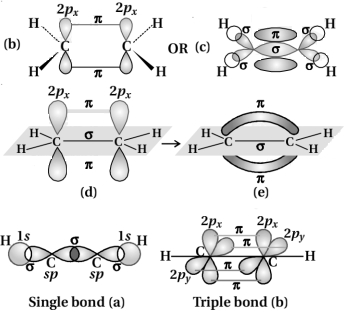
Draw diagrams showing the formation of a double bond and a triple bond between carbon atoms in $C_2H_4$ and $C_2H_2$ molecules.
Solution
(N/A) In $C_2H_4$ (Ethene),the carbon atoms undergo $sp^2$ hybridization. One $C-C$ $\sigma$ bond is formed by the overlap of $sp^2$ orbitals,and one $\pi$ bond is formed by the lateral overlap of unhybridized $2p_x$ orbitals.
In $C_2H_2$ (Ethyne),the carbon atoms undergo $sp$ hybridization. One $C-C$ $\sigma$ bond is formed by the overlap of $sp$ orbitals,and two $\pi$ bonds are formed by the lateral overlap of unhybridized $2p_x$ and $2p_y$ orbitals.
In $C_2H_2$ (Ethyne),the carbon atoms undergo $sp$ hybridization. One $C-C$ $\sigma$ bond is formed by the overlap of $sp$ orbitals,and two $\pi$ bonds are formed by the lateral overlap of unhybridized $2p_x$ and $2p_y$ orbitals.
0 likes
View Solution79
Medium
State the number of $\sigma$ and $\pi$ bonds in the following molecules:
$(a)$ $C_2H_2$
$(b)$ $C_2H_4$
$(a)$ $C_2H_2$
$(b)$ $C_2H_4$
Solution
(N/A) The structure of $C_2H_2$ is $H-C \equiv C-H$.
In the triple bond between the two carbon atoms,there is $1$ $\sigma$ bond and $2$ $\pi$ bonds.
There are also $2$ $C-H$ $\sigma$ bonds.
Thus,$C_2H_2$ has a total of $3$ $\sigma$ bonds and $2$ $\pi$ bonds.
$(b)$ The structure of $C_2H_4$ is $H_2C=CH_2$.
There are $4$ $C-H$ $\sigma$ bonds and in the $C=C$ double bond,there is $1$ $\sigma$ bond and $1$ $\pi$ bond.
Thus,$C_2H_4$ has a total of $5$ $\sigma$ bonds and $1$ $\pi$ bond.
In the triple bond between the two carbon atoms,there is $1$ $\sigma$ bond and $2$ $\pi$ bonds.
There are also $2$ $C-H$ $\sigma$ bonds.
Thus,$C_2H_2$ has a total of $3$ $\sigma$ bonds and $2$ $\pi$ bonds.
$(b)$ The structure of $C_2H_4$ is $H_2C=CH_2$.
There are $4$ $C-H$ $\sigma$ bonds and in the $C=C$ double bond,there is $1$ $\sigma$ bond and $1$ $\pi$ bond.
Thus,$C_2H_4$ has a total of $5$ $\sigma$ bonds and $1$ $\pi$ bond.
0 likes
View Solution80
MediumMCQ
Considering the $X$-axis as the internuclear axis,which of the following will not form a sigma $(\sigma)$ bond and why?
A
$1s$ and $1s$
B
$1s$ and $2p_x$
C
$2p_y$ and $2p_y$
D
$1s$ and $2s$
Solution
(C) sigma $(\sigma)$ bond is formed by the head-on (axial) overlap of atomic orbitals along the internuclear axis.
If the $X$-axis is the internuclear axis,$2p_y$ orbitals (which are oriented along the $Y$-axis) are perpendicular to the internuclear axis.
Their lateral (sideways) overlap results in the formation of a pi $(\pi)$ bond,not a sigma $(\sigma)$ bond.
On the other hand,$s-s$ and $s-p_x$ overlaps along the $X$-axis are axial and form $\sigma$ bonds.
If the $X$-axis is the internuclear axis,$2p_y$ orbitals (which are oriented along the $Y$-axis) are perpendicular to the internuclear axis.
Their lateral (sideways) overlap results in the formation of a pi $(\pi)$ bond,not a sigma $(\sigma)$ bond.
On the other hand,$s-s$ and $s-p_x$ overlaps along the $X$-axis are axial and form $\sigma$ bonds.
0 likes
View Solution81
Medium
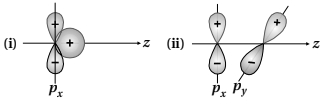
Why does the type of overlap shown in the following figure not result in bond formation? Explain.
Solution
(N/A) In figure $(i)$,the $s$-orbital overlaps with both lobes of the $p_x$-orbital. The overlap between the $s$-orbital and the positive lobe of the $p_x$-orbital is positive,while the overlap with the negative lobe is negative. Since these two overlaps are equal in magnitude and opposite in sign,the net overlap is zero,preventing bond formation.
In figure $(ii)$,the $p_x$-orbital and $p_y$-orbital have different symmetries with respect to the internuclear axis ($z$-axis). Due to this mismatch in symmetry,they cannot overlap effectively to form a bond.
In figure $(ii)$,the $p_x$-orbital and $p_y$-orbital have different symmetries with respect to the internuclear axis ($z$-axis). Due to this mismatch in symmetry,they cannot overlap effectively to form a bond.
0 likes
View Solution82
Easy
According to the $VB$ theory,when is a bond not formed between two atoms? Give examples.
Solution
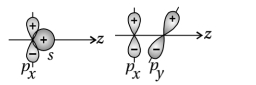
(N/A) According to the $VB$ theory,a bond is not formed if the two atomic orbitals are not oriented along the common internuclear axis,as this leads to zero overlap.
Examples:
$1$. The overlap between an $s$-orbital and a $p_x$-orbital oriented perpendicular to the internuclear axis ($z$-axis) results in zero overlap.
$2$. The overlap between a $p_x$-orbital and a $p_y$-orbital oriented along the same internuclear axis ($z$-axis) also results in zero overlap.
Examples:
$1$. The overlap between an $s$-orbital and a $p_x$-orbital oriented perpendicular to the internuclear axis ($z$-axis) results in zero overlap.
$2$. The overlap between a $p_x$-orbital and a $p_y$-orbital oriented along the same internuclear axis ($z$-axis) also results in zero overlap.
0 likes
View Solution83
MediumMCQ
Determine the number of sigma $(\sigma)$ and pi $(\pi)$ bonds in the following molecules: $(i)$ Methane,$(ii)$ Ethane,$(iii)$ Ethene,$(iv)$ Ethyne.
A
$(i) 4\sigma, 0\pi; (ii) 7\sigma, 0\pi; (iii) 5\sigma, 1\pi; (iv) 3\sigma, 2\pi$
B
$(i) 3\sigma, 1\pi; (ii) 6\sigma, 1\pi; (iii) 4\sigma, 2\pi; (iv) 2\sigma, 3\pi$
C
$(i) 4\sigma, 0\pi; (ii) 6\sigma, 1\pi; (iii) 5\sigma, 1\pi; (iv) 3\sigma, 2\pi$
D
$(i) 4\sigma, 0\pi; (ii) 7\sigma, 0\pi; (iii) 4\sigma, 2\pi; (iv) 2\sigma, 3\pi$
Solution
(A) The number of $\sigma$ and $\pi$ bonds are calculated as follows:
$(i)$ Methane $(CH_4)$: It has $4$ $C-H$ single bonds. Total: $4\sigma, 0\pi$.
$(ii)$ Ethane $(C_2H_6)$: It has $1$ $C-C$ single bond and $6$ $C-H$ single bonds. Total: $7\sigma, 0\pi$.
$(iii)$ Ethene $(C_2H_4)$: It has $1$ $C=C$ double bond $(1\sigma, 1\pi)$ and $4$ $C-H$ single bonds. Total: $5\sigma, 1\pi$.
$(iv)$ Ethyne $(C_2H_2)$: It has $1$ $C\equiv C$ triple bond $(1\sigma, 2\pi)$ and $2$ $C-H$ single bonds. Total: $3\sigma, 2\pi$.
$(i)$ Methane $(CH_4)$: It has $4$ $C-H$ single bonds. Total: $4\sigma, 0\pi$.
$(ii)$ Ethane $(C_2H_6)$: It has $1$ $C-C$ single bond and $6$ $C-H$ single bonds. Total: $7\sigma, 0\pi$.
$(iii)$ Ethene $(C_2H_4)$: It has $1$ $C=C$ double bond $(1\sigma, 1\pi)$ and $4$ $C-H$ single bonds. Total: $5\sigma, 1\pi$.
$(iv)$ Ethyne $(C_2H_2)$: It has $1$ $C\equiv C$ triple bond $(1\sigma, 2\pi)$ and $2$ $C-H$ single bonds. Total: $3\sigma, 2\pi$.
0 likes
View Solution84
Easy
Which of the following orbital combinations form a sigma $(\sigma)$ bond? $1s-1s, 2s-2s, 1s-2s, 2p_x-2p_x, 2p_y-2p_y, 2p_z-2p_z$.
Solution
(A) $\sigma$-bond is formed by the head-on (axial) overlap of atomic orbitals.
$1$. $1s-1s$ overlap: Forms a $\sigma$-bond.
$2$. $2s-2s$ overlap: Forms a $\sigma$-bond.
$3$. $1s-2s$ overlap: Forms a $\sigma$-bond.
$4$. $2p_z-2p_z$ overlap (assuming $z$-axis as the internuclear axis): Forms a $\sigma$-bond.
$2p_x-2p_x$ and $2p_y-2p_y$ overlaps result in $\pi$-bonds because they overlap laterally (sideways).
$1$. $1s-1s$ overlap: Forms a $\sigma$-bond.
$2$. $2s-2s$ overlap: Forms a $\sigma$-bond.
$3$. $1s-2s$ overlap: Forms a $\sigma$-bond.
$4$. $2p_z-2p_z$ overlap (assuming $z$-axis as the internuclear axis): Forms a $\sigma$-bond.
$2p_x-2p_x$ and $2p_y-2p_y$ overlaps result in $\pi$-bonds because they overlap laterally (sideways).
0 likes
View Solution85
Easy
How and when is a $\pi$-bond formed by the overlapping of orbitals?
Solution
(N/A) $\pi$-bond is formed by the lateral or side-wise overlapping of $2p_x-2p_x$ or $2p_y-2p_y$ orbitals.
This overlapping occurs only when these participating orbitals are parallel to each other and perpendicular to the internuclear axis.
This overlapping occurs only when these participating orbitals are parallel to each other and perpendicular to the internuclear axis.
0 likes
View Solution86
Medium
What type of bond is formed by the overlapping of $2p_x$ and $2p_y$ orbitals? Why?
Solution
(NONE) No bond is formed between $2p_x$ and $2p_y$ orbitals.
Because $2p_x$ and $2p_y$ orbitals are mutually perpendicular to each other,they cannot overlap effectively to form a chemical bond.
Because $2p_x$ and $2p_y$ orbitals are mutually perpendicular to each other,they cannot overlap effectively to form a chemical bond.
0 likes
View Solution87
Easy
State the resemblance and difference between $\sigma$ ($\sigma$) and $\pi$ ($\pi$) bonds.
Solution
(N/A) Resemblance: Both $\sigma$ and $\pi$ bonds are covalent bonds formed by the overlapping of atomic orbitals. Both involve the sharing of electron pairs between two atoms.
Differences:
$1$. $\sigma$ bond is formed by the head-on (axial) overlapping of atomic orbitals, whereas $\pi$ bond is formed by the lateral (sideways) overlapping of atomic orbitals.
$2$. $\sigma$ bond allows free rotation of atoms around the bond axis, while $\pi$ bond restricts rotation.
$3$. $\sigma$ bond is stronger due to greater extent of overlapping, whereas $\pi$ bond is weaker due to lesser extent of overlapping.
$4$. $\sigma$ bond can exist independently, whereas $\pi$ bond is always formed in addition to a $\sigma$ bond.
Differences:
$1$. $\sigma$ bond is formed by the head-on (axial) overlapping of atomic orbitals, whereas $\pi$ bond is formed by the lateral (sideways) overlapping of atomic orbitals.
$2$. $\sigma$ bond allows free rotation of atoms around the bond axis, while $\pi$ bond restricts rotation.
$3$. $\sigma$ bond is stronger due to greater extent of overlapping, whereas $\pi$ bond is weaker due to lesser extent of overlapping.
$4$. $\sigma$ bond can exist independently, whereas $\pi$ bond is always formed in addition to a $\sigma$ bond.
0 likes
View Solution88
EasyMCQ
Which of the following combinations does not form a $\sigma$ bond?
$(i) \ 2p_y - 2p_y$
$(ii) \ 2p_z - 2p_z$
$(iii) \ 2s - 2p_x$
$(iv) \ 2p_x - 2p_x$
$(i) \ 2p_y - 2p_y$
$(ii) \ 2p_z - 2p_z$
$(iii) \ 2s - 2p_x$
$(iv) \ 2p_x - 2p_x$
A
$(i)$ and $(ii)$
B
$(i)$ and $(iv)$
C
$(ii)$ and $(iii)$
D
$(iii)$ and $(iv)$
Solution
(B) By convention,the internuclear axis is taken as the $z$-axis.
$(i) \ 2p_y - 2p_y$ overlap: Since the $p_y$ orbitals are perpendicular to the $z$-axis,they undergo lateral (sideways) overlap,forming a $\pi$ bond,not a $\sigma$ bond.
$(ii) \ 2p_z - 2p_z$ overlap: These orbitals are oriented along the internuclear axis,resulting in head-on (axial) overlap,which forms a $\sigma$ bond.
$(iii) \ 2s - 2p_x$ overlap: The $2s$ orbital is spherical and the $2p_x$ orbital is perpendicular to the $z$-axis. Their overlap is zero (non-bonding) because of symmetry.
$(iv) \ 2p_x - 2p_x$ overlap: Similar to $p_y$,these orbitals are perpendicular to the $z$-axis and undergo lateral overlap,forming a $\pi$ bond,not a $\sigma$ bond.
Therefore,combinations $(i)$,$(iii)$,and $(iv)$ do not form a $\sigma$ bond. Given the options,$(i)$ and $(iv)$ are the most appropriate choices for lateral overlap.
$(i) \ 2p_y - 2p_y$ overlap: Since the $p_y$ orbitals are perpendicular to the $z$-axis,they undergo lateral (sideways) overlap,forming a $\pi$ bond,not a $\sigma$ bond.
$(ii) \ 2p_z - 2p_z$ overlap: These orbitals are oriented along the internuclear axis,resulting in head-on (axial) overlap,which forms a $\sigma$ bond.
$(iii) \ 2s - 2p_x$ overlap: The $2s$ orbital is spherical and the $2p_x$ orbital is perpendicular to the $z$-axis. Their overlap is zero (non-bonding) because of symmetry.
$(iv) \ 2p_x - 2p_x$ overlap: Similar to $p_y$,these orbitals are perpendicular to the $z$-axis and undergo lateral overlap,forming a $\pi$ bond,not a $\sigma$ bond.
Therefore,combinations $(i)$,$(iii)$,and $(iv)$ do not form a $\sigma$ bond. Given the options,$(i)$ and $(iv)$ are the most appropriate choices for lateral overlap.
0 likes
View Solution89
Medium
Determine the number of $\sigma$ and $\pi$ bonds in the following molecules:
$(i)$ $O_2$
$(ii)$ $N_2$
$(iii)$ $C_6H_6$ (Benzene)
$(iv)$ $O_3$ (Ozone)
$(i)$ $O_2$
$(ii)$ $N_2$
$(iii)$ $C_6H_6$ (Benzene)
$(iv)$ $O_3$ (Ozone)
Solution
(N/A) The number of $\sigma$ and $\pi$ bonds are calculated as follows:
$(i)$ $O_2$ $(O=O)$: $1 \sigma, 1 \pi$.
$(ii)$ $N_2$ $(N\equiv N)$: $1 \sigma, 2 \pi$.
$(iii)$ $C_6H_6$ (Benzene): It has $12 \sigma$ bonds ($6$ $C-C$ and $6$ $C-H$) and $3 \pi$ bonds.
$(iv)$ $O_3$ (Ozone): The resonance structure shows $2 \sigma$ bonds and $1 \pi$ bond (delocalized over the structure).
$(i)$ $O_2$ $(O=O)$: $1 \sigma, 1 \pi$.
$(ii)$ $N_2$ $(N\equiv N)$: $1 \sigma, 2 \pi$.
$(iii)$ $C_6H_6$ (Benzene): It has $12 \sigma$ bonds ($6$ $C-C$ and $6$ $C-H$) and $3 \pi$ bonds.
$(iv)$ $O_3$ (Ozone): The resonance structure shows $2 \sigma$ bonds and $1 \pi$ bond (delocalized over the structure).
0 likes
View Solution90
Medium
Which orbitals on overlapping will form $\sigma$ and $\pi$ bond in $C=C$ of alkene? Explain.
Solution
(N/A) In an alkene,each carbon atom undergoes $sp^{2}$ hybridization.
The $\sigma$-bond between the two carbon atoms is formed by the head-on (axial) overlapping of one $sp^{2}$ hybrid orbital from each carbon atom.
The $\pi$-bond is formed by the lateral (sideways) overlapping of the unhybridized $2p$ orbitals of the two carbon atoms,which are parallel to each other and perpendicular to the molecular plane.
The $\sigma$-bond between the two carbon atoms is formed by the head-on (axial) overlapping of one $sp^{2}$ hybrid orbital from each carbon atom.
The $\pi$-bond is formed by the lateral (sideways) overlapping of the unhybridized $2p$ orbitals of the two carbon atoms,which are parallel to each other and perpendicular to the molecular plane.
0 likes
View Solution91
MediumMCQ
Given below are two statements: One is labelled as Assertion $A$ and the other is labelled as Reason $R$.
Assertion $A$: Zero orbital overlap is an out-of-phase overlap.
Reason $R$: It results due to different orientation/direction of approach of orbitals.
In the light of the above statements,choose the correct answer from the options given below.
Assertion $A$: Zero orbital overlap is an out-of-phase overlap.
Reason $R$: It results due to different orientation/direction of approach of orbitals.
In the light of the above statements,choose the correct answer from the options given below.
A
Both $A$ and $R$ are true and $R$ is the correct explanation of $A$.
B
Both $A$ and $R$ are true but $R$ is $NOT$ the correct explanation of $A$.
C
$A$ is true but $R$ is false.
D
$A$ is false but $R$ is true.
Solution
(D) Zero overlap occurs when the orbitals do not have the proper symmetry or orientation to overlap effectively.
Assertion $A$ is false because zero overlap is not necessarily an out-of-phase overlap (which refers to destructive interference of wave functions). Zero overlap often occurs due to improper orientation or symmetry,such as the overlap between $s$ and $p_y$ orbitals along the $x$-axis.
Reason $R$ is true because zero overlap is indeed caused by the different orientation or direction of approach of the orbitals relative to each other,as shown in the provided figure where $p_x$ and $p_y$ orbitals do not overlap effectively.
Therefore,$A$ is false but $R$ is true.
Assertion $A$ is false because zero overlap is not necessarily an out-of-phase overlap (which refers to destructive interference of wave functions). Zero overlap often occurs due to improper orientation or symmetry,such as the overlap between $s$ and $p_y$ orbitals along the $x$-axis.
Reason $R$ is true because zero overlap is indeed caused by the different orientation or direction of approach of the orbitals relative to each other,as shown in the provided figure where $p_x$ and $p_y$ orbitals do not overlap effectively.
Therefore,$A$ is false but $R$ is true.
0 likes
View Solution92
DifficultMCQ
Among the following atomic orbital overlaps,the non-bonding overlap is
A
B
C
D
Solution
(A) When orbitals of two atoms come close to form a bond,their overlap may be positive,negative,or zero depending upon the sign and the direction of orientation of the amplitude of the orbital wave function in space.
In the case of non-bonding overlap,there is no effective overlap because the positive and negative regions cancel each other out,resulting in a net overlap of zero.
This occurs when the symmetry of the orbitals is such that they cannot interact effectively,such as the overlap between a $p_x$ orbital and a $p_z$ orbital,where the positive lobe of one overlaps with both the positive and negative lobes of the other equally,leading to zero net overlap as shown in option $(A)$.
In the case of non-bonding overlap,there is no effective overlap because the positive and negative regions cancel each other out,resulting in a net overlap of zero.
This occurs when the symmetry of the orbitals is such that they cannot interact effectively,such as the overlap between a $p_x$ orbital and a $p_z$ orbital,where the positive lobe of one overlaps with both the positive and negative lobes of the other equally,leading to zero net overlap as shown in option $(A)$.
0 likes
View Solution93
MediumMCQ
The number of $\sigma$ and $\pi$ bonds present in an ethylene molecule is respectively:
A
$3$ and $1$
B
$5$ and $2$
C
$4$ and $1$
D
$5$ and $1$
Solution
(D) The chemical formula of ethylene is $CH_2=CH_2$.
In this molecule,there are $4$ $C-H$ $\sigma$ bonds and $1$ $C-C$ $\sigma$ bond,making a total of $5$ $\sigma$ bonds.
There is also $1$ $C-C$ $\pi$ bond.
Therefore,the number of $\sigma$ and $\pi$ bonds is $5$ and $1$ respectively.
In this molecule,there are $4$ $C-H$ $\sigma$ bonds and $1$ $C-C$ $\sigma$ bond,making a total of $5$ $\sigma$ bonds.
There is also $1$ $C-C$ $\pi$ bond.
Therefore,the number of $\sigma$ and $\pi$ bonds is $5$ and $1$ respectively.
0 likes
View Solution94
MediumMCQ
Given below are two statements :
Statement $(I)$ : The oxidation state of an element in a particular compound is the charge acquired by its atom on the basis of electron gain enthalpy consideration from other atoms in the molecule.
Statement $(II)$ : $p\pi-p\pi$ bond formation is more prevalent in second period elements over other periods.
In the light of the above statements,choose the most appropriate answer from the options given below :
Statement $(I)$ : The oxidation state of an element in a particular compound is the charge acquired by its atom on the basis of electron gain enthalpy consideration from other atoms in the molecule.
Statement $(II)$ : $p\pi-p\pi$ bond formation is more prevalent in second period elements over other periods.
In the light of the above statements,choose the most appropriate answer from the options given below :
A
Both Statement $I$ and Statement $II$ are incorrect
B
Statement $I$ is correct but Statement $II$ is incorrect
C
Both Statement $I$ and Statement $II$ are correct
D
Statement $I$ is incorrect but Statement $II$ is correct
Solution
(D) Statement $(I)$ is incorrect because the oxidation state is defined based on electronegativity,not electron gain enthalpy.
Statement $(II)$ is correct because elements of the second period (like $C, N, O$) have small atomic sizes,which allow for effective side-on overlap of $2p$ orbitals,leading to strong $p\pi-p\pi$ bonding.
Therefore,Statement $(I)$ is incorrect but Statement $(II)$ is correct.
Statement $(II)$ is correct because elements of the second period (like $C, N, O$) have small atomic sizes,which allow for effective side-on overlap of $2p$ orbitals,leading to strong $p\pi-p\pi$ bonding.
Therefore,Statement $(I)$ is incorrect but Statement $(II)$ is correct.
0 likes
View Solution95
MediumMCQ
Match the orbital overlap figures shown in List-$I$ with the description given in List-$II$ and select the correct answer using the code given below the lists.
List-$I$:
$P$. Two $d$-orbitals overlapping axially with same phase.
$Q$. $A$ $p$-orbital and a $d$-orbital overlapping laterally with same phase.
$R$. $A$ $p$-orbital and a $d$-orbital overlapping laterally with opposite phase.
$S$. Two $d$-orbitals overlapping axially with opposite phase.
List-$II$:
$1$. $p-d$ $\pi$ antibonding
$2$. $d-d$ $\sigma$ bonding
$3$. $p-d$ $\pi$ bonding
$4$. $d-d$ $\sigma$ antibonding
Codes: $P \quad Q \quad R \quad S$
List-$I$:
$P$. Two $d$-orbitals overlapping axially with same phase.
$Q$. $A$ $p$-orbital and a $d$-orbital overlapping laterally with same phase.
$R$. $A$ $p$-orbital and a $d$-orbital overlapping laterally with opposite phase.
$S$. Two $d$-orbitals overlapping axially with opposite phase.
List-$II$:
$1$. $p-d$ $\pi$ antibonding
$2$. $d-d$ $\sigma$ bonding
$3$. $p-d$ $\pi$ bonding
$4$. $d-d$ $\sigma$ antibonding
Codes: $P \quad Q \quad R \quad S$
A
$2 \quad 1 \quad 3 \quad 4$
B
$4 \quad 3 \quad 1 \quad 2$
C
$2 \quad 3 \quad 1 \quad 4$
D
$4 \quad 1 \quad 3 \quad 2$
Solution
(C) Based on the orbital overlap diagrams:
$P$: Two $d$-orbitals overlapping axially in the same phase result in $d-d$ $\sigma$ bonding $(P-2)$.
$Q$: $A$ $p$-orbital and a $d$-orbital overlapping laterally in the same phase result in $p-d$ $\pi$ bonding $(Q-3)$.
$R$: $A$ $p$-orbital and a $d$-orbital overlapping laterally in opposite phases result in $p-d$ $\pi$ antibonding $(R-1)$.
$S$: Two $d$-orbitals overlapping axially in opposite phases result in $d-d$ $\sigma$ antibonding $(S-4)$.
Thus,the correct matching is $P-2, Q-3, R-1, S-4$.
$P$: Two $d$-orbitals overlapping axially in the same phase result in $d-d$ $\sigma$ bonding $(P-2)$.
$Q$: $A$ $p$-orbital and a $d$-orbital overlapping laterally in the same phase result in $p-d$ $\pi$ bonding $(Q-3)$.
$R$: $A$ $p$-orbital and a $d$-orbital overlapping laterally in opposite phases result in $p-d$ $\pi$ antibonding $(R-1)$.
$S$: Two $d$-orbitals overlapping axially in opposite phases result in $d-d$ $\sigma$ antibonding $(S-4)$.
Thus,the correct matching is $P-2, Q-3, R-1, S-4$.
0 likes
View Solution96
DifficultMCQ
If the internuclear axis is $z$,then which of the following overlapping gives a $\sigma$ bond?
A
$p_{z} \& d_{z^2}$
B
$p_{z} \& p_{z}$
C
$s \& p_{z}$
D
All of these
Solution
(D) $\sigma$ bond is formed by the head-on (axial) overlapping of atomic orbitals along the internuclear axis.
Given the internuclear axis is $z$:
$1$. $p_{z} \& d_{z^2}$ overlap head-on along the $z$-axis to form a $\sigma$ bond.
$2$. $p_{z} \& p_{z}$ overlap head-on along the $z$-axis to form a $\sigma$ bond.
$3$. $s \& p_{z}$ overlap head-on along the $z$-axis to form a $\sigma$ bond.
Since all the given combinations result in head-on overlapping along the $z$-axis,all of them form a $\sigma$ bond.
Given the internuclear axis is $z$:
$1$. $p_{z} \& d_{z^2}$ overlap head-on along the $z$-axis to form a $\sigma$ bond.
$2$. $p_{z} \& p_{z}$ overlap head-on along the $z$-axis to form a $\sigma$ bond.
$3$. $s \& p_{z}$ overlap head-on along the $z$-axis to form a $\sigma$ bond.
Since all the given combinations result in head-on overlapping along the $z$-axis,all of them form a $\sigma$ bond.
0 likes
View Solution97
MediumMCQ
Which of the following represent zero overlap (non-bonding condition)?
A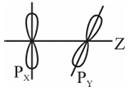
B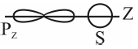
C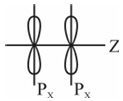
D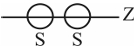
Solution
(A) Zero overlap occurs when the symmetry of the atomic orbitals is such that the positive and negative regions of the overlapping orbitals cancel each other out,or when the orbitals are oriented in a way that they cannot effectively interact to form a bond.
In option $A$,the $P_x$ orbital lies in the $xy$-plane and the $P_y$ orbital also lies in the $xy$-plane. When placed along the $Z$-axis,their symmetry is such that they cannot overlap to form a bond,resulting in zero overlap.
In option $C$,two $P_x$ orbitals are placed side-by-side along the $Z$-axis. Since they are oriented perpendicular to the internuclear axis ($Z$-axis),they can undergo lateral overlap to form a $\pi$-bond,so this is not a zero-overlap condition.
Therefore,the correct representation of zero overlap is given by the combination of $P_x$ and $P_y$ orbitals.
In option $A$,the $P_x$ orbital lies in the $xy$-plane and the $P_y$ orbital also lies in the $xy$-plane. When placed along the $Z$-axis,their symmetry is such that they cannot overlap to form a bond,resulting in zero overlap.
In option $C$,two $P_x$ orbitals are placed side-by-side along the $Z$-axis. Since they are oriented perpendicular to the internuclear axis ($Z$-axis),they can undergo lateral overlap to form a $\pi$-bond,so this is not a zero-overlap condition.
Therefore,the correct representation of zero overlap is given by the combination of $P_x$ and $P_y$ orbitals.
0 likes
View Solution98
MediumMCQ
The number of $\sigma$ and $\pi$ bonds in $2-$formylbenzoic acid are respectively
A
$10, 3$
B
$14, 3$
C
$12, 5$
D
$17, 5$
Solution
(D) The chemical formula of $2-$formylbenzoic acid is $C_8H_6O_3$.
Its structure consists of a benzene ring substituted with a carboxylic acid group $(-COOH)$ and an aldehyde group $(-CHO)$ at the ortho position.
Counting the bonds:
- There are $12$ $\sigma$ bonds in the benzene ring and its substituents (including $C-H$,$C-C$,$C=O$,$C-O$,and $O-H$ bonds).
- Specifically,the structure contains $17$ $\sigma$ bonds and $5$ $\pi$ bonds (three from the benzene ring,one from the $C=O$ of the aldehyde,and one from the $C=O$ of the carboxylic acid).
Its structure consists of a benzene ring substituted with a carboxylic acid group $(-COOH)$ and an aldehyde group $(-CHO)$ at the ortho position.
Counting the bonds:
- There are $12$ $\sigma$ bonds in the benzene ring and its substituents (including $C-H$,$C-C$,$C=O$,$C-O$,and $O-H$ bonds).
- Specifically,the structure contains $17$ $\sigma$ bonds and $5$ $\pi$ bonds (three from the benzene ring,one from the $C=O$ of the aldehyde,and one from the $C=O$ of the carboxylic acid).
0 likes
View Solution99
EasyMCQ
Number of $\sigma$ (sigma) and $\pi$ (pi) bonds in aspirin are respectively . . . . . . .
A
$22$ and $4$
B
$22$ and $5$
C
$21$ and $4$
D
$21$ and $5$
Solution
(D) Aspirin is acetylsalicylic acid with the chemical formula $C_9H_8O_4$.
Its structure consists of a benzene ring,a carboxylic acid group $(-COOH)$,and an ester group $(-OCOCH_3)$.
Counting the bonds:
$1$. The benzene ring has $6$ $C-C$ $\sigma$ bonds,$3$ $C-C$ $\pi$ bonds,and $4$ $C-H$ $\sigma$ bonds.
$2$. The carboxylic acid group has $1$ $C-C$ $\sigma$ bond,$1$ $C=O$ $\sigma$ bond,$1$ $C=O$ $\pi$ bond,$1$ $C-O$ $\sigma$ bond,and $1$ $O-H$ $\sigma$ bond.
$3$. The ester group has $1$ $C-O$ $\sigma$ bond,$1$ $C=O$ $\sigma$ bond,$1$ $C=O$ $\pi$ bond,$1$ $C-C$ $\sigma$ bond,and $3$ $C-H$ $\sigma$ bonds.
Total $\sigma$ bonds = $6 (ring) + 4 (C-H) + 1 (C-C) + 1 (C=O) + 1 (C-O) + 1 (O-H) + 1 (C-O) + 1 (C=O) + 1 (C-C) + 3 (C-H) = 21$.
Total $\pi$ bonds = $3 (ring) + 1 (C=O) + 1 (C=O) = 5$.
Therefore,the number of $\sigma$ and $\pi$ bonds are $21$ and $5$ respectively.
Its structure consists of a benzene ring,a carboxylic acid group $(-COOH)$,and an ester group $(-OCOCH_3)$.
Counting the bonds:
$1$. The benzene ring has $6$ $C-C$ $\sigma$ bonds,$3$ $C-C$ $\pi$ bonds,and $4$ $C-H$ $\sigma$ bonds.
$2$. The carboxylic acid group has $1$ $C-C$ $\sigma$ bond,$1$ $C=O$ $\sigma$ bond,$1$ $C=O$ $\pi$ bond,$1$ $C-O$ $\sigma$ bond,and $1$ $O-H$ $\sigma$ bond.
$3$. The ester group has $1$ $C-O$ $\sigma$ bond,$1$ $C=O$ $\sigma$ bond,$1$ $C=O$ $\pi$ bond,$1$ $C-C$ $\sigma$ bond,and $3$ $C-H$ $\sigma$ bonds.
Total $\sigma$ bonds = $6 (ring) + 4 (C-H) + 1 (C-C) + 1 (C=O) + 1 (C-O) + 1 (O-H) + 1 (C-O) + 1 (C=O) + 1 (C-C) + 3 (C-H) = 21$.
Total $\pi$ bonds = $3 (ring) + 1 (C=O) + 1 (C=O) = 5$.
Therefore,the number of $\sigma$ and $\pi$ bonds are $21$ and $5$ respectively.
0 likes
View Solution100
MediumMCQ
In an acetylene molecule,the bond between the carbon atoms consists of:
A
three $\pi$ bonds
B
one $\sigma$ and two $\pi$ bonds
C
two $\sigma$ and one $\pi$ bonds
D
three $\sigma$ bonds
Solution
(B) The chemical formula of acetylene is $C_2H_2$,and its structural formula is $H-C \equiv C-H$.
In the triple bond between the two carbon atoms,there is one $\sigma$ bond (formed by the head-on overlap of $sp$ hybrid orbitals) and two $\pi$ bonds (formed by the lateral overlap of unhybridized $2p$ orbitals).
In the triple bond between the two carbon atoms,there is one $\sigma$ bond (formed by the head-on overlap of $sp$ hybrid orbitals) and two $\pi$ bonds (formed by the lateral overlap of unhybridized $2p$ orbitals).
0 likes
View SolutionChemical Bonding and Molecular Structure — Overlaping - s and p- bonds · Frequently Asked Questions
1Are these Chemical Bonding and Molecular Structure questions useful for JEE and NEET?
Yes. All questions in this section are mapped to JEE Main and NEET exam patterns. Previous year questions from JEE Main, NEET, GUJCET and state-level exams are included with full solutions.
2Can I switch to Hindi or Gujarati for these questions?
Yes. Use the language tabs in the hero section or the sidebar to view the same questions and solutions in English, Hindi or Gujarati.
3How do I generate a question paper from this subtopic?
Use the Vedclass Exam Paper Generator — select the chapter and subtopic, set difficulty, and generate Sets A, B, C, D automatically. First 3 chapters of every subject are free.
Vedclass Products
For Students
Vedclass Test Series
Mock tests in real JEE/NEET style with performance analysis. 5-day free trial.
Start Free TrialFor Teachers
Exam Paper Generator
Generate Set A/B/C/D papers from this chapter in 2 minutes. 3 chapters free.
Try FreeFor Institutes
Online Exam Module
Live online exams with unlimited students, 360° analytics & white-label branding.
See DemoFor Teachers & Institutes
Generate a Chemical Bonding and Molecular Structure Exam Paper in 2 Minutes
Select subtopic & difficulty — Sets A, B, C, D auto-generated with No Repeat logic.
First 3 chapters of every subject are free — no payment required.