
A English
Mix Examples-Chemical Bonding Questions in English
Class 11 Chemistry · Chemical Bonding and Molecular Structure · Mix Examples-Chemical Bonding
489+
Questions
English
Language
100%
With Solutions
Showing 50 of 489 questions in English
151
DifficultMCQ
The correct order of bond strength for the given species is:
A
$N-N < O-O$
B
$F-F > O-O$
C
$C-C > N-N$
D
$N-N < F-F$
Solution
(C) Bond strength is inversely proportional to the bond length and directly proportional to the extent of orbital overlap.
For single bonds between atoms of the same period,the bond strength decreases as the atomic size increases and the number of lone pairs increases due to inter-electronic repulsion.
The order of bond strength for these single bonds is $C-C > N-N > O-O > F-F$.
Comparing the given options:
$A$: $N-N < O-O$ (Incorrect,$N-N > O-O$)
$B$: $F-F > O-O$ (Incorrect,$O-O > F-F$)
$C$: $C-C > N-N$ (Correct)
$D$: $N-N < F-F$ (Incorrect,$N-N > F-F$)
For single bonds between atoms of the same period,the bond strength decreases as the atomic size increases and the number of lone pairs increases due to inter-electronic repulsion.
The order of bond strength for these single bonds is $C-C > N-N > O-O > F-F$.
Comparing the given options:
$A$: $N-N < O-O$ (Incorrect,$N-N > O-O$)
$B$: $F-F > O-O$ (Incorrect,$O-O > F-F$)
$C$: $C-C > N-N$ (Correct)
$D$: $N-N < F-F$ (Incorrect,$N-N > F-F$)
0 likes
View Solution152
MediumMCQ
$NH_2^-$,$NH_3$ and $NH_4^+$ do not show similarity in the following:
A
Hybridisation state of nitrogen
B
No. of lone pair of electrons
C
Atomic no. of $N$
D
Type of overlapping in $N-H$ bond
Solution
(B) The species $NH_2^-$,$NH_3$,and $NH_4^+$ are compared below:
As shown in the table,the number of lone pairs on the nitrogen atom is different for each species ($2, 1, 0$ respectively). Therefore,they do not show similarity in the number of lone pairs of electrons.
| Species | $NH_2^-$ | $NH_3$ | $NH_4^+$ |
| Hybridisation | $sp^3$ | $sp^3$ | $sp^3$ |
| Lone pair | $2$ | $1$ | $0$ |
As shown in the table,the number of lone pairs on the nitrogen atom is different for each species ($2, 1, 0$ respectively). Therefore,they do not show similarity in the number of lone pairs of electrons.
0 likes
View Solution153
MediumMCQ
Which of the following represents the incorrect order of bond dissociation energy?
A
$H-H > Cl-Cl > Br-Br$
B
$Si-Si > C-C > H-H$
C
$C-C > N-N > O-O$
D
$H-Cl > H-Br > H-I$
Solution
(B) Bond dissociation energy depends on the size of the atoms and the extent of orbital overlap.
$1$. For $H-H$ $(436 \ kJ/mol)$,$Cl-Cl$ $(242 \ kJ/mol)$,and $Br-Br$ $(193 \ kJ/mol)$,the order is correct as size increases down the group,decreasing overlap.
$2$. For $Si-Si$ $(226 \ kJ/mol)$,$C-C$ $(348 \ kJ/mol)$,and $H-H$ $(436 \ kJ/mol)$,the order $Si-Si > C-C > H-H$ is incorrect because $C-C$ has a higher bond energy than $Si-Si$ due to effective $2p-2p$ overlap compared to $3p-3p$ overlap.
$3$. For $C-C$ $(348 \ kJ/mol)$,$N-N$ $(163 \ kJ/mol)$,and $O-O$ $(146 \ kJ/mol)$,the order is correct due to increasing lone pair repulsions.
$4$. For $H-Cl$,$H-Br$,and $H-I$,the bond energy decreases as the bond length increases,so the order is correct.
Thus,the incorrect order is $Si-Si > C-C > H-H$.
$1$. For $H-H$ $(436 \ kJ/mol)$,$Cl-Cl$ $(242 \ kJ/mol)$,and $Br-Br$ $(193 \ kJ/mol)$,the order is correct as size increases down the group,decreasing overlap.
$2$. For $Si-Si$ $(226 \ kJ/mol)$,$C-C$ $(348 \ kJ/mol)$,and $H-H$ $(436 \ kJ/mol)$,the order $Si-Si > C-C > H-H$ is incorrect because $C-C$ has a higher bond energy than $Si-Si$ due to effective $2p-2p$ overlap compared to $3p-3p$ overlap.
$3$. For $C-C$ $(348 \ kJ/mol)$,$N-N$ $(163 \ kJ/mol)$,and $O-O$ $(146 \ kJ/mol)$,the order is correct due to increasing lone pair repulsions.
$4$. For $H-Cl$,$H-Br$,and $H-I$,the bond energy decreases as the bond length increases,so the order is correct.
Thus,the incorrect order is $Si-Si > C-C > H-H$.
0 likes
View Solution154
DifficultMCQ
Which of the following species exists?
A
$AlF_6^{3-}$
B
$MnF_7$
C
$BI_4^-$
D
$SCl_6$
Solution
(A) $1$. $AlF_6^{3-}$ exists because $Al$ can expand its octet due to the presence of vacant $3d$ orbitals,and the small size of $F^-$ ions allows six of them to coordinate around the $Al^{3+}$ ion.
$2$. $MnF_7$ does not exist because $Mn$ cannot accommodate seven large $F$ atoms due to steric hindrance and the high oxidation state required.
$3$. $BI_4^-$ does not exist because $B$ is a small atom and cannot accommodate four large $I$ atoms around it due to severe steric hindrance.
$4$. $SCl_6$ does not exist because $S$ is not large enough to accommodate six large $Cl$ atoms around it due to steric hindrance,unlike $SF_6$ where $F$ is small.
$2$. $MnF_7$ does not exist because $Mn$ cannot accommodate seven large $F$ atoms due to steric hindrance and the high oxidation state required.
$3$. $BI_4^-$ does not exist because $B$ is a small atom and cannot accommodate four large $I$ atoms around it due to severe steric hindrance.
$4$. $SCl_6$ does not exist because $S$ is not large enough to accommodate six large $Cl$ atoms around it due to steric hindrance,unlike $SF_6$ where $F$ is small.
0 likes
View Solution155
MediumMCQ
Which of the following orders of bond length is correct?
A
$CO < CO^{+}$
B
$Si-Si > C-C$
C
$C=C > C=N$
D
$H_2O_2 > O_2F_2$ ($O-O$ bond)
Solution
(A) Bond length is inversely proportional to bond order.
$1$. For $CO$ (bond order $3$) and $CO^{+}$ (bond order $2.5$),the bond length order is $CO < CO^{+}$. This is correct.
$2$. For $Si-Si$ and $C-C$,$Si-Si$ bond length is greater due to the larger atomic size of $Si$ compared to $C$.
$3$. For $C=C$ and $C=N$,$C=C$ bond length is greater than $C=N$ due to the smaller atomic radius of $N$ compared to $C$.
$4$. For $H_2O_2$ and $O_2F_2$,the $O-O$ bond length in $H_2O_2$ $(1.48 \ \mathring{A})$ is greater than in $O_2F_2$ $(1.22 \ \mathring{A})$ due to the high electronegativity of $F$ atoms reducing the bond length.
Thus,option $A$ is correct.
$1$. For $CO$ (bond order $3$) and $CO^{+}$ (bond order $2.5$),the bond length order is $CO < CO^{+}$. This is correct.
$2$. For $Si-Si$ and $C-C$,$Si-Si$ bond length is greater due to the larger atomic size of $Si$ compared to $C$.
$3$. For $C=C$ and $C=N$,$C=C$ bond length is greater than $C=N$ due to the smaller atomic radius of $N$ compared to $C$.
$4$. For $H_2O_2$ and $O_2F_2$,the $O-O$ bond length in $H_2O_2$ $(1.48 \ \mathring{A})$ is greater than in $O_2F_2$ $(1.22 \ \mathring{A})$ due to the high electronegativity of $F$ atoms reducing the bond length.
Thus,option $A$ is correct.
0 likes
View Solution156
DifficultMCQ
Identify the correct match.
A
$S_3O_9 - $ only $p\pi - p\pi$ bond
B
$P_4O_{10} - $ Equal number of $\sigma$ and $\pi$ bonds
C
$P_4O_6 - $ All $\pi$ bonds are $p\pi - d\pi$ bonds
D
$SO_3 - $ both $p\pi - p\pi$ and $p\pi - d\pi$ bonds present
Solution
(D) In $S_3O_9$,the structure consists of $S-O-S$ linkages where sulfur atoms are $sp^3$ hybridized. The $\pi$ bonds present are $p\pi - d\pi$ bonds.
In $P_4O_{10}$,there are $16 \ \sigma$ bonds and $4 \ \pi$ bonds. Thus,they are not equal.
In $P_4O_6$,there are no $\pi$ bonds as all phosphorus atoms are $sp^3$ hybridized and form only $\sigma$ bonds.
In $SO_3$ (cyclic trimer or monomeric gas),the sulfur atom forms $\pi$ bonds with oxygen using its $d$-orbitals. Specifically,in the monomeric $SO_3$,there are $p\pi - p\pi$ and $p\pi - d\pi$ bonds. Thus,option $D$ is correct.
In $P_4O_{10}$,there are $16 \ \sigma$ bonds and $4 \ \pi$ bonds. Thus,they are not equal.
In $P_4O_6$,there are no $\pi$ bonds as all phosphorus atoms are $sp^3$ hybridized and form only $\sigma$ bonds.
In $SO_3$ (cyclic trimer or monomeric gas),the sulfur atom forms $\pi$ bonds with oxygen using its $d$-orbitals. Specifically,in the monomeric $SO_3$,there are $p\pi - p\pi$ and $p\pi - d\pi$ bonds. Thus,option $D$ is correct.
0 likes
View Solution157
EasyMCQ
$P_4O_{10}$ has short and long $P-O$ bonds. The number of short $(P=O)$ bonds in this compound is:
A
$6$
B
$12$
C
$3$
D
$4$
Solution
(D) The structure of $P_4O_{10}$ consists of a $P_4$ tetrahedron where each edge has an oxygen atom bridging the two phosphorus atoms ($P-O-P$ bonds).
Additionally,each phosphorus atom is bonded to a terminal oxygen atom via a double bond $(P=O)$.
There are $6$ bridging $P-O-P$ bonds and $4$ terminal $P=O$ bonds.
The terminal $P=O$ bonds are shorter than the bridging $P-O$ bonds.
Therefore,the number of short $(P=O)$ bonds is $4$.
Additionally,each phosphorus atom is bonded to a terminal oxygen atom via a double bond $(P=O)$.
There are $6$ bridging $P-O-P$ bonds and $4$ terminal $P=O$ bonds.
The terminal $P=O$ bonds are shorter than the bridging $P-O$ bonds.
Therefore,the number of short $(P=O)$ bonds is $4$.
0 likes
View Solution158
MediumMCQ
The bonds present in $N_2O_{5(s)}$ is/are:
$I$. Ionic
$II$. Covalent
$III$. Coordinate
$I$. Ionic
$II$. Covalent
$III$. Coordinate
A
$II$,only
B
$II$ and $III$ only
C
$I$ and $II$ only
D
$I$,$II$,and $III$
Solution
(D) In the solid state,$N_2O_5$ exists as the nitronium nitrate salt,$[NO_2]^+[NO_3]^-$.
$1$. The $[NO_2]^+$ ion contains covalent bonds between $N$ and $O$ atoms.
$2$. The $[NO_3]^-$ ion contains covalent bonds and coordinate (dative) bonds between $N$ and $O$ atoms.
$3$. The electrostatic force of attraction between the $[NO_2]^+$ cation and the $[NO_3]^-$ anion constitutes an ionic bond.
Therefore,$N_2O_{5(s)}$ contains ionic,covalent,and coordinate bonds.
$1$. The $[NO_2]^+$ ion contains covalent bonds between $N$ and $O$ atoms.
$2$. The $[NO_3]^-$ ion contains covalent bonds and coordinate (dative) bonds between $N$ and $O$ atoms.
$3$. The electrostatic force of attraction between the $[NO_2]^+$ cation and the $[NO_3]^-$ anion constitutes an ionic bond.
Therefore,$N_2O_{5(s)}$ contains ionic,covalent,and coordinate bonds.
0 likes
View Solution159
MediumMCQ
Find the correct option regarding the given chemical properties.
A
$NH_3 < NF_3$ (Dipole moment)
B
$CO < CO_2$ ($C-O$ bond length)
C
$NH_2^- > NH_4^+$ (Bond angle)
D
$I_3^- < N_3^-$ (Number of lone pairs on central atom)
Solution
(B) $1$. For $NH_3$ and $NF_3$: The dipole moment of $NH_3$ $(1.46 \ D)$ is greater than $NF_3$ $(0.24 \ D)$ because in $NH_3$,the orbital dipole and bond dipoles are in the same direction,while in $NF_3$,they oppose each other. Thus,$A$ is incorrect.
$2$. For $CO$ and $CO_2$: The $C-O$ bond length in $CO$ $(1.128 \ \mathring{A})$ is shorter than in $CO_2$ $(1.16 \ \mathring{A})$ due to the triple bond character in $CO$. Thus,$B$ is correct.
$3$. For $NH_2^-$ and $NH_4^+$: $NH_2^-$ is $sp^3$ hybridized with two lone pairs (bond angle $\approx 104.5^\circ$),while $NH_4^+$ is $sp^3$ hybridized with zero lone pairs (bond angle $109.5^\circ$). Thus,$NH_2^- < NH_4^+$. Option $C$ is incorrect.
$4$. For $I_3^-$ and $N_3^-$: $I_3^-$ has $3$ lone pairs on the central $I$ atom,while $N_3^-$ has $0$ lone pairs on the central $N$ atom. Thus,$I_3^- > N_3^-$. Option $D$ is incorrect.
$2$. For $CO$ and $CO_2$: The $C-O$ bond length in $CO$ $(1.128 \ \mathring{A})$ is shorter than in $CO_2$ $(1.16 \ \mathring{A})$ due to the triple bond character in $CO$. Thus,$B$ is correct.
$3$. For $NH_2^-$ and $NH_4^+$: $NH_2^-$ is $sp^3$ hybridized with two lone pairs (bond angle $\approx 104.5^\circ$),while $NH_4^+$ is $sp^3$ hybridized with zero lone pairs (bond angle $109.5^\circ$). Thus,$NH_2^- < NH_4^+$. Option $C$ is incorrect.
$4$. For $I_3^-$ and $N_3^-$: $I_3^-$ has $3$ lone pairs on the central $I$ atom,while $N_3^-$ has $0$ lone pairs on the central $N$ atom. Thus,$I_3^- > N_3^-$. Option $D$ is incorrect.
0 likes
View Solution160
DifficultMCQ
Which of the following statements is not correct?
A
Both $SO_2$ and $ClF_3$ are polar and planar
B
$N-N$ bond length is more in $N_2H_4$ as compared to $N_2H_2$
C
Anionic part of $PCl_{5(s)}$ has octahedral structure
D
$KO_2, O_2$ and $BaO_2$ are paramagnetic
Solution
(D) Let us analyze each statement:
$1$. $SO_2$ has a bent shape (polar) and $ClF_3$ has a $T$-shaped geometry (polar). Both are planar. This statement is correct.
$2$. In $N_2H_4$ $(H_2N-NH_2)$,the bond is a single $N-N$ bond. In $N_2H_2$ $(HN=NH)$,the bond is a double $N=N$ bond. Single bonds are longer than double bonds. This statement is correct.
$3$. $PCl_{5(s)}$ exists as $[PCl_4]^+[PCl_6]^-$. The anionic part $[PCl_6]^-$ has an octahedral structure. This statement is correct.
$4$. $KO_2$ contains the superoxide ion $O_2^-$,which is paramagnetic. $O_2$ is paramagnetic. However,$BaO_2$ contains the peroxide ion $O_2^{2-}$,which is diamagnetic. Therefore,this statement is incorrect.
$1$. $SO_2$ has a bent shape (polar) and $ClF_3$ has a $T$-shaped geometry (polar). Both are planar. This statement is correct.
$2$. In $N_2H_4$ $(H_2N-NH_2)$,the bond is a single $N-N$ bond. In $N_2H_2$ $(HN=NH)$,the bond is a double $N=N$ bond. Single bonds are longer than double bonds. This statement is correct.
$3$. $PCl_{5(s)}$ exists as $[PCl_4]^+[PCl_6]^-$. The anionic part $[PCl_6]^-$ has an octahedral structure. This statement is correct.
$4$. $KO_2$ contains the superoxide ion $O_2^-$,which is paramagnetic. $O_2$ is paramagnetic. However,$BaO_2$ contains the peroxide ion $O_2^{2-}$,which is diamagnetic. Therefore,this statement is incorrect.
0 likes
View Solution161
DifficultMCQ
In how many isomeric forms does $B_3N_3H_4Cl_2$ exist?
A
$3$
B
$4$
C
$5$
D
$6$
Solution
(B) The compound $B_3N_3H_4Cl_2$ is a derivative of borazine $(B_3N_3H_6)$.
In borazine,there are three boron atoms and three nitrogen atoms in the ring.
When two hydrogen atoms are replaced by chlorine atoms $(Cl)$,the possible isomers are determined by the relative positions of the chlorine atoms on the ring.
The isomers are:
$1$. $1,2$-dichloro isomer (where $Cl$ atoms are on adjacent $B$ atoms).
$2$. $1,3$-dichloro isomer (where $Cl$ atoms are on $B$ atoms separated by one $N$ atom).
$3$. $1,4$-dichloro isomer (where $Cl$ atoms are on opposite $B$ atoms).
$4$. Another $1,3$-dichloro isomer exists due to the asymmetry of the $B-N$ ring,where the chlorine atoms are attached to different nitrogen-boron environments.
Thus,there are $4$ distinct isomeric forms.
In borazine,there are three boron atoms and three nitrogen atoms in the ring.
When two hydrogen atoms are replaced by chlorine atoms $(Cl)$,the possible isomers are determined by the relative positions of the chlorine atoms on the ring.
The isomers are:
$1$. $1,2$-dichloro isomer (where $Cl$ atoms are on adjacent $B$ atoms).
$2$. $1,3$-dichloro isomer (where $Cl$ atoms are on $B$ atoms separated by one $N$ atom).
$3$. $1,4$-dichloro isomer (where $Cl$ atoms are on opposite $B$ atoms).
$4$. Another $1,3$-dichloro isomer exists due to the asymmetry of the $B-N$ ring,where the chlorine atoms are attached to different nitrogen-boron environments.
Thus,there are $4$ distinct isomeric forms.
0 likes
View Solution162
DifficultMCQ
Which of these represents the incorrect order of the mentioned property?
A
$PF_3 < PCl_3 < PBr_3 < PI_3$ (Bond angle)
B
$H_2O > SO_2 > NH_3 > NF_3$ (Dipole moment)
C
$NO^{+} > NO_2^+ > NO > NO^{-}$ (Bond order)
D
$O_2 > O_2^+ = O_2^- > O_2^{2-}$ (Paramagnetic nature)
Solution
(C) Let's analyze each option:
$A$: The bond angle in $PX_3$ molecules decreases as the electronegativity of the halogen decreases (or size increases). The correct order is $PF_3 > PCl_3 > PBr_3 > PI_3$. Thus,the given order $PI_3 < PBr_3 < PCl_3 < PF_3$ is actually correct.
$B$: Dipole moments are: $H_2O$ $(1.85 \ D)$,$SO_2$ $(1.62 \ D)$,$NH_3$ $(1.47 \ D)$,$NF_3$ $(0.24 \ D)$. The order $H_2O > SO_2 > NH_3 > NF_3$ is correct.
$C$: Bond orders are: $NO^+$ $(3)$,$NO_2^+$ $(2)$,$NO$ $(2.5)$,$NO^-$ $(2)$. The order $NO^+ (3) > NO (2.5) > NO_2^+ (2) = NO^- (2)$ is correct. The given order $NO^+ > NO_2^+ > NO > NO^-$ is incorrect.
$D$: Paramagnetic nature depends on the number of unpaired electrons: $O_2$ $(2)$,$O_2^+$ $(1)$,$O_2^-$ $(1)$,$O_2^{2-}$ $(0)$. The order $O_2 > O_2^+ = O_2^- > O_2^{2-}$ is correct.
$A$: The bond angle in $PX_3$ molecules decreases as the electronegativity of the halogen decreases (or size increases). The correct order is $PF_3 > PCl_3 > PBr_3 > PI_3$. Thus,the given order $PI_3 < PBr_3 < PCl_3 < PF_3$ is actually correct.
$B$: Dipole moments are: $H_2O$ $(1.85 \ D)$,$SO_2$ $(1.62 \ D)$,$NH_3$ $(1.47 \ D)$,$NF_3$ $(0.24 \ D)$. The order $H_2O > SO_2 > NH_3 > NF_3$ is correct.
$C$: Bond orders are: $NO^+$ $(3)$,$NO_2^+$ $(2)$,$NO$ $(2.5)$,$NO^-$ $(2)$. The order $NO^+ (3) > NO (2.5) > NO_2^+ (2) = NO^- (2)$ is correct. The given order $NO^+ > NO_2^+ > NO > NO^-$ is incorrect.
$D$: Paramagnetic nature depends on the number of unpaired electrons: $O_2$ $(2)$,$O_2^+$ $(1)$,$O_2^-$ $(1)$,$O_2^{2-}$ $(0)$. The order $O_2 > O_2^+ = O_2^- > O_2^{2-}$ is correct.
0 likes
View Solution163
MediumMCQ
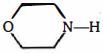
The total number of lone pairs of electrons in the given molecule is
A
$2$
B
$3$
C
$4$
D
$5$
Solution
(B) The given molecule is morpholine.
In this molecule,the oxygen atom $(O)$ has $2$ lone pairs of electrons.
The nitrogen atom $(N)$ has $1$ lone pair of electrons.
Therefore,the total number of lone pairs of electrons in the molecule is $2 + 1 = 3$.
In this molecule,the oxygen atom $(O)$ has $2$ lone pairs of electrons.
The nitrogen atom $(N)$ has $1$ lone pair of electrons.
Therefore,the total number of lone pairs of electrons in the molecule is $2 + 1 = 3$.
0 likes
View Solution164
MediumMCQ
Which of the following molecules has an axis of symmetry and a coaxial plane of symmetry?
A
Formaldehyde $(HCHO)$
B
$1,3$-Dichlorobenzene
C
Dichloromethane $(CH_2Cl_2)$
D
All of these
Solution
(D) An axis of symmetry $(AOS)$ is a line about which rotation by $360^{\circ}/n$ results in an identical orientation. $A$ plane of symmetry $(POS)$ is a plane that divides a molecule into two mirror-image halves.
$1$. Formaldehyde $(HCHO)$: It has a $C_2$ axis of symmetry passing through the $C=O$ bond and a plane of symmetry containing the atoms.
$2$. $1,3$-Dichlorobenzene: It has a $C_2$ axis of symmetry and a plane of symmetry passing through the ring.
$3$. Dichloromethane $(CH_2Cl_2)$: It has a $C_2$ axis of symmetry and a plane of symmetry.
Since all the given molecules possess both an axis of symmetry and a plane of symmetry,the correct option is $D$.
$1$. Formaldehyde $(HCHO)$: It has a $C_2$ axis of symmetry passing through the $C=O$ bond and a plane of symmetry containing the atoms.
$2$. $1,3$-Dichlorobenzene: It has a $C_2$ axis of symmetry and a plane of symmetry passing through the ring.
$3$. Dichloromethane $(CH_2Cl_2)$: It has a $C_2$ axis of symmetry and a plane of symmetry.
Since all the given molecules possess both an axis of symmetry and a plane of symmetry,the correct option is $D$.
0 likes
View Solution165
DifficultMCQ
The decreasing order of bond angles in $BF_3$,$NH_3$,$PF_3$ and $I_3^-$ is
A
$I_3^- > BF_3 > NH_3 > PF_3$
B
$BF_3 > I_3^- > PF_3 > NH_3$
C
$BF_3 > NH_3 > PF_3 > I_3^-$
D
$I_3^- > NH_3 > PF_3 > BF_3$
Solution
(A) $1$. $I_3^-$: The central $I$ atom is $sp^3d$ hybridized with $3$ lone pairs in the equatorial positions,resulting in a linear geometry with a bond angle of $180^\circ$.
$2$. $BF_3$: The central $B$ atom is $sp^2$ hybridized with no lone pairs,resulting in a trigonal planar geometry with a bond angle of $120^\circ$.
$3$. $NH_3$ and $PF_3$: Both have $sp^3$ hybridization with $1$ lone pair,giving them a trigonal pyramidal geometry. The bond angle in $NH_3$ is $\approx 107^\circ$,while in $PF_3$ it is $\approx 96^\circ$. As the electronegativity of the surrounding atoms decreases or the size of the central atom increases,the bond angle decreases. Thus,$NH_3 > PF_3$.
$4$. Combining these,the decreasing order of bond angles is $I_3^- (180^\circ) > BF_3 (120^\circ) > NH_3 (107^\circ) > PF_3 (96^\circ)$.
$2$. $BF_3$: The central $B$ atom is $sp^2$ hybridized with no lone pairs,resulting in a trigonal planar geometry with a bond angle of $120^\circ$.
$3$. $NH_3$ and $PF_3$: Both have $sp^3$ hybridization with $1$ lone pair,giving them a trigonal pyramidal geometry. The bond angle in $NH_3$ is $\approx 107^\circ$,while in $PF_3$ it is $\approx 96^\circ$. As the electronegativity of the surrounding atoms decreases or the size of the central atom increases,the bond angle decreases. Thus,$NH_3 > PF_3$.
$4$. Combining these,the decreasing order of bond angles is $I_3^- (180^\circ) > BF_3 (120^\circ) > NH_3 (107^\circ) > PF_3 (96^\circ)$.
0 likes
View Solution166
DifficultMCQ
In $XeO_3F_2$,the number of bond pair$(s)$,$\pi$-bond$(s)$ and lone pair$(s)$ on $Xe$ atom respectively are:
A
$5, 3, 0$
B
$5, 2, 0$
C
$4, 2, 2$
D
$4, 4, 0$
Solution
(A) The central atom $Xe$ has $8$ valence electrons.
In $XeO_3F_2$,$Xe$ forms $3$ double bonds with $3$ oxygen atoms and $2$ single bonds with $2$ fluorine atoms.
Total bond pairs = $3$ (from $Xe=O$) + $2$ (from $Xe-F$) = $5$.
Number of $\pi$-bonds = $3$ (each $Xe=O$ bond contains one $\pi$-bond).
Number of lone pairs on $Xe$ = $\frac{1}{2} \times (8 - 5 - 3) = 0$.
Thus,the number of bond pairs,$\pi$-bonds,and lone pairs are $5, 3, 0$ respectively.
In $XeO_3F_2$,$Xe$ forms $3$ double bonds with $3$ oxygen atoms and $2$ single bonds with $2$ fluorine atoms.
Total bond pairs = $3$ (from $Xe=O$) + $2$ (from $Xe-F$) = $5$.
Number of $\pi$-bonds = $3$ (each $Xe=O$ bond contains one $\pi$-bond).
Number of lone pairs on $Xe$ = $\frac{1}{2} \times (8 - 5 - 3) = 0$.
Thus,the number of bond pairs,$\pi$-bonds,and lone pairs are $5, 3, 0$ respectively.
0 likes
View Solution167
DifficultMCQ
The number of $S-S$ bonds in $SO_3, S_2O_3^{2-}, S_2O_6^{2-}$ and $S_2O_8^{2-}$ respectively are
A
$0, 1, 1, 0$
B
$1, 0, 1, 0$
C
$0, 1, 1, 0$
D
$0, 1, 0, 1$
Solution
(A) $1$. In $SO_3$,there is no $S-S$ bond. Number of $S-S$ bonds = $0$.
$2$. In $S_2O_3^{2-}$ (thiosulfate ion),there is one $S-S$ bond. Number of $S-S$ bonds = $1$.
$3$. In $S_2O_6^{2-}$ (dithionate ion),there is one $S-S$ bond. Number of $S-S$ bonds = $1$.
$4$. In $S_2O_8^{2-}$ (peroxydisulfate ion),there is no $S-S$ bond; it contains an $O-O$ peroxide linkage. Number of $S-S$ bonds = $0$.
Thus,the number of $S-S$ bonds are $0, 1, 1, 0$ respectively.
$2$. In $S_2O_3^{2-}$ (thiosulfate ion),there is one $S-S$ bond. Number of $S-S$ bonds = $1$.
$3$. In $S_2O_6^{2-}$ (dithionate ion),there is one $S-S$ bond. Number of $S-S$ bonds = $1$.
$4$. In $S_2O_8^{2-}$ (peroxydisulfate ion),there is no $S-S$ bond; it contains an $O-O$ peroxide linkage. Number of $S-S$ bonds = $0$.
Thus,the number of $S-S$ bonds are $0, 1, 1, 0$ respectively.
0 likes
View Solution168
DifficultMCQ
The correct statement among the following is:
A
$(SiH_3)_3N$ is planar and less basic than $(CH_3)_3N$
B
$(SiH_3)_3N$ is planar and more basic than $(CH_3)_3N$
C
$(SiH_3)_3N$ is pyramidal and less basic than $(CH_3)_3N$
D
$(SiH_3)_3N$ is pyramidal and more basic than $(CH_3)_3N$
Solution
(A) In $(SiH_3)_3N$,the lone pair of electrons on the nitrogen atom is involved in $p\pi-d\pi$ back-bonding with the vacant $d$-orbitals of the silicon atoms.
This results in the molecule adopting a planar geometry ($sp^2$ hybridization).
Because the lone pair is delocalized into the $d$-orbitals of silicon,it is not readily available for donation,making $(SiH_3)_3N$ much less basic than $(CH_3)_3N$,where the lone pair is localized on the nitrogen atom.
This results in the molecule adopting a planar geometry ($sp^2$ hybridization).
Because the lone pair is delocalized into the $d$-orbitals of silicon,it is not readily available for donation,making $(SiH_3)_3N$ much less basic than $(CH_3)_3N$,where the lone pair is localized on the nitrogen atom.
0 likes
View Solution169
MediumMCQ
Which of the following compounds will exist?
A
$SF_2$
B
$SF_4$
C
$SF_6$
D
All of these
Solution
(D) Sulfur $(S)$ has the electronic configuration $[Ne] 3s^2 3p^4$. It has $6$ valence electrons.
In $SF_2$,sulfur forms two single bonds with fluorine atoms,leaving two lone pairs on sulfur.
In $SF_4$,sulfur forms four single bonds with fluorine atoms,leaving one lone pair on sulfur.
In $SF_6$,sulfur forms six single bonds with fluorine atoms,utilizing its $3d$ orbitals to expand its octet.
Since all these compounds satisfy the valency and bonding requirements of sulfur,all of them exist.
In $SF_2$,sulfur forms two single bonds with fluorine atoms,leaving two lone pairs on sulfur.
In $SF_4$,sulfur forms four single bonds with fluorine atoms,leaving one lone pair on sulfur.
In $SF_6$,sulfur forms six single bonds with fluorine atoms,utilizing its $3d$ orbitals to expand its octet.
Since all these compounds satisfy the valency and bonding requirements of sulfur,all of them exist.
0 likes
View Solution170
MediumMCQ
Identify the correct option.
A
$NO_3^- > NH_3 > NH_2^-$ (order of bond angle)
B
$(CH_3)_3B$ is a planar molecule
C
In $NH_4Cl$,'$N$' atom is in $sp^3$ hybridization
D
In $S_8$ molecule,a total of $16$ valence shell electrons are left non-bonded on all the '$S$' atoms after bonding
Solution
(A) $1$. In $NO_3^-$,the bond angle is $120^\circ$. In $NH_3$,it is $107^\circ$. In $NH_2^-$,it is $104.5^\circ$. Thus,the order $NO_3^- > NH_3 > NH_2^-$ is correct.
$2$. $(CH_3)_3B$ has $3$ bond pairs and $0$ lone pairs on $B$,making it $sp^2$ hybridized and planar. This is also correct.
$3$. In $NH_4^+$,$N$ is $sp^3$ hybridized. Thus,in $NH_4Cl$,$N$ is $sp^3$ hybridized. This is also correct.
$4$. In $S_8$,each $S$ atom forms $2$ bonds and has $2$ lone pairs. Total lone pairs = $8 \times 2 = 16$. Total non-bonded electrons = $16 \times 2 = 32$. Thus,option $D$ is incorrect.
Given the nature of the question,all options $A, B, C$ are factually correct. However,in standard competitive contexts,if one must choose,$A$ is a fundamental comparison of bond angles.
$2$. $(CH_3)_3B$ has $3$ bond pairs and $0$ lone pairs on $B$,making it $sp^2$ hybridized and planar. This is also correct.
$3$. In $NH_4^+$,$N$ is $sp^3$ hybridized. Thus,in $NH_4Cl$,$N$ is $sp^3$ hybridized. This is also correct.
$4$. In $S_8$,each $S$ atom forms $2$ bonds and has $2$ lone pairs. Total lone pairs = $8 \times 2 = 16$. Total non-bonded electrons = $16 \times 2 = 32$. Thus,option $D$ is incorrect.
Given the nature of the question,all options $A, B, C$ are factually correct. However,in standard competitive contexts,if one must choose,$A$ is a fundamental comparison of bond angles.
0 likes
View Solution171
DifficultMCQ
Select true or false statements :
$(a)$ Promotion of electron is essential condition prior to hybridisation
$(b)$ In $VSEPR$ theory,two or three electron pairs of a multiple bond are treated as a single super pair
$(c)$ Bond length for $CO_2$ lies between double and triple bonds
$(d)$ $Ne_2$ does not exist
$(a)$ Promotion of electron is essential condition prior to hybridisation
$(b)$ In $VSEPR$ theory,two or three electron pairs of a multiple bond are treated as a single super pair
$(c)$ Bond length for $CO_2$ lies between double and triple bonds
$(d)$ $Ne_2$ does not exist
A
$FFFT$
B
$FTTT$
C
$FTFT$
D
$FFTT$
Solution
(B) False: Promotion of an electron is not a necessary condition for hybridization; it is only required in specific cases like carbon to form four bonds.
$(b)$ True: In $VSEPR$ theory,multiple bonds are treated as a single electron domain or 'super pair' for geometry prediction.
$(c)$ True: $CO_2$ exhibits resonance,and its bond length is intermediate between a pure double bond and a triple bond.
$(d)$ True: $Ne_2$ has a bond order of $0$ ($10$ bonding and $10$ antibonding electrons),so it does not exist.
Therefore,the sequence is $FTTT$.
$(b)$ True: In $VSEPR$ theory,multiple bonds are treated as a single electron domain or 'super pair' for geometry prediction.
$(c)$ True: $CO_2$ exhibits resonance,and its bond length is intermediate between a pure double bond and a triple bond.
$(d)$ True: $Ne_2$ has a bond order of $0$ ($10$ bonding and $10$ antibonding electrons),so it does not exist.
Therefore,the sequence is $FTTT$.
0 likes
View Solution172
DifficultMCQ
Choose the incorrect statement.
A
The bond angle of $PH_3$ is greater than $PF_3$.
B
$B.A. : BF_3 = BCl_3 = BBr_3 = BI_3$
C
The direction of dipole moment in $CO$ molecule is from $O \to C$ due to backbonding.
D
The order of bond angles is $OF_2 < H_2O < OCl_2 < O(SiH_3)_2$.
Solution
(C) $1$. In $PH_3$ and $PF_3$,the central atom $P$ has a lone pair. Since $F$ is more electronegative than $H$,the bond pairs in $PF_3$ are closer to $F$,reducing repulsion between bond pairs,leading to a smaller bond angle in $PF_3$ compared to $PH_3$. Thus,$PH_3 > PF_3$ is correct.
$2$. In $BX_3$ molecules,the bond angle is $120^{\circ}$ for all due to $sp^2$ hybridization. Thus,$BF_3 = BCl_3 = BBr_3 = BI_3$ is correct.
$3$. In $CO$,the formal charge on $C$ is $-1$ and on $O$ is $+1$. The dipole moment direction is from $C$ to $O$ (from negative to positive end). The statement claiming $O \to C$ is incorrect.
$4$. The bond angle order $OF_2 (103^{\circ}) < H_2O (104.5^{\circ}) < OCl_2 (111^{\circ}) < O(SiH_3)_2 (144^{\circ})$ is correct due to increasing steric repulsion and backbonding in $O(SiH_3)_2$.
$2$. In $BX_3$ molecules,the bond angle is $120^{\circ}$ for all due to $sp^2$ hybridization. Thus,$BF_3 = BCl_3 = BBr_3 = BI_3$ is correct.
$3$. In $CO$,the formal charge on $C$ is $-1$ and on $O$ is $+1$. The dipole moment direction is from $C$ to $O$ (from negative to positive end). The statement claiming $O \to C$ is incorrect.
$4$. The bond angle order $OF_2 (103^{\circ}) < H_2O (104.5^{\circ}) < OCl_2 (111^{\circ}) < O(SiH_3)_2 (144^{\circ})$ is correct due to increasing steric repulsion and backbonding in $O(SiH_3)_2$.
0 likes
View Solution173
DifficultMCQ
What is the difference between the bond angles in the cationic species of $PCl_5$ and $PBr_5$ in the solid state?
A
$60^o$
B
$109^o 28'$
C
$0^o$
D
$90^o$
Solution
(C) In the solid state,$PCl_5$ exists as $[PCl_4]^+ [PCl_6]^-$. The cation $[PCl_4]^+$ has a tetrahedral geometry with bond angles of $109^o 28'$.
In the solid state,$PBr_5$ exists as $[PBr_4]^+ Br^-$. The cation $[PBr_4]^+$ also has a tetrahedral geometry with bond angles of $109^o 28'$.
Since both cationic species $[PCl_4]^+$ and $[PBr_4]^+$ are tetrahedral,their bond angles are identical.
Therefore,the difference between the bond angles is $109^o 28' - 109^o 28' = 0^o$.
In the solid state,$PBr_5$ exists as $[PBr_4]^+ Br^-$. The cation $[PBr_4]^+$ also has a tetrahedral geometry with bond angles of $109^o 28'$.
Since both cationic species $[PCl_4]^+$ and $[PBr_4]^+$ are tetrahedral,their bond angles are identical.
Therefore,the difference between the bond angles is $109^o 28' - 109^o 28' = 0^o$.
0 likes
View Solution174
DifficultMCQ
Back bonding in $BF_3$ does not affect
A
Planarity,Lewis acidic strength and bond angle
B
Bond length,Hybridisation and bond strength
C
Bond angle,Planarity and Geometry
D
Lewis acidity,Bond length and $(B-F)$ bond order
Solution
(C) In $BF_3$,the boron atom is $sp^2$ hybridized and the molecule has a trigonal planar geometry with a bond angle of $120^{\circ}$.
Back bonding occurs due to the donation of electron density from the filled $2p$ orbital of $F$ to the empty $2p$ orbital of $B$.
This back bonding results in partial double bond character in the $B-F$ bond,which decreases the $B-F$ bond length and increases the $B-F$ bond order.
It also reduces the Lewis acidic strength of $BF_3$ because the electron deficiency of the boron atom is partially compensated.
However,the $sp^2$ hybridization,the trigonal planar geometry,and the bond angle of $120^{\circ}$ remain unaffected by the back bonding.
Back bonding occurs due to the donation of electron density from the filled $2p$ orbital of $F$ to the empty $2p$ orbital of $B$.
This back bonding results in partial double bond character in the $B-F$ bond,which decreases the $B-F$ bond length and increases the $B-F$ bond order.
It also reduces the Lewis acidic strength of $BF_3$ because the electron deficiency of the boron atom is partially compensated.
However,the $sp^2$ hybridization,the trigonal planar geometry,and the bond angle of $120^{\circ}$ remain unaffected by the back bonding.
0 likes
View Solution175
MediumMCQ
The lattice energy of $NaCl$ is $-780 \, kJ \, mol^{-1}$. The enthalpies of hydration of $Na^{+}_{(g)}$ and $Cl^{-}_{(g)}$ ions are $-406 \, kJ \, mol^{-1}$ and $-364 \, kJ \, mol^{-1}$ respectively. The enthalpy of solution of $NaCl_{(s)}$ is $..... \, kJ \, mol^{-1}$.
A
$738$
B
$10$
C
$-10$
D
$-822$
Solution
(B) The enthalpy of solution $(\Delta H_{sol})$ is calculated using the Born-Haber cycle approach,where $\Delta H_{sol} = \Delta H_{lattice} + \Delta H_{hyd(Na^+)} + \Delta H_{hyd(Cl^-)}$.
Step $1$: The lattice energy is given as $-780 \, kJ \, mol^{-1}$ (energy released during formation). The lattice enthalpy $(\Delta H_{lattice})$ is the energy required to break the lattice,which is the negative of the lattice energy: $\Delta H_{lattice} = -(-780 \, kJ \, mol^{-1}) = 780 \, kJ \, mol^{-1}$.
Step $2$: The hydration enthalpies are $\Delta H_{hyd(Na^+)} = -406 \, kJ \, mol^{-1}$ and $\Delta H_{hyd(Cl^-)} = -364 \, kJ \, mol^{-1}$.
Step $3$: Calculate the enthalpy of solution:
$\Delta H_{sol} = 780 \, kJ \, mol^{-1} + (-406 \, kJ \, mol^{-1}) + (-364 \, kJ \, mol^{-1})$
$\Delta H_{sol} = 780 - 770 = 10 \, kJ \, mol^{-1}$.
Step $1$: The lattice energy is given as $-780 \, kJ \, mol^{-1}$ (energy released during formation). The lattice enthalpy $(\Delta H_{lattice})$ is the energy required to break the lattice,which is the negative of the lattice energy: $\Delta H_{lattice} = -(-780 \, kJ \, mol^{-1}) = 780 \, kJ \, mol^{-1}$.
Step $2$: The hydration enthalpies are $\Delta H_{hyd(Na^+)} = -406 \, kJ \, mol^{-1}$ and $\Delta H_{hyd(Cl^-)} = -364 \, kJ \, mol^{-1}$.
Step $3$: Calculate the enthalpy of solution:
$\Delta H_{sol} = 780 \, kJ \, mol^{-1} + (-406 \, kJ \, mol^{-1}) + (-364 \, kJ \, mol^{-1})$
$\Delta H_{sol} = 780 - 770 = 10 \, kJ \, mol^{-1}$.
0 likes
View Solution176
DifficultMCQ
If in $NH_3$ formation $N$ uses its pure atomic orbitals,then the wrong statement is:
A
At least three bond angles are of $90^{\circ}$
B
Three $\sigma$ bonds with identical strength
C
Lone pair will be in $2s$ orbital
D
Molecule will be $T$-shaped
Solution
(D) If $N$ uses pure atomic orbitals $(2p_x, 2p_y, 2p_z)$ for bonding with $H$ atoms,the three $N-H$ bonds would be formed by the overlap of $N(2p)$ and $H(1s)$ orbitals.
Since the $p$-orbitals are mutually perpendicular,the bond angles would be $90^{\circ}$.
The lone pair would reside in the $2s$ orbital.
However,the $N-H$ bonds formed by $p-s$ overlap would have identical strength.
The geometry would be pyramidal,not $T$-shaped.
Therefore,the statement that the molecule will be $T$-shaped is incorrect.
Since the $p$-orbitals are mutually perpendicular,the bond angles would be $90^{\circ}$.
The lone pair would reside in the $2s$ orbital.
However,the $N-H$ bonds formed by $p-s$ overlap would have identical strength.
The geometry would be pyramidal,not $T$-shaped.
Therefore,the statement that the molecule will be $T$-shaped is incorrect.
0 likes
View Solution177
MediumMCQ
Species isoelectronic with $BF_3$ would be
A
$NO_3^-$
B
$CO_3^{2-}$
C
$BO_3^{3-}$
D
All the above
Solution
(D) Isoelectronic species are those that have the same number of electrons.
For $BF_3$: Total electrons = $5 + (3 \times 9) = 5 + 27 = 32$ electrons.
For $NO_3^-$: Total electrons = $7 + (3 \times 8) + 1 = 7 + 24 + 1 = 32$ electrons.
For $CO_3^{2-}$: Total electrons = $6 + (3 \times 8) + 2 = 6 + 24 + 2 = 32$ electrons.
For $BO_3^{3-}$: Total electrons = $5 + (3 \times 8) + 3 = 5 + 24 + 3 = 32$ electrons.
Since all the given species have $32$ electrons,they are all isoelectronic with $BF_3$.
For $BF_3$: Total electrons = $5 + (3 \times 9) = 5 + 27 = 32$ electrons.
For $NO_3^-$: Total electrons = $7 + (3 \times 8) + 1 = 7 + 24 + 1 = 32$ electrons.
For $CO_3^{2-}$: Total electrons = $6 + (3 \times 8) + 2 = 6 + 24 + 2 = 32$ electrons.
For $BO_3^{3-}$: Total electrons = $5 + (3 \times 8) + 3 = 5 + 24 + 3 = 32$ electrons.
Since all the given species have $32$ electrons,they are all isoelectronic with $BF_3$.
0 likes
View Solution178
DifficultMCQ
In which of the following pairs is the geometry around the central atom not the same?
A
$CH_4, SiH_4$
B
$As_4O_{10}, P_4O_{10}$
C
$CO_2, SiO_2$
D
$NO_2, ClO_2$
Solution
(C) $1$. $CH_4$ and $SiH_4$: Both have $sp^3$ hybridization and tetrahedral geometry.
$2$. $As_4O_{10}$ and $P_4O_{10}$: Both have similar cage-like structures where each central atom is tetrahedral.
$3$. $CO_2$ and $SiO_2$: $CO_2$ is a discrete molecule with $sp$ hybridization (linear geometry),whereas $SiO_2$ is a giant covalent network structure where each $Si$ atom is $sp^3$ hybridized (tetrahedral geometry).
$4$. $NO_2$ and $ClO_2$: Both are bent molecules due to the presence of a lone pair on the central atom.
Therefore,the pair with different geometries is $CO_2$ and $SiO_2$.
$2$. $As_4O_{10}$ and $P_4O_{10}$: Both have similar cage-like structures where each central atom is tetrahedral.
$3$. $CO_2$ and $SiO_2$: $CO_2$ is a discrete molecule with $sp$ hybridization (linear geometry),whereas $SiO_2$ is a giant covalent network structure where each $Si$ atom is $sp^3$ hybridized (tetrahedral geometry).
$4$. $NO_2$ and $ClO_2$: Both are bent molecules due to the presence of a lone pair on the central atom.
Therefore,the pair with different geometries is $CO_2$ and $SiO_2$.
0 likes
View Solution179
DifficultMCQ
The correct order as indicated in each option is
A
$CaF_2 > CaCl_2 > CaBr_2$ (Melting point)
B
$CH_3F > CH_3Cl > CH_3Br$ (Dipole moment)
C
$np_{\pi} - np_{\pi} < ns - ns < ns - np$ (Extent of overlapping)
D
$H_2 > H_2^+ = H_2^-$ (Stability)
Solution
(A) $1$. For $CaF_2, CaCl_2, CaBr_2$,the melting point decreases as the size of the anion increases due to increased covalent character (Fajan's rule). Thus,$CaF_2 > CaCl_2 > CaBr_2$ is correct.
$2$. For $CH_3F, CH_3Cl, CH_3Br$,the dipole moment order is $CH_3Cl > CH_3F > CH_3Br$ because the bond length increase in $C-Cl$ outweighs the electronegativity difference in $C-F$.
$3$. The extent of overlapping follows the order $ns-ns > ns-np > np_{\pi}-np_{\pi}$.
$4$. Stability is determined by bond order. $H_2$ (bond order $1$) $> H_2^+$ (bond order $0.5$) $= H_2^-$ (bond order $0.5$). Thus,$H_2 > H_2^+ = H_2^-$ is correct.
Note: Both $A$ and $D$ are technically correct statements based on chemical principles.
$2$. For $CH_3F, CH_3Cl, CH_3Br$,the dipole moment order is $CH_3Cl > CH_3F > CH_3Br$ because the bond length increase in $C-Cl$ outweighs the electronegativity difference in $C-F$.
$3$. The extent of overlapping follows the order $ns-ns > ns-np > np_{\pi}-np_{\pi}$.
$4$. Stability is determined by bond order. $H_2$ (bond order $1$) $> H_2^+$ (bond order $0.5$) $= H_2^-$ (bond order $0.5$). Thus,$H_2 > H_2^+ = H_2^-$ is correct.
Note: Both $A$ and $D$ are technically correct statements based on chemical principles.
0 likes
View Solution180
DifficultMCQ
Incorrect statement regarding $N(SiH_3)_3$ is
A
It is associated with two types of hybridization of central atoms
B
It is a planar compound as a whole
C
$N-Si$ bond length is less than a single bond
D
It is a weaker base than $NH_3$
Solution
(NONE) The molecule $N(SiH_3)_3$ (trisilylamine) has a planar geometry around the nitrogen atom due to $p\pi-d\pi$ back-bonding from the lone pair of $N$ into the vacant $d$-orbitals of $Si$.
Because of this back-bonding,the $N-Si$ bond acquires partial double bond character,making it shorter than a typical $N-Si$ single bond.
$N(SiH_3)_3$ is a much weaker base than $NH_3$ because the lone pair on $N$ is involved in back-bonding and is not available for donation.
The central $N$ atom is $sp^2$ hybridized,while the $Si$ atoms are $sp^3$ hybridized.
Therefore,the statement that it is associated with two types of hybridization of central atoms is correct.
All statements $A$,$B$,$C$,and $D$ are actually correct descriptions of $N(SiH_3)_3$. However,if forced to choose the most technically 'incorrect' phrasing in some contexts,it is often noted that $N(SiH_3)_3$ is planar,but the $SiH_3$ groups themselves are tetrahedral. Given the standard options,all are factually true. If this is a multiple-choice question where one must be false,there may be an error in the question source,but based on chemical principles,all provided statements are correct.
Because of this back-bonding,the $N-Si$ bond acquires partial double bond character,making it shorter than a typical $N-Si$ single bond.
$N(SiH_3)_3$ is a much weaker base than $NH_3$ because the lone pair on $N$ is involved in back-bonding and is not available for donation.
The central $N$ atom is $sp^2$ hybridized,while the $Si$ atoms are $sp^3$ hybridized.
Therefore,the statement that it is associated with two types of hybridization of central atoms is correct.
All statements $A$,$B$,$C$,and $D$ are actually correct descriptions of $N(SiH_3)_3$. However,if forced to choose the most technically 'incorrect' phrasing in some contexts,it is often noted that $N(SiH_3)_3$ is planar,but the $SiH_3$ groups themselves are tetrahedral. Given the standard options,all are factually true. If this is a multiple-choice question where one must be false,there may be an error in the question source,but based on chemical principles,all provided statements are correct.
0 likes
View Solution181
MediumMCQ
What is true about $S_8$ molecule?
$I.$ There are no $p_{\pi}-p_{\pi}$ bonds present in the molecule.
$II.$ There are eight lone pairs of electrons.
$III.$ Each $S$ atom is $sp^3$ hybridized.
$I.$ There are no $p_{\pi}-p_{\pi}$ bonds present in the molecule.
$II.$ There are eight lone pairs of electrons.
$III.$ Each $S$ atom is $sp^3$ hybridized.
A
$I, III$
B
$II, III$
C
$I, II$
D
$I, II, III$
Solution
(A) The $S_8$ molecule has a puckered ring structure (crown shape).
$I.$ Since all $S-S$ bonds are single covalent bonds,there are no $p_{\pi}-p_{\pi}$ multiple bonds present. This statement is true.
$II.$ Each sulfur atom in the $S_8$ ring is bonded to two other sulfur atoms and has two lone pairs. Since there are $8$ sulfur atoms,the total number of lone pairs is $8 \times 2 = 16$. Thus,statement $II$ is false.
$III.$ Each sulfur atom is bonded to two other atoms and possesses two lone pairs,resulting in a steric number of $4$ ($2$ bond pairs + $2$ lone pairs). Therefore,each $S$ atom is $sp^3$ hybridized. This statement is true.
Thus,statements $I$ and $III$ are correct.
$I.$ Since all $S-S$ bonds are single covalent bonds,there are no $p_{\pi}-p_{\pi}$ multiple bonds present. This statement is true.
$II.$ Each sulfur atom in the $S_8$ ring is bonded to two other sulfur atoms and has two lone pairs. Since there are $8$ sulfur atoms,the total number of lone pairs is $8 \times 2 = 16$. Thus,statement $II$ is false.
$III.$ Each sulfur atom is bonded to two other atoms and possesses two lone pairs,resulting in a steric number of $4$ ($2$ bond pairs + $2$ lone pairs). Therefore,each $S$ atom is $sp^3$ hybridized. This statement is true.
Thus,statements $I$ and $III$ are correct.
0 likes
View Solution182
DifficultMCQ
Which of the following pairs of molecules have almost identical bond dissociation energy?
A
$F_2$ and $H_2$
B
$N_2$ and $CO$
C
$F_2$ and $I_2$
D
$HF$ and $O_2$
Solution
(C) The bond dissociation energy of $F_2$ is approximately $158 \ kJ/mol$ due to significant inter-electronic repulsion between the lone pairs of the small $F$ atoms.
The bond dissociation energy of $I_2$ is approximately $151 \ kJ/mol$. The bond is weak because the $5p$ orbitals of $I$ atoms are very large,leading to poor orbital overlap.
Since $158 \ kJ/mol$ and $151 \ kJ/mol$ are very close,$F_2$ and $I_2$ have almost identical bond dissociation energies.
Therefore,the correct pair is $F_2$ and $I_2$.
The bond dissociation energy of $I_2$ is approximately $151 \ kJ/mol$. The bond is weak because the $5p$ orbitals of $I$ atoms are very large,leading to poor orbital overlap.
Since $158 \ kJ/mol$ and $151 \ kJ/mol$ are very close,$F_2$ and $I_2$ have almost identical bond dissociation energies.
Therefore,the correct pair is $F_2$ and $I_2$.
0 likes
View Solution183
DifficultMCQ
Which of the following order is incorrect?
A
Electronegativity of central atom : $CF_4 > CH_4 > SiH_4$
B
Hydration energy : $Al^{3+} > Be^{2+} > Mg^{2+} > Na^{+}$
C
Electrical conductance : $F^{-}_{(aq.)} > Cl^{-}_{(aq.)} > S^{2-}_{(aq.)}$
D
Magnetic moment : $Ni^{4+} > V^{3+} > Sr^{2+}$
Solution
(C) Let us analyze each option:
$A$: Electronegativity of the central atom depends on its oxidation state and hybridization. In $CF_4$,$C$ is $sp^3$ hybridized and bonded to highly electronegative $F$. In $CH_4$,$C$ is $sp^3$ hybridized. In $SiH_4$,$Si$ is less electronegative than $C$. The order $CF_4 > CH_4 > SiH_4$ is correct.
$B$: Hydration energy is directly proportional to charge density $(charge/size)$. $Al^{3+}$ $(3+/small)$ > $Be^{2+}$ $(2+/small)$ > $Mg^{2+}$ $(2+/larger)$ > $Na^{+}$ $(1+/larger)$. This order is correct.
$C$: Electrical conductance in aqueous solution depends on ionic mobility. Smaller ions with higher charge density are more heavily hydrated,making them larger and slower. $S^{2-}$ has a larger size and lower charge density compared to $F^{-}$ and $Cl^{-}$,thus it has higher mobility. The given order $F^{-} > Cl^{-} > S^{2-}$ is incorrect.
$D$: Magnetic moment $\mu = \sqrt{n(n+2)} \ BM$. $Ni^{4+}$ ($3d^6$,$n=4$),$V^{3+}$ ($3d^2$,$n=2$),$Sr^{2+}$ ($[Kr]$,$n=0$). The order $Ni^{4+} > V^{3+} > Sr^{2+}$ is correct.
$A$: Electronegativity of the central atom depends on its oxidation state and hybridization. In $CF_4$,$C$ is $sp^3$ hybridized and bonded to highly electronegative $F$. In $CH_4$,$C$ is $sp^3$ hybridized. In $SiH_4$,$Si$ is less electronegative than $C$. The order $CF_4 > CH_4 > SiH_4$ is correct.
$B$: Hydration energy is directly proportional to charge density $(charge/size)$. $Al^{3+}$ $(3+/small)$ > $Be^{2+}$ $(2+/small)$ > $Mg^{2+}$ $(2+/larger)$ > $Na^{+}$ $(1+/larger)$. This order is correct.
$C$: Electrical conductance in aqueous solution depends on ionic mobility. Smaller ions with higher charge density are more heavily hydrated,making them larger and slower. $S^{2-}$ has a larger size and lower charge density compared to $F^{-}$ and $Cl^{-}$,thus it has higher mobility. The given order $F^{-} > Cl^{-} > S^{2-}$ is incorrect.
$D$: Magnetic moment $\mu = \sqrt{n(n+2)} \ BM$. $Ni^{4+}$ ($3d^6$,$n=4$),$V^{3+}$ ($3d^2$,$n=2$),$Sr^{2+}$ ($[Kr]$,$n=0$). The order $Ni^{4+} > V^{3+} > Sr^{2+}$ is correct.
0 likes
View Solution184
DifficultMCQ
The Born-Haber cycle can be used to estimate:
A
Lattice energy of ionic crystals
B
Electron gain enthalpy
C
Electronegativity
D
Both $(a)$ and $(b)$
Solution
(D) The Born-Haber cycle is a thermochemical cycle used to relate lattice energy,ionization energy,electron gain enthalpy,sublimation energy,and bond dissociation energy to the standard enthalpy of formation of an ionic compound.
It applies Hess's law to calculate the lattice enthalpy by comparing the standard enthalpy change of formation of the ionic compound from its elements to the total enthalpy required to form gaseous ions from those elements.
Therefore,it can be used to estimate both the lattice energy of ionic crystals and the electron gain enthalpy.
It applies Hess's law to calculate the lattice enthalpy by comparing the standard enthalpy change of formation of the ionic compound from its elements to the total enthalpy required to form gaseous ions from those elements.
Therefore,it can be used to estimate both the lattice energy of ionic crystals and the electron gain enthalpy.
0 likes
View Solution185
AdvancedMCQ
| Element | Electronegativity |
|---|---|
| $W$ | $2.7$ |
| $X$ | $2.1$ |
| $Y$ | $0.8$ |
| $Z$ | $3.4$ |
A
$WZ$ does not conduct electricity in solid and fused state
B
$YZ$ conducts electricity in fused as well as solution state
C
$XZ$ conducts electricity only in solution state
D
$WX$ conducts electricity only in fused state
Solution
(D) Electronegativity difference determines the nature of the bond:
$1$. $W$ $(2.7)$ and $Z$ $(3.4)$: Difference = $0.7$ (Covalent). $WZ$ is a covalent compound and does not conduct electricity in solid or fused state.
$2$. $Y$ $(0.8)$ and $Z$ $(3.4)$: Difference = $2.6$ (Ionic). $YZ$ is an ionic compound and conducts electricity in fused and solution states.
$3$. $X$ $(2.1)$ and $Z$ $(3.4)$: Difference = $1.3$ (Polar covalent). $XZ$ is a polar covalent compound and generally does not conduct electricity.
$4$. $W$ $(2.7)$ and $X$ $(2.1)$: Difference = $0.6$ (Covalent). $WX$ is a covalent compound and does not conduct electricity in any state.
Thus,the statement that $WX$ conducts electricity in fused state is incorrect.
$1$. $W$ $(2.7)$ and $Z$ $(3.4)$: Difference = $0.7$ (Covalent). $WZ$ is a covalent compound and does not conduct electricity in solid or fused state.
$2$. $Y$ $(0.8)$ and $Z$ $(3.4)$: Difference = $2.6$ (Ionic). $YZ$ is an ionic compound and conducts electricity in fused and solution states.
$3$. $X$ $(2.1)$ and $Z$ $(3.4)$: Difference = $1.3$ (Polar covalent). $XZ$ is a polar covalent compound and generally does not conduct electricity.
$4$. $W$ $(2.7)$ and $X$ $(2.1)$: Difference = $0.6$ (Covalent). $WX$ is a covalent compound and does not conduct electricity in any state.
Thus,the statement that $WX$ conducts electricity in fused state is incorrect.
0 likes
View Solution186
AdvancedMCQ
Which of the following attractions is the strongest?
A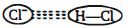
B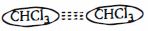
C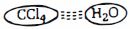
D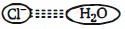
Solution
(D) The strength of intermolecular forces follows the order:
Ion-dipole $ > $ dipole-dipole $ > $ ion-induced dipole $ > $ dipole-induced dipole $ > $ London dispersion forces.
$(A)$ $Cl^-$ and $HCl$: Ion-dipole interaction.
$(B)$ $CHCl_3$ and $CHCl_3$: Dipole-dipole interaction.
$(C)$ $CCl_4$ and $H_2O$: Dipole-induced dipole interaction (since $CCl_4$ is non-polar).
$(D)$ $Cl^-$ and $H_2O$: Ion-dipole interaction.
Comparing $(A)$ and $(D)$,the ion-dipole interaction between $Cl^-$ and $H_2O$ is stronger than that between $Cl^-$ and $HCl$ because water $(H_2O)$ has a higher dipole moment than hydrogen chloride $(HCl)$.
Ion-dipole $ > $ dipole-dipole $ > $ ion-induced dipole $ > $ dipole-induced dipole $ > $ London dispersion forces.
$(A)$ $Cl^-$ and $HCl$: Ion-dipole interaction.
$(B)$ $CHCl_3$ and $CHCl_3$: Dipole-dipole interaction.
$(C)$ $CCl_4$ and $H_2O$: Dipole-induced dipole interaction (since $CCl_4$ is non-polar).
$(D)$ $Cl^-$ and $H_2O$: Ion-dipole interaction.
Comparing $(A)$ and $(D)$,the ion-dipole interaction between $Cl^-$ and $H_2O$ is stronger than that between $Cl^-$ and $HCl$ because water $(H_2O)$ has a higher dipole moment than hydrogen chloride $(HCl)$.
0 likes
View Solution187
DifficultMCQ
Which of the following is an example of a super octet molecule?
A
$ClF_3$
B
$PCl_5$
C
$IF_7$
D
All the three
Solution
(D) super octet molecule is one that has more than $8$ electrons in the valence shell of the central atom.
$A$) In $ClF_3$,the central $Cl$ atom is surrounded by $10$ electrons.
$B$) In $PCl_5$,the central $P$ atom is surrounded by $10$ electrons.
$C$) In $IF_7$,the central $I$ atom is surrounded by $14$ electrons.
Since all three molecules have more than $8$ electrons in the valence shell of their central atoms,they are all examples of super octet molecules.
$A$) In $ClF_3$,the central $Cl$ atom is surrounded by $10$ electrons.
$B$) In $PCl_5$,the central $P$ atom is surrounded by $10$ electrons.
$C$) In $IF_7$,the central $I$ atom is surrounded by $14$ electrons.
Since all three molecules have more than $8$ electrons in the valence shell of their central atoms,they are all examples of super octet molecules.
0 likes
View Solution188
MediumMCQ
Which of the following molecules is theoretically not possible?
A
$SF_4$
B
$OF_2$
C
$OF_4$
D
$O_2F_2$
Solution
(C) In $OF_4$,the oxidation state of oxygen would be $+4$.
Oxygen is a highly electronegative element and its common oxidation states are $-2, -1, +1$,and $+2$.
Since oxygen cannot exhibit a $+4$ oxidation state due to the absence of $d$-orbitals in its valence shell,$OF_4$ is not a theoretically possible molecule.
Therefore,the correct answer is option $C$.
Oxygen is a highly electronegative element and its common oxidation states are $-2, -1, +1$,and $+2$.
Since oxygen cannot exhibit a $+4$ oxidation state due to the absence of $d$-orbitals in its valence shell,$OF_4$ is not a theoretically possible molecule.
Therefore,the correct answer is option $C$.
0 likes
View Solution189
DifficultMCQ
Which of the following species is neither hypervalent nor hypovalent?
A
$ClO_4^-$
B
$BF_3$
C
$SO_4^{2-}$
D
$CO_3^{2-}$
Solution
(D) species is hypervalent if the central atom has more than $8$ electrons in its valence shell,and hypovalent if it has fewer than $8$ electrons.
$(a)$ In $ClO_4^-$,the central $Cl$ atom has $14$ valence electrons,so it is hypervalent.
$(b)$ In $BF_3$,the central $B$ atom has $6$ valence electrons,so it is hypovalent.
$(c)$ In $SO_4^{2-}$,the central $S$ atom has $12$ valence electrons,so it is hypervalent.
$(d)$ In $CO_3^{2-}$,the central $C$ atom has $8$ valence electrons (octet is complete),so it is neither hypervalent nor hypovalent.
$(a)$ In $ClO_4^-$,the central $Cl$ atom has $14$ valence electrons,so it is hypervalent.
$(b)$ In $BF_3$,the central $B$ atom has $6$ valence electrons,so it is hypovalent.
$(c)$ In $SO_4^{2-}$,the central $S$ atom has $12$ valence electrons,so it is hypervalent.
$(d)$ In $CO_3^{2-}$,the central $C$ atom has $8$ valence electrons (octet is complete),so it is neither hypervalent nor hypovalent.
0 likes
View Solution190
MediumMCQ
Which molecule does not exist?
A
$OF_2$
B
$OF_4$
C
$SF_2$
D
$SH_4$
Solution
(B) The maximum covalency of an oxygen atom is $3$ because it lacks $d$-orbitals in its valence shell.
Therefore,$OF_4$ cannot exist as it would require oxygen to exhibit a covalency of $4$.
Therefore,$OF_4$ cannot exist as it would require oxygen to exhibit a covalency of $4$.
0 likes
View Solution191
MediumMCQ
The correct order of increasing $C-O$ bond strength of $CO, CO_3^{2-}, CO_2$ is
A
$CO_3^{2-} < CO_2 < CO$
B
$CO_2 < CO_3^{2-} < CO$
C
$CO < CO_3^{2-} < CO_2$
D
$CO < CO_2 < CO_3^{2-}$
Solution
(A) The bond strength is inversely proportional to the bond order.
First,calculate the bond order for each species:
$1$. For $CO$: The bond order is $3$.
$2$. For $CO_2$: The structure is $O=C=O$,and the bond order is $2$.
$3$. For $CO_3^{2-}$: The resonance hybrid structure gives a bond order of $4/3 \approx 1.33$.
Comparing the bond orders: $1.33 (CO_3^{2-}) < 2 (CO_2) < 3 (CO)$.
Since bond strength increases with bond order,the correct order is $CO_3^{2-} < CO_2 < CO$.
First,calculate the bond order for each species:
$1$. For $CO$: The bond order is $3$.
$2$. For $CO_2$: The structure is $O=C=O$,and the bond order is $2$.
$3$. For $CO_3^{2-}$: The resonance hybrid structure gives a bond order of $4/3 \approx 1.33$.
Comparing the bond orders: $1.33 (CO_3^{2-}) < 2 (CO_2) < 3 (CO)$.
Since bond strength increases with bond order,the correct order is $CO_3^{2-} < CO_2 < CO$.
0 likes
View Solution192
MediumMCQ
The ratio of $\sigma$-bond and $\pi$-bond in tetracyanoethylene is
A
$2 : 1$
B
$1 : 1$
C
$1 : 2$
D
None of these
Solution
(B) The structure of tetracyanoethylene is $(CN)_2C=C(CN)_2$.
In this molecule,there is a central $C=C$ double bond (one $\sigma$ and one $\pi$ bond).
Each of the four $C-CN$ bonds contains one $\sigma$ bond.
Each of the four $C \equiv N$ triple bonds contains one $\sigma$ bond and two $\pi$ bonds.
Total $\sigma$-bonds = $1$ (central $C-C$) + $4$ $(C-CN)$ + $4$ $(C-N)$ = $9$.
Total $\pi$-bonds = $1$ (central $C=C$) + $4 \times 2$ $(C \equiv N)$ = $9$.
The ratio of $\sigma$-bond to $\pi$-bond is $9 : 9$,which simplifies to $1 : 1$.
In this molecule,there is a central $C=C$ double bond (one $\sigma$ and one $\pi$ bond).
Each of the four $C-CN$ bonds contains one $\sigma$ bond.
Each of the four $C \equiv N$ triple bonds contains one $\sigma$ bond and two $\pi$ bonds.
Total $\sigma$-bonds = $1$ (central $C-C$) + $4$ $(C-CN)$ + $4$ $(C-N)$ = $9$.
Total $\pi$-bonds = $1$ (central $C=C$) + $4 \times 2$ $(C \equiv N)$ = $9$.
The ratio of $\sigma$-bond to $\pi$-bond is $9 : 9$,which simplifies to $1 : 1$.
0 likes
View Solution193
MediumMCQ
Number of $S-S$ bonds in $H_2S_nO_6$ is:
A
$n$
B
$(n-1)$
C
$(n-2)$
D
$(n+1)$
Solution
(B) The general formula for polythionic acid is $H_2S_nO_6$.
In the structure of polythionic acid,there are $n$ sulfur atoms linked in a chain.
The number of $S-S$ bonds in a chain of $n$ sulfur atoms is given by $(n-1)$.
Hence,option $B$ is correct.
In the structure of polythionic acid,there are $n$ sulfur atoms linked in a chain.
The number of $S-S$ bonds in a chain of $n$ sulfur atoms is given by $(n-1)$.
Hence,option $B$ is correct.
0 likes
View Solution194
DifficultMCQ
How many $S-S$ bonds,$S-O-S$ bonds,$\sigma$-bonds,and $\pi$-bonds are present in the trimer of sulphur trioxide $(S_3O_9)$?
A
$0, 3, 16, 2$
B
$0, 3, 12, 6$
C
$0, 6, 12, 16$
D
$0, 4, 12, 6$
Solution
(B) The trimer of sulphur trioxide is $S_3O_9$,which has a cyclic structure consisting of a six-membered ring of alternating $S$ and $O$ atoms.
In this structure,there are no $S-S$ bonds.
There are $3$ $S-O-S$ linkages in the ring.
Each $S$ atom is bonded to two oxygen atoms in the ring and two terminal oxygen atoms via double bonds.
Total $\sigma$-bonds = $3$ (in ring) + $6$ (to terminal $O$) + $3$ (in ring $S-O$) = $12$ $\sigma$-bonds.
Total $\pi$-bonds = $6$ (each of the $3$ $S$ atoms has $2$ terminal $S=O$ bonds,contributing $2$ $\pi$-bonds each,$3 \times 2 = 6$).
Thus,the counts are $0$ $S-S$ bonds,$3$ $S-O-S$ bonds,$12$ $\sigma$-bonds,and $6$ $\pi$-bonds.
Therefore,the correct option is $B$.
In this structure,there are no $S-S$ bonds.
There are $3$ $S-O-S$ linkages in the ring.
Each $S$ atom is bonded to two oxygen atoms in the ring and two terminal oxygen atoms via double bonds.
Total $\sigma$-bonds = $3$ (in ring) + $6$ (to terminal $O$) + $3$ (in ring $S-O$) = $12$ $\sigma$-bonds.
Total $\pi$-bonds = $6$ (each of the $3$ $S$ atoms has $2$ terminal $S=O$ bonds,contributing $2$ $\pi$-bonds each,$3 \times 2 = 6$).
Thus,the counts are $0$ $S-S$ bonds,$3$ $S-O-S$ bonds,$12$ $\sigma$-bonds,and $6$ $\pi$-bonds.
Therefore,the correct option is $B$.
0 likes
View Solution195
MediumMCQ
In the electronic structure of $H_2SO_4$,the total number of unshared electrons is
A
$20$
B
$16$
C
$12$
D
$8$
Solution
(B) The total number of valence electrons in $H_2SO_4$ is calculated as:
$2 \times (H) + 1 \times (S) + 4 \times (O) = 2 \times 1 + 6 + 4 \times 6 = 32$ electrons.
In the Lewis structure of $H_2SO_4$,there are $8$ covalent bonds (two $S-OH$ bonds,two $S=O$ bonds).
Each covalent bond consists of $2$ shared electrons,so the total number of shared electrons is $8 \times 2 = 16$.
The number of unshared electrons (lone pair electrons) is the total valence electrons minus the shared electrons:
$32 - 16 = 16$.
Thus,the total number of unshared electrons is $16$.
Hence,the correct option is $B$.
$2 \times (H) + 1 \times (S) + 4 \times (O) = 2 \times 1 + 6 + 4 \times 6 = 32$ electrons.
In the Lewis structure of $H_2SO_4$,there are $8$ covalent bonds (two $S-OH$ bonds,two $S=O$ bonds).
Each covalent bond consists of $2$ shared electrons,so the total number of shared electrons is $8 \times 2 = 16$.
The number of unshared electrons (lone pair electrons) is the total valence electrons minus the shared electrons:
$32 - 16 = 16$.
Thus,the total number of unshared electrons is $16$.
Hence,the correct option is $B$.
0 likes
View Solution196
DifficultMCQ
Which of the following leads to bonding?
A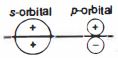
B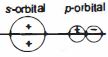
C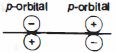
D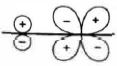
Solution
(A) Bonding occurs when atomic orbitals overlap with the same phase (same sign),leading to constructive interference.
In option $(A)$,the $s$-orbital has a positive sign,while the $p$-orbital has a positive sign on top and a negative sign on the bottom. When they overlap,the positive region of the $s$-orbital interacts with the positive region of the $p$-orbital,resulting in constructive interference (bonding).
In options $(B)$,$(C)$,and $(D)$,the overlap involves regions of opposite signs,which leads to destructive interference (anti-bonding).
Therefore,option $(A)$ represents a bonding interaction.
In option $(A)$,the $s$-orbital has a positive sign,while the $p$-orbital has a positive sign on top and a negative sign on the bottom. When they overlap,the positive region of the $s$-orbital interacts with the positive region of the $p$-orbital,resulting in constructive interference (bonding).
In options $(B)$,$(C)$,and $(D)$,the overlap involves regions of opposite signs,which leads to destructive interference (anti-bonding).
Therefore,option $(A)$ represents a bonding interaction.
0 likes
View Solution197
AdvancedMCQ
Which of the following overlapping is not present in $XeO_3$ molecule?
A
$sp^3 + p_x$
B
$sp^3 + p_y$
C
$d_{xy} + p_x$
D
$sp^3 + s$
Solution
(D) In $XeO_3$,the central atom $Xe$ undergoes $sp^3$ hybridization.
The $Xe$ atom uses its $sp^3$ hybrid orbitals to form $3$ $\sigma$ bonds with the $p_z$ orbitals of three oxygen atoms.
The $\pi$ bonds in $XeO_3$ are formed by the overlap of $d$-orbitals of $Xe$ (specifically $d_{xz}, d_{yz}, d_{xy}$) with the $p_x$ or $p_y$ orbitals of oxygen.
Therefore,the overlapping $sp^3 + p_x$ and $sp^3 + p_y$ are involved in $\sigma$ bond formation (or hybrid orbital interactions),and $d_{xy} + p_x$ is involved in $\pi$ bond formation.
The overlapping $sp^3 + s$ is not present in the $XeO_3$ molecule because oxygen uses its $p$-orbitals for bonding with the $sp^3$ hybrid orbitals of $Xe$.
The $Xe$ atom uses its $sp^3$ hybrid orbitals to form $3$ $\sigma$ bonds with the $p_z$ orbitals of three oxygen atoms.
The $\pi$ bonds in $XeO_3$ are formed by the overlap of $d$-orbitals of $Xe$ (specifically $d_{xz}, d_{yz}, d_{xy}$) with the $p_x$ or $p_y$ orbitals of oxygen.
Therefore,the overlapping $sp^3 + p_x$ and $sp^3 + p_y$ are involved in $\sigma$ bond formation (or hybrid orbital interactions),and $d_{xy} + p_x$ is involved in $\pi$ bond formation.
The overlapping $sp^3 + s$ is not present in the $XeO_3$ molecule because oxygen uses its $p$-orbitals for bonding with the $sp^3$ hybrid orbitals of $Xe$.
0 likes
View Solution198
AdvancedMCQ
The species having the maximum $Cl-O$ bond order is:
A
$ClO_3^-$
B
$ClO_3$
C
$ClO_2$
D
$ClO_2^-$
Solution
(B) To determine the bond order $(B.O.)$,we use the formula: $B.O. = \frac{\text{Total number of bonds}}{\text{Total number of resonating structures}}$ or by analyzing the number of $Cl-O$ bonds in the Lewis structure.
$A) \, ClO_3^-$: The structure has $3$ oxygen atoms and $5$ bonds total (one double bond,two single bonds),$B.O. = \frac{5}{3} \approx 1.66$.
$B) \, ClO_3$: The neutral radical $ClO_3$ has $3$ oxygen atoms and $6$ bonds total (three double bonds),$B.O. = \frac{6}{3} = 2.0$.
$C) \, ClO_2$: The neutral radical $ClO_2$ has $2$ oxygen atoms and $3$ bonds total (one double bond,one single bond),$B.O. = \frac{3}{2} = 1.5$.
$D) \, ClO_2^-$: The structure has $2$ oxygen atoms and $3$ bonds total (one double bond,one single bond),$B.O. = \frac{3}{2} = 1.5$.
Comparing the values,$ClO_3$ has the maximum bond order of $2.0$.
$A) \, ClO_3^-$: The structure has $3$ oxygen atoms and $5$ bonds total (one double bond,two single bonds),$B.O. = \frac{5}{3} \approx 1.66$.
$B) \, ClO_3$: The neutral radical $ClO_3$ has $3$ oxygen atoms and $6$ bonds total (three double bonds),$B.O. = \frac{6}{3} = 2.0$.
$C) \, ClO_2$: The neutral radical $ClO_2$ has $2$ oxygen atoms and $3$ bonds total (one double bond,one single bond),$B.O. = \frac{3}{2} = 1.5$.
$D) \, ClO_2^-$: The structure has $2$ oxygen atoms and $3$ bonds total (one double bond,one single bond),$B.O. = \frac{3}{2} = 1.5$.
Comparing the values,$ClO_3$ has the maximum bond order of $2.0$.
0 likes
View Solution199
AdvancedMCQ
Select the pair of compounds in which both have different hybridization but have the same molecular geometry.
A
$BF_3, BrF_3$
B
$ICl_2^{\ominus}, BeCl_2$
C
$BCl_3, PCl_3$
D
$PCl_3, NCl_3$
Solution
(B) $BF_3$: $sp^2$ hybridization,Trigonal planar geometry.
$BrF_3$: $sp^3d$ hybridization,Bent '$T$' shape geometry.
$ICl_2^{\ominus}$: $sp^3d$ hybridization,Linear geometry.
$BeCl_2$: $sp$ hybridization,Linear geometry.
$BCl_3$: $sp^2$ hybridization,Trigonal planar geometry.
$PCl_3$: $sp^3$ hybridization,Pyramidal geometry.
$NCl_3$: $sp^3$ hybridization,Pyramidal geometry.
Comparing the pairs:
$ICl_2^{\ominus}$ $(sp^3d)$ and $BeCl_2$ $(sp)$ both have linear geometry but different hybridization. Thus,option $B$ is correct.
$BrF_3$: $sp^3d$ hybridization,Bent '$T$' shape geometry.
$ICl_2^{\ominus}$: $sp^3d$ hybridization,Linear geometry.
$BeCl_2$: $sp$ hybridization,Linear geometry.
$BCl_3$: $sp^2$ hybridization,Trigonal planar geometry.
$PCl_3$: $sp^3$ hybridization,Pyramidal geometry.
$NCl_3$: $sp^3$ hybridization,Pyramidal geometry.
Comparing the pairs:
$ICl_2^{\ominus}$ $(sp^3d)$ and $BeCl_2$ $(sp)$ both have linear geometry but different hybridization. Thus,option $B$ is correct.
0 likes
View Solution200
AdvancedMCQ
Which of the following species has no $p\pi - p\pi$ bond but has a bond order equal to that of $O_2$?
A
$ClO_3^-$
B
$PO_4^{3-}$
C
$SO_4^{2-}$
D
$XeO_3$
Solution
(D) The bond order of $O_2$ is $2.0$.
We need to find a species that has a bond order of $2.0$ and does not contain $p\pi - p\pi$ bonding.
$(a)$ $ClO_3^-$: Bond order of $Cl-O$ is $1.67$. It involves $p\pi - d\pi$ bonding.
$(b)$ $PO_4^{3-}$: Bond order of $P-O$ is $1.25$. It involves $p\pi - d\pi$ bonding.
$(c)$ $SO_4^{2-}$: Bond order of $S-O$ is $1.5$. It involves $p\pi - d\pi$ bonding.
$(d)$ $XeO_3$: The structure of $XeO_3$ involves $Xe$ in $sp^3$ hybridization with one lone pair. The $Xe-O$ bonds are formed by $d\pi - p\pi$ back bonding (since $Xe$ uses its $d$-orbitals). The bond order of $Xe-O$ is $2.0$. Since $Xe$ uses $d$-orbitals for $\pi$-bonding,there is no $p\pi - p\pi$ bond present.
Thus,$XeO_3$ satisfies both conditions.
We need to find a species that has a bond order of $2.0$ and does not contain $p\pi - p\pi$ bonding.
$(a)$ $ClO_3^-$: Bond order of $Cl-O$ is $1.67$. It involves $p\pi - d\pi$ bonding.
$(b)$ $PO_4^{3-}$: Bond order of $P-O$ is $1.25$. It involves $p\pi - d\pi$ bonding.
$(c)$ $SO_4^{2-}$: Bond order of $S-O$ is $1.5$. It involves $p\pi - d\pi$ bonding.
$(d)$ $XeO_3$: The structure of $XeO_3$ involves $Xe$ in $sp^3$ hybridization with one lone pair. The $Xe-O$ bonds are formed by $d\pi - p\pi$ back bonding (since $Xe$ uses its $d$-orbitals). The bond order of $Xe-O$ is $2.0$. Since $Xe$ uses $d$-orbitals for $\pi$-bonding,there is no $p\pi - p\pi$ bond present.
Thus,$XeO_3$ satisfies both conditions.
0 likes
View SolutionChemical Bonding and Molecular Structure — Mix Examples-Chemical Bonding · Frequently Asked Questions
1Are these Chemical Bonding and Molecular Structure questions useful for JEE and NEET?
Yes. All questions in this section are mapped to JEE Main and NEET exam patterns. Previous year questions from JEE Main, NEET, GUJCET and state-level exams are included with full solutions.
2Can I switch to Hindi or Gujarati for these questions?
Yes. Use the language tabs in the hero section or the sidebar to view the same questions and solutions in English, Hindi or Gujarati.
3How do I generate a question paper from this subtopic?
Use the Vedclass Exam Paper Generator — select the chapter and subtopic, set difficulty, and generate Sets A, B, C, D automatically. First 3 chapters of every subject are free.
Vedclass Products
For Students
Vedclass Test Series
Mock tests in real JEE/NEET style with performance analysis. 5-day free trial.
Start Free TrialFor Teachers
Exam Paper Generator
Generate Set A/B/C/D papers from this chapter in 2 minutes. 3 chapters free.
Try FreeFor Institutes
Online Exam Module
Live online exams with unlimited students, 360° analytics & white-label branding.
See DemoFor Teachers & Institutes
Generate a Chemical Bonding and Molecular Structure Exam Paper in 2 Minutes
Select subtopic & difficulty — Sets A, B, C, D auto-generated with No Repeat logic.
First 3 chapters of every subject are free — no payment required.