
A English
Mix Examples-Chemical Bonding Questions in English
Class 11 Chemistry · Chemical Bonding and Molecular Structure · Mix Examples-Chemical Bonding
489+
Questions
English
Language
100%
With Solutions
Showing 49 of 489 questions in English
51
EasyMCQ
Which of the following is the correct set for $SiO_2$?
A
Linear,Acidic
B
Linear,Basic
C
Tetrahedral,Acidic
D
Angular,Basic
Solution
(C) $SiO_2$ (silica) has a three-dimensional network structure where each $Si$ atom is bonded to four oxygen atoms in a $Tetrahedral$ geometry.
$SiO_2$ is acidic in nature because it reacts with strong bases to form silicates.
$SiO_2$ is acidic in nature because it reacts with strong bases to form silicates.
0 likes
View Solution52
MediumMCQ
The $B-F$ bond dissociation energy in $BF_3$ is $646 \, kJ \, mol^{-1}$,whereas the $C-F$ bond dissociation energy in $CF_4$ is $515 \, kJ \, mol^{-1}$. Which of the following is the correct reason for the $B-F$ bond dissociation energy being higher than the $C-F$ bond dissociation energy?
A
Smaller size of $B$ atom compared to $C$ atom.
B
Stronger bond between $B$ and $F$ in $BF_3$ compared to the weaker bond between $C$ and $F$ in $CF_4$.
C
Presence of $p\pi - p\pi$ interaction between $B$ and $F$ in $BF_3$,which is not possible between $C$ and $F$ in $CF_4$.
D
Less interaction between $C$ and $F$ in $CF_4$ compared to $p\pi - p\pi$ interaction between $B$ and $F$ in $BF_3$.
Solution
(C) In $BF_3$,the Boron atom is $sp^2$ hybridized and possesses an empty $2p$ orbital.
This empty $2p$ orbital undergoes lateral overlap with the filled $2p$ orbital of the Fluorine atom.
This results in a strong $p\pi - p\pi$ back-bonding interaction,which increases the bond strength and dissociation energy.
This empty $2p$ orbital undergoes lateral overlap with the filled $2p$ orbital of the Fluorine atom.
This results in a strong $p\pi - p\pi$ back-bonding interaction,which increases the bond strength and dissociation energy.
0 likes
View Solution53
MediumMCQ
Which of the following substances is isoelectronic with ${N_2}O$ and has a similar structure?
A
$N{O_2}$
B
${H_2}O$
C
${N_3}H$
D
$C{O_2}$
Solution
(D) $1$. Isoelectronic species have the same number of electrons. The number of electrons in ${N_2}O$ is $(7 \times 2) + 8 = 22$ electrons.
$2$. Let us check the number of electrons in the options:
- $N{O_2}$: $7 + (8 \times 2) = 23$ electrons.
- ${H_2}O$: $(1 \times 2) + 8 = 10$ electrons.
- ${N_3}H$: $(7 \times 3) + 1 = 22$ electrons.
- $C{O_2}$: $6 + (8 \times 2) = 22$ electrons.
$3$. Both ${N_3}H$ and $C{O_2}$ have $22$ electrons. However,${N_2}O$ is a linear molecule with a structure $N=N=O$. $C{O_2}$ is also a linear molecule with the structure $O=C=O$. Thus,$C{O_2}$ is isoelectronic and isostructural with ${N_2}O$.
$2$. Let us check the number of electrons in the options:
- $N{O_2}$: $7 + (8 \times 2) = 23$ electrons.
- ${H_2}O$: $(1 \times 2) + 8 = 10$ electrons.
- ${N_3}H$: $(7 \times 3) + 1 = 22$ electrons.
- $C{O_2}$: $6 + (8 \times 2) = 22$ electrons.
$3$. Both ${N_3}H$ and $C{O_2}$ have $22$ electrons. However,${N_2}O$ is a linear molecule with a structure $N=N=O$. $C{O_2}$ is also a linear molecule with the structure $O=C=O$. Thus,$C{O_2}$ is isoelectronic and isostructural with ${N_2}O$.
0 likes
View Solution54
EasyMCQ
The bond energies of $F_2, Cl_2, Br_2$ and $I_2$ are $155.4, 243.6, 193.2$ and $151.2 \, kJ \, mol^{-1}$ respectively. The strongest bond is......
A
$F-F$
B
$Cl-Cl$
C
$Br-Br$
D
$I-I$
Solution
(B) The bond strength is directly proportional to the bond dissociation energy.
Since $Cl_2$ has the highest bond dissociation energy of $243.6 \, kJ \, mol^{-1}$,the $Cl-Cl$ bond is the strongest.
Since $Cl_2$ has the highest bond dissociation energy of $243.6 \, kJ \, mol^{-1}$,the $Cl-Cl$ bond is the strongest.
0 likes
View Solution55
MediumMCQ
Which of the following sequences does not contain an isoelectronic species?
A
$BO_3^{3-}, CO_3^{2-}, NO_3^-$
B
$CN^-, N_2, C_2^{2-}$
C
$SO_3^{2-}, CO_3^{2-}, NO_3^-$
D
$PO_4^{3-}, SO_4^{2-}, ClO_4^-$
Solution
(C) Isoelectronic species are those that have the same number of electrons.
$1$. For $BO_3^{3-}, CO_3^{2-}, NO_3^-$: Total electrons are $5+3(8)+3 = 32$,$6+3(8)+2 = 32$,and $7+3(8)+1 = 32$. These are isoelectronic.
$2$. For $CN^-, N_2, C_2^{2-}$: Total electrons are $6+7+1 = 14$,$7+7 = 14$,and $6+6+2 = 14$. These are isoelectronic.
$3$. For $SO_3^{2-}, CO_3^{2-}, NO_3^-$: $SO_3^{2-}$ has $16+3(8)+2 = 42$ electrons,while $CO_3^{2-}$ and $NO_3^-$ have $32$ electrons. Thus,this sequence is not isoelectronic.
$4$. For $PO_4^{3-}, SO_4^{2-}, ClO_4^-$: Total electrons are $15+4(8)+3 = 50$,$16+4(8)+2 = 50$,and $17+4(8)+1 = 50$. These are isoelectronic.
$1$. For $BO_3^{3-}, CO_3^{2-}, NO_3^-$: Total electrons are $5+3(8)+3 = 32$,$6+3(8)+2 = 32$,and $7+3(8)+1 = 32$. These are isoelectronic.
$2$. For $CN^-, N_2, C_2^{2-}$: Total electrons are $6+7+1 = 14$,$7+7 = 14$,and $6+6+2 = 14$. These are isoelectronic.
$3$. For $SO_3^{2-}, CO_3^{2-}, NO_3^-$: $SO_3^{2-}$ has $16+3(8)+2 = 42$ electrons,while $CO_3^{2-}$ and $NO_3^-$ have $32$ electrons. Thus,this sequence is not isoelectronic.
$4$. For $PO_4^{3-}, SO_4^{2-}, ClO_4^-$: Total electrons are $15+4(8)+3 = 50$,$16+4(8)+2 = 50$,and $17+4(8)+1 = 50$. These are isoelectronic.
0 likes
View Solution56
MediumMCQ
Identify the set of molecules/ions that are isoelectronic.
A
$(a), (b), (d)$
B
$(b), (c), (d)$
C
$(c), (d)$
D
$(a), (b), (c), (d)$
Solution
(D) Isoelectronic species are those that have the same number of electrons.
$(a) N_2 (7+7=14)$ and $CO (6+8=14)$. Both have $14$ electrons.
$(b) CO_2 (6+8+8=22)$ and $N_2O (7+7+8=22)$. Both have $22$ electrons.
$(c) CaO (20+8=28)$ and $MgS (12+16=28)$. Both have $28$ electrons.
$(d) C_6H_6 (6 \times 6 + 6 = 42)$ and $B_3N_3H_6 (3 \times 5 + 3 \times 7 + 6 = 15+21+6 = 42)$. Both have $42$ electrons.
Since all pairs are isoelectronic,the correct option is $(d)$.
$(a) N_2 (7+7=14)$ and $CO (6+8=14)$. Both have $14$ electrons.
$(b) CO_2 (6+8+8=22)$ and $N_2O (7+7+8=22)$. Both have $22$ electrons.
$(c) CaO (20+8=28)$ and $MgS (12+16=28)$. Both have $28$ electrons.
$(d) C_6H_6 (6 \times 6 + 6 = 42)$ and $B_3N_3H_6 (3 \times 5 + 3 \times 7 + 6 = 15+21+6 = 42)$. Both have $42$ electrons.
Since all pairs are isoelectronic,the correct option is $(d)$.
0 likes
View Solution57
DifficultMCQ
Which of the following sets is not isoelectronic?
A
$BO_3^{3-}, NO_3^-, CO_3^{2-}$
B
$SO_3^{2-}, CO_3^{2-}, NO_3^-$
C
$CN^-, N_2, C_2^{2-}$
D
$PO_4^{3-}, SO_4^{2-}, ClO_4^-$
Solution
(B) Isoelectronic species are those that have the same number of electrons.
$(A)$ $BO_3^{3-}: 5 + 3(8) + 3 = 32$; $NO_3^-: 7 + 3(8) + 1 = 32$; $CO_3^{2-}: 6 + 3(8) + 2 = 32$. (All are isoelectronic)
$(B)$ $SO_3^{2-}: 16 + 3(8) + 2 = 42$; $CO_3^{2-}: 32$; $NO_3^-: 32$. (Not isoelectronic)
$(C)$ $CN^-: 6 + 7 + 1 = 14$; $N_2: 7 + 7 = 14$; $C_2^{2-}: 6 + 6 + 2 = 14$. (All are isoelectronic)
$(D)$ $PO_4^{3-}: 15 + 4(8) + 3 = 50$; $SO_4^{2-}: 16 + 4(8) + 2 = 50$; $ClO_4^-: 17 + 4(8) + 1 = 50$. (All are isoelectronic)
Therefore,the set in option $B$ is not isoelectronic.
$(A)$ $BO_3^{3-}: 5 + 3(8) + 3 = 32$; $NO_3^-: 7 + 3(8) + 1 = 32$; $CO_3^{2-}: 6 + 3(8) + 2 = 32$. (All are isoelectronic)
$(B)$ $SO_3^{2-}: 16 + 3(8) + 2 = 42$; $CO_3^{2-}: 32$; $NO_3^-: 32$. (Not isoelectronic)
$(C)$ $CN^-: 6 + 7 + 1 = 14$; $N_2: 7 + 7 = 14$; $C_2^{2-}: 6 + 6 + 2 = 14$. (All are isoelectronic)
$(D)$ $PO_4^{3-}: 15 + 4(8) + 3 = 50$; $SO_4^{2-}: 16 + 4(8) + 2 = 50$; $ClO_4^-: 17 + 4(8) + 1 = 50$. (All are isoelectronic)
Therefore,the set in option $B$ is not isoelectronic.
0 likes
View Solution58
EasyMCQ
In the reaction $AlCl_3 + Cl^- \rightarrow [AlCl_4]^-$,$AlCl_3$ acts as a.......
A
Salt
B
Lewis base
C
Bronsted acid
D
Lewis acid
Solution
(D) In the reaction $AlCl_3 + Cl^- \rightarrow [AlCl_4]^-$,the $AlCl_3$ molecule has an incomplete octet around the central $Al$ atom.
It accepts a lone pair of electrons from the $Cl^-$ ion to form the complex $[AlCl_4]^-$.
According to the Lewis theory,a substance that accepts a lone pair of electrons is defined as a Lewis acid.
Therefore,$AlCl_3$ acts as a Lewis acid.
It accepts a lone pair of electrons from the $Cl^-$ ion to form the complex $[AlCl_4]^-$.
According to the Lewis theory,a substance that accepts a lone pair of electrons is defined as a Lewis acid.
Therefore,$AlCl_3$ acts as a Lewis acid.
0 likes
View Solution59
MediumMCQ
In which of the following pairs is the product of the Lewis acid and Lewis base reaction also a Lewis base?
A
$BF_3, NH_3$
B
$SiCl_4, 2Cl^-$
C
$CH_3^+ , ^-OC_2H_5$
D
None of these
Solution
(C) Lewis acid is an electron pair acceptor,and a Lewis base is an electron pair donor.
In the reaction $CH_3^+ + ^-OC_2H_5 \to CH_3OC_2H_5$,the product $CH_3OC_2H_5$ (diethyl ether) contains an oxygen atom with lone pairs of electrons.
Since the oxygen atom in the product can donate a lone pair,the product $CH_3OC_2H_5$ acts as a Lewis base.
In the reaction $CH_3^+ + ^-OC_2H_5 \to CH_3OC_2H_5$,the product $CH_3OC_2H_5$ (diethyl ether) contains an oxygen atom with lone pairs of electrons.
Since the oxygen atom in the product can donate a lone pair,the product $CH_3OC_2H_5$ acts as a Lewis base.
0 likes
View Solution60
EasyMCQ
Which of the following is a Lewis acid?
A
$S$
B
$CH_2$
C
$(CH_3)_3B$
D
All of these
Solution
(C) Lewis acid is defined as an electron-pair acceptor.
In $(CH_3)_3B$ (trimethylborane),the boron atom has only $6$ electrons in its valence shell,making it electron-deficient.
Therefore,it can accept an electron pair to complete its octet,acting as a Lewis acid.
$S$ and $CH_2$ are not typically classified as Lewis acids in this context.
In $(CH_3)_3B$ (trimethylborane),the boron atom has only $6$ electrons in its valence shell,making it electron-deficient.
Therefore,it can accept an electron pair to complete its octet,acting as a Lewis acid.
$S$ and $CH_2$ are not typically classified as Lewis acids in this context.
0 likes
View Solution61
EasyMCQ
Which of the following species among $BF_3, SnCl_2, SnCl_4$ act as Lewis acids?
A
$SnCl_2, SnCl_4$
B
$BF_3, SnCl_2$
C
$BF_3$ only
D
$BF_3, SnCl_2, SnCl_4$
Solution
(D) Lewis acid is a substance that can accept an electron pair.
$BF_3$ has an incomplete octet (only $6$ electrons around $B$),so it acts as a Lewis acid.
$SnCl_4$ has an empty $d$-orbital on the $Sn$ atom,allowing it to accept electron pairs,thus acting as a Lewis acid.
$SnCl_2$ also has an incomplete octet and an empty $d$-orbital,enabling it to act as a Lewis acid.
Therefore,all three species $BF_3, SnCl_2, SnCl_4$ act as Lewis acids.
$BF_3$ has an incomplete octet (only $6$ electrons around $B$),so it acts as a Lewis acid.
$SnCl_4$ has an empty $d$-orbital on the $Sn$ atom,allowing it to accept electron pairs,thus acting as a Lewis acid.
$SnCl_2$ also has an incomplete octet and an empty $d$-orbital,enabling it to act as a Lewis acid.
Therefore,all three species $BF_3, SnCl_2, SnCl_4$ act as Lewis acids.
0 likes
View Solution62
EasyMCQ
Which of the following is not a Lewis base?
A
$NH_3$
B
$O_2^-$
C
$H_2O$
D
$I^+$
Solution
(D) Lewis base is defined as a substance that can donate a lone pair of electrons.
$NH_3$ has a lone pair on the nitrogen atom,$O_2^-$ has lone pairs of electrons,and $H_2O$ has two lone pairs on the oxygen atom. All of these can act as Lewis bases.
$I^+$ is a positively charged species (an electrophile) that lacks electrons and acts as a Lewis acid,not a Lewis base.
$NH_3$ has a lone pair on the nitrogen atom,$O_2^-$ has lone pairs of electrons,and $H_2O$ has two lone pairs on the oxygen atom. All of these can act as Lewis bases.
$I^+$ is a positively charged species (an electrophile) that lacks electrons and acts as a Lewis acid,not a Lewis base.
0 likes
View Solution63
MediumMCQ
Which of the following is a Lewis acid?
A
$BF_3$
B
$Cl^-$
C
$H_2O$
D
$NH_3$
Solution
(A) Lewis acid is an electron pair acceptor.
In $BF_3$,the central Boron atom has only $6$ electrons in its valence shell,which is an incomplete octet.
Therefore,it can accept an electron pair to complete its octet,making it a Lewis acid.
In $BF_3$,the central Boron atom has only $6$ electrons in its valence shell,which is an incomplete octet.
Therefore,it can accept an electron pair to complete its octet,making it a Lewis acid.
0 likes
View Solution64
MediumMCQ
Which of the following species are isoelectronic?
$I. CH_3^+$
$II. NH_2^-$
$III. NH_4^+$
$IV. NH_3$
$I. CH_3^+$
$II. NH_2^-$
$III. NH_4^+$
$IV. NH_3$
A
$I, III, IV$
B
$II, III, IV$
C
$I, II, IV$
D
$II$ and $I$
Solution
(B) To determine if species are isoelectronic,we calculate the total number of electrons in each:
$I. CH_3^+: 6 + 3 - 1 = 8 \text{ electrons}$
$II. NH_2^-: 7 + 2 + 1 = 10 \text{ electrons}$
$III. NH_4^+: 7 + 4 - 1 = 10 \text{ electrons}$
$IV. NH_3: 7 + 3 = 10 \text{ electrons}$
Species $II$,$III$,and $IV$ all have $10$ electrons,so they are isoelectronic.
$I. CH_3^+: 6 + 3 - 1 = 8 \text{ electrons}$
$II. NH_2^-: 7 + 2 + 1 = 10 \text{ electrons}$
$III. NH_4^+: 7 + 4 - 1 = 10 \text{ electrons}$
$IV. NH_3: 7 + 3 = 10 \text{ electrons}$
Species $II$,$III$,and $IV$ all have $10$ electrons,so they are isoelectronic.
0 likes
View Solution65
EasyMCQ
Identify the type of bonding in $CCl_4$ and $CaH_2$.
A
Covalent in $CCl_4$ and electrovalent (ionic) in $CaH_2$
B
Electrovalent (ionic) in both $CCl_4$ and $CaH_2$
C
Covalent in both $CCl_4$ and $CaH_2$
D
Electrovalent (ionic) in $CCl_4$ and covalent in $CaH_2$
Solution
(A) $CCl_4$ is a covalent compound formed by the sharing of electrons between carbon and chlorine atoms.
$CaH_2$ is an ionic (electrovalent) compound consisting of $Ca^{2+}$ and $H^-$ ions.
$CaH_2$ is an ionic (electrovalent) compound consisting of $Ca^{2+}$ and $H^-$ ions.
0 likes
View Solution66
MediumMCQ
In $O_3$,there are:
A
Two $\sigma$ bonds and one $\pi$ bond.
B
One $\sigma$ bond and two $\pi$ bonds.
C
Two $\sigma$ bonds and two $\pi$ bonds.
D
Two $\sigma$ bonds,one $\pi$ bond,and one lone pair.
Solution
(A) The structure of ozone $(O_3)$ is a resonance hybrid of two canonical forms. In any one of these canonical forms,the central oxygen atom is bonded to one oxygen atom by a double bond (one $\sigma$ and one $\pi$ bond) and to the other oxygen atom by a coordinate covalent bond (which acts as a $\sigma$ bond). Thus,there are two $\sigma$ bonds and one $\pi$ bond in the molecule. The central oxygen atom also possesses one lone pair of electrons.
0 likes
View Solution67
DifficultMCQ
What is the number of $\sigma$ and $\pi$ bonds in tetracyanoethylene?
A
$9 \sigma$ and $9 \pi$
B
$5 \sigma$ and $9 \pi$
C
$9 \sigma$ and $7 \pi$
D
$8 \sigma$ and $8 \pi$
Solution
(A) The structure of tetracyanoethylene is $(CN)_2C=C(CN)_2$.
Counting the bonds:
$1$. There is $1$ $C=C$ double bond $(1 \sigma, 1 \pi)$.
$2$. There are $4$ $C-C$ single bonds $(4 \sigma)$.
$3$. There are $4$ $C \equiv N$ triple bonds $(4 \sigma, 8 \pi)$.
Total $\sigma$ bonds = $1 + 4 + 4 = 9$.
Total $\pi$ bonds = $1 + 8 = 9$.
Thus,there are $9 \sigma$ and $9 \pi$ bonds.
Counting the bonds:
$1$. There is $1$ $C=C$ double bond $(1 \sigma, 1 \pi)$.
$2$. There are $4$ $C-C$ single bonds $(4 \sigma)$.
$3$. There are $4$ $C \equiv N$ triple bonds $(4 \sigma, 8 \pi)$.
Total $\sigma$ bonds = $1 + 4 + 4 = 9$.
Total $\pi$ bonds = $1 + 8 = 9$.
Thus,there are $9 \sigma$ and $9 \pi$ bonds.
0 likes
View Solution68
MediumMCQ
What is the number of sigma bonds in $P_4O_{10}$?
A
$6$
B
$7$
C
$17$
D
$16$
Solution
(D) The structure of $P_4O_{10}$ consists of four $P$ atoms at the corners of a tetrahedron.
Each $P$ atom is bonded to three $O$ atoms in the form of $P-O-P$ bridges,which accounts for $6$ such bridges.
Additionally,each $P$ atom is bonded to one terminal $O$ atom via a double bond $(P=O)$.
Total sigma bonds = $6$ ($P-O-P$ bonds) + $4$ ($P-O$ sigma bonds from $P=O$ double bonds) = $16$ sigma bonds.
Each $P$ atom is bonded to three $O$ atoms in the form of $P-O-P$ bridges,which accounts for $6$ such bridges.
Additionally,each $P$ atom is bonded to one terminal $O$ atom via a double bond $(P=O)$.
Total sigma bonds = $6$ ($P-O-P$ bonds) + $4$ ($P-O$ sigma bonds from $P=O$ double bonds) = $16$ sigma bonds.
0 likes
View Solution69
EasyMCQ
Which of the following pairs does not contain isoelectronic species?
A
$PO_4^{3-}, SO_4^{2-}, ClO_4^-$
B
$CN^-, N_2, C_2^{2-}$
C
$SO_3^{2-}, CO_3^{2-}, NO_3^-$
D
$BO_3^{3-}, CO_3^{2-}, NO_3^-$
Solution
(C) Isoelectronic species are those that have the same number of electrons.
For option $A$: $PO_4^{3-} (15+32+3=50)$,$SO_4^{2-} (16+32+2=50)$,$ClO_4^- (17+32+1=50)$. These are isoelectronic.
For option $B$: $CN^- (6+7+1=14)$,$N_2 (7+7=14)$,$C_2^{2-} (6+6+2=14)$. These are isoelectronic.
For option $C$: $SO_3^{2-} (16+24+2=42)$,$CO_3^{2-} (6+24+2=32)$,$NO_3^- (7+24+1=32)$. These are not isoelectronic.
For option $D$: $BO_3^{3-} (5+24+3=32)$,$CO_3^{2-} (6+24+2=32)$,$NO_3^- (7+24+1=32)$. These are isoelectronic.
Thus,the pair in option $C$ does not contain isoelectronic species.
For option $A$: $PO_4^{3-} (15+32+3=50)$,$SO_4^{2-} (16+32+2=50)$,$ClO_4^- (17+32+1=50)$. These are isoelectronic.
For option $B$: $CN^- (6+7+1=14)$,$N_2 (7+7=14)$,$C_2^{2-} (6+6+2=14)$. These are isoelectronic.
For option $C$: $SO_3^{2-} (16+24+2=42)$,$CO_3^{2-} (6+24+2=32)$,$NO_3^- (7+24+1=32)$. These are not isoelectronic.
For option $D$: $BO_3^{3-} (5+24+3=32)$,$CO_3^{2-} (6+24+2=32)$,$NO_3^- (7+24+1=32)$. These are isoelectronic.
Thus,the pair in option $C$ does not contain isoelectronic species.
0 likes
View Solution70
MediumMCQ
Which of the following types of bonds are present in $CuSO_4 \cdot 5H_2O$?
A
Only electrovalent and covalent
B
Electrovalent,covalent and coordinate covalent
C
Ionic,covalent,coordinate covalent and hydrogen bonds
D
Covalent and coordinate covalent
Solution
(C) In $CuSO_4 \cdot 5H_2O$,the structure consists of $[Cu(H_2O)_4]^{2+}$ and $SO_4^{2-}$ ions held by ionic bonds.
Within the $SO_4^{2-}$ ion,there are covalent bonds.
Within the $[Cu(H_2O)_4]^{2+}$ complex,there are coordinate covalent bonds between $Cu^{2+}$ and $H_2O$.
The fifth water molecule is held by hydrogen bonds between the $SO_4^{2-}$ ion and the coordinated water molecules.
Thus,it contains ionic,covalent,coordinate covalent,and hydrogen bonds.
Within the $SO_4^{2-}$ ion,there are covalent bonds.
Within the $[Cu(H_2O)_4]^{2+}$ complex,there are coordinate covalent bonds between $Cu^{2+}$ and $H_2O$.
The fifth water molecule is held by hydrogen bonds between the $SO_4^{2-}$ ion and the coordinated water molecules.
Thus,it contains ionic,covalent,coordinate covalent,and hydrogen bonds.
0 likes
View Solution71
MediumMCQ
Which of the following statements is correct?
A
The number of electrons present in the valence shell of $S$ in $SF_6$ is $12$.
B
The rate of ionic reactions is very slow.
C
According to the $VSEPR$ theory,$SnCl_2$ is a linear molecule.
D
The correct order of stability for ionic compounds formed by $Na^+$,$Mg^{2+}$,and $Al^{3+}$ is $Al^{3+} > Mg^{2+} > Na^+$.
Solution
(A) In $SF_6$,the sulfur atom forms $6$ covalent bonds with $6$ fluorine atoms,resulting in $12$ electrons in its valence shell (expanded octet).
Ionic reactions are generally very fast due to the presence of ions in solution.
According to $VSEPR$ theory,$SnCl_2$ has a lone pair on the central atom,making it a bent (angular) molecule,not linear.
The stability of ionic compounds depends on the lattice energy,which increases with the charge density of the cation. Thus,the order of stability is $Al^{3+} > Mg^{2+} > Na^+$. However,the statement in option $A$ is a direct fact regarding the expanded octet of $S$ in $SF_6$.
Ionic reactions are generally very fast due to the presence of ions in solution.
According to $VSEPR$ theory,$SnCl_2$ has a lone pair on the central atom,making it a bent (angular) molecule,not linear.
The stability of ionic compounds depends on the lattice energy,which increases with the charge density of the cation. Thus,the order of stability is $Al^{3+} > Mg^{2+} > Na^+$. However,the statement in option $A$ is a direct fact regarding the expanded octet of $S$ in $SF_6$.
0 likes
View Solution72
MediumMCQ
What is the decreasing order of $C - C$ bond length in the following compounds?
$[I]$ $C_2H_4$
$[II]$ $C_2H_2$
$[III]$ $C_6H_6$
$[IV]$ $C_2H_6$
$[I]$ $C_2H_4$
$[II]$ $C_2H_2$
$[III]$ $C_6H_6$
$[IV]$ $C_2H_6$
A
$IV > III > I > II$
B
$I > II > IV > III$
C
$II > I > IV > III$
D
$IV > I > III > II$
Solution
(A) The bond length decreases as the bond order increases.
$1.$ In $C_2H_6$ (Ethane), the $C-C$ bond is a single bond (bond order = $1$), length $\approx 154 \ pm$.
$2.$ In $C_6H_6$ (Benzene), the $C-C$ bond has partial double bond character due to resonance (bond order = $1.5$), length $\approx 139 \ pm$.
$3.$ In $C_2H_4$ (Ethene), the $C-C$ bond is a double bond (bond order = $2$), length $\approx 134 \ pm$.
$4.$ In $C_2H_2$ (Ethyne), the $C-C$ bond is a triple bond (bond order = $3$), length $\approx 120 \ pm$.
Therefore, the decreasing order of $C-C$ bond length is $IV > III > I > II$.
$1.$ In $C_2H_6$ (Ethane), the $C-C$ bond is a single bond (bond order = $1$), length $\approx 154 \ pm$.
$2.$ In $C_6H_6$ (Benzene), the $C-C$ bond has partial double bond character due to resonance (bond order = $1.5$), length $\approx 139 \ pm$.
$3.$ In $C_2H_4$ (Ethene), the $C-C$ bond is a double bond (bond order = $2$), length $\approx 134 \ pm$.
$4.$ In $C_2H_2$ (Ethyne), the $C-C$ bond is a triple bond (bond order = $3$), length $\approx 120 \ pm$.
Therefore, the decreasing order of $C-C$ bond length is $IV > III > I > II$.
0 likes
View Solution73
MediumMCQ
Which of the following is the correct order of increasing $O-O$ bond length in the given compounds?
A
$H_2O_2$ < $O_2$ < $O_3$
B
$O_3$ < $H_2O_2$ < $O_2$
C
$O_2$ < $O_3$ < $H_2O_2$
D
$O_2$ < $H_2O_2$ < $O_3$
Solution
(C) The bond order and bond length are inversely related.
$O_2$ has a double bond $(O=O)$, bond order = $2$, bond length = $121 \text{ pm}$.
$O_3$ has resonance, bond order = $1.5$, bond length = $128 \text{ pm}$.
$H_2O_2$ has a single bond $(H-O-O-H)$, bond order = $1$, bond length = $148 \text{ pm}$.
Thus, the increasing order of bond length is $O_2$ < $O_3$ < $H_2O_2$.
$O_2$ has a double bond $(O=O)$, bond order = $2$, bond length = $121 \text{ pm}$.
$O_3$ has resonance, bond order = $1.5$, bond length = $128 \text{ pm}$.
$H_2O_2$ has a single bond $(H-O-O-H)$, bond order = $1$, bond length = $148 \text{ pm}$.
Thus, the increasing order of bond length is $O_2$ < $O_3$ < $H_2O_2$.
0 likes
View Solution74
EasyMCQ
In which of the following compounds is the octet rule not followed?
A
$CO_2$
B
$H_2O$
C
$O_2$
D
$CO$
Solution
(D) In $CO$ (carbon monoxide),the carbon atom has $5$ valence electrons and the oxygen atom has $5$ valence electrons in the Lewis structure,resulting in an incomplete octet for carbon. Thus,the octet rule is not followed.
0 likes
View Solution75
MediumMCQ
Which of the following compounds contains both polar and non-polar bonds?
A
$NH_4Cl$
B
$HCN$
C
$H_2O_2$
D
$CH_4$
Solution
(C) In the structure of hydrogen peroxide,$H-O-O-H$,the $O-H$ bonds are polar due to the difference in electronegativity between oxygen and hydrogen.
The $O-O$ bond is non-polar because the electronegativity difference between two identical oxygen atoms is zero.
Therefore,$H_2O_2$ contains both polar and non-polar bonds.
The $O-O$ bond is non-polar because the electronegativity difference between two identical oxygen atoms is zero.
Therefore,$H_2O_2$ contains both polar and non-polar bonds.
0 likes
View Solution76
EasyMCQ
Which of the following pairs are isoelectronic and isostructural: $NO_3^-$,$CO_3^{2-}$,$ClO_3^-$,$SO_3$?
A
$NO_3^-$ and $CO_3^{2-}$
B
$SO_3$ and $NO_3^-$
C
$ClO_3^-$ and $CO_3^{2-}$
D
$CO_3^{2-}$ and $SO_3$
Solution
(A) $1$. Isoelectronic species have the same number of electrons.
$2$. For $NO_3^-$: $7 + (3 \times 8) + 1 = 32$ electrons.
$3$. For $CO_3^{2-}$: $6 + (3 \times 8) + 2 = 32$ electrons.
$4$. Both $NO_3^-$ and $CO_3^{2-}$ have $32$ electrons and possess a trigonal planar geometry ($sp^2$ hybridization),making them isostructural.
$5$. Therefore,$NO_3^-$ and $CO_3^{2-}$ are both isoelectronic and isostructural.
$2$. For $NO_3^-$: $7 + (3 \times 8) + 1 = 32$ electrons.
$3$. For $CO_3^{2-}$: $6 + (3 \times 8) + 2 = 32$ electrons.
$4$. Both $NO_3^-$ and $CO_3^{2-}$ have $32$ electrons and possess a trigonal planar geometry ($sp^2$ hybridization),making them isostructural.
$5$. Therefore,$NO_3^-$ and $CO_3^{2-}$ are both isoelectronic and isostructural.
0 likes
View Solution77
MediumMCQ
Which of the following contains both ionic and covalent bonds?
A
$CH_4$
B
$H_2$
C
$KCN$
D
$KCl$
Solution
(C) In $KCN$,the bond between $K^+$ and $CN^-$ is ionic.
Within the cyanide ion $(CN^-)$,there is a triple covalent bond between the carbon and nitrogen atoms $(C \equiv N)$.
Therefore,$KCN$ contains both ionic and covalent bonds.
Within the cyanide ion $(CN^-)$,there is a triple covalent bond between the carbon and nitrogen atoms $(C \equiv N)$.
Therefore,$KCN$ contains both ionic and covalent bonds.
0 likes
View Solution78
MediumMCQ
In which of the following are ionic,covalent,and coordinate bonds present?
A
Water
B
Ammonia
C
Sodium cyanide
D
Potassium bromide
Solution
(C) The correct answer is $(C)$.
Sodium cyanide $(NaCN)$ consists of a sodium ion $(Na^+)$ and a cyanide ion $(CN^-)$.
The bond between $Na^+$ and $CN^-$ is ionic.
Within the cyanide ion $(CN^-)$,there is a triple bond between carbon and nitrogen,consisting of one covalent bond and two coordinate bonds (or one covalent and two coordinate bonds depending on the resonance structure representation,but specifically,$NaCN$ is recognized for containing all three types of bonds).
Sodium cyanide $(NaCN)$ consists of a sodium ion $(Na^+)$ and a cyanide ion $(CN^-)$.
The bond between $Na^+$ and $CN^-$ is ionic.
Within the cyanide ion $(CN^-)$,there is a triple bond between carbon and nitrogen,consisting of one covalent bond and two coordinate bonds (or one covalent and two coordinate bonds depending on the resonance structure representation,but specifically,$NaCN$ is recognized for containing all three types of bonds).
0 likes
View Solution79
DifficultMCQ
Which of the following pairs of ions is isoelectronic and isostructural?
A
$CO_3^{2-}, NO_3^-$
B
$ClO_3^-, CO_3^{2-}$
C
$ClO_3^-, SO_3^{2-}$
D
Both $(a)$ and $(c)$
Solution
(D) Isoelectronic species have the same number of electrons,and isostructural species have the same geometry.
$1.$ For pair $(a)$: $CO_3^{2-}$ has $6 + (3 \times 8) + 2 = 32$ electrons and $NO_3^-$ has $7 + (3 \times 8) + 1 = 32$ electrons. Both have $sp^2$ hybridization and a trigonal planar shape.
$2.$ For pair $(c)$: $ClO_3^-$ has $17 + (3 \times 8) + 1 = 42$ electrons and $SO_3^{2-}$ has $16 + (3 \times 8) + 2 = 42$ electrons. Both have $sp^3$ hybridization (with one lone pair) and a pyramidal shape.
Since both pairs $(a)$ and $(c)$ satisfy the conditions,the correct option is $(d)$.
$1.$ For pair $(a)$: $CO_3^{2-}$ has $6 + (3 \times 8) + 2 = 32$ electrons and $NO_3^-$ has $7 + (3 \times 8) + 1 = 32$ electrons. Both have $sp^2$ hybridization and a trigonal planar shape.
$2.$ For pair $(c)$: $ClO_3^-$ has $17 + (3 \times 8) + 1 = 42$ electrons and $SO_3^{2-}$ has $16 + (3 \times 8) + 2 = 42$ electrons. Both have $sp^3$ hybridization (with one lone pair) and a pyramidal shape.
Since both pairs $(a)$ and $(c)$ satisfy the conditions,the correct option is $(d)$.
0 likes
View Solution80
DifficultMCQ
The correct order of increasing bond length of $C - H, C - O, C - C$ and $C=C$ is
A
$C - H < C=C < C - O < C - C$
B
$C - C < C=C < C - O < C - H$
C
$C - O < C - H < C - C < C = C$
D
$C - H < C - O < C - C < C=C$
Solution
(A) The bond lengths for the given bonds are as follows:
$C - H \approx 0.109 \ nm$
$C=C \approx 0.134 \ nm$
$C - O \approx 0.143 \ nm$
$C - C \approx 0.154 \ nm$
Comparing these values,the order of increasing bond length is $C - H < C=C < C - O < C - C$.
$C - H \approx 0.109 \ nm$
$C=C \approx 0.134 \ nm$
$C - O \approx 0.143 \ nm$
$C - C \approx 0.154 \ nm$
Comparing these values,the order of increasing bond length is $C - H < C=C < C - O < C - C$.
0 likes
View Solution81
AdvancedMCQ
Which of the following structures is the most preferred and hence of lowest energy for $SO_3$?
A
B
C
D
Solution
(D) Formal charges help in the selection of the lowest energy structure from a number of possible Lewis structures for a given species.
Generally,the lowest energy structure is the one with the smallest formal charges on the atoms.
Formal charge on an atom $=$ (total number of valence electrons) $-$ (non-bonding electrons) $-$ $\frac{1}{2} \times$ (bonding electrons).
For the Lewis structure of $SO_3$ with three double bonds:
Formal charge on $S$ atom $= 6 - 0 - \frac{1}{2} \times 12 = 0$.
Formal charge on each of the three $O$ atoms $= 6 - 4 - \frac{1}{2} \times 4 = 0$.
Since all atoms have a formal charge of $0$,this structure is the most preferred and has the lowest energy.
Generally,the lowest energy structure is the one with the smallest formal charges on the atoms.
Formal charge on an atom $=$ (total number of valence electrons) $-$ (non-bonding electrons) $-$ $\frac{1}{2} \times$ (bonding electrons).
For the Lewis structure of $SO_3$ with three double bonds:
Formal charge on $S$ atom $= 6 - 0 - \frac{1}{2} \times 12 = 0$.
Formal charge on each of the three $O$ atoms $= 6 - 4 - \frac{1}{2} \times 4 = 0$.
Since all atoms have a formal charge of $0$,this structure is the most preferred and has the lowest energy.
0 likes
View Solution82
MediumMCQ
Some of the properties of the two species,$NO_{3}^{-}$ and $H_{3}O^{+}$ are described below. Which one of them is correct?
A
Dissimilar in hybridization for the central atom with different structures.
B
Isostructural with same hybridization for the central atom.
C
Isostructural with different hybridization for the central atom.
D
Similar in hybridization for the central atom with different structures.
Solution
(A) For $NO_{3}^{-}$,the number of hybrid orbitals $H = \frac{1}{2} [5 + 0 - 0 + 1] = 3$. Thus,the central atom $N$ is $sp^{2}$ hybridized and the species has a trigonal planar geometry.
For $H_{3}O^{+}$,the number of hybrid orbitals $H = \frac{1}{2} [6 + 3 - 1 + 0] = 4$. Thus,the central atom $O$ is $sp^{3}$ hybridized and the species has a pyramidal geometry due to the presence of one lone pair.
Since they have different hybridization states ($sp^{2}$ vs $sp^{3}$) and different geometries (trigonal planar vs pyramidal),they are dissimilar in both hybridization and structure.
For $H_{3}O^{+}$,the number of hybrid orbitals $H = \frac{1}{2} [6 + 3 - 1 + 0] = 4$. Thus,the central atom $O$ is $sp^{3}$ hybridized and the species has a pyramidal geometry due to the presence of one lone pair.
Since they have different hybridization states ($sp^{2}$ vs $sp^{3}$) and different geometries (trigonal planar vs pyramidal),they are dissimilar in both hybridization and structure.
1 likes
View Solution83
MediumMCQ
The correct order of $C-O$ bond length among $CO, CO_3^{2-}, CO_2$ is
A
$CO < CO_3^{2-} < CO_2$
B
$CO_3^{2-} < CO_2 < CO$
C
$CO < CO_2 < CO_3^{2-}$
D
$CO_2 < CO_3^{2-} < CO$
Solution
(C) Bond length is inversely proportional to bond order. Higher bond order results in shorter bond length.
$1.$ In $CO$, the bond order is $3$ $(:C \equiv O:^+)$, so the bond length is shortest $(112.8 \ pm)$.
$2.$ In $CO_2$, the bond order is $2$ $(O=C=O)$, so the bond length is intermediate $(122 \ pm)$.
$3.$ In $CO_3^{2-}$, the carbon atom is $sp^2$ hybridized and exhibits resonance. The bond order is $1.33$, which is the lowest, resulting in the longest bond length $(136 \ pm)$.
Therefore, the correct order of increasing bond length is $CO < CO_2 < CO_3^{2-}$.
$1.$ In $CO$, the bond order is $3$ $(:C \equiv O:^+)$, so the bond length is shortest $(112.8 \ pm)$.
$2.$ In $CO_2$, the bond order is $2$ $(O=C=O)$, so the bond length is intermediate $(122 \ pm)$.
$3.$ In $CO_3^{2-}$, the carbon atom is $sp^2$ hybridized and exhibits resonance. The bond order is $1.33$, which is the lowest, resulting in the longest bond length $(136 \ pm)$.
Therefore, the correct order of increasing bond length is $CO < CO_2 < CO_3^{2-}$.
0 likes
View Solution84
EasyMCQ
Which of these is least likely to act as a Lewis base?
A
$BF_3$
B
$PF_3$
C
$CO$
D
$F^{-}$
Solution
(A) Lewis base is defined as a species that can donate an electron pair.
$BF_3$ is an electron-deficient molecule with an incomplete octet around the central Boron atom ($6$ electrons).
Because it has an empty orbital,it acts as a Lewis acid by accepting an electron pair.
In contrast,$PF_3$,$CO$,and $F^{-}$ all possess at least one lone pair of electrons that can be donated,allowing them to act as Lewis bases.
Therefore,$BF_3$ is the least likely to act as a Lewis base.
$BF_3$ is an electron-deficient molecule with an incomplete octet around the central Boron atom ($6$ electrons).
Because it has an empty orbital,it acts as a Lewis acid by accepting an electron pair.
In contrast,$PF_3$,$CO$,and $F^{-}$ all possess at least one lone pair of electrons that can be donated,allowing them to act as Lewis bases.
Therefore,$BF_3$ is the least likely to act as a Lewis base.
0 likes
View Solution85
EasyMCQ
Which of the following is least likely to behave as a Lewis base?
A
$H_2O$
B
$NH_3$
C
$BF_3$
D
$OH^{-}$
Solution
(C) Lewis base is a substance that can donate a lone pair of electrons.
$H_2O$,$NH_3$,and $OH^{-}$ all possess lone pairs of electrons that can be donated.
$BF_3$ has an incomplete octet around the central Boron atom,making it an electron-deficient species.
Therefore,$BF_3$ acts as a Lewis acid rather than a Lewis base.
$H_2O$,$NH_3$,and $OH^{-}$ all possess lone pairs of electrons that can be donated.
$BF_3$ has an incomplete octet around the central Boron atom,making it an electron-deficient species.
Therefore,$BF_3$ acts as a Lewis acid rather than a Lewis base.
0 likes
View Solution86
MediumMCQ
Which of the following species contains an equal number of $\sigma -$ and $\pi -$ bonds?
A
$(CN)_2$
B
$CH_2(CN)_2$
C
$HCO_3^-$
D
$XeO_4$
Solution
(D) Let us analyze the number of $\sigma$ and $\pi$ bonds in each species:
$A$. $(CN)_2$ (or $N \equiv C-C \equiv N$): It has $3$ $\sigma$ bonds and $4$ $\pi$ bonds.
$B$. $CH_2(CN)_2$ (or $NC-CH_2-CN$): It has $9$ $\sigma$ bonds and $4$ $\pi$ bonds.
$C$. $HCO_3^-$: It has $5$ $\sigma$ bonds and $1$ $\pi$ bond.
$D$. $XeO_4$: The structure consists of a central $Xe$ atom bonded to $4$ oxygen atoms via double bonds. Each double bond consists of $1$ $\sigma$ bond and $1$ $\pi$ bond. Thus,there are $4$ $\sigma$ bonds and $4$ $\pi$ bonds.
Therefore,$XeO_4$ contains an equal number of $\sigma$ and $\pi$ bonds.
$A$. $(CN)_2$ (or $N \equiv C-C \equiv N$): It has $3$ $\sigma$ bonds and $4$ $\pi$ bonds.
$B$. $CH_2(CN)_2$ (or $NC-CH_2-CN$): It has $9$ $\sigma$ bonds and $4$ $\pi$ bonds.
$C$. $HCO_3^-$: It has $5$ $\sigma$ bonds and $1$ $\pi$ bond.
$D$. $XeO_4$: The structure consists of a central $Xe$ atom bonded to $4$ oxygen atoms via double bonds. Each double bond consists of $1$ $\sigma$ bond and $1$ $\pi$ bond. Thus,there are $4$ $\sigma$ bonds and $4$ $\pi$ bonds.
Therefore,$XeO_4$ contains an equal number of $\sigma$ and $\pi$ bonds.
0 likes
View Solution87
MediumMCQ
In which of the following molecules,all atoms are coplanar?
A
Biphenyl
B
Cyclohexane
C
$1,1-$dicyano$-2,2-$dimethylethene
D
Bicyclohexyl
Solution
(C) For a molecule to be coplanar,all its atoms must lie in the same plane.
$(A)$ Biphenyl: Due to steric hindrance between the ortho-hydrogens of the two phenyl rings,the rings are twisted relative to each other,making the molecule non-coplanar.
$(B)$ Cyclohexane: It exists in a chair conformation,which is non-planar.
$(C)$ $1,1-$dicyano$-2,2-$dimethylethene: The central $C=C$ bond is $sp^2$ hybridized. The two $CH_3$ groups and two $CN$ groups are attached to these $sp^2$ carbons. While the $C=C$ bond and the atoms directly attached to it are planar,the $CH_3$ groups have $sp^3$ hybridized carbons,which are tetrahedral and not coplanar with the rest of the molecule.
$(D)$ Bicyclohexyl: It consists of two cyclohexane rings,which are non-planar.
Correction: Upon re-evaluating the options,none of the provided structures are strictly coplanar in their most stable conformations. However,if we consider the planar representation of the $C=C$ system in option $(C)$,it is the closest to being planar,but strictly speaking,the methyl hydrogens prevent total coplanarity. If the question implies a planar structure like $1,1-dicyanoethene$,it would be planar. Given the standard options,this question is often flawed in competitive exams. If we must choose,$1,1-dicyano-2,2-dimethylethene$ has a planar $C=C$ core,but the methyl groups are not. If the question intended $1,1-dicyanoethene$,it would be planar.
$(A)$ Biphenyl: Due to steric hindrance between the ortho-hydrogens of the two phenyl rings,the rings are twisted relative to each other,making the molecule non-coplanar.
$(B)$ Cyclohexane: It exists in a chair conformation,which is non-planar.
$(C)$ $1,1-$dicyano$-2,2-$dimethylethene: The central $C=C$ bond is $sp^2$ hybridized. The two $CH_3$ groups and two $CN$ groups are attached to these $sp^2$ carbons. While the $C=C$ bond and the atoms directly attached to it are planar,the $CH_3$ groups have $sp^3$ hybridized carbons,which are tetrahedral and not coplanar with the rest of the molecule.
$(D)$ Bicyclohexyl: It consists of two cyclohexane rings,which are non-planar.
Correction: Upon re-evaluating the options,none of the provided structures are strictly coplanar in their most stable conformations. However,if we consider the planar representation of the $C=C$ system in option $(C)$,it is the closest to being planar,but strictly speaking,the methyl hydrogens prevent total coplanarity. If the question implies a planar structure like $1,1-dicyanoethene$,it would be planar. Given the standard options,this question is often flawed in competitive exams. If we must choose,$1,1-dicyano-2,2-dimethylethene$ has a planar $C=C$ core,but the methyl groups are not. If the question intended $1,1-dicyanoethene$,it would be planar.
0 likes
View Solution88
EasyMCQ
Which one of the following molecules contains no $\pi$ bond?
A
$SO_2$
B
$NO_2$
C
$CO_2$
D
$H_2O$
Solution
(D) To determine the presence of $\pi$ bonds,we examine the Lewis structures of the given molecules:
$1$. $SO_2$: The structure is $O=S=O$ (with a lone pair on $S$),containing two $\pi$ bonds.
$2$. $NO_2$: The structure involves a nitrogen atom with an unpaired electron and double bonds,containing $\pi$ bonds.
$3$. $CO_2$: The structure is $O=C=O$,containing two $\pi$ bonds.
$4$. $H_2O$: The structure is $H-O-H$ with two lone pairs on the oxygen atom. All bonds are $\sigma$ bonds. There are no $\pi$ bonds in the $H_2O$ molecule.
Therefore,the correct option is $D$.
$1$. $SO_2$: The structure is $O=S=O$ (with a lone pair on $S$),containing two $\pi$ bonds.
$2$. $NO_2$: The structure involves a nitrogen atom with an unpaired electron and double bonds,containing $\pi$ bonds.
$3$. $CO_2$: The structure is $O=C=O$,containing two $\pi$ bonds.
$4$. $H_2O$: The structure is $H-O-H$ with two lone pairs on the oxygen atom. All bonds are $\sigma$ bonds. There are no $\pi$ bonds in the $H_2O$ molecule.
Therefore,the correct option is $D$.
0 likes
View Solution89
DifficultMCQ
The angular shape of ozone molecule $(O_3)$ consists of
A
$1\sigma$ and $1\pi$ bond
B
$2\sigma$ and $1\pi$ bond
C
$1\sigma$ and $2\pi$ bonds
D
$2\sigma$ and $2\pi$ bonds
Solution
(B) The ozone molecule $(O_3)$ exhibits resonance between two canonical structures. In each resonance structure,there is one $O-O$ single bond (which is a $\sigma$-bond) and one $O=O$ double bond (which consists of one $\sigma$-bond and one $\pi$-bond).
Therefore,the overall structure of the ozone molecule contains a total of $2 \sigma$-bonds and $1 \pi$-bond.
Therefore,the overall structure of the ozone molecule contains a total of $2 \sigma$-bonds and $1 \pi$-bond.
0 likes
View Solution90
DifficultMCQ
Which of the following is $INCORRECT$ regarding the molecule and the type of overlapping in the bridge bond?
A
$B_2H_6$: $sp^3-s-sp^3$
B
$Al_2Cl_6$: $sp^3-p-sp^3$
C
$(BeCl_2)_n$: $sp^2-p-sp^2$
D
$Al_2(CH_3)_6$: $sp^3-sp^3-sp^3$
Solution
(C) $1$. In $B_2H_6$ (diborane),the bridge bond is a $3c-2e^-$ bond formed by $sp^3$ hybrid orbital of $B$,$1s$ orbital of $H$,and $sp^3$ hybrid orbital of $B$. Thus,$sp^3-s-sp^3$ is correct.
$2$. In $Al_2Cl_6$,the bridge bond involves $sp^3$ hybrid orbital of $Al$,$p$ orbital of $Cl$,and $sp^3$ hybrid orbital of $Al$. Thus,$sp^3-p-sp^3$ is correct.
$3$. In $(BeCl_2)_n$,$Be$ is $sp$ hybridized. The bridge bond involves $sp$ hybrid orbital of $Be$,$p$ orbital of $Cl$,and $sp$ hybrid orbital of $Be$. Thus,$sp-p-sp$ is the correct overlapping,making $sp^2-p-sp^2$ incorrect.
$4$. In $Al_2(CH_3)_6$,the bridge bond is a $3c-2e^-$ bond involving $sp^3$ hybrid orbital of $Al$,$sp^3$ hybrid orbital of $C$ (from $CH_3$),and $sp^3$ hybrid orbital of $Al$. Thus,$sp^3-sp^3-sp^3$ is correct.
$2$. In $Al_2Cl_6$,the bridge bond involves $sp^3$ hybrid orbital of $Al$,$p$ orbital of $Cl$,and $sp^3$ hybrid orbital of $Al$. Thus,$sp^3-p-sp^3$ is correct.
$3$. In $(BeCl_2)_n$,$Be$ is $sp$ hybridized. The bridge bond involves $sp$ hybrid orbital of $Be$,$p$ orbital of $Cl$,and $sp$ hybrid orbital of $Be$. Thus,$sp-p-sp$ is the correct overlapping,making $sp^2-p-sp^2$ incorrect.
$4$. In $Al_2(CH_3)_6$,the bridge bond is a $3c-2e^-$ bond involving $sp^3$ hybrid orbital of $Al$,$sp^3$ hybrid orbital of $C$ (from $CH_3$),and $sp^3$ hybrid orbital of $Al$. Thus,$sp^3-sp^3-sp^3$ is correct.
0 likes
View Solution91
MediumMCQ
Which of the following options is correct with respect to bonds/forces of attraction?
A
Salicylaldehyde has a high melting point as compared to its position isomer because of intramolecular $H$-bonding.
B
Ionic bonds are directional in nature.
C
In a crystal of $I_2$,the forces of attraction will be covalent.
D
None of the above options are correct.
Solution
(D) Option $A$ is incorrect because intramolecular $H$-bonding decreases the melting point due to the formation of a chelate ring,which prevents intermolecular association.
Option $B$ is incorrect because ionic bonds are non-directional; they are electrostatic forces acting in all directions.
Option $C$ is incorrect because in a crystal of $I_2$,the molecules are held together by weak London dispersion forces (van der Waals forces),not by covalent bonds between the molecules.
Therefore,all the given statements are incorrect.
Option $B$ is incorrect because ionic bonds are non-directional; they are electrostatic forces acting in all directions.
Option $C$ is incorrect because in a crystal of $I_2$,the molecules are held together by weak London dispersion forces (van der Waals forces),not by covalent bonds between the molecules.
Therefore,all the given statements are incorrect.
0 likes
View Solution92
DifficultMCQ
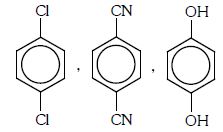
Identify the option$(s)$ which contain correct statements.
A
Dipole moment of all the three compounds will be zero.
B
Among $HF, HCl, HBr$ and $HI$,$HCl$ will have the least bond energy.
C
$NaHCO_3$ has no $H$-bonding.
D
The order of bond strength of $\sigma$ bond will be $1s-1s > 1s-2p_x > 2p_x-2p_x$.
Solution
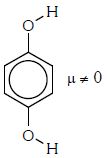
(D) Incorrect: The dipole moment of $p$-dichlorobenzene and $p$-dicyanobenzene is zero,but for hydroquinone ($p$-dihydroxybenzene),the dipole moment is not zero due to the orientation of the $-OH$ groups.
$(B)$ Incorrect: Bond energy decreases down the group as the size of the halogen atom increases. Thus,$HI$ has the least bond energy.
$(C)$ Incorrect: In $NaHCO_3$,$HCO_3^-$ ions are linked by intermolecular hydrogen bonding.
$(D)$ Correct: The strength of a $\sigma$ bond depends on the extent of overlap. The $1s-1s$ overlap is the strongest due to the small size of the $1s$ orbital,followed by $1s-2p_x$,and $2p_x-2p_x$ is the weakest among these.
$(B)$ Incorrect: Bond energy decreases down the group as the size of the halogen atom increases. Thus,$HI$ has the least bond energy.
$(C)$ Incorrect: In $NaHCO_3$,$HCO_3^-$ ions are linked by intermolecular hydrogen bonding.
$(D)$ Correct: The strength of a $\sigma$ bond depends on the extent of overlap. The $1s-1s$ overlap is the strongest due to the small size of the $1s$ orbital,followed by $1s-2p_x$,and $2p_x-2p_x$ is the weakest among these.
0 likes
View Solution93
MediumMCQ
$XeF_4$ has a total of $36$ valence electrons. Select the correct statement regarding the use of valence electrons in $XeF_4$.
A
$8$ valence electrons are used to form $Xe-F$ bonds.
B
$24$ valence electrons are used to form lone pairs on $F$ atoms.
C
$4$ valence electrons are used to form two lone pairs on $Xe$.
D
All of the above.
Solution
(D) The total number of valence electrons in $XeF_4$ is calculated as: $8$ (from $Xe$) $+ 4 \times 7$ (from $4F$) $= 36$ electrons.
In the $XeF_4$ molecule,there are $4$ $Xe-F$ bonds,which consume $4 \times 2 = 8$ electrons.
Each of the $4$ fluorine atoms has $3$ lone pairs,totaling $4 \times 3 \times 2 = 24$ electrons.
The central $Xe$ atom has $2$ lone pairs,which consume $2 \times 2 = 4$ electrons.
Summing these: $8 + 24 + 4 = 36$ electrons.
Therefore,all statements are correct.
In the $XeF_4$ molecule,there are $4$ $Xe-F$ bonds,which consume $4 \times 2 = 8$ electrons.
Each of the $4$ fluorine atoms has $3$ lone pairs,totaling $4 \times 3 \times 2 = 24$ electrons.
The central $Xe$ atom has $2$ lone pairs,which consume $2 \times 2 = 4$ electrons.
Summing these: $8 + 24 + 4 = 36$ electrons.
Therefore,all statements are correct.
0 likes
View Solution94
DifficultMCQ
Consider the following molecules: $(I)$ $POF_3$,$(II)$ $SOF_4$,$(III)$ $IOF_5$. On moving from $(I)$ to $(III)$,which of the following changes is $NOT$ observed?
A
Number of $d-$orbitals involved in bonding: $(I)$ One $\to$ $(II)$ Two $\to$ $(III)$ Three
B
Number of orbitals involved in hybridization: $(I)$ Four $\to$ $(II)$ Five $\to$ $(III)$ Six
C
Number of $d\pi - p\pi$ bonds in the respective molecule: $(I)$ One $\to$ $(II)$ Two $\to$ $(III)$ Three
D
Number of lone pairs on the central atom: $(I)$ Zero $\to$ $(II)$ Zero $\to$ $(III)$ Zero
Solution
(C) $1$. Analyze the structures:
$(I)$ $POF_3$: $P$ is $sp^3$ hybridized ($4$ orbitals). $P$ has $1$ $d\pi - p\pi$ bond with $O$. $P$ has $0$ lone pairs.
$(II)$ $SOF_4$: $S$ is $sp^3d$ hybridized ($5$ orbitals). $S$ has $1$ $d\pi - p\pi$ bond with $O$. $S$ has $0$ lone pairs.
$(III)$ $IOF_5$: $I$ is $sp^3d^2$ hybridized ($6$ orbitals). $I$ has $1$ $d\pi - p\pi$ bond with $O$. $I$ has $0$ lone pairs.
$2$. Evaluate the options:
- Option $(A)$: $d-$orbitals involved: $P$ $(3d^1)$,$S$ $(3d^1)$,$I$ $(5d^1)$. This is incorrect as the number of $d-$orbitals involved in $\pi$ bonding remains $1$ for all.
- Option $(B)$: Hybridization orbitals: $4 \to 5 \to 6$ is correct $(sp^3, sp^3d, sp^3d^2)$.
- Option $(C)$: Number of $d\pi - p\pi$ bonds: All have $1$ $d\pi - p\pi$ bond. The sequence $1 \to 2 \to 3$ is $NOT$ observed.
- Option $(D)$: Lone pairs: All have $0$ lone pairs. This is observed.
$3$. Since both $(A)$ and $(C)$ describe changes that are not observed,and $(C)$ is a more direct contradiction to the bonding pattern,$(C)$ is the intended answer.
$(I)$ $POF_3$: $P$ is $sp^3$ hybridized ($4$ orbitals). $P$ has $1$ $d\pi - p\pi$ bond with $O$. $P$ has $0$ lone pairs.
$(II)$ $SOF_4$: $S$ is $sp^3d$ hybridized ($5$ orbitals). $S$ has $1$ $d\pi - p\pi$ bond with $O$. $S$ has $0$ lone pairs.
$(III)$ $IOF_5$: $I$ is $sp^3d^2$ hybridized ($6$ orbitals). $I$ has $1$ $d\pi - p\pi$ bond with $O$. $I$ has $0$ lone pairs.
$2$. Evaluate the options:
- Option $(A)$: $d-$orbitals involved: $P$ $(3d^1)$,$S$ $(3d^1)$,$I$ $(5d^1)$. This is incorrect as the number of $d-$orbitals involved in $\pi$ bonding remains $1$ for all.
- Option $(B)$: Hybridization orbitals: $4 \to 5 \to 6$ is correct $(sp^3, sp^3d, sp^3d^2)$.
- Option $(C)$: Number of $d\pi - p\pi$ bonds: All have $1$ $d\pi - p\pi$ bond. The sequence $1 \to 2 \to 3$ is $NOT$ observed.
- Option $(D)$: Lone pairs: All have $0$ lone pairs. This is observed.
$3$. Since both $(A)$ and $(C)$ describe changes that are not observed,and $(C)$ is a more direct contradiction to the bonding pattern,$(C)$ is the intended answer.
0 likes
View Solution95
EasyMCQ
Which one of the following is different from others with respect to hydrolysis?
A
$CCl_4$
B
$NF_3$
C
$BF_3$
D
$SF_6$
Solution
(C) Hydrolysis of a compound depends on the presence of vacant $d$-orbitals or the ability to expand the octet.
$CCl_4$ does not undergo hydrolysis because carbon lacks vacant $d$-orbitals and is sterically hindered.
$NF_3$ does not undergo hydrolysis because nitrogen lacks vacant $d$-orbitals and the $N-F$ bond is very strong.
$SF_6$ does not undergo hydrolysis due to steric hindrance by six fluorine atoms around the sulfur atom,which prevents the attack of water molecules.
$BF_3$ undergoes hydrolysis to form $H_3BO_3$ and $HBF_4$ because boron has a vacant $p$-orbital and can accept a lone pair from water.
Therefore,$BF_3$ is different from the others as it readily undergoes hydrolysis.
$CCl_4$ does not undergo hydrolysis because carbon lacks vacant $d$-orbitals and is sterically hindered.
$NF_3$ does not undergo hydrolysis because nitrogen lacks vacant $d$-orbitals and the $N-F$ bond is very strong.
$SF_6$ does not undergo hydrolysis due to steric hindrance by six fluorine atoms around the sulfur atom,which prevents the attack of water molecules.
$BF_3$ undergoes hydrolysis to form $H_3BO_3$ and $HBF_4$ because boron has a vacant $p$-orbital and can accept a lone pair from water.
Therefore,$BF_3$ is different from the others as it readily undergoes hydrolysis.
0 likes
View Solution96
DifficultMCQ
Match the following columns:
| Column-$I$ | Column-$II$ |
| $(P)$ $\underline PCl_5 \to PCl_3 + Cl_2$ | $(i)$ Change in hybridisation |
| $(Q)$ $\underline SO_3 \to \underline SO_2 + \frac{1}{2}O_2$ | $(ii)$ Change in bond angle |
| $(R)$ $\underline NH_3 + H^{+} \to \underline NH_4^+$ | $(iii)$ Change in shape |
| $(S)$ $H_2\underline O + H^{+} \to H_3\underline O^{+}$ | $(iv)$ Change in oxidation state |
A
$(P) \to i, ii, iii, iv; (Q) \to ii, iii, iv; (R) \to ii, iii; (S) \to ii, iii$
B
$(P) \to i, iv; (Q) \to ii, iv; (R) \to i, iv; (S) \to ii, iii, iv$
C
$(P) \to i, ii, iii, iv; (Q) \to ii, iii, iv; (R) \to ii, iii, iv; (S) \to ii, iii, iv$
D
$(P) \to i, iii; (Q) \to ii, iv; (R) \to ii, iii; (S) \to ii, iii$
Solution
(A) $(P)$ In $PCl_5 \to PCl_3 + Cl_2$: $P$ in $PCl_5$ is $sp^3d$ (Trigonal bipyramidal,$+5$ state) and $P$ in $PCl_3$ is $sp^3$ (Pyramidal,$+3$ state). Changes: $(i), (ii), (iii), (iv)$.
$(Q)$ In $SO_3 \to SO_2 + \frac{1}{2}O_2$: $S$ in $SO_3$ is $sp^2$ (Trigonal planar,$+6$ state) and $S$ in $SO_2$ is $sp^2$ (Bent,$+4$ state). Changes: $(ii), (iii), (iv)$. (Hybridisation remains $sp^2$).
$(R)$ In $NH_3 + H^{+} \to NH_4^+$: $N$ in $NH_3$ is $sp^3$ (Pyramidal,$-3$ state) and $N$ in $NH_4^+$ is $sp^3$ (Tetrahedral,$-3$ state). Changes: $(ii), (iii)$.
$(S)$ In $H_2O + H^{+} \to H_3O^{+}$: $O$ in $H_2O$ is $sp^3$ (Bent,$-2$ state) and $O$ in $H_3O^{+}$ is $sp^3$ (Pyramidal,$-2$ state). Changes: $(ii), (iii)$.
$(Q)$ In $SO_3 \to SO_2 + \frac{1}{2}O_2$: $S$ in $SO_3$ is $sp^2$ (Trigonal planar,$+6$ state) and $S$ in $SO_2$ is $sp^2$ (Bent,$+4$ state). Changes: $(ii), (iii), (iv)$. (Hybridisation remains $sp^2$).
$(R)$ In $NH_3 + H^{+} \to NH_4^+$: $N$ in $NH_3$ is $sp^3$ (Pyramidal,$-3$ state) and $N$ in $NH_4^+$ is $sp^3$ (Tetrahedral,$-3$ state). Changes: $(ii), (iii)$.
$(S)$ In $H_2O + H^{+} \to H_3O^{+}$: $O$ in $H_2O$ is $sp^3$ (Bent,$-2$ state) and $O$ in $H_3O^{+}$ is $sp^3$ (Pyramidal,$-2$ state). Changes: $(ii), (iii)$.
0 likes
View Solution97
MediumMCQ
Select the hybridisation which has non-planar geometry when all are bond pairs,but planar when there are $2$ lone pairs on the central atom:
A
$sp^3$
B
$sp^3d$
C
$sp^3d^2$
D
All of the above
Solution
(D) For $sp^3$ hybridisation: When all are bond pairs,the geometry is tetrahedral (non-planar). When there are $2$ lone pairs,the shape is bent (planar).
For $sp^3d$ hybridisation: When all are bond pairs,the geometry is trigonal bipyramidal (non-planar). When there are $2$ lone pairs,the shape is $T$-shaped (planar).
For $sp^3d^2$ hybridisation: When all are bond pairs,the geometry is octahedral (non-planar). When there are $2$ lone pairs,the shape is square planar (planar).
Since all given hybridisations satisfy the condition,the correct answer is $D$.
For $sp^3d$ hybridisation: When all are bond pairs,the geometry is trigonal bipyramidal (non-planar). When there are $2$ lone pairs,the shape is $T$-shaped (planar).
For $sp^3d^2$ hybridisation: When all are bond pairs,the geometry is octahedral (non-planar). When there are $2$ lone pairs,the shape is square planar (planar).
Since all given hybridisations satisfy the condition,the correct answer is $D$.
0 likes
View Solution98
AdvancedMCQ
How many $S-S$ bonds,$S-O-S$ bonds,$\sigma$ bonds,and $\pi$ bonds are present in the trimer of $SO_3$?
A
$0, 3, 16, 2$
B
$0, 3, 12, 6$
C
$0, 6, 12, 16$
D
$0, 4, 12, 6$
Solution
(B) The trimer of $SO_3$ is $(SO_3)_3$,which is cyclic $S_3O_9$.
In this structure,there are $3$ $S-O-S$ linkages forming the ring.
There are no $S-S$ bonds.
Each $S$ atom is bonded to two terminal $O$ atoms via double bonds $(S=O)$ and two bridging $O$ atoms via single bonds $(S-O-S)$.
Total $\sigma$ bonds: $3$ ($S-O-S$ ring) + $6$ ($S=O$ double bonds) + $6$ ($S-O$ single bonds) = $15$ $\sigma$ bonds. Wait,let's recount: There are $3$ $S-O-S$ linkages (each has $2$ $\sigma$ bonds,total $6$ $\sigma$ bonds). Each $S$ atom has $2$ terminal $O$ atoms,each with $1$ $\sigma$ and $1$ $\pi$ bond. So $3$ $S$ atoms $\times$ $2$ terminal $O$ atoms = $6$ $\sigma$ bonds and $6$ $\pi$ bonds. Total $\sigma$ bonds = $6$ (ring) + $6$ (terminal) = $12$. Total $\pi$ bonds = $6$.
Thus,the counts are: $S-S$ bonds = $0$,$S-O-S$ bonds = $3$,$\sigma$ bonds = $12$,$\pi$ bonds = $6$.
In this structure,there are $3$ $S-O-S$ linkages forming the ring.
There are no $S-S$ bonds.
Each $S$ atom is bonded to two terminal $O$ atoms via double bonds $(S=O)$ and two bridging $O$ atoms via single bonds $(S-O-S)$.
Total $\sigma$ bonds: $3$ ($S-O-S$ ring) + $6$ ($S=O$ double bonds) + $6$ ($S-O$ single bonds) = $15$ $\sigma$ bonds. Wait,let's recount: There are $3$ $S-O-S$ linkages (each has $2$ $\sigma$ bonds,total $6$ $\sigma$ bonds). Each $S$ atom has $2$ terminal $O$ atoms,each with $1$ $\sigma$ and $1$ $\pi$ bond. So $3$ $S$ atoms $\times$ $2$ terminal $O$ atoms = $6$ $\sigma$ bonds and $6$ $\pi$ bonds. Total $\sigma$ bonds = $6$ (ring) + $6$ (terminal) = $12$. Total $\pi$ bonds = $6$.
Thus,the counts are: $S-S$ bonds = $0$,$S-O-S$ bonds = $3$,$\sigma$ bonds = $12$,$\pi$ bonds = $6$.
0 likes
View Solution99
DifficultMCQ
Total number of compounds / ions which have at least two bond lengths same out of $CO_3^{2-}, HCOOH, S_2O_3^{2-}, NO_2^{-}$
A
$2$
B
$4$
C
$3$
D
$1$
Solution
(C) $1$. $CO_3^{2-}$: It has resonance,so all three $C-O$ bond lengths are equal. Thus,at least two are same. (Yes)
$2$. $HCOOH$: It has one $C=O$ bond and one $C-OH$ bond. The bond lengths are different. However,in the resonance hybrid,the $C-O$ bonds have partial double bond character,but they are not identical to each other. (No)
$3$. $S_2O_3^{2-}$: The structure has two types of $S-O$ bonds: two terminal $S=O$ bonds and two $S-O$ single bonds. The two $S=O$ bonds are equivalent,and the two $S-O$ bonds are equivalent. Thus,at least two bond lengths are same. (Yes)
$4$. $NO_2^{-}$: It has resonance,so both $N-O$ bond lengths are equal. Thus,at least two are same. (Yes)
Therefore,$CO_3^{2-}, S_2O_3^{2-}$,and $NO_2^{-}$ satisfy the condition. The total count is $3$.
$2$. $HCOOH$: It has one $C=O$ bond and one $C-OH$ bond. The bond lengths are different. However,in the resonance hybrid,the $C-O$ bonds have partial double bond character,but they are not identical to each other. (No)
$3$. $S_2O_3^{2-}$: The structure has two types of $S-O$ bonds: two terminal $S=O$ bonds and two $S-O$ single bonds. The two $S=O$ bonds are equivalent,and the two $S-O$ bonds are equivalent. Thus,at least two bond lengths are same. (Yes)
$4$. $NO_2^{-}$: It has resonance,so both $N-O$ bond lengths are equal. Thus,at least two are same. (Yes)
Therefore,$CO_3^{2-}, S_2O_3^{2-}$,and $NO_2^{-}$ satisfy the condition. The total count is $3$.
0 likes
View SolutionChemical Bonding and Molecular Structure — Mix Examples-Chemical Bonding · Frequently Asked Questions
1Are these Chemical Bonding and Molecular Structure questions useful for JEE and NEET?
Yes. All questions in this section are mapped to JEE Main and NEET exam patterns. Previous year questions from JEE Main, NEET, GUJCET and state-level exams are included with full solutions.
2Can I switch to Hindi or Gujarati for these questions?
Yes. Use the language tabs in the hero section or the sidebar to view the same questions and solutions in English, Hindi or Gujarati.
3How do I generate a question paper from this subtopic?
Use the Vedclass Exam Paper Generator — select the chapter and subtopic, set difficulty, and generate Sets A, B, C, D automatically. First 3 chapters of every subject are free.
Vedclass Products
For Students
Vedclass Test Series
Mock tests in real JEE/NEET style with performance analysis. 5-day free trial.
Start Free TrialFor Teachers
Exam Paper Generator
Generate Set A/B/C/D papers from this chapter in 2 minutes. 3 chapters free.
Try FreeFor Institutes
Online Exam Module
Live online exams with unlimited students, 360° analytics & white-label branding.
See DemoFor Teachers & Institutes
Generate a Chemical Bonding and Molecular Structure Exam Paper in 2 Minutes
Select subtopic & difficulty — Sets A, B, C, D auto-generated with No Repeat logic.
First 3 chapters of every subject are free — no payment required.