
A English
Covalent bonding Questions in English
Class 11 Chemistry · Chemical Bonding and Molecular Structure · Covalent bonding
244+
Questions
English
Language
100%
With Solutions
Showing 50 of 244 questions in English
51
EasyMCQ
The total number of electrons that take part in forming bonds in $N_2$ is
A
$2$
B
$4$
C
$6$
D
$10$
Solution
(C) The nitrogen molecule $(N_2)$ consists of two nitrogen atoms connected by a triple bond $(N \equiv N)$.
$A$ triple bond consists of one sigma $(\sigma)$ bond and two pi $(\pi)$ bonds.
Each bond represents a shared pair of electrons,meaning $3 \times 2 = 6$ electrons are involved in the bonding process.
$A$ triple bond consists of one sigma $(\sigma)$ bond and two pi $(\pi)$ bonds.
Each bond represents a shared pair of electrons,meaning $3 \times 2 = 6$ electrons are involved in the bonding process.
0 likes
View Solution52
EasyMCQ
Which of the following has the highest bond energy?
A
$F_2$
B
$Cl_2$
C
$Br_2$
D
$I_2$
Solution
(B) The bond dissociation energy of halogens follows the order: $Cl_2 > Br_2 > F_2 > I_2$.
In $F_2$,the interelectronic repulsion between the lone pairs of the small $F$ atoms is very high,which weakens the $F-F$ bond.
Therefore,$Cl_2$ has the highest bond energy among the given halogens.
In $F_2$,the interelectronic repulsion between the lone pairs of the small $F$ atoms is very high,which weakens the $F-F$ bond.
Therefore,$Cl_2$ has the highest bond energy among the given halogens.
0 likes
View Solution53
MediumMCQ
Which can be described as a molecule with residual bonding capacity?
A
$BeCl_2$
B
$NaCl$
C
$CH_4$
D
$N_2$
Solution
(A) At room temperature,$BeCl_2$ exists as a dimer $(Be_2Cl_4)$ or polymer in the solid state.
It has residual bonding capacity because the $Be$ atom is electron-deficient (incomplete octet) and can accept electron pairs from other molecules to form coordinate bonds,thereby attaining further stability.
It has residual bonding capacity because the $Be$ atom is electron-deficient (incomplete octet) and can accept electron pairs from other molecules to form coordinate bonds,thereby attaining further stability.
0 likes
View Solution54
MediumMCQ
What will happen if $CCl_4$ is treated with $AgNO_3$?
A
$A$. $A$ white precipitate of $AgCl$ will form
B
$B$. $NO_2$ gas will be evolved
C
$C$. $CCl_4$ will dissolve in $AgNO_3$
D
$D$. Nothing will happen
Solution
(D) $CCl_4$ is a covalent compound and does not ionize to provide $Cl^-$ ions in the solution.
Since $AgNO_3$ reacts with free $Cl^-$ ions to form a white precipitate of $AgCl$,no reaction occurs between $CCl_4$ and $AgNO_3$.
Therefore,the correct answer is $D$.
Since $AgNO_3$ reacts with free $Cl^-$ ions to form a white precipitate of $AgCl$,no reaction occurs between $CCl_4$ and $AgNO_3$.
Therefore,the correct answer is $D$.
0 likes
View Solution55
MediumMCQ
Which one of the following compounds is a Lewis acid?
A
$PCl_3$
B
$BCl_3$
C
$NCl_3$
D
Both $(a)$ and $(b)$
Solution
(B) Lewis acid is defined as an electron-pair acceptor.
$BCl_3$ has an incomplete octet on the central Boron atom (only $6$ electrons),making it an electron-deficient species and a strong Lewis acid.
$PCl_3$ has a lone pair on the Phosphorus atom,which can be donated,making it a Lewis base.
$NCl_3$ also has a lone pair on the Nitrogen atom,making it a Lewis base.
Therefore,only $BCl_3$ acts as a Lewis acid.
$BCl_3$ has an incomplete octet on the central Boron atom (only $6$ electrons),making it an electron-deficient species and a strong Lewis acid.
$PCl_3$ has a lone pair on the Phosphorus atom,which can be donated,making it a Lewis base.
$NCl_3$ also has a lone pair on the Nitrogen atom,making it a Lewis base.
Therefore,only $BCl_3$ acts as a Lewis acid.
0 likes
View Solution56
EasyMCQ
Which of the following will have the highest bond energy?
A
$F_2$
B
$Cl_2$
C
$Br_2$
D
$I_2$
Solution
(B) The bond energy of halogens is influenced by the small size of the fluorine atom,which leads to significant inter-electronic repulsion between the lone pairs of the two fluorine atoms.
This makes the $F-F$ bond weaker than the $Cl-Cl$ bond.
The general order of bond dissociation energy for halogens is $Cl_2 > Br_2 > F_2 > I_2$.
Therefore,$Cl_2$ has the highest bond energy.
This makes the $F-F$ bond weaker than the $Cl-Cl$ bond.
The general order of bond dissociation energy for halogens is $Cl_2 > Br_2 > F_2 > I_2$.
Therefore,$Cl_2$ has the highest bond energy.
0 likes
View Solution57
MediumMCQ
Which of the following is an electron-deficient molecule?
A
$B_2H_6$
B
$C_2H_6$
C
$PH_3$
D
$SiH_4$
Solution
(A) An electron-deficient molecule is one in which the central atom has fewer than $8$ electrons in its valence shell,or it lacks sufficient electrons to form conventional covalent bonds.
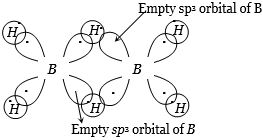
In $B_2H_6$ (diborane),each boron atom is bonded to four hydrogen atoms,but there are only $12$ valence electrons available for the entire molecule,which is insufficient to form standard two-center-two-electron $(2c-2e)$ bonds for all linkages.
It contains two $3$-center-$2$-electron $(3c-2e)$ bonds,also known as banana bonds,making it an electron-deficient molecule.
In contrast,$C_2H_6$,$PH_3$,and $SiH_4$ are electron-precise molecules where the octet rule is satisfied for the central atoms.
In $B_2H_6$ (diborane),each boron atom is bonded to four hydrogen atoms,but there are only $12$ valence electrons available for the entire molecule,which is insufficient to form standard two-center-two-electron $(2c-2e)$ bonds for all linkages.
It contains two $3$-center-$2$-electron $(3c-2e)$ bonds,also known as banana bonds,making it an electron-deficient molecule.
In contrast,$C_2H_6$,$PH_3$,and $SiH_4$ are electron-precise molecules where the octet rule is satisfied for the central atoms.
0 likes
View Solution58
MediumMCQ
Which of the following has the least covalent $P-H$ bond?
A
$PH_3$
B
$P_2H_6$
C
$P_2H_5$
D
$PH_6^+$
Solution
(D) In $PH_6^+$,the phosphorus atom carries a positive charge,which increases its electronegativity and electron-attracting tendency.
This results in a higher degree of ionic character in the $P-H$ bond compared to the other neutral phosphine species.
Therefore,$PH_6^+$ has the least covalent $P-H$ bond.
This results in a higher degree of ionic character in the $P-H$ bond compared to the other neutral phosphine species.
Therefore,$PH_6^+$ has the least covalent $P-H$ bond.
0 likes
View Solution59
MediumMCQ
Which of the following bonds has the highest bond energy?
A
$Se-Se$
B
$Te-Te$
C
$S-S$
D
$O-O$
Solution
(C) The bond energy depends on the size of the atoms and the extent of orbital overlap. $O-O$ bond has the lowest bond energy due to high inter-electronic repulsion between the lone pairs of small oxygen atoms. As we move down the group,the atomic size increases,which decreases the bond energy. However,the $S-S$ bond is stronger than $Se-Se$ and $Te-Te$ due to better orbital overlap compared to the larger atoms. Therefore,among the given options,the $S-S$ bond has the highest bond energy.
0 likes
View Solution60
EasyMCQ
The type of bonding in $HCl$ molecule is
A
Pure covalent
B
Polar covalent
C
Highly covalent
D
$H$-bonding
Solution
(B) In an $HCl$ molecule,the electronegativity difference between $H$ $(2.1)$ and $Cl$ $(3.0)$ is approximately $0.9$.
Because the electronegativity difference is greater than $0$ but less than $1.7$,the bond formed is a polar covalent bond,where the shared pair of electrons is shifted towards the more electronegative chlorine atom.
Because the electronegativity difference is greater than $0$ but less than $1.7$,the bond formed is a polar covalent bond,where the shared pair of electrons is shifted towards the more electronegative chlorine atom.
0 likes
View Solution61
MediumMCQ
The correct order of bond length is:
A
$C-C < C=C < C\equiv C$
B
$C\equiv C < C=C < C-C$
C
$C=C < C\equiv C < C-C$
D
$C=C < C-C < C\equiv C$
Solution
(B) The bond length decreases as the bond order increases.
The bond lengths are:
$C-C$ (single bond) = $1.54 \ \mathring{A}$
$C=C$ (double bond) = $1.34 \ \mathring{A}$
$C\equiv C$ (triple bond) = $1.20 \ \mathring{A}$
Therefore,the correct order of increasing bond length is $C\equiv C < C=C < C-C$.
The bond lengths are:
$C-C$ (single bond) = $1.54 \ \mathring{A}$
$C=C$ (double bond) = $1.34 \ \mathring{A}$
$C\equiv C$ (triple bond) = $1.20 \ \mathring{A}$
Therefore,the correct order of increasing bond length is $C\equiv C < C=C < C-C$.
0 likes
View Solution62
MediumMCQ
Anhydrous $AlCl_3$ is used in the Friedel-Crafts reaction because it is
A
Electron rich
B
Soluble in ether
C
Insoluble to chloride and aluminium ions
D
Electron deficient
Solution
(D) Anhydrous $AlCl_3$ acts as a Lewis acid because it is an electron-deficient compound.
In the Friedel-Crafts reaction,it reacts with the alkyl halide to generate a carbocation (electrophile).
The reaction is: $CH_3Cl + AlCl_3 \to CH_3^+ + AlCl_4^-$
In the Friedel-Crafts reaction,it reacts with the alkyl halide to generate a carbocation (electrophile).
The reaction is: $CH_3Cl + AlCl_3 \to CH_3^+ + AlCl_4^-$
0 likes
View Solution63
MediumMCQ
What happens when naphthalene balls are put inside kerosene?
A
Precipitates
B
Dissolves upon heating
C
Dissolves easily
D
Does not dissolve
Solution
(C) Covalent compounds dissolve in non-polar solvents,while ionic compounds dissolve in polar solvents.
Naphthalene $(C_{10}H_8)$ is a non-polar covalent compound,and kerosene is a non-polar solvent.
According to the principle of 'like dissolves like',non-polar solutes dissolve in non-polar solvents. Therefore,naphthalene dissolves easily in kerosene.
Naphthalene $(C_{10}H_8)$ is a non-polar covalent compound,and kerosene is a non-polar solvent.
According to the principle of 'like dissolves like',non-polar solutes dissolve in non-polar solvents. Therefore,naphthalene dissolves easily in kerosene.
0 likes
View Solution64
MediumMCQ
In graphite,carbon atoms are joined together due to
A
Ionic bonding
B
Vander Waal's forces
C
Metallic bonding
D
Covalent bonding
Solution
(D) . In graphite,each carbon atom is $sp^2$ hybridized and is covalently bonded to three other carbon atoms in the same layer to form a hexagonal network. The layers are held together by weak Vander Waal's forces,but the atoms within the layers are joined by covalent bonding.
0 likes
View Solution65
DifficultMCQ
$CCl_4$ cannot give a precipitate with $AgNO_3$ due to:
A
Formation of a complex with $AgNO_3$
B
Evolution of $Cl_2$ gas
C
Chloride ion is not formed
D
$AgNO_3$ does not give silver ion
Solution
(C) $CCl_4$ is a covalent compound.
It does not ionize in water to produce $Cl^-$ ions.
Since $AgNO_3$ reacts with $Cl^-$ ions to form a white precipitate of $AgCl$,the absence of $Cl^-$ ions means no precipitate is formed.
$CCl_4 + AgNO_3 \to \text{No reaction}$
It does not ionize in water to produce $Cl^-$ ions.
Since $AgNO_3$ reacts with $Cl^-$ ions to form a white precipitate of $AgCl$,the absence of $Cl^-$ ions means no precipitate is formed.
$CCl_4 + AgNO_3 \to \text{No reaction}$
0 likes
View Solution66
EasyMCQ
Which of the following statements is incorrect regarding the $B-F$ bond in $BF_{3}$?
A
All three $B-F$ bond lengths are equal and each is shorter than the sum of the covalent radii of boron and fluorine.
B
The bond energy of the $B-F$ bond is very high,higher than that of any other single bond.
C
The unusual shortness and strength of the $B-F$ bond cannot be explained by $p\pi-p\pi$ interaction between boron and fluorine.
D
The unusual shortness and strength of the $B-F$ bond can be explained by $p\pi-p\pi$ interaction between boron and fluorine.
Solution
(C) In $BF_{3}$,the boron atom is $sp^{2}$ hybridized and has an empty $p$-orbital.
Fluorine atoms have lone pairs in their $2p$-orbitals.
There is a back-bonding effect where fluorine donates electron density into the empty $p$-orbital of boron,creating a $p\pi-p\pi$ bond.
This back-bonding gives the $B-F$ bond partial double bond character,making it shorter and stronger than a typical single bond.
Therefore,the statement that this interaction cannot explain the shortness and strength of the bond is incorrect.
Fluorine atoms have lone pairs in their $2p$-orbitals.
There is a back-bonding effect where fluorine donates electron density into the empty $p$-orbital of boron,creating a $p\pi-p\pi$ bond.
This back-bonding gives the $B-F$ bond partial double bond character,making it shorter and stronger than a typical single bond.
Therefore,the statement that this interaction cannot explain the shortness and strength of the bond is incorrect.
0 likes
View Solution67
EasyMCQ
$BCl_3$ does not exist as a dimer,whereas $BH_3$ exists as a dimer $(B_2H_6)$ because ....
A
Chlorine is more electronegative than hydrogen.
B
$BCl_3$ has $p\pi - p\pi$ back bonding,but $BH_3$ does not have such multiple bonding.
C
Large chlorine atoms do not fit between small boron atoms,whereas small hydrogen atoms fit between boron atoms.
D
None of these.
Solution
(B) In $BCl_3$,the boron atom has an empty $p$-orbital and chlorine has lone pairs of electrons. This leads to $p\pi - p\pi$ back bonding,which reduces the electron deficiency of the boron atom and stabilizes the monomeric form.
In $BH_3$,there is no such back bonding because hydrogen does not have lone pairs. To complete its octet and achieve stability,$BH_3$ undergoes dimerization to form $B_2H_6$ (diborane),which involves $3c-2e^-$ (three-center two-electron) bonds.
In $BH_3$,there is no such back bonding because hydrogen does not have lone pairs. To complete its octet and achieve stability,$BH_3$ undergoes dimerization to form $B_2H_6$ (diborane),which involves $3c-2e^-$ (three-center two-electron) bonds.
0 likes
View Solution68
EasyMCQ
Which of the following forces holds the carbon atoms together in diamond?
A
Ionic
B
Covalent
C
Dimolar
D
Van der Waals
Solution
(B) In diamond,each carbon atom is $sp^3$ hybridized and is bonded to four other carbon atoms through strong covalent bonds,forming a rigid three-dimensional network structure.
0 likes
View Solution69
EasyMCQ
Which of the following has the maximum bond dissociation energy?
A
$O - O$
B
$N - N$
C
$C - C$
D
$F - F$
Solution
(B) The bond dissociation energy of the $N - N$ bond is higher than that of $C - C$,$O - O$,and $F - F$ bonds due to the small size of nitrogen atoms and the presence of lone pair-lone pair repulsions in the other cases,although $N - N$ single bond is relatively weak compared to $N \equiv N$ triple bond,it is stronger than the $O - O$ and $F - F$ single bonds.
0 likes
View Solution70
EasyMCQ
Aluminum chloride $(AlCl_3)$ is a:
A
Brønsted-Lowry acid
B
Arrhenius acid
C
Lewis acid
D
Lewis base
Solution
(C) Aluminum chloride $(AlCl_3)$ has an incomplete octet around the central aluminum atom.
It has only $6$ electrons in its valence shell.
Therefore,it acts as an electron-pair acceptor.
According to the Lewis concept,a substance that accepts an electron pair is a Lewis acid.
It has only $6$ electrons in its valence shell.
Therefore,it acts as an electron-pair acceptor.
According to the Lewis concept,a substance that accepts an electron pair is a Lewis acid.
0 likes
View Solution71
EasyMCQ
What type of bonds exist between the two carbon atoms in calcium carbide?
A
One sigma and one pi bond
B
One sigma and two pi bonds
C
Two sigma and one pi bond
D
Two sigma and two pi bonds
Solution
(B) Calcium carbide $(CaC_2)$ is an ionic carbide containing the acetylide ion,$[C \equiv C]^{2-}$.
In the acetylide ion,the two carbon atoms are bonded by a triple bond.
$A$ triple bond consists of $1$ sigma $(\sigma)$ bond and $2$ pi $(\pi)$ bonds.
Therefore,the correct answer is $1$ sigma and $2$ pi bonds.
In the acetylide ion,the two carbon atoms are bonded by a triple bond.
$A$ triple bond consists of $1$ sigma $(\sigma)$ bond and $2$ pi $(\pi)$ bonds.
Therefore,the correct answer is $1$ sigma and $2$ pi bonds.
0 likes
View Solution72
EasyMCQ
How many electrons are shared between atoms in a double bond?
A
$2$
B
$4$
C
$1$
D
$6$
Solution
(B) single covalent bond involves the sharing of $2$ electrons.
Therefore,a double bond involves the sharing of $2 \times 2 = 4$ electrons.
Therefore,a double bond involves the sharing of $2 \times 2 = 4$ electrons.
0 likes
View Solution73
EasyMCQ
Which of the following bonds is present in hydrogen chloride $(HCl)$?
A
Covalent bond
B
Double bond
C
Coordinate covalent bond
D
Ionic bond
Solution
(A) The bond in $H-Cl$ is a polar covalent bond,formed by the sharing of electrons between $H$ and $Cl$ atoms.
0 likes
View Solution74
DifficultMCQ
It has been recently reported that carbon suboxide,$C_3O_2$,is present in the atmosphere of Venus. What is the correct Lewis structure of $C_3O_2$?
A
$:O=C=C=C=O:$
B
$:O=C=C=C=O:$
C
$:O=C=C=C=O:$
D
$:O-C-C-C-O:$
Solution
(A) The carbon suboxide molecule,$C_3O_2$,consists of a linear chain of three carbon atoms with two oxygen atoms attached to the terminal carbons.
Each carbon atom must satisfy the octet rule and form four bonds.
The structure is $O=C=C=C=O$,where each carbon atom is $sp$ hybridized.
Each carbon atom must satisfy the octet rule and form four bonds.
The structure is $O=C=C=C=O$,where each carbon atom is $sp$ hybridized.
0 likes
View Solution75
MediumMCQ
In which of the following is the maximum covalent character found between non-metallic elements?
A
Between atoms of the same size
B
Between chemically similar atoms
C
Between identical atoms
D
Between atoms with a large electronegativity difference
Solution
(C) The maximum covalent character is found between identical atoms.
This is because the electronegativity difference between two identical atoms is $0$,resulting in a purely non-polar covalent bond.
This is because the electronegativity difference between two identical atoms is $0$,resulting in a purely non-polar covalent bond.
0 likes
View Solution76
MediumMCQ
Covalent compounds are soluble in which of the following?
A
Polar solvents
B
All solvents
C
Concentrated acids
D
Non-polar solvents
Solution
(D) Covalent compounds are generally non-polar in nature. According to the principle of $ \text{'like dissolves like'} $,non-polar solutes dissolve in non-polar solvents.
0 likes
View Solution77
EasyMCQ
Which of the following is true for the pair of electrons in a bond between two identical non-metal atoms?
A
They are shared unequally between the two atoms.
B
They are completely transferred from one atom to another.
C
They have the same spin.
D
They are shared equally between the two atoms.
Solution
(D) In a bond between two identical atoms,the difference in electronegativity is zero. Therefore,the shared pair of electrons is distributed equally between them,resulting in a non-polar covalent bond.
0 likes
View Solution78
DifficultMCQ
When two atoms with electrons having the same spin approach each other for bonding,which of the following will occur?
A
Orbitals will not overlap.
B
Bonding will not be possible.
C
Both of the above are correct.
D
None of the above is correct.
Solution
(C) According to the valence bond theory,a covalent bond is formed by the overlapping of atomic orbitals containing electrons with opposite spins.
If the electrons have the same spin,the orbitals will not overlap effectively,and consequently,bonding will not be possible.
If the electrons have the same spin,the orbitals will not overlap effectively,and consequently,bonding will not be possible.
0 likes
View Solution79
EasyMCQ
Which of the following compounds is covalent?
A
$H_2$
B
$CaS$
C
$KCl$
D
$Na_2S$
Solution
(A) covalent bond is formed by the sharing of electrons between atoms of non-metals.
$H_2$ is a homonuclear diatomic molecule where two hydrogen atoms share a pair of electrons to form a covalent bond.
$CaS$,$KCl$,and $Na_2S$ are ionic compounds formed by the electrostatic attraction between metal cations and non-metal anions.
$H_2$ is a homonuclear diatomic molecule where two hydrogen atoms share a pair of electrons to form a covalent bond.
$CaS$,$KCl$,and $Na_2S$ are ionic compounds formed by the electrostatic attraction between metal cations and non-metal anions.
0 likes
View Solution80
EasyMCQ
Which of the following bonds requires the highest bond energy to dissociate the bonded atoms?
A
$H-H$ bond in $H_2$
B
$C-H$ bond in $CH_4$
C
$N \equiv N$ bond in $N_2$
D
$O=O$ bond in $O_2$
Solution
(C) The bond energy is directly proportional to the bond order (number of bonds between atoms).
$N_2$ has a triple bond $(N \equiv N)$,which has a bond order of $3$.
$O_2$ has a double bond $(O=O)$,which has a bond order of $2$.
$H_2$ has a single bond $(H-H)$,which has a bond order of $1$.
$CH_4$ involves $C-H$ single bonds.
Since $N \equiv N$ has the highest bond order,it requires the highest energy to dissociate.
$N_2$ has a triple bond $(N \equiv N)$,which has a bond order of $3$.
$O_2$ has a double bond $(O=O)$,which has a bond order of $2$.
$H_2$ has a single bond $(H-H)$,which has a bond order of $1$.
$CH_4$ involves $C-H$ single bonds.
Since $N \equiv N$ has the highest bond order,it requires the highest energy to dissociate.
0 likes
View Solution81
MediumMCQ
The internuclear distances in $H_2$ and $Cl_2$ molecules are $74 \, pm$ and $198 \, pm$ respectively. What will be the bond length of $HCl$ in $pm$?
A
$272$
B
$124$
C
$136$
D
$248$
Solution
(C) The bond length of a molecule $AB$ is given by the sum of the covalent radii of atoms $A$ and $B$,i.e.,$d_{AB} = r_A + r_B$.
For $H_2$,the internuclear distance is $74 \, pm$,so the covalent radius of $H$ is $r_H = \frac{74}{2} = 37 \, pm$.
For $Cl_2$,the internuclear distance is $198 \, pm$,so the covalent radius of $Cl$ is $r_{Cl} = \frac{198}{2} = 99 \, pm$.
Therefore,the bond length of $HCl$ is $d_{HCl} = r_H + r_{Cl} = 37 + 99 = 136 \, pm$.
For $H_2$,the internuclear distance is $74 \, pm$,so the covalent radius of $H$ is $r_H = \frac{74}{2} = 37 \, pm$.
For $Cl_2$,the internuclear distance is $198 \, pm$,so the covalent radius of $Cl$ is $r_{Cl} = \frac{198}{2} = 99 \, pm$.
Therefore,the bond length of $HCl$ is $d_{HCl} = r_H + r_{Cl} = 37 + 99 = 136 \, pm$.
0 likes
View Solution82
MediumMCQ
In which of the following molecules does the central atom not follow the octet rule?
A
$CO_2$
B
$BF_3$
C
$H_2O$
D
$PCl_3$
Solution
(B) The octet rule states that atoms tend to gain,lose,or share electrons to achieve a stable configuration of $8$ electrons in their valence shell.
In $BF_3$,the central Boron atom is bonded to $3$ Fluorine atoms.
Each $B-F$ bond consists of $2$ shared electrons,resulting in a total of $3 \times 2 = 6$ electrons in the valence shell of Boron.
Since $6 < 8$,the central Boron atom in $BF_3$ does not follow the octet rule (it is an electron-deficient molecule).
In $BF_3$,the central Boron atom is bonded to $3$ Fluorine atoms.
Each $B-F$ bond consists of $2$ shared electrons,resulting in a total of $3 \times 2 = 6$ electrons in the valence shell of Boron.
Since $6 < 8$,the central Boron atom in $BF_3$ does not follow the octet rule (it is an electron-deficient molecule).
0 likes
View Solution83
MediumMCQ
What is the correct order of bond strength?
A
$C-C < C=C < C \equiv C$
B
$C \equiv C < C=C < C-C$
C
$C=C < C \equiv C < C-C$
D
$C=C < C-C < C \equiv C$
Solution
(A) The bond strength is directly proportional to the bond order and the $s$-character of the hybrid orbitals involved in the bond formation.
For $C-C$ (alkane),the hybridization is $sp^3$ ($25\% \ s$-character).
For $C=C$ (alkene),the hybridization is $sp^2$ ($33.3\% \ s$-character).
For $C \equiv C$ (alkyne),the hybridization is $sp$ ($50\% \ s$-character).
As the $s$-character increases,the bond becomes shorter and stronger.
Therefore,the correct order of bond strength is $C-C < C=C < C \equiv C$.
For $C-C$ (alkane),the hybridization is $sp^3$ ($25\% \ s$-character).
For $C=C$ (alkene),the hybridization is $sp^2$ ($33.3\% \ s$-character).
For $C \equiv C$ (alkyne),the hybridization is $sp$ ($50\% \ s$-character).
As the $s$-character increases,the bond becomes shorter and stronger.
Therefore,the correct order of bond strength is $C-C < C=C < C \equiv C$.
0 likes
View Solution84
EasyMCQ
The octet rule is not followed in
A
$F_2$
B
$NaF$
C
$CaF_2$
D
$BF_3$
Solution
(D) In $BF_3$,the central boron atom is bonded to three fluorine atoms by single covalent bonds.
This results in a total of $6$ valence electrons around the boron atom.
Since the octet rule requires $8$ electrons for stability,$BF_3$ is an electron-deficient compound that does not follow the octet rule.
This results in a total of $6$ valence electrons around the boron atom.
Since the octet rule requires $8$ electrons for stability,$BF_3$ is an electron-deficient compound that does not follow the octet rule.
0 likes
View Solution85
MediumMCQ
$AlCl_3$,in reactions,acts as
A
Oxidizing agent
B
Reducing agent
C
Acid catalyst
D
None of these
Solution
(C) $AlCl_3$ is an electron-deficient compound with an incomplete octet of $Al$ atom.
It acts as a Lewis acid because it can accept a lone pair of electrons.
In many organic reactions,such as Friedel-Crafts reactions,it is used as an acid catalyst.
It acts as a Lewis acid because it can accept a lone pair of electrons.
In many organic reactions,such as Friedel-Crafts reactions,it is used as an acid catalyst.
0 likes
View Solution86
MediumMCQ
Which of the following molecules acts as a Lewis acid?
A
$(CH_3)_2O$
B
$(CH_3)_3P$
C
$(CH_3)_3N$
D
$(CH_3)_3B$
Solution
(D) Lewis acid is defined as an electron-pair acceptor.
In $(CH_3)_3B$,the central boron atom has only $6$ electrons in its valence shell,meaning it has an incomplete octet.
Therefore,it can accept a lone pair of electrons to complete its octet,acting as a Lewis acid.
In contrast,$(CH_3)_2O$,$(CH_3)_3P$,and $(CH_3)_3N$ all have central atoms with complete octets and at least one lone pair of electrons,which allows them to act as Lewis bases (electron-pair donors).
In $(CH_3)_3B$,the central boron atom has only $6$ electrons in its valence shell,meaning it has an incomplete octet.
Therefore,it can accept a lone pair of electrons to complete its octet,acting as a Lewis acid.
In contrast,$(CH_3)_2O$,$(CH_3)_3P$,and $(CH_3)_3N$ all have central atoms with complete octets and at least one lone pair of electrons,which allows them to act as Lewis bases (electron-pair donors).
0 likes
View Solution87
MediumMCQ
The bond dissociation energy of $B-F$ in $BF_3$ is $646 \ kJ \ mol^{-1}$ whereas that of $C-F$ in $CF_4$ is $515 \ kJ \ mol^{-1}.$ The correct reason for higher $B-F$ bond dissociation energy as compared to that of $C-F$ is
A
stronger $\sigma$ bond between $B$ and $F$ in $BF_3$ as compared to that between $C$ and $F$ in $CF_4.$
B
significant $p\pi - p\pi$ interaction between $B$ and $F$ in $BF_3$ whereas there is no possibility of such interaction between $C$ and $F$ in $CF_4.$
C
lower degree of $p\pi - p\pi$ interaction between $B$ and $F$ in $BF_3$ than that between $C$ and $F$ in $CF_4.$
D
smaller size of $B$ atom as compared to that of $C$ atom.
Solution
(B) $BF_3$ is a Lewis acid due to the incomplete octet of Boron.
In $BF_3$,the Boron atom has a vacant $2p$-orbital,and the Fluorine atom has lone pairs in its $2p$-orbital.
This allows for $p\pi - p\pi$ back-bonding from the Fluorine to the Boron,which increases the bond order and strengthens the $B-F$ bond.
In $CF_4$,the Carbon atom has a complete octet and no vacant orbitals,so no such back-bonding is possible.
Therefore,the $B-F$ bond in $BF_3$ is stronger than the $C-F$ bond in $CF_4$ due to this back-bonding interaction.
In $BF_3$,the Boron atom has a vacant $2p$-orbital,and the Fluorine atom has lone pairs in its $2p$-orbital.
This allows for $p\pi - p\pi$ back-bonding from the Fluorine to the Boron,which increases the bond order and strengthens the $B-F$ bond.
In $CF_4$,the Carbon atom has a complete octet and no vacant orbitals,so no such back-bonding is possible.
Therefore,the $B-F$ bond in $BF_3$ is stronger than the $C-F$ bond in $CF_4$ due to this back-bonding interaction.
0 likes
View Solution88
MediumMCQ
Which is true for $SF_6$?
A
$S$ : ground state,covalency $= 6$
B
$S$ : excited state,covalency $= 4$
C
$S$ : excited state,oxidation No. $= +6$
D
$S$ : ground state,oxidation No. $= +6$
Solution
(C) In $SF_6$,the central sulfur atom $(S)$ undergoes excitation to form six covalent bonds with fluorine atoms.
Ground state electronic configuration of $S$ is $[Ne] 3s^2 3p^4 3d^0$.
To form $6$ bonds,$S$ promotes electrons from $3s$ and $3p$ orbitals to the empty $3d$ orbitals.
This results in the $2^{nd}$ excited state configuration: $3s^1 3p^3 3d^2$.
Since it has $6$ unpaired electrons,its covalency is $6$.
The oxidation number of $S$ in $SF_6$ is calculated as: $x + 6(-1) = 0 \implies x = +6$.
Thus,$S$ is in an excited state and its oxidation number is $+6$.
Ground state electronic configuration of $S$ is $[Ne] 3s^2 3p^4 3d^0$.
To form $6$ bonds,$S$ promotes electrons from $3s$ and $3p$ orbitals to the empty $3d$ orbitals.
This results in the $2^{nd}$ excited state configuration: $3s^1 3p^3 3d^2$.
Since it has $6$ unpaired electrons,its covalency is $6$.
The oxidation number of $S$ in $SF_6$ is calculated as: $x + 6(-1) = 0 \implies x = +6$.
Thus,$S$ is in an excited state and its oxidation number is $+6$.
0 likes
View Solution89
AdvancedMCQ
Which of the following is the correct prediction about observed $B-X$ bond length in $BX_3$ molecules?
A
$B-F$ bond length in $BF_3$ is found to be less than the theoretical value because electronegativity values of $B$ $(2.04)$ and $F$ $(4.0)$ suggest the bond to be ionic,and hence the attraction between oppositely charged ions must decrease the bond length.
B
$BF_3$ and $[BF_4]^-$ have equal $B-F$ bond length.
C
The decrease in the $B-F$ bond length in $BF_3$ is due to delocalized $p\pi-p\pi$ bonding between the vacant $2p$-orbital of $B$ and the filled $2p$-orbital of $F$.
D
The correct $B-X$ bond length order is $B-F > B-Cl > B-Br > B-I$.
0 likes
View Solution90
DifficultMCQ
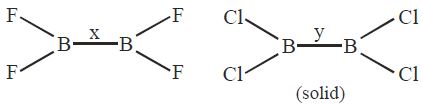
Compare the $B-B$ bond length in the following molecules:
A
$x > y$
B
$y > x$
C
$x = y$
D
None of these
Solution
(B) The molecules are $B_2F_4$ and $B_2Cl_4$. The bond length $y$ (in $B_2Cl_4$) is greater than the bond length $x$ (in $B_2F_4$).
Fluorine is more electronegative than chlorine. In $B_2F_4$, the $B-F$ bond is highly polar, which increases the $s$-character in the $B-B$ bond due to Bent's rule (electronegative atoms prefer orbitals with more $p$-character, leaving more $s$-character for the $B-B$ bond). Higher $s$-character leads to a shorter bond length.
Additionally, the back-bonding from $F$ to $B$ is more effective than from $Cl$ to $B$, which also influences the bond order and length. Experimental values confirm $x \approx 172 \ pm$ and $y \approx 175 \ pm$.
Therefore, $y > x$.
Fluorine is more electronegative than chlorine. In $B_2F_4$, the $B-F$ bond is highly polar, which increases the $s$-character in the $B-B$ bond due to Bent's rule (electronegative atoms prefer orbitals with more $p$-character, leaving more $s$-character for the $B-B$ bond). Higher $s$-character leads to a shorter bond length.
Additionally, the back-bonding from $F$ to $B$ is more effective than from $Cl$ to $B$, which also influences the bond order and length. Experimental values confirm $x \approx 172 \ pm$ and $y \approx 175 \ pm$.
Therefore, $y > x$.
0 likes
View Solution91
MediumMCQ
Which one of the following species does not exist?
A
$[CCl_6]^{2-}$
B
$[SiF_6]^{2-}$
C
$[GeF_6]^{2-}$
D
$[SnCl_6]^{2-}$
Solution
(A) Carbon belongs to the second period and has a maximum covalency of $4$ because it lacks $d$-orbitals in its valence shell.
Therefore,it cannot expand its octet to form a hexacoordinated species like $[CCl_6]^{2-}$.
Silicon,Germanium,and Tin belong to the third,fourth,and fifth periods respectively,and they possess vacant $d$-orbitals,allowing them to form stable octahedral complexes like $[SiF_6]^{2-}$,$[GeF_6]^{2-}$,and $[SnCl_6]^{2-}$.
Therefore,it cannot expand its octet to form a hexacoordinated species like $[CCl_6]^{2-}$.
Silicon,Germanium,and Tin belong to the third,fourth,and fifth periods respectively,and they possess vacant $d$-orbitals,allowing them to form stable octahedral complexes like $[SiF_6]^{2-}$,$[GeF_6]^{2-}$,and $[SnCl_6]^{2-}$.
0 likes
View Solution92
EasyMCQ
$BCl_3$ does not exist as a dimer,but $BH_3$ exists as a dimer $(B_2H_6)$ because:
A
Chlorine is more electronegative than hydrogen.
B
There is $p\pi - p\pi$ back bonding in $BCl_3$,but $BH_3$ does not contain such multiple bonding.
C
Large-sized chlorine atoms do not fit in between the small boron atoms,whereas small-sized hydrogen atoms get fitted between boron atoms.
D
None of these.
Solution
(C) In $BCl_3$,the large size of chlorine atoms creates steric hindrance,preventing the formation of a bridged dimer structure. Additionally,$p\pi - p\pi$ back bonding stabilizes the monomeric $BCl_3$ molecule.
In $BH_3$,the small size of hydrogen atoms allows them to easily fit between boron atoms to form the bridged structure $(B_2H_6)$,which is stabilized by $3c-2e$ (three-center two-electron) bonds.
In $BH_3$,the small size of hydrogen atoms allows them to easily fit between boron atoms to form the bridged structure $(B_2H_6)$,which is stabilized by $3c-2e$ (three-center two-electron) bonds.

0 likes
View Solution93
MediumMCQ
The structure of aluminium bromide is best represented as :
A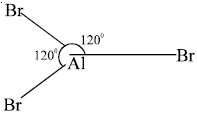
B
$[AlBr_2]^+ \, [AlBr_4]^-$
C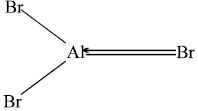
D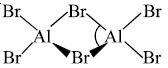
Solution
(D) Aluminium bromide $(AlBr_3)$ exists as a dimer,$Al_2Br_6$,in the solid and vapour states to complete the octet of the aluminium atom.
In this dimeric structure,two $AlBr_3$ units are linked by two bridging bromine atoms,where each aluminium atom achieves a tetrahedral geometry.
Thus,the structure is best represented as a dimer.
In this dimeric structure,two $AlBr_3$ units are linked by two bridging bromine atoms,where each aluminium atom achieves a tetrahedral geometry.
Thus,the structure is best represented as a dimer.
0 likes
View Solution94
MediumMCQ
In a molecule of phosphorus $(V)$ oxide,there are
A
$4 P-P$,$10 P-O$ and $4 P=O$ bonds
B
$12 P-O$ and $4 P=O$ bonds
C
$2 P-O$ and $4 P=P$ bonds
D
$6 P-P$,$12 P-O$ and $4 P=P$ bonds
Solution
(B) The molecular formula of phosphorus $(V)$ oxide is $P_4O_{10}$.
In its structure,each phosphorus atom is bonded to four oxygen atoms.
There are $6$ $P-O-P$ linkages,which involve $12$ $P-O$ single bonds.
Additionally,each of the $4$ phosphorus atoms forms one terminal $P=O$ double bond.
Therefore,the structure contains $12$ $P-O$ single bonds and $4$ $P=O$ double bonds.
In its structure,each phosphorus atom is bonded to four oxygen atoms.
There are $6$ $P-O-P$ linkages,which involve $12$ $P-O$ single bonds.
Additionally,each of the $4$ phosphorus atoms forms one terminal $P=O$ double bond.
Therefore,the structure contains $12$ $P-O$ single bonds and $4$ $P=O$ double bonds.
0 likes
View Solution95
MediumMCQ
Which of the following occurs when two hydrogen atoms bond with each other?
A
Potential energy is lowered
B
Kinetic energy is lowered
C
Electronic motion ceases
D
Energy is absorbed
Solution
(A) When two hydrogen atoms approach each other to form a bond,the attractive forces between the nuclei and electrons dominate,leading to a decrease in the potential energy of the system.
This release of energy results in the formation of a stable $H_2$ molecule.
This release of energy results in the formation of a stable $H_2$ molecule.
0 likes
View Solution96
EasyMCQ
Which one is a Lewis acid?
A
$NH_3$
B
$CH_3CH_2CH_3$
C
$H_2O$
D
$AlCl_3$
Solution
(D) Lewis acid is defined as an electron pair acceptor.
In $AlCl_3$,the central aluminum atom has only $6$ electrons in its valence shell,which is an incomplete octet.
Therefore,$AlCl_3$ can accept an electron pair to complete its octet,making it a Lewis acid.
In $AlCl_3$,the central aluminum atom has only $6$ electrons in its valence shell,which is an incomplete octet.
Therefore,$AlCl_3$ can accept an electron pair to complete its octet,making it a Lewis acid.
0 likes
View Solution97
MediumMCQ
Which of the following elements can be involved in $p \pi-d \pi$ bonding with oxygen?
A
Carbon
B
Phosphorus
C
Nitrogen
D
Boron
Solution
(B) The formation of a $p \pi-d \pi$ bond requires one atom to have a lone pair of electrons in a $p$-orbital and the other atom to have a vacant $d$-orbital.
Oxygen has a lone pair in its $p$-orbital. For $p \pi-d \pi$ bonding,the other element must possess vacant $d$-orbitals in its valence shell.
Carbon $(2s^2 2p^2)$,Nitrogen $(2s^2 2p^3)$,and Boron $(2s^2 2p^1)$ belong to the second period and lack $d$-orbitals in their valence shell.
Phosphorus $(3s^2 3p^3 3d^0)$ belongs to the third period and possesses vacant $3d$-orbitals,allowing it to participate in $p \pi-d \pi$ bonding with oxygen (e.g.,in $PO_4^{3-}$ or $P=O$ bonds).
Oxygen has a lone pair in its $p$-orbital. For $p \pi-d \pi$ bonding,the other element must possess vacant $d$-orbitals in its valence shell.
Carbon $(2s^2 2p^2)$,Nitrogen $(2s^2 2p^3)$,and Boron $(2s^2 2p^1)$ belong to the second period and lack $d$-orbitals in their valence shell.
Phosphorus $(3s^2 3p^3 3d^0)$ belongs to the third period and possesses vacant $3d$-orbitals,allowing it to participate in $p \pi-d \pi$ bonding with oxygen (e.g.,in $PO_4^{3-}$ or $P=O$ bonds).
0 likes
View Solution98
MediumMCQ
Which of the following molecules follows the octet rule?
A
$BH_3$
B
$ZnCl_2$
C
$NO_2$
D
$SnCl_4$
Solution
(D) The octet rule states that atoms tend to form bonds such that they have $8$ electrons in their valence shell.
$BH_3$ is an electron-deficient molecule with $6$ valence electrons around $B$.
$ZnCl_2$ is a covalent compound where $Zn$ does not complete its octet.
$NO_2$ is an odd-electron molecule with $7$ valence electrons on the nitrogen atom.
$SnCl_4$ has a central $Sn$ atom bonded to $4$ $Cl$ atoms,resulting in $8$ electrons in the valence shell of $Sn$,thus following the octet rule.
$BH_3$ is an electron-deficient molecule with $6$ valence electrons around $B$.
$ZnCl_2$ is a covalent compound where $Zn$ does not complete its octet.
$NO_2$ is an odd-electron molecule with $7$ valence electrons on the nitrogen atom.
$SnCl_4$ has a central $Sn$ atom bonded to $4$ $Cl$ atoms,resulting in $8$ electrons in the valence shell of $Sn$,thus following the octet rule.
0 likes
View Solution99
MediumMCQ
Which plot best represents the potential energy $(E)$ of two hydrogen atoms as they approach one another to form a hydrogen molecule?
A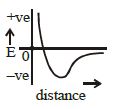
B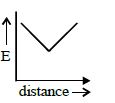
C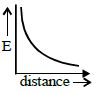
D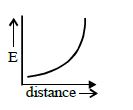
Solution
(A) When two hydrogen atoms approach each other,the potential energy of the system decreases due to attractive forces between the nucleus of one atom and the electron of the other.
As they get closer,the potential energy reaches a minimum value at the equilibrium bond distance.
If they get even closer,the repulsive forces between the nuclei and between the electrons dominate,causing the potential energy to increase sharply.
The plot in option $A$ correctly depicts this behavior,showing a minimum potential energy at the equilibrium distance.
As they get closer,the potential energy reaches a minimum value at the equilibrium bond distance.
If they get even closer,the repulsive forces between the nuclei and between the electrons dominate,causing the potential energy to increase sharply.
The plot in option $A$ correctly depicts this behavior,showing a minimum potential energy at the equilibrium distance.
0 likes
View Solution100
MediumMCQ
Which one of the following bonds has the highest bond energy?
A
$C-C$
B
$Si-Si$
C
$Ge-Ge$
D
$Sn-Sn$
Solution
(A) Bond energy depends on the size of the atoms involved in the bond. As the atomic size increases down the group,the bond length increases and the bond strength (bond energy) decreases. The order of atomic size is $C < Si < Ge < Sn$. Therefore,the order of bond energy is $C-C > Si-Si > Ge-Ge > Sn-Sn$. Thus,the $C-C$ bond has the highest bond energy.
0 likes
View SolutionChemical Bonding and Molecular Structure — Covalent bonding · Frequently Asked Questions
1Are these Chemical Bonding and Molecular Structure questions useful for JEE and NEET?
Yes. All questions in this section are mapped to JEE Main and NEET exam patterns. Previous year questions from JEE Main, NEET, GUJCET and state-level exams are included with full solutions.
2Can I switch to Hindi or Gujarati for these questions?
Yes. Use the language tabs in the hero section or the sidebar to view the same questions and solutions in English, Hindi or Gujarati.
3How do I generate a question paper from this subtopic?
Use the Vedclass Exam Paper Generator — select the chapter and subtopic, set difficulty, and generate Sets A, B, C, D automatically. First 3 chapters of every subject are free.
Vedclass Products
For Students
Vedclass Test Series
Mock tests in real JEE/NEET style with performance analysis. 5-day free trial.
Start Free TrialFor Teachers
Exam Paper Generator
Generate Set A/B/C/D papers from this chapter in 2 minutes. 3 chapters free.
Try FreeFor Institutes
Online Exam Module
Live online exams with unlimited students, 360° analytics & white-label branding.
See DemoFor Teachers & Institutes
Generate a Chemical Bonding and Molecular Structure Exam Paper in 2 Minutes
Select subtopic & difficulty — Sets A, B, C, D auto-generated with No Repeat logic.
First 3 chapters of every subject are free — no payment required.