
A English
pH of strong Acids and strong Bases Questions in English
Class 11 Chemistry · 6-2.Equilibrium-II (Ionic Equilibrium) · pH of strong Acids and strong Bases
226+
Questions
English
Language
100%
With Solutions
Showing 50 of 226 questions in English
151
Medium
Calculate the $pH$ of the following solutions:
$(a)$ $0.002 \ M \ HNO_3$
$(b)$ $0.06 \ M \ H_2SO_4$
$(a)$ $0.002 \ M \ HNO_3$
$(b)$ $0.06 \ M \ H_2SO_4$
Solution
(N/A) For $HNO_3$,which is a strong monoprotic acid,$[H^+] = [HNO_3] = 0.002 \ M$.
$pH = -\log[H^+] = -\log(2 \times 10^{-3}) = 3 - \log 2 = 3 - 0.3010 = 2.699$.
$(b)$ For $H_2SO_4$,which is a strong diprotic acid,$[H^+] = 2 \times [H_2SO_4] = 2 \times 0.06 = 0.12 \ M$.
$pH = -\log[H^+] = -\log(0.12) = -\log(1.2 \times 10^{-1}) = 1 - \log 1.2 = 1 - 0.0792 = 0.9208$.
$pH = -\log[H^+] = -\log(2 \times 10^{-3}) = 3 - \log 2 = 3 - 0.3010 = 2.699$.
$(b)$ For $H_2SO_4$,which is a strong diprotic acid,$[H^+] = 2 \times [H_2SO_4] = 2 \times 0.06 = 0.12 \ M$.
$pH = -\log[H^+] = -\log(0.12) = -\log(1.2 \times 10^{-1}) = 1 - \log 1.2 = 1 - 0.0792 = 0.9208$.
0 likes
View Solution152
Difficult
Calculate the concentration of hydrogen ions $[H^+]$ in the following solutions: $(a)$ $0.001 \ M \ HNO_3$ $(b)$ $0.0001 \ M \ KOH$.
Solution
(A) $HNO_3$ is a strong acid,so $[H^+] = [HNO_3] = 0.001 \ M = 1.0 \times 10^{-3} \ M$.
$(b)$ $KOH$ is a strong base,so $[OH^-] = [KOH] = 0.0001 \ M = 1.0 \times 10^{-4} \ M$.
Using the ionic product of water,$K_w = [H^+][OH^-] = 1.0 \times 10^{-14}$.
$[H^+] = \frac{K_w}{[OH^-]} = \frac{1.0 \times 10^{-14}}{1.0 \times 10^{-4}} = 1.0 \times 10^{-10} \ M$.
$(b)$ $KOH$ is a strong base,so $[OH^-] = [KOH] = 0.0001 \ M = 1.0 \times 10^{-4} \ M$.
Using the ionic product of water,$K_w = [H^+][OH^-] = 1.0 \times 10^{-14}$.
$[H^+] = \frac{K_w}{[OH^-]} = \frac{1.0 \times 10^{-14}}{1.0 \times 10^{-4}} = 1.0 \times 10^{-10} \ M$.
0 likes
View Solution153
MediumMCQ
$0.837 \ g$ of $Ba(OH)_2$ is dissolved in $100 \ mL$ of solution. Calculate the $pH$ of the solution. (Atomic masses: $Ba = 137, O = 16, H = 1$)
A
$12.91$
B
$13.09$
C
$1.09$
D
$12.00$
Solution
(A) $1$. Calculate the molar mass of $Ba(OH)_2$: $137 + 2 \times (16 + 1) = 137 + 34 = 171 \ g/mol$.
$2$. Calculate the number of moles of $Ba(OH)_2$: $n = \frac{0.837 \ g}{171 \ g/mol} = 0.00489 \ mol$.
$3$. Calculate the molarity of $Ba(OH)_2$: $M = \frac{0.00489 \ mol}{0.1 \ L} = 0.0489 \ M$.
$4$. Since $Ba(OH)_2$ is a strong base,$[OH^-] = 2 \times [Ba(OH)_2] = 2 \times 0.0489 = 0.0978 \ M$.
$5$. Calculate $pOH$: $pOH = -\log(0.0978) \approx 1.01$.
$6$. Calculate $pH$: $pH = 14 - pOH = 14 - 1.01 = 12.99 \approx 12.91$ (considering rounding differences in atomic mass precision).
$2$. Calculate the number of moles of $Ba(OH)_2$: $n = \frac{0.837 \ g}{171 \ g/mol} = 0.00489 \ mol$.
$3$. Calculate the molarity of $Ba(OH)_2$: $M = \frac{0.00489 \ mol}{0.1 \ L} = 0.0489 \ M$.
$4$. Since $Ba(OH)_2$ is a strong base,$[OH^-] = 2 \times [Ba(OH)_2] = 2 \times 0.0489 = 0.0978 \ M$.
$5$. Calculate $pOH$: $pOH = -\log(0.0978) \approx 1.01$.
$6$. Calculate $pH$: $pH = 14 - pOH = 14 - 1.01 = 12.99 \approx 12.91$ (considering rounding differences in atomic mass precision).
0 likes
View Solution154
MediumMCQ
Calculate the $pH$ of a $0.37 \ g$ $Ca(OH)_2$ solution in $200 \ mL$ of water. (Atomic masses: $Ca = 40, O = 16, H = 1$)
A
$12.6$
B
$1.4$
C
$11.6$
D
$2.4$
Solution
(A) $1$. Calculate the molar mass of $Ca(OH)_2$: $40 + 2 \times (16 + 1) = 40 + 34 = 74 \ g/mol$.
$2$. Calculate the number of moles of $Ca(OH)_2$: $n = \frac{0.37 \ g}{74 \ g/mol} = 0.005 \ mol$.
$3$. Calculate the molarity of $Ca(OH)_2$: $M = \frac{0.005 \ mol}{0.2 \ L} = 0.025 \ M$.
$4$. Since $Ca(OH)_2$ is a strong base,it dissociates as $Ca(OH)_2 \rightarrow Ca^{2+} + 2OH^-$.
$5$. The concentration of $OH^-$ ions is $[OH^-] = 2 \times 0.025 \ M = 0.05 \ M$.
$6$. Calculate $pOH$: $pOH = -\log[OH^-] = -\log(0.05) = -\log(5 \times 10^{-2}) = 2 - \log(5) \approx 2 - 0.699 = 1.301$.
$7$. Calculate $pH$: $pH = 14 - pOH = 14 - 1.301 = 12.699 \approx 12.7$.
$2$. Calculate the number of moles of $Ca(OH)_2$: $n = \frac{0.37 \ g}{74 \ g/mol} = 0.005 \ mol$.
$3$. Calculate the molarity of $Ca(OH)_2$: $M = \frac{0.005 \ mol}{0.2 \ L} = 0.025 \ M$.
$4$. Since $Ca(OH)_2$ is a strong base,it dissociates as $Ca(OH)_2 \rightarrow Ca^{2+} + 2OH^-$.
$5$. The concentration of $OH^-$ ions is $[OH^-] = 2 \times 0.025 \ M = 0.05 \ M$.
$6$. Calculate $pOH$: $pOH = -\log[OH^-] = -\log(0.05) = -\log(5 \times 10^{-2}) = 2 - \log(5) \approx 2 - 0.699 = 1.301$.
$7$. Calculate $pH$: $pH = 14 - pOH = 14 - 1.301 = 12.699 \approx 12.7$.
0 likes
View Solution155
EasyMCQ
Calculate the $pH$ of $1.0 \times 10^{-8} \ M \ NaOH$ solution.
A
$6.00$
B
$7.02$
C
$8.00$
D
$6.98$
Solution
(B) For a strong base like $NaOH$,the concentration of $OH^-$ ions is $1.0 \times 10^{-8} \ M$.
However,we must also consider the contribution of $OH^-$ ions from the auto-ionization of water,which is $1.0 \times 10^{-7} \ M$.
Total $[OH^-] = 1.0 \times 10^{-8} + 1.0 \times 10^{-7} = 1.1 \times 10^{-7} \ M$.
$pOH = -\log[OH^-] = -\log(1.1 \times 10^{-7}) = 7 - \log(1.1) \approx 7 - 0.041 = 6.959$.
Since $pH + pOH = 14$,$pH = 14 - 6.959 = 7.041$.
Rounding to the nearest provided option,the value is $7.02$.
However,we must also consider the contribution of $OH^-$ ions from the auto-ionization of water,which is $1.0 \times 10^{-7} \ M$.
Total $[OH^-] = 1.0 \times 10^{-8} + 1.0 \times 10^{-7} = 1.1 \times 10^{-7} \ M$.
$pOH = -\log[OH^-] = -\log(1.1 \times 10^{-7}) = 7 - \log(1.1) \approx 7 - 0.041 = 6.959$.
Since $pH + pOH = 14$,$pH = 14 - 6.959 = 7.041$.
Rounding to the nearest provided option,the value is $7.02$.
0 likes
View Solution156
EasyMCQ
$A$ solution with $pH = 5.0$ is diluted $100$ times. Calculate the $pH$ of the diluted solution.
A
$6.0$
B
$7.0$
C
$5.0$
D
$6.96$
Solution
(D) The initial concentration of $H^+$ ions is $[H^+]_1 = 10^{-pH} = 10^{-5} \ M$.
Upon diluting the solution $100$ times,the new concentration becomes $[H^+]_2 = \frac{10^{-5}}{100} = 10^{-7} \ M$.
Since the concentration of $H^+$ from water $(10^{-7} \ M)$ cannot be ignored when the acid concentration is very low,the total $[H^+]$ is $[H^+]_{total} = [H^+]_{acid} + [H^+]_{water} = 10^{-7} + 10^{-7} = 2 \times 10^{-7} \ M$.
The $pH$ is calculated as $pH = -\log[H^+]_{total} = -\log(2 \times 10^{-7}) = 7 - \log 2 = 7 - 0.301 = 6.699 \approx 6.7$.
Upon diluting the solution $100$ times,the new concentration becomes $[H^+]_2 = \frac{10^{-5}}{100} = 10^{-7} \ M$.
Since the concentration of $H^+$ from water $(10^{-7} \ M)$ cannot be ignored when the acid concentration is very low,the total $[H^+]$ is $[H^+]_{total} = [H^+]_{acid} + [H^+]_{water} = 10^{-7} + 10^{-7} = 2 \times 10^{-7} \ M$.
The $pH$ is calculated as $pH = -\log[H^+]_{total} = -\log(2 \times 10^{-7}) = 7 - \log 2 = 7 - 0.301 = 6.699 \approx 6.7$.
0 likes
View Solution157
EasyMCQ
$25 \ mL$ of $0.1 \ M$ $HCl$ solution is diluted till $500 \ mL$. Calculate the $pH$ of the dilute solution. (in $.3$)
A
$1$
B
$2$
C
$3$
D
$4$
Solution
(B) Using the dilution formula $M_1V_1 = M_2V_2$:
$0.1 \ M \times 25 \ mL = M_2 \times 500 \ mL$
$M_2 = \frac{0.1 \times 25}{500} = 0.005 \ M$
Since $HCl$ is a strong acid,$[H^+] = [HCl] = 0.005 \ M = 5 \times 10^{-3} \ M$.
$pH = -\log[H^+] = -\log(5 \times 10^{-3}) = 3 - \log 5 = 3 - 0.698 = 2.302$.
$0.1 \ M \times 25 \ mL = M_2 \times 500 \ mL$
$M_2 = \frac{0.1 \times 25}{500} = 0.005 \ M$
Since $HCl$ is a strong acid,$[H^+] = [HCl] = 0.005 \ M = 5 \times 10^{-3} \ M$.
$pH = -\log[H^+] = -\log(5 \times 10^{-3}) = 3 - \log 5 = 3 - 0.698 = 2.302$.
0 likes
View Solution158
Medium
How many grams of $NaOH$ are required to prepare $1 \ L$ of $NaOH$ solution with a $pH$ of $10.06$?
Solution
(N/A) $1$. The $pH$ of the solution is $10.06$. Since $NaOH$ is a strong base,we first calculate the $pOH$ using the relation: $pH + pOH = 14$.
$2$. $pOH = 14 - 10.06 = 3.94$.
$3$. The concentration of hydroxide ions $[OH^-]$ is given by $[OH^-] = 10^{-pOH} = 10^{-3.94} \approx 1.148 \times 10^{-4} \ M$.
$4$. Since $NaOH$ dissociates completely as $NaOH \rightarrow Na^+ + OH^-$,the molarity of $NaOH$ is equal to $[OH^-]$,which is $1.148 \times 10^{-4} \ mol/L$.
$5$. The molar mass of $NaOH$ is $23 + 16 + 1 = 40 \ g/mol$.
$6$. Mass of $NaOH = \text{Molarity} \times \text{Volume} \times \text{Molar Mass} = 1.148 \times 10^{-4} \ mol/L \times 1 \ L \times 40 \ g/mol = 4.592 \times 10^{-3} \ g$.
$2$. $pOH = 14 - 10.06 = 3.94$.
$3$. The concentration of hydroxide ions $[OH^-]$ is given by $[OH^-] = 10^{-pOH} = 10^{-3.94} \approx 1.148 \times 10^{-4} \ M$.
$4$. Since $NaOH$ dissociates completely as $NaOH \rightarrow Na^+ + OH^-$,the molarity of $NaOH$ is equal to $[OH^-]$,which is $1.148 \times 10^{-4} \ mol/L$.
$5$. The molar mass of $NaOH$ is $23 + 16 + 1 = 40 \ g/mol$.
$6$. Mass of $NaOH = \text{Molarity} \times \text{Volume} \times \text{Molar Mass} = 1.148 \times 10^{-4} \ mol/L \times 1 \ L \times 40 \ g/mol = 4.592 \times 10^{-3} \ g$.
0 likes
View Solution159
EasyMCQ
$50 \ mL$ of water is added to $50 \ mL$ of $0.01 \ M$ $Ba(OH)_2$ solution. Calculate the $pH$ of the resulting solution.
A
$12.0$
B
$12.3$
C
$11.7$
D
$12.7$
Solution
(A) $1$. Initial moles of $Ba(OH)_2 = \text{Molarity} \times \text{Volume (L)} = 0.01 \ M \times 0.050 \ L = 5 \times 10^{-4} \ mol$.
$2$. Since $Ba(OH)_2$ is a strong base,it dissociates as $Ba(OH)_2 \rightarrow Ba^{2+} + 2OH^-$.
$3$. Moles of $OH^- = 2 \times \text{moles of } Ba(OH)_2 = 2 \times 5 \times 10^{-4} = 10^{-3} \ mol$.
$4$. Total volume of the solution after adding water = $50 \ mL + 50 \ mL = 100 \ mL = 0.1 \ L$.
$5$. Concentration of $OH^- = \frac{10^{-3} \ mol}{0.1 \ L} = 0.01 \ M = 10^{-2} \ M$.
$6$. $pOH = -\log[OH^-] = -\log(10^{-2}) = 2$.
$7$. $pH = 14 - pOH = 14 - 2 = 12.0$.
$2$. Since $Ba(OH)_2$ is a strong base,it dissociates as $Ba(OH)_2 \rightarrow Ba^{2+} + 2OH^-$.
$3$. Moles of $OH^- = 2 \times \text{moles of } Ba(OH)_2 = 2 \times 5 \times 10^{-4} = 10^{-3} \ mol$.
$4$. Total volume of the solution after adding water = $50 \ mL + 50 \ mL = 100 \ mL = 0.1 \ L$.
$5$. Concentration of $OH^- = \frac{10^{-3} \ mol}{0.1 \ L} = 0.01 \ M = 10^{-2} \ M$.
$6$. $pOH = -\log[OH^-] = -\log(10^{-2}) = 2$.
$7$. $pH = 14 - pOH = 14 - 2 = 12.0$.
0 likes
View Solution160
DifficultMCQ
$50 \ mL$ water is mixed with $50 \ mL$ $0.01 \ M$ $Ba(OH)_2$. Calculate its $pH$.
A
$12.0$
B
$12.3$
C
$11.7$
D
$12.7$
Solution
(A) Step $1$: Calculate the total volume of the solution. $V_{total} = 50 \ mL + 50 \ mL = 100 \ mL = 0.1 \ L$.
Step $2$: Calculate the moles of $Ba(OH)_2$. $n = M \times V = 0.01 \ mol/L \times 0.05 \ L = 5 \times 10^{-4} \ mol$.
Step $3$: Calculate the concentration of $OH^-$ ions. Since $Ba(OH)_2 \rightarrow Ba^{2+} + 2OH^-$,the moles of $OH^-$ are $2 \times (5 \times 10^{-4}) = 10^{-3} \ mol$.
$[OH^-] = \frac{10^{-3} \ mol}{0.1 \ L} = 0.01 \ M = 10^{-2} \ M$.
Step $4$: Calculate $pOH$. $pOH = -\log[OH^-] = -\log(10^{-2}) = 2$.
Step $5$: Calculate $pH$. $pH = 14 - pOH = 14 - 2 = 12.0$.
Step $2$: Calculate the moles of $Ba(OH)_2$. $n = M \times V = 0.01 \ mol/L \times 0.05 \ L = 5 \times 10^{-4} \ mol$.
Step $3$: Calculate the concentration of $OH^-$ ions. Since $Ba(OH)_2 \rightarrow Ba^{2+} + 2OH^-$,the moles of $OH^-$ are $2 \times (5 \times 10^{-4}) = 10^{-3} \ mol$.
$[OH^-] = \frac{10^{-3} \ mol}{0.1 \ L} = 0.01 \ M = 10^{-2} \ M$.
Step $4$: Calculate $pOH$. $pOH = -\log[OH^-] = -\log(10^{-2}) = 2$.
Step $5$: Calculate $pH$. $pH = 14 - pOH = 14 - 2 = 12.0$.
0 likes
View Solution161
MediumMCQ
Calculate the $pH$ of $0.0035 \ M \ Ba(OH)_2$ solution.
A
$11.84$
B
$10.50$
C
$2.16$
D
$12.15$
Solution
(A) $Ba(OH)_2$ is a strong base and dissociates completely as: $Ba(OH)_2 \rightarrow Ba^{2+} + 2OH^-$.
The concentration of $OH^-$ ions is $[OH^-] = 2 \times [Ba(OH)_2] = 2 \times 0.0035 \ M = 0.007 \ M$.
Now,$pOH = -\log[OH^-] = -\log(0.007) = -\log(7 \times 10^{-3}) = 3 - \log(7) \approx 3 - 0.845 = 2.155$.
Since $pH + pOH = 14$,we have $pH = 14 - 2.155 = 11.845 \approx 11.84$.
The concentration of $OH^-$ ions is $[OH^-] = 2 \times [Ba(OH)_2] = 2 \times 0.0035 \ M = 0.007 \ M$.
Now,$pOH = -\log[OH^-] = -\log(0.007) = -\log(7 \times 10^{-3}) = 3 - \log(7) \approx 3 - 0.845 = 2.155$.
Since $pH + pOH = 14$,we have $pH = 14 - 2.155 = 11.845 \approx 11.84$.
0 likes
View Solution162
MediumMCQ
Calculate the volume of $0.1 \ M \ NaOH$ required to complete the neutralization of $300 \ mL$ of $HCl$ solution having $pH = 2.25$. (in $mL$)
A
$16.9$
B
$1.69$
C
$169$
D
$0.169$
Solution
(A) $1$. Given $pH = 2.25$ for $HCl$. The concentration of $H^+$ ions is $[H^+] = 10^{-pH} = 10^{-2.25}$.
$2$. $[H^+] = 10^{0.75} \times 10^{-3} \approx 5.623 \times 10^{-3} \ M$.
$3$. Since $HCl$ is a strong acid,$[HCl] = [H^+] = 5.623 \times 10^{-3} \ M$.
$4$. The neutralization reaction is $HCl + NaOH \rightarrow NaCl + H_2O$. The stoichiometry is $1:1$,so $n_{HCl} = n_{NaOH}$.
$5$. $n_{HCl} = M_{HCl} \times V_{HCl} = (5.623 \times 10^{-3} \ M) \times (0.300 \ L) = 1.687 \times 10^{-3} \ mol$.
$6$. $V_{NaOH} = \frac{n_{NaOH}}{M_{NaOH}} = \frac{1.687 \times 10^{-3} \ mol}{0.1 \ M} = 0.01687 \ L = 16.87 \ mL \approx 16.9 \ mL$.
$2$. $[H^+] = 10^{0.75} \times 10^{-3} \approx 5.623 \times 10^{-3} \ M$.
$3$. Since $HCl$ is a strong acid,$[HCl] = [H^+] = 5.623 \times 10^{-3} \ M$.
$4$. The neutralization reaction is $HCl + NaOH \rightarrow NaCl + H_2O$. The stoichiometry is $1:1$,so $n_{HCl} = n_{NaOH}$.
$5$. $n_{HCl} = M_{HCl} \times V_{HCl} = (5.623 \times 10^{-3} \ M) \times (0.300 \ L) = 1.687 \times 10^{-3} \ mol$.
$6$. $V_{NaOH} = \frac{n_{NaOH}}{M_{NaOH}} = \frac{1.687 \times 10^{-3} \ mol}{0.1 \ M} = 0.01687 \ L = 16.87 \ mL \approx 16.9 \ mL$.
0 likes
View Solution163
DifficultMCQ
Calculate the $pH$ of a mixed solution containing $300 \ mL$ of $0.05 \ M \ H_2SO_4$ and $150 \ mL$ of $0.05 \ M \ KOH$. (in $.301$)
A
$1$
B
$2$
C
$0$
D
$3$
Solution
(A) $1$. Calculate the millimoles of $H^+$ ions from $H_2SO_4$: $n(H^+) = 2 \times M \times V = 2 \times 0.05 \ M \times 300 \ mL = 30 \ mmol$.
$2$. Calculate the millimoles of $OH^-$ ions from $KOH$: $n(OH^-) = M \times V = 0.05 \ M \times 150 \ mL = 7.5 \ mmol$.
$3$. Calculate the remaining $H^+$ after neutralization: $n(H^+)_{rem} = 30 - 7.5 = 22.5 \ mmol$.
$4$. Calculate the total volume of the solution: $V_{total} = 300 \ mL + 150 \ mL = 450 \ mL$.
$5$. Calculate the concentration of $H^+$: $[H^+] = \frac{22.5 \ mmol}{450 \ mL} = 0.05 \ M$.
$6$. Calculate $pH$: $pH = -\log[H^+] = -\log(0.05) = -\log(5 \times 10^{-2}) = 2 - \log(5) = 2 - 0.699 = 1.301$.
$2$. Calculate the millimoles of $OH^-$ ions from $KOH$: $n(OH^-) = M \times V = 0.05 \ M \times 150 \ mL = 7.5 \ mmol$.
$3$. Calculate the remaining $H^+$ after neutralization: $n(H^+)_{rem} = 30 - 7.5 = 22.5 \ mmol$.
$4$. Calculate the total volume of the solution: $V_{total} = 300 \ mL + 150 \ mL = 450 \ mL$.
$5$. Calculate the concentration of $H^+$: $[H^+] = \frac{22.5 \ mmol}{450 \ mL} = 0.05 \ M$.
$6$. Calculate $pH$: $pH = -\log[H^+] = -\log(0.05) = -\log(5 \times 10^{-2}) = 2 - \log(5) = 2 - 0.699 = 1.301$.
0 likes
View Solution164
MediumMCQ
What is the $pH$ of $1 \times 10^{-4} \ M \ H_2SO_4$ solution?
A
$3.70$
B
$4.00$
C
$3.40$
D
$2.00$
Solution
(A) $H_2SO_4$ is a strong diprotic acid that dissociates completely in water as follows:
$H_2SO_4 \rightarrow 2H^+ + SO_4^{2-}$
Since the concentration of $H_2SO_4$ is $1 \times 10^{-4} \ M$,the concentration of $H^+$ ions is:
$[H^+] = 2 \times [H_2SO_4] = 2 \times 1 \times 10^{-4} \ M = 2 \times 10^{-4} \ M$
The $pH$ is calculated as:
$pH = -\log[H^+] = -\log(2 \times 10^{-4})$
$pH = -(\log 2 + \log 10^{-4}) = -(0.301 - 4) = 3.699 \approx 3.70$
$H_2SO_4 \rightarrow 2H^+ + SO_4^{2-}$
Since the concentration of $H_2SO_4$ is $1 \times 10^{-4} \ M$,the concentration of $H^+$ ions is:
$[H^+] = 2 \times [H_2SO_4] = 2 \times 1 \times 10^{-4} \ M = 2 \times 10^{-4} \ M$
The $pH$ is calculated as:
$pH = -\log[H^+] = -\log(2 \times 10^{-4})$
$pH = -(\log 2 + \log 10^{-4}) = -(0.301 - 4) = 3.699 \approx 3.70$
0 likes
View Solution165
MediumMCQ
How many liters of water must be added to $1 \ L$ of an aqueous $HCl$ solution with $pH = 1$ to make the $pH$ of the resulting solution equal to $2$ (in $L$)?
A
$1$
B
$9$
C
$10$
D
$0.9$
Solution
(B) For $pH = 1$,$[H^+]_1 = 10^{-1} = 0.1 \ M$.
For $pH = 2$,$[H^+]_2 = 10^{-2} = 0.01 \ M$.
Using the dilution formula $M_1V_1 = M_2V_2$:
$0.1 \ M \times 1 \ L = 0.01 \ M \times V_2$.
$V_2 = \frac{0.1}{0.01} = 10 \ L$.
The volume of water to be added is $V_2 - V_1 = 10 \ L - 1 \ L = 9 \ L$.
For $pH = 2$,$[H^+]_2 = 10^{-2} = 0.01 \ M$.
Using the dilution formula $M_1V_1 = M_2V_2$:
$0.1 \ M \times 1 \ L = 0.01 \ M \times V_2$.
$V_2 = \frac{0.1}{0.01} = 10 \ L$.
The volume of water to be added is $V_2 - V_1 = 10 \ L - 1 \ L = 9 \ L$.
0 likes
View Solution166
MediumMCQ
The $pH$ of $1 \ L$ of an aqueous solution of $HCl$ is $1$. How many liters of water must be added to make the $pH$ of this solution $2$ (in $L$)?
A
$1$
B
$2$
C
$9$
D
$10$
Solution
(C) For the initial solution: $pH_1 = 1$,so $[H^+]_1 = 10^{-pH_1} = 10^{-1} \ M$.
Volume $V_1 = 1 \ L$.
Number of moles of $H^+ = M_1 \times V_1 = 10^{-1} \times 1 = 0.1 \ mol$.
For the final solution: $pH_2 = 2$,so $[H^+]_2 = 10^{-pH_2} = 10^{-2} \ M$.
Let the final volume be $V_2$.
Since the number of moles of $H^+$ remains constant: $M_1 \times V_1 = M_2 \times V_2$.
$0.1 \times 1 = 0.01 \times V_2$.
$V_2 = 10 \ L$.
Volume of water to be added = $V_2 - V_1 = 10 \ L - 1 \ L = 9 \ L$.
Volume $V_1 = 1 \ L$.
Number of moles of $H^+ = M_1 \times V_1 = 10^{-1} \times 1 = 0.1 \ mol$.
For the final solution: $pH_2 = 2$,so $[H^+]_2 = 10^{-pH_2} = 10^{-2} \ M$.
Let the final volume be $V_2$.
Since the number of moles of $H^+$ remains constant: $M_1 \times V_1 = M_2 \times V_2$.
$0.1 \times 1 = 0.01 \times V_2$.
$V_2 = 10 \ L$.
Volume of water to be added = $V_2 - V_1 = 10 \ L - 1 \ L = 9 \ L$.
0 likes
View Solution167
MediumMCQ
Calculate the $pH$ of a mixture obtained by mixing equal volumes of $0.01 \ M \ HCl$ and $0.1 \ M \ NaOH$.
A
$1.3$
B
$12.65$
C
$1.0$
D
$13.0$
Solution
(B) Let the volume of each solution be $V \ L$.
Total volume of the mixture = $2V \ L$.
Moles of $H^+$ from $HCl$ = $0.01 \times V = 0.01V \ mol$.
Moles of $OH^-$ from $NaOH$ = $0.1 \times V = 0.1V \ mol$.
Since $OH^-$ is in excess,moles of $OH^-$ remaining = $0.1V - 0.01V = 0.09V \ mol$.
Concentration of $[OH^-]$ in the mixture = $\frac{0.09V}{2V} = 0.045 \ M$.
$pOH = -\log[OH^-] = -\log(0.045) = -(\log(4.5 \times 10^{-2})) = -(0.653 - 2) = 1.347$.
$pH = 14 - pOH = 14 - 1.347 = 12.653 \approx 12.65$.
Total volume of the mixture = $2V \ L$.
Moles of $H^+$ from $HCl$ = $0.01 \times V = 0.01V \ mol$.
Moles of $OH^-$ from $NaOH$ = $0.1 \times V = 0.1V \ mol$.
Since $OH^-$ is in excess,moles of $OH^-$ remaining = $0.1V - 0.01V = 0.09V \ mol$.
Concentration of $[OH^-]$ in the mixture = $\frac{0.09V}{2V} = 0.045 \ M$.
$pOH = -\log[OH^-] = -\log(0.045) = -(\log(4.5 \times 10^{-2})) = -(0.653 - 2) = 1.347$.
$pH = 14 - pOH = 14 - 1.347 = 12.653 \approx 12.65$.
0 likes
View Solution168
MediumMCQ
$100 \ mL$ of $0.1 \ M$ $HCl$ is taken in a beaker and to it $100 \ mL$ of $0.1 \ M$ $NaOH$ is added in steps of $2 \ mL$ and the $pH$ is continuously measured. Which of the following graphs correctly depicts the change in $pH$?
A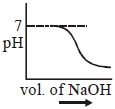
B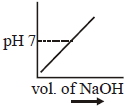
C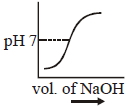
D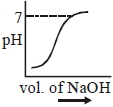
Solution
(C) The titration involves a strong acid $(HCl)$ and a strong base $(NaOH)$.
Initially,the beaker contains $HCl$,which is a strong acid,so the initial $pH$ is low (around $1$).
As $NaOH$ is added,the $H^+$ ions are neutralized by $OH^-$ ions,causing the $pH$ to increase gradually.
Near the equivalence point,there is a very sharp or steep increase in $pH$ because the concentration of $H^+$ ions changes drastically.
After the equivalence point,the solution becomes basic due to excess $NaOH$,and the $pH$ levels off at a high value.
Graph $C$ correctly represents this characteristic sigmoidal curve for a strong acid-strong base titration,where the $pH$ rises sharply through $pH = 7$ at the equivalence point.
Initially,the beaker contains $HCl$,which is a strong acid,so the initial $pH$ is low (around $1$).
As $NaOH$ is added,the $H^+$ ions are neutralized by $OH^-$ ions,causing the $pH$ to increase gradually.
Near the equivalence point,there is a very sharp or steep increase in $pH$ because the concentration of $H^+$ ions changes drastically.
After the equivalence point,the solution becomes basic due to excess $NaOH$,and the $pH$ levels off at a high value.
Graph $C$ correctly represents this characteristic sigmoidal curve for a strong acid-strong base titration,where the $pH$ rises sharply through $pH = 7$ at the equivalence point.
0 likes
View Solution169
MediumMCQ
Assuming that $Ba(OH)_{2}$ is completely ionised in aqueous solution under the given conditions,the concentration of $H_{3}O^{+}$ ions in $0.005 \, M$ aqueous solution of $Ba(OH)_{2}$ at $298 \, K$ is $..... \times 10^{-12} \, mol \, L^{-1}$. (Nearest integer)
A
$2$
B
$1$
C
$3$
D
$4$
Solution
(B) $Ba(OH)_{2}$ is a strong base and dissociates completely as: $Ba(OH)_{2} \rightarrow Ba^{2+} + 2OH^{-}$.
Given concentration of $Ba(OH)_{2} = 0.005 \, M$.
Therefore,$[OH^{-}] = 2 \times 0.005 \, M = 0.01 \, M = 10^{-2} \, M$.
At $298 \, K$,the ionic product of water is $K_{w} = [H_{3}O^{+}][OH^{-}] = 10^{-14}$.
Substituting the value of $[OH^{-}]$:
$[H_{3}O^{+}] = \frac{10^{-14}}{10^{-2}} = 10^{-12} \, M$.
Thus,the concentration is $1 \times 10^{-12} \, mol \, L^{-1}$.
Given concentration of $Ba(OH)_{2} = 0.005 \, M$.
Therefore,$[OH^{-}] = 2 \times 0.005 \, M = 0.01 \, M = 10^{-2} \, M$.
At $298 \, K$,the ionic product of water is $K_{w} = [H_{3}O^{+}][OH^{-}] = 10^{-14}$.
Substituting the value of $[OH^{-}]$:
$[H_{3}O^{+}] = \frac{10^{-14}}{10^{-2}} = 10^{-12} \, M$.
Thus,the concentration is $1 \times 10^{-12} \, mol \, L^{-1}$.
0 likes
View Solution170
EasyMCQ
$pH$ value of $0.001 \ M \ NaOH$ solution is $..... .$
A
$7$
B
$14$
C
$3$
D
$11$
Solution
(D) $NaOH$ is a strong base,so it dissociates completely as $NaOH \rightarrow Na^{+} + OH^{-}$.
Given concentration of $NaOH = 0.001 \ M = 10^{-3} \ M$.
Therefore,$[OH^{-}] = 10^{-3} \ M$.
$pOH = -\log[OH^{-}] = -\log(10^{-3}) = 3$.
Since $pH + pOH = 14$ at $25^{\circ}C$,
$pH = 14 - pOH = 14 - 3 = 11$.
Given concentration of $NaOH = 0.001 \ M = 10^{-3} \ M$.
Therefore,$[OH^{-}] = 10^{-3} \ M$.
$pOH = -\log[OH^{-}] = -\log(10^{-3}) = 3$.
Since $pH + pOH = 14$ at $25^{\circ}C$,
$pH = 14 - pOH = 14 - 3 = 11$.
0 likes
View Solution171
MediumMCQ
$200 \ mL$ of $0.01 \ M \ HCl$ is mixed with $400 \ mL$ of $0.01 \ M \ H_{2}SO_{4}$. The $pH$ of the mixture is
A
$1.14$
B
$1.78$
C
$2.34$
D
$3.02$
Solution
(B) The total moles of $H^{+}$ ions from $HCl$ is $n_{1} = M \times V = 0.01 \times 0.2 = 0.002 \ mol$.
The total moles of $H^{+}$ ions from $H_{2}SO_{4}$ is $n_{2} = M \times V \times 2 = 0.01 \times 0.4 \times 2 = 0.008 \ mol$.
Total moles of $H^{+} = 0.002 + 0.008 = 0.01 \ mol$.
Total volume of the mixture = $200 \ mL + 400 \ mL = 600 \ mL = 0.6 \ L$.
Concentration of $[H^{+}] = \frac{0.01 \ mol}{0.6 \ L} = \frac{1}{60} \ M$.
$pH = -\log[H^{+}] = -\log(\frac{1}{60}) = \log(60) = \log(6 \times 10) = \log(6) + \log(10) \approx 0.778 + 1 = 1.778 \approx 1.78$.
The total moles of $H^{+}$ ions from $H_{2}SO_{4}$ is $n_{2} = M \times V \times 2 = 0.01 \times 0.4 \times 2 = 0.008 \ mol$.
Total moles of $H^{+} = 0.002 + 0.008 = 0.01 \ mol$.
Total volume of the mixture = $200 \ mL + 400 \ mL = 600 \ mL = 0.6 \ L$.
Concentration of $[H^{+}] = \frac{0.01 \ mol}{0.6 \ L} = \frac{1}{60} \ M$.
$pH = -\log[H^{+}] = -\log(\frac{1}{60}) = \log(60) = \log(6 \times 10) = \log(6) + \log(10) \approx 0.778 + 1 = 1.778 \approx 1.78$.
0 likes
View Solution172
DifficultMCQ
The $pH$ values of $(i) \ 0.1 \ M \ HCl_{(aq)}$,$(ii) \ 0.1 \ M \ KOH$,$(iii)$ tomato juice,and $(iv)$ pure water follow the order.
A
$i < iii < iv < ii$
B
$iii < i < iv < ii$
C
$i < ii < iii < iv$
D
$iv < iii < ii < i$
Solution
(A) The $pH$ values are determined as follows:
$(i)$ $0.1 \ M \ HCl$ is a strong acid,so its $pH = -\log[H^+] = -\log(0.1) = 1$.
(ii) $0.1 \ M \ KOH$ is a strong base,so its $pOH = -\log[OH^-] = 1$,which means $pH = 14 - 1 = 13$.
(iii) Tomato juice is acidic,typically having a $pH$ in the range of $4.0 - 4.5$.
(iv) Pure water is neutral,having a $pH = 7.0$ at $25^{\circ}C$.
Comparing these values: $1 (i) < 4.0-4.5 (iii) < 7.0 (iv) < 13 (ii)$.
Therefore,the correct order is $i < iii < iv < ii$.
$(i)$ $0.1 \ M \ HCl$ is a strong acid,so its $pH = -\log[H^+] = -\log(0.1) = 1$.
(ii) $0.1 \ M \ KOH$ is a strong base,so its $pOH = -\log[OH^-] = 1$,which means $pH = 14 - 1 = 13$.
(iii) Tomato juice is acidic,typically having a $pH$ in the range of $4.0 - 4.5$.
(iv) Pure water is neutral,having a $pH = 7.0$ at $25^{\circ}C$.
Comparing these values: $1 (i) < 4.0-4.5 (iii) < 7.0 (iv) < 13 (ii)$.
Therefore,the correct order is $i < iii < iv < ii$.
0 likes
View Solution173
MediumMCQ
The $pH$ of a $10 \ mL$ aqueous solution of $HCl$ is $4$. The amount of water to be added to this solution in order to change its $pH$ from $4$ to $5$ is $..... \ mL$
A
$30$
B
$60$
C
$90$
D
$120$
Solution
(C) Given,
$pH_1 = 4$,so $[H^+]_1 = 10^{-4} \ M$.
Initial volume $V_1 = 10 \ mL$.
After dilution,$pH_2 = 5$,so $[H^+]_2 = 10^{-5} \ M$.
Using the dilution formula $M_1 V_1 = M_2 V_2$:
$10^{-4} \times 10 = 10^{-5} \times V_2$
$V_2 = \frac{10^{-4} \times 10}{10^{-5}} = 100 \ mL$.
Volume of water to be added = $V_2 - V_1 = 100 \ mL - 10 \ mL = 90 \ mL$.
$pH_1 = 4$,so $[H^+]_1 = 10^{-4} \ M$.
Initial volume $V_1 = 10 \ mL$.
After dilution,$pH_2 = 5$,so $[H^+]_2 = 10^{-5} \ M$.
Using the dilution formula $M_1 V_1 = M_2 V_2$:
$10^{-4} \times 10 = 10^{-5} \times V_2$
$V_2 = \frac{10^{-4} \times 10}{10^{-5}} = 100 \ mL$.
Volume of water to be added = $V_2 - V_1 = 100 \ mL - 10 \ mL = 90 \ mL$.
0 likes
View Solution174
DifficultMCQ
Millimoles of calcium hydroxide required to produce $100 \ mL$ of the aqueous solution of $pH$ $12$ is $x \times 10^{-1}$. The value of $x$ is $..............$. (Nearest integer). Assume complete dissociation.
A
$5$
B
$4$
C
$3$
D
$2$
Solution
(A) Given $pH = 12$,we know that $pOH = 14 - pH = 14 - 12 = 2$.
$[OH^-] = 10^{-pOH} = 10^{-2} \ M$.
Since $Ca(OH)_2$ dissociates completely as $Ca(OH)_2 \rightarrow Ca^{2+} + 2OH^-$,the concentration of $Ca(OH)_2$ is $[Ca(OH)_2] = \frac{[OH^-]}{2} = \frac{10^{-2}}{2} = 0.5 \times 10^{-2} = 5 \times 10^{-3} \ M$.
Number of millimoles $= \text{Molarity} \times \text{Volume in } mL = (5 \times 10^{-3} \ M) \times (100 \ mL) = 0.5 \ \text{millimoles}$.
This can be written as $5 \times 10^{-1} \ \text{millimoles}$.
Comparing with $x \times 10^{-1}$,we get $x = 5$.
$[OH^-] = 10^{-pOH} = 10^{-2} \ M$.
Since $Ca(OH)_2$ dissociates completely as $Ca(OH)_2 \rightarrow Ca^{2+} + 2OH^-$,the concentration of $Ca(OH)_2$ is $[Ca(OH)_2] = \frac{[OH^-]}{2} = \frac{10^{-2}}{2} = 0.5 \times 10^{-2} = 5 \times 10^{-3} \ M$.
Number of millimoles $= \text{Molarity} \times \text{Volume in } mL = (5 \times 10^{-3} \ M) \times (100 \ mL) = 0.5 \ \text{millimoles}$.
This can be written as $5 \times 10^{-1} \ \text{millimoles}$.
Comparing with $x \times 10^{-1}$,we get $x = 5$.
0 likes
View Solution175
DifficultMCQ
$600 \, mL$ of $0.01 \, M \, HCl$ is mixed with $400 \, mL$ of $0.01 \, M \, H_2SO_4$. The $pH$ of the mixture is $....... \times 10^{-2}$. (Nearest integer) [Given $\log 2 = 0.30, \quad \log 3 = 0.48, \quad \log 5 = 0.69, \quad \log 7 = 0.84, \quad \log 11 = 1.04$]
A
$185$
B
$186$
C
$184$
D
$183$
Solution
(B) Total millimoles of $H^{+} = (600 \times 0.01) + (400 \times 0.01 \times 2) = 6 + 8 = 14 \, mmol$.
Total volume $= 600 + 400 = 1000 \, mL$.
Concentration of $[H^{+}] = \frac{14 \, mmol}{1000 \, mL} = 0.014 \, M = 1.4 \times 10^{-2} \, M$.
$pH = -\log[H^{+}] = -\log(1.4 \times 10^{-2}) = 2 - \log(1.4) = 2 - \log(14/10) = 2 - (\log 14 - \log 10) = 2 - (\log 2 + \log 7 - 1) = 2 - (0.30 + 0.84 - 1) = 2 - 0.14 = 1.86$.
Thus,$pH = 1.86 = 186 \times 10^{-2}$.
Total volume $= 600 + 400 = 1000 \, mL$.
Concentration of $[H^{+}] = \frac{14 \, mmol}{1000 \, mL} = 0.014 \, M = 1.4 \times 10^{-2} \, M$.
$pH = -\log[H^{+}] = -\log(1.4 \times 10^{-2}) = 2 - \log(1.4) = 2 - \log(14/10) = 2 - (\log 14 - \log 10) = 2 - (\log 2 + \log 7 - 1) = 2 - (0.30 + 0.84 - 1) = 2 - 0.14 = 1.86$.
Thus,$pH = 1.86 = 186 \times 10^{-2}$.
0 likes
View Solution176
MediumMCQ
An analyst wants to convert $1 \ L$ of $HCl$ solution with $pH = 1$ to a solution of $HCl$ with $pH = 2$. The volume of water needed to do this dilution is $...... \ mL$. (Nearest Integer)
A
$8000$
B
$9000$
C
$7000$
D
$6000$
Solution
(B) For $pH = 1$,the concentration of $HCl$ is $[H^+]_1 = 10^{-pH} = 10^{-1} \ M = 0.1 \ M$.
For $pH = 2$,the concentration of $HCl$ is $[H^+]_2 = 10^{-pH} = 10^{-2} \ M = 0.01 \ M$.
Using the dilution formula $M_1 \times V_1 = M_2 \times V_2$:
$0.1 \ M \times 1 \ L = 0.01 \ M \times V_2$.
$V_2 = \frac{0.1}{0.01} \ L = 10 \ L$.
The volume of water to be added is $V_{added} = V_2 - V_1 = 10 \ L - 1 \ L = 9 \ L$.
Since $1 \ L = 1000 \ mL$,the volume of water added is $9 \times 1000 \ mL = 9000 \ mL$.
For $pH = 2$,the concentration of $HCl$ is $[H^+]_2 = 10^{-pH} = 10^{-2} \ M = 0.01 \ M$.
Using the dilution formula $M_1 \times V_1 = M_2 \times V_2$:
$0.1 \ M \times 1 \ L = 0.01 \ M \times V_2$.
$V_2 = \frac{0.1}{0.01} \ L = 10 \ L$.
The volume of water to be added is $V_{added} = V_2 - V_1 = 10 \ L - 1 \ L = 9 \ L$.
Since $1 \ L = 1000 \ mL$,the volume of water added is $9 \times 1000 \ mL = 9000 \ mL$.
0 likes
View Solution177
MediumMCQ
$x \ mg$ of $Mg(OH)_2$ (molar mass $= 58 \ g/mol$) is required to be dissolved in $1.0 \ L$ of water to produce a $pH$ of $10.0$ at $298 \ K$. The value of $x$ is $........... mg$ ($Nearest$ $integer$). ($Given$: $Mg(OH)_2$ is assumed to dissociate completely in $H_2O$)
A
$3$
B
$13$
C
$23$
D
$33$
Solution
(A) Given $pH = 10.0$,so $pOH = 14 - 10 = 4.0$.
The concentration of hydroxide ions is $[OH^-] = 10^{-pOH} = 10^{-4} \ M$.
Since $Mg(OH)_2$ dissociates as $Mg(OH)_2 \rightarrow Mg^{2+} + 2OH^-$,the concentration of $Mg(OH)_2$ required is $[Mg(OH)_2] = \frac{[OH^-]}{2} = \frac{10^{-4}}{2} = 5 \times 10^{-5} \ M$.
For $1.0 \ L$ of solution,the number of moles of $Mg(OH)_2 = 5 \times 10^{-5} \ mol$.
Mass of $Mg(OH)_2 = \text{moles} \times \text{molar mass} = 5 \times 10^{-5} \ mol \times 58 \ g/mol = 290 \times 10^{-5} \ g = 2.9 \times 10^{-3} \ g$.
Converting to $mg$: $2.9 \times 10^{-3} \ g \times 1000 \ mg/g = 2.9 \ mg$.
The nearest integer value of $x$ is $3$.
The concentration of hydroxide ions is $[OH^-] = 10^{-pOH} = 10^{-4} \ M$.
Since $Mg(OH)_2$ dissociates as $Mg(OH)_2 \rightarrow Mg^{2+} + 2OH^-$,the concentration of $Mg(OH)_2$ required is $[Mg(OH)_2] = \frac{[OH^-]}{2} = \frac{10^{-4}}{2} = 5 \times 10^{-5} \ M$.
For $1.0 \ L$ of solution,the number of moles of $Mg(OH)_2 = 5 \times 10^{-5} \ mol$.
Mass of $Mg(OH)_2 = \text{moles} \times \text{molar mass} = 5 \times 10^{-5} \ mol \times 58 \ g/mol = 290 \times 10^{-5} \ g = 2.9 \times 10^{-3} \ g$.
Converting to $mg$: $2.9 \times 10^{-3} \ g \times 1000 \ mg/g = 2.9 \ mg$.
The nearest integer value of $x$ is $3$.
0 likes
View Solution178
MediumMCQ
An aqueous solution of $HCl$ with $pH \ 1.0$ is diluted by adding an equal volume of water (ignoring the dissociation of water). The $pH$ of the $HCl$ solution would be (Given $\log 2 = 0.30$):
A
reduce to $0.5$
B
increase to $1.3$
C
remain same
D
increase to $2$
Solution
(B) For an aqueous solution of $HCl$ with $pH = 1.0$,the concentration of hydrogen ions is $[H^{+}] = 10^{-pH} = 10^{-1} \ M = 0.1 \ M$.
When an equal volume of water is added,the total volume becomes double $(2V)$.
Since the number of moles of $HCl$ remains constant,the new concentration $[H^{+}]_{new}$ becomes half of the original concentration: $[H^{+}]_{new} = \frac{0.1 \ M}{2} = 0.05 \ M = 5 \times 10^{-2} \ M$.
The new $pH$ is calculated as: $pH = -\log[H^{+}]_{new} = -\log(5 \times 10^{-2}) = -(\log 5 + \log 10^{-2}) = -(\log(10/2) - 2) = -(1 - \log 2 - 2) = -(-1 - 0.30) = 1.3$.
Therefore,the $pH$ increases to $1.3$.
When an equal volume of water is added,the total volume becomes double $(2V)$.
Since the number of moles of $HCl$ remains constant,the new concentration $[H^{+}]_{new}$ becomes half of the original concentration: $[H^{+}]_{new} = \frac{0.1 \ M}{2} = 0.05 \ M = 5 \times 10^{-2} \ M$.
The new $pH$ is calculated as: $pH = -\log[H^{+}]_{new} = -\log(5 \times 10^{-2}) = -(\log 5 + \log 10^{-2}) = -(\log(10/2) - 2) = -(1 - \log 2 - 2) = -(-1 - 0.30) = 1.3$.
Therefore,the $pH$ increases to $1.3$.
0 likes
View Solution179
MediumMCQ
Given below are two statements:
Statement-$I$: $pH$ of a $1.0 \times 10^{-8} \ M$ solution of $HCl$ is $8$ at $25^{\circ} C$.
Statement-$II$: $HCl$ is a strong acid and negative log of $H^{+}$ concentration is called $pH$.
In the light of the above statements,choose the most appropriate answer from the options given below:
Statement-$I$: $pH$ of a $1.0 \times 10^{-8} \ M$ solution of $HCl$ is $8$ at $25^{\circ} C$.
Statement-$II$: $HCl$ is a strong acid and negative log of $H^{+}$ concentration is called $pH$.
In the light of the above statements,choose the most appropriate answer from the options given below:
A
Both Statement-$I$ and Statement-$II$ are incorrect
B
Both Statement-$I$ and Statement-$II$ are correct
C
Statement-$I$ is incorrect but Statement-$II$ is correct
D
Statement-$I$ is correct but Statement-$II$ is incorrect
Solution
(C) Statement-$I$ is incorrect. For a very dilute solution of a strong acid like $HCl$ $(1.0 \times 10^{-8} \ M)$,the contribution of $H^{+}$ ions from the auto-ionization of water cannot be neglected.
The total $[H^{+}] = [H^{+}]_{HCl} + [H^{+}]_{water} = 10^{-8} + 10^{-7} \approx 1.1 \times 10^{-7} \ M$.
Therefore,$pH = -\log(1.1 \times 10^{-7}) \approx 6.96$,which is not $8$.
Statement-$II$ is correct. $HCl$ is a strong acid that dissociates completely in water,and the definition of $pH$ is indeed $-\log[H^{+}]$.
The total $[H^{+}] = [H^{+}]_{HCl} + [H^{+}]_{water} = 10^{-8} + 10^{-7} \approx 1.1 \times 10^{-7} \ M$.
Therefore,$pH = -\log(1.1 \times 10^{-7}) \approx 6.96$,which is not $8$.
Statement-$II$ is correct. $HCl$ is a strong acid that dissociates completely in water,and the definition of $pH$ is indeed $-\log[H^{+}]$.
0 likes
View Solution180
MediumMCQ
What is the pH of $10^{-8} \ M \ HCl$ solution?
A
$8$
B
$7$
C
$< 7$
D
$> 8$
Solution
(C) For a very dilute solution of $HCl$ with concentration $10^{-8} \ M$,the contribution of $H^+$ ions from the auto-ionization of water cannot be neglected.
Total $[H^+] = [H^+]_{HCl} + [H^+]_{H_2O}$.
Since $[H^+]_{HCl} = 10^{-8} \ M$ and $[H^+]_{H_2O} \approx 10^{-7} \ M$,the total $[H^+]$ will be slightly greater than $10^{-7} \ M$.
Therefore,$pH = -\log[H^+] < -\log(10^{-7}) = 7$.
Thus,the $pH$ of a $10^{-8} \ M \ HCl$ solution is slightly less than $7$.
Total $[H^+] = [H^+]_{HCl} + [H^+]_{H_2O}$.
Since $[H^+]_{HCl} = 10^{-8} \ M$ and $[H^+]_{H_2O} \approx 10^{-7} \ M$,the total $[H^+]$ will be slightly greater than $10^{-7} \ M$.
Therefore,$pH = -\log[H^+] < -\log(10^{-7}) = 7$.
Thus,the $pH$ of a $10^{-8} \ M \ HCl$ solution is slightly less than $7$.
0 likes
View Solution181
EasyMCQ
$4 \ g$ of $NaOH$ is added in water to form $500 \ mL$ solution at $298 \ K$. What is the $pH$ of the solution? (Molar mass of $NaOH = 40 \ g \ mol^{-1}$)
A
$8.6990$
B
$10.3010$
C
$10.6990$
D
$13.3010$
Solution
(D) Step $1$: Calculate the number of moles of $NaOH$. $n = \frac{\text{mass}}{\text{molar mass}} = \frac{4 \ g}{40 \ g \ mol^{-1}} = 0.1 \ mol$.
Step $2$: Calculate the molarity $(M)$ of the solution. $M = \frac{n}{V(L)} = \frac{0.1 \ mol}{0.5 \ L} = 0.2 \ M$.
Step $3$: Since $NaOH$ is a strong base,$[OH^-] = [NaOH] = 0.2 \ M$.
Step $4$: Calculate $pOH$. $pOH = -\log[OH^-] = -\log(0.2) = -(\log 2 - \log 10) = -(0.3010 - 1) = 0.6990$.
Step $5$: Calculate $pH$. $pH = 14 - pOH = 14 - 0.6990 = 13.3010$.
Step $2$: Calculate the molarity $(M)$ of the solution. $M = \frac{n}{V(L)} = \frac{0.1 \ mol}{0.5 \ L} = 0.2 \ M$.
Step $3$: Since $NaOH$ is a strong base,$[OH^-] = [NaOH] = 0.2 \ M$.
Step $4$: Calculate $pOH$. $pOH = -\log[OH^-] = -\log(0.2) = -(\log 2 - \log 10) = -(0.3010 - 1) = 0.6990$.
Step $5$: Calculate $pH$. $pH = 14 - pOH = 14 - 0.6990 = 13.3010$.
0 likes
View Solution182
EasyMCQ
Calculate the $pH$ of a $0.002 \ M$ $KOH$ solution.
A
$10.4$
B
$11.3$
C
$12.4$
D
$13.2$
Solution
(B) $KOH$ is a strong base,so it dissociates completely: $[OH^-] = [KOH] = 0.002 \ M$.
$pOH = -\log_{10}[OH^-] = -\log_{10}(2 \times 10^{-3}) = 3 - \log_{10}(2) = 3 - 0.301 = 2.699 \approx 2.7$.
Using the relation $pH + pOH = 14$ at $298 \ K$:
$pH = 14 - 2.7 = 11.3$.
$pOH = -\log_{10}[OH^-] = -\log_{10}(2 \times 10^{-3}) = 3 - \log_{10}(2) = 3 - 0.301 = 2.699 \approx 2.7$.
Using the relation $pH + pOH = 14$ at $298 \ K$:
$pH = 14 - 2.7 = 11.3$.
0 likes
View Solution183
DifficultMCQ
What is the $pOH$ of a $1 \ mM$ solution of $Ca(OH)_2$?
A
$2.7$
B
$10.3$
C
$12.3$
D
$11.3$
Solution
(A) The concentration of the solution is $1 \ mM = 10^{-3} \ M$.
Since $Ca(OH)_2$ is a strong base,it dissociates completely as: $Ca(OH)_2 \rightarrow Ca^{2+} + 2OH^-$.
For every $1 \text{ mole}$ of $Ca(OH)_2$,$2 \text{ moles}$ of $OH^-$ ions are produced.
Therefore,$[OH^-] = 2 \times 10^{-3} \ M$.
$pOH = -\log_{10} [OH^-] = -\log_{10} (2 \times 10^{-3})$.
$pOH = -(\log_{10} 2 + \log_{10} 10^{-3}) = -(0.301 - 3) = 2.699 \approx 2.7$.
Since $Ca(OH)_2$ is a strong base,it dissociates completely as: $Ca(OH)_2 \rightarrow Ca^{2+} + 2OH^-$.
For every $1 \text{ mole}$ of $Ca(OH)_2$,$2 \text{ moles}$ of $OH^-$ ions are produced.
Therefore,$[OH^-] = 2 \times 10^{-3} \ M$.
$pOH = -\log_{10} [OH^-] = -\log_{10} (2 \times 10^{-3})$.
$pOH = -(\log_{10} 2 + \log_{10} 10^{-3}) = -(0.301 - 3) = 2.699 \approx 2.7$.
0 likes
View Solution184
MediumMCQ
What is the $pH$ of a centimolar solution of $H_2SO_4$?
A
$1.7$
B
$2$
C
$3.2$
D
$4.5$
Solution
(A) $H_2SO_4$ is a strong diprotic acid,so it dissociates completely as $H_2SO_4 \rightarrow 2H^+ + SO_4^{2-}$.
For a centimolar solution,concentration $C = 0.01 \ M = 10^{-2} \ M$.
The concentration of $H^+$ ions is $[H^+] = 2 \times C = 2 \times 10^{-2} \ M$.
$pH = -\log_{10} [H^+] = -\log_{10} (2 \times 10^{-2})$.
$pH = -(\log_{10} 2 + \log_{10} 10^{-2}) = -(\log_{10} 2 - 2) = 2 - \log_{10} 2$.
Using $\log_{10} 2 \approx 0.3010$,we get $pH = 2 - 0.3010 = 1.699 \approx 1.7$.
For a centimolar solution,concentration $C = 0.01 \ M = 10^{-2} \ M$.
The concentration of $H^+$ ions is $[H^+] = 2 \times C = 2 \times 10^{-2} \ M$.
$pH = -\log_{10} [H^+] = -\log_{10} (2 \times 10^{-2})$.
$pH = -(\log_{10} 2 + \log_{10} 10^{-2}) = -(\log_{10} 2 - 2) = 2 - \log_{10} 2$.
Using $\log_{10} 2 \approx 0.3010$,we get $pH = 2 - 0.3010 = 1.699 \approx 1.7$.
0 likes
View Solution185
DifficultMCQ
An aqueous solution of a strong monoacidic base has a concentration of $1 \times 10^{-4} \ M$. What is the value of $pH$ at $25^{\circ} C$?
A
$7$
B
$4$
C
$3$
D
$10$
Solution
(D) For a strong monoacidic base,the concentration of hydroxide ions is $[OH^-] = 1 \times 10^{-4} \ M$.
$pOH = -\log_{10}[OH^-]$
$pOH = -\log_{10}(1 \times 10^{-4}) = 4$
Since $pH + pOH = 14$ at $25^{\circ} C$,
$pH = 14 - pOH = 14 - 4 = 10$.
$pOH = -\log_{10}[OH^-]$
$pOH = -\log_{10}(1 \times 10^{-4}) = 4$
Since $pH + pOH = 14$ at $25^{\circ} C$,
$pH = 14 - pOH = 14 - 4 = 10$.
0 likes
View Solution186
DifficultMCQ
Calculate the $pH$ of $0.01 \ M$ sulphuric acid.
A
$1.699$
B
$2$
C
$0.699$
D
$3.398$
Solution
(A) $H_2SO_4$ is a strong diprotic acid that dissociates completely in water:
$H_2SO_{4(aq)} + 2H_2O_{(l)} \longrightarrow 2H_3O^{+}_{(aq)} + SO_{4(aq)}^{2-}$
Since it is a strong acid,the concentration of hydronium ions is twice the concentration of the acid:
$[H_3O^{+}] = 2 \times c = 2 \times 0.01 \ M = 0.02 \ M = 2 \times 10^{-2} \ M$
The $pH$ is calculated as:
$pH = -\log_{10}[H_3O^{+}]$
$pH = -\log_{10}(2 \times 10^{-2})$
$pH = -(\log_{10}2 + \log_{10}10^{-2})$
$pH = -(0.3010 - 2)$
$pH = 2 - 0.3010 = 1.699$
$H_2SO_{4(aq)} + 2H_2O_{(l)} \longrightarrow 2H_3O^{+}_{(aq)} + SO_{4(aq)}^{2-}$
Since it is a strong acid,the concentration of hydronium ions is twice the concentration of the acid:
$[H_3O^{+}] = 2 \times c = 2 \times 0.01 \ M = 0.02 \ M = 2 \times 10^{-2} \ M$
The $pH$ is calculated as:
$pH = -\log_{10}[H_3O^{+}]$
$pH = -\log_{10}(2 \times 10^{-2})$
$pH = -(\log_{10}2 + \log_{10}10^{-2})$
$pH = -(0.3010 - 2)$
$pH = 2 - 0.3010 = 1.699$
0 likes
View Solution187
MediumMCQ
Calculate the $pH$ of $1.36 \times 10^{-2} \ M$ solution of perchloric acid.
A
$1.43$
B
$1.86$
C
$2.43$
D
$2.86$
Solution
(B) Perchloric acid $(HClO_4)$ is a strong monobasic acid,so it dissociates completely in water.
$[H_3O^{+}] = [HClO_4] = 1.36 \times 10^{-2} \ M$
$pH = -\log_{10}[H_3O^{+}]$
$pH = -\log_{10}(1.36 \times 10^{-2})$
$pH = -(\log_{10} 1.36 + \log_{10} 10^{-2})$
$pH = -\log_{10} 1.36 - (-2)$
$pH = 2 - 0.1335$
$pH = 1.8665 \approx 1.87$
Given the options,the closest value is $1.86$.
$[H_3O^{+}] = [HClO_4] = 1.36 \times 10^{-2} \ M$
$pH = -\log_{10}[H_3O^{+}]$
$pH = -\log_{10}(1.36 \times 10^{-2})$
$pH = -(\log_{10} 1.36 + \log_{10} 10^{-2})$
$pH = -\log_{10} 1.36 - (-2)$
$pH = 2 - 0.1335$
$pH = 1.8665 \approx 1.87$
Given the options,the closest value is $1.86$.
0 likes
View Solution188
MediumMCQ
What is the $pH$ of $0.005 \ M \ NaOH$ solution?
A
$2.30$
B
$12.6$
C
$11.7$
D
$3.2$
Solution
(C) $NaOH \longrightarrow Na^{+} + OH^{-}$
Since $NaOH$ is a strong base,$[OH^{-}] = [NaOH] = 0.005 \ M = 5 \times 10^{-3} \ M$.
$pOH = -\log_{10}[OH^{-}]$
$pOH = -\log_{10}(5 \times 10^{-3}) = -(\log_{10} 5 + \log_{10} 10^{-3})$
$pOH = -(0.699 - 3) = -(-2.301) = 2.301$.
We know that $pH + pOH = 14$ at $298 \ K$.
$pH = 14 - 2.301 = 11.699 \approx 11.7$.
Since $NaOH$ is a strong base,$[OH^{-}] = [NaOH] = 0.005 \ M = 5 \times 10^{-3} \ M$.
$pOH = -\log_{10}[OH^{-}]$
$pOH = -\log_{10}(5 \times 10^{-3}) = -(\log_{10} 5 + \log_{10} 10^{-3})$
$pOH = -(0.699 - 3) = -(-2.301) = 2.301$.
We know that $pH + pOH = 14$ at $298 \ K$.
$pH = 14 - 2.301 = 11.699 \approx 11.7$.
0 likes
View Solution189
MediumMCQ
What is the $pH$ of a solution containing $4.62 \times 10^{-4} \ M \ H^{+}$ ions?
A
$8.62$
B
$4.64$
C
$5.66$
D
$3.34$
Solution
(D) $pH = -\log_{10}[H^{+}]$
$= -\log_{10}(4.62 \times 10^{-4})$
$= -(\log_{10} 4.62 + \log_{10} 10^{-4})$
$= -(0.6646 - 4)$
$= 3.3354 \approx 3.34$
$= -\log_{10}(4.62 \times 10^{-4})$
$= -(\log_{10} 4.62 + \log_{10} 10^{-4})$
$= -(0.6646 - 4)$
$= 3.3354 \approx 3.34$
0 likes
View Solution190
EasyMCQ
Calculate the $pH$ of $0.01 \ M$ strong dibasic acid.
A
$5.5$
B
$2.5$
C
$2.0$
D
$1.7$
Solution
(D) For a strong dibasic acid,the concentration of hydronium ions is given by $[H_3O^{+}] = 2 \times c$.
$[H_3O^{+}] = 2 \times 0.01 \ M = 0.02 \ M = 2 \times 10^{-2} \ M$.
The $pH$ is calculated using the formula $pH = -\log_{10}[H_3O^{+}]$.
$pH = -\log_{10}(2 \times 10^{-2})$.
$pH = -(\log_{10} 2 + \log_{10} 10^{-2})$.
$pH = -0.3010 + 2$.
$pH = 1.699 \approx 1.7$.
$[H_3O^{+}] = 2 \times 0.01 \ M = 0.02 \ M = 2 \times 10^{-2} \ M$.
The $pH$ is calculated using the formula $pH = -\log_{10}[H_3O^{+}]$.
$pH = -\log_{10}(2 \times 10^{-2})$.
$pH = -(\log_{10} 2 + \log_{10} 10^{-2})$.
$pH = -0.3010 + 2$.
$pH = 1.699 \approx 1.7$.
0 likes
View Solution191
DifficultMCQ
What is the $pH$ of a $2.6 \times 10^{-8} \ M \ H^{+}$ ion solution?
$(\log 2.6 = 0.4150)$
$(\log 2.6 = 0.4150)$
A
$7.6$
B
$6.9$
C
$10.6$
D
$8.4$
Solution
(B) The formula for $pH$ is $pH = -\log [H^{+}]$.
Since the concentration of $H^{+}$ is very low $(< 10^{-7} \ M)$,the contribution of $H^{+}$ from the auto-ionization of water $(1.0 \times 10^{-7} \ M)$ must be considered.
$[H^{+}]_{total} = [H^{+}]_{acid} + [H^{+}]_{water} = 2.6 \times 10^{-8} + 1.0 \times 10^{-7} \ M$.
Converting to the same power of $10$: $[H^{+}]_{total} = 0.26 \times 10^{-7} + 1.0 \times 10^{-7} = 1.26 \times 10^{-7} \ M$.
Now,$pH = -\log(1.26 \times 10^{-7}) = 7 - \log(1.26)$.
Given $\log 2.6 = 0.4150$,we know $\log 1.26 = \log(2.6 / 2) = \log 2.6 - \log 2 = 0.4150 - 0.3010 \approx 0.114$.
$pH = 7 - 0.114 = 6.886 \approx 6.9$.
Since the concentration of $H^{+}$ is very low $(< 10^{-7} \ M)$,the contribution of $H^{+}$ from the auto-ionization of water $(1.0 \times 10^{-7} \ M)$ must be considered.
$[H^{+}]_{total} = [H^{+}]_{acid} + [H^{+}]_{water} = 2.6 \times 10^{-8} + 1.0 \times 10^{-7} \ M$.
Converting to the same power of $10$: $[H^{+}]_{total} = 0.26 \times 10^{-7} + 1.0 \times 10^{-7} = 1.26 \times 10^{-7} \ M$.
Now,$pH = -\log(1.26 \times 10^{-7}) = 7 - \log(1.26)$.
Given $\log 2.6 = 0.4150$,we know $\log 1.26 = \log(2.6 / 2) = \log 2.6 - \log 2 = 0.4150 - 0.3010 \approx 0.114$.
$pH = 7 - 0.114 = 6.886 \approx 6.9$.
0 likes
View Solution192
MediumMCQ
What is the $pH$ of a $1 \ mM$ solution of $NaOH$?
A
$13$
B
$11$
C
$3$
D
$12$
Solution
(B) $NaOH$ is a strong base and dissociates completely as $NaOH \rightarrow Na^+ + OH^-$.
Concentration of $NaOH = 1 \ mM = 1 \times 10^{-3} \ M$.
Therefore,$[OH^-] = 1 \times 10^{-3} \ M$.
$pOH = -\log[OH^-] = -\log(10^{-3}) = 3$.
Since $pH + pOH = 14$ at $25^{\circ}C$,
$pH = 14 - pOH = 14 - 3 = 11$.
Concentration of $NaOH = 1 \ mM = 1 \times 10^{-3} \ M$.
Therefore,$[OH^-] = 1 \times 10^{-3} \ M$.
$pOH = -\log[OH^-] = -\log(10^{-3}) = 3$.
Since $pH + pOH = 14$ at $25^{\circ}C$,
$pH = 14 - pOH = 14 - 3 = 11$.
0 likes
View Solution193
MediumMCQ
What is the $pH$ of a solution containing $H^{+}$ ion concentration $2.5 \times 10^{-3} \ mol \ dm^{-3}$? (Given $\log 2.5 = 0.3979$)
A
$2.6$
B
$3.6$
C
$3.9$
D
$5.2$
Solution
(A) The $pH$ of a solution is calculated using the formula: $pH = -\log [H^{+}]$.
Given $[H^{+}] = 2.5 \times 10^{-3} \ mol \ dm^{-3}$.
Substituting the value: $pH = -\log (2.5 \times 10^{-3})$.
Using the property $\log (a \times b) = \log a + \log b$: $pH = -(\log 2.5 + \log 10^{-3})$.
$pH = -(\log 2.5 - 3)$.
$pH = 3 - \log 2.5$.
Given $\log 2.5 = 0.3979$,so $pH = 3 - 0.3979 = 2.6021$.
Rounding to one decimal place,the $pH$ is approximately $2.6$.
Given $[H^{+}] = 2.5 \times 10^{-3} \ mol \ dm^{-3}$.
Substituting the value: $pH = -\log (2.5 \times 10^{-3})$.
Using the property $\log (a \times b) = \log a + \log b$: $pH = -(\log 2.5 + \log 10^{-3})$.
$pH = -(\log 2.5 - 3)$.
$pH = 3 - \log 2.5$.
Given $\log 2.5 = 0.3979$,so $pH = 3 - 0.3979 = 2.6021$.
Rounding to one decimal place,the $pH$ is approximately $2.6$.
0 likes
View Solution194
MediumMCQ
What is the $pH$ of $0.02 \ M \ NaOH$ solution?
A
$10.3$
B
$11.3$
C
$11.7$
D
$12.3$
Solution
(D) $NaOH$ is a strong base,so it dissociates completely in water: $[NaOH] = [OH^-] = 0.02 \ M = 2 \times 10^{-2} \ M$.
$pOH = -\log[OH^-] = -\log(2 \times 10^{-2}) = 2 - \log 2 = 2 - 0.301 = 1.699 \approx 1.7$.
Using the relation $pH + pOH = 14$ at $25^{\circ}C$:
$pH = 14 - pOH = 14 - 1.7 = 12.3$.
$pOH = -\log[OH^-] = -\log(2 \times 10^{-2}) = 2 - \log 2 = 2 - 0.301 = 1.699 \approx 1.7$.
Using the relation $pH + pOH = 14$ at $25^{\circ}C$:
$pH = 14 - pOH = 14 - 1.7 = 12.3$.
0 likes
View Solution195
MediumMCQ
What is the $pH$ of $0.005 \ M \ H_2SO_4$ solution?
A
$5$
B
$2.3$
C
$3.3$
D
$2$
Solution
(D) $H_2SO_4 \longrightarrow 2H^{+} + SO_4^{2-}$
$[H_2SO_4] = 0.005 \ M$
$[H^{+}] = 2 \times 0.005 = 0.01 \ M$
$pH = -\log[H^{+}] = -\log(0.01)$
$pH = 2$
$[H_2SO_4] = 0.005 \ M$
$[H^{+}] = 2 \times 0.005 = 0.01 \ M$
$pH = -\log[H^{+}] = -\log(0.01)$
$pH = 2$
0 likes
View Solution196
DifficultMCQ
The $pH$ of a $10^{-8} \ M$ solution of $HCl$ in water is
A
$8$
B
between $7$ and $8$
C
between $6$ and $7$
D
None of these
Solution
(C) For a very dilute acid solution,the contribution of $H^+$ ions from the auto-ionization of water cannot be neglected.
The total concentration of $H^+$ ions is given by:
$[H^+]_{total} = [H^+]_{HCl} + [H^+]_{water} = 10^{-8} \ M + 10^{-7} \ M$.
$[H^+]_{total} = (0.1 \times 10^{-7} + 1 \times 10^{-7}) \ M = 1.1 \times 10^{-7} \ M$.
Now,calculate the $pH$:
$pH = -\log[H^+]_{total} = -\log(1.1 \times 10^{-7})$.
$pH = 7 - \log(1.1) \approx 7 - 0.0414 = 6.9586$.
Thus,the $pH$ lies between $6$ and $7$.
The total concentration of $H^+$ ions is given by:
$[H^+]_{total} = [H^+]_{HCl} + [H^+]_{water} = 10^{-8} \ M + 10^{-7} \ M$.
$[H^+]_{total} = (0.1 \times 10^{-7} + 1 \times 10^{-7}) \ M = 1.1 \times 10^{-7} \ M$.
Now,calculate the $pH$:
$pH = -\log[H^+]_{total} = -\log(1.1 \times 10^{-7})$.
$pH = 7 - \log(1.1) \approx 7 - 0.0414 = 6.9586$.
Thus,the $pH$ lies between $6$ and $7$.
0 likes
View Solution197
EasyMCQ
What is the normality of an aqueous solution of $H_2SO_4$ having $pH = 1$ (in $N$)?
A
$0.1$
B
$0.05$
C
$1$
D
$0.5$
Solution
(A) The dissociation of $H_2SO_4$ is given by: $H_2SO_4 \rightarrow 2H^+ + SO_4^{2-}$.
Given $pH = 1$,we know that $[H^+] = 10^{-pH} = 10^{-1} = 0.1 \ M$.
Since $1 \ mol$ of $H_2SO_4$ produces $2 \ mol$ of $H^+$,the molarity $(M)$ of $H_2SO_4$ is $[H^+] / 2 = 0.1 / 2 = 0.05 \ M$.
Normality $(N)$ is calculated as $Molarity \times n$-factor.
For $H_2SO_4$,the $n$-factor is $2$.
Therefore,$N = 0.05 \times 2 = 0.1 \ N$.
Given $pH = 1$,we know that $[H^+] = 10^{-pH} = 10^{-1} = 0.1 \ M$.
Since $1 \ mol$ of $H_2SO_4$ produces $2 \ mol$ of $H^+$,the molarity $(M)$ of $H_2SO_4$ is $[H^+] / 2 = 0.1 / 2 = 0.05 \ M$.
Normality $(N)$ is calculated as $Molarity \times n$-factor.
For $H_2SO_4$,the $n$-factor is $2$.
Therefore,$N = 0.05 \times 2 = 0.1 \ N$.
0 likes
View Solution198
EasyMCQ
The hydroxyl ion concentration of $10^{-2} \ M \ HCl$ is:
A
$1 \times 10^{1} \ mol \ dm^{-3}$
B
$1 \times 10^{-12} \ mol \ dm^{-3}$
C
$1 \times 10^{-1} \ mol \ dm^{-3}$
D
$1 \times 10^{-14} \ mol \ dm^{-3}$
Solution
(B) For a strong acid like $HCl$,the concentration of hydrogen ions is $[H^+] = 10^{-2} \ M$.
Using the ionic product of water,$K_w = [H^+][OH^-] = 10^{-14}$ at $298 \ K$.
Substituting the values: $[10^{-2}][OH^-] = 10^{-14}$.
Therefore,$[OH^-] = \frac{10^{-14}}{10^{-2}} = 10^{-12} \ mol \ dm^{-3}$.
Using the ionic product of water,$K_w = [H^+][OH^-] = 10^{-14}$ at $298 \ K$.
Substituting the values: $[10^{-2}][OH^-] = 10^{-14}$.
Therefore,$[OH^-] = \frac{10^{-14}}{10^{-2}} = 10^{-12} \ mol \ dm^{-3}$.
0 likes
View Solution199
EasyMCQ
Which among the following has the highest $pH$?
A
$1 \ M \ NaOH$
B
$1 \ M \ H_2SO_4$
C
$0.1 \ M \ NaOH$
D
$1 \ M \ HCl$
Solution
(A) For an aqueous solution,the $pH$ scale ranges from $0$ to $14$. Acidic solutions have $pH < 7$,neutral solutions have $pH = 7$,and basic solutions have $pH > 7$.
Among the given options,$H_2SO_4$ and $HCl$ are strong acids,while $NaOH$ is a strong base. Therefore,the basic solutions will have a higher $pH$ than the acidic solutions.
Comparing the two basic solutions ($1 \ M \ NaOH$ and $0.1 \ M \ NaOH$):
For $1 \ M \ NaOH$: $[OH^-] = 1 \ M$. Thus,$pOH = -\log(1) = 0$. Since $pH + pOH = 14$,$pH = 14 - 0 = 14$.
For $0.1 \ M \ NaOH$: $[OH^-] = 0.1 \ M$. Thus,$pOH = -\log(0.1) = 1$. Since $pH + pOH = 14$,$pH = 14 - 1 = 13$.
Comparing the values,$1 \ M \ NaOH$ has the highest $pH$.
Among the given options,$H_2SO_4$ and $HCl$ are strong acids,while $NaOH$ is a strong base. Therefore,the basic solutions will have a higher $pH$ than the acidic solutions.
Comparing the two basic solutions ($1 \ M \ NaOH$ and $0.1 \ M \ NaOH$):
For $1 \ M \ NaOH$: $[OH^-] = 1 \ M$. Thus,$pOH = -\log(1) = 0$. Since $pH + pOH = 14$,$pH = 14 - 0 = 14$.
For $0.1 \ M \ NaOH$: $[OH^-] = 0.1 \ M$. Thus,$pOH = -\log(0.1) = 1$. Since $pH + pOH = 14$,$pH = 14 - 1 = 13$.
Comparing the values,$1 \ M \ NaOH$ has the highest $pH$.
0 likes
View Solution200
DifficultMCQ
The $pH$ of $10^{-8} \ M \ HCl$ solution is
A
$8$
B
$6.9586$
C
more than $8$
D
slightly more than $7$
Solution
(B) Since $HCl$ is an acid,its $pH$ must be less than $7$.
For very dilute solutions of strong acids,the contribution of $H^+$ ions from the auto-ionization of water cannot be neglected.
From $HCl$,$[H^+]_{acid} = 10^{-8} \ M$.
From water,$[H^+]_{water} = 10^{-7} \ M$.
Total $[H^+] = 10^{-8} + 10^{-7} = 10^{-8}(1 + 10) = 11 \times 10^{-8} \ M$.
$pH = -\log[H^+] = -\log(11 \times 10^{-8}) = -(\log 11 + \log 10^{-8}) = -(1.0414 - 8) = 6.9586$.
For very dilute solutions of strong acids,the contribution of $H^+$ ions from the auto-ionization of water cannot be neglected.
From $HCl$,$[H^+]_{acid} = 10^{-8} \ M$.
From water,$[H^+]_{water} = 10^{-7} \ M$.
Total $[H^+] = 10^{-8} + 10^{-7} = 10^{-8}(1 + 10) = 11 \times 10^{-8} \ M$.
$pH = -\log[H^+] = -\log(11 \times 10^{-8}) = -(\log 11 + \log 10^{-8}) = -(1.0414 - 8) = 6.9586$.
0 likes
View Solution6-2.Equilibrium-II (Ionic Equilibrium) — pH of strong Acids and strong Bases · Frequently Asked Questions
1Are these 6-2.Equilibrium-II (Ionic Equilibrium) questions useful for JEE and NEET?
Yes. All questions in this section are mapped to JEE Main and NEET exam patterns. Previous year questions from JEE Main, NEET, GUJCET and state-level exams are included with full solutions.
2Can I switch to Hindi or Gujarati for these questions?
Yes. Use the language tabs in the hero section or the sidebar to view the same questions and solutions in English, Hindi or Gujarati.
3How do I generate a question paper from this subtopic?
Use the Vedclass Exam Paper Generator — select the chapter and subtopic, set difficulty, and generate Sets A, B, C, D automatically. First 3 chapters of every subject are free.
Vedclass Products
For Students
Vedclass Test Series
Mock tests in real JEE/NEET style with performance analysis. 5-day free trial.
Start Free TrialFor Teachers
Exam Paper Generator
Generate Set A/B/C/D papers from this chapter in 2 minutes. 3 chapters free.
Try FreeFor Institutes
Online Exam Module
Live online exams with unlimited students, 360° analytics & white-label branding.
See DemoFor Teachers & Institutes
Generate a 6-2.Equilibrium-II (Ionic Equilibrium) Exam Paper in 2 Minutes
Select subtopic & difficulty — Sets A, B, C, D auto-generated with No Repeat logic.
First 3 chapters of every subject are free — no payment required.