
A English
Mix Examples-Ionic Equilibrium Questions in English
Class 11 Chemistry · 6-2.Equilibrium-II (Ionic Equilibrium) · Mix Examples-Ionic Equilibrium
205+
Questions
English
Language
100%
With Solutions
Showing 48 of 205 questions in English
151
MediumMCQ
The $pK_{b}$ of dimethylamine and $pK_{a}$ of acetic acid are $3.27$ and $4.77$ respectively at $T(K)$. The correct option for the $pH$ of dimethylammonium acetate solution is :
A
$8.50$
B
$5.50$
C
$7.75$
D
$6.25$
Solution
(C) Dimethylammonium acetate is a salt of a weak acid (acetic acid) and a weak base (dimethylamine).
The formula for the $pH$ of a salt of a weak acid and a weak base is given by:
$pH = 7 + \frac{1}{2} pK_{a} - \frac{1}{2} pK_{b}$
Given:
$pK_{a} = 4.77$
$pK_{b} = 3.27$
Substituting the values into the formula:
$pH = 7 + \frac{1}{2} (4.77) - \frac{1}{2} (3.27)$
$pH = 7 + \frac{1}{2} (4.77 - 3.27)$
$pH = 7 + \frac{1}{2} (1.50)$
$pH = 7 + 0.75$
$pH = 7.75$
The formula for the $pH$ of a salt of a weak acid and a weak base is given by:
$pH = 7 + \frac{1}{2} pK_{a} - \frac{1}{2} pK_{b}$
Given:
$pK_{a} = 4.77$
$pK_{b} = 3.27$
Substituting the values into the formula:
$pH = 7 + \frac{1}{2} (4.77) - \frac{1}{2} (3.27)$
$pH = 7 + \frac{1}{2} (4.77 - 3.27)$
$pH = 7 + \frac{1}{2} (1.50)$
$pH = 7 + 0.75$
$pH = 7.75$
0 likes
View Solution152
DifficultMCQ
The conductivity of a weak acid $HA$ of concentration $0.001 \, mol \, L^{-1}$ is $2.0 \times 10^{-5} \, S \, cm^{-1} .$ If $\Lambda_{m}^{\circ} (HA)=190 \, S \, cm^{2} \, mol^{-1}$,the ionization constant $(K_{a})$ of $HA$ is equal to $....\, \times 10^{-6} .$ (Round off to the Nearest Integer)
A
$18$
B
$12$
C
$61$
D
$14$
Solution
(B) First,calculate the molar conductivity $(\Lambda_{m})$ using the formula: $\Lambda_{m} = \frac{1000 \times \kappa}{C}$
$\Lambda_{m} = \frac{1000 \times 2.0 \times 10^{-5}}{0.001} = 20 \, S \, cm^{2} \, mol^{-1}$
Next,calculate the degree of dissociation $(\alpha)$:
$\alpha = \frac{\Lambda_{m}}{\Lambda_{m}^{\circ}} = \frac{20}{190} = \frac{2}{19}$
For a weak acid $HA$,the ionization constant $K_{a}$ is given by:
$K_{a} = \frac{C \alpha^{2}}{1 - \alpha}$
Since $\alpha$ is very small,$1 - \alpha \approx 1$,but we can calculate it precisely:
$K_{a} = \frac{0.001 \times (2/19)^{2}}{1 - (2/19)} = \frac{0.001 \times (4/361)}{17/19} = \frac{0.001 \times 4}{361} \times \frac{19}{17} = \frac{0.004}{19 \times 17} = \frac{0.004}{323} \approx 1.238 \times 10^{-5} = 12.38 \times 10^{-6}$
Rounding to the nearest integer,we get $12 \times 10^{-6}$.
$\Lambda_{m} = \frac{1000 \times 2.0 \times 10^{-5}}{0.001} = 20 \, S \, cm^{2} \, mol^{-1}$
Next,calculate the degree of dissociation $(\alpha)$:
$\alpha = \frac{\Lambda_{m}}{\Lambda_{m}^{\circ}} = \frac{20}{190} = \frac{2}{19}$
For a weak acid $HA$,the ionization constant $K_{a}$ is given by:
$K_{a} = \frac{C \alpha^{2}}{1 - \alpha}$
Since $\alpha$ is very small,$1 - \alpha \approx 1$,but we can calculate it precisely:
$K_{a} = \frac{0.001 \times (2/19)^{2}}{1 - (2/19)} = \frac{0.001 \times (4/361)}{17/19} = \frac{0.001 \times 4}{361} \times \frac{19}{17} = \frac{0.004}{19 \times 17} = \frac{0.004}{323} \approx 1.238 \times 10^{-5} = 12.38 \times 10^{-6}$
Rounding to the nearest integer,we get $12 \times 10^{-6}$.
0 likes
View Solution153
DifficultMCQ
The solubility product of a sparingly soluble salt $A_{2}X_{3}$ is $1.1 \times 10^{-23}$. If specific conductance of the solution is $3 \times 10^{-5} \ S \ m^{-1}$,the limiting molar conductivity of the solution is $x \times 10^{-3} \ S \ m^{2} \ mol^{-1}$. The value of $x$ is ...
A
$30$
B
$54$
C
$3$
D
$90$
Solution
(C) The dissociation of the salt is given by: $A_{2}X_{3(s)} \rightleftharpoons 2A^{3+}_{(aq)} + 3X^{2-}_{(aq)}$.
Let the solubility be $s \ mol \ L^{-1}$. Then $[A^{3+}] = 2s$ and $[X^{2-}] = 3s$.
The solubility product $K_{sp} = (2s)^2(3s)^3 = 108s^5 = 1.1 \times 10^{-23}$.
$s^5 = \frac{1.1 \times 10^{-23}}{108} \approx 1.018 \times 10^{-25}$.
$s \approx 10^{-5} \ mol \ L^{-1} = 10^{-5} \ mol \ (10^{-3} \ m^3)^{-1} = 0.01 \ mol \ m^{-3}$.
For a sparingly soluble salt,the molar conductivity $\Lambda_m \approx \Lambda_m^{\infty} = \frac{\kappa}{C}$,where $\kappa$ is the specific conductance and $C$ is the concentration in $mol \ m^{-3}$.
$\Lambda_m^{\infty} = \frac{3 \times 10^{-5} \ S \ m^{-1}}{0.01 \ mol \ m^{-3}} = 3 \times 10^{-3} \ S \ m^2 \ mol^{-1}$.
Comparing this with $x \times 10^{-3} \ S \ m^2 \ mol^{-1}$,we get $x = 3$.
Let the solubility be $s \ mol \ L^{-1}$. Then $[A^{3+}] = 2s$ and $[X^{2-}] = 3s$.
The solubility product $K_{sp} = (2s)^2(3s)^3 = 108s^5 = 1.1 \times 10^{-23}$.
$s^5 = \frac{1.1 \times 10^{-23}}{108} \approx 1.018 \times 10^{-25}$.
$s \approx 10^{-5} \ mol \ L^{-1} = 10^{-5} \ mol \ (10^{-3} \ m^3)^{-1} = 0.01 \ mol \ m^{-3}$.
For a sparingly soluble salt,the molar conductivity $\Lambda_m \approx \Lambda_m^{\infty} = \frac{\kappa}{C}$,where $\kappa$ is the specific conductance and $C$ is the concentration in $mol \ m^{-3}$.
$\Lambda_m^{\infty} = \frac{3 \times 10^{-5} \ S \ m^{-1}}{0.01 \ mol \ m^{-3}} = 3 \times 10^{-3} \ S \ m^2 \ mol^{-1}$.
Comparing this with $x \times 10^{-3} \ S \ m^2 \ mol^{-1}$,we get $x = 3$.
0 likes
View Solution154
MediumMCQ
The plot of $pH$-metric titration of weak base $NH_4OH$ vs strong acid $HCl$ looks like:
A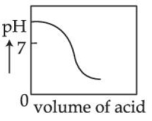
B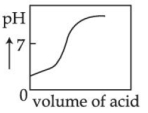
C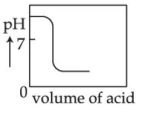
D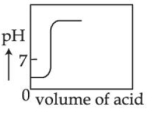
Solution
(A) The titration of a weak base $(NH_4OH)$ with a strong acid $(HCl)$ involves the addition of acid to the base.
Initially,the $pH$ is high (basic).
As the strong acid is added,the $pH$ decreases gradually.
Near the equivalence point,there is a sharp drop in $pH$.
Since the resulting salt $(NH_4Cl)$ is acidic due to the hydrolysis of the $NH_4^+$ ion,the equivalence point $pH$ is less than $7$.
Therefore,the correct plot shows a downward curve starting from a high $pH$ value.
Initially,the $pH$ is high (basic).
As the strong acid is added,the $pH$ decreases gradually.
Near the equivalence point,there is a sharp drop in $pH$.
Since the resulting salt $(NH_4Cl)$ is acidic due to the hydrolysis of the $NH_4^+$ ion,the equivalence point $pH$ is less than $7$.
Therefore,the correct plot shows a downward curve starting from a high $pH$ value.
0 likes
View Solution155
DifficultMCQ
$A$ weak acid is titrated with a weak base. Consider the following statements regarding the $pH$ of the solution at the equivalence point.
$(i)$ $pH$ depends on the concentration of acid and base
$(ii)$ $pH$ is independent of the concentration of acid and base
$(iii)$ $pH$ depends on the $pK_{a}$ of acid and $pK_{b}$ of base
$(iv)$ $pH$ is independent of the $pK_{a}$ of acid and $pK_{b}$ of base
The correct statements are
$(i)$ $pH$ depends on the concentration of acid and base
$(ii)$ $pH$ is independent of the concentration of acid and base
$(iii)$ $pH$ depends on the $pK_{a}$ of acid and $pK_{b}$ of base
$(iv)$ $pH$ is independent of the $pK_{a}$ of acid and $pK_{b}$ of base
The correct statements are
A
only $(i)$ and $(iii)$
B
only $(i)$ and $(iv)$
C
only $(ii)$ and $(iii)$
D
only $(ii)$ and $(iv)$
Solution
(C) The $pH$ at the equivalence point for the titration of a weak acid with a weak base is given by the formula:
$pH = \frac{1}{2}(pK_{w} + pK_{a} - pK_{b})$
From this expression,it is clear that the $pH$ is independent of the concentration of the acid and the base (statement $ii$ is correct,$i$ is incorrect).
The expression also shows that the $pH$ depends on the $pK_{a}$ of the acid and the $pK_{b}$ of the base (statement $iii$ is correct,$iv$ is incorrect).
Therefore,the correct statements are $(ii)$ and $(iii)$.
$pH = \frac{1}{2}(pK_{w} + pK_{a} - pK_{b})$
From this expression,it is clear that the $pH$ is independent of the concentration of the acid and the base (statement $ii$ is correct,$i$ is incorrect).
The expression also shows that the $pH$ depends on the $pK_{a}$ of the acid and the $pK_{b}$ of the base (statement $iii$ is correct,$iv$ is incorrect).
Therefore,the correct statements are $(ii)$ and $(iii)$.
0 likes
View Solution156
DifficultMCQ
The hydrogen ion concentration in a mixture of $10 \ mL$ of $0.1 \ M$ $H_2SO_4$ and $10 \ mL$ of $0.1 \ M$ $KOH$ solution in water,is . . . . . . $M$.
A
$0.1$
B
$0.05$
C
$0.2$
D
$0.02$
Solution
(B) $H_2SO_4$ is a diprotic acid,so $10 \ mL$ of $0.1 \ M$ $H_2SO_4$ provides $2 \times 10 \times 0.1 = 2 \ mmol$ of $H^{+}$ ions.
$KOH$ is a monoprotic base,so $10 \ mL$ of $0.1 \ M$ $KOH$ provides $10 \times 0.1 = 1 \ mmol$ of $OH^{-}$ ions.
After neutralization,the remaining $H^{+}$ ions $= 2 - 1 = 1 \ mmol$.
Total volume of the mixture $= 10 \ mL + 10 \ mL = 20 \ mL$.
Therefore,$[H^{+}] = \frac{1 \ mmol}{20 \ mL} = 0.05 \ M$.
$KOH$ is a monoprotic base,so $10 \ mL$ of $0.1 \ M$ $KOH$ provides $10 \times 0.1 = 1 \ mmol$ of $OH^{-}$ ions.
After neutralization,the remaining $H^{+}$ ions $= 2 - 1 = 1 \ mmol$.
Total volume of the mixture $= 10 \ mL + 10 \ mL = 20 \ mL$.
Therefore,$[H^{+}] = \frac{1 \ mmol}{20 \ mL} = 0.05 \ M$.
0 likes
View Solution157
MediumMCQ
$1 \times 10^{-5} \ S \ M$ $AgNO_3$ is added to $1 \ L$ of a saturated solution of $AgBr$. The conductivity of this solution at $298 \ K$ is $......... \times 10^{-8} \ S \ m^{-1}$.
Given: $K_{sp}(AgBr) = 4.9 \times 10^{-13}$ at $298 \ K$,$\lambda^0_{Ag^{+}} = 6 \times 10^{-3} \ S \ m^2 \ mol^{-1}$,$\lambda^0_{Br^{-}} = 8 \times 10^{-3} \ S \ m^2 \ mol^{-1}$,$\lambda^0_{NO_3^-} = 7 \times 10^{-3} \ S \ m^2 \ mol^{-1}$.
Given: $K_{sp}(AgBr) = 4.9 \times 10^{-13}$ at $298 \ K$,$\lambda^0_{Ag^{+}} = 6 \times 10^{-3} \ S \ m^2 \ mol^{-1}$,$\lambda^0_{Br^{-}} = 8 \times 10^{-3} \ S \ m^2 \ mol^{-1}$,$\lambda^0_{NO_3^-} = 7 \times 10^{-3} \ S \ m^2 \ mol^{-1}$.
A
$12$
B
$14$
C
$13$
D
$15$
Solution
(C) The concentration of $Ag^{+}$ ions from $AgNO_3$ is $[Ag^{+}] = 10^{-5} \ M$.
The concentration of $NO_3^{-}$ ions is $[NO_3^{-}] = 10^{-5} \ M$.
Due to the common ion effect,the concentration of $Br^{-}$ ions is determined by the solubility product constant: $[Br^{-}] = \frac{K_{sp}}{[Ag^{+}]} = \frac{4.9 \times 10^{-13}}{10^{-5}} = 4.9 \times 10^{-8} \ M$.
The conductivity $\kappa$ is given by $\kappa = \sum C_i \lambda_i$.
For $Ag^{+}$: $\kappa_{Ag^{+}} = 10^{-5} \times 6 \times 10^{-3} = 6 \times 10^{-8} \ S \ m^{-1}$.
For $Br^{-}$: $\kappa_{Br^{-}} = 4.9 \times 10^{-8} \times 8 \times 10^{-3} = 39.2 \times 10^{-11} \ S \ m^{-1} = 0.392 \times 10^{-8} \ S \ m^{-1}$.
For $NO_3^{-}$: $\kappa_{NO_3^{-}} = 10^{-5} \times 7 \times 10^{-3} = 7 \times 10^{-8} \ S \ m^{-1}$.
Total conductivity $\kappa = (6 + 0.392 + 7) \times 10^{-8} \ S \ m^{-1} = 13.392 \times 10^{-8} \ S \ m^{-1}$.
Rounding to the nearest integer,we get $13 \times 10^{-8} \ S \ m^{-1}$.
The concentration of $NO_3^{-}$ ions is $[NO_3^{-}] = 10^{-5} \ M$.
Due to the common ion effect,the concentration of $Br^{-}$ ions is determined by the solubility product constant: $[Br^{-}] = \frac{K_{sp}}{[Ag^{+}]} = \frac{4.9 \times 10^{-13}}{10^{-5}} = 4.9 \times 10^{-8} \ M$.
The conductivity $\kappa$ is given by $\kappa = \sum C_i \lambda_i$.
For $Ag^{+}$: $\kappa_{Ag^{+}} = 10^{-5} \times 6 \times 10^{-3} = 6 \times 10^{-8} \ S \ m^{-1}$.
For $Br^{-}$: $\kappa_{Br^{-}} = 4.9 \times 10^{-8} \times 8 \times 10^{-3} = 39.2 \times 10^{-11} \ S \ m^{-1} = 0.392 \times 10^{-8} \ S \ m^{-1}$.
For $NO_3^{-}$: $\kappa_{NO_3^{-}} = 10^{-5} \times 7 \times 10^{-3} = 7 \times 10^{-8} \ S \ m^{-1}$.
Total conductivity $\kappa = (6 + 0.392 + 7) \times 10^{-8} \ S \ m^{-1} = 13.392 \times 10^{-8} \ S \ m^{-1}$.
Rounding to the nearest integer,we get $13 \times 10^{-8} \ S \ m^{-1}$.
0 likes
View Solution158
MediumMCQ
For a concentrated solution of a weak electrolyte ($K_{eq} = $ equilibrium constant) $A_2B_3$ of concentration '$c$',the degree of dissociation '$\alpha$' is
A
$\left(\frac{K_{eq}}{108 c^4}\right)^{\frac{1}{5}}$
B
$\left(\frac{K_{eq}}{6 c^5}\right)^{\frac{1}{5}}$
C
$\left(\frac{K_{eq}}{5 c^4}\right)^{\frac{1}{5}}$
D
$\left(\frac{K_{eq}}{25 c^2}\right)^{\frac{1}{5}}$
Solution
(A) The dissociation reaction is: $A_2B_3 (aq.) \rightleftharpoons 2 A^{3+} (aq.) + 3 B^{2-} (aq.)$
At equilibrium,the concentrations are: $[A_2B_3] = c(1 - \alpha)$,$[A^{3+}] = 2c\alpha$,and $[B^{2-}] = 3c\alpha$.
The equilibrium constant expression is: $K_{eq} = \frac{[A^{3+}]^2 [B^{2-}]^3}{[A_2B_3]} = \frac{(2c\alpha)^2 (3c\alpha)^3}{c(1 - \alpha)}$.
For a weak electrolyte,$\alpha \ll 1$,so $(1 - \alpha) \approx 1$.
Thus,$K_{eq} = \frac{(4c^2\alpha^2)(27c^3\alpha^3)}{c} = 108c^4\alpha^5$.
Solving for $\alpha$: $\alpha^5 = \frac{K_{eq}}{108c^4} \implies \alpha = \left(\frac{K_{eq}}{108 c^4}\right)^{\frac{1}{5}}$.
At equilibrium,the concentrations are: $[A_2B_3] = c(1 - \alpha)$,$[A^{3+}] = 2c\alpha$,and $[B^{2-}] = 3c\alpha$.
The equilibrium constant expression is: $K_{eq} = \frac{[A^{3+}]^2 [B^{2-}]^3}{[A_2B_3]} = \frac{(2c\alpha)^2 (3c\alpha)^3}{c(1 - \alpha)}$.
For a weak electrolyte,$\alpha \ll 1$,so $(1 - \alpha) \approx 1$.
Thus,$K_{eq} = \frac{(4c^2\alpha^2)(27c^3\alpha^3)}{c} = 108c^4\alpha^5$.
Solving for $\alpha$: $\alpha^5 = \frac{K_{eq}}{108c^4} \implies \alpha = \left(\frac{K_{eq}}{108 c^4}\right)^{\frac{1}{5}}$.
0 likes
View Solution159
MediumMCQ
Which of the following statement$(s)$ is/are correct?
$ (A) $ The $pH$ of $1 \times 10^{-8} \ M \ HCl$ solution is $8$.
$ (B) $ The conjugate base of $H_2PO_4^{-}$ is $HPO_4^{2-}$.
$ (C) $ $K_w$ increases with increase in temperature.
$ (D) $ When a solution of weak monoprotic acid is titrated against a strong base at half neutralisation point,$pH = pK_a$.
Choose the correct answer from the option given below.
$ (A) $ The $pH$ of $1 \times 10^{-8} \ M \ HCl$ solution is $8$.
$ (B) $ The conjugate base of $H_2PO_4^{-}$ is $HPO_4^{2-}$.
$ (C) $ $K_w$ increases with increase in temperature.
$ (D) $ When a solution of weak monoprotic acid is titrated against a strong base at half neutralisation point,$pH = pK_a$.
Choose the correct answer from the option given below.
A
$ (B), (C), (D) $
B
$ (A), (D) $
C
$ (A), (B), (C) $
D
$ (B), (C) $
Solution
(A) $ (A) $ The $pH$ of $1 \times 10^{-8} \ M \ HCl$ is not $8$ because the contribution of $H^+$ ions from water cannot be neglected. The $pH$ is approximately $6.98$.
$ (B) $ The conjugate base of $H_2PO_4^{-}$ is obtained by removing one $H^+$ ion,which gives $HPO_4^{2-}$. This is correct.
$ (C) $ The auto-ionization of water is an endothermic process,so $K_w$ increases with an increase in temperature. This is correct.
$ (D) $ According to the Henderson-Hasselbalch equation,$pH = pK_a + \log \frac{[Salt]}{[Acid]}$. At the half-neutralization point,$[Salt] = [Acid]$,so $pH = pK_a$. This is correct.
$ (B) $ The conjugate base of $H_2PO_4^{-}$ is obtained by removing one $H^+$ ion,which gives $HPO_4^{2-}$. This is correct.
$ (C) $ The auto-ionization of water is an endothermic process,so $K_w$ increases with an increase in temperature. This is correct.
$ (D) $ According to the Henderson-Hasselbalch equation,$pH = pK_a + \log \frac{[Salt]}{[Acid]}$. At the half-neutralization point,$[Salt] = [Acid]$,so $pH = pK_a$. This is correct.
0 likes
View Solution160
DifficultMCQ
Given below are two statements :
Statement $I$ : Aqueous solution of ammonium carbonate is basic.
Statement $II$ : Acidic/basic nature of salt solution of a salt of weak acid and weak base depends on $K_a$ and $K_b$ value of acid and the base forming it.
In the light of the above statements,choose the most appropriate answer from the options given below :
Statement $I$ : Aqueous solution of ammonium carbonate is basic.
Statement $II$ : Acidic/basic nature of salt solution of a salt of weak acid and weak base depends on $K_a$ and $K_b$ value of acid and the base forming it.
In the light of the above statements,choose the most appropriate answer from the options given below :
A
Both Statement $I$ and Statement $II$ are correct
B
Statement $I$ is correct but Statement $II$ is incorrect
C
Both Statement $I$ and Statement $II$ are incorrect
D
Statement $I$ is incorrect but Statement $II$ is correct
Solution
(A) Ammonium carbonate $(NH_4)_2CO_3$ is a salt of a weak base $(NH_4OH)$ and a weak acid $(H_2CO_3)$.
The $pH$ of a salt solution formed from a weak acid and a weak base is given by the formula: $pH = 7 + \frac{1}{2}(pK_a - pK_b)$.
For $(NH_4)_2CO_3$,the $pK_a$ of $H_2CO_3$ is approximately $6.35$ and the $pK_b$ of $NH_4OH$ is approximately $4.75$. Since $pK_b < pK_a$,the solution is slightly basic.
Thus,both Statement $I$ and Statement $II$ are correct.
The $pH$ of a salt solution formed from a weak acid and a weak base is given by the formula: $pH = 7 + \frac{1}{2}(pK_a - pK_b)$.
For $(NH_4)_2CO_3$,the $pK_a$ of $H_2CO_3$ is approximately $6.35$ and the $pK_b$ of $NH_4OH$ is approximately $4.75$. Since $pK_b < pK_a$,the solution is slightly basic.
Thus,both Statement $I$ and Statement $II$ are correct.
0 likes
View Solution161
DifficultMCQ
The species present in solution when $CO_2$ is dissolved in water are
A
$CO_2, H_2CO_3, HCO_3^-, CO_3^{2-}$
B
$H_2CO_3, CO_3^{2-}$
C
$CO_3^{2-}, HCO_3^-$
D
$CO_2, H_2CO_3$
Solution
(A) When $CO_2$ dissolves in water,it forms carbonic acid $(H_2CO_3)$.
$H_2CO_3$ is a weak diprotic acid that undergoes partial dissociation in two steps:
$CO_2 + H_2O \rightleftharpoons H_2CO_3$
$H_2CO_3 \rightleftharpoons H^+ + HCO_3^-$
$HCO_3^- \rightleftharpoons H^+ + CO_3^{2-}$
Therefore,the species present in the equilibrium mixture are $CO_2$,$H_2CO_3$,$HCO_3^-$,and $CO_3^{2-}$.
$H_2CO_3$ is a weak diprotic acid that undergoes partial dissociation in two steps:
$CO_2 + H_2O \rightleftharpoons H_2CO_3$
$H_2CO_3 \rightleftharpoons H^+ + HCO_3^-$
$HCO_3^- \rightleftharpoons H^+ + CO_3^{2-}$
Therefore,the species present in the equilibrium mixture are $CO_2$,$H_2CO_3$,$HCO_3^-$,and $CO_3^{2-}$.
0 likes
View Solution162
AdvancedMCQ
$2.5 \ mL$ of $\frac{2}{5} \ M$ weak monoacidic base ($K_{b} = 1 \times 10^{-12}$ at $25^{\circ} C$) is titrated with $\frac{2}{15} \ M \ HCl$ in water at $25^{\circ} C$. The concentration of $H^{+}$ at equivalence point is ($K_W = 1 \times 10^{-14}$ at $25^{\circ} C$).
A
$3.7 \times 10^{-13} \ M$
B
$3.2 \times 10^{-7} \ M$
C
$3.2 \times 10^{-2} \ M$
D
$2.7 \times 10^{-2} \ M$
Solution
(C) The reaction is $BOH + HCl \longrightarrow BCl + H_2O$.
At the equivalence point,the salt $BCl$ is formed.
The moles of $BOH = 2.5 \ mL \times 0.4 \ M = 1.0 \ mmol$.
The volume of $HCl$ required $= \frac{1.0 \ mmol}{2/15 \ M} = 7.5 \ mL$.
Total volume at equivalence point $= 2.5 \ mL + 7.5 \ mL = 10 \ mL$.
Concentration of salt $C = \frac{1.0 \ mmol}{10 \ mL} = 0.1 \ M$.
For the salt of a weak base and strong acid,$[H^{+}] = \sqrt{\frac{K_W \times C}{K_b}}$.
$[H^{+}] = \sqrt{\frac{10^{-14} \times 0.1}{10^{-12}}} = \sqrt{10^{-3}} = \sqrt{10 \times 10^{-4}} \approx 3.16 \times 10^{-2} \ M$.
At the equivalence point,the salt $BCl$ is formed.
The moles of $BOH = 2.5 \ mL \times 0.4 \ M = 1.0 \ mmol$.
The volume of $HCl$ required $= \frac{1.0 \ mmol}{2/15 \ M} = 7.5 \ mL$.
Total volume at equivalence point $= 2.5 \ mL + 7.5 \ mL = 10 \ mL$.
Concentration of salt $C = \frac{1.0 \ mmol}{10 \ mL} = 0.1 \ M$.
For the salt of a weak base and strong acid,$[H^{+}] = \sqrt{\frac{K_W \times C}{K_b}}$.
$[H^{+}] = \sqrt{\frac{10^{-14} \times 0.1}{10^{-12}}} = \sqrt{10^{-3}} = \sqrt{10 \times 10^{-4}} \approx 3.16 \times 10^{-2} \ M$.
0 likes
View Solution163
AdvancedMCQ
On decreasing the $pH$ from $7$ to $2$,the solubility of a sparingly soluble salt $(MX)$ of a weak acid $(HX)$ increased from $10^{-4} \ mol \ L^{-1}$ to $10^{-3} \ mol \ L^{-1}$. The $pK_{a}$ of $HX$ is:
A
$3$
B
$4$
C
$5$
D
$2$
Solution
(B) At $pH = 7$,the salt $MX$ dissociates as $MX_{(s)} \rightleftharpoons M^+_{(aq)} + X^-_{(aq)}$. The solubility $S_1 = \sqrt{K_{sp}} = 10^{-4} \ mol \ L^{-1}$,so $K_{sp} = 10^{-8}$.
At $pH = 2$,$[H^+] = 10^{-2} \ M$. The salt dissociates and $X^-$ reacts with $H^+$: $X^-_{(aq)} + H^+_{(aq)} \rightleftharpoons HX_{(aq)}$.
The equilibrium constant for this reaction is $K = \frac{1}{K_a}$.
The total solubility $S = [M^+] = [X^-] + [HX] = 10^{-3} \ M$.
From $K_{sp} = [M^+][X^-]$,we have $[X^-] = \frac{K_{sp}}{[M^+]} = \frac{10^{-8}}{10^{-3}} = 10^{-5} \ M$.
Thus,$[HX] = S - [X^-] = 10^{-3} - 10^{-5} \approx 10^{-3} \ M$.
Using the equilibrium expression for $HX$ formation: $K_a = \frac{[H^+][X^-]}{[HX]} = \frac{10^{-2} \times 10^{-5}}{10^{-3}} = 10^{-4}$.
Therefore,$pK_a = -\log(10^{-4}) = 4$.
At $pH = 2$,$[H^+] = 10^{-2} \ M$. The salt dissociates and $X^-$ reacts with $H^+$: $X^-_{(aq)} + H^+_{(aq)} \rightleftharpoons HX_{(aq)}$.
The equilibrium constant for this reaction is $K = \frac{1}{K_a}$.
The total solubility $S = [M^+] = [X^-] + [HX] = 10^{-3} \ M$.
From $K_{sp} = [M^+][X^-]$,we have $[X^-] = \frac{K_{sp}}{[M^+]} = \frac{10^{-8}}{10^{-3}} = 10^{-5} \ M$.
Thus,$[HX] = S - [X^-] = 10^{-3} - 10^{-5} \approx 10^{-3} \ M$.
Using the equilibrium expression for $HX$ formation: $K_a = \frac{[H^+][X^-]}{[HX]} = \frac{10^{-2} \times 10^{-5}}{10^{-3}} = 10^{-4}$.
Therefore,$pK_a = -\log(10^{-4}) = 4$.
0 likes
View Solution164
AdvancedMCQ
Dilution processes of different aqueous solutions with water are given in $LIST-I$. The effects of dilution of the solutions on $[H^{+}]$ are given in $LIST-II$. (Note: Degree of dissociation $(\alpha)$ of weak acid and weak base is $ << 1$; degree of hydrolysis of salt $ << 1$; $[H^{+}]$ represents the concentration of $H^{+}$ ions)
Match each process given in $LIST-I$ with one or more effect$(s)$ in $LIST-II$. The correct option is:
| $LIST-I$ | $LIST-II$ |
|---|---|
| $P$. ($10 \ mL$ of $0.1 \ M$ $NaOH$ + $20 \ mL$ of $0.1 \ M$ acetic acid) diluted to $60 \ mL$ | $1$. The value of $[H^{+}]$ does not change on dilution |
| $Q$. ($20 \ mL$ of $0.1 \ M$ $NaOH$ + $20 \ mL$ of $0.1 \ M$ acetic acid) diluted to $80 \ mL$ | $2$. The value of $[H^{+}]$ changes to half of its initial value on dilution |
| $R$. ($20 \ mL$ of $0.1 \ M$ $HCl$ + $20 \ mL$ of $0.1 \ M$ ammonia solution) diluted to $80 \ mL$ | $3$. The value of $[H^{+}]$ changes to $1/\sqrt{2}$ times of its initial value on dilution |
| $S$. $10 \ mL$ saturated solution of $Ni(OH)_2$ in equilibrium with excess solid $Ni(OH)_2$ is diluted to $20 \ mL$ (solid $Ni(OH)_2$ is still present after dilution) | $4$. The value of $[H^{+}]$ changes to $\sqrt{2}$ times of its initial value on dilution |
Match each process given in $LIST-I$ with one or more effect$(s)$ in $LIST-II$. The correct option is:
A
$P$ $\rightarrow 1, Q$ $\rightarrow 4, R$ $\rightarrow 3, S$ $\rightarrow 1$
B
$P$ $\rightarrow 4, Q$ $\rightarrow 3, R$ $\rightarrow 2, S$ $\rightarrow 3$
C
$P$ $\rightarrow 1, Q$ $\rightarrow 4, R$ $\rightarrow 5, S$ $\rightarrow 3$
D
$P$ $\rightarrow 1, Q$ $\rightarrow 5, R$ $\rightarrow 4, S$ $\rightarrow 1$
Solution
(A) $P$: This is an acidic buffer solution $(CH_3COOH + CH_3COONa)$. The $[H^{+}]$ of a buffer solution remains constant upon dilution. Thus,$P \rightarrow 1$.
$Q$: This is a salt of a weak acid and a strong base $(CH_3COONa)$. The $[H^{+}]$ is given by $[H^{+}] = \sqrt{K_w K_a / C}$. Since $[H^{+}] \propto 1/\sqrt{C}$,and the concentration $C$ decreases by a factor of $2$ (from $40 \ mL$ to $80 \ mL$),$[H^{+}]$ increases by $\sqrt{2}$. Thus,$Q \rightarrow 4$.
$R$: This is a salt of a strong acid and a weak base $(NH_4Cl)$. The $[H^{+}]$ is given by $[H^{+}] = \sqrt{K_h C} = \sqrt{(K_w/K_b) C}$. Since $[H^{+}] \propto \sqrt{C}$,and the concentration $C$ decreases by a factor of $2$ (from $40 \ mL$ to $80 \ mL$),$[H^{+}]$ decreases by $1/\sqrt{2}$. Thus,$R \rightarrow 3$.
$S$: This is a saturated solution of a sparingly soluble base in equilibrium with its solid. The $[OH^{-}]$ remains constant due to the common ion effect of the solid. Since $[H^{+}][OH^{-}] = K_w$,$[H^{+}]$ remains constant. Thus,$S \rightarrow 1$.
Therefore,the correct matching is $P$ $\rightarrow 1, Q$ $\rightarrow 4, R$ $\rightarrow 3, S$ $\rightarrow 1$.
$Q$: This is a salt of a weak acid and a strong base $(CH_3COONa)$. The $[H^{+}]$ is given by $[H^{+}] = \sqrt{K_w K_a / C}$. Since $[H^{+}] \propto 1/\sqrt{C}$,and the concentration $C$ decreases by a factor of $2$ (from $40 \ mL$ to $80 \ mL$),$[H^{+}]$ increases by $\sqrt{2}$. Thus,$Q \rightarrow 4$.
$R$: This is a salt of a strong acid and a weak base $(NH_4Cl)$. The $[H^{+}]$ is given by $[H^{+}] = \sqrt{K_h C} = \sqrt{(K_w/K_b) C}$. Since $[H^{+}] \propto \sqrt{C}$,and the concentration $C$ decreases by a factor of $2$ (from $40 \ mL$ to $80 \ mL$),$[H^{+}]$ decreases by $1/\sqrt{2}$. Thus,$R \rightarrow 3$.
$S$: This is a saturated solution of a sparingly soluble base in equilibrium with its solid. The $[OH^{-}]$ remains constant due to the common ion effect of the solid. Since $[H^{+}][OH^{-}] = K_w$,$[H^{+}]$ remains constant. Thus,$S \rightarrow 1$.
Therefore,the correct matching is $P$ $\rightarrow 1, Q$ $\rightarrow 4, R$ $\rightarrow 3, S$ $\rightarrow 1$.
0 likes
View Solution165
DifficultMCQ
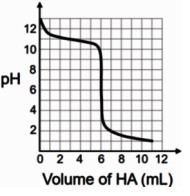
$A$ solution of $0.1 \ M$ weak base $(B)$ is titrated with $0.1 \ M$ of a strong acid $(HA)$. The variation of $pH$ of the solution with the volume of $HA$ added is shown in the figure below. What is the $pK_{b}$ of the base? The neutralization reaction is given by $B + HA \rightarrow BH^{+} + A^{-}$.
A
$2.60$
B
$2.80$
C
$2.85$
D
$2.90$
Solution
(C) From the titration curve,the equivalence point is reached at $V = 6 \ mL$ of $HA$ added.
At the half-equivalence point,$V = 3 \ mL$,the concentration of the weak base $[B]$ is equal to the concentration of its conjugate acid $[BH^{+}]$.
According to the Henderson-Hasselbalch equation for a weak base:
$pOH = pK_{b} + \log\left(\frac{[BH^{+}]}{[B]}\right)$
At the half-equivalence point,$[BH^{+}] = [B]$,so $\log(1) = 0$.
Therefore,$pOH = pK_{b}$.
From the graph,at $V = 3 \ mL$,the $pH$ is approximately $11.15$.
Since $pH + pOH = 14$ at $25^{\circ}C$,we have $pOH = 14 - 11.15 = 2.85$.
Thus,$pK_{b} = 2.85$.
At the half-equivalence point,$V = 3 \ mL$,the concentration of the weak base $[B]$ is equal to the concentration of its conjugate acid $[BH^{+}]$.
According to the Henderson-Hasselbalch equation for a weak base:
$pOH = pK_{b} + \log\left(\frac{[BH^{+}]}{[B]}\right)$
At the half-equivalence point,$[BH^{+}] = [B]$,so $\log(1) = 0$.
Therefore,$pOH = pK_{b}$.
From the graph,at $V = 3 \ mL$,the $pH$ is approximately $11.15$.
Since $pH + pOH = 14$ at $25^{\circ}C$,we have $pOH = 14 - 11.15 = 2.85$.
Thus,$pK_{b} = 2.85$.
0 likes
View Solution166
DifficultMCQ
The initial rate of hydrolysis of methyl acetate $(1 \ M)$ by a weak acid $(HA, 1 \ M)$ is $1/100$th of that of a strong acid $(HX, 1 \ M)$ at $25^{\circ} C$. The $K_a$ of $HA$ is:
A
$1 \times 10^{-4}$
B
$1 \times 10^{-5}$
C
$1 \times 10^{-6}$
D
$1 \times 10^{-3}$
Solution
(A) The rate of acid-catalyzed hydrolysis of an ester is directly proportional to the concentration of $H^+$ ions,i.e.,$Rate \propto [H^+]$.
For a strong acid $(HX, 1 \ M)$,$[H^+]_{HX} = 1 \ M$.
Given that the rate with $HA$ is $1/100$th of the rate with $HX$,we have:
$\frac{Rate_{HA}}{Rate_{HX}} = \frac{[H^+]_{HA}}{[H^+]_{HX}} = \frac{1}{100}$
Since $[H^+]_{HX} = 1 \ M$,then $[H^+]_{HA} = 0.01 \ M$.
For the weak acid dissociation: $HA \rightleftharpoons H^+ + A^-$.
At equilibrium,$[H^+] = [A^-] = 0.01 \ M$ and $[HA] = 1 - 0.01 \approx 1 \ M$.
The acid dissociation constant $K_a$ is given by:
$K_a = \frac{[H^+][A^-]}{[HA]} = \frac{(0.01)(0.01)}{1} = 10^{-4}$.
For a strong acid $(HX, 1 \ M)$,$[H^+]_{HX} = 1 \ M$.
Given that the rate with $HA$ is $1/100$th of the rate with $HX$,we have:
$\frac{Rate_{HA}}{Rate_{HX}} = \frac{[H^+]_{HA}}{[H^+]_{HX}} = \frac{1}{100}$
Since $[H^+]_{HX} = 1 \ M$,then $[H^+]_{HA} = 0.01 \ M$.
For the weak acid dissociation: $HA \rightleftharpoons H^+ + A^-$.
At equilibrium,$[H^+] = [A^-] = 0.01 \ M$ and $[HA] = 1 - 0.01 \approx 1 \ M$.
The acid dissociation constant $K_a$ is given by:
$K_a = \frac{[H^+][A^-]}{[HA]} = \frac{(0.01)(0.01)}{1} = 10^{-4}$.
0 likes
View Solution167
Advanced
When $100 \ mL$ of $1.0 \ M \ HCl$ was mixed with $100 \ mL$ of $1.0 \ M \ NaOH$ in an insulated beaker at constant pressure,a temperature increase of $5.7^{\circ} C$ was measured for the beaker and its contents (Expt. $1$). Because the enthalpy of neutralization of a strong acid with a strong base is a constant $\left(-57.0 \ kJ \ mol ^{-1}\right)$,this experiment could be used to measure the calorimeter constant. In a second experiment (Expt. $2$),$100 \ mL$ of $2.0 \ M$ acetic acid $\left(K_a=2.0 \times 10^{-5}\right)$ was mixed with $100 \ mL$ of $1.0 \ M \ NaOH$ (under identical conditions to Expt. $1$) where a temperature rise of $5.6^{\circ} C$ was measured.
(Consider heat capacity of all solutions as $4.2 \ J \ g ^{-1} K ^{-1}$ and density of all solutions as $1.0 \ g \ mL ^{-1}$)
$1.$ Enthalpy of dissociation (in $kJ \ mol ^{-1}$) of acetic acid obtained from the Expt. $2$ is
$(A) \ 1.0 \ (B) \ 10.0 \ (C) \ 24.5 \ (D) \ 51.4$
$2.$ The $pH$ of the solution after Expt. $2$ is
$(A) \ 2.8 \ (B) \ 4.7 \ (C) \ 5.0 \ (D) \ 7.0$
Give the answer for question $1$ and $2.$
(Consider heat capacity of all solutions as $4.2 \ J \ g ^{-1} K ^{-1}$ and density of all solutions as $1.0 \ g \ mL ^{-1}$)
$1.$ Enthalpy of dissociation (in $kJ \ mol ^{-1}$) of acetic acid obtained from the Expt. $2$ is
$(A) \ 1.0 \ (B) \ 10.0 \ (C) \ 24.5 \ (D) \ 51.4$
$2.$ The $pH$ of the solution after Expt. $2$ is
$(A) \ 2.8 \ (B) \ 4.7 \ (C) \ 5.0 \ (D) \ 7.0$
Give the answer for question $1$ and $2.$
Solution
(A) $1.$ $HCl + NaOH \longrightarrow NaCl + H_2O$
$n = 100 \times 1 = 100 \ mmol = 0.1 \ mol$
Energy evolved due to neutralization of $HCl$ and $NaOH = 0.1 \times 57 = 5.7 \ kJ = 5700 \ J$
Energy used to increase temperature of solution $= 200 \times 4.2 \times 5.7 = 4788 \ J$
Energy used to increase temperature of calorimeter $= 5700 - 4788 = 912 \ J$
Calorimeter constant $(C_{cal}) = \frac{912 \ J}{5.7^{\circ}C} = 160 \ J/^{\circ}C$
Energy evolved by neutralization of $CH_3COOH$ and $NaOH$ in Expt. $2$ $= (200 \times 4.2 \times 5.6) + (160 \times 5.6) = 4704 + 896 = 5600 \ J$
Energy used in dissociation of $0.1 \ mol \ CH_3COOH = 5700 - 5600 = 100 \ J = 0.1 \ kJ$
Enthalpy of dissociation $= \frac{0.1 \ kJ}{0.1 \ mol} = 1.0 \ kJ \ mol^{-1}$
$2.$ After mixing,$[CH_3COOH] = \frac{100 \times 2 - 100 \times 1}{200} = 0.5 \ M$ and $[CH_3COONa] = \frac{100 \times 1}{200} = 0.5 \ M$
$pK_a = -\log(2.0 \times 10^{-5}) = 5 - \log 2 = 5 - 0.3 = 4.7$
Using Henderson-Hasselbalch equation: $pH = pK_a + \log \frac{[salt]}{[acid]} = 4.7 + \log \frac{0.5}{0.5} = 4.7$
$n = 100 \times 1 = 100 \ mmol = 0.1 \ mol$
Energy evolved due to neutralization of $HCl$ and $NaOH = 0.1 \times 57 = 5.7 \ kJ = 5700 \ J$
Energy used to increase temperature of solution $= 200 \times 4.2 \times 5.7 = 4788 \ J$
Energy used to increase temperature of calorimeter $= 5700 - 4788 = 912 \ J$
Calorimeter constant $(C_{cal}) = \frac{912 \ J}{5.7^{\circ}C} = 160 \ J/^{\circ}C$
Energy evolved by neutralization of $CH_3COOH$ and $NaOH$ in Expt. $2$ $= (200 \times 4.2 \times 5.6) + (160 \times 5.6) = 4704 + 896 = 5600 \ J$
Energy used in dissociation of $0.1 \ mol \ CH_3COOH = 5700 - 5600 = 100 \ J = 0.1 \ kJ$
Enthalpy of dissociation $= \frac{0.1 \ kJ}{0.1 \ mol} = 1.0 \ kJ \ mol^{-1}$
$2.$ After mixing,$[CH_3COOH] = \frac{100 \times 2 - 100 \times 1}{200} = 0.5 \ M$ and $[CH_3COONa] = \frac{100 \times 1}{200} = 0.5 \ M$
$pK_a = -\log(2.0 \times 10^{-5}) = 5 - \log 2 = 5 - 0.3 = 4.7$
Using Henderson-Hasselbalch equation: $pH = pK_a + \log \frac{[salt]}{[acid]} = 4.7 + \log \frac{0.5}{0.5} = 4.7$
0 likes
View Solution168
MediumMCQ
Which of the following statement$(s)$ is/are correct.
$A$. The $pH$ of $1 \times 10^{-8} \ M$ aqueous solution of $HCl$ is $8$
$B$. The conjugate base of $H_2PO_4^{\ominus}$ is $HPO_4^{2-}$
$C$. $K_w$ increases with increase in temperature
$D$. When a solution of a weak monoprotic acid is titrated against a strong base,then at the half-neutralization point,$pH = pK_a$.
$A$. The $pH$ of $1 \times 10^{-8} \ M$ aqueous solution of $HCl$ is $8$
$B$. The conjugate base of $H_2PO_4^{\ominus}$ is $HPO_4^{2-}$
$C$. $K_w$ increases with increase in temperature
$D$. When a solution of a weak monoprotic acid is titrated against a strong base,then at the half-neutralization point,$pH = pK_a$.
A
$A, D$
B
$B, C$
C
$A, B, C$
D
$B, C, D$
Solution
(B) . Incorrect. For a very dilute acid solution $(1 \times 10^{-8} \ M)$,the contribution of $H^{\oplus}$ from water cannot be ignored. The $pH$ will be slightly less than $7$,not $8$.
$B$. Correct. The conjugate base is formed by the removal of a proton $(H^{\oplus})$: $H_2PO_4^{\ominus} \rightarrow HPO_4^{2-} + H^{\oplus}$.
$C$. Correct. The auto-ionization of water is an endothermic process; thus,$K_w$ increases as temperature increases.
$D$. Incorrect. At the half-neutralization point of a weak acid titrated with a strong base,the Henderson-Hasselbalch equation gives $pH = pK_a + \log(\frac{[Salt]}{[Acid]})$. Since $[Salt] = [Acid]$,$pH = pK_a$.
$B$. Correct. The conjugate base is formed by the removal of a proton $(H^{\oplus})$: $H_2PO_4^{\ominus} \rightarrow HPO_4^{2-} + H^{\oplus}$.
$C$. Correct. The auto-ionization of water is an endothermic process; thus,$K_w$ increases as temperature increases.
$D$. Incorrect. At the half-neutralization point of a weak acid titrated with a strong base,the Henderson-Hasselbalch equation gives $pH = pK_a + \log(\frac{[Salt]}{[Acid]})$. Since $[Salt] = [Acid]$,$pH = pK_a$.
0 likes
View Solution169
MediumMCQ
The incorrect relation for isohydric solutions is $:-$
A
$[H^{+}]_1 = [H^{+}]_2$
B
$K_{a_1} C_1 = K_{a_2} C_2$
C
$\frac{K_{a_1}}{V_2} = \frac{K_{a_2}}{V_1}$
D
None of these
Solution
(C) Isohydric solutions are those solutions which have the same concentration of hydrogen ions $([H^{+}])$.
For a weak acid $HA$,the concentration of $H^{+}$ is given by $[H^{+}] = \sqrt{K_a \cdot C}$.
For two isohydric solutions,$[H^{+}]_1 = [H^{+}]_2$.
Therefore,$\sqrt{K_{a_1} C_1} = \sqrt{K_{a_2} C_2}$,which implies $K_{a_1} C_1 = K_{a_2} C_2$.
Since $C = \frac{1}{V}$ (where $V$ is dilution),we can write $K_{a_1} \cdot \frac{1}{V_1} = K_{a_2} \cdot \frac{1}{V_2}$,which simplifies to $K_{a_1} V_2 = K_{a_2} V_1$ or $\frac{K_{a_1}}{V_1} = \frac{K_{a_2}}{V_2}$.
Option $C$ states $\frac{K_{a_1}}{V_2} = \frac{K_{a_2}}{V_1}$,which is mathematically incorrect.
For a weak acid $HA$,the concentration of $H^{+}$ is given by $[H^{+}] = \sqrt{K_a \cdot C}$.
For two isohydric solutions,$[H^{+}]_1 = [H^{+}]_2$.
Therefore,$\sqrt{K_{a_1} C_1} = \sqrt{K_{a_2} C_2}$,which implies $K_{a_1} C_1 = K_{a_2} C_2$.
Since $C = \frac{1}{V}$ (where $V$ is dilution),we can write $K_{a_1} \cdot \frac{1}{V_1} = K_{a_2} \cdot \frac{1}{V_2}$,which simplifies to $K_{a_1} V_2 = K_{a_2} V_1$ or $\frac{K_{a_1}}{V_1} = \frac{K_{a_2}}{V_2}$.
Option $C$ states $\frac{K_{a_1}}{V_2} = \frac{K_{a_2}}{V_1}$,which is mathematically incorrect.
0 likes
View Solution170
MediumMCQ
An acid dissociated to $1.5 \%$ in its $0.1 \ M$ solution. Calculate its dissociation constant.
A
$1.2 \times 10^{-5}$
B
$2.25 \times 10^{-5}$
C
$1.1 \times 10^{-5}$
D
$1.5 \times 10^{-5}$
Solution
(B) For a weak acid,the dissociation constant $K_a$ is given by the formula $K_a = C \alpha^2$,where $C$ is the concentration and $\alpha$ is the degree of dissociation.
Given: $C = 0.1 \ M$ and $\alpha = 1.5 \% = \frac{1.5}{100} = 0.015$.
Substituting the values:
$K_a = 0.1 \times (0.015)^2$
$K_a = 0.1 \times 0.000225$
$K_a = 2.25 \times 10^{-5}$
Given: $C = 0.1 \ M$ and $\alpha = 1.5 \% = \frac{1.5}{100} = 0.015$.
Substituting the values:
$K_a = 0.1 \times (0.015)^2$
$K_a = 0.1 \times 0.000225$
$K_a = 2.25 \times 10^{-5}$
0 likes
View Solution171
MediumMCQ
What is the percent dissociation of $NH_4OH$ if the molar conductance at zero concentration for $NH_4Cl, NaCl$,and $NaOH$ are $130, 109$,and $213 \ S \ cm^2 \ mol^{-1}$ respectively,and the molar conductivity of $0.01 \ M \ NH_4OH$ is $9.0 \ S \ cm^2 \ mol^{-1}$?
A
$\frac{100}{40}$
B
$\frac{100}{35}$
C
$\frac{100}{32}$
D
$\frac{100}{26}$
Solution
(D) According to Kohlrausch's law,the molar conductivity at infinite dilution for $NH_4OH$ is given by: $\Lambda^0_{m}(NH_4OH) = \Lambda^0_{m}(NH_4Cl) + \Lambda^0_{m}(NaOH) - \Lambda^0_{m}(NaCl)$.
Substituting the given values: $\Lambda^0_{m}(NH_4OH) = 130 + 213 - 109 = 234 \ S \ cm^2 \ mol^{-1}$.
The degree of dissociation $(\alpha)$ is calculated as: $\alpha = \frac{\Lambda^m_c}{\Lambda^0_m} = \frac{9.0}{234}$.
The percent dissociation is: $\alpha \times 100 = \frac{9.0 \times 100}{234} = \frac{900}{234} = \frac{100}{26} \%$.
Substituting the given values: $\Lambda^0_{m}(NH_4OH) = 130 + 213 - 109 = 234 \ S \ cm^2 \ mol^{-1}$.
The degree of dissociation $(\alpha)$ is calculated as: $\alpha = \frac{\Lambda^m_c}{\Lambda^0_m} = \frac{9.0}{234}$.
The percent dissociation is: $\alpha \times 100 = \frac{9.0 \times 100}{234} = \frac{900}{234} = \frac{100}{26} \%$.
0 likes
View Solution172
MediumMCQ
What is the degree of dissociation of $CH_3COOH$ if $\wedge^{\circ}(CH_3COO^{-}) = 50 \ S \ cm^2 \ mol^{-1}$,$\wedge^{\circ}(H^{+}) = 350 \ S \ cm^2 \ mol^{-1}$ and the molar conductivity of $5 \times 10^{-2} \ M \ CH_3COOH$ is $20 \ S \ cm^2 \ mol^{-1}$?
A
$1.25 \times 10^{-4}$
B
$1.25 \times 10^{-2}$
C
$5 \times 10^{-2}$
D
$5 \times 10^{-4}$
Solution
(C) The degree of dissociation $(\alpha)$ is given by the formula: $\alpha = \frac{\wedge_m^c}{\wedge_m^{\circ}}$.
First,calculate the molar conductivity at infinite dilution $(\wedge_m^{\circ})$ for $CH_3COOH$ using Kohlrausch's law:
$\wedge_m^{\circ}(CH_3COOH) = \wedge^{\circ}(CH_3COO^{-}) + \wedge^{\circ}(H^{+}) = 50 + 350 = 400 \ S \ cm^2 \ mol^{-1}$.
Given the molar conductivity at concentration $c$ $(\wedge_m^c)$ is $20 \ S \ cm^2 \ mol^{-1}$.
Now,calculate $\alpha$:
$\alpha = \frac{20}{400} = \frac{1}{20} = 0.05 = 5 \times 10^{-2}$.
First,calculate the molar conductivity at infinite dilution $(\wedge_m^{\circ})$ for $CH_3COOH$ using Kohlrausch's law:
$\wedge_m^{\circ}(CH_3COOH) = \wedge^{\circ}(CH_3COO^{-}) + \wedge^{\circ}(H^{+}) = 50 + 350 = 400 \ S \ cm^2 \ mol^{-1}$.
Given the molar conductivity at concentration $c$ $(\wedge_m^c)$ is $20 \ S \ cm^2 \ mol^{-1}$.
Now,calculate $\alpha$:
$\alpha = \frac{20}{400} = \frac{1}{20} = 0.05 = 5 \times 10^{-2}$.
0 likes
View Solution173
DifficultMCQ
In a solution,$0.02 \ M$ acetic acid is $4 \%$ dissociated. The $[OH^{-}]$ in the solution is
A
$8 \times 10^{-4}$
B
$2 \times 10^{-14}$
C
$8 \times 10^{10}$
D
$1.25 \times 10^{-11}$
Solution
(D) The concentration of $H^{+}$ ions is given by $[H^{+}] = C \cdot \alpha = 0.02 \times 0.04 = 8 \times 10^{-4} \ M$.
Using the ionic product of water,$[H^{+}][OH^{-}] = 10^{-14}$.
Therefore,$[OH^{-}] = \frac{10^{-14}}{8 \times 10^{-4}} = 1.25 \times 10^{-11} \ M$.
Using the ionic product of water,$[H^{+}][OH^{-}] = 10^{-14}$.
Therefore,$[OH^{-}] = \frac{10^{-14}}{8 \times 10^{-4}} = 1.25 \times 10^{-11} \ M$.
0 likes
View Solution174
DifficultMCQ
The number of hydroxyl ions in $10 \text{ cm}^3$ of $0.2 \text{ M}$ $HCl$ solution is
A
$5 \times 10^{-14}$
B
$3 \times 10^9$
C
$3 \times 10^{12}$
D
$5 \times 10^{-12}$
Solution
(C) Given: $[H^{+}] = 0.2 \text{ M}$,Volume $V = 10 \text{ cm}^3 = 10^{-2} \text{ L}$.
At $298 \text{ K}$,the ionic product of water is $K_w = [H^{+}][OH^{-}] = 10^{-14}$.
$[OH^{-}] = \frac{K_w}{[H^{+}]} = \frac{10^{-14}}{0.2} = 5 \times 10^{-14} \text{ mol/L}$.
Number of $OH^{-}$ ions $= [OH^{-}] \times V \times N_A$.
$= (5 \times 10^{-14} \text{ mol/L}) \times (10^{-2} \text{ L}) \times (6.022 \times 10^{23} \text{ ions/mol}) \approx 3.011 \times 10^8$.
Note: The calculated value is $3.011 \times 10^8$. The provided option $(c)$ $3 \times 10^{12}$ is mathematically inconsistent with the given parameters.
At $298 \text{ K}$,the ionic product of water is $K_w = [H^{+}][OH^{-}] = 10^{-14}$.
$[OH^{-}] = \frac{K_w}{[H^{+}]} = \frac{10^{-14}}{0.2} = 5 \times 10^{-14} \text{ mol/L}$.
Number of $OH^{-}$ ions $= [OH^{-}] \times V \times N_A$.
$= (5 \times 10^{-14} \text{ mol/L}) \times (10^{-2} \text{ L}) \times (6.022 \times 10^{23} \text{ ions/mol}) \approx 3.011 \times 10^8$.
Note: The calculated value is $3.011 \times 10^8$. The provided option $(c)$ $3 \times 10^{12}$ is mathematically inconsistent with the given parameters.
0 likes
View Solution175
EasyMCQ
$0.1 \ M$ solution of which of the following has almost unity degree of dissociation?
A
Ammonium chloride
B
Potassium chloride
C
Sodium acetate
D
All of the above
Solution
(B) The degree of dissociation $(\alpha)$ is almost unity for strong electrolytes,which dissociate completely in aqueous solution.
$KCl$ (Potassium chloride) is a strong electrolyte.
$NH_4Cl$ (Ammonium chloride) is a salt of a weak base and a strong acid,which undergoes hydrolysis.
$CH_3COONa$ (Sodium acetate) is a salt of a weak acid and a strong base,which also undergoes hydrolysis.
Therefore,only $KCl$ has a degree of dissociation close to $1$.
$KCl$ (Potassium chloride) is a strong electrolyte.
$NH_4Cl$ (Ammonium chloride) is a salt of a weak base and a strong acid,which undergoes hydrolysis.
$CH_3COONa$ (Sodium acetate) is a salt of a weak acid and a strong base,which also undergoes hydrolysis.
Therefore,only $KCl$ has a degree of dissociation close to $1$.
0 likes
View Solution176
MediumMCQ
The increasing order of $pH$ of $0.1 \ M$ solution of the following compounds is:
A
$HCl < NaCl < NaCN < NH_4NO_3$
B
$NH_4NO_3 < HCl < NaCl < NaCN$
C
$NaCN < HCl < NH_4NO_3 < NaCl$
D
$HCl < NH_4NO_3 < NaCl < NaCN$
Solution
(D) $HCl$ is a strong acid $(SA)$,so its $pH$ is very low (approx $1$).
$NH_4NO_3$ is a salt of a strong acid and a weak base $(SAWB)$,which undergoes cationic hydrolysis,making the solution acidic $(pH < 7)$.
$NaCl$ is a salt of a strong acid and a strong base $(SASB)$,which does not undergo hydrolysis,making the solution neutral $(pH = 7)$.
$NaCN$ is a salt of a weak acid and a strong base $(WASB)$,which undergoes anionic hydrolysis,making the solution basic $(pH > 7)$.
Therefore,the increasing order of $pH$ is $HCl < NH_4NO_3 < NaCl < NaCN$.
$NH_4NO_3$ is a salt of a strong acid and a weak base $(SAWB)$,which undergoes cationic hydrolysis,making the solution acidic $(pH < 7)$.
$NaCl$ is a salt of a strong acid and a strong base $(SASB)$,which does not undergo hydrolysis,making the solution neutral $(pH = 7)$.
$NaCN$ is a salt of a weak acid and a strong base $(WASB)$,which undergoes anionic hydrolysis,making the solution basic $(pH > 7)$.
Therefore,the increasing order of $pH$ is $HCl < NH_4NO_3 < NaCl < NaCN$.
0 likes
View Solution177
EasyMCQ
The degree of dissociation of $0.01 \ M$ solution of $NH_4OH$ is $4.2 \times 10^{-2}$. What is the percent dissociation of $NH_4OH$ (in $\%$)?
A
$2.4$
B
$4.2$
C
$0.2$
D
$0.4$
Solution
(B) The degree of dissociation $(\alpha)$ is given as $4.2 \times 10^{-2}$.
To find the percent dissociation,multiply the degree of dissociation by $100$.
$\text{Percent dissociation} = \alpha \times 100$
$\text{Percent dissociation} = 4.2 \times 10^{-2} \times 100 = 4.2 \%$
To find the percent dissociation,multiply the degree of dissociation by $100$.
$\text{Percent dissociation} = \alpha \times 100$
$\text{Percent dissociation} = 4.2 \times 10^{-2} \times 100 = 4.2 \%$
0 likes
View Solution178
EasyMCQ
One mole of ammonia was completely absorbed in one litre solution each of $(a)$ $1 \ M \ HCl$,$(b)$ $1 \ M \ CH_{3}COOH$,and $(c)$ $1 \ M \ H_{2}SO_{4}$ at $298 \ K$. The decreasing order for the $pH$ of the resulting solutions is (Given $pK_{b}(NH_{3}) = 4.74$)
A
$a > b > c$
B
$c > b > a$
C
$b > c > a$
D
$b > a > c$
Solution
(D) The reactions are: $(a)$ $NH_{3} + HCl \rightarrow NH_{4}Cl$ (Salt of strong acid and weak base,$pH < 7$). $(b)$ $NH_{3} + CH_{3}COOH \rightarrow CH_{3}COONH_{4}$ (Salt of weak acid and weak base,$pH \approx 7$). $(c)$ $2NH_{3} + H_{2}SO_{4} \rightarrow (NH_{4})_{2}SO_{4}$ (Salt of strong acid and weak base,$pH < 7$).
For $(a)$,$pH = 7 - \frac{1}{2}(pK_{b} + \log C) = 7 - \frac{1}{2}(4.74 + 0) = 4.63$.
For $(b)$,$pH = 7 + \frac{1}{2}(pK_{a} - pK_{b}) = 7 + \frac{1}{2}(4.74 - 4.74) = 7.0$.
For $(c)$,$H_{2}SO_{4}$ is a strong diprotic acid. $1 \ M \ H_{2}SO_{4}$ provides $2 \ M \ H^{+}$,which reacts with $1 \ M \ NH_{3}$ to leave $1 \ M \ H^{+}$ and $0.5 \ M \ (NH_{4})_{2}SO_{4}$. This results in a highly acidic solution $(pH < 1)$.
Thus,the order of $pH$ is $b (7.0) > a (4.63) > c (< 1)$,which corresponds to $b > a > c$.
For $(a)$,$pH = 7 - \frac{1}{2}(pK_{b} + \log C) = 7 - \frac{1}{2}(4.74 + 0) = 4.63$.
For $(b)$,$pH = 7 + \frac{1}{2}(pK_{a} - pK_{b}) = 7 + \frac{1}{2}(4.74 - 4.74) = 7.0$.
For $(c)$,$H_{2}SO_{4}$ is a strong diprotic acid. $1 \ M \ H_{2}SO_{4}$ provides $2 \ M \ H^{+}$,which reacts with $1 \ M \ NH_{3}$ to leave $1 \ M \ H^{+}$ and $0.5 \ M \ (NH_{4})_{2}SO_{4}$. This results in a highly acidic solution $(pH < 1)$.
Thus,the order of $pH$ is $b (7.0) > a (4.63) > c (< 1)$,which corresponds to $b > a > c$.
0 likes
View Solution179
DifficultMCQ
$5 \ mL$ of $0.4 \ N$ $NaOH$ is mixed with $20 \ mL$ of $0.1 \ N$ $HCl$. The $pH$ of the resulting solution will be
A
$7$
B
$8$
C
$5$
D
$6$
Solution
(A) Calculate the milliequivalents $(meq)$ of $NaOH$ and $HCl$ present in the solution.
$meq \ of \ NaOH = N_1 \times V_1 = 0.4 \times 5 = 2.0 \ meq$.
$meq \ of \ HCl = N_2 \times V_2 = 0.1 \times 20 = 2.0 \ meq$.
Since the number of milliequivalents of the strong base $(NaOH)$ is equal to the number of milliequivalents of the strong acid $(HCl)$,the neutralization reaction is complete.
The resulting solution contains only the salt $(NaCl)$ and water,making the solution neutral.
Therefore,the $pH$ of the resulting solution is $7$.
$meq \ of \ NaOH = N_1 \times V_1 = 0.4 \times 5 = 2.0 \ meq$.
$meq \ of \ HCl = N_2 \times V_2 = 0.1 \times 20 = 2.0 \ meq$.
Since the number of milliequivalents of the strong base $(NaOH)$ is equal to the number of milliequivalents of the strong acid $(HCl)$,the neutralization reaction is complete.
The resulting solution contains only the salt $(NaCl)$ and water,making the solution neutral.
Therefore,the $pH$ of the resulting solution is $7$.
0 likes
View Solution180
EasyMCQ
$30 \ cc$ of $\frac{M}{3} \ HCl$,$20 \ cc$ of $\frac{M}{2} \ HNO_{3}$ and $40 \ cc$ of $\frac{M}{4} \ NaOH$ solutions are mixed and the volume was made up to $1 \ dm^{3}$. The $pH$ of the resulting solution is
A
$8$
B
$2$
C
$1$
D
$3$
Solution
(B) Total milliequivalents of $H^{+}$ ions from $HCl$ and $HNO_{3}$:
$= (30 \times \frac{1}{3}) + (20 \times \frac{1}{2}) = 10 + 10 = 20 \ mEq$.
Total milliequivalents of $OH^{-}$ ions from $NaOH$:
$= 40 \times \frac{1}{4} = 10 \ mEq$.
Since $H^{+}$ reacts with $OH^{-}$ to form water,the remaining milliequivalents of $H^{+}$:
$= 20 - 10 = 10 \ mEq$.
The final volume of the solution is $1 \ dm^{3} = 1000 \ mL$.
Concentration of $H^{+}$ ions $[H^{+}] = \frac{10 \ mEq}{1000 \ mL} = 10^{-2} \ M$.
$pH = -\log[H^{+}] = -\log(10^{-2}) = 2$.
$= (30 \times \frac{1}{3}) + (20 \times \frac{1}{2}) = 10 + 10 = 20 \ mEq$.
Total milliequivalents of $OH^{-}$ ions from $NaOH$:
$= 40 \times \frac{1}{4} = 10 \ mEq$.
Since $H^{+}$ reacts with $OH^{-}$ to form water,the remaining milliequivalents of $H^{+}$:
$= 20 - 10 = 10 \ mEq$.
The final volume of the solution is $1 \ dm^{3} = 1000 \ mL$.
Concentration of $H^{+}$ ions $[H^{+}] = \frac{10 \ mEq}{1000 \ mL} = 10^{-2} \ M$.
$pH = -\log[H^{+}] = -\log(10^{-2}) = 2$.
0 likes
View Solution181
MediumMCQ
At $27^{\circ} C$,the degree of dissociation of $HA$ (weak acid) in $0.5 \ M$ of its solution is $1 \%$. The concentrations of $H_3O^{+}$,$A^{-}$,and $HA$ at equilibrium (in $mol \ L^{-1}$) are respectively
A
$0.005, 0.005, 0.495$
B
$0.05, 0.05, 0.45$
C
$0.01, 0.01, 0.49$
D
$0.005, 0.495, 0.005$
Solution
(A) The dissociation reaction is: $HA + H_2O \rightleftharpoons H_3O^{+} + A^{-}$.
Initial concentration: $0.5 \ M$,$0$,$0$.
Equilibrium concentration: $0.5(1 - \alpha)$,$0.5\alpha$,$0.5\alpha$.
Given $\alpha = 1 \% = 0.01$.
$[H_3O^{+}] = [A^{-}] = 0.5 \times 0.01 = 0.005 \ M$.
$[HA] = 0.5(1 - 0.01) = 0.5 \times 0.99 = 0.495 \ M$.
Initial concentration: $0.5 \ M$,$0$,$0$.
Equilibrium concentration: $0.5(1 - \alpha)$,$0.5\alpha$,$0.5\alpha$.
Given $\alpha = 1 \% = 0.01$.
$[H_3O^{+}] = [A^{-}] = 0.5 \times 0.01 = 0.005 \ M$.
$[HA] = 0.5(1 - 0.01) = 0.5 \times 0.99 = 0.495 \ M$.
0 likes
View Solution182
MediumMCQ
Which one of the following statements is correct?
A
Bronsted-Lowry theory could not explain the acidic nature of $BCl_3$.
B
The $pH$ of $0.01 \ M \ NaOH$ solution is $2$.
C
The ionic product of water at $25^{\circ} C$ is $10^{-14} \ mol^2 \ L^{-2}$.
D
The $pH$ of a solution can be calculated using the equation $pH = -\log [H^+]$.
Solution
(C) Option $A$ is correct because Bronsted-Lowry theory defines acids as proton donors,but $BCl_3$ is a Lewis acid that accepts electron pairs,not protons.
Option $B$ is incorrect because for $0.01 \ M \ NaOH$,$[OH^-] = 10^{-2} \ M$,so $pOH = 2$ and $pH = 14 - 2 = 12$.
Option $C$ is correct as the ionic product of water $(K_w)$ at $25^{\circ} C$ is $1.0 \times 10^{-14} \ mol^2 \ L^{-2}$.
Option $D$ is correct as the definition of $pH$ is $pH = -\log [H^+]$.
Note: In many contexts,multiple statements may be technically correct. However,$C$ and $D$ are fundamental definitions. Given the standard format,$C$ is a specific constant value.
Option $B$ is incorrect because for $0.01 \ M \ NaOH$,$[OH^-] = 10^{-2} \ M$,so $pOH = 2$ and $pH = 14 - 2 = 12$.
Option $C$ is correct as the ionic product of water $(K_w)$ at $25^{\circ} C$ is $1.0 \times 10^{-14} \ mol^2 \ L^{-2}$.
Option $D$ is correct as the definition of $pH$ is $pH = -\log [H^+]$.
Note: In many contexts,multiple statements may be technically correct. However,$C$ and $D$ are fundamental definitions. Given the standard format,$C$ is a specific constant value.
0 likes
View Solution183
MediumMCQ
The percentage of ionization of $1 \ L$ of $x \ M$ acetic acid is $4.242$ and is called solution "$A$". The percentage of ionization of $1 \ L$ of $y \ M$ acetic acid is $3$ and is called solution "$B$". Solution "$A$" is mixed with solution "$B$". What is the concentration of acetic acid in the resultant solution (in $M$)? $\left(K_{a} \text{ of acetic acid } = 1.8 \times 10^{-5}\right)$
A
$0.05$
B
$0.015$
C
$0.02$
D
$0.15$
Solution
(B) For a weak acid,the degree of ionization $\alpha$ is given by $\alpha = \sqrt{\frac{K_a}{C}}$,where $C$ is the molar concentration.
Given $K_a = 1.8 \times 10^{-5}$.
For solution "$A$": $\alpha_A = \frac{4.242}{100} = 0.04242$. Thus,$0.04242 = \sqrt{\frac{1.8 \times 10^{-5}}{x}}$. Squaring both sides: $0.0018 = \frac{1.8 \times 10^{-5}}{x}$,which gives $x = \frac{1.8 \times 10^{-5}}{1.8 \times 10^{-3}} = 0.01 \ M$.
For solution "$B$": $\alpha_B = \frac{3}{100} = 0.03$. Thus,$0.03 = \sqrt{\frac{1.8 \times 10^{-5}}{y}}$. Squaring both sides: $0.0009 = \frac{1.8 \times 10^{-5}}{y}$,which gives $y = \frac{1.8 \times 10^{-5}}{9 \times 10^{-4}} = 0.02 \ M$.
When $1 \ L$ of solution "$A$" $(0.01 \ M)$ is mixed with $1 \ L$ of solution "$B$" $(0.02 \ M)$,the total volume becomes $2 \ L$.
The total moles of acetic acid = $(1 \ L \times 0.01 \ M) + (1 \ L \times 0.02 \ M) = 0.03 \ \text{moles}$.
The resultant concentration = $\frac{0.03 \ \text{moles}}{2 \ L} = 0.015 \ M$.
Given $K_a = 1.8 \times 10^{-5}$.
For solution "$A$": $\alpha_A = \frac{4.242}{100} = 0.04242$. Thus,$0.04242 = \sqrt{\frac{1.8 \times 10^{-5}}{x}}$. Squaring both sides: $0.0018 = \frac{1.8 \times 10^{-5}}{x}$,which gives $x = \frac{1.8 \times 10^{-5}}{1.8 \times 10^{-3}} = 0.01 \ M$.
For solution "$B$": $\alpha_B = \frac{3}{100} = 0.03$. Thus,$0.03 = \sqrt{\frac{1.8 \times 10^{-5}}{y}}$. Squaring both sides: $0.0009 = \frac{1.8 \times 10^{-5}}{y}$,which gives $y = \frac{1.8 \times 10^{-5}}{9 \times 10^{-4}} = 0.02 \ M$.
When $1 \ L$ of solution "$A$" $(0.01 \ M)$ is mixed with $1 \ L$ of solution "$B$" $(0.02 \ M)$,the total volume becomes $2 \ L$.
The total moles of acetic acid = $(1 \ L \times 0.01 \ M) + (1 \ L \times 0.02 \ M) = 0.03 \ \text{moles}$.
The resultant concentration = $\frac{0.03 \ \text{moles}}{2 \ L} = 0.015 \ M$.
0 likes
View Solution184
MediumMCQ
Identify the correct statements from the following.
$(A)$ The ionic product of water at $100^{\circ} C$ is $< 10^{-14}$.
$(B)$ $pH$ of a solution decreases with increasing temperature.
$(C)$ $NaH_2PO_4$ on hydrolysis gives a basic solution.
$(D)$ $NH_3$ can act both as Bronsted acid and base.
$(A)$ The ionic product of water at $100^{\circ} C$ is $< 10^{-14}$.
$(B)$ $pH$ of a solution decreases with increasing temperature.
$(C)$ $NaH_2PO_4$ on hydrolysis gives a basic solution.
$(D)$ $NH_3$ can act both as Bronsted acid and base.
A
$B, C, D$
B
$A, B, C$
C
$A, C, D$
D
$A, B, D$
Solution
(A) The ionic product of water $(K_w)$ at $100^{\circ} C$ is approximately $51.3 \times 10^{-14}$,which is greater than $10^{-14}$. Thus,statement $(A)$ is incorrect.
$(B)$ The dissociation of water is an endothermic process. As temperature increases,$K_w$ increases,which leads to a decrease in the $pH$ of neutral water $(pH = -\log[H^+])$. Thus,statement $(B)$ is correct.
$(C)$ $NaH_2PO_4$ is a salt of a strong base $(NaOH)$ and a weak acid $(H_3PO_4)$. However,the anion $H_2PO_4^-$ acts as an acid $(K_a > K_b)$,making the solution acidic,not basic. Thus,statement $(C)$ is incorrect.
$(D)$ $NH_3$ can accept a proton to form $NH_4^+$ (acting as a Bronsted base) and can donate a proton to form $NH_2^-$ (acting as a Bronsted acid). Thus,statement $(D)$ is correct.
Note: Based on the analysis,only $(B)$ and $(D)$ are correct. However,if the question implies $Na_2HPO_4$ in option $(C)$,it would be basic. Given the options provided,there is a discrepancy in the standard interpretation.
$(B)$ The dissociation of water is an endothermic process. As temperature increases,$K_w$ increases,which leads to a decrease in the $pH$ of neutral water $(pH = -\log[H^+])$. Thus,statement $(B)$ is correct.
$(C)$ $NaH_2PO_4$ is a salt of a strong base $(NaOH)$ and a weak acid $(H_3PO_4)$. However,the anion $H_2PO_4^-$ acts as an acid $(K_a > K_b)$,making the solution acidic,not basic. Thus,statement $(C)$ is incorrect.
$(D)$ $NH_3$ can accept a proton to form $NH_4^+$ (acting as a Bronsted base) and can donate a proton to form $NH_2^-$ (acting as a Bronsted acid). Thus,statement $(D)$ is correct.
Note: Based on the analysis,only $(B)$ and $(D)$ are correct. However,if the question implies $Na_2HPO_4$ in option $(C)$,it would be basic. Given the options provided,there is a discrepancy in the standard interpretation.
0 likes
View Solution185
MediumMCQ
At $27^{\circ}C$,$100 \ mL$ of $0.4 \ M$ $HCl$ is mixed with $100 \ mL$ of $0.5 \ M$ $NaOH$ solution. To the resultant solution,$800 \ mL$ of distilled water is added. What is the $pH$ of the final solution?
A
$12$
B
$2$
C
$1.3$
D
$1.0$
Solution
(A) Moles of $HCl = 0.4 \ M \times 0.1 \ L = 0.04 \ \text{moles}$.
Moles of $NaOH = 0.5 \ M \times 0.1 \ L = 0.05 \ \text{moles}$.
$HCl$ and $NaOH$ react in a $1:1$ ratio according to the equation: $HCl + NaOH \rightarrow NaCl + H_2O$.
Since $0.05 \ \text{moles}$ of $NaOH$ react with $0.04 \ \text{moles}$ of $HCl$,$NaOH$ is in excess.
Remaining moles of $NaOH = 0.05 - 0.04 = 0.01 \ \text{moles}$.
Total volume of the solution = $100 \ mL + 100 \ mL + 800 \ mL = 1000 \ mL = 1 \ L$.
Concentration of $[OH^-] = \frac{0.01 \ \text{moles}}{1 \ L} = 0.01 \ M = 10^{-2} \ M$.
$pOH = -\log[OH^-] = -\log(10^{-2}) = 2$.
Since $pH + pOH = 14$ at $27^{\circ}C$,$pH = 14 - 2 = 12$.
Moles of $NaOH = 0.5 \ M \times 0.1 \ L = 0.05 \ \text{moles}$.
$HCl$ and $NaOH$ react in a $1:1$ ratio according to the equation: $HCl + NaOH \rightarrow NaCl + H_2O$.
Since $0.05 \ \text{moles}$ of $NaOH$ react with $0.04 \ \text{moles}$ of $HCl$,$NaOH$ is in excess.
Remaining moles of $NaOH = 0.05 - 0.04 = 0.01 \ \text{moles}$.
Total volume of the solution = $100 \ mL + 100 \ mL + 800 \ mL = 1000 \ mL = 1 \ L$.
Concentration of $[OH^-] = \frac{0.01 \ \text{moles}}{1 \ L} = 0.01 \ M = 10^{-2} \ M$.
$pOH = -\log[OH^-] = -\log(10^{-2}) = 2$.
Since $pH + pOH = 14$ at $27^{\circ}C$,$pH = 14 - 2 = 12$.
0 likes
View Solution186
DifficultMCQ
Which of the following,when added to $20 \ mL$ of a $0.01 \ M$ solution of $HCl$,would decrease its $pH$?
A
$20 \ mL$ of $0.02 \ M \ HCl$
B
$20 \ mL$ of $0.005 \ M \ HCl$
C
$20 \ mL$ of $0.01 \ M \ HCl$
D
$40 \ mL$ of $0.005 \ M \ HCl$
Solution
(A) The $pH$ of an acidic solution decreases as the concentration of $H^+$ ions increases. The initial concentration of $HCl$ is $0.01 \ M$ in $20 \ mL$. We calculate the final concentration $(M_{final})$ for each option:
$M_{final} = \frac{M_1 V_1 + M_2 V_2}{V_1 + V_2}$
For option $A$: $M_A = \frac{0.01 \times 20 + 0.02 \times 20}{20 + 20} = \frac{0.2 + 0.4}{40} = 0.015 \ M$. Since $0.015 \ M > 0.01 \ M$,the $pH$ will decrease.
For option $B$: $M_B = \frac{0.01 \times 20 + 0.005 \times 20}{40} = 0.0075 \ M$. Since $0.0075 \ M < 0.01 \ M$,the $pH$ will increase.
For option $C$: $M_C = \frac{0.01 \times 20 + 0.01 \times 20}{40} = 0.01 \ M$. The $pH$ remains unchanged.
For option $D$: $M_D = \frac{0.01 \times 20 + 0.005 \times 40}{20 + 40} = \frac{0.2 + 0.2}{60} = 0.0066 \ M$. Since $0.0066 \ M < 0.01 \ M$,the $pH$ will increase.
Therefore,only option $A$ results in a higher concentration of $H^+$,leading to a decrease in $pH$.
$M_{final} = \frac{M_1 V_1 + M_2 V_2}{V_1 + V_2}$
For option $A$: $M_A = \frac{0.01 \times 20 + 0.02 \times 20}{20 + 20} = \frac{0.2 + 0.4}{40} = 0.015 \ M$. Since $0.015 \ M > 0.01 \ M$,the $pH$ will decrease.
For option $B$: $M_B = \frac{0.01 \times 20 + 0.005 \times 20}{40} = 0.0075 \ M$. Since $0.0075 \ M < 0.01 \ M$,the $pH$ will increase.
For option $C$: $M_C = \frac{0.01 \times 20 + 0.01 \times 20}{40} = 0.01 \ M$. The $pH$ remains unchanged.
For option $D$: $M_D = \frac{0.01 \times 20 + 0.005 \times 40}{20 + 40} = \frac{0.2 + 0.2}{60} = 0.0066 \ M$. Since $0.0066 \ M < 0.01 \ M$,the $pH$ will increase.
Therefore,only option $A$ results in a higher concentration of $H^+$,leading to a decrease in $pH$.
0 likes
View Solution187
EasyMCQ
When $200 \ mL$ solution of $HCl$ of $pH=2$ is mixed with $300 \ mL$ solution of $NaOH$ of $pH=12$,the $pH$ of resulting solution is $(\log 2=0.3)$
A
$2.7$
B
$11.3$
C
$12$
D
$8$
Solution
(B) For $HCl$ solution: $pH = 2$,so $[H^+] = 10^{-2} \ M = 0.01 \ M$.
Number of moles of $H^+ = M \times V(L) = 0.01 \times 0.2 = 0.002 \ mol$.
For $NaOH$ solution: $pH = 12$,so $pOH = 14 - 12 = 2$.
$[OH^-] = 10^{-2} \ M = 0.01 \ M$.
Number of moles of $OH^- = M \times V(L) = 0.01 \times 0.3 = 0.003 \ mol$.
Since $n_{OH^-} > n_{H^+}$,the resulting solution is basic.
Remaining moles of $OH^- = 0.003 - 0.002 = 0.001 \ mol$.
Total volume = $200 \ mL + 300 \ mL = 500 \ mL = 0.5 \ L$.
$[OH^-]_{final} = \frac{0.001 \ mol}{0.5 \ L} = 0.002 \ M = 2 \times 10^{-3} \ M$.
$pOH = -\log(2 \times 10^{-3}) = 3 - \log 2 = 3 - 0.3 = 2.7$.
$pH = 14 - pOH = 14 - 2.7 = 11.3$.
Number of moles of $H^+ = M \times V(L) = 0.01 \times 0.2 = 0.002 \ mol$.
For $NaOH$ solution: $pH = 12$,so $pOH = 14 - 12 = 2$.
$[OH^-] = 10^{-2} \ M = 0.01 \ M$.
Number of moles of $OH^- = M \times V(L) = 0.01 \times 0.3 = 0.003 \ mol$.
Since $n_{OH^-} > n_{H^+}$,the resulting solution is basic.
Remaining moles of $OH^- = 0.003 - 0.002 = 0.001 \ mol$.
Total volume = $200 \ mL + 300 \ mL = 500 \ mL = 0.5 \ L$.
$[OH^-]_{final} = \frac{0.001 \ mol}{0.5 \ L} = 0.002 \ M = 2 \times 10^{-3} \ M$.
$pOH = -\log(2 \times 10^{-3}) = 3 - \log 2 = 3 - 0.3 = 2.7$.
$pH = 14 - pOH = 14 - 2.7 = 11.3$.
0 likes
View Solution188
EasyMCQ
Statement $A$: $pH$ of a buffer increases with increasing temperature. Statement $B$: The value of $K_W$ of water decreases with decreasing temperature.
A
$A$ is correct,but $B$ is wrong.
B
Both $A$ and $B$ are correct.
C
Both $A$ and $B$ are wrong.
D
$A$ is wrong,but $B$ is correct.
Solution
(B) The dissociation of water is an endothermic process. Therefore,as temperature increases,the ionic product of water $(K_W)$ increases. Conversely,as temperature decreases,$K_W$ decreases. Thus,Statement $B$ is correct.
For a buffer solution,the $pH$ is given by the Henderson-Hasselbalch equation: $pH = pK_a + \log(\frac{[Salt]}{[Acid]})$. As temperature increases,the $pK_a$ value generally decreases,leading to an increase in the $pH$ of the buffer solution. Thus,Statement $A$ is also correct.
For a buffer solution,the $pH$ is given by the Henderson-Hasselbalch equation: $pH = pK_a + \log(\frac{[Salt]}{[Acid]})$. As temperature increases,the $pK_a$ value generally decreases,leading to an increase in the $pH$ of the buffer solution. Thus,Statement $A$ is also correct.
0 likes
View Solution189
DifficultMCQ
Estimate the approximate $pK_a$ of $0.5 \ M$ $CH_3COOH$. Degree of dissociation (ionisation) is $0.15$ $(\log 1.32 = 0.12)$.
A
$2$
B
$1.5$
C
$1.88$
D
$0.15$
Solution
(C) The dissociation of acetic acid is represented as: $CH_3COOH \rightleftharpoons H^{+} + CH_3COO^{-}$
Using the expression for the dissociation constant $K_a = \frac{C\alpha^2}{1-\alpha}$,where $C = 0.5 \ M$ and $\alpha = 0.15$.
$K_a = \frac{0.5 \times (0.15)^2}{1 - 0.15} = \frac{0.5 \times 0.0225}{0.85} = \frac{0.01125}{0.85} \approx 0.0132$.
Now,calculate $pK_a$ using $pK_a = -\log K_a$.
$pK_a = -\log(0.0132) = -\log(1.32 \times 10^{-2})$.
$pK_a = -(\log 1.32 + \log 10^{-2}) = -(0.12 - 2) = 1.88$.
Using the expression for the dissociation constant $K_a = \frac{C\alpha^2}{1-\alpha}$,where $C = 0.5 \ M$ and $\alpha = 0.15$.
$K_a = \frac{0.5 \times (0.15)^2}{1 - 0.15} = \frac{0.5 \times 0.0225}{0.85} = \frac{0.01125}{0.85} \approx 0.0132$.
Now,calculate $pK_a$ using $pK_a = -\log K_a$.
$pK_a = -\log(0.0132) = -\log(1.32 \times 10^{-2})$.
$pK_a = -(\log 1.32 + \log 10^{-2}) = -(0.12 - 2) = 1.88$.
0 likes
View Solution190
DifficultMCQ
If the degree of dissociation of formic acid is $11.0 \%$,the molar conductivity of $0.02 \ M$ solution of it is (Given: $\lambda^{\circ}(H^{+}) = 349.6 \ S \ cm^2 \ mol^{-1}, \lambda^{\circ}(HCOO^{-}) = 54.6 \ S \ cm^2 \ mol^{-1}$)
A
$44.46 \ S \ cm^2 \ mol^{-1}$
B
$40.42 \ S \ cm^2 \ mol^{-1}$
C
$22.23 \ S \ cm^2 \ mol^{-1}$
D
$80.84 \ S \ cm^2 \ mol^{-1}$
Solution
(A) Given: $\lambda^{\circ}(H^{+}) = 349.6 \ S \ cm^2 \ mol^{-1}$ and $\lambda^{\circ}(HCOO^{-}) = 54.6 \ S \ cm^2 \ mol^{-1}$.
Degree of dissociation $\alpha = 11.0 \% = 0.11$.
The molar conductivity at infinite dilution is calculated as: $\lambda_{m}^{\circ}(HCOOH) = \lambda^{\circ}(H^{+}) + \lambda^{\circ}(HCOO^{-}) = 349.6 + 54.6 = 404.2 \ S \ cm^2 \ mol^{-1}$.
The molar conductivity $\lambda_{m}$ at a given concentration is related to the degree of dissociation by the formula: $\lambda_{m} = \alpha \times \lambda_{m}^{\circ}$.
Substituting the values: $\lambda_{m} = 0.11 \times 404.2 = 44.46 \ S \ cm^2 \ mol^{-1}$.
Degree of dissociation $\alpha = 11.0 \% = 0.11$.
The molar conductivity at infinite dilution is calculated as: $\lambda_{m}^{\circ}(HCOOH) = \lambda^{\circ}(H^{+}) + \lambda^{\circ}(HCOO^{-}) = 349.6 + 54.6 = 404.2 \ S \ cm^2 \ mol^{-1}$.
The molar conductivity $\lambda_{m}$ at a given concentration is related to the degree of dissociation by the formula: $\lambda_{m} = \alpha \times \lambda_{m}^{\circ}$.
Substituting the values: $\lambda_{m} = 0.11 \times 404.2 = 44.46 \ S \ cm^2 \ mol^{-1}$.
0 likes
View Solution191
DifficultMCQ
Match the following:
The correct match is:
| List-$I$ | List-$II$ |
| $A$. $Aq.$ solution of $AlCl_3$ | $I$. Basic |
| $B$. $Aq.$ solution of $CH_3COONa$ | $II$. Acidic |
| $C$. $Aq.$ solution of $KCl$ | $III$. Highly conductive |
| $D$. $Al_2O_3$ | $IV$. Strongly basic |
| $V$. Amphoteric |
The correct match is:
A
$A-II, B-I, C-III, D-V$
B
$A-I, B-III, C-IV, D-V$
C
$A-III, B-II, C-I, D-V$
D
$A-IV, B-V, C-II, D-I$
Solution
(A) $AlCl_3$ is a salt of a weak base and a strong acid; it undergoes cationic hydrolysis:
$Al^{3+} + 3H_2O \rightarrow Al(OH)_3 + 3H^+$
$H^+$ ions are released into the solution,making the aqueous solution of $AlCl_3$ acidic $(A-II)$.
$CH_3COONa$ is a salt of a weak acid and a strong base; it undergoes anionic hydrolysis:
$CH_3COO^- + H_2O \rightarrow CH_3COOH + OH^-$
$OH^-$ ions are released,making the solution basic $(B-I)$.
$KCl$ is a strong electrolyte and an ionic compound,making its aqueous solution highly conductive $(C-III)$.
$Al_2O_3$ is an amphoteric oxide as it reacts with both acids and bases $(D-V)$.
Therefore,the correct match is $A-II, B-I, C-III, D-V$.
$Al^{3+} + 3H_2O \rightarrow Al(OH)_3 + 3H^+$
$H^+$ ions are released into the solution,making the aqueous solution of $AlCl_3$ acidic $(A-II)$.
$CH_3COONa$ is a salt of a weak acid and a strong base; it undergoes anionic hydrolysis:
$CH_3COO^- + H_2O \rightarrow CH_3COOH + OH^-$
$OH^-$ ions are released,making the solution basic $(B-I)$.
$KCl$ is a strong electrolyte and an ionic compound,making its aqueous solution highly conductive $(C-III)$.
$Al_2O_3$ is an amphoteric oxide as it reacts with both acids and bases $(D-V)$.
Therefore,the correct match is $A-II, B-I, C-III, D-V$.
0 likes
View Solution192
DifficultMCQ
The concentration of oxalic acid is '$x$' $mol \ L^{-1}$. $40 \ mL$ of this solution reacts with $16 \ mL$ of $0.05 \ M$ acidified $KMnO_4$. What is the $pH$ of '$x$' $M$ oxalic acid solution? (Assume that oxalic acid dissociates completely)
A
$1.3$
B
$1.699$
C
$1$
D
$2$
Solution
(C) The balanced chemical equation for the reaction between oxalic acid $(H_2C_2O_4)$ and acidified $KMnO_4$ is:
$2MnO_4^- + 5H_2C_2O_4 + 6H^+ \rightarrow 2Mn^{2+} + 10CO_2 + 8H_2O$
From the stoichiometry,$5$ moles of $H_2C_2O_4$ react with $2$ moles of $MnO_4^-$.
Using the relation $n_{H_2C_2O_4} / 5 = n_{MnO_4^-} / 2$:
$(40 \times 10^{-3} \times x) / 5 = (16 \times 10^{-3} \times 0.05) / 2$
$8 \times 10^{-3} \times x = 4 \times 10^{-4}$
$x = (4 \times 10^{-4}) / (8 \times 10^{-3}) = 0.05 \ M$
Oxalic acid is a diprotic acid: $H_2C_2O_4 \rightarrow 2H^+ + C_2O_4^{2-}$.
Assuming complete dissociation,$[H^+] = 2 \times [H_2C_2O_4] = 2 \times 0.05 = 0.1 \ M$.
$pH = -\log[H^+] = -\log(0.1) = 1$.
$2MnO_4^- + 5H_2C_2O_4 + 6H^+ \rightarrow 2Mn^{2+} + 10CO_2 + 8H_2O$
From the stoichiometry,$5$ moles of $H_2C_2O_4$ react with $2$ moles of $MnO_4^-$.
Using the relation $n_{H_2C_2O_4} / 5 = n_{MnO_4^-} / 2$:
$(40 \times 10^{-3} \times x) / 5 = (16 \times 10^{-3} \times 0.05) / 2$
$8 \times 10^{-3} \times x = 4 \times 10^{-4}$
$x = (4 \times 10^{-4}) / (8 \times 10^{-3}) = 0.05 \ M$
Oxalic acid is a diprotic acid: $H_2C_2O_4 \rightarrow 2H^+ + C_2O_4^{2-}$.
Assuming complete dissociation,$[H^+] = 2 \times [H_2C_2O_4] = 2 \times 0.05 = 0.1 \ M$.
$pH = -\log[H^+] = -\log(0.1) = 1$.
0 likes
View Solution193
DifficultMCQ
What will be the change in acidity if
$(i)$ $CuSO_4$ is added in saturated $(NH_4)_2SO_4$ solution
$(ii)$ $SbF_5$ is added in anhydrous $HF$?
$(i)$ $CuSO_4$ is added in saturated $(NH_4)_2SO_4$ solution
$(ii)$ $SbF_5$ is added in anhydrous $HF$?
A
increase,increase
B
decrease,decrease
C
increase,decrease
D
decrease,increase
Solution
(A) $(i)$ In a saturated $(NH_4)_2SO_4$ solution,$NH_4^+$ ions are in equilibrium with $NH_3$ and $H^+$. When $CuSO_4$ is added,$Cu^{2+}$ reacts with $NH_3$ to form the stable complex $[Cu(NH_3)_4]^{2+}$.
$Cu^{2+}_{(aq)} + 4NH_{3(aq)} \rightarrow [Cu(NH_3)_4]^{2+}_{(aq)}$
This reaction consumes $NH_3$,shifting the equilibrium $NH_4^+ \rightleftharpoons NH_3 + H^+$ to the right,which increases the $H^+$ ion concentration and thus increases the acidity.
$(ii)$ In anhydrous $HF$,the auto-ionization equilibrium is $2HF \rightleftharpoons H_2F^+ + F^-$.
When $SbF_5$ is added,it acts as a strong Lewis acid and reacts with $F^-$ to form the stable $SbF_6^-$ ion $(SbF_5 + F^- \rightarrow SbF_6^-)$.
This removes $F^-$ from the solution,shifting the equilibrium to the right,which increases the concentration of $H_2F^+$ (the superacidic species),thereby increasing the acidity.
$Cu^{2+}_{(aq)} + 4NH_{3(aq)} \rightarrow [Cu(NH_3)_4]^{2+}_{(aq)}$
This reaction consumes $NH_3$,shifting the equilibrium $NH_4^+ \rightleftharpoons NH_3 + H^+$ to the right,which increases the $H^+$ ion concentration and thus increases the acidity.
$(ii)$ In anhydrous $HF$,the auto-ionization equilibrium is $2HF \rightleftharpoons H_2F^+ + F^-$.
When $SbF_5$ is added,it acts as a strong Lewis acid and reacts with $F^-$ to form the stable $SbF_6^-$ ion $(SbF_5 + F^- \rightarrow SbF_6^-)$.
This removes $F^-$ from the solution,shifting the equilibrium to the right,which increases the concentration of $H_2F^+$ (the superacidic species),thereby increasing the acidity.
0 likes
View Solution194
MediumMCQ
At $25^{\circ} C$,the molar conductance of $0.007 \ M$ hydrofluoric acid is $150 \ \text{mho} \ cm^{2} \ mol^{-1}$ and its $\Lambda_{m}^{\circ} = 500 \ \text{mho} \ cm^{2} \ mol^{-1}$. The value of the dissociation constant of the acid at the given concentration at $25^{\circ} C$ is
A
$7 \times 10^{-4} \ M$
B
$7 \times 10^{-5} \ M$
C
$9 \times 10^{-3} \ M$
D
$9 \times 10^{-4} \ M$
Solution
(D) Degree of dissociation,$\alpha = \frac{\Lambda_{m}^{c}}{\Lambda_{m}^{\circ}} = \frac{150}{500} = 0.3$
Given,$C = 0.007 \ M$
Hydrofluoric acid dissociates as follows:
$HF \rightleftharpoons H^{+} + F^{-}$
Initially: $C, 0, 0$
At equilibrium: $C(1 - \alpha), C\alpha, C\alpha$
Dissociation constant,$K_{a} = \frac{[H^{+}] [F^{-}]}{[HF]} = \frac{C \alpha \cdot C \alpha}{C(1 - \alpha)} = \frac{C \alpha^{2}}{(1 - \alpha)}$
On substituting the values,we get:
$K_{a} = \frac{0.007 \times (0.3)^{2}}{(1 - 0.3)} = \frac{0.007 \times 0.09}{0.7} = 0.01 \times 0.09 = 9 \times 10^{-4} \ M$
Given,$C = 0.007 \ M$
Hydrofluoric acid dissociates as follows:
$HF \rightleftharpoons H^{+} + F^{-}$
Initially: $C, 0, 0$
At equilibrium: $C(1 - \alpha), C\alpha, C\alpha$
Dissociation constant,$K_{a} = \frac{[H^{+}] [F^{-}]}{[HF]} = \frac{C \alpha \cdot C \alpha}{C(1 - \alpha)} = \frac{C \alpha^{2}}{(1 - \alpha)}$
On substituting the values,we get:
$K_{a} = \frac{0.007 \times (0.3)^{2}}{(1 - 0.3)} = \frac{0.007 \times 0.09}{0.7} = 0.01 \times 0.09 = 9 \times 10^{-4} \ M$
0 likes
View Solution195
MediumMCQ
Which of the following statements are incorrect?
A
$pH$ of a solution of salt of strong acid and weak base is less than $7$.
B
$pH$ of a solution of a weak acid and weak base is basic if $K_{b} < K_{a}$.
C
$pH$ of an aqueous solution of $10^{-8} \ M \ HCl$ is $8$.
D
Conjugate acid of $NH_{2}^{-}$ is $NH_{3}$.
Solution
(B, C) $1$. The salt of a strong acid and a weak base undergoes cationic hydrolysis,resulting in an acidic solution with $pH < 7$. This is a correct statement.
$2$. For a salt of a weak acid and a weak base,the $pH$ is determined by the relation $pH = 7 + \frac{1}{2}(pK_{a} - pK_{b})$. If $K_{b} < K_{a}$,then $pK_{b} > pK_{a}$,which implies $pH < 7$ (acidic). Thus,the statement that it is basic if $K_{b} < K_{a}$ is incorrect.
$3$. For a very dilute solution of $HCl$ $(10^{-8} \ M)$,the contribution of $H^{+}$ ions from water cannot be neglected. The total $[H^{+}] = 10^{-8} + 10^{-7} \approx 1.1 \times 10^{-7} \ M$. Thus,$pH = -\log(1.1 \times 10^{-7}) \approx 6.96$,which is less than $7$. The statement that $pH$ is $8$ is incorrect.
$4$. The conjugate acid of $NH_{2}^{-}$ is formed by adding a proton $(H^{+})$,resulting in $NH_{3}$. This is a correct statement.
Therefore,statements $B$ and $C$ are incorrect.
$2$. For a salt of a weak acid and a weak base,the $pH$ is determined by the relation $pH = 7 + \frac{1}{2}(pK_{a} - pK_{b})$. If $K_{b} < K_{a}$,then $pK_{b} > pK_{a}$,which implies $pH < 7$ (acidic). Thus,the statement that it is basic if $K_{b} < K_{a}$ is incorrect.
$3$. For a very dilute solution of $HCl$ $(10^{-8} \ M)$,the contribution of $H^{+}$ ions from water cannot be neglected. The total $[H^{+}] = 10^{-8} + 10^{-7} \approx 1.1 \times 10^{-7} \ M$. Thus,$pH = -\log(1.1 \times 10^{-7}) \approx 6.96$,which is less than $7$. The statement that $pH$ is $8$ is incorrect.
$4$. The conjugate acid of $NH_{2}^{-}$ is formed by adding a proton $(H^{+})$,resulting in $NH_{3}$. This is a correct statement.
Therefore,statements $B$ and $C$ are incorrect.
0 likes
View Solution196
DifficultMCQ
In which of the following mixed aqueous solutions,$pH = pK_{a}$ at equilibrium?
$(1)$ $100 \ mL$ of $0.1 \ M \ CH_{3}COOH + 100 \ mL$ of $0.1 \ M \ CH_{3}COONa$
$(2)$ $100 \ mL$ of $0.1 \ M \ CH_{3}COOH + 50 \ mL$ of $0.1 \ M \ NaOH$
$(3)$ $100 \ mL$ of $0.1 \ M \ CH_{3}COOH + 100 \ mL$ of $0.1 \ M \ NaOH$
$(4)$ $100 \ mL$ of $0.1 \ M \ CH_{3}COOH + 100 \ mL$ of $0.1 \ M \ NH_{3}$
$(1)$ $100 \ mL$ of $0.1 \ M \ CH_{3}COOH + 100 \ mL$ of $0.1 \ M \ CH_{3}COONa$
$(2)$ $100 \ mL$ of $0.1 \ M \ CH_{3}COOH + 50 \ mL$ of $0.1 \ M \ NaOH$
$(3)$ $100 \ mL$ of $0.1 \ M \ CH_{3}COOH + 100 \ mL$ of $0.1 \ M \ NaOH$
$(4)$ $100 \ mL$ of $0.1 \ M \ CH_{3}COOH + 100 \ mL$ of $0.1 \ M \ NH_{3}$
A
$(1)$ is correct
B
$(2)$ is correct
C
$(3)$ is correct
D
Both $(1)$ and $(2)$ are correct
Solution
(D) The $pH$ of an acidic buffer solution is given by the Henderson-Hasselbalch equation:
$pH = pK_{a} + \log \frac{[salt]}{[acid]}$
For $pH = pK_{a}$,we must have $\log \frac{[salt]}{[acid]} = 0$,which implies $[salt] = [acid]$.
$(1)$ $100 \ mL$ of $0.1 \ M \ CH_{3}COOH$ $(10 \ mmol)$ + $100 \ mL$ of $0.1 \ M \ CH_{3}COONa$ $(10 \ mmol)$.
Here,$[salt] = [acid] = 10 \ mmol$. Thus,$pH = pK_{a} + \log(1) = pK_{a}$.
$(2)$ $100 \ mL$ of $0.1 \ M \ CH_{3}COOH$ $(10 \ mmol)$ + $50 \ mL$ of $0.1 \ M \ NaOH$ $(5 \ mmol)$.
The reaction is: $CH_{3}COOH + NaOH \rightarrow CH_{3}COONa + H_{2}O$.
Initial: $10 \ mmol \ CH_{3}COOH, 5 \ mmol \ NaOH$.
Final: $5 \ mmol \ CH_{3}COOH, 5 \ mmol \ CH_{3}COONa$.
Since $[salt] = [acid] = 5 \ mmol$,$pH = pK_{a} + \log(1) = pK_{a}$.
$(3)$ $100 \ mL$ of $0.1 \ M \ CH_{3}COOH$ $(10 \ mmol)$ + $100 \ mL$ of $0.1 \ M \ NaOH$ $(10 \ mmol)$.
This results in complete neutralization to form $CH_{3}COONa$. No buffer is formed.
$(4)$ $CH_{3}COOH + NH_{3} \rightarrow CH_{3}COONH_{4}$.
This forms a salt of a weak acid and a weak base,not a buffer solution.
Therefore,both $(1)$ and $(2)$ satisfy the condition $pH = pK_{a}$.
$pH = pK_{a} + \log \frac{[salt]}{[acid]}$
For $pH = pK_{a}$,we must have $\log \frac{[salt]}{[acid]} = 0$,which implies $[salt] = [acid]$.
$(1)$ $100 \ mL$ of $0.1 \ M \ CH_{3}COOH$ $(10 \ mmol)$ + $100 \ mL$ of $0.1 \ M \ CH_{3}COONa$ $(10 \ mmol)$.
Here,$[salt] = [acid] = 10 \ mmol$. Thus,$pH = pK_{a} + \log(1) = pK_{a}$.
$(2)$ $100 \ mL$ of $0.1 \ M \ CH_{3}COOH$ $(10 \ mmol)$ + $50 \ mL$ of $0.1 \ M \ NaOH$ $(5 \ mmol)$.
The reaction is: $CH_{3}COOH + NaOH \rightarrow CH_{3}COONa + H_{2}O$.
Initial: $10 \ mmol \ CH_{3}COOH, 5 \ mmol \ NaOH$.
Final: $5 \ mmol \ CH_{3}COOH, 5 \ mmol \ CH_{3}COONa$.
Since $[salt] = [acid] = 5 \ mmol$,$pH = pK_{a} + \log(1) = pK_{a}$.
$(3)$ $100 \ mL$ of $0.1 \ M \ CH_{3}COOH$ $(10 \ mmol)$ + $100 \ mL$ of $0.1 \ M \ NaOH$ $(10 \ mmol)$.
This results in complete neutralization to form $CH_{3}COONa$. No buffer is formed.
$(4)$ $CH_{3}COOH + NH_{3} \rightarrow CH_{3}COONH_{4}$.
This forms a salt of a weak acid and a weak base,not a buffer solution.
Therefore,both $(1)$ and $(2)$ satisfy the condition $pH = pK_{a}$.
0 likes
View Solution197
EasyMCQ
At $25^{\circ} C$,the ionic product of water is $10^{-14}$. The free energy change for the self-ionization of water in $kCal \ mol^{-1}$ is close to
A
$20.5$
B
$14$
C
$19.1$
D
$25.3$
Solution
(C) The self-ionization reaction of water is: $H_2O(\ell) \rightleftharpoons H^{+}_{(aq)} + OH^{-}_{(aq)}$ with $K_w = 10^{-14}$.
The standard Gibbs free energy change is given by: $\Delta G^{\circ} = -RT \ln K_w = -2.303 RT \log K_w$.
Given $R = 1.987 \times 10^{-3} \ kCal \ K^{-1} \ mol^{-1}$ and $T = 298 \ K$:
$\Delta G^{\circ} = -2.303 \times (1.987 \times 10^{-3}) \times 298 \times \log(10^{-14})$
$\Delta G^{\circ} = -2.303 \times 1.987 \times 10^{-3} \times 298 \times (-14)$
$\Delta G^{\circ} \approx 19.1 \ kCal \ mol^{-1}$.
The standard Gibbs free energy change is given by: $\Delta G^{\circ} = -RT \ln K_w = -2.303 RT \log K_w$.
Given $R = 1.987 \times 10^{-3} \ kCal \ K^{-1} \ mol^{-1}$ and $T = 298 \ K$:
$\Delta G^{\circ} = -2.303 \times (1.987 \times 10^{-3}) \times 298 \times \log(10^{-14})$
$\Delta G^{\circ} = -2.303 \times 1.987 \times 10^{-3} \times 298 \times (-14)$
$\Delta G^{\circ} \approx 19.1 \ kCal \ mol^{-1}$.
0 likes
View Solution198
DifficultMCQ
$A$ sample of $MgCO_3$ is dissolved in dil. $HCl$ and the solution is neutralized with ammonia and buffered with $NH_4Cl / NH_4OH$. Disodium hydrogen phosphate reagent is added to the resulting solution. $A$ white precipitate is formed. What is the formula of the precipitate?
A
$Mg_3(PO_4)_2$
B
$Mg(NH_4)PO_4$
C
$MgHPO_4$
D
$Mg_2P_2O_7$
Solution
(B) The reaction proceeds as follows:
$1$. $MgCO_3(s) + 2HCl(aq) \rightarrow MgCl_2(aq) + H_2O(l) + CO_2(g)$
$2$. The solution is neutralized with ammonia and buffered with $NH_4Cl / NH_4OH$.
$3$. Upon adding disodium hydrogen phosphate $(Na_2HPO_4)$ to the solution containing $Mg^{2+}$ ions in the presence of $NH_4^+$ ions,a white crystalline precipitate of magnesium ammonium phosphate is formed:
$Mg^{2+}(aq) + NH_4^+(aq) + HPO_4^{2-}(aq) \rightarrow Mg(NH_4)PO_4(s) \downarrow$
Thus,the formula of the white precipitate is $Mg(NH_4)PO_4$.
$1$. $MgCO_3(s) + 2HCl(aq) \rightarrow MgCl_2(aq) + H_2O(l) + CO_2(g)$
$2$. The solution is neutralized with ammonia and buffered with $NH_4Cl / NH_4OH$.
$3$. Upon adding disodium hydrogen phosphate $(Na_2HPO_4)$ to the solution containing $Mg^{2+}$ ions in the presence of $NH_4^+$ ions,a white crystalline precipitate of magnesium ammonium phosphate is formed:
$Mg^{2+}(aq) + NH_4^+(aq) + HPO_4^{2-}(aq) \rightarrow Mg(NH_4)PO_4(s) \downarrow$
Thus,the formula of the white precipitate is $Mg(NH_4)PO_4$.
0 likes
View Solution6-2.Equilibrium-II (Ionic Equilibrium) — Mix Examples-Ionic Equilibrium · Frequently Asked Questions
1Are these 6-2.Equilibrium-II (Ionic Equilibrium) questions useful for JEE and NEET?
Yes. All questions in this section are mapped to JEE Main and NEET exam patterns. Previous year questions from JEE Main, NEET, GUJCET and state-level exams are included with full solutions.
2Can I switch to Hindi or Gujarati for these questions?
Yes. Use the language tabs in the hero section or the sidebar to view the same questions and solutions in English, Hindi or Gujarati.
3How do I generate a question paper from this subtopic?
Use the Vedclass Exam Paper Generator — select the chapter and subtopic, set difficulty, and generate Sets A, B, C, D automatically. First 3 chapters of every subject are free.
Vedclass Products
For Students
Vedclass Test Series
Mock tests in real JEE/NEET style with performance analysis. 5-day free trial.
Start Free TrialFor Teachers
Exam Paper Generator
Generate Set A/B/C/D papers from this chapter in 2 minutes. 3 chapters free.
Try FreeFor Institutes
Online Exam Module
Live online exams with unlimited students, 360° analytics & white-label branding.
See DemoFor Teachers & Institutes
Generate a 6-2.Equilibrium-II (Ionic Equilibrium) Exam Paper in 2 Minutes
Select subtopic & difficulty — Sets A, B, C, D auto-generated with No Repeat logic.
First 3 chapters of every subject are free — no payment required.