
A English
Standard free energy Questions in English
Class 11 Chemistry · 6-1.Equilibrium (Chemical Equilibrium) · Standard free energy
100+
Questions
English
Language
100%
With Solutions
Showing 50 of 100 questions in English
51
EasyMCQ
Which quantity out of $\Delta _{r}G$ and $\Delta _{r}G^{\theta }$ will be zero at equilibrium?
A
$\Delta _{r}G$
B
$\Delta _{r}G^{\theta }$
C
Both $\Delta _{r}G$ and $\Delta _{r}G^{\theta }$
D
None of these
Solution
(A) The relationship between Gibbs energy change and the standard Gibbs energy change is given by the equation:
$\Delta _{r}G = \Delta _{r}G^{\theta } + RT \ln Q$
At equilibrium,the reaction quotient $Q$ becomes equal to the equilibrium constant $K$,and the total Gibbs energy change $\Delta _{r}G$ becomes $0$.
Therefore,$0 = \Delta _{r}G^{\theta } + RT \ln K$.
This implies that $\Delta _{r}G$ is always zero at equilibrium,whereas $\Delta _{r}G^{\theta }$ is a constant for a given reaction at a specific temperature and is generally not zero unless $K = 1$.
$\Delta _{r}G = \Delta _{r}G^{\theta } + RT \ln Q$
At equilibrium,the reaction quotient $Q$ becomes equal to the equilibrium constant $K$,and the total Gibbs energy change $\Delta _{r}G$ becomes $0$.
Therefore,$0 = \Delta _{r}G^{\theta } + RT \ln K$.
This implies that $\Delta _{r}G$ is always zero at equilibrium,whereas $\Delta _{r}G^{\theta }$ is a constant for a given reaction at a specific temperature and is generally not zero unless $K = 1$.
0 likes
View Solution52
Medium
Explain chemical equilibrium and free Gibbs energy change by $\Delta G$.
Solution
(N/A) The value of $K_{c}$ indicates the ratio of product and reactant concentrations at equilibrium,but it does not describe the rate of the reaction. The value of $K_{c}$ does not indicate the time required to attain equilibrium; this is explained by thermodynamics. Gibbs free energy $(\Delta G)$ is used to predict the spontaneity of a reaction.
$(i)$ $\Delta G < 0$: If $\Delta G$ is negative,the reaction is spontaneous. The reaction proceeds in the forward direction,and products are formed from reactants as the system moves toward a lower energy state.
$(ii)$ $\Delta G > 0$: If $\Delta G$ is positive,the reaction is non-spontaneous in the forward direction. The reaction will not occur spontaneously as the system is not thermodynamically favored.
$(iii)$ $\Delta G = 0$: If $\Delta G$ is zero,the system is at chemical equilibrium.
$(i)$ $\Delta G < 0$: If $\Delta G$ is negative,the reaction is spontaneous. The reaction proceeds in the forward direction,and products are formed from reactants as the system moves toward a lower energy state.
$(ii)$ $\Delta G > 0$: If $\Delta G$ is positive,the reaction is non-spontaneous in the forward direction. The reaction will not occur spontaneously as the system is not thermodynamically favored.
$(iii)$ $\Delta G = 0$: If $\Delta G$ is zero,the system is at chemical equilibrium.
0 likes
View Solution53
Medium
Derive the relation between the equilibrium constant $K$,reaction quotient $Q_{c}$,and Gibbs energy change $\Delta G$.
Solution
(N/A) The thermodynamic relationship between Gibbs energy change and the reaction quotient is given by the equation:
$\Delta G = \Delta G^{\circ} + RT \ln Q \quad (Eq. I)$
Where:
$\Delta G^{\circ} = \text{Standard Gibbs energy change}$
$\Delta G = \text{Gibbs energy change at any state}$
$R = \text{Gas constant} = 8.314 \ J \ mol^{-1} \ K^{-1}$
$T = \text{Temperature in Kelvin}$
$Q = \text{Reaction quotient}$
At equilibrium,the system reaches a state where $\Delta G = 0$ and $Q = K_{c}$. Substituting these values into $(Eq. I)$:
$0 = \Delta G^{\circ} + RT \ln K$
$\Delta G^{\circ} = -RT \ln K$
$\ln K = -\frac{\Delta G^{\circ}}{RT} \quad (Eq. II)$
Taking the antilog of both sides,we get:
$K = e^{-\Delta G^{\circ} / RT} \quad (Eq. III)$
Significance of $\Delta G^{\circ}$:
If $\Delta G^{\circ} < 0$,then $-\Delta G^{\circ} / RT$ is positive,so $K > 1$,indicating a spontaneous reaction where products predominate.
If $\Delta G^{\circ} > 0$,then $-\Delta G^{\circ} / RT$ is negative,so $K < 1$,indicating a non-spontaneous reaction where reactants predominate.
$\Delta G = \Delta G^{\circ} + RT \ln Q \quad (Eq. I)$
Where:
$\Delta G^{\circ} = \text{Standard Gibbs energy change}$
$\Delta G = \text{Gibbs energy change at any state}$
$R = \text{Gas constant} = 8.314 \ J \ mol^{-1} \ K^{-1}$
$T = \text{Temperature in Kelvin}$
$Q = \text{Reaction quotient}$
At equilibrium,the system reaches a state where $\Delta G = 0$ and $Q = K_{c}$. Substituting these values into $(Eq. I)$:
$0 = \Delta G^{\circ} + RT \ln K$
$\Delta G^{\circ} = -RT \ln K$
$\ln K = -\frac{\Delta G^{\circ}}{RT} \quad (Eq. II)$
Taking the antilog of both sides,we get:
$K = e^{-\Delta G^{\circ} / RT} \quad (Eq. III)$
Significance of $\Delta G^{\circ}$:
If $\Delta G^{\circ} < 0$,then $-\Delta G^{\circ} / RT$ is positive,so $K > 1$,indicating a spontaneous reaction where products predominate.
If $\Delta G^{\circ} > 0$,then $-\Delta G^{\circ} / RT$ is negative,so $K < 1$,indicating a non-spontaneous reaction where reactants predominate.
0 likes
View Solution54
Medium
In the glycolysis process,during the phosphorylation of glucose,the equilibrium constant at $298 \ K$ is $3.6 \times 10^{-3}$. Find the value of $\Delta G^{\Theta}$. What does this indicate? $(R = 8.314 \ J \ K^{-1} \ mol^{-1})$
Solution
(A) The relationship between standard Gibbs free energy change and the equilibrium constant is given by the formula: $\Delta G^{\Theta} = -RT \ln K$.
Substituting the given values: $\Delta G^{\Theta} = -(8.314 \ J \ K^{-1} \ mol^{-1}) \times (298 \ K) \times \ln(3.6 \times 10^{-3})$.
$\Delta G^{\Theta} = -2477.572 \times (-5.6268) \approx 13940 \ J \ mol^{-1} = 13.94 \ kJ \ mol^{-1}$.
Since $\Delta G^{\Theta} > 0$,the reaction is non-spontaneous under standard conditions.
Substituting the given values: $\Delta G^{\Theta} = -(8.314 \ J \ K^{-1} \ mol^{-1}) \times (298 \ K) \times \ln(3.6 \times 10^{-3})$.
$\Delta G^{\Theta} = -2477.572 \times (-5.6268) \approx 13940 \ J \ mol^{-1} = 13.94 \ kJ \ mol^{-1}$.
Since $\Delta G^{\Theta} > 0$,the reaction is non-spontaneous under standard conditions.
0 likes
View Solution55
Easy
Write the formula relating the equilibrium constant $K$ and the standard Gibbs free energy change $\Delta G^{\circ}$.
Solution
(N/A) The relationship between the standard Gibbs free energy change $\Delta G^{\circ}$ and the equilibrium constant $K$ is given by the equation: $\Delta G^{\circ} = -RT \ln K$ or $\Delta G^{\circ} = -2.303 RT \log K$.
0 likes
View Solution56
Easy
Write the formula relating the equilibrium constant $K$ and $\Delta G^{\circ}$.
Solution
(N/A) The relationship between the standard Gibbs free energy change $\Delta_{r}G^{\circ}$ and the equilibrium constant $K$ is given by the equation: $\Delta_{r}G^{\circ} = -RT \ln K$ or $\Delta_{r}G^{\circ} = -2.303 RT \log K$.
0 likes
View Solution57
Medium
For a reaction at $298 \ K$,the equilibrium constant is ${K_p} = 0.17 \times {10^{12}}$. Find the standard Gibbs free energy change $\Delta {G^\Theta }$. (Given: $R = 8.314 \ J \ mol^{-1} \ K^{-1}$)
Solution
The relationship between standard Gibbs free energy change and the equilibrium constant is given by the formula: $\Delta {G^\Theta } = -RT \ln {K_p}$
Substituting the given values:
$\Delta {G^\Theta } = -(8.314 \ J \ mol^{-1} \ K^{-1}) \times (298 \ K) \times \ln(0.17 \times 10^{12})$
$\Delta {G^\Theta } = -2477.572 \times \ln(1.7 \times 10^{11})$
Using the property $\ln(a \times b) = \ln(a) + \ln(b)$:
$\Delta {G^\Theta } = -2477.572 \times [\ln(1.7) + 11 \times \ln(10)]$
$\Delta {G^\Theta } = -2477.572 \times [0.5306 + 11 \times 2.303]$
$\Delta {G^\Theta } = -2477.572 \times [0.5306 + 25.333]$
$\Delta {G^\Theta } = -2477.572 \times 25.8636 \approx -64078 \ J \ mol^{-1} \approx -64.08 \ kJ \ mol^{-1}$
Substituting the given values:
$\Delta {G^\Theta } = -(8.314 \ J \ mol^{-1} \ K^{-1}) \times (298 \ K) \times \ln(0.17 \times 10^{12})$
$\Delta {G^\Theta } = -2477.572 \times \ln(1.7 \times 10^{11})$
Using the property $\ln(a \times b) = \ln(a) + \ln(b)$:
$\Delta {G^\Theta } = -2477.572 \times [\ln(1.7) + 11 \times \ln(10)]$
$\Delta {G^\Theta } = -2477.572 \times [0.5306 + 11 \times 2.303]$
$\Delta {G^\Theta } = -2477.572 \times [0.5306 + 25.333]$
$\Delta {G^\Theta } = -2477.572 \times 25.8636 \approx -64078 \ J \ mol^{-1} \approx -64.08 \ kJ \ mol^{-1}$
0 likes
View Solution58
MediumMCQ
Hydrolysis of sucrose is given by the following reaction:
$\text{Sucrose} + H_{2}O \rightleftharpoons \text{Glucose} + \text{Fructose}$
If the equilibrium constant $(K_{c})$ is $2 \times 10^{13}$ at $300 \ K$,the value of $\Delta_{r}G^{\Theta}$ at the same temperature will be:
$\text{Sucrose} + H_{2}O \rightleftharpoons \text{Glucose} + \text{Fructose}$
If the equilibrium constant $(K_{c})$ is $2 \times 10^{13}$ at $300 \ K$,the value of $\Delta_{r}G^{\Theta}$ at the same temperature will be:
A
$-8.314 \ J \ mol^{-1} \ K^{-1} \times 300 \ K \times \ln(4 \times 10^{13})$
B
$-8.314 \ J \ mol^{-1} \ K^{-1} \times 300 \ K \times \ln(2 \times 10^{13})$
C
$8.314 \ J \ mol^{-1} \ K^{-1} \times 300 \ K \times \ln(2 \times 10^{13})$
D
$8.314 \ J \ mol^{-1} \ K^{-1} \times 300 \ K \times \ln(3 \times 10^{13})$
Solution
(B) The relationship between standard Gibbs free energy change and the equilibrium constant is given by the formula:
$\Delta_{r}G^{\Theta} = -RT \ln K_{c}$
Given values:
$R = 8.314 \ J \ mol^{-1} \ K^{-1}$
$T = 300 \ K$
$K_{c} = 2 \times 10^{13}$
Substituting these values into the equation:
$\Delta_{r}G^{\Theta} = -8.314 \ J \ mol^{-1} \ K^{-1} \times 300 \ K \times \ln(2 \times 10^{13})$
$\Delta_{r}G^{\Theta} = -RT \ln K_{c}$
Given values:
$R = 8.314 \ J \ mol^{-1} \ K^{-1}$
$T = 300 \ K$
$K_{c} = 2 \times 10^{13}$
Substituting these values into the equation:
$\Delta_{r}G^{\Theta} = -8.314 \ J \ mol^{-1} \ K^{-1} \times 300 \ K \times \ln(2 \times 10^{13})$
0 likes
View Solution59
EasyMCQ
The correct relation is:
A
$\Delta G = - RT \ln (Q / K)$
B
$\Delta G = + RT \ln K$
C
$\Delta G = - RT \ln (K / Q)$
D
$\Delta G = + RT \ln Q$
Solution
(C) The equation for Gibbs free energy is given by:
$\Delta G = \Delta G^{\circ} + RT \ln Q \dots(1)$
At equilibrium,$\Delta G = 0$ and $Q = K$,therefore:
$0 = \Delta G^{\circ} + RT \ln K \implies \Delta G^{\circ} = - RT \ln K \dots(2)$
Substituting equation $(2)$ into equation $(1)$:
$\Delta G = - RT \ln K + RT \ln Q$
$\Delta G = RT \ln Q - RT \ln K$
$\Delta G = RT \ln (Q / K)$
Wait,checking the options provided: $\Delta G = - RT \ln (K / Q)$ is equivalent to $\Delta G = RT \ln (Q / K)$. Thus,option $C$ is correct.
$\Delta G = \Delta G^{\circ} + RT \ln Q \dots(1)$
At equilibrium,$\Delta G = 0$ and $Q = K$,therefore:
$0 = \Delta G^{\circ} + RT \ln K \implies \Delta G^{\circ} = - RT \ln K \dots(2)$
Substituting equation $(2)$ into equation $(1)$:
$\Delta G = - RT \ln K + RT \ln Q$
$\Delta G = RT \ln Q - RT \ln K$
$\Delta G = RT \ln (Q / K)$
Wait,checking the options provided: $\Delta G = - RT \ln (K / Q)$ is equivalent to $\Delta G = RT \ln (Q / K)$. Thus,option $C$ is correct.
0 likes
View Solution60
MediumMCQ
For the reaction $A_{(g)} \rightarrow B_{(g)},$ the value of the equilibrium constant at $300 \ K$ and $1 \ atm$ is equal to $100.0.$ The value of $\Delta_{r}G^{\circ}$ for the reaction at $300 \ K$ and $1 \ atm$ in $J \ mol^{-1}$ is $-xR,$ where $x$ is ........... (Rounded off to the nearest integer) ($R = 8.31 \ J \ mol^{-1} K^{-1}$ and $\ln 10 = 2.3$)
A
$1255$
B
$1460$
C
$1380$
D
$1290$
Solution
(C) The relationship between standard Gibbs free energy change and the equilibrium constant is given by the equation: $\Delta_{r}G^{\circ} = -RT \ln K_p$
Given that $T = 300 \ K$,$K_p = 100.0$,and $\ln 10 = 2.3$.
Substituting the values: $\Delta_{r}G^{\circ} = -R \times 300 \times \ln(100)$
Since $\ln(100) = \ln(10^2) = 2 \ln(10) = 2 \times 2.3 = 4.6$.
Therefore,$\Delta_{r}G^{\circ} = -R \times 300 \times 4.6 = -1380 R$.
Comparing this with $-xR$,we get $x = 1380$.
Given that $T = 300 \ K$,$K_p = 100.0$,and $\ln 10 = 2.3$.
Substituting the values: $\Delta_{r}G^{\circ} = -R \times 300 \times \ln(100)$
Since $\ln(100) = \ln(10^2) = 2 \ln(10) = 2 \times 2.3 = 4.6$.
Therefore,$\Delta_{r}G^{\circ} = -R \times 300 \times 4.6 = -1380 R$.
Comparing this with $-xR$,we get $x = 1380$.
0 likes
View Solution61
DifficultMCQ
Assuming ideal behaviour,the magnitude of $\log \, K$ for the following reaction at $25^{\circ} C$ is $x \times 10^{-1}$. The value of $x$ is $......$. (Integer answer)
$3 HC \equiv CH_{(g)} \rightleftharpoons C_6H_{6(\ell)}$
[Given: $\Delta_f G^{\circ}(HC \equiv CH) = -2.04 \times 10^5 \, J \, mol^{-1}$
$\Delta_f G^{\circ}(C_6H_6) = -1.24 \times 10^5 \, J \, mol^{-1}; R = 8.314 \, J \, K^{-1} \, mol^{-1}$]
$3 HC \equiv CH_{(g)} \rightleftharpoons C_6H_{6(\ell)}$
[Given: $\Delta_f G^{\circ}(HC \equiv CH) = -2.04 \times 10^5 \, J \, mol^{-1}$
$\Delta_f G^{\circ}(C_6H_6) = -1.24 \times 10^5 \, J \, mol^{-1}; R = 8.314 \, J \, K^{-1} \, mol^{-1}$]
A
$855$
B
$952$
C
$412$
D
$1054$
Solution
(A) For the reaction: $3 HC \equiv CH_{(g)} \rightleftharpoons C_6H_{6(\ell)}$
$\Delta G^{\circ} = \sum \Delta_f G^{\circ}(\text{products}) - \sum \Delta_f G^{\circ}(\text{reactants})$
$\Delta G^{\circ} = [1 \times (-1.24 \times 10^5)] - [3 \times (-2.04 \times 10^5)]$
$\Delta G^{\circ} = -1.24 \times 10^5 + 6.12 \times 10^5 = 4.88 \times 10^5 \, J \, mol^{-1}$
We know that $\Delta G^{\circ} = -RT \ln K = -2.303 RT \log K$
$4.88 \times 10^5 = -2.303 \times 8.314 \times 298 \times \log K$
$\log K = -\frac{4.88 \times 10^5}{2.303 \times 8.314 \times 298} \approx -85.52$
The magnitude of $\log K$ is $85.52$.
Given $\log K = x \times 10^{-1}$,so $85.52 = x \times 10^{-1} \Rightarrow x = 855.2 \approx 855$.
$\Delta G^{\circ} = \sum \Delta_f G^{\circ}(\text{products}) - \sum \Delta_f G^{\circ}(\text{reactants})$
$\Delta G^{\circ} = [1 \times (-1.24 \times 10^5)] - [3 \times (-2.04 \times 10^5)]$
$\Delta G^{\circ} = -1.24 \times 10^5 + 6.12 \times 10^5 = 4.88 \times 10^5 \, J \, mol^{-1}$
We know that $\Delta G^{\circ} = -RT \ln K = -2.303 RT \log K$
$4.88 \times 10^5 = -2.303 \times 8.314 \times 298 \times \log K$
$\log K = -\frac{4.88 \times 10^5}{2.303 \times 8.314 \times 298} \approx -85.52$
The magnitude of $\log K$ is $85.52$.
Given $\log K = x \times 10^{-1}$,so $85.52 = x \times 10^{-1} \Rightarrow x = 855.2 \approx 855$.
0 likes
View Solution62
MediumMCQ
$2O_{3(g)} \rightleftharpoons 3O_{2(g)}$
At $300 \ K$,ozone is $50\%$ dissociated. The standard free energy change at this temperature and $1 \ atm$ pressure is $(-) \dots \ J \ mol^{-1}$ (Nearest integer).
[Given: $\ln 1.35 = 0.3$ and $R = 8.3 \ J \ K^{-1} \ mol^{-1}$ ]
At $300 \ K$,ozone is $50\%$ dissociated. The standard free energy change at this temperature and $1 \ atm$ pressure is $(-) \dots \ J \ mol^{-1}$ (Nearest integer).
[Given: $\ln 1.35 = 0.3$ and $R = 8.3 \ J \ K^{-1} \ mol^{-1}$ ]
A
$102$
B
$243$
C
$747$
D
$545$
Solution
(C) For the reaction $2O_{3(g)} \rightleftharpoons 3O_{2(g)}$,let the initial moles of $O_3$ be $1$.
At equilibrium,moles of $O_3 = 1 - 0.5 = 0.5$ and moles of $O_2 = \frac{3}{2} \times 0.5 = 0.75$.
Total moles = $0.5 + 0.75 = 1.25$.
Mole fraction of $O_3 = \frac{0.5}{1.25} = 0.4$ and $O_2 = \frac{0.75}{1.25} = 0.6$.
Partial pressures at $P = 1 \ atm$: $P_{O_3} = 0.4 \ atm$,$P_{O_2} = 0.6 \ atm$.
$K_p = \frac{(P_{O_2})^3}{(P_{O_3})^2} = \frac{(0.6)^3}{(0.4)^2} = \frac{0.216}{0.16} = 1.35$.
$\Delta G^{\circ} = -RT \ln K_p$.
$\Delta G^{\circ} = -8.3 \times 300 \times \ln 1.35$.
$\Delta G^{\circ} = -8.3 \times 300 \times 0.3 = -747 \ J \ mol^{-1}$.
At equilibrium,moles of $O_3 = 1 - 0.5 = 0.5$ and moles of $O_2 = \frac{3}{2} \times 0.5 = 0.75$.
Total moles = $0.5 + 0.75 = 1.25$.
Mole fraction of $O_3 = \frac{0.5}{1.25} = 0.4$ and $O_2 = \frac{0.75}{1.25} = 0.6$.
Partial pressures at $P = 1 \ atm$: $P_{O_3} = 0.4 \ atm$,$P_{O_2} = 0.6 \ atm$.
$K_p = \frac{(P_{O_2})^3}{(P_{O_3})^2} = \frac{(0.6)^3}{(0.4)^2} = \frac{0.216}{0.16} = 1.35$.
$\Delta G^{\circ} = -RT \ln K_p$.
$\Delta G^{\circ} = -8.3 \times 300 \times \ln 1.35$.
$\Delta G^{\circ} = -8.3 \times 300 \times 0.3 = -747 \ J \ mol^{-1}$.
0 likes
View Solution63
EasyMCQ
The standard free energy change $(\Delta G^{\circ})$ for $50\%$ dissociation of $N_2O_4$ into $NO_2$ at $27^{\circ}C$ and $1\,atm$ pressure is $-x\,J\,mol^{-1}$. The value of $x$ is $......$ (Nearest Integer)
[Given: $R = 8.31\,J\,K^{-1}\,mol^{-1}$,$\log 1.33 = 0.1239$,$\ln 10 = 2.3$]
[Given: $R = 8.31\,J\,K^{-1}\,mol^{-1}$,$\log 1.33 = 0.1239$,$\ln 10 = 2.3$]
A
$520$
B
$430$
C
$931$
D
$710$
Solution
(D) The dissociation reaction is: $N_2O_4(g) \rightleftharpoons 2NO_2(g)$
At $t=0$,moles of $N_2O_4 = 1$ and $NO_2 = 0$.
At equilibrium,for $50\%$ dissociation: $N_2O_4 = 1 - 0.5 = 0.5\,mol$ and $NO_2 = 2 \times 0.5 = 1.0\,mol$.
Total moles at equilibrium $= 0.5 + 1.0 = 1.5\,mol$.
Partial pressures are: $P_{N_2O_4} = \frac{0.5}{1.5} \times 1\,atm = \frac{1}{3}\,atm$ and $P_{NO_2} = \frac{1.0}{1.5} \times 1\,atm = \frac{2}{3}\,atm$.
$K_p = \frac{(P_{NO_2})^2}{P_{N_2O_4}} = \frac{(2/3)^2}{1/3} = \frac{4/9}{1/3} = \frac{4}{3} \approx 1.333$.
Using the formula $\Delta G^{\circ} = -RT \ln K_p$:
$\Delta G^{\circ} = -8.31 \times 300 \times \ln(1.333)$.
Since $\ln(1.333) = 2.303 \times \log(1.333) \approx 2.303 \times 0.1248 \approx 0.2875$.
$\Delta G^{\circ} = -8.31 \times 300 \times 0.2875 \approx -716.7\,J\,mol^{-1}$.
Rounding to the nearest integer,$x = 717$ (Note: Given options suggest $710$ as the intended answer based on provided constants).
At $t=0$,moles of $N_2O_4 = 1$ and $NO_2 = 0$.
At equilibrium,for $50\%$ dissociation: $N_2O_4 = 1 - 0.5 = 0.5\,mol$ and $NO_2 = 2 \times 0.5 = 1.0\,mol$.
Total moles at equilibrium $= 0.5 + 1.0 = 1.5\,mol$.
Partial pressures are: $P_{N_2O_4} = \frac{0.5}{1.5} \times 1\,atm = \frac{1}{3}\,atm$ and $P_{NO_2} = \frac{1.0}{1.5} \times 1\,atm = \frac{2}{3}\,atm$.
$K_p = \frac{(P_{NO_2})^2}{P_{N_2O_4}} = \frac{(2/3)^2}{1/3} = \frac{4/9}{1/3} = \frac{4}{3} \approx 1.333$.
Using the formula $\Delta G^{\circ} = -RT \ln K_p$:
$\Delta G^{\circ} = -8.31 \times 300 \times \ln(1.333)$.
Since $\ln(1.333) = 2.303 \times \log(1.333) \approx 2.303 \times 0.1248 \approx 0.2875$.
$\Delta G^{\circ} = -8.31 \times 300 \times 0.2875 \approx -716.7\,J\,mol^{-1}$.
Rounding to the nearest integer,$x = 717$ (Note: Given options suggest $710$ as the intended answer based on provided constants).
0 likes
View Solution64
DifficultMCQ
The reaction,$CaCO_{3(s)} \rightleftharpoons CaO_{(s)} + CO_{2(g)}$ is in equilibrium in a closed vessel at $298 \, K$. The partial pressure (in $atm$) of $CO_{2(g)}$ in the reaction vessel is closest to $....$ [Given : The change in Gibbs energies of formation at $298 \, K$ and $1 \, bar$ for $CaO_{(s)} = -603.501 \, kJ \, mol^{-1}$,$CO_{2(g)} = -394.389 \, kJ \, mol^{-1}$,$CaCO_{3(s)} = -1128.79 \, kJ \, mol^{-1}$,Gas constant,$R = 8.314 \, J \, K^{-1} \, mol^{-1}$]
A
$1.13 \times 10^{-23}$
B
$0.95$
C
$1.05$
D
$8.79 \times 10^{23}$
Solution
(A) The standard Gibbs free energy change for the reaction is calculated as: $\Delta G^{\circ} = \Delta G_{f}^{\circ}(CaO) + \Delta G_{f}^{\circ}(CO_{2}) - \Delta G_{f}^{\circ}(CaCO_{3})$.
Substituting the given values: $\Delta G^{\circ} = (-603.501) + (-394.389) - (-1128.79) = +130.9 \, kJ \, mol^{-1} = 130900 \, J \, mol^{-1}$.
Using the relation $\Delta G^{\circ} = -RT \ln K_{p}$,we have $\ln K_{p} = -\frac{\Delta G^{\circ}}{RT}$.
$\ln K_{p} = -\frac{130900}{8.314 \times 298} \approx -52.834$.
Converting to base $10$ logarithm: $\log_{10} K_{p} = \frac{-52.834}{2.303} \approx -22.941$.
Thus,$K_{p} = 10^{-22.941} \approx 1.13 \times 10^{-23}$.
Since $K_{p} = P_{CO_{2}}$,the partial pressure of $CO_{2(g)}$ is $1.13 \times 10^{-23} \, atm$.
Substituting the given values: $\Delta G^{\circ} = (-603.501) + (-394.389) - (-1128.79) = +130.9 \, kJ \, mol^{-1} = 130900 \, J \, mol^{-1}$.
Using the relation $\Delta G^{\circ} = -RT \ln K_{p}$,we have $\ln K_{p} = -\frac{\Delta G^{\circ}}{RT}$.
$\ln K_{p} = -\frac{130900}{8.314 \times 298} \approx -52.834$.
Converting to base $10$ logarithm: $\log_{10} K_{p} = \frac{-52.834}{2.303} \approx -22.941$.
Thus,$K_{p} = 10^{-22.941} \approx 1.13 \times 10^{-23}$.
Since $K_{p} = P_{CO_{2}}$,the partial pressure of $CO_{2(g)}$ is $1.13 \times 10^{-23} \, atm$.
0 likes
View Solution65
DifficultMCQ
Of the following reactions:
$(i) \, A \rightleftharpoons B, \Delta G^{\circ} = 250 \, kJ \, mol^{-1}$
$(ii) \, D \rightleftharpoons E, \Delta G^{\circ} = -100 \, kJ \, mol^{-1}$
$(iii) \, F \rightleftharpoons G, \Delta G^{\circ} = -150 \, kJ \, mol^{-1}$
$(iv) \, M \rightleftharpoons N, \Delta G^{\circ} = 150 \, kJ \, mol^{-1}$
The reaction with the largest equilibrium constant is:
$(i) \, A \rightleftharpoons B, \Delta G^{\circ} = 250 \, kJ \, mol^{-1}$
$(ii) \, D \rightleftharpoons E, \Delta G^{\circ} = -100 \, kJ \, mol^{-1}$
$(iii) \, F \rightleftharpoons G, \Delta G^{\circ} = -150 \, kJ \, mol^{-1}$
$(iv) \, M \rightleftharpoons N, \Delta G^{\circ} = 150 \, kJ \, mol^{-1}$
The reaction with the largest equilibrium constant is:
A
$(i)$
B
$(ii)$
C
$(iii)$
D
$(iv)$
Solution
(C) The relationship between standard Gibbs free energy change $(\Delta G^{\circ})$ and the equilibrium constant $(K_{eq})$ is given by the equation:
$\Delta G^{\circ} = -RT \ln K_{eq}$ or $\log K_{eq} = -\Delta G^{\circ} / (2.303 \, RT)$
From this relation,it is clear that $\log K_{eq}$ is inversely proportional to $\Delta G^{\circ}$.
Therefore,the reaction with the most negative value of $\Delta G^{\circ}$ will have the largest positive value for $\log K_{eq}$,and consequently,the largest equilibrium constant $(K_{eq})$.
Comparing the given values:
$(i) \, 250 \, kJ \, mol^{-1}$
$(ii) \, -100 \, kJ \, mol^{-1}$
$(iii) \, -150 \, kJ \, mol^{-1}$
$(iv) \, 150 \, kJ \, mol^{-1}$
The most negative value is $-150 \, kJ \, mol^{-1}$,which corresponds to reaction $(iii)$.
$\Delta G^{\circ} = -RT \ln K_{eq}$ or $\log K_{eq} = -\Delta G^{\circ} / (2.303 \, RT)$
From this relation,it is clear that $\log K_{eq}$ is inversely proportional to $\Delta G^{\circ}$.
Therefore,the reaction with the most negative value of $\Delta G^{\circ}$ will have the largest positive value for $\log K_{eq}$,and consequently,the largest equilibrium constant $(K_{eq})$.
Comparing the given values:
$(i) \, 250 \, kJ \, mol^{-1}$
$(ii) \, -100 \, kJ \, mol^{-1}$
$(iii) \, -150 \, kJ \, mol^{-1}$
$(iv) \, 150 \, kJ \, mol^{-1}$
The most negative value is $-150 \, kJ \, mol^{-1}$,which corresponds to reaction $(iii)$.
0 likes
View Solution66
DifficultMCQ
The equilibrium concentrations of the species in the reaction $A + B \rightleftharpoons C + D$ are $2, 3, 10$ and $6 \, mol \, L^{-1}$,respectively at $300 \, K$. $\Delta G^{\circ}$ for the reaction is $(R = 2 \, cal \, mol^{-1} \, K^{-1})$ (in $, cal$)
A
$-13.73$
B
$1372.60$
C
$-137.26$
D
$-1381.80$
Solution
(D) The reaction is $A + B \rightleftharpoons C + D$.
At equilibrium,the concentrations are $[A] = 2 \, mol \, L^{-1}$,$[B] = 3 \, mol \, L^{-1}$,$[C] = 10 \, mol \, L^{-1}$,and $[D] = 6 \, mol \, L^{-1}$.
The equilibrium constant $K_{eq}$ is calculated as:
$K_{eq} = \frac{[C][D]}{[A][B]} = \frac{10 \times 6}{2 \times 3} = \frac{60}{6} = 10$.
The standard Gibbs free energy change $\Delta G^{\circ}$ is given by the formula:
$\Delta G^{\circ} = -RT \ln K_{eq} = -2.303 \, RT \log K_{eq}$.
Substituting the values $R = 2 \, cal \, mol^{-1} \, K^{-1}$,$T = 300 \, K$,and $K_{eq} = 10$:
$\Delta G^{\circ} = -2.303 \times 2 \times 300 \times \log(10)$.
Since $\log(10) = 1$:
$\Delta G^{\circ} = -2.303 \times 600 = -1381.8 \, cal \, mol^{-1}$.
At equilibrium,the concentrations are $[A] = 2 \, mol \, L^{-1}$,$[B] = 3 \, mol \, L^{-1}$,$[C] = 10 \, mol \, L^{-1}$,and $[D] = 6 \, mol \, L^{-1}$.
The equilibrium constant $K_{eq}$ is calculated as:
$K_{eq} = \frac{[C][D]}{[A][B]} = \frac{10 \times 6}{2 \times 3} = \frac{60}{6} = 10$.
The standard Gibbs free energy change $\Delta G^{\circ}$ is given by the formula:
$\Delta G^{\circ} = -RT \ln K_{eq} = -2.303 \, RT \log K_{eq}$.
Substituting the values $R = 2 \, cal \, mol^{-1} \, K^{-1}$,$T = 300 \, K$,and $K_{eq} = 10$:
$\Delta G^{\circ} = -2.303 \times 2 \times 300 \times \log(10)$.
Since $\log(10) = 1$:
$\Delta G^{\circ} = -2.303 \times 600 = -1381.8 \, cal \, mol^{-1}$.
0 likes
View Solution67
DifficultMCQ
Consider the following reaction at $298 \ K$.
$\frac{3}{2} O_{2(g)} \rightleftharpoons O_{3(g)} ; K_{P} = 2.47 \times 10^{-29}$.
$\Delta_{r} G^{\ominus}$ for the reaction is $ . . . . . . \ kJ$. (Given $R = 8.314 \ J \ K^{-1} \ mol^{-1}$)
$\frac{3}{2} O_{2(g)} \rightleftharpoons O_{3(g)} ; K_{P} = 2.47 \times 10^{-29}$.
$\Delta_{r} G^{\ominus}$ for the reaction is $ . . . . . . \ kJ$. (Given $R = 8.314 \ J \ K^{-1} \ mol^{-1}$)
A
$150$
B
$165$
C
$160$
D
$163$
Solution
(D) The standard Gibbs free energy change is given by the formula: $\Delta_{r} G^{\ominus} = -RT \ln K_{P}$.
Given $R = 8.314 \ J \ K^{-1} \ mol^{-1} = 8.314 \times 10^{-3} \ kJ \ K^{-1} \ mol^{-1}$,$T = 298 \ K$,and $K_{P} = 2.47 \times 10^{-29}$.
Substituting the values:
$\Delta_{r} G^{\ominus} = -(8.314 \times 10^{-3} \ kJ \ K^{-1} \ mol^{-1}) \times (298 \ K) \times \ln(2.47 \times 10^{-29})$.
$\ln(2.47 \times 10^{-29}) = \ln(2.47) + \ln(10^{-29}) \approx 0.904 - 66.776 = -65.872$.
$\Delta_{r} G^{\ominus} = -8.314 \times 10^{-3} \times 298 \times (-65.872) \approx 163.29 \ kJ$.
Rounding to the nearest integer,we get $163 \ kJ$.
Given $R = 8.314 \ J \ K^{-1} \ mol^{-1} = 8.314 \times 10^{-3} \ kJ \ K^{-1} \ mol^{-1}$,$T = 298 \ K$,and $K_{P} = 2.47 \times 10^{-29}$.
Substituting the values:
$\Delta_{r} G^{\ominus} = -(8.314 \times 10^{-3} \ kJ \ K^{-1} \ mol^{-1}) \times (298 \ K) \times \ln(2.47 \times 10^{-29})$.
$\ln(2.47 \times 10^{-29}) = \ln(2.47) + \ln(10^{-29}) \approx 0.904 - 66.776 = -65.872$.
$\Delta_{r} G^{\ominus} = -8.314 \times 10^{-3} \times 298 \times (-65.872) \approx 163.29 \ kJ$.
Rounding to the nearest integer,we get $163 \ kJ$.
0 likes
View Solution68
DifficultMCQ
For a certain reaction at $300 \ K$,$K=10$,then $\Delta G^{\circ}$ for the same reaction is . . . . . . $\times 10^{-1} \ kJ \ mol^{-1}$. (Given $R=8.314 \ J \ K^{-1} \ mol^{-1}$)
A
$70$
B
$60$
C
$80$
D
$57$
Solution
(D) The relationship between standard Gibbs free energy change and equilibrium constant is given by $\Delta G^{\circ} = -RT \ln(K)$.
Given $R = 8.314 \ J \ K^{-1} \ mol^{-1}$,$T = 300 \ K$,and $K = 10$.
$\Delta G^{\circ} = -8.314 \times 300 \times \ln(10)$
$\Delta G^{\circ} = -8.314 \times 300 \times 2.303 \ J \ mol^{-1}$
$\Delta G^{\circ} = -5744.14 \ J \ mol^{-1}$
Converting to $kJ \ mol^{-1}$ by dividing by $1000$:
$\Delta G^{\circ} = -5.744 \ kJ \ mol^{-1}$
Expressing in terms of $\times 10^{-1} \ kJ \ mol^{-1}$:
$-5.744 \ kJ \ mol^{-1} = -57.44 \times 10^{-1} \ kJ \ mol^{-1}$.
Rounding to the nearest integer value as per the options,we get $57$.
Given $R = 8.314 \ J \ K^{-1} \ mol^{-1}$,$T = 300 \ K$,and $K = 10$.
$\Delta G^{\circ} = -8.314 \times 300 \times \ln(10)$
$\Delta G^{\circ} = -8.314 \times 300 \times 2.303 \ J \ mol^{-1}$
$\Delta G^{\circ} = -5744.14 \ J \ mol^{-1}$
Converting to $kJ \ mol^{-1}$ by dividing by $1000$:
$\Delta G^{\circ} = -5.744 \ kJ \ mol^{-1}$
Expressing in terms of $\times 10^{-1} \ kJ \ mol^{-1}$:
$-5.744 \ kJ \ mol^{-1} = -57.44 \times 10^{-1} \ kJ \ mol^{-1}$.
Rounding to the nearest integer value as per the options,we get $57$.
0 likes
View Solution69
DifficultMCQ
The value of $\log _{10} K$ for a reaction $A \rightleftharpoons B$ is
(Given : $\Delta _{r} H_{298 K}^{\circ} = -54.07 \ kJ \ mol^{-1}$,$\Delta _{r} S_{298 K}^{\circ} = 10 \ J \ K^{-1} \ mol^{-1}$ and $R = 8.314 \ J \ K^{-1} \ mol^{-1}$; $2.303 \times 8.314 \times 298 = 5705$)
(Given : $\Delta _{r} H_{298 K}^{\circ} = -54.07 \ kJ \ mol^{-1}$,$\Delta _{r} S_{298 K}^{\circ} = 10 \ J \ K^{-1} \ mol^{-1}$ and $R = 8.314 \ J \ K^{-1} \ mol^{-1}$; $2.303 \times 8.314 \times 298 = 5705$)
A
$5$
B
$10$
C
$95$
D
$100$
Solution
(B) The standard Gibbs free energy change is given by $\Delta _{r} G^{\circ} = \Delta _{r} H^{\circ} - T \Delta _{r} S^{\circ}$.
Substituting the values: $\Delta _{r} G^{\circ} = (-54.07 \times 1000 \ J \ mol^{-1}) - (298 \ K \times 10 \ J \ K^{-1} \ mol^{-1}) = -54070 - 2980 = -57050 \ J \ mol^{-1}$.
We know that $\Delta _{r} G^{\circ} = -2.303 \ RT \log _{10} K$.
Substituting the values: $-57050 = - (2.303 \times 8.314 \times 298) \log _{10} K$.
Given $2.303 \times 8.314 \times 298 = 5705$,we have: $-57050 = -5705 \log _{10} K$.
Therefore,$\log _{10} K = \frac{57050}{5705} = 10$.
Hence,the correct option is $(B)$.
Substituting the values: $\Delta _{r} G^{\circ} = (-54.07 \times 1000 \ J \ mol^{-1}) - (298 \ K \times 10 \ J \ K^{-1} \ mol^{-1}) = -54070 - 2980 = -57050 \ J \ mol^{-1}$.
We know that $\Delta _{r} G^{\circ} = -2.303 \ RT \log _{10} K$.
Substituting the values: $-57050 = - (2.303 \times 8.314 \times 298) \log _{10} K$.
Given $2.303 \times 8.314 \times 298 = 5705$,we have: $-57050 = -5705 \log _{10} K$.
Therefore,$\log _{10} K = \frac{57050}{5705} = 10$.
Hence,the correct option is $(B)$.
0 likes
View Solution70
EasyMCQ
$STATEMENT-1$: For every chemical reaction at equilibrium,standard Gibbs energy of reaction is zero. $STATEMENT-2$: At constant temperature and pressure,chemical reactions are spontaneous in the direction of decreasing Gibbs energy.
A
$STATEMENT-1$ is True,$STATEMENT-2$ is True; $STATEMENT-2$ is correct explanation for $STATEMENT-1$
B
$STATEMENT-1$ is True,$STATEMENT-2$ is True; $STATEMENT-2$ is $NOT$ a correct explanation for $STATEMENT-1$
C
$STATEMENT-1$ is True,$STATEMENT-2$ is False
D
$STATEMENT-1$ is False,$STATEMENT-2$ is True
Solution
(D) At equilibrium,the change in Gibbs energy $\Delta G = 0$,but the standard Gibbs energy change $\Delta G^{\circ}$ is related to the equilibrium constant $K$ by the equation $\Delta G^{\circ} = -RT \ln K$. Thus,$\Delta G^{\circ}$ is zero only if $K = 1$. Therefore,$STATEMENT-1$ is False.
At constant temperature and pressure,a chemical reaction is spontaneous if the Gibbs energy of the system decreases,i.e.,$\Delta G < 0$. Therefore,$STATEMENT-2$ is True.
At constant temperature and pressure,a chemical reaction is spontaneous if the Gibbs energy of the system decreases,i.e.,$\Delta G < 0$. Therefore,$STATEMENT-2$ is True.
0 likes
View Solution71
DifficultMCQ
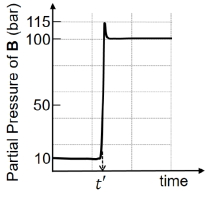
Consider the reaction $A \rightleftharpoons B$ at $1000 \ K$. At time $t^{\prime}$,the temperature of the system was increased to $2000 \ K$ and the system was allowed to reach equilibrium. Throughout this experiment,the partial pressure of $A$ was maintained at $1 \ bar$. Given below is the plot of the partial pressure of $B$ with time. What is the ratio of the standard Gibbs energy of the reaction at $1000 \ K$ to that at $2000 \ K$?
A
$0.10$
B
$0.15$
C
$0.20$
D
$0.25$
Solution
(D) The equilibrium constant $K_{eq}$ for the reaction $A \rightleftharpoons B$ is given by $K_{eq} = \frac{P_B}{P_A}$.
From the graph,at $1000 \ K$,$P_B = 10 \ bar$ and $P_A = 1 \ bar$,so $K_{1000} = \frac{10}{1} = 10$.
At $2000 \ K$,$P_B = 100 \ bar$ and $P_A = 1 \ bar$,so $K_{2000} = \frac{100}{1} = 100$.
The standard Gibbs energy change is given by $\Delta G^0 = -RT \ln(K_{eq})$.
Therefore,the ratio is:
$\frac{\Delta G_{1000}^0}{\Delta G_{2000}^0} = \frac{-R(1000) \ln(10)}{-R(2000) \ln(100)}$
$= \frac{1000 \times \ln(10)}{2000 \times \ln(10^2)}$
$= \frac{1000 \times \ln(10)}{2000 \times 2 \ln(10)}$
$= \frac{1000}{4000} = 0.25$.
From the graph,at $1000 \ K$,$P_B = 10 \ bar$ and $P_A = 1 \ bar$,so $K_{1000} = \frac{10}{1} = 10$.
At $2000 \ K$,$P_B = 100 \ bar$ and $P_A = 1 \ bar$,so $K_{2000} = \frac{100}{1} = 100$.
The standard Gibbs energy change is given by $\Delta G^0 = -RT \ln(K_{eq})$.
Therefore,the ratio is:
$\frac{\Delta G_{1000}^0}{\Delta G_{2000}^0} = \frac{-R(1000) \ln(10)}{-R(2000) \ln(100)}$
$= \frac{1000 \times \ln(10)}{2000 \times \ln(10^2)}$
$= \frac{1000 \times \ln(10)}{2000 \times 2 \ln(10)}$
$= \frac{1000}{4000} = 0.25$.
0 likes
View Solution72
DifficultMCQ
At $227^{\circ} C$,dinitrogen tetraoxide is $60 \%$ dissociated. What is the standard free energy change at this temperature and at $1 \ atm$ pressure?
A
$-204 \ cal / mol$
B
$-204 \ kcal / mol$
C
$-806 \ kcal / mol$
D
$-806 \ cal / mol$
Solution
(D) The dissociation of dinitrogen tetraoxide is given by:
$N_2O_{4(g)} \rightleftharpoons 2NO_{2(g)}$
Given:
Temperature $T = 227 + 273 = 500 \ K$
Degree of dissociation $\alpha = 60 \% = 0.6$
Total pressure $P = 1 \ atm$
The equilibrium constant $K_p$ for this reaction is:
$K_p = \frac{4\alpha^2 P}{1-\alpha^2}$
$K_p = \frac{4 \times (0.6)^2 \times 1}{1 - (0.6)^2} = \frac{4 \times 0.36}{1 - 0.36} = \frac{1.44}{0.64} = 2.25$
The standard free energy change $\Delta G^{\circ}$ is:
$\Delta G^{\circ} = -RT \ln K_p = -2.303 RT \log K_p$
$\Delta G^{\circ} = -2.303 \times 1.987 \times 500 \times \log(2.25)$
$\Delta G^{\circ} = -2.303 \times 1.987 \times 500 \times 0.3522 \approx -806 \ cal / mol$.
$N_2O_{4(g)} \rightleftharpoons 2NO_{2(g)}$
Given:
Temperature $T = 227 + 273 = 500 \ K$
Degree of dissociation $\alpha = 60 \% = 0.6$
Total pressure $P = 1 \ atm$
The equilibrium constant $K_p$ for this reaction is:
$K_p = \frac{4\alpha^2 P}{1-\alpha^2}$
$K_p = \frac{4 \times (0.6)^2 \times 1}{1 - (0.6)^2} = \frac{4 \times 0.36}{1 - 0.36} = \frac{1.44}{0.64} = 2.25$
The standard free energy change $\Delta G^{\circ}$ is:
$\Delta G^{\circ} = -RT \ln K_p = -2.303 RT \log K_p$
$\Delta G^{\circ} = -2.303 \times 1.987 \times 500 \times \log(2.25)$
$\Delta G^{\circ} = -2.303 \times 1.987 \times 500 \times 0.3522 \approx -806 \ cal / mol$.
0 likes
View Solution73
EasyMCQ
Which of the following equations relates the temperature of a reaction with $\Delta H^{\circ}$ and $\Delta S^{\circ}$ at equilibrium?
A
$\Delta H^{\circ} = \frac{T}{\Delta S^{\circ}}$
B
$\Delta H^{\circ} = \frac{\Delta S^{\circ}}{T}$
C
$\Delta H^{\circ} = T \Delta S^{\circ}$
D
$\Delta H^{\circ} = \frac{1}{T \Delta S^{\circ}}$
Solution
(C) At equilibrium,the change in Gibbs free energy $(\Delta G)$ is zero.
The relationship between enthalpy,entropy,and temperature is given by the equation: $\Delta G = \Delta H - T \Delta S$.
At equilibrium,$\Delta G = 0$.
Therefore,$0 = \Delta H - T \Delta S$.
Rearranging the terms,we get $\Delta H = T \Delta S$.
For standard conditions,this is expressed as $\Delta H^{\circ} = T \Delta S^{\circ}$.
The relationship between enthalpy,entropy,and temperature is given by the equation: $\Delta G = \Delta H - T \Delta S$.
At equilibrium,$\Delta G = 0$.
Therefore,$0 = \Delta H - T \Delta S$.
Rearranging the terms,we get $\Delta H = T \Delta S$.
For standard conditions,this is expressed as $\Delta H^{\circ} = T \Delta S^{\circ}$.
0 likes
View Solution74
EasyMCQ
For the reaction $CH_{4(g)} + H_{2(g)} \longrightarrow C_2H_{6(g)}$,$K_p = 3.356 \times 10^{17}$,calculate $\Delta G^{\circ}$ for the reaction at $298 \ K$.
A
$-90 \ kJ \ mol^{-1}$
B
$-100 \ kJ \ mol^{-1}$
C
$235.6 \ kJ \ mol^{-1}$
D
$33.56 \ kJ \ mol^{-1}$
Solution
(B) The relationship between standard Gibbs free energy change and the equilibrium constant is given by: $\Delta G^{\circ} = -RT \ln K_p = -2.303 \ RT \log_{10} K_p$
Given: $R = 8.314 \ J \ K^{-1} \ mol^{-1}$,$T = 298 \ K$,$K_p = 3.356 \times 10^{17}$
$\Delta G^{\circ} = -2.303 \times 8.314 \ J \ K^{-1} \ mol^{-1} \times 298 \ K \times \log_{10} (3.356 \times 10^{17})$
$\log_{10} (3.356 \times 10^{17}) = \log_{10} (3.356) + 17 \approx 0.526 + 17 = 17.526$
$\Delta G^{\circ} = -2.303 \times 8.314 \times 298 \times 17.526 \ J \ mol^{-1}$
$\Delta G^{\circ} \approx -100,000 \ J \ mol^{-1} = -100 \ kJ \ mol^{-1}$
Given: $R = 8.314 \ J \ K^{-1} \ mol^{-1}$,$T = 298 \ K$,$K_p = 3.356 \times 10^{17}$
$\Delta G^{\circ} = -2.303 \times 8.314 \ J \ K^{-1} \ mol^{-1} \times 298 \ K \times \log_{10} (3.356 \times 10^{17})$
$\log_{10} (3.356 \times 10^{17}) = \log_{10} (3.356) + 17 \approx 0.526 + 17 = 17.526$
$\Delta G^{\circ} = -2.303 \times 8.314 \times 298 \times 17.526 \ J \ mol^{-1}$
$\Delta G^{\circ} \approx -100,000 \ J \ mol^{-1} = -100 \ kJ \ mol^{-1}$
0 likes
View Solution75
EasyMCQ
The equilibrium constant for a reaction is $20$. What is the value of $\Delta G^{\circ}$ at $300 \ K$? (Given: $R = 8 \times 10^{-3} \ kJ \ K^{-1} \ mol^{-1}$,$\ln(20) \approx 2.996$)
A
$-5.527 \ kJ \ mol^{-1}$
B
$-7.19 \ kJ \ mol^{-1}$
C
$-1.663 \ kJ \ mol^{-1}$
D
$-2.763 \ kJ \ mol^{-1}$
Solution
(B) The relationship between standard Gibbs free energy change and the equilibrium constant is given by the equation: $\Delta G^{\circ} = -RT \ln K$.
Given values: $K = 20$,$T = 300 \ K$,$R = 8 \times 10^{-3} \ kJ \ K^{-1} \ mol^{-1}$.
Substituting the values into the formula: $\Delta G^{\circ} = -(8 \times 10^{-3} \ kJ \ K^{-1} \ mol^{-1}) \times (300 \ K) \times \ln(20)$.
Since $\ln(20) \approx 2.996$,we have: $\Delta G^{\circ} = -2.4 \times 2.996 \approx -7.19 \ kJ \ mol^{-1}$.
Therefore,the correct value is $-7.19 \ kJ \ mol^{-1}$.
Given values: $K = 20$,$T = 300 \ K$,$R = 8 \times 10^{-3} \ kJ \ K^{-1} \ mol^{-1}$.
Substituting the values into the formula: $\Delta G^{\circ} = -(8 \times 10^{-3} \ kJ \ K^{-1} \ mol^{-1}) \times (300 \ K) \times \ln(20)$.
Since $\ln(20) \approx 2.996$,we have: $\Delta G^{\circ} = -2.4 \times 2.996 \approx -7.19 \ kJ \ mol^{-1}$.
Therefore,the correct value is $-7.19 \ kJ \ mol^{-1}$.
0 likes
View Solution76
MediumMCQ
The equilibrium constant of a reaction is $0.008$ at $298 \ K$. The standard free energy change of the reaction at the same temperature is
A
$-11.96 \ kJ$
B
$-5.43 \ kJ$
C
$-8.46 \ kJ$
D
$+11.96 \ kJ$
Solution
(D) The standard free energy change is given by the formula: $\Delta G^{\circ} = -RT \ln K = -2.303 RT \log K$.
Given: $R = 8.314 \ J \ K^{-1} \ mol^{-1}$,$T = 298 \ K$,$K = 0.008$.
Substituting the values: $\Delta G^{\circ} = -2.303 \times 8.314 \times 298 \times \log(0.008)$.
Since $\log(0.008) = \log(8 \times 10^{-3}) = \log 8 - 3 = 0.903 - 3 = -2.097$.
$\Delta G^{\circ} = -2.303 \times 8.314 \times 298 \times (-2.097) \approx 11965 \ J \ mol^{-1} = +11.96 \ kJ \ mol^{-1}$.
Given: $R = 8.314 \ J \ K^{-1} \ mol^{-1}$,$T = 298 \ K$,$K = 0.008$.
Substituting the values: $\Delta G^{\circ} = -2.303 \times 8.314 \times 298 \times \log(0.008)$.
Since $\log(0.008) = \log(8 \times 10^{-3}) = \log 8 - 3 = 0.903 - 3 = -2.097$.
$\Delta G^{\circ} = -2.303 \times 8.314 \times 298 \times (-2.097) \approx 11965 \ J \ mol^{-1} = +11.96 \ kJ \ mol^{-1}$.
0 likes
View Solution77
MediumMCQ
For the reversible reaction,$A_{(s)} + B_{(g)} \rightleftharpoons C_{(g)} + D_{(g)}$,$\Delta G^{\circ} = -350 \ kJ$,which one of the following statements is true?
A
The reaction is thermodynamically non-feasible
B
The entropy change is negative
C
Equilibrium constant is greater than one
D
The reaction should be instantaneous
Solution
(C) For the reaction $A_{(s)} + B_{(g)} \rightleftharpoons C_{(g)} + D_{(g)}$,the standard Gibbs free energy change is $\Delta G^{\circ} = -350 \ kJ$.
The relationship between $\Delta G^{\circ}$ and the equilibrium constant $K_{eq}$ is given by the equation: $\Delta G^{\circ} = -RT \ln K_{eq}$.
Since $\Delta G^{\circ}$ is negative $(-350 \ kJ)$,the value of $\ln K_{eq}$ must be positive,which implies that $K_{eq} > 1$.
Therefore,the equilibrium constant is greater than one.
The relationship between $\Delta G^{\circ}$ and the equilibrium constant $K_{eq}$ is given by the equation: $\Delta G^{\circ} = -RT \ln K_{eq}$.
Since $\Delta G^{\circ}$ is negative $(-350 \ kJ)$,the value of $\ln K_{eq}$ must be positive,which implies that $K_{eq} > 1$.
Therefore,the equilibrium constant is greater than one.
0 likes
View Solution78
EasyMCQ
In the equilibrium state,the value of $\Delta G$ is:
A
zero
B
negative
C
positive
D
may be negative or positive
Solution
(A) For a spontaneous process,$\Delta G < 0$. For a non-spontaneous process,$\Delta G > 0$. At equilibrium,the system is at its minimum Gibbs free energy,and the change in Gibbs free energy is $\Delta G = 0$.
0 likes
View Solution79
MediumMCQ
$K_p$ for the conversion of oxygen to ozone at $400 \ K$ is $1.0 \times 10^{-30}$,its standard Gibbs energy change in $kJ \ mol^{-1}$ is approximately
A
$229.8$
B
$114.9$
C
$-229.8$
D
$-114.9$
Solution
(A) Given,$K_p$ for the conversion of oxygen to ozone at $400 \ K$ is $1.0 \times 10^{-30}$.
Standard Gibbs energy change $\Delta G^{\circ} = -RT \ln K_p = -2.303 RT \log_{10} K_p$.
Here,$R = 8.314 \ J \ K^{-1} \ mol^{-1}$ and $T = 400 \ K$.
Substituting the values:
$\Delta G^{\circ} = -2.303 \times 8.314 \times 400 \times \log_{10} (1.0 \times 10^{-30})$
$\Delta G^{\circ} = -2.303 \times 8.314 \times 400 \times (-30)$
$\Delta G^{\circ} = 229765.7 \ J \ mol^{-1}$
Converting to $kJ \ mol^{-1}$:
$\Delta G^{\circ} \approx 229.8 \ kJ \ mol^{-1}$.
Standard Gibbs energy change $\Delta G^{\circ} = -RT \ln K_p = -2.303 RT \log_{10} K_p$.
Here,$R = 8.314 \ J \ K^{-1} \ mol^{-1}$ and $T = 400 \ K$.
Substituting the values:
$\Delta G^{\circ} = -2.303 \times 8.314 \times 400 \times \log_{10} (1.0 \times 10^{-30})$
$\Delta G^{\circ} = -2.303 \times 8.314 \times 400 \times (-30)$
$\Delta G^{\circ} = 229765.7 \ J \ mol^{-1}$
Converting to $kJ \ mol^{-1}$:
$\Delta G^{\circ} \approx 229.8 \ kJ \ mol^{-1}$.
0 likes
View Solution80
EasyMCQ
Which condition among the following holds true at the state of half-completion for the reaction $A \rightleftharpoons B$?
A
$\Delta G^{\circ} = 0$
B
$\Delta G^{\circ} > 0$
C
$\Delta G^{\circ} < 0$
D
$\Delta G^{\circ} = -RT \ln 2$
Solution
(A) For a reversible reaction $A \rightleftharpoons B$,the equilibrium constant $K$ is defined as $K = \frac{[B]}{[A]}$.
At the state of half-completion,the concentration of reactant equals the concentration of product,i.e.,$[A] = [B]$.
Therefore,$K = \frac{[B]}{[A]} = 1$.
The relationship between standard Gibbs free energy change and the equilibrium constant is given by $\Delta G^{\circ} = -RT \ln K$.
Substituting $K = 1$ into the equation,we get $\Delta G^{\circ} = -RT \ln(1)$.
Since $\ln(1) = 0$,it follows that $\Delta G^{\circ} = 0$.
At the state of half-completion,the concentration of reactant equals the concentration of product,i.e.,$[A] = [B]$.
Therefore,$K = \frac{[B]}{[A]} = 1$.
The relationship between standard Gibbs free energy change and the equilibrium constant is given by $\Delta G^{\circ} = -RT \ln K$.
Substituting $K = 1$ into the equation,we get $\Delta G^{\circ} = -RT \ln(1)$.
Since $\ln(1) = 0$,it follows that $\Delta G^{\circ} = 0$.
0 likes
View Solution81
MediumMCQ
At $60^{\circ} C$,dinitrogen tetroxide is $50 \%$ dissociated. Find its standard free energy change at this temperature and $1 \ atm$. [ Given: $\log 1.33 = 0.1239 ]$
A
$-650 \ J \cdot mol^{-1}$
B
$-830 \ J \cdot mol^{-1}$
C
$-790 \ J \cdot mol^{-1}$
D
$-875 \ J \cdot mol^{-1}$
Solution
(C) The reaction for the dissociation is: $N_2O_{4(g)} \rightleftharpoons 2NO_{2(g)}$
At $t=0$,we have $1 \ mol$ of $N_2O_4$ and $0 \ mol$ of $NO_2$.
At equilibrium,with $50 \%$ dissociation,we have $1-0.5 = 0.5 \ mol$ of $N_2O_4$ and $2 \times 0.5 = 1 \ mol$ of $NO_2$.
The total number of moles is $0.5 + 1 = 1.5 \ mol$.
The partial pressures are:
$P_{N_2O_4} = \frac{0.5}{1.5} \times 1 \ atm = \frac{1}{3} \ atm$
$P_{NO_2} = \frac{1}{1.5} \times 1 \ atm = \frac{2}{3} \ atm$
The equilibrium constant $K_p$ is:
$K_p = \frac{(P_{NO_2})^2}{P_{N_2O_4}} = \frac{(2/3)^2}{1/3} = \frac{4/9}{1/3} = \frac{4}{3} \approx 1.33 \ atm$
The standard free energy change is given by:
$\Delta G^{\circ} = -RT \ln K_p = -2.303 \times RT \times \log_{10} K_p$
$\Delta G^{\circ} = -2.303 \times (8.314 \ J \cdot K^{-1} \cdot mol^{-1}) \times (333 \ K) \times \log_{10} 1.33$
$\Delta G^{\circ} = -2.303 \times 8.314 \times 333 \times 0.1239 \approx -790 \ J \cdot mol^{-1}$
At $t=0$,we have $1 \ mol$ of $N_2O_4$ and $0 \ mol$ of $NO_2$.
At equilibrium,with $50 \%$ dissociation,we have $1-0.5 = 0.5 \ mol$ of $N_2O_4$ and $2 \times 0.5 = 1 \ mol$ of $NO_2$.
The total number of moles is $0.5 + 1 = 1.5 \ mol$.
The partial pressures are:
$P_{N_2O_4} = \frac{0.5}{1.5} \times 1 \ atm = \frac{1}{3} \ atm$
$P_{NO_2} = \frac{1}{1.5} \times 1 \ atm = \frac{2}{3} \ atm$
The equilibrium constant $K_p$ is:
$K_p = \frac{(P_{NO_2})^2}{P_{N_2O_4}} = \frac{(2/3)^2}{1/3} = \frac{4/9}{1/3} = \frac{4}{3} \approx 1.33 \ atm$
The standard free energy change is given by:
$\Delta G^{\circ} = -RT \ln K_p = -2.303 \times RT \times \log_{10} K_p$
$\Delta G^{\circ} = -2.303 \times (8.314 \ J \cdot K^{-1} \cdot mol^{-1}) \times (333 \ K) \times \log_{10} 1.33$
$\Delta G^{\circ} = -2.303 \times 8.314 \times 333 \times 0.1239 \approx -790 \ J \cdot mol^{-1}$
0 likes
View Solution82
MediumMCQ
When a reaction is carried out at standard states,then at equilibrium:
A
$\Delta H^{\circ} = 0$
B
$\Delta S^{\circ} = 0$
C
$\text{equilibrium constant } (K) = 0$
D
$\text{equilibrium constant } (K) = 1$
Solution
(D) The relationship between standard Gibbs free energy change and the equilibrium constant is given by the equation: $\Delta G^{\circ} = -RT \ln K$.
At standard states,the reaction quotient $Q$ is equal to $1$.
At equilibrium,$\Delta G = 0$.
However,the question specifies standard states,implying $\Delta G^{\circ} = -RT \ln K$.
For the reaction to be at equilibrium under standard conditions,$\Delta G^{\circ}$ must be $0$.
Therefore,$0 = -RT \ln K$,which implies $\ln K = 0$.
Thus,$K = e^0 = 1$.
At standard states,the reaction quotient $Q$ is equal to $1$.
At equilibrium,$\Delta G = 0$.
However,the question specifies standard states,implying $\Delta G^{\circ} = -RT \ln K$.
For the reaction to be at equilibrium under standard conditions,$\Delta G^{\circ}$ must be $0$.
Therefore,$0 = -RT \ln K$,which implies $\ln K = 0$.
Thus,$K = e^0 = 1$.
0 likes
View Solution83
MediumMCQ
At $298 \ K$,$\Delta_r G^{\ominus}$ for the following reaction is $165.469 \ kJ \ mol^{-1}$. What is the equilibrium constant for this reaction? $(R = 8.3 \ J \ mol^{-1} \ K^{-1})$
$\frac{3}{2} O_{2(g)} \longrightarrow O_{3(g)}$
$\frac{3}{2} O_{2(g)} \longrightarrow O_{3(g)}$
A
$10^{29}$
B
$10^{-29}$
C
$5 \times 10^{-27}$
D
$5 \times 10^{+27}$
Solution
(B) The relationship between standard Gibbs free energy change and the equilibrium constant is given by the equation: $\Delta_r G^{\ominus} = -RT \ln K_{eq}$.
Given: $\Delta_r G^{\ominus} = 165.469 \ kJ \ mol^{-1} = 165469 \ J \ mol^{-1}$,$T = 298 \ K$,and $R = 8.3 \ J \ mol^{-1} \ K^{-1}$.
Substituting the values: $165469 = -(8.3) \times (298) \times \ln K_{eq}$.
$\ln K_{eq} = -\frac{165469}{8.3 \times 298} = -\frac{165469}{2473.4} \approx -66.9$.
$K_{eq} = e^{-66.9} \approx 10^{-29}$.
Given: $\Delta_r G^{\ominus} = 165.469 \ kJ \ mol^{-1} = 165469 \ J \ mol^{-1}$,$T = 298 \ K$,and $R = 8.3 \ J \ mol^{-1} \ K^{-1}$.
Substituting the values: $165469 = -(8.3) \times (298) \times \ln K_{eq}$.
$\ln K_{eq} = -\frac{165469}{8.3 \times 298} = -\frac{165469}{2473.4} \approx -66.9$.
$K_{eq} = e^{-66.9} \approx 10^{-29}$.
0 likes
View Solution84
MediumMCQ
At $300 \ K$,$\Delta_{r} G^{\circ}$ for the reaction $A_{2(g)} \rightleftharpoons B_{2(g)}$ is $-11.5 \ kJ \ mol^{-1}$. The equilibrium constant at $300 \ K$ is approximately $(R=8.314 \ J \ mol^{-1} \ K^{-1})$.
A
$10$
B
$100$
C
$1000$
D
$25$
Solution
(B) The relationship between standard Gibbs free energy change and the equilibrium constant is given by: $\Delta_{r} G^{\circ} = -RT \ln K_{eq}$.
Given values: $\Delta_{r} G^{\circ} = -11.5 \ kJ \ mol^{-1} = -11500 \ J \ mol^{-1}$,$T = 300 \ K$,and $R = 8.314 \ J \ mol^{-1} \ K^{-1}$.
Substituting these values into the equation: $-11500 = -8.314 \times 300 \times \ln K_{eq}$.
$\ln K_{eq} = \frac{11500}{8.314 \times 300} \approx \frac{11500}{2494.2} \approx 4.61$.
Since $\ln K_{eq} = 2.303 \log_{10} K_{eq}$,we have $2.303 \log_{10} K_{eq} \approx 4.61$.
$\log_{10} K_{eq} \approx \frac{4.61}{2.303} \approx 2$.
Therefore,$K_{eq} = 10^2 = 100$.
Given values: $\Delta_{r} G^{\circ} = -11.5 \ kJ \ mol^{-1} = -11500 \ J \ mol^{-1}$,$T = 300 \ K$,and $R = 8.314 \ J \ mol^{-1} \ K^{-1}$.
Substituting these values into the equation: $-11500 = -8.314 \times 300 \times \ln K_{eq}$.
$\ln K_{eq} = \frac{11500}{8.314 \times 300} \approx \frac{11500}{2494.2} \approx 4.61$.
Since $\ln K_{eq} = 2.303 \log_{10} K_{eq}$,we have $2.303 \log_{10} K_{eq} \approx 4.61$.
$\log_{10} K_{eq} \approx \frac{4.61}{2.303} \approx 2$.
Therefore,$K_{eq} = 10^2 = 100$.
0 likes
View Solution85
EasyMCQ
Which of the following expressions is correct?
A
$\Delta G = -RT \ln K$
B
$\Delta G = \frac{1}{RT^2 \ln K}$
C
$\Delta G^0 = -RT \ln K$
D
$\Delta G^0 = -\frac{1}{RT^2 \ln K}$
Solution
(C) The relationship between Gibbs free energy change and the standard Gibbs free energy change is given by the equation: $\Delta G = \Delta G^{\circ} + RT \ln Q$,where $Q$ is the reaction quotient.
At equilibrium,the change in Gibbs free energy $(\Delta G)$ is equal to $0$,and the reaction quotient $(Q)$ is equal to the equilibrium constant $(K)$.
Substituting these values into the equation:
$0 = \Delta G^{\circ} + RT \ln K$
Therefore,$\Delta G^{\circ} = -RT \ln K$.
At equilibrium,the change in Gibbs free energy $(\Delta G)$ is equal to $0$,and the reaction quotient $(Q)$ is equal to the equilibrium constant $(K)$.
Substituting these values into the equation:
$0 = \Delta G^{\circ} + RT \ln K$
Therefore,$\Delta G^{\circ} = -RT \ln K$.
0 likes
View Solution86
DifficultMCQ
For the reaction,$2 NH_{3(g)} + CO_{2(g)} \rightleftharpoons NH_2CONH_{2(aq)} + H_2O_{(l)}$,find the value of the equilibrium constant at $295 \ K$. Given,the standard Gibbs energy change at the given temperature is $13.9 \ kJ \ mol^{-1}$.
A
$2.88 \times 10^2$
B
$2.58 \times 10^2$
C
$2.40 \times 10^2$
D
$2.65 \times 10^2$
Solution
(A) The relationship between standard Gibbs energy change and equilibrium constant is given by: $\Delta G^{\circ} = -RT \ln K$ or $\Delta G^{\circ} = -2.303 RT \log K$.
Given: $\Delta G^{\circ} = 13.9 \ kJ \ mol^{-1} = 13900 \ J \ mol^{-1}$,$R = 8.314 \ J \ K^{-1} \ mol^{-1}$,$T = 295 \ K$.
Substituting the values: $13900 = -2.303 \times 8.314 \times 295 \times \log K$.
$\log K = \frac{-13900}{2.303 \times 8.314 \times 295} = \frac{-13900}{5650.3} \approx -2.46$.
Wait,the standard Gibbs energy change for the formation of urea from ammonia and carbon dioxide is typically negative. Assuming the value provided is $\Delta G^{\circ} = -13.9 \ kJ \ mol^{-1}$:
$\log K = \frac{13900}{5650.3} \approx 2.46$.
$K = 10^{2.46} \approx 288.4 = 2.88 \times 10^2$.
Hence,option $(A)$ is correct.
Given: $\Delta G^{\circ} = 13.9 \ kJ \ mol^{-1} = 13900 \ J \ mol^{-1}$,$R = 8.314 \ J \ K^{-1} \ mol^{-1}$,$T = 295 \ K$.
Substituting the values: $13900 = -2.303 \times 8.314 \times 295 \times \log K$.
$\log K = \frac{-13900}{2.303 \times 8.314 \times 295} = \frac{-13900}{5650.3} \approx -2.46$.
Wait,the standard Gibbs energy change for the formation of urea from ammonia and carbon dioxide is typically negative. Assuming the value provided is $\Delta G^{\circ} = -13.9 \ kJ \ mol^{-1}$:
$\log K = \frac{13900}{5650.3} \approx 2.46$.
$K = 10^{2.46} \approx 288.4 = 2.88 \times 10^2$.
Hence,option $(A)$ is correct.
0 likes
View Solution87
DifficultMCQ
At $300 \ K$,for the reaction $PCl_{5(g)} \rightleftharpoons PCl_{3(g)} + Cl_{2(g)}$,the equilibrium constant $K_p = 1.8 \times 10^{-7}$. Calculate its standard Gibbs free energy change $\Delta G^0$.
A
$38.72 \ kJ \ mol^{-1}$
B
$44.80 \ kJ \ mol^{-1}$
C
$80.80 \ kJ \ mol^{-1}$
D
$45.80 \ kJ \ mol^{-1}$
Solution
(A) The relationship between standard Gibbs free energy change $\Delta G^0$ and equilibrium constant $K_p$ is given by the formula: $\Delta G^0 = -RT \ln K_p$.
Given: $R = 8.314 \ J \ K^{-1} \ mol^{-1}$,$T = 300 \ K$,$K_p = 1.8 \times 10^{-7}$.
Substituting the values: $\Delta G^0 = -(8.314 \ J \ K^{-1} \ mol^{-1}) \times (300 \ K) \times \ln(1.8 \times 10^{-7})$.
$\Delta G^0 = -2494.2 \times (\ln(1.8) + \ln(10^{-7}))$.
$\Delta G^0 = -2494.2 \times (0.5878 - 16.118)$.
$\Delta G^0 = -2494.2 \times (-15.5302) \approx 38735 \ J \ mol^{-1}$.
Converting to $kJ \ mol^{-1}$: $\Delta G^0 \approx 38.74 \ kJ \ mol^{-1}$.
Thus,the closest option is $38.72 \ kJ \ mol^{-1}$.
Given: $R = 8.314 \ J \ K^{-1} \ mol^{-1}$,$T = 300 \ K$,$K_p = 1.8 \times 10^{-7}$.
Substituting the values: $\Delta G^0 = -(8.314 \ J \ K^{-1} \ mol^{-1}) \times (300 \ K) \times \ln(1.8 \times 10^{-7})$.
$\Delta G^0 = -2494.2 \times (\ln(1.8) + \ln(10^{-7}))$.
$\Delta G^0 = -2494.2 \times (0.5878 - 16.118)$.
$\Delta G^0 = -2494.2 \times (-15.5302) \approx 38735 \ J \ mol^{-1}$.
Converting to $kJ \ mol^{-1}$: $\Delta G^0 \approx 38.74 \ kJ \ mol^{-1}$.
Thus,the closest option is $38.72 \ kJ \ mol^{-1}$.
0 likes
View Solution88
MediumMCQ
At $300 \ K$,the equilibrium constant for a reaction is $10$. The standard free energy change (in $kJ \ mol^{-1}$) for the reaction is
A
$-5.74$
B
$-115.2$
C
$5.74$
D
$-57.4$
Solution
(A) The relationship between standard Gibbs free energy change and equilibrium constant is given by the equation: $\Delta G^{\circ} = -2.303 \ RT \ \log \ K$.
Given: $K = 10$,$T = 300 \ K$,and $R = 8.314 \ J \ mol^{-1} \ K^{-1}$.
Substituting the values: $\Delta G^{\circ} = -2.303 \times 8.314 \ J \ mol^{-1} \ K^{-1} \times 300 \ K \times \log(10)$.
Since $\log(10) = 1$,we get: $\Delta G^{\circ} = -2.303 \times 8.314 \times 300 \ J \ mol^{-1}$.
$\Delta G^{\circ} = -5744.14 \ J \ mol^{-1}$.
Converting to $kJ \ mol^{-1}$: $\Delta G^{\circ} = -5.744 \ kJ \ mol^{-1}$.
Thus,the correct option is $(A)$.
Given: $K = 10$,$T = 300 \ K$,and $R = 8.314 \ J \ mol^{-1} \ K^{-1}$.
Substituting the values: $\Delta G^{\circ} = -2.303 \times 8.314 \ J \ mol^{-1} \ K^{-1} \times 300 \ K \times \log(10)$.
Since $\log(10) = 1$,we get: $\Delta G^{\circ} = -2.303 \times 8.314 \times 300 \ J \ mol^{-1}$.
$\Delta G^{\circ} = -5744.14 \ J \ mol^{-1}$.
Converting to $kJ \ mol^{-1}$: $\Delta G^{\circ} = -5.744 \ kJ \ mol^{-1}$.
Thus,the correct option is $(A)$.
0 likes
View Solution89
EasyMCQ
Assertion $(A)$: For every chemical reaction at equilibrium,standard Gibbs energy change of the reaction is zero.
Reason $(R)$: At constant temperature and pressure,chemical reactions are spontaneous in the direction of decreasing Gibbs energy.
Reason $(R)$: At constant temperature and pressure,chemical reactions are spontaneous in the direction of decreasing Gibbs energy.
A
Both $(A)$ and $(R)$ are correct and $(R)$ is the correct explanation of $(A)$
B
Both $(A)$ and $(R)$ are correct but $(R)$ is not the correct explanation of $(A)$
C
$(A)$ is correct and $(R)$ is not correct
D
$(A)$ is not correct but $(R)$ is correct
Solution
(D) The standard Gibbs energy change of a reaction is given by $\Delta G^\circ = -RT \ln K$. At equilibrium,the reaction quotient $Q = K$,but the standard Gibbs energy change $\Delta G^\circ$ is not necessarily zero unless the equilibrium constant $K = 1$. Therefore,Assertion $(A)$ is incorrect.
The reason statement is correct because for a spontaneous process at constant temperature and pressure,the Gibbs energy of the system must decrease $(\Delta G < 0)$. Thus,$(A)$ is incorrect but $(R)$ is correct.
The reason statement is correct because for a spontaneous process at constant temperature and pressure,the Gibbs energy of the system must decrease $(\Delta G < 0)$. Thus,$(A)$ is incorrect but $(R)$ is correct.
0 likes
View Solution90
EasyMCQ
Which of the following correctly represents the relationship between $\Delta G$ and $\Delta G^{\circ}$? $[P = \text{products}, R = \text{reactants}]$
A
$\Delta G = \Delta G^{\circ} + 2.303 RT \log \frac{[R]}{[P]}$
B
$\Delta G = \Delta G^{\circ} - 2.303 RT \log \frac{[P]}{[R]}$
C
$\Delta G^{\circ} = \Delta G + 2.303 RT \log \frac{[R]}{[P]}$
D
$\Delta G^{\circ} = \Delta G - 2.303 RT \log \frac{[R]}{[P]}$
Solution
(C) The relationship between Gibbs free energy change and the reaction quotient is given by: $\Delta G = \Delta G^{\circ} + RT \ln Q$.
Substituting $Q = \frac{[P]}{[R]}$ and converting natural logarithm to base $10$ $(\ln x = 2.303 \log x)$,we get: $\Delta G = \Delta G^{\circ} + 2.303 RT \log \frac{[P]}{[R]}$.
Rearranging this equation to solve for $\Delta G^{\circ}$: $\Delta G^{\circ} = \Delta G - 2.303 RT \log \frac{[P]}{[R]}$.
Since $-\log \frac{[P]}{[R]} = \log \frac{[R]}{[P]}$,the equation can be written as: $\Delta G^{\circ} = \Delta G + 2.303 RT \log \frac{[R]}{[P]}$.
Thus,option $C$ is correct.
Substituting $Q = \frac{[P]}{[R]}$ and converting natural logarithm to base $10$ $(\ln x = 2.303 \log x)$,we get: $\Delta G = \Delta G^{\circ} + 2.303 RT \log \frac{[P]}{[R]}$.
Rearranging this equation to solve for $\Delta G^{\circ}$: $\Delta G^{\circ} = \Delta G - 2.303 RT \log \frac{[P]}{[R]}$.
Since $-\log \frac{[P]}{[R]} = \log \frac{[R]}{[P]}$,the equation can be written as: $\Delta G^{\circ} = \Delta G + 2.303 RT \log \frac{[R]}{[P]}$.
Thus,option $C$ is correct.
0 likes
View Solution91
MediumMCQ
At $298 \ K$,if the standard Gibbs energy change $\Delta_r G^{\ominus}$ of a reaction is $-115 \ kJ \ mol^{-1}$,the value of $\log_{10} K_{p}$ will be $(R = 8.314 \ J \ K^{-1} \ mol^{-1})$.
A
$+20.15$
B
$-20.15$
C
$-10.30$
D
$+10.30$
Solution
(A) The relationship between standard Gibbs energy change and equilibrium constant is given by the equation: $\Delta_r G^{\ominus} = -RT \ln K_p$.
Converting natural logarithm to base $10$: $\Delta_r G^{\ominus} = -2.303 RT \log_{10} K_p$.
Given $\Delta_r G^{\ominus} = -115 \ kJ \ mol^{-1} = -115000 \ J \ mol^{-1}$,$R = 8.314 \ J \ K^{-1} \ mol^{-1}$,and $T = 298 \ K$.
Substituting the values: $-115000 = -2.303 \times 8.314 \times 298 \times \log_{10} K_p$.
$\log_{10} K_p = \frac{115000}{2.303 \times 8.314 \times 298}$.
$\log_{10} K_p = \frac{115000}{5705.84} \approx 20.15$.
Converting natural logarithm to base $10$: $\Delta_r G^{\ominus} = -2.303 RT \log_{10} K_p$.
Given $\Delta_r G^{\ominus} = -115 \ kJ \ mol^{-1} = -115000 \ J \ mol^{-1}$,$R = 8.314 \ J \ K^{-1} \ mol^{-1}$,and $T = 298 \ K$.
Substituting the values: $-115000 = -2.303 \times 8.314 \times 298 \times \log_{10} K_p$.
$\log_{10} K_p = \frac{115000}{2.303 \times 8.314 \times 298}$.
$\log_{10} K_p = \frac{115000}{5705.84} \approx 20.15$.
0 likes
View Solution92
MediumMCQ
Find the value of the equilibrium constant $(K)$ of a reaction at $300 \ K$,when standard Gibbs free energy change is $-25 \ kJ \ mol^{-1}$? (Consider $R = 8.33 \ J \ mol^{-1} \ K^{-1}$)
A
$e^{8}$
B
$e^{9}$
C
$e^{10}$
D
$e^{11}$
Solution
(C) Given,$\Delta G^{\circ} = -25 \ kJ \ mol^{-1} = -25000 \ J \ mol^{-1}$.
Temperature $T = 300 \ K$.
Gas constant $R = 8.33 \ J \ mol^{-1} \ K^{-1}$.
The relationship between standard Gibbs free energy and equilibrium constant is given by $\Delta G^{\circ} = -RT \ln K$.
Substituting the values: $-25000 = -(8.33 \times 300) \ln K$.
$-25000 = -2499 \ln K$.
$\ln K = \frac{25000}{2499} \approx 10.004$.
Therefore,$K = e^{10.004} \approx e^{10}$.
Temperature $T = 300 \ K$.
Gas constant $R = 8.33 \ J \ mol^{-1} \ K^{-1}$.
The relationship between standard Gibbs free energy and equilibrium constant is given by $\Delta G^{\circ} = -RT \ln K$.
Substituting the values: $-25000 = -(8.33 \times 300) \ln K$.
$-25000 = -2499 \ln K$.
$\ln K = \frac{25000}{2499} \approx 10.004$.
Therefore,$K = e^{10.004} \approx e^{10}$.
0 likes
View Solution93
MediumMCQ
For a chemical reaction,the standard Gibbs energy change,$\Delta G^{\circ}$ is $-7.64 \times 10^4 \ J \ mol^{-1}$. What is the value of equilibrium constant $(K)$?
A
$K=1$
B
$K > 1$
C
$K < 1$
D
$K=0$
Solution
(B) The relationship between standard Gibbs free energy change and the equilibrium constant is given by the equation: $\Delta G^{\circ} = -RT \ln K$ or $\Delta G^{\circ} = -2.303 RT \log K$.
Given that $\Delta G^{\circ} = -7.64 \times 10^4 \ J \ mol^{-1}$.
Since $\Delta G^{\circ}$ is negative,the reaction is spontaneous in the forward direction.
For a spontaneous reaction,the equilibrium constant $K$ must be greater than $1$.
Mathematically,$\log K = -\frac{\Delta G^{\circ}}{2.303 RT} = -\frac{-7.64 \times 10^4}{2.303 \times 8.314 \times 298} > 0$.
Since $\log K > 0$,it implies $K > 10^0$,so $K > 1$.
Thus,option $(B)$ is correct.
Given that $\Delta G^{\circ} = -7.64 \times 10^4 \ J \ mol^{-1}$.
Since $\Delta G^{\circ}$ is negative,the reaction is spontaneous in the forward direction.
For a spontaneous reaction,the equilibrium constant $K$ must be greater than $1$.
Mathematically,$\log K = -\frac{\Delta G^{\circ}}{2.303 RT} = -\frac{-7.64 \times 10^4}{2.303 \times 8.314 \times 298} > 0$.
Since $\log K > 0$,it implies $K > 10^0$,so $K > 1$.
Thus,option $(B)$ is correct.
0 likes
View Solution94
MediumMCQ
At $298 \ K$,the equilibrium constant of the process $1.5 O_{2(g)} \rightleftharpoons O_{3(g)}$ is $3 \times 10^{-29}$. The standard free energy change (in $kJ \ mol^{-1}$) of the process is approximately ($R = 8.314 \ J \ mol^{-1} \ K^{-1}$; $\log 3 = 0.47$)
A
$724$
B
$612$
C
$247$
D
$163$
Solution
(D) The standard free energy change $\Delta G^{\circ}$ is related to the equilibrium constant $K$ by the equation: $\Delta G^{\circ} = -RT \ln K = -2.303 RT \log_{10} K$.
Given $R = 8.314 \ J \ mol^{-1} \ K^{-1}$,$T = 298 \ K$,and $K = 3 \times 10^{-29}$.
Substituting these values: $\Delta G^{\circ} = -2.303 \times 8.314 \times 298 \times \log(3 \times 10^{-29}) \ J \ mol^{-1}$.
$\Delta G^{\circ} = -5705.8 \times (\log 3 + \log 10^{-29}) \ J \ mol^{-1}$.
$\Delta G^{\circ} = -5705.8 \times (0.47 - 29) \ J \ mol^{-1}$.
$\Delta G^{\circ} = -5705.8 \times (-28.53) \ J \ mol^{-1} \approx 162787 \ J \ mol^{-1}$.
Converting to $kJ \ mol^{-1}$: $\Delta G^{\circ} \approx 163 \ kJ \ mol^{-1}$.
Given $R = 8.314 \ J \ mol^{-1} \ K^{-1}$,$T = 298 \ K$,and $K = 3 \times 10^{-29}$.
Substituting these values: $\Delta G^{\circ} = -2.303 \times 8.314 \times 298 \times \log(3 \times 10^{-29}) \ J \ mol^{-1}$.
$\Delta G^{\circ} = -5705.8 \times (\log 3 + \log 10^{-29}) \ J \ mol^{-1}$.
$\Delta G^{\circ} = -5705.8 \times (0.47 - 29) \ J \ mol^{-1}$.
$\Delta G^{\circ} = -5705.8 \times (-28.53) \ J \ mol^{-1} \approx 162787 \ J \ mol^{-1}$.
Converting to $kJ \ mol^{-1}$: $\Delta G^{\circ} \approx 163 \ kJ \ mol^{-1}$.
0 likes
View Solution95
EasyMCQ
If the equilibrium constant of a process is $3.8 \times 10^{-3}$ at $25^{\circ} C$,what is the standard free energy change of the process? $(R = 8.314 \ J \ mol^{-1} \ K^{-1}, \log 0.0038 = -2.42)$
A
$5.7 \ kJ \ mol^{-1}$
B
$9.9 \ kJ \ mol^{-1}$
C
$13.8 \ kJ \ mol^{-1}$
D
$15.6 \ kJ \ mol^{-1}$
Solution
(C) The standard free energy change is given by the formula: $\Delta G^{\circ} = -RT \ln K = -2.303 RT \log K$.
Given: $R = 8.314 \ J \ mol^{-1} \ K^{-1}$,$T = 25 + 273 = 298 \ K$,and $K = 3.8 \times 10^{-3}$.
Substituting the values: $\Delta G^{\circ} = -2.303 \times 8.314 \times 298 \times \log (3.8 \times 10^{-3})$.
Since $\log (3.8 \times 10^{-3}) = -2.42$,we have: $\Delta G^{\circ} = -2.303 \times 8.314 \times 298 \times (-2.42)$.
$\Delta G^{\circ} \approx 13817 \ J \ mol^{-1} \approx 13.8 \ kJ \ mol^{-1}$.
Given: $R = 8.314 \ J \ mol^{-1} \ K^{-1}$,$T = 25 + 273 = 298 \ K$,and $K = 3.8 \times 10^{-3}$.
Substituting the values: $\Delta G^{\circ} = -2.303 \times 8.314 \times 298 \times \log (3.8 \times 10^{-3})$.
Since $\log (3.8 \times 10^{-3}) = -2.42$,we have: $\Delta G^{\circ} = -2.303 \times 8.314 \times 298 \times (-2.42)$.
$\Delta G^{\circ} \approx 13817 \ J \ mol^{-1} \approx 13.8 \ kJ \ mol^{-1}$.
0 likes
View Solution96
MediumMCQ
The standard Gibbs free energy change $\Delta G^{\circ}$ at $25^{\circ} C$ for the dissociation of $N_2O_{4(g)}$ to $NO_{2(g)}$ is (given,equilibrium constant $K_{eq} = 0.15, R = 8.314 \ J \ K^{-1} \ mol^{-1}$) (in $kJ$)
A
$1.1$
B
$4.7$
C
$8.1$
D
$38.2$
Solution
(B) The relationship between standard Gibbs free energy change and the equilibrium constant is given by the equation: $\Delta G^{\circ} = -RT \ln K_{eq}$.
Given: $T = 25^{\circ} C = 298 \ K$,$R = 8.314 \ J \ K^{-1} \ mol^{-1}$,and $K_{eq} = 0.15$.
Substituting the values: $\Delta G^{\circ} = -8.314 \times 298 \times \ln(0.15)$.
Using $\ln(0.15) \approx -1.897$:
$\Delta G^{\circ} = -8.314 \times 298 \times (-1.897) \approx 4703 \ J \approx 4.7 \ kJ$.
Alternatively,using $\log_{10}$:
$\Delta G^{\circ} = -2.303 \times 8.314 \times 298 \times \log_{10}(0.15) \approx -5705.8 \times (-0.8239) \approx 4701 \ J \approx 4.7 \ kJ$.
Given: $T = 25^{\circ} C = 298 \ K$,$R = 8.314 \ J \ K^{-1} \ mol^{-1}$,and $K_{eq} = 0.15$.
Substituting the values: $\Delta G^{\circ} = -8.314 \times 298 \times \ln(0.15)$.
Using $\ln(0.15) \approx -1.897$:
$\Delta G^{\circ} = -8.314 \times 298 \times (-1.897) \approx 4703 \ J \approx 4.7 \ kJ$.
Alternatively,using $\log_{10}$:
$\Delta G^{\circ} = -2.303 \times 8.314 \times 298 \times \log_{10}(0.15) \approx -5705.8 \times (-0.8239) \approx 4701 \ J \approx 4.7 \ kJ$.
0 likes
View Solution97
EasyMCQ
The equilibrium constant $(K)$ of a reaction may be written as :
A
$K=e^{-\Delta G / RT}$
B
$K=e^{-\Delta G^0 / RT}$
C
$K=e^{-\Delta H / RT}$
D
$K=e^{-\Delta H^0 / RT}$
Solution
(B) The relationship between the standard Gibbs free energy change $(\Delta G^0)$ and the equilibrium constant $(K)$ is given by the equation: $\Delta G^0 = -RT \ln K$.
Rearranging this equation to solve for $K$:
$\ln K = -\frac{\Delta G^0}{RT}$.
Taking the exponential of both sides:
$K = e^{-\Delta G^0 / RT}$.
Rearranging this equation to solve for $K$:
$\ln K = -\frac{\Delta G^0}{RT}$.
Taking the exponential of both sides:
$K = e^{-\Delta G^0 / RT}$.
0 likes
View Solution98
DifficultMCQ
For the following reaction at $50^\circ$ $C$ and at $2 \text{ atm}$ pressure, $2N_2O_5(g) \rightleftharpoons 2N_2O_4(g) + O_2(g)$. $N_2O_5$ is $50\%$ dissociated. The magnitude of standard free energy change at this temperature is $x$. $x = . . . . . . \text{ J mol}^{-1}$.
A
$1000$
B
$2000$
C
$1500$
D
$2500$
Solution
(D) $1$. Initial moles of $N_2O_5 = 1 \text{ mol}$.
$2$. At equilibrium, $N_2O_5$ dissociated is $50\%$, so remaining $N_2O_5 = 1 - 0.5 = 0.5 \text{ mol}$.
$3$. According to stoichiometry, $N_2O_4$ formed = $0.5 \text{ mol}$ and $O_2$ formed = $0.25 \text{ mol}$.
$4$. Total moles at equilibrium = $0.5 + 0.5 + 0.25 = 1.25 \text{ mol}$.
$5$. Partial pressures: $P_{N_2O_5} = (0.5 / 1.25) \times 2 = 0.8 \text{ atm}$, $P_{N_2O_4} = (0.5 / 1.25) \times 2 = 0.8 \text{ atm}$, $P_{O_2} = (0.25 / 1.25) \times 2 = 0.4 \text{ atm}$.
$6$. Equilibrium constant $K_p = (P_{N_2O_4}^2 \times P_{O_2}) / P_{N_2O_5}^2 = (0.8^2 \times 0.4) / 0.8^2 = 0.4$.
$7$. Standard free energy change $\Delta G^\circ = -RT \ln K_p$.
$8$. Given $T = 50 + 273 = 323 \text{ K}$ and $R = 8.314 \text{ J K}^{-1} \text{ mol}^{-1}$.
$9$. $\Delta G^\circ = -(8.314 \times 323) \times \ln(0.4) = -2685.422 \times (-0.9163) \approx 2460.6 \text{ J mol}^{-1}$.
$10$. The magnitude $x \approx 2460 \text{ J mol}^{-1}$, which is closest to $2500 \text{ J mol}^{-1}$.
$2$. At equilibrium, $N_2O_5$ dissociated is $50\%$, so remaining $N_2O_5 = 1 - 0.5 = 0.5 \text{ mol}$.
$3$. According to stoichiometry, $N_2O_4$ formed = $0.5 \text{ mol}$ and $O_2$ formed = $0.25 \text{ mol}$.
$4$. Total moles at equilibrium = $0.5 + 0.5 + 0.25 = 1.25 \text{ mol}$.
$5$. Partial pressures: $P_{N_2O_5} = (0.5 / 1.25) \times 2 = 0.8 \text{ atm}$, $P_{N_2O_4} = (0.5 / 1.25) \times 2 = 0.8 \text{ atm}$, $P_{O_2} = (0.25 / 1.25) \times 2 = 0.4 \text{ atm}$.
$6$. Equilibrium constant $K_p = (P_{N_2O_4}^2 \times P_{O_2}) / P_{N_2O_5}^2 = (0.8^2 \times 0.4) / 0.8^2 = 0.4$.
$7$. Standard free energy change $\Delta G^\circ = -RT \ln K_p$.
$8$. Given $T = 50 + 273 = 323 \text{ K}$ and $R = 8.314 \text{ J K}^{-1} \text{ mol}^{-1}$.
$9$. $\Delta G^\circ = -(8.314 \times 323) \times \ln(0.4) = -2685.422 \times (-0.9163) \approx 2460.6 \text{ J mol}^{-1}$.
$10$. The magnitude $x \approx 2460 \text{ J mol}^{-1}$, which is closest to $2500 \text{ J mol}^{-1}$.
0 likes
View Solution99
DifficultMCQ
In a closed flask at $600 \text{ K}$,one mole of $X_2Y_4(g)$ attains equilibrium as given below: $X_2Y_4(g) \rightleftharpoons 2XY_2(g)$. At equilibrium,$75\%$ of $X_2Y_4(g)$ is dissociated and the total pressure is $1 \text{ atm}$. The magnitude of $\Delta_r G^\circ$ (in $\text{kJ mol}^{-1}$) at this temperature is . . . . . . .
A
$1$
B
$2$
C
$3$
D
$4$
Solution
(A) Initial moles: $X_2Y_4 = 1$,$XY_2 = 0$.
At equilibrium,$75\%$ of $X_2Y_4$ dissociates,so $X_2Y_4 = 1 - 0.75 = 0.25$ moles.
$XY_2$ produced = $2 \times 0.75 = 1.5$ moles.
Total moles at equilibrium = $0.25 + 1.5 = 1.75$ moles.
Partial pressures at $P_{total} = 1 \text{ atm}$:
$P_{X_2Y_4} = (0.25 / 1.75) \times 1 = 1/7 \text{ atm}$.
$P_{XY_2} = (1.5 / 1.75) \times 1 = 6/7 \text{ atm}$.
Equilibrium constant $K_p = (P_{XY_2})^2 / P_{X_2Y_4} = (6/7)^2 / (1/7) = (36/49) \times 7 = 36/7 \approx 5.14$.
Standard Gibbs free energy change $\Delta_r G^\circ = -RT \ln K_p$.
Using $R = 8.314 \times 10^{-3} \text{ kJ K}^{-1} \text{ mol}^{-1}$ and $T = 600 \text{ K}$:
$\Delta_r G^\circ = -(8.314 \times 10^{-3}) \times 600 \times \ln(5.14) = -4.9884 \times 1.637 \approx -8.16 \text{ kJ mol}^{-1}$.
The magnitude is approximately $8.16 \text{ kJ mol}^{-1}$.
At equilibrium,$75\%$ of $X_2Y_4$ dissociates,so $X_2Y_4 = 1 - 0.75 = 0.25$ moles.
$XY_2$ produced = $2 \times 0.75 = 1.5$ moles.
Total moles at equilibrium = $0.25 + 1.5 = 1.75$ moles.
Partial pressures at $P_{total} = 1 \text{ atm}$:
$P_{X_2Y_4} = (0.25 / 1.75) \times 1 = 1/7 \text{ atm}$.
$P_{XY_2} = (1.5 / 1.75) \times 1 = 6/7 \text{ atm}$.
Equilibrium constant $K_p = (P_{XY_2})^2 / P_{X_2Y_4} = (6/7)^2 / (1/7) = (36/49) \times 7 = 36/7 \approx 5.14$.
Standard Gibbs free energy change $\Delta_r G^\circ = -RT \ln K_p$.
Using $R = 8.314 \times 10^{-3} \text{ kJ K}^{-1} \text{ mol}^{-1}$ and $T = 600 \text{ K}$:
$\Delta_r G^\circ = -(8.314 \times 10^{-3}) \times 600 \times \ln(5.14) = -4.9884 \times 1.637 \approx -8.16 \text{ kJ mol}^{-1}$.
The magnitude is approximately $8.16 \text{ kJ mol}^{-1}$.
0 likes
View Solution100
DifficultMCQ
Consider the reaction $X \rightleftharpoons Y$ at $300 \text{ K}$. If $\Delta H^\circ$ and $K$ are $28.40 \text{ kJ mol}^{-1}$ and $1.8 \times 10^{-7}$ at the same temperature,then the magnitude of $\Delta S^\circ$ for the reaction in $\text{J K}^{-1} \text{ mol}^{-1}$ is . . . . . . . (Nearest integer) (Given: $R = 8.3 \text{ J K}^{-1} \text{ mol}^{-1}$,$\ln 10 = 2.3$,$\log 3 = 0.48$,$\log 2 = 0.30$)
A
$50$
B
-$50$
C
$25$
D
-$25$
Solution
(B) The relationship between Gibbs free energy change,enthalpy change,and entropy change is given by $\Delta G^\circ = \Delta H^\circ - T\Delta S^\circ$.
Also,$\Delta G^\circ = -RT \ln K$.
Given $T = 300 \text{ K}$,$\Delta H^\circ = 28.40 \text{ kJ mol}^{-1} = 28400 \text{ J mol}^{-1}$,$K = 1.8 \times 10^{-7}$,and $R = 8.3 \text{ J K}^{-1} \text{ mol}^{-1}$.
First,calculate $\ln K$: $\ln K = \ln(1.8 \times 10^{-7}) = \ln(18 \times 10^{-8}) = \ln(2 \times 3^2) - 8 \ln 10 = \ln 2 + 2 \ln 3 - 8 \ln 10$.
Using $\ln x = 2.3 \log x$,we have $\ln 2 = 2.3 \times 0.30 = 0.69$,$\ln 3 = 2.3 \times 0.48 = 1.104$,and $\ln 10 = 2.3$.
So,$\ln K = 0.69 + 2(1.104) - 8(2.3) = 0.69 + 2.208 - 18.4 = -15.502$.
Now,$\Delta G^\circ = -RT \ln K = -(8.3)(300)(-15.502) = 38599.98 \text{ J mol}^{-1} \approx 38.60 \text{ kJ mol}^{-1}$.
Finally,$\Delta S^\circ = \frac{\Delta H^\circ - \Delta G^\circ}{T} = \frac{28400 - 38600}{300} = \frac{-10200}{300} = -34 \text{ J K}^{-1} \text{ mol}^{-1}$.
The nearest integer value is $-34$.
Also,$\Delta G^\circ = -RT \ln K$.
Given $T = 300 \text{ K}$,$\Delta H^\circ = 28.40 \text{ kJ mol}^{-1} = 28400 \text{ J mol}^{-1}$,$K = 1.8 \times 10^{-7}$,and $R = 8.3 \text{ J K}^{-1} \text{ mol}^{-1}$.
First,calculate $\ln K$: $\ln K = \ln(1.8 \times 10^{-7}) = \ln(18 \times 10^{-8}) = \ln(2 \times 3^2) - 8 \ln 10 = \ln 2 + 2 \ln 3 - 8 \ln 10$.
Using $\ln x = 2.3 \log x$,we have $\ln 2 = 2.3 \times 0.30 = 0.69$,$\ln 3 = 2.3 \times 0.48 = 1.104$,and $\ln 10 = 2.3$.
So,$\ln K = 0.69 + 2(1.104) - 8(2.3) = 0.69 + 2.208 - 18.4 = -15.502$.
Now,$\Delta G^\circ = -RT \ln K = -(8.3)(300)(-15.502) = 38599.98 \text{ J mol}^{-1} \approx 38.60 \text{ kJ mol}^{-1}$.
Finally,$\Delta S^\circ = \frac{\Delta H^\circ - \Delta G^\circ}{T} = \frac{28400 - 38600}{300} = \frac{-10200}{300} = -34 \text{ J K}^{-1} \text{ mol}^{-1}$.
The nearest integer value is $-34$.
0 likes
View Solution6-1.Equilibrium (Chemical Equilibrium) — Standard free energy · Frequently Asked Questions
1Are these 6-1.Equilibrium (Chemical Equilibrium) questions useful for JEE and NEET?
Yes. All questions in this section are mapped to JEE Main and NEET exam patterns. Previous year questions from JEE Main, NEET, GUJCET and state-level exams are included with full solutions.
2Can I switch to Hindi or Gujarati for these questions?
Yes. Use the language tabs in the hero section or the sidebar to view the same questions and solutions in English, Hindi or Gujarati.
3How do I generate a question paper from this subtopic?
Use the Vedclass Exam Paper Generator — select the chapter and subtopic, set difficulty, and generate Sets A, B, C, D automatically. First 3 chapters of every subject are free.
Vedclass Products
For Students
Vedclass Test Series
Mock tests in real JEE/NEET style with performance analysis. 5-day free trial.
Start Free TrialFor Teachers
Exam Paper Generator
Generate Set A/B/C/D papers from this chapter in 2 minutes. 3 chapters free.
Try FreeFor Institutes
Online Exam Module
Live online exams with unlimited students, 360° analytics & white-label branding.
See DemoFor Teachers & Institutes
Generate a 6-1.Equilibrium (Chemical Equilibrium) Exam Paper in 2 Minutes
Select subtopic & difficulty — Sets A, B, C, D auto-generated with No Repeat logic.
First 3 chapters of every subject are free — no payment required.