
A English
Kp and Kc Relationship Questions in English
Class 11 Chemistry · 6-1.Equilibrium (Chemical Equilibrium) · Kp and Kc Relationship
367+
Questions
English
Language
100%
With Solutions
Showing 50 of 367 questions in English
301
MediumMCQ
The reaction for which $K_{c} = 2.3 \times 10^3 \ mol \ L^{-1}$ is $-$
A
$2 SO_{2(g)} + O_{2(g)} \rightleftharpoons 2 SO_{3(g)}$
B
$N_{2(g)} + 3 H_{2(g)} \rightleftharpoons 2 NH_{3(g)}$
C
$N_{2(g)} + O_{2(g)} \rightleftharpoons 2 NO_{(g)}$
D
$PCl_{5(g)} \rightleftharpoons PCl_{3(g)} + Cl_{2(g)}$
Solution
(D) The unit of $K_{c}$ is given by $(mol \ L^{-1})^{\Delta n}$,where $\Delta n$ is the change in the number of moles of gaseous products and reactants.
For the unit to be $mol \ L^{-1}$,$\Delta n$ must be equal to $1$.
For option $D$: $PCl_{5(g)} \rightleftharpoons PCl_{3(g)} + Cl_{2(g)}$,$\Delta n = (1 + 1) - 1 = 1$.
Thus,the unit of $K_{c}$ for this reaction is $(mol \ L^{-1})^1 = mol \ L^{-1}$.
For the unit to be $mol \ L^{-1}$,$\Delta n$ must be equal to $1$.
For option $D$: $PCl_{5(g)} \rightleftharpoons PCl_{3(g)} + Cl_{2(g)}$,$\Delta n = (1 + 1) - 1 = 1$.
Thus,the unit of $K_{c}$ for this reaction is $(mol \ L^{-1})^1 = mol \ L^{-1}$.
0 likes
View Solution302
MediumMCQ
$NH_4HS_{(s)} \rightleftharpoons NH_{3(g)} + H_2S_{(g)}$
The reaction was started with some amount of $NH_4HS$. The equilibrium pressure at $25^{\circ}C$ is $0.5 \ atm$. What is $K_p$ for the reaction (in $atm^2$)?
The reaction was started with some amount of $NH_4HS$. The equilibrium pressure at $25^{\circ}C$ is $0.5 \ atm$. What is $K_p$ for the reaction (in $atm^2$)?
A
$0.109$
B
$0.0625$
C
$1$
D
$0.25$
Solution
(B) For the reaction $NH_4HS_{(s)} \rightleftharpoons NH_{3(g)} + H_2S_{(g)}$,the equilibrium constant $K_p$ is given by the product of the partial pressures of the gaseous products.
$K_p = P_{NH_3} \times P_{H_2S}$
Since the stoichiometry of the reaction is $1:1$ for the gases,at equilibrium,$P_{NH_3} = P_{H_2S} = p$.
The total equilibrium pressure $P_{total} = P_{NH_3} + P_{H_2S} = p + p = 2p$.
Given $P_{total} = 0.5 \ atm$,we have $2p = 0.5 \ atm$,so $p = 0.25 \ atm$.
Therefore,$K_p = p \times p = (0.25 \ atm) \times (0.25 \ atm) = 0.0625 \ atm^2$.
$K_p = P_{NH_3} \times P_{H_2S}$
Since the stoichiometry of the reaction is $1:1$ for the gases,at equilibrium,$P_{NH_3} = P_{H_2S} = p$.
The total equilibrium pressure $P_{total} = P_{NH_3} + P_{H_2S} = p + p = 2p$.
Given $P_{total} = 0.5 \ atm$,we have $2p = 0.5 \ atm$,so $p = 0.25 \ atm$.
Therefore,$K_p = p \times p = (0.25 \ atm) \times (0.25 \ atm) = 0.0625 \ atm^2$.
0 likes
View Solution303
MediumMCQ
One mole of $N_2O_4$ in a $1 \ L$ flask decomposes to attain the equilibrium $N_2O_{4(g)} \rightleftharpoons 2NO_{2(g)}$. At the equilibrium the mole fraction of $NO_2$ is $1/2$. Hence $K_C$ will be:
A
$1/3$
B
$1/2$
C
$2/3$
D
$1$
Solution
(C) The initial moles of $N_2O_4$ is $1$ and $NO_2$ is $0$. Let $x$ be the moles of $N_2O_4$ that decompose.
At equilibrium,moles of $N_2O_4 = 1 - x$ and moles of $NO_2 = 2x$.
Total moles at equilibrium $= (1 - x) + 2x = 1 + x$.
The mole fraction of $NO_2$ is given as $1/2$,so $\frac{2x}{1+x} = \frac{1}{2}$.
Solving for $x$: $4x = 1 + x \implies 3x = 1 \implies x = 1/3$.
At equilibrium,$[N_2O_4] = 1 - 1/3 = 2/3 \ M$ and $[NO_2] = 2(1/3) = 2/3 \ M$.
$K_C = \frac{[NO_2]^2}{[N_2O_4]} = \frac{(2/3)^2}{2/3} = 2/3$.
At equilibrium,moles of $N_2O_4 = 1 - x$ and moles of $NO_2 = 2x$.
Total moles at equilibrium $= (1 - x) + 2x = 1 + x$.
The mole fraction of $NO_2$ is given as $1/2$,so $\frac{2x}{1+x} = \frac{1}{2}$.
Solving for $x$: $4x = 1 + x \implies 3x = 1 \implies x = 1/3$.
At equilibrium,$[N_2O_4] = 1 - 1/3 = 2/3 \ M$ and $[NO_2] = 2(1/3) = 2/3 \ M$.
$K_C = \frac{[NO_2]^2}{[N_2O_4]} = \frac{(2/3)^2}{2/3} = 2/3$.
0 likes
View Solution304
MediumMCQ
In the reaction,$A_{(s)} + B_{(g)} \rightleftharpoons 2C_{(s)} + 2D_{(g)}$,equilibrium is established. If the pressure of $B$ is doubled,then to reestablish the equilibrium,how many times does the pressure of $D$ become as compared to its initial pressure?
A
$2$
B
$4$
C
$\sqrt{2}$
D
$1$
Solution
(C) For the reaction $A_{(s)} + B_{(g)} \rightleftharpoons 2C_{(s)} + 2D_{(g)}$,the equilibrium constant $K_p$ is given by $K_p = \frac{P_D^2}{P_B}$.
Since $K_p$ is constant at a constant temperature,we have $\frac{P_{D,1}^2}{P_{B,1}} = \frac{P_{D,2}^2}{P_{B,2}}$.
Given that the pressure of $B$ is doubled,$P_{B,2} = 2P_{B,1}$.
Substituting this into the equation: $\frac{P_{D,1}^2}{P_{B,1}} = \frac{P_{D,2}^2}{2P_{B,1}}$.
This simplifies to $P_{D,2}^2 = 2P_{D,1}^2$,which means $P_{D,2} = \sqrt{2} P_{D,1}$.
Therefore,the pressure of $D$ becomes $\sqrt{2}$ times the initial pressure.
Since $K_p$ is constant at a constant temperature,we have $\frac{P_{D,1}^2}{P_{B,1}} = \frac{P_{D,2}^2}{P_{B,2}}$.
Given that the pressure of $B$ is doubled,$P_{B,2} = 2P_{B,1}$.
Substituting this into the equation: $\frac{P_{D,1}^2}{P_{B,1}} = \frac{P_{D,2}^2}{2P_{B,1}}$.
This simplifies to $P_{D,2}^2 = 2P_{D,1}^2$,which means $P_{D,2} = \sqrt{2} P_{D,1}$.
Therefore,the pressure of $D$ becomes $\sqrt{2}$ times the initial pressure.
0 likes
View Solution305
EasyMCQ
For the reaction $PCl_{5(g)} \rightleftharpoons PCl_{3(g)} + Cl_{2(g)}$ at equilibrium,the partial pressures of $PCl_5, PCl_3$ and $Cl_2$ are $2 \ atm, 4 \ atm$ and $4 \ atm$ respectively. The value of $K_C$ at $27^{\circ}C$ is (approx):-
A
$\frac{1}{3} \ mol \ L^{-1}$
B
$3 \ mol \ L^{-1}$
C
$\frac{2}{3} \ mol \ L^{-1}$
D
$\frac{1}{2} \ mol \ L^{-1}$
Solution
(A) The equilibrium constant $K_P$ is given by: $K_P = \frac{P_{PCl_3} \times P_{Cl_2}}{P_{PCl_5}} = \frac{4 \times 4}{2} = 8 \ atm$.
The relationship between $K_P$ and $K_C$ is $K_P = K_C(RT)^{\Delta n_g}$.
Here,$\Delta n_g = (1 + 1) - 1 = 1$.
Temperature $T = 27 + 273 = 300 \ K$.
$R = 0.0821 \ L \ atm \ K^{-1} \ mol^{-1}$.
$K_C = \frac{K_P}{(RT)^{\Delta n_g}} = \frac{8}{0.0821 \times 300} \approx \frac{8}{24.63} \approx 0.325 \approx \frac{1}{3} \ mol \ L^{-1}$.
The relationship between $K_P$ and $K_C$ is $K_P = K_C(RT)^{\Delta n_g}$.
Here,$\Delta n_g = (1 + 1) - 1 = 1$.
Temperature $T = 27 + 273 = 300 \ K$.
$R = 0.0821 \ L \ atm \ K^{-1} \ mol^{-1}$.
$K_C = \frac{K_P}{(RT)^{\Delta n_g}} = \frac{8}{0.0821 \times 300} \approx \frac{8}{24.63} \approx 0.325 \approx \frac{1}{3} \ mol \ L^{-1}$.
0 likes
View Solution306
MediumMCQ
$1 \ mole$ of $HI$ is heated in a closed container of capacity $2 \ L$. At equilibrium,half a mole of $HI$ is dissociated. The equilibrium constant of the reaction is
A
$0.5$
B
$0.25$
C
$0.35$
D
$1$
Solution
(B) The reaction is: $2HI \rightleftharpoons H_2 + I_2$
Initial moles: $1 \ mol$ of $HI$,$0 \ mol$ of $H_2$,$0 \ mol$ of $I_2$.
At equilibrium,$0.5 \ mol$ of $HI$ is dissociated. Therefore,remaining $HI = 1 - 0.5 = 0.5 \ mol$.
According to stoichiometry,$2 \ mol$ of $HI$ produces $1 \ mol$ of $H_2$ and $1 \ mol$ of $I_2$.
So,$0.5 \ mol$ of $HI$ produces $0.25 \ mol$ of $H_2$ and $0.25 \ mol$ of $I_2$.
Equilibrium concentrations in $2 \ L$ container:
$[HI] = 0.5 / 2 = 0.25 \ M$
$[H_2] = 0.25 / 2 = 0.125 \ M$
$[I_2] = 0.25 / 2 = 0.125 \ M$
$K_C = \frac{[H_2][I_2]}{[HI]^2} = \frac{0.125 \times 0.125}{(0.25)^2} = \frac{0.015625}{0.0625} = 0.25$
Initial moles: $1 \ mol$ of $HI$,$0 \ mol$ of $H_2$,$0 \ mol$ of $I_2$.
At equilibrium,$0.5 \ mol$ of $HI$ is dissociated. Therefore,remaining $HI = 1 - 0.5 = 0.5 \ mol$.
According to stoichiometry,$2 \ mol$ of $HI$ produces $1 \ mol$ of $H_2$ and $1 \ mol$ of $I_2$.
So,$0.5 \ mol$ of $HI$ produces $0.25 \ mol$ of $H_2$ and $0.25 \ mol$ of $I_2$.
Equilibrium concentrations in $2 \ L$ container:
$[HI] = 0.5 / 2 = 0.25 \ M$
$[H_2] = 0.25 / 2 = 0.125 \ M$
$[I_2] = 0.25 / 2 = 0.125 \ M$
$K_C = \frac{[H_2][I_2]}{[HI]^2} = \frac{0.125 \times 0.125}{(0.25)^2} = \frac{0.015625}{0.0625} = 0.25$
0 likes
View Solution307
EasyMCQ
The relationship between $K_{p}$ and $K_{c}$ is $K_{p}=K_{c}(RT)^{\Delta n_{g}}$. What would be the value of $\Delta n_{g}$ for the reaction $NH_{4}Cl_{(s)} \rightleftharpoons NH_{3(g)} + HCl_{(g)}$?
A
$1$
B
$0.5$
C
$1.5$
D
$2$
Solution
(D) The relationship is given by $K_{p}=K_{c}(RT)^{\Delta n_{g}}$.
$\Delta n_{g}$ is defined as the difference between the sum of the stoichiometric coefficients of gaseous products and the sum of the stoichiometric coefficients of gaseous reactants.
For the reaction $NH_{4}Cl_{(s)} \rightleftharpoons NH_{3(g)} + HCl_{(g)}$:
Number of moles of gaseous products = $1 (NH_{3}) + 1 (HCl) = 2$.
Number of moles of gaseous reactants = $0$ (since $NH_{4}Cl$ is a solid).
Therefore,$\Delta n_{g} = 2 - 0 = 2$.
$\Delta n_{g}$ is defined as the difference between the sum of the stoichiometric coefficients of gaseous products and the sum of the stoichiometric coefficients of gaseous reactants.
For the reaction $NH_{4}Cl_{(s)} \rightleftharpoons NH_{3(g)} + HCl_{(g)}$:
Number of moles of gaseous products = $1 (NH_{3}) + 1 (HCl) = 2$.
Number of moles of gaseous reactants = $0$ (since $NH_{4}Cl$ is a solid).
Therefore,$\Delta n_{g} = 2 - 0 = 2$.
0 likes
View Solution308
MediumMCQ
Equilibrium constants $K_1$ and $K_2$ for the following equilibria:
$(a)$ $NO_{(g)} + \frac{1}{2}O_{2(g)} \rightleftharpoons NO_{2(g)}$
$(b)$ $2NO_{2(g)} \rightleftharpoons 2NO_{(g)} + O_{2(g)}$
are related as:
$(a)$ $NO_{(g)} + \frac{1}{2}O_{2(g)} \rightleftharpoons NO_{2(g)}$
$(b)$ $2NO_{2(g)} \rightleftharpoons 2NO_{(g)} + O_{2(g)}$
are related as:
A
$K_1 = \sqrt{K_2}$
B
$K_2 = \frac{1}{K_1}$
C
$K_1 = 2K_2$
D
$K_2 = \frac{1}{K_1^2}$
Solution
(D) For reaction $(a)$: $K_1 = \frac{[NO_2]}{[NO][O_2]^{1/2}}$
For reaction $(b)$: $K_2 = \frac{[NO]^2[O_2]}{[NO_2]^2}$
From $(a)$,we can write: $\frac{1}{K_1} = \frac{[NO][O_2]^{1/2}}{[NO_2]}$
Squaring both sides: $\left(\frac{1}{K_1}\right)^2 = \frac{[NO]^2[O_2]}{[NO_2]^2}$
Since the right side is equal to $K_2$,we have $\frac{1}{K_1^2} = K_2$
Therefore,$K_2 = \frac{1}{K_1^2}$.
For reaction $(b)$: $K_2 = \frac{[NO]^2[O_2]}{[NO_2]^2}$
From $(a)$,we can write: $\frac{1}{K_1} = \frac{[NO][O_2]^{1/2}}{[NO_2]}$
Squaring both sides: $\left(\frac{1}{K_1}\right)^2 = \frac{[NO]^2[O_2]}{[NO_2]^2}$
Since the right side is equal to $K_2$,we have $\frac{1}{K_1^2} = K_2$
Therefore,$K_2 = \frac{1}{K_1^2}$.
0 likes
View Solution309
MediumMCQ
The following equilibrium is established at $STP$. $B_{2(g)} \rightleftharpoons 2B_{(g)}$. Atoms of $B$ occupy $20 \%$ of total volume at $STP$. The total pressure of the system is $1 \ bar$. What is its $K_p$?
A
$0.05$
B
$0.1$
C
$0.5$
D
$0.025$
Solution
(A) Let the initial moles of $B_2$ be $1 \ mol$. At equilibrium,let the degree of dissociation be $\alpha$.
The reaction is $B_{2(g)} \rightleftharpoons 2B_{(g)}$.
Initial moles: $1$ for $B_2$,$0$ for $B$.
Equilibrium moles: $(1-\alpha)$ for $B_2$,$2\alpha$ for $B$.
Total moles at equilibrium = $(1-\alpha) + 2\alpha = 1+\alpha$.
The volume fraction of $B$ atoms is given as $20 \%$,which is equal to the mole fraction of $B$ atoms in the gas mixture.
Mole fraction of $B$ = $\frac{2\alpha}{1+\alpha} = 0.2$.
$2\alpha = 0.2 + 0.2\alpha \implies 1.8\alpha = 0.2 \implies \alpha = \frac{0.2}{1.8} = \frac{1}{9}$.
Partial pressure of $B$ $(P_B)$ = $\frac{2\alpha}{1+\alpha} \times P_{total} = 0.2 \times 1 \ bar = 0.2 \ bar$.
Partial pressure of $B_2$ $(P_{B_2})$ = $\frac{1-\alpha}{1+\alpha} \times P_{total} = \frac{1 - 1/9}{1 + 1/9} \times 1 = \frac{8/9}{10/9} = 0.8 \ bar$.
$K_p = \frac{(P_B)^2}{P_{B_2}} = \frac{(0.2)^2}{0.8} = \frac{0.04}{0.8} = 0.05$.
The reaction is $B_{2(g)} \rightleftharpoons 2B_{(g)}$.
Initial moles: $1$ for $B_2$,$0$ for $B$.
Equilibrium moles: $(1-\alpha)$ for $B_2$,$2\alpha$ for $B$.
Total moles at equilibrium = $(1-\alpha) + 2\alpha = 1+\alpha$.
The volume fraction of $B$ atoms is given as $20 \%$,which is equal to the mole fraction of $B$ atoms in the gas mixture.
Mole fraction of $B$ = $\frac{2\alpha}{1+\alpha} = 0.2$.
$2\alpha = 0.2 + 0.2\alpha \implies 1.8\alpha = 0.2 \implies \alpha = \frac{0.2}{1.8} = \frac{1}{9}$.
Partial pressure of $B$ $(P_B)$ = $\frac{2\alpha}{1+\alpha} \times P_{total} = 0.2 \times 1 \ bar = 0.2 \ bar$.
Partial pressure of $B_2$ $(P_{B_2})$ = $\frac{1-\alpha}{1+\alpha} \times P_{total} = \frac{1 - 1/9}{1 + 1/9} \times 1 = \frac{8/9}{10/9} = 0.8 \ bar$.
$K_p = \frac{(P_B)^2}{P_{B_2}} = \frac{(0.2)^2}{0.8} = \frac{0.04}{0.8} = 0.05$.
0 likes
View Solution310
MediumMCQ
At $298 \ K$,the value of $K_c$ for the following reaction is $x \ mol \ L^{-1}$. What is the approximate $K_p$ value for this reaction? $(R=0.082 \ L \ atm \ mol^{-1} \ K^{-1})$ $A_2O_{4(g)} \rightleftharpoons 2AO_{2(g)}$
A
$24.4x$
B
$12.2x$
C
$\frac{x}{24.4}$
D
$\frac{24.4}{x}$
Solution
(A) The relationship between $K_p$ and $K_c$ is given by the equation: $K_p = K_c(RT)^{\Delta n_g}$.
For the reaction $A_2O_{4(g)} \rightleftharpoons 2AO_{2(g)}$,the change in the number of moles of gaseous species is $\Delta n_g = 2 - 1 = 1$.
Given $T = 298 \ K$,$R = 0.082 \ L \ atm \ mol^{-1} \ K^{-1}$,and $K_c = x$.
Substituting these values: $K_p = x \times (0.082 \times 298)^1$.
Calculating the product: $0.082 \times 298 \approx 24.436 \approx 24.4$.
Therefore,$K_p = 24.4x$.
For the reaction $A_2O_{4(g)} \rightleftharpoons 2AO_{2(g)}$,the change in the number of moles of gaseous species is $\Delta n_g = 2 - 1 = 1$.
Given $T = 298 \ K$,$R = 0.082 \ L \ atm \ mol^{-1} \ K^{-1}$,and $K_c = x$.
Substituting these values: $K_p = x \times (0.082 \times 298)^1$.
Calculating the product: $0.082 \times 298 \approx 24.436 \approx 24.4$.
Therefore,$K_p = 24.4x$.
0 likes
View Solution311
MediumMCQ
At $T(K)$,$K_{c}$ value for $AO_{2(g)} + BO_{2(g)} \rightleftharpoons AO_{3(g)} + BO_{(g)}$ is $16$. In a closed $1 \ L$ flask,one mole each of $AO_2, BO_2, AO_3$ and $BO$ are taken and heated to $T(K)$. What is the concentration (in $mol \ L^{-1}$) of $AO_3$ at equilibrium?
A
$0.4$
B
$0.6$
C
$1.6$
D
$1.4$
Solution
(C) The given reaction is $AO_{2(g)} + BO_{2(g)} \rightleftharpoons AO_{3(g)} + BO_{(g)}$ with $K_c = 16$.
Initial concentrations in $1 \ L$ flask are $[AO_2] = 1 \ M$,$[BO_2] = 1 \ M$,$[AO_3] = 1 \ M$,and $[BO] = 1 \ M$.
The reaction quotient $Q_c = \frac{[AO_3][BO]}{[AO_2][BO_2]} = \frac{1 \times 1}{1 \times 1} = 1$.
Since $Q_c < K_c$ $(1 < 16)$,the reaction proceeds in the forward direction.
Let $x$ be the amount of $AO_2$ and $BO_2$ consumed at equilibrium.
Equilibrium concentrations: $[AO_2] = 1-x$,$[BO_2] = 1-x$,$[AO_3] = 1+x$,$[BO] = 1+x$.
$K_c = \frac{(1+x)(1+x)}{(1-x)(1-x)} = \left(\frac{1+x}{1-x}\right)^2 = 16$.
Taking the square root: $\frac{1+x}{1-x} = 4$.
$1+x = 4 - 4x \implies 5x = 3 \implies x = 0.6$.
Equilibrium concentration of $AO_3 = 1 + x = 1 + 0.6 = 1.6 \ mol \ L^{-1}$.
Initial concentrations in $1 \ L$ flask are $[AO_2] = 1 \ M$,$[BO_2] = 1 \ M$,$[AO_3] = 1 \ M$,and $[BO] = 1 \ M$.
The reaction quotient $Q_c = \frac{[AO_3][BO]}{[AO_2][BO_2]} = \frac{1 \times 1}{1 \times 1} = 1$.
Since $Q_c < K_c$ $(1 < 16)$,the reaction proceeds in the forward direction.
Let $x$ be the amount of $AO_2$ and $BO_2$ consumed at equilibrium.
Equilibrium concentrations: $[AO_2] = 1-x$,$[BO_2] = 1-x$,$[AO_3] = 1+x$,$[BO] = 1+x$.
$K_c = \frac{(1+x)(1+x)}{(1-x)(1-x)} = \left(\frac{1+x}{1-x}\right)^2 = 16$.
Taking the square root: $\frac{1+x}{1-x} = 4$.
$1+x = 4 - 4x \implies 5x = 3 \implies x = 0.6$.
Equilibrium concentration of $AO_3 = 1 + x = 1 + 0.6 = 1.6 \ mol \ L^{-1}$.
0 likes
View Solution312
MediumMCQ
At $T(K)$,the following gaseous equilibrium is established: $W + X \rightleftharpoons Y + Z$. The initial concentration of $W$ is two times the initial concentration of $X$. The system is heated to $T(K)$ to establish equilibrium. At equilibrium,the concentration of $Y$ is four times the concentration of $X$. What is the value of $K_c$?
A
$0.375$
B
$1.333$
C
$2.666$
D
$5.333$
Solution
(C) Let the initial concentration of $X$ be $c$. Then,the initial concentration of $W$ is $2c$. Let the concentration of $Y$ at equilibrium be $4x$. Since the stoichiometry of the reaction $W + X \rightleftharpoons Y + Z$ is $1:1:1:1$,the concentration of $Z$ at equilibrium is also $4x$. The amount of $W$ and $X$ reacted is $4x$. Equilibrium concentrations are: $[W] = 2c - 4x$,$[X] = c - 4x$,$[Y] = 4x$,$[Z] = 4x$. Given that at equilibrium $[Y] = 4[X]$,we have $4x = 4(c - 4x)$,which simplifies to $x = c - 4x$,so $c = 5x$. Substituting $c = 5x$ into the equilibrium concentrations: $[W] = 2(5x) - 4x = 6x$,$[X] = 5x - 4x = x$,$[Y] = 4x$,$[Z] = 4x$. The equilibrium constant $K_c$ is given by $K_c = \frac{[Y][Z]}{[W][X]} = \frac{(4x)(4x)}{(6x)(x)} = \frac{16x^2}{6x^2} = \frac{16}{6} = 2.666$.
0 likes
View Solution313
MediumMCQ
At $298 \ K$,the value of $K_p$ for $N_2O_{4(g)} \rightleftharpoons 2NO_{2(g)}$ is $0.113 \ atm$. The partial pressure of $N_2O_4$ at equilibrium is $0.2 \ atm$. What is the partial pressure (in $atm$) of $NO_2$ at equilibrium?
A
$0.05$
B
$0.075$
C
$0.30$
D
$0.15$
Solution
(D) The equilibrium expression for the reaction $N_2O_{4(g)} \rightleftharpoons 2NO_{2(g)}$ is given by $K_p = \frac{(P_{NO_2})^2}{P_{N_2O_4}}$.
Given $K_p = 0.113 \ atm$ and $P_{N_2O_4} = 0.2 \ atm$.
Substituting these values into the expression: $0.113 = \frac{(P_{NO_2})^2}{0.2}$.
$(P_{NO_2})^2 = 0.113 \times 0.2 = 0.0226$.
$P_{NO_2} = \sqrt{0.0226} \approx 0.15 \ atm$.
Given $K_p = 0.113 \ atm$ and $P_{N_2O_4} = 0.2 \ atm$.
Substituting these values into the expression: $0.113 = \frac{(P_{NO_2})^2}{0.2}$.
$(P_{NO_2})^2 = 0.113 \times 0.2 = 0.0226$.
$P_{NO_2} = \sqrt{0.0226} \approx 0.15 \ atm$.
0 likes
View Solution314
MediumMCQ
For the following given equilibrium reaction,$\frac{K_{c}}{K_{p}}$ is equal to $1076$ at $T \ K$. What is the value of $T$ (in $K$)? $(R = 0.082 \ L \ atm \ K^{-1} \ mol^{-1})$
$N_{2(g)} + 3H_{2(g)} \rightleftharpoons 2NH_{3(g)}$
$N_{2(g)} + 3H_{2(g)} \rightleftharpoons 2NH_{3(g)}$
A
$500$
B
$600$
C
$400$
D
$450$
Solution
(C) The relationship between $K_p$ and $K_c$ is given by the formula: $K_p = K_c(RT)^{\Delta n_g}$.
Rearranging this,we get $\frac{K_c}{K_p} = (RT)^{-\Delta n_g}$.
For the reaction $N_{2(g)} + 3H_{2(g)} \rightleftharpoons 2NH_{3(g)}$,the change in the number of moles of gaseous species is $\Delta n_g = n_p - n_r = 2 - (1 + 3) = 2 - 4 = -2$.
Substituting the values into the equation: $\frac{K_c}{K_p} = (RT)^{-(-2)} = (RT)^2$.
Given $\frac{K_c}{K_p} = 1076$,we have $(RT)^2 = 1076$.
Taking the square root of both sides: $RT = \sqrt{1076} \approx 32.8$.
Given $R = 0.082 \ L \ atm \ K^{-1} \ mol^{-1}$,we have $0.082 \times T = 32.8$.
$T = \frac{32.8}{0.082} = 400 \ K$.
Rearranging this,we get $\frac{K_c}{K_p} = (RT)^{-\Delta n_g}$.
For the reaction $N_{2(g)} + 3H_{2(g)} \rightleftharpoons 2NH_{3(g)}$,the change in the number of moles of gaseous species is $\Delta n_g = n_p - n_r = 2 - (1 + 3) = 2 - 4 = -2$.
Substituting the values into the equation: $\frac{K_c}{K_p} = (RT)^{-(-2)} = (RT)^2$.
Given $\frac{K_c}{K_p} = 1076$,we have $(RT)^2 = 1076$.
Taking the square root of both sides: $RT = \sqrt{1076} \approx 32.8$.
Given $R = 0.082 \ L \ atm \ K^{-1} \ mol^{-1}$,we have $0.082 \times T = 32.8$.
$T = \frac{32.8}{0.082} = 400 \ K$.
0 likes
View Solution315
MediumMCQ
$K_{c}$ for the reaction,$A_{2(g)} \rightleftarrows B_{2(g)}$ is $99.0$. In a $1 \ L$ closed flask,two moles of $B_{2(g)}$ are heated to $T(K)$. What is the concentration of $B_{2(g)}$ (in $mol \ L^{-1}$) at equilibrium?
A
$0.02$
B
$1.98$
C
$0.198$
D
$1.5$
Solution
(B) The reaction is $A_{2(g)} \rightleftarrows B_{2(g)}$. The equilibrium constant expression is $K_{c} = \frac{[B_2]}{[A_2]} = 99.0$.
Initial concentration of $B_2 = 2 \ mol / 1 \ L = 2 \ M$.
Let the concentration of $A_2$ at equilibrium be $x \ M$. Then the concentration of $B_2$ at equilibrium will be $(2 - x) \ M$.
Substituting these into the $K_c$ expression:
$99 = \frac{2 - x}{x}$
$99x = 2 - x$
$100x = 2$
$x = 0.02 \ M$ (concentration of $A_2$ at equilibrium).
Concentration of $B_2$ at equilibrium $= 2 - x = 2 - 0.02 = 1.98 \ M$.
Initial concentration of $B_2 = 2 \ mol / 1 \ L = 2 \ M$.
Let the concentration of $A_2$ at equilibrium be $x \ M$. Then the concentration of $B_2$ at equilibrium will be $(2 - x) \ M$.
Substituting these into the $K_c$ expression:
$99 = \frac{2 - x}{x}$
$99x = 2 - x$
$100x = 2$
$x = 0.02 \ M$ (concentration of $A_2$ at equilibrium).
Concentration of $B_2$ at equilibrium $= 2 - x = 2 - 0.02 = 1.98 \ M$.
0 likes
View Solution316
EasyMCQ
$K_{c}$ for the reaction $A_{2(g)} \rightleftharpoons B_{2(g)}$ is $39.0$. In a closed one litre flask,one mole of $A_{2(g)}$ was heated to $T \ K$. What are the concentrations of $A_{2(g)}$ and $B_{2(g)}$ (in $mol \ L^{-1}$) respectively at equilibrium?
A
$0.025, 0.975$
B
$0.975, 0.025$
C
$0.05, 0.95$
D
$0.02, 0.98$
Solution
(A) Initial: $[A_2] = 1 \ M, [B_2] = 0 \ M$
Equilibrium: $[A_2] = (1-x) \ M, [B_2] = x \ M$
$K_{c} = \frac{[B_2]}{[A_2]}$
$39 = \frac{x}{1-x}$
$39 - 39x = x$
$40x = 39$
$x = \frac{39}{40} = 0.975$
$[B_2] = 0.975 \ M$
$[A_2] = 1 - 0.975 = 0.025 \ M$
Equilibrium: $[A_2] = (1-x) \ M, [B_2] = x \ M$
$K_{c} = \frac{[B_2]}{[A_2]}$
$39 = \frac{x}{1-x}$
$39 - 39x = x$
$40x = 39$
$x = \frac{39}{40} = 0.975$
$[B_2] = 0.975 \ M$
$[A_2] = 1 - 0.975 = 0.025 \ M$
0 likes
View Solution317
EasyMCQ
At $300 \ K$,$K_C$ for the reaction $A_2B_{2(g)} \rightleftharpoons A_{2(g)} + B_{2(g)}$ is $100 \ mol \ L^{-1}$. What is its $K_p$ (in $atm$) at the same temperature? $(R = 0.082 \ L \ atm \ K^{-1} \ mol^{-1})$
A
$100$
B
$2460$
C
$4.06$
D
$246$
Solution
(B) The relationship between $K_p$ and $K_c$ is given by the formula: $K_p = K_c(RT)^{\Delta n_g}$.
Given:
$K_c = 100 \ mol \ L^{-1}$
$R = 0.082 \ L \ atm \ K^{-1} \ mol^{-1}$
$T = 300 \ K$
For the reaction $A_2B_{2(g)} \rightleftharpoons A_{2(g)} + B_{2(g)}$,the change in the number of gaseous moles is $\Delta n_g = (1 + 1) - 1 = 1$.
Substituting the values into the formula:
$K_p = 100 \times (0.082 \times 300)^1$
$K_p = 100 \times 24.6 = 2460 \ atm$.
Given:
$K_c = 100 \ mol \ L^{-1}$
$R = 0.082 \ L \ atm \ K^{-1} \ mol^{-1}$
$T = 300 \ K$
For the reaction $A_2B_{2(g)} \rightleftharpoons A_{2(g)} + B_{2(g)}$,the change in the number of gaseous moles is $\Delta n_g = (1 + 1) - 1 = 1$.
Substituting the values into the formula:
$K_p = 100 \times (0.082 \times 300)^1$
$K_p = 100 \times 24.6 = 2460 \ atm$.
0 likes
View Solution318
MediumMCQ
One mole $H_2O_{(g)}$ and one mole $CO_{(g)}$ are taken in a $1 \ L$ flask and heated to $725 \ K$. At equilibrium,$40 \%$ of water reacted with $CO_{(g)}$ as follows:
$H_2O_{(g)} + CO_{(g)} \rightleftharpoons H_{2(g)} + CO_{2(g)}$
Its $K_c$ value is:
$H_2O_{(g)} + CO_{(g)} \rightleftharpoons H_{2(g)} + CO_{2(g)}$
Its $K_c$ value is:
A
$0.444$
B
$2.22$
C
$0.222$
D
$4.44$
Solution
(A) The reaction is: $H_2O_{(g)} + CO_{(g)} \rightleftharpoons H_{2(g)} + CO_{2(g)}$
Initial moles: $H_2O = 1.0 \ mol$,$CO = 1.0 \ mol$,$H_2 = 0 \ mol$,$CO_2 = 0 \ mol$.
Given that $40 \%$ of water reacts,the moles of $H_2O$ reacted $= 0.4 \times 1.0 = 0.4 \ mol$.
According to the stoichiometry of the reaction,$0.4 \ mol$ of $CO$ will also react,and $0.4 \ mol$ of $H_2$ and $0.4 \ mol$ of $CO_2$ will be formed.
Moles at equilibrium:
$n(H_2O) = 1.0 - 0.4 = 0.6 \ mol$
$n(CO) = 1.0 - 0.4 = 0.6 \ mol$
$n(H_2) = 0.4 \ mol$
$n(CO_2) = 0.4 \ mol$
Since the volume of the flask is $1 \ L$,the concentrations are equal to the number of moles.
$[H_2O] = 0.6 \ M, [CO] = 0.6 \ M, [H_2] = 0.4 \ M, [CO_2] = 0.4 \ M$
$K_c = \frac{[H_2][CO_2]}{[H_2O][CO]} = \frac{0.4 \times 0.4}{0.6 \times 0.6} = \frac{0.16}{0.36} = 0.444$
Initial moles: $H_2O = 1.0 \ mol$,$CO = 1.0 \ mol$,$H_2 = 0 \ mol$,$CO_2 = 0 \ mol$.
Given that $40 \%$ of water reacts,the moles of $H_2O$ reacted $= 0.4 \times 1.0 = 0.4 \ mol$.
According to the stoichiometry of the reaction,$0.4 \ mol$ of $CO$ will also react,and $0.4 \ mol$ of $H_2$ and $0.4 \ mol$ of $CO_2$ will be formed.
Moles at equilibrium:
$n(H_2O) = 1.0 - 0.4 = 0.6 \ mol$
$n(CO) = 1.0 - 0.4 = 0.6 \ mol$
$n(H_2) = 0.4 \ mol$
$n(CO_2) = 0.4 \ mol$
Since the volume of the flask is $1 \ L$,the concentrations are equal to the number of moles.
$[H_2O] = 0.6 \ M, [CO] = 0.6 \ M, [H_2] = 0.4 \ M, [CO_2] = 0.4 \ M$
$K_c = \frac{[H_2][CO_2]}{[H_2O][CO]} = \frac{0.4 \times 0.4}{0.6 \times 0.6} = \frac{0.16}{0.36} = 0.444$
0 likes
View Solution319
MediumMCQ
One mole of $PCl_{5(g)}$ was heated in a $1 \ L$ closed flask at $500 \ K$. At equilibrium,$0.1 \ mole$ of $Cl_{2(g)}$ was formed. What is its $K_{p}$ (in $atm$)? (Given $R=0.082 \ L \ atm \ mol^{-1} \ K^{-1}$)
A
$2.7 \times 10^{-4}$
B
$0.455$
C
$0.0111$
D
$90$
Solution
(B) The dissociation reaction is: $PCl_{5(g)} \rightleftharpoons PCl_{3(g)} + Cl_{2(g)}$
Initial moles: $1, 0, 0$
Equilibrium moles: $(1-0.1), 0.1, 0.1$
Since the volume is $1 \ L$,the concentrations are $[PCl_{5}] = 0.9 \ M$,$[PCl_{3}] = 0.1 \ M$,and $[Cl_{2}] = 0.1 \ M$.
$K_{c} = \frac{[PCl_{3}][Cl_{2}]}{[PCl_{5}]} = \frac{0.1 \times 0.1}{0.9} = \frac{0.01}{0.9} = 0.0111$
For the reaction,$\Delta n_{g} = (1+1) - 1 = 1$.
Using the relation $K_{p} = K_{c}(RT)^{\Delta n_{g}}$:
$K_{p} = 0.0111 \times (0.082 \times 500)^{1}$
$K_{p} = 0.0111 \times 41 = 0.4551 \approx 0.455 \ atm$.
Initial moles: $1, 0, 0$
Equilibrium moles: $(1-0.1), 0.1, 0.1$
Since the volume is $1 \ L$,the concentrations are $[PCl_{5}] = 0.9 \ M$,$[PCl_{3}] = 0.1 \ M$,and $[Cl_{2}] = 0.1 \ M$.
$K_{c} = \frac{[PCl_{3}][Cl_{2}]}{[PCl_{5}]} = \frac{0.1 \times 0.1}{0.9} = \frac{0.01}{0.9} = 0.0111$
For the reaction,$\Delta n_{g} = (1+1) - 1 = 1$.
Using the relation $K_{p} = K_{c}(RT)^{\Delta n_{g}}$:
$K_{p} = 0.0111 \times (0.082 \times 500)^{1}$
$K_{p} = 0.0111 \times 41 = 0.4551 \approx 0.455 \ atm$.
0 likes
View Solution320
EasyMCQ
One mole of $A_{(g)}$ is heated to $T(K)$ until the following equilibrium is obtained:
$A_{(g)} \rightleftharpoons B_{(g)}$
The equilibrium constant of this reaction is $10^{-1}$. After reaching the equilibrium,$0.5 \ mol$ of $A_{(g)}$ is added and heated. The equilibrium is again established. The value of $\frac{[A]}{[B]}$ is:
$A_{(g)} \rightleftharpoons B_{(g)}$
The equilibrium constant of this reaction is $10^{-1}$. After reaching the equilibrium,$0.5 \ mol$ of $A_{(g)}$ is added and heated. The equilibrium is again established. The value of $\frac{[A]}{[B]}$ is:
A
$10^{-1}$
B
$10$
C
$10^{-2}$
D
$100$
Solution
(B) The equilibrium constant $K_C$ for the reaction $A_{(g)} \rightleftharpoons B_{(g)}$ is given by $K_C = \frac{[B]}{[A]} = 10^{-1}$.
Since the temperature remains constant,the value of the equilibrium constant $K_C$ remains unchanged regardless of the addition of reactants or products.
Therefore,at the new equilibrium state,the ratio $\frac{[B]}{[A]}$ will still be equal to $10^{-1}$.
Consequently,the value of $\frac{[A]}{[B]} = \frac{1}{K_C} = \frac{1}{10^{-1}} = 10$.
Since the temperature remains constant,the value of the equilibrium constant $K_C$ remains unchanged regardless of the addition of reactants or products.
Therefore,at the new equilibrium state,the ratio $\frac{[B]}{[A]}$ will still be equal to $10^{-1}$.
Consequently,the value of $\frac{[A]}{[B]} = \frac{1}{K_C} = \frac{1}{10^{-1}} = 10$.
0 likes
View Solution321
EasyMCQ
At $1000 \ K$,the value of $K_c$ for the reaction $A_{(g)} \rightleftharpoons B_{(g)} + C_{(g)}$ is $10 \ mol \ L^{-1}$. The value of $K_p$ (in $atm$) is: (Given $R = 0.082 \ L \ atm \ K^{-1} \ mol^{-1}$)
A
$82$
B
$0.82$
C
$8.2$
D
$820$
Solution
(D) The relationship between $K_p$ and $K_c$ is given by the formula: $K_p = K_c(RT)^{\Delta n_g}$.
Given values are: $K_c = 10 \ mol \ L^{-1}$,$T = 1000 \ K$,and $R = 0.082 \ L \ atm \ K^{-1} \ mol^{-1}$.
The change in the number of moles of gaseous species is $\Delta n_g = (n_{products} - n_{reactants}) = (1 + 1) - 1 = 1$.
Substituting these values into the formula: $K_p = 10 \times (0.082 \times 1000)^1$.
$K_p = 10 \times 82 = 820 \ atm$.
Given values are: $K_c = 10 \ mol \ L^{-1}$,$T = 1000 \ K$,and $R = 0.082 \ L \ atm \ K^{-1} \ mol^{-1}$.
The change in the number of moles of gaseous species is $\Delta n_g = (n_{products} - n_{reactants}) = (1 + 1) - 1 = 1$.
Substituting these values into the formula: $K_p = 10 \times (0.082 \times 1000)^1$.
$K_p = 10 \times 82 = 820 \ atm$.
0 likes
View Solution322
EasyMCQ
At $500 \ K$,for the reaction $N_{2(g)} + 3H_{2(g)} \rightleftharpoons 2NH_{3(g)}$,the $K_p$ is $0.036 \ atm^{-2}$. What is its $K_C$ in $L^2 \ mol^{-2}$? $(R = 0.082 \ L \ atm \ mol^{-1} \ K^{-1})$.
A
$2.1 \times 10^{-4}$
B
$2.1 \times 10^{-5}$
C
$60.5$
D
$605$
Solution
(C) The relationship between $K_p$ and $K_C$ is given by the formula: $K_p = K_C(RT)^{\Delta n}$.
For the reaction $N_{2(g)} + 3H_{2(g)} \rightleftharpoons 2NH_{3(g)}$,the change in the number of moles of gas is $\Delta n = n_{products} - n_{reactants} = 2 - (1 + 3) = -2$.
Given $K_p = 0.036 \ atm^{-2}$,$T = 500 \ K$,and $R = 0.082 \ L \ atm \ mol^{-1} \ K^{-1}$.
Substituting the values into the formula: $0.036 = K_C(0.082 \times 500)^{-2}$.
$0.036 = K_C(41)^{-2}$.
$K_C = 0.036 \times (41)^2$.
$K_C = 0.036 \times 1681 = 60.516 \ L^2 \ mol^{-2}$.
For the reaction $N_{2(g)} + 3H_{2(g)} \rightleftharpoons 2NH_{3(g)}$,the change in the number of moles of gas is $\Delta n = n_{products} - n_{reactants} = 2 - (1 + 3) = -2$.
Given $K_p = 0.036 \ atm^{-2}$,$T = 500 \ K$,and $R = 0.082 \ L \ atm \ mol^{-1} \ K^{-1}$.
Substituting the values into the formula: $0.036 = K_C(0.082 \times 500)^{-2}$.
$0.036 = K_C(41)^{-2}$.
$K_C = 0.036 \times (41)^2$.
$K_C = 0.036 \times 1681 = 60.516 \ L^2 \ mol^{-2}$.
0 likes
View Solution323
EasyMCQ
The value of $K_P / K_C$ for the reaction at $T(K)$ is:
$CO_{(g)} + \frac{1}{2} O_{2(g)} \rightleftharpoons CO_{2(g)}$
$CO_{(g)} + \frac{1}{2} O_{2(g)} \rightleftharpoons CO_{2(g)}$
A
$\sqrt{RT}$
B
$2RT$
C
$RT$
D
$1 / \sqrt{RT}$
Solution
(D) The relationship between $K_P$ and $K_C$ is given by the equation: $K_P = K_C(RT)^{\Delta n}$.
Here,$\Delta n$ is the change in the number of gaseous moles,calculated as: $\Delta n = n_{p(g)} - n_{r(g)}$.
For the given reaction: $CO_{(g)} + \frac{1}{2} O_{2(g)} \rightleftharpoons CO_{2(g)}$,
$\Delta n = 1 - (1 + \frac{1}{2}) = 1 - 1.5 = -\frac{1}{2}$.
Substituting this into the equation: $\frac{K_P}{K_C} = (RT)^{-1/2} = \frac{1}{\sqrt{RT}}$.
Here,$\Delta n$ is the change in the number of gaseous moles,calculated as: $\Delta n = n_{p(g)} - n_{r(g)}$.
For the given reaction: $CO_{(g)} + \frac{1}{2} O_{2(g)} \rightleftharpoons CO_{2(g)}$,
$\Delta n = 1 - (1 + \frac{1}{2}) = 1 - 1.5 = -\frac{1}{2}$.
Substituting this into the equation: $\frac{K_P}{K_C} = (RT)^{-1/2} = \frac{1}{\sqrt{RT}}$.
0 likes
View Solution324
MediumMCQ
Which among the following denotes the correct relationship between $K_{p}$ and $K_{c}$ for the reaction $2A_{(g)} \rightleftharpoons B_{(g)} + C_{(g)}$?
A
$K_{p} > K_{c}$
B
$K_{c} > K_{p}$
C
$K_{c} = (K_{p})^2$
D
$K_{p} = K_{c}$
Solution
(D) The relationship between the equilibrium constant $K_{p}$ and $K_{c}$ is given by the formula:
$K_{p} = K_{c}(RT)^{\Delta n_{g}}$
Where $\Delta n_{g}$ is the difference between the sum of stoichiometric coefficients of gaseous products and gaseous reactants.
For the reaction $2A_{(g)} \rightleftharpoons B_{(g)} + C_{(g)}$,the change in the number of gaseous moles is:
$\Delta n_{g} = (1 + 1) - 2 = 0$
Substituting $\Delta n_{g} = 0$ into the formula:
$K_{p} = K_{c}(RT)^{0}$
Since $(RT)^{0} = 1$,we get:
$K_{p} = K_{c}$
$K_{p} = K_{c}(RT)^{\Delta n_{g}}$
Where $\Delta n_{g}$ is the difference between the sum of stoichiometric coefficients of gaseous products and gaseous reactants.
For the reaction $2A_{(g)} \rightleftharpoons B_{(g)} + C_{(g)}$,the change in the number of gaseous moles is:
$\Delta n_{g} = (1 + 1) - 2 = 0$
Substituting $\Delta n_{g} = 0$ into the formula:
$K_{p} = K_{c}(RT)^{0}$
Since $(RT)^{0} = 1$,we get:
$K_{p} = K_{c}$
0 likes
View Solution325
EasyMCQ
Given $K_p$ for the reaction $\frac{1}{2} C_{(g)} \rightleftharpoons \frac{1}{2} A_{(g)} + \frac{1}{2} B_{(g)}$ at a fixed temperature is $0.25 \ atm$. Find the $K_p$ for the reaction $A_{(g)} + B_{(g)} \rightleftharpoons C_{(g)}$ at the same temperature.
A
$16$
B
$25$
C
$9$
D
$36$
Solution
(A) For the reaction,$\frac{1}{2} C_{(g)} \rightleftharpoons \frac{1}{2} A_{(g)} + \frac{1}{2} B_{(g)}$,given $K_{p1} = 0.25$.
For the target reaction $A_{(g)} + B_{(g)} \rightleftharpoons C_{(g)}$,let the equilibrium constant be $K_{p2}$.
First,reverse the given reaction: $\frac{1}{2} A_{(g)} + \frac{1}{2} B_{(g)} \rightleftharpoons \frac{1}{2} C_{(g)}$. The new constant $K'_{p} = \frac{1}{K_{p1}} = \frac{1}{0.25} = 4$.
Next,multiply the stoichiometry by $2$ to match the target reaction: $A_{(g)} + B_{(g)} \rightleftharpoons C_{(g)}$. The constant becomes $K_{p2} = (K'_{p})^2 = (4)^2 = 16$.
Thus,$K_p$ for the reaction is $16$.
For the target reaction $A_{(g)} + B_{(g)} \rightleftharpoons C_{(g)}$,let the equilibrium constant be $K_{p2}$.
First,reverse the given reaction: $\frac{1}{2} A_{(g)} + \frac{1}{2} B_{(g)} \rightleftharpoons \frac{1}{2} C_{(g)}$. The new constant $K'_{p} = \frac{1}{K_{p1}} = \frac{1}{0.25} = 4$.
Next,multiply the stoichiometry by $2$ to match the target reaction: $A_{(g)} + B_{(g)} \rightleftharpoons C_{(g)}$. The constant becomes $K_{p2} = (K'_{p})^2 = (4)^2 = 16$.
Thus,$K_p$ for the reaction is $16$.
0 likes
View Solution326
EasyMCQ
The equilibrium constant at $850 \ K$ for the reaction $N_{2(g)} + O_{2(g)} \rightleftharpoons 2 NO_{(g)}$ is $0.5625$. The equilibrium concentration of $NO_{(g)}$ is $3.0 \times 10^{-3} \ M$. If the equilibrium concentrations of $N_{2(g)}$ and $O_{2(g)}$ are equal,the concentration of $N_{2(g)}$ in $M$ is
A
$4.0 \times 10^{-3}$
B
$4.0 \times 10^{-2}$
C
$1.6 \times 10^{-3}$
D
$3.0 \times 10^{-3}$
Solution
(A) Given reaction: $N_{2(g)} + O_{2(g)} \rightleftharpoons 2 NO_{(g)}$
Equilibrium constant,$K_C = 0.5625$
Equilibrium concentration,$[NO] = 3.0 \times 10^{-3} \ M$
The expression for equilibrium constant is $K_C = \frac{[NO]^2}{[N_2][O_2]}$
Since $[N_2] = [O_2]$,we can write $K_C = \frac{[NO]^2}{[N_2]^2}$
Substituting the values: $0.5625 = \frac{(3.0 \times 10^{-3})^2}{[N_2]^2}$
$[N_2]^2 = \frac{9.0 \times 10^{-6}}{0.5625} = 16 \times 10^{-6}$
$[N_2] = \sqrt{16 \times 10^{-6}} = 4.0 \times 10^{-3} \ M$
Therefore,the correct option is $(A)$.
Equilibrium constant,$K_C = 0.5625$
Equilibrium concentration,$[NO] = 3.0 \times 10^{-3} \ M$
The expression for equilibrium constant is $K_C = \frac{[NO]^2}{[N_2][O_2]}$
Since $[N_2] = [O_2]$,we can write $K_C = \frac{[NO]^2}{[N_2]^2}$
Substituting the values: $0.5625 = \frac{(3.0 \times 10^{-3})^2}{[N_2]^2}$
$[N_2]^2 = \frac{9.0 \times 10^{-6}}{0.5625} = 16 \times 10^{-6}$
$[N_2] = \sqrt{16 \times 10^{-6}} = 4.0 \times 10^{-3} \ M$
Therefore,the correct option is $(A)$.
0 likes
View Solution327
EasyMCQ
The value of $K_{C}$ for the equilibrium reaction: $CO_{2(g)} + C_{(s)} \rightleftharpoons 2CO_{(g)}$ at $T \ K$ is $0.036$. If the equilibrium concentration of $CO_{2(g)}$ is $0.004 \ M$,the concentration of $CO_{(g)}$ in $mol \ L^{-1}$ is:
A
$3.6 \times 10^{-2}$
B
$2.0 \times 10^{-2}$
C
$1.2 \times 10^{-2}$
D
$1.2 \times 10^{-3}$
Solution
(C) The equilibrium constant expression for the reaction $CO_{2(g)} + C_{(s)} \rightleftharpoons 2CO_{(g)}$ is given by:
$K_c = \frac{[CO]^2}{[CO_2]}$
Given $K_c = 0.036$ and $[CO_2] = 0.004 \ M$.
Substituting the values:
$0.036 = \frac{[CO]^2}{0.004}$
$[CO]^2 = 0.036 \times 0.004 = 0.000144$
$[CO] = \sqrt{0.000144} = 0.012 \ M = 1.2 \times 10^{-2} \ mol \ L^{-1}$.
$K_c = \frac{[CO]^2}{[CO_2]}$
Given $K_c = 0.036$ and $[CO_2] = 0.004 \ M$.
Substituting the values:
$0.036 = \frac{[CO]^2}{0.004}$
$[CO]^2 = 0.036 \times 0.004 = 0.000144$
$[CO] = \sqrt{0.000144} = 0.012 \ M = 1.2 \times 10^{-2} \ mol \ L^{-1}$.
0 likes
View Solution328
DifficultMCQ
At $1000 \ K$,the partial pressures of $CO_{2(g)}$ and $CO_{(g)}$ for the reaction $CO_{2(g)} + C_{(s)} \rightleftharpoons 2 CO_{(g)}$ in a closed vessel at equilibrium are $0.15 \ bar$ and $0.60 \ bar$ respectively. The $K_c$ for this reaction at the same temperature is approximately
A
$2.0 \times 10^{-4}$
B
$2.89 \times 10^{-2}$
C
$2.89 \times 10^{-3}$
D
$5.78 \times 10^{-3}$
Solution
(B) For the reaction,$CO_{2(g)} + C_{(s)} \rightleftharpoons 2 CO_{(g)}$
$K_p = \frac{(p_{CO})^2}{p_{CO_2}} = \frac{(0.6)^2}{0.15} = \frac{0.36}{0.15} = 2.4$
Using the relation $K_p = K_c(RT)^{\Delta n}$,where $\Delta n = 2 - 1 = 1$ and $R = 0.08314 \ L \ bar \ K^{-1} \ mol^{-1}$.
$K_c = \frac{K_p}{RT} = \frac{2.4}{0.08314 \times 1000} = \frac{2.4}{83.14} \approx 0.02887 \approx 2.89 \times 10^{-2}$.
Thus,the correct option is $(B)$.
$K_p = \frac{(p_{CO})^2}{p_{CO_2}} = \frac{(0.6)^2}{0.15} = \frac{0.36}{0.15} = 2.4$
Using the relation $K_p = K_c(RT)^{\Delta n}$,where $\Delta n = 2 - 1 = 1$ and $R = 0.08314 \ L \ bar \ K^{-1} \ mol^{-1}$.
$K_c = \frac{K_p}{RT} = \frac{2.4}{0.08314 \times 1000} = \frac{2.4}{83.14} \approx 0.02887 \approx 2.89 \times 10^{-2}$.
Thus,the correct option is $(B)$.
0 likes
View Solution329
MediumMCQ
$18.4 \ g$ of $N_2O_4$ was placed in a $1 \ L$ vessel at $400 \ K$ and allowed to attain the following equilibrium: $N_2O_{4(g)} \rightleftharpoons 2NO_{2(g)}$. If the total pressure at equilibrium was $10.64 \ bar$,the approximate $K_p$ is (Given: $R = 0.083 \ L \ bar \ K^{-1} \ mol^{-1}$,assume $N_2O_4$ and $NO_2$ behave as ideal gases).
A
$57.2$
B
$24.24$
C
$14.3$
D
$6.64$
Solution
(B) Initial pressure $(p)$ of $N_2O_4$ can be calculated using the ideal gas equation $pV = nRT$:
$p = \frac{nRT}{V} = \frac{(18.4 \ g / 92 \ g \ mol^{-1}) \times 0.083 \ L \ bar \ K^{-1} \ mol^{-1} \times 400 \ K}{1 \ L} = 0.2 \ mol \times 0.083 \times 400 = 6.64 \ bar$.
For the equilibrium reaction $N_2O_{4(g)} \rightleftharpoons 2NO_{2(g)}$:
Initial: $p$ atm,$0$
At equilibrium: $(p - p_i)$ atm,$2p_i$ atm
Total pressure $(p_T)$ at equilibrium:
$p_T = (p - p_i) + 2p_i = p + p_i$
$10.64 = 6.64 + p_i$
$p_i = 10.64 - 6.64 = 4.00 \ bar$.
Partial pressures at equilibrium:
$p_{N_2O_4} = p - p_i = 6.64 - 4.00 = 2.64 \ bar$
$p_{NO_2} = 2p_i = 2 \times 4.00 = 8.00 \ bar$
Equilibrium constant $K_p$:
$K_p = \frac{(p_{NO_2})^2}{p_{N_2O_4}} = \frac{(8.00)^2}{2.64} = \frac{64}{2.64} \approx 24.24$.
$p = \frac{nRT}{V} = \frac{(18.4 \ g / 92 \ g \ mol^{-1}) \times 0.083 \ L \ bar \ K^{-1} \ mol^{-1} \times 400 \ K}{1 \ L} = 0.2 \ mol \times 0.083 \times 400 = 6.64 \ bar$.
For the equilibrium reaction $N_2O_{4(g)} \rightleftharpoons 2NO_{2(g)}$:
Initial: $p$ atm,$0$
At equilibrium: $(p - p_i)$ atm,$2p_i$ atm
Total pressure $(p_T)$ at equilibrium:
$p_T = (p - p_i) + 2p_i = p + p_i$
$10.64 = 6.64 + p_i$
$p_i = 10.64 - 6.64 = 4.00 \ bar$.
Partial pressures at equilibrium:
$p_{N_2O_4} = p - p_i = 6.64 - 4.00 = 2.64 \ bar$
$p_{NO_2} = 2p_i = 2 \times 4.00 = 8.00 \ bar$
Equilibrium constant $K_p$:
$K_p = \frac{(p_{NO_2})^2}{p_{N_2O_4}} = \frac{(8.00)^2}{2.64} = \frac{64}{2.64} \approx 24.24$.
0 likes
View Solution330
EasyMCQ
At $1000 \ K$,the equilibrium constant $K_C$ for the reaction $2 \ NOCl_{(g)} \rightleftharpoons 2 \ NO_{(g)} + Cl_{2(g)}$ is $4.0 \times 10^{-6} \ mol \ L^{-1}$. The $K_P$ (in bar) at the same temperature is $\left(R=0.083 \ L \ bar \ K^{-1} \ mol^{-1}\right)$
A
$3.32 \times 10^{-6}$
B
$3.32 \times 10^4$
C
$3.32 \times 10^{-4}$
D
$3.32 \times 10^{-3}$
Solution
(C) Given: $K_C = 4.0 \times 10^{-6} \ mol \ L^{-1}$,$T = 1000 \ K$,$R = 0.083 \ L \ bar \ K^{-1} \ mol^{-1}$.
For the reaction $2 \ NOCl_{(g)} \rightleftharpoons 2 \ NO_{(g)} + Cl_{2(g)}$,the change in moles of gas is $\Delta n = (2 + 1) - 2 = 1$.
The relationship between $K_P$ and $K_C$ is given by $K_P = K_C(RT)^{\Delta n}$.
Substituting the values: $K_P = 4.0 \times 10^{-6} \times (0.083 \times 1000)^1$.
$K_P = 4.0 \times 10^{-6} \times 83 = 3.32 \times 10^{-4}$.
For the reaction $2 \ NOCl_{(g)} \rightleftharpoons 2 \ NO_{(g)} + Cl_{2(g)}$,the change in moles of gas is $\Delta n = (2 + 1) - 2 = 1$.
The relationship between $K_P$ and $K_C$ is given by $K_P = K_C(RT)^{\Delta n}$.
Substituting the values: $K_P = 4.0 \times 10^{-6} \times (0.083 \times 1000)^1$.
$K_P = 4.0 \times 10^{-6} \times 83 = 3.32 \times 10^{-4}$.
0 likes
View Solution331
MediumMCQ
At $1000 \ K$,if the equilibrium constant $K_p$ for the reaction $2 \ NOCl_{(g)} \rightleftharpoons 2 \ NO_{(g)} + Cl_{2(g)}$ is $4.157 \times 10^{-4} \ bar$,the $K_c$ (in $mol \ L^{-1}$) is $(R = 0.083 \ L \ bar \ K^{-1} \ mol^{-1})$
A
$4.16 \times 10^{-7}$
B
$4.16 \times 10^{-4}$
C
$50 \times 10^{-4}$
D
$5.0 \times 10^{-6}$
Solution
(D) The relationship between $K_p$ and $K_c$ is given by the formula: $K_p = K_c(RT)^{\Delta n}$.
Here,$\Delta n = (2 + 1) - 2 = 1$.
Given $K_p = 4.157 \times 10^{-4} \ bar$,$T = 1000 \ K$,and $R = 0.083 \ L \ bar \ K^{-1} \ mol^{-1}$.
Substituting the values: $4.157 \times 10^{-4} = K_c(0.083 \times 1000)^1$.
$K_c = \frac{4.157 \times 10^{-4}}{83} = 0.05008 \times 10^{-4} = 5.008 \times 10^{-6} \ mol \ L^{-1}$.
Thus,the correct value is approximately $5.0 \times 10^{-6}$.
Here,$\Delta n = (2 + 1) - 2 = 1$.
Given $K_p = 4.157 \times 10^{-4} \ bar$,$T = 1000 \ K$,and $R = 0.083 \ L \ bar \ K^{-1} \ mol^{-1}$.
Substituting the values: $4.157 \times 10^{-4} = K_c(0.083 \times 1000)^1$.
$K_c = \frac{4.157 \times 10^{-4}}{83} = 0.05008 \times 10^{-4} = 5.008 \times 10^{-6} \ mol \ L^{-1}$.
Thus,the correct value is approximately $5.0 \times 10^{-6}$.
0 likes
View Solution332
EasyMCQ
The equilibrium concentrations of $N_2, H_2$ and $NH_3$ in the formation of $NH_3$ at $500 \ K$ are $1.25 \times 10^{-2} \ M, 4.0 \times 10^{-2} \ M$ and $1.6 \times 10^{-2} \ M$ respectively. The equilibrium constant $K_{p}$ at the same temperature is
A
$3.2(RT)^{-2}$
B
$32(RT)^2$
C
$320(RT)^2$
D
$320(RT)^{-2}$
Solution
(D) The balanced chemical equation for the formation of $NH_3$ is: $N_2(g) + 3H_2(g) \rightleftharpoons 2NH_3(g)$.
First,calculate the equilibrium constant $K_c$:
$K_c = \frac{[NH_3]^2}{[N_2][H_2]^3} = \frac{(1.6 \times 10^{-2})^2}{(1.25 \times 10^{-2}) \times (4.0 \times 10^{-2})^3}$.
$K_c = \frac{2.56 \times 10^{-4}}{(1.25 \times 10^{-2}) \times (64 \times 10^{-6})} = \frac{2.56 \times 10^{-4}}{80 \times 10^{-8}} = \frac{2.56 \times 10^{-4}}{8 \times 10^{-7}} = 0.32 \times 10^3 = 320$.
The relationship between $K_p$ and $K_c$ is $K_p = K_c(RT)^{\Delta n}$.
Here,$\Delta n = 2 - (1 + 3) = 2 - 4 = -2$.
Therefore,$K_p = 320(RT)^{-2}$.
First,calculate the equilibrium constant $K_c$:
$K_c = \frac{[NH_3]^2}{[N_2][H_2]^3} = \frac{(1.6 \times 10^{-2})^2}{(1.25 \times 10^{-2}) \times (4.0 \times 10^{-2})^3}$.
$K_c = \frac{2.56 \times 10^{-4}}{(1.25 \times 10^{-2}) \times (64 \times 10^{-6})} = \frac{2.56 \times 10^{-4}}{80 \times 10^{-8}} = \frac{2.56 \times 10^{-4}}{8 \times 10^{-7}} = 0.32 \times 10^3 = 320$.
The relationship between $K_p$ and $K_c$ is $K_p = K_c(RT)^{\Delta n}$.
Here,$\Delta n = 2 - (1 + 3) = 2 - 4 = -2$.
Therefore,$K_p = 320(RT)^{-2}$.
0 likes
View Solution333
MediumMCQ
At $800 \ K$ in a closed vessel,the molar concentrations of $N_2, O_2$ and $NO$ at equilibrium are $3.2 \times 10^{-3} \ M, 4.2 \times 10^{-3} \ M$ and $2.8 \times 10^{-3} \ M$ respectively. The approximate values of $K_{c}$ and $\frac{1}{K_{c}}$ for the following reaction are respectively: $N_{2(g)} + O_{2(g)} \rightleftharpoons 2 NO_{(g)}$
A
$1.714, 0.583$
B
$0.583, 1.714$
C
$0.8576, 1.166$
D
$1.166, 0.8576$
Solution
(B) The equilibrium constant $K_c$ for the reaction $N_{2(g)} + O_{2(g)} \rightleftharpoons 2 NO_{(g)}$ is given by the expression: $K_c = \frac{[NO]^2}{[N_2][O_2]}$
Substituting the given equilibrium concentrations:
$K_c = \frac{(2.8 \times 10^{-3})^2}{(3.2 \times 10^{-3}) \times (4.2 \times 10^{-3})}$
$K_c = \frac{7.84 \times 10^{-6}}{13.44 \times 10^{-6}}$
$K_c = \frac{7.84}{13.44} \approx 0.5833$
Now,calculating $\frac{1}{K_c}$:
$\frac{1}{K_c} = \frac{1}{0.5833} \approx 1.714$
Thus,the values are $0.583$ and $1.714$ respectively.
Substituting the given equilibrium concentrations:
$K_c = \frac{(2.8 \times 10^{-3})^2}{(3.2 \times 10^{-3}) \times (4.2 \times 10^{-3})}$
$K_c = \frac{7.84 \times 10^{-6}}{13.44 \times 10^{-6}}$
$K_c = \frac{7.84}{13.44} \approx 0.5833$
Now,calculating $\frac{1}{K_c}$:
$\frac{1}{K_c} = \frac{1}{0.5833} \approx 1.714$
Thus,the values are $0.583$ and $1.714$ respectively.
0 likes
View Solution334
EasyMCQ
If $K_C$ for the equilibrium reaction $2 ABC_{(g)} \rightleftharpoons 2 AB_{(g)} + C_{2(g)}$ is $X$ at $T \ K$,its $K_P$ at the same temperature is:
A
$X \cdot T$
B
$X(RT)$
C
$\left(\frac{X}{T}\right) R$
D
$\frac{XT}{R}$
Solution
(B) The relationship between $K_P$ and $K_C$ is given by the formula: $K_P = K_C(RT)^{\Delta n_g}$.
For the reaction $2 ABC_{(g)} \rightleftharpoons 2 AB_{(g)} + C_{2(g)}$,the change in the number of moles of gaseous species is $\Delta n_g = (2 + 1) - 2 = 1$.
Substituting the values into the formula: $K_P = X(RT)^1 = X(RT)$.
For the reaction $2 ABC_{(g)} \rightleftharpoons 2 AB_{(g)} + C_{2(g)}$,the change in the number of moles of gaseous species is $\Delta n_g = (2 + 1) - 2 = 1$.
Substituting the values into the formula: $K_P = X(RT)^1 = X(RT)$.
0 likes
View Solution335
DifficultMCQ
At $400 \ K$,in a $1.0 \ L$ vessel,$N_2O_4$ is allowed to attain equilibrium,$N_2O_{4(g)} \rightleftharpoons 2NO_{2(g)}$. At equilibrium,the total pressure is $600 \ mm \ Hg$,when $20 \%$ of $N_2O_4$ is dissociated. The value of $K_p$ for the reaction is
A
$50$
B
$100$
C
$150$
D
$200$
Solution
(B) The reaction is $N_2O_{4(g)} \rightleftharpoons 2NO_{2(g)}$.
Let the initial moles of $N_2O_4$ be $1$.
At equilibrium,$20 \%$ of $N_2O_4$ is dissociated,so the moles of $N_2O_4$ remaining $= 1 - 0.2 = 0.8$.
The moles of $NO_2$ formed $= 2 \times 0.2 = 0.4$.
Total moles at equilibrium $= 0.8 + 0.4 = 1.2$.
Partial pressure of $N_2O_4$ $(P_{N_2O_4})$ $= \frac{0.8}{1.2} \times 600 \ mm \ Hg = 400 \ mm \ Hg$.
Partial pressure of $NO_2$ $(P_{NO_2})$ $= \frac{0.4}{1.2} \times 600 \ mm \ Hg = 200 \ mm \ Hg$.
$K_p = \frac{(P_{NO_2})^2}{P_{N_2O_4}} = \frac{(200)^2}{400} = \frac{40000}{400} = 100$.
Let the initial moles of $N_2O_4$ be $1$.
At equilibrium,$20 \%$ of $N_2O_4$ is dissociated,so the moles of $N_2O_4$ remaining $= 1 - 0.2 = 0.8$.
The moles of $NO_2$ formed $= 2 \times 0.2 = 0.4$.
Total moles at equilibrium $= 0.8 + 0.4 = 1.2$.
Partial pressure of $N_2O_4$ $(P_{N_2O_4})$ $= \frac{0.8}{1.2} \times 600 \ mm \ Hg = 400 \ mm \ Hg$.
Partial pressure of $NO_2$ $(P_{NO_2})$ $= \frac{0.4}{1.2} \times 600 \ mm \ Hg = 200 \ mm \ Hg$.
$K_p = \frac{(P_{NO_2})^2}{P_{N_2O_4}} = \frac{(200)^2}{400} = \frac{40000}{400} = 100$.
0 likes
View Solution336
MediumMCQ
One mole $H_2O_{(g)}$ and one mole $CO_{(g)}$ are taken in a $1 \ L$ flask and heated to $725 \ K$. At equilibrium,$40 \%$ (by mass) of water reacted with $CO_{(g)}$ as follows: $H_2O_{(g)} + CO_{(g)} \rightleftharpoons H_{2_{(g)}} + CO_{2_{(g)}}$. The value of $K_p$ is:
A
$2.220$
B
$0.444$
C
$4.440$
D
$0.222$
Solution
(B) For the reaction: $H_2O_{(g)} + CO_{(g)} \rightleftharpoons H_{2_{(g)}} + CO_{2_{(g)}}$
$\Delta n_g = (1 + 1) - (1 + 1) = 0$
Since $\Delta n_g = 0$,$K_p = K_c(RT)^{\Delta n_g} = K_c$.
Given that $40 \%$ of water reacted,the degree of reaction $\alpha = 0.4$.
Concentrations in $1 \ L$ flask: $[H_2O] = 0.6 \ M, [CO] = 0.6 \ M, [H_2] = 0.4 \ M, [CO_2] = 0.4 \ M$.
$K_c = \frac{[H_2][CO_2]}{[H_2O][CO]} = \frac{0.4 \times 0.4}{0.6 \times 0.6} = \frac{0.16}{0.36} = 0.444$.
Therefore,$K_p = 0.444$.
$\Delta n_g = (1 + 1) - (1 + 1) = 0$
Since $\Delta n_g = 0$,$K_p = K_c(RT)^{\Delta n_g} = K_c$.
Given that $40 \%$ of water reacted,the degree of reaction $\alpha = 0.4$.
| Species | Initial moles | Equilibrium moles |
| $H_2O$ | $1.0$ | $0.6$ |
| $CO$ | $1.0$ | $0.6$ |
| $H_2$ | $0.0$ | $0.4$ |
| $CO_2$ | $0.0$ | $0.4$ |
Concentrations in $1 \ L$ flask: $[H_2O] = 0.6 \ M, [CO] = 0.6 \ M, [H_2] = 0.4 \ M, [CO_2] = 0.4 \ M$.
$K_c = \frac{[H_2][CO_2]}{[H_2O][CO]} = \frac{0.4 \times 0.4}{0.6 \times 0.6} = \frac{0.16}{0.36} = 0.444$.
Therefore,$K_p = 0.444$.
0 likes
View Solution337
MediumMCQ
At $T(K)$,when $1 \ mol$ of $X$ and $1 \ mol$ of $Y$ are heated in a $1 \ L$ flask,$0.5 \ mol$ of $Z$ is formed at equilibrium. The $K_c$ value for the reaction $X_{(g)} + Y_{(g)} \rightleftharpoons Z_{(g)} + A_{(g)}$ is:
A
$0.5$
B
$1.0$
C
$0.75$
D
$0.82$
Solution
(B) For the reaction: $X_{(g)} + Y_{(g)} \rightleftharpoons Z_{(g)} + A_{(g)}$
Initial moles: $X = 1, Y = 1, Z = 0, A = 0$
Moles at equilibrium: $X = 1 - 0.5 = 0.5, Y = 1 - 0.5 = 0.5, Z = 0.5, A = 0.5$
Since volume $V = 1 \ L$,concentration $[C] = \text{moles}/V$
$K_c = \frac{[Z][A]}{[X][Y]} = \frac{0.5 \times 0.5}{0.5 \times 0.5} = 1.0$
Initial moles: $X = 1, Y = 1, Z = 0, A = 0$
Moles at equilibrium: $X = 1 - 0.5 = 0.5, Y = 1 - 0.5 = 0.5, Z = 0.5, A = 0.5$
Since volume $V = 1 \ L$,concentration $[C] = \text{moles}/V$
$K_c = \frac{[Z][A]}{[X][Y]} = \frac{0.5 \times 0.5}{0.5 \times 0.5} = 1.0$
0 likes
View Solution338
MediumMCQ
For the formation of ammonia gas from its constituent elements,the $K_{P} / K_{C}$ is
A
$RT$
B
$\frac{1}{(RT)^2}$
C
$\frac{1}{\sqrt{RT}}$
D
$1$
Solution
(B) The formation of ammonia from nitrogen and hydrogen is represented by the balanced chemical equation:
$N_2(g) + 3H_2(g) \leftrightarrow 2NH_3(g)$
The relationship between $K_{P}$ and $K_{C}$ is given by the formula:
$K_{P} = K_{C}(RT)^{\Delta n}$
Where $\Delta n$ is the change in the number of moles of gaseous species:
$\Delta n = (\text{moles of gaseous products}) - (\text{moles of gaseous reactants})$
For this reaction:
$\Delta n = 2 - (1 + 3) = 2 - 4 = -2$
Substituting $\Delta n$ into the relationship:
$K_{P} = K_{C}(RT)^{-2}$
Rearranging to find the ratio $K_{P} / K_{C}$:
$\frac{K_{P}}{K_{C}} = (RT)^{-2} = \frac{1}{(RT)^2}$
$N_2(g) + 3H_2(g) \leftrightarrow 2NH_3(g)$
The relationship between $K_{P}$ and $K_{C}$ is given by the formula:
$K_{P} = K_{C}(RT)^{\Delta n}$
Where $\Delta n$ is the change in the number of moles of gaseous species:
$\Delta n = (\text{moles of gaseous products}) - (\text{moles of gaseous reactants})$
For this reaction:
$\Delta n = 2 - (1 + 3) = 2 - 4 = -2$
Substituting $\Delta n$ into the relationship:
$K_{P} = K_{C}(RT)^{-2}$
Rearranging to find the ratio $K_{P} / K_{C}$:
$\frac{K_{P}}{K_{C}} = (RT)^{-2} = \frac{1}{(RT)^2}$
0 likes
View Solution339
MediumMCQ
The $K_{p}$ value at equilibrium of $SO_3$ formation reaction from $SO_{2(g)}$ and $O_{2(g)}$ is $5 \ atm^{-1}$. What is the equilibrium partial pressure of $O_2$ if the equilibrium pressure of $SO_2$ and $SO_3$ are equal (in $atm$)?
A
$0.2$
B
$0.4$
C
$0.3$
D
$0.1$
Solution
(A) The equilibrium reaction is: $2 SO_{2(g)} + O_{2(g)} \rightleftharpoons 2 SO_{3(g)}$
$K_{P} = \frac{(P_{SO_3})^2}{(P_{SO_2})^2 (P_{O_2})}$
Given that at equilibrium,$P_{SO_2} = P_{SO_3}$.
Substituting this into the expression: $5 = \frac{(P_{SO_2})^2}{(P_{SO_2})^2 (P_{O_2})}$
$5 = \frac{1}{P_{O_2}}$
$P_{O_2} = \frac{1}{5} = 0.2 \ atm$.
$K_{P} = \frac{(P_{SO_3})^2}{(P_{SO_2})^2 (P_{O_2})}$
Given that at equilibrium,$P_{SO_2} = P_{SO_3}$.
Substituting this into the expression: $5 = \frac{(P_{SO_2})^2}{(P_{SO_2})^2 (P_{O_2})}$
$5 = \frac{1}{P_{O_2}}$
$P_{O_2} = \frac{1}{5} = 0.2 \ atm$.
0 likes
View Solution340
MediumMCQ
For the formation of ammonia from its constituent elements ($1 \ mol$ of $N_2$ and $3 \ mol$ of $H_2$) in a closed vessel of volume $V \ L$,the value of $K_C$ is [units of $K_C = mol^{-2} \ L^2$].
A
$\frac{3x^2V^2}{9(1-x)^4}$
B
$\frac{4xV^2}{9(1-x)^3}$
C
$\frac{4x^2V^2}{27(1-x)^4}$
D
$\frac{x^2V^2}{27(1-x)^3}$
Solution
(C) The chemical equation for the formation of ammonia is: $N_2(g) + 3H_2(g) \rightleftharpoons 2NH_3(g)$
Initial moles: $N_2 = 1$,$H_2 = 3$,$NH_3 = 0$
At equilibrium moles: $N_2 = (1-x)$,$H_2 = (3-3x)$,$NH_3 = 2x$
Concentrations at equilibrium (in volume $V$):
$[N_2] = \frac{1-x}{V}$
$[H_2] = \frac{3(1-x)}{V}$
$[NH_3] = \frac{2x}{V}$
The equilibrium constant $K_C$ is given by:
$K_C = \frac{[NH_3]^2}{[N_2][H_2]^3}$
$K_C = \frac{(\frac{2x}{V})^2}{(\frac{1-x}{V}) \times (\frac{3(1-x)}{V})^3}$
$K_C = \frac{\frac{4x^2}{V^2}}{(\frac{1-x}{V}) \times \frac{27(1-x)^3}{V^3}}$
$K_C = \frac{4x^2}{V^2} \times \frac{V^4}{27(1-x)^4}$
$K_C = \frac{4x^2V^2}{27(1-x)^4}$
Initial moles: $N_2 = 1$,$H_2 = 3$,$NH_3 = 0$
At equilibrium moles: $N_2 = (1-x)$,$H_2 = (3-3x)$,$NH_3 = 2x$
Concentrations at equilibrium (in volume $V$):
$[N_2] = \frac{1-x}{V}$
$[H_2] = \frac{3(1-x)}{V}$
$[NH_3] = \frac{2x}{V}$
The equilibrium constant $K_C$ is given by:
$K_C = \frac{[NH_3]^2}{[N_2][H_2]^3}$
$K_C = \frac{(\frac{2x}{V})^2}{(\frac{1-x}{V}) \times (\frac{3(1-x)}{V})^3}$
$K_C = \frac{\frac{4x^2}{V^2}}{(\frac{1-x}{V}) \times \frac{27(1-x)^3}{V^3}}$
$K_C = \frac{4x^2}{V^2} \times \frac{V^4}{27(1-x)^4}$
$K_C = \frac{4x^2V^2}{27(1-x)^4}$
0 likes
View Solution341
MediumMCQ
Calculate the value of the equilibrium constant $(K_p)$ for the reaction of oxygen gas oxidizing ammonia gas to nitric oxide and water vapor. The pressure of each gas at equilibrium is $0.5 \ atm$. (in $atm$)
A
$1.5$
B
$0.5$
C
$1$
D
$2.5$
Solution
(B) The balanced chemical equation for the reaction is: $4 NH_{3(g)} + 5 O_{2(g)} \longrightarrow 4 NO_{(g)} + 6 H_2O_{(g)}$
The expression for the equilibrium constant $(K_p)$ is given by:
$K_p = \frac{(p_{NO})^4 \cdot (p_{H_2O})^6}{(p_{NH_3})^4 \cdot (p_{O_2})^5}$
Given that the equilibrium pressure of each gas is $0.5 \ atm$,we substitute these values into the expression:
$K_p = \frac{(0.5)^4 \cdot (0.5)^6}{(0.5)^4 \cdot (0.5)^5}$
Simplifying the expression:
$K_p = \frac{(0.5)^{10}}{(0.5)^9} = 0.5$
Note: The equilibrium constant $K_p$ is dimensionless. Therefore,the value is $0.5$.
The expression for the equilibrium constant $(K_p)$ is given by:
$K_p = \frac{(p_{NO})^4 \cdot (p_{H_2O})^6}{(p_{NH_3})^4 \cdot (p_{O_2})^5}$
Given that the equilibrium pressure of each gas is $0.5 \ atm$,we substitute these values into the expression:
$K_p = \frac{(0.5)^4 \cdot (0.5)^6}{(0.5)^4 \cdot (0.5)^5}$
Simplifying the expression:
$K_p = \frac{(0.5)^{10}}{(0.5)^9} = 0.5$
Note: The equilibrium constant $K_p$ is dimensionless. Therefore,the value is $0.5$.
0 likes
View Solution342
DifficultMCQ
The equilibrium constant $(K_p)$ for the formation of ammonia from its constituent elements at $27^{\circ} C$ is $1.2 \times 10^{-4}$ and at $127^{\circ} C$ is $0.60 \times 10^{-4}$. Calculate the mean heat of formation of ammonia per mole in this temperature range. (in $cal$)
A
$-82.64$
B
$-826.4$
C
$-1652.8$
D
$-165.2$
Solution
(C) The Van't Hoff equation is given by: $\log \frac{K_2}{K_1} = \frac{\Delta H}{2.303 R} \left[ \frac{T_2 - T_1}{T_1 T_2} \right]$
Given:
$K_1 = 1.2 \times 10^{-4}$ at $T_1 = 300 \ K$
$K_2 = 0.60 \times 10^{-4}$ at $T_2 = 400 \ K$
$R = 1.98 \ cal \ K^{-1} \ mol^{-1}$
Substituting the values:
$\log \left( \frac{0.60 \times 10^{-4}}{1.2 \times 10^{-4}} \right) = \frac{\Delta H}{2.303 \times 1.98} \left[ \frac{400 - 300}{300 \times 400} \right]$
$\log(0.5) = \frac{\Delta H}{4.56} \left[ \frac{100}{120000} \right]$
$-0.301 = \frac{\Delta H}{4.56} \times \frac{1}{1200}$
$\Delta H = -0.301 \times 4.56 \times 1200 \approx -1646 \ cal \ mol^{-1}$.
Rounding to the nearest option provided,the result is $-1652.8 \ cal$.
Given:
$K_1 = 1.2 \times 10^{-4}$ at $T_1 = 300 \ K$
$K_2 = 0.60 \times 10^{-4}$ at $T_2 = 400 \ K$
$R = 1.98 \ cal \ K^{-1} \ mol^{-1}$
Substituting the values:
$\log \left( \frac{0.60 \times 10^{-4}}{1.2 \times 10^{-4}} \right) = \frac{\Delta H}{2.303 \times 1.98} \left[ \frac{400 - 300}{300 \times 400} \right]$
$\log(0.5) = \frac{\Delta H}{4.56} \left[ \frac{100}{120000} \right]$
$-0.301 = \frac{\Delta H}{4.56} \times \frac{1}{1200}$
$\Delta H = -0.301 \times 4.56 \times 1200 \approx -1646 \ cal \ mol^{-1}$.
Rounding to the nearest option provided,the result is $-1652.8 \ cal$.
0 likes
View Solution343
EasyMCQ
For the reaction,$H_{2(g)} + I_{2(g)} \rightleftharpoons 2 HI_{(g)}$,which of the following relations is correct?
A
$K_p = K_C$
B
$K_p > K_C$
C
$K_p < K_C$
D
$K_p = K_C = 0$
Solution
(A) The given reaction is $H_{2(g)} + I_{2(g)} \rightleftharpoons 2 HI_{(g)}$.
For the relationship between $K_p$ and $K_C$,we use the formula $K_p = K_C(RT)^{\Delta n}$.
Here,$\Delta n$ is the change in the number of moles of gaseous species,calculated as $\Delta n = (\text{moles of gaseous products}) - (\text{moles of gaseous reactants})$.
For this reaction,$\Delta n = 2 - (1 + 1) = 2 - 2 = 0$.
Substituting $\Delta n = 0$ into the formula,we get $K_p = K_C(RT)^0$.
Since $(RT)^0 = 1$,it follows that $K_p = K_C$.
For the relationship between $K_p$ and $K_C$,we use the formula $K_p = K_C(RT)^{\Delta n}$.
Here,$\Delta n$ is the change in the number of moles of gaseous species,calculated as $\Delta n = (\text{moles of gaseous products}) - (\text{moles of gaseous reactants})$.
For this reaction,$\Delta n = 2 - (1 + 1) = 2 - 2 = 0$.
Substituting $\Delta n = 0$ into the formula,we get $K_p = K_C(RT)^0$.
Since $(RT)^0 = 1$,it follows that $K_p = K_C$.
0 likes
View Solution344
EasyMCQ
For the given equilibrium reaction,$2 A(g) \rightleftharpoons 2 B(g) + C(g)$,the equilibrium constant $(K_c)$ at $1000 \ K$ is $4 \times 10^{-4}$. Calculate $K_p$ for the reaction at $800 \ K$ temperature.
A
$0.044$
B
$0.026$
C
$0.33$
D
$1$
Solution
(B) The relationship between $K_p$ and $K_c$ is given by the equation: $K_p = K_c(RT)^{\Delta n}$.
Here,$\Delta n = (2 + 1) - 2 = 1$.
Given $T = 800 \ K$ and $R = 0.082 \ L \ atm \ K^{-1} \ mol^{-1}$.
Note: The value of $K_c$ changes with temperature. However,assuming the provided $K_c$ value is intended for the calculation at $800 \ K$ (as is common in such textbook problems),we use $K_c = 4 \times 10^{-4}$.
$K_p = (4 \times 10^{-4}) \times (0.082 \times 800)^1$.
$K_p = 0.0004 \times 65.6 = 0.02624 \approx 0.026$.
Here,$\Delta n = (2 + 1) - 2 = 1$.
Given $T = 800 \ K$ and $R = 0.082 \ L \ atm \ K^{-1} \ mol^{-1}$.
Note: The value of $K_c$ changes with temperature. However,assuming the provided $K_c$ value is intended for the calculation at $800 \ K$ (as is common in such textbook problems),we use $K_c = 4 \times 10^{-4}$.
$K_p = (4 \times 10^{-4}) \times (0.082 \times 800)^1$.
$K_p = 0.0004 \times 65.6 = 0.02624 \approx 0.026$.
0 likes
View Solution345
MediumMCQ
For the given equilibrium reaction $H_{2(g)} + I_{2(g)} \rightleftharpoons 2 HI_{(g)}$,choose the correct equation to calculate $K_p$.
A
$K_p = K_C$
B
$K_p = K_C(RT)$
C
$K_p = K_C(RT)^{-1}$
D
$K_p = K_C(RT)^2$
Solution
(A) The relationship between $K_p$ and $K_C$ is given by the formula: $K_p = K_C(RT)^{\Delta n_g}$.
For the reaction $H_{2(g)} + I_{2(g)} \rightleftharpoons 2 HI_{(g)}$,the change in the number of moles of gaseous species is calculated as $\Delta n_g = n_p - n_r = 2 - (1 + 1) = 0$.
Substituting this into the formula,we get $K_p = K_C(RT)^0$.
Since any non-zero value raised to the power of $0$ is $1$,we have $K_p = K_C \times 1 = K_C$.
For the reaction $H_{2(g)} + I_{2(g)} \rightleftharpoons 2 HI_{(g)}$,the change in the number of moles of gaseous species is calculated as $\Delta n_g = n_p - n_r = 2 - (1 + 1) = 0$.
Substituting this into the formula,we get $K_p = K_C(RT)^0$.
Since any non-zero value raised to the power of $0$ is $1$,we have $K_p = K_C \times 1 = K_C$.
0 likes
View Solution346
EasyMCQ
Consider the equilibrium,$H_2 + I_2 \rightleftharpoons 2 HI$. Calculate the equilibrium constant of the reverse reaction when the equilibrium concentrations of $H_2$,$I_2$,and $HI$ are $1.14 \times 10^{-2} \ mol \ L^{-1}$,$0.12 \times 10^{-2} \ mol \ L^{-1}$,and $2.52 \times 10^{-2} \ mol \ L^{-1}$,respectively.
A
$46.4$
B
$0.021$
C
$18.42$
D
$0.054$
Solution
(B) The given reaction is $H_2 + I_2 \rightleftharpoons 2 HI$.
The reverse reaction is $2 HI \rightleftharpoons H_2 + I_2$.
The equilibrium constant for the reverse reaction is given by $K = \frac{[H_2][I_2]}{[HI]^2}$.
Given concentrations are $[H_2] = 1.14 \times 10^{-2} \ mol \ L^{-1}$,$[I_2] = 0.12 \times 10^{-2} \ mol \ L^{-1}$,and $[HI] = 2.52 \times 10^{-2} \ mol \ L^{-1}$.
Substituting these values into the expression:
$K = \frac{(1.14 \times 10^{-2}) \times (0.12 \times 10^{-2})}{(2.52 \times 10^{-2})^2}$
$K = \frac{0.1368 \times 10^{-4}}{6.3504 \times 10^{-4}}$
$K \approx 0.02154$.
Rounding to two significant figures,$K = 0.021$.
The reverse reaction is $2 HI \rightleftharpoons H_2 + I_2$.
The equilibrium constant for the reverse reaction is given by $K = \frac{[H_2][I_2]}{[HI]^2}$.
Given concentrations are $[H_2] = 1.14 \times 10^{-2} \ mol \ L^{-1}$,$[I_2] = 0.12 \times 10^{-2} \ mol \ L^{-1}$,and $[HI] = 2.52 \times 10^{-2} \ mol \ L^{-1}$.
Substituting these values into the expression:
$K = \frac{(1.14 \times 10^{-2}) \times (0.12 \times 10^{-2})}{(2.52 \times 10^{-2})^2}$
$K = \frac{0.1368 \times 10^{-4}}{6.3504 \times 10^{-4}}$
$K \approx 0.02154$.
Rounding to two significant figures,$K = 0.021$.
0 likes
View Solution347
DifficultMCQ
In which of the following plots,an endothermic reaction is correctly represented?
A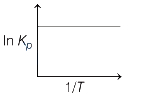
B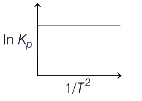
C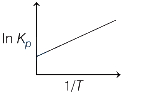
D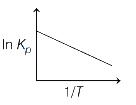
Solution
(D) The relationship between the equilibrium constant $K_p$ and temperature $T$ is given by the van 't Hoff equation:
$\ln K_p = -\frac{\Delta H^\circ}{R} \cdot \frac{1}{T} + \frac{\Delta S^\circ}{R}$
where $\Delta H^\circ$ is the standard enthalpy change of the reaction,$R$ is the gas constant,and $\Delta S^\circ$ is the standard entropy change.
For an endothermic reaction,$\Delta H^\circ > 0$.
Comparing this with the linear equation $y = mx + c$,where $y = \ln K_p$ and $x = \frac{1}{T}$,the slope $m = -\frac{\Delta H^\circ}{R}$.
Since $\Delta H^\circ > 0$ and $R > 0$,the slope $m = -\frac{\Delta H^\circ}{R}$ must be negative.
Therefore,the plot of $\ln K_p$ versus $\frac{1}{T}$ for an endothermic reaction is a straight line with a negative slope.
Thus,option $(d)$ is correct.
$\ln K_p = -\frac{\Delta H^\circ}{R} \cdot \frac{1}{T} + \frac{\Delta S^\circ}{R}$
where $\Delta H^\circ$ is the standard enthalpy change of the reaction,$R$ is the gas constant,and $\Delta S^\circ$ is the standard entropy change.
For an endothermic reaction,$\Delta H^\circ > 0$.
Comparing this with the linear equation $y = mx + c$,where $y = \ln K_p$ and $x = \frac{1}{T}$,the slope $m = -\frac{\Delta H^\circ}{R}$.
Since $\Delta H^\circ > 0$ and $R > 0$,the slope $m = -\frac{\Delta H^\circ}{R}$ must be negative.
Therefore,the plot of $\ln K_p$ versus $\frac{1}{T}$ for an endothermic reaction is a straight line with a negative slope.
Thus,option $(d)$ is correct.
0 likes
View Solution348
MediumMCQ
For a reaction $2A_{(g)} \rightleftharpoons 2B_{(g)} + C_{(g)}$,$K_c = 3.75 \times 10^{-6}$ at $1069 \ K$. The approximate value of $K_p$ for this reaction at the same temperature is $(R = 0.082 \ L \ bar \ mol^{-1} \ K^{-1})$.
A
$2.4 \times 10^{-4}$
B
$3.3 \times 10^{-4}$
C
$33 \times 10^2$
D
$7.2 \times 10^{34}$
Solution
(B) The relationship between the equilibrium constant in terms of concentration $(K_c)$ and partial pressure $(K_p)$ is given by the equation:
$K_p = K_c(RT)^{\Delta n}$
Here,$\Delta n$ is the change in the number of gaseous moles:
$\Delta n = (2 + 1) - 2 = 1$
Given $K_c = 3.75 \times 10^{-6}$,$R = 0.082 \ L \ bar \ mol^{-1} \ K^{-1}$,and $T = 1069 \ K$:
$K_p = 3.75 \times 10^{-6} \times (0.082 \times 1069)^{1}$
$K_p = 3.75 \times 10^{-6} \times 87.658$
$K_p \approx 3.287 \times 10^{-4}$
Rounding to two significant figures,we get $K_p \approx 3.3 \times 10^{-4}$.
$K_p = K_c(RT)^{\Delta n}$
Here,$\Delta n$ is the change in the number of gaseous moles:
$\Delta n = (2 + 1) - 2 = 1$
Given $K_c = 3.75 \times 10^{-6}$,$R = 0.082 \ L \ bar \ mol^{-1} \ K^{-1}$,and $T = 1069 \ K$:
$K_p = 3.75 \times 10^{-6} \times (0.082 \times 1069)^{1}$
$K_p = 3.75 \times 10^{-6} \times 87.658$
$K_p \approx 3.287 \times 10^{-4}$
Rounding to two significant figures,we get $K_p \approx 3.3 \times 10^{-4}$.
0 likes
View Solution349
MediumMCQ
For the formation of $NH_3$ from $N_2$ and $H_2$ at $500 \ K$,the concentrations of $N_2, H_2$ and $NH_3$ at equilibrium are $1.5 \times 10^{-2} \ M, 3.0 \times 10^{-2} \ M$ and $1.2 \times 10^{-2} \ M$,respectively. The equilibrium constant for the reverse reaction is
A
$3.56 \times 10^2$
B
$2.81 \times 10^{-3}$
C
$3.56 \times 10^{-2}$
D
$2.81 \times 10^3$
Solution
(B) The balanced chemical equation for the formation of $NH_3$ is: $N_2(g) + 3H_2(g) \rightleftharpoons 2NH_3(g)$.
For the reverse reaction,the equation is: $2NH_3(g) \rightleftharpoons N_2(g) + 3H_2(g)$.
The equilibrium constant $K_C$ for the reverse reaction is given by the expression: $K_C = \frac{[N_2][H_2]^3}{[NH_3]^2}$.
Substituting the given equilibrium concentrations:
$K_C = \frac{(1.5 \times 10^{-2}) \times (3.0 \times 10^{-2})^3}{(1.2 \times 10^{-2})^2}$.
$K_C = \frac{(1.5 \times 10^{-2}) \times (27.0 \times 10^{-6})}{1.44 \times 10^{-4}}$.
$K_C = \frac{40.5 \times 10^{-8}}{1.44 \times 10^{-4}} = 28.125 \times 10^{-4} = 2.81 \times 10^{-3}$.
For the reverse reaction,the equation is: $2NH_3(g) \rightleftharpoons N_2(g) + 3H_2(g)$.
The equilibrium constant $K_C$ for the reverse reaction is given by the expression: $K_C = \frac{[N_2][H_2]^3}{[NH_3]^2}$.
Substituting the given equilibrium concentrations:
$K_C = \frac{(1.5 \times 10^{-2}) \times (3.0 \times 10^{-2})^3}{(1.2 \times 10^{-2})^2}$.
$K_C = \frac{(1.5 \times 10^{-2}) \times (27.0 \times 10^{-6})}{1.44 \times 10^{-4}}$.
$K_C = \frac{40.5 \times 10^{-8}}{1.44 \times 10^{-4}} = 28.125 \times 10^{-4} = 2.81 \times 10^{-3}$.
0 likes
View Solution350
DifficultMCQ
Consider the following reaction in a $1 \ L$ closed vessel: $N_2 + 3H_2 \rightleftharpoons 2NH_3$. If all the species $N_2, H_2$ and $NH_3$ are $1 \ mol$ each at the beginning of the reaction and equilibrium is attained when unreacted $N_2$ is $0.7 \ mol$,what is the value of the equilibrium constant?
A
$3600$
B
$3657.14$
C
$2657.14$
D
$1828.57$
Solution
(B) Given reaction: $N_2 + 3H_2 \rightleftharpoons 2NH_3$
Initial moles: $n(N_2) = 1, n(H_2) = 1, n(NH_3) = 1$
Let $x$ be the moles of $N_2$ reacted at equilibrium.
Equilibrium moles of $N_2 = 1 - x = 0.7 \Rightarrow x = 0.3 \ mol$
Equilibrium moles of $H_2 = 1 - 3x = 1 - 3(0.3) = 0.1 \ mol$
Equilibrium moles of $NH_3 = 1 + 2x = 1 + 2(0.3) = 1.6 \ mol$
Since volume $V = 1 \ L$,concentrations are equal to the number of moles.
$[N_2] = 0.7 \ M, [H_2] = 0.1 \ M, [NH_3] = 1.6 \ M$
Equilibrium constant $K_c = \frac{[NH_3]^2}{[N_2][H_2]^3}$
$K_c = \frac{(1.6)^2}{(0.7)(0.1)^3} = \frac{2.56}{0.7 \times 0.001} = \frac{2.56}{0.0007} = 3657.14$
Initial moles: $n(N_2) = 1, n(H_2) = 1, n(NH_3) = 1$
Let $x$ be the moles of $N_2$ reacted at equilibrium.
Equilibrium moles of $N_2 = 1 - x = 0.7 \Rightarrow x = 0.3 \ mol$
Equilibrium moles of $H_2 = 1 - 3x = 1 - 3(0.3) = 0.1 \ mol$
Equilibrium moles of $NH_3 = 1 + 2x = 1 + 2(0.3) = 1.6 \ mol$
Since volume $V = 1 \ L$,concentrations are equal to the number of moles.
$[N_2] = 0.7 \ M, [H_2] = 0.1 \ M, [NH_3] = 1.6 \ M$
Equilibrium constant $K_c = \frac{[NH_3]^2}{[N_2][H_2]^3}$
$K_c = \frac{(1.6)^2}{(0.7)(0.1)^3} = \frac{2.56}{0.7 \times 0.001} = \frac{2.56}{0.0007} = 3657.14$
0 likes
View Solution6-1.Equilibrium (Chemical Equilibrium) — Kp and Kc Relationship · Frequently Asked Questions
1Are these 6-1.Equilibrium (Chemical Equilibrium) questions useful for JEE and NEET?
Yes. All questions in this section are mapped to JEE Main and NEET exam patterns. Previous year questions from JEE Main, NEET, GUJCET and state-level exams are included with full solutions.
2Can I switch to Hindi or Gujarati for these questions?
Yes. Use the language tabs in the hero section or the sidebar to view the same questions and solutions in English, Hindi or Gujarati.
3How do I generate a question paper from this subtopic?
Use the Vedclass Exam Paper Generator — select the chapter and subtopic, set difficulty, and generate Sets A, B, C, D automatically. First 3 chapters of every subject are free.
Vedclass Products
For Students
Vedclass Test Series
Mock tests in real JEE/NEET style with performance analysis. 5-day free trial.
Start Free TrialFor Teachers
Exam Paper Generator
Generate Set A/B/C/D papers from this chapter in 2 minutes. 3 chapters free.
Try FreeFor Institutes
Online Exam Module
Live online exams with unlimited students, 360° analytics & white-label branding.
See DemoFor Teachers & Institutes
Generate a 6-1.Equilibrium (Chemical Equilibrium) Exam Paper in 2 Minutes
Select subtopic & difficulty — Sets A, B, C, D auto-generated with No Repeat logic.
First 3 chapters of every subject are free — no payment required.