
A English
Degree of dissociation and Vapour density Questions in English
Class 11 Chemistry · 6-1.Equilibrium (Chemical Equilibrium) · Degree of dissociation and Vapour density
100+
Questions
English
Language
100%
With Solutions
Showing 50 of 100 questions in English
51
MediumMCQ
$0.1 \ mol$ of $H_2S_{(g)}$ is kept in a $0.4 \ L$ vessel at $1000 \ K$. For the reaction $2 H_2S_{(g)} \rightleftharpoons 2 H_{2(g)} + S_{2(g)}$,$K_c = 10^{-6}$. The percentage dissociation of $H_2S$ is.......$\%$
A
$0.5$
B
$1$
C
$2$
D
$3$
Solution
(C) Initial concentration of $H_2S = \frac{0.1 \ mol}{0.4 \ L} = 0.25 \ M$.
Let the degree of dissociation be $\alpha$.
The reaction is $2 H_2S_{(g)} \rightleftharpoons 2 H_{2(g)} + S_{2(g)}$.
At equilibrium: $[H_2S] = 0.25(1 - \alpha)$,$[H_2] = 0.25\alpha$,$[S_2] = 0.125\alpha$.
Since $K_c = 10^{-6}$ is very small,$\alpha << 1$,so $(1 - \alpha) \approx 1$.
$K_c = \frac{[H_2]^2 [S_2]}{[H_2S]^2} = \frac{(0.25\alpha)^2 (0.125\alpha)}{(0.25)^2} = 0.125 \alpha^3$.
$10^{-6} = 0.125 \alpha^3 \implies \alpha^3 = \frac{10^{-6}}{0.125} = 8 \times 10^{-6}$.
$\alpha = 2 \times 10^{-2} = 0.02$.
Percentage dissociation = $\alpha \times 100 = 0.02 \times 100 = 2 \%$.
Let the degree of dissociation be $\alpha$.
The reaction is $2 H_2S_{(g)} \rightleftharpoons 2 H_{2(g)} + S_{2(g)}$.
At equilibrium: $[H_2S] = 0.25(1 - \alpha)$,$[H_2] = 0.25\alpha$,$[S_2] = 0.125\alpha$.
Since $K_c = 10^{-6}$ is very small,$\alpha << 1$,so $(1 - \alpha) \approx 1$.
$K_c = \frac{[H_2]^2 [S_2]}{[H_2S]^2} = \frac{(0.25\alpha)^2 (0.125\alpha)}{(0.25)^2} = 0.125 \alpha^3$.
$10^{-6} = 0.125 \alpha^3 \implies \alpha^3 = \frac{10^{-6}}{0.125} = 8 \times 10^{-6}$.
$\alpha = 2 \times 10^{-2} = 0.02$.
Percentage dissociation = $\alpha \times 100 = 0.02 \times 100 = 2 \%$.
0 likes
View Solution52
MediumMCQ
Ammonium carbamate $(NH_4COONH_2)$ when heated to $200 \ ^oC$ gives a mixture of $NH_3$ and $CO_2$ with a vapour density of $26$ at equilibrium. What is the degree of dissociation of ammonium carbamate?
A
$2/3$
B
$0.25$
C
$0.5$
D
$1$
Solution
(B) The dissociation reaction is: $NH_4COONH_2(s) \rightleftharpoons 2NH_3(g) + CO_2(g)$.
The number of moles of gaseous products produced per mole of reactant dissociated is $n = 2 + 1 = 3$.
The theoretical vapour density $(D_t)$ is calculated as: $D_t = \frac{\text{Molar Mass}}{2} = \frac{78}{2} = 39$.
Given the observed vapour density at equilibrium is $D_0 = 26$.
The degree of dissociation $(\alpha)$ is given by the formula: $\alpha = \frac{D_t - D_0}{D_0(n - 1)}$.
Substituting the values: $\alpha = \frac{39 - 26}{26(3 - 1)} = \frac{13}{26 \times 2} = \frac{13}{52} = 0.25$.
The number of moles of gaseous products produced per mole of reactant dissociated is $n = 2 + 1 = 3$.
The theoretical vapour density $(D_t)$ is calculated as: $D_t = \frac{\text{Molar Mass}}{2} = \frac{78}{2} = 39$.
Given the observed vapour density at equilibrium is $D_0 = 26$.
The degree of dissociation $(\alpha)$ is given by the formula: $\alpha = \frac{D_t - D_0}{D_0(n - 1)}$.
Substituting the values: $\alpha = \frac{39 - 26}{26(3 - 1)} = \frac{13}{26 \times 2} = \frac{13}{52} = 0.25$.
0 likes
View Solution53
MediumMCQ
For the reaction,$N_2 + O_2 \rightleftharpoons 2NO$,the equilibrium constant is $K_c = 2$. If both reactants have the same initial moles,what is the degree of dissociation of $N_2$ and $O_2$?
A
$\frac{1}{1 + \sqrt{2}}, \frac{1}{1 - \sqrt{2}}$
B
$\frac{1}{1 - \sqrt{2}}, \frac{1}{1 + \sqrt{2}}$
C
Both are $\frac{1}{1 + \sqrt{2}}$
D
Both are $\frac{1}{1 - \sqrt{2}}$
Solution
(C) Let the initial moles of $N_2$ and $O_2$ be $1$ mole each.
Let $\alpha$ be the degree of dissociation for both $N_2$ and $O_2$.
The reaction is $N_2 + O_2 \rightleftharpoons 2NO$.
At equilibrium,moles are: $N_2 = (1 - \alpha)$,$O_2 = (1 - \alpha)$,$NO = 2\alpha$.
The equilibrium constant $K_c$ is given by: $K_c = \frac{[NO]^2}{[N_2][O_2]} = \frac{(2\alpha)^2}{(1 - \alpha)(1 - \alpha)} = \frac{(2\alpha)^2}{(1 - \alpha)^2}$.
Given $K_c = 2$,we have $2 = \left(\frac{2\alpha}{1 - \alpha}\right)^2$.
Taking the square root on both sides: $\sqrt{2} = \frac{2\alpha}{1 - \alpha}$.
$\sqrt{2}(1 - \alpha) = 2\alpha$.
$\sqrt{2} - \alpha\sqrt{2} = 2\alpha$.
$\sqrt{2} = \alpha(2 + \sqrt{2})$.
$\alpha = \frac{\sqrt{2}}{2 + \sqrt{2}} = \frac{\sqrt{2}}{\sqrt{2}(\sqrt{2} + 1)} = \frac{1}{1 + \sqrt{2}}$.
Let $\alpha$ be the degree of dissociation for both $N_2$ and $O_2$.
The reaction is $N_2 + O_2 \rightleftharpoons 2NO$.
At equilibrium,moles are: $N_2 = (1 - \alpha)$,$O_2 = (1 - \alpha)$,$NO = 2\alpha$.
The equilibrium constant $K_c$ is given by: $K_c = \frac{[NO]^2}{[N_2][O_2]} = \frac{(2\alpha)^2}{(1 - \alpha)(1 - \alpha)} = \frac{(2\alpha)^2}{(1 - \alpha)^2}$.
Given $K_c = 2$,we have $2 = \left(\frac{2\alpha}{1 - \alpha}\right)^2$.
Taking the square root on both sides: $\sqrt{2} = \frac{2\alpha}{1 - \alpha}$.
$\sqrt{2}(1 - \alpha) = 2\alpha$.
$\sqrt{2} - \alpha\sqrt{2} = 2\alpha$.
$\sqrt{2} = \alpha(2 + \sqrt{2})$.
$\alpha = \frac{\sqrt{2}}{2 + \sqrt{2}} = \frac{\sqrt{2}}{\sqrt{2}(\sqrt{2} + 1)} = \frac{1}{1 + \sqrt{2}}$.
0 likes
View Solution54
MediumMCQ
For which of the following reactions,the degree of dissociation cannot be calculated from the vapour density data?
$I. \ 2HI_{(g)} \rightleftharpoons H_{2(g)} + I_{2(g)}$
$II. \ 2NH_{3(g)} \rightleftharpoons N_{2(g)} + 3H_{2(g)}$
$III. \ 2NO_{(g)} \rightleftharpoons N_{2(g)} + O_{2(g)}$
$IV. \ PCl_{5(g)} \rightleftharpoons PCl_{3(g)} + Cl_{2(g)}$
$I. \ 2HI_{(g)} \rightleftharpoons H_{2(g)} + I_{2(g)}$
$II. \ 2NH_{3(g)} \rightleftharpoons N_{2(g)} + 3H_{2(g)}$
$III. \ 2NO_{(g)} \rightleftharpoons N_{2(g)} + O_{2(g)}$
$IV. \ PCl_{5(g)} \rightleftharpoons PCl_{3(g)} + Cl_{2(g)}$
A
$I$ and $III$
B
$II$ and $IV$
C
$I$ and $II$
D
$III$ and $IV$
Solution
(A) The degree of dissociation $(\alpha)$ can be calculated from vapour density data using the formula $\alpha = \frac{D-d}{(n-1)d}$,where $D$ is the theoretical vapour density,$d$ is the observed vapour density,and $n$ is the number of moles of products formed from $1$ mole of reactant.
This method is applicable only when there is a change in the number of moles during the reaction,i.e.,$\Delta n_g \neq 0$.
Let us calculate $\Delta n_g$ for each reaction:
$I. \ 2HI_{(g)} \rightleftharpoons H_{2(g)} + I_{2(g)} \Rightarrow \Delta n_g = (1+1) - 2 = 0$
$II. \ 2NH_{3(g)} \rightleftharpoons N_{2(g)} + 3H_{2(g)} \Rightarrow \Delta n_g = (1+3) - 2 = 2$
$III. \ 2NO_{(g)} \rightleftharpoons N_{2(g)} + O_{2(g)} \Rightarrow \Delta n_g = (1+1) - 2 = 0$
$IV. \ PCl_{5(g)} \rightleftharpoons PCl_{3(g)} + Cl_{2(g)} \Rightarrow \Delta n_g = (1+1) - 1 = 1$
Since $\Delta n_g = 0$ for reactions $I$ and $III$,the degree of dissociation cannot be calculated using the vapour density method for these reactions.
This method is applicable only when there is a change in the number of moles during the reaction,i.e.,$\Delta n_g \neq 0$.
Let us calculate $\Delta n_g$ for each reaction:
$I. \ 2HI_{(g)} \rightleftharpoons H_{2(g)} + I_{2(g)} \Rightarrow \Delta n_g = (1+1) - 2 = 0$
$II. \ 2NH_{3(g)} \rightleftharpoons N_{2(g)} + 3H_{2(g)} \Rightarrow \Delta n_g = (1+3) - 2 = 2$
$III. \ 2NO_{(g)} \rightleftharpoons N_{2(g)} + O_{2(g)} \Rightarrow \Delta n_g = (1+1) - 2 = 0$
$IV. \ PCl_{5(g)} \rightleftharpoons PCl_{3(g)} + Cl_{2(g)} \Rightarrow \Delta n_g = (1+1) - 1 = 1$
Since $\Delta n_g = 0$ for reactions $I$ and $III$,the degree of dissociation cannot be calculated using the vapour density method for these reactions.
0 likes
View Solution55
DifficultMCQ
Ammonium carbamate $(NH_2COONH_4)$ when heated to $200\,^{\circ}C$ gives a mixture of $NH_3$ and $CO_2$ with a vapour density of $13.0$ at equilibrium. What is the degree of dissociation of ammonium carbamate?
A
$1.5$
B
$0.5$
C
$2$
D
$1$
Solution
(D) The dissociation reaction is: $NH_2COONH_4(s) \rightleftharpoons 2NH_3(g) + CO_2(g)$.
Here,the number of moles of gaseous products $n = 2 + 1 = 3$.
The molar mass of ammonium carbamate is $M = 78 \, g/mol$.
The theoretical vapour density $D_t = \frac{M}{2} = \frac{78}{2} = 39$.
The observed vapour density $D_o = 13.0$.
The degree of dissociation $\alpha$ is given by the formula: $\alpha = \frac{D_t - D_o}{D_o(n - 1)}$.
Substituting the values: $\alpha = \frac{39 - 13}{13(3 - 1)} = \frac{26}{13 \times 2} = \frac{26}{26} = 1$.
Here,the number of moles of gaseous products $n = 2 + 1 = 3$.
The molar mass of ammonium carbamate is $M = 78 \, g/mol$.
The theoretical vapour density $D_t = \frac{M}{2} = \frac{78}{2} = 39$.
The observed vapour density $D_o = 13.0$.
The degree of dissociation $\alpha$ is given by the formula: $\alpha = \frac{D_t - D_o}{D_o(n - 1)}$.
Substituting the values: $\alpha = \frac{39 - 13}{13(3 - 1)} = \frac{26}{13 \times 2} = \frac{26}{26} = 1$.
0 likes
View Solution56
MediumMCQ
At $NTP$,$5.6 \ L$ of a gas weighs $8 \ g$. The vapour density of the gas is:
A
$32$
B
$40$
C
$16$
D
$8$
Solution
(C) The number of moles of the gas is given by the formula: $\text{moles} = \frac{\text{mass}}{\text{molar mass}} = \frac{V_{NTP}}{22.4 \ L/mol}$.
Substituting the given values: $\frac{8}{M} = \frac{5.6}{22.4}$.
Simplifying the equation: $\frac{5.6}{22.4} = \frac{1}{4}$.
Therefore,$\frac{8}{M} = \frac{1}{4}$,which gives $M = 32 \ g/mol$.
The vapour density is defined as: $\text{Vapour density} = \frac{\text{Molar mass}}{2}$.
$\text{Vapour density} = \frac{32}{2} = 16$.
Substituting the given values: $\frac{8}{M} = \frac{5.6}{22.4}$.
Simplifying the equation: $\frac{5.6}{22.4} = \frac{1}{4}$.
Therefore,$\frac{8}{M} = \frac{1}{4}$,which gives $M = 32 \ g/mol$.
The vapour density is defined as: $\text{Vapour density} = \frac{\text{Molar mass}}{2}$.
$\text{Vapour density} = \frac{32}{2} = 16$.
0 likes
View Solution57
MediumMCQ
$2SO_3 \rightleftharpoons 2SO_2 + O_2$. Initially,$3$ moles of $SO_3$ were heated. If the degree of dissociation of $SO_3$ is $40\%$,find the total number of moles at equilibrium.
A
$3.3$
B
$6.6$
C
$3.15$
D
$3.6$
Solution
(D) The chemical equation is: $2SO_3 \rightleftharpoons 2SO_2 + O_2$
Initial moles: $3 \quad 0 \quad 0$
Degree of dissociation $(\alpha)$ $= 0.4$
Moles reacted $= 3 \times 0.4 = 1.2$
At equilibrium:
$SO_3 = 3 - 1.2 = 1.8$
$SO_2 = 1.2$
$O_2 = \frac{1.2}{2} = 0.6$
Total moles at equilibrium $= 1.8 + 1.2 + 0.6 = 3.6$
Initial moles: $3 \quad 0 \quad 0$
Degree of dissociation $(\alpha)$ $= 0.4$
Moles reacted $= 3 \times 0.4 = 1.2$
At equilibrium:
$SO_3 = 3 - 1.2 = 1.8$
$SO_2 = 1.2$
$O_2 = \frac{1.2}{2} = 0.6$
Total moles at equilibrium $= 1.8 + 1.2 + 0.6 = 3.6$
0 likes
View Solution58
MediumMCQ
Phosphine decomposes at $300 \ K$ and $3 \ atm$ as
$4PH_{3(g)} \rightleftharpoons P_{4(g)} + 6H_{2(g)}$
Calculate the vapour density of phosphine if it dissociates to the extent of $30 \%$.
$4PH_{3(g)} \rightleftharpoons P_{4(g)} + 6H_{2(g)}$
Calculate the vapour density of phosphine if it dissociates to the extent of $30 \%$.
A
$18.14$
B
$10$
C
$13.8$
D
$11.14$
Solution
(C) The dissociation reaction is: $4PH_{3(g)} \rightleftharpoons P_{4(g)} + 6H_{2(g)}$
Let the initial moles of $PH_3$ be $1$. At equilibrium,moles are: $PH_3 = (1 - \alpha)$,$P_4 = \alpha/4$,$H_2 = 6\alpha/4 = 1.5\alpha$.
Total moles at equilibrium $= (1 - \alpha) + 0.25\alpha + 1.5\alpha = 1 + 0.75\alpha$.
Given $\alpha = 0.3$,total moles $= 1 + 0.75(0.3) = 1.225$.
The relation between vapour density $(D)$ and observed vapour density $(d)$ is $\frac{D}{d} = \frac{\text{Total moles at equilibrium}}{\text{Initial moles}} = 1 + n\alpha$,where $n$ is the change in moles per mole of reactant.
Here,$n = \frac{1+6-4}{4} = 0.75$.
$D = \frac{M_{PH_3}}{2} = \frac{34}{2} = 17$.
$d = \frac{D}{1 + 0.75 \times 0.3} = \frac{17}{1.225} \approx 13.87$.
Let the initial moles of $PH_3$ be $1$. At equilibrium,moles are: $PH_3 = (1 - \alpha)$,$P_4 = \alpha/4$,$H_2 = 6\alpha/4 = 1.5\alpha$.
Total moles at equilibrium $= (1 - \alpha) + 0.25\alpha + 1.5\alpha = 1 + 0.75\alpha$.
Given $\alpha = 0.3$,total moles $= 1 + 0.75(0.3) = 1.225$.
The relation between vapour density $(D)$ and observed vapour density $(d)$ is $\frac{D}{d} = \frac{\text{Total moles at equilibrium}}{\text{Initial moles}} = 1 + n\alpha$,where $n$ is the change in moles per mole of reactant.
Here,$n = \frac{1+6-4}{4} = 0.75$.
$D = \frac{M_{PH_3}}{2} = \frac{34}{2} = 17$.
$d = \frac{D}{1 + 0.75 \times 0.3} = \frac{17}{1.225} \approx 13.87$.
0 likes
View Solution59
MediumMCQ
If $D_T$ and $D_0$ are the theoretical and observed vapour densities at a definite temperature and $\alpha$ is the degree of dissociation of a substance,then $\alpha$ in terms of $D_0, D_T$ and $n$ (number of moles of product formed from $1 \, \text{mole}$ of reactant) is calculated by the formula:
A
$\alpha = \frac{D_0 - D_T}{(1 - n)D_T}$
B
$\alpha = \frac{D_T - D_0}{(n - 1)D_T}$
C
$\alpha = \frac{D_T - D_0}{(n - 1)D_0}$
D
$\alpha = \frac{D_0 - D_T}{(n - 1)D_T}$
Solution
(C) Consider the dissociation reaction: $A \rightleftharpoons nB$
Initial moles: $1 \quad 0$
Moles at equilibrium: $1 - \alpha \quad n\alpha$
Total moles at equilibrium: $1 - \alpha + n\alpha = 1 + \alpha(n - 1)$
Since vapour density is inversely proportional to the number of moles,we have: $\frac{D_T}{D_0} = \frac{\text{Total moles at equilibrium}}{\text{Initial moles}} = \frac{1 + \alpha(n - 1)}{1}$
Rearranging for $\alpha$: $\frac{D_T}{D_0} = 1 + \alpha(n - 1)$
$\frac{D_T}{D_0} - 1 = \alpha(n - 1)$
$\frac{D_T - D_0}{D_0} = \alpha(n - 1)$
$\alpha = \frac{D_T - D_0}{(n - 1)D_0}$
Initial moles: $1 \quad 0$
Moles at equilibrium: $1 - \alpha \quad n\alpha$
Total moles at equilibrium: $1 - \alpha + n\alpha = 1 + \alpha(n - 1)$
Since vapour density is inversely proportional to the number of moles,we have: $\frac{D_T}{D_0} = \frac{\text{Total moles at equilibrium}}{\text{Initial moles}} = \frac{1 + \alpha(n - 1)}{1}$
Rearranging for $\alpha$: $\frac{D_T}{D_0} = 1 + \alpha(n - 1)$
$\frac{D_T}{D_0} - 1 = \alpha(n - 1)$
$\frac{D_T - D_0}{D_0} = \alpha(n - 1)$
$\alpha = \frac{D_T - D_0}{(n - 1)D_0}$
0 likes
View Solution60
MediumMCQ
$AB_{3(g)}$ dissociates as:
$AB_{3(g)} \rightleftharpoons AB_{2(g)} + \frac{1}{2} B_{2(g)}$. When the initial pressure of $AB_3$ is $800 \ torr$ and the total pressure developed at equilibrium is $900 \ torr$,what percentage of $AB_{3(g)}$ is dissociated?
$AB_{3(g)} \rightleftharpoons AB_{2(g)} + \frac{1}{2} B_{2(g)}$. When the initial pressure of $AB_3$ is $800 \ torr$ and the total pressure developed at equilibrium is $900 \ torr$,what percentage of $AB_{3(g)}$ is dissociated?
A
$10$
B
$20$
C
$25$
D
$30$
Solution
(C) The reaction is: $AB_{3(g)} \rightleftharpoons AB_{2(g)} + \frac{1}{2} B_{2(g)}$
Let the initial pressure of $AB_3$ be $P_i = 800 \ torr$.
Let the change in pressure due to dissociation be $x$.
At equilibrium:
$P_{AB_3} = 800 - x$
$P_{AB_2} = x$
$P_{B_2} = \frac{x}{2}$
The total pressure at equilibrium is given as $900 \ torr$:
$(800 - x) + x + \frac{x}{2} = 900$
$800 + \frac{x}{2} = 900$
$\frac{x}{2} = 100$
$x = 200 \ torr$
The degree of dissociation $(\alpha)$ is the fraction of initial pressure dissociated:
$\alpha = \frac{x}{P_i} = \frac{200}{800} = 0.25$
Percentage of dissociation = $0.25 \times 100 = 25 \%$.
Let the initial pressure of $AB_3$ be $P_i = 800 \ torr$.
Let the change in pressure due to dissociation be $x$.
At equilibrium:
$P_{AB_3} = 800 - x$
$P_{AB_2} = x$
$P_{B_2} = \frac{x}{2}$
The total pressure at equilibrium is given as $900 \ torr$:
$(800 - x) + x + \frac{x}{2} = 900$
$800 + \frac{x}{2} = 900$
$\frac{x}{2} = 100$
$x = 200 \ torr$
The degree of dissociation $(\alpha)$ is the fraction of initial pressure dissociated:
$\alpha = \frac{x}{P_i} = \frac{200}{800} = 0.25$
Percentage of dissociation = $0.25 \times 100 = 25 \%$.
0 likes
View Solution61
MediumMCQ
$A$ $1 \ L$ vessel contains $2 \ moles$ of $PCl_5$ initially. If $K_c$ is found to be $1$,the degree of dissociation of $PCl_5$ for the reaction $PCl_{5(g)} \rightleftharpoons PCl_{3(g)} + Cl_{2(g)}$ is:
A
$1$
B
$-1$
C
$0.5$
D
$0.25$
Solution
(C) The reaction is: $PCl_{5(g)} \rightleftharpoons PCl_{3(g)} + Cl_{2(g)}$
Initially,moles: $PCl_5 = 2, PCl_3 = 0, Cl_2 = 0$
At equilibrium,moles: $PCl_5 = 2-x, PCl_3 = x, Cl_2 = x$
Since the volume is $1 \ L$,the concentrations are equal to the number of moles.
$K_c = \frac{[PCl_3][Cl_2]}{[PCl_5]} = \frac{x \cdot x}{2-x} = 1$
$x^2 = 2 - x \implies x^2 + x - 2 = 0$
$(x+2)(x-1) = 0$
Since $x$ cannot be negative,$x = 1$.
Degree of dissociation $(\alpha)$ $= \frac{\text{moles dissociated}}{\text{initial moles}} = \frac{x}{2} = \frac{1}{2} = 0.5$.
Initially,moles: $PCl_5 = 2, PCl_3 = 0, Cl_2 = 0$
At equilibrium,moles: $PCl_5 = 2-x, PCl_3 = x, Cl_2 = x$
Since the volume is $1 \ L$,the concentrations are equal to the number of moles.
$K_c = \frac{[PCl_3][Cl_2]}{[PCl_5]} = \frac{x \cdot x}{2-x} = 1$
$x^2 = 2 - x \implies x^2 + x - 2 = 0$
$(x+2)(x-1) = 0$
Since $x$ cannot be negative,$x = 1$.
Degree of dissociation $(\alpha)$ $= \frac{\text{moles dissociated}}{\text{initial moles}} = \frac{x}{2} = \frac{1}{2} = 0.5$.
0 likes
View Solution62
DifficultMCQ
Gaseous $N_2O_4$ dissociates into gaseous $NO_2$ according to the reaction:
$N_2O_{4(g)} \rightleftharpoons 2NO_{2(g)}$
At $300 \ K$ and $1 \ atm$ pressure,the degree of dissociation of $N_2O_4$ is $0.2$. If one mole of $N_2O_4$ gas is contained in a vessel,then the density of the equilibrium mixture is.......$g/L$
$N_2O_{4(g)} \rightleftharpoons 2NO_{2(g)}$
At $300 \ K$ and $1 \ atm$ pressure,the degree of dissociation of $N_2O_4$ is $0.2$. If one mole of $N_2O_4$ gas is contained in a vessel,then the density of the equilibrium mixture is.......$g/L$
A
$1.56$
B
$6.22$
C
$3.11$
D
$4.56$
Solution
(C) Reaction: $N_2O_{4(g)} \rightleftharpoons 2NO_{2(g)}$
Initial moles $(t=0)$: $1 \ mol$ of $N_2O_4$ and $0 \ mol$ of $NO_2$.
At equilibrium $(t=eq)$: $(1-\alpha) \ mol$ of $N_2O_4$ and $2\alpha \ mol$ of $NO_2$,where $\alpha = 0.2$.
Total moles at equilibrium: $n_{total} = (1-\alpha) + 2\alpha = 1 + \alpha = 1 + 0.2 = 1.2 \ mol$.
Molar mass of $N_2O_4 = 92 \ g/mol$ and $NO_2 = 46 \ g/mol$.
Average molar mass of the mixture $(M_{mix})$:
$M_{mix} = \frac{(1 - \alpha) \times 92 + 2\alpha \times 46}{1 + \alpha} = \frac{0.8 \times 92 + 0.4 \times 46}{1.2} = \frac{73.6 + 18.4}{1.2} = \frac{92}{1.2} = 76.66 \ g/mol$.
Using the ideal gas law $PV = nRT$ or $PM = dRT$:
$d = \frac{P \times M_{mix}}{R \times T} = \frac{1 \times 76.66}{0.0821 \times 300} = \frac{76.66}{24.63} \approx 3.11 \ g/L$.
Initial moles $(t=0)$: $1 \ mol$ of $N_2O_4$ and $0 \ mol$ of $NO_2$.
At equilibrium $(t=eq)$: $(1-\alpha) \ mol$ of $N_2O_4$ and $2\alpha \ mol$ of $NO_2$,where $\alpha = 0.2$.
Total moles at equilibrium: $n_{total} = (1-\alpha) + 2\alpha = 1 + \alpha = 1 + 0.2 = 1.2 \ mol$.
Molar mass of $N_2O_4 = 92 \ g/mol$ and $NO_2 = 46 \ g/mol$.
Average molar mass of the mixture $(M_{mix})$:
$M_{mix} = \frac{(1 - \alpha) \times 92 + 2\alpha \times 46}{1 + \alpha} = \frac{0.8 \times 92 + 0.4 \times 46}{1.2} = \frac{73.6 + 18.4}{1.2} = \frac{92}{1.2} = 76.66 \ g/mol$.
Using the ideal gas law $PV = nRT$ or $PM = dRT$:
$d = \frac{P \times M_{mix}}{R \times T} = \frac{1 \times 76.66}{0.0821 \times 300} = \frac{76.66}{24.63} \approx 3.11 \ g/L$.
0 likes
View Solution63
DifficultMCQ
The value of $K_P$ for the equilibrium reaction ${N_2}{O_4}_{(g)} \rightleftharpoons 2N{O_2}_{(g)}$ is $2$. The percentage dissociation of ${N_2}{O_4}_{(g)}$ at a pressure of $0.5 \ atm$ is
A
$25$
B
$88$
C
$50$
D
$71$
Solution
(D) For the reaction: ${N_2}{O_4}_{(g)} \rightleftharpoons 2N{O_2}_{(g)}$
Let the initial moles of ${N_2}{O_4}$ be $1$ and degree of dissociation be $\alpha$.
At equilibrium,moles of ${N_2}{O_4} = (1 - \alpha)$ and moles of $N{O_2} = 2\alpha$.
Total moles at equilibrium $= (1 - \alpha) + 2\alpha = (1 + \alpha)$.
Partial pressure of ${N_2}{O_4} = \frac{(1 - \alpha)}{(1 + \alpha)} \times P$.
Partial pressure of $N{O_2} = \frac{2\alpha}{(1 + \alpha)} \times P$.
$K_P = \frac{(P_{N{O_2}})^2}{P_{{N_2}{O_4}}} = \frac{[\frac{2\alpha}{1 + \alpha} \times P]^2}{\frac{1 - \alpha}{1 + \alpha} \times P} = \frac{4\alpha^2 P}{1 - \alpha^2}$.
Given $K_P = 2$ and $P = 0.5 \ atm$:
$2 = \frac{4 \times \alpha^2 \times 0.5}{1 - \alpha^2} = \frac{2\alpha^2}{1 - \alpha^2}$.
$1 - \alpha^2 = \alpha^2 \implies 2\alpha^2 = 1 \implies \alpha^2 = 0.5$.
$\alpha = \sqrt{0.5} \approx 0.707$.
Percentage dissociation $= \alpha \times 100 = 70.7 \% \approx 71 \%$.
Let the initial moles of ${N_2}{O_4}$ be $1$ and degree of dissociation be $\alpha$.
At equilibrium,moles of ${N_2}{O_4} = (1 - \alpha)$ and moles of $N{O_2} = 2\alpha$.
Total moles at equilibrium $= (1 - \alpha) + 2\alpha = (1 + \alpha)$.
Partial pressure of ${N_2}{O_4} = \frac{(1 - \alpha)}{(1 + \alpha)} \times P$.
Partial pressure of $N{O_2} = \frac{2\alpha}{(1 + \alpha)} \times P$.
$K_P = \frac{(P_{N{O_2}})^2}{P_{{N_2}{O_4}}} = \frac{[\frac{2\alpha}{1 + \alpha} \times P]^2}{\frac{1 - \alpha}{1 + \alpha} \times P} = \frac{4\alpha^2 P}{1 - \alpha^2}$.
Given $K_P = 2$ and $P = 0.5 \ atm$:
$2 = \frac{4 \times \alpha^2 \times 0.5}{1 - \alpha^2} = \frac{2\alpha^2}{1 - \alpha^2}$.
$1 - \alpha^2 = \alpha^2 \implies 2\alpha^2 = 1 \implies \alpha^2 = 0.5$.
$\alpha = \sqrt{0.5} \approx 0.707$.
Percentage dissociation $= \alpha \times 100 = 70.7 \% \approx 71 \%$.
0 likes
View Solution64
MediumMCQ
The degree of dissociation $(\alpha)$ of $PCl_5$ obeying the equilibrium $PCl_5 \rightleftharpoons PCl_3 + Cl_2$ is related to the pressure at equilibrium by
A
$\alpha \propto P$
B
$\alpha \propto \frac{1}{\sqrt{P}}$
C
$\alpha \propto \frac{1}{P^2}$
D
$\alpha \propto \frac{1}{P^4}$
Solution
(B) For the equilibrium: $PCl_5 \rightleftharpoons PCl_3 + Cl_2$
Initial moles: $1 \quad 0 \quad 0$
At equilibrium: $(1 - \alpha) \quad \alpha \quad \alpha$
Total moles at equilibrium: $(1 - \alpha) + \alpha + \alpha = 1 + \alpha$
Partial pressures: $p_{PCl_5} = \frac{1 - \alpha}{1 + \alpha} P$,$p_{PCl_3} = \frac{\alpha}{1 + \alpha} P$,$p_{Cl_2} = \frac{\alpha}{1 + \alpha} P$
$K_P = \frac{p_{PCl_3} \cdot p_{Cl_2}}{p_{PCl_5}} = \frac{\left( \frac{\alpha}{1 + \alpha} P \right) \left( \frac{\alpha}{1 + \alpha} P \right)}{\left( \frac{1 - \alpha}{1 + \alpha} P \right)} = \frac{\alpha^2 P}{1 - \alpha^2}$
For $\alpha << 1$,$1 - \alpha^2 \approx 1$,so $K_P \approx \alpha^2 P$
Thus,$\alpha^2 \approx \frac{K_P}{P}$,which implies $\alpha \propto \frac{1}{\sqrt{P}}$.
Initial moles: $1 \quad 0 \quad 0$
At equilibrium: $(1 - \alpha) \quad \alpha \quad \alpha$
Total moles at equilibrium: $(1 - \alpha) + \alpha + \alpha = 1 + \alpha$
Partial pressures: $p_{PCl_5} = \frac{1 - \alpha}{1 + \alpha} P$,$p_{PCl_3} = \frac{\alpha}{1 + \alpha} P$,$p_{Cl_2} = \frac{\alpha}{1 + \alpha} P$
$K_P = \frac{p_{PCl_3} \cdot p_{Cl_2}}{p_{PCl_5}} = \frac{\left( \frac{\alpha}{1 + \alpha} P \right) \left( \frac{\alpha}{1 + \alpha} P \right)}{\left( \frac{1 - \alpha}{1 + \alpha} P \right)} = \frac{\alpha^2 P}{1 - \alpha^2}$
For $\alpha << 1$,$1 - \alpha^2 \approx 1$,so $K_P \approx \alpha^2 P$
Thus,$\alpha^2 \approx \frac{K_P}{P}$,which implies $\alpha \propto \frac{1}{\sqrt{P}}$.
0 likes
View Solution65
DifficultMCQ
The vapour density of undecomposed $N_2O_4$ is $46$. When heated,the vapour density decreases to $24.5$ due to its dissociation into $NO_{2(g)}$. The percentage dissociation of $N_2O_4$ is:
A
$87.75$
B
$60$
C
$40$
D
$70$
Solution
(A) The relation between degree of dissociation $(\alpha)$ and vapour density is given by $\alpha = \frac{D-d}{d(n-1)}$,where $D$ is the theoretical vapour density,$d$ is the observed vapour density,and $n$ is the number of moles of products formed from one mole of reactant.
For the reaction $N_2O_4(g) \rightleftharpoons 2NO_2(g)$,$n = 2$.
Given: $D = 46$,$d = 24.5$.
Substituting the values:
$\alpha = \frac{46 - 24.5}{24.5(2 - 1)}$
$\alpha = \frac{21.5}{24.5} \approx 0.8775$
Percentage dissociation $= \alpha \times 100 = 0.8775 \times 100 = 87.75\%$.
For the reaction $N_2O_4(g) \rightleftharpoons 2NO_2(g)$,$n = 2$.
Given: $D = 46$,$d = 24.5$.
Substituting the values:
$\alpha = \frac{46 - 24.5}{24.5(2 - 1)}$
$\alpha = \frac{21.5}{24.5} \approx 0.8775$
Percentage dissociation $= \alpha \times 100 = 0.8775 \times 100 = 87.75\%$.
0 likes
View Solution66
MediumMCQ
In a $Victor \ Meyer$ experiment,$0.23 \ g$ of a volatile substance displaces $112 \ mL$ of air at $STP$. Calculate the vapor density of the substance.
A
$46.02$
B
$11.5$
C
$23.01$
D
$89.6$
Solution
(C) At $STP$,$112 \ mL$ of air is displaced by $0.23 \ g$ of the substance.
Since $22400 \ mL$ of any gas at $STP$ corresponds to $1 \ mole$,the mass of $22400 \ mL$ of the substance is:
$\text{Molar Mass} = \frac{0.23 \ g \times 22400 \ mL}{112 \ mL} = 46 \ g \ mol^{-1}$.
$\text{Vapor Density} = \frac{\text{Molar Mass}}{2} = \frac{46}{2} = 23$.
Since $22400 \ mL$ of any gas at $STP$ corresponds to $1 \ mole$,the mass of $22400 \ mL$ of the substance is:
$\text{Molar Mass} = \frac{0.23 \ g \times 22400 \ mL}{112 \ mL} = 46 \ g \ mol^{-1}$.
$\text{Vapor Density} = \frac{\text{Molar Mass}}{2} = \frac{46}{2} = 23$.
0 likes
View Solution67
MediumMCQ
If the density of air at $STP$ is $0.001293 \, g \, mL^{-1}$,what will be its vapor density?
A
$14.4$
B
$28.8$
C
$12.93$
D
$25.86$
Solution
(A) The density of air is $d = 0.001293 \, g \, mL^{-1} = 1.293 \, g \, L^{-1}$.
At $STP$,the molar volume of an ideal gas is $22.4 \, L \, mol^{-1}$.
The molar mass $M$ of air is given by $M = d \times V_m = 1.293 \, g \, L^{-1} \times 22.4 \, L \, mol^{-1} \approx 28.96 \, g \, mol^{-1}$.
Vapor density is defined as $\frac{\text{Molar mass of gas}}{\text{Molar mass of hydrogen}} = \frac{M}{2}$.
Therefore,$\text{Vapor density} = \frac{28.96}{2} \approx 14.48 \approx 14.4$.
At $STP$,the molar volume of an ideal gas is $22.4 \, L \, mol^{-1}$.
The molar mass $M$ of air is given by $M = d \times V_m = 1.293 \, g \, L^{-1} \times 22.4 \, L \, mol^{-1} \approx 28.96 \, g \, mol^{-1}$.
Vapor density is defined as $\frac{\text{Molar mass of gas}}{\text{Molar mass of hydrogen}} = \frac{M}{2}$.
Therefore,$\text{Vapor density} = \frac{28.96}{2} \approx 14.48 \approx 14.4$.
0 likes
View Solution68
MediumMCQ
What is the vapor density of a mixture containing $20\%\, NO_2$ by volume and $N_2O_4$?
A
$82.8$
B
$69$
C
$41.4$
D
$31.6$
Solution
(C) The molar mass of $NO_2$ $(M_1)$ is $46 \, g/mol$ and $N_2O_4$ $(M_2)$ is $92 \, g/mol$.
Given the volume percentage,$V_1 = 20\%$ and $V_2 = 80\%$.
The average molar mass $(M_{avg})$ of the mixture is calculated as:
$M_{avg} = \frac{M_1 V_1 + M_2 V_2}{V_1 + V_2} = \frac{46 \times 20 + 92 \times 80}{100} = \frac{920 + 7360}{100} = \frac{8280}{100} = 82.8 \, g/mol$.
The vapor density $(VD)$ is half of the molar mass:
$VD = \frac{M_{avg}}{2} = \frac{82.8}{2} = 41.4$.
Given the volume percentage,$V_1 = 20\%$ and $V_2 = 80\%$.
The average molar mass $(M_{avg})$ of the mixture is calculated as:
$M_{avg} = \frac{M_1 V_1 + M_2 V_2}{V_1 + V_2} = \frac{46 \times 20 + 92 \times 80}{100} = \frac{920 + 7360}{100} = \frac{8280}{100} = 82.8 \, g/mol$.
The vapor density $(VD)$ is half of the molar mass:
$VD = \frac{M_{avg}}{2} = \frac{82.8}{2} = 41.4$.
0 likes
View Solution69
MediumMCQ
If the density of a gas at $STP$ is $0.178 \, g/L$,find its vapor density.
A
$0.178$
B
$2$
C
$4$
D
$0.089$
Solution
(B) The density of the gas at $STP$ is $0.178 \, g/L$.
The molar mass of the gas is calculated as: $\text{Molar mass} = \text{Density at } STP \times 22.4 \, L/mol$.
$\text{Molar mass} = 0.178 \times 22.4 = 3.9872 \, g/mol \approx 4 \, g/mol$.
The vapor density is defined as: $\text{Vapor density} = \frac{\text{Molar mass}}{2}$.
$\text{Vapor density} = \frac{4}{2} = 2$.
The molar mass of the gas is calculated as: $\text{Molar mass} = \text{Density at } STP \times 22.4 \, L/mol$.
$\text{Molar mass} = 0.178 \times 22.4 = 3.9872 \, g/mol \approx 4 \, g/mol$.
The vapor density is defined as: $\text{Vapor density} = \frac{\text{Molar mass}}{2}$.
$\text{Vapor density} = \frac{4}{2} = 2$.
0 likes
View Solution70
EasyMCQ
If the vapor density of a volatile substance relative to $CH_4$ is $4$,then find the molecular mass of that substance.
A
$8$
B
$32$
C
$64$
D
$128$
Solution
(C) The formula for vapor density relative to a gas is given by: $\text{Vapor Density} = \frac{M_{\text{substance}}}{M_{\text{reference gas}}}$
Given that the reference gas is $CH_4$,its molecular mass $M_{CH_4} = 12 + (4 \times 1) = 16 \, g/mol$.
Given vapor density $= 4$.
Substituting the values: $4 = \frac{M_{\text{substance}}}{16}$.
Therefore,$M_{\text{substance}} = 4 \times 16 = 64 \, g/mol$.
Given that the reference gas is $CH_4$,its molecular mass $M_{CH_4} = 12 + (4 \times 1) = 16 \, g/mol$.
Given vapor density $= 4$.
Substituting the values: $4 = \frac{M_{\text{substance}}}{16}$.
Therefore,$M_{\text{substance}} = 4 \times 16 = 64 \, g/mol$.
0 likes
View Solution71
MediumMCQ
The vapour density of a mixture containing $NO_2$ and $N_2O_4$ is $27.6$. The mole fraction of $N_2O_4$ in the mixture is
A
$0.1$
B
$0.2$
C
$0.5$
D
$0.8$
Solution
(B) The molar mass of the mixture is given by $M_{mix} = 2 \times \text{Vapour Density} = 2 \times 27.6 = 55.2 \ g/mol$.
Let the mole fraction of $N_2O_4$ be $x$. Then the mole fraction of $NO_2$ is $(1 - x)$.
The molar mass of $N_2O_4$ is $92 \ g/mol$ and $NO_2$ is $46 \ g/mol$.
$M_{mix} = x(92) + (1 - x)(46) = 55.2$.
$92x + 46 - 46x = 55.2$.
$46x = 9.2$.
$x = \frac{9.2}{46} = 0.2$.
Let the mole fraction of $N_2O_4$ be $x$. Then the mole fraction of $NO_2$ is $(1 - x)$.
The molar mass of $N_2O_4$ is $92 \ g/mol$ and $NO_2$ is $46 \ g/mol$.
$M_{mix} = x(92) + (1 - x)(46) = 55.2$.
$92x + 46 - 46x = 55.2$.
$46x = 9.2$.
$x = \frac{9.2}{46} = 0.2$.
0 likes
View Solution72
DifficultMCQ
The equilibrium constant at a certain temperature for the reaction $A_2 + B_2 \rightleftharpoons 2AB$ is $2$. Calculate the degree of dissociation of either $A_2$ or $B_2$.
A
$0.2$
B
$0.5$
C
$\frac{1}{1 + \sqrt{2}}$
D
$\frac{\sqrt{2}}{1 + \sqrt{2}}$
Solution
(C) For the reaction: $A_2 + B_2 \rightleftharpoons 2AB$
Initial moles: $1$ mol of $A_2$ and $1$ mol of $B_2$ are taken.
At equilibrium: $A_2 = (1 - \alpha)$,$B_2 = (1 - \alpha)$,$AB = 2\alpha$.
Equilibrium constant $K_c = \frac{[AB]^2}{[A_2][B_2]} = \frac{(2\alpha)^2}{(1-\alpha)(1-\alpha)} = \frac{4\alpha^2}{(1-\alpha)^2}$.
Given $K_c = 2$,so $\frac{4\alpha^2}{(1-\alpha)^2} = 2$.
Taking square root on both sides: $\frac{2\alpha}{1-\alpha} = \sqrt{2}$.
$2\alpha = \sqrt{2} - \sqrt{2}\alpha$.
$\alpha(2 + \sqrt{2}) = \sqrt{2}$.
$\alpha = \frac{\sqrt{2}}{2 + \sqrt{2}} = \frac{\sqrt{2}}{\sqrt{2}(\sqrt{2} + 1)} = \frac{1}{1 + \sqrt{2}}$.
Initial moles: $1$ mol of $A_2$ and $1$ mol of $B_2$ are taken.
At equilibrium: $A_2 = (1 - \alpha)$,$B_2 = (1 - \alpha)$,$AB = 2\alpha$.
Equilibrium constant $K_c = \frac{[AB]^2}{[A_2][B_2]} = \frac{(2\alpha)^2}{(1-\alpha)(1-\alpha)} = \frac{4\alpha^2}{(1-\alpha)^2}$.
Given $K_c = 2$,so $\frac{4\alpha^2}{(1-\alpha)^2} = 2$.
Taking square root on both sides: $\frac{2\alpha}{1-\alpha} = \sqrt{2}$.
$2\alpha = \sqrt{2} - \sqrt{2}\alpha$.
$\alpha(2 + \sqrt{2}) = \sqrt{2}$.
$\alpha = \frac{\sqrt{2}}{2 + \sqrt{2}} = \frac{\sqrt{2}}{\sqrt{2}(\sqrt{2} + 1)} = \frac{1}{1 + \sqrt{2}}$.
0 likes
View Solution73
MediumMCQ
The degree of dissociation of $PCl_5$ $(\alpha)$ obeying the equilibrium,$PCl_5 \rightleftharpoons PCl_3 + Cl_2$,is approximately related to the pressure at equilibrium by (given $\alpha << 1$):
A
$\alpha \propto P$
B
$\alpha \propto \frac{1}{\sqrt{P}}$
C
$\alpha \propto \frac{1}{P^2}$
D
$\alpha \propto \frac{1}{P^4}$
Solution
(B) For the equilibrium $PCl_5 \rightleftharpoons PCl_3 + Cl_2$,the equilibrium constant $K_p$ is given by:
$K_p = \frac{\alpha^2}{1 - \alpha^2} P$
Given $\alpha << 1$,we can approximate $1 - \alpha^2 \approx 1$.
Thus,$K_p \approx \alpha^2 P$.
Rearranging for $\alpha$,we get $\alpha^2 \approx \frac{K_p}{P}$,which implies $\alpha \approx \sqrt{\frac{K_p}{P}}$.
Therefore,$\alpha \propto \frac{1}{\sqrt{P}}$.
$K_p = \frac{\alpha^2}{1 - \alpha^2} P$
Given $\alpha << 1$,we can approximate $1 - \alpha^2 \approx 1$.
Thus,$K_p \approx \alpha^2 P$.
Rearranging for $\alpha$,we get $\alpha^2 \approx \frac{K_p}{P}$,which implies $\alpha \approx \sqrt{\frac{K_p}{P}}$.
Therefore,$\alpha \propto \frac{1}{\sqrt{P}}$.
0 likes
View Solution74
MediumMCQ
Vapour density of a gas is $5.6$,volume of $5.6 \ g$ of it at $STP$ is ............... $L$
A
$5.6$
B
$11.2$
C
$22.4$
D
$2.8$
Solution
(B) Molecular weight $= 2 \times \text{Vapour Density} = 2 \times 5.6 = 11.2 \ g/mol$.
Number of moles of gas $= \frac{\text{Given mass}}{\text{Molecular weight}} = \frac{5.6 \ g}{11.2 \ g/mol} = 0.5 \ mol$.
Since $1 \ mol$ of any gas occupies $22.4 \ L$ at $STP$,
Volume of $0.5 \ mol$ of gas $= 0.5 \ mol \times 22.4 \ L/mol = 11.2 \ L$.
Hence,option $B$ is correct.
Number of moles of gas $= \frac{\text{Given mass}}{\text{Molecular weight}} = \frac{5.6 \ g}{11.2 \ g/mol} = 0.5 \ mol$.
Since $1 \ mol$ of any gas occupies $22.4 \ L$ at $STP$,
Volume of $0.5 \ mol$ of gas $= 0.5 \ mol \times 22.4 \ L/mol = 11.2 \ L$.
Hence,option $B$ is correct.
0 likes
View Solution75
MediumMCQ
For the following equilibrium $N_2O_4 \rightleftharpoons 2NO_2$ in gaseous phase,$NO_2$ is $50\%$ of the total volume when equilibrium is set up. Hence,the percentage of dissociation of $N_2O_4$ is.......$\%$
A
$50$
B
$25$
C
$66.66$
D
$33.33$
Solution
(D) Let the initial moles of $N_2O_4$ be $1$ and $NO_2$ be $0$. At equilibrium,the moles are $N_2O_4 = (1 - \alpha)$ and $NO_2 = 2\alpha$,where $\alpha$ is the degree of dissociation.
Total moles at equilibrium = $(1 - \alpha) + 2\alpha = 1 + \alpha$.
Since volume is proportional to the number of moles at constant pressure and temperature,the mole fraction is equal to the volume fraction.
Given that $NO_2$ is $50\%$ of the total volume,we have $\frac{2\alpha}{1 + \alpha} = 0.5$.
$2\alpha = 0.5(1 + \alpha) \implies 2\alpha = 0.5 + 0.5\alpha$.
$1.5\alpha = 0.5 \implies \alpha = \frac{0.5}{1.5} = \frac{1}{3}$.
Percentage of dissociation = $\alpha \times 100 = \frac{1}{3} \times 100 = 33.33\%$.
Total moles at equilibrium = $(1 - \alpha) + 2\alpha = 1 + \alpha$.
Since volume is proportional to the number of moles at constant pressure and temperature,the mole fraction is equal to the volume fraction.
Given that $NO_2$ is $50\%$ of the total volume,we have $\frac{2\alpha}{1 + \alpha} = 0.5$.
$2\alpha = 0.5(1 + \alpha) \implies 2\alpha = 0.5 + 0.5\alpha$.
$1.5\alpha = 0.5 \implies \alpha = \frac{0.5}{1.5} = \frac{1}{3}$.
Percentage of dissociation = $\alpha \times 100 = \frac{1}{3} \times 100 = 33.33\%$.
0 likes
View Solution76
MediumMCQ
If $PCl_{5(g)}$ is $40\%$ dissociated at equilibrium at $27\,^{\circ}C$ and $1\, atm$,then calculate the density of the equilibrium mixture at $27\,^{\circ}C$ and $1\, atm$ for the reaction: $PCl_{5(g)} \rightleftharpoons PCl_{3(g)} + Cl_{2(g)}$ (in $g\,L^{-1}$)
A
$4.53$
B
$1.35$
C
$9.37$
D
$6.05$
Solution
(D) The dissociation reaction is: $PCl_{5(g)} \rightleftharpoons PCl_{3(g)} + Cl_{2(g)}$
Initial moles: $1$,$0$,$0$
Moles at equilibrium: $(1 - 0.4)$,$0.4$,$0.4$,which equals $0.6$,$0.4$,$0.4$.
Total moles at equilibrium = $0.6 + 0.4 + 0.4 = 1.4$.
The average molar mass of the mixture is $\overline{M} = \frac{\text{Total mass}}{\text{Total moles}} = \frac{208.5}{1.4} \approx 148.93\,g\,mol^{-1}$.
Using the ideal gas law for density: $d = \frac{P\overline{M}}{RT}$.
Given $P = 1\,atm$,$R = 0.0821\,L\,atm\,K^{-1}mol^{-1}$,and $T = 300\,K$.
$d = \frac{1 \times 148.93}{0.0821 \times 300} = \frac{148.93}{24.63} \approx 6.05\,g\,L^{-1}$.
Initial moles: $1$,$0$,$0$
Moles at equilibrium: $(1 - 0.4)$,$0.4$,$0.4$,which equals $0.6$,$0.4$,$0.4$.
Total moles at equilibrium = $0.6 + 0.4 + 0.4 = 1.4$.
The average molar mass of the mixture is $\overline{M} = \frac{\text{Total mass}}{\text{Total moles}} = \frac{208.5}{1.4} \approx 148.93\,g\,mol^{-1}$.
Using the ideal gas law for density: $d = \frac{P\overline{M}}{RT}$.
Given $P = 1\,atm$,$R = 0.0821\,L\,atm\,K^{-1}mol^{-1}$,and $T = 300\,K$.
$d = \frac{1 \times 148.93}{0.0821 \times 300} = \frac{148.93}{24.63} \approx 6.05\,g\,L^{-1}$.
0 likes
View Solution77
MediumMCQ
For the reaction $N_{2(g)} + O_{2(g)} \rightleftharpoons 2NO_{(g)}$; if $K_C = 2$,then the degree of dissociation of $O_2$ is:
A
$\frac{1}{1 - \sqrt{2}}$
B
$\frac{1}{1 + \sqrt{2}}$
C
$\frac{\sqrt{2}}{1 + \sqrt{2}}$
D
$\frac{\sqrt{2}}{\sqrt{2} - 1}$
Solution
(B) For the reaction: $N_{2(g)} + O_{2(g)} \rightleftharpoons 2NO_{(g)}$
Initial concentration $(t=0)$: $1 \ M$ of $N_2$,$1 \ M$ of $O_2$,$0 \ M$ of $NO$.
At equilibrium $(t=eq)$: $(1-\alpha) \ M$ of $N_2$,$(1-\alpha) \ M$ of $O_2$,$2\alpha \ M$ of $NO$.
$K_C = \frac{[NO]^2}{[N_2][O_2]} = \frac{(2\alpha)^2}{(1-\alpha)(1-\alpha)} = \frac{(2\alpha)^2}{(1-\alpha)^2} = 2$.
Taking the square root on both sides: $\sqrt{2} = \frac{2\alpha}{1-\alpha}$.
$\sqrt{2}(1-\alpha) = 2\alpha$.
$\sqrt{2} - \sqrt{2}\alpha = 2\alpha$.
$\sqrt{2} = \alpha(2 + \sqrt{2})$.
$\alpha = \frac{\sqrt{2}}{2 + \sqrt{2}} = \frac{\sqrt{2}}{\sqrt{2}(\sqrt{2} + 1)} = \frac{1}{\sqrt{2} + 1}$.
Initial concentration $(t=0)$: $1 \ M$ of $N_2$,$1 \ M$ of $O_2$,$0 \ M$ of $NO$.
At equilibrium $(t=eq)$: $(1-\alpha) \ M$ of $N_2$,$(1-\alpha) \ M$ of $O_2$,$2\alpha \ M$ of $NO$.
$K_C = \frac{[NO]^2}{[N_2][O_2]} = \frac{(2\alpha)^2}{(1-\alpha)(1-\alpha)} = \frac{(2\alpha)^2}{(1-\alpha)^2} = 2$.
Taking the square root on both sides: $\sqrt{2} = \frac{2\alpha}{1-\alpha}$.
$\sqrt{2}(1-\alpha) = 2\alpha$.
$\sqrt{2} - \sqrt{2}\alpha = 2\alpha$.
$\sqrt{2} = \alpha(2 + \sqrt{2})$.
$\alpha = \frac{\sqrt{2}}{2 + \sqrt{2}} = \frac{\sqrt{2}}{\sqrt{2}(\sqrt{2} + 1)} = \frac{1}{\sqrt{2} + 1}$.
0 likes
View Solution78
EasyMCQ
Degree of dissociation of an electrolyte does not depend on
A
Temperature
B
Concentration
C
Nature of solvent
D
Pressure
Solution
(D) The degree of dissociation $(\alpha)$ of an electrolyte is influenced by several factors:
$1$. Temperature: As temperature increases,the kinetic energy of the ions increases,which generally increases the degree of dissociation.
$2$. Concentration: According to Ostwald's dilution law,the degree of dissociation increases with dilution (decrease in concentration).
$3$. Nature of solvent: The dielectric constant of the solvent plays a crucial role; a solvent with a higher dielectric constant facilitates better dissociation.
$4$. Pressure: For electrolytes in solution,the degree of dissociation is essentially independent of pressure,as liquids and solids are nearly incompressible.
$1$. Temperature: As temperature increases,the kinetic energy of the ions increases,which generally increases the degree of dissociation.
$2$. Concentration: According to Ostwald's dilution law,the degree of dissociation increases with dilution (decrease in concentration).
$3$. Nature of solvent: The dielectric constant of the solvent plays a crucial role; a solvent with a higher dielectric constant facilitates better dissociation.
$4$. Pressure: For electrolytes in solution,the degree of dissociation is essentially independent of pressure,as liquids and solids are nearly incompressible.
0 likes
View Solution79
MediumMCQ
At temperature,$T$,a compound $AB_{2(g)}$ dissociates according to the reaction; $2AB_{2(g)} \rightleftharpoons 2AB_{(g)} + B_{2(g)}$ with a degree of dissociation $x$,which is small compared with unity. The expression for $K_p$,in terms of $x$ and the total pressure,$P$ is
A
$\frac{Px^3}{2}$
B
$\frac{Px^2}{3}$
C
$\frac{Px^3}{3}$
D
$\frac{Px^2}{2}$
Solution
(A) Reaction: $2AB_{2(g)} \rightleftharpoons 2AB_{(g)} + B_{2(g)}$
Initial moles: $1, 0, 0$
Equilibrium moles: $1-x, x, \frac{x}{2}$
Total moles: $1 - x + x + \frac{x}{2} = 1 + \frac{x}{2}$
Since $x \ll 1$,total moles $\approx 1$.
Partial pressures:
$p_{AB_2} = \frac{1-x}{1+x/2} P \approx P$
$p_{AB} = \frac{x}{1+x/2} P \approx xP$
$p_{B_2} = \frac{x/2}{1+x/2} P \approx \frac{x}{2} P$
$K_p = \frac{(p_{AB})^2 (p_{B_2})}{(p_{AB_2})^2} = \frac{(xP)^2 (xP/2)}{P^2} = \frac{Px^3}{2}$
Initial moles: $1, 0, 0$
Equilibrium moles: $1-x, x, \frac{x}{2}$
Total moles: $1 - x + x + \frac{x}{2} = 1 + \frac{x}{2}$
Since $x \ll 1$,total moles $\approx 1$.
Partial pressures:
$p_{AB_2} = \frac{1-x}{1+x/2} P \approx P$
$p_{AB} = \frac{x}{1+x/2} P \approx xP$
$p_{B_2} = \frac{x/2}{1+x/2} P \approx \frac{x}{2} P$
$K_p = \frac{(p_{AB})^2 (p_{B_2})}{(p_{AB_2})^2} = \frac{(xP)^2 (xP/2)}{P^2} = \frac{Px^3}{2}$
0 likes
View Solution80
MediumMCQ
The degree of dissociation of $PCl_5$ $(\alpha)$ obeying the equilibrium $PCl_5 \rightleftharpoons PCl_3 + Cl_2$ is related to the pressure at equilibrium $(P)$ by:
A
$\alpha \propto P$
B
$\alpha \propto \frac{1}{\sqrt{P}}$
C
$\alpha \propto \frac{1}{P^2}$
D
$\alpha \propto \frac{1}{P^4}$
Solution
(B) For the equilibrium: $PCl_5 \rightleftharpoons PCl_3 + Cl_2$
Initial moles: $1, 0, 0$
Moles at equilibrium: $(1-\alpha), \alpha, \alpha$
Total moles at equilibrium: $1-\alpha + \alpha + \alpha = 1+\alpha$
Partial pressures: $p_{PCl_5} = \frac{1-\alpha}{1+\alpha} P$,$p_{PCl_3} = \frac{\alpha}{1+\alpha} P$,$p_{Cl_2} = \frac{\alpha}{1+\alpha} P$
$K_p = \frac{p_{PCl_3} \cdot p_{Cl_2}}{p_{PCl_5}} = \frac{(\frac{\alpha}{1+\alpha} P)(\frac{\alpha}{1+\alpha} P)}{\frac{1-\alpha}{1+\alpha} P} = \frac{\alpha^2 P}{1-\alpha^2}$
Since $\alpha$ is very small,$1-\alpha^2 \approx 1$,so $K_p \approx \alpha^2 P$
Therefore,$\alpha^2 \propto \frac{1}{P}$ or $\alpha \propto \frac{1}{\sqrt{P}}$.
Initial moles: $1, 0, 0$
Moles at equilibrium: $(1-\alpha), \alpha, \alpha$
Total moles at equilibrium: $1-\alpha + \alpha + \alpha = 1+\alpha$
Partial pressures: $p_{PCl_5} = \frac{1-\alpha}{1+\alpha} P$,$p_{PCl_3} = \frac{\alpha}{1+\alpha} P$,$p_{Cl_2} = \frac{\alpha}{1+\alpha} P$
$K_p = \frac{p_{PCl_3} \cdot p_{Cl_2}}{p_{PCl_5}} = \frac{(\frac{\alpha}{1+\alpha} P)(\frac{\alpha}{1+\alpha} P)}{\frac{1-\alpha}{1+\alpha} P} = \frac{\alpha^2 P}{1-\alpha^2}$
Since $\alpha$ is very small,$1-\alpha^2 \approx 1$,so $K_p \approx \alpha^2 P$
Therefore,$\alpha^2 \propto \frac{1}{P}$ or $\alpha \propto \frac{1}{\sqrt{P}}$.
0 likes
View Solution81
MediumMCQ
At $444\,^oC$,the equilibrium constant $K$ for the reaction $2AB_{(g)} \rightleftharpoons A_{2(g)} + B_{2(g)}$ is $\frac{1}{64}$. The degree of dissociation of $AB$ will be .....$\%$
A
$10$
B
$20$
C
$30$
D
$50$
Solution
(B) The reaction is $2AB_{(g)} \rightleftharpoons A_{2(g)} + B_{2(g)}$.
Let the initial moles of $AB$ be $1$.
At equilibrium,the moles are: $AB = (1 - \alpha)$,$A_2 = \alpha/2$,$B_2 = \alpha/2$,where $\alpha$ is the degree of dissociation.
The equilibrium constant expression is $K = \frac{[A_2][B_2]}{[AB]^2} = \frac{(\alpha/2)(\alpha/2)}{(1-\alpha)^2} = \frac{\alpha^2}{4(1-\alpha)^2}$.
Given $K = \frac{1}{64}$,we have $\frac{\alpha^2}{4(1-\alpha)^2} = \frac{1}{64}$.
Taking the square root on both sides: $\frac{\alpha}{2(1-\alpha)} = \frac{1}{8}$.
Simplifying: $\frac{\alpha}{1-\alpha} = \frac{2}{8} = \frac{1}{4}$.
$4\alpha = 1 - \alpha$ $\Rightarrow 5\alpha = 1$ $\Rightarrow \alpha = 0.2$.
Therefore,the degree of dissociation is $0.2 \times 100 = 20\%$.
Let the initial moles of $AB$ be $1$.
At equilibrium,the moles are: $AB = (1 - \alpha)$,$A_2 = \alpha/2$,$B_2 = \alpha/2$,where $\alpha$ is the degree of dissociation.
The equilibrium constant expression is $K = \frac{[A_2][B_2]}{[AB]^2} = \frac{(\alpha/2)(\alpha/2)}{(1-\alpha)^2} = \frac{\alpha^2}{4(1-\alpha)^2}$.
Given $K = \frac{1}{64}$,we have $\frac{\alpha^2}{4(1-\alpha)^2} = \frac{1}{64}$.
Taking the square root on both sides: $\frac{\alpha}{2(1-\alpha)} = \frac{1}{8}$.
Simplifying: $\frac{\alpha}{1-\alpha} = \frac{2}{8} = \frac{1}{4}$.
$4\alpha = 1 - \alpha$ $\Rightarrow 5\alpha = 1$ $\Rightarrow \alpha = 0.2$.
Therefore,the degree of dissociation is $0.2 \times 100 = 20\%$.
0 likes
View Solution82
MediumMCQ
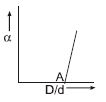
Before equilibrium is set up for the chemical reaction $N_2O_{4(g)} \rightleftharpoons 2NO_{2(g)}$,the vapour density $d$ of the gaseous mixture was measured. If $D$ is the theoretical value of vapour density,the variation of $\alpha$ with $D/d$ is given by the graph. What is the value of $D/d$ at point $A$?
A
$0$
B
$0.5$
C
$1$
D
$1.5$
Solution
(C) The relationship between the degree of dissociation $\alpha$,theoretical vapour density $D$,and observed vapour density $d$ is given by the formula: $\alpha = \frac{D - d}{(n - 1)d}$.
For the reaction $N_2O_{4(g)} \rightleftharpoons 2NO_{2(g)}$,the number of moles of product formed from one mole of reactant is $n = 2$.
Substituting $n = 2$ into the formula: $\alpha = \frac{D - d}{(2 - 1)d} = \frac{D - d}{d}$.
Rearranging the equation: $\alpha = \frac{D}{d} - 1$,which gives $\frac{D}{d} = \alpha + 1$.
At point $A$ on the graph,the degree of dissociation $\alpha = 0$ (this represents the initial state before any dissociation has occurred).
Therefore,at point $A$,$\frac{D}{d} = 0 + 1 = 1$.
For the reaction $N_2O_{4(g)} \rightleftharpoons 2NO_{2(g)}$,the number of moles of product formed from one mole of reactant is $n = 2$.
Substituting $n = 2$ into the formula: $\alpha = \frac{D - d}{(2 - 1)d} = \frac{D - d}{d}$.
Rearranging the equation: $\alpha = \frac{D}{d} - 1$,which gives $\frac{D}{d} = \alpha + 1$.
At point $A$ on the graph,the degree of dissociation $\alpha = 0$ (this represents the initial state before any dissociation has occurred).
Therefore,at point $A$,$\frac{D}{d} = 0 + 1 = 1$.
0 likes
View Solution83
MediumMCQ
At temperature $T$,the dissociation equilibrium of $AB_{2(g)}$ is given as: $2AB_{2(g)} \rightleftharpoons 2AB_{(g)} + B_{2(g)}$. If the degree of dissociation $x$ is very small compared to $1$,then the expression for the equilibrium constant $K_p$ in terms of $x$ and total pressure $P$ is:
A
$Px^3 / 2$
B
$Px^2 / 3$
C
$Px^3 / 3$
D
$Px^2 / 2$
Solution
(A) The initial moles are $2$ moles of $AB_2$. Let the degree of dissociation be $x$.
For the reaction: $2AB_{2(g)} \rightleftharpoons 2AB_{(g)} + B_{2(g)}$
Initial moles: $2, 0, 0$
Moles at equilibrium: $2(1-x), 2x, x$
Total moles at equilibrium $= 2-2x+2x+x = 2+x$.
Partial pressures at equilibrium:
$p_{AB_2} = \frac{2(1-x)}{2+x} P \approx P$ (since $x \ll 1$)
$p_{AB} = \frac{2x}{2+x} P \approx xP$
$p_{B_2} = \frac{x}{2+x} P \approx \frac{x}{2} P$
$K_p = \frac{(p_{AB})^2 (p_{B_2})}{(p_{AB_2})^2} = \frac{(xP)^2 (xP/2)}{P^2} = \frac{Px^3}{2}$
For the reaction: $2AB_{2(g)} \rightleftharpoons 2AB_{(g)} + B_{2(g)}$
Initial moles: $2, 0, 0$
Moles at equilibrium: $2(1-x), 2x, x$
Total moles at equilibrium $= 2-2x+2x+x = 2+x$.
Partial pressures at equilibrium:
$p_{AB_2} = \frac{2(1-x)}{2+x} P \approx P$ (since $x \ll 1$)
$p_{AB} = \frac{2x}{2+x} P \approx xP$
$p_{B_2} = \frac{x}{2+x} P \approx \frac{x}{2} P$
$K_p = \frac{(p_{AB})^2 (p_{B_2})}{(p_{AB_2})^2} = \frac{(xP)^2 (xP/2)}{P^2} = \frac{Px^3}{2}$
0 likes
View Solution84
MediumMCQ
Which of the following will have the highest degree of dissociation for $4-$nitrophenol in an aqueous solution (in $M$)?
A
$0.85$
B
$0.15$
C
$0.10$
D
$0.015$
Solution
(D) The degree of dissociation $(\alpha)$ of a weak acid is given by the formula $\alpha = \sqrt{\frac{K_a}{C}}$,where $K_a$ is the acid dissociation constant and $C$ is the molar concentration of the solution.
For a given weak acid like $4-$nitrophenol,$K_a$ remains constant at a constant temperature.
Therefore,$\alpha \propto \frac{1}{\sqrt{C}}$.
To have the highest degree of dissociation,the concentration $C$ must be the lowest.
Comparing the given concentrations: $0.85 \ M, 0.15 \ M, 0.10 \ M,$ and $0.015 \ M$.
The lowest concentration is $0.015 \ M$.
Thus,the solution with $0.015 \ M$ concentration will have the highest degree of dissociation.
For a given weak acid like $4-$nitrophenol,$K_a$ remains constant at a constant temperature.
Therefore,$\alpha \propto \frac{1}{\sqrt{C}}$.
To have the highest degree of dissociation,the concentration $C$ must be the lowest.
Comparing the given concentrations: $0.85 \ M, 0.15 \ M, 0.10 \ M,$ and $0.015 \ M$.
The lowest concentration is $0.015 \ M$.
Thus,the solution with $0.015 \ M$ concentration will have the highest degree of dissociation.
0 likes
View Solution85
DifficultMCQ
The vapour density of a mixture containing $NO_2$ and $N_2O_4$ is $27.6$. The mole fraction of $NO_2$ in the mixture is:
A
$0.8$
B
$0.6$
C
$0.4$
D
$0.2$
Solution
(A) The vapour density $(V.D.)$ of a mixture is given by the weighted average of the vapour densities of its components:
$V.D._{mix} = X_{NO_2} \times V.D._{NO_2} + X_{N_2O_4} \times V.D._{N_2O_4}$
Given that $V.D._{NO_2} = \frac{M_{NO_2}}{2} = \frac{46}{2} = 23$ and $V.D._{N_2O_4} = \frac{M_{N_2O_4}}{2} = \frac{92}{2} = 46$.
Let the mole fraction of $NO_2$ be $x$,then the mole fraction of $N_2O_4$ is $(1 - x)$.
Substituting the values:
$27.6 = x(23) + (1 - x)(46)$
$27.6 = 23x + 46 - 46x$
$27.6 = 46 - 23x$
$23x = 46 - 27.6$
$23x = 18.4$
$x = \frac{18.4}{23} = 0.8$
Therefore,the mole fraction of $NO_2$ is $0.8$.
$V.D._{mix} = X_{NO_2} \times V.D._{NO_2} + X_{N_2O_4} \times V.D._{N_2O_4}$
Given that $V.D._{NO_2} = \frac{M_{NO_2}}{2} = \frac{46}{2} = 23$ and $V.D._{N_2O_4} = \frac{M_{N_2O_4}}{2} = \frac{92}{2} = 46$.
Let the mole fraction of $NO_2$ be $x$,then the mole fraction of $N_2O_4$ is $(1 - x)$.
Substituting the values:
$27.6 = x(23) + (1 - x)(46)$
$27.6 = 23x + 46 - 46x$
$27.6 = 46 - 23x$
$23x = 46 - 27.6$
$23x = 18.4$
$x = \frac{18.4}{23} = 0.8$
Therefore,the mole fraction of $NO_2$ is $0.8$.
0 likes
View Solution86
MediumMCQ
For a reaction at equilibrium $A_{(g)} \rightleftharpoons B_{(g)} + \frac{1}{2} C_{(g)}$,the relation between dissociation constant $(K)$,degree of dissociation $(\alpha)$ and equilibrium pressure $(p)$ is given by?
A
$K = \frac{\alpha^{\frac{3}{2}} p^{\frac{1}{2}}}{(2 + \alpha)^{\frac{1}{2}}(1 - \alpha)}$
B
$K = \frac{\alpha^{\frac{1}{2}} p^{\frac{3}{2}}}{(1 + \frac{3}{2} \alpha)^{\frac{1}{2}}(1 - \alpha)}$
C
$K = \frac{(\alpha p)^{\frac{3}{2}}}{(1 + \frac{3}{2} \alpha)^{\frac{1}{2}}(1 - \alpha)}$
D
$K = \frac{(\alpha p)^{\frac{3}{2}}}{(1 + \alpha)(1 - \alpha)^{\frac{1}{2}}}$
Solution
(A) For the reaction: $A_{(g)} \rightleftharpoons B_{(g)} + \frac{1}{2} C_{(g)}$
Initial moles: $1, 0, 0$
At equilibrium: $(1 - \alpha), \alpha, \frac{\alpha}{2}$
Total moles at equilibrium = $(1 - \alpha) + \alpha + \frac{\alpha}{2} = 1 + \frac{\alpha}{2}$
Partial pressures are given by $P_i = x_i \cdot p$,where $x_i$ is the mole fraction and $p$ is the total pressure.
$P_A = \frac{1 - \alpha}{1 + \frac{\alpha}{2}} p$
$P_B = \frac{\alpha}{1 + \frac{\alpha}{2}} p$
$P_C = \frac{\alpha/2}{1 + \frac{\alpha}{2}} p$
$K_p = \frac{P_B \cdot P_C^{1/2}}{P_A} = \frac{(\frac{\alpha}{1 + \alpha/2} p) \cdot (\frac{\alpha/2}{1 + \alpha/2} p)^{1/2}}{\frac{1 - \alpha}{1 + \alpha/2} p}$
Simplifying the expression:
$K_p = \frac{\alpha \cdot (\alpha/2)^{1/2} \cdot p^{1/2}}{1 - \alpha} \cdot \frac{(1 + \alpha/2)^{1/2}}{(1 + \alpha/2)^{1/2}} = \frac{\alpha \cdot \alpha^{1/2} \cdot p^{1/2}}{\sqrt{2} \cdot (1 - \alpha) \cdot (\frac{2 + \alpha}{2})^{1/2}} = \frac{\alpha^{3/2} p^{1/2}}{(2 + \alpha)^{1/2}(1 - \alpha)}$
Initial moles: $1, 0, 0$
At equilibrium: $(1 - \alpha), \alpha, \frac{\alpha}{2}$
Total moles at equilibrium = $(1 - \alpha) + \alpha + \frac{\alpha}{2} = 1 + \frac{\alpha}{2}$
Partial pressures are given by $P_i = x_i \cdot p$,where $x_i$ is the mole fraction and $p$ is the total pressure.
$P_A = \frac{1 - \alpha}{1 + \frac{\alpha}{2}} p$
$P_B = \frac{\alpha}{1 + \frac{\alpha}{2}} p$
$P_C = \frac{\alpha/2}{1 + \frac{\alpha}{2}} p$
$K_p = \frac{P_B \cdot P_C^{1/2}}{P_A} = \frac{(\frac{\alpha}{1 + \alpha/2} p) \cdot (\frac{\alpha/2}{1 + \alpha/2} p)^{1/2}}{\frac{1 - \alpha}{1 + \alpha/2} p}$
Simplifying the expression:
$K_p = \frac{\alpha \cdot (\alpha/2)^{1/2} \cdot p^{1/2}}{1 - \alpha} \cdot \frac{(1 + \alpha/2)^{1/2}}{(1 + \alpha/2)^{1/2}} = \frac{\alpha \cdot \alpha^{1/2} \cdot p^{1/2}}{\sqrt{2} \cdot (1 - \alpha) \cdot (\frac{2 + \alpha}{2})^{1/2}} = \frac{\alpha^{3/2} p^{1/2}}{(2 + \alpha)^{1/2}(1 - \alpha)}$
0 likes
View Solution87
MediumMCQ
$A_{(g)} \rightleftharpoons 2B_{(g)} + C_{(g)}$
For the given reaction,if the initial pressure is $450 \ mm \ Hg$ and the total pressure at time $t$ is $720 \ mm \ Hg$ at a constant temperature $T$ and constant volume $V$. The fraction of $A_{(g)}$ decomposed under these conditions is $x \times 10^{-1}$. The value of $x$ is $......$. (nearest integer)
For the given reaction,if the initial pressure is $450 \ mm \ Hg$ and the total pressure at time $t$ is $720 \ mm \ Hg$ at a constant temperature $T$ and constant volume $V$. The fraction of $A_{(g)}$ decomposed under these conditions is $x \times 10^{-1}$. The value of $x$ is $......$. (nearest integer)
A
$2$
B
$4$
C
$3$
D
$5$
Solution
(C) The reaction is $A_{(g)} \rightleftharpoons 2B_{(g)} + C_{(g)}$.
Let the initial pressure of $A$ be $P_0 = 450 \ mm \ Hg$.
Let the pressure of $A$ that decomposes at time $t$ be $p$.
At $t=0$: $P_A = 450, P_B = 0, P_C = 0$. Total pressure $P_i = 450 \ mm \ Hg$.
At time $t$: $P_A = 450 - p, P_B = 2p, P_C = p$.
Total pressure $P_t = (450 - p) + 2p + p = 450 + 2p$.
Given $P_t = 720 \ mm \ Hg$,so $450 + 2p = 720$.
$2p = 270 \implies p = 135 \ mm \ Hg$.
The fraction of $A$ decomposed is $\alpha = \frac{p}{P_0} = \frac{135}{450} = 0.3$.
Given $\alpha = x \times 10^{-1} = 0.3$,therefore $x = 3$.
Let the initial pressure of $A$ be $P_0 = 450 \ mm \ Hg$.
Let the pressure of $A$ that decomposes at time $t$ be $p$.
At $t=0$: $P_A = 450, P_B = 0, P_C = 0$. Total pressure $P_i = 450 \ mm \ Hg$.
At time $t$: $P_A = 450 - p, P_B = 2p, P_C = p$.
Total pressure $P_t = (450 - p) + 2p + p = 450 + 2p$.
Given $P_t = 720 \ mm \ Hg$,so $450 + 2p = 720$.
$2p = 270 \implies p = 135 \ mm \ Hg$.
The fraction of $A$ decomposed is $\alpha = \frac{p}{P_0} = \frac{135}{450} = 0.3$.
Given $\alpha = x \times 10^{-1} = 0.3$,therefore $x = 3$.
0 likes
View Solution88
MediumMCQ
Consider the following reaction in a sealed vessel at equilibrium with concentrations of $N_2 = 3.0 \times 10^{-3} \ M$,$O_2 = 4.2 \times 10^{-3} \ M$,and $NO = 2.8 \times 10^{-3} \ M$.
$2 \ NO_{(g)} \rightleftharpoons N_{2_{(g)}} + O_{2_{(g)}}$
If $0.1 \ mol \ L^{-1}$ of $NO_{(g)}$ is taken in a closed vessel,what will be the degree of dissociation $(\alpha)$ of $NO_{(g)}$ at equilibrium?
$2 \ NO_{(g)} \rightleftharpoons N_{2_{(g)}} + O_{2_{(g)}}$
If $0.1 \ mol \ L^{-1}$ of $NO_{(g)}$ is taken in a closed vessel,what will be the degree of dissociation $(\alpha)$ of $NO_{(g)}$ at equilibrium?
A
$0.0889$
B
$0.8889$
C
$0.717$
D
$0.00889$
Solution
(C) The equilibrium constant $K_c$ for the reaction $2 \ NO_{(g)} \rightleftharpoons N_{2_{(g)}} + O_{2_{(g)}}$ is given by:
$K_c = \frac{[N_2][O_2]}{[NO]^2} = \frac{(3.0 \times 10^{-3})(4.2 \times 10^{-3})}{(2.8 \times 10^{-3})^2} = \frac{12.6 \times 10^{-6}}{7.84 \times 10^{-6}} \approx 1.607$
For the reaction starting with $0.1 \ M$ of $NO_{(g)}$:
$2 \ NO_{(g)} \rightleftharpoons N_{2_{(g)}} + O_{2_{(g)}}$
Initial: $0.1 \quad 0 \quad 0$
At equilibrium: $0.1(1 - \alpha) \quad 0.05 \alpha \quad 0.05 \alpha$
$K_c = \frac{(0.05 \alpha)(0.05 \alpha)}{(0.1(1 - \alpha))^2} = \frac{0.0025 \alpha^2}{0.01(1 - \alpha)^2} = 0.25 \left( \frac{\alpha}{1 - \alpha} \right)^2$
$1.607 = 0.25 \left( \frac{\alpha}{1 - \alpha} \right)^2$
$\left( \frac{\alpha}{1 - \alpha} \right)^2 = \frac{1.607}{0.25} = 6.428$
$\frac{\alpha}{1 - \alpha} = \sqrt{6.428} \approx 2.535$
$\alpha = 2.535 - 2.535 \alpha$
$3.535 \alpha = 2.535$
$\alpha = \frac{2.535}{3.535} \approx 0.717$
$K_c = \frac{[N_2][O_2]}{[NO]^2} = \frac{(3.0 \times 10^{-3})(4.2 \times 10^{-3})}{(2.8 \times 10^{-3})^2} = \frac{12.6 \times 10^{-6}}{7.84 \times 10^{-6}} \approx 1.607$
For the reaction starting with $0.1 \ M$ of $NO_{(g)}$:
$2 \ NO_{(g)} \rightleftharpoons N_{2_{(g)}} + O_{2_{(g)}}$
Initial: $0.1 \quad 0 \quad 0$
At equilibrium: $0.1(1 - \alpha) \quad 0.05 \alpha \quad 0.05 \alpha$
$K_c = \frac{(0.05 \alpha)(0.05 \alpha)}{(0.1(1 - \alpha))^2} = \frac{0.0025 \alpha^2}{0.01(1 - \alpha)^2} = 0.25 \left( \frac{\alpha}{1 - \alpha} \right)^2$
$1.607 = 0.25 \left( \frac{\alpha}{1 - \alpha} \right)^2$
$\left( \frac{\alpha}{1 - \alpha} \right)^2 = \frac{1.607}{0.25} = 6.428$
$\frac{\alpha}{1 - \alpha} = \sqrt{6.428} \approx 2.535$
$\alpha = 2.535 - 2.535 \alpha$
$3.535 \alpha = 2.535$
$\alpha = \frac{2.535}{3.535} \approx 0.717$
0 likes
View Solution89
DifficultMCQ
Consider the reaction $X_2Y_{(g)} \rightleftharpoons X_{2(g)} + \frac{1}{2}Y_{2(g)}$. The equation representing the correct relationship between the degree of dissociation $(x)$ of $X_2Y_{(g)}$ with its equilibrium constant $Kp$ is. . . . . . . Assume $x$ to be very very small.
A
$x = \sqrt[3]{\frac{2 Kp^2}{p}}$
B
$x = \sqrt[3]{\frac{2 Kp}{p}}$
C
$x = \sqrt[3]{\frac{Kp}{2p}}$
D
$x = \sqrt[3]{\frac{Kp}{p}}$
Solution
(A) For the reaction: $X_2Y_{(g)} \rightleftharpoons X_{2(g)} + \frac{1}{2}Y_{2(g)}$
Initial moles: $1, 0, 0$
Moles at equilibrium: $(1-x), x, \frac{x}{2}$
Total moles at equilibrium: $1-x+x+\frac{x}{2} = 1+\frac{x}{2}$
Partial pressures: $P_{X_2Y} = \frac{1-x}{1+x/2} P$,$P_{X_2} = \frac{x}{1+x/2} P$,$P_{Y_2} = \frac{x/2}{1+x/2} P$
$Kp = \frac{P_{X_2} \cdot (P_{Y_2})^{1/2}}{P_{X_2Y}} = \frac{[x/(1+x/2)] P \cdot [x/2(1+x/2) P]^{1/2}}{[(1-x)/(1+x/2)] P}$
Since $x \ll 1$,we approximate $1-x \approx 1$ and $1+x/2 \approx 1$.
$Kp \approx \frac{x \cdot (x/2)^{1/2} \cdot P^{1/2}}{1} = \frac{x^{3/2} \cdot P^{1/2}}{\sqrt{2}}$
$Kp^2 = \frac{x^3 \cdot P}{2} \implies x^3 = \frac{2 Kp^2}{P}$
$x = \left( \frac{2 Kp^2}{P} \right)^{1/3}$
Initial moles: $1, 0, 0$
Moles at equilibrium: $(1-x), x, \frac{x}{2}$
Total moles at equilibrium: $1-x+x+\frac{x}{2} = 1+\frac{x}{2}$
Partial pressures: $P_{X_2Y} = \frac{1-x}{1+x/2} P$,$P_{X_2} = \frac{x}{1+x/2} P$,$P_{Y_2} = \frac{x/2}{1+x/2} P$
$Kp = \frac{P_{X_2} \cdot (P_{Y_2})^{1/2}}{P_{X_2Y}} = \frac{[x/(1+x/2)] P \cdot [x/2(1+x/2) P]^{1/2}}{[(1-x)/(1+x/2)] P}$
Since $x \ll 1$,we approximate $1-x \approx 1$ and $1+x/2 \approx 1$.
$Kp \approx \frac{x \cdot (x/2)^{1/2} \cdot P^{1/2}}{1} = \frac{x^{3/2} \cdot P^{1/2}}{\sqrt{2}}$
$Kp^2 = \frac{x^3 \cdot P}{2} \implies x^3 = \frac{2 Kp^2}{P}$
$x = \left( \frac{2 Kp^2}{P} \right)^{1/3}$
0 likes
View Solution90
MediumMCQ
At temperature $T$,compound $AB_{2(g)}$ dissociates as $AB_{2(g)} \rightleftharpoons AB_{(g)} + \frac{1}{2} B_{2(g)}$ having degree of dissociation $x$ (small compared to unity). The correct expression for $x$ in terms of $K_p$ and $p$ is
A
$\sqrt[3]{\frac{2 K_p}{p}}$
B
$\sqrt[4]{\frac{2 K_p}{p}}$
C
$\sqrt[3]{\frac{2 K_p^2}{p}}$
D
$\sqrt{K_p}$
Solution
(C) The dissociation reaction is: $AB_{2(g)} \rightleftharpoons AB_{(g)} + \frac{1}{2} B_{2(g)}$
Initial moles: $1, 0, 0$
Moles at equilibrium: $(1-x), x, \frac{x}{2}$
Total moles at equilibrium: $1-x+x+\frac{x}{2} = 1+\frac{x}{2}$
Partial pressures: $P_{AB_2} = \frac{1-x}{1+x/2}P$,$P_{AB} = \frac{x}{1+x/2}P$,$P_{B_2} = \frac{x/2}{1+x/2}P$
Since $x \ll 1$,we approximate $1+x/2 \approx 1$ and $1-x \approx 1$.
Thus,$P_{AB_2} \approx P$,$P_{AB} \approx xP$,$P_{B_2} \approx \frac{x}{2}P$.
$K_p = \frac{P_{AB} \cdot (P_{B_2})^{1/2}}{P_{AB_2}} = \frac{(xP) \cdot (xP/2)^{1/2}}{P} = x \cdot (xP/2)^{1/2} = x^{3/2} \cdot (P/2)^{1/2}$.
Squaring both sides: $K_p^2 = x^3 \cdot \frac{P}{2}$.
Solving for $x$: $x^3 = \frac{2 K_p^2}{P} \Rightarrow x = \left( \frac{2 K_p^2}{P} \right)^{1/3}$.
Initial moles: $1, 0, 0$
Moles at equilibrium: $(1-x), x, \frac{x}{2}$
Total moles at equilibrium: $1-x+x+\frac{x}{2} = 1+\frac{x}{2}$
Partial pressures: $P_{AB_2} = \frac{1-x}{1+x/2}P$,$P_{AB} = \frac{x}{1+x/2}P$,$P_{B_2} = \frac{x/2}{1+x/2}P$
Since $x \ll 1$,we approximate $1+x/2 \approx 1$ and $1-x \approx 1$.
Thus,$P_{AB_2} \approx P$,$P_{AB} \approx xP$,$P_{B_2} \approx \frac{x}{2}P$.
$K_p = \frac{P_{AB} \cdot (P_{B_2})^{1/2}}{P_{AB_2}} = \frac{(xP) \cdot (xP/2)^{1/2}}{P} = x \cdot (xP/2)^{1/2} = x^{3/2} \cdot (P/2)^{1/2}$.
Squaring both sides: $K_p^2 = x^3 \cdot \frac{P}{2}$.
Solving for $x$: $x^3 = \frac{2 K_p^2}{P} \Rightarrow x = \left( \frac{2 K_p^2}{P} \right)^{1/3}$.
0 likes
View Solution91
EasyMCQ
The equilibrium constant for the decomposition of $H_2O_{(g)}$: $H_2O_{(g)} \rightleftharpoons H_{2(g)} + \frac{1}{2} O_{2(g)}$ $(\Delta G^{\circ} = 92.34 \ kJ \ mol^{-1})$ is $8.0 \times 10^{-3}$ at $2300 \ K$ and the total pressure at equilibrium is $1 \ bar$. Under this condition,the degree of dissociation $(\alpha)$ of water is $............ \times 10^{-2}$ (nearest integer value). [Assume $\alpha$ is negligible with respect to $1$]
A
$1$
B
$2$
C
$3$
D
$5$
Solution
(D) The reaction is $H_2O_{(g)} \rightleftharpoons H_{2(g)} + \frac{1}{2} O_{2(g)}$.
At $t = 0$,we have $1 \ mole$ of $H_2O$.
At equilibrium,the moles are: $H_2O = 1-\alpha$,$H_2 = \alpha$,$O_2 = \frac{\alpha}{2}$.
Total moles $n_T = 1 + \frac{\alpha}{2} \approx 1$ (since $\alpha \ll 1$).
The equilibrium constant $K_p$ is given by:
$K_p = \frac{P_{H_2} \cdot P_{O_2}^{1/2}}{P_{H_2O}} = \frac{(\alpha \cdot P) \cdot (\frac{\alpha}{2} \cdot P)^{1/2}}{(1-\alpha) \cdot P}$.
Given $P = 1 \ bar$,$K_p = \frac{\alpha \cdot (\alpha/2)^{1/2}}{1} = \frac{\alpha^{3/2}}{\sqrt{2}}$.
$8.0 \times 10^{-3} = \frac{\alpha^{3/2}}{\sqrt{2}}$.
$\alpha^{3/2} = 8.0 \times 10^{-3} \times \sqrt{2} \approx 11.31 \times 10^{-3}$.
$\alpha = (11.31 \times 10^{-3})^{2/3} \approx 5.04 \times 10^{-2}$.
The nearest integer value is $5$.
At $t = 0$,we have $1 \ mole$ of $H_2O$.
At equilibrium,the moles are: $H_2O = 1-\alpha$,$H_2 = \alpha$,$O_2 = \frac{\alpha}{2}$.
Total moles $n_T = 1 + \frac{\alpha}{2} \approx 1$ (since $\alpha \ll 1$).
The equilibrium constant $K_p$ is given by:
$K_p = \frac{P_{H_2} \cdot P_{O_2}^{1/2}}{P_{H_2O}} = \frac{(\alpha \cdot P) \cdot (\frac{\alpha}{2} \cdot P)^{1/2}}{(1-\alpha) \cdot P}$.
Given $P = 1 \ bar$,$K_p = \frac{\alpha \cdot (\alpha/2)^{1/2}}{1} = \frac{\alpha^{3/2}}{\sqrt{2}}$.
$8.0 \times 10^{-3} = \frac{\alpha^{3/2}}{\sqrt{2}}$.
$\alpha^{3/2} = 8.0 \times 10^{-3} \times \sqrt{2} \approx 11.31 \times 10^{-3}$.
$\alpha = (11.31 \times 10^{-3})^{2/3} \approx 5.04 \times 10^{-2}$.
The nearest integer value is $5$.
0 likes
View Solution92
EasyMCQ
At $STP$,the density of air is $0.001293 \ g \ mL^{-1}$. Its vapour density is $---$.
A
$143$
B
$14.3$
C
$1.43$
D
$0.143$
Solution
(B) The vapour density $(V.D.)$ of a gas is defined as the ratio of the density of the gas to the density of hydrogen gas at the same temperature and pressure.
$V.D. = \frac{\text{density of air}}{\text{density of } H_2}$
Given,density of air = $0.001293 \ g \ mL^{-1}$ and density of $H_2$ at $STP$ = $0.000089 \ g \ mL^{-1}$.
$V.D. = \frac{0.001293}{0.000089} \approx 14.53$.
Since $14.53$ is closest to $14.4$ (the standard value for air),and based on the provided options,the calculation yields approximately $14.5$. Given the options,$14.4$ is the standard theoretical value,but based on the provided numbers,$14.5$ is the result. Among the choices,$14.4$ is not present,but $14.3$ is the closest value.
$V.D. = \frac{\text{density of air}}{\text{density of } H_2}$
Given,density of air = $0.001293 \ g \ mL^{-1}$ and density of $H_2$ at $STP$ = $0.000089 \ g \ mL^{-1}$.
$V.D. = \frac{0.001293}{0.000089} \approx 14.53$.
Since $14.53$ is closest to $14.4$ (the standard value for air),and based on the provided options,the calculation yields approximately $14.5$. Given the options,$14.4$ is the standard theoretical value,but based on the provided numbers,$14.5$ is the result. Among the choices,$14.4$ is not present,but $14.3$ is the closest value.
0 likes
View Solution93
EasyMCQ
The degree of dissociation of a weak acid is $7.2 \times 10^{-4}$. What is the value of its percent dissociation in a $0.025 \ M$ solution (in $\%$)?
A
$0.072$
B
$8.2$
C
$0.062$
D
$0.80$
Solution
(A) The degree of dissociation $(\alpha)$ is given as $7.2 \times 10^{-4}$.
Percent dissociation is calculated by multiplying the degree of dissociation by $100$.
$\text{Percent dissociation} = \alpha \times 100$
$\text{Percent dissociation} = 7.2 \times 10^{-4} \times 100 = 0.072 \%$
Percent dissociation is calculated by multiplying the degree of dissociation by $100$.
$\text{Percent dissociation} = \alpha \times 100$
$\text{Percent dissociation} = 7.2 \times 10^{-4} \times 100 = 0.072 \%$
0 likes
View Solution94
EasyMCQ
What is the vapour density of $O_2$ gas?
A
$8$
B
$16$
C
$32$
D
$22.4$
Solution
(B) The vapour density of a gas is defined as the ratio of the mass of a certain volume of the gas to the mass of an equal volume of hydrogen gas at the same temperature and pressure.
It is calculated using the formula: $\text{Vapour Density} = \frac{\text{Molar Mass of Gas}}{2}$.
The molar mass of $O_2$ gas is $32 \ g/mol$.
Therefore,$\text{Vapour Density} = \frac{32}{2} = 16$.
It is calculated using the formula: $\text{Vapour Density} = \frac{\text{Molar Mass of Gas}}{2}$.
The molar mass of $O_2$ gas is $32 \ g/mol$.
Therefore,$\text{Vapour Density} = \frac{32}{2} = 16$.
0 likes
View Solution95
MediumMCQ
At $T$ $K$,consider the following gaseous reaction,which is in equilibrium: $N_2O_5 \rightleftharpoons 2NO_2 + \frac{1}{2}O_2$. What is the fraction of $N_2O_5$ decomposed at constant volume and temperature,if the initial pressure is $300 \ mm \ Hg$ and pressure at equilibrium is $480 \ mm \ Hg$? (Assume all gases as ideal)
A
$0.2$
B
$0.6$
C
$0.4$
D
$0.8$
Solution
(C) Let the initial pressure of $N_2O_5$ be $P_0 = 300 \ mm \ Hg$. Let $\alpha$ be the fraction of $N_2O_5$ decomposed.
The reaction is: $N_2O_5 \rightleftharpoons 2NO_2 + \frac{1}{2}O_2$.
At $t=0$: $P_0, 0, 0$.
At equilibrium: $P_0(1-\alpha), 2P_0\alpha, \frac{1}{2}P_0\alpha$.
Total pressure at equilibrium $P_t = P_0(1-\alpha) + 2P_0\alpha + 0.5P_0\alpha = P_0(1 + 1.5\alpha)$.
Given $P_t = 480 \ mm \ Hg$ and $P_0 = 300 \ mm \ Hg$.
$480 = 300(1 + 1.5\alpha)$.
$1.6 = 1 + 1.5\alpha$.
$0.6 = 1.5\alpha$.
$\alpha = \frac{0.6}{1.5} = 0.4$.
The reaction is: $N_2O_5 \rightleftharpoons 2NO_2 + \frac{1}{2}O_2$.
At $t=0$: $P_0, 0, 0$.
At equilibrium: $P_0(1-\alpha), 2P_0\alpha, \frac{1}{2}P_0\alpha$.
Total pressure at equilibrium $P_t = P_0(1-\alpha) + 2P_0\alpha + 0.5P_0\alpha = P_0(1 + 1.5\alpha)$.
Given $P_t = 480 \ mm \ Hg$ and $P_0 = 300 \ mm \ Hg$.
$480 = 300(1 + 1.5\alpha)$.
$1.6 = 1 + 1.5\alpha$.
$0.6 = 1.5\alpha$.
$\alpha = \frac{0.6}{1.5} = 0.4$.
0 likes
View Solution96
DifficultMCQ
In a $100 \ L$ vessel,$3 \ moles$ of nitrogen and $3 \ moles$ of $PCl_5$ are taken and heated to $500 \ K$. The equilibrium pressure is $3.28 \ atm$. The percentage degree of dissociation of $PCl_5$ is : (Assume ideal behaviour for all gases).
A
$33.3$
B
$66.6$
C
$20.6$
D
$40.6$
Solution
(B) The reaction for the dissociation of $PCl_5$ is: $PCl_5(g) \rightleftharpoons PCl_3(g) + Cl_2(g)$.
Initial moles: $PCl_5 = 3$,$N_2 = 3$,$PCl_3 = 0$,$Cl_2 = 0$.
Let $\alpha$ be the degree of dissociation of $PCl_5$. At equilibrium,moles are: $PCl_5 = 3(1-\alpha)$,$PCl_3 = 3\alpha$,$Cl_2 = 3\alpha$,$N_2 = 3$.
Total moles at equilibrium $n_{total} = 3(1-\alpha) + 3\alpha + 3\alpha + 3 = 6 + 3\alpha$.
Using the ideal gas law $PV = nRT$:
$3.28 \times 100 = (6 + 3\alpha) \times 0.0821 \times 500$.
$328 = (6 + 3\alpha) \times 41.05$.
$6 + 3\alpha = \frac{328}{41.05} \approx 7.99$.
$3\alpha = 7.99 - 6 = 1.99$.
$\alpha = \frac{1.99}{3} \approx 0.663$.
Percentage dissociation = $0.663 \times 100 = 66.3 \% \approx 66.6 \%$.
Initial moles: $PCl_5 = 3$,$N_2 = 3$,$PCl_3 = 0$,$Cl_2 = 0$.
Let $\alpha$ be the degree of dissociation of $PCl_5$. At equilibrium,moles are: $PCl_5 = 3(1-\alpha)$,$PCl_3 = 3\alpha$,$Cl_2 = 3\alpha$,$N_2 = 3$.
Total moles at equilibrium $n_{total} = 3(1-\alpha) + 3\alpha + 3\alpha + 3 = 6 + 3\alpha$.
Using the ideal gas law $PV = nRT$:
$3.28 \times 100 = (6 + 3\alpha) \times 0.0821 \times 500$.
$328 = (6 + 3\alpha) \times 41.05$.
$6 + 3\alpha = \frac{328}{41.05} \approx 7.99$.
$3\alpha = 7.99 - 6 = 1.99$.
$\alpha = \frac{1.99}{3} \approx 0.663$.
Percentage dissociation = $0.663 \times 100 = 66.3 \% \approx 66.6 \%$.
0 likes
View Solution97
MediumMCQ
For the reaction $N_2O_{4(g)} \rightleftharpoons 2NO_{2(g)}$,the correct relation between degree of dissociation $(\alpha)$ of $N_2O_{4(g)}$ and equilibrium constant,$K_p$ is $(P=$ total pressure of mixture $)$
A
$\alpha=\sqrt{\frac{K_p}{K_p+4P}}$
B
$\alpha=\frac{K_p}{4+K_p}$
C
$\alpha=\left(\frac{K_p / P}{4+\frac{K_p}{P}}\right)^{\frac{1}{2}}$
D
$\alpha=\left(\frac{K_p}{4+K_p}\right)^{\frac{1}{2}}$
Solution
(A) For the reaction $N_2O_{4(g)} \rightleftharpoons 2NO_{2(g)}$:
Initial moles: $1$ $0$
At equilibrium: $(1-\alpha)$ $2\alpha$
Total moles at equilibrium $= 1-\alpha+2\alpha = 1+\alpha$.
Partial pressure of $N_2O_4 = \frac{1-\alpha}{1+\alpha} P$.
Partial pressure of $NO_2 = \frac{2\alpha}{1+\alpha} P$.
$K_p = \frac{(P_{NO_2})^2}{P_{N_2O_4}} = \frac{(\frac{2\alpha}{1+\alpha} P)^2}{\frac{1-\alpha}{1+\alpha} P} = \frac{4\alpha^2 P}{1-\alpha^2}$.
Rearranging for $\alpha$:
$K_p(1-\alpha^2) = 4\alpha^2 P$
$K_p = \alpha^2(4P + K_p)$
$\alpha^2 = \frac{K_p}{4P+K_p}$
$\alpha = \sqrt{\frac{K_p}{4P+K_p}}$.
Initial moles: $1$ $0$
At equilibrium: $(1-\alpha)$ $2\alpha$
Total moles at equilibrium $= 1-\alpha+2\alpha = 1+\alpha$.
Partial pressure of $N_2O_4 = \frac{1-\alpha}{1+\alpha} P$.
Partial pressure of $NO_2 = \frac{2\alpha}{1+\alpha} P$.
$K_p = \frac{(P_{NO_2})^2}{P_{N_2O_4}} = \frac{(\frac{2\alpha}{1+\alpha} P)^2}{\frac{1-\alpha}{1+\alpha} P} = \frac{4\alpha^2 P}{1-\alpha^2}$.
Rearranging for $\alpha$:
$K_p(1-\alpha^2) = 4\alpha^2 P$
$K_p = \alpha^2(4P + K_p)$
$\alpha^2 = \frac{K_p}{4P+K_p}$
$\alpha = \sqrt{\frac{K_p}{4P+K_p}}$.
0 likes
View Solution98
MediumMCQ
The vapour density of $N_2O_4$ in the equilibrium $N_2O_4 \rightleftharpoons 2NO_2$ is $40$. The degree of dissociation is:
A
$1.25$
B
$2.5$
C
$1.5$
D
$0.15$
Solution
(D) The reaction is $N_2O_4 \rightleftharpoons 2NO_2$.
The molar mass of $N_2O_4$ is $92 \ g/mol$.
The theoretical vapour density $D$ is calculated as $D = \frac{\text{Molar mass}}{2} = \frac{92}{2} = 46$.
The observed vapour density $d$ is given as $40$.
The number of moles of product formed from $1 \ mole$ of reactant is $n = 2$.
The degree of dissociation $\alpha$ is given by the formula $\alpha = \frac{D-d}{(n-1)d}$.
Substituting the values: $\alpha = \frac{46-40}{(2-1) \times 40} = \frac{6}{40} = 0.15$.
The molar mass of $N_2O_4$ is $92 \ g/mol$.
The theoretical vapour density $D$ is calculated as $D = \frac{\text{Molar mass}}{2} = \frac{92}{2} = 46$.
The observed vapour density $d$ is given as $40$.
The number of moles of product formed from $1 \ mole$ of reactant is $n = 2$.
The degree of dissociation $\alpha$ is given by the formula $\alpha = \frac{D-d}{(n-1)d}$.
Substituting the values: $\alpha = \frac{46-40}{(2-1) \times 40} = \frac{6}{40} = 0.15$.
0 likes
View Solution99
MediumMCQ
Consider the following gas phase dissociation,$PCl_{5(g)} \rightleftharpoons PCl_{3(g)} + Cl_{2(g)}$ with equilibrium constant $K_P$ at a particular temperature and at pressure $P$. The degree of dissociation $(\alpha)$ for $PCl_{5(g)}$ is
A
$\alpha = \left( \frac{K_P}{K_P + P} \right)^{1/3}$
B
$\alpha = \left( \frac{K_P}{K_P + P} \right)$
C
$\alpha = \left( \frac{K_P}{K_P + P} \right)^{1/2}$
D
$\alpha = \left( \frac{K_P}{K_P + P} \right)^2$
Solution
(C)
Total moles at equilibrium = $(1 - \alpha) + \alpha + \alpha = 1 + \alpha$.
Partial pressures: $P_{PCl_5} = \frac{1 - \alpha}{1 + \alpha} P$,$P_{PCl_3} = \frac{\alpha}{1 + \alpha} P$,$P_{Cl_2} = \frac{\alpha}{1 + \alpha} P$.
Equilibrium constant $K_P = \frac{P_{PCl_3} \cdot P_{Cl_2}}{P_{PCl_5}} = \frac{(\frac{\alpha}{1 + \alpha} P)(\frac{\alpha}{1 + \alpha} P)}{(\frac{1 - \alpha}{1 + \alpha} P)} = \frac{\alpha^2 P}{1 - \alpha^2}$.
Rearranging: $K_P(1 - \alpha^2) = \alpha^2 P \implies K_P = \alpha^2(P + K_P) \implies \alpha^2 = \frac{K_P}{K_P + P}$.
Therefore,$\alpha = \left( \frac{K_P}{K_P + P} \right)^{1/2}$.
| Species | $PCl_{5(g)}$ | $PCl_{3(g)}$ | $Cl_{2(g)}$ |
|---|---|---|---|
| Initial moles | $1$ | $0$ | $0$ |
| Equilibrium moles | $1 - \alpha$ | $\alpha$ | $\alpha$ |
Total moles at equilibrium = $(1 - \alpha) + \alpha + \alpha = 1 + \alpha$.
Partial pressures: $P_{PCl_5} = \frac{1 - \alpha}{1 + \alpha} P$,$P_{PCl_3} = \frac{\alpha}{1 + \alpha} P$,$P_{Cl_2} = \frac{\alpha}{1 + \alpha} P$.
Equilibrium constant $K_P = \frac{P_{PCl_3} \cdot P_{Cl_2}}{P_{PCl_5}} = \frac{(\frac{\alpha}{1 + \alpha} P)(\frac{\alpha}{1 + \alpha} P)}{(\frac{1 - \alpha}{1 + \alpha} P)} = \frac{\alpha^2 P}{1 - \alpha^2}$.
Rearranging: $K_P(1 - \alpha^2) = \alpha^2 P \implies K_P = \alpha^2(P + K_P) \implies \alpha^2 = \frac{K_P}{K_P + P}$.
Therefore,$\alpha = \left( \frac{K_P}{K_P + P} \right)^{1/2}$.
0 likes
View Solution100
DifficultMCQ
Given is a concentrated solution of a weak electrolyte $A_{x}B_{y}$ of concentration '$c$' and dissociation constant '$K$'. The degree of dissociation is given by:
A
$[K \times c^{x+y-1} x^{x} y^{y}]^{\frac{1}{x+y}}$
B
$(\frac{K}{c^{x+y-1} x^{x} y^{y}})^{\frac{1}{x+y}}$
C
$(\frac{c^{x+y-1} x^{x} y^{y}}{K})^{\frac{1}{x+y}}$
D
$(\frac{K}{c^{x+y-1} x^{x} y^{y}})^{\frac{1}{x+y}}$
Solution
(B) For the dissociation of a weak electrolyte $A_{x}B_{y} \rightleftharpoons xA^{y+} + yB^{x-}$,let $\alpha$ be the degree of dissociation.
At equilibrium,the concentrations are: $[A_{x}B_{y}] = c(1-\alpha)$,$[A^{y+}] = xc\alpha$,and $[B^{x-}] = yc\alpha$.
The dissociation constant $K$ is given by: $K = \frac{[A^{y+}]^{x} [B^{x-}]^{y}}{[A_{x}B_{y}]} = \frac{(xc\alpha)^{x} (yc\alpha)^{y}}{c(1-\alpha)}$.
Since $A_{x}B_{y}$ is a weak electrolyte,$\alpha \ll 1$,therefore $(1-\alpha) \approx 1$.
Thus,$K = \frac{x^{x} c^{x} \alpha^{x} y^{y} c^{y} \alpha^{y}}{c} = c^{x+y-1} x^{x} y^{y} \alpha^{x+y}$.
Solving for $\alpha$,we get: $\alpha^{x+y} = \frac{K}{c^{x+y-1} x^{x} y^{y}}$.
Therefore,$\alpha = (\frac{K}{c^{x+y-1} x^{x} y^{y}})^{\frac{1}{x+y}}$.
At equilibrium,the concentrations are: $[A_{x}B_{y}] = c(1-\alpha)$,$[A^{y+}] = xc\alpha$,and $[B^{x-}] = yc\alpha$.
The dissociation constant $K$ is given by: $K = \frac{[A^{y+}]^{x} [B^{x-}]^{y}}{[A_{x}B_{y}]} = \frac{(xc\alpha)^{x} (yc\alpha)^{y}}{c(1-\alpha)}$.
Since $A_{x}B_{y}$ is a weak electrolyte,$\alpha \ll 1$,therefore $(1-\alpha) \approx 1$.
Thus,$K = \frac{x^{x} c^{x} \alpha^{x} y^{y} c^{y} \alpha^{y}}{c} = c^{x+y-1} x^{x} y^{y} \alpha^{x+y}$.
Solving for $\alpha$,we get: $\alpha^{x+y} = \frac{K}{c^{x+y-1} x^{x} y^{y}}$.
Therefore,$\alpha = (\frac{K}{c^{x+y-1} x^{x} y^{y}})^{\frac{1}{x+y}}$.
0 likes
View Solution6-1.Equilibrium (Chemical Equilibrium) — Degree of dissociation and Vapour density · Frequently Asked Questions
1Are these 6-1.Equilibrium (Chemical Equilibrium) questions useful for JEE and NEET?
Yes. All questions in this section are mapped to JEE Main and NEET exam patterns. Previous year questions from JEE Main, NEET, GUJCET and state-level exams are included with full solutions.
2Can I switch to Hindi or Gujarati for these questions?
Yes. Use the language tabs in the hero section or the sidebar to view the same questions and solutions in English, Hindi or Gujarati.
3How do I generate a question paper from this subtopic?
Use the Vedclass Exam Paper Generator — select the chapter and subtopic, set difficulty, and generate Sets A, B, C, D automatically. First 3 chapters of every subject are free.
Vedclass Products
For Students
Vedclass Test Series
Mock tests in real JEE/NEET style with performance analysis. 5-day free trial.
Start Free TrialFor Teachers
Exam Paper Generator
Generate Set A/B/C/D papers from this chapter in 2 minutes. 3 chapters free.
Try FreeFor Institutes
Online Exam Module
Live online exams with unlimited students, 360° analytics & white-label branding.
See DemoFor Teachers & Institutes
Generate a 6-1.Equilibrium (Chemical Equilibrium) Exam Paper in 2 Minutes
Select subtopic & difficulty — Sets A, B, C, D auto-generated with No Repeat logic.
First 3 chapters of every subject are free — no payment required.