
A English
O.P.,T.P., I.P., D.P.D Questions in English
Class 11 Biology · Transport in Plants · O.P.,T.P., I.P., D.P.D
62+
Questions
English
Language
100%
With Solutions
Showing 12 of 62 questions in English
51
MediumMCQ
Which of the following equations is incorrect?
A
$\psi_{s} = -\pi$
B
$DPD = -OP + TP$
C
$\psi_{w} = \psi_{s} + \psi_{p}$
D
$\psi_{w} = -DPD$
Solution
(B) The correct equation for Diffusion Pressure Deficit $(DPD)$ is $DPD = OP - TP$,where $OP$ is Osmotic Pressure and $TP$ is Turgor Pressure.
Option $B$ states $DPD = -OP + TP$,which is mathematically equivalent to $DPD = TP - OP$. This is incorrect because $DPD$ is defined as the difference between the osmotic pressure of the solution and the turgor pressure of the cell $(OP - TP)$.
Option $B$ states $DPD = -OP + TP$,which is mathematically equivalent to $DPD = TP - OP$. This is incorrect because $DPD$ is defined as the difference between the osmotic pressure of the solution and the turgor pressure of the cell $(OP - TP)$.
0 likes
View Solution52
MediumMCQ
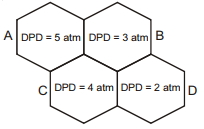
$A$ hypothetical arrangement of plant cells $(A, B, C, \text{ and } D)$ is given below. Find the correct sequence of movement of water using the given values.
A
$D \rightarrow B \rightarrow C \rightarrow A$
B
$A \rightarrow C \rightarrow B \rightarrow D$
C
$D \rightarrow B \rightarrow A \rightarrow C$
D
$D \rightarrow A \rightarrow C \rightarrow B$
Solution
(A) Water always moves from a region of lower $DPD$ (Diffusion Pressure Deficit) to a region of higher $DPD$.
Given $DPD$ values are:
Cell $A = 5 \text{ atm}$
Cell $B = 3 \text{ atm}$
Cell $C = 4 \text{ atm}$
Cell $D = 2 \text{ atm}$
Comparing these values, the sequence of increasing $DPD$ is $D (2 \text{ atm}) < B (3 \text{ atm}) < C (4 \text{ atm}) < A (5 \text{ atm})$.
Therefore, the water will move in the direction $D \rightarrow B \rightarrow C \rightarrow A$.
Given $DPD$ values are:
Cell $A = 5 \text{ atm}$
Cell $B = 3 \text{ atm}$
Cell $C = 4 \text{ atm}$
Cell $D = 2 \text{ atm}$
Comparing these values, the sequence of increasing $DPD$ is $D (2 \text{ atm}) < B (3 \text{ atm}) < C (4 \text{ atm}) < A (5 \text{ atm})$.
Therefore, the water will move in the direction $D \rightarrow B \rightarrow C \rightarrow A$.

0 likes
View Solution53
MediumMCQ
$A$: Xerophytes have high water-retaining capacity.
$R$: They have high $OP$.
$R$: They have high $OP$.
A
Assertion and Reason both are correct and Reason is the correct explanation of Assertion.
B
Assertion and Reason both are correct but Reason is not the correct explanation of Assertion.
C
Assertion is correct,but Reason is incorrect.
D
Both Assertion and Reason are incorrect.
Solution
(A) Xerophytes are plants adapted to survive in environments with little liquid water,such as deserts.
To survive in water-deficient soils,xerophytes maintain a high Osmotic Pressure $(OP)$ within their cells.
This high $OP$ helps them to absorb water from the soil even when the water potential of the soil is very low.
Therefore,both the Assertion and the Reason are correct,and the high $OP$ is the reason why they can retain water effectively.
To survive in water-deficient soils,xerophytes maintain a high Osmotic Pressure $(OP)$ within their cells.
This high $OP$ helps them to absorb water from the soil even when the water potential of the soil is very low.
Therefore,both the Assertion and the Reason are correct,and the high $OP$ is the reason why they can retain water effectively.
0 likes
View Solution54
EasyMCQ
The positive value of $\psi_P$ is called .....
A
Turgor pressure
B
Osmotic pressure
C
Diffusion pressure
D
Diffusion pressure deficit
Solution
(A) In plant cells,the pressure potential $(\psi_P)$ is usually positive due to the pressure exerted by the cell contents against the cell wall.
This pressure is known as turgor pressure.
When water enters a plant cell,it causes the cell to swell,building up pressure against the cell wall,which is defined as turgor pressure.
Therefore,the positive value of $\psi_P$ is referred to as turgor pressure.
This pressure is known as turgor pressure.
When water enters a plant cell,it causes the cell to swell,building up pressure against the cell wall,which is defined as turgor pressure.
Therefore,the positive value of $\psi_P$ is referred to as turgor pressure.
0 likes
View Solution55
MediumMCQ
The pressure exerted by the entry of water on the cell wall is called $.....P.....$, and the pressure exerted by the cell wall on the protoplast is called $.....Q.....$.
A
Turgor pressure, Wall pressure
B
Osmotic pressure, Wall pressure
C
Wall pressure, Turgor pressure
D
Turgor pressure, Osmotic pressure
Solution
(A) When water enters a plant cell, it creates a pressure against the cell wall due to the swelling of the protoplast. This pressure is known as Turgor pressure $(P)$.
In response, the rigid cell wall exerts an equal and opposite pressure on the protoplast, which is known as Wall pressure $(Q)$.
Therefore, $P = \text{Turgor pressure}$ and $Q = \text{Wall pressure}$.
In response, the rigid cell wall exerts an equal and opposite pressure on the protoplast, which is known as Wall pressure $(Q)$.
Therefore, $P = \text{Turgor pressure}$ and $Q = \text{Wall pressure}$.
0 likes
View Solution56
MediumMCQ
Osmotic pressure is defined as $.............$
A
The pressure that stops the process of osmosis.
B
The pressure exerted by the protoplast on the cell wall.
C
The pressure exerted by the cell wall on the protoplast.
D
The pressure generated by diffusion.
Solution
(A) Osmotic pressure is the external pressure applied to a solution to prevent the inward flow of its pure solvent across a semipermeable membrane.
In biological terms,it is the pressure required to stop the process of osmosis completely.
Therefore,the correct definition is the pressure that stops the process of osmosis.
In biological terms,it is the pressure required to stop the process of osmosis completely.
Therefore,the correct definition is the pressure that stops the process of osmosis.
0 likes
View Solution57
MediumMCQ
Select the correct option based on the Diffusion Pressure Deficit $(DPD)$ for the following cells:
A
Flaccid cell $>$ Plasmolysed cell $>$ Turgid cell
B
Turgid cell $>$ Flaccid cell $>$ Plasmolysed cell
C
Plasmolysed cell $>$ Flaccid cell $>$ Turgid cell
D
Turgid cell $>$ Plasmolysed cell $>$ Flaccid cell
Solution
(C) The Diffusion Pressure Deficit $(DPD)$ is defined as the difference between the diffusion pressure of pure water and the diffusion pressure of a solution. It is calculated as $DPD = OP - TP$,where $OP$ is Osmotic Pressure and $TP$ is Turgor Pressure.
$1$. For a Turgid cell: $OP = TP$,therefore $DPD = 0$ (minimum).
$2$. For a Flaccid cell: $TP = 0$,therefore $DPD = OP$.
$3$. For a Plasmolysed cell: $TP$ is negative,therefore $DPD = OP - (-TP) = OP + TP$ (maximum).
Thus,the order of $DPD$ is: Plasmolysed cell $>$ Flaccid cell $>$ Turgid cell.
$1$. For a Turgid cell: $OP = TP$,therefore $DPD = 0$ (minimum).
$2$. For a Flaccid cell: $TP = 0$,therefore $DPD = OP$.
$3$. For a Plasmolysed cell: $TP$ is negative,therefore $DPD = OP - (-TP) = OP + TP$ (maximum).
Thus,the order of $DPD$ is: Plasmolysed cell $>$ Flaccid cell $>$ Turgid cell.
0 likes
View Solution58
EasyMCQ
What is the pressure exerted by the protoplast against the cell wall called?
A
Osmotic pressure
B
Turgor pressure
C
Wall pressure
D
Diffusion pressure
Solution
(B) The pressure exerted by the protoplast against the cell wall due to the entry of water is known as $Turgor \text{ pressure}$.
According to the physical laws, the cell wall exerts an equal and opposite pressure on the protoplast, which is known as $Wall \text{ pressure}$.
Therefore, the correct answer is $Turgor \text{ pressure}$.
According to the physical laws, the cell wall exerts an equal and opposite pressure on the protoplast, which is known as $Wall \text{ pressure}$.
Therefore, the correct answer is $Turgor \text{ pressure}$.
0 likes
View Solution59
EasyMCQ
Match Column-$I$ with Column-$II$.
| Column-$I$ | Column-$II$ |
| $i$. Turgid cell | $a$. $T.P. = 0$ |
| $ii$. Pure water | $b$. $D.P.D. = 0$ |
| $iii$. Flaccid cell | $c$. $\Psi_w = 0$ |
A
$i-a, ii-b, iii-c$
B
$i-b, ii-c, iii-a$
C
$i-c, ii-b, iii-a$
D
$i-b, ii-a, iii-c$
Solution
(B) $1$. A Turgid cell is a cell that is fully distended with water. In this state, the Turgor Pressure $(T.P.)$ is equal to the Osmotic Pressure $(O.P.)$, which makes the Diffusion Pressure Deficit $(D.P.D.)$ equal to zero $(D.P.D. = O.P. - T.P. = 0)$. Thus, $i-b$.
$2$. Pure water has the highest water potential, which is defined as zero at standard temperature and pressure. Thus, $ii-c$.
$3$. A Flaccid cell is a cell that has lost water and is no longer turgid. In a flaccid cell, the Turgor Pressure $(T.P.)$ is zero. Thus, $iii-a$.
Therefore, the correct matching is $i-b, ii-c, iii-a$.
$2$. Pure water has the highest water potential, which is defined as zero at standard temperature and pressure. Thus, $ii-c$.
$3$. A Flaccid cell is a cell that has lost water and is no longer turgid. In a flaccid cell, the Turgor Pressure $(T.P.)$ is zero. Thus, $iii-a$.
Therefore, the correct matching is $i-b, ii-c, iii-a$.
0 likes
View Solution60
EasyMCQ
If a cell $A$ has an osmotic pressure of $100 \ bars$ and a turgor pressure of $50 \ bars$,and a cell $B$ has an osmotic pressure of $100 \ bars$ and a turgor pressure of $60 \ bars$,then the flow of water occurs . . . . . . .
A
from cell $A$ to cell $B$
B
from cell $B$ to cell $A$
C
from both cell $A$ to cell $B$ and cell $B$ to cell $A$
D
in neither direction
Solution
(B) The movement of water is determined by the Diffusion Pressure Deficit $(DPD)$,where $DPD = OP - TP$.
For cell $A$: $DPD = 100 - 50 = 50 \ bars$.
For cell $B$: $DPD = 100 - 60 = 40 \ bars$.
Water always moves from a region of lower $DPD$ to a region of higher $DPD$.
Since cell $B$ has a lower $DPD$ $(40 \ bars)$ compared to cell $A$ $(50 \ bars)$,water will flow from cell $B$ to cell $A$.
For cell $A$: $DPD = 100 - 50 = 50 \ bars$.
For cell $B$: $DPD = 100 - 60 = 40 \ bars$.
Water always moves from a region of lower $DPD$ to a region of higher $DPD$.
Since cell $B$ has a lower $DPD$ $(40 \ bars)$ compared to cell $A$ $(50 \ bars)$,water will flow from cell $B$ to cell $A$.
0 likes
View Solution61
EasyMCQ
$DPD$ of a cell can be expressed as . . . . . . .
A
$DPD = OP + TP$
B
$DPD = OP \times TP$
C
$DPD = OP - TP$
D
$DPD = TP - OP$
Solution
(C) The $DPD$ (Diffusion Pressure Deficit) of a cell is defined as the difference between the diffusion pressure of pure water and the diffusion pressure of the solution.
It is mathematically expressed as $DPD = OP - TP$, where $OP$ is the Osmotic Pressure and $TP$ is the Turgor Pressure.
$OP$ represents the pressure that prevents the entry of pure water into the solution, while $TP$ is the pressure exerted by the cell contents against the cell wall.
As water enters the cell, $TP$ increases, which reduces the $DPD$ of the cell.
It is mathematically expressed as $DPD = OP - TP$, where $OP$ is the Osmotic Pressure and $TP$ is the Turgor Pressure.
$OP$ represents the pressure that prevents the entry of pure water into the solution, while $TP$ is the pressure exerted by the cell contents against the cell wall.
As water enters the cell, $TP$ increases, which reduces the $DPD$ of the cell.
0 likes
View Solution62
EasyMCQ
In a plant cell,the Diffusion Pressure Deficit $(DPD)$ is zero when it is . . . . . . .
A
plasmolysed
B
turgid
C
flaccid
D
incipient
Solution
(B) The $DPD$ (Diffusion Pressure Deficit) is defined by the equation: $DPD = OP - TP$,where $OP$ is Osmotic Pressure and $TP$ is Turgor Pressure.
When a plant cell is fully turgid,the Turgor Pressure $(TP)$ becomes equal to the Osmotic Pressure $(OP)$.
Therefore,$DPD = OP - OP = 0$.
Thus,in a fully turgid cell,the $DPD$ is zero.
When a plant cell is fully turgid,the Turgor Pressure $(TP)$ becomes equal to the Osmotic Pressure $(OP)$.
Therefore,$DPD = OP - OP = 0$.
Thus,in a fully turgid cell,the $DPD$ is zero.
0 likes
View SolutionTransport in Plants — O.P.,T.P., I.P., D.P.D · Frequently Asked Questions
1Are these Transport in Plants questions useful for JEE and NEET?
Yes. All questions in this section are mapped to JEE Main and NEET exam patterns. Previous year questions from JEE Main, NEET, GUJCET and state-level exams are included with full solutions.
2Can I switch to Hindi or Gujarati for these questions?
Yes. Use the language tabs in the hero section or the sidebar to view the same questions and solutions in English, Hindi or Gujarati.
3How do I generate a question paper from this subtopic?
Use the Vedclass Exam Paper Generator — select the chapter and subtopic, set difficulty, and generate Sets A, B, C, D automatically. First 3 chapters of every subject are free.
Vedclass Products
For Students
Vedclass Test Series
Mock tests in real JEE/NEET style with performance analysis. 5-day free trial.
Start Free TrialFor Teachers
Exam Paper Generator
Generate Set A/B/C/D papers from this chapter in 2 minutes. 3 chapters free.
Try FreeFor Institutes
Online Exam Module
Live online exams with unlimited students, 360° analytics & white-label branding.
See DemoFor Teachers & Institutes
Generate a Transport in Plants Exam Paper in 2 Minutes
Select subtopic & difficulty — Sets A, B, C, D auto-generated with No Repeat logic.
First 3 chapters of every subject are free — no payment required.