
A English
Means of transport Questions in English
Class 11 Biology · Transport in Plants · Means of transport
129+
Questions
English
Language
100%
With Solutions
Showing 29 of 129 questions in English
101
MediumMCQ
Identify the means of transport represented below and the structure marked as $A$.
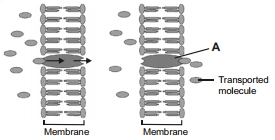
A
Simple diffusion; $A$ - Transport protein
B
Facilitated diffusion; $A$ - Transport protein
C
Facilitated diffusion; $A$ - Transport pumps
D
Active transport; $A$ - Transport pumps
Solution
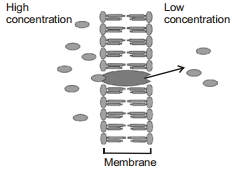
(B) The diagram shows the movement of molecules from a region of high concentration to a region of low concentration across a biological membrane.
Since the movement occurs along the concentration gradient,it is a passive process,which is characteristic of diffusion.
However,the process requires a specific membrane protein to facilitate the movement of molecules across the lipid bilayer.
Therefore,this process is identified as facilitated diffusion,and the structure marked as $A$ is a transport protein.
Since the movement occurs along the concentration gradient,it is a passive process,which is characteristic of diffusion.
However,the process requires a specific membrane protein to facilitate the movement of molecules across the lipid bilayer.
Therefore,this process is identified as facilitated diffusion,and the structure marked as $A$ is a transport protein.
0 likes
View Solution102
MediumMCQ
Facilitated diffusion is characterized by all,except
A
Requirement of membrane proteins
B
Uphill transport
C
No requirement of energy
D
Highly selective nature
Solution
(B) Facilitated diffusion is a type of passive transport where molecules move across the membrane along the concentration gradient (from a region of higher concentration to a region of lower concentration).
Since it follows the concentration gradient,it is a 'downhill' process and does not require metabolic energy $(ATP)$.
It requires specific membrane proteins (carrier or channel proteins) to facilitate the movement of hydrophilic molecules.
It is also highly selective in nature.
Therefore,'Uphill transport' is the incorrect characteristic,as it describes active transport.
Since it follows the concentration gradient,it is a 'downhill' process and does not require metabolic energy $(ATP)$.
It requires specific membrane proteins (carrier or channel proteins) to facilitate the movement of hydrophilic molecules.
It is also highly selective in nature.
Therefore,'Uphill transport' is the incorrect characteristic,as it describes active transport.
0 likes
View Solution103
MediumMCQ
Water channels are
A
Made up of eight similar types of aquaporins
B
Involved in active transport
C
Involved in facilitated diffusion
D
More than one option is correct
Solution
(C) Water channels are known as aquaporins.
They are membrane proteins that facilitate the movement of water molecules across the cell membrane.
They consist of eight different types of aquaporins.
Since they facilitate the movement of water along the concentration gradient without the expenditure of energy,they are involved in facilitated diffusion.
They are membrane proteins that facilitate the movement of water molecules across the cell membrane.
They consist of eight different types of aquaporins.
Since they facilitate the movement of water along the concentration gradient without the expenditure of energy,they are involved in facilitated diffusion.
0 likes
View Solution104
EasyMCQ
Active transport of ions by the cell requires
A
Alkaline $pH$
B
Salts
C
High temperature
D
$ATP$
Solution
(D) Active transport is the movement of molecules or ions against a concentration gradient. This process requires the expenditure of metabolic energy in the form of $ATP$ (Adenosine Triphosphate) to move substances across the cell membrane.
0 likes
View Solution105
EasyMCQ
Match the following columns:
| Column-$I$ | Column-$II$ |
| $(A)$ Movement of ions into or out of the cell | $(1)$ Diffusion |
| $(B)$ Outward movement is | $(2)$ Flux |
| $(C)$ Inward movement is | $(3)$ Efflux |
| $(D)$ Passive uptake | $(4)$ Influx |
A
$A-1, B-4, C-3, D-2$
B
$A-4, B-2, C-1, D-3$
C
$A-2, B-3, C-4, D-1$
D
$A-3, B-4, C-1, D-2$
Solution
(C) The correct matches are as follows:
$A$. Movement of ions into or out of the cell is defined as $Flux$ $(2)$.
$B$. Outward movement of ions from the cell is known as $Efflux$ $(3)$.
$C$. Inward movement of ions into the cell is known as $Influx$ $(4)$.
$D$. Passive uptake of ions occurs through the process of $Diffusion$ $(1)$.
Therefore, the correct matching is $A-2, B-3, C-4, D-1$.
$A$. Movement of ions into or out of the cell is defined as $Flux$ $(2)$.
$B$. Outward movement of ions from the cell is known as $Efflux$ $(3)$.
$C$. Inward movement of ions into the cell is known as $Influx$ $(4)$.
$D$. Passive uptake of ions occurs through the process of $Diffusion$ $(1)$.
Therefore, the correct matching is $A-2, B-3, C-4, D-1$.
0 likes
View Solution106
MediumMCQ
The entry and exit of ions to and from the symplast requires the expenditure of
A
Photosynthetic energy
B
Metabolic energy
C
Energy derived from ions
D
Zero amount of energy
Solution
(B) The movement of ions into and out of the symplast is an active transport process. Active transport involves the movement of molecules against their concentration gradient,which requires the expenditure of metabolic energy in the form of $ATP$.
0 likes
View Solution107
Easy
What is active transport?
Solution
(N/A) $\Rightarrow$ Active transport is the movement of ions or molecules across a cell membrane against their concentration gradient,i.e.,from a region of lower concentration to a region of higher concentration.
This process requires the expenditure of metabolic energy in the form of $ATP$.
It is essential for maintaining specific ion concentrations within the cell,such as the $Na^{+}/K^{+}$ pump,which actively transports sodium ions out of the cell and potassium ions into the cell.
This process requires the expenditure of metabolic energy in the form of $ATP$.
It is essential for maintaining specific ion concentrations within the cell,such as the $Na^{+}/K^{+}$ pump,which actively transports sodium ions out of the cell and potassium ions into the cell.
0 likes
View Solution108
MediumMCQ
How does most of the water move within the root?
A
Apoplast pathway
B
Symplast pathway
C
Transmembrane pathway
D
Vacuolar pathway
Solution
(A) $\Rightarrow$ Most of the water is transported within the root through the apoplast pathway.
$\Rightarrow$ The cortical cells are loosely arranged,which provides little resistance to the movement of water,allowing for mass flow.
$\Rightarrow$ This mass flow is facilitated by the cohesive and adhesive forces of water molecules.
$\Rightarrow$ While the apoplast pathway is the primary route,the symplast pathway also contributes to water transport,particularly across the endodermis where the Casparian strip is present.
$\Rightarrow$ The cortical cells are loosely arranged,which provides little resistance to the movement of water,allowing for mass flow.
$\Rightarrow$ This mass flow is facilitated by the cohesive and adhesive forces of water molecules.
$\Rightarrow$ While the apoplast pathway is the primary route,the symplast pathway also contributes to water transport,particularly across the endodermis where the Casparian strip is present.
0 likes
View Solution109
MediumMCQ
Identify a type of molecular movement which is highly selective and requires special membrane proteins,but does not require energy.
A
Simple diffusion
B
Facilitated diffusion
C
Active transport
D
Osmosis
Solution
(B) Facilitated diffusion is a process of passive transport where molecules move across the cell membrane with the help of special membrane proteins (carrier proteins or channel proteins).
It is highly selective,meaning it allows only specific molecules to pass through.
It does not require metabolic energy $(ATP)$ because the movement occurs along the concentration gradient (from a region of higher concentration to a region of lower concentration).
It is highly selective,meaning it allows only specific molecules to pass through.
It does not require metabolic energy $(ATP)$ because the movement occurs along the concentration gradient (from a region of higher concentration to a region of lower concentration).
0 likes
View Solution110
Easy
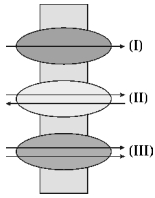
Identify the processes occurring in $(I)$,$(II)$,and $(III)$ based on the provided diagram.
Solution
(N/A) Based on the transport mechanisms across the membrane:
$(I)$ Uniport: $A$ single molecule moves across the membrane independently of other molecules.
$(II)$ Antiport: Two molecules move in opposite directions across the membrane.
$(III)$ Symport: Two molecules move in the same direction across the membrane simultaneously.
$(I)$ Uniport: $A$ single molecule moves across the membrane independently of other molecules.
$(II)$ Antiport: Two molecules move in opposite directions across the membrane.
$(III)$ Symport: Two molecules move in the same direction across the membrane simultaneously.
0 likes
View Solution111
Medium
Given below is a table. Fill in the gaps.
| Property | Simple Diffusion | Facilitated Transport | Active Transport |
| Highly selective | No | Yes | ... |
| Uphill transport | ... | ... | Yes |
| Requires $ATP$ | ... | ... | ... |
Solution
(D) The completed table is as follows:
Explanation:
$1$. Simple Diffusion: Passive process,non-selective,no energy required,moves along the concentration gradient.
$2$. Facilitated Transport: Passive process,highly selective (uses membrane proteins),no energy required,moves along the concentration gradient.
$3$. Active Transport: Uses energy $(ATP)$ to pump molecules against the concentration gradient (uphill),highly selective,and requires carrier proteins.
| Property | Simple Diffusion | Facilitated Transport | Active Transport |
| Highly selective | No | Yes | Yes |
| Uphill transport | No | No | Yes |
| Requires $ATP$ | No | No | Yes |
Explanation:
$1$. Simple Diffusion: Passive process,non-selective,no energy required,moves along the concentration gradient.
$2$. Facilitated Transport: Passive process,highly selective (uses membrane proteins),no energy required,moves along the concentration gradient.
$3$. Active Transport: Uses energy $(ATP)$ to pump molecules against the concentration gradient (uphill),highly selective,and requires carrier proteins.
0 likes
View Solution112
Easy
What is meant by influx and efflux?
Solution
(N/A) $\Rightarrow$ The movement of ions is generally referred to as flux.
$\Rightarrow$ The inward movement of ions into the cells is known as influx.
$\Rightarrow$ The outward movement of ions from the cells is known as efflux.
$\Rightarrow$ Both these processes often require the expenditure of metabolic energy,making them active transport processes.
$\Rightarrow$ The inward movement of ions into the cells is known as influx.
$\Rightarrow$ The outward movement of ions from the cells is known as efflux.
$\Rightarrow$ Both these processes often require the expenditure of metabolic energy,making them active transport processes.
0 likes
View Solution113
MediumMCQ
Match the following columns:
| Column-$I$ | Column-$II$ |
| $P$. Diffusion | $I$. Along the gradient, with protein |
| $Q$. Facilitated transport | $II$. Against the gradient |
| $R$. Active transport | $III$. Along the gradient, without protein |
A
$(P-III), (Q-I), (R-II)$
B
$(P-III), (Q-II), (R-I)$
C
$(P-I), (Q-III), (R-II)$
D
$(P-I), (Q-II), (R-III)$
Solution
(A) $P$. Diffusion is the movement of molecules along the concentration gradient without the help of membrane proteins. Thus, $P-III$.
$Q$. Facilitated transport is the movement of molecules along the concentration gradient with the help of specific membrane proteins. Thus, $Q-I$.
$R$. Active transport is the movement of molecules against the concentration gradient, which requires energy and membrane proteins. Thus, $R-II$.
Therefore, the correct matching is $(P-III), (Q-I), (R-II)$.
$Q$. Facilitated transport is the movement of molecules along the concentration gradient with the help of specific membrane proteins. Thus, $Q-I$.
$R$. Active transport is the movement of molecules against the concentration gradient, which requires energy and membrane proteins. Thus, $R-II$.
Therefore, the correct matching is $(P-III), (Q-I), (R-II)$.
0 likes
View Solution114
EasyMCQ
Which of the following types of transport are included in passive transport?
A
Diffusion
B
Facilitated diffusion
C
Active transport
D
Both $A$ and $B$
Solution
(D) Passive transport is the movement of molecules across a cell membrane without the expenditure of metabolic energy $(ATP)$.
Diffusion is a passive process where molecules move from a region of higher concentration to a region of lower concentration.
Facilitated diffusion is also a passive process that uses specific membrane proteins to move molecules across the membrane without the use of $ATP$.
Active transport,on the other hand,requires the expenditure of energy $(ATP)$ to move molecules against their concentration gradient.
Therefore,both diffusion and facilitated diffusion are types of passive transport.
Diffusion is a passive process where molecules move from a region of higher concentration to a region of lower concentration.
Facilitated diffusion is also a passive process that uses specific membrane proteins to move molecules across the membrane without the use of $ATP$.
Active transport,on the other hand,requires the expenditure of energy $(ATP)$ to move molecules against their concentration gradient.
Therefore,both diffusion and facilitated diffusion are types of passive transport.
0 likes
View Solution115
MediumMCQ
Transport occurs along the concentration gradient.
A
Diffusion
B
Facilitated diffusion
C
Active transport
D
Both $A$ and $B$
Solution
(D) Transport along the concentration gradient means moving from a region of higher concentration to a region of lower concentration. This process does not require metabolic energy $(ATP)$.
Diffusion is the movement of molecules from a region of higher concentration to a region of lower concentration.
Facilitated diffusion also occurs along the concentration gradient,utilizing membrane proteins to transport molecules without the expenditure of energy.
Active transport,on the other hand,occurs against the concentration gradient and requires energy in the form of $ATP$.
Therefore,both diffusion and facilitated diffusion occur along the concentration gradient.
Diffusion is the movement of molecules from a region of higher concentration to a region of lower concentration.
Facilitated diffusion also occurs along the concentration gradient,utilizing membrane proteins to transport molecules without the expenditure of energy.
Active transport,on the other hand,occurs against the concentration gradient and requires energy in the form of $ATP$.
Therefore,both diffusion and facilitated diffusion occur along the concentration gradient.
0 likes
View Solution116
EasyMCQ
Transport occurs against the concentration gradient.
A
Diffusion
B
Facilitated diffusion
C
Active transport
D
Both $A$ and $B$
Solution
(C) Active transport is the process of moving molecules across a cell membrane from a region of lower concentration to a region of higher concentration.
This process requires energy in the form of $ATP$ because it moves substances against the concentration gradient.
In contrast,diffusion and facilitated diffusion are types of passive transport that move substances along the concentration gradient and do not require energy.
This process requires energy in the form of $ATP$ because it moves substances against the concentration gradient.
In contrast,diffusion and facilitated diffusion are types of passive transport that move substances along the concentration gradient and do not require energy.
0 likes
View Solution117
MediumMCQ
Which of the following transport mechanisms require protein for the movement of substances?
A
Diffusion and Facilitated Diffusion
B
Facilitated Diffusion and Active Transport
C
Diffusion and Active Transport
D
Only Active Transport
Solution
(B) $1$. Simple diffusion is a passive process that does not require membrane proteins.
$2$. Facilitated diffusion involves the movement of molecules across a membrane through specific transport proteins without the expenditure of energy.
$3$. Active transport involves the movement of molecules against the concentration gradient,which requires both energy $(ATP)$ and specific membrane transport proteins (pumps).
$4$. Therefore,both facilitated diffusion and active transport require membrane proteins for the transport of substances.
$2$. Facilitated diffusion involves the movement of molecules across a membrane through specific transport proteins without the expenditure of energy.
$3$. Active transport involves the movement of molecules against the concentration gradient,which requires both energy $(ATP)$ and specific membrane transport proteins (pumps).
$4$. Therefore,both facilitated diffusion and active transport require membrane proteins for the transport of substances.
0 likes
View Solution118
EasyMCQ
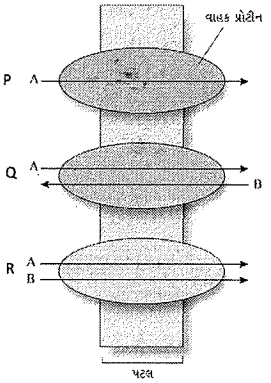
Identify $P, Q,$ and $R$ in the given figure.
A
Symport,Antiport,Uniport
B
Symport,Uniport,Antiport
C
Uniport,Antiport,Symport
D
Uniport,Symport,Antiport
Solution
(C) In the given figure,the transport mechanisms are represented as follows:
$P$: $A$ single molecule moves in one direction independently of other molecules. This is called Uniport.
$Q$: Two molecules move in opposite directions. This is called Antiport.
$R$: Two molecules move in the same direction simultaneously. This is called Symport.
Therefore,the correct sequence is $P$ = Uniport,$Q$ = Antiport,$R$ = Symport.
$P$: $A$ single molecule moves in one direction independently of other molecules. This is called Uniport.
$Q$: Two molecules move in opposite directions. This is called Antiport.
$R$: Two molecules move in the same direction simultaneously. This is called Symport.
Therefore,the correct sequence is $P$ = Uniport,$Q$ = Antiport,$R$ = Symport.
0 likes
View Solution119
MediumMCQ
Which of the following statements is incorrect regarding facilitated diffusion?
A
Facilitated diffusion occurs for lipid-soluble molecules.
B
Facilitated diffusion occurs with the help of special membrane proteins.
C
Proteins do not establish a concentration gradient; a concentration gradient must already be present.
D
Facilitated diffusion occurs along the concentration gradient.
Solution
(A) Facilitated diffusion is a type of passive transport where molecules move across a membrane with the help of transport proteins.
$1$. It occurs along the concentration gradient (from high to low concentration).
$2$. It does not require metabolic energy $(ATP)$.
$3$. It is highly selective and sensitive to inhibitors.
$4$. It is specifically required for hydrophilic (water-soluble) molecules that cannot pass through the lipid bilayer.
Therefore,the statement that facilitated diffusion occurs for lipid-soluble molecules is incorrect,as lipid-soluble molecules can easily pass through the lipid bilayer via simple diffusion.
$1$. It occurs along the concentration gradient (from high to low concentration).
$2$. It does not require metabolic energy $(ATP)$.
$3$. It is highly selective and sensitive to inhibitors.
$4$. It is specifically required for hydrophilic (water-soluble) molecules that cannot pass through the lipid bilayer.
Therefore,the statement that facilitated diffusion occurs for lipid-soluble molecules is incorrect,as lipid-soluble molecules can easily pass through the lipid bilayer via simple diffusion.
0 likes
View Solution120
MediumMCQ
Which of the following is true for both active transport and facilitated diffusion?
A
They are highly selective and allow cells to select substances for uptake.
B
They are sensitive to inhibitors that react with protein side chains.
C
They show saturation of transport.
D
All of the above.
0 likes
View Solution121
MediumMCQ
Match the following columns regarding membrane transport mechanisms:
| Column-$I$ | Column-$II$ |
|---|---|
| $P$. Uniport | $I$. $A$ molecule moves across the membrane independent of other molecules. |
| $Q$. Symport | $II$. Two molecules move in opposite directions. |
| $R$. Antiport | $III$. Two molecules cross the membrane in the same direction. |
A
$P-II, Q-III, R-I$
B
$P-I, Q-III, R-II$
C
$P-I, Q-II, R-III$
D
$P-III, Q-II, R-I$
Solution
(B) The membrane transport mechanisms are defined as follows:
$1$. $Uniport$: $A$ molecule moves across the membrane independent of other molecules $(P-I)$.
$2$. $Symport$: Two molecules cross the membrane in the same direction $(Q-III)$.
$3$. $Antiport$: Two molecules move in opposite directions $(R-II)$.
Therefore,the correct matching is $P-I, Q-III, R-II$.
$1$. $Uniport$: $A$ molecule moves across the membrane independent of other molecules $(P-I)$.
$2$. $Symport$: Two molecules cross the membrane in the same direction $(Q-III)$.
$3$. $Antiport$: Two molecules move in opposite directions $(R-II)$.
Therefore,the correct matching is $P-I, Q-III, R-II$.
0 likes
View Solution122
MediumMCQ
Identify the type of transport shown in the given image.
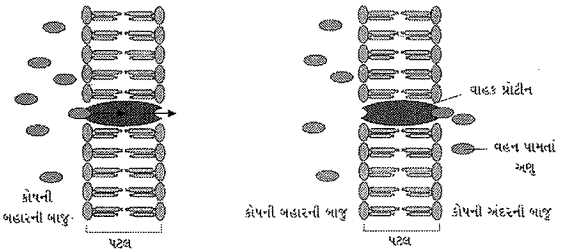
A
Diffusion
B
Facilitated diffusion
C
Active transport
D
Both $A$ and $B$
Solution
(B) The image illustrates a molecule moving across a cell membrane with the help of a carrier protein.
$1$. Diffusion occurs directly through the lipid bilayer without the aid of proteins.
$2$. Facilitated diffusion involves the movement of molecules across the membrane with the help of special membrane proteins (carrier proteins or channel proteins) along the concentration gradient.
$3$. Active transport requires energy $(ATP)$ to move molecules against the concentration gradient.
Since the diagram shows the involvement of a carrier protein to facilitate the movement of molecules,it represents facilitated diffusion.
$1$. Diffusion occurs directly through the lipid bilayer without the aid of proteins.
$2$. Facilitated diffusion involves the movement of molecules across the membrane with the help of special membrane proteins (carrier proteins or channel proteins) along the concentration gradient.
$3$. Active transport requires energy $(ATP)$ to move molecules against the concentration gradient.
Since the diagram shows the involvement of a carrier protein to facilitate the movement of molecules,it represents facilitated diffusion.
0 likes
View Solution123
MediumMCQ
Which of the following processes shows uphill transport?
A
Diffusion
B
Facilitated diffusion
C
Active transport
D
Both $A$ and $B$
Solution
(C) Uphill transport refers to the movement of substances from a region of lower concentration to a region of higher concentration.
This process requires energy in the form of $ATP$.
Active transport is the only mechanism among the given options that moves molecules against the concentration gradient,which is known as uphill transport.
Diffusion and facilitated diffusion are passive processes that move molecules along the concentration gradient (downhill transport).
This process requires energy in the form of $ATP$.
Active transport is the only mechanism among the given options that moves molecules against the concentration gradient,which is known as uphill transport.
Diffusion and facilitated diffusion are passive processes that move molecules along the concentration gradient (downhill transport).
0 likes
View Solution124
MediumMCQ
Choose the correct option for $P, Q$ and $R$.
$P, Q$ and $R$ respectively are:
| Property | Simple Diffusion | Facilitated Transport | Active Transport |
| Transport Saturation | $P$ | Yes | Yes |
| Uphill Transport | No | No | $Q$ |
| Requirement of Energy | No | $R$ | Yes |
$P, Q$ and $R$ respectively are:
A
Yes,No,Yes
B
No,Yes,No
C
Yes,Yes,No
D
No,Yes,Yes
Solution
(B) $1$. Simple diffusion is a passive process that does not show transport saturation because it does not involve carrier proteins. Thus, $P = \text{No}$.
$2$. Active transport involves the movement of molecules against the concentration gradient (uphill transport), which requires energy. Thus, $Q = \text{Yes}$.
$3$. Facilitated transport is a passive process that uses carrier proteins but does not require metabolic energy $(ATP)$. Thus, $R = \text{No}$.
$4$. Therefore, the sequence $P, Q, R$ is $No, Yes, No$.
$2$. Active transport involves the movement of molecules against the concentration gradient (uphill transport), which requires energy. Thus, $Q = \text{Yes}$.
$3$. Facilitated transport is a passive process that uses carrier proteins but does not require metabolic energy $(ATP)$. Thus, $R = \text{No}$.
$4$. Therefore, the sequence $P, Q, R$ is $No, Yes, No$.
0 likes
View Solution125
MediumMCQ
Which pathway is responsible for the majority of water transport in plants?
A
Apoplast pathway
B
Symplast pathway
C
Vacuolar pathway
D
Water transport occurs equally in all pathways
Solution
(A) The $Apoplast$ pathway is the system of adjacent cell walls that is continuous throughout the plant,except at the $Casparian$ strips of the endodermis in the roots.
Because the $Apoplast$ does not involve crossing cell membranes,it offers the least resistance to the movement of water.
Therefore,the majority of water transport in plants occurs through the $Apoplast$ pathway.
Because the $Apoplast$ does not involve crossing cell membranes,it offers the least resistance to the movement of water.
Therefore,the majority of water transport in plants occurs through the $Apoplast$ pathway.
0 likes
View Solution126
MediumMCQ
Identify the water transport pathways $P$ and $Q$ shown in the given figure.
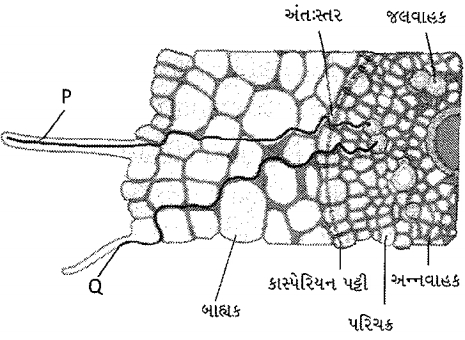
A
Symplastic pathway,Apoplastic pathway
B
Apoplastic pathway,Symplastic pathway
C
Transmembrane pathway,Symplastic pathway
D
Apoplastic pathway,Transmembrane pathway
Solution
(A) In the given figure,pathway $P$ moves through the cytoplasm and plasmodesmata,which represents the Symplastic pathway.
Pathway $Q$ moves through the cell walls and intercellular spaces,which represents the Apoplastic pathway.
Therefore,$P$ is the Symplastic pathway and $Q$ is the Apoplastic pathway.
Pathway $Q$ moves through the cell walls and intercellular spaces,which represents the Apoplastic pathway.
Therefore,$P$ is the Symplastic pathway and $Q$ is the Apoplastic pathway.
0 likes
View Solution127
MediumMCQ
When a carrier protein facilitates the movement of two molecules across the membrane in the same direction,it is called:
A
Uniport
B
Transport
C
Antiport
D
Symport
Solution
(D) In facilitated diffusion,carrier proteins are involved in the transport of molecules across the membrane.
When a molecule moves across the membrane independent of other molecules,it is called $Uniport$.
When two molecules move across the membrane in the same direction,it is called $Symport$.
When two molecules move across the membrane in opposite directions,it is called $Antiport$.
Therefore,the correct term for the movement of two molecules in the same direction is $Symport$.
When a molecule moves across the membrane independent of other molecules,it is called $Uniport$.
When two molecules move across the membrane in the same direction,it is called $Symport$.
When two molecules move across the membrane in opposite directions,it is called $Antiport$.
Therefore,the correct term for the movement of two molecules in the same direction is $Symport$.
0 likes
View Solution128
EasyMCQ
Movement and accumulation of ions across a membrane against their concentration gradient can be explained by
A
Active Transport
B
Osmosis
C
Facilitated Diffusion
D
Passive Transport
Solution
(A) The movement and accumulation of ions across a membrane against their concentration gradient is defined as active transport.
Active transport requires metabolic energy (usually in the form of $ATP$) to move molecules from a region of lower concentration to a region of higher concentration.
Unlike passive transport,which moves substances along the concentration gradient without energy expenditure,active transport is an energy-dependent process.
Active transport requires metabolic energy (usually in the form of $ATP$) to move molecules from a region of lower concentration to a region of higher concentration.
Unlike passive transport,which moves substances along the concentration gradient without energy expenditure,active transport is an energy-dependent process.
0 likes
View Solution129
EasyMCQ
Facilitated diffusion in cells is brought about by . . . . . . in the cell membrane.
A
Casparian strips
B
pectin
C
cellulose
D
aquaporins
Solution
(D) Facilitated diffusion is a type of passive transport that occurs across the cell membrane with the help of special membrane proteins.
These proteins provide a pathway for specific molecules or ions to move across the membrane along their concentration gradient without the expenditure of metabolic energy $(ATP)$.
Aquaporins are specialized integral membrane proteins that act as channels for the facilitated diffusion of water molecules across the cell membrane.
Therefore,aquaporins are responsible for facilitating the movement of water in cells.
These proteins provide a pathway for specific molecules or ions to move across the membrane along their concentration gradient without the expenditure of metabolic energy $(ATP)$.
Aquaporins are specialized integral membrane proteins that act as channels for the facilitated diffusion of water molecules across the cell membrane.
Therefore,aquaporins are responsible for facilitating the movement of water in cells.
0 likes
View SolutionTransport in Plants — Means of transport · Frequently Asked Questions
1Are these Transport in Plants questions useful for JEE and NEET?
Yes. All questions in this section are mapped to JEE Main and NEET exam patterns. Previous year questions from JEE Main, NEET, GUJCET and state-level exams are included with full solutions.
2Can I switch to Hindi or Gujarati for these questions?
Yes. Use the language tabs in the hero section or the sidebar to view the same questions and solutions in English, Hindi or Gujarati.
3How do I generate a question paper from this subtopic?
Use the Vedclass Exam Paper Generator — select the chapter and subtopic, set difficulty, and generate Sets A, B, C, D automatically. First 3 chapters of every subject are free.
Vedclass Products
For Students
Vedclass Test Series
Mock tests in real JEE/NEET style with performance analysis. 5-day free trial.
Start Free TrialFor Teachers
Exam Paper Generator
Generate Set A/B/C/D papers from this chapter in 2 minutes. 3 chapters free.
Try FreeFor Institutes
Online Exam Module
Live online exams with unlimited students, 360° analytics & white-label branding.
See DemoFor Teachers & Institutes
Generate a Transport in Plants Exam Paper in 2 Minutes
Select subtopic & difficulty — Sets A, B, C, D auto-generated with No Repeat logic.
First 3 chapters of every subject are free — no payment required.