
A English
Means of transport Questions in English
Class 11 Biology · Transport in Plants · Means of transport
129+
Questions
English
Language
100%
With Solutions
Showing 50 of 129 questions in English
51
MediumMCQ
Choose the incorrect sentence.
A
Movement by diffusion is passive.
B
In diffusion,molecules move in a random fashion.
C
Diffusion is a slow process and is not dependent on a 'living system'.
D
Diffusion rates are affected by the gradient of concentration,the permeability of the membrane separating them,light and pressure.
Solution
(D) Diffusion is the net movement of molecules from a region of higher concentration to a region of lower concentration.
$1$. It is a passive process,meaning it does not require energy expenditure $(ATP)$.
$2$. Molecules move in a random fashion.
$3$. It is a slow process and does not depend on a 'living system'.
$4$. Diffusion rates are affected by the gradient of concentration,the permeability of the membrane separating them,temperature,and pressure.
Light does not directly affect the rate of diffusion. Therefore,option $D$ is the incorrect statement.
$1$. It is a passive process,meaning it does not require energy expenditure $(ATP)$.
$2$. Molecules move in a random fashion.
$3$. It is a slow process and does not depend on a 'living system'.
$4$. Diffusion rates are affected by the gradient of concentration,the permeability of the membrane separating them,temperature,and pressure.
Light does not directly affect the rate of diffusion. Therefore,option $D$ is the incorrect statement.
0 likes
View Solution52
EasyMCQ
In a $X$, both molecules cross the membrane in the same direction; in an $Y$, they move in opposite directions.
A
$X - \text{antiport}, Y - \text{symport}$
B
$X - \text{uniport}, Y - \text{antiport}$
C
$X - \text{symport}, Y - \text{antiport}$
D
$X - \text{uniport}, Y - \text{symport}$
Solution
(C) In facilitated diffusion, some carrier proteins allow transport only if two types of molecules move together.
$1$. In a $symport$, both molecules cross the membrane in the same direction.
$2$. In an $antiport$, the molecules move in opposite directions.
$3$. In a $uniport$, a molecule moves across a membrane independent of other molecules.
Therefore, $X$ is $symport$ and $Y$ is $antiport$.
$1$. In a $symport$, both molecules cross the membrane in the same direction.
$2$. In an $antiport$, the molecules move in opposite directions.
$3$. In a $uniport$, a molecule moves across a membrane independent of other molecules.
Therefore, $X$ is $symport$ and $Y$ is $antiport$.
0 likes
View Solution53
MediumMCQ
$A-$ The symplastic system is the system of interconnected protoplasts.
$R-$ The apoplast is the system of adjacent cell walls that is continuous throughout the plant root,except at the Casparian strips of the endodermis in the roots.
$R-$ The apoplast is the system of adjacent cell walls that is continuous throughout the plant root,except at the Casparian strips of the endodermis in the roots.
A
$A$ and $R$ both are correct.
B
$A$ and $R$ both are incorrect.
C
$A$ is correct and $R$ is incorrect.
D
$A$ is incorrect and $R$ is correct.
Solution
(A) The symplastic system consists of the entire network of cell protoplasts connected by plasmodesmata.
This allows for the movement of water and solutes through the cytoplasm of adjacent cells.
Therefore,statement $A$ is correct.
The apoplastic system consists of the non-living parts of the plant,specifically the cell walls and intercellular spaces.
This system is continuous throughout the plant,except at the Casparian strips in the endodermis of the roots,where the suberin deposition blocks the apoplastic pathway.
Therefore,statement $R$ is also correct.
Since both statements are correct,the correct option is $A$.
This allows for the movement of water and solutes through the cytoplasm of adjacent cells.
Therefore,statement $A$ is correct.
The apoplastic system consists of the non-living parts of the plant,specifically the cell walls and intercellular spaces.
This system is continuous throughout the plant,except at the Casparian strips in the endodermis of the roots,where the suberin deposition blocks the apoplastic pathway.
Therefore,statement $R$ is also correct.
Since both statements are correct,the correct option is $A$.
0 likes
View Solution54
MediumMCQ
Chloride ions : Simple diffusion :: Some amino acids and glucose : ...
A
Carrier $K^+$
B
Carrier protein
C
Carrier $Ca^+$
D
Carrier $Cl^-$
Solution
(B) The transport of substances across the cell membrane occurs via different mechanisms.
Chloride ions $(Cl^-)$ can move across the membrane via simple diffusion.
However,larger or polar molecules like glucose and some amino acids cannot pass through the lipid bilayer directly.
They require specific membrane transport proteins,known as carrier proteins,to facilitate their movement across the membrane,a process called facilitated diffusion.
Therefore,the correct analogy is: Chloride ions : Simple diffusion :: Some amino acids and glucose : Carrier protein.
Chloride ions $(Cl^-)$ can move across the membrane via simple diffusion.
However,larger or polar molecules like glucose and some amino acids cannot pass through the lipid bilayer directly.
They require specific membrane transport proteins,known as carrier proteins,to facilitate their movement across the membrane,a process called facilitated diffusion.
Therefore,the correct analogy is: Chloride ions : Simple diffusion :: Some amino acids and glucose : Carrier protein.
0 likes
View Solution55
MediumMCQ
Which of the following is not applicable to facilitated diffusion?
A
It is an uphill transport process.
B
It requires special membrane proteins.
C
It is highly selective.
D
It shows transport saturation.
0 likes
View Solution56
EasyMCQ
In which method of transport in the plasma membrane is a carrier molecule not required?
A
Active transport
B
Facilitated diffusion
C
Simple diffusion
D
$Na^+ -K^+$ pump
Solution
(C) Simple diffusion is the movement of molecules from a region of higher concentration to a region of lower concentration without the expenditure of energy.
This process does not require any membrane proteins or carrier molecules to facilitate the movement of substances across the plasma membrane.
In contrast,active transport,facilitated diffusion,and the $Na^+ -K^+$ pump all require specific membrane proteins or carrier molecules to transport substances across the membrane.
This process does not require any membrane proteins or carrier molecules to facilitate the movement of substances across the plasma membrane.
In contrast,active transport,facilitated diffusion,and the $Na^+ -K^+$ pump all require specific membrane proteins or carrier molecules to transport substances across the membrane.
0 likes
View Solution57
MediumMCQ
Which of the following is not a feature of active transport of solutes in plants?
A
Occurs against concentration gradient
B
Non-selective
C
Occurs through membranes
D
Requires $ATP$
Solution
(B) Active transport is a process that moves molecules across a cell membrane from a region of lower concentration to a region of higher concentration (against the concentration gradient).
This process requires energy in the form of $ATP$.
Active transport is highly selective because it uses specific membrane proteins (pumps) to transport particular solutes.
Therefore,being 'non-selective' is not a feature of active transport; rather,it is a characteristic of passive transport like simple diffusion.
This process requires energy in the form of $ATP$.
Active transport is highly selective because it uses specific membrane proteins (pumps) to transport particular solutes.
Therefore,being 'non-selective' is not a feature of active transport; rather,it is a characteristic of passive transport like simple diffusion.
0 likes
View Solution58
Medium
What are the factors affecting the rate of diffusion?
Solution
(N/A) Diffusion is the passive movement of substances from a region of higher concentration to a region of lower concentration. Diffusion of substances plays an important role in cellular transport in plants.
The rate of diffusion is primarily affected by the following factors:
$1$. Concentration gradient: The difference in concentration between two regions. A steeper gradient increases the rate of diffusion.
$2$. Membrane permeability: The ability of the membrane to allow substances to pass through. The rate of diffusion increases as membrane permeability increases.
$3$. Temperature: An increase in temperature generally increases the kinetic energy of molecules, thereby increasing the rate of diffusion.
$4$. Pressure: Pressure plays a significant role, especially in the diffusion of gases, where substances move from a region of higher partial pressure to a region of lower partial pressure.
Diffusion continues until the concentrations on both sides of the barrier become equal, at which point net diffusion stops.
The rate of diffusion is primarily affected by the following factors:
$1$. Concentration gradient: The difference in concentration between two regions. A steeper gradient increases the rate of diffusion.
$2$. Membrane permeability: The ability of the membrane to allow substances to pass through. The rate of diffusion increases as membrane permeability increases.
$3$. Temperature: An increase in temperature generally increases the kinetic energy of molecules, thereby increasing the rate of diffusion.
$4$. Pressure: Pressure plays a significant role, especially in the diffusion of gases, where substances move from a region of higher partial pressure to a region of lower partial pressure.
Diffusion continues until the concentrations on both sides of the barrier become equal, at which point net diffusion stops.
0 likes
View Solution59
Medium
Describe the role played by protein pumps during active transport in plants.
Solution
(N/A) In plant cells,active transport occurs against the concentration gradient,i.e.,from a region of lower concentration to a region of higher concentration.
The process of active transport involves specific protein pumps.
The protein pumps are made up of specific proteins called trans-membrane proteins.
These pumps first make a complex with the substance to be transported across the membrane,using the energy derived from $ATP$.
The substance finally gets liberated into the cytoplasm as a result of the dissociation of the protein-substance complex.
The process of active transport involves specific protein pumps.
The protein pumps are made up of specific proteins called trans-membrane proteins.
These pumps first make a complex with the substance to be transported across the membrane,using the energy derived from $ATP$.
The substance finally gets liberated into the cytoplasm as a result of the dissociation of the protein-substance complex.
0 likes
View Solution60
EasyMCQ
What are the different means of transport in plants?
A
Diffusion
B
Facilitated diffusion
C
Active transport
D
All of the above
Solution
(D) The means of transport in plants are classified into four main types:
$(1)$ Diffusion: The movement of molecules from a region of higher concentration to a region of lower concentration.
$(2)$ Facilitated Diffusion: The movement of molecules across a membrane with the help of special membrane proteins without the expenditure of energy.
$(3)$ Passive Symports and Antiports: $A$ type of facilitated transport where two molecules move together across the membrane.
$(4)$ Active Transport: The movement of molecules against the concentration gradient,which requires the expenditure of energy in the form of $ATP$.
$(1)$ Diffusion: The movement of molecules from a region of higher concentration to a region of lower concentration.
$(2)$ Facilitated Diffusion: The movement of molecules across a membrane with the help of special membrane proteins without the expenditure of energy.
$(3)$ Passive Symports and Antiports: $A$ type of facilitated transport where two molecules move together across the membrane.
$(4)$ Active Transport: The movement of molecules against the concentration gradient,which requires the expenditure of energy in the form of $ATP$.
0 likes
View Solution61
Medium
Give the definition of diffusion and write its properties.
Solution
(N/A) $\Rightarrow$ Definition: The movement of molecules of any substance from a region of higher concentration to a region of lower concentration is called diffusion. Molecules move in a random fashion.
$\Rightarrow$ Properties:
$\bullet$ Movement by diffusion is passive.
$\bullet$ It may occur from one part of the cell to another,or from cell to cell.
$\bullet$ This movement occurs over short distances.
$\bullet$ It can occur from the intercellular spaces of a leaf to the outside environment.
$\bullet$ No energy expenditure takes place during diffusion.
$\bullet$ Diffusion is a slow process and is not dependent on a 'living system'.
$\bullet$ Diffusion is most obvious in gases and liquids.
$\bullet$ Diffusion of solid substances is also possible.
$\bullet$ Diffusion is very important to plants since it is the only means for gaseous movement within the plant body.
$\bullet$ Diffusion rates are affected by the concentration gradient,the permeability of the membrane separating them,temperature,and pressure.
$\Rightarrow$ Properties:
$\bullet$ Movement by diffusion is passive.
$\bullet$ It may occur from one part of the cell to another,or from cell to cell.
$\bullet$ This movement occurs over short distances.
$\bullet$ It can occur from the intercellular spaces of a leaf to the outside environment.
$\bullet$ No energy expenditure takes place during diffusion.
$\bullet$ Diffusion is a slow process and is not dependent on a 'living system'.
$\bullet$ Diffusion is most obvious in gases and liquids.
$\bullet$ Diffusion of solid substances is also possible.
$\bullet$ Diffusion is very important to plants since it is the only means for gaseous movement within the plant body.
$\bullet$ Diffusion rates are affected by the concentration gradient,the permeability of the membrane separating them,temperature,and pressure.
0 likes
View Solution62
Medium
Explain: Facilitated Diffusion and its properties.
Solution
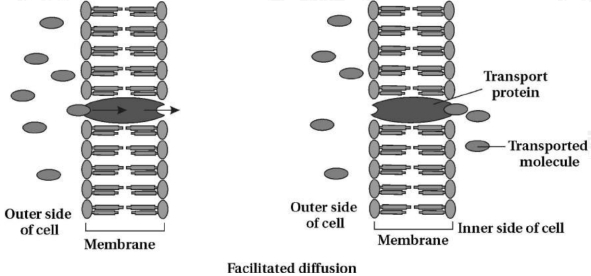
(N/A) Facilitated diffusion is a type of passive transport where specific membrane proteins assist in the movement of molecules across a biological membrane without the expenditure of $ATP$ energy.
Key Principles of Diffusion:
- Diffusion occurs only if a concentration gradient is already present.
- The rate of diffusion depends on the size of the substances; smaller substances diffuse faster.
- Diffusion across a membrane depends on the solubility of the substance in lipids. Lipid-soluble substances diffuse through the membrane more rapidly.
Need for Facilitated Diffusion:
- Substances with a hydrophilic moiety find it difficult to pass through the lipid bilayer of the membrane.
- Membrane proteins provide specific sites for these molecules to cross the membrane.
- Facilitated diffusion does not set up a concentration gradient; it requires an existing gradient to function.
Properties of Facilitated Diffusion:
- It is a passive process that does not require $ATP$ energy.
- It is highly specific,allowing the cell to select substances for uptake.
- The transport rate reaches a maximum when all protein transporters are saturated (used).
- It is sensitive to inhibitors that react with protein side chains.
- Some proteins form channels in the membrane. These channels can be always open or gated (controlled).
- Porins are specialized proteins that form large pores in the outer membranes of plastids,mitochondria,and some bacteria,allowing molecules as large as small proteins to pass through.
- In some cases,an extracellular molecule binds to a transport protein,which then undergoes a conformational change (rotates) to release the molecule inside the cell.
- An example of this is the water channels,which are made up of eight different types of aquaporins.
Key Principles of Diffusion:
- Diffusion occurs only if a concentration gradient is already present.
- The rate of diffusion depends on the size of the substances; smaller substances diffuse faster.
- Diffusion across a membrane depends on the solubility of the substance in lipids. Lipid-soluble substances diffuse through the membrane more rapidly.
Need for Facilitated Diffusion:
- Substances with a hydrophilic moiety find it difficult to pass through the lipid bilayer of the membrane.
- Membrane proteins provide specific sites for these molecules to cross the membrane.
- Facilitated diffusion does not set up a concentration gradient; it requires an existing gradient to function.
Properties of Facilitated Diffusion:
- It is a passive process that does not require $ATP$ energy.
- It is highly specific,allowing the cell to select substances for uptake.
- The transport rate reaches a maximum when all protein transporters are saturated (used).
- It is sensitive to inhibitors that react with protein side chains.
- Some proteins form channels in the membrane. These channels can be always open or gated (controlled).
- Porins are specialized proteins that form large pores in the outer membranes of plastids,mitochondria,and some bacteria,allowing molecules as large as small proteins to pass through.
- In some cases,an extracellular molecule binds to a transport protein,which then undergoes a conformational change (rotates) to release the molecule inside the cell.
- An example of this is the water channels,which are made up of eight different types of aquaporins.
0 likes
View Solution63
Medium
Explain: Passive Symports and Antiports.
Solution
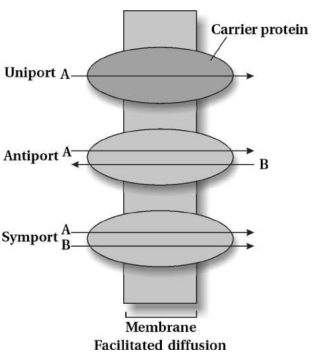
$ \Rightarrow $ Some carrier or transport proteins allow diffusion only if two types of molecules move together.
$ \Rightarrow $ Symport: In a symport, both molecules cross the membrane in the same direction.
$ \Rightarrow $ Antiport: In an antiport, molecules move in opposite directions.
$ \Rightarrow $ Uniport: When a molecule moves across a membrane independent of other molecules, the process is called uniport.
$ \Rightarrow $ Symport: In a symport, both molecules cross the membrane in the same direction.
$ \Rightarrow $ Antiport: In an antiport, molecules move in opposite directions.
$ \Rightarrow $ Uniport: When a molecule moves across a membrane independent of other molecules, the process is called uniport.
0 likes
View Solution64
Medium
Explain: Active Transport.
Solution
(N/A) $\Rightarrow$ Active transport uses energy to pump molecules against a concentration gradient.
$\Rightarrow$ Active transport is carried out by membrane proteins.
$\Rightarrow$ Hence,different proteins in the membrane play a major role in both active as well as passive transport.
$\Rightarrow$ Pumps are proteins that use energy $(ATP)$ to carry substances across the cell membrane.
$\Rightarrow$ These pumps can transport substances from a lower concentration to a higher concentration (uphill transport).
$\Rightarrow$ The transport rate reaches a maximum when all the protein transporters are being used or are saturated.
$\Rightarrow$ Like enzymes,the carrier protein is very specific in what it carries across the membrane.
$\Rightarrow$ These proteins are sensitive to inhibitors that react with protein side chains.
$\Rightarrow$ Active transport is carried out by membrane proteins.
$\Rightarrow$ Hence,different proteins in the membrane play a major role in both active as well as passive transport.
$\Rightarrow$ Pumps are proteins that use energy $(ATP)$ to carry substances across the cell membrane.
$\Rightarrow$ These pumps can transport substances from a lower concentration to a higher concentration (uphill transport).
$\Rightarrow$ The transport rate reaches a maximum when all the protein transporters are being used or are saturated.
$\Rightarrow$ Like enzymes,the carrier protein is very specific in what it carries across the membrane.
$\Rightarrow$ These proteins are sensitive to inhibitors that react with protein side chains.
0 likes
View Solution65
Medium
Compare various transport processes.
Solution
$\Rightarrow$ It is clear that proteins in the membrane are responsible for facilitated diffusion and active transport.
$\Rightarrow$ Thus, they show common characteristics of being highly selective.
$\Rightarrow$ They are liable to saturate, respond to inhibitors, and are under hormonal regulation.
$\Rightarrow$ However, diffusion, whether facilitated or not, takes place only along a gradient and does not use energy.
$\Rightarrow$ Thus, they show common characteristics of being highly selective.
$\Rightarrow$ They are liable to saturate, respond to inhibitors, and are under hormonal regulation.
$\Rightarrow$ However, diffusion, whether facilitated or not, takes place only along a gradient and does not use energy.
| Property | Simple Diffusion | Facilitated Transport | Active Transport |
| Requires special membrane proteins | No | Yes | Yes |
| Highly selective | No | Yes | Yes |
| Transport saturates | No | Yes | Yes |
| Uphill transport | No | No | Yes |
| Requires $ATP$ energy | No | No | Yes |
0 likes
View Solution66
Easy
Define the following terms:
$(i)$ Passive transport
$(ii)$ Facilitated diffusion
$(i)$ Passive transport
$(ii)$ Facilitated diffusion
Solution
(N/A) $(i)$ Passive transport: This process occurs along the concentration gradient,i.e.,from a region of higher concentration to a region of lower concentration,and it does not require any metabolic energy $(ATP)$.
$(ii)$ Facilitated diffusion: This process also occurs along the concentration gradient,but it requires specific membrane proteins (carrier molecules) to act as mediators to transport molecules across the membrane.
$(ii)$ Facilitated diffusion: This process also occurs along the concentration gradient,but it requires specific membrane proteins (carrier molecules) to act as mediators to transport molecules across the membrane.
0 likes
View Solution67
MediumMCQ
Mention the peculiarities of facilitated diffusion.
A
It requires $ATP$ energy.
B
It is highly selective and sensitive to inhibitors.
C
It is a downhill process only.
D
It does not require membrane proteins.
Solution
(B) Facilitated diffusion has the following peculiarities:
$1$. It is a passive process that does not require $ATP$ energy.
$2$. It is highly selective; it allows the cell to select substances for uptake.
$3$. It is sensitive to inhibitors that react with protein side chains.
$4$. The proteins form channels in the membrane for specific molecules to pass through.
$5$. Some channels are always open,while others can be controlled (gated).
$1$. It is a passive process that does not require $ATP$ energy.
$2$. It is highly selective; it allows the cell to select substances for uptake.
$3$. It is sensitive to inhibitors that react with protein side chains.
$4$. The proteins form channels in the membrane for specific molecules to pass through.
$5$. Some channels are always open,while others can be controlled (gated).
0 likes
View Solution68
Medium
State the characteristics of facilitated diffusion.
Solution
(N/A) Facilitated diffusion is sensitive to inhibitors that react with the side chains of proteins.
Proteins in the membrane provide sites for molecules to cross the membrane.
Some channels are always open,while others are controlled or gated.
Some channels are large,allowing a variety of molecules to cross.
Porins are proteins that form large pores in the outer membranes of plastids,mitochondria,and some bacteria,allowing molecules up to the size of small proteins to pass through.
In facilitated diffusion,the transport protein binds to the extracellular molecule and then releases it into the cell.
An example is the water channel,which is made up of eight different types of aquaporins.
Proteins in the membrane provide sites for molecules to cross the membrane.
Some channels are always open,while others are controlled or gated.
Some channels are large,allowing a variety of molecules to cross.
Porins are proteins that form large pores in the outer membranes of plastids,mitochondria,and some bacteria,allowing molecules up to the size of small proteins to pass through.
In facilitated diffusion,the transport protein binds to the extracellular molecule and then releases it into the cell.
An example is the water channel,which is made up of eight different types of aquaporins.
0 likes
View Solution69
MediumMCQ
What are the characteristics of active transport?
A
Requires membrane proteins
B
Highly selective
C
Requires $ATP$ energy
D
All of the above
Solution
(D) Active transport is a method of transporting substances across the cell membrane. Its main characteristics are as follows:
$1.$ It uses specific membrane proteins (carrier proteins).
$2.$ It is highly selective.
$3.$ It exhibits transport saturation.
$4.$ It performs uphill transport,i.e.,from a region of lower concentration to a region of higher concentration.
$5.$ This process requires energy in the form of $ATP$.
$1.$ It uses specific membrane proteins (carrier proteins).
$2.$ It is highly selective.
$3.$ It exhibits transport saturation.
$4.$ It performs uphill transport,i.e.,from a region of lower concentration to a region of higher concentration.
$5.$ This process requires energy in the form of $ATP$.
0 likes
View Solution70
Medium
Define the following terms:
$(1)$ Diffusion
$(2)$ Facilitated Diffusion
$(1)$ Diffusion
$(2)$ Facilitated Diffusion
Solution
(N/A) $(1)$ Diffusion: The movement of molecules of any substance from a region of higher concentration to a region of lower concentration is called diffusion. It is a passive and random process that does not require energy.
$(2)$ Facilitated Diffusion: When the movement of molecules across a membrane occurs from a region of higher concentration to a region of lower concentration with the help of special membrane proteins (carrier proteins) without the expenditure of energy,it is called facilitated diffusion.
$(2)$ Facilitated Diffusion: When the movement of molecules across a membrane occurs from a region of higher concentration to a region of lower concentration with the help of special membrane proteins (carrier proteins) without the expenditure of energy,it is called facilitated diffusion.
0 likes
View Solution71
Medium
Provide definitions/explanations for the following terms:
$(1)$ Uniport
$(2)$ Symport
$(1)$ Uniport
$(2)$ Symport
Solution
(N/A) $(1)$ Uniport: When a molecule moves across a membrane independently of other molecules,the process is called uniport.
$(2)$ Symport: In symport,two different molecules cross the membrane simultaneously in the same direction.
$(2)$ Symport: In symport,two different molecules cross the membrane simultaneously in the same direction.
0 likes
View Solution72
Medium
Define the following terms:
$(1)$ Antiport
$(2)$ Active transport
$(1)$ Antiport
$(2)$ Active transport
Solution
(N/A) $(1)$ Antiport: In this type of transport,two different molecules move across the membrane in opposite directions.
$(2)$ Active transport: This is the movement of molecules across a membrane against the concentration gradient (from lower concentration to higher concentration). This process requires carrier proteins and the expenditure of metabolic energy in the form of $ATP$.
$(2)$ Active transport: This is the movement of molecules across a membrane against the concentration gradient (from lower concentration to higher concentration). This process requires carrier proteins and the expenditure of metabolic energy in the form of $ATP$.
0 likes
View Solution73
Medium
How is facilitated diffusion different from diffusion?
Solution
(N/A)
| Diffusion | Facilitated Diffusion |
|---|---|
| $1$. It is a passive process where substances move randomly from a region of higher concentration to a region of lower concentration. | $1$. It is a process where substances move across membranes with the help of special membrane proteins,even if they follow the concentration gradient. |
| $2$. It is a slow process and does not require any energy or specific transport proteins. | $2$. It is a faster process that is highly selective and requires specific membrane proteins (like porins or carrier proteins) to facilitate the movement of molecules. |
0 likes
View Solution74
Medium
Define uniport,symport and antiport. Do they require energy?
Solution
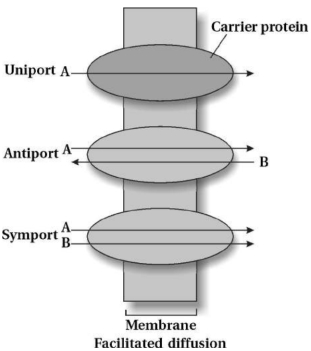
Uniport,symport,and antiport are types of facilitated diffusion mediated by carrier proteins.
$1$. Uniport: In this process,a molecule moves across a membrane independent of other molecules.
$2$. Symport: In this process,two types of molecules cross the membrane simultaneously in the same direction.
$3$. Antiport: In this process,two types of molecules move in opposite directions across the membrane.
Energy requirement: These processes are types of facilitated diffusion,which is a passive transport mechanism. Therefore,they do not require energy $(ATP)$ to move molecules across the membrane.
$1$. Uniport: In this process,a molecule moves across a membrane independent of other molecules.
$2$. Symport: In this process,two types of molecules cross the membrane simultaneously in the same direction.
$3$. Antiport: In this process,two types of molecules move in opposite directions across the membrane.
Energy requirement: These processes are types of facilitated diffusion,which is a passive transport mechanism. Therefore,they do not require energy $(ATP)$ to move molecules across the membrane.
0 likes
View Solution75
EasyMCQ
Analogy type question:
$(1)$ Active transport : Energy requirement from $ATP$ :: Passive transport : ........
$(1)$ Active transport : Energy requirement from $ATP$ :: Passive transport : ........
A
Energy requirement from $ATP$
B
No energy requirement
C
Movement against concentration gradient
D
Requires membrane proteins
Solution
(B) Active transport requires energy in the form of $ATP$ to move molecules against their concentration gradient.
Passive transport,on the other hand,occurs along the concentration gradient and does not require any metabolic energy in the form of $ATP$.
Passive transport,on the other hand,occurs along the concentration gradient and does not require any metabolic energy in the form of $ATP$.
0 likes
View Solution76
EasyMCQ
In a passive transport across a membrane,when two protein molecules move in opposite directions and independent of each other,it is called as $.......$
A
Symport
B
Antiport
C
Uniport
D
Co-transport
Solution
(B) $\Rightarrow$ The correct answer is $Antiport$.
In this type of facilitated diffusion,two different molecules move across the membrane in opposite directions,independent of each other.
In this type of facilitated diffusion,two different molecules move across the membrane in opposite directions,independent of each other.
0 likes
View Solution77
MediumMCQ
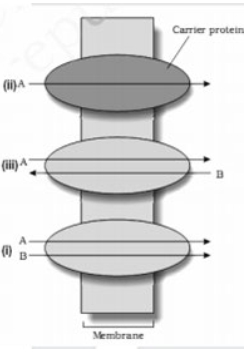
Identify $(i), (ii)$ and $(iii)$ based on the provided diagram of carrier proteins in a membrane.
A
$(i)$ - uniport,$(ii)$ - antiport,$(iii)$ - symport
B
$(i)$ - uniport,$(ii)$ - symport,$(iii)$ - antiport
C
$(i)$ - antiport,$(ii)$ - symport,$(iii)$ - uniport
D
$(i)$ - symport,$(ii)$ - uniport,$(iii)$ - antiport
Solution
(D) In the provided diagram:
$(i)$ shows two molecules ($A$ and $B$) moving in the same direction,which is known as symport.
$(ii)$ shows a single molecule $(A)$ moving in a single direction,which is known as uniport.
$(iii)$ shows two molecules ($A$ and $B$) moving in opposite directions,which is known as antiport.
Therefore,$(i)$ is symport,$(ii)$ is uniport,and $(iii)$ is antiport.
$(i)$ shows two molecules ($A$ and $B$) moving in the same direction,which is known as symport.
$(ii)$ shows a single molecule $(A)$ moving in a single direction,which is known as uniport.
$(iii)$ shows two molecules ($A$ and $B$) moving in opposite directions,which is known as antiport.
Therefore,$(i)$ is symport,$(ii)$ is uniport,and $(iii)$ is antiport.
0 likes
View Solution78
MediumMCQ
In which method of transport,does the plasma membrane not require a carrier molecule?
A
Active transport
B
Facilitated diffusion
C
Simple diffusion
D
$Na^+ - K^+$ pump
Solution
(C) Simple diffusion is a process in which the plasma membrane does not require any carrier molecule to allow small,non-charged molecules or lipid-soluble molecules to pass between the phospholipids to enter or leave the cell.
In this process,particles move from areas of high concentration to areas of low concentration,moving down their concentration gradient.
Oxygen,carbon dioxide,and most lipids enter and leave cells by simple diffusion.
In this process,particles move from areas of high concentration to areas of low concentration,moving down their concentration gradient.
Oxygen,carbon dioxide,and most lipids enter and leave cells by simple diffusion.
0 likes
View Solution79
MediumMCQ
Active transport differs from passive transport in that active transport
A
requires energy.
B
Energy input in the form of $ATP$ only
C
moves molecules along the concentration gradient.
D
All of these
Solution
(A) Active transport is the movement of molecules or ions across a cell membrane from a region of lower concentration to a region of higher concentration (against the concentration gradient).
This process requires metabolic energy,typically in the form of $ATP$,to pump substances against their gradient.
Passive transport,on the other hand,occurs along the concentration gradient and does not require energy expenditure.
This process requires metabolic energy,typically in the form of $ATP$,to pump substances against their gradient.
Passive transport,on the other hand,occurs along the concentration gradient and does not require energy expenditure.
0 likes
View Solution80
EasyMCQ
What are the aquaporins in the facilitated diffusion process?
A
Membrane proteins
B
Carrier proteins
C
Channel proteins
D
Carrier lipids
Solution
(C) Aquaporins are specialized proteins present in cell membranes that facilitate the rapid transport of water molecules across the membrane.
They function as specific pores or channels that allow water to pass through the lipid bilayer,which is otherwise hydrophobic.
Therefore,aquaporins are classified as channel proteins.
They function as specific pores or channels that allow water to pass through the lipid bilayer,which is otherwise hydrophobic.
Therefore,aquaporins are classified as channel proteins.
0 likes
View Solution81
MediumMCQ
Why is active transport considered important?
A
Because material is transported from higher concentration to lower concentration
B
Because material is transported from lower concentration to higher concentration
C
Because it increases diffusion coefficient
D
Because it does not use $ATP$
Solution
(B) Active transport is a process that occurs against the concentration gradient,meaning substances are moved from a region of lower concentration to a region of higher concentration.
This process requires energy in the form of $ATP$ to pump molecules across the membrane.
In contrast,passive transport or diffusion occurs along the concentration gradient,moving substances from higher to lower concentration without the expenditure of energy.
This process requires energy in the form of $ATP$ to pump molecules across the membrane.
In contrast,passive transport or diffusion occurs along the concentration gradient,moving substances from higher to lower concentration without the expenditure of energy.
0 likes
View Solution82
EasyMCQ
Movement among cells against concentration gradient is called
A
Osmosis
B
Active transport
C
Diffusion
D
Passive transport
Solution
(B) Active transport uses specific transporter proteins called pumps,which use metabolic energy $(ATP)$ to move ions or molecules against the concentration gradient.
This process requires energy because the movement occurs from a region of lower concentration to a region of higher concentration.
This process requires energy because the movement occurs from a region of lower concentration to a region of higher concentration.
0 likes
View Solution83
EasyMCQ
Uphill transport is a type of
A
Active transport
B
Passive transport
C
Facilitated diffusion
D
Simple diffusion
Solution
(A) Active transport of solute occurs against the concentration gradient or potential gradient,i.e.,the movement of solute takes place from a lower chemical concentration to a higher chemical concentration.
Because this process requires energy to move substances against the gradient,it is referred to as uphill transport.
Because this process requires energy to move substances against the gradient,it is referred to as uphill transport.
0 likes
View Solution84
EasyMCQ
In which of the following pathways does the flow of water occur from cell to cell through their protoplasm?
A
Apoplast pathway
B
Symplast pathway
C
Both $(a)$ and $(b)$
D
Transmembrane pathway
Solution
(B) The pathway of water movement inside a root is of two types: apoplast pathway and symplast pathway.
In symplastic movement,the flow of water occurs from cell to cell through their protoplasm.
In this pathway,the adjacent cells are connected through plasmodesmata.
In this system,water has to pass through the plasmalemma at least at one place.
Symplastic movement may be aided by cytoplasmic streaming.
In symplastic movement,the flow of water occurs from cell to cell through their protoplasm.
In this pathway,the adjacent cells are connected through plasmodesmata.
In this system,water has to pass through the plasmalemma at least at one place.
Symplastic movement may be aided by cytoplasmic streaming.
0 likes
View Solution85
MediumMCQ
Consider the following statements and choose the correct answer:
$I.$ Carrier proteins are needed by both facilitated diffusion and active transport and are sensitive to inhibitors that react with protein side chains.
$II.$ Different types of proteins present in the membrane play a major role in both active as well as passive transport.
$III.$ The carrier proteins needed by facilitated and active transport are specific.
$IV.$ There is no need of energy to pump molecules against a concentration gradient in active transport.
$V.$ Transport rate reaches a saturation point when all the active proteins are used.
$I.$ Carrier proteins are needed by both facilitated diffusion and active transport and are sensitive to inhibitors that react with protein side chains.
$II.$ Different types of proteins present in the membrane play a major role in both active as well as passive transport.
$III.$ The carrier proteins needed by facilitated and active transport are specific.
$IV.$ There is no need of energy to pump molecules against a concentration gradient in active transport.
$V.$ Transport rate reaches a saturation point when all the active proteins are used.
A
$I, II, III, IV$ and $V$
B
$I, II$ and $III$
C
$V, IV$ and $I$
D
$I, II, III$ and $V$
Solution
(D) Statement $I$ is correct: Both facilitated diffusion and active transport require carrier proteins,which are sensitive to inhibitors that react with protein side chains.
Statement $II$ is correct: Membrane proteins are essential for both active and passive transport mechanisms.
Statement $III$ is correct: Carrier proteins are highly specific,meaning they only transport specific molecules.
Statement $IV$ is incorrect: Active transport requires energy (usually in the form of $ATP$) to pump molecules against a concentration gradient.
Statement $V$ is correct: Transport rate reaches a saturation point when all available carrier proteins are occupied or in use.
Therefore,statements $I, II, III,$ and $V$ are correct.
Statement $II$ is correct: Membrane proteins are essential for both active and passive transport mechanisms.
Statement $III$ is correct: Carrier proteins are highly specific,meaning they only transport specific molecules.
Statement $IV$ is incorrect: Active transport requires energy (usually in the form of $ATP$) to pump molecules against a concentration gradient.
Statement $V$ is correct: Transport rate reaches a saturation point when all available carrier proteins are occupied or in use.
Therefore,statements $I, II, III,$ and $V$ are correct.
0 likes
View Solution86
MediumMCQ
Which of the following transport induces conformational changes in proteins?
A
Simple diffusion
B
Osmosis
C
Facilitated diffusion
D
Plasmolysis
Solution
(C) The transport of water-soluble substances (such as glucose,sodium ions,and chloride ions) is facilitated by transport proteins.
These transport proteins are embedded in the lipid bilayer of cellular membranes and provide specific sites for molecules to cross the membrane.
Transport proteins do not create a concentration gradient; a gradient must already exist to facilitate diffusion.
$A$ transport protein provides a binding site that binds the specific molecule (e.g.,glucose) or ion.
Upon binding the specific molecule,the transport protein undergoes a conformational change (changes its shape) to carry the molecule across the membrane,where it is released.
Finally,the transport protein returns to its original shape to transport another molecule.
These transport proteins are embedded in the lipid bilayer of cellular membranes and provide specific sites for molecules to cross the membrane.
Transport proteins do not create a concentration gradient; a gradient must already exist to facilitate diffusion.
$A$ transport protein provides a binding site that binds the specific molecule (e.g.,glucose) or ion.
Upon binding the specific molecule,the transport protein undergoes a conformational change (changes its shape) to carry the molecule across the membrane,where it is released.
Finally,the transport protein returns to its original shape to transport another molecule.
0 likes
View Solution87
EasyMCQ
Active transport
A
Releases energy
B
Requires energy
C
Produces $ATP$
D
Produces a toxic substance
Solution
(B) Active transport is the movement of molecules or ions across a cell membrane from a region of lower concentration to a region of higher concentration,which is against the concentration gradient.
Because this process moves substances against their concentration gradient,it is not a spontaneous process.
Therefore,it requires the expenditure of metabolic energy,typically in the form of $ATP$ hydrolysis,to drive the transport proteins.
As a result,active transport is sensitive to factors that affect cellular metabolism,such as temperature and metabolic inhibitors.
Because this process moves substances against their concentration gradient,it is not a spontaneous process.
Therefore,it requires the expenditure of metabolic energy,typically in the form of $ATP$ hydrolysis,to drive the transport proteins.
As a result,active transport is sensitive to factors that affect cellular metabolism,such as temperature and metabolic inhibitors.
0 likes
View Solution88
EasyMCQ
Identify the following process and choose the correct option.
A
Simple diffusion
B
Facilitated diffusion
C
Osmosis
D
Deplasmolysis
Solution
(B) The diffusion of hydrophilic substances along the concentration gradient through fixed membrane transport proteins without involving energy expenditure is called facilitated diffusion.
0 likes
View Solution89
MediumMCQ
Read carefully the following statements and choose the right answer from the options given below.
$I$. Diffusion is a slow process and it does not depend upon the living system.
$II$. Usually,the process of diffusion does not need energy.
$III$. Diffusion can occur from one part of a cell to another part of the same cell,or from one cell to another,and from one tissue to another tissue.
$IV$. Diffusion is a rapid process over short distances,but extremely slow over long distances.
$I$. Diffusion is a slow process and it does not depend upon the living system.
$II$. Usually,the process of diffusion does not need energy.
$III$. Diffusion can occur from one part of a cell to another part of the same cell,or from one cell to another,and from one tissue to another tissue.
$IV$. Diffusion is a rapid process over short distances,but extremely slow over long distances.
A
$I$ and $III$
B
$I$ and $II$
C
$III$ and $IV$
D
$I, II, III$ and $IV$
Solution
(D) Diffusion is a passive movement of molecules from a region of higher concentration to a region of lower concentration.
Statement $I$ is correct: Diffusion is a slow process and does not depend on a living system.
Statement $II$ is correct: Diffusion is a passive process,meaning it does not require the expenditure of metabolic energy $(ATP)$.
Statement $III$ is correct: Diffusion can occur within a cell,between adjacent cells,or between tissues.
Statement $IV$ is correct: Diffusion is effective and rapid over short distances,but it is an extremely slow process for long-distance transport.
Since all statements are correct,the correct option is $D$.
Statement $I$ is correct: Diffusion is a slow process and does not depend on a living system.
Statement $II$ is correct: Diffusion is a passive process,meaning it does not require the expenditure of metabolic energy $(ATP)$.
Statement $III$ is correct: Diffusion can occur within a cell,between adjacent cells,or between tissues.
Statement $IV$ is correct: Diffusion is effective and rapid over short distances,but it is an extremely slow process for long-distance transport.
Since all statements are correct,the correct option is $D$.
0 likes
View Solution90
MediumMCQ
Read the following statements regarding porins and select the correct option given below:
$I$. Porins are transport proteins.
$II$. Channel proteins are a type of transport protein,which are usually gated.
$III$. Carrier protein binds the particular solute to be transported.
$IV$. Particular solute is delivered to the other side of the membrane by carrier proteins.
$I$. Porins are transport proteins.
$II$. Channel proteins are a type of transport protein,which are usually gated.
$III$. Carrier protein binds the particular solute to be transported.
$IV$. Particular solute is delivered to the other side of the membrane by carrier proteins.
A
$I, II$ and $III$
B
$I, III$ and $IV$
C
$I, II, III$ and $IV$
D
$I$ and $IV$
Solution
(C) Porins are large proteins that form pores in the outer membranes of mitochondria,plastids,and some bacteria,allowing the passage of small-sized molecules. These are classified as transport proteins.
Transport proteins are categorized into two types: channel proteins and carrier proteins.
Channel proteins form tunnels or channels in the membrane that allow the movement of appropriate-sized solutes.
Carrier proteins bind to the specific solute to be transported and undergo conformational changes to deliver the solute to the other side of the membrane.
All four statements $(I, II, III, IV)$ are scientifically correct descriptions of these transport mechanisms.
Transport proteins are categorized into two types: channel proteins and carrier proteins.
Channel proteins form tunnels or channels in the membrane that allow the movement of appropriate-sized solutes.
Carrier proteins bind to the specific solute to be transported and undergo conformational changes to deliver the solute to the other side of the membrane.
All four statements $(I, II, III, IV)$ are scientifically correct descriptions of these transport mechanisms.
0 likes
View Solution91
MediumMCQ
What is mandatory in the process of facilitated diffusion?
A
Presence of concentration gradient
B
$A$ carrier protein
C
$A$ hydrophilic moiety
D
All of the above
Solution
(D) Facilitated diffusion is a type of passive transport where substances move across the cell membrane along the concentration gradient.
It requires a concentration gradient to drive the movement of molecules from a region of higher concentration to a region of lower concentration.
Since the cell membrane is composed of a lipid bilayer,hydrophilic (water-loving) moieties cannot pass through it directly.
Therefore,specific carrier proteins or channel proteins are mandatory to facilitate the transport of these hydrophilic substances across the membrane.
Since all three factors—a concentration gradient,a carrier protein,and the presence of a hydrophilic moiety—are essential for this process,the correct answer is $D$.
It requires a concentration gradient to drive the movement of molecules from a region of higher concentration to a region of lower concentration.
Since the cell membrane is composed of a lipid bilayer,hydrophilic (water-loving) moieties cannot pass through it directly.
Therefore,specific carrier proteins or channel proteins are mandatory to facilitate the transport of these hydrophilic substances across the membrane.
Since all three factors—a concentration gradient,a carrier protein,and the presence of a hydrophilic moiety—are essential for this process,the correct answer is $D$.
0 likes
View Solution92
MediumMCQ
The given diagram shows the cotransport method of two molecules. Label it correctly and choose the correct option accordingly.
A
$A-Uniport, B-Symport, C-Antiport$
B
$A-Uniport, B-Antiport, C-Symport$
C
$A-Symport, B-Uniport, C-Antiport$
D
$A-Antiport, B-Uniport, C-Uniport$
Solution
(B) The given diagram represents the transport of two types of molecules by carrier proteins.
$A$ depicts the uniport method,where a single molecule moves across the membrane independently.
$B$ shows the antiport method,where two molecules move in opposite directions across the membrane.
$C$ shows the symport method,where two molecules move in the same direction across the membrane.
$A$ depicts the uniport method,where a single molecule moves across the membrane independently.
$B$ shows the antiport method,where two molecules move in opposite directions across the membrane.
$C$ shows the symport method,where two molecules move in the same direction across the membrane.
0 likes
View Solution93
MediumMCQ
Compare the following processes of transport and choose the correct option:
| $S.no.$ | Property | Facilitated diffusion | Active Transport | Simple Diffusion |
|---|---|---|---|---|
| $I.$ | Highly specific | Yes | Yes | No |
| $II.$ | Energy as $ATP$ | No | Yes | No |
| $III.$ | Saturation point reached when all carrier proteins are used | Yes | Yes | No |
| $IV.$ | Require transport proteins | Yes | Yes | No |
A
Only $II$
B
Only $III$
C
$I, II, III$ and $IV$
D
Only $I$
Solution
(D) $1$. Facilitated diffusion and active transport are highly specific because they use carrier proteins to select substances. Simple diffusion is not specific.
$2$. Active transport requires $ATP$ energy to move substances against the concentration gradient. Facilitated diffusion and simple diffusion do not require $ATP$.
$3$. Saturation occurs in facilitated diffusion and active transport because they rely on a limited number of carrier proteins. Simple diffusion does not show saturation.
$4$. Facilitated diffusion and active transport require transport proteins,whereas simple diffusion does not.
Comparing these facts with the provided table,none of the rows are entirely correct as presented in the original prompt's table. However,based on standard biological principles,$I$ is the only property that correctly identifies the specificity of these processes.
$2$. Active transport requires $ATP$ energy to move substances against the concentration gradient. Facilitated diffusion and simple diffusion do not require $ATP$.
$3$. Saturation occurs in facilitated diffusion and active transport because they rely on a limited number of carrier proteins. Simple diffusion does not show saturation.
$4$. Facilitated diffusion and active transport require transport proteins,whereas simple diffusion does not.
Comparing these facts with the provided table,none of the rows are entirely correct as presented in the original prompt's table. However,based on standard biological principles,$I$ is the only property that correctly identifies the specificity of these processes.
0 likes
View Solution94
MediumMCQ
Why does the rate of diffusion of a substance along the concentration gradient not increase continuously,even when the concentration difference of the molecules across the membrane increases?
A
Process of facilitated diffusion needs $ATP$
B
As concentration difference increases,molecules interfere with one another
C
$100 \%$ saturation of carrier protein after some time
D
Transport proteins must be of channel protein type
Solution
(C) The rate of diffusion of a substance along the concentration gradient does not increase continuously as the concentration difference increases in the case of facilitated diffusion.
This occurs because facilitated diffusion is mediated by specific carrier proteins.
As the concentration gradient increases,the rate of transport increases initially,but it reaches a maximum limit when all available carrier proteins are occupied or saturated.
Once the carrier proteins reach $100 \%$ saturation,the rate of transport cannot increase further,regardless of any additional increase in the concentration gradient.
This occurs because facilitated diffusion is mediated by specific carrier proteins.
As the concentration gradient increases,the rate of transport increases initially,but it reaches a maximum limit when all available carrier proteins are occupied or saturated.
Once the carrier proteins reach $100 \%$ saturation,the rate of transport cannot increase further,regardless of any additional increase in the concentration gradient.
0 likes
View Solution95
MediumMCQ
Which of the following processes requires membrane proteins?
A
Simple diffusion
B
Imbibition
C
Facilitated diffusion
D
More than one option is correct
Solution
(C) Simple diffusion is a passive process that does not require membrane proteins.
Imbibition is a special type of diffusion involving the absorption of water by solids (colloids),which also does not require membrane proteins.
Facilitated diffusion is a type of passive transport that specifically requires membrane proteins (carrier proteins or channel proteins) to move molecules across the lipid bilayer.
Therefore,only facilitated diffusion requires membrane proteins.
Imbibition is a special type of diffusion involving the absorption of water by solids (colloids),which also does not require membrane proteins.
Facilitated diffusion is a type of passive transport that specifically requires membrane proteins (carrier proteins or channel proteins) to move molecules across the lipid bilayer.
Therefore,only facilitated diffusion requires membrane proteins.
0 likes
View Solution96
MediumMCQ
Select the incorrect statement with respect to facilitated diffusion.
A
Highly selective
B
Uphill transport
C
Requires special membrane proteins
D
Transport saturates
Solution
(B) Facilitated diffusion is a type of passive transport that occurs along the concentration gradient,meaning it is a downhill process. It does not require energy $(ATP)$. Since it is a passive process,it cannot perform uphill transport (moving molecules against the concentration gradient). Therefore,the statement 'Uphill transport' is incorrect.
0 likes
View Solution97
EasyMCQ
In antiport,
A
Two molecules are transported in same direction across the membrane
B
Only one molecule is transported across the membrane
C
Two molecules are moved in opposite directions across the membrane
D
No transport occurs
Solution
(C) In membrane transport,when two molecules are transported in the same direction,it is called $Symport$.
When only one molecule is transported across the membrane independently,it is called $Uniport$.
When two molecules are moved in opposite directions across the membrane,it is called $Antiport$.
When only one molecule is transported across the membrane independently,it is called $Uniport$.
When two molecules are moved in opposite directions across the membrane,it is called $Antiport$.
0 likes
View Solution98
MediumMCQ
In active transport,
A
Energy is required
B
Membrane proteins are involved
C
Pumps are present
D
All of these
Solution
(D) Active transport is a process that moves molecules across a cell membrane from a region of lower concentration to a region of higher concentration.
$1$. It requires energy in the form of $ATP$.
$2$. It involves specific membrane proteins known as carriers or transporters.
$3$. These proteins act as pumps to move substances against the concentration gradient.
Therefore,all the given statements are correct.
$1$. It requires energy in the form of $ATP$.
$2$. It involves specific membrane proteins known as carriers or transporters.
$3$. These proteins act as pumps to move substances against the concentration gradient.
Therefore,all the given statements are correct.
0 likes
View Solution99
MediumMCQ
In mass flow,various substances move independently according to their
A
Size
B
Concentration gradient
C
Root pressure
D
Carrier proteins
Solution
(B) Mass flow (or bulk flow) is the movement of substances in bulk from one point to another as a result of pressure differences between the two points.
In this process,various substances move independently according to their concentration gradient,while the bulk itself moves due to the pressure gradient.
In this process,various substances move independently according to their concentration gradient,while the bulk itself moves due to the pressure gradient.
0 likes
View Solution100
MediumMCQ
Non-living components of $xylem$ tissues are involved in
A
Symplast pathway
B
Apoplast pathway
C
Osmosis
D
Active transport
Solution
(B) The $xylem$ tissue consists of both living and non-living components. The non-living components,such as tracheids and vessels,provide a continuous pathway for water movement through the cell walls and intercellular spaces. This movement of water is known as the $apoplast$ pathway. Since this pathway occurs through non-living parts of the plant,it is often referred to as the 'dead channel'.
0 likes
View SolutionTransport in Plants — Means of transport · Frequently Asked Questions
1Are these Transport in Plants questions useful for JEE and NEET?
Yes. All questions in this section are mapped to JEE Main and NEET exam patterns. Previous year questions from JEE Main, NEET, GUJCET and state-level exams are included with full solutions.
2Can I switch to Hindi or Gujarati for these questions?
Yes. Use the language tabs in the hero section or the sidebar to view the same questions and solutions in English, Hindi or Gujarati.
3How do I generate a question paper from this subtopic?
Use the Vedclass Exam Paper Generator — select the chapter and subtopic, set difficulty, and generate Sets A, B, C, D automatically. First 3 chapters of every subject are free.
Vedclass Products
For Students
Vedclass Test Series
Mock tests in real JEE/NEET style with performance analysis. 5-day free trial.
Start Free TrialFor Teachers
Exam Paper Generator
Generate Set A/B/C/D papers from this chapter in 2 minutes. 3 chapters free.
Try FreeFor Institutes
Online Exam Module
Live online exams with unlimited students, 360° analytics & white-label branding.
See DemoFor Teachers & Institutes
Generate a Transport in Plants Exam Paper in 2 Minutes
Select subtopic & difficulty — Sets A, B, C, D auto-generated with No Repeat logic.
First 3 chapters of every subject are free — no payment required.