
A English
Absorption of water and Ascent of sap Questions in English
Class 11 Biology · Transport in Plants · Absorption of water and Ascent of sap
152+
Questions
English
Language
100%
With Solutions
Showing 50 of 152 questions in English
101
Medium
Discuss the factors responsible for the ascent of xylem sap in plants.
Solution
(N/A) The ascent of xylem sap is primarily driven by the transpirational pull,which is supported by the following physical properties of water:
$1$. Cohesion: This is the mutual attraction between water molecules due to hydrogen bonding.
$2$. Adhesion: This refers to the attraction of water molecules to the polar surfaces of the xylem vessel walls (tracheary elements).
$3$. Surface Tension: Water molecules are more attracted to each other in the liquid phase than to water molecules in the gaseous phase,which gives water high tensile strength.
$4$. Capillarity: This is the ability of water to rise in thin tubes,facilitated by the small diameter of the tracheids and vessel elements.
These properties collectively provide water with high tensile strength and high capillarity,enabling it to be pulled upward through the xylem against the force of gravity.
$1$. Cohesion: This is the mutual attraction between water molecules due to hydrogen bonding.
$2$. Adhesion: This refers to the attraction of water molecules to the polar surfaces of the xylem vessel walls (tracheary elements).
$3$. Surface Tension: Water molecules are more attracted to each other in the liquid phase than to water molecules in the gaseous phase,which gives water high tensile strength.
$4$. Capillarity: This is the ability of water to rise in thin tubes,facilitated by the small diameter of the tracheids and vessel elements.
These properties collectively provide water with high tensile strength and high capillarity,enabling it to be pulled upward through the xylem against the force of gravity.
0 likes
View Solution102
Medium
How do plants absorb water?
Solution
(N/A) $\Rightarrow$ Importance of roots in absorption: Roots absorb most of the water that goes into plants. The responsibility of absorption of water and minerals is more specifically the function of the root hairs.
$\Rightarrow$ Root hairs are present at the tips of the roots. Root hairs are thin-walled,slender extensions of root epidermal cells that greatly increase the surface area for absorption.
$\Rightarrow$ Water is absorbed along with mineral solutes by the root hairs,purely by diffusion.
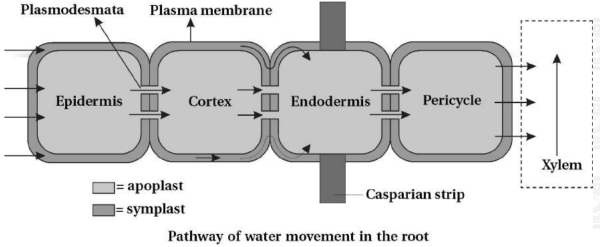
$\Rightarrow$ Once water is absorbed by the root hairs,it can move deeper into root layers by two distinct pathways:
$(1)$ Apoplast Pathway
$(2)$ Symplast Pathway
$\Rightarrow$ Apoplast Pathway: The apoplast is the system of adjacent cell walls that is continuous throughout the plant,except at the Casparian strips of the endodermis in the roots.
$\Rightarrow$ The apoplastic movement of water occurs exclusively through the intercellular spaces and the walls of the cells. It does not involve crossing the cell membrane and is dependent on the gradient. It does not provide any barrier to water movement,and water movement is through mass flow due to the adhesive and cohesive properties of water.
$\Rightarrow$ Symplast Pathway: The symplastic system is the system of interconnected protoplasts. Neighbouring cells are connected through cytoplasmic strands that extend through plasmodesmata.
$\Rightarrow$ Water has to enter the cells through the cell membrane,hence the movement is relatively slower and occurs down a potential gradient. Symplastic movement may be aided by cytoplasmic streaming.
$\Rightarrow$ Root hairs are present at the tips of the roots. Root hairs are thin-walled,slender extensions of root epidermal cells that greatly increase the surface area for absorption.
$\Rightarrow$ Water is absorbed along with mineral solutes by the root hairs,purely by diffusion.
$\Rightarrow$ Once water is absorbed by the root hairs,it can move deeper into root layers by two distinct pathways:
$(1)$ Apoplast Pathway
$(2)$ Symplast Pathway
$\Rightarrow$ Apoplast Pathway: The apoplast is the system of adjacent cell walls that is continuous throughout the plant,except at the Casparian strips of the endodermis in the roots.
$\Rightarrow$ The apoplastic movement of water occurs exclusively through the intercellular spaces and the walls of the cells. It does not involve crossing the cell membrane and is dependent on the gradient. It does not provide any barrier to water movement,and water movement is through mass flow due to the adhesive and cohesive properties of water.
$\Rightarrow$ Symplast Pathway: The symplastic system is the system of interconnected protoplasts. Neighbouring cells are connected through cytoplasmic strands that extend through plasmodesmata.
$\Rightarrow$ Water has to enter the cells through the cell membrane,hence the movement is relatively slower and occurs down a potential gradient. Symplastic movement may be aided by cytoplasmic streaming.
0 likes
View Solution103
Medium
How are water and ions absorbed in roots? Explain with a diagram.
Solution
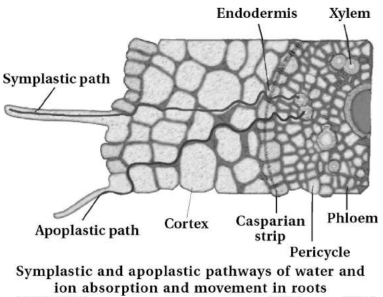
(N/A) $ \Rightarrow $ Most of the water flow in the roots occurs via the apoplast since the cortical cells are loosely packed and hence offer no resistance to water movement.
$ \Rightarrow $ However, the inner boundary of the cortex, the endodermis, is impervious to water because of a band of suberised matrix called the casparian strip.
$ \Rightarrow $ Water molecules are unable to penetrate this layer, so they are directed to wall regions that are not suberised, into the cells proper through the membranes. The water then moves through the symplast and again crosses a membrane to reach the cells of the xylem. The movement of water through the root layers is ultimately symplastic in the endodermis.
$ \Rightarrow $ This is the only way water and other solutes can enter the vascular cylinder.
$ \Rightarrow $ Once inside the xylem, water is again free to move between cells as well as through them.
$ \Rightarrow $ In young roots, water enters directly into the xylem vessels and/or tracheids. These are nonliving conduits and so are parts of the apoplast.
$ \Rightarrow $ The path of water and mineral ions into the root vascular system is shown in the figure.
$ \Rightarrow $ Symbiotic association of root and fungi: Some plants have additional structures associated with them that help in water (and mineral) absorption.
$ \Rightarrow $ Mycorrhiza is a symbiotic association of a fungus with a root system.
$ \Rightarrow $ The fungal filaments form a network around the young root or they penetrate the root cells. The hyphae have a very large surface area that absorbs mineral ions and water from the soil from a much larger volume of soil than a root can do alone.
$ \Rightarrow $ The fungus provides minerals and water to the roots; in turn, the roots provide sugars and $N$-containing compounds to the mycorrhizae.
$ \Rightarrow $ Some plants have an obligate association with mycorrhizae. For example, $Pinus$ seeds cannot germinate and establish without the presence of mycorrhizae.
$ \Rightarrow $ However, the inner boundary of the cortex, the endodermis, is impervious to water because of a band of suberised matrix called the casparian strip.
$ \Rightarrow $ Water molecules are unable to penetrate this layer, so they are directed to wall regions that are not suberised, into the cells proper through the membranes. The water then moves through the symplast and again crosses a membrane to reach the cells of the xylem. The movement of water through the root layers is ultimately symplastic in the endodermis.
$ \Rightarrow $ This is the only way water and other solutes can enter the vascular cylinder.
$ \Rightarrow $ Once inside the xylem, water is again free to move between cells as well as through them.
$ \Rightarrow $ In young roots, water enters directly into the xylem vessels and/or tracheids. These are nonliving conduits and so are parts of the apoplast.
$ \Rightarrow $ The path of water and mineral ions into the root vascular system is shown in the figure.
$ \Rightarrow $ Symbiotic association of root and fungi: Some plants have additional structures associated with them that help in water (and mineral) absorption.
$ \Rightarrow $ Mycorrhiza is a symbiotic association of a fungus with a root system.
$ \Rightarrow $ The fungal filaments form a network around the young root or they penetrate the root cells. The hyphae have a very large surface area that absorbs mineral ions and water from the soil from a much larger volume of soil than a root can do alone.
$ \Rightarrow $ The fungus provides minerals and water to the roots; in turn, the roots provide sugars and $N$-containing compounds to the mycorrhizae.
$ \Rightarrow $ Some plants have an obligate association with mycorrhizae. For example, $Pinus$ seeds cannot germinate and establish without the presence of mycorrhizae.
0 likes
View Solution104
Medium
Explain: Root Pressure.
Solution
(N/A) $\Rightarrow$ As various ions from the soil are actively transported into the vascular tissues of the roots,water follows (its potential gradient) and increases the pressure inside the xylem. This positive pressure is called root pressure.
$\Rightarrow$ Root pressure can be responsible for pushing up water to small heights in the stem.
$\Rightarrow$ To understand how root pressure exists,choose a small soft-stemmed plant and on a day,when there is plenty of atmospheric moisture,cut the stem horizontally near the base with a sharp blade,early in the morning.
$\Rightarrow$ You will soon see drops of solution ooze out of the cut stem; this comes out due to the positive root pressure.
$\Rightarrow$ If you fix a rubber tube to the cut stem as a sleeve,you can actually collect and measure the rate of exudation and also determine the composition of the exudates.
$\Rightarrow$ Effects of root pressure are also observable at night and early morning.
$\Rightarrow$ When evaporation is low and excess water collects in the form of droplets around special openings of veins near the tip of grass blades and leaves of many herbaceous plants,such water loss in its liquid phase is known as guttation.
$\Rightarrow$ Root pressure can at best only provide a modest push in the overall process of water transport.
$\Rightarrow$ It obviously does not play a major role in water movement up tall trees.
$\Rightarrow$ The greatest contribution of root pressure may be to re-establish the continuous chains of water molecules in the xylem,which often break under the enormous tensions created by transpiration.
$\Rightarrow$ Root pressure does not account for the majority of water transport; most plants meet their need by transpiratory pull.
$\Rightarrow$ Root pressure can be responsible for pushing up water to small heights in the stem.
$\Rightarrow$ To understand how root pressure exists,choose a small soft-stemmed plant and on a day,when there is plenty of atmospheric moisture,cut the stem horizontally near the base with a sharp blade,early in the morning.
$\Rightarrow$ You will soon see drops of solution ooze out of the cut stem; this comes out due to the positive root pressure.
$\Rightarrow$ If you fix a rubber tube to the cut stem as a sleeve,you can actually collect and measure the rate of exudation and also determine the composition of the exudates.
$\Rightarrow$ Effects of root pressure are also observable at night and early morning.
$\Rightarrow$ When evaporation is low and excess water collects in the form of droplets around special openings of veins near the tip of grass blades and leaves of many herbaceous plants,such water loss in its liquid phase is known as guttation.
$\Rightarrow$ Root pressure can at best only provide a modest push in the overall process of water transport.
$\Rightarrow$ It obviously does not play a major role in water movement up tall trees.
$\Rightarrow$ The greatest contribution of root pressure may be to re-establish the continuous chains of water molecules in the xylem,which often break under the enormous tensions created by transpiration.
$\Rightarrow$ Root pressure does not account for the majority of water transport; most plants meet their need by transpiratory pull.
0 likes
View Solution105
Medium
Explain the cohesion-tension-transpiration pull model of water transport.
Solution
(N/A) - In plants,the upward movement of water through the $Xylem$ due to transpiration is primarily dependent on the following physical properties:
- $Cohesion$ $Force$: The mutual attraction between water molecules.
- $Adhesion$ $Force$: The attraction of water molecules to polar surfaces (such as the surface of tracheary elements).
- $Surface$ $Tension$: Water molecules are attracted to each other in the liquid phase more strongly than to water in the gas phase.
- These properties provide water with high tensile strength,which is the ability to resist a pulling force,and high capillarity.
- $Capillarity$ is the ability to rise in thin tubes. In plants,capillarity is aided by the small diameter of the tracheary elements,specifically the tracheids and vessel elements.
- $Cohesion$ $Force$: The mutual attraction between water molecules.
- $Adhesion$ $Force$: The attraction of water molecules to polar surfaces (such as the surface of tracheary elements).
- $Surface$ $Tension$: Water molecules are attracted to each other in the liquid phase more strongly than to water in the gas phase.
- These properties provide water with high tensile strength,which is the ability to resist a pulling force,and high capillarity.
- $Capillarity$ is the ability to rise in thin tubes. In plants,capillarity is aided by the small diameter of the tracheary elements,specifically the tracheids and vessel elements.
0 likes
View Solution106
Medium
Explain the horizontal cut experiment to demonstrate root pressure.
Solution
(N/A) $\Rightarrow$ To demonstrate the existence of root pressure,select a small,soft-stemmed plant.
$\Rightarrow$ On a day with high atmospheric humidity,cut the stem horizontally near the base using a sharp blade,early in the morning.
$\Rightarrow$ You will observe drops of xylem sap oozing out from the cut surface; this phenomenon occurs due to the positive root pressure generated by the roots.
$\Rightarrow$ If you attach a rubber tube to the cut stem as a sleeve,you can collect the exudate,measure the rate of exudation,and analyze the chemical composition of the sap.
$\Rightarrow$ On a day with high atmospheric humidity,cut the stem horizontally near the base using a sharp blade,early in the morning.
$\Rightarrow$ You will observe drops of xylem sap oozing out from the cut surface; this phenomenon occurs due to the positive root pressure generated by the roots.
$\Rightarrow$ If you attach a rubber tube to the cut stem as a sleeve,you can collect the exudate,measure the rate of exudation,and analyze the chemical composition of the sap.
0 likes
View Solution107
MediumMCQ
What role is played by root pressure in the transport of water in plants?
A
It is the primary force for water transport in tall trees.
B
It helps in re-establishing the continuous chains of water molecules in the xylem.
C
It is responsible for the majority of water transport in all plants.
D
It prevents the process of transpiration in plants.
Solution
(B) $\Rightarrow$ Root pressure does not play a major role in water movement up tall trees.
$\Rightarrow$ The greatest contribution of root pressure is to re-establish the continuous chains of water molecules in the xylem,which often break under the enormous tensions created by transpiration.
$\Rightarrow$ Root pressure does not account for the majority of water transport in plants.
$\Rightarrow$ The greatest contribution of root pressure is to re-establish the continuous chains of water molecules in the xylem,which often break under the enormous tensions created by transpiration.
$\Rightarrow$ Root pressure does not account for the majority of water transport in plants.
0 likes
View Solution108
Medium
Explain the significance of capillarity in plants.
Solution
(N/A) Capillarity is the ability of water to rise in thin tubes due to surface tension and adhesion-cohesion forces.
In plants,water possesses high tensile strength,which is the ability to resist a pulling force,and high capillarity,which is the ability to rise in thin tubes.
This capillarity is significant in plants as it facilitates the upward movement of water through narrow conducting elements like tracheids and vessel elements in the xylem.
In plants,water possesses high tensile strength,which is the ability to resist a pulling force,and high capillarity,which is the ability to rise in thin tubes.
This capillarity is significant in plants as it facilitates the upward movement of water through narrow conducting elements like tracheids and vessel elements in the xylem.
0 likes
View Solution109
Medium
Give scientific reasons:
$(1)$ Ascent of sap is done by $Xylem$ tissue.
$(1)$ Ascent of sap is done by $Xylem$ tissue.
Solution
(N/A) The ascent of sap is the upward movement of water and dissolved minerals from the roots to the aerial parts of the plant.
$Xylem$ tissue is specialized for this function due to the following reasons:
$1$. It consists of tracheids and vessels which form a continuous pipe-like structure,facilitating the bulk flow of water.
$2$. The process relies on physical forces such as cohesive force (attraction between water molecules),adhesive force (attraction between water and $Xylem$ wall),and capillarity.
$3$. The transpiration pull,generated by the evaporation of water from leaves,creates a negative pressure that pulls the water column upward through the $Xylem$.
$Xylem$ tissue is specialized for this function due to the following reasons:
$1$. It consists of tracheids and vessels which form a continuous pipe-like structure,facilitating the bulk flow of water.
$2$. The process relies on physical forces such as cohesive force (attraction between water molecules),adhesive force (attraction between water and $Xylem$ wall),and capillarity.
$3$. The transpiration pull,generated by the evaporation of water from leaves,creates a negative pressure that pulls the water column upward through the $Xylem$.
0 likes
View Solution110
Medium
Will the ascent of sap be possible without the cohesion and adhesion of the water molecules? Explain.
Solution
(N/A) $\Rightarrow$ No,the ascent of sap is not possible without the properties of water such as cohesive force and adhesive force,as both play a crucial role in the transport of water. The reasons are as follows:
$(i)$ Cohesive force (attraction between water molecules) maintains the water column in the vascular tissue,preventing it from breaking.
$(ii)$ Adhesive force (attraction between water molecules and the polar surfaces of the xylem walls) forms a thin film that helps water climb the xylem vessels. Together,these forces,combined with transpiration pull,allow water to be transported upwards from the roots to the leaves.
$(i)$ Cohesive force (attraction between water molecules) maintains the water column in the vascular tissue,preventing it from breaking.
$(ii)$ Adhesive force (attraction between water molecules and the polar surfaces of the xylem walls) forms a thin film that helps water climb the xylem vessels. Together,these forces,combined with transpiration pull,allow water to be transported upwards from the roots to the leaves.
0 likes
View Solution111
MediumMCQ
Keep some freshly cut flowers in a solution of food colour. Wait for some time for the colour to rise in the flower. When the stem of the flower is held up to the light,coloured strands can be seen inside. Can this experiment demonstrate which tissue is conducting water up the stem?
A
Yes,it demonstrates that xylem conducts water.
B
Yes,it demonstrates that phloem conducts water.
C
No,it does not demonstrate water conduction.
D
Yes,it demonstrates that epidermis conducts water.
Solution
(A) $1$. When freshly cut flowers are placed in a food colour solution,the water containing the dye is absorbed by the stem through the process of transpiration pull.
$2$. As the water moves upward,the dye accumulates in the conducting tissues.
$3$. Upon observing the stem against light,the coloured strands represent the xylem vessels.
$4$. Therefore,this experiment successfully demonstrates that the $xylem$ tissue is responsible for conducting water up the stem.
$2$. As the water moves upward,the dye accumulates in the conducting tissues.
$3$. Upon observing the stem against light,the coloured strands represent the xylem vessels.
$4$. Therefore,this experiment successfully demonstrates that the $xylem$ tissue is responsible for conducting water up the stem.
0 likes
View Solution112
Medium
Water molecules are highly polar. The polar end of a molecule attracts opposite charges on another water molecule (acting like a magnet). How would you explain this property of water with reference to the upward movement of water? Comment on the upward movement of water given the intermolecular hydrogen bonding in water.
Solution
(N/A) $\Rightarrow$ The polarity of water molecules leads to strong cohesive forces (attraction between water molecules) and adhesive forces (attraction between water molecules and the surfaces of xylem vessels).
$\Rightarrow$ The upward movement of water is facilitated by these properties:
$(i)$ Cohesion: Mutual attraction between water molecules due to hydrogen bonding,which resists the downward pull of gravity.
$(ii)$ Adhesion: Attraction of water molecules to the polar surfaces of tracheids and vessel elements,which helps water climb against gravity.
$(iii)$ Capillarity: The ability of water to rise in narrow tubes (like xylem) due to the combined effect of cohesion,adhesion,and surface tension.
$\Rightarrow$ Intermolecular hydrogen bonding ensures that water remains a cohesive liquid column,allowing it to be pulled upward through the xylem under tension generated by transpiration.
$\Rightarrow$ The upward movement of water is facilitated by these properties:
$(i)$ Cohesion: Mutual attraction between water molecules due to hydrogen bonding,which resists the downward pull of gravity.
$(ii)$ Adhesion: Attraction of water molecules to the polar surfaces of tracheids and vessel elements,which helps water climb against gravity.
$(iii)$ Capillarity: The ability of water to rise in narrow tubes (like xylem) due to the combined effect of cohesion,adhesion,and surface tension.
$\Rightarrow$ Intermolecular hydrogen bonding ensures that water remains a cohesive liquid column,allowing it to be pulled upward through the xylem under tension generated by transpiration.
0 likes
View Solution113
EasyMCQ
The process responsible for facilitating the loss of water in liquid form from the tip of grass blades at night and in early morning is:
A
Plasmolysis
B
Transpiration
C
Root pressure
D
Imbibition
Solution
(C) The process described is known as guttation. Guttation occurs due to the development of positive hydrostatic pressure in the roots,known as root pressure. When transpiration is low (at night or early morning),water accumulates in the xylem,creating a positive pressure that pushes water out through specialized pores called hydathodes located at the tips of grass blades.
0 likes
View Solution114
MediumMCQ
$A$ mutant plant is unable to produce materials or precursors that form the Casparian strip. This plant would be:
A
Unable to transport water from roots to the leaves
B
Able to exert greater root pressure than the normal plant
C
Unable to transport food from leaves to roots
D
Unable to control the amount of water and solute it absorbs
Solution
(D) The Casparian strip is a band of cell wall material deposited in the radial and transverse walls of the endodermis.
It is composed of suberin and sometimes lignin.
Its primary function is to block the apoplastic pathway,forcing water and dissolved solutes to pass through the plasma membrane of the endodermal cells (symplastic pathway).
This allows the plant to selectively regulate the uptake of water and minerals.
Therefore,if a plant cannot produce the Casparian strip,it loses the ability to control the amount of water and solutes entering the vascular cylinder.
It is composed of suberin and sometimes lignin.
Its primary function is to block the apoplastic pathway,forcing water and dissolved solutes to pass through the plasma membrane of the endodermal cells (symplastic pathway).
This allows the plant to selectively regulate the uptake of water and minerals.
Therefore,if a plant cannot produce the Casparian strip,it loses the ability to control the amount of water and solutes entering the vascular cylinder.
0 likes
View Solution115
EasyMCQ
Which of the following is responsible for the transport of water and minerals from roots to stems,leaves,flowers and fruits in rooted plants?
A
Xylem
B
Phloem
C
Either $(a)$ or $(b)$
D
Both $(a)$ and $(b)$
Solution
(A) In rooted plants,the transport of inorganic substances like water and minerals occurs through the xylem.
This transport is unidirectional,moving from the roots to the aerial parts of the plant such as stems,leaves,flowers,and fruits.
This transport is unidirectional,moving from the roots to the aerial parts of the plant such as stems,leaves,flowers,and fruits.
0 likes
View Solution116
EasyMCQ
Xylem sap is made up of
A
Water alone
B
Water and minerals
C
Minerals alone
D
Sugar and water
Solution
(B) Xylem sap consists of water and dissolved mineral ions. The unidirectional upward movement of water and minerals from the soil to the tips of leaves through the stem and branches of plants is known as the ascent of sap. This process is facilitated by the tracheary elements of the xylem.
0 likes
View Solution117
MediumMCQ
In tall plants,because of which factor,does a continuous water column extend upward?
A
Atmospheric pressure
B
Osmotic pressure
C
Suction pull
D
Root pressure
Solution
(C) The Transpiration pull and cohesion-tension theory was proposed by Dixon and Jolly $(1894)$.
The water molecules form a continuous column within the xylem due to cohesion (attraction between water molecules).
The cell walls of xylem vessels have a strong affinity for water molecules,which is known as adhesion.
Loss of water from aerial parts through transpiration creates a negative pressure or tension in the water column of the plant,which is called suction pull or transpiration pull,allowing the column to extend upward.
The water molecules form a continuous column within the xylem due to cohesion (attraction between water molecules).
The cell walls of xylem vessels have a strong affinity for water molecules,which is known as adhesion.
Loss of water from aerial parts through transpiration creates a negative pressure or tension in the water column of the plant,which is called suction pull or transpiration pull,allowing the column to extend upward.
0 likes
View Solution118
MediumMCQ
In plants, continuous water supply is due to
A
Osmosis
B
Imbibition
C
Guttation
D
Adhesion-cohesion forces
Solution
(D) The continuous upward movement of water in plants, known as the $transpiration \text{ pull}$, is primarily maintained by the $cohesion-tension-transpiration \text{ pull}$ model.
$1$. $Cohesion$: The mutual attraction between water molecules due to hydrogen bonding.
$2$. $Adhesion$: The attraction of water molecules to the polar surfaces of the xylem vessel walls.
$3$. $Surface \text{ Tension}$: Water molecules are more attracted to each other in the liquid phase than to water in the gas phase.
These forces create a continuous water column that resists breakage, allowing water to be pulled up to great heights in tall trees.
$1$. $Cohesion$: The mutual attraction between water molecules due to hydrogen bonding.
$2$. $Adhesion$: The attraction of water molecules to the polar surfaces of the xylem vessel walls.
$3$. $Surface \text{ Tension}$: Water molecules are more attracted to each other in the liquid phase than to water in the gas phase.
These forces create a continuous water column that resists breakage, allowing water to be pulled up to great heights in tall trees.
0 likes
View Solution119
MediumMCQ
When the concentration of the soil solutes is low,the absorption of water
A
Remains normal
B
Is stopped
C
Is increased
D
Is decreased
Solution
(C) The absorption of water is increased when the concentration of soil solutes is low.
When the soil has a low concentration of solutes,the water potential is higher.
Water moves from a region of higher water potential (or higher water concentration) to a region of lower water potential (or lower water concentration) through the process of osmosis.
Therefore,when soil solutes are low,the water concentration in the soil is relatively high,leading to increased water absorption by the root cells.
When the soil has a low concentration of solutes,the water potential is higher.
Water moves from a region of higher water potential (or higher water concentration) to a region of lower water potential (or lower water concentration) through the process of osmosis.
Therefore,when soil solutes are low,the water concentration in the soil is relatively high,leading to increased water absorption by the root cells.
0 likes
View Solution120
EasyMCQ
Which one of the following is the most accepted theory of ascent of sap?
A
Root pressure theory
B
Capillary theory
C
Passive transport
D
Cohesion-tension theory
Solution
(D) The Cohesion-Tension theory,also known as the Cohesion-Adhesion-Transpiration pull theory,is the most widely accepted explanation for the ascent of sap in plants.
It was proposed by Dixon and Jolly in $1894$ and further elaborated by Dixon in $1914$ and $1924$.
This theory explains that water moves upward due to the cohesive and adhesive properties of water molecules and the transpiration pull generated at the leaf surface.
It was proposed by Dixon and Jolly in $1894$ and further elaborated by Dixon in $1914$ and $1924$.
This theory explains that water moves upward due to the cohesive and adhesive properties of water molecules and the transpiration pull generated at the leaf surface.
0 likes
View Solution121
MediumMCQ
Ascent of sap in plants was demonstrated by
A
Girdling experiment
B
Ganong's experiment
C
Went experiment
D
Lever auxanometer
Solution
(A) Ascent of sap in plants was demonstrated by the Girdling experiment.
In this experiment,the bark (cortex and phloem) of a plant stem is removed in a ring-like fashion.
Due to this,the downward conduction of food (photosynthates) to the roots is stopped.
However,the upward conduction of water and minerals through the $Xylem$ remains unaffected,which proves that the $Xylem$ is responsible for the ascent of sap.
The plant may survive for some time,but eventually,it dies because the roots do not receive the necessary nutrients (sugars) for survival.
In this experiment,the bark (cortex and phloem) of a plant stem is removed in a ring-like fashion.
Due to this,the downward conduction of food (photosynthates) to the roots is stopped.
However,the upward conduction of water and minerals through the $Xylem$ remains unaffected,which proves that the $Xylem$ is responsible for the ascent of sap.
The plant may survive for some time,but eventually,it dies because the roots do not receive the necessary nutrients (sugars) for survival.
0 likes
View Solution122
EasyMCQ
Which type of water is used by the plants?
A
Gravitational water
B
Capillary water
C
Hygroscopic water
D
Bound water
Solution
(B) Plants primarily absorb water from the soil through their roots.
Soil water exists in various forms:
$1$. Gravitational water: This water moves deep into the soil due to gravity and is generally unavailable to plants.
$2$. Capillary water: This water is held in the micropores of the soil particles due to surface tension. It is the form of water that is readily available for absorption by plant roots.
$3$. Hygroscopic water: This water is held tightly around soil particles as a thin film and is not available to plants.
$4$. Bound water: This is chemically combined with soil minerals and is also unavailable to plants.
Therefore,capillary water is the correct answer.
Soil water exists in various forms:
$1$. Gravitational water: This water moves deep into the soil due to gravity and is generally unavailable to plants.
$2$. Capillary water: This water is held in the micropores of the soil particles due to surface tension. It is the form of water that is readily available for absorption by plant roots.
$3$. Hygroscopic water: This water is held tightly around soil particles as a thin film and is not available to plants.
$4$. Bound water: This is chemically combined with soil minerals and is also unavailable to plants.
Therefore,capillary water is the correct answer.
0 likes
View Solution123
MediumMCQ
Ascent of sap is
A
Active and requires energy expenditure by the soil
B
Passive,and no requirement of energy by the plants
C
Active and requires energy expenditure by the plants
D
Passive unless soil is dry
Solution
(B) Ascent of sap is the upward movement of water and dissolved minerals from the roots to the aerial parts of the plant.
This process is primarily driven by the transpiration pull,which is a physical (passive) force generated by the evaporation of water from the leaves.
Since it relies on the cohesion-tension mechanism and does not involve the metabolic activity of the plant to move water against gravity,it is considered a passive process.
Therefore,there is no requirement for energy expenditure by the plants.
This process is primarily driven by the transpiration pull,which is a physical (passive) force generated by the evaporation of water from the leaves.
Since it relies on the cohesion-tension mechanism and does not involve the metabolic activity of the plant to move water against gravity,it is considered a passive process.
Therefore,there is no requirement for energy expenditure by the plants.
0 likes
View Solution124
MediumMCQ
Which one is against the theory of ascent of sap given by Dixon and Jolly?
A
Pores in tracheary elements
B
Cohesion force of water molecules
C
Adhesion force of water molecules
D
Requirement of $ATP$
Solution
(D) The theory of ascent of sap,proposed by Dixon and Jolly,is known as the Cohesion-Tension-Transpiration Pull theory.
This theory explains that water moves upward in plants due to the transpiration pull generated in the leaves,which is transmitted down to the roots through a continuous water column.
The integrity of this water column is maintained by the cohesive forces (attraction between water molecules) and adhesive forces (attraction between water molecules and the walls of tracheary elements).
The theory states that this process is passive and does not require metabolic energy in the form of $ATP$.
Therefore,the requirement of $ATP$ is against the principles of this theory.
This theory explains that water moves upward in plants due to the transpiration pull generated in the leaves,which is transmitted down to the roots through a continuous water column.
The integrity of this water column is maintained by the cohesive forces (attraction between water molecules) and adhesive forces (attraction between water molecules and the walls of tracheary elements).
The theory states that this process is passive and does not require metabolic energy in the form of $ATP$.
Therefore,the requirement of $ATP$ is against the principles of this theory.
0 likes
View Solution125
EasyMCQ
Guttation is mainly due to
A
Root pressure
B
Imbibition
C
Osmosis
D
Transpiration
Solution
(A) Guttation refers to the exudation of liquid drops from the margins and tips of leaves through specialized structures called hydathodes.
The development of root pressure in a plant leads to positive hydrostatic pressure in the xylem sap throughout the plant.
Because the water-conducting xylem elements of a vascular bundle terminate in hydathodes,the xylem sap is forced to flow through these structures.
Thus,in guttation,water is exuded from the leaf due to the positive pressure generated by the roots.
The development of root pressure in a plant leads to positive hydrostatic pressure in the xylem sap throughout the plant.
Because the water-conducting xylem elements of a vascular bundle terminate in hydathodes,the xylem sap is forced to flow through these structures.
Thus,in guttation,water is exuded from the leaf due to the positive pressure generated by the roots.
0 likes
View Solution126
MediumMCQ
According to the transpiration-cohesion theory,the upward pull of water is transmitted to other water molecules by cohesion,which is caused by
A
Hydrogen bond
B
Hydrophilic cell walls
C
Turgor pressure
D
Osmosis
Solution
(A) Water is a polar molecule and forms hydrogen bonds between the positively charged hydrogen atoms and the negatively charged oxygen atom.
Hydrogen bonds cause water molecules to stick together,a property known as cohesion.
When water molecules form hydrogen bonds with other surfaces,such as the cell walls of xylem vessels,it is called adhesion.
These cohesive forces allow water molecules to be pulled upward as a continuous column during transpiration.
Hydrogen bonds cause water molecules to stick together,a property known as cohesion.
When water molecules form hydrogen bonds with other surfaces,such as the cell walls of xylem vessels,it is called adhesion.
These cohesive forces allow water molecules to be pulled upward as a continuous column during transpiration.
0 likes
View Solution127
MediumMCQ
Root pressure is due to
A
Diffusion
B
Passive transport
C
Active transport
D
Osmosis
Solution
(C) Root pressure is defined as a positive pressure that develops in the xylem sap of roots as a result of metabolic activities.
It is considered an active process because it requires the expenditure of energy to actively transport mineral ions from the soil into the root hairs.
This accumulation of ions decreases the water potential inside the root,causing water to enter the root cells from the soil via osmosis.
Therefore,the development of root pressure is a consequence of active transport followed by osmosis.
It is considered an active process because it requires the expenditure of energy to actively transport mineral ions from the soil into the root hairs.
This accumulation of ions decreases the water potential inside the root,causing water to enter the root cells from the soil via osmosis.
Therefore,the development of root pressure is a consequence of active transport followed by osmosis.
0 likes
View Solution128
MediumMCQ
The path of water movement from soil to xylem is:
A
Soil $\rightarrow$ root hair $\rightarrow$ cortex $\rightarrow$ pericycle $\rightarrow$ endodermis $\rightarrow$ metaxylem $\rightarrow$ protoxylem
B
Soil $\rightarrow$ root hair $\rightarrow$ cortex $\rightarrow$ endodermis $\rightarrow$ pericycle $\rightarrow$ protoxylem $\rightarrow$ metaxylem
C
Soil $\rightarrow$ root hair $\rightarrow$ epidermis $\rightarrow$ endodermis $\rightarrow$ phloem $\rightarrow$ xylem
D
Soil $\rightarrow$ root hair $\rightarrow$ epidermis $\rightarrow$ cortex $\rightarrow$ phloem $\rightarrow$ xylem
Solution
(B) Water is absorbed from the soil by root hairs through osmosis.
From the root hairs,water moves through the cortical cells (cortex) via the apoplast or symplast pathway.
It then reaches the endodermis,which contains the Casparian strip.
After crossing the endodermis,water enters the pericycle.
Finally,it moves into the vascular tissue,specifically entering the protoxylem first and then the metaxylem.
Therefore,the correct sequence is: $\text{Soil} \rightarrow \text{root hair} \rightarrow \text{cortex} \rightarrow \text{endodermis} \rightarrow \text{pericycle} \rightarrow \text{protoxylem} \rightarrow \text{metaxylem}$.
From the root hairs,water moves through the cortical cells (cortex) via the apoplast or symplast pathway.
It then reaches the endodermis,which contains the Casparian strip.
After crossing the endodermis,water enters the pericycle.
Finally,it moves into the vascular tissue,specifically entering the protoxylem first and then the metaxylem.
Therefore,the correct sequence is: $\text{Soil} \rightarrow \text{root hair} \rightarrow \text{cortex} \rightarrow \text{endodermis} \rightarrow \text{pericycle} \rightarrow \text{protoxylem} \rightarrow \text{metaxylem}$.
0 likes
View Solution129
MediumMCQ
Guttation happens due to the development of
A
Negative hydrostatic pressure in xylem
B
Positive hydrostatic pressure in xylem
C
Intense transpiration pull
D
Low root pressure
Solution
(B) Guttation is the exudation of water droplets from the margins of leaves. It occurs when the rate of water absorption by roots is high and the rate of transpiration is very low (e.g.,at night or early morning). This leads to the accumulation of water in the xylem,creating a positive hydrostatic pressure known as $Root \ Pressure$. This pressure pushes the water out through specialized pores called hydathodes.
0 likes
View Solution130
MediumMCQ
Water is mainly transported to shoot tips by the help of
A
Capillarity
B
Root pressure
C
Transpiration pull
D
Canopy structure
Solution
(C) Transpiration pull is the primary force responsible for the ascent of sap in plants. As water evaporates from the stomata of leaves (transpiration),it creates a negative pressure (tension) in the xylem vessels. This tension pulls the water column upwards from the roots to the shoot tips,overcoming the force of gravity.
0 likes
View Solution131
MediumMCQ
The water rises in a straw due to suction; this is due to:
A
Positive hydrostatic pressure
B
Negative hydrostatic pressure
C
Zero hydrostatic pressure
D
Diffusion pressure
Solution
(B) When we suck through a straw,we create a partial vacuum in our mouth,which results in a pressure lower than the atmospheric pressure. This pressure difference is known as negative hydrostatic pressure. This negative pressure creates a pull that draws the liquid up the straw,which is analogous to the transpiration pull in plants that helps in the ascent of sap.
0 likes
View Solution132
MediumMCQ
Which is not true regarding active water absorption?
A
Requires energy
B
Occurs only when transpiration is slow
C
Living cells are essential
D
Force develops in shoot
Solution
(D) Active water absorption is a process where the root cells actively participate in the uptake of water,which requires metabolic energy. This process occurs when the rate of transpiration is low. Living cells are essential for this process because they must expend energy to create an osmotic gradient. The force for active water absorption develops in the roots,not the shoot. Therefore,the statement that 'Force develops in shoot' is incorrect.
0 likes
View Solution133
MediumMCQ
Which is not true for root pressure?
A
Positive hydrostatic pressure
B
Maximum during the day and minimum during night
C
Magnitude is $1-2$ bars
D
Develops due to metabolic activity of roots
Solution
(B) Root pressure is a positive hydrostatic pressure that develops in the xylem of roots due to the active absorption of mineral ions.
It is observed that root pressure is maximum during the night and early morning hours when the rate of transpiration is low or absent.
Conversely,it is minimum or absent during the day when the rate of transpiration is high,as the water is pulled up by the transpirational pull.
Therefore,the statement that root pressure is maximum during the day and minimum during the night is incorrect.
It is observed that root pressure is maximum during the night and early morning hours when the rate of transpiration is low or absent.
Conversely,it is minimum or absent during the day when the rate of transpiration is high,as the water is pulled up by the transpirational pull.
Therefore,the statement that root pressure is maximum during the day and minimum during the night is incorrect.
0 likes
View Solution134
MediumMCQ
$A$ : Root pressure is dynamic and is always a positive hydrostatic pressure.
$R$ : It is a universal phenomenon and develops under absorption lag.
$R$ : It is a universal phenomenon and develops under absorption lag.
A
Assertion and Reason both are correct and Reason is the correct explanation of Assertion.
B
Assertion and Reason both are correct but Reason is not the correct explanation of Assertion.
C
Assertion is correct,but Reason is incorrect.
D
Both Assertion and Reason are incorrect.
Solution
(C) Root pressure is defined as the positive hydrostatic pressure that develops in the xylem sap of roots due to the active absorption of mineral ions.
It is a dynamic process because it depends on the metabolic activity of root cells.
However,root pressure is not a universal phenomenon; it is observed only in certain plants under specific conditions (e.g.,high soil moisture and low transpiration).
It typically develops when the rate of water absorption is greater than the rate of transpiration,often referred to as an absorption lag or during periods of low transpiration like the night.
Since the Assertion is correct but the Reason claims it is a universal phenomenon (which is false),the correct option is $C$.
It is a dynamic process because it depends on the metabolic activity of root cells.
However,root pressure is not a universal phenomenon; it is observed only in certain plants under specific conditions (e.g.,high soil moisture and low transpiration).
It typically develops when the rate of water absorption is greater than the rate of transpiration,often referred to as an absorption lag or during periods of low transpiration like the night.
Since the Assertion is correct but the Reason claims it is a universal phenomenon (which is false),the correct option is $C$.
0 likes
View Solution135
Medium
Describe briefly the three physical properties of water which help in the ascent of water in the xylem.
Solution
(N/A) $\Rightarrow$ In plants,the upward flow of water through the xylem due to transpiration is mainly dependent on the following three physical properties:
$\Rightarrow$ $1$. Cohesion Force: This refers to the mutual attraction between water molecules.
$\Rightarrow$ $2$. Adhesion Force: This refers to the attraction of water molecules to polar surfaces,such as the inner walls of tracheary elements (tracheids and vessels).
$\Rightarrow$ $3$. Surface Tension: This property describes how water molecules are attracted to each other in the liquid phase more strongly than to water molecules in the gas phase.
$\Rightarrow$ These properties provide water with high tensile strength (the ability to resist a pulling force) and high capillarity (the ability to rise in thin tubes). In plants,capillarity is further aided by the small diameter of the tracheary elements.
$\Rightarrow$ $1$. Cohesion Force: This refers to the mutual attraction between water molecules.
$\Rightarrow$ $2$. Adhesion Force: This refers to the attraction of water molecules to polar surfaces,such as the inner walls of tracheary elements (tracheids and vessels).
$\Rightarrow$ $3$. Surface Tension: This property describes how water molecules are attracted to each other in the liquid phase more strongly than to water molecules in the gas phase.
$\Rightarrow$ These properties provide water with high tensile strength (the ability to resist a pulling force) and high capillarity (the ability to rise in thin tubes). In plants,capillarity is further aided by the small diameter of the tracheary elements.
0 likes
View Solution136
EasyMCQ
Plants absorb water through which of the following?
A
Stem hairs
B
Leaf hairs
C
Root hairs
D
All of the above
Solution
(C) Plants primarily absorb water and minerals from the soil through their root system. The root hairs are unicellular extensions of the epidermal cells of the root. These hairs significantly increase the surface area for the absorption of water and dissolved minerals by the process of osmosis.
0 likes
View Solution137
MediumMCQ
Root pressure is $................$.
A
The combined turgor pressure of epidermal cells.
B
The combined turgor pressure of cortical cells.
C
The combined turgor pressure of endodermal cells.
D
The combined turgor pressure of pericycle cells.
Solution
(B) Root pressure is a positive pressure that develops in the xylem sap of roots of plants. It is primarily a result of active absorption of mineral nutrients from the soil by the root hairs. This leads to a decrease in the water potential of the root cells,causing water to enter the roots by osmosis. As water enters,it builds up a positive hydrostatic pressure in the xylem. This pressure is essentially the result of the combined turgor pressure of the cortical cells,which pushes the water upward through the xylem vessels.
0 likes
View Solution138
EasyMCQ
The positive pressure that develops in the xylem of the roots of plants is called $............$.
A
Root pressure
B
Transpiration pull
C
Osmotic pressure
D
Diffusion pressure
Solution
(A) Root pressure is the positive pressure that develops in the xylem of roots due to the active absorption of mineral ions from the soil by root hairs. This active absorption creates a water potential gradient,causing water to enter the root xylem and push it upwards. This phenomenon is known as root pressure.
0 likes
View Solution139
MediumMCQ
When is the root pressure highest?
A
High transpiration,low water absorption
B
Low transpiration,high water absorption
C
Low transpiration,low water absorption
D
High transpiration,high water absorption
Solution
(B) Root pressure is a positive pressure that develops in the xylem of roots due to the active absorption of mineral ions from the soil.
When transpiration is low (e.g.,at night or early morning) and water absorption is high,the water potential of the root xylem becomes more negative than the soil,leading to an influx of water.
This accumulation of water in the xylem creates a positive hydrostatic pressure,known as root pressure,which pushes the xylem sap upwards.
Therefore,root pressure is highest when transpiration is low and water absorption is high.
When transpiration is low (e.g.,at night or early morning) and water absorption is high,the water potential of the root xylem becomes more negative than the soil,leading to an influx of water.
This accumulation of water in the xylem creates a positive hydrostatic pressure,known as root pressure,which pushes the xylem sap upwards.
Therefore,root pressure is highest when transpiration is low and water absorption is high.
0 likes
View Solution140
EasyMCQ
The rate of upward movement of water through the xylem in plants can be up to $..........$.
A
$15 \ m/h$
B
$15 \ m/min$
C
$15 \ ft/h$
D
$15 \ ft/min$
Solution
(A) In tall trees,the upward movement of water through the xylem is driven by transpiration pull.
Experimental observations have shown that the velocity of water transport in the xylem can reach up to $15 \ m/h$ (meters per hour) in certain plants.
This rapid movement is essential to maintain the water balance and support photosynthesis in the canopy.
Experimental observations have shown that the velocity of water transport in the xylem can reach up to $15 \ m/h$ (meters per hour) in certain plants.
This rapid movement is essential to maintain the water balance and support photosynthesis in the canopy.
0 likes
View Solution141
EasyMCQ
What force keeps two water molecules connected in the xylem?
A
Cohesive force
B
Adhesive force
C
Surface tension
D
Capillary force
Solution
(A) In the xylem, water molecules are held together by a strong mutual attraction known as $Cohesive$ $force$.
This force arises due to hydrogen bonding between water molecules.
$Adhesive$ $force$ refers to the attraction between water molecules and the polar surfaces of the xylem vessel walls.
Together, these forces, along with surface tension, create the $Cohesion-Tension-Transpiration$ $pull$ mechanism that allows water to rise to great heights in plants.
This force arises due to hydrogen bonding between water molecules.
$Adhesive$ $force$ refers to the attraction between water molecules and the polar surfaces of the xylem vessel walls.
Together, these forces, along with surface tension, create the $Cohesion-Tension-Transpiration$ $pull$ mechanism that allows water to rise to great heights in plants.
0 likes
View Solution142
MediumMCQ
The ascent of xylem sap in plants is mainly accomplished by the :
A
size of the stomatal aperture
B
distribution of stomata on the upper and lower epidermis
C
cohesion and adhesion between water molecules
D
root pressure
Solution
(C) The ascent of xylem sap is primarily driven by the transpiration pull,which is generated by the evaporation of water from the leaves.
This process relies on the physical properties of water,specifically cohesion (attraction between water molecules) and adhesion (attraction of water molecules to the polar surfaces of xylem vessel elements).
Together with surface tension,these forces create a continuous water column that is pulled upward through the xylem as water evaporates from the stomata.
While root pressure contributes to the movement of water in some plants,it is not the primary mechanism for the ascent of sap in tall trees.
This process relies on the physical properties of water,specifically cohesion (attraction between water molecules) and adhesion (attraction of water molecules to the polar surfaces of xylem vessel elements).
Together with surface tension,these forces create a continuous water column that is pulled upward through the xylem as water evaporates from the stomata.
While root pressure contributes to the movement of water in some plants,it is not the primary mechanism for the ascent of sap in tall trees.
0 likes
View Solution143
EasyMCQ
According to capillarity theory, . . . . . . alone causes ascent of sap in plants.
A
hydrostatic pressure
B
osmotic pressure
C
transpiration pull
D
physical forces and dead cells
Solution
(D) The capillarity theory,proposed by $Bohm$ $(1863)$,suggests that the ascent of sap in plants is primarily due to the physical forces of cohesion,adhesion,and surface tension acting within the narrow xylem vessels,which act like capillaries. According to this theory,these physical forces and the presence of dead cells (xylem tracheids and vessels) are sufficient to cause the ascent of sap. It does not rely on transpiration pull or osmotic pressure as the primary driving force.
0 likes
View Solution144
EasyMCQ
Given below are two statements.
Statement $I$ - Presence of capillary water is essential.
Statement $II$ - High concentration of solutes in soil water reduces the rate of absorption of water.
In the light of the above statements,select the correct option given below:
Statement $I$ - Presence of capillary water is essential.
Statement $II$ - High concentration of solutes in soil water reduces the rate of absorption of water.
In the light of the above statements,select the correct option given below:
A
Both statement $I$ and statement $II$ are correct.
B
Both statement $I$ and statement $II$ are incorrect.
C
Statement $I$ is correct but statement $II$ is incorrect.
D
Statement $I$ is incorrect but statement $II$ is correct.
Solution
(A) Statement $I$ is correct because capillary water is the water held in the soil pores by capillary forces,which is the primary source of water available for plant roots.
Statement $II$ is correct because a high concentration of solutes in the soil water lowers the water potential of the soil solution,making it harder for water to move into the roots via osmosis,thereby reducing the rate of water absorption.
Statement $II$ is correct because a high concentration of solutes in the soil water lowers the water potential of the soil solution,making it harder for water to move into the roots via osmosis,thereby reducing the rate of water absorption.
0 likes
View Solution145
EasyMCQ
Which of the following are objections to the root pressure theory of ascent of sap in plants?
$I$. It is not applicable to plants taller than $20 \ m$.
$II$. Ascent of sap occurs even in the absence of a root system.
$III$. Root pressure is almost zero in tall gymnosperms.
$IV$. Root pressure is the only mechanism explaining the ascent of sap.
$V$. Root pressure is not developed in actively transpiring plants.
$I$. It is not applicable to plants taller than $20 \ m$.
$II$. Ascent of sap occurs even in the absence of a root system.
$III$. Root pressure is almost zero in tall gymnosperms.
$IV$. Root pressure is the only mechanism explaining the ascent of sap.
$V$. Root pressure is not developed in actively transpiring plants.
A
$I, II, III$ and $IV$ only
B
$I, III$ and $V$ only
C
$I$ and $V$ only
D
$I, II, III$ and $V$ only
Solution
(D) The root pressure theory faces several objections:
$1$. It cannot explain the ascent of sap in tall trees (taller than $20 \ m$) because the magnitude of root pressure is insufficient to push water to such heights.
$2$. Ascent of sap continues even when the root system is removed or absent,indicating that roots are not the only source of upward movement.
$3$. In tall gymnosperms,root pressure is often measured to be near zero.
$4$. Root pressure is not observed in actively transpiring plants because the rapid loss of water creates a tension that overrides the positive pressure.
Statement $IV$ is a misconception rather than an objection to the theory itself. Therefore,the valid objections are $I, II, III$,and $V$.
$1$. It cannot explain the ascent of sap in tall trees (taller than $20 \ m$) because the magnitude of root pressure is insufficient to push water to such heights.
$2$. Ascent of sap continues even when the root system is removed or absent,indicating that roots are not the only source of upward movement.
$3$. In tall gymnosperms,root pressure is often measured to be near zero.
$4$. Root pressure is not observed in actively transpiring plants because the rapid loss of water creates a tension that overrides the positive pressure.
Statement $IV$ is a misconception rather than an objection to the theory itself. Therefore,the valid objections are $I, II, III$,and $V$.
0 likes
View Solution146
EasyMCQ
Given below are two statements about the ascent of sap in plants.
$Statement-I$: Under normal conditions, the sap in the xylem cells shows negative hydrostatic pressure.
$Statement-II$: It also shows high osmotic pressure.
In the light of the above statements, select the correct option given below:
$Statement-I$: Under normal conditions, the sap in the xylem cells shows negative hydrostatic pressure.
$Statement-II$: It also shows high osmotic pressure.
In the light of the above statements, select the correct option given below:
A
Both $Statement-I$ and $Statement-II$ are correct
B
Both $Statement-I$ and $Statement-II$ are incorrect
C
$Statement-I$ is correct but $Statement-II$ is incorrect
D
$Statement-I$ is incorrect but $Statement-II$ is correct
Solution
(A) The ascent of sap is primarily explained by the cohesion-tension-transpiration pull model.
$Statement-I$ is correct: Due to the continuous loss of water through transpiration from the leaves, a negative pressure (tension) is generated in the xylem vessels, which pulls the water column upwards.
$Statement-II$ is correct: The xylem sap contains dissolved minerals and solutes, which contribute to a high osmotic pressure, helping in the movement of water across cell membranes.
Therefore, both statements are correct.
$Statement-I$ is correct: Due to the continuous loss of water through transpiration from the leaves, a negative pressure (tension) is generated in the xylem vessels, which pulls the water column upwards.
$Statement-II$ is correct: The xylem sap contains dissolved minerals and solutes, which contribute to a high osmotic pressure, helping in the movement of water across cell membranes.
Therefore, both statements are correct.
0 likes
View Solution147
EasyMCQ
Identify the correct sequence of the path of water across the root.
A
Epiblema $\rightarrow$ cortical cells $\rightarrow$ endodermis $\rightarrow$ pericycle $\rightarrow$ protoxylem
B
Endodermis $\rightarrow$ cortical cells $\rightarrow$ epiblema $\rightarrow$ pericycle $\rightarrow$ protoxylem
C
Epiblema $\rightarrow$ protoxylem $\rightarrow$ endodermis $\rightarrow$ pericycle $\rightarrow$ cortical cells
D
Protoxylem $\rightarrow$ pericycle $\rightarrow$ endodermis $\rightarrow$ epiblema $\rightarrow$ cortical cells
Solution
(A) gradient of suction pressure $(DPD)$ is developed from the cells of the epiblema to the cortex of the root.
Consequently,water moves rapidly across the root through the loosely arranged living cells of the cortex.
After passing through the cortex,water moves through the endodermis (specifically via passage cells in many cases) and enters the pericycle.
Finally,the water reaches the protoxylem,which is located in close proximity to the pericycle.
Consequently,water moves rapidly across the root through the loosely arranged living cells of the cortex.
After passing through the cortex,water moves through the endodermis (specifically via passage cells in many cases) and enters the pericycle.
Finally,the water reaches the protoxylem,which is located in close proximity to the pericycle.
0 likes
View Solution148
EasyMCQ
Exudation of xylem sap at the cut end of stem is due to . . . . . . pressure.
A
osmotic
B
root
C
diffusion
D
wall
Solution
(B) The exudation of xylem sap from the cut end of a stem is a phenomenon known as bleeding or guttation,which is primarily caused by $root$ pressure.
$Root$ pressure is the positive pressure that develops in the roots of plants due to the active absorption of mineral ions from the soil,which leads to water following by osmosis.
This pressure is sufficient to push water and dissolved solutes up to small heights in the stem,especially when transpiration is low,such as at night or early morning.
$Root$ pressure is the positive pressure that develops in the roots of plants due to the active absorption of mineral ions from the soil,which leads to water following by osmosis.
This pressure is sufficient to push water and dissolved solutes up to small heights in the stem,especially when transpiration is low,such as at night or early morning.
0 likes
View Solution149
EasyMCQ
Root pressure theory was proposed by . . . . . . .
A
Bohem
B
$J$. Priestley
C
Dixon and Joly
D
Levitt
Solution
(NONE) The root pressure theory was proposed by $Stephen \text{ } Hales$.
However, among the given options, none of the scientists listed proposed the root pressure theory.
$Bohem$ is associated with the $Cohesion-Tension$ theory.
$Dixon$ and $Joly$ are famous for the $Cohesion-Tension$ theory of sap ascent.
$J. \text{ } Priestley$ is known for his experiments on photosynthesis.
$Levitt$ is known for the $Starch-Sugar$ interconversion theory of stomatal movement.
Since the question asks for the proposer of root pressure theory and $Stephen \text{ } Hales$ is the correct answer, this question appears to have incorrect options provided.
However, among the given options, none of the scientists listed proposed the root pressure theory.
$Bohem$ is associated with the $Cohesion-Tension$ theory.
$Dixon$ and $Joly$ are famous for the $Cohesion-Tension$ theory of sap ascent.
$J. \text{ } Priestley$ is known for his experiments on photosynthesis.
$Levitt$ is known for the $Starch-Sugar$ interconversion theory of stomatal movement.
Since the question asks for the proposer of root pressure theory and $Stephen \text{ } Hales$ is the correct answer, this question appears to have incorrect options provided.
0 likes
View Solution150
EasyMCQ
What is $NOT$ true about the cohesion-tension theory of translocation of water in plants?
A
There is a force of attraction between water and lignified walls of xylem cells.
B
Living cells of roots play an active role and ascent of sap occurs actively.
C
Transpiration pull is transmitted downward from leaf,stem to root.
D
Water molecules have strong mutual attraction so they cannot be easily separated.
Solution
(B) The cohesion-tension theory,also known as the transpiration pull theory,states that the ascent of sap is a passive process. It relies on the physical properties of water (cohesion,adhesion,and surface tension) and the transpiration pull generated by the leaves. The xylem vessels are dead cells at maturity and do not require metabolic energy for the transport of water. Therefore,the statement that living cells of roots play an active role in the ascent of sap is incorrect,as the process is primarily driven by transpiration and physical forces.
0 likes
View SolutionTransport in Plants — Absorption of water and Ascent of sap · Frequently Asked Questions
1Are these Transport in Plants questions useful for JEE and NEET?
Yes. All questions in this section are mapped to JEE Main and NEET exam patterns. Previous year questions from JEE Main, NEET, GUJCET and state-level exams are included with full solutions.
2Can I switch to Hindi or Gujarati for these questions?
Yes. Use the language tabs in the hero section or the sidebar to view the same questions and solutions in English, Hindi or Gujarati.
3How do I generate a question paper from this subtopic?
Use the Vedclass Exam Paper Generator — select the chapter and subtopic, set difficulty, and generate Sets A, B, C, D automatically. First 3 chapters of every subject are free.
Vedclass Products
For Students
Vedclass Test Series
Mock tests in real JEE/NEET style with performance analysis. 5-day free trial.
Start Free TrialFor Teachers
Exam Paper Generator
Generate Set A/B/C/D papers from this chapter in 2 minutes. 3 chapters free.
Try FreeFor Institutes
Online Exam Module
Live online exams with unlimited students, 360° analytics & white-label branding.
See DemoFor Teachers & Institutes
Generate a Transport in Plants Exam Paper in 2 Minutes
Select subtopic & difficulty — Sets A, B, C, D auto-generated with No Repeat logic.
First 3 chapters of every subject are free — no payment required.