
A English
Taxonomical Aids Questions in English
Class 11 Biology · The Living World · Taxonomical Aids
457+
Questions
English
Language
100%
With Solutions
Showing 50 of 457 questions in English
351
EasyMCQ
Find the mismatched pair.
A
Sakkarbaug - Junagadh
B
Indroda Park - Gandhinagar
C
Nehru Zoological Park - Mumbai
D
Himalayan Zoological Park - Gangtok
Solution
(C) The correct answer is $C$.
$1$. Sakkarbaug Zoological Park is located in Junagadh,Gujarat.
$2$. Indroda Nature Park is located in Gandhinagar,Gujarat.
$3$. Nehru Zoological Park is located in Hyderabad,Telangana,not in Mumbai.
$4$. Himalayan Zoological Park is located in Gangtok,Sikkim.
Therefore,the pair $C$ is mismatched.
$1$. Sakkarbaug Zoological Park is located in Junagadh,Gujarat.
$2$. Indroda Nature Park is located in Gandhinagar,Gujarat.
$3$. Nehru Zoological Park is located in Hyderabad,Telangana,not in Mumbai.
$4$. Himalayan Zoological Park is located in Gangtok,Sikkim.
Therefore,the pair $C$ is mismatched.
0 likes
View Solution352
EasyMCQ
Name the zoological park located in Mumbai.
A
Nehru Zoological Park
B
Arignar Anna Zoological Park
C
Veermata Jijabai Bhosale Udyan
D
Safari Park
Solution
(C) The zoological park located in Mumbai is known as $Veermata Jijabai Bhosale Udyan$,formerly known as $Victoria Gardens$ and $Ranibaug$. It is one of the oldest zoos in India.
0 likes
View Solution353
MediumMCQ
Which of the following is useful for the $Ex-situ$ conservation of plants?
A
Herbarium
B
Botanical Garden
C
Museum
D
All of the above
Solution
(B) $Ex-situ$ conservation involves the conservation of organisms outside their natural habitats.
Botanical gardens are specialized institutions that maintain living collections of plants for research,education,and conservation purposes.
While herbaria and museums store preserved plant specimens,they are primarily used for taxonomic study and reference,not for the active conservation of living plant populations.
Therefore,botanical gardens are the primary $Ex-situ$ conservation sites for plants.
Botanical gardens are specialized institutions that maintain living collections of plants for research,education,and conservation purposes.
While herbaria and museums store preserved plant specimens,they are primarily used for taxonomic study and reference,not for the active conservation of living plant populations.
Therefore,botanical gardens are the primary $Ex-situ$ conservation sites for plants.
0 likes
View Solution354
EasyMCQ
Statement $X$: Zoological parks are managed by private organizations. Statement $Y$: Zoological parks are managed by government organizations. Which of the following is correct regarding statements $X$ and $Y$?
A
Statement $-X$ is correct,Statement $-Y$ is incorrect.
B
Statement $-X$ is incorrect,Statement $-Y$ is correct.
C
Both statements $-X$ and $-Y$ are correct.
D
Both statements $-X$ and $-Y$ are incorrect.
Solution
(B) Zoological parks are places where wild animals are kept in protected environments under human care and which enable us to learn about their food habits and behavior.
In India,most zoological parks are managed by government organizations (e.g.,Central Zoo Authority of India).
Therefore,statement $X$ is incorrect because they are generally not managed by private organizations,and statement $Y$ is correct because they are managed by government bodies.
In India,most zoological parks are managed by government organizations (e.g.,Central Zoo Authority of India).
Therefore,statement $X$ is incorrect because they are generally not managed by private organizations,and statement $Y$ is correct because they are managed by government bodies.
0 likes
View Solution355
EasyMCQ
Select the correct option for the following matches:
| List-$I$ | List-$II$ |
| $(1)$ Sasangir | $(P)$ Indroda Park |
| $(2)$ Junagadh | $(Q)$ Himalayan Zoological Park |
| $(3)$ Gangtok | $(R)$ Sakkarbaug |
| $(4)$ Gandhinagar | $(S)$ Safari Park |
A
$(1-S), (2-R), (3-Q), (4-P)$
B
$(1-R), (2-S), (3-P), (4-Q)$
C
$(1-P), (2-Q), (3-R), (4-S)$
D
$(1-Q), (2-R), (3-P), (4-S)$
Solution
(A) The correct matches are as follows:
$(1)$ Sasangir is famous for its Safari Park $(S)$.
$(2)$ Junagadh is home to the Sakkarbaug Zoological Garden $(R)$.
$(3)$ Gangtok is the location of the Himalayan Zoological Park $(Q)$.
$(4)$ Gandhinagar is the location of the Indroda Nature Park $(P)$.
Therefore, the correct sequence is $(1-S), (2-R), (3-Q), (4-P)$.
$(1)$ Sasangir is famous for its Safari Park $(S)$.
$(2)$ Junagadh is home to the Sakkarbaug Zoological Garden $(R)$.
$(3)$ Gangtok is the location of the Himalayan Zoological Park $(Q)$.
$(4)$ Gandhinagar is the location of the Indroda Nature Park $(P)$.
Therefore, the correct sequence is $(1-S), (2-R), (3-Q), (4-P)$.
0 likes
View Solution356
EasyMCQ
What is 'stuffing' consistent with in the context of biological collections?
A
Collection and preservation of insects
B
Collection and preservation of invertebrates
C
Collection and preservation of birds and mammals
D
All of the above
Solution
(C) In biological museums,'stuffing' is a technique used for the preservation of larger vertebrates,specifically birds and mammals.
Since birds and mammals are large and have internal organs that decay quickly,their skin is removed,cleaned,and then filled with materials like cotton,straw,or wood wool to maintain their natural shape and size.
Insects are typically preserved in insect boxes after pinning,and smaller invertebrates are often preserved in chemical solutions like formalin.
Since birds and mammals are large and have internal organs that decay quickly,their skin is removed,cleaned,and then filled with materials like cotton,straw,or wood wool to maintain their natural shape and size.
Insects are typically preserved in insect boxes after pinning,and smaller invertebrates are often preserved in chemical solutions like formalin.
0 likes
View Solution357
EasyMCQ
The label of a herbarium sheet does not carry information on
A
date of collection
B
name of collector
C
local names
D
height of the plant
Solution
(D) The correct answer is $(d)$. $A$ herbarium is a collection of dried,pressed,and preserved plant specimens mounted on sheets,which are identified and classified according to an accepted system.
$A$ standard herbarium sheet label $(7 \ cm \times 12 \ cm)$ is fixed on the lower right corner,which typically includes the following information:
$(i)$ Scientific name of the plant
$(ii)$ Common or vernacular name
$(iii)$ Family
$(iv)$ Locality
$(v)$ Date of collection
$(vi)$ Collection number
$(vii)$ Name of the collector
$(viii)$ Name of the institution.
The height of the plant is not a standard piece of information recorded on the herbarium sheet label.
$A$ standard herbarium sheet label $(7 \ cm \times 12 \ cm)$ is fixed on the lower right corner,which typically includes the following information:
$(i)$ Scientific name of the plant
$(ii)$ Common or vernacular name
$(iii)$ Family
$(iv)$ Locality
$(v)$ Date of collection
$(vi)$ Collection number
$(vii)$ Name of the collector
$(viii)$ Name of the institution.
The height of the plant is not a standard piece of information recorded on the herbarium sheet label.
0 likes
View Solution358
EasyMCQ
Which one of the following is not a correct statement?
A
$A$ museum has a collection of photographs of plants and animals.
B
Key is a taxonomic aid for identification of specimens.
C
Herbarium houses dried,pressed,and preserved plant specimens.
D
Botanical gardens have a collection of living plants for reference.
Solution
(A) The correct answer is $A$.
Museums have collections of preserved plant and animal specimens for study and reference.
Specimens are preserved in containers or jars in preservative solutions.
Plant and animal specimens may also be preserved as dry specimens.
Insects are preserved in insect boxes after collecting,killing,and pinning.
Larger animals like birds and mammals are usually stuffed and preserved.
Museums often have collections of skeletons of animals too.
Therefore,the statement that a museum has a collection of photographs is incorrect,as they contain actual physical specimens.
Museums have collections of preserved plant and animal specimens for study and reference.
Specimens are preserved in containers or jars in preservative solutions.
Plant and animal specimens may also be preserved as dry specimens.
Insects are preserved in insect boxes after collecting,killing,and pinning.
Larger animals like birds and mammals are usually stuffed and preserved.
Museums often have collections of skeletons of animals too.
Therefore,the statement that a museum has a collection of photographs is incorrect,as they contain actual physical specimens.
0 likes
View Solution359
EasyMCQ
Which of the following places is used for storing animals in a living form?
A
Herbarium
B
Zoological parks
C
Botanical gardens
D
Museum
Solution
(B) Zoological parks are places where wild animals are kept in protected environments under human care.
This allows us to learn about their food habits and behavior.
In contrast,a herbarium is for dried plant specimens,botanical gardens are for living plants,and museums contain preserved plant and animal specimens.
This allows us to learn about their food habits and behavior.
In contrast,a herbarium is for dried plant specimens,botanical gardens are for living plants,and museums contain preserved plant and animal specimens.
0 likes
View Solution360
EasyMCQ
Which information is not on a herbarium sheet?
A
Date of specimen collection
B
Place of specimen collection
C
Height of the specimen
D
Local name
Solution
(C) herbarium is a storehouse of collected plant specimens that are dried,pressed,and preserved on sheets.
These sheets are labeled with information about the date and place of collection,English,local,and botanical names,family,and the collector's name.
The height of the specimen is not a standard piece of information recorded on a herbarium sheet,as the plant is usually pressed and dried,making its original height irrelevant or difficult to determine accurately.
These sheets are labeled with information about the date and place of collection,English,local,and botanical names,family,and the collector's name.
The height of the specimen is not a standard piece of information recorded on a herbarium sheet,as the plant is usually pressed and dried,making its original height irrelevant or difficult to determine accurately.
0 likes
View Solution361
EasyMCQ
Living plants are stored in:
A
Herbarium
B
Museum
C
Zoological parks
D
Botanical gardens
Solution
(D) Botanical gardens are specialized gardens that contain collections of living plants for reference.
Plant species in these gardens are grown for identification purposes and each plant is labeled indicating its botanical/scientific name and its family.
Herbarium is a collection of dried,pressed,and preserved plant specimens.
Museums contain collections of preserved plant and animal specimens for study and reference.
Zoological parks are places where wild animals are kept in protected environments under human care.
Plant species in these gardens are grown for identification purposes and each plant is labeled indicating its botanical/scientific name and its family.
Herbarium is a collection of dried,pressed,and preserved plant specimens.
Museums contain collections of preserved plant and animal specimens for study and reference.
Zoological parks are places where wild animals are kept in protected environments under human care.
0 likes
View Solution362
EasyMCQ
In which place is the stuffing technique used?
A
Museum
B
Botanical garden
C
Herbarium
D
All of the above
Solution
(A) The stuffing technique is primarily used in museums to preserve large animals like birds and mammals.
In this process,the internal organs are removed,and the skin is stuffed with materials like cotton or straw to maintain the original shape of the animal for study and display purposes.
Botanical gardens are used for the cultivation of living plants,and herbaria are used for storing dried and pressed plant specimens.
Therefore,the correct answer is $A$.
In this process,the internal organs are removed,and the skin is stuffed with materials like cotton or straw to maintain the original shape of the animal for study and display purposes.
Botanical gardens are used for the cultivation of living plants,and herbaria are used for storing dried and pressed plant specimens.
Therefore,the correct answer is $A$.
0 likes
View Solution363
EasyMCQ
Which place enables us to learn about the food habits and behavior of animals?
A
Museum
B
Herbarium
C
Botanical garden
D
Zoological parks
Solution
(D) Zoological parks are places where wild animals are kept in protected environments under human care.
These parks allow us to learn about the food habits and behavior of animals in a controlled setting that mimics their natural habitat.
Museums are used for preserving dead specimens,herbaria are for preserved plant specimens,and botanical gardens are for living plant collections.
These parks allow us to learn about the food habits and behavior of animals in a controlled setting that mimics their natural habitat.
Museums are used for preserving dead specimens,herbaria are for preserved plant specimens,and botanical gardens are for living plant collections.
0 likes
View Solution364
EasyMCQ
Manuals are useful for
A
Identification
B
Nomenclature
C
Collection of plant
D
None of the above
Solution
(A) Manuals are one of the important taxonomical aids used in taxonomy.
They provide information useful in providing identification of names of species found in an area.
Therefore,manuals serve as a guide for the identification of plants and animals in a specific geographical region.
They provide information useful in providing identification of names of species found in an area.
Therefore,manuals serve as a guide for the identification of plants and animals in a specific geographical region.
0 likes
View Solution365
EasyMCQ
Museums have a collection of:
A
Preserved plants
B
Animal specimens
C
Skeletons of animals
D
All of the above
Solution
(D) Museums are generally set up in educational institutes such as schools and colleges.
Museums have collections of preserved plant and animal specimens for study and reference.
Specimens are preserved in the containers or jars in preservative solutions.
Plants and animal specimens may also be preserved as dry specimens.
Insects are preserved in insect boxes after collecting,killing,and pinning.
Larger animals like birds and mammals are usually stuffed and preserved by stuffing and mounting.
Museums often have collections of skeletons of animals as well.
Therefore,all the given options are correct.
Museums have collections of preserved plant and animal specimens for study and reference.
Specimens are preserved in the containers or jars in preservative solutions.
Plants and animal specimens may also be preserved as dry specimens.
Insects are preserved in insect boxes after collecting,killing,and pinning.
Larger animals like birds and mammals are usually stuffed and preserved by stuffing and mounting.
Museums often have collections of skeletons of animals as well.
Therefore,all the given options are correct.
0 likes
View Solution366
EasyMCQ
Where is the National Botanical Research Institute $(NBRI)$ situated?
A
Gujarat
B
Mumbai
C
Lucknow
D
England
Solution
(C) The National Botanical Research Institute $(NBRI)$ is a prominent research institute located in $Lucknow$,$Uttar$ $Pradesh$,$India$. It is a constituent laboratory of the Council of Scientific and Industrial Research $(CSIR)$. It is famous for its botanical garden and research in plant sciences.
0 likes
View Solution367
EasyMCQ
Choose the incorrect pair:
$(1)$ Museum - storage of living organisms
$(2)$ Herbarium - storage of dead animals
$(3)$ Zoological parks - storage of living animals
$(4)$ Botanical gardens - storage of living plants
$(1)$ Museum - storage of living organisms
$(2)$ Herbarium - storage of dead animals
$(3)$ Zoological parks - storage of living animals
$(4)$ Botanical gardens - storage of living plants
A
$1, 2$
B
$2, 3$
C
$1, 4$
D
$3, 4$
Solution
(A) Taxonomical aids are used for identification and classification of organisms.
$(1)$ Museums store preserved plants and animals in containers or jars using preservative solutions,or as dry specimens. They do not store living organisms. Thus,this is incorrect.
$(2)$ Herbarium is a storehouse of collected plant specimens that are dried,pressed,and preserved on sheets. It does not store dead animals. Thus,this is incorrect.
$(3)$ Zoological parks are places where wild animals are kept in protected environments under human care,which enables us to learn about their food habits and behavior. This is correct.
$(4)$ Botanical gardens are collections of living plants for reference. This is correct.
Therefore,pairs $(1)$ and $(2)$ are incorrect.
$(1)$ Museums store preserved plants and animals in containers or jars using preservative solutions,or as dry specimens. They do not store living organisms. Thus,this is incorrect.
$(2)$ Herbarium is a storehouse of collected plant specimens that are dried,pressed,and preserved on sheets. It does not store dead animals. Thus,this is incorrect.
$(3)$ Zoological parks are places where wild animals are kept in protected environments under human care,which enables us to learn about their food habits and behavior. This is correct.
$(4)$ Botanical gardens are collections of living plants for reference. This is correct.
Therefore,pairs $(1)$ and $(2)$ are incorrect.
0 likes
View Solution368
EasyMCQ
Select the odd one out.
A
Herbarium
B
Museum
C
Botanical garden
D
Order
Solution
(D) The correct answer is $D$ (Order).
$Herbarium$, $Museum$, and $Botanical$ $garden$ are all examples of taxonomical aids used for the identification and classification of organisms.
$Order$ is a taxonomic category (rank) in the hierarchical classification system, not a taxonomical aid.
$Herbarium$, $Museum$, and $Botanical$ $garden$ are all examples of taxonomical aids used for the identification and classification of organisms.
$Order$ is a taxonomic category (rank) in the hierarchical classification system, not a taxonomical aid.
0 likes
View Solution369
EasyMCQ
$A$ place where dried,pressed and preserved plant specimens are kept.
A
Herbarium
B
Zoo
C
Both $A$ and $B$ correct
D
Both $A$ and $B$ incorrect
Solution
(A) $Herbarium$ is a storehouse of collected plant specimens that are dried,pressed,and preserved on sheets.
These sheets are arranged according to a universally accepted system of classification.
These specimens,along with their descriptions on herbarium sheets,become a storehouse or repository for future use.
In contrast,a $Zoo$ is a place where wild animals are kept in protected environments under human care,which is not related to plant specimens.
These sheets are arranged according to a universally accepted system of classification.
These specimens,along with their descriptions on herbarium sheets,become a storehouse or repository for future use.
In contrast,a $Zoo$ is a place where wild animals are kept in protected environments under human care,which is not related to plant specimens.
0 likes
View Solution370
EasyMCQ
Which one of the following is not a correct statement?
A
Botanical gardens have collections of living plants for reference.
B
$A$ museum has only collections of photographs of plants and animals.
C
Key is a taxonomic aid for the identification of specimens.
D
Herbarium houses dried,pressed,and preserved plant specimens.
Solution
(B) The correct answer is $B$.
$A$ statement: Botanical gardens are specialized gardens that maintain collections of living plants for reference and research purposes. This is a correct statement.
$B$ statement: Museums are institutions that preserve collections of plants and animals in preserved forms (in containers or jars with preservative solutions) or as dry specimens. They do not contain only photographs. Therefore,this statement is incorrect.
$C$ statement: $A$ key is a taxonomic aid used for the identification of plants and animals based on the similarities and dissimilarities. This is a correct statement.
$D$ statement: $A$ herbarium is a storehouse of collected plant specimens that are dried,pressed,and preserved on sheets. This is a correct statement.
$A$ statement: Botanical gardens are specialized gardens that maintain collections of living plants for reference and research purposes. This is a correct statement.
$B$ statement: Museums are institutions that preserve collections of plants and animals in preserved forms (in containers or jars with preservative solutions) or as dry specimens. They do not contain only photographs. Therefore,this statement is incorrect.
$C$ statement: $A$ key is a taxonomic aid used for the identification of plants and animals based on the similarities and dissimilarities. This is a correct statement.
$D$ statement: $A$ herbarium is a storehouse of collected plant specimens that are dried,pressed,and preserved on sheets. This is a correct statement.
0 likes
View Solution371
EasyMCQ
The stuffing method is used to store specimens of
A
Only invertebrates
B
Only living plants
C
Only dead plants
D
Mammals and birds
Solution
(D) The stuffing method is a taxidermy technique used to preserve the bodies of vertebrates,specifically $Mammals$ and $Birds$.
In this process,the internal organs are removed,and the skin is preserved and stuffed with materials like cotton or straw to maintain the original shape and appearance of the animal for study or display in museums.
In this process,the internal organs are removed,and the skin is preserved and stuffed with materials like cotton or straw to maintain the original shape and appearance of the animal for study or display in museums.
0 likes
View Solution372
EasyMCQ
Generally,a museum is developed by:
A
Schools and colleges
B
Botanical gardens and Herbarium
C
Colleges and Botanical gardens
D
Schools and botanical gardens
Solution
(A) Museums are educational institutions that preserve collections of plants and animals for study and reference. In an educational context,museums are generally developed and maintained by educational institutions such as schools and colleges to provide students with practical knowledge about biodiversity and natural history.
0 likes
View Solution373
EasyMCQ
The Indian Botanical Garden is located in:
A
Howrah (India)
B
Mumbai (India)
C
Lucknow (India)
D
Delhi (India)
Solution
(A) The Indian Botanical Garden,officially known as the Acharya Jagadish Chandra Bose Indian Botanic Garden,is located in Howrah,near Kolkata,India.
It is famous for its massive Great Banyan Tree,which is one of the largest in the world.
It is famous for its massive Great Banyan Tree,which is one of the largest in the world.
0 likes
View Solution374
EasyMCQ
......... contain information on any one taxon.
A
Museum
B
Herbarium
C
Monograph
D
Botanical garden
Solution
(C) $Monograph$ is a comprehensive document that provides detailed information on any one taxon (such as a genus or a family).
It includes all the known information about that specific group,including its description,classification,and distribution.
Other options like $Museum$,$Herbarium$,and $Botanical$ $garden$ are taxonomical aids used for storage and preservation of specimens,not for providing detailed written information on a single taxon.
It includes all the known information about that specific group,including its description,classification,and distribution.
Other options like $Museum$,$Herbarium$,and $Botanical$ $garden$ are taxonomical aids used for storage and preservation of specimens,not for providing detailed written information on a single taxon.
0 likes
View Solution375
MediumMCQ
It is based on information like chromosome number,structure,and behaviour.
A
Cytotaxonomy
B
Numerical taxonomy
C
Phylogenetic taxonomy
D
Chemotaxonomy
Solution
(A) Cytotaxonomy is a branch of taxonomy that uses cytological information,such as chromosome number,structure,and behaviour,to classify organisms.
Numerical taxonomy is based on all observable characteristics using computers.
Phylogenetic taxonomy is based on evolutionary relationships between organisms.
Chemotaxonomy uses chemical constituents of plants to resolve taxonomic confusion.
Numerical taxonomy is based on all observable characteristics using computers.
Phylogenetic taxonomy is based on evolutionary relationships between organisms.
Chemotaxonomy uses chemical constituents of plants to resolve taxonomic confusion.
0 likes
View Solution376
MediumMCQ
The most important function of a botanical garden is ........
A
It provides a beautiful area for recreation.
B
One can observe tropical plants.
C
It allows for ex-situ conservation of germplasm.
D
It provides a natural habitat for wildlife.
Solution
(C) Botanical gardens serve as centers for $ex-situ$ conservation. The most significant role they play is the preservation of plant species,particularly rare and endangered ones,by maintaining their germplasm in a controlled environment outside their natural habitat. This ensures the genetic diversity of plants is protected for future research and restoration efforts.
0 likes
View Solution377
MediumMCQ
Match the items given in Column $I$ with those in Column $II$ and select the correct option given below:
| Column $I$ | Column $II$ |
| $(a)$ Herbarium | $(i)$ It is a place having a collection of preserved plants and animals. |
| $(b)$ Key | $(ii)$ $A$ list that enumerates methodically all the species found in an area with brief description aiding identification. |
| $(c)$ Museum | $(iii)$ Is a place where dried and pressed plant specimens mounted on sheets are kept. |
| $(d)$ Catalogue | $(iv)$ $A$ booklet containing a list of characters and their alternates which are helpful in identification of various taxa. |
A
$a-iii, b-iv, c-i, d-ii$
B
$a-i, b-iv, c-iii, d-ii$
C
$a-ii, b-iv, c-iii, d-i$
D
$a-iii, b-ii, c-i, d-iv$
Solution
$(A)$ The correct matches are as follows:
$(a)$ Herbarium $(iii)$: It is a storehouse of collected plant specimens that are dried, pressed, and preserved on sheets.
$(b)$ Key $(iv)$: It is a taxonomical aid used for identification of plants and animals based on the similarities and dissimilarities. It contains a list of characters and their alternates called couplets.
$(c)$ Museum $(i)$: These are generally set up in educational institutes such as schools and colleges. Museums have collections of preserved plant and animal specimens for study and reference.
$(d)$ Catalogue $(ii)$: It is a list that enumerates methodically all the species found in an area with brief descriptions aiding identification.
Therefore, the correct sequence is $a-iii, b-iv, c-i, d-ii$.
$(a)$ Herbarium $(iii)$: It is a storehouse of collected plant specimens that are dried, pressed, and preserved on sheets.
$(b)$ Key $(iv)$: It is a taxonomical aid used for identification of plants and animals based on the similarities and dissimilarities. It contains a list of characters and their alternates called couplets.
$(c)$ Museum $(i)$: These are generally set up in educational institutes such as schools and colleges. Museums have collections of preserved plant and animal specimens for study and reference.
$(d)$ Catalogue $(ii)$: It is a list that enumerates methodically all the species found in an area with brief descriptions aiding identification.
Therefore, the correct sequence is $a-iii, b-iv, c-i, d-ii$.
0 likes
View Solution378
MediumMCQ
Assertion : Flora contains the actual account of habitat and distribution of plants of a given area.
Reason : Flora helps in correct identification.
Reason : Flora helps in correct identification.
A
If both Assertion and Reason are correct and the Reason is a correct explanation of the Assertion.
B
If both Assertion and Reason are correct but Reason is not a correct explanation of the Assertion.
C
If the Assertion is correct but Reason is incorrect.
D
If both the Assertion and Reason are incorrect.
Solution
(A) Flora is a taxonomic aid that provides the actual account of habitat and distribution of plants in a given area.
It serves as an index to the plant species found in a particular area,which facilitates the correct identification of those plants.
Therefore,both the Assertion and the Reason are correct,and the Reason is the correct explanation of the Assertion.
It serves as an index to the plant species found in a particular area,which facilitates the correct identification of those plants.
Therefore,both the Assertion and the Reason are correct,and the Reason is the correct explanation of the Assertion.
0 likes
View Solution379
EasyMCQ
The contrasting characteristics generally in a pair used for identification of animals in a Taxonomic Key are referred to as:
A
Lead
B
Couplet
C
Doublet
D
Annelids
Solution
(B) Taxonomic Key is an important taxonomic aid used for the identification of plants and animals based on the similarities and dissimilarities.
Key is based on the contrasting characters generally in a pair called a $Couplet$.
It represents the choice made between two opposite options.
Each statement in the key is called a $Lead$.
Key is based on the contrasting characters generally in a pair called a $Couplet$.
It represents the choice made between two opposite options.
Each statement in the key is called a $Lead$.
0 likes
View Solution380
Medium
How is a key helpful in the identification and classification of an organism?
Solution
(N/A) key is a taxonomical aid used for the identification of plants and animals based on similarities and dissimilarities.
It is based on the set of contrasting characters generally in a pair,which is called a $couplet$.
This represents the choice made between two opposite options,resulting in the acceptance of one and the rejection of the other.
Each statement in the key is called a $lead$.
Separate taxonomic keys are required for each taxonomic category,such as $family$,$genus$,and $species$,for identification purposes.
Keys are generally analytical in nature.
It is based on the set of contrasting characters generally in a pair,which is called a $couplet$.
This represents the choice made between two opposite options,resulting in the acceptance of one and the rejection of the other.
Each statement in the key is called a $lead$.
Separate taxonomic keys are required for each taxonomic category,such as $family$,$genus$,and $species$,for identification purposes.
Keys are generally analytical in nature.
0 likes
View Solution381
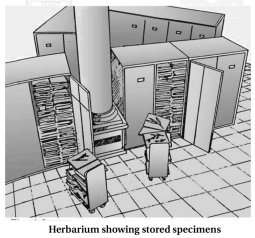
Medium
Identify the tool of classification shown in the image and describe its purpose.
Solution
(N/A) The image displays a $Herbarium$.
$1$. Definition: $A$ $Herbarium$ is a storehouse of collected plant specimens that are dried,pressed,and preserved on sheets.
$2$. Preparation: These sheets are arranged according to a universally accepted system of classification.
$3$. Information: The herbarium sheet carries a label providing information about the date and place of collection,English,local and botanical names,family,and the collector's name.
$4$. Purpose: Herbaria serve as quick referral systems in taxonomic studies.
$1$. Definition: $A$ $Herbarium$ is a storehouse of collected plant specimens that are dried,pressed,and preserved on sheets.
$2$. Preparation: These sheets are arranged according to a universally accepted system of classification.
$3$. Information: The herbarium sheet carries a label providing information about the date and place of collection,English,local and botanical names,family,and the collector's name.
$4$. Purpose: Herbaria serve as quick referral systems in taxonomic studies.
0 likes
View Solution382
MediumMCQ
What is a Herbarium? Explain its significance in taxonomy.
A
$A$ collection of dried,pressed,and preserved plant specimens mounted on sheets.
B
$A$ place where live plants are grown for research purposes.
C
$A$ collection of preserved animal specimens in jars.
D
$A$ digital database of plant $DNA$ sequences.
Solution
(A) $Herbarium$ is a storehouse of collected plant specimens that are dried,pressed,and preserved on sheets.
These sheets are arranged according to a universally accepted system of classification.
Each sheet carries a label providing information about the date and place of collection,English,local and botanical names,family,and the collector's name.
$Herbarium$ sheets serve as quick referral systems in taxonomical studies.
These sheets are arranged according to a universally accepted system of classification.
Each sheet carries a label providing information about the date and place of collection,English,local and botanical names,family,and the collector's name.
$Herbarium$ sheets serve as quick referral systems in taxonomical studies.
0 likes
View Solution383
MediumMCQ
Differentiate between a museum and a botanical garden.
A
Museums preserve dead specimens; Botanical gardens preserve living plants.
B
Museums are indoor facilities; Botanical gardens are outdoor areas.
C
Museums contain preserved plants and animals; Botanical gardens contain only living plants.
D
All of the above.
Solution
(D) The differences between a museum and a botanical garden are as follows:
$1$. $A$ museum is a place where collections of preserved plants and animals are kept for study and reference. These specimens are usually dead and preserved in containers or jars with preservative solutions or as dry specimens.
$2$. $A$ botanical garden is a specialized garden that holds collections of living plants for reference. These plants are grown for identification purposes,and each plant is labeled with its botanical/scientific name and its family.
$3$. Museums are typically indoor facilities,whereas botanical gardens are large outdoor areas.
$1$. $A$ museum is a place where collections of preserved plants and animals are kept for study and reference. These specimens are usually dead and preserved in containers or jars with preservative solutions or as dry specimens.
$2$. $A$ botanical garden is a specialized garden that holds collections of living plants for reference. These plants are grown for identification purposes,and each plant is labeled with its botanical/scientific name and its family.
$3$. Museums are typically indoor facilities,whereas botanical gardens are large outdoor areas.
0 likes
View Solution384
MediumMCQ
Give a scientific reason: Biological diversity is preserved by museums.
A
Museums provide a natural habitat for endangered species.
B
Museums store specimens of plants,animals,and fossils for study and reference.
C
Museums are used to breed animals in captivity.
D
Museums act as botanical gardens for rare plant species.
Solution
(B) Museums are institutions where specimens of plants,animals,and fossils are collected,preserved,and displayed for study and reference.
They often contain separate galleries for mammals,birds,and various invertebrate and vertebrate groups,along with libraries and laboratories.
By preserving these specimens in a controlled environment,museums protect biological records and contribute to the understanding and conservation of biodiversity.
They often contain separate galleries for mammals,birds,and various invertebrate and vertebrate groups,along with libraries and laboratories.
By preserving these specimens in a controlled environment,museums protect biological records and contribute to the understanding and conservation of biodiversity.
0 likes
View Solution385
Medium
Define the following terms:
$(i)$ Herbarium
$(ii)$ Museum
$(i)$ Herbarium
$(ii)$ Museum
Solution
(N/A) $(i)$ Herbarium: $A$ herbarium is a storehouse of collected plant specimens that are dried,pressed,and preserved on sheets. These sheets are arranged according to a universally accepted system of classification and are used as a reference for taxonomic studies.
$(ii)$ Museum: Biological museums are generally set up in educational institutes such as schools and colleges. Museums have collections of preserved plant and animal specimens for study and reference. Specimens are preserved in containers or jars in preservative solutions or as dry specimens. Insects are preserved in insect boxes after collecting,killing,and pinning. Larger animals like birds and mammals are usually stuffed and preserved.
$(ii)$ Museum: Biological museums are generally set up in educational institutes such as schools and colleges. Museums have collections of preserved plant and animal specimens for study and reference. Specimens are preserved in containers or jars in preservative solutions or as dry specimens. Insects are preserved in insect boxes after collecting,killing,and pinning. Larger animals like birds and mammals are usually stuffed and preserved.
0 likes
View Solution386
Medium
How do you prepare your own herbarium sheets? What are the different tools you carry with you while collecting plants for the preparation of a herbarium? What information should a preserved plant material on the herbarium sheet provide for taxonomical studies?
Solution
(N/A) The process of preparing a herbarium involves the following steps:
$(a)$ Collection: This step involves the collection of a healthy specimen of a particular plant species.
$(b)$ Pressing: The specimen is spread out and pressed between two sheets of paper to preserve its structure.
$(c)$ Drying: The pressed specimen is dried,usually under the sun or in a plant press,to remove moisture.
$(d)$ Poisoning: To prevent fungal or insect attacks,the specimen is treated with chemicals like mercuric chloride.
$(e)$ Mounting: The dried specimen is carefully mounted on a standard herbarium sheet of size $29 \times 41 \text{ cm}$.
$(f)$ Labelling: $A$ label is affixed to the sheet containing essential details.
$\rightarrow$ Tools required for collection include: Digger,pruning knife,sickle,vasculum (a metal box for carrying specimens),polythene bags,old newspapers,blotting paper,plant press,and field notebooks.
$\rightarrow$ The label on the herbarium sheet must provide the following information for taxonomical studies: Date and place of collection,English,local and botanical names,family,and the name of the collector.
$(a)$ Collection: This step involves the collection of a healthy specimen of a particular plant species.
$(b)$ Pressing: The specimen is spread out and pressed between two sheets of paper to preserve its structure.
$(c)$ Drying: The pressed specimen is dried,usually under the sun or in a plant press,to remove moisture.
$(d)$ Poisoning: To prevent fungal or insect attacks,the specimen is treated with chemicals like mercuric chloride.
$(e)$ Mounting: The dried specimen is carefully mounted on a standard herbarium sheet of size $29 \times 41 \text{ cm}$.
$(f)$ Labelling: $A$ label is affixed to the sheet containing essential details.
$\rightarrow$ Tools required for collection include: Digger,pruning knife,sickle,vasculum (a metal box for carrying specimens),polythene bags,old newspapers,blotting paper,plant press,and field notebooks.
$\rightarrow$ The label on the herbarium sheet must provide the following information for taxonomical studies: Date and place of collection,English,local and botanical names,family,and the name of the collector.
0 likes
View Solution387
Difficult
$A$ scientist has come across a plant, which he feels is a new species. How will he go about its identification, classification, and nomenclature?
Solution
(N/A) The scientist should first observe the various morphological features of the plant.
He should begin with broad characteristics such as the type of root system and leaf venation.
Following this, the scientist should examine features like phyllotaxy, inflorescence, and floral structure, which will help in classifying the plant into its respective order and family.
He must compare these characteristic features with existing information available in scientific literature, such as herbaria, monographs, and taxonomic keys.
After determining the systematic position, he should name the plant according to the rules of the International Code of Nomenclature for algae, fungi, and plants $(ICN)$ using the principles of binomial nomenclature.
He should begin with broad characteristics such as the type of root system and leaf venation.
Following this, the scientist should examine features like phyllotaxy, inflorescence, and floral structure, which will help in classifying the plant into its respective order and family.
He must compare these characteristic features with existing information available in scientific literature, such as herbaria, monographs, and taxonomic keys.
After determining the systematic position, he should name the plant according to the rules of the International Code of Nomenclature for algae, fungi, and plants $(ICN)$ using the principles of binomial nomenclature.
0 likes
View Solution388
Medium
What are taxonomical aids? Give the importance of herbaria and museums. How are botanical gardens and zoological parks useful in conserving biodiversity?
Solution
(N/A) $\rightarrow$ Taxonomical aids are tools,techniques,and procedures that help scientists in the identification,nomenclature,and classification of plants and animal species. These can be in the form of preserved specimens (herbaria,museums) or written documents (monographs,manuals,keys).
$\rightarrow$ Importance of Herbaria:
$(a)$ They serve as a quick referral system for plant identification.
$(b)$ They provide the basis for the compilation of floras,monographs,and manuals.
$(c)$ They help in locating wild varieties and relatives of economically important plants.
$(d)$ They provide information about morphological variations within a species.
$(e)$ They are essential for research in plant taxonomy,ecology,and distribution.
$\rightarrow$ Importance of Museums:
$(a)$ They house a wide collection of preserved plant and animal specimens for study and reference.
$(b)$ They often contain skeletons of extinct animals,providing insights into evolutionary history.
$(c)$ They serve as an educational resource for students and a research hub for scientists.
$\rightarrow$ Role of Botanical Gardens and Zoological Parks in Conserving Biodiversity:
Botanical Gardens:
$(i)$ Ex-situ conservation of rare and endangered plant species.
$(ii)$ Maintaining records and germplasm of local and exotic plant species.
$(iii)$ Providing seeds and plant material for botanical research.
Zoological Parks:
$(i)$ Providing a protected environment that mimics natural habitats for wild animals.
$(ii)$ Protecting endangered species from predators and poaching.
$(iii)$ Facilitating captive breeding programs to increase the population of endangered species before reintroduction into the wild.
$\rightarrow$ Importance of Herbaria:
$(a)$ They serve as a quick referral system for plant identification.
$(b)$ They provide the basis for the compilation of floras,monographs,and manuals.
$(c)$ They help in locating wild varieties and relatives of economically important plants.
$(d)$ They provide information about morphological variations within a species.
$(e)$ They are essential for research in plant taxonomy,ecology,and distribution.
$\rightarrow$ Importance of Museums:
$(a)$ They house a wide collection of preserved plant and animal specimens for study and reference.
$(b)$ They often contain skeletons of extinct animals,providing insights into evolutionary history.
$(c)$ They serve as an educational resource for students and a research hub for scientists.
$\rightarrow$ Role of Botanical Gardens and Zoological Parks in Conserving Biodiversity:
Botanical Gardens:
$(i)$ Ex-situ conservation of rare and endangered plant species.
$(ii)$ Maintaining records and germplasm of local and exotic plant species.
$(iii)$ Providing seeds and plant material for botanical research.
Zoological Parks:
$(i)$ Providing a protected environment that mimics natural habitats for wild animals.
$(ii)$ Protecting endangered species from predators and poaching.
$(iii)$ Facilitating captive breeding programs to increase the population of endangered species before reintroduction into the wild.
0 likes
View Solution389
MediumMCQ
$A$ student of taxonomy was puzzled when told by his professor to look for a key to identify a plant. He went to his friend to clarify what 'Key' the professor was referring to? What would the friend explain to him?
A
$A$ physical key to unlock a cabinet containing plant specimens.
B
$A$ taxonomic key used for the identification of organisms based on contrasting characters.
C
$A$ digital password to access a botanical database.
D
$A$ secret code used to label herbarium sheets.
Solution
(B) The 'Key' referred to by the professor is a taxonomic key,which is an important taxonomic aid used for the identification of plants and animals.
It is based on the use of contrasting characters,generally in a pair called a couplet.
$A$ couplet represents the choice made between two opposite options,where one is accepted and the other is rejected.
Each statement in the key is called a 'lead'.
Keys are analytical in nature and separate keys are required for each taxonomic category,such as family,genus,and species.
They provide a systematic,step-by-step process to identify an organism based on its morphological characteristics.
It is based on the use of contrasting characters,generally in a pair called a couplet.
$A$ couplet represents the choice made between two opposite options,where one is accepted and the other is rejected.
Each statement in the key is called a 'lead'.
Keys are analytical in nature and separate keys are required for each taxonomic category,such as family,genus,and species.
They provide a systematic,step-by-step process to identify an organism based on its morphological characteristics.
0 likes
View Solution390
Medium
What are taxonomical aids?
Solution
(N/A) $\rightarrow$ Taxonomic studies of various species of plants,animals,and other organisms are useful in agriculture,forestry,industry,and in general in knowing our bio-resources and their diversity.
$\rightarrow$ These studies require correct classification and identification of organisms.
$\rightarrow$ Identification of organisms requires intensive laboratory and field studies.
$\rightarrow$ The collection of actual specimens of plant and animal species is essential and is the prime source of taxonomic studies.
$\rightarrow$ These are also fundamental to studies and essential for training in systematics. They are used for the classification of an organism,and the information gathered is stored along with the specimens.
$\rightarrow$ In some cases,the specimen is preserved for future studies.
$\rightarrow$ Biologists have established certain procedures and techniques to store and preserve the information as well as the specimens. These procedures and techniques are known as taxonomical aids.
$\rightarrow$ These studies require correct classification and identification of organisms.
$\rightarrow$ Identification of organisms requires intensive laboratory and field studies.
$\rightarrow$ The collection of actual specimens of plant and animal species is essential and is the prime source of taxonomic studies.
$\rightarrow$ These are also fundamental to studies and essential for training in systematics. They are used for the classification of an organism,and the information gathered is stored along with the specimens.
$\rightarrow$ In some cases,the specimen is preserved for future studies.
$\rightarrow$ Biologists have established certain procedures and techniques to store and preserve the information as well as the specimens. These procedures and techniques are known as taxonomical aids.
0 likes
View Solution391
Medium
Write a short note on Herbarium.
Solution
(N/A) $\rightarrow$ Herbarium is a storehouse of collected plant specimens that are dried, pressed, and preserved on sheets.
$\rightarrow$ These sheets are arranged according to a universally accepted system of classification.
$\rightarrow$ These specimens, along with their descriptions on herbarium sheets, become a storehouse or repository for future use.
$\rightarrow$ The herbarium sheets also carry a label providing information about the date and place of collection, English, local and botanical names, family, collector's name, etc.
$\rightarrow$ Herbaria also serve as quick referral systems in taxonomical studies.
$\rightarrow$ These sheets are arranged according to a universally accepted system of classification.
$\rightarrow$ These specimens, along with their descriptions on herbarium sheets, become a storehouse or repository for future use.
$\rightarrow$ The herbarium sheets also carry a label providing information about the date and place of collection, English, local and botanical names, family, collector's name, etc.
$\rightarrow$ Herbaria also serve as quick referral systems in taxonomical studies.
0 likes
View Solution392
Medium
Write a short note on Botanical Gardens.
Solution
(N/A) $\rightarrow$ Botanical gardens are specialized gardens that maintain collections of living plants for reference purposes.
$\rightarrow$ Plant species in these gardens are grown primarily for identification. Each plant is labeled with its botanical/scientific name and its family.
$\rightarrow$ Famous botanical gardens include the Royal Botanical Garden at Kew (England),the Indian Botanical Garden in Howrah (India),and the National Botanical Research Institute in Lucknow (India).
$\rightarrow$ Plant species in these gardens are grown primarily for identification. Each plant is labeled with its botanical/scientific name and its family.
$\rightarrow$ Famous botanical gardens include the Royal Botanical Garden at Kew (England),the Indian Botanical Garden in Howrah (India),and the National Botanical Research Institute in Lucknow (India).
0 likes
View Solution393
Medium
Write an explanatory note on Museums.
Solution
(N/A) $\rightarrow$ Biological museums are generally set up in educational institutes such as schools and colleges.
$\rightarrow$ Museums have collections of preserved plant and animal specimens for study and reference.
$\rightarrow$ Specimens are preserved in containers or jars in preservative solutions.
$\rightarrow$ Plant and animal specimens may also be preserved as dry specimens.
$\rightarrow$ Insects are preserved in insect boxes after collecting,killing,and pinning.
$\rightarrow$ Larger animals like birds and mammals are usually stuffed and preserved.
$\rightarrow$ Museums often have collections of animal skeletons as well.
$\rightarrow$ Museums have collections of preserved plant and animal specimens for study and reference.
$\rightarrow$ Specimens are preserved in containers or jars in preservative solutions.
$\rightarrow$ Plant and animal specimens may also be preserved as dry specimens.
$\rightarrow$ Insects are preserved in insect boxes after collecting,killing,and pinning.
$\rightarrow$ Larger animals like birds and mammals are usually stuffed and preserved.
$\rightarrow$ Museums often have collections of animal skeletons as well.
0 likes
View Solution394
Easy
What are Zoological Parks?
Solution
(N/A) $\rightarrow$ Zoological parks are places where wild animals are kept in protected environments under human care,which enable us to learn about their food habits and behavior.
$\rightarrow$ In these parks,all animals are provided,as far as possible,with conditions similar to their natural habitats.
$\rightarrow$ Children love visiting these parks,which are commonly called Zoos.
$\rightarrow$ In these parks,all animals are provided,as far as possible,with conditions similar to their natural habitats.
$\rightarrow$ Children love visiting these parks,which are commonly called Zoos.
0 likes
View Solution395
Medium
Describe Key as a taxonomical aid.
Solution
(N/A) $\rightarrow$ Key is a taxonomical aid used for the identification of plants and animals based on similarities and dissimilarities.
$\rightarrow$ The keys are based on contrasting characters,generally in a pair called a couplet.
$\rightarrow$ It represents the choice made between two opposite options.
$\rightarrow$ This results in the acceptance of only one and the rejection of the other.
$\rightarrow$ Each statement in the key is called a lead.
$\rightarrow$ Separate taxonomic keys are required for each taxonomic category,such as family,genus,and species,for identification purposes.
$\rightarrow$ Keys are generally analytical in nature.
$\rightarrow$ The keys are based on contrasting characters,generally in a pair called a couplet.
$\rightarrow$ It represents the choice made between two opposite options.
$\rightarrow$ This results in the acceptance of only one and the rejection of the other.
$\rightarrow$ Each statement in the key is called a lead.
$\rightarrow$ Separate taxonomic keys are required for each taxonomic category,such as family,genus,and species,for identification purposes.
$\rightarrow$ Keys are generally analytical in nature.
0 likes
View Solution396
Medium
Describe other means of recording descriptions.
Solution
(N/A) $\rightarrow$ Flora,manuals,monographs,and catalogues are some other means of recording descriptions.
$\rightarrow$ They also help in correct identification of organisms.
$\rightarrow$ Flora contains the actual account of habitat and distribution of plants of a given area. These provide the index to the plant species found in a particular area.
$\rightarrow$ Manuals are useful in providing information for the identification of names of species found in an area.
$\rightarrow$ Monographs contain information on any one taxon.
$\rightarrow$ They also help in correct identification of organisms.
$\rightarrow$ Flora contains the actual account of habitat and distribution of plants of a given area. These provide the index to the plant species found in a particular area.
$\rightarrow$ Manuals are useful in providing information for the identification of names of species found in an area.
$\rightarrow$ Monographs contain information on any one taxon.
0 likes
View Solution397
EasyMCQ
Couplet represents the choice made between two opposite options which results in
A
rejection of both the option.
B
acceptance of both the option.
C
either acceptance or rejection of both the option.
D
acceptance of only one and rejection of the other.
Solution
(D) In taxonomy,a key is a taxonomical aid used for identification of plants and animals based on the similarities and dissimilarities. Each statement in the key is called a lead. $A$ couplet represents the choice made between two opposite options. This process results in the acceptance of only one option and the rejection of the other.
0 likes
View Solution398
EasyMCQ
Which of the following taxonomic aid provides information for the identification of names of species found in an area?
A
Monograph
B
Manual
C
Flora
D
Periodical
Solution
(B) Manuals are taxonomic aids that contain information for the identification of names of species found in a particular area.
They provide essential details such as keys,and descriptions of families,genera,and species,which help in the identification of various organisms.
They provide essential details such as keys,and descriptions of families,genera,and species,which help in the identification of various organisms.
0 likes
View Solution399
EasyMCQ
Which one of the following taxonomical aids is used for the identification of plants and animals based on similarities and dissimilarities?
A
Flora
B
Keys
C
Monographs
D
Catalogues
Solution
(B) Key is a taxonomical aid used for the identification of plants and animals based on similarities and dissimilarities.
Keys are based on a set of contrasting characters,generally in a pair called a couplet.
Each statement in a couplet is called a lead.
Keys are generally analytical in nature.
Keys are based on a set of contrasting characters,generally in a pair called a couplet.
Each statement in a couplet is called a lead.
Keys are generally analytical in nature.
0 likes
View Solution400
EasyMCQ
Keys are generally $analytical$ in nature.
A
physical
B
Chemical
C
analytical
D
qualitative
Solution
(C) key is a type of taxonomical aid used for the identification of plants and animals based on their similarities and dissimilarities.
Keys are based on the set of contrasting characters known as a couplet.
Each statement in the key is called a lead.
Because they involve the analysis of characteristics to identify an organism,keys are generally analytical in nature.
Keys are based on the set of contrasting characters known as a couplet.
Each statement in the key is called a lead.
Because they involve the analysis of characteristics to identify an organism,keys are generally analytical in nature.
0 likes
View SolutionThe Living World — Taxonomical Aids · Frequently Asked Questions
1Are these The Living World questions useful for JEE and NEET?
Yes. All questions in this section are mapped to JEE Main and NEET exam patterns. Previous year questions from JEE Main, NEET, GUJCET and state-level exams are included with full solutions.
2Can I switch to Hindi or Gujarati for these questions?
Yes. Use the language tabs in the hero section or the sidebar to view the same questions and solutions in English, Hindi or Gujarati.
3How do I generate a question paper from this subtopic?
Use the Vedclass Exam Paper Generator — select the chapter and subtopic, set difficulty, and generate Sets A, B, C, D automatically. First 3 chapters of every subject are free.
Vedclass Products
For Students
Vedclass Test Series
Mock tests in real JEE/NEET style with performance analysis. 5-day free trial.
Start Free TrialFor Teachers
Exam Paper Generator
Generate Set A/B/C/D papers from this chapter in 2 minutes. 3 chapters free.
Try FreeFor Institutes
Online Exam Module
Live online exams with unlimited students, 360° analytics & white-label branding.
See DemoFor Teachers & Institutes
Generate a The Living World Exam Paper in 2 Minutes
Select subtopic & difficulty — Sets A, B, C, D auto-generated with No Repeat logic.
First 3 chapters of every subject are free — no payment required.