
A English
Taxonomic categories Questions in English
Class 11 Biology · The Living World · Taxonomic categories
567+
Questions
English
Language
100%
With Solutions
Showing 50 of 567 questions in English
201
MediumMCQ
Identify the taxonomic category that truly exists in nature among the following.
A
Genus
B
Species
C
Phylum
D
Kingdom
Solution
(B) In biological classification,the taxonomic categories are hierarchical levels used to group organisms.
According to the concept of biological species,the $Species$ is the only category that represents a real,natural unit of organisms that can interbreed and produce fertile offspring.
Other categories like $Genus$,$Phylum$,and $Kingdom$ are artificial constructs created by taxonomists for the convenience of classification and do not represent distinct biological entities in the same way as a species.
According to the concept of biological species,the $Species$ is the only category that represents a real,natural unit of organisms that can interbreed and produce fertile offspring.
Other categories like $Genus$,$Phylum$,and $Kingdom$ are artificial constructs created by taxonomists for the convenience of classification and do not represent distinct biological entities in the same way as a species.
0 likes
View Solution202
MediumMCQ
Match the following columns correctly:
| Common Name | Scientific Name / Order / Family |
|---|---|
| $A$. Earthworm | $R$. Pheretima posthuma,$Y$. Opisthopora,$3$. Megascolecidae |
| $B$. Sunflower | $S$. Helianthus annuus,$Z$. Asterales,$2$. Asteraceae |
| $C$. Frog | $P$. Rana tigrina,$X$. Anura,$4$. Ranidae |
| $D$. Maize | $Q$. Zea mays,$W$. Glumiflorae,$1$. Poaceae |
A
$A-Q-Y-3; B-P-X-2; C-R-Z-1; D-S-W-4$
B
$A-R-Z-3; B-S-W-1; C-P-X-2; D-Q-Y-4$
C
$A-P-Z-1; B-Q-X-2; C-R-Y-3; D-S-W-4$
D
$A-R-Y-3; B-S-Z-2; C-P-X-4; D-Q-W-1$
Solution
(D) The correct matches are as follows:
$1$. Earthworm $(A)$: Scientific name is Pheretima posthuma $(R)$,Order is Opisthopora $(Y)$,and Family is Megascolecidae $(3)$.
$2$. Sunflower $(B)$: Scientific name is Helianthus annuus $(S)$,Order is Asterales $(Z)$,and Family is Asteraceae $(2)$.
$3$. Frog $(C)$: Scientific name is Rana tigrina $(P)$,Order is Anura $(X)$,and Family is Ranidae $(4)$.
$4$. Maize $(D)$: Scientific name is Zea mays $(Q)$,Order is Glumiflorae $(W)$,and Family is Poaceae $(1)$.
Thus,the correct sequence is $A-R-Y-3; B-S-Z-2; C-P-X-4; D-Q-W-1$.
$1$. Earthworm $(A)$: Scientific name is Pheretima posthuma $(R)$,Order is Opisthopora $(Y)$,and Family is Megascolecidae $(3)$.
$2$. Sunflower $(B)$: Scientific name is Helianthus annuus $(S)$,Order is Asterales $(Z)$,and Family is Asteraceae $(2)$.
$3$. Frog $(C)$: Scientific name is Rana tigrina $(P)$,Order is Anura $(X)$,and Family is Ranidae $(4)$.
$4$. Maize $(D)$: Scientific name is Zea mays $(Q)$,Order is Glumiflorae $(W)$,and Family is Poaceae $(1)$.
Thus,the correct sequence is $A-R-Y-3; B-S-Z-2; C-P-X-4; D-Q-W-1$.
0 likes
View Solution203
EasyMCQ
When is a rank called a taxonomic category?
A
If the rank is a part of the taxonomic arrangement in all aspects.
B
If the rank is a part of the taxonomic arrangement in any one aspect.
C
When it represents a single step.
D
When it follows the rules of classification.
Solution
(A) In biological classification,the taxonomic arrangement is not merely a morphological grouping but a hierarchy of steps. Each step represents a rank or category. Since the category is a part of the overall taxonomic arrangement,it is referred to as a taxonomic category. Therefore,if a rank is a part of the taxonomic arrangement in all aspects,it is called a taxonomic category.
0 likes
View Solution204
EasyMCQ
In the given figure,what do the labeled parts $P$ and $Q$ represent respectively?
| $P$ |
| $\uparrow$ |
| Family |
| $\uparrow$ |
| $Q$ |
| $\uparrow$ |
| Species |
A
Genus,Order
B
Order,Genus
C
Class,Kingdom
D
Kingdom,Class
Solution
(B) The taxonomic hierarchy in ascending order is: Species < Genus < Family < Order < Class < Phylum/Division < Kingdom.
Given the sequence: $P$ $\rightarrow$ Family $\rightarrow$ $Q$ $\rightarrow$ Species.
Looking at the hierarchy,the category above 'Family' is 'Order' and the category between 'Family' and 'Species' is 'Genus'.
Therefore,$P$ represents 'Order' and $Q$ represents 'Genus'.
Given the sequence: $P$ $\rightarrow$ Family $\rightarrow$ $Q$ $\rightarrow$ Species.
Looking at the hierarchy,the category above 'Family' is 'Order' and the category between 'Family' and 'Species' is 'Genus'.
Therefore,$P$ represents 'Order' and $Q$ represents 'Genus'.
0 likes
View Solution205
EasyMCQ
What is the genus of the sunflower?
A
Rana
B
Periplaneta
C
Pheretima
D
Helianthus
Solution
(D) The scientific name of the sunflower is $Helianthus \ annuus$. In binomial nomenclature,the first word represents the genus and the second word represents the species. Therefore,$Helianthus$ is the genus of the sunflower. $Rana$ is the genus of frogs,$Periplaneta$ is the genus of cockroaches,and $Pheretima$ is the genus of earthworms.
0 likes
View Solution206
EasyMCQ
Each step of classification represents a:
A
Rank
B
Assumption
C
Criterion
D
Principle
Solution
(A) In biological classification,the taxonomic hierarchy consists of various levels or steps. Each step represents a taxonomic rank or category. These categories are part of the overall taxonomic arrangement,ranging from Kingdom to Species. Therefore,each step in the hierarchy is referred to as a rank.
0 likes
View Solution207
EasyMCQ
As we go higher from species to kingdom in the taxonomic hierarchy,the number of common characteristics shared by the organisms:
A
Decreases
B
Increases
C
Remains same
D
None of the above
Solution
(A) In the taxonomic hierarchy,the $Species$ is the lowest category and $Kingdom$ is the highest category.
As we move from $Species$ towards $Kingdom$,the number of common characteristics shared by the organisms decreases.
This is because organisms in lower categories like $Species$ share more specific features,whereas organisms in higher categories like $Kingdom$ share only very broad,general features.
Therefore,the number of common characteristics decreases as we go higher in the taxonomic hierarchy.
As we move from $Species$ towards $Kingdom$,the number of common characteristics shared by the organisms decreases.
This is because organisms in lower categories like $Species$ share more specific features,whereas organisms in higher categories like $Kingdom$ share only very broad,general features.
Therefore,the number of common characteristics decreases as we go higher in the taxonomic hierarchy.
0 likes
View Solution208
EasyMCQ
All the orders together constitute which of the following?
A
Taxonomic series
B
Taxonomic family
C
Taxonomic species
D
Taxonomic class
Solution
(D) In the taxonomic hierarchy,categories are arranged in a specific order from species to kingdom.
According to the taxonomic hierarchy,a group of related orders constitutes a class.
Therefore,all the orders together constitute a taxonomic class.
According to the taxonomic hierarchy,a group of related orders constitutes a class.
Therefore,all the orders together constitute a taxonomic class.
0 likes
View Solution209
EasyMCQ
How many species can a genus include?
A
Four
B
Two
C
Three
D
One or more
Solution
(D) genus is a taxonomic category that contains a group of related species which have more characters in common in comparison to species of other genera. $A$ genus can contain a single species (monotypic) or multiple species (polytypic). For example,the genus $Panthera$ includes species like $Panthera$ $leo$ (lion) and $Panthera$ $tigris$ (tiger). Therefore,a genus can include one or more species.
0 likes
View Solution210
EasyMCQ
What is the highest taxonomic category that includes all other groups in the classification hierarchy?
A
Kingdom
B
Species
C
Genus
D
Taxon
Solution
(A) In the taxonomic hierarchy,the categories are arranged in a specific order from the lowest to the highest level: Species,Genus,Family,Order,Class,Phylum/Division,and Kingdom.
$1$. Species is the basic unit of classification.
$2$. Kingdom is the highest category in the taxonomic hierarchy.
$3$. It encompasses all other taxonomic groups,as it represents the broadest level of classification containing organisms with the most general shared characteristics.
$1$. Species is the basic unit of classification.
$2$. Kingdom is the highest category in the taxonomic hierarchy.
$3$. It encompasses all other taxonomic groups,as it represents the broadest level of classification containing organisms with the most general shared characteristics.
0 likes
View Solution211
MediumMCQ
As we move from Kingdom to Species in the taxonomic hierarchy,the number of common characteristics among organisms .............
A
increases
B
decreases
C
remains constant
D
becomes equal
Solution
(A) In the taxonomic hierarchy,the Kingdom is the highest category and Species is the lowest category.
As we move from Kingdom to Species,the number of shared or common characteristics among the organisms increases.
This is because organisms placed in the same species share the maximum number of similar features,whereas organisms in the same kingdom share only a few broad,general characteristics.
As we move from Kingdom to Species,the number of shared or common characteristics among the organisms increases.
This is because organisms placed in the same species share the maximum number of similar features,whereas organisms in the same kingdom share only a few broad,general characteristics.
0 likes
View Solution212
MediumMCQ
Which of the following represents the correct sequence of taxonomic categories in descending order of variation?
A
Kingdom $\rightarrow$ Subkingdom $\rightarrow$ Phylum $\rightarrow$ Class $\rightarrow$ Subclass $\rightarrow$ Order $\rightarrow$ Family
B
Order $\rightarrow$ Subclass $\rightarrow$ Family $\rightarrow$ Phylum $\rightarrow$ Kingdom $\rightarrow$ Subkingdom
C
Kingdom $\rightarrow$ Phylum $\rightarrow$ Family $\rightarrow$ Subclass $\rightarrow$ Order
D
Family $\rightarrow$ Order $\rightarrow$ Subclass $\rightarrow$ Class $\rightarrow$ Phylum $\rightarrow$ Subkingdom $\rightarrow$ Kingdom
Solution
(A) The taxonomic hierarchy follows a specific order where the number of common characteristics decreases as we move from Kingdom to Species,meaning the variation increases as we move from Species to Kingdom.
Descending order of variation means moving from the highest category (most variation) to the lower categories (least variation).
The correct hierarchy is: Kingdom $\rightarrow$ Subkingdom $\rightarrow$ Phylum $\rightarrow$ Class $\rightarrow$ Subclass $\rightarrow$ Order $\rightarrow$ Family.
Therefore,option $A$ represents the correct sequence in descending order of variation.
Descending order of variation means moving from the highest category (most variation) to the lower categories (least variation).
The correct hierarchy is: Kingdom $\rightarrow$ Subkingdom $\rightarrow$ Phylum $\rightarrow$ Class $\rightarrow$ Subclass $\rightarrow$ Order $\rightarrow$ Family.
Therefore,option $A$ represents the correct sequence in descending order of variation.
0 likes
View Solution213
EasyMCQ
What are the names of two species of the genus $Homo$ and two birds of the family $Columbidae$?
A
$Homo$ $erectus$,$Homo$ $sapiens$ and Pigeon,Dove
B
$Primate$,$Cro-Magnon$ and Pigeon,Crow
C
$Homo$ $erectus$,$Cro-Magnon$ and Pigeon,Dove
D
$Primate$,$Homo$ $sapiens$ and Dove,Crow
Solution
(A) $1$. The genus $Homo$ includes extinct and extant species of humans. Two well-known species are $Homo$ $erectus$ and $Homo$ $sapiens$.
$2$. The family $Columbidae$ includes birds commonly known as pigeons and doves. Therefore,the correct pair is Pigeon and Dove.
$3$. Comparing this with the options,option $A$ correctly identifies two species of $Homo$ and two birds belonging to the family $Columbidae$.
$2$. The family $Columbidae$ includes birds commonly known as pigeons and doves. Therefore,the correct pair is Pigeon and Dove.
$3$. Comparing this with the options,option $A$ correctly identifies two species of $Homo$ and two birds belonging to the family $Columbidae$.
0 likes
View Solution214
EasyMCQ
Which taxonomic category is formed by a group of closely related species?
A
Family
B
Species
C
Genus
D
Order
Solution
(C) In biological classification,a $Genus$ is defined as a group of closely related species that share more characters in common in comparison to species of other genera. For example,$Solanum$ is a genus that includes species like $Solanum$ $tuberosum$ (potato) and $Solanum$ $melongena$ (brinjal). Therefore,the correct option is $C$.
0 likes
View Solution215
EasyMCQ
What is a group of species that share a common ancestor called?
A
Genus
B
Subspecies
C
Series
D
Order
Solution
(A) In biological classification,a $Genus$ is defined as a group of related species which has more characters in common in comparison to species of other genera. These species are considered to have evolved from a common ancestor. Therefore,a group of species sharing a common ancestor is referred to as a $Genus$.
0 likes
View Solution216
MediumMCQ
Which of the following options represents the correct sequence of taxonomic categories based on increasing similarity of characteristics?
A
Family,Order,Kingdom,Genus
B
Class,Species,Family,Kingdom
C
Order,Family,Genus,Species
D
Family,Order,Species,Genus
Solution
(C) In taxonomic hierarchy,as we move from Kingdom to Species,the number of common characteristics increases.
Therefore,the sequence representing increasing similarity of characteristics is: Kingdom < Phylum < Class < Order < Family < Genus < Species.
Among the given options,the sequence 'Order,Family,Genus,Species' follows the trend of increasing similarity of characteristics as we move towards the species level.
Therefore,the sequence representing increasing similarity of characteristics is: Kingdom < Phylum < Class < Order < Family < Genus < Species.
Among the given options,the sequence 'Order,Family,Genus,Species' follows the trend of increasing similarity of characteristics as we move towards the species level.
0 likes
View Solution217
MediumMCQ
Match the following columns correctly:
| Column $I$ (Organism) | Column $II$ (Family) | Column $III$ (Order) |
| $i$. Sunflower | $a$. Blattidae | $p$. Opisthopora |
| $ii$. Earthworm | $b$. Asteraceae | $q$. Glumiflorae |
| $c$. Megascolecidae | $r$. Anura | |
| $s$. Asterales |
A
$i-b-q, ii-a-r$
B
$i-b-s, ii-c-p$
C
$i-c-q, ii-a-r$
D
$i-b-r, ii-c-s$
Solution
(B) $1$. Sunflower $(Helianthus \text{ } annuus)$: It belongs to the family Asteraceae and the order Asterales. Thus, $i-b-s$.
$2$. Earthworm $(Pheretima \text{ } posthuma)$: It belongs to the family Megascolecidae and the order Opisthopora. Thus, $ii-c-p$.
Therefore, the correct matching is $i-b-s$ and $ii-c-p$.
$2$. Earthworm $(Pheretima \text{ } posthuma)$: It belongs to the family Megascolecidae and the order Opisthopora. Thus, $ii-c-p$.
Therefore, the correct matching is $i-b-s$ and $ii-c-p$.
0 likes
View Solution218
MediumMCQ
Which of the following is $NOT$ true for a species?
A
Members of a species can interbreed.
B
Variations are observed among members of a species.
C
Each species is reproductively isolated from other species.
D
Gene flow is not observed between populations of the same species.
Solution
(D) species is defined as a group of organisms that can interbreed to produce fertile offspring.
$1$. Members of a species share a common gene pool and can interbreed ($A$ is true).
$2$. Variations are natural among individuals of a species due to genetic differences ($B$ is true).
$3$. Reproductive isolation is a key characteristic that separates one species from another ($C$ is true).
$4$. Gene flow refers to the movement of alleles between populations. Within the same species,populations are generally capable of interbreeding,which facilitates gene flow. Therefore,stating that gene flow is not observed between populations of the same species is incorrect ($D$ is false).
$1$. Members of a species share a common gene pool and can interbreed ($A$ is true).
$2$. Variations are natural among individuals of a species due to genetic differences ($B$ is true).
$3$. Reproductive isolation is a key characteristic that separates one species from another ($C$ is true).
$4$. Gene flow refers to the movement of alleles between populations. Within the same species,populations are generally capable of interbreeding,which facilitates gene flow. Therefore,stating that gene flow is not observed between populations of the same species is incorrect ($D$ is false).
0 likes
View Solution219
EasyMCQ
Which of the following taxonomic categories contains the least number of similarities?
A
Class
B
Subclass
C
Order
D
Family
Solution
(A) In biological classification, the taxonomic hierarchy follows a specific order: Kingdom > Phylum > Class > Order > Family > Genus > Species.
As we move from the species level towards the kingdom level, the number of shared characteristics among the organisms decreases.
Conversely, as we move from the kingdom level towards the species level, the number of similarities increases.
Among the given options ($Class$, $Subclass$, $Order$, $Family$), $Class$ is the highest taxonomic category.
Therefore, organisms placed in the $Class$ category share the fewest common characteristics compared to those in $Order$ or $Family$.
As we move from the species level towards the kingdom level, the number of shared characteristics among the organisms decreases.
Conversely, as we move from the kingdom level towards the species level, the number of similarities increases.
Among the given options ($Class$, $Subclass$, $Order$, $Family$), $Class$ is the highest taxonomic category.
Therefore, organisms placed in the $Class$ category share the fewest common characteristics compared to those in $Order$ or $Family$.
0 likes
View Solution220
EasyMCQ
In taxonomy,the category 'Class' is placed between which of the following?
A
Kingdom and Order
B
Kingdom and Family
C
Phylum and Order
D
Family and Genus
Solution
(C) The taxonomic hierarchy follows the sequence: Kingdom $\rightarrow$ Phylum $\rightarrow$ Class $\rightarrow$ Order $\rightarrow$ Family $\rightarrow$ Genus $\rightarrow$ Species.
Based on this sequence,the category 'Class' is placed between 'Phylum' and 'Order'.
Based on this sequence,the category 'Class' is placed between 'Phylum' and 'Order'.
0 likes
View Solution221
EasyMCQ
Which of the following are included in the taxonomic categories?
A
Kingdom
B
Phylum
C
Order
D
All of the above
Solution
(D) Taxonomic categories are the distinct ranks or levels in the hierarchical classification of organisms.
According to the taxonomic hierarchy,the categories are: Kingdom,Phylum (or Division for plants),Class,Order,Family,Genus,and Species.
Since Kingdom,Phylum,and Order are all part of this hierarchy,the correct answer is 'All of the above'.
According to the taxonomic hierarchy,the categories are: Kingdom,Phylum (or Division for plants),Class,Order,Family,Genus,and Species.
Since Kingdom,Phylum,and Order are all part of this hierarchy,the correct answer is 'All of the above'.
0 likes
View Solution222
EasyMCQ
Which taxonomic category is written first when writing the scientific name of an organism?
A
Species
B
Kingdom
C
Genus
D
Subkingdom
Solution
(C) According to the binomial nomenclature system proposed by $Carl$ $Linnaeus$,the scientific name of an organism consists of two components: the generic name (genus) and the specific epithet (species).
In this system,the first word represents the $Genus$ (generic name),and the second word represents the $Species$ (specific epithet).
Therefore,the taxonomic category written first is the $Genus$.
In this system,the first word represents the $Genus$ (generic name),and the second word represents the $Species$ (specific epithet).
Therefore,the taxonomic category written first is the $Genus$.
0 likes
View Solution223
EasyMCQ
What do the taxonomic categories together constitute?
A
Taxonomic order
B
Taxonomic hierarchy
C
Taxonomic rank
D
Taxonomic series
Solution
(B) Taxonomic categories are the distinct levels in the classification of organisms. When these categories are arranged in a specific sequence from kingdom to species,they collectively form the $Taxonomic \ hierarchy$. This hierarchy represents the systematic arrangement of organisms into various levels based on their similarities and differences.
0 likes
View Solution224
EasyMCQ
The rank given to groups of organisms arranged at different levels of classification is called ...........
A
Class
B
Taxon
C
Order
D
Category
Solution
(D) In biological classification,the hierarchy of taxonomic groups is known as taxonomic hierarchy.
Each level in this hierarchy represents a rank or category.
These categories are referred to as taxonomic categories.
$A$ 'taxon' (plural: 'taxa') represents a group of organisms at any particular level of classification.
Therefore,the rank or level assigned to these groups is specifically termed as a 'category'.
Each level in this hierarchy represents a rank or category.
These categories are referred to as taxonomic categories.
$A$ 'taxon' (plural: 'taxa') represents a group of organisms at any particular level of classification.
Therefore,the rank or level assigned to these groups is specifically termed as a 'category'.
0 likes
View Solution225
EasyMCQ
Which is the highest taxonomic category that includes all other groups of organisms?
A
Subclass
B
Class
C
Kingdom
D
Species
Solution
(C) In the taxonomic hierarchy, the categories are arranged in a specific order from the lowest to the highest rank: $Species < Genus < Family < Order < Class < Phylum/Division < Kingdom$.
$Kingdom$ is the highest taxonomic category in the biological classification system.
It encompasses all other groups, as it represents the broadest level of classification containing all organisms that share fundamental characteristics.
$Kingdom$ is the highest taxonomic category in the biological classification system.
It encompasses all other groups, as it represents the broadest level of classification containing all organisms that share fundamental characteristics.
0 likes
View Solution226
MediumMCQ
In the taxonomic hierarchy from Kingdom to Species,which of the following occurs?
A
Variation increases.
B
Number of species increases.
C
Similarity increases.
D
Similarity decreases.
Solution
(C) In the taxonomic hierarchy,as we move from the higher category (Kingdom) to the lower category (Species),the number of common characteristics shared by the organisms increases.
This means that the organisms placed in the same category at the lower levels (like Species) show more similarities compared to those at higher levels (like Kingdom).
Therefore,as we go from Kingdom to Species,the similarity among the organisms increases.
This means that the organisms placed in the same category at the lower levels (like Species) show more similarities compared to those at higher levels (like Kingdom).
Therefore,as we go from Kingdom to Species,the similarity among the organisms increases.
0 likes
View Solution227
MediumMCQ
Which of the following taxonomic categories contains organisms with the least number of similarities?
A
Class
B
Subclass
C
Order
D
Family
Solution
(A) In the taxonomic hierarchy, as we move from the species level to the kingdom level, the number of shared characteristics among organisms decreases.
This means that higher taxonomic categories contain organisms with fewer similarities compared to lower categories.
The hierarchy is: Species < Genus < Family < Order < Class < Phylum < Kingdom.
Among the given options ($Class$, $Subclass$, $Order$, $Family$), $Class$ is the highest taxonomic category.
Therefore, organisms in the $Class$ category share the least number of similarities.
This means that higher taxonomic categories contain organisms with fewer similarities compared to lower categories.
The hierarchy is: Species < Genus < Family < Order < Class < Phylum < Kingdom.
Among the given options ($Class$, $Subclass$, $Order$, $Family$), $Class$ is the highest taxonomic category.
Therefore, organisms in the $Class$ category share the least number of similarities.
0 likes
View Solution228
EasyMCQ
The taxonomic category that consists of organisms with maximum similarity and the ability to interbreed to produce fertile offspring is .........
A
Genus
B
Family
C
Species
D
Order
Solution
(C) In biological classification, the $Species$ is the fundamental unit of classification.
It is defined as a group of individual organisms that share maximum morphological similarities and have the potential to interbreed among themselves to produce fertile offspring.
Therefore, the correct answer is $Species$.
It is defined as a group of individual organisms that share maximum morphological similarities and have the potential to interbreed among themselves to produce fertile offspring.
Therefore, the correct answer is $Species$.
0 likes
View Solution229
EasyMCQ
In the scientific name of organisms,which taxonomic category is written in lowercase letters?
A
Species
B
Genus
C
Kingdom
D
Family
Solution
(A) According to the rules of binomial nomenclature,a scientific name consists of two parts: the genus and the species.
$1$. The first word represents the genus,which starts with a capital letter.
$2$. The second word represents the specific epithet (species),which is written in lowercase letters.
Therefore,the species name is written in lowercase.
$1$. The first word represents the genus,which starts with a capital letter.
$2$. The second word represents the specific epithet (species),which is written in lowercase letters.
Therefore,the species name is written in lowercase.
0 likes
View Solution230
EasyMCQ
In a scientific name,what taxonomic category does the second word represent?
A
Genus
B
Species
C
Class
D
Order
Solution
(B) In binomial nomenclature,a scientific name consists of two components: the first word represents the $Genus$ and the second word represents the specific epithet or $Species$. Therefore,the second word indicates the species.
0 likes
View Solution231
EasyMCQ
What is the taxonomic category formed by a group of closely related species called?
A
Species
B
Genus
C
Family
D
Order
Solution
(B) In biological classification,a $Genus$ is a taxonomic category that comprises a group of closely related species which have more characters in common in comparison to species of other genera. For example,$Potato$ ($Solanum$ $tuberosum$) and $Brinjal$ ($Solanum$ $melongena$) are two different species but both belong to the same genus $Solanum$.
0 likes
View Solution232
EasyMCQ
What is formed by a group of related genera?
A
Species
B
Subfamily
C
Order
D
Family
Solution
(D) In biological classification,the taxonomic hierarchy follows a specific order: Species $\rightarrow$ Genus $\rightarrow$ Family $\rightarrow$ Order $\rightarrow$ Class $\rightarrow$ Phylum $\rightarrow$ Kingdom.
According to this hierarchy,a group of related genera (plural of genus) is placed together in a higher taxonomic category known as a Family.
For example,the genera $Panthera$ (lion,tiger,leopard) and $Felis$ (cat) are grouped together in the family $Felidae$.
According to this hierarchy,a group of related genera (plural of genus) is placed together in a higher taxonomic category known as a Family.
For example,the genera $Panthera$ (lion,tiger,leopard) and $Felis$ (cat) are grouped together in the family $Felidae$.
0 likes
View Solution233
MediumMCQ
Match the following columns and choose the correct option:
| Column-$I$ (Common Name) | Column-$II$ (Family) | Column-$III$ (Order) |
|---|---|---|
| $A$. Frog | $P$. Poaceae | $i$. Orthoptera |
| $B$. Earthworm | $Q$. Asteraceae | $ii$. Anura |
| $C$. Maize | $R$. Blattidae | $iii$. Asterales |
| $D$. Sunflower | $S$. Megascolecidae | $iv$. Glumiflorae |
| $E$. Cockroach | $T$. Ranidae | $v$. Opisthopora |
A
$A-S-i, B-R-iii, C-P-iv, D-Q-ii, E-T-v$
B
$A-T-ii, B-R-v, C-S-iii, D-P-iv, E-Q-i$
C
$A-T-ii, B-S-v, C-P-iv, D-Q-iii, E-R-i$
D
$A-T-ii, B-R-v, C-P-iii, D-Q-iv, E-R-i$
Solution
(C) The correct matches are as follows:
$A$. Frog belongs to the family $Ranidae$ $(T)$ and order $Anura$ $(ii)$.
$B$. Earthworm belongs to the family $Megascolecidae$ $(S)$ and order $Opisthopora$ $(v)$.
$C$. Maize belongs to the family $Poaceae$ $(P)$ and order $Glumiflorae$ $(iv)$.
$D$. Sunflower belongs to the family $Asteraceae$ $(Q)$ and order $Asterales$ $(iii)$.
$E$. Cockroach belongs to the family $Blattidae$ $(R)$ and order $Orthoptera$ $(i)$.
Thus,the correct sequence is $A-T-ii, B-S-v, C-P-iv, D-Q-iii, E-R-i$.
$A$. Frog belongs to the family $Ranidae$ $(T)$ and order $Anura$ $(ii)$.
$B$. Earthworm belongs to the family $Megascolecidae$ $(S)$ and order $Opisthopora$ $(v)$.
$C$. Maize belongs to the family $Poaceae$ $(P)$ and order $Glumiflorae$ $(iv)$.
$D$. Sunflower belongs to the family $Asteraceae$ $(Q)$ and order $Asterales$ $(iii)$.
$E$. Cockroach belongs to the family $Blattidae$ $(R)$ and order $Orthoptera$ $(i)$.
Thus,the correct sequence is $A-T-ii, B-S-v, C-P-iv, D-Q-iii, E-R-i$.
0 likes
View Solution234
MediumMCQ
Statement $S$: The family $Columbidae$ includes pigeons and doves,which consist of various genera and species.
Reason $R$: $A$ family is a category formed by a group of closely related genera.
$(a)$ Both $S$ and $R$ are true,and $R$ is the correct explanation of $S$.
$(b)$ Both $S$ and $R$ are true,but $R$ is not the correct explanation of $S$.
$(c)$ $S$ is true and $R$ is false.
$(d)$ $S$ is false and $R$ is true.
$(e)$ Both $S$ and $R$ are false.
Reason $R$: $A$ family is a category formed by a group of closely related genera.
$(a)$ Both $S$ and $R$ are true,and $R$ is the correct explanation of $S$.
$(b)$ Both $S$ and $R$ are true,but $R$ is not the correct explanation of $S$.
$(c)$ $S$ is true and $R$ is false.
$(d)$ $S$ is false and $R$ is true.
$(e)$ Both $S$ and $R$ are false.
A
$a$
B
$b$
C
$c$
D
$d$
Solution
(A) Statement $S$ is true because the family $Columbidae$ (often referred to as the pigeon family) encompasses various genera and species of pigeons and doves.
Reason $R$ is also true because,in biological classification,a family is defined as a taxonomic category that includes a group of related genera that share common features.
Since the inclusion of pigeons and doves in the family $Columbidae$ is a direct application of the definition of a family,$R$ provides the correct explanation for $S$.
Reason $R$ is also true because,in biological classification,a family is defined as a taxonomic category that includes a group of related genera that share common features.
Since the inclusion of pigeons and doves in the family $Columbidae$ is a direct application of the definition of a family,$R$ provides the correct explanation for $S$.
0 likes
View Solution235
EasyMCQ
Assertion $(S)$: Kingdom is the largest taxonomic category.
Reason $(R)$: The major group that includes all other groups is called a Kingdom.
$(a)$ Both $S$ and $R$ are true,and $R$ is the correct explanation of $S$.
$(b)$ Both $S$ and $R$ are true,but $R$ is not the correct explanation of $S$.
$(c)$ $S$ is true and $R$ is false.
$(d)$ $S$ is false and $R$ is true.
$(e)$ Both $S$ and $R$ are false.
Reason $(R)$: The major group that includes all other groups is called a Kingdom.
$(a)$ Both $S$ and $R$ are true,and $R$ is the correct explanation of $S$.
$(b)$ Both $S$ and $R$ are true,but $R$ is not the correct explanation of $S$.
$(c)$ $S$ is true and $R$ is false.
$(d)$ $S$ is false and $R$ is true.
$(e)$ Both $S$ and $R$ are false.
A
$a$
B
$b$
C
$c$
D
$d$
Solution
(A) In the taxonomic hierarchy,the categories are arranged in descending order from Kingdom to Species.
Kingdom is the highest or largest taxonomic category,which encompasses all other lower categories (Phylum/Division,Class,Order,Family,Genus,Species).
Therefore,the statement $(S)$ is true.
The reason $(R)$ correctly defines the Kingdom as the major group that includes all other groups,which explains why it is the largest category.
Thus,both $S$ and $R$ are true,and $R$ is the correct explanation of $S$.
Kingdom is the highest or largest taxonomic category,which encompasses all other lower categories (Phylum/Division,Class,Order,Family,Genus,Species).
Therefore,the statement $(S)$ is true.
The reason $(R)$ correctly defines the Kingdom as the major group that includes all other groups,which explains why it is the largest category.
Thus,both $S$ and $R$ are true,and $R$ is the correct explanation of $S$.
0 likes
View Solution236
MediumMCQ
Select the mismatched pair from the following.
A
Family - Ranidae
B
Order - Opisthopora
C
Class - Asterates
D
Genus - Helianthus
Solution
(C) In biological classification,the taxonomic hierarchy includes categories like Kingdom,Phylum,Class,Order,Family,Genus,and Species.
$A$. Family - Ranidae is correct (Ranidae is the family of frogs).
$B$. Order - Opisthopora is correct (Opisthopora is the order of earthworms).
$C$. Class - Asterates is incorrect. 'Asterates' is not a standard taxonomic class. The correct class for plants like sunflowers is 'Magnoliopsida' (or Dicotyledonae).
$D$. Genus - Helianthus is correct (Helianthus is the genus of sunflowers).
Therefore,the mismatched pair is $C$.
$A$. Family - Ranidae is correct (Ranidae is the family of frogs).
$B$. Order - Opisthopora is correct (Opisthopora is the order of earthworms).
$C$. Class - Asterates is incorrect. 'Asterates' is not a standard taxonomic class. The correct class for plants like sunflowers is 'Magnoliopsida' (or Dicotyledonae).
$D$. Genus - Helianthus is correct (Helianthus is the genus of sunflowers).
Therefore,the mismatched pair is $C$.
0 likes
View Solution237
MediumMCQ
Which of the following statements is incorrect?
A
Genus: $A$ group of related species which has more characters in common.
B
Family: $A$ group of related genera with still less number of similarities as compared to genus and species.
C
Order: Being a higher category,it is the assemblage of families which exhibit a few similar characters.
D
Subclass: $A$ group of families forms a subclass.
Solution
(D) In biological classification,the taxonomic hierarchy follows a specific order: Species $\rightarrow$ Genus $\rightarrow$ Family $\rightarrow$ Order $\rightarrow$ Class $\rightarrow$ Phylum/Division $\rightarrow$ Kingdom.
Option $A$ is correct as a Genus is a group of related species.
Option $B$ is correct as a Family is a group of related genera.
Option $C$ is correct as an Order is an assemblage of families.
Option $D$ is incorrect because a group of families forms an Order,not a Subclass. $A$ Subclass is a category below the Class level.
Option $A$ is correct as a Genus is a group of related species.
Option $B$ is correct as a Family is a group of related genera.
Option $C$ is correct as an Order is an assemblage of families.
Option $D$ is incorrect because a group of families forms an Order,not a Subclass. $A$ Subclass is a category below the Class level.
0 likes
View Solution238
EasyMCQ
Which of the following statements is consistent with the taxonomic category 'Family'?
A
$A$ group of species sharing a common ancestor.
B
$A$ group of closely related genera.
C
$A$ group of related orders.
D
Organisms that share maximum similarities and are capable of interbreeding.
Solution
(B) In biological classification,the taxonomic hierarchy follows the order: Species,Genus,Family,Order,Class,Phylum,and Kingdom.
- $A$ 'Family' is a taxonomic category that includes a group of related genera.
- For example,the family 'Felidae' includes genera like 'Panthera' (lions,tigers) and 'Felis' (cats).
- Option $A$ refers to a clade or evolutionary group.
- Option $B$ correctly defines a 'Family' as a group of closely related genera.
- Option $C$ describes a higher category,such as a 'Class' or 'Subclass'.
- Option $D$ defines a 'Species'.
- $A$ 'Family' is a taxonomic category that includes a group of related genera.
- For example,the family 'Felidae' includes genera like 'Panthera' (lions,tigers) and 'Felis' (cats).
- Option $A$ refers to a clade or evolutionary group.
- Option $B$ correctly defines a 'Family' as a group of closely related genera.
- Option $C$ describes a higher category,such as a 'Class' or 'Subclass'.
- Option $D$ defines a 'Species'.
0 likes
View Solution239
MediumMCQ
In the given taxonomic hierarchy diagram, what do "$P$" $\rightarrow$ and "$Q$" $\rightarrow$ represent respectively?
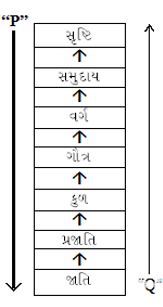
A
"$P$" $\rightarrow$ Increase in the number of species; "$Q$" $\rightarrow$ Decrease in the number of species.
B
"$P$" $\rightarrow$ Decrease in the number of species; "$Q$" $\rightarrow$ Increase in the number of species.
C
"$P$" $\rightarrow$ Increase in the number of organisms; "$Q$" $\rightarrow$ Decrease in the number of organisms.
D
Both $(a)$ and $(c)$.
Solution
(C) In the taxonomic hierarchy, as we move from species towards kingdom (upwards, as indicated by "$Q$"), the number of common characteristics decreases, and the number of organisms in each taxon increases. Conversely, as we move from kingdom towards species (downwards, as indicated by "$P$"), the number of common characteristics increases, and the number of organisms in each taxon decreases. Therefore, "$P$" represents a decrease in the number of organisms, and "$Q$" represents an increase in the number of organisms. Since the number of species is a specific taxonomic rank, the term "number of organisms" is more accurate in this context. Thus, option $(c)$ is correct.
0 likes
View Solution240
EasyMCQ
In the given diagram,what do the labeled parts $P$ and $Q$ represent respectively?
| Kingdom |
| $\uparrow$ |
| $P$ |
| $\uparrow$ |
| Class |
| $\uparrow$ |
| Order |
| $\uparrow$ |
| $Q$ |
A
Phylum,Family
B
Family,Phylum
C
Species,Family
D
Genus,Species
Solution
(A) The taxonomic hierarchy in biological classification follows the order: Kingdom $\rightarrow$ Phylum $\rightarrow$ Class $\rightarrow$ Order $\rightarrow$ Family $\rightarrow$ Genus $\rightarrow$ Species.
Looking at the given sequence: Kingdom $\rightarrow$ $P$ $\rightarrow$ Class $\rightarrow$ Order $\rightarrow$ $Q$.
Comparing this with the standard hierarchy:
$1$. $P$ comes between Kingdom and Class,which is Phylum.
$2$. $Q$ comes after Order,which is Family.
Therefore,$P$ represents Phylum and $Q$ represents Family.
Looking at the given sequence: Kingdom $\rightarrow$ $P$ $\rightarrow$ Class $\rightarrow$ Order $\rightarrow$ $Q$.
Comparing this with the standard hierarchy:
$1$. $P$ comes between Kingdom and Class,which is Phylum.
$2$. $Q$ comes after Order,which is Family.
Therefore,$P$ represents Phylum and $Q$ represents Family.
0 likes
View Solution241
EasyMCQ
Which of the following is a taxonomic category?
A
Species
B
Family
C
Order
D
All of the above
Solution
(D) Taxonomic categories are the distinct levels in the taxonomic hierarchy used for classification of organisms.
The hierarchy includes: Kingdom,Phylum/Division,Class,Order,Family,Genus,and Species.
Since Species,Family,and Order are all part of this hierarchy,the correct answer is 'All of the above'.
The hierarchy includes: Kingdom,Phylum/Division,Class,Order,Family,Genus,and Species.
Since Species,Family,and Order are all part of this hierarchy,the correct answer is 'All of the above'.
0 likes
View Solution242
EasyMCQ
The basic unit of classification for plants and animals is ....
A
Genus
B
Species
C
Order
D
Family
Solution
(B) In biological classification,the taxonomic hierarchy consists of various ranks. The basic unit of classification is the $Species$. It is the lowest level in the taxonomic hierarchy and represents a group of individual organisms that can interbreed and produce fertile offspring.
0 likes
View Solution243
EasyMCQ
In taxonomic classification,the category 'Family' is placed between which of the following?
A
Class and Order
B
Order and Genus
C
Kingdom and Class
D
Species and Genus
Solution
(B) The taxonomic hierarchy follows the sequence: Kingdom > Phylum > Class > Order > Family > Genus > Species.
According to this hierarchy,the category 'Family' is placed between 'Order' and 'Genus'.
Therefore,the correct option is $B$.
According to this hierarchy,the category 'Family' is placed between 'Order' and 'Genus'.
Therefore,the correct option is $B$.
0 likes
View Solution244
EasyMCQ
Which of the following represents the correct ascending order of taxonomic categories based on the number of organisms?
A
Species,Genus,Phylum,Kingdom
B
Kingdom,Phylum,Species,Genus
C
Kingdom,Genus,Phylum,Species
D
Genus,Species,Phylum,Kingdom
Solution
(A) The taxonomic hierarchy follows a specific order: Species < Genus < Family < Order < Class < Phylum < Kingdom.
As we move from Species to Kingdom,the number of common characteristics decreases,while the number of organisms increases.
Therefore,the ascending order (from fewer organisms to more organisms) is: Species < Genus < Phylum < Kingdom.
Thus,option $A$ is the correct sequence.
As we move from Species to Kingdom,the number of common characteristics decreases,while the number of organisms increases.
Therefore,the ascending order (from fewer organisms to more organisms) is: Species < Genus < Phylum < Kingdom.
Thus,option $A$ is the correct sequence.
0 likes
View Solution245
EasyMCQ
Which of the following is true for a taxon?
A
$A$ part of the taxonomic hierarchy
B
$A$ unit of classification
C
$A$ major group containing all other groups
D
$A$ rank or level representing a group of organisms in a classification system
Solution
(D) In biological classification,a taxon (plural: taxa) is a group of one or more populations of an organism or organisms seen by taxonomists to form a unit.
It represents a rank or level in the taxonomic hierarchy,such as species,genus,family,order,class,phylum,or kingdom.
Therefore,a taxon is defined as a group of organisms representing a specific rank or level in the classification system.
It represents a rank or level in the taxonomic hierarchy,such as species,genus,family,order,class,phylum,or kingdom.
Therefore,a taxon is defined as a group of organisms representing a specific rank or level in the classification system.
0 likes
View Solution246
EasyMCQ
Which of the following forms a taxonomic category?
A
$A$ group of families
B
$A$ group of classes
C
$A$ group of genera
D
$A$ group of species
Solution
(A) taxonomic category is a rank or level in the hierarchical classification of organisms.
According to the taxonomic hierarchy,each rank represents a unit of classification.
For example,an Order is a group of related families,a Family is a group of related genera,and a Genus is a group of related species.
Therefore,any of these groupings (like a group of families forming an Order) represents a taxonomic category.
According to the taxonomic hierarchy,each rank represents a unit of classification.
For example,an Order is a group of related families,a Family is a group of related genera,and a Genus is a group of related species.
Therefore,any of these groupings (like a group of families forming an Order) represents a taxonomic category.
0 likes
View Solution247
EasyMCQ
Which of the following is considered a unit of classification?
A
Class
B
Kingdom
C
Order
D
Genus
Solution
(D) In biological classification,the hierarchy of taxonomic categories includes Kingdom,Phylum/Division,Class,Order,Family,Genus,and Species.
Each of these categories represents a rank or unit of classification,often referred to as a taxon.
Since 'Genus' is a fundamental taxonomic category in the hierarchy,it is considered a unit of classification.
Each of these categories represents a rank or unit of classification,often referred to as a taxon.
Since 'Genus' is a fundamental taxonomic category in the hierarchy,it is considered a unit of classification.
0 likes
View Solution248
EasyMCQ
Which of the following is the highest taxonomic category?
A
Kingdom
B
Species
C
Family
D
Class
Solution
(A) The taxonomic hierarchy consists of various ranks or categories arranged in a specific order.
Starting from the lowest level to the highest level, the hierarchy is: $Species < Genus < Family < Order < Class < Phylum/Division < Kingdom$.
Therefore, $Kingdom$ is the highest taxonomic category in the biological classification system.
Starting from the lowest level to the highest level, the hierarchy is: $Species < Genus < Family < Order < Class < Phylum/Division < Kingdom$.
Therefore, $Kingdom$ is the highest taxonomic category in the biological classification system.
0 likes
View Solution249
MediumMCQ
Which of the following represents the correct sequence of decreasing order of diversity?
A
Kingdom - Class - Family - Species
B
Species - Family - Class - Kingdom
C
Class - Kingdom - Species - Family
D
Species - Class - Family - Kingdom
Solution
(A) The taxonomic hierarchy follows the order: Kingdom > Phylum > Class > Order > Family > Genus > Species.
As we move from Kingdom to Species,the number of common characteristics increases,but the diversity decreases.
Therefore,the correct sequence representing the decreasing order of diversity is: Kingdom > Class > Family > Species.
This corresponds to option $A$.
As we move from Kingdom to Species,the number of common characteristics increases,but the diversity decreases.
Therefore,the correct sequence representing the decreasing order of diversity is: Kingdom > Class > Family > Species.
This corresponds to option $A$.
0 likes
View Solution250
MediumMCQ
Which of the following represents the correct sequence of increasing similarity?
A
Family - Genus - Order - Class
B
Genus - Family - Order - Class
C
Class - Order - Family - Genus
D
Order - Class - Family - Genus
Solution
(C) In biological classification,taxonomic categories are arranged in a hierarchy from higher to lower levels: Kingdom,Phylum,Class,Order,Family,Genus,and Species.
As we move from higher categories (like Class) to lower categories (like Species),the number of shared characteristics increases,meaning the similarity between organisms increases.
Therefore,the sequence of increasing similarity is: Class < Order < Family < Genus.
This corresponds to the order: Class - Order - Family - Genus.
As we move from higher categories (like Class) to lower categories (like Species),the number of shared characteristics increases,meaning the similarity between organisms increases.
Therefore,the sequence of increasing similarity is: Class < Order < Family < Genus.
This corresponds to the order: Class - Order - Family - Genus.
0 likes
View SolutionThe Living World — Taxonomic categories · Frequently Asked Questions
1Are these The Living World questions useful for JEE and NEET?
Yes. All questions in this section are mapped to JEE Main and NEET exam patterns. Previous year questions from JEE Main, NEET, GUJCET and state-level exams are included with full solutions.
2Can I switch to Hindi or Gujarati for these questions?
Yes. Use the language tabs in the hero section or the sidebar to view the same questions and solutions in English, Hindi or Gujarati.
3How do I generate a question paper from this subtopic?
Use the Vedclass Exam Paper Generator — select the chapter and subtopic, set difficulty, and generate Sets A, B, C, D automatically. First 3 chapters of every subject are free.
Vedclass Products
For Students
Vedclass Test Series
Mock tests in real JEE/NEET style with performance analysis. 5-day free trial.
Start Free TrialFor Teachers
Exam Paper Generator
Generate Set A/B/C/D papers from this chapter in 2 minutes. 3 chapters free.
Try FreeFor Institutes
Online Exam Module
Live online exams with unlimited students, 360° analytics & white-label branding.
See DemoFor Teachers & Institutes
Generate a The Living World Exam Paper in 2 Minutes
Select subtopic & difficulty — Sets A, B, C, D auto-generated with No Repeat logic.
First 3 chapters of every subject are free — no payment required.