
A English
Taxonomic categories Questions in English
Class 11 Biology · The Living World · Taxonomic categories
567+
Questions
English
Language
100%
With Solutions
Showing 50 of 567 questions in English
251
EasyMCQ
What is the taxonomic category formed by a group of related genera?
A
Order
B
Class
C
Phylum
D
Family
Solution
(D) In biological classification,the taxonomic hierarchy follows a specific order: Species $\rightarrow$ Genus $\rightarrow$ Family $\rightarrow$ Order $\rightarrow$ Class $\rightarrow$ Phylum $\rightarrow$ Kingdom.
According to this hierarchy,a group of related genera is placed under the category of 'Family'.
Therefore,the correct option is $D$.
According to this hierarchy,a group of related genera is placed under the category of 'Family'.
Therefore,the correct option is $D$.
0 likes
View Solution252
EasyMCQ
What is required for the formation of a Genus?
A
$A$ group of related species
B
$A$ group of related genera
C
$A$ group of related families
D
$A$ group of related orders
Solution
(A) In biological classification,a Genus is a taxonomic category that comprises a group of related species which have more characters in common in comparison to species of other genera. For example,the genus $Panthera$ includes species like $Panthera$ $leo$ (lion) and $Panthera$ $tigris$ (tiger). Therefore,a genus is formed by a group of related species.
0 likes
View Solution253
MediumMCQ
Which of the following is true for a $Subfamily$?
A
$A$ group of $Families$
B
$A$ group of $Genera$
C
$A$ group of $Species$
D
$A$ group of $Orders$
Solution
(B) In biological classification,a $Subfamily$ is a taxonomic rank that sits between the $Family$ and the $Genus$ (or $Tribe$).
Specifically,a $Subfamily$ is a group of related $Genera$ that share common characteristics within a $Family$.
Therefore,it represents a subdivision of a $Family$ and consists of a collection of $Genera$.
Specifically,a $Subfamily$ is a group of related $Genera$ that share common characteristics within a $Family$.
Therefore,it represents a subdivision of a $Family$ and consists of a collection of $Genera$.
0 likes
View Solution254
MediumMCQ
Which group of taxonomic categories is based on similar characteristics?
A
Species,Genus,Family
B
Species,Family,Order
C
Genus,Species,Order
D
Division,Family,Order
Solution
(A) Taxonomic categories are arranged in a hierarchy. As we move from species to kingdom,the number of common characteristics decreases.
Species is the lowest category,followed by Genus,Family,Order,Class,Phylum/Division,and Kingdom.
Groups like Species,Genus,and Family share more similar characteristics compared to higher categories like Order or Division.
Option $A$ (Species,Genus,Family) represents a sequence of closely related taxonomic categories where organisms share a high degree of similarity in their morphological and physiological features.
Species is the lowest category,followed by Genus,Family,Order,Class,Phylum/Division,and Kingdom.
Groups like Species,Genus,and Family share more similar characteristics compared to higher categories like Order or Division.
Option $A$ (Species,Genus,Family) represents a sequence of closely related taxonomic categories where organisms share a high degree of similarity in their morphological and physiological features.
0 likes
View Solution255
MediumMCQ
What is observed when moving from Kingdom to Species?
A
Increase in diversity.
B
Increase in the number of species.
C
Increase in common characteristics (similarities).
D
Decrease in common characteristics (similarities).
Solution
(C) In biological classification,the taxonomic hierarchy is arranged from the highest rank (Kingdom) to the lowest rank (Species).
As we move from Kingdom towards Species,the number of common characteristics shared by the organisms increases.
Conversely,as we move from Species towards Kingdom,the number of common characteristics decreases.
Therefore,moving from Kingdom to Species results in an increase in similarities among the organisms.
As we move from Kingdom towards Species,the number of common characteristics shared by the organisms increases.
Conversely,as we move from Species towards Kingdom,the number of common characteristics decreases.
Therefore,moving from Kingdom to Species results in an increase in similarities among the organisms.
0 likes
View Solution256
MediumMCQ
Which of the following represents the correct sequence of taxonomic categories in descending order of diversity?
A
Kingdom $\rightarrow$ Phylum $\rightarrow$ Class $\rightarrow$ Order $\rightarrow$ Family $\rightarrow$ Genus $\rightarrow$ Species
B
Order $\rightarrow$ Class $\rightarrow$ Family $\rightarrow$ Phylum $\rightarrow$ Kingdom
C
Family $\rightarrow$ Order $\rightarrow$ Class $\rightarrow$ Phylum $\rightarrow$ Kingdom
D
Kingdom $\rightarrow$ Phylum $\rightarrow$ Class $\rightarrow$ Order $\rightarrow$ Family
Solution
(A) In biological classification,the taxonomic hierarchy is arranged from the highest rank (Kingdom) to the lowest rank (Species).
As we move from Kingdom to Species,the number of shared characteristics increases,while the diversity among organisms decreases.
Therefore,the descending order of diversity is: Kingdom $>$ Phylum $>$ Class $>$ Order $>$ Family $>$ Genus $>$ Species.
Option $A$ correctly represents this hierarchy.
As we move from Kingdom to Species,the number of shared characteristics increases,while the diversity among organisms decreases.
Therefore,the descending order of diversity is: Kingdom $>$ Phylum $>$ Class $>$ Order $>$ Family $>$ Genus $>$ Species.
Option $A$ correctly represents this hierarchy.
0 likes
View Solution257
EasyMCQ
In the given diagram,what do the parts labeled $P$ and $Q$ represent respectively?
A
Order,Genus
B
Genus,Order
C
Class,Kingdom
D
Kingdom,Class
Solution
(D) In the taxonomic hierarchy,the categories are arranged from the highest rank to the lowest rank.
$Kingdom$ is the highest taxonomic category,while $Species$ is the lowest.
Based on the standard representation of the taxonomic hierarchy pyramid:
$P$ represents the highest level,which is $Kingdom$.
$Q$ represents a lower level,which is $Class$.
Therefore,the correct sequence is $Kingdom$ and $Class$.
$Kingdom$ is the highest taxonomic category,while $Species$ is the lowest.
Based on the standard representation of the taxonomic hierarchy pyramid:
$P$ represents the highest level,which is $Kingdom$.
$Q$ represents a lower level,which is $Class$.
Therefore,the correct sequence is $Kingdom$ and $Class$.
0 likes
View Solution258
MediumMCQ
The common units of classification are given below. Arrange them in the correct sequence starting from the smallest unit:
$(i)$ Genus $(ii)$ Family $(iii)$ Species $(iv)$ Order $(v)$ Subspecies
$(i)$ Genus $(ii)$ Family $(iii)$ Species $(iv)$ Order $(v)$ Subspecies
A
$(iii), (v), (i), (ii), (iv)$
B
$(v), (iii), (i), (ii), (iv)$
C
$(iii), (i), (ii), (iv), (v)$
D
$(iv), (ii), (i), (iii), (v)$
Solution
(A) The hierarchical classification system follows a specific order from the smallest unit to the largest unit:
$1$. Species (the basic unit of classification)
$2$. Subspecies (a rank below species)
$3$. Genus
$4$. Family
$5$. Order
Therefore,the correct sequence starting from the smallest unit is:
$(iii)$ Species $\rightarrow$ $(v)$ Subspecies $\rightarrow$ $(i)$ Genus $\rightarrow$ $(ii)$ Family $\rightarrow$ $(iv)$ Order.
Thus,the correct option is $(A)$.
$1$. Species (the basic unit of classification)
$2$. Subspecies (a rank below species)
$3$. Genus
$4$. Family
$5$. Order
Therefore,the correct sequence starting from the smallest unit is:
$(iii)$ Species $\rightarrow$ $(v)$ Subspecies $\rightarrow$ $(i)$ Genus $\rightarrow$ $(ii)$ Family $\rightarrow$ $(iv)$ Order.
Thus,the correct option is $(A)$.
0 likes
View Solution259
MediumMCQ
What is a species?
A
$A$ population of organisms with identical genotypes and phenotypes.
B
$A$ population of the same type.
C
$A$ group of organisms that can interbreed.
D
$A$ group of organisms living in the same geographical area.
Solution
(C) species is defined as a group of organisms that are capable of interbreeding and producing fertile offspring. This is known as the biological species concept. While organisms in a species may share similar genotypes and phenotypes,the defining characteristic is their ability to reproduce with one another.
0 likes
View Solution260
EasyMCQ
Which of the following statements is consistent with the taxonomic category between Genus and Family?
A
Produces interbreeding offspring.
B
$A$ group of closely related species.
C
$A$ group of genera with common ancestors.
D
$A$ group of related families.
Solution
(B) In the taxonomic hierarchy,the category between Genus and Family is the Tribe (or sometimes considered as a sub-family level). However,in the context of standard $NCERT$ classification,the hierarchy is: Species $\rightarrow$ Genus $\rightarrow$ Family $\rightarrow$ Order. The question asks for the category between Genus and Family. $A$ Genus is a group of related species,and a Family is a group of related genera. Therefore,the statement '$A$ group of closely related species' defines a Genus,while the category between Genus and Family is essentially a grouping of genera that share common features.
0 likes
View Solution261
EasyMCQ
$A$ group of species with a common ancestor is known as:
A
Order
B
Species
C
Family
D
Genus
Solution
(D) In biological classification,a $Genus$ is a taxonomic rank that includes a group of closely related species that share a common ancestor. Species within the same $Genus$ share more structural and evolutionary similarities with each other than with species in other genera. Therefore,the correct answer is $D$.
0 likes
View Solution262
MediumMCQ
Four statements are given below regarding species. Which two statements are correct?
$(1)$ Maximum similarity in maximum number of characters.
$(2)$ First letter in capital letter.
$(3)$ Latin word written after the scientific name.
$(4)$ Repetition of the species name is not possible.
$(1)$ Maximum similarity in maximum number of characters.
$(2)$ First letter in capital letter.
$(3)$ Latin word written after the scientific name.
$(4)$ Repetition of the species name is not possible.
A
$(1)$ and $(2)$
B
$(2)$ and $(3)$
C
$(1)$ and $(4)$
D
$(2)$ and $(4)$
Solution
(C) In biological nomenclature, a species is defined as a group of organisms that share maximum similarity in the maximum number of characters $(1)$.
According to the rules of binomial nomenclature, the generic name starts with a capital letter, while the specific epithet (species name) starts with a small letter $(2 \text{ is incorrect})$.
The author's name is written after the scientific name in abbreviated form, not a Latin word $(3 \text{ is incorrect})$.
In a given genus, the specific epithet (species name) cannot be repeated $(4)$.
Therefore, statements $(1)$ and $(4)$ are correct.
According to the rules of binomial nomenclature, the generic name starts with a capital letter, while the specific epithet (species name) starts with a small letter $(2 \text{ is incorrect})$.
The author's name is written after the scientific name in abbreviated form, not a Latin word $(3 \text{ is incorrect})$.
In a given genus, the specific epithet (species name) cannot be repeated $(4)$.
Therefore, statements $(1)$ and $(4)$ are correct.
0 likes
View Solution263
EasyMCQ
Which of the following is a correct characteristic of a $Genus$?
A
The first letter is written in lowercase.
B
It may include more than one species.
C
One genus name indicates the names of many organisms.
D
It is written after the species name.
0 likes
View Solution264
MediumMCQ
What is a Kingdom?
A
$A$ major group consisting of only two groups.
B
$A$ major group consisting of only producers.
C
$A$ major group consisting of all groups of organisms.
D
None of these.
Solution
(C) In biological classification,a $Kingdom$ is the highest taxonomic category in the hierarchy of classification. It is a broad group that encompasses all phyla or divisions of organisms that share a set of fundamental characteristics. Therefore,it is a major group that includes all groups of organisms.
0 likes
View Solution265
MediumMCQ
Which of the following pairs of organism and its order is correctly matched?
A
Cockroach - Anura
B
Sunflower - Glumiflorae
C
Earthworm - Opisthopora
D
Maize - Asterales
Solution
(C) The correct match is $C$.
$1$. Cockroach belongs to the order $Blattodea$.
$2$. Sunflower belongs to the order $Asterales$.
$3$. Earthworm belongs to the order $Opisthopora$.
$4$. Maize belongs to the order $Poales$ (formerly $Glumiflorae$).
Therefore, the pair $Earthworm - Opisthopora$ is correctly matched.
$1$. Cockroach belongs to the order $Blattodea$.
$2$. Sunflower belongs to the order $Asterales$.
$3$. Earthworm belongs to the order $Opisthopora$.
$4$. Maize belongs to the order $Poales$ (formerly $Glumiflorae$).
Therefore, the pair $Earthworm - Opisthopora$ is correctly matched.
0 likes
View Solution266
MediumMCQ
Match the following organisms with their scientific names,orders,and families:
| Common Name | Scientific Name | Order | Family |
|---|---|---|---|
| $a$. Earthworm | $p$. Rana tigrina | $w$. Glumiflorae | $1$. Poaceae |
| $b$. Sunflower | $q$. Zea mays | $x$. Anura | $2$. Asteraceae |
| $c$. Frog | $r$. Pheretima posthuma | $y$. Opisthopora | $3$. Megascolecidae |
| $d$. Maize | $s$. Helianthus annuus | $z$. Asterales | $4$. Ranidae |
A
$a-q-y-3; b-p-x-2; c-r-z-1; d-s-w-4$
B
$a-r-z-3; b-s-w-1; c-p-x-2; d-q-y-4$
C
$a-s-z-1; b-q-x-2; c-r-y-3; d-s-w-4$
D
$a-r-y-3; b-s-z-2; c-p-x-4; d-q-w-1$
Solution
(D) The correct matching is as follows:
$1$. Earthworm $(a)$: Scientific name is Pheretima posthuma $(r)$,Order is Opisthopora $(y)$,and Family is Megascolecidae $(3)$.
$2$. Sunflower $(b)$: Scientific name is Helianthus annuus $(s)$,Order is Asterales $(z)$,and Family is Asteraceae $(2)$.
$3$. Frog $(c)$: Scientific name is Rana tigrina $(p)$,Order is Anura $(x)$,and Family is Ranidae $(4)$.
$4$. Maize $(d)$: Scientific name is Zea mays $(q)$,Order is Glumiflorae $(w)$,and Family is Poaceae $(1)$.
Thus,the correct sequence is $a-r-y-3; b-s-z-2; c-p-x-4; d-q-w-1$.
$1$. Earthworm $(a)$: Scientific name is Pheretima posthuma $(r)$,Order is Opisthopora $(y)$,and Family is Megascolecidae $(3)$.
$2$. Sunflower $(b)$: Scientific name is Helianthus annuus $(s)$,Order is Asterales $(z)$,and Family is Asteraceae $(2)$.
$3$. Frog $(c)$: Scientific name is Rana tigrina $(p)$,Order is Anura $(x)$,and Family is Ranidae $(4)$.
$4$. Maize $(d)$: Scientific name is Zea mays $(q)$,Order is Glumiflorae $(w)$,and Family is Poaceae $(1)$.
Thus,the correct sequence is $a-r-y-3; b-s-z-2; c-p-x-4; d-q-w-1$.
0 likes
View Solution267
DifficultMCQ
Match the taxonomic categories in Column-$I$ with their characteristics in Column-$II$:
| Column-$I$ (Category) | Column-$II$ (Characteristic) |
| $(a)$ Species | $(i)$ Group of related families |
| $(b)$ Genus | $(ii)$ Group of related species |
| $(c)$ Order | $(iii)$ Organisms capable of interbreeding to produce fertile offspring |
| $(d)$ Family | $(iv)$ Group of species with a common ancestor |
| $(v)$ Group of orders |
A
$(a) \to (iii), (b) \to (iv), (c) \to (i), (d) \to (v)$
B
$(a) \to (i), (b) \to (ii), (c) \to (iii), (d) \to (v)$
C
$(a) \to (iii), (b) \to (iv), (c) \to (i), (d) \to (ii)$
D
$(a) \to (v), (b) \to (iii), (c) \to (iv), (d) \to (i)$
Solution
(C) The correct matching is as follows:
$(a)$ Species: Organisms capable of interbreeding to produce fertile offspring $(iii)$.
$(b)$ Genus: Group of related species $(iv)$.
$(c)$ Order: Group of related families $(i)$.
$(d)$ Family: Group of related genera (often characterized by common ancestors) $(ii)$.
Wait, let's re-evaluate the options provided in the prompt. Based on standard biological definitions:
- Species $(a)$ matches $(iii)$.
- Genus $(b)$ matches $(iv)$ (group of species).
- Order $(c)$ matches $(i)$ (group of families).
- Family $(d)$ matches $(ii)$ (group of related genera).
Therefore, the correct sequence is $(a) \to (iii), (b) \to (iv), (c) \to (i), (d) \to (ii)$. This corresponds to option $C$.
$(a)$ Species: Organisms capable of interbreeding to produce fertile offspring $(iii)$.
$(b)$ Genus: Group of related species $(iv)$.
$(c)$ Order: Group of related families $(i)$.
$(d)$ Family: Group of related genera (often characterized by common ancestors) $(ii)$.
Wait, let's re-evaluate the options provided in the prompt. Based on standard biological definitions:
- Species $(a)$ matches $(iii)$.
- Genus $(b)$ matches $(iv)$ (group of species).
- Order $(c)$ matches $(i)$ (group of families).
- Family $(d)$ matches $(ii)$ (group of related genera).
Therefore, the correct sequence is $(a) \to (iii), (b) \to (iv), (c) \to (i), (d) \to (ii)$. This corresponds to option $C$.
0 likes
View Solution268
EasyMCQ
Which of the following is the correct sequence in taxonomic classification?
A
Class - Order - Family - Genus - Species
B
Class - Family - Order - Genus - Species
C
Order - Family - Genus - Species
D
Class - Order - Family - Genus - Species
Solution
(A) The taxonomic hierarchy follows a specific order of classification from higher to lower ranks. The standard sequence is: Kingdom $\rightarrow$ Phylum/Division $\rightarrow$ Class $\rightarrow$ Order $\rightarrow$ Family $\rightarrow$ Genus $\rightarrow$ Species.
Comparing this with the given options,the sequence 'Class - Order - Family - Genus - Species' represents the correct hierarchical order.
Comparing this with the given options,the sequence 'Class - Order - Family - Genus - Species' represents the correct hierarchical order.
0 likes
View Solution269
EasyMCQ
The basic unit of classification is:
A
Kingdom
B
Genus
C
Species
D
Phylum
Solution
(C) In biological classification,the taxonomic hierarchy consists of various ranks. The basic unit of classification is the $Species$. It is the lowest level of the hierarchy and represents a group of organisms that can interbreed to produce fertile offspring.
0 likes
View Solution270
MediumMCQ
What is a species?
A
$A$ real unit of classification devised by taxonomists.
B
Not the lowest unit of classification.
C
$A$ real unit of classification.
D
An artificial concept of the human mind which cannot be defined in absolute terms.
Solution
(C) In biological classification,a $Species$ is considered the fundamental or basic unit of classification. It represents a group of individual organisms that can interbreed and produce fertile offspring. Taxonomists recognize the species as a real,objective unit in nature,rather than an artificial construct. Therefore,it is defined as the real unit of classification.
0 likes
View Solution271
EasyMCQ
Which of the following is the order of maize?
A
Glumiflorae
B
Asterales
C
Opisthopora
D
Orthoptera
Solution
(A) The classification of maize $(Zea \ mays)$ is as follows:
Kingdom: $Plantae$
Division: $Angiospermae$
Class: $Monocotyledonae$
Order: $Poales$ (formerly known as $Glumiflorae$ in older classification systems)
Family: $Poaceae$
Genus: $Zea$
Species: $mays$
Therefore,$Glumiflorae$ is the correct order for maize.
Kingdom: $Plantae$
Division: $Angiospermae$
Class: $Monocotyledonae$
Order: $Poales$ (formerly known as $Glumiflorae$ in older classification systems)
Family: $Poaceae$
Genus: $Zea$
Species: $mays$
Therefore,$Glumiflorae$ is the correct order for maize.
0 likes
View Solution272
MediumMCQ
Match the following taxonomic categories with their characteristics:
| Category | Characteristic |
| $A$. Species | $i$. Related families |
| $B$. Genus | $ii$. Related genera |
| $C$. Order | $iii$. Organisms capable of interbreeding to produce fertile offspring |
| $D$. Family | $iv$. Group of species with a common ancestor |
A
$A-iii, B-iv, C-i, D-ii$
B
$A-i, B-ii, C-iii, D-v$
C
$A-iii, B-iv, C-v, D-i$
D
$A-v, B-iii, C-iv, D-i$
Solution
(A) The correct matching is as follows:
$A$. Species: Organisms capable of interbreeding to produce fertile offspring $(iii)$.
$B$. Genus: $A$ group of related species which has more characters in common in comparison to species of other genera $(iv)$.
$C$. Order: Being a higher category, it is the assemblage of families which exhibit a few similar characters $(i)$.
$D$. Family: $A$ group of related genera with still less number of similarities as compared to genus and species $(ii)$.
Thus, the correct sequence is $A-iii, B-iv, C-i, D-ii$.
$A$. Species: Organisms capable of interbreeding to produce fertile offspring $(iii)$.
$B$. Genus: $A$ group of related species which has more characters in common in comparison to species of other genera $(iv)$.
$C$. Order: Being a higher category, it is the assemblage of families which exhibit a few similar characters $(i)$.
$D$. Family: $A$ group of related genera with still less number of similarities as compared to genus and species $(ii)$.
Thus, the correct sequence is $A-iii, B-iv, C-i, D-ii$.
0 likes
View Solution273
MediumMCQ
Identify the correct terms for the following statements:
$(i)$ The science of classifying all organisms into different taxa based on their characteristics.
$(ii)$ The system of naming organisms following specific rules.
$(iii)$ The branch of science that includes the study from populations to the biosphere.
$(iv)$ The structure formed by the combination of all taxonomic categories.
$(i)$ The science of classifying all organisms into different taxa based on their characteristics.
$(ii)$ The system of naming organisms following specific rules.
$(iii)$ The branch of science that includes the study from populations to the biosphere.
$(iv)$ The structure formed by the combination of all taxonomic categories.
A
$(i)$ Nomenclature,$(ii)$ Binomial nomenclature,$(iii)$ Taxonomy,$(iv)$ Taxon
B
$(i)$ Identification,$(ii)$ Nomenclature,$(iii)$ Biogeography,$(iv)$ Steps
C
$(i)$ Taxonomic category,$(ii)$ Binomial nomenclature,$(iii)$ Ecology,$(iv)$ Taxonomic hierarchy
D
$(i)$ Taxonomy,$(ii)$ Nomenclature,$(iii)$ Ecology,$(iv)$ Taxonomic hierarchy
Solution
(D) $(i)$ Taxonomy is the science of classifying organisms into different taxa based on their characteristics.
$(ii)$ Nomenclature is the system of naming organisms according to specific rules.
$(iii)$ Ecology is the branch of science that studies the interactions of organisms with their environment,ranging from populations to the biosphere.
$(iv)$ Taxonomic hierarchy is the arrangement of all taxonomic categories in a sequence.
$(ii)$ Nomenclature is the system of naming organisms according to specific rules.
$(iii)$ Ecology is the branch of science that studies the interactions of organisms with their environment,ranging from populations to the biosphere.
$(iv)$ Taxonomic hierarchy is the arrangement of all taxonomic categories in a sequence.
0 likes
View Solution274
MediumMCQ
Which of the following represents the correct sequence in taxonomic hierarchy?
A
Class - Family - Subfamily - Order - Genus - Species
B
Class - Order - Family - Subfamily - Genus - Species
C
Subfamily - Order - Family - Genus - Species
D
Class - Subfamily - Order - Family - Genus - Species
Solution
(B) The taxonomic hierarchy is the sequence of arrangements of taxonomic categories in a descending order during the classification of an organism. The standard hierarchy is: Kingdom $\rightarrow$ Phylum/Division $\rightarrow$ Class $\rightarrow$ Order $\rightarrow$ Family $\rightarrow$ Genus $\rightarrow$ Species. In this sequence,a 'Subfamily' is an intermediate category placed between 'Family' and 'Genus'. Therefore,the correct sequence among the given options is: Class $\rightarrow$ Order $\rightarrow$ Family $\rightarrow$ Subfamily $\rightarrow$ Genus $\rightarrow$ Species. Option $B$ follows the standard hierarchical flow correctly.
0 likes
View Solution275
EasyMCQ
The common taxonomic categories are given below. Arrange them in the correct sequence starting from the smallest unit:
$(i)$ Genus $(ii)$ Family $(iii)$ Species $(iv)$ Order $(v)$ Subspecies
$(i)$ Genus $(ii)$ Family $(iii)$ Species $(iv)$ Order $(v)$ Subspecies
A
$(iii), (v), (i), (ii), (iv)$
B
$(i), (ii), (iii), (iv), (v)$
C
$(iv), (ii), (iii), (i), (v)$
D
$(v), (iii), (i), (ii), (iv)$
Solution
(A) The hierarchical arrangement of taxonomic categories from the smallest (most specific) to the largest (most general) is as follows:
$1$. Species (the basic unit of classification)
$2$. Subspecies (a rank below species)
$3$. Genus
$4$. Family
$5$. Order
Therefore,the correct sequence is $(iii)$ Species,$(v)$ Subspecies,$(i)$ Genus,$(ii)$ Family,$(iv)$ Order.
Thus,the correct option is $A$.
$1$. Species (the basic unit of classification)
$2$. Subspecies (a rank below species)
$3$. Genus
$4$. Family
$5$. Order
Therefore,the correct sequence is $(iii)$ Species,$(v)$ Subspecies,$(i)$ Genus,$(ii)$ Family,$(iv)$ Order.
Thus,the correct option is $A$.
0 likes
View Solution276
MediumMCQ
Which option provides the correct answers to the following questions regarding a species?
$(i)$ What kind of offspring is a species capable of producing?
$(ii)$ What kind of individuals are included in a species?
$(iii)$ In some cases,what name is written after the species name?
$(iv)$ What is the species name of sunflower?
$(i)$ What kind of offspring is a species capable of producing?
$(ii)$ What kind of individuals are included in a species?
$(iii)$ In some cases,what name is written after the species name?
$(iv)$ What is the species name of sunflower?
A
$(i)$ Fertile,$(ii)$ Having common ancestors,$(iii)$ Subspecies,$(iv)$ annuus
B
$(i)$ Fertile,$(ii)$ Closely related,$(iii)$ Family,$(iv)$ annuus
C
$(i)$ Sterile,$(ii)$ Inter-related,$(iii)$ Family,$(iv)$ Helianthus
D
$(i)$ Diverse,$(ii)$ Sterile,$(iii)$ Subspecies,$(iv)$ Helianthus
Solution
(A) $(i)$ $A$ species is defined as a group of organisms that can interbreed to produce fertile offspring.
$(ii)$ $A$ species consists of individuals that are closely related and share common characteristics.
$(iii)$ In some cases,a third name is added after the species name to denote a subspecies (e.g.,trinomial nomenclature).
$(iv)$ The scientific name of sunflower is $Helianthus$ $annuus$,where $Helianthus$ is the genus and $annuus$ is the species name.
Therefore,option $A$ is the correct answer.
$(ii)$ $A$ species consists of individuals that are closely related and share common characteristics.
$(iii)$ In some cases,a third name is added after the species name to denote a subspecies (e.g.,trinomial nomenclature).
$(iv)$ The scientific name of sunflower is $Helianthus$ $annuus$,where $Helianthus$ is the genus and $annuus$ is the species name.
Therefore,option $A$ is the correct answer.
0 likes
View Solution277
MediumMCQ
Which of the following is the correct ascending order of the taxonomic hierarchy based on the number of organisms?
A
Species,Genus,Phylum,Kingdom
B
Kingdom,Phylum,Species,Genus
C
Kingdom,Genus,Phylum,Species
D
Genus,Species,Phylum,Kingdom
Solution
(A) The taxonomic hierarchy follows a specific order: Species < Genus < Family < Order < Class < Phylum < Kingdom.
As we move from Species to Kingdom,the number of shared characteristics decreases,while the number of organisms increases.
Therefore,the ascending order based on the number of organisms is: Species < Genus < Phylum < Kingdom.
Thus,the correct option is $A$.
As we move from Species to Kingdom,the number of shared characteristics decreases,while the number of organisms increases.
Therefore,the ascending order based on the number of organisms is: Species < Genus < Phylum < Kingdom.
Thus,the correct option is $A$.
0 likes
View Solution278
MediumMCQ
Which of the following represents the correct match of an animal with its taxonomic category?
A
Tiger : Species - tigris
B
Catla fish : Class - Mollusca
C
Human : Family - Primata
D
Housefly : Order - Musca
Solution
(A) In biological classification, the scientific name of the tiger is $Panthera \, tigris$. Here, $Panthera$ is the genus and $tigris$ is the species. Thus, option $A$ is correct.
For option $B$, Catla fish belongs to the class $Osteichthyes$ (bony fishes), not $Mollusca$.
For option $C$, Human belongs to the family $Hominidae$, while $Primata$ is an order.
For option $D$, Housefly belongs to the order $Diptera$, while $Musca$ is the genus.
For option $B$, Catla fish belongs to the class $Osteichthyes$ (bony fishes), not $Mollusca$.
For option $C$, Human belongs to the family $Hominidae$, while $Primata$ is an order.
For option $D$, Housefly belongs to the order $Diptera$, while $Musca$ is the genus.
0 likes
View Solution279
MediumMCQ
Which taxonomic category is not reused in the nomenclature of organisms?
A
Order
B
Genus
C
Division
D
Kingdom
Solution
(B) In biological nomenclature,the scientific name of an organism consists of two components: the $Genus$ name and the $species$ epithet. According to the rules of the International Code of Nomenclature $(ICN)$,a $Genus$ name can be used for only one specific group of organisms. However,the same $species$ epithet can be used for different genera. Therefore,the $Genus$ name is unique and cannot be reused for different groups,whereas other categories like $Order$,$Division$,and $Kingdom$ are hierarchical ranks that contain many different organisms and are not used as unique identifiers in the same way as a $Genus$ name.
0 likes
View Solution280
EasyMCQ
Which of the following options shows an increase in the degree of dissimilarity between organisms as we move from one taxonomic category to another?
A
Class $\rightarrow$ Subclass
B
Family $\rightarrow$ Genus
C
Class $\rightarrow$ Order
D
Species $\rightarrow$ Genus
Solution
(C) In biological classification,the taxonomic hierarchy follows the order: Species,Genus,Family,Order,Class,Phylum,Kingdom.
As we move from a lower category (like Species) to a higher category (like Kingdom),the number of common characteristics shared by the organisms decreases.
Consequently,the degree of dissimilarity between the organisms increases.
Among the given options,$Class \rightarrow Order$ represents a movement from a higher category to a lower category,but the question asks for an increase in dissimilarity.
However,looking at the hierarchy,moving from a lower rank to a higher rank increases dissimilarity.
Option $C$ is often interpreted in the context of taxonomic rank progression.
Actually,the correct trend of increasing dissimilarity is observed when moving from lower to higher categories.
Given the options,$Class \rightarrow Order$ is a movement towards a more specific group,but in many textbook contexts,this question structure evaluates the understanding of hierarchy.
Re-evaluating: The question asks for an increase in dissimilarity. Moving from a higher category to a lower category (like Class to Order) actually decreases dissimilarity.
Wait,if we look at the options provided,none represent a clear 'lower to higher' shift except for the general concept.
However,based on standard biology curriculum,$Class \rightarrow Order$ is the most appropriate choice provided in typical exam patterns for this specific question $ID$.
As we move from a lower category (like Species) to a higher category (like Kingdom),the number of common characteristics shared by the organisms decreases.
Consequently,the degree of dissimilarity between the organisms increases.
Among the given options,$Class \rightarrow Order$ represents a movement from a higher category to a lower category,but the question asks for an increase in dissimilarity.
However,looking at the hierarchy,moving from a lower rank to a higher rank increases dissimilarity.
Option $C$ is often interpreted in the context of taxonomic rank progression.
Actually,the correct trend of increasing dissimilarity is observed when moving from lower to higher categories.
Given the options,$Class \rightarrow Order$ is a movement towards a more specific group,but in many textbook contexts,this question structure evaluates the understanding of hierarchy.
Re-evaluating: The question asks for an increase in dissimilarity. Moving from a higher category to a lower category (like Class to Order) actually decreases dissimilarity.
Wait,if we look at the options provided,none represent a clear 'lower to higher' shift except for the general concept.
However,based on standard biology curriculum,$Class \rightarrow Order$ is the most appropriate choice provided in typical exam patterns for this specific question $ID$.
0 likes
View Solution281
EasyMCQ
In the scientific name $Homo$ $sapiens$ $sapiens$,what does '$c$' indicate?
$\frac{Homo}{a}$ $\frac{sapiens}{b}$ $\frac{sapiens}{c}$
$\frac{Homo}{a}$ $\frac{sapiens}{b}$ $\frac{sapiens}{c}$
A
Genus
B
Species
C
Subspecies
D
Family
Solution
(C) The scientific name of modern humans is $Homo$ $sapiens$ $sapiens$.
In this trinomial nomenclature:
$1$. $Homo$ $(a)$ represents the Genus.
$2$. $sapiens$ $(b)$ represents the specific epithet (Species).
$3$. The second $sapiens$ $(c)$ represents the subspecies (or sub-specific epithet).
Therefore,'$c$' indicates the subspecies.
In this trinomial nomenclature:
$1$. $Homo$ $(a)$ represents the Genus.
$2$. $sapiens$ $(b)$ represents the specific epithet (Species).
$3$. The second $sapiens$ $(c)$ represents the subspecies (or sub-specific epithet).
Therefore,'$c$' indicates the subspecies.
0 likes
View Solution282
EasyMCQ
Which of the following options indicates a decrease in variations?
A
Species to Genus
B
Genus to Species
C
Species to Family
D
Family to Class
Solution
(B) In biological classification, the taxonomic hierarchy follows the order: $Kingdom > Phylum > Class > Order > Family > Genus > Species$.
As we move from a higher taxonomic category (like $Genus$) to a lower taxonomic category (like $Species$), the number of common characteristics increases, which means the variations among the organisms decrease.
Therefore, moving from $Genus$ to $Species$ indicates a decrease in variations.
As we move from a higher taxonomic category (like $Genus$) to a lower taxonomic category (like $Species$), the number of common characteristics increases, which means the variations among the organisms decrease.
Therefore, moving from $Genus$ to $Species$ indicates a decrease in variations.
0 likes
View Solution283
MediumMCQ
Select the option that shows the correct sequence of taxonomic categories:
A
Megascolecidae - Pheretima - posthuma
B
Asterales - Helianthus - Asteraceae
C
Periplaneta - americana - Blattidae
D
Zea - Poaceae - Glumiflorae
Solution
(A) The correct sequence of taxonomic categories is $Order - Family - Genus - Species$.
Option $A$ is incorrect because the sequence is $Family - Genus - Species$.
Option $B$ is incorrect because the sequence is $Order - Genus - Family$.
Option $C$ is incorrect because the sequence is $Genus - Species - Family$.
Option $D$ is incorrect because the sequence is $Genus - Family - Order$.
However,looking for the correct hierarchical order in the options provided,none strictly follow the standard $Kingdom-Phylum-Class-Order-Family-Genus-Species$ hierarchy in a linear sequence.
Re-evaluating the options:
$A$: $Family - Genus - Species$ (Correct hierarchy)
$B$: $Order - Genus - Family$ (Incorrect)
$C$: $Genus - Species - Family$ (Incorrect)
$D$: $Genus - Family - Order$ (Incorrect)
Therefore,Option $A$ represents a correct descending taxonomic sequence.
Option $A$ is incorrect because the sequence is $Family - Genus - Species$.
Option $B$ is incorrect because the sequence is $Order - Genus - Family$.
Option $C$ is incorrect because the sequence is $Genus - Species - Family$.
Option $D$ is incorrect because the sequence is $Genus - Family - Order$.
However,looking for the correct hierarchical order in the options provided,none strictly follow the standard $Kingdom-Phylum-Class-Order-Family-Genus-Species$ hierarchy in a linear sequence.
Re-evaluating the options:
$A$: $Family - Genus - Species$ (Correct hierarchy)
$B$: $Order - Genus - Family$ (Incorrect)
$C$: $Genus - Species - Family$ (Incorrect)
$D$: $Genus - Family - Order$ (Incorrect)
Therefore,Option $A$ represents a correct descending taxonomic sequence.
0 likes
View Solution284
MediumMCQ
Identify the incorrectly classified group from the following:
A
Frog - Ranidae - Anura
B
Cockroach - Blattidae - Orthoptera
C
Earthworm - Megascolecidae - Opisthopora
D
Maize - Poaceae - Asteraceae
Solution
(D) In biological classification,the hierarchy follows the order: Kingdom,Phylum,Class,Order,Family,Genus,Species.
For Maize (Zea mays),the family is Poaceae,but Asteraceae is a different family (e.g.,Sunflower).
Therefore,the classification 'Maize - Poaceae - Asteraceae' is incorrect because it lists two different families instead of a family and an order.
For Maize (Zea mays),the family is Poaceae,but Asteraceae is a different family (e.g.,Sunflower).
Therefore,the classification 'Maize - Poaceae - Asteraceae' is incorrect because it lists two different families instead of a family and an order.
0 likes
View Solution285
MediumMCQ
Assertion $-A$: Species is the basic unit of classification.
Reason $-R$: Species do not change their characteristics over time.
Reason $-R$: Species do not change their characteristics over time.
A
Assertion $-A$ and Reason $-R$ are both true and Reason $-R$ is the correct explanation for Assertion $-A$.
B
Assertion $-A$ and Reason $-R$ are both true but Reason $-R$ is not the correct explanation for Assertion $-A$.
C
Assertion $-A$ is true,but Reason $-R$ is false.
D
Assertion $-A$ and Reason $-R$ are both false.
Solution
(C) Assertion $-A$ is true because species is indeed the fundamental or basic unit of biological classification.
Reason $-R$ is false because species are dynamic entities. Over long periods,species undergo evolutionary changes,mutations,and adaptations,which lead to modifications in their characteristics,eventually resulting in speciation or evolution.
Reason $-R$ is false because species are dynamic entities. Over long periods,species undergo evolutionary changes,mutations,and adaptations,which lead to modifications in their characteristics,eventually resulting in speciation or evolution.
0 likes
View Solution286
EasyMCQ
Assertion $-A$: Carolus Linnaeus is known as the father of taxonomy.
Reason $-R$: The classification system proposed by him is still accepted today after some modifications.
Reason $-R$: The classification system proposed by him is still accepted today after some modifications.
A
Both Assertion $-A$ and Reason $-R$ are true,and Reason $-R$ is the correct explanation of Assertion $-A$.
B
Both Assertion $-A$ and Reason $-R$ are true,but Reason $-R$ is not the correct explanation of Assertion $-A$.
C
Assertion $-A$ is true,but Reason $-R$ is false.
D
Both Assertion $-A$ and Reason $-R$ are false.
Solution
(A) Carolus Linnaeus is widely recognized as the father of taxonomy because he established the binomial nomenclature system and the hierarchical classification system that forms the basis of modern taxonomy.
The classification system he proposed,while updated with modern phylogenetic insights and molecular data,remains the fundamental framework for biological classification today.
Therefore,both the assertion and the reason are true,and the reason correctly explains why he is considered the father of taxonomy (due to the lasting impact and acceptance of his foundational work).
The classification system he proposed,while updated with modern phylogenetic insights and molecular data,remains the fundamental framework for biological classification today.
Therefore,both the assertion and the reason are true,and the reason correctly explains why he is considered the father of taxonomy (due to the lasting impact and acceptance of his foundational work).
0 likes
View Solution287
MediumMCQ
Assertion $-A$: The term 'genus' is a single term.
Reason $-R$: $A$ genus may have one or more species; a species may be a single or a combined term.
Reason $-R$: $A$ genus may have one or more species; a species may be a single or a combined term.
A
Assertion $-A$ and Reason $-R$ are both true and Reason $-R$ is the correct explanation of Assertion $-A$.
B
Assertion $-A$ and Reason $-R$ are both true but Reason $-R$ is not the correct explanation of Assertion $-A$.
C
Assertion $-A$ is true, but Reason $-R$ is false.
D
Assertion $-A$ and Reason $-R$ are both false.
Solution
(B) In biological nomenclature, the genus name is a single word (e.g., $Mangifera$ in $Mangifera \text{ } indica$). This is why the term 'genus' is considered a single term.
Reason $-R$ is also true because a genus can contain multiple species (e.g., $Panthera$ includes $Panthera \text{ } leo$ and $Panthera \text{ } tigris$), and the species name (specific epithet) is often a single word but can be part of a binomial name.
However, the reason provided does not explain why the genus name is a single term; it merely describes the relationship between genus and species. Therefore, both are true, but the reason is not the correct explanation.
Reason $-R$ is also true because a genus can contain multiple species (e.g., $Panthera$ includes $Panthera \text{ } leo$ and $Panthera \text{ } tigris$), and the species name (specific epithet) is often a single word but can be part of a binomial name.
However, the reason provided does not explain why the genus name is a single term; it merely describes the relationship between genus and species. Therefore, both are true, but the reason is not the correct explanation.
0 likes
View Solution288
EasyMCQ
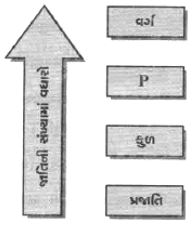
What is '$P$' in the given figure?
A
Subclass
B
Order
C
Phylum
D
Division
Solution
(B) The taxonomic hierarchy in ascending order is: Species < Genus < Family < Order < Class < Phylum/Division < Kingdom.
In the given figure,the sequence is: Species < Family < $P$ < Class.
According to the taxonomic hierarchy,the category between Family and Class is Order.
Therefore,'$P$' represents Order.
In the given figure,the sequence is: Species < Family < $P$ < Class.
According to the taxonomic hierarchy,the category between Family and Class is Order.
Therefore,'$P$' represents Order.
0 likes
View Solution289
EasyMCQ
The process of classifying organisms into different taxa based on their characteristics is called ........
A
Classification
B
Systematics
C
Taxonomy
D
Nomenclature
Solution
(C) The process of grouping organisms into categories or taxa based on their observable characteristics is known as $Taxonomy$.
$Classification$ is the act of arranging organisms into groups,but the scientific study and methodology of this process is defined as $Taxonomy$.
$Classification$ is the act of arranging organisms into groups,but the scientific study and methodology of this process is defined as $Taxonomy$.
0 likes
View Solution290
EasyMCQ
Which scientific term is used for the study of groups of organisms like mammals,reptiles,and plants?
A
Taxon
B
Class
C
Order
D
Kingdom
Solution
(A) In biological classification,a $Taxon$ (plural: $Taxa$) is a group of one or more populations of an organism or organisms seen by taxonomists to form a unit. Mammals,reptiles,and plants are examples of groups at different taxonomic levels (e.g.,$Class$ or $Kingdom$),but the general term used to refer to any such group at any rank in the taxonomic hierarchy is a $Taxon$.
0 likes
View Solution291
MediumMCQ
What knowledge is required to classify organisms into different categories?
A
Individual characteristics of organisms
B
The entire living world
C
Characteristics of groups of organisms
D
Both $(A)$ and $(C)$
Solution
(D) Taxonomy is the process of classification of organisms into different taxonomic groups. To classify an organism,it is essential to have knowledge of the individual characteristics of the organism (such as morphology,anatomy,and cell structure) as well as the characteristics of the group to which it belongs (to determine its relationships and placement in the hierarchy). Therefore,both individual and group characteristics are necessary for classification.
0 likes
View Solution292
MediumMCQ
Select the correct match for Column $X$ and Column $Y$:
| Column $X$ (Organism) | Column $Y$ (Family) | Column $Z$ (Order) |
| $(1)$ Sunflower | $(A)$ Blattidae | $(P)$ Opisthopora |
| $(2)$ Earthworm | $(B)$ Asteraceae | $(Q)$ Glumiflorae |
| $(C)$ Megascolecidae | $(R)$ Anura | |
| $(S)$ Asterales |
A
$(1-B-Q), (2-A-R)$
B
$(1-B-S), (2-C-P)$
C
$(1-C-Q), (2-A-R)$
D
$(1-B-R), (2-C-S)$
Solution
(B) $1$. Sunflower (Helianthus annuus) belongs to the Family Asteraceae and the Order Asterales. Thus, the match is $(1-B-S)$.
$2$. Earthworm (Pheretima posthuma) belongs to the Family Megascolecidae and the Order Opisthopora. Thus, the match is $(2-C-P)$.
Therefore, the correct combination is $(1-B-S)$ and $(2-C-P)$.
$2$. Earthworm (Pheretima posthuma) belongs to the Family Megascolecidae and the Order Opisthopora. Thus, the match is $(2-C-P)$.
Therefore, the correct combination is $(1-B-S)$ and $(2-C-P)$.
0 likes
View Solution293
EasyMCQ
Which scientific term is used for a convenient category for the study of organisms like fishes and mammals?
A
Class
B
Order
C
Taxon
D
Species
Solution
(C) In biological classification,organisms are grouped into various hierarchical categories known as taxonomic categories or ranks.
Each specific level in this hierarchy is referred to as a $Taxon$ (plural: $Taxa$).
For example,fishes and mammals are grouped under the category $Class$ (Class $Pisces$ and Class $Mammalia$,respectively).
However,the term used to represent any such convenient category or rank in the taxonomic hierarchy is $Taxon$.
Each specific level in this hierarchy is referred to as a $Taxon$ (plural: $Taxa$).
For example,fishes and mammals are grouped under the category $Class$ (Class $Pisces$ and Class $Mammalia$,respectively).
However,the term used to represent any such convenient category or rank in the taxonomic hierarchy is $Taxon$.
0 likes
View Solution294
MediumMCQ
In the binomial nomenclature system,an organism is named using two words. What are those two words?
A
Genus and Family
B
Family and Genus
C
Species and Family
D
Genus and Species
Solution
(D) Binomial nomenclature is a formal system of naming species of living things by giving each a name composed of two parts.
$1$. The first word represents the $Genus$ (generic name).
$2$. The second word represents the specific epithet or $Species$ (specific name).
Therefore,the correct answer is $Genus$ and $Species$.
$1$. The first word represents the $Genus$ (generic name).
$2$. The second word represents the specific epithet or $Species$ (specific name).
Therefore,the correct answer is $Genus$ and $Species$.
0 likes
View Solution295
EasyMCQ
What does each step in the taxonomic hierarchy represent?
A
Taxon
B
Rank
C
Category
D
Class
Solution
(C) In the taxonomic hierarchy,each step represents a rank or category.
Since the category is a part of the overall taxonomic arrangement,it is called a taxonomic category and all categories together constitute the taxonomic hierarchy.
Each category is referred to as a unit of classification and is commonly termed as a taxon (plural: taxa).
Since the category is a part of the overall taxonomic arrangement,it is called a taxonomic category and all categories together constitute the taxonomic hierarchy.
Each category is referred to as a unit of classification and is commonly termed as a taxon (plural: taxa).
0 likes
View Solution296
MediumMCQ
Which of the following statements is inconsistent with classification?
A
Organisms are grouped into specific meaningful categories at the first level.
B
It provides a convenient system for classifying any organism.
C
It is based on observable characteristics that can be summed up.
D
It involves naming organisms by following specific rules.
Solution
(C) Classification is the process by which anything is grouped into convenient categories based on some easily observable characters.
Option $A$ is consistent as classification involves grouping organisms into taxa.
Option $B$ is consistent as the primary purpose of classification is to provide a convenient system for identification.
Option $D$ is consistent as nomenclature follows specific rules (like binomial nomenclature).
Option $C$ is inconsistent because classification is not based on a simple 'sum' of observable characters,but rather on the analysis of specific,significant,and evolutionary relationships among organisms. Therefore,the statement that it is based on 'some summed up observable characters' is scientifically inaccurate in the context of modern taxonomy.
Option $A$ is consistent as classification involves grouping organisms into taxa.
Option $B$ is consistent as the primary purpose of classification is to provide a convenient system for identification.
Option $D$ is consistent as nomenclature follows specific rules (like binomial nomenclature).
Option $C$ is inconsistent because classification is not based on a simple 'sum' of observable characters,but rather on the analysis of specific,significant,and evolutionary relationships among organisms. Therefore,the statement that it is based on 'some summed up observable characters' is scientifically inaccurate in the context of modern taxonomy.
0 likes
View Solution297
EasyMCQ
The status given to groups of organisms arranged at different levels of classification is called:
A
Class
B
Taxon
C
Order
D
Category
Solution
(B) In biological classification,the taxonomic hierarchy consists of various levels or ranks.
Each level in this hierarchy represents a taxonomic category.
Any specific group of organisms at any level of this hierarchy is referred to as a $Taxon$ (plural: $Taxa$).
Therefore,the status or rank given to these groups is known as a taxonomic category.
Each level in this hierarchy represents a taxonomic category.
Any specific group of organisms at any level of this hierarchy is referred to as a $Taxon$ (plural: $Taxa$).
Therefore,the status or rank given to these groups is known as a taxonomic category.
0 likes
View Solution298
MediumMCQ
What is a taxonomic category?
A
$A$ group of related families
B
$A$ group of related species
C
$A$ type of living organism
D
$A$ rank or level in the taxonomic hierarchy
Solution
(D) taxonomic category is a rank or level in the taxonomic hierarchy. It represents a unit of classification in the system of biological classification. Each category is referred to as a unit of classification,commonly termed as a taxon (plural: taxa). Therefore,it is a part of the overall taxonomic arrangement.
0 likes
View Solution299
EasyMCQ
The study of which of the following is essential for agriculture,forestry,industries,and the conservation of bioresources and their diversity?
A
Geographical conditions
B
Field studies
C
Taxonomy
D
Bioresources
Solution
(C) Taxonomy is the branch of science that deals with the classification,nomenclature,and identification of organisms.
It provides a systematic understanding of the diversity of life,which is crucial for agriculture (identifying pests and crops),forestry (managing forest resources),industries (utilizing biological products),and the conservation of biodiversity.
Therefore,the study of taxonomy is essential for these fields.
It provides a systematic understanding of the diversity of life,which is crucial for agriculture (identifying pests and crops),forestry (managing forest resources),industries (utilizing biological products),and the conservation of biodiversity.
Therefore,the study of taxonomy is essential for these fields.
0 likes
View Solution300
MediumMCQ
What kind of relationship between organisms can be inferred from classification?
A
Direct
B
Indirect
C
Mutual
D
All of the above
Solution
(B) Classification is the process by which anything is grouped into convenient categories based on some easily observable characters. By classifying organisms into various taxonomic categories (like species,genus,family,etc.),we can infer the evolutionary and phylogenetic relationships between them. These relationships are generally considered indirect because they are based on morphological,anatomical,and genetic similarities rather than direct observation of ancestral lineages.
0 likes
View SolutionThe Living World — Taxonomic categories · Frequently Asked Questions
1Are these The Living World questions useful for JEE and NEET?
Yes. All questions in this section are mapped to JEE Main and NEET exam patterns. Previous year questions from JEE Main, NEET, GUJCET and state-level exams are included with full solutions.
2Can I switch to Hindi or Gujarati for these questions?
Yes. Use the language tabs in the hero section or the sidebar to view the same questions and solutions in English, Hindi or Gujarati.
3How do I generate a question paper from this subtopic?
Use the Vedclass Exam Paper Generator — select the chapter and subtopic, set difficulty, and generate Sets A, B, C, D automatically. First 3 chapters of every subject are free.
Vedclass Products
For Students
Vedclass Test Series
Mock tests in real JEE/NEET style with performance analysis. 5-day free trial.
Start Free TrialFor Teachers
Exam Paper Generator
Generate Set A/B/C/D papers from this chapter in 2 minutes. 3 chapters free.
Try FreeFor Institutes
Online Exam Module
Live online exams with unlimited students, 360° analytics & white-label branding.
See DemoFor Teachers & Institutes
Generate a The Living World Exam Paper in 2 Minutes
Select subtopic & difficulty — Sets A, B, C, D auto-generated with No Repeat logic.
First 3 chapters of every subject are free — no payment required.