
A English
Muscular tissue Questions in English
Class 11 Biology · Structural Organisation In Animals · Muscular tissue
73+
Questions
English
Language
100%
With Solutions
Showing 23 of 73 questions in English
51
EasyMCQ
Which type of muscles show peristaltic movements in the gastrointestinal tract?
A
Striated
B
Smooth
C
Cardiac
D
Skeletal
Solution
(B) Smooth muscles (non-striated muscles) are responsible for involuntary movements in the body,such as peristalsis,which is the rhythmic contraction and relaxation of muscles to move food through the alimentary canal.
These muscles are found in the walls of the oesophagus,stomach,and intestines,where they facilitate the peristaltic movement necessary for digestion.
These muscles are found in the walls of the oesophagus,stomach,and intestines,where they facilitate the peristaltic movement necessary for digestion.
0 likes
View Solution52
MediumMCQ
Which of the following is the correct pairing of a body part and the kind of muscle tissue that moves it?
A
Iris - Involuntary smooth muscle
B
Heart wall - Involuntary unstriated muscle
C
Biceps of upper arm - Smooth muscle fibres
D
Abdominal wall - Smooth muscle
Solution
(A) The correct pairing is as follows:
$1$. Iris - Involuntary smooth muscles (Correct).
$2$. Heart wall - Cardiac muscle (The heart wall consists of cardiac muscle,not unstriated muscle).
$3$. Biceps of upper arm - Skeletal muscle fibres (Biceps are voluntary muscles attached to bones,hence skeletal).
$4$. Muscles in abdominal wall - Skeletal muscles (These are primarily skeletal muscles involved in voluntary movement and posture).
Therefore,the correct option is $A$.
$1$. Iris - Involuntary smooth muscles (Correct).
$2$. Heart wall - Cardiac muscle (The heart wall consists of cardiac muscle,not unstriated muscle).
$3$. Biceps of upper arm - Skeletal muscle fibres (Biceps are voluntary muscles attached to bones,hence skeletal).
$4$. Muscles in abdominal wall - Skeletal muscles (These are primarily skeletal muscles involved in voluntary movement and posture).
Therefore,the correct option is $A$.
0 likes
View Solution53
MediumMCQ
$A$ : Smooth muscle fibres are unstriated,fusiform and uninucleate.
$R$ : These cells are involuntary in function.
$R$ : These cells are involuntary in function.
A
Assertion and Reason both are correct and Reason is the correct explanation of Assertion.
B
Assertion and Reason both are correct but Reason is not the correct explanation of Assertion.
C
Assertion is correct,but Reason is incorrect.
D
Both Assertion and Reason are incorrect.
Solution
(B) Assertion is true because smooth muscle fibres are non-striated (lack cross-striations),fusiform (spindle-shaped,tapering at both ends),and uninucleate (contain a single,centrally located nucleus).
Reason is true because smooth muscles are involuntary,meaning their contraction is not under direct conscious control.
While both statements are correct,the involuntary nature of the muscle is a functional characteristic,whereas the structural description (unstriated,fusiform,uninucleate) is a morphological characteristic. Therefore,the Reason does not explain why the muscle has that specific structure.
Reason is true because smooth muscles are involuntary,meaning their contraction is not under direct conscious control.
While both statements are correct,the involuntary nature of the muscle is a functional characteristic,whereas the structural description (unstriated,fusiform,uninucleate) is a morphological characteristic. Therefore,the Reason does not explain why the muscle has that specific structure.
0 likes
View Solution54
EasyMCQ
The heart muscles are
A
Striated and involuntary
B
Striated and voluntary
C
Smooth and involuntary
D
Non-striated and involuntary
Solution
(A) Cardiac muscles are specialized muscles found only in the heart.
They exhibit striations (bands) similar to skeletal muscles, which is why they are classified as striated.
However, unlike skeletal muscles, they are not under conscious control, meaning they are involuntary.
Therefore, cardiac muscles are $Striated$ and $Involuntary$.
They exhibit striations (bands) similar to skeletal muscles, which is why they are classified as striated.
However, unlike skeletal muscles, they are not under conscious control, meaning they are involuntary.
Therefore, cardiac muscles are $Striated$ and $Involuntary$.
0 likes
View Solution55
EasyMCQ
Striped muscles are characterized by
A
Syncytial
B
Spindle shape
C
Uninucleate
D
None of these
Solution
(A) Striped muscles are also known as skeletal muscles or voluntary muscles.
These muscles are composed of a large number of muscle fibres.
Skeletal muscle fibres are multinucleated,meaning they contain many nuclei within a single cell membrane,a condition known as syncytial.
They are also characterized by the presence of striations and are not spindle-shaped (which is a characteristic of smooth muscles).
These muscles are composed of a large number of muscle fibres.
Skeletal muscle fibres are multinucleated,meaning they contain many nuclei within a single cell membrane,a condition known as syncytial.
They are also characterized by the presence of striations and are not spindle-shaped (which is a characteristic of smooth muscles).
0 likes
View Solution56
MediumMCQ
In a vertebrate,which germ layer forms the skeletal muscles?
A
Ectoderm
B
Endoderm
C
Mesoderm
D
Both $(A)$ and $(C)$
Solution
(C) During embryonic development,the three primary germ layers give rise to different tissues and organs in vertebrates:
$1$. Ectoderm: Forms the nervous system,epidermis of the skin,and associated structures.
$2$. Mesoderm: Forms the connective tissues,including bones,cartilage,blood,and all types of muscles (skeletal,smooth,and cardiac).
$3$. Endoderm: Forms the epithelial lining of the digestive tract,respiratory system,and associated organs like the liver and pancreas.
Therefore,skeletal muscles are derived from the mesoderm.
$1$. Ectoderm: Forms the nervous system,epidermis of the skin,and associated structures.
$2$. Mesoderm: Forms the connective tissues,including bones,cartilage,blood,and all types of muscles (skeletal,smooth,and cardiac).
$3$. Endoderm: Forms the epithelial lining of the digestive tract,respiratory system,and associated organs like the liver and pancreas.
Therefore,skeletal muscles are derived from the mesoderm.
0 likes
View Solution57
EasyMCQ
Which one of the following is wrongly matched?
A
Myosin - Contractile protein
B
Tendon - Connective Tissue
C
Smooth muscle - Voluntary Muscles
D
Red muscle - Myoglobin
Solution
(C) The correct answer is $C$. Smooth muscles are involuntary muscles,meaning they are not under conscious control. They are found in the walls of internal organs like the stomach,intestine,and blood vessels. In contrast,skeletal muscles are voluntary muscles. Myosin is indeed a contractile protein,tendons are dense regular connective tissues,and red muscle fibers contain high amounts of myoglobin.
0 likes
View Solution58
MediumMCQ
Intercalated disc is found in
A
Muscles of heart
B
Vertebrae
C
Muscles of legs
D
Pubic symphysis
Solution
(A) Intercalated discs are found in cardiac muscle. They are irregular transverse thickenings of the sarcolemma that contain desmosomes,which hold cardiac muscle fibres together,and gap junctions,which aid in the conduction of muscle action potentials.
0 likes
View Solution59
MediumMCQ
Which one is wrongly matched?
A
Tendon - Connective tissue
B
Smooth muscle - Involuntary muscle
C
Red muscle - Myoglobin
D
Troponin - Fibrous protein
Solution
(D) The correct answer is $D$.
Tendon is a dense regular connective tissue that connects muscle to bone.
Smooth muscles are involuntary muscles found in the walls of internal organs.
Red muscles contain high amounts of myoglobin,which provides oxygen for aerobic respiration.
Troponin is a globular protein complex involved in muscle contraction,whereas tropomyosin is a fibrous protein that covers the active sites on actin filaments.
Tendon is a dense regular connective tissue that connects muscle to bone.
Smooth muscles are involuntary muscles found in the walls of internal organs.
Red muscles contain high amounts of myoglobin,which provides oxygen for aerobic respiration.
Troponin is a globular protein complex involved in muscle contraction,whereas tropomyosin is a fibrous protein that covers the active sites on actin filaments.
0 likes
View Solution60
MediumMCQ
The muscle is a specialised tissue which is originated from
A
Endoderm
B
Mesoderm
C
Ectoderm
D
Yolk sac
Solution
(B) Muscles are specialized tissues that are derived from the embryonic mesoderm layer.
During embryonic development,the three germ layers (ectoderm,mesoderm,and endoderm) give rise to different tissues and organs.
The mesoderm is responsible for the formation of muscles,bones,cartilage,the circulatory system,and the dermis of the skin.
During embryonic development,the three germ layers (ectoderm,mesoderm,and endoderm) give rise to different tissues and organs.
The mesoderm is responsible for the formation of muscles,bones,cartilage,the circulatory system,and the dermis of the skin.
0 likes
View Solution61
EasyMCQ
The specialised cells that make the muscular tissue are
A
Neuroblast
B
Osteoblast
C
Osteocytes
D
Myocytes
Solution
(D) $Myocytes$: These are the specialized cells that make up the muscular tissue and are responsible for contraction.
$Osteoblast$: These are the cells responsible for bone formation.
$Osteocytes$: These are mature bone cells found within the bone matrix.
$Neuroblast$: These are embryonic cells that develop into nerve cells or neurons.
$Osteoblast$: These are the cells responsible for bone formation.
$Osteocytes$: These are mature bone cells found within the bone matrix.
$Neuroblast$: These are embryonic cells that develop into nerve cells or neurons.
0 likes
View Solution62
MediumMCQ
Which of the following is an example of multiunit smooth muscles?
A
Smooth muscle in uterine wall
B
Smooth muscle of the intestine
C
Masseter muscle of the jaw
D
Arrector pili muscle of skin
Solution
(D) Multiunit smooth muscle fibers: The smooth muscle cells in an organ behave independently,where each cell contracts and relaxes on its own.
Examples include the iris of the eye,the ciliary body,and the arrector pili muscles of the skin.
Single-unit (visceral) smooth muscle: Cells are interconnected by gap junctions,causing them to contract as a single unit.
Examples include the walls of the gastrointestinal tract,the uterus,and the urinogenital tract.
Therefore,the arrector pili muscle is a classic example of multiunit smooth muscle.
Examples include the iris of the eye,the ciliary body,and the arrector pili muscles of the skin.
Single-unit (visceral) smooth muscle: Cells are interconnected by gap junctions,causing them to contract as a single unit.
Examples include the walls of the gastrointestinal tract,the uterus,and the urinogenital tract.
Therefore,the arrector pili muscle is a classic example of multiunit smooth muscle.
0 likes
View Solution63
MediumMCQ
Which of the following statements wrongly represents the nature of smooth muscle?
A
These muscles have no striations.
B
They are involuntary muscles.
C
Communication among the cells is performed by intercalated discs.
D
These muscles are present in the wall of blood vessels.
Solution
(C) Smooth muscles are non-striated,involuntary muscles found in the walls of internal organs such as blood vessels,the stomach,and the intestine.
Intercalated discs are specialized junctions found exclusively in cardiac muscles,which allow for rapid communication and synchronized contraction of the heart.
Therefore,the statement that communication among smooth muscle cells is performed by intercalated discs is incorrect.
Intercalated discs are specialized junctions found exclusively in cardiac muscles,which allow for rapid communication and synchronized contraction of the heart.
Therefore,the statement that communication among smooth muscle cells is performed by intercalated discs is incorrect.
0 likes
View Solution64
MediumMCQ
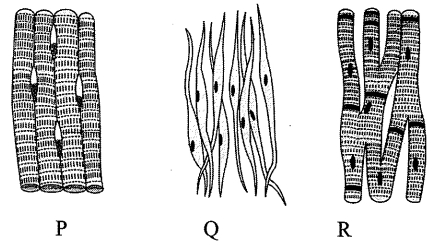
Identify the following muscle types shown in the image.
A
$P$: Cardiac muscle,$Q$: Skeletal muscle,$R$: Smooth muscle
B
$P$: Skeletal muscle,$Q$: Smooth muscle,$R$: Cardiac muscle
C
$P$: Smooth muscle,$Q$: Skeletal muscle,$R$: Cardiac muscle
D
$P$: Cardiac muscle,$Q$: Smooth muscle,$R$: Skeletal muscle
Solution
(B) Based on the structural characteristics shown in the image:
$P$ represents Skeletal muscle,which is striated,multinucleated,and cylindrical.
$Q$ represents Smooth muscle,which is spindle-shaped,uninucleated,and non-striated.
$R$ represents Cardiac muscle,which is striated,branched,and contains intercalated discs.
Therefore,the correct sequence is $P$: Skeletal muscle,$Q$: Smooth muscle,$R$: Cardiac muscle. This corresponds to option $B$.
$P$ represents Skeletal muscle,which is striated,multinucleated,and cylindrical.
$Q$ represents Smooth muscle,which is spindle-shaped,uninucleated,and non-striated.
$R$ represents Cardiac muscle,which is striated,branched,and contains intercalated discs.
Therefore,the correct sequence is $P$: Skeletal muscle,$Q$: Smooth muscle,$R$: Cardiac muscle. This corresponds to option $B$.
0 likes
View Solution65
MediumMCQ
Which type of muscle is found in the blood vessels?
A
Involuntary muscle
B
Voluntary muscle
C
Cardiac muscle
D
None of these
Solution
(A) The walls of blood vessels are lined with smooth muscle tissue.
Smooth muscles are involuntary in nature,meaning they are not under conscious control.
They are also known as non-striated or unstriped muscles.
Therefore,the correct answer is involuntary muscle.
Smooth muscles are involuntary in nature,meaning they are not under conscious control.
They are also known as non-striated or unstriped muscles.
Therefore,the correct answer is involuntary muscle.
0 likes
View Solution66
MediumMCQ
What is the structure of smooth muscle fibers found in the intestine?
A
Cylindrical and uninucleated
B
Cylindrical and multinucleated
C
Fusiform and uninucleated
D
Fusiform and multinucleated
Solution
(C) The muscles found in the walls of the intestine are smooth muscles (also known as visceral or involuntary muscles).
Smooth muscle fibers are fusiform (spindle-shaped) in structure,meaning they are thick in the middle and tapered at both ends.
Each smooth muscle fiber contains a single,centrally located nucleus (uninucleated).
Therefore,they are described as fusiform and uninucleated.
Smooth muscle fibers are fusiform (spindle-shaped) in structure,meaning they are thick in the middle and tapered at both ends.
Each smooth muscle fiber contains a single,centrally located nucleus (uninucleated).
Therefore,they are described as fusiform and uninucleated.
0 likes
View Solution67
MediumMCQ
Which type of muscle tissue is found only in a single organ of the body?
A
Involuntary muscle
B
Voluntary muscle
C
Cardiac muscle
D
None of the above
Solution
(C) Cardiac muscle tissue is a specialized type of muscle tissue that is found exclusively in the heart.
Unlike skeletal muscles (voluntary) which are attached to bones throughout the body,or smooth muscles (involuntary) which are found in the walls of various hollow organs like the stomach,intestines,and blood vessels,cardiac muscle is restricted to the heart wall (myocardium).
Therefore,it is unique to a single organ.
Unlike skeletal muscles (voluntary) which are attached to bones throughout the body,or smooth muscles (involuntary) which are found in the walls of various hollow organs like the stomach,intestines,and blood vessels,cardiac muscle is restricted to the heart wall (myocardium).
Therefore,it is unique to a single organ.
0 likes
View Solution68
MediumMCQ
From which germ layer do muscles originate?
A
Ectoderm
B
Mesoderm
C
Endoderm
D
All of the above
Solution
(B) Muscles are specialized tissues of mesodermal origin.
During embryonic development,the three primary germ layers are formed: the ectoderm,the mesoderm,and the endoderm.
The mesoderm gives rise to various structures including the muscular system,the skeletal system,the circulatory system,and the dermis of the skin.
Therefore,the correct answer is $B$ (Mesoderm).
During embryonic development,the three primary germ layers are formed: the ectoderm,the mesoderm,and the endoderm.
The mesoderm gives rise to various structures including the muscular system,the skeletal system,the circulatory system,and the dermis of the skin.
Therefore,the correct answer is $B$ (Mesoderm).
0 likes
View Solution69
MediumMCQ
Select the correct option from the following.
A
Voluntary muscles - Striated muscles,Cardiac muscles
Involuntary muscles - Non-striated muscles
Involuntary muscles - Non-striated muscles
B
Voluntary muscles - Non-striated muscles
Involuntary muscles - Striated muscles,Cardiac muscles
Involuntary muscles - Striated muscles,Cardiac muscles
C
Voluntary muscles - Non-striated muscles,Cardiac muscles
Involuntary muscles - Striated muscles
Involuntary muscles - Striated muscles
D
Voluntary muscles - Striated muscles
Involuntary muscles - Non-striated muscles,Cardiac muscles
Involuntary muscles - Non-striated muscles,Cardiac muscles
Solution
(D) $1$. Voluntary muscles are those that are under the conscious control of the nervous system. Skeletal muscles are voluntary and are striated in appearance.
$2$. Involuntary muscles are those that are not under conscious control. These include smooth (non-striated) muscles and cardiac muscles.
$3$. Therefore,Voluntary muscles consist of striated muscles,while Involuntary muscles consist of non-striated (smooth) muscles and cardiac muscles.
$2$. Involuntary muscles are those that are not under conscious control. These include smooth (non-striated) muscles and cardiac muscles.
$3$. Therefore,Voluntary muscles consist of striated muscles,while Involuntary muscles consist of non-striated (smooth) muscles and cardiac muscles.
0 likes
View Solution70
MediumMCQ
Which type of muscle is found in the visceral organs of the body?
A
Striated muscle
B
Smooth muscle
C
Cardiac muscle
D
All of the above
Solution
(B) Visceral organs (such as the alimentary canal,reproductive tract,and blood vessels) contain smooth muscles.
These muscles are involuntary in nature and are also known as non-striated or unstriped muscles.
Striated muscles are primarily associated with the skeletal system,while cardiac muscles are exclusively found in the heart.
These muscles are involuntary in nature and are also known as non-striated or unstriped muscles.
Striated muscles are primarily associated with the skeletal system,while cardiac muscles are exclusively found in the heart.
0 likes
View Solution71
MediumMCQ
What are the characteristics of muscle cells found in the reproductive tract?
A
Cylindrical and multinucleated
B
Cylindrical and uninucleated
C
Fusiform and multinucleated
D
Fusiform and uninucleated
Solution
(D) The reproductive tract,like other visceral organs,is lined with smooth muscle tissue.
Smooth muscle cells are characterized by being fusiform (spindle-shaped) in structure.
They contain a single,centrally located nucleus,making them uninucleated.
Therefore,the correct description is fusiform and uninucleated.
Smooth muscle cells are characterized by being fusiform (spindle-shaped) in structure.
They contain a single,centrally located nucleus,making them uninucleated.
Therefore,the correct description is fusiform and uninucleated.
0 likes
View Solution72
MediumMCQ
Choose the correct statement about a muscular tissue :
A
Skeletal muscle fibres are uninucleated and found in parallel bundles.
B
Intercalated discs allow the cardiac muscle cells to contract as a unit.
C
The walls of blood vessels are made up of columnar epithelium.
D
Smooth muscles are multinucleated and involuntary.
Solution
(B) $1$. Skeletal muscle fibres are multinucleated (syncytial) and arranged in parallel bundles,not uninucleated.
$2$. Cardiac muscle cells are connected by intercalated discs,which function as communication junctions (gap junctions) allowing the cells to contract as a single unit.
$3$. The walls of blood vessels are primarily composed of smooth muscle tissue,not columnar epithelium.
$4$. Smooth muscles are uninucleated and involuntary,not multinucleated.
$2$. Cardiac muscle cells are connected by intercalated discs,which function as communication junctions (gap junctions) allowing the cells to contract as a single unit.
$3$. The walls of blood vessels are primarily composed of smooth muscle tissue,not columnar epithelium.
$4$. Smooth muscles are uninucleated and involuntary,not multinucleated.
0 likes
View Solution73
MediumMCQ
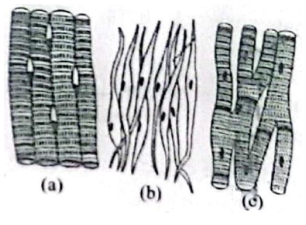
Three types of muscles are given as $a, b$ and $c$. Identify the correct matching pair along with their location in the human body:
$a$: Skeletal muscle
$b$: Smooth muscle
$c$: Cardiac muscle
$a$: Skeletal muscle
$b$: Smooth muscle
$c$: Cardiac muscle
A
$(a)$ Skeletal - Triceps
$(b)$ Smooth - Stomach
$(c)$ Cardiac - Heart
$(b)$ Smooth - Stomach
$(c)$ Cardiac - Heart
B
$(a)$ Skeletal - Biceps
$(b)$ Involuntary - Intestine
$(c)$ Smooth - Heart
$(b)$ Involuntary - Intestine
$(c)$ Smooth - Heart
C
$(a)$ Involuntary - Nose tip
$(b)$ Skeletal - Bone
$(c)$ Cardiac - Heart
$(b)$ Skeletal - Bone
$(c)$ Cardiac - Heart
D
$(a)$ Smooth - Toes
$(b)$ Skeletal - Legs
$(c)$ Cardiac - Heart
$(b)$ Skeletal - Legs
$(c)$ Cardiac - Heart
Solution
(A) The correct answer is option $(A)$.
Figure $(a)$ represents skeletal muscle fibres,which are striated and closely attached to skeletal bones. In a typical muscle such as the triceps,these fibres are bundled together in a parallel fashion.
Figure $(b)$ represents smooth muscle fibres,which are fusiform (spindle-shaped) and present in the walls of internal organs such as the stomach and intestine.
Figure $(c)$ represents cardiac muscle fibres,which are branched and exclusively present in the heart.
Figure $(a)$ represents skeletal muscle fibres,which are striated and closely attached to skeletal bones. In a typical muscle such as the triceps,these fibres are bundled together in a parallel fashion.
Figure $(b)$ represents smooth muscle fibres,which are fusiform (spindle-shaped) and present in the walls of internal organs such as the stomach and intestine.
Figure $(c)$ represents cardiac muscle fibres,which are branched and exclusively present in the heart.
0 likes
View SolutionStructural Organisation In Animals — Muscular tissue · Frequently Asked Questions
1Are these Structural Organisation In Animals questions useful for JEE and NEET?
Yes. All questions in this section are mapped to JEE Main and NEET exam patterns. Previous year questions from JEE Main, NEET, GUJCET and state-level exams are included with full solutions.
2Can I switch to Hindi or Gujarati for these questions?
Yes. Use the language tabs in the hero section or the sidebar to view the same questions and solutions in English, Hindi or Gujarati.
3How do I generate a question paper from this subtopic?
Use the Vedclass Exam Paper Generator — select the chapter and subtopic, set difficulty, and generate Sets A, B, C, D automatically. First 3 chapters of every subject are free.
Vedclass Products
For Students
Vedclass Test Series
Mock tests in real JEE/NEET style with performance analysis. 5-day free trial.
Start Free TrialFor Teachers
Exam Paper Generator
Generate Set A/B/C/D papers from this chapter in 2 minutes. 3 chapters free.
Try FreeFor Institutes
Online Exam Module
Live online exams with unlimited students, 360° analytics & white-label branding.
See DemoFor Teachers & Institutes
Generate a Structural Organisation In Animals Exam Paper in 2 Minutes
Select subtopic & difficulty — Sets A, B, C, D auto-generated with No Repeat logic.
First 3 chapters of every subject are free — no payment required.