
A English
Morphology of Cockroach Questions in English
Class 11 Biology · Structural Organisation In Animals · Morphology of Cockroach
195+
Questions
English
Language
100%
With Solutions
Showing 45 of 195 questions in English
151
Medium
Describe the wings of a cockroach.
Solution
(N/A) $\rightarrow$ The cockroach has two pairs of wings.
$1$. The first pair of wings,known as the forewings or $Tegmina$,arises from the $Mesothorax$. These wings are opaque,dark,and leathery,and they serve to cover and protect the hind wings when the cockroach is at rest.
$2$. The second pair of wings arises from the $Metathorax$. These hind wings are transparent and membranous,and they are primarily used for flight.
$1$. The first pair of wings,known as the forewings or $Tegmina$,arises from the $Mesothorax$. These wings are opaque,dark,and leathery,and they serve to cover and protect the hind wings when the cockroach is at rest.
$2$. The second pair of wings arises from the $Metathorax$. These hind wings are transparent and membranous,and they are primarily used for flight.
0 likes
View Solution152
Easy
Describe the structure of oothecae in cockroach.
Solution
(N/A) The ootheca in a cockroach is a dark reddish to blackish brown capsule that contains fertilized eggs.
It is approximately $8 \ mm$ long.
They are dropped or glued to a suitable surface,usually in a crack or crevice of high relative humidity near a food source.
On average,each female produces $9-10$ oothecae,and each ootheca contains $14-16$ eggs.
It is approximately $8 \ mm$ long.
They are dropped or glued to a suitable surface,usually in a crack or crevice of high relative humidity near a food source.
On average,each female produces $9-10$ oothecae,and each ootheca contains $14-16$ eggs.
0 likes
View Solution153
Medium
Give scientific reasons: Cockroaches are harmful to human life.
Solution
(N/A) $1$. Many species of cockroaches are wild and have no economic importance,but a few species thrive in and around human habitats.
$2$. They are considered pests because they destroy food and contaminate it with their smelly excreta.
$3$. They act as vectors for various diseases by carrying pathogens on their bodies and contaminating food and water,which can transmit bacterial diseases to humans.
$2$. They are considered pests because they destroy food and contaminate it with their smelly excreta.
$3$. They act as vectors for various diseases by carrying pathogens on their bodies and contaminating food and water,which can transmit bacterial diseases to humans.
0 likes
View Solution154
Medium
Mention the special features of the eye in a cockroach. Discuss the compound eye in arthropods and mention its structural features.
Solution
(N/A) $ \Rightarrow $ The eye of a cockroach is situated at the dorsal surface of the head in the form of black, kidney-shaped patches. It is a compound eye. Each eye consists of about $ 2000 $ hexagonal ommatidia.
$ \Rightarrow $ Each compound eye possesses a dioptric region and a receptor region. It is able to form different images of whatever it sees.
$ \Rightarrow $ Hence, a cockroach can receive several images of an object. This kind of vision is known as mosaic vision. From the inner end of each compound eye, thin nerve fibres emerge. They all unite to form the optic nerve, which connects to the brain.
$ \Rightarrow $ In arthropods, the compound eye is the primary visual organ. Its structural unit is the ommatidium. Each ommatidium consists of a corneal lens, crystalline cone, iris pigment cells, receptor cells (retinula cells), and a rhabdom, all supported by a basement membrane. These units work together to provide a wide field of view and high sensitivity to motion.
$ \Rightarrow $ Each compound eye possesses a dioptric region and a receptor region. It is able to form different images of whatever it sees.
$ \Rightarrow $ Hence, a cockroach can receive several images of an object. This kind of vision is known as mosaic vision. From the inner end of each compound eye, thin nerve fibres emerge. They all unite to form the optic nerve, which connects to the brain.
$ \Rightarrow $ In arthropods, the compound eye is the primary visual organ. Its structural unit is the ommatidium. Each ommatidium consists of a corneal lens, crystalline cone, iris pigment cells, receptor cells (retinula cells), and a rhabdom, all supported by a basement membrane. These units work together to provide a wide field of view and high sensitivity to motion.
0 likes
View Solution155
Easy
Write a note on the mouthparts of a cockroach.
Solution
(N/A) The mouthparts of a cockroach are of the biting and chewing type. They consist of the following structures:
$1$. $A$ labrum (upper lip).
$2$. $A$ pair of mandibles.
$3$. $A$ pair of maxillae.
$4$. $A$ labium (lower lip).
Additionally,a median flexible lobe,known as the hypopharynx,acts as a tongue and lies within the cavity enclosed by the mouthparts.
$1$. $A$ labrum (upper lip).
$2$. $A$ pair of mandibles.
$3$. $A$ pair of maxillae.
$4$. $A$ labium (lower lip).
Additionally,a median flexible lobe,known as the hypopharynx,acts as a tongue and lies within the cavity enclosed by the mouthparts.
0 likes
View Solution156
Medium
Describe the structure of oothecae in cockroach.
Solution
(N/A) $\Rightarrow$ On an average,females produce $9-10$ oothecae,each containing $14-16$ eggs.
$\Rightarrow$ The development of $P. \text{ americana}$ is paurometabolous,meaning development occurs through nymphal stages.
$\Rightarrow$ The nymph looks very much like the adult. The nymph grows by moulting about $13$ times to reach the adult form.
$\Rightarrow$ The next-to-last nymphal stage has wing pads,but only adult cockroaches have fully developed wings.
$\Rightarrow$ The development of $P. \text{ americana}$ is paurometabolous,meaning development occurs through nymphal stages.
$\Rightarrow$ The nymph looks very much like the adult. The nymph grows by moulting about $13$ times to reach the adult form.
$\Rightarrow$ The next-to-last nymphal stage has wing pads,but only adult cockroaches have fully developed wings.
0 likes
View Solution157
MediumMCQ
Choose the correct statement for Periplaneta americana.
A
It has $6$ muscular hearts.
B
It has $10$ thoracic segments.
C
Anal style is present in both male and female.
D
It is nocturnal and present in damp places.
Solution
(D) Periplaneta americana is a nocturnal organism that prefers to live in damp and dark places.
Regarding other options:
- Cockroaches have $13$ chambers in their heart,not $6$.
- The thorax consists of only $3$ segments (prothorax,mesothorax,and metathorax),not $10$.
- Anal styles are present only in males,whereas anal cerci are present in both sexes.
Regarding other options:
- Cockroaches have $13$ chambers in their heart,not $6$.
- The thorax consists of only $3$ segments (prothorax,mesothorax,and metathorax),not $10$.
- Anal styles are present only in males,whereas anal cerci are present in both sexes.
0 likes
View Solution158
MediumMCQ
Which of the following statements is not true for a cockroach?
A
$1$ pair of compound eyes
B
Forewings called tegmina used for flight are attached to the $1^{st}$ thoracic segment
C
$1$ pair of maxilla and mandible
D
Has $10$ abdominal segments
Solution
(B) The cockroach has three thoracic segments: prothorax,mesothorax,and metathorax. The forewings (tegmina) are attached to the mesothorax (the $2^{nd}$ thoracic segment),not the prothorax (the $1^{st}$ thoracic segment). Therefore,the statement in option $B$ is incorrect.
0 likes
View Solution159
EasyMCQ
Complete metamorphosis is found in
A
House-fly and mosquito
B
House-fly and cockroach
C
Mosquito and cockroach
D
None of the above
Solution
(A) Complete metamorphosis (holometabolous development) involves four distinct stages: egg,larva,pupa,and adult. Both house-flies and mosquitoes undergo this type of development. In contrast,cockroaches exhibit incomplete metamorphosis (paurometabolous development),which involves three stages: egg,nymph,and adult.
0 likes
View Solution160
EasyMCQ
The correct sequence of arrangements of segments in the leg of cockroach is
A
Tibia,trochanter,femur,tarsus and coxa
B
Trochanter,coxa,tibia,femur and tarsus
C
Coxa,femur,trochanter,tibia and tarsus
D
Coxa,trochanter,femur,tibia and tarsus
Solution
(D) The leg of a cockroach consists of five segments.
Starting from the base (proximal end) to the tip (distal end),the correct sequence of these segments is:
$1$. $Coxa$ (the basal segment attached to the thorax)
$2$. $Trochanter$ (a small segment)
$3$. $Femur$ (the largest and thickest segment)
$4$. $Tibia$ (a long,slender segment)
$5$. $Tarsus$ (the terminal part,consisting of tarsomeres)
Therefore,the correct sequence is $Coxa$,$Trochanter$,$Femur$,$Tibia$,and $Tarsus$.
Starting from the base (proximal end) to the tip (distal end),the correct sequence of these segments is:
$1$. $Coxa$ (the basal segment attached to the thorax)
$2$. $Trochanter$ (a small segment)
$3$. $Femur$ (the largest and thickest segment)
$4$. $Tibia$ (a long,slender segment)
$5$. $Tarsus$ (the terminal part,consisting of tarsomeres)
Therefore,the correct sequence is $Coxa$,$Trochanter$,$Femur$,$Tibia$,and $Tarsus$.
0 likes
View Solution161
MediumMCQ
In cockroach,the head can move in all directions due to:
A
absence of neck.
B
fusion of all $6$ segments of head.
C
flexible neck.
D
head is small and light weight.
Solution
(C) The head of the cockroach is triangular in shape and lies anteriorly at right angles to the longitudinal body axis.
It is formed by the fusion of $6$ segments.
The neck is a short extension of the prothorax,which is flexible and facilitates a wide range of movement in all directions.
It is formed by the fusion of $6$ segments.
The neck is a short extension of the prothorax,which is flexible and facilitates a wide range of movement in all directions.
0 likes
View Solution162
MediumMCQ
What external changes are visible after the last moult of a cockroach nymph?
A
Development of anal cerci.
B
Development of both forewings and hind wings.
C
Development of labium.
D
Mandibles become harder.
Solution
(B) The development of a cockroach is paurometabolous,meaning that its development occurs through a nymphal stage. The nymphs resemble adults closely. The nymph grows by moulting approximately $13$ times to reach the adult form. The last nymphal stage possesses wing pads,whereas adult cockroaches possess fully developed wings (forewings and hind wings).
0 likes
View Solution163
MediumMCQ
The diagram given below represents the posterior part of the male cockroach. Choose the correct labelling for the parts marked as $A, B, C$ and $D$.
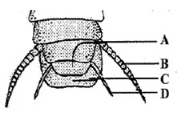
A
$A - 9$th sternum,$B$ - Anal cercus,$C - 10$th tergum,$D$ - Anal style
B
$A - 8$th sternum,$B$ - Anal style,$C - 10$th tergum,$D$ - Anal cerci
C
$A - 7$th sternum,$B$ - Anal cerci,$C - 10$th tergum,$D$ - Anal cerci
D
$A - 10$th sternum,$B$ - Anal style,$C - 10$th tergum,$D$ - Anal style
Solution
(A) In the given diagram of the posterior part of a male cockroach:
$A$ represents the $9$th sternum.
$B$ represents the anal cercus (jointed filamentous structure).
$C$ represents the $10$th tergum.
$D$ represents the anal style (short,thread-like structure present only in males).
Therefore,the correct labelling is $A - 9$th sternum,$B$ - Anal cercus,$C - 10$th tergum,$D$ - Anal style.
$A$ represents the $9$th sternum.
$B$ represents the anal cercus (jointed filamentous structure).
$C$ represents the $10$th tergum.
$D$ represents the anal style (short,thread-like structure present only in males).
Therefore,the correct labelling is $A - 9$th sternum,$B$ - Anal cercus,$C - 10$th tergum,$D$ - Anal style.
0 likes
View Solution164
MediumMCQ
The following figure shows the external features of a cockroach with a few structures labeled as $A, B, C, D$,and $E$. Identify the correct labels.
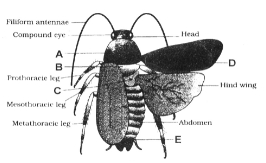
A
$A$- Mesothorax,$B$-Pronotum,$C$-Metathorax,$D$-Tegmina,$E$-Anal style
B
$A$- Pronotum,$B$-Metathorax,$C$-Mesothorax,$D$-Tegmina,$E$-Sterna
C
$A$- Pronotum,$B$-Mesothorax,$C$-Metathorax,$D$-Tegmina,$E$-Anal cerci
D
$A$- Pronotum,$B$-Mesothorax,$C$-Metathorax,$D$-Tegmina,$E$-Anal style
Solution
(C) Based on the morphological structure of the cockroach:
$A$ represents the Pronotum,which is the dorsal sclerite of the prothorax.
$B$ represents the Mesothorax,the middle segment of the thorax.
$C$ represents the Metathorax,the posterior segment of the thorax.
$D$ represents the Tegmina (forewings),which are opaque,dark,and leathery.
$E$ represents the Anal cerci,which are paired,jointed,filamentous structures present in both male and female cockroaches.
Therefore,the correct labeling is $A$- Pronotum,$B$-Mesothorax,$C$-Metathorax,$D$-Tegmina,$E$-Anal cerci.
$A$ represents the Pronotum,which is the dorsal sclerite of the prothorax.
$B$ represents the Mesothorax,the middle segment of the thorax.
$C$ represents the Metathorax,the posterior segment of the thorax.
$D$ represents the Tegmina (forewings),which are opaque,dark,and leathery.
$E$ represents the Anal cerci,which are paired,jointed,filamentous structures present in both male and female cockroaches.
Therefore,the correct labeling is $A$- Pronotum,$B$-Mesothorax,$C$-Metathorax,$D$-Tegmina,$E$-Anal cerci.
0 likes
View Solution165
EasyMCQ
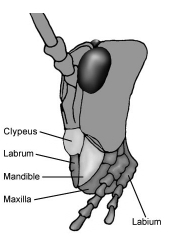
The figure given below shows the head region of a cockroach. Identify $A$ to $D$.
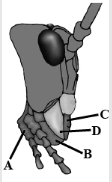
A
$A$-Maxilla,$B$-Mandible,$C$-Labium,$D$-Labrum
B
$A$-Labium,$B$-Maxilla,$C$-Labrum,$D$-Mandible
C
$A$-Mandible,$B$-Maxilla,$C$-Labium,$D$-Labrum
D
$A$-Labium,$B$-Labrum,$C$-Maxilla,$D$-Mandible
Solution
(B) Based on the anatomical structure of the cockroach mouthparts shown in the figure:
$A$ represents the Labium (lower lip).
$B$ represents the Maxilla.
$C$ represents the Labrum (upper lip).
$D$ represents the Mandible.
Therefore,the correct sequence is $A$-Labium,$B$-Maxilla,$C$-Labrum,$D$-Mandible.
$A$ represents the Labium (lower lip).
$B$ represents the Maxilla.
$C$ represents the Labrum (upper lip).
$D$ represents the Mandible.
Therefore,the correct sequence is $A$-Labium,$B$-Maxilla,$C$-Labrum,$D$-Mandible.
0 likes
View Solution166
MediumMCQ
Cockroaches are brown or black bodied animals that are included in the class and phylum respectively:
A
$Insecta$; $Annelida$
B
$Insecta$; $Arthropoda$
C
$Reptilia$; $Arthropoda$
D
$Reptilia$; $Annelida$
Solution
(B) Cockroaches are brown or black-bodied animals.
They belong to the kingdom $Animalia$,phylum $Arthropoda$,class $Insecta$,and order $Blattaria$.
Therefore,the correct classification is class $Insecta$ and phylum $Arthropoda$.
They belong to the kingdom $Animalia$,phylum $Arthropoda$,class $Insecta$,and order $Blattaria$.
Therefore,the correct classification is class $Insecta$ and phylum $Arthropoda$.
0 likes
View Solution167
MediumMCQ
The mouth parts of cockroach are
A
cutting and biting type.
B
piercing and sucking type.
C
sucking and rasping type.
D
sucking and siphoning type.
Solution
(A) Cockroaches possess biting and cutting type of mouth parts,which are adapted for feeding on a variety of organic matter.
Mosquitoes have piercing and sucking type of mouth parts.
Houseflies possess sponging type of mouth parts,while butterflies have siphoning type of mouth parts.
Mosquitoes have piercing and sucking type of mouth parts.
Houseflies possess sponging type of mouth parts,while butterflies have siphoning type of mouth parts.
0 likes
View Solution168
MediumMCQ
Which statement regarding anal cerci and anal style in cockroach is correct?
A
Anal cerci are absent but anal styles are present in male.
B
Anal cerci are absent and anal styles are present in female.
C
Anal styles are absent and anal cerci are present in male.
D
Anal styles are absent and anal cerci are present in female.
Solution
(C) In cockroaches,both males and females possess a pair of jointed,filamentous structures called anal cerci on the $10$th abdominal segment.
However,males possess an additional pair of short,thread-like structures called anal styles,which are absent in females.
Therefore,in males,both anal cerci and anal styles are present.
However,males possess an additional pair of short,thread-like structures called anal styles,which are absent in females.
Therefore,in males,both anal cerci and anal styles are present.
0 likes
View Solution169
MediumMCQ
Select the correct statement regarding $Periplaneta$ $americana$.
A
There are $16$ very long malpighian tubules present at the junctions of midgut and hindgut.
B
Grinding of food is carried out only by the mouth parts.
C
Nervous system is located dorsally and consists of segmentally arranged ganglia joined by a pair of longitudinal connectives.
D
Males bear a pair of short thread-like anal styles.
Solution
(D) Anal style is a pair of short,thread-like structures present in males only. In both sexes,the $10$th segment bears a pair of jointed filamentous structures called anal cerci.
There are about $100-150$ malpighian tubules in each cockroach,not $16$.
The nervous system is present ventrally,not dorsally.
Grinding of food is carried out by the gizzard (proventriculus),not just the mouth parts.
There are about $100-150$ malpighian tubules in each cockroach,not $16$.
The nervous system is present ventrally,not dorsally.
Grinding of food is carried out by the gizzard (proventriculus),not just the mouth parts.
0 likes
View Solution170
MediumMCQ
Which of the following statement$(s)$ is/are correct regarding cockroaches?
$(i)$ The body of the cockroach is segmented and divisible into three distinct regions - head,thorax and abdomen.
$(ii)$ Blood vascular system is of closed type.
$(iii)$ They are monoecious and both sexes have well developed reproductive organs.
$(iv)$ The development of $P. americana$ is paurometabolous,meaning there is development through nymphal stage.
$(i)$ The body of the cockroach is segmented and divisible into three distinct regions - head,thorax and abdomen.
$(ii)$ Blood vascular system is of closed type.
$(iii)$ They are monoecious and both sexes have well developed reproductive organs.
$(iv)$ The development of $P. americana$ is paurometabolous,meaning there is development through nymphal stage.
A
Both $(i)$ and $(ii)$
B
Both $(ii)$ and $(iii)$
C
Both $(i)$ and $(iv)$
D
All of these
Solution
(C) Statement $(i)$ is correct: The body of the cockroach is segmented and divisible into head,thorax,and abdomen.
Statement $(ii)$ is incorrect: Cockroaches have an open type of blood vascular system.
Statement $(iii)$ is incorrect: Cockroaches are dioecious (unisexual),meaning male and female reproductive organs are in separate individuals.
Statement $(iv)$ is correct: The development of $P. americana$ is paurometabolous,which means development occurs through nymphal stages that resemble the adult.
Statement $(ii)$ is incorrect: Cockroaches have an open type of blood vascular system.
Statement $(iii)$ is incorrect: Cockroaches are dioecious (unisexual),meaning male and female reproductive organs are in separate individuals.
Statement $(iv)$ is correct: The development of $P. americana$ is paurometabolous,which means development occurs through nymphal stages that resemble the adult.
0 likes
View Solution171
MediumMCQ
Which of the following statement$(s)$ is/are correct?
$(i)$ Cockroaches are brown or black bodied animals that are included in class $Insecta$ of phylum $Arthropoda$.
$(ii)$ Males bear a pair of short,thread-like anal styles which are absent in females.
$(iii)$ The heart of a cockroach consists of an elongated muscular tube lying along the mid-dorsal line of the thorax and abdomen.
$(iv)$ The nymph grows by moulting about $13$ times to reach the adult form.
$(i)$ Cockroaches are brown or black bodied animals that are included in class $Insecta$ of phylum $Arthropoda$.
$(ii)$ Males bear a pair of short,thread-like anal styles which are absent in females.
$(iii)$ The heart of a cockroach consists of an elongated muscular tube lying along the mid-dorsal line of the thorax and abdomen.
$(iv)$ The nymph grows by moulting about $13$ times to reach the adult form.
A
Only $(i)$
B
Both $(ii)$ and $(iii)$
C
Both $(i)$ and $(ii)$
D
All of the above
Solution
(D) $(i)$ Cockroaches are indeed brown or black-bodied animals belonging to the class $Insecta$ of the phylum $Arthropoda$. This statement is correct.
$(ii)$ Males possess a pair of short,thread-like anal styles,which are absent in females. This statement is correct.
$(iii)$ The heart of a cockroach is an elongated muscular tube that lies along the mid-dorsal line of the thorax and abdomen. This statement is correct.
$(iv)$ The nymph of the cockroach ($Periplaneta$ $americana$) undergoes moulting approximately $13$ times to reach the adult stage. This statement is correct.
Since all statements $(i), (ii), (iii),$ and $(iv)$ are correct,the correct option is $D$.
$(ii)$ Males possess a pair of short,thread-like anal styles,which are absent in females. This statement is correct.
$(iii)$ The heart of a cockroach is an elongated muscular tube that lies along the mid-dorsal line of the thorax and abdomen. This statement is correct.
$(iv)$ The nymph of the cockroach ($Periplaneta$ $americana$) undergoes moulting approximately $13$ times to reach the adult stage. This statement is correct.
Since all statements $(i), (ii), (iii),$ and $(iv)$ are correct,the correct option is $D$.
0 likes
View Solution172
MediumMCQ
Which type of mouthparts is present on the lateral side of the pre-oral cavity in a cockroach?
A
Labrum and mandibles
B
Mandibles and labium
C
Mandibles and $1^{\text{st}}$ maxillae
D
Mandibles and hypopharynx
Solution
(C) The mouthparts of a cockroach consist of a labrum (upper lip),a pair of mandibles,a pair of maxillae,and a labium (lower lip).
The pre-oral cavity is the space enclosed by these mouthparts.
The mandibles and the $1^{\text{st}}$ maxillae are located on the lateral sides of the pre-oral cavity,helping in the mastication and manipulation of food.
The pre-oral cavity is the space enclosed by these mouthparts.
The mandibles and the $1^{\text{st}}$ maxillae are located on the lateral sides of the pre-oral cavity,helping in the mastication and manipulation of food.
0 likes
View Solution173
MediumMCQ
Which of the following characteristics is incorrect with respect to the cockroach?
A
$A$ ring of gastric caeca is present at the junction of midgut and hindgut.
B
Hypopharynx lies within the cavity enclosed by the mouthparts.
C
In females,$7^{\text{th}}-9^{\text{th}}$ sterna together form a genital pouch.
D
$10^{\text{th}}$ abdominal segment in both sexes bears a pair of anal cerci.
Solution
(A) The correct answer is $A$.
In cockroaches,a ring of $6-8$ blind tubules called hepatic or gastric caeca is present at the junction of the foregut and midgut,not the midgut and hindgut.
Option $B$ is correct: The hypopharynx acts as a tongue and lies within the cavity enclosed by the mouthparts.
Option $C$ is correct: In female cockroaches,the $7^{\text{th}}$ sternum is boat-shaped and together with the $8^{\text{th}}$ and $9^{\text{th}}$ sterna forms a brood or genital pouch.
Option $D$ is correct: The $10^{\text{th}}$ abdominal segment in both male and female cockroaches bears a pair of jointed filamentous structures called anal cerci.
In cockroaches,a ring of $6-8$ blind tubules called hepatic or gastric caeca is present at the junction of the foregut and midgut,not the midgut and hindgut.
Option $B$ is correct: The hypopharynx acts as a tongue and lies within the cavity enclosed by the mouthparts.
Option $C$ is correct: In female cockroaches,the $7^{\text{th}}$ sternum is boat-shaped and together with the $8^{\text{th}}$ and $9^{\text{th}}$ sterna forms a brood or genital pouch.
Option $D$ is correct: The $10^{\text{th}}$ abdominal segment in both male and female cockroaches bears a pair of jointed filamentous structures called anal cerci.
0 likes
View Solution174
MediumMCQ
Tegmina in cockroach,arises from :
A
Mesothorax
B
Metathorax
C
Prothorax and Mesothorax
D
Prothorax
Solution
(A) In cockroaches,the thorax consists of three segments: $Prothorax$,$Mesothorax$,and $Metathorax$.
Each thoracic segment bears a pair of walking legs.
The cockroach has two pairs of wings.
The first pair of wings,known as $Tegmina$ or forewings,arises from the $Mesothorax$.
The second pair of wings,known as hindwings,arises from the $Metathorax$.
Therefore,the correct option is $A$.
Each thoracic segment bears a pair of walking legs.
The cockroach has two pairs of wings.
The first pair of wings,known as $Tegmina$ or forewings,arises from the $Mesothorax$.
The second pair of wings,known as hindwings,arises from the $Metathorax$.
Therefore,the correct option is $A$.
0 likes
View Solution175
MediumMCQ
Segments in the head of a cockroach - $P$
Segments in the thorax of a cockroach - $Q$
Segments in the abdomen of a cockroach - $R$
Select the correct option for $P, Q, R$.
Segments in the thorax of a cockroach - $Q$
Segments in the abdomen of a cockroach - $R$
Select the correct option for $P, Q, R$.
A
$6, 3, 10$
B
$3, 6, 10$
C
$6, 10, 10$
D
$6, 0, 3$
Solution
(A) The body of a cockroach is segmented and divisible into three distinct regions: the head,thorax,and abdomen.
$1$. The head is formed by the fusion of $6$ segments.
$2$. The thorax consists of $3$ segments: prothorax,mesothorax,and metathorax.
$3$. The abdomen in both male and female cockroaches consists of $10$ segments.
Therefore,$P = 6$,$Q = 3$,and $R = 10$.
$1$. The head is formed by the fusion of $6$ segments.
$2$. The thorax consists of $3$ segments: prothorax,mesothorax,and metathorax.
$3$. The abdomen in both male and female cockroaches consists of $10$ segments.
Therefore,$P = 6$,$Q = 3$,and $R = 10$.
0 likes
View Solution176
MediumMCQ
In the given diagram of a cockroach,which part represents the prothorax?
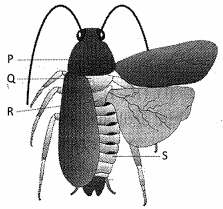
A
$P$
B
$Q$
C
$R$
D
$S$
Solution
(A) The thorax of a cockroach consists of three parts: prothorax,mesothorax,and metathorax.
In the provided diagram:
- $P$ represents the prothorax,which is the first segment of the thorax.
- $Q$ represents the mesothorax.
- $R$ represents the tegmina (forewing).
- $S$ represents the abdomen.
Therefore,the correct option is $A$.
In the provided diagram:
- $P$ represents the prothorax,which is the first segment of the thorax.
- $Q$ represents the mesothorax.
- $R$ represents the tegmina (forewing).
- $S$ represents the abdomen.
Therefore,the correct option is $A$.
0 likes
View Solution177
MediumMCQ
Identify the mouthparts of the cockroach shown in the figure.
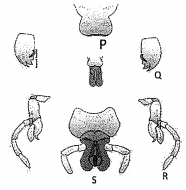
A
$P$: Labrum,$Q$: Mandible,$R$: Maxilla,$S$: Labium
B
$P$: Labium,$Q$: Labrum,$R$: Maxilla,$S$: Mandible
C
$P$: Maxilla,$Q$: Labium,$R$: Mandible,$S$: Labrum
D
$P$: Maxilla,$Q$: Labium,$R$: Labrum,$S$: Mandible
Solution
(A) The mouthparts of a cockroach consist of the following structures:
$P$ represents the Labrum (upper lip).
$Q$ represents the Mandible (jaws).
$R$ represents the Maxilla (first maxilla).
$S$ represents the Labium (lower lip).
Therefore,the correct sequence is $P$: Labrum,$Q$: Mandible,$R$: Maxilla,$S$: Labium.
$P$ represents the Labrum (upper lip).
$Q$ represents the Mandible (jaws).
$R$ represents the Maxilla (first maxilla).
$S$ represents the Labium (lower lip).
Therefore,the correct sequence is $P$: Labrum,$Q$: Mandible,$R$: Maxilla,$S$: Labium.
0 likes
View Solution178
MediumMCQ
In female cockroaches,the brood or genital pouch is formed by which abdominal segments?
A
$8^{th}$ and $9^{th}$ terga dorsally and $8^{th}$ sternum ventrally
B
$8^{th}$ tergum dorsally and $8^{th}$ sternum ventrally
C
$9^{th}$ tergum dorsally and $9^{th}$ and $10^{th}$ sterna ventrally
D
$9^{th}$ and $10^{th}$ terga dorsally and $9^{th}$ sternum ventrally
Solution
(D) In female cockroaches,the genital pouch or brood pouch is formed by the $7^{th}$,$8^{th}$,and $9^{th}$ abdominal sterna. However,in terms of the structural boundaries described in the $NCERT$ textbook,the genital pouch is bounded dorsally by the $9^{th}$ and $10^{th}$ terga and ventrally by the $9^{th}$ sternum. This pouch contains the female gonopore,spermathecal pores,and collateral glands.
0 likes
View Solution179
MediumMCQ
Select the incorrect statement regarding the mesothoracic wings of a cockroach.
A
They are also called hind wings.
B
They are also called tegmina.
C
They are opaque and dark-colored.
D
They are leathery.
Solution
(A) In cockroaches,there are two pairs of wings.
$1$. The first pair of wings arises from the mesothorax and is called the forewings or $Tegmina$.
$2$. The second pair of wings arises from the metathorax and is called the hind wings.
$3$. The forewings $(Tegmina)$ are opaque,dark,and leathery,and they cover the hind wings when at rest.
$4$. The hind wings are transparent,membranous,and used for flight.
Therefore,the statement that mesothoracic wings are called hind wings is incorrect.
$1$. The first pair of wings arises from the mesothorax and is called the forewings or $Tegmina$.
$2$. The second pair of wings arises from the metathorax and is called the hind wings.
$3$. The forewings $(Tegmina)$ are opaque,dark,and leathery,and they cover the hind wings when at rest.
$4$. The hind wings are transparent,membranous,and used for flight.
Therefore,the statement that mesothoracic wings are called hind wings is incorrect.
0 likes
View Solution180
MediumMCQ
In the given figure,which part represents the hypopharynx?
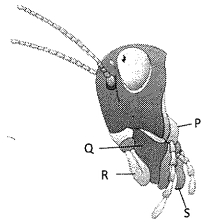
A
$P$
B
$Q$
C
$R$
D
$S$
Solution
(B) The mouthparts of a cockroach consist of a labrum (upper lip),a pair of mandibles,a pair of maxillae,a labium (lower lip),and a hypopharynx (tongue).
In the provided diagram of the cockroach head:
- $P$ represents the labrum.
- $Q$ represents the hypopharynx (the median lobe acting as a tongue).
- $R$ represents the maxilla.
- $S$ represents the labium.
Therefore,the hypopharynx is represented by $Q$.
In the provided diagram of the cockroach head:
- $P$ represents the labrum.
- $Q$ represents the hypopharynx (the median lobe acting as a tongue).
- $R$ represents the maxilla.
- $S$ represents the labium.
Therefore,the hypopharynx is represented by $Q$.
0 likes
View Solution181
MediumMCQ
Select the correct option regarding the eye of a cockroach.
A
Located at the dorsal side of the head,each eye consists of about $2000$ hexagonal ommatidia.
B
With the help of several ommatidia,a cockroach receives several images of an object. This type of vision is known as mosaic vision.
C
In cockroaches,visual sensitivity is high but resolution is low.
D
All of the above.
Solution
(D) कॉकरोच में सिर के पृष्ठीय भाग पर एक जोड़ी संयुक्त आँखें स्थित होती हैं।
प्रत्येक संयुक्त आँख लगभग $2000$ षट्कोणीय ओमेटिडिया (ommatidia) से बनी होती है।
कई ओमेटिडिया की मदद से कॉकरोच एक ही वस्तु की कई छवियां प्राप्त करता है,जिसे मोज़ेक दृष्टि (mosaic vision) कहा जाता है।
इस प्रकार की दृष्टि में संवेदनशीलता अधिक होती है लेकिन रिज़ॉल्यूशन कम होता है,जो रात के समय देखने के लिए अनुकूलित है।
अतः,दिए गए सभी विकल्प सही हैं।
प्रत्येक संयुक्त आँख लगभग $2000$ षट्कोणीय ओमेटिडिया (ommatidia) से बनी होती है।
कई ओमेटिडिया की मदद से कॉकरोच एक ही वस्तु की कई छवियां प्राप्त करता है,जिसे मोज़ेक दृष्टि (mosaic vision) कहा जाता है।
इस प्रकार की दृष्टि में संवेदनशीलता अधिक होती है लेकिन रिज़ॉल्यूशन कम होता है,जो रात के समय देखने के लिए अनुकूलित है।
अतः,दिए गए सभी विकल्प सही हैं।
0 likes
View Solution182
EasyMCQ
Each ootheca of a cockroach contains $............$ eggs.
A
$9-10$
B
$14-16$
C
$2-22$
D
$13$
Solution
(B) In cockroaches,the female produces egg cases called oothecae.
Each ootheca is a dark reddish to blackish brown capsule,about $8-10 \ mm$ long.
They are dropped or glued to a suitable surface,usually in a high humidity area near a food source.
On average,each ootheca contains $14-16$ eggs.
Each ootheca is a dark reddish to blackish brown capsule,about $8-10 \ mm$ long.
They are dropped or glued to a suitable surface,usually in a high humidity area near a food source.
On average,each ootheca contains $14-16$ eggs.
0 likes
View Solution183
EasyMCQ
The nymph of the cockroach undergoes moulting approximately how many times to reach the adult form?
A
$9-10$
B
$14-16$
C
$13$
D
$2-22$
Solution
(C) The development of the cockroach is paurometabolous,meaning there is development through the nymphal stage.
The nymphs look very much like adults.
The nymph grows by moulting (ecdysis).
The nymphal stage undergoes moulting approximately $13$ times to reach the adult form.
Therefore,the correct option is $C$.
The nymphs look very much like adults.
The nymph grows by moulting (ecdysis).
The nymphal stage undergoes moulting approximately $13$ times to reach the adult form.
Therefore,the correct option is $C$.
0 likes
View Solution184
MediumMCQ
What are gonapophyses in male cockroaches?
A
Chitinous asymmetrical structures surrounding the male genital pore.
B
Chitinous symmetrical structures surrounding the male genital pore.
C
Proteinaceous asymmetrical structures surrounding the male genital pore.
D
Proteinaceous symmetrical structures surrounding the male genital pore.
Solution
(A) In male cockroaches,the male genital pore is surrounded by a number of chitinous asymmetrical structures called gonapophyses or phallomeres. These structures are involved in copulation and are located ventrally to the anus.
0 likes
View Solution185
EasyMCQ
The cockroach is ....... .
A
Monoecious
B
Hermaphrodite
C
Dioecious
D
Both $A$ and $B$
Solution
(C) Cockroaches are unisexual organisms,meaning they have separate male and female individuals.
In biological terms,organisms with separate sexes are called dioecious.
Monoecious and hermaphrodite are terms used for organisms that possess both male and female reproductive organs in the same individual (bisexual).
Therefore,the cockroach is dioecious.
In biological terms,organisms with separate sexes are called dioecious.
Monoecious and hermaphrodite are terms used for organisms that possess both male and female reproductive organs in the same individual (bisexual).
Therefore,the cockroach is dioecious.
0 likes
View Solution186
MediumMCQ
Which of the following is a characteristic feature of the cockroach regarding sexual dimorphism?
A
Presence of anal cerci
B
Dark brown body colour and anal cerci
C
Presence of anal styles
D
Presence of sclerites
Solution
(C) Option $C$ is the correct answer because anal styles are present only in male cockroaches and are absent in female cockroaches.
Options $A$,$B$,and $D$ are incorrect because anal cerci,dark brown body colour,and sclerites are common features found in both male and female cockroaches.
Options $A$,$B$,and $D$ are incorrect because anal cerci,dark brown body colour,and sclerites are common features found in both male and female cockroaches.
0 likes
View Solution187
MediumMCQ
In both sexes of cockroach,a pair of jointed filamentous structures called anal cerci are present on
A
$10^{\text{th}}$ segment
B
$8^{\text{th}}$ and $9^{\text{th}}$ segment
C
$11^{\text{th}}$ segment
D
$5^{\text{th}}$ segment
Solution
(A) The correct answer is option $(A)$.
In both male and female cockroaches,the $10^{\text{th}}$ abdominal segment bears a pair of jointed filamentous structures known as anal cerci.
These structures are sensory in nature and help the cockroach in detecting vibrations in the environment.
Options $(B)$,$(C)$,and $(D)$ are incorrect because the $5^{\text{th}}$,$8^{\text{th}}$,and $9^{\text{th}}$ segments do not possess anal cerci,and the $11^{\text{th}}$ abdominal segment is absent in adult cockroaches.
In both male and female cockroaches,the $10^{\text{th}}$ abdominal segment bears a pair of jointed filamentous structures known as anal cerci.
These structures are sensory in nature and help the cockroach in detecting vibrations in the environment.
Options $(B)$,$(C)$,and $(D)$ are incorrect because the $5^{\text{th}}$,$8^{\text{th}}$,and $9^{\text{th}}$ segments do not possess anal cerci,and the $11^{\text{th}}$ abdominal segment is absent in adult cockroaches.
0 likes
View Solution188
EasyMCQ
Sclerites are joined to each other by which structure in a cockroach?
A
Thin and flexible articular membrane
B
Thin and non-flexible arthroidal membrane
C
Thick and flexible arthroidal membrane
D
Thick and non-flexible articular membrane
Solution
(A) In cockroaches,the exoskeleton consists of hardened plates called sclerites.
These sclerites are joined to each other by a thin and flexible membrane known as the arthroidal membrane or articular membrane.
This membrane allows for the movement of the body segments and appendages,as it provides flexibility between the rigid sclerites.
These sclerites are joined to each other by a thin and flexible membrane known as the arthroidal membrane or articular membrane.
This membrane allows for the movement of the body segments and appendages,as it provides flexibility between the rigid sclerites.
0 likes
View Solution189
MediumMCQ
On an average,female $Periplaneta$ produces $.......$ oothecae,each containing $......$ eggs. Choose the correct option which fills the blanks respectively.
A
$14-16, 9-10$
B
$11-12, 17-18$
C
$10-15, 16-20$
D
$9-10, 14-16$
Solution
(D) In $Periplaneta$ $americana$ (cockroach),the female produces $9-10$ oothecae during its reproductive life.
Each ootheca is a dark reddish to blackish brown capsule,about $8 \ mm$ long,and contains $14-16$ eggs.
Therefore,the correct sequence to fill the blanks is $9-10$ and $14-16$.
Each ootheca is a dark reddish to blackish brown capsule,about $8 \ mm$ long,and contains $14-16$ eggs.
Therefore,the correct sequence to fill the blanks is $9-10$ and $14-16$.
0 likes
View Solution190
MediumMCQ
In the female cockroach,which segment is boat-shaped?
A
$6^{\text{th}}$ Tergum
B
$7^{\text{th}}$ Sternum
C
$8^{\text{th}}$ Sternum
D
$9^{\text{th}}$ Sternum
Solution
(B) In female cockroaches,the $7^{\text{th}}$ sternum is boat-shaped.
It,together with the $8^{\text{th}}$ and $9^{\text{th}}$ sterna,forms a brood or genital pouch.
The anterior part of this pouch contains the female gonopore,spermathecal pores,and collateral glands.
It,together with the $8^{\text{th}}$ and $9^{\text{th}}$ sterna,forms a brood or genital pouch.
The anterior part of this pouch contains the female gonopore,spermathecal pores,and collateral glands.
0 likes
View Solution191
MediumMCQ
In female cockroach,the $7^{th}$ sternum is $:-$
A
Ring shaped
B
Filamentous
C
Boat shaped
D
Spiral
Solution
(C) In the female cockroach,the $7^{th}$ sternum is boat-shaped.
Together with the $8^{th}$ and $9^{th}$ sterna,it forms a brood or genital pouch,which contains the female gonopore,spermathecal pores,and collateral glands.
Together with the $8^{th}$ and $9^{th}$ sterna,it forms a brood or genital pouch,which contains the female gonopore,spermathecal pores,and collateral glands.
0 likes
View Solution192
EasyMCQ
If the mandible is removed from the mouthparts of a cockroach,what will happen?
A
No grinding
B
No incising
C
Both
D
Will not be able to capture food
Solution
(C) The mouthparts of a cockroach consist of a labrum,a pair of mandibles,a pair of maxillae,a labium,and a hypopharynx.
Each mandible is heavily sclerotized and possesses teeth-like structures used for both incising (cutting) and grinding (crushing) the food.
If the mandibles are removed,the cockroach will lose the ability to perform both of these essential mechanical processes.
Therefore,the correct answer is $C$ (Both).
Each mandible is heavily sclerotized and possesses teeth-like structures used for both incising (cutting) and grinding (crushing) the food.
If the mandibles are removed,the cockroach will lose the ability to perform both of these essential mechanical processes.
Therefore,the correct answer is $C$ (Both).
0 likes
View Solution193
MediumMCQ
What is another name for the Labrum?
A
Upper lip
B
Lower lip
C
Upper jaw
D
Lower jaw
Solution
(A) In the mouthparts of a cockroach,the $Labrum$ is a single,plate-like structure that functions as the upper lip. It is attached to the clypeus and covers the mouth cavity from the front. Therefore,the correct answer is $A$.
0 likes
View Solution194
MediumMCQ
Find out the incorrect statement:
A
Cockroaches are serious pests and vectors of several diseases.
B
Cockroaches are nocturnal and herbivorous animals.
C
Cockroaches are included in class $Insecta$ of phylum $Arthropoda$.
D
Common species of cockroach is $Periplaneta$ $americana$.
Solution
(B) The correct answer is $B$. Cockroaches are omnivorous,not herbivorous. They feed on a wide variety of organic matter,including decaying plant and animal material,food scraps,and even paper or glue. They are nocturnal,meaning they are active at night,and they are indeed serious pests and vectors of several diseases. They belong to the class $Insecta$ under the phylum $Arthropoda$,and $Periplaneta$ $americana$ is the most common species found in homes.
0 likes
View Solution195
MediumMCQ
Spiracles found in cockroach are $:-$ (in $pairs$)
A
$8$
B
$9$
C
$10$
D
$11$
Solution
(C) In cockroaches, the respiratory system consists of a network of trachea that open through $10$ pairs of small holes called spiracles present on the lateral side of the body.
Out of these $10$ pairs, $2$ pairs are located in the thoracic region and $8$ pairs are located in the abdominal region.
Therefore, the correct answer is $10$ pairs.
Out of these $10$ pairs, $2$ pairs are located in the thoracic region and $8$ pairs are located in the abdominal region.
Therefore, the correct answer is $10$ pairs.
0 likes
View SolutionStructural Organisation In Animals — Morphology of Cockroach · Frequently Asked Questions
1Are these Structural Organisation In Animals questions useful for JEE and NEET?
Yes. All questions in this section are mapped to JEE Main and NEET exam patterns. Previous year questions from JEE Main, NEET, GUJCET and state-level exams are included with full solutions.
2Can I switch to Hindi or Gujarati for these questions?
Yes. Use the language tabs in the hero section or the sidebar to view the same questions and solutions in English, Hindi or Gujarati.
3How do I generate a question paper from this subtopic?
Use the Vedclass Exam Paper Generator — select the chapter and subtopic, set difficulty, and generate Sets A, B, C, D automatically. First 3 chapters of every subject are free.
Vedclass Products
For Students
Vedclass Test Series
Mock tests in real JEE/NEET style with performance analysis. 5-day free trial.
Start Free TrialFor Teachers
Exam Paper Generator
Generate Set A/B/C/D papers from this chapter in 2 minutes. 3 chapters free.
Try FreeFor Institutes
Online Exam Module
Live online exams with unlimited students, 360° analytics & white-label branding.
See DemoFor Teachers & Institutes
Generate a Structural Organisation In Animals Exam Paper in 2 Minutes
Select subtopic & difficulty — Sets A, B, C, D auto-generated with No Repeat logic.
First 3 chapters of every subject are free — no payment required.