
A English
Morphology of Cockroach Questions in English
Class 11 Biology · Structural Organisation In Animals · Morphology of Cockroach
195+
Questions
English
Language
100%
With Solutions
Showing 50 of 195 questions in English
101
EasyMCQ
The characteristic feature that distinguishes between male and female cockroaches is .........
A
Antennae
B
Mandibles
C
Anal cerci
D
Anal styles
Solution
(D) In cockroaches,both males and females possess a pair of jointed filamentous structures called $Anal \ cerci$ arising from the $10^{th}$ segment. However,males possess an additional pair of short,thread-like anal styles arising from the $9^{th}$ sternum. These $Anal \ styles$ are absent in females. Therefore,the presence of $Anal \ styles$ is the characteristic feature that distinguishes male cockroaches from females.
0 likes
View Solution102
MediumMCQ
In a cockroach,the sound-receptive organs are located on ..........?
A
Legs
B
Antennae
C
Sensory receptors
D
Anal cerci
Solution
(D) In cockroaches,the $anal$ $cerci$ are paired,jointed,sensory appendages located on the $10^{th}$ abdominal segment.
These structures act as sound-receptive organs,allowing the cockroach to detect vibrations in the air and ground,which helps in sensing predators or environmental changes.
These structures act as sound-receptive organs,allowing the cockroach to detect vibrations in the air and ground,which helps in sensing predators or environmental changes.
0 likes
View Solution103
EasyMCQ
The structural and functional unit of the compound eye in a cockroach is known as:
A
Retina
B
Rhabdom
C
Cornea
D
Ommatidium
Solution
(D) The compound eye of a cockroach consists of approximately $2000$ hexagonal units called $Ommatidia$ (singular: $Ommatidium$).
Each $Ommatidium$ acts as an independent visual unit that captures a small part of the image.
These units collectively form a mosaic vision,which is highly sensitive to movement.
Each $Ommatidium$ acts as an independent visual unit that captures a small part of the image.
These units collectively form a mosaic vision,which is highly sensitive to movement.
0 likes
View Solution104
EasyMCQ
What type of eggs are found in cockroaches?
A
Alecithal
B
Telolecithal
C
Microlecithal
D
Centrolecithal
Solution
(D) The eggs of cockroaches $(Periplaneta \text{ } americana)$ are $centrolecithal$.
In $centrolecithal$ eggs, the yolk is concentrated in the center of the egg, and the cytoplasm is restricted to the peripheral layer.
This type of egg is characteristic of most insects.
In $centrolecithal$ eggs, the yolk is concentrated in the center of the egg, and the cytoplasm is restricted to the peripheral layer.
This type of egg is characteristic of most insects.
0 likes
View Solution105
EasyMCQ
An animal that possesses compound eyes is ........
A
Cockroach
B
Chameleon
C
Pila
D
Octopus
Solution
(A) Compound eyes are a characteristic feature of the phylum $Arthropoda$.
Among the given options,the cockroach ($Periplaneta$ $americana$) belongs to the class $Insecta$ of the phylum $Arthropoda$.
Insects typically possess a pair of compound eyes on the dorsal side of the head.
Chameleon is a reptile,Pila is a mollusk,and Octopus is a cephalopod mollusk; none of these possess compound eyes.
Among the given options,the cockroach ($Periplaneta$ $americana$) belongs to the class $Insecta$ of the phylum $Arthropoda$.
Insects typically possess a pair of compound eyes on the dorsal side of the head.
Chameleon is a reptile,Pila is a mollusk,and Octopus is a cephalopod mollusk; none of these possess compound eyes.
0 likes
View Solution106
MediumMCQ
Which of the following animals possesses compound eyes?
A
Cockroach
B
Chameleon
C
Pila
D
Octopus
Solution
(A) Compound eyes are a characteristic feature of the phylum $Arthropoda$.
Among the given options,the cockroach ($Periplaneta$ $americana$) belongs to the class $Insecta$ under the phylum $Arthropoda$.
Therefore,it possesses compound eyes.
Chameleon is a reptile,Pila is a mollusk,and Octopus is a cephalopod mollusk; none of these possess compound eyes.
Among the given options,the cockroach ($Periplaneta$ $americana$) belongs to the class $Insecta$ under the phylum $Arthropoda$.
Therefore,it possesses compound eyes.
Chameleon is a reptile,Pila is a mollusk,and Octopus is a cephalopod mollusk; none of these possess compound eyes.
0 likes
View Solution107
MediumMCQ
Which of the following is a correct description regarding the animal?
A
Earthworm - The alimentary canal consists of pharynx,oesophagus,stomach,gizzard,and intestine in sequence.
B
Frog - The body is divided into head,neck,and trunk.
C
Rat - The left kidney is situated slightly higher than the right kidney.
D
Cockroach - It possesses $10$ pairs of spiracles ($2$ pairs in the thoracic region and $8$ pairs in the abdominal region).
Solution
(D) Let us analyze each option:
$A$. In earthworms,the alimentary canal sequence is mouth,buccal cavity,pharynx,oesophagus,gizzard,stomach,and intestine. The gizzard is located after the oesophagus,but the sequence provided is incomplete/incorrect regarding the standard anatomical order.
$B$. The body of a frog is divided into head and trunk only; it does not have a neck.
$C$. In mammals like rats (and humans),the left kidney is typically situated slightly higher than the right kidney due to the position of the liver on the right side.
$D$. Cockroaches have $10$ pairs of spiracles,but they are arranged as $2$ pairs in the thorax and $8$ pairs in the abdomen. This statement is factually correct.
$A$. In earthworms,the alimentary canal sequence is mouth,buccal cavity,pharynx,oesophagus,gizzard,stomach,and intestine. The gizzard is located after the oesophagus,but the sequence provided is incomplete/incorrect regarding the standard anatomical order.
$B$. The body of a frog is divided into head and trunk only; it does not have a neck.
$C$. In mammals like rats (and humans),the left kidney is typically situated slightly higher than the right kidney due to the position of the liver on the right side.
$D$. Cockroaches have $10$ pairs of spiracles,but they are arranged as $2$ pairs in the thorax and $8$ pairs in the abdomen. This statement is factually correct.
0 likes
View Solution108
EasyMCQ
What serves as the locomotory organ in Periplaneta?
A
Jointed appendages
B
Setae
C
Muscular feet
D
Tube feet
Solution
(A) Periplaneta (cockroach) belongs to the phylum Arthropoda.
Arthropods are characterized by the presence of jointed appendages,which serve as their primary locomotory organs.
These appendages are modified for various functions including walking,running,and climbing.
Setae are found in Annelids,muscular feet in Molluscs,and tube feet in Echinoderms.
Arthropods are characterized by the presence of jointed appendages,which serve as their primary locomotory organs.
These appendages are modified for various functions including walking,running,and climbing.
Setae are found in Annelids,muscular feet in Molluscs,and tube feet in Echinoderms.
0 likes
View Solution109
EasyMCQ
The exoskeleton of a cockroach is made up of which substance?
A
Chitin
B
Pectin
C
Calcium carbonate
D
Calcium pectate
Solution
(A) The exoskeleton of a cockroach $(Periplaneta \text{ } americana)$ is composed of hard, chitinous plates known as sclerites. Chitin is a nitrogen-containing polysaccharide that provides structural support and protection to the insect's body.
0 likes
View Solution110
EasyMCQ
During growth and development,the cockroach sheds its exoskeleton at regular intervals. What is this process called?
A
Metamorphosis
B
Polymorphism
C
Ecdysis
D
Parthenogenesis
Solution
(C) The process of shedding the exoskeleton in insects,such as the cockroach,during their growth and development is known as $Ecdysis$ or molting.
This occurs because the rigid exoskeleton does not grow with the body,so the insect must shed it to accommodate its increasing size.
$Metamorphosis$ refers to the biological process by which an animal physically develops after birth or hatching.
$Polymorphism$ is the occurrence of two or more clearly different morphs or forms in the population of a species.
$Parthenogenesis$ is a form of asexual reproduction in which an embryo develops from an unfertilized egg.
This occurs because the rigid exoskeleton does not grow with the body,so the insect must shed it to accommodate its increasing size.
$Metamorphosis$ refers to the biological process by which an animal physically develops after birth or hatching.
$Polymorphism$ is the occurrence of two or more clearly different morphs or forms in the population of a species.
$Parthenogenesis$ is a form of asexual reproduction in which an embryo develops from an unfertilized egg.
0 likes
View Solution111
EasyMCQ
Which of the following is the genus of the cockroach?
A
Rana
B
Periplaneta
C
Pheretima
D
Zea
Solution
(B) The scientific name of the common cockroach is $Periplaneta$ $americana$.
Therefore,the genus of the cockroach is $Periplaneta$.
$Rana$ is the genus of frogs.
$Pheretima$ is the genus of earthworms.
$Zea$ is the genus of maize (corn).
Therefore,the genus of the cockroach is $Periplaneta$.
$Rana$ is the genus of frogs.
$Pheretima$ is the genus of earthworms.
$Zea$ is the genus of maize (corn).
0 likes
View Solution112
EasyMCQ
Which of the following is the correct classification of the cockroach?
A
Chordata $\rightarrow$ Amphibia $\rightarrow$ Anura $\rightarrow$ Ranidae $\rightarrow$ Rana $\rightarrow$ tigrina
B
Arthropoda $\rightarrow$ Insecta $\rightarrow$ Blattodea $\rightarrow$ Blattidae $\rightarrow$ Periplaneta $\rightarrow$ americana
C
Arthropoda $\rightarrow$ Insecta $\rightarrow$ Orthoptera $\rightarrow$ Periplaneta $\rightarrow$ Rana $\rightarrow$ americana
D
Annelida $\rightarrow$ Oligochaeta $\rightarrow$ Blattidae $\rightarrow$ Periplaneta $\rightarrow$ americana
Solution
(B) The scientific classification of the American cockroach $(Periplaneta \ americana)$ is as follows:
$1$. Phylum: Arthropoda (jointed appendages).
$2$. Class: Insecta (three pairs of legs,body divided into head,thorax,and abdomen).
$3$. Order: Blattodea (cockroaches).
$4$. Family: Blattidae.
$5$. Genus: $Periplaneta$.
$6$. Species: $americana$.
Therefore,option $B$ provides the correct taxonomic hierarchy.
$1$. Phylum: Arthropoda (jointed appendages).
$2$. Class: Insecta (three pairs of legs,body divided into head,thorax,and abdomen).
$3$. Order: Blattodea (cockroaches).
$4$. Family: Blattidae.
$5$. Genus: $Periplaneta$.
$6$. Species: $americana$.
Therefore,option $B$ provides the correct taxonomic hierarchy.
0 likes
View Solution113
EasyMCQ
Which of the following is the correct taxonomic classification of a cockroach?
A
Vertebrata $\rightarrow$ Amphibia $\rightarrow$ Anura $\rightarrow$ Ranidae $\rightarrow$ Rana $\rightarrow$ tigrina
B
Arthropoda $\rightarrow$ Insecta $\rightarrow$ Blattodea $\rightarrow$ Blattidae $\rightarrow$ Periplaneta $\rightarrow$ americana
C
Arthropoda $\rightarrow$ Insecta $\rightarrow$ Opipora $\rightarrow$ Periplaneta $\rightarrow$ Rana $\rightarrow$ americana
D
Annelida $\rightarrow$ Oligochaeta $\rightarrow$ Blattidae $\rightarrow$ Periplaneta $\rightarrow$ americana
Solution
(B) The taxonomic classification of the American cockroach $(Periplaneta \ americana)$ is as follows:
$1$. Phylum: Arthropoda (Jointed appendages)
$2$. Class: Insecta (Three pairs of legs)
$3$. Order: Blattodea (Cockroaches)
$4$. Family: Blattidae
$5$. Genus: Periplaneta
$6$. Species: americana
Therefore, the correct sequence is $Arthropoda \rightarrow Insecta \rightarrow Blattodea \rightarrow Blattidae \rightarrow Periplaneta \rightarrow americana$.
$1$. Phylum: Arthropoda (Jointed appendages)
$2$. Class: Insecta (Three pairs of legs)
$3$. Order: Blattodea (Cockroaches)
$4$. Family: Blattidae
$5$. Genus: Periplaneta
$6$. Species: americana
Therefore, the correct sequence is $Arthropoda \rightarrow Insecta \rightarrow Blattodea \rightarrow Blattidae \rightarrow Periplaneta \rightarrow americana$.
0 likes
View Solution114
MediumMCQ
Which of the following features is not present in $Periplaneta$ $americana$?
A
Exoskeleton composed of $N$-acetylglucosamine
B
Metamerically segmented body
C
Schizocoelom as body cavity
D
Indeterminate and radial cleavage during embryonic development
Solution
(D) $Periplaneta$ $americana$ (cockroach) belongs to the phylum $Arthropoda$.
In insects,the cleavage during embryonic development is superficial,not radial or indeterminate.
Radial and indeterminate cleavage are characteristic features of deuterostomes (e.g.,echinoderms and chordates).
Therefore,option $D$ is the correct answer as it is not a feature of $Periplaneta$ $americana$.
In insects,the cleavage during embryonic development is superficial,not radial or indeterminate.
Radial and indeterminate cleavage are characteristic features of deuterostomes (e.g.,echinoderms and chordates).
Therefore,option $D$ is the correct answer as it is not a feature of $Periplaneta$ $americana$.
0 likes
View Solution115
MediumMCQ
The terga,sterna and pleura of the cockroach body are joined by:
A
arthrodial membrane
B
cartilage
C
cementing glue
D
muscular tissue
Solution
(A) The correct answer is $A$.
In the body of a cockroach,the exoskeleton consists of hardened plates called sclerites.
The dorsal plates are called terga,the ventral plates are called sterna,and the lateral plates are called pleura.
These sclerites are joined to each other by a thin,flexible,and tough cuticle known as the arthrodial membrane,which allows for movement between the segments.
In the body of a cockroach,the exoskeleton consists of hardened plates called sclerites.
The dorsal plates are called terga,the ventral plates are called sterna,and the lateral plates are called pleura.
These sclerites are joined to each other by a thin,flexible,and tough cuticle known as the arthrodial membrane,which allows for movement between the segments.
0 likes
View Solution116
MediumMCQ
What external changes are visible after the last moult of a cockroach nymph?
A
Both forewings and hindwings develop
B
Labium develops
C
Mandibles become harder
D
Anal cerci develop
Solution
(A) The cockroach undergoes paurometabolous development,meaning the nymphal stages resemble the adult. The nymph moults about $13$ times to reach the adult form. The next-to-last nymphal stage has wing pads,but only the adult cockroach possesses fully developed wings (forewings and hindwings). Therefore,the development of wings is the primary external change visible after the final moult.
0 likes
View Solution117
MediumMCQ
Select the correct option with respect to cockroaches.
A
Malpighian tubules convert nitrogenous wastes into urea.
B
Males bear short anal styles not present in females.
C
Nervous system comprises of a dorsal nerve cord and ten pairs of ganglia.
D
The forewings are tegmina which are used in flight.
Solution
(B) : Malpighian tubules are the main excretory organs in cockroaches. They extract nitrogenous wastes and water from the haemolymph and reabsorb certain salts,resulting in the excretion of uric acid. Thus,cockroaches are uricotelic. Males possess a pair of anal styles on the $9^{th}$ abdominal sternite,which are absent in females.
0 likes
View Solution118
MediumMCQ
Select the correct statement from the ones given below with respect to $Periplaneta$ $americana$.
A
Nervous system is located dorsally and consists of segmentally arranged ganglia joined by a pair of longitudinal connectives.
B
Males bear a pair of short,thread-like anal styles.
C
There are $16$ very long Malpighian tubules present at the junctions of midgut and hindgut.
D
Grinding of food is carried out only by the mouth parts.
Solution
(B) is the correct statement.
In $Periplaneta$ $americana$ (cockroach),the posterior segment of the abdomen bears a pair of jointed filamentous structures called anal cerci,which are present in both sexes.
However,males can be distinguished from females by the presence of an additional pair of short,thread-like structures called anal styles.
These anal styles assist in the process of copulation.
In $Periplaneta$ $americana$ (cockroach),the posterior segment of the abdomen bears a pair of jointed filamentous structures called anal cerci,which are present in both sexes.
However,males can be distinguished from females by the presence of an additional pair of short,thread-like structures called anal styles.
These anal styles assist in the process of copulation.
0 likes
View Solution119
MediumMCQ
The head of a cockroach is formed by the fusion of ...... segments.
A
$5$
B
$6$
C
$4$
D
$3$
Solution
(B) The head of a cockroach is triangular in shape and lies anteriorly at right angles to the longitudinal body axis.
It is formed by the fusion of $6$ embryonic segments.
These segments are highly modified to form the head capsule,which bears the mouthparts,antennae,and compound eyes.
It is formed by the fusion of $6$ embryonic segments.
These segments are highly modified to form the head capsule,which bears the mouthparts,antennae,and compound eyes.
0 likes
View Solution120
MediumMCQ
In cockroach,the male genital pore opens into which region?
A
Mid-ventral region of $8^{th}$ segment
B
Mid-ventral region of $9^{th}$ segment
C
Mid-ventral region of $10^{th}$ segment
D
Mid-ventral region of $7^{th}$ segment
Solution
(B) In male cockroaches,the abdomen consists of $10$ segments.
The male genital pore is situated ventrally,specifically in the mid-ventral region of the $9^{th}$ segment.
This pore is surrounded by genital structures such as gonapophyses or phallomeres.
Therefore,the correct option is $B$.
The male genital pore is situated ventrally,specifically in the mid-ventral region of the $9^{th}$ segment.
This pore is surrounded by genital structures such as gonapophyses or phallomeres.
Therefore,the correct option is $B$.
0 likes
View Solution121
EasyMCQ
Which of the following is not a sense organ of a cockroach?
A
Antennae
B
Wing
C
Eyes
D
Anal cercus
Solution
(B) In cockroaches,the sense organs include antennae,eyes (compound eyes),maxillary palps,labial palps,and anal cerci.
Antennae are sensory organs that help in monitoring the environment.
Eyes are visual organs.
Anal cerci are paired appendages on the $10^{th}$ abdominal segment that act as sensory organs sensitive to vibrations in the ground and air.
Wings are locomotory organs used for flight,not sensory organs.
Antennae are sensory organs that help in monitoring the environment.
Eyes are visual organs.
Anal cerci are paired appendages on the $10^{th}$ abdominal segment that act as sensory organs sensitive to vibrations in the ground and air.
Wings are locomotory organs used for flight,not sensory organs.
0 likes
View Solution122
EasyMCQ
What is the scientific name of the common cockroach?
A
Rana tigrina
B
Periplaneta americana
C
Pheretima posthuma
D
Eichhornia crassipes
Solution
(B) The scientific name of the common American cockroach is $Periplaneta$ $americana$.
$Rana$ $tigrina$ is the scientific name of the Indian bullfrog.
$Pheretima$ $posthuma$ is the scientific name of the earthworm.
$Eichhornia$ $crassipes$ is the scientific name of the water hyacinth.
$Rana$ $tigrina$ is the scientific name of the Indian bullfrog.
$Pheretima$ $posthuma$ is the scientific name of the earthworm.
$Eichhornia$ $crassipes$ is the scientific name of the water hyacinth.
0 likes
View Solution123
MediumMCQ
Arthrodial membrane is present in...
A
Earthworm
B
Cockroach
C
Frog
D
Man
Solution
(B) The arthrodial membrane is a thin, flexible, and soft chitinous membrane.
It connects the sclerites (hardened plates of the exoskeleton) in insects, specifically in the cockroach $(Periplaneta \text{ } americana)$.
This membrane allows for the movement of the body segments and appendages by providing flexibility between the rigid plates of the exoskeleton.
Therefore, the correct answer is $B$ (Cockroach).
It connects the sclerites (hardened plates of the exoskeleton) in insects, specifically in the cockroach $(Periplaneta \text{ } americana)$.
This membrane allows for the movement of the body segments and appendages by providing flexibility between the rigid plates of the exoskeleton.
Therefore, the correct answer is $B$ (Cockroach).
0 likes
View Solution124
MediumMCQ
Choose the incorrect statement regarding the characteristics of a cockroach.
A
Blood vascular system - closed
B
Respiratory system - network of trachea
C
Head - triangular
D
Eye - compound
Solution
(A) The cockroach $(Periplaneta \text{ } americana)$ possesses an open type of circulatory system, not a closed one. In an open circulatory system, the blood (hemolymph) flows into body cavities called sinuses. Therefore, the statement 'Blood vascular system - closed' is incorrect. The other options are correct: the respiratory system consists of a network of trachea, the head is triangular in shape, and the eyes are compound.
0 likes
View Solution125
MediumMCQ
In both male and female cockroaches,the abdomen is made up of ................. segments.
A
Male - $8$,female - $9$
B
Male - $10$,female - $10$
C
Male - $10$,female - $7$
D
Male - $9$,female - $8$
Solution
(B) The abdomen of both male and female cockroaches consists of $10$ segments.
In female cockroaches,the $7$th sternum is boat-shaped and together with the $8$th and $9$th sterna,forms a brood or genital pouch.
In males,the genital pouch is present at the hind end of the abdomen bounded dorsally by the $9$th and $10$th terga and ventrally by the $9$th sternum.
In female cockroaches,the $7$th sternum is boat-shaped and together with the $8$th and $9$th sterna,forms a brood or genital pouch.
In males,the genital pouch is present at the hind end of the abdomen bounded dorsally by the $9$th and $10$th terga and ventrally by the $9$th sternum.
0 likes
View Solution126
EasyMCQ
Which of the following is present in a male cockroach?
A
Anal cerci
B
Phallomere
C
Anal style
D
All of the above
Solution
(D) In male cockroaches,the $9^{th}$ abdominal segment bears a pair of short,thread-like anal styles,which are absent in females.
Anal cerci are a pair of jointed filamentous structures present in both male and female cockroaches on the $10^{th}$ segment.
Phallomeres are chitinous asymmetrical structures surrounding the male gonopore,which are specific to male cockroaches.
Since all three structures (anal cerci,phallomeres,and anal styles) are found in male cockroaches,the correct answer is $D$.
Anal cerci are a pair of jointed filamentous structures present in both male and female cockroaches on the $10^{th}$ segment.
Phallomeres are chitinous asymmetrical structures surrounding the male gonopore,which are specific to male cockroaches.
Since all three structures (anal cerci,phallomeres,and anal styles) are found in male cockroaches,the correct answer is $D$.
0 likes
View Solution127
MediumMCQ
What is not present in a female cockroach?
A
Anal style
B
Anal cercus
C
Tarsus
D
Mouth parts
Solution
(A) In cockroaches,the $9^{th}$ abdominal segment in males bears a pair of short,thread-like anal styles,which are absent in females.
Anal cerci are present in both sexes.
Tarsus is a part of the leg and is present in both sexes.
Mouth parts are present in both sexes for feeding.
Anal cerci are present in both sexes.
Tarsus is a part of the leg and is present in both sexes.
Mouth parts are present in both sexes for feeding.
0 likes
View Solution128
MediumMCQ
$A$-Antennae have sensory receptors.
$R$-Sensory receptors help in monitoring the environment.
$R$-Sensory receptors help in monitoring the environment.
A
$A$ and $R$ are both correct.
B
$A$ and $R$ are both incorrect.
C
$A$ is correct,$R$ is not correct.
D
$A$ is not correct,$R$ is correct.
Solution
(A) In cockroaches,the antennae are sensory organs located on the head. They contain various sensory receptors that allow the organism to monitor the surrounding environment,such as detecting vibrations,chemicals,and changes in air currents. Therefore,both the assertion $(A)$ and the reason $(R)$ are correct,and the reason correctly explains the function of the antennae.
0 likes
View Solution129
MediumMCQ
The nymph grows by moulting about ..... to reach the adult form. (in $times$)
A
$13$
B
$12$
C
$10$
D
$14$
Solution
(A) The development of the cockroach is paurometabolous, meaning development occurs through the nymphal stage.
The nymph looks very much like the adult.
The nymph grows by moulting (ecdysis) about $13$ times to reach the adult form.
The next nymphal stage is very similar to the adult, except for the lack of wings and external genitalia.
The nymph looks very much like the adult.
The nymph grows by moulting (ecdysis) about $13$ times to reach the adult form.
The next nymphal stage is very similar to the adult, except for the lack of wings and external genitalia.
0 likes
View Solution130
MediumMCQ
Which is the correct sequence for ootheca formation in a cockroach?
A
$1 \rightarrow 2 \rightarrow 3$
B
$3 \rightarrow 2 \rightarrow 1$
C
$1 \rightarrow 3 \rightarrow 2$
D
$2 \rightarrow 1 \rightarrow 3$
Solution
(C) The process of ootheca formation in a cockroach follows these steps:
$1$. First,the ova enter the genital chamber.
$2$. Second,the ova are fertilized by sperms within the genital chamber.
$3$. Third,a protective cover (ootheca) is secreted around the fertilized eggs.
Therefore,the correct sequence is $1 \rightarrow 3 \rightarrow 2$.
$1$. First,the ova enter the genital chamber.
$2$. Second,the ova are fertilized by sperms within the genital chamber.
$3$. Third,a protective cover (ootheca) is secreted around the fertilized eggs.
Therefore,the correct sequence is $1 \rightarrow 3 \rightarrow 2$.
0 likes
View Solution131
MediumMCQ
Identify $X$ from the figure.
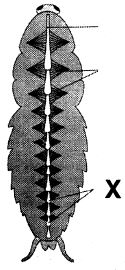
A
Chambers of heart
B
Chambers of blood vessels
C
Anterior aorta
D
Muscles
Solution
(A) The figure represents the circulatory system of a cockroach.
In cockroaches,the heart consists of an elongated tube with $13$ funnel-shaped chambers.
The label $X$ points to these specific chambers of the heart.
Therefore,the correct option is $A$.
In cockroaches,the heart consists of an elongated tube with $13$ funnel-shaped chambers.
The label $X$ points to these specific chambers of the heart.
Therefore,the correct option is $A$.
0 likes
View Solution132
MediumMCQ
In cockroach,ootheca covers...
A
Sperms,in male
B
Fertilised eggs,in female
C
Fertilised eggs,in male
D
Spermatheca,in female
Solution
(B) In cockroaches,the female produces a dark reddish to blackish brown capsule called an $ootheca$.
This $ootheca$ contains the fertilised eggs.
Each $ootheca$ is dropped or glued to a suitable surface,usually in a crack or crevice of high relative humidity near a food source.
Therefore,the $ootheca$ covers the fertilised eggs in the female.
This $ootheca$ contains the fertilised eggs.
Each $ootheca$ is dropped or glued to a suitable surface,usually in a crack or crevice of high relative humidity near a food source.
Therefore,the $ootheca$ covers the fertilised eggs in the female.
0 likes
View Solution133
MediumMCQ
Externally,male and female cockroaches can be distinguished by ............ .
A
Anal styles in males
B
Anal cerci in females
C
Anal cerci and antennae in females
D
Both $(b)$ and $(c)$
Solution
(A) In cockroaches,sexual dimorphism is present.
Male cockroaches can be distinguished from females by the presence of a pair of short,thread-like anal styles on the $9^{th}$ sternum.
Anal cerci are present in both males and females on the $10^{th}$ segment.
Therefore,the presence of anal styles in males is the primary external feature used to distinguish them from females.
Male cockroaches can be distinguished from females by the presence of a pair of short,thread-like anal styles on the $9^{th}$ sternum.
Anal cerci are present in both males and females on the $10^{th}$ segment.
Therefore,the presence of anal styles in males is the primary external feature used to distinguish them from females.
0 likes
View Solution134
MediumMCQ
Statement $-A:$ $Periplaneta$ $americana$ is a nocturnal,omnivorous,and household pest.
Reason $-R:$ It acts as a scavenger.
Reason $-R:$ It acts as a scavenger.
A
$A$ is true,$R$ is false.
B
$A$ is false,$R$ is true.
C
Both $A$ and $R$ are true,and $R$ is the correct explanation of $A$.
D
Both $A$ and $R$ are true,but $R$ is not the correct explanation of $A$.
Solution
(C) Statement $-A$ is true because $Periplaneta$ $americana$ (cockroach) is indeed a nocturnal,omnivorous,and household pest that causes damage to food and contaminates it.
Reason $-R$ is also true because cockroaches are scavengers,meaning they feed on decaying organic matter,waste,and food scraps.
Since the cockroach's habit of being a scavenger is the primary reason it thrives as a household pest (by feeding on human waste and food),$R$ is the correct explanation of $A$.
Reason $-R$ is also true because cockroaches are scavengers,meaning they feed on decaying organic matter,waste,and food scraps.
Since the cockroach's habit of being a scavenger is the primary reason it thrives as a household pest (by feeding on human waste and food),$R$ is the correct explanation of $A$.
0 likes
View Solution135
MediumMCQ
Which of the following statements is correct regarding $Periplaneta$ $americana$?
A
The nervous system is located dorsally,consisting of segmentally arranged ganglia joined by a pair of longitudinal connectives.
B
Males possess a pair of thread-like anal styles.
C
$16$ long Malpighian tubules are present at the junction of the midgut and hindgut.
D
The grinding of food is performed by the mouthparts.
Solution
(B) $1$. The nervous system of the cockroach consists of a series of fused,segmentally arranged ganglia joined by paired longitudinal connectives on the ventral side. Thus,option $A$ is incorrect.
$2$. Males possess a pair of short,thread-like anal styles,which are absent in females. Thus,option $B$ is correct.
$3$. $100-150$ yellow-colored thin filamentous Malpighian tubules are present at the junction of the midgut and hindgut,not $16$. Thus,option $C$ is incorrect.
$4$. The grinding of food is performed by the gizzard (proventriculus),not the mouthparts. Thus,option $D$ is incorrect.
$2$. Males possess a pair of short,thread-like anal styles,which are absent in females. Thus,option $B$ is correct.
$3$. $100-150$ yellow-colored thin filamentous Malpighian tubules are present at the junction of the midgut and hindgut,not $16$. Thus,option $C$ is incorrect.
$4$. The grinding of food is performed by the gizzard (proventriculus),not the mouthparts. Thus,option $D$ is incorrect.
0 likes
View Solution136
MediumMCQ
Which external changes are observed after the final nymphal stage of a cockroach?
A
Hypopharynx develops.
B
Mandibles become hard.
C
Anal cerci develop.
D
Forewings and hindwings develop.
Solution
(D) The development of a cockroach is paurometabolous,meaning it undergoes gradual metamorphosis through nymphal stages. The nymph looks very much like an adult. The nymph grows by moulting (ecdysis) about $13$ times to reach the adult form. The next to last nymphal stage has wing pads,but only the adult cockroaches have fully developed wings (forewings and hindwings).
0 likes
View Solution137
MediumMCQ
Which of the following characteristics is $NOT$ found in the cockroach $(Periplaneta \text{ } americana)$?
A
Indeterminate and radial cleavage during embryonic development
B
Exoskeleton made of $N$-acetylglucosamine
C
Metamerically segmented body
D
Schizocoelous body cavity
Solution
(A) The cockroach $(Periplaneta \text{ } americana)$ belongs to the phylum $Arthropoda$.
Key characteristics of arthropods include a chitinous exoskeleton made of $N$-acetylglucosamine, a metamerically segmented body, and a haemocoel (blood-filled body cavity).
However, indeterminate and radial cleavage are characteristic features of deuterostomes (like echinoderms and chordates).
Cockroaches, being protostomes, exhibit determinate and spiral cleavage during embryonic development.
Therefore, the correct answer is $A$.
Key characteristics of arthropods include a chitinous exoskeleton made of $N$-acetylglucosamine, a metamerically segmented body, and a haemocoel (blood-filled body cavity).
However, indeterminate and radial cleavage are characteristic features of deuterostomes (like echinoderms and chordates).
Cockroaches, being protostomes, exhibit determinate and spiral cleavage during embryonic development.
Therefore, the correct answer is $A$.
0 likes
View Solution138
EasyMCQ
$RBC$ are not found in .......
A
Frog
B
Cow
C
Camel
D
Cockroach
Solution
(D) In insects like the cockroach,the circulatory system is of the open type. The blood (hemolymph) does not contain respiratory pigments like hemoglobin and lacks $RBC$ (erythrocytes). Instead,oxygen is transported directly to tissues via the tracheal system. In contrast,frogs,cows,and camels are vertebrates and possess $RBC$ in their blood.
0 likes
View Solution139
MediumMCQ
Which of the following features is used to identify a male cockroach from a female cockroach?
A
Presence of anal cerci
B
Presence of a boat-shaped sternum on the $9th$ abdominal segment
C
Forewings with darker tegmina
D
Presence of caudal styles
Solution
(D) In male cockroaches,the $9th$ abdominal segment bears a pair of short,thread-like anal styles (caudal styles).
These structures are absent in female cockroaches.
Anal cerci are present in both male and female cockroaches.
The $7th$ sternum is boat-shaped in females,not males.
Therefore,the presence of caudal styles is the diagnostic feature used to distinguish a male cockroach from a female.
These structures are absent in female cockroaches.
Anal cerci are present in both male and female cockroaches.
The $7th$ sternum is boat-shaped in females,not males.
Therefore,the presence of caudal styles is the diagnostic feature used to distinguish a male cockroach from a female.
0 likes
View Solution140
MediumMCQ
Cockroaches are brown or black bodied animals that are included in class . . . . . . of phylum . . . . . . .
A
Reptilia; Annelida
B
Insecta; Arthropoda
C
Insecta; Annelida
D
Reptilia; Arthropoda
Solution
(B) Cockroaches belong to the class $Insecta$ and the phylum $Arthropoda$.
$Arthropoda$ is the largest phylum of $Animalia$ which includes insects.
Cockroaches are characterized by a chitinous exoskeleton,jointed appendages,and a segmented body,which are key features of the phylum $Arthropoda$.
$Arthropoda$ is the largest phylum of $Animalia$ which includes insects.
Cockroaches are characterized by a chitinous exoskeleton,jointed appendages,and a segmented body,which are key features of the phylum $Arthropoda$.
0 likes
View Solution141
EasyMCQ
Of the following,which instrument is most commonly used to observe the external features of a grasshopper's abdomen?
A
Ultracentrifuge
B
Microdissection instrument
C
Dissecting microscope
D
Electron microscope
Solution
(C) The dissecting microscope allows for the viewing of $3D$ images at magnifications up to $50x$. It is commonly used during dissections to observe external morphological features.
An ultracentrifuge is used to separate components of a mixture based on density by spinning at high speeds.
Microdissection instruments are specialized tools used for manipulating microscopic structures,such as cell nuclei.
Electron microscopes provide extremely high magnification (up to $250,000x$) and are used to study internal cellular ultrastructure,not external features of an organism.
An ultracentrifuge is used to separate components of a mixture based on density by spinning at high speeds.
Microdissection instruments are specialized tools used for manipulating microscopic structures,such as cell nuclei.
Electron microscopes provide extremely high magnification (up to $250,000x$) and are used to study internal cellular ultrastructure,not external features of an organism.
0 likes
View Solution142
DifficultMCQ
The figure given below shows the head region of a cockroach. Identify $A$ to $F$.
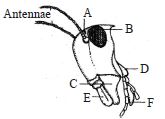
A
$A-$ Compound eye,$B-$ Ocellus,$C-$ Maxilla,$D-$ Mandible,$E-$ Labrum,$F-$ Labium
B
$A-$ Ocellus,$B-$ Compound eye,$C-$ Mandible,$D-$ Maxilla,$E-$ Labrum,$F-$ Labium
C
$A-$ Ocellus,$B-$ Compound eye,$C-$ Mandible,$D-$ Maxilla,$E-$ Labium,$F-$ Labrum
D
$A-$ Ocellus,$B-$ Compound eye,$C-$ Maxilla,$D-$ Mandible,$E-$ Labrum,$F-$ Labium
Solution
(B) Based on the anatomy of the cockroach head:
$A$ represents the Ocellus (fenestra),which is a simple eye.
$B$ represents the Compound eye.
$C$ represents the Mandible,which is a hard,biting jaw.
$D$ represents the Maxilla,which helps in food manipulation.
$E$ represents the Labrum,which acts as the upper lip.
$F$ represents the Labium,which acts as the lower lip.
Therefore,the correct sequence is $A-$ Ocellus,$B-$ Compound eye,$C-$ Mandible,$D-$ Maxilla,$E-$ Labrum,$F-$ Labium.
$A$ represents the Ocellus (fenestra),which is a simple eye.
$B$ represents the Compound eye.
$C$ represents the Mandible,which is a hard,biting jaw.
$D$ represents the Maxilla,which helps in food manipulation.
$E$ represents the Labrum,which acts as the upper lip.
$F$ represents the Labium,which acts as the lower lip.
Therefore,the correct sequence is $A-$ Ocellus,$B-$ Compound eye,$C-$ Mandible,$D-$ Maxilla,$E-$ Labrum,$F-$ Labium.
0 likes
View Solution143
EasyMCQ
Male cockroach can be identified from the female by the presence of
A
long antennae
B
wingless body
C
elongated abdomen
D
anal styles
Solution
(D) Both sexes of the cockroach possess anal cerci,which are jointed,paired structures located on the $10^{th}$ abdominal segment.
However,the male cockroach possesses an additional pair of unjointed,needle-like structures called anal styles on the $9^{th}$ abdominal segment.
These anal styles are absent in the female cockroach,making them a key morphological feature for distinguishing between the two sexes.
However,the male cockroach possesses an additional pair of unjointed,needle-like structures called anal styles on the $9^{th}$ abdominal segment.
These anal styles are absent in the female cockroach,making them a key morphological feature for distinguishing between the two sexes.
0 likes
View Solution144
Easy
Answer in one word or one line.
Give the common name of $Periplaneta \text{ } americana$.
Give the common name of $Periplaneta \text{ } americana$.
Solution
(N/A) The common name of $Periplaneta \text{ } americana$ is the American cockroach.
0 likes
View Solution145
Easy
Answer in one word or one line. How many segments are present in the abdomen of a cockroach?
Solution
(10) In both male and female cockroaches,the abdomen consists of $10$ segments.
0 likes
View Solution146
EasyMCQ
Mark the odd one in each series:
Maxilla; mandible; labrum; antennae
Maxilla; mandible; labrum; antennae
A
Maxilla
B
Mandible
C
Labrum
D
Antennae
Solution
(D) The mouthparts of a cockroach consist of a labrum (upper lip),a pair of mandibles,a pair of maxillae,and a labium (lower lip).
Maxilla,mandible,and labrum are all components of the mouthparts of a cockroach.
Antennae are sensory organs located on the head of the cockroach,not part of the mouthparts.
Therefore,antennae is the odd one out.
Maxilla,mandible,and labrum are all components of the mouthparts of a cockroach.
Antennae are sensory organs located on the head of the cockroach,not part of the mouthparts.
Therefore,antennae is the odd one out.
0 likes
View Solution147
Easy
Give general information about cockroach.
Solution
(N/A) $\rightarrow$ Cockroaches are brown or black-bodied animals.
$\rightarrow$ Cockroaches are included in the class $Insecta$ of the phylum $Arthropoda$. Bright yellow,red,and green-coloured cockroaches have also been reported in tropical regions.
$\rightarrow$ Their size ranges from $1/4$ inches to $3$ inches. They possess antennae,legs,and a flat extension of the upper body wall that conceals the head.
$\rightarrow$ They are nocturnal omnivores that live in damp places throughout the world.
$\rightarrow$ They have become residents of human homes and thus are serious pests and vectors of several diseases.
$\rightarrow$ Cockroaches are included in the class $Insecta$ of the phylum $Arthropoda$. Bright yellow,red,and green-coloured cockroaches have also been reported in tropical regions.
$\rightarrow$ Their size ranges from $1/4$ inches to $3$ inches. They possess antennae,legs,and a flat extension of the upper body wall that conceals the head.
$\rightarrow$ They are nocturnal omnivores that live in damp places throughout the world.
$\rightarrow$ They have become residents of human homes and thus are serious pests and vectors of several diseases.
0 likes
View Solution148
Medium
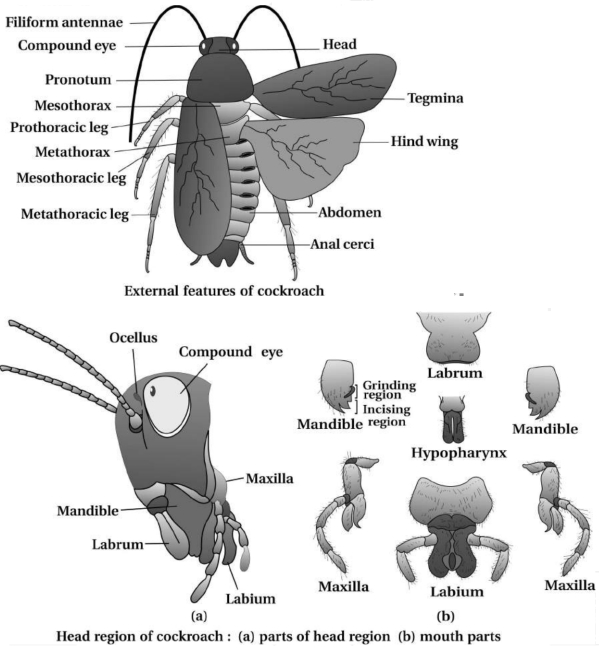
Describe the external body structure of a cockroach.
Solution
(N/A) $\rightarrow$ The adults of the common species of cockroach are $Periplaneta$ $americana$.
$\rightarrow$ The body of the cockroach is long,dorso-ventrally flattened,and brownish-red in colour.
$\rightarrow$ Adult cockroaches have a length of $25 \ mm$ to $45 \ mm$ and a breadth of $8 \ mm$ to $12 \ mm$.
$\rightarrow$ The body is covered by a hard,chitinous exoskeleton.
$\rightarrow$ In each segment,the exoskeleton has hardened plates called tergites (dorsally) and sternites (ventrally),which are joined to each other by a thin and flexible articular membrane called the arthrodial membrane.
$\rightarrow$ The body is segmented and divisible into three distinct regions: head,thorax,and abdomen.
$\rightarrow$ Head: The head is triangular in shape and lies anteriorly at right angles to the longitudinal body axis. It is formed by the fusion of six segments and bears a pair of compound eyes and a pair of thread-like antennae.
$\rightarrow$ Mouth parts: The mouth parts consist of a labrum (upper lip),a pair of mandibles,a pair of maxillae,and a labium (lower lip). $A$ median flexible lobe acting as a tongue (hypopharynx) lies within the cavity enclosed by the mouth parts.
$\rightarrow$ Thorax: The thorax consists of three parts: prothorax,mesothorax,and metathorax. Each thoracic segment bears a pair of walking legs. The first pair of wings arises from the mesothorax (tegmina) and the second pair from the metathorax.
$\rightarrow$ Abdomen: The abdomen in both males and females consists of $10$ segments. In females,the $7^{th}$ sternum is boat-shaped and forms a brood or genital pouch. In males,the genital pouch lies at the hind end of the abdomen,bounded dorsally by the $9^{th}$ and $10^{th}$ terga and ventrally by the $9^{th}$ sternum. Anal cerci are present in both sexes,while anal styles are present only in males.
$\rightarrow$ The body of the cockroach is long,dorso-ventrally flattened,and brownish-red in colour.
$\rightarrow$ Adult cockroaches have a length of $25 \ mm$ to $45 \ mm$ and a breadth of $8 \ mm$ to $12 \ mm$.
$\rightarrow$ The body is covered by a hard,chitinous exoskeleton.
$\rightarrow$ In each segment,the exoskeleton has hardened plates called tergites (dorsally) and sternites (ventrally),which are joined to each other by a thin and flexible articular membrane called the arthrodial membrane.
$\rightarrow$ The body is segmented and divisible into three distinct regions: head,thorax,and abdomen.
$\rightarrow$ Head: The head is triangular in shape and lies anteriorly at right angles to the longitudinal body axis. It is formed by the fusion of six segments and bears a pair of compound eyes and a pair of thread-like antennae.
$\rightarrow$ Mouth parts: The mouth parts consist of a labrum (upper lip),a pair of mandibles,a pair of maxillae,and a labium (lower lip). $A$ median flexible lobe acting as a tongue (hypopharynx) lies within the cavity enclosed by the mouth parts.
$\rightarrow$ Thorax: The thorax consists of three parts: prothorax,mesothorax,and metathorax. Each thoracic segment bears a pair of walking legs. The first pair of wings arises from the mesothorax (tegmina) and the second pair from the metathorax.
$\rightarrow$ Abdomen: The abdomen in both males and females consists of $10$ segments. In females,the $7^{th}$ sternum is boat-shaped and forms a brood or genital pouch. In males,the genital pouch lies at the hind end of the abdomen,bounded dorsally by the $9^{th}$ and $10^{th}$ terga and ventrally by the $9^{th}$ sternum. Anal cerci are present in both sexes,while anal styles are present only in males.
0 likes
View Solution149
Medium
Explain: Cockroach is harmful for human beings.
Solution
(N/A) $\rightarrow$ Many species of cockroaches are wild and are of no economic importance.
$A$ few species thrive in and around human habitats.
They are considered pests because they destroy food and contaminate it with their smelly excreta.
They act as vectors and can transmit a variety of bacterial diseases by contaminating food material and water.
$A$ few species thrive in and around human habitats.
They are considered pests because they destroy food and contaminate it with their smelly excreta.
They act as vectors and can transmit a variety of bacterial diseases by contaminating food material and water.
0 likes
View Solution150
Medium
Explain the head of a cockroach.
Solution
(N/A) $\rightarrow$ The head of a cockroach is triangular in shape and lies anteriorly at right angles to the longitudinal body axis.
$\rightarrow$ It is connected to the thorax by a short,thin,and flexible neck.
$\rightarrow$ The head is formed by the fusion of six embryonic segments.
$\rightarrow$ The head capsule bears a pair of large,sessile,compound eyes. These are bean-shaped.
$\rightarrow$ $A$ pair of thread-like antennae arise from membranous sockets lying in front of the eyes. These antennae contain sensory receptors that help in monitoring the environment.
$\rightarrow$ The anterior end of the head bears appendages that form biting and chewing type of mouthparts,which include the labrum,a pair of mandibles,a pair of maxillae,and the labium.
$\rightarrow$ It is connected to the thorax by a short,thin,and flexible neck.
$\rightarrow$ The head is formed by the fusion of six embryonic segments.
$\rightarrow$ The head capsule bears a pair of large,sessile,compound eyes. These are bean-shaped.
$\rightarrow$ $A$ pair of thread-like antennae arise from membranous sockets lying in front of the eyes. These antennae contain sensory receptors that help in monitoring the environment.
$\rightarrow$ The anterior end of the head bears appendages that form biting and chewing type of mouthparts,which include the labrum,a pair of mandibles,a pair of maxillae,and the labium.
0 likes
View SolutionStructural Organisation In Animals — Morphology of Cockroach · Frequently Asked Questions
1Are these Structural Organisation In Animals questions useful for JEE and NEET?
Yes. All questions in this section are mapped to JEE Main and NEET exam patterns. Previous year questions from JEE Main, NEET, GUJCET and state-level exams are included with full solutions.
2Can I switch to Hindi or Gujarati for these questions?
Yes. Use the language tabs in the hero section or the sidebar to view the same questions and solutions in English, Hindi or Gujarati.
3How do I generate a question paper from this subtopic?
Use the Vedclass Exam Paper Generator — select the chapter and subtopic, set difficulty, and generate Sets A, B, C, D automatically. First 3 chapters of every subject are free.
Vedclass Products
For Students
Vedclass Test Series
Mock tests in real JEE/NEET style with performance analysis. 5-day free trial.
Start Free TrialFor Teachers
Exam Paper Generator
Generate Set A/B/C/D papers from this chapter in 2 minutes. 3 chapters free.
Try FreeFor Institutes
Online Exam Module
Live online exams with unlimited students, 360° analytics & white-label branding.
See DemoFor Teachers & Institutes
Generate a Structural Organisation In Animals Exam Paper in 2 Minutes
Select subtopic & difficulty — Sets A, B, C, D auto-generated with No Repeat logic.
First 3 chapters of every subject are free — no payment required.