
A English
Anatomy of frog Questions in English
Class 11 Biology · Structural Organisation In Animals · Anatomy of frog
241+
Questions
English
Language
100%
With Solutions
Showing 41 of 241 questions in English
201
MediumMCQ
Which of the following blood vessels in the circulatory system of a frog contains more oxygenated blood?
A
Pulmocutaneous artery
B
Pulmonary vein
C
Pulmonary artery
D
Precaval veins
Solution
(B) In a frog,the oxygenated blood from the two lungs is collected by the right and left pulmonary veins. These veins unite to form a common pulmonary vein,which opens directly into the left auricle of the heart. Therefore,the pulmonary vein carries oxygenated blood.
0 likes
View Solution202
MediumMCQ
The integument of the frog is always kept moist because
A
It cannot move with dry skin
B
It performs cutaneous respiration
C
It cannot catch food with dry skin
D
It cannot jump better with moist skin
Solution
(B) In frogs,respiration takes place through the skin,lungs,and buccopharyngeal cavity. To perform cutaneous (skin) respiration,the skin must remain moist due to the presence of mucous-secreting glands.
0 likes
View Solution203
EasyMCQ
In the frog's heart, there are muscular ridges which consist of fibers called
A
Purkinje fibers
B
Myonemes
C
Telodendria
D
Columnae carneae
Solution
(D) In the frog's heart, a number of muscular ridges called $Columnae \text{ } carneae$ project from the wall of the ventricle into its cavity.
These ridges divide the peripheral part of the ventricular cavity into a number of small pockets.
They prevent the suction effect that would occur with a flat-surfaced membrane, thereby ensuring the heart pumps blood efficiently.
These ridges divide the peripheral part of the ventricular cavity into a number of small pockets.
They prevent the suction effect that would occur with a flat-surfaced membrane, thereby ensuring the heart pumps blood efficiently.
0 likes
View Solution204
EasyMCQ
$A$ frog never drinks water but absorbs it through one of its respiratory organs. Identify the organ.
A
Skin
B
Lung
C
Buccal cavity
D
None of the above
Solution
(A) Frogs do not drink water through their mouth. Instead,they absorb water directly from the environment through their skin. The skin of a frog is highly vascular and permeable,which allows for both cutaneous respiration and the absorption of water to maintain hydration.
0 likes
View Solution205
MediumMCQ
Match the description given in column $I$ with their examples given in column $II$ and choose the correct option.
| Column $I$ (Description) | Column $II$ (Example) |
| $A$. Aquatic respiratory organ | $I$. Skin |
| $B$. Organ which acts as urogenital duct | $II$. Ureter and opens into the cloaca |
| $C$. $A$ small median chamber | $III$. Cloaca that is used to pass faecal matter,urine and sperms to the exterior |
| $D$. $A$ triangular structure | $IV$. Sinus venosus which joins the right atrium and receives blood through vena cava |
A
$A-I, B-II, C-III, D-IV$
B
$A-III, B-IV, C-I, D-II$
C
$A-III, B-I, C-II, D-IV$
D
$A-I, B-II, C-III, D-IV$ (Note: Correct mapping is $A-I, B-II, C-III, D-IV$)
Solution
(A) The correct matches are as follows:
$A$. Aquatic respiratory organ: $I$. Skin (Frogs respire through skin in water).
$B$. Organ which acts as urogenital duct: $II$. Ureter (In male frogs,the ureters act as urinogenital ducts).
$C$. $A$ small median chamber: $III$. Cloaca (It is a common chamber for the digestive,urinary,and reproductive tracts).
$D$. $A$ triangular structure: $IV$. Sinus venosus (It is a triangular chamber that joins the right atrium).
Therefore,the correct sequence is $A-I, B-II, C-III, D-IV$.
$A$. Aquatic respiratory organ: $I$. Skin (Frogs respire through skin in water).
$B$. Organ which acts as urogenital duct: $II$. Ureter (In male frogs,the ureters act as urinogenital ducts).
$C$. $A$ small median chamber: $III$. Cloaca (It is a common chamber for the digestive,urinary,and reproductive tracts).
$D$. $A$ triangular structure: $IV$. Sinus venosus (It is a triangular chamber that joins the right atrium).
Therefore,the correct sequence is $A-I, B-II, C-III, D-IV$.
0 likes
View Solution206
MediumMCQ
What happens if the bone of a frog is kept in dilute hydrochloric acid?
A
It becomes flexible
B
It turns black
C
It breaks into pieces
D
It shrinks
Solution
(A) When a bone is kept in dilute hydrochloric acid $(HCl)$ for several hours,the inorganic components of the bone matrix,such as calcium,magnesium,and potassium salts,are dissolved by the acid. The organic part of the bone,primarily collagen,remains intact. As a result of the removal of the mineral salts that provide rigidity,the bone loses its hardness and becomes flexible.
0 likes
View Solution207
MediumMCQ
Which of the following blood vessels in the circulatory system of a frog contains more deoxygenated blood?
A
Pulmonary artery
B
Precaval veins
C
Pulmocutaneous artery
D
Pulmocutaneous vein
Solution
(C) In a frog,the heart pumps blood to the lungs and skin for oxygenation. The $pulmocutaneous$ $artery$ is responsible for carrying deoxygenated blood from the heart to the lungs and the skin,where gas exchange occurs. Therefore,it contains deoxygenated blood.
0 likes
View Solution208
EasyMCQ
The parasphenoid bone in frog forms
A
Roof of cranium
B
Floor of cranium
C
Dorsal side of cranium
D
Dorsolateral side of cranium
Solution
(B) The parasphenoid bone is a flattened and inverted $T-$shaped bone,which forms the floor (base) of the cranium in frogs.
0 likes
View Solution209
EasyMCQ
The zygomatic arch of a rabbit is formed by which of the following bones?
A
Maxilla,periotic and jugal
B
Periotic,jugal and palatine
C
Maxilla,squamosal and jugal
D
Maxilla,premaxilla and squamosal
Solution
(C) The zygomatic arch is a bony bridge in the skull of mammals.
In a rabbit,it is formed by the union of the zygomatic process of the maxilla,the jugal bone,and the zygomatic process of the squamosal bone.
These bones articulate to provide structural support to the cheek region and serve as an attachment site for masseter muscles.
In a rabbit,it is formed by the union of the zygomatic process of the maxilla,the jugal bone,and the zygomatic process of the squamosal bone.
These bones articulate to provide structural support to the cheek region and serve as an attachment site for masseter muscles.
0 likes
View Solution210
MediumMCQ
Different colours of frog's skin are controlled by
A
Hormones
B
Melanocytes
C
Nervous system
D
Both $(a)$ and $(b)$
Solution
(D) Frogs possess specialized pigment-containing cells in their skin known as chromatophores,which include melanophores,iridophores,and xanthophores.
These chromatophores are regulated by both the central nervous system and various hormones (such as melanocyte-stimulating hormone).
By adjusting the distribution of pigments within these cells,frogs can change their skin color to match their environment,producing a wide variety of shades ranging from brown to gray and green.
These chromatophores are regulated by both the central nervous system and various hormones (such as melanocyte-stimulating hormone).
By adjusting the distribution of pigments within these cells,frogs can change their skin color to match their environment,producing a wide variety of shades ranging from brown to gray and green.
0 likes
View Solution211
MediumMCQ
Select the incorrect statement regarding frogs.
A
Frogs inhabit both land and saltwater environments.
B
The scientific name of the frog is $Rana$ $tigrina$.
C
Frogs are classified as poikilothermic or cold-blooded animals.
D
To protect themselves from extreme heat and cold,they burrow into deep pits,known as hibernation and aestivation,respectively.
Solution
(A) The correct answer is $A$. Frogs are amphibians and typically inhabit freshwater environments. They cannot survive in saltwater (marine) environments because they lack the physiological adaptations to regulate osmotic pressure in high-salinity water.
$B$ is correct: The common Indian bullfrog is scientifically known as $Rana$ $tigrina$.
$C$ is correct: Frogs are poikilothermic,meaning their body temperature fluctuates with the ambient temperature.
$D$ is correct: During winter,they undergo hibernation (winter sleep) and during summer,they undergo aestivation (summer sleep) to avoid extreme temperatures.
$B$ is correct: The common Indian bullfrog is scientifically known as $Rana$ $tigrina$.
$C$ is correct: Frogs are poikilothermic,meaning their body temperature fluctuates with the ambient temperature.
$D$ is correct: During winter,they undergo hibernation (winter sleep) and during summer,they undergo aestivation (summer sleep) to avoid extreme temperatures.
0 likes
View Solution212
MediumMCQ
Frogs are $.......$ and therefore their alimentary canal is $.......$.
A
Carnivorous,short
B
Carnivorous,long
C
Herbivorous,short
D
Herbivorous,long
Solution
(A) Frogs are carnivorous animals that feed on insects.
Since meat is easier to digest than plant cellulose,the alimentary canal of a carnivore is shorter compared to that of a herbivore.
Therefore,because frogs are carnivorous,their alimentary canal is short.
Since meat is easier to digest than plant cellulose,the alimentary canal of a carnivore is shorter compared to that of a herbivore.
Therefore,because frogs are carnivorous,their alimentary canal is short.
0 likes
View Solution213
MediumMCQ
Match the following columns regarding the respiration in frogs:
| $P$. Frog on land | $I$. Cutaneous respiration |
| $Q$. Frog in water | $II$. Pulmonary respiration |
| $R$. Frog during aestivation and hibernation | $III$. Buccopharyngeal respiration |
A
$(P - I, II, III), (Q - I), (R - I)$
B
$(P - I, II, III), (Q - I, II, III), (R - I, II)$
C
$(P - II), (Q - I, III), (R - I)$
D
$(P - II, III), (Q - I), (R - I, III)$
Solution
(A) In frogs, respiration occurs through different methods depending on the environment and activity level:
$1$. When the frog is on land, it primarily uses pulmonary respiration (lungs) $(II)$ and can also use buccopharyngeal respiration $(III)$ and cutaneous respiration $(I)$.
$2$. When the frog is in water, it primarily uses cutaneous respiration $(I)$ because the skin is moist and permeable to gases.
$3$. During aestivation (summer sleep) and hibernation (winter sleep), the metabolic rate is low, and the frog relies exclusively on cutaneous respiration $(I)$.
Therefore, the correct matching is: $P - (I, II, III)$, $Q - (I)$, $R - (I)$.
$1$. When the frog is on land, it primarily uses pulmonary respiration (lungs) $(II)$ and can also use buccopharyngeal respiration $(III)$ and cutaneous respiration $(I)$.
$2$. When the frog is in water, it primarily uses cutaneous respiration $(I)$ because the skin is moist and permeable to gases.
$3$. During aestivation (summer sleep) and hibernation (winter sleep), the metabolic rate is low, and the frog relies exclusively on cutaneous respiration $(I)$.
Therefore, the correct matching is: $P - (I, II, III)$, $Q - (I)$, $R - (I)$.
0 likes
View Solution214
MediumMCQ
Select the incorrect statement from the following.
A
Frog erythrocytes are nucleated.
B
Human erythrocytes are nucleated.
C
Renal portal system is absent in humans.
D
Renal portal system is present in frogs.
Solution
(B) $1$. Frog erythrocytes (red blood cells) are nucleated,which is a correct statement.
$2$. Human erythrocytes are enucleated (lack a nucleus) at maturity to provide more space for hemoglobin,making option $B$ incorrect.
$3$. Humans possess a closed circulatory system but lack a renal portal system,which is a correct statement.
$4$. Frogs possess a well-developed renal portal system,which is a correct statement.
Therefore,the incorrect statement is $B$.
$2$. Human erythrocytes are enucleated (lack a nucleus) at maturity to provide more space for hemoglobin,making option $B$ incorrect.
$3$. Humans possess a closed circulatory system but lack a renal portal system,which is a correct statement.
$4$. Frogs possess a well-developed renal portal system,which is a correct statement.
Therefore,the incorrect statement is $B$.
0 likes
View Solution215
MediumMCQ
In the heart of a frog,the triangular structure called the sinus venosus opens into the $...............$.
A
Right atrium
B
Left atrium
C
Truncus arteriosus
D
Ventricle
Solution
(A) The heart of a frog is a $3$-chambered structure consisting of two atria and one ventricle.
It is covered by a membrane called the pericardium.
$A$ triangular structure called the sinus venosus joins the right atrium on the dorsal side.
It receives blood through the major veins called venae cavae.
Therefore,the sinus venosus opens into the right atrium.
It is covered by a membrane called the pericardium.
$A$ triangular structure called the sinus venosus joins the right atrium on the dorsal side.
It receives blood through the major veins called venae cavae.
Therefore,the sinus venosus opens into the right atrium.
0 likes
View Solution216
MediumMCQ
How many chambers in the heart of a frog contain mixed blood?
A
$1$
B
$2$
C
$3$
D
$4$
Solution
(A) The heart of a frog is $3$-chambered,consisting of two atria and one ventricle.
Deoxygenated blood from the body is received by the right atrium,while oxygenated blood from the lungs and skin is received by the left atrium.
Both atria empty their contents into the single ventricle.
Consequently,the ventricle contains mixed blood,which is then pumped to the rest of the body.
Therefore,only $1$ chamber (the ventricle) contains mixed blood.
Deoxygenated blood from the body is received by the right atrium,while oxygenated blood from the lungs and skin is received by the left atrium.
Both atria empty their contents into the single ventricle.
Consequently,the ventricle contains mixed blood,which is then pumped to the rest of the body.
Therefore,only $1$ chamber (the ventricle) contains mixed blood.
1 likes
View Solution217
MediumMCQ
Select the incorrect statement regarding excretion in frogs.
A
In female frogs, the ureters emerge from the kidneys as urinogenital ducts.
B
The structural and functional units of the kidneys are called uriniferous tubules or nephrons.
C
$A$ thin-walled urinary bladder is present ventral to the rectum.
D
The kidneys are dark red and bean-shaped structures.
Solution
(A) In the excretory system of frogs, in male frogs, the ureter and vas deferens join to form a 'urinogenital duct' that opens into the cloaca. In female frogs, the ureter and oviduct open separately into the cloaca; therefore, there is no urinogenital duct in females. Thus, option $A$ is the incorrect statement.
0 likes
View Solution218
MediumMCQ
Select the correct option for the nervous system of a frog.
A
Central Nervous System - Brain,Cranial nerves; Peripheral Nervous System - Spinal cord,Spinal nerves
B
Central Nervous System - Brain,Spinal cord; Peripheral Nervous System - Cranial nerves,Spinal nerves
C
Central Nervous System - Cranial nerves,Spinal nerves; Peripheral Nervous System - Brain,Spinal cord
D
Central Nervous System - Spinal cord,Spinal nerves; Peripheral Nervous System - Brain,Cranial nerves
Solution
(B) The nervous system of a frog is organized into the Central Nervous System $(CNS)$ and the Peripheral Nervous System $(PNS)$.
The $CNS$ includes the brain and the spinal cord.
The $PNS$ consists of the cranial nerves (arising from the brain) and the spinal nerves (arising from the spinal cord).
Therefore,option $B$ correctly describes this organization.
The $CNS$ includes the brain and the spinal cord.
The $PNS$ consists of the cranial nerves (arising from the brain) and the spinal nerves (arising from the spinal cord).
Therefore,option $B$ correctly describes this organization.
0 likes
View Solution219
MediumMCQ
How many pairs of cranial nerves arise from the brain of a frog (in $pairs$)?
A
$10$
B
$12$
C
$14$
D
$15$
Solution
(A) In a frog $(Rana \, tigrina)$, the brain is enclosed in a bony brain box or cranium.
From the brain of a frog, $10$ pairs of cranial nerves arise.
These nerves are responsible for transmitting sensory and motor signals between the brain and various parts of the head and neck region.
Therefore, the correct answer is $10$ pairs.
From the brain of a frog, $10$ pairs of cranial nerves arise.
These nerves are responsible for transmitting sensory and motor signals between the brain and various parts of the head and neck region.
Therefore, the correct answer is $10$ pairs.
0 likes
View Solution220
MediumMCQ
Match the following columns:
| Column-$I$ | Column-$II$ |
| $P$. Forebrain | $I$. Optic lobes |
| $Q$. Midbrain | $II$. Cerebellum,Medulla oblongata |
| $R$. Hindbrain | $III$. Cerebral hemispheres,Diencephalon |
A
$(P - III), (Q - II), (R - I)$
B
$(P - I), (Q - II), (R - III)$
C
$(P - II), (Q - I), (R - III)$
D
$(P - III), (Q - I), (R - II)$
Solution
(D) The brain of a frog is divided into three main parts:
$1$. Forebrain: It consists of paired cerebral hemispheres and the diencephalon. Thus,$P$ matches with $III$.
$2$. Midbrain: It is characterized by a pair of optic lobes. Thus,$Q$ matches with $I$.
$3$. Hindbrain: It consists of the cerebellum and the medulla oblongata. Thus,$R$ matches with $II$.
Therefore,the correct matching is $(P - III), (Q - I), (R - II)$.
$1$. Forebrain: It consists of paired cerebral hemispheres and the diencephalon. Thus,$P$ matches with $III$.
$2$. Midbrain: It is characterized by a pair of optic lobes. Thus,$Q$ matches with $I$.
$3$. Hindbrain: It consists of the cerebellum and the medulla oblongata. Thus,$R$ matches with $II$.
Therefore,the correct matching is $(P - III), (Q - I), (R - II)$.
0 likes
View Solution221
MediumMCQ
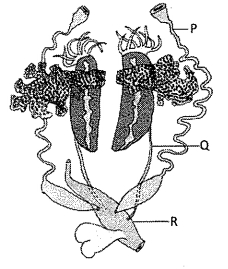
Identify $P, Q$ and $R$ in the given figure.
A
Ureter,Oviduct,Cloaca
B
Ureter,Oviduct,Cloaca
C
Oviduct,Ureter,Cloaca
D
Oviduct,Ureter,Rectum
Solution
(C) The given figure represents the female reproductive system of a frog.
In the female reproductive system of a frog:
$P$ represents the Oviduct,which is a coiled tube that transports eggs.
$Q$ represents the Ureter,which carries urine from the kidneys to the cloaca.
$R$ represents the Cloaca,which is a common chamber for the urinary,reproductive,and digestive tracts.
Therefore,the correct identification is $P$ = Oviduct,$Q$ = Ureter,and $R$ = Cloaca.
In the female reproductive system of a frog:
$P$ represents the Oviduct,which is a coiled tube that transports eggs.
$Q$ represents the Ureter,which carries urine from the kidneys to the cloaca.
$R$ represents the Cloaca,which is a common chamber for the urinary,reproductive,and digestive tracts.
Therefore,the correct identification is $P$ = Oviduct,$Q$ = Ureter,and $R$ = Cloaca.
0 likes
View Solution222
MediumMCQ
Identify the correct pathway of sperm transport in a frog.
A
Testis $\rightarrow$ Vasa efferentia $\rightarrow$ Bidder's canal $\rightarrow$ Urinogenital duct $\rightarrow$ Cloaca $\rightarrow$ Cloacal aperture
B
Testis $\rightarrow$ Vasa efferentia $\rightarrow$ Urinogenital duct $\rightarrow$ Bidder's canal $\rightarrow$ Cloaca $\rightarrow$ Cloacal aperture
C
Testis $\rightarrow$ Vasa efferentia $\rightarrow$ Oviduct $\rightarrow$ Ovary $\rightarrow$ Cloaca $\rightarrow$ Cloacal aperture
D
Testis $\rightarrow$ Vasa efferentia $\rightarrow$ Ovary $\rightarrow$ Oviduct $\rightarrow$ Cloaca $\rightarrow$ Cloacal aperture
Solution
(A) In male frogs,the sperm are produced in the testes.
From the testes,they pass through $10-12$ small ducts called vasa efferentia.
These vasa efferentia enter the kidneys on their side and open into the Bidder's canal.
From the Bidder's canal,the sperms are carried by the urinogenital duct,which finally opens into the cloaca.
From the cloaca,the sperms are released outside through the cloacal aperture.
Therefore,the correct pathway is: Testis $\rightarrow$ Vasa efferentia $\rightarrow$ Bidder's canal $\rightarrow$ Urinogenital duct $\rightarrow$ Cloaca $\rightarrow$ Cloacal aperture.
From the testes,they pass through $10-12$ small ducts called vasa efferentia.
These vasa efferentia enter the kidneys on their side and open into the Bidder's canal.
From the Bidder's canal,the sperms are carried by the urinogenital duct,which finally opens into the cloaca.
From the cloaca,the sperms are released outside through the cloacal aperture.
Therefore,the correct pathway is: Testis $\rightarrow$ Vasa efferentia $\rightarrow$ Bidder's canal $\rightarrow$ Urinogenital duct $\rightarrow$ Cloaca $\rightarrow$ Cloacal aperture.
0 likes
View Solution223
MediumMCQ
$A$ mature female frog lays how many ova at a time?
A
$1000-1500$
B
$2500-3000$
C
$10000-15000$
D
$25000-30000$
Solution
(B) In the anatomy of a frog,the female reproductive system is highly prolific. $A$ single mature female frog is capable of laying approximately $2500$ to $3000$ ova at a time during the breeding season. This high number of eggs ensures the survival of the species despite high predation rates in their aquatic environment.
0 likes
View Solution224
MediumMCQ
Select the correct option regarding the frog.
A
Fertilization is external and occurs in water.
B
Development is larval,known as the tadpole.
C
The tadpole undergoes metamorphosis to become an adult frog.
D
All of the above.
Solution
(D) In frogs,fertilization is external,meaning it occurs in water ($A$ is correct).
Development is indirect,involving a larval stage called the tadpole ($B$ is correct).
The tadpole undergoes metamorphosis,passing through various stages to transform into an adult frog ($C$ is correct).
Therefore,all the given statements are correct.
Development is indirect,involving a larval stage called the tadpole ($B$ is correct).
The tadpole undergoes metamorphosis,passing through various stages to transform into an adult frog ($C$ is correct).
Therefore,all the given statements are correct.
0 likes
View Solution225
MediumMCQ
What is the name of the blood vessel that carries deoxygenated blood from the body to the heart in a frog?
A
Aorta
B
Pulmonary artery
C
Pulmonary vein
D
Vena cava
Solution
(D) In a frog,the deoxygenated blood from various parts of the body is collected by the venous system and brought to the heart through two large veins known as the vena cavae (precaval and postcaval). These vessels empty into the sinus venosus,which then leads into the right atrium of the heart.
0 likes
View Solution226
MediumMCQ
In frog,the Renal portal system is a special venous connection that acts to link :
A
Liver and intestine
B
Liver and kidney
C
Kidney and intestine
D
Kidney and lower part of body
Solution
(D) The renal portal system in a frog is a specialized venous network that carries blood from the posterior (lower) parts of the body directly to the kidneys before it returns to the heart.
This system is essential for the excretion of nitrogenous wastes from the lower limbs and posterior regions of the body.
Therefore,it acts as a link between the lower part of the body and the kidneys.
This system is essential for the excretion of nitrogenous wastes from the lower limbs and posterior regions of the body.
Therefore,it acts as a link between the lower part of the body and the kidneys.
0 likes
View Solution227
MediumMCQ
Frogs respire in water by skin and buccal cavity and on land by skin,buccal cavity and lungs. Choose the correct answer from the following:
A
The statement is true for water but false for land
B
The statement is true for both the environment
C
The statement is false for water but true for land
D
The statement is false for both the environment
Solution
(B) Frogs exhibit cutaneous respiration (through the skin) in both water and on land.
In water,the skin acts as the primary respiratory organ,and the buccal cavity also contributes to gas exchange.
On land,frogs respire through their skin (cutaneous respiration),buccal cavity (buccal respiration),and lungs (pulmonary respiration).
Therefore,the statement provided is scientifically accurate for both environments.
In water,the skin acts as the primary respiratory organ,and the buccal cavity also contributes to gas exchange.
On land,frogs respire through their skin (cutaneous respiration),buccal cavity (buccal respiration),and lungs (pulmonary respiration).
Therefore,the statement provided is scientifically accurate for both environments.
0 likes
View Solution228
MediumMCQ
Assertion: Heart of frog is muscular and three-chambered.
Reason: Heart of frog pumps mixed blood into lungs and body by conus arteriosus.
Reason: Heart of frog pumps mixed blood into lungs and body by conus arteriosus.
A
Both Assertion & Reason are True & the Reason is a correct explanation of the Assertion.
B
Both Assertion & Reason are True but Reason is not a correct explanation of the Assertion.
C
Assertion is True but the Reason is False.
D
Both Assertion & Reason are False.
Solution
(A) The heart of a frog is indeed muscular and three-chambered,consisting of two atria and one ventricle.
This structure is an adaptation for its semi-aquatic life.
The conus arteriosus is a specialized structure attached to the ventricle that helps in the distribution of blood.
It receives mixed blood from the ventricle and directs it to different parts of the body,including the lungs and skin,through various arterial arches.
Therefore,the reason correctly explains why the heart structure is significant in the context of blood circulation in frogs.
This structure is an adaptation for its semi-aquatic life.
The conus arteriosus is a specialized structure attached to the ventricle that helps in the distribution of blood.
It receives mixed blood from the ventricle and directs it to different parts of the body,including the lungs and skin,through various arterial arches.
Therefore,the reason correctly explains why the heart structure is significant in the context of blood circulation in frogs.
0 likes
View Solution229
MediumMCQ
In the frog,the ventricle opens into a sac-like conus arteriosus on the $......$ of the heart. Read the given statement and fill in the blank with the correct option from the given below.
A
Dorsal side
B
Lateral side
C
Ventral side
D
Posterior side
Solution
(C) In the heart of a frog,the ventricle is a thick-walled,muscular chamber.
It pumps blood into a sac-like structure called the conus arteriosus.
The conus arteriosus is located on the ventral side of the heart.
Therefore,the correct option is $C$.
It pumps blood into a sac-like structure called the conus arteriosus.
The conus arteriosus is located on the ventral side of the heart.
Therefore,the correct option is $C$.
0 likes
View Solution230
EasyMCQ
Forebrain of frog does not include which of the following structures?
A
Olfactory lobe
B
Optic lobe
C
Cerebral hemisphere
D
Diencephalon
Solution
(B) The brain of a frog is divided into three main parts: forebrain,midbrain,and hindbrain.
$1$. The forebrain consists of a pair of olfactory lobes,a pair of cerebral hemispheres,and a diencephalon.
$2$. The midbrain consists of a pair of optic lobes.
$3$. The hindbrain consists of the cerebellum and medulla oblongata.
Therefore,the optic lobes are part of the midbrain,not the forebrain.
$1$. The forebrain consists of a pair of olfactory lobes,a pair of cerebral hemispheres,and a diencephalon.
$2$. The midbrain consists of a pair of optic lobes.
$3$. The hindbrain consists of the cerebellum and medulla oblongata.
Therefore,the optic lobes are part of the midbrain,not the forebrain.
0 likes
View Solution231
MediumMCQ
During Aestivation,which structure helps in respiration in frogs?
A
Moist skin
B
Lungs
C
Buccal cavity
D
All of these
Solution
(A) Frogs exhibit cutaneous respiration through their moist skin during both aestivation (summer sleep) and hibernation (winter sleep).
In this state,the metabolic rate is reduced,and the skin acts as the primary respiratory surface for the exchange of gases.
While lungs and the buccal cavity are used for respiration on land during active periods,cutaneous respiration is the exclusive or primary method during periods of dormancy like aestivation.
In this state,the metabolic rate is reduced,and the skin acts as the primary respiratory surface for the exchange of gases.
While lungs and the buccal cavity are used for respiration on land during active periods,cutaneous respiration is the exclusive or primary method during periods of dormancy like aestivation.
0 likes
View Solution232
DifficultMCQ
How many vasa efferentia arise from the testes of a male frog?
A
$25-30$
B
$10-12$
C
$10$ pairs
D
$3-4$
Solution
(B) In male frogs,the vasa efferentia are a series of fine tubules that arise from the testes. These tubules enter the kidneys on their respective sides and open into the Bidder's canal. The number of vasa efferentia typically ranges from $10$ to $12$.
0 likes
View Solution233
MediumMCQ
Statement-$I$: In frog,eyes and internal ears are well-organised structures.
Statement-$II$: Sensory papillae,taste buds,and nasal epithelium are cellular aggregations around nerve endings.
Statement-$II$: Sensory papillae,taste buds,and nasal epithelium are cellular aggregations around nerve endings.
A
Both statement $I$ and statement $II$ are incorrect
B
Statement $I$ is correct but statement $II$ is incorrect
C
Statement $I$ is incorrect but statement $II$ is correct
D
Both statement $I$ and statement $II$ are correct
Solution
(D) Statement-$I$ is correct: In frogs,the eyes and internal ears are highly developed and well-organised sensory structures.
Statement-$II$ is correct: Sensory papillae (for touch),taste buds (for taste),and nasal epithelium (for smell) are indeed cellular aggregations located around nerve endings that function as sensory receptors.
Therefore,both statements are correct.
Statement-$II$ is correct: Sensory papillae (for touch),taste buds (for taste),and nasal epithelium (for smell) are indeed cellular aggregations located around nerve endings that function as sensory receptors.
Therefore,both statements are correct.
0 likes
View Solution234
MediumMCQ
In frog, a triangular structure called $A$ joins the $B$:
A
$A -$ Conus arteriosus, $B -$ Left atrium
B
$A -$ Sinus venosus, $B -$ Ventricle
C
$A -$ Sinus venosus, $B -$ Right atrium
D
$A -$ Conus arteriosus, $B -$ Right atrium
Solution
(C) In the heart of a frog, the $Sinus$ $venosus$ is a thin-walled, triangular chamber.
It is located on the dorsal side of the heart.
Its primary function is to receive blood from the major veins (vena cava) and join the right atrium to deliver deoxygenated blood into the heart.
It is located on the dorsal side of the heart.
Its primary function is to receive blood from the major veins (vena cava) and join the right atrium to deliver deoxygenated blood into the heart.
0 likes
View Solution235
MediumMCQ
Frogs differ from humans in possessing$-$
A
Thyroid as well as parathyroid
B
Paired cerebral hemispheres
C
Hepatic portal system
D
Nucleated red blood cells
Solution
(D) Frogs and humans share several anatomical features,such as the presence of a thyroid gland,parathyroid glands,paired cerebral hemispheres,and a hepatic portal system.
However,a key difference lies in the nature of their red blood cells $(RBCs)$.
In humans,mature red blood cells are enucleated (lacking a nucleus) to maximize space for hemoglobin.
In contrast,frogs possess nucleated red blood cells throughout their life cycle.
Therefore,the correct option is $D$.
However,a key difference lies in the nature of their red blood cells $(RBCs)$.
In humans,mature red blood cells are enucleated (lacking a nucleus) to maximize space for hemoglobin.
In contrast,frogs possess nucleated red blood cells throughout their life cycle.
Therefore,the correct option is $D$.
0 likes
View Solution236
EasyMCQ
At a time,a mature female frog can lay $2500-3000$ ova at a time.
A
$2000-2500$
B
$2500-3000$
C
$1000-2000$
D
$1500-2000$
Solution
(B) In the reproductive system of a frog,the female reproductive organs consist of a pair of ovaries. The ovaries are situated near the kidneys and do not have a functional connection with them. $A$ mature female frog can lay $2500-3000$ ova at a time during the breeding season.
0 likes
View Solution237
MediumMCQ
Assertion: Indirect development is present in frogs.
Reason: The larva of a frog undergoes metamorphosis to form the adult.
Reason: The larva of a frog undergoes metamorphosis to form the adult.
A
Both Assertion & Reason are True & the Reason is a correct explanation of the Assertion.
B
Both Assertion & Reason are True but Reason is not a correct explanation of the Assertion.
C
Assertion is True but the Reason is False.
D
Both Assertion & Reason are False.
Solution
(A) In frogs,the life cycle includes a larval stage known as the tadpole.
Since the organism does not develop directly into the adult form but passes through a distinct larval stage,this is termed as indirect development.
The process by which the tadpole (larva) transforms into the adult frog is called metamorphosis.
Therefore,the reason correctly explains why the development is considered indirect.
Since the organism does not develop directly into the adult form but passes through a distinct larval stage,this is termed as indirect development.
The process by which the tadpole (larva) transforms into the adult frog is called metamorphosis.
Therefore,the reason correctly explains why the development is considered indirect.
0 likes
View Solution238
EasyMCQ
Match each item in Column $I$ with one in Column $II$ and select the correct match from the codes given:
| Column $I$ | Column $II$ |
| $A$. Vocal Sac | $P$. Sexual dimorphism |
| $B$. In hibernation, frog respires | $R$. Through skin |
| $C$. Renal portal system | $U$. Joins kidneys and lower parts of body |
| $D$. Bidder's canal | $X$. Receives sperm from vasa efferentia |
A
$A \rightarrow P, B \rightarrow R, C \rightarrow X, D \rightarrow W$
B
$A \rightarrow P, B \rightarrow R, C \rightarrow U, D \rightarrow X$
C
$A \rightarrow R, B \rightarrow P, C \rightarrow T, D \rightarrow X$
D
$A \rightarrow Q, B \rightarrow S, C \rightarrow T, D \rightarrow W$
Solution
(B) The correct matches are as follows:
$1$. Vocal Sac $(A)$ is a characteristic feature of male frogs, representing sexual dimorphism $(P)$.
$2$. During hibernation and aestivation, the frog respires only through its skin $(R)$.
$3$. The renal portal system $(C)$ is a vascular system that collects blood from the lower parts of the body and transports it to the kidneys $(U)$.
$4$. Bidder's canal $(D)$ is present in the kidneys of male frogs and receives sperms from the vasa efferentia $(X)$.
Therefore, the correct sequence is $A \rightarrow P, B \rightarrow R, C \rightarrow U, D \rightarrow X$.
$1$. Vocal Sac $(A)$ is a characteristic feature of male frogs, representing sexual dimorphism $(P)$.
$2$. During hibernation and aestivation, the frog respires only through its skin $(R)$.
$3$. The renal portal system $(C)$ is a vascular system that collects blood from the lower parts of the body and transports it to the kidneys $(U)$.
$4$. Bidder's canal $(D)$ is present in the kidneys of male frogs and receives sperms from the vasa efferentia $(X)$.
Therefore, the correct sequence is $A \rightarrow P, B \rightarrow R, C \rightarrow U, D \rightarrow X$.
0 likes
View Solution239
MediumMCQ
Which of the following structures attaches the testes to the kidneys in a frog?
A
Mesorchium
B
Perichondrium
C
Nuptial pad
D
Copulatory pad
Solution
(A) In frogs,the testes are yellowish,ovoid structures paired and attached to the upper part of the kidneys by a double fold of peritoneum called the mesorchium.
$1$. $Mesorchium$ is the fold of the peritoneum that suspends the testes.
$2$. $Perichondrium$ is the connective tissue covering cartilage.
$3$. $Nuptial$ $pad$ is a secondary sexual character found on the first digit of the forelimbs of male frogs.
$4$. $Copulatory$ $pad$ is another term often used for nuptial pads in some contexts,but it is not the structure that attaches the testes to the kidneys.
$1$. $Mesorchium$ is the fold of the peritoneum that suspends the testes.
$2$. $Perichondrium$ is the connective tissue covering cartilage.
$3$. $Nuptial$ $pad$ is a secondary sexual character found on the first digit of the forelimbs of male frogs.
$4$. $Copulatory$ $pad$ is another term often used for nuptial pads in some contexts,but it is not the structure that attaches the testes to the kidneys.
0 likes
View Solution240
EasyMCQ
Which of the following statements are correct with respect to $Frogs$?
$A$. $Bidder's$ canals are present in male $Frogs$
$B$. Copulatory pads are present in female $Frogs$
$C$. Sound producing vocal sacs are present in male $Frogs$
$D$. $Cloaca$ is present in male $Frog$ only
Choose the most appropriate answer from the options given below:
$A$. $Bidder's$ canals are present in male $Frogs$
$B$. Copulatory pads are present in female $Frogs$
$C$. Sound producing vocal sacs are present in male $Frogs$
$D$. $Cloaca$ is present in male $Frog$ only
Choose the most appropriate answer from the options given below:
A
$A$ and $C$
B
$B$ and $D$
C
$A$ and $D$
D
$A$ and $B$
Solution
(A) The correct statements are $A$ and $C$.
$1$. $Bidder's$ canals are present in the kidneys of male $Frogs$ and are involved in the transport of spermatozoa.
$2$. Copulatory pads (nuptial pads) are present on the first digit of the forelimbs in male $Frogs$ to assist in amplexus during mating.
$3$. Vocal sacs are present in male $Frogs$ to produce sound for attracting females.
$4$. The $Cloaca$ is a common chamber for the urinary,reproductive,and digestive tracts,and it is present in both male and female $Frogs$.
$1$. $Bidder's$ canals are present in the kidneys of male $Frogs$ and are involved in the transport of spermatozoa.
$2$. Copulatory pads (nuptial pads) are present on the first digit of the forelimbs in male $Frogs$ to assist in amplexus during mating.
$3$. Vocal sacs are present in male $Frogs$ to produce sound for attracting females.
$4$. The $Cloaca$ is a common chamber for the urinary,reproductive,and digestive tracts,and it is present in both male and female $Frogs$.
0 likes
View Solution241
MediumMCQ
Choose the correct statements regarding frog's anatomy:
$A$. Hepatic portal system is the special venous connection between liver and intestine.
$B$. There are twelve pairs of cranial nerves arising from the brain.
$C$. The ureters and oviducts open separately into the cloaca in female frogs.
$D$. Hind-brain consists of cerebellum,medulla oblongata and optic lobes.
$E$. Sinus venosus joins the right atrium of heart.
Choose the correct answer from the options given below:
$A$. Hepatic portal system is the special venous connection between liver and intestine.
$B$. There are twelve pairs of cranial nerves arising from the brain.
$C$. The ureters and oviducts open separately into the cloaca in female frogs.
$D$. Hind-brain consists of cerebellum,medulla oblongata and optic lobes.
$E$. Sinus venosus joins the right atrium of heart.
Choose the correct answer from the options given below:
A
$(1)$ $B$ and $D$ only
B
$(2)$ $A, B$ and $C$ only
C
$(3)$ $B$ and $C$ only
D
$(4)$ $A, C$ and $E$ only
Solution
(D) Statement $A$ is correct: The hepatic portal system is a special venous connection between the intestine and the liver.
Statement $B$ is incorrect: Frogs have $10$ pairs of cranial nerves,not $12$.
Statement $C$ is correct: In female frogs,the ureters and oviducts open separately into the cloaca.
Statement $D$ is incorrect: The hind-brain consists of the cerebellum and medulla oblongata; the optic lobes are part of the mid-brain.
Statement $E$ is correct: The sinus venosus is a triangular chamber that joins the right atrium of the heart.
Therefore,statements $A, C,$ and $E$ are correct.
Statement $B$ is incorrect: Frogs have $10$ pairs of cranial nerves,not $12$.
Statement $C$ is correct: In female frogs,the ureters and oviducts open separately into the cloaca.
Statement $D$ is incorrect: The hind-brain consists of the cerebellum and medulla oblongata; the optic lobes are part of the mid-brain.
Statement $E$ is correct: The sinus venosus is a triangular chamber that joins the right atrium of the heart.
Therefore,statements $A, C,$ and $E$ are correct.
0 likes
View SolutionStructural Organisation In Animals — Anatomy of frog · Frequently Asked Questions
1Are these Structural Organisation In Animals questions useful for JEE and NEET?
Yes. All questions in this section are mapped to JEE Main and NEET exam patterns. Previous year questions from JEE Main, NEET, GUJCET and state-level exams are included with full solutions.
2Can I switch to Hindi or Gujarati for these questions?
Yes. Use the language tabs in the hero section or the sidebar to view the same questions and solutions in English, Hindi or Gujarati.
3How do I generate a question paper from this subtopic?
Use the Vedclass Exam Paper Generator — select the chapter and subtopic, set difficulty, and generate Sets A, B, C, D automatically. First 3 chapters of every subject are free.
Vedclass Products
For Students
Vedclass Test Series
Mock tests in real JEE/NEET style with performance analysis. 5-day free trial.
Start Free TrialFor Teachers
Exam Paper Generator
Generate Set A/B/C/D papers from this chapter in 2 minutes. 3 chapters free.
Try FreeFor Institutes
Online Exam Module
Live online exams with unlimited students, 360° analytics & white-label branding.
See DemoFor Teachers & Institutes
Generate a Structural Organisation In Animals Exam Paper in 2 Minutes
Select subtopic & difficulty — Sets A, B, C, D auto-generated with No Repeat logic.
First 3 chapters of every subject are free — no payment required.