
A English
Anatomy of frog Questions in English
Class 11 Biology · Structural Organisation In Animals · Anatomy of frog
241+
Questions
English
Language
100%
With Solutions
Showing 49 of 241 questions in English
151
MediumMCQ
Frogs differ from humans in terms of:
A
Paired limbs
B
Respiration
C
Phylum
D
Kingdom
Solution
(B) Frogs belong to the class $Amphibia$ and the phylum $Chordata$. Humans belong to the class $Mammalia$ and the phylum $Chordata$. Both organisms share the same phylum $(Chordata)$ and kingdom $(Animalia)$. Both possess paired limbs. However,they differ significantly in their mode of respiration: frogs use skin,lungs,and buccal cavity (cutaneous,pulmonary,and buccopharyngeal respiration),whereas humans rely exclusively on lungs for respiration.
0 likes
View Solution152
EasyMCQ
Which is the main respiratory organ in a frog?
A
Buccal cavity
B
Spiracles
C
Skin
D
All of the above
Solution
(C) Frogs exhibit cutaneous respiration,meaning they breathe through their skin. The skin is moist and rich in blood vessels,allowing for the exchange of gases directly with the environment. While frogs also use their lungs (pulmonary respiration) and buccal cavity for breathing,the skin serves as the primary respiratory surface,especially when the frog is underwater or hibernating. Therefore,the skin is considered the main respiratory organ.
0 likes
View Solution153
EasyMCQ
Which of the following structures open into the cloaca of a female frog?
A
Urinary bladder
B
Rectum
C
Oviduct
D
All of the above
Solution
(D) In a female frog, the cloaca is a common chamber for the urinary, reproductive, and digestive tracts.
$1$. The $Rectum$ opens into the cloaca to discharge fecal matter.
$2$. The $Urinary \text{ } bladder$ opens into the cloaca to discharge urine.
$3$. The $Oviducts$ (paired) open separately into the cloaca to release eggs.
Therefore, all these structures open into the cloaca.
$1$. The $Rectum$ opens into the cloaca to discharge fecal matter.
$2$. The $Urinary \text{ } bladder$ opens into the cloaca to discharge urine.
$3$. The $Oviducts$ (paired) open separately into the cloaca to release eggs.
Therefore, all these structures open into the cloaca.
0 likes
View Solution154
MediumMCQ
Identify the odd one out regarding the anatomy of a frog.
A
All accessory digestive glands are in pairs.
B
Appendages are in pairs.
C
Testes are in pairs.
D
Kidneys are in pairs.
Solution
(A) In frogs,the appendages (forelimbs and hindlimbs) are present in pairs. The testes and kidneys are also paired structures. However,the accessory digestive glands,specifically the liver and pancreas,are not both paired in the same way; the liver is a large,multi-lobed organ,and the pancreas is a single,irregular gland. Therefore,the statement that all accessory digestive glands are in pairs is incorrect for a frog.
0 likes
View Solution155
MediumMCQ
The alimentary canal of a frog is short because:
A
It does not have salivary glands.
B
They are carnivores,and hence the length of the intestine is reduced.
C
They are omnivorous,and hence the oesophagus is very short.
D
They are herbivorous,and hence the pharynx is not present.
Solution
(B) Frogs are carnivores,meaning their diet consists primarily of animal matter (insects,worms,etc.).
Animal matter is relatively easy to digest compared to plant matter,which contains cellulose.
Herbivores require a longer alimentary canal to allow more time for the fermentation and digestion of complex plant cellulose.
Since frogs consume protein-rich animal food,they do not require a long intestine,leading to a shorter alimentary canal.
Animal matter is relatively easy to digest compared to plant matter,which contains cellulose.
Herbivores require a longer alimentary canal to allow more time for the fermentation and digestion of complex plant cellulose.
Since frogs consume protein-rich animal food,they do not require a long intestine,leading to a shorter alimentary canal.
0 likes
View Solution156
MediumMCQ
Choose the correct sentences for a female frog.
$1$. Vocal sacs are absent in female frogs.
$2$. $A$ mature female can lay $2500$ to $3000$ ova at a time.
$3$. In female frogs,fertilized eggs are encased in oothecae and it is a dark reddish to blackish brown.
$1$. Vocal sacs are absent in female frogs.
$2$. $A$ mature female can lay $2500$ to $3000$ ova at a time.
$3$. In female frogs,fertilized eggs are encased in oothecae and it is a dark reddish to blackish brown.
A
$2, 3$
B
$1, 2$
C
$1, 3$
D
All are correct
Solution
(B) Statement $1$ is correct: Vocal sacs are secondary sexual characteristics found only in male frogs to produce mating calls; they are absent in females.
Statement $2$ is correct: $A$ mature female frog can lay $2500$ to $3000$ ova at a time during the breeding season.
Statement $3$ is incorrect: The description of eggs being encased in 'oothecae' that are 'dark reddish to blackish brown' refers to the cockroach,not the frog. Frog eggs are laid in a cluster called 'spawn' which is a gelatinous mass.
Statement $2$ is correct: $A$ mature female frog can lay $2500$ to $3000$ ova at a time during the breeding season.
Statement $3$ is incorrect: The description of eggs being encased in 'oothecae' that are 'dark reddish to blackish brown' refers to the cockroach,not the frog. Frog eggs are laid in a cluster called 'spawn' which is a gelatinous mass.
0 likes
View Solution157
MediumMCQ
Identify the odd one out regarding the anatomy of a frog.
A
Gonapophyses
B
Cloaca
C
Nucleated $RBC$
D
Three chambered heart
Solution
(A) The correct answer is $A$.
$1$. Gonapophyses are chitinous structures found in insects (e.g.,cockroaches) used for copulation or egg-laying. They are not present in frogs.
$2$. Cloaca is a common chamber for the urinary,reproductive,and digestive tracts in frogs.
$3$. Frogs possess nucleated red blood cells $(RBCs)$,unlike mammals which have non-nucleated $RBCs$.
$4$. Frogs have a three-chambered heart consisting of two atria and one ventricle.
$1$. Gonapophyses are chitinous structures found in insects (e.g.,cockroaches) used for copulation or egg-laying. They are not present in frogs.
$2$. Cloaca is a common chamber for the urinary,reproductive,and digestive tracts in frogs.
$3$. Frogs possess nucleated red blood cells $(RBCs)$,unlike mammals which have non-nucleated $RBCs$.
$4$. Frogs have a three-chambered heart consisting of two atria and one ventricle.
0 likes
View Solution158
MediumMCQ
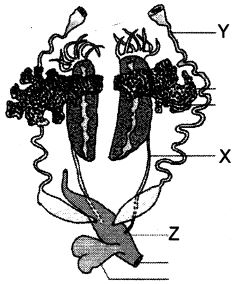
Identify $X, Y$ and $Z$ in the given figure of the female reproductive system of a frog.
A
Urinogenital duct - Cloaca - Oviduct
B
Oviduct - Ureter - Cloacal aperture
C
Ureter - Oviduct - Cloaca
D
Ureter - Cloaca - Urinary bladder
Solution
(C) The provided figure represents the female reproductive system of a frog.
In this diagram:
$X$ represents the Ureter, which carries urine from the kidneys.
$Y$ represents the Oviduct, which is a coiled tube responsible for transporting eggs.
$Z$ represents the Cloaca, which is the common chamber for the digestive, reproductive, and urinary tracts.
Therefore, the correct sequence is $X = \text{Ureter}$, $Y = \text{Oviduct}$, and $Z = \text{Cloaca}$.
In this diagram:
$X$ represents the Ureter, which carries urine from the kidneys.
$Y$ represents the Oviduct, which is a coiled tube responsible for transporting eggs.
$Z$ represents the Cloaca, which is the common chamber for the digestive, reproductive, and urinary tracts.
Therefore, the correct sequence is $X = \text{Ureter}$, $Y = \text{Oviduct}$, and $Z = \text{Cloaca}$.
0 likes
View Solution159
MediumMCQ
Match the correct pair.
| Column-$I$ | Column-$II$ |
| $A$. Skin | $1$. Accessory digestive gland |
| $B$. Pancreas | $2$. Respiratory organ |
| $C$. Genitalia | $3$. Sensory organ |
| $D$. Eye | $4$. Reproductive organ |
| $5$. Excretory organ |
A
$(A-1), (B-3), (C-2), (D-4)$
B
$(A-2), (B-4), (C-1), (D-3)$
C
$(A-2), (B-1), (C-4), (D-3)$
D
$(A-4), (B-2), (C-3), (D-1)$
Solution
(C) In the context of frog morphology:
$A$. Skin acts as a respiratory organ (cutaneous respiration).
$B$. Pancreas acts as an accessory digestive gland,secreting pancreatic juice.
$C$. Genitalia are involved in reproduction (reproductive organs).
$D$. Eye is a sensory organ.
Therefore,the correct matching is $A-2, B-1, C-4, D-3$.
$A$. Skin acts as a respiratory organ (cutaneous respiration).
$B$. Pancreas acts as an accessory digestive gland,secreting pancreatic juice.
$C$. Genitalia are involved in reproduction (reproductive organs).
$D$. Eye is a sensory organ.
Therefore,the correct matching is $A-2, B-1, C-4, D-3$.
0 likes
View Solution160
MediumMCQ
In a frog,which of the following is a part of the hindbrain?
A
Olfactory lobe
B
Cerebellum
C
Diencephalon
D
None of these
Solution
(B) The brain of a frog is divided into three main parts: the forebrain,midbrain,and hindbrain.
$1$. The forebrain includes the olfactory lobes,paired cerebral hemispheres,and the unpaired diencephalon.
$2$. The midbrain consists of a pair of optic lobes.
$3$. The hindbrain consists of the cerebellum and the medulla oblongata.
Therefore,the cerebellum is a part of the hindbrain.
$1$. The forebrain includes the olfactory lobes,paired cerebral hemispheres,and the unpaired diencephalon.
$2$. The midbrain consists of a pair of optic lobes.
$3$. The hindbrain consists of the cerebellum and the medulla oblongata.
Therefore,the cerebellum is a part of the hindbrain.
0 likes
View Solution161
MediumMCQ
Which of the following is $NOT$ a part of the frog's digestive system?
A
Cloaca
B
Caecum
C
Ileum
D
Stomach
Solution
(B) The digestive system of a frog consists of an alimentary canal and digestive glands.
The alimentary canal includes the mouth, buccal cavity, pharynx, esophagus, stomach, small intestine (duodenum and ileum), large intestine (rectum), and cloaca.
- The $Stomach$ is a part of the digestive system.
- The $Ileum$ is the terminal part of the small intestine.
- The $Cloaca$ is the common chamber for the digestive, urinary, and reproductive tracts.
- The $Caecum$ is a pouch connected to the junction of the small and large intestines in mammals (like humans), but it is $NOT$ present in the digestive system of a frog.
The alimentary canal includes the mouth, buccal cavity, pharynx, esophagus, stomach, small intestine (duodenum and ileum), large intestine (rectum), and cloaca.
- The $Stomach$ is a part of the digestive system.
- The $Ileum$ is the terminal part of the small intestine.
- The $Cloaca$ is the common chamber for the digestive, urinary, and reproductive tracts.
- The $Caecum$ is a pouch connected to the junction of the small and large intestines in mammals (like humans), but it is $NOT$ present in the digestive system of a frog.
0 likes
View Solution162
MediumMCQ
Which of the following is included in the forebrain of a frog?
A
Medulla oblongata
B
Cerebellum
C
Olfactory lobes
D
All of the above
Solution
(C) The brain of a frog is divided into three main parts: forebrain,midbrain,and hindbrain.
$1$. The forebrain includes the olfactory lobes,paired cerebral hemispheres,and the unpaired diencephalon.
$2$. The midbrain consists of a pair of optic lobes.
$3$. The hindbrain consists of the cerebellum and the medulla oblongata.
Therefore,among the given options,only the olfactory lobes are part of the forebrain.
$1$. The forebrain includes the olfactory lobes,paired cerebral hemispheres,and the unpaired diencephalon.
$2$. The midbrain consists of a pair of optic lobes.
$3$. The hindbrain consists of the cerebellum and the medulla oblongata.
Therefore,among the given options,only the olfactory lobes are part of the forebrain.
0 likes
View Solution163
MediumMCQ
Choose the correct sentence regarding the anatomy of a frog.
A
The ileum opens into the large intestine.
B
The ileum is the long coiled part of the digestive duct.
C
The pyloric stomach opens into the small intestine.
D
All of the above.
Solution
(D) In the digestive system of a frog:
$1$. The stomach is divided into two parts: the cardiac stomach and the pyloric stomach. The pyloric stomach opens into the small intestine.
$2$. The small intestine is further divided into the duodenum and the ileum.
$3$. The ileum is the long,coiled part of the digestive tract.
$4$. The ileum opens into the large intestine (rectum),which then opens into the cloaca.
Therefore,all the given statements are correct.
$1$. The stomach is divided into two parts: the cardiac stomach and the pyloric stomach. The pyloric stomach opens into the small intestine.
$2$. The small intestine is further divided into the duodenum and the ileum.
$3$. The ileum is the long,coiled part of the digestive tract.
$4$. The ileum opens into the large intestine (rectum),which then opens into the cloaca.
Therefore,all the given statements are correct.
0 likes
View Solution164
MediumMCQ
The left auricle of a frog receives .........
A
Oxygenated blood
B
Deoxygenated blood
C
Mixed blood
D
Blood absent
Solution
(A) In the heart of a frog,the left auricle receives oxygenated blood from the lungs and skin via the pulmonary veins.
Conversely,the right auricle receives deoxygenated blood from the rest of the body through the sinus venosus.
Both auricles then empty their contents into the single ventricle,where the blood becomes mixed before being pumped out to the body.
Conversely,the right auricle receives deoxygenated blood from the rest of the body through the sinus venosus.
Both auricles then empty their contents into the single ventricle,where the blood becomes mixed before being pumped out to the body.
0 likes
View Solution165
EasyMCQ
In frogs,mucus helps to keep the skin ..........
A
thick
B
dry
C
soft
D
moist
Solution
(D) In frogs,the skin is smooth and slippery due to the presence of mucus glands. The mucus secreted by these glands helps to keep the skin moist,which is essential for cutaneous respiration (breathing through the skin).
0 likes
View Solution166
EasyMCQ
Compared to humans,the red blood cells of a frog are ...........
A
Enucleated but contain hemoglobin.
B
Nucleated and contain hemoglobin.
C
Very small and fewer in number.
D
Nucleated but lack hemoglobin.
Solution
(B) In humans,mature red blood cells $(RBCs)$ are enucleated (lack a nucleus) to provide more space for hemoglobin. In contrast,the red blood cells of a frog are nucleated (possess a nucleus) and contain hemoglobin,which is the respiratory pigment responsible for oxygen transport.
0 likes
View Solution167
MediumMCQ
If a bone piece,such as a frog's femur,is kept in dilute $HCl$ for a week,it will become .......
A
Turn black
B
Shrink in size
C
Become flexible
D
Break into pieces
Solution
(C) Bone is composed of an organic matrix (collagen) and an inorganic mineral component (calcium salts/hydroxyapatite).
When a bone is placed in dilute $HCl$,the acid reacts with the calcium salts (inorganic component) and dissolves them.
This process is known as decalcification.
After the removal of calcium,only the flexible organic matrix (collagen) remains.
As a result,the bone loses its rigidity and becomes flexible,allowing it to be bent easily.
When a bone is placed in dilute $HCl$,the acid reacts with the calcium salts (inorganic component) and dissolves them.
This process is known as decalcification.
After the removal of calcium,only the flexible organic matrix (collagen) remains.
As a result,the bone loses its rigidity and becomes flexible,allowing it to be bent easily.
0 likes
View Solution168
MediumMCQ
Select the correct pathway for the transport of sperms in a male frog.
A
Testes $\rightarrow$ Bidder's canal $\rightarrow$ Kidney $\rightarrow$ Vasa efferentia $\rightarrow$ Urinogenital duct $\rightarrow$ Cloaca
B
Testes $\rightarrow$ Vasa efferentia $\rightarrow$ Kidney $\rightarrow$ Seminal vesicle $\rightarrow$ Urinogenital duct $\rightarrow$ Cloaca
C
Testes $\rightarrow$ Vasa efferentia $\rightarrow$ Bidder's canal $\rightarrow$ Urinogenital duct $\rightarrow$ Cloaca
D
Testes $\rightarrow$ Vasa efferentia $\rightarrow$ Kidney $\rightarrow$ Bidder's canal $\rightarrow$ Urinogenital duct $\rightarrow$ Cloaca
Solution
(C) In male frogs,the sperms are produced in the testes.
From the testes,they pass through $10-12$ fine tubules called vasa efferentia.
These vasa efferentia enter the kidneys on their sides and open into the Bidder's canal.
The Bidder's canal communicates with the urinogenital duct that comes out of the kidneys and opens into the cloaca.
Therefore,the correct pathway is: Testes $\rightarrow$ Vasa efferentia $\rightarrow$ Bidder's canal $\rightarrow$ Urinogenital duct $\rightarrow$ Cloaca.
From the testes,they pass through $10-12$ fine tubules called vasa efferentia.
These vasa efferentia enter the kidneys on their sides and open into the Bidder's canal.
The Bidder's canal communicates with the urinogenital duct that comes out of the kidneys and opens into the cloaca.
Therefore,the correct pathway is: Testes $\rightarrow$ Vasa efferentia $\rightarrow$ Bidder's canal $\rightarrow$ Urinogenital duct $\rightarrow$ Cloaca.
0 likes
View Solution169
EasyMCQ
The kidney of an adult frog is:
A
Pronephros
B
Mesonephros
C
Metanephros
D
Opisthonephros
Solution
(B) The kidney of an adult frog is of the $Mesonephric$ type.
In amphibians,the larval stage possesses a $Pronephric$ kidney,while the adult stage develops a $Mesonephric$ kidney.
$Metanephric$ kidneys are characteristic of higher vertebrates like reptiles,birds,and mammals.
Therefore,the correct option is $B$.
In amphibians,the larval stage possesses a $Pronephric$ kidney,while the adult stage develops a $Mesonephric$ kidney.
$Metanephric$ kidneys are characteristic of higher vertebrates like reptiles,birds,and mammals.
Therefore,the correct option is $B$.
0 likes
View Solution170
EasyMCQ
The roof of the cranium in a frog is formed by the ........
A
Parasphenoid
B
Alisphenoid
C
Fronto-parietals
D
Orbitosphenoid
Solution
(C) In frogs,the cranium (brain box) is a bony structure that protects the brain. The roof of the cranium is formed by a pair of fused bones known as the $Fronto-parietals$. These bones cover the dorsal surface of the cranium,while the floor is primarily formed by the $Parasphenoid$ bone.
0 likes
View Solution171
MediumMCQ
In frogs,the $Fenestra$ $ovalis$ is:
A
An opening in the auditory capsule that separates the middle ear from the inner ear.
B
An air-filled cavity of the middle ear.
C
$A$ connection between the pharynx and the tympanic cavity.
D
An external opening of the tympanic cavity,covered by the tympanic membrane.
Solution
(A) In frogs,the middle ear communicates with the inner ear through an opening called the $Fenestra$ $ovalis$ (also known as the oval window).
This opening is covered by the stapes (columella auris) and allows the transmission of sound vibrations from the middle ear to the fluid-filled inner ear.
Therefore,it acts as the gateway between the middle ear and the inner ear.
This opening is covered by the stapes (columella auris) and allows the transmission of sound vibrations from the middle ear to the fluid-filled inner ear.
Therefore,it acts as the gateway between the middle ear and the inner ear.
0 likes
View Solution172
MediumMCQ
The blastopore is the ....................
A
opening of the neural tube
B
opening of the archenteron
C
future anterior end of the embryo
D
opening found in the blastocoel
Solution
(B) The blastopore is the opening that connects the archenteron (primitive gut) to the outside of the embryo during the gastrulation stage of embryonic development.
In protostomes,the blastopore develops into the mouth,while in deuterostomes,it develops into the anus.
In protostomes,the blastopore develops into the mouth,while in deuterostomes,it develops into the anus.
0 likes
View Solution173
EasyMCQ
In a frog, the tongue is attached to the $..........$.
A
Palatine
B
Sphenoid
C
Pterygoid
D
Hyoid apparatus
Solution
(D) In a frog, the tongue is bifid and muscular. It is attached to the $Hyoid$ apparatus at the anterior end of the mouth cavity. This attachment allows the frog to flip its tongue out rapidly to catch prey.
0 likes
View Solution174
Medium
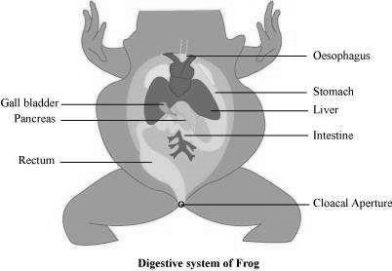
Draw a neat and labeled diagram of the digestive system of a frog.
Solution
(N/A) The digestive system of a frog consists of an alimentary canal and digestive glands.
$1$. Alimentary Canal: It is short because frogs are carnivores and hence the length of the intestine is reduced.
$2$. Mouth: The mouth opens into the buccal cavity that leads to the oesophagus through the pharynx.
$3$. Oesophagus: It is a short tube that opens into the stomach.
$4$. Stomach: The stomach continues into the intestine,rectum,and finally opens outside by the cloaca.
$5$. Digestive Glands: These include the liver (which secretes bile) and the pancreas (which produces digestive enzymes). The bile is stored in the gall bladder.
$1$. Alimentary Canal: It is short because frogs are carnivores and hence the length of the intestine is reduced.
$2$. Mouth: The mouth opens into the buccal cavity that leads to the oesophagus through the pharynx.
$3$. Oesophagus: It is a short tube that opens into the stomach.
$4$. Stomach: The stomach continues into the intestine,rectum,and finally opens outside by the cloaca.
$5$. Digestive Glands: These include the liver (which secretes bile) and the pancreas (which produces digestive enzymes). The bile is stored in the gall bladder.
0 likes
View Solution175
Easy
Mention the function of the following: Ureters in frog.
Solution
(N/A) In male frogs,the ureters act as urinogenital ducts. They serve the dual purpose of transporting both urine from the kidneys and sperms from the testes to the cloaca for excretion and reproduction,respectively.
1 likes
View Solution176
Medium
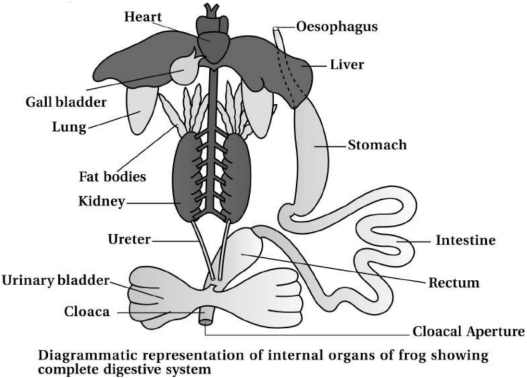
Describe the digestive system of a frog with a diagram.
Solution
(N/A) The digestive system of a frog consists of an alimentary canal and digestive glands.
The alimentary canal is short because frogs are carnivores,and hence the length of the intestine is reduced.
The mouth opens into the buccal cavity,which leads to the oesophagus through the pharynx. The oesophagus is a short tube due to the absence of a neck. The oesophagus opens into the stomach.
Stomach: It is located on the left side in the body cavity. It is long,broad,and slightly curved. It is made up of two parts. The anterior larger part is called the cardiac stomach,and the posterior narrow part is called the pyloric stomach.
The pyloric end of the stomach is constricted,and its opening into the small intestine is guarded by a sphincter (a circular ring-like muscle).
The small intestine is divided into the duodenum and the ileum.
The duodenum curves upwards to form a '$U$' shape with the stomach.
Liver and Pancreas are accessory digestive glands. The liver produces bile juice,which is stored in the gallbladder. The pancreas is a digestive gland that secretes pancreatic juice containing digestive enzymes.
Liver and Pancreas: Bile juice and pancreatic juice. The hepatic duct and cystic ducts join to form a common bile duct,which runs through the pancreas and opens into the duodenum.
Ileum: It is the longest and coiled part of the alimentary canal. Digestion and absorption of digested food occur in the small intestine.
Large Intestine: The ileum opens into the large intestine. The anterior rectum is a short,broad tube. It goes further and opens into the cloaca.
Cloaca: It is a small,sac-like structure that receives the openings of the anus and the urinogenital apertures.
The cloaca opens to the exterior through a cloacal aperture situated at the posterior end of the body.
Digestion process in a frog:
Food is captured by the bilobed tongue.
Digestion of food takes place by the action of $HCl$ and gastric juices secreted from the walls of the stomach. Partially digested food is called chyme.
Chyme is passed from the stomach to the first part of the intestine,the duodenum.
The duodenum receives bile from the gallbladder and pancreatic juices from the pancreas through a common bile duct.
Bile emulsifies fat,and pancreatic juices digest carbohydrates and proteins.
Final digestion takes place in the intestine.
Absorption: Digested food is absorbed by numerous finger-like folds in the inner wall of the intestine called villi and microvilli.
The undigested solid waste moves into the rectum and passes out through the cloaca.
The alimentary canal is short because frogs are carnivores,and hence the length of the intestine is reduced.
The mouth opens into the buccal cavity,which leads to the oesophagus through the pharynx. The oesophagus is a short tube due to the absence of a neck. The oesophagus opens into the stomach.
Stomach: It is located on the left side in the body cavity. It is long,broad,and slightly curved. It is made up of two parts. The anterior larger part is called the cardiac stomach,and the posterior narrow part is called the pyloric stomach.
The pyloric end of the stomach is constricted,and its opening into the small intestine is guarded by a sphincter (a circular ring-like muscle).
The small intestine is divided into the duodenum and the ileum.
The duodenum curves upwards to form a '$U$' shape with the stomach.
Liver and Pancreas are accessory digestive glands. The liver produces bile juice,which is stored in the gallbladder. The pancreas is a digestive gland that secretes pancreatic juice containing digestive enzymes.
Liver and Pancreas: Bile juice and pancreatic juice. The hepatic duct and cystic ducts join to form a common bile duct,which runs through the pancreas and opens into the duodenum.
Ileum: It is the longest and coiled part of the alimentary canal. Digestion and absorption of digested food occur in the small intestine.
Large Intestine: The ileum opens into the large intestine. The anterior rectum is a short,broad tube. It goes further and opens into the cloaca.
Cloaca: It is a small,sac-like structure that receives the openings of the anus and the urinogenital apertures.
The cloaca opens to the exterior through a cloacal aperture situated at the posterior end of the body.
Digestion process in a frog:
Food is captured by the bilobed tongue.
Digestion of food takes place by the action of $HCl$ and gastric juices secreted from the walls of the stomach. Partially digested food is called chyme.
Chyme is passed from the stomach to the first part of the intestine,the duodenum.
The duodenum receives bile from the gallbladder and pancreatic juices from the pancreas through a common bile duct.
Bile emulsifies fat,and pancreatic juices digest carbohydrates and proteins.
Final digestion takes place in the intestine.
Absorption: Digested food is absorbed by numerous finger-like folds in the inner wall of the intestine called villi and microvilli.
The undigested solid waste moves into the rectum and passes out through the cloaca.
0 likes
View Solution177
Medium
Explain respiration in frog.
Solution
(N/A) $\rightarrow$ Frogs respire on land and in water by two different methods.
$\rightarrow$ In water,the skin acts as an aquatic respiratory organ,known as cutaneous respiration. Dissolved oxygen in the water is exchanged through the skin by diffusion.
$\rightarrow$ On land,the buccal cavity,skin,and lungs act as respiratory organs.
$\rightarrow$ Respiration by lungs is called pulmonary respiration. The lungs are a pair of elongated,pink-coloured,sac-like structures present in the upper part of the trunk region. Air enters through the nostrils into the buccal cavity and then into the lungs.
$\rightarrow$ During summer sleep (aestivation) and winter sleep (hibernation),gaseous exchange takes place exclusively through the skin.
$\rightarrow$ In water,the skin acts as an aquatic respiratory organ,known as cutaneous respiration. Dissolved oxygen in the water is exchanged through the skin by diffusion.
$\rightarrow$ On land,the buccal cavity,skin,and lungs act as respiratory organs.
$\rightarrow$ Respiration by lungs is called pulmonary respiration. The lungs are a pair of elongated,pink-coloured,sac-like structures present in the upper part of the trunk region. Air enters through the nostrils into the buccal cavity and then into the lungs.
$\rightarrow$ During summer sleep (aestivation) and winter sleep (hibernation),gaseous exchange takes place exclusively through the skin.
0 likes
View Solution178
Medium
Describe the circulatory system of a frog.
Solution
(A) $\rightarrow$ The vascular system of a frog is a well-developed closed type. It also includes a lymphatic system.
$\rightarrow$ The blood vascular system involves the heart,blood vessels,and blood.
$\rightarrow$ The lymphatic system consists of lymph,lymph channels,and lymph nodes.
$\rightarrow$ Heart of Frog: The heart is a muscular structure situated in the upper part of the body cavity. It has three chambers,two atria and one ventricle,and is covered by a membrane called the pericardium.
$\rightarrow$ $A$ triangular structure called the sinus venosus joins the right atrium. It receives blood through the major veins called vena cava.
$\rightarrow$ The ventricle opens into a sac-like conus arteriosus on the ventral side of the heart. The blood from the heart is carried to all parts of the body by the arteries.
$\rightarrow$ The veins collect blood from different parts of the body and return it to the heart,forming the venous system.
$\rightarrow$ Portal system: Special venous connections between the liver and intestine (hepatic portal system) as well as the kidney and lower parts of the body (renal portal system) are present in frogs.
$\rightarrow$ Blood: Blood consists of blood plasma and blood cells.
$\rightarrow$ Blood cells include $RBC$ (red blood cells) or erythrocytes,$WBC$ (white blood cells) or leucocytes,and blood platelets. The circulation of blood is maintained by the pumping action of the muscular heart.
$\rightarrow$ $A$ red-coloured pigment,namely haemoglobin,is present in red blood cells. These cells are nucleated.
$\rightarrow$ Lymph: Lymph is different from blood because it lacks proteins and red blood cells. During circulation,the blood carries nutrients,gases,and water to the respective sites.
$\rightarrow$ The blood vascular system involves the heart,blood vessels,and blood.
$\rightarrow$ The lymphatic system consists of lymph,lymph channels,and lymph nodes.
$\rightarrow$ Heart of Frog: The heart is a muscular structure situated in the upper part of the body cavity. It has three chambers,two atria and one ventricle,and is covered by a membrane called the pericardium.
$\rightarrow$ $A$ triangular structure called the sinus venosus joins the right atrium. It receives blood through the major veins called vena cava.
$\rightarrow$ The ventricle opens into a sac-like conus arteriosus on the ventral side of the heart. The blood from the heart is carried to all parts of the body by the arteries.
$\rightarrow$ The veins collect blood from different parts of the body and return it to the heart,forming the venous system.
$\rightarrow$ Portal system: Special venous connections between the liver and intestine (hepatic portal system) as well as the kidney and lower parts of the body (renal portal system) are present in frogs.
$\rightarrow$ Blood: Blood consists of blood plasma and blood cells.
$\rightarrow$ Blood cells include $RBC$ (red blood cells) or erythrocytes,$WBC$ (white blood cells) or leucocytes,and blood platelets. The circulation of blood is maintained by the pumping action of the muscular heart.
$\rightarrow$ $A$ red-coloured pigment,namely haemoglobin,is present in red blood cells. These cells are nucleated.
$\rightarrow$ Lymph: Lymph is different from blood because it lacks proteins and red blood cells. During circulation,the blood carries nutrients,gases,and water to the respective sites.
0 likes
View Solution179
Easy
Describe the excretory system of a frog.
Solution
(N/A) $\rightarrow$ The elimination of nitrogenous wastes is called excretion. These wastes are removed by a well-developed excretory system.
$\rightarrow$ The excretory system consists of a pair of kidneys,ureters,cloaca,and urinary bladder.
$\rightarrow$ Kidney: These are compact,dark red,and bean-shaped structures situated posteriorly in the body cavity on both sides of the vertebral column.
$\rightarrow$ Each kidney is composed of several structural and functional units called uriniferous tubules or nephrons.
$\rightarrow$ The ureters act as urinogenital ducts in males,which open into the cloaca.
$\rightarrow$ Urinary bladder: $A$ thin-walled urinary bladder is present ventral to the rectum,which also opens into the cloaca.
$\rightarrow$ Excretory wastes are carried by the blood into the kidney,where they are filtered and excreted.
$\rightarrow$ The excretory system consists of a pair of kidneys,ureters,cloaca,and urinary bladder.
$\rightarrow$ Kidney: These are compact,dark red,and bean-shaped structures situated posteriorly in the body cavity on both sides of the vertebral column.
$\rightarrow$ Each kidney is composed of several structural and functional units called uriniferous tubules or nephrons.
$\rightarrow$ The ureters act as urinogenital ducts in males,which open into the cloaca.
$\rightarrow$ Urinary bladder: $A$ thin-walled urinary bladder is present ventral to the rectum,which also opens into the cloaca.
$\rightarrow$ Excretory wastes are carried by the blood into the kidney,where they are filtered and excreted.
1 likes
View Solution180
Easy
How do control and coordination occur in a frog? Explain.
Solution
(N/A) $\rightarrow$ The system for control and coordination is highly evolved in the frog. It includes both the neural system and endocrine glands.
$\rightarrow$ The neural system is composed of the central nervous system (brain and spinal cord),peripheral nervous system (cranial and spinal nerves),and autonomic nervous system (sympathetic and parasympathetic).
$\rightarrow$ The chemical coordination of various organs of the body is achieved by hormones,which are secreted by endocrine glands. The prominent endocrine glands found in the frog are the pituitary,thyroid,parathyroid,thymus,pineal body,pancreatic islets,adrenal,and gonads.
$\rightarrow$ The neural system is composed of the central nervous system (brain and spinal cord),peripheral nervous system (cranial and spinal nerves),and autonomic nervous system (sympathetic and parasympathetic).
$\rightarrow$ The chemical coordination of various organs of the body is achieved by hormones,which are secreted by endocrine glands. The prominent endocrine glands found in the frog are the pituitary,thyroid,parathyroid,thymus,pineal body,pancreatic islets,adrenal,and gonads.
0 likes
View Solution181
Medium
Explain the nervous system of a frog.
Solution
(N/A) $\rightarrow$ The nervous system of a frog is organized into a central nervous system (brain and spinal cord),a peripheral nervous system (cranial and spinal nerves),and an autonomic nervous system (sympathetic and parasympathetic).
$\rightarrow$ The brain is enclosed in a bony structure called the cranium (brain box).
$\rightarrow$ The brain is divided into three parts: forebrain,midbrain,and hindbrain.
$\rightarrow$ The forebrain includes olfactory lobes,paired cerebral hemispheres,and an unpaired diencephalon.
$\rightarrow$ The midbrain is characterized by a pair of optic lobes.
$\rightarrow$ The hindbrain consists of the cerebellum and medulla oblongata.
$\rightarrow$ The medulla oblongata passes out through the foramen magnum and continues into the spinal cord,which is enclosed within the vertebral column.
$\rightarrow$ The brain is enclosed in a bony structure called the cranium (brain box).
$\rightarrow$ The brain is divided into three parts: forebrain,midbrain,and hindbrain.
$\rightarrow$ The forebrain includes olfactory lobes,paired cerebral hemispheres,and an unpaired diencephalon.
$\rightarrow$ The midbrain is characterized by a pair of optic lobes.
$\rightarrow$ The hindbrain consists of the cerebellum and medulla oblongata.
$\rightarrow$ The medulla oblongata passes out through the foramen magnum and continues into the spinal cord,which is enclosed within the vertebral column.
0 likes
View Solution182
Easy
Write a note on the sensory organs of a frog.
Solution
(N/A) In frogs,the sensory organs are well-developed to interact with the environment. They include the following:
$1$. Sensory Papillae: These are for touch (tangoreceptors).
$2$. Taste Buds: These are for taste (gustatoreceptors) located on the tongue.
$3$. Nasal Epithelium: These are for smell (olfactoreceptors).
$4$. Eyes: These are paired,simple eyes situated in the orbit of the skull. They are protected by a transparent nictitating membrane.
$5$. Tympanum: This is a membranous structure that receives sound signals (auditory receptors). Frogs lack an external ear; the tympanum represents the middle ear.
$1$. Sensory Papillae: These are for touch (tangoreceptors).
$2$. Taste Buds: These are for taste (gustatoreceptors) located on the tongue.
$3$. Nasal Epithelium: These are for smell (olfactoreceptors).
$4$. Eyes: These are paired,simple eyes situated in the orbit of the skull. They are protected by a transparent nictitating membrane.
$5$. Tympanum: This is a membranous structure that receives sound signals (auditory receptors). Frogs lack an external ear; the tympanum represents the middle ear.
0 likes
View Solution183
Easy
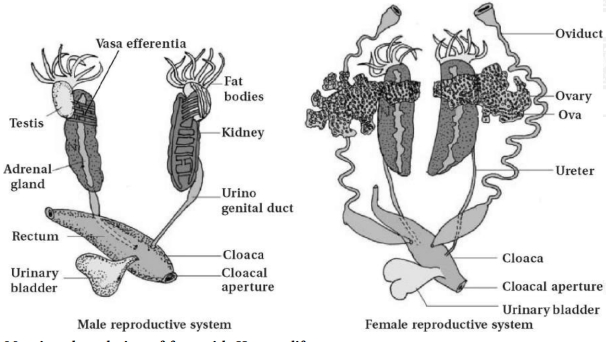
Explain the reproductive system of a frog with a diagram.
Solution
(N/A) $\rightarrow$ Frogs have well-organized male and female reproductive systems.
$(a)$ Male reproductive system: The male reproductive system consists of a pair of yellowish,ovoid testes which are found adhered to the upper part of the kidneys by a double fold of peritoneum called mesorchium.
$\rightarrow$ Vasa efferentia are $10-12$ in number and arise from the testes. They enter the kidneys on their side and open into Bidder's canal.
$\rightarrow$ The ureter is now known as the urinogenital duct. It emerges from the kidney and opens into the cloaca.
$\rightarrow$ The cloaca is a small median chamber that is used to pass fecal matter,urine,and sperms to the exterior.
$(b)$ Female reproductive system: The female reproductive organs include a pair of ovaries which are situated near the kidneys,and there is no functional connection with the kidneys.
$\rightarrow$ $A$ pair of oviducts arising from the ovaries opens into the cloaca separately.
$\rightarrow$ $A$ mature female can lay $2500$ to $3000$ ova at a time.
$\rightarrow$ Fertilization is external and takes place in water.
$\rightarrow$ Development involves a larval stage called a tadpole. The tadpole undergoes metamorphosis to form the adult.
$(a)$ Male reproductive system: The male reproductive system consists of a pair of yellowish,ovoid testes which are found adhered to the upper part of the kidneys by a double fold of peritoneum called mesorchium.
$\rightarrow$ Vasa efferentia are $10-12$ in number and arise from the testes. They enter the kidneys on their side and open into Bidder's canal.
$\rightarrow$ The ureter is now known as the urinogenital duct. It emerges from the kidney and opens into the cloaca.
$\rightarrow$ The cloaca is a small median chamber that is used to pass fecal matter,urine,and sperms to the exterior.
$(b)$ Female reproductive system: The female reproductive organs include a pair of ovaries which are situated near the kidneys,and there is no functional connection with the kidneys.
$\rightarrow$ $A$ pair of oviducts arising from the ovaries opens into the cloaca separately.
$\rightarrow$ $A$ mature female can lay $2500$ to $3000$ ova at a time.
$\rightarrow$ Fertilization is external and takes place in water.
$\rightarrow$ Development involves a larval stage called a tadpole. The tadpole undergoes metamorphosis to form the adult.
0 likes
View Solution184
Easy
Describe the structure of the stomach of a frog.
Solution
(N/A) $\rightarrow$ The stomach is located on the left side of the body cavity. It is long,broad,and slightly curved in shape.
$\rightarrow$ It consists of two parts: the anterior larger part is called the cardiac stomach,and the posterior narrow part is called the pyloric stomach.
$\rightarrow$ The pyloric end of the stomach is constricted,and its opening into the small intestine is guarded by a sphincter (a circular ring-like muscle).
$\rightarrow$ It consists of two parts: the anterior larger part is called the cardiac stomach,and the posterior narrow part is called the pyloric stomach.
$\rightarrow$ The pyloric end of the stomach is constricted,and its opening into the small intestine is guarded by a sphincter (a circular ring-like muscle).
0 likes
View Solution185
Medium
Explain the structure of the heart of a frog.
Solution
(N/A) The heart of a frog is a muscular organ located in the upper part of the body cavity.
It consists of three chambers: two atria and one ventricle.
The heart is enclosed in a protective double-layered membrane known as the pericardium.
Additionally,it receives deoxygenated blood from the body through the sinus venosus and oxygenated blood from the lungs and skin.
It consists of three chambers: two atria and one ventricle.
The heart is enclosed in a protective double-layered membrane known as the pericardium.
Additionally,it receives deoxygenated blood from the body through the sinus venosus and oxygenated blood from the lungs and skin.
0 likes
View Solution186
Easy
Describe the structure of the kidney in a frog.
Solution
(N/A) $\rightarrow$ The kidneys are compact,dark red,and bean-shaped structures situated slightly posteriorly in the body cavity on both sides of the vertebral column.
$\rightarrow$ Each kidney is composed of several structural and functional units called uriniferous tubules or nephrons.
$\rightarrow$ In male frogs,two ureters emerge from the kidneys.
$\rightarrow$ These ureters act as urinogenital ducts,which open into the cloaca.
$\rightarrow$ Each kidney is composed of several structural and functional units called uriniferous tubules or nephrons.
$\rightarrow$ In male frogs,two ureters emerge from the kidneys.
$\rightarrow$ These ureters act as urinogenital ducts,which open into the cloaca.
0 likes
View Solution187
Medium
Describe the structure of the brain of a frog.
Solution
(N/A) $\rightarrow$ There are $10$ pairs of cranial nerves arising from the brain. The brain is enclosed in a bony structure called the brain box (cranium).
$\rightarrow$ The brain is divided into the forebrain,midbrain,and hindbrain.
$\rightarrow$ The forebrain includes olfactory lobes,paired cerebral hemispheres,and an unpaired diencephalon.
$\rightarrow$ The midbrain is characterized by a pair of optic lobes.
$\rightarrow$ The hindbrain consists of the cerebellum and medulla oblongata.
$\rightarrow$ The medulla oblongata passes out through the foramen magnum and continues into the spinal cord,which is enclosed in the vertebral column.
$\rightarrow$ The brain is divided into the forebrain,midbrain,and hindbrain.
$\rightarrow$ The forebrain includes olfactory lobes,paired cerebral hemispheres,and an unpaired diencephalon.
$\rightarrow$ The midbrain is characterized by a pair of optic lobes.
$\rightarrow$ The hindbrain consists of the cerebellum and medulla oblongata.
$\rightarrow$ The medulla oblongata passes out through the foramen magnum and continues into the spinal cord,which is enclosed in the vertebral column.
0 likes
View Solution188
Medium
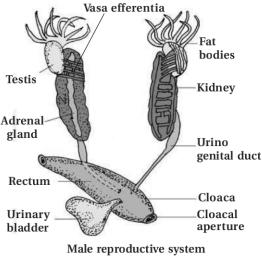
Describe the structure of the male reproductive system of a frog.
Solution
The male reproductive system of a frog consists of a pair of yellowish,ovoid testes. These are found adhered to the upper part of the kidneys by a double fold of peritoneum called the mesorchium.
There are $10-12$ vasa efferentia that arise from the testes. They enter the kidneys on their side and open into Bidder's canal.
Finally,the ureter,which is now known as the urinogenital duct,emerges from the kidney and opens into the cloaca.
The cloaca is a small,median chamber that is used to pass faecal matter,urine,and sperms to the exterior.
There are $10-12$ vasa efferentia that arise from the testes. They enter the kidneys on their side and open into Bidder's canal.
Finally,the ureter,which is now known as the urinogenital duct,emerges from the kidney and opens into the cloaca.
The cloaca is a small,median chamber that is used to pass faecal matter,urine,and sperms to the exterior.
0 likes
View Solution189
EasyMCQ
Select the correct option regarding the respiratory system of a frog:
$(1)$ The glottis is covered by a thin,elastic cartilaginous flap called the epiglottis.
$(2)$ Frogs respire through gills or moist skin.
$(1)$ The glottis is covered by a thin,elastic cartilaginous flap called the epiglottis.
$(2)$ Frogs respire through gills or moist skin.
A
$(1)$ Only $1$ is correct.
B
$(1)$ Only $2$ is correct.
C
Both $1$ and $2$ are correct.
D
Both $1$ and $2$ are incorrect.
Solution
(D) $(1)$ The statement is incorrect. In frogs,the glottis is not covered by an epiglottis. The epiglottis is a structure found in mammals to prevent food from entering the trachea.
$(2)$ The statement is partially correct but contextually misleading. Frogs respire through moist skin (cutaneous respiration) and lungs (pulmonary respiration). While tadpoles respire through gills,adult frogs do not use gills for respiration.
Therefore,both statements are considered incorrect in the context of adult frog anatomy and physiology.
$(2)$ The statement is partially correct but contextually misleading. Frogs respire through moist skin (cutaneous respiration) and lungs (pulmonary respiration). While tadpoles respire through gills,adult frogs do not use gills for respiration.
Therefore,both statements are considered incorrect in the context of adult frog anatomy and physiology.
0 likes
View Solution190
Medium
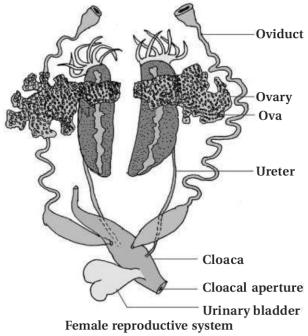
Describe the structure of the female reproductive system of a frog.
Solution
(N/A) The female reproductive system of a frog consists of a pair of ovaries situated near the kidneys. There is no functional connection between the ovaries and the kidneys.
$A$ pair of oviducts arises from the ovaries and opens into the cloaca separately.
$A$ mature female can lay $2500$ to $3000$ ova at a time.
Fertilisation is external and takes place in water.
Development involves a larval stage called a tadpole. The tadpole undergoes metamorphosis to form the adult frog.
$A$ pair of oviducts arises from the ovaries and opens into the cloaca separately.
$A$ mature female can lay $2500$ to $3000$ ova at a time.
Fertilisation is external and takes place in water.
Development involves a larval stage called a tadpole. The tadpole undergoes metamorphosis to form the adult frog.
0 likes
View Solution191
Medium
Give scientific reasons: Frogs undergo summer sleep and winter sleep (aestivation and hibernation).
Solution
(N/A) Frogs are poikilothermic (cold-blooded) animals,meaning their body temperature fluctuates with the ambient environmental temperature.
To protect themselves from extreme environmental conditions,such as the intense heat of summer and the freezing cold of winter,they seek shelter in deep burrows.
This state of inactivity during summer to avoid heat is known as aestivation,while the state of inactivity during winter to avoid cold is known as hibernation.
To protect themselves from extreme environmental conditions,such as the intense heat of summer and the freezing cold of winter,they seek shelter in deep burrows.
This state of inactivity during summer to avoid heat is known as aestivation,while the state of inactivity during winter to avoid cold is known as hibernation.
0 likes
View Solution192
Easy
Provide definitions/explanations for the following terms:
$(i)$ Tadpole
$(ii)$ Urinogenital duct
$(i)$ Tadpole
$(ii)$ Urinogenital duct
Solution
(N/A) $(i)$ Tadpole: It is the larval stage in the life cycle of a frog that develops from the embryo. It is aquatic and undergoes metamorphosis to become an adult frog.
$(ii)$ Urinogenital duct: In male frogs,the ureters emerge from the kidneys and open into the cloaca. These ducts carry both urine and sperms,hence they are referred to as urinogenital ducts.
$(ii)$ Urinogenital duct: In male frogs,the ureters emerge from the kidneys and open into the cloaca. These ducts carry both urine and sperms,hence they are referred to as urinogenital ducts.
0 likes
View Solution193
Medium
Describe the location and function of the following structures in a frog:
$(i)$ Sinus venosus
$(ii)$ Cloaca
$(i)$ Sinus venosus
$(ii)$ Cloaca
Solution
(N/A) $(i)$ Sinus venosus:
Location: $A$ thin-walled,triangular chamber situated on the dorsal side of the heart that joins the right atrium.
Function: It collects deoxygenated blood from the major veins of the body and pumps it into the right atrium.
$(ii)$ Cloaca:
Location: It is a small,median chamber located at the posterior end of the alimentary canal (large intestine) in a frog.
Function: It serves as a common opening for the digestive,urinary,and reproductive tracts,facilitating the discharge of faeces,urine,and reproductive cells (gametes) out of the body.
Location: $A$ thin-walled,triangular chamber situated on the dorsal side of the heart that joins the right atrium.
Function: It collects deoxygenated blood from the major veins of the body and pumps it into the right atrium.
$(ii)$ Cloaca:
Location: It is a small,median chamber located at the posterior end of the alimentary canal (large intestine) in a frog.
Function: It serves as a common opening for the digestive,urinary,and reproductive tracts,facilitating the discharge of faeces,urine,and reproductive cells (gametes) out of the body.
0 likes
View Solution194
MediumMCQ
Frog is a poikilotherm,exhibits camouflage and undergoes aestivation and hibernation,how are all these beneficial to it?
A
It helps in maintaining constant body temperature.
B
It helps in protecting the frog from extreme environmental conditions and predators.
C
It helps in increasing the metabolic rate during winter.
D
It helps in rapid growth and reproduction.
Solution
(B) $\Rightarrow$ Frog is a poikilotherm (cold-blooded) animal,meaning its body temperature fluctuates with the ambient environmental temperature.
$\Rightarrow$ To survive extreme cold,frogs undergo hibernation (winter sleep),and to survive extreme heat,they undergo aestivation (summer sleep). During these periods,they remain dormant with minimal biological activity to conserve energy.
$\Rightarrow$ Camouflage is the ability of the frog to change its skin color to match its surroundings. This is a vital adaptation that helps the frog hide from predators and avoid being detected,thereby increasing its chances of survival.
$\Rightarrow$ To survive extreme cold,frogs undergo hibernation (winter sleep),and to survive extreme heat,they undergo aestivation (summer sleep). During these periods,they remain dormant with minimal biological activity to conserve energy.
$\Rightarrow$ Camouflage is the ability of the frog to change its skin color to match its surroundings. This is a vital adaptation that helps the frog hide from predators and avoid being detected,thereby increasing its chances of survival.
0 likes
View Solution195
Easy
Write the functions in brief in column $II$, appropriate to the structures given in column $I$.
| Column - $I$ | Column - $II$ |
| $(A)$ Nictitating membrane | $(1)$ .......... |
| $(B)$ Tympanum | $(2)$ .......... |
| $(C)$ Copulatory pad | $(3)$ .......... |
Solution
$(A)$ Nictitating membrane: It protects the eyes while the frog is in water.
$(B)$ Tympanum: It is a membranous structure located on either side of the eyes that receives sound signals.
$(C)$ Copulatory pad: It is a specialized structure located on the first digit of the forelimbs of male frogs, which helps in holding the female during copulation.
$(B)$ Tympanum: It is a membranous structure located on either side of the eyes that receives sound signals.
$(C)$ Copulatory pad: It is a specialized structure located on the first digit of the forelimbs of male frogs, which helps in holding the female during copulation.
0 likes
View Solution196
Easy
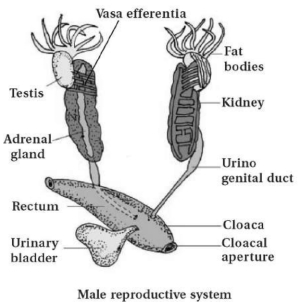
Draw a neat and well-labelled diagram of the male reproductive system of a frog.
Solution
(N/A) The male reproductive system of a frog consists of a pair of yellowish,ovoid testes which are found adhered to the upper part of the kidneys by a double fold of peritoneum called the mesorchium.
From the testes,$10-12$ vasa efferentia arise. They enter the kidneys on their side and open into the Bidder's canal.
Finally,it communicates with the urinogenital duct that comes out of the kidneys and opens into the cloaca.
The cloaca is a small,median chamber that is used to pass faecal matter,urine,and sperms to the exterior.
From the testes,$10-12$ vasa efferentia arise. They enter the kidneys on their side and open into the Bidder's canal.
Finally,it communicates with the urinogenital duct that comes out of the kidneys and opens into the cloaca.
The cloaca is a small,median chamber that is used to pass faecal matter,urine,and sperms to the exterior.
0 likes
View Solution197
Medium
What is called a portal system? Give names of the portal systems seen in a frog.
Solution
(N/A) portal system is a circulatory arrangement where blood collected from one organ or part of the body is transported to another organ through a vein before returning to the heart,instead of going directly to the heart.
In frogs,two types of portal systems are present:
$1$. Hepatic portal system: This is a special venous connection between the intestine and the liver.
$2$. Renal portal system: This is a special venous connection between the lower parts of the body (hind limbs) and the kidneys.
In frogs,two types of portal systems are present:
$1$. Hepatic portal system: This is a special venous connection between the intestine and the liver.
$2$. Renal portal system: This is a special venous connection between the lower parts of the body (hind limbs) and the kidneys.
0 likes
View Solution198
EasyMCQ
In frogs,the oviduct is formed by:
A
Wolffian duct
B
Metanephric duct
C
Mullerian duct
D
Bidder's canal
Solution
(C) In frogs,the female reproductive system includes a pair of oviducts. These oviducts are derived from the Mullerian ducts,which develop independently of the urinary system.
0 likes
View Solution199
EasyMCQ
The skull of a frog is:
A
Tricondylic
B
Monocondylic
C
Dicondylic
D
Non-condylic
Solution
(C) The skull of a frog is triangular in shape.
It is dicondylic,meaning it possesses two occipital condyles that articulate with the first vertebra (atlas).
It is also described as platybasic due to the presence of a wide cranial base and the absence of an interorbital septum.
The skull is primarily cartilaginous during the tadpole stage but becomes mostly bony in the adult frog.
It is dicondylic,meaning it possesses two occipital condyles that articulate with the first vertebra (atlas).
It is also described as platybasic due to the presence of a wide cranial base and the absence of an interorbital septum.
The skull is primarily cartilaginous during the tadpole stage but becomes mostly bony in the adult frog.
0 likes
View SolutionStructural Organisation In Animals — Anatomy of frog · Frequently Asked Questions
1Are these Structural Organisation In Animals questions useful for JEE and NEET?
Yes. All questions in this section are mapped to JEE Main and NEET exam patterns. Previous year questions from JEE Main, NEET, GUJCET and state-level exams are included with full solutions.
2Can I switch to Hindi or Gujarati for these questions?
Yes. Use the language tabs in the hero section or the sidebar to view the same questions and solutions in English, Hindi or Gujarati.
3How do I generate a question paper from this subtopic?
Use the Vedclass Exam Paper Generator — select the chapter and subtopic, set difficulty, and generate Sets A, B, C, D automatically. First 3 chapters of every subject are free.
Vedclass Products
For Students
Vedclass Test Series
Mock tests in real JEE/NEET style with performance analysis. 5-day free trial.
Start Free TrialFor Teachers
Exam Paper Generator
Generate Set A/B/C/D papers from this chapter in 2 minutes. 3 chapters free.
Try FreeFor Institutes
Online Exam Module
Live online exams with unlimited students, 360° analytics & white-label branding.
See DemoFor Teachers & Institutes
Generate a Structural Organisation In Animals Exam Paper in 2 Minutes
Select subtopic & difficulty — Sets A, B, C, D auto-generated with No Repeat logic.
First 3 chapters of every subject are free — no payment required.