
A English
Gymnosperms (General) Questions in English
Class 11 Biology · Plant Kingdom · Gymnosperms (General)
483+
Questions
English
Language
100%
With Solutions
Showing 49 of 483 questions in English
351
EasyMCQ
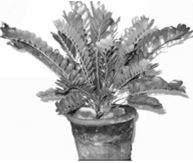
What type of plant is shown in the given figure?
A
Largest gymnosperm
B
Smallest gymnosperm
C
Largest angiosperm
D
Smallest angiosperm
Solution
(B) The plant shown in the figure is $Cycas$,which is a type of gymnosperm. Among gymnosperms,$Zamia$ $pygmaea$ is considered the smallest gymnosperm. The plant in the image is a species of $Cycas$ (often grown as an ornamental plant). However,in the context of $NCERT$ biology,$Zamia$ is specifically cited as the smallest gymnosperm. Given the options provided and the typical representation of such plants in textbooks,the question refers to the classification of gymnosperms. $Zamia$ is the smallest gymnosperm.
0 likes
View Solution352
EasyMCQ
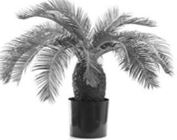
Identify the plant shown in the given figure.
A
Pinus
B
Araucaria
C
Bennetittis
D
Cycas
Solution
(D) The plant shown in the figure is $Cycas$.
$Cycas$ is a genus of gymnosperms characterized by a stout,unbranched stem and a crown of large,pinnately compound leaves.
It is commonly known as a sago palm,although it is not a true palm.
$Pinus$ has branched stems and needle-like leaves,while $Araucaria$ also has a different branching pattern.
Therefore,the correct option is $D$.
$Cycas$ is a genus of gymnosperms characterized by a stout,unbranched stem and a crown of large,pinnately compound leaves.
It is commonly known as a sago palm,although it is not a true palm.
$Pinus$ has branched stems and needle-like leaves,while $Araucaria$ also has a different branching pattern.
Therefore,the correct option is $D$.
0 likes
View Solution353
EasyMCQ
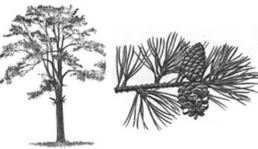
Identify the part of the plant labeled as '$A$' in the given figure.
A
Seed
B
Sporophyll
C
Stamen
D
Ovary
Solution
(B) The provided image shows a $Pinus$ plant,which is a gymnosperm.
In gymnosperms,the reproductive structures are organized into cones or strobili.
The structure labeled '$A$' (the cone-like structure on the branch) is a strobilus,which consists of spirally arranged sporophylls.
Therefore,the correct identification for the structure shown is a sporophyll-bearing cone (strobilus).
In gymnosperms,the reproductive structures are organized into cones or strobili.
The structure labeled '$A$' (the cone-like structure on the branch) is a strobilus,which consists of spirally arranged sporophylls.
Therefore,the correct identification for the structure shown is a sporophyll-bearing cone (strobilus).
0 likes
View Solution354
EasyMCQ
Which of the following plants is a Gymnosperm?
A
Nephrolepis
B
Strigula
C
Araucaria
D
Marchantia
Solution
(C) The plant kingdom is classified into Thallophyta,Bryophyta,Pteridophyta,Gymnosperms,and Angiosperms.
$1$. $Nephrolepis$ is a Pteridophyte (fern).
$2$. $Strigula$ is a lichen.
$3$. $Araucaria$ is a well-known Gymnosperm (conifer).
$4$. $Marchantia$ is a Bryophyte (liverwort).
Therefore,$Araucaria$ is the correct answer.
$1$. $Nephrolepis$ is a Pteridophyte (fern).
$2$. $Strigula$ is a lichen.
$3$. $Araucaria$ is a well-known Gymnosperm (conifer).
$4$. $Marchantia$ is a Bryophyte (liverwort).
Therefore,$Araucaria$ is the correct answer.
0 likes
View Solution355
MediumMCQ
Conifers are adapted to tolerate extreme environmental conditions because of
A
broad hardy leaves
B
superficial stomata
C
thick cuticle
D
presence of vessels
Solution
(C) Conifers are gymnosperms that exhibit xerophytic adaptations to survive in harsh,cold,or dry environments.
These adaptations include needle-like leaves,a thick waxy cuticle,and sunken stomata,which help in reducing the rate of transpiration and preventing water loss.
Therefore,the presence of a thick cuticle is a key adaptation for tolerating extreme environmental conditions.
These adaptations include needle-like leaves,a thick waxy cuticle,and sunken stomata,which help in reducing the rate of transpiration and preventing water loss.
Therefore,the presence of a thick cuticle is a key adaptation for tolerating extreme environmental conditions.
0 likes
View Solution356
MediumMCQ
In which of the following,gametophyte is not independent free living?
A
Pteris
B
Pinus
C
Funaria
D
Marchantia
Solution
(B) : In gymnosperms (like $Pinus$),the male and female gametophytes do not have an independent free-living existence.
They remain within the sporangia retained on the sporophytes,$i.e.$,the female gametophyte (within the megasporangium) and the male gametophyte (within the microsporangium).
They remain within the sporangia retained on the sporophytes,$i.e.$,the female gametophyte (within the megasporangium) and the male gametophyte (within the microsporangium).
0 likes
View Solution357
MediumMCQ
The gametophyte is not an independent,free-living generation in
A
Polytrichum
B
Adiantum
C
Marchantia
D
Pinus
Solution
(D) : In gymnosperms (like $Pinus$),the male and female gametophytes do not have an independent,free-living existence.
They remain within the sporangia retained on the sporophytes,$i.e.$,the female gametophyte (within the megasporangium) and the male gametophyte (within the microsporangium).
They remain within the sporangia retained on the sporophytes,$i.e.$,the female gametophyte (within the megasporangium) and the male gametophyte (within the microsporangium).
0 likes
View Solution358
MediumMCQ
$A$ prokaryotic autotrophic nitrogen-fixing symbiont is found in
A
Alnus
B
Cycas
C
Cicer
D
Pisum
Solution
(B) : $Cycas$ forms a symbiotic association with autotrophic nitrogen-fixing cyanobacteria (such as $Anabaena$ or $Nostoc$).
$Cycas$ provides fixed carbon and a stable environment to the cyanobacteria in exchange for fixed nitrogen.
These cyanobacteria are endosymbionts and live within the specialized roots of $Cycas$.
In addition to normal roots,$Cycas$ develops specialized symbiotic organs called coralloid roots,which house these cyanobacteria.
$Cycas$ provides fixed carbon and a stable environment to the cyanobacteria in exchange for fixed nitrogen.
These cyanobacteria are endosymbionts and live within the specialized roots of $Cycas$.
In addition to normal roots,$Cycas$ develops specialized symbiotic organs called coralloid roots,which house these cyanobacteria.
0 likes
View Solution359
MediumMCQ
Select one of the following pairs of important features distinguishing $Gnetum$ from $Cycas$ and $Pinus$ and showing affinities with angiosperms.
A
Perianth and two integuments
B
Embryo development and apical meristem
C
Absence of resin duct and leaf venation
D
Presence of vessel elements and absence of archegonia
Solution
(D) $Gnetum$ is considered the most advanced gymnosperm because it exhibits several characteristics similar to angiosperms.
In most gymnosperms,the xylem consists of tracheids and xylem parenchyma,but they lack vessels.
$Gnetum$ possesses vessel elements in its xylem,which is a characteristic feature of angiosperms.
Furthermore,$Gnetum$ lacks archegonia in its female gametophyte,which is another significant similarity to the angiosperm life cycle.
Therefore,the presence of vessel elements and the absence of archegonia are key features that distinguish $Gnetum$ from $Cycas$ and $Pinus$ and show its evolutionary affinity with angiosperms.
In most gymnosperms,the xylem consists of tracheids and xylem parenchyma,but they lack vessels.
$Gnetum$ possesses vessel elements in its xylem,which is a characteristic feature of angiosperms.
Furthermore,$Gnetum$ lacks archegonia in its female gametophyte,which is another significant similarity to the angiosperm life cycle.
Therefore,the presence of vessel elements and the absence of archegonia are key features that distinguish $Gnetum$ from $Cycas$ and $Pinus$ and show its evolutionary affinity with angiosperms.
0 likes
View Solution360
MediumMCQ
In which one of the following do male and female gametophytes not have a free-living independent existence?
A
Polytrichum
B
Cedrus
C
Pteris
D
Funaria
Solution
(B) The correct answer is $B$. In gymnosperms (such as $Cedrus$),the male and female gametophytes do not have an independent,free-living existence. They remain within the sporangia retained on the sporophytes; specifically,the female gametophyte is retained within the megasporangium and the male gametophyte within the microsporangium.
0 likes
View Solution361
MediumMCQ
In gymnosperms,the pollen chamber represents
A
a cavity in the ovule in which pollen grains are stored after pollination
B
an opening in the megagametophyte through which the pollen tube approaches the egg
C
the microsporangium in which pollen grains develop
D
a cell in the pollen grain in which the sperms are formed
Solution
(A) The correct answer is $A$. In gymnosperms,the pollen chamber is a cavity formed in the ovule near the micropyle,where pollen grains are deposited and stored after pollination. The pollen grains germinate within this chamber to produce pollen tubes that carry male gametes towards the egg cell.
0 likes
View Solution362
MediumMCQ
Conifers differ from grasses in the
A
formation of endosperm before fertilization
B
production of seeds from ovules
C
lack of xylem tracheids
D
absence of pollen tubes
Solution
(A) : Conifers belong to gymnosperms. They are seed-bearing plants in which the sporophylls are aggregated to form cones,and the seeds develop in an exposed state over the surface of megasporophylls.
Vascular tissue in conifers consists of tracheids and sieve cells.
The female gametophyte forms archegonia,provides nourishment to the developing embryo,and later transforms into food-laden tissue or endosperm inside the seed.
This endosperm is formed before fertilization,so it is haploid $(n)$ in nature.
It provides nourishment for the growth of seedlings at the time of seed germination.
Grass is an angiospermic plant,and in angiosperms,the endosperm is produced after fertilization (typically through double fertilization).
Vascular tissue in conifers consists of tracheids and sieve cells.
The female gametophyte forms archegonia,provides nourishment to the developing embryo,and later transforms into food-laden tissue or endosperm inside the seed.
This endosperm is formed before fertilization,so it is haploid $(n)$ in nature.
It provides nourishment for the growth of seedlings at the time of seed germination.
Grass is an angiospermic plant,and in angiosperms,the endosperm is produced after fertilization (typically through double fertilization).
0 likes
View Solution363
MediumMCQ
Gymnosperms are also called soft wood spermatophytes because they lack
A
cambium
B
phloem fibres
C
thick-walled tracheids
D
xylem fibres
Solution
(D) Gymnosperms are referred to as soft wood spermatophytes because their xylem lacks $xylem$ $fibres$ (also known as wood fibres). In angiosperms,the presence of these fibres provides mechanical strength and hardness to the wood,which is why they are called hard wood. Since gymnosperms lack these fibres,their wood is relatively soft.
0 likes
View Solution364
MediumMCQ
The chief water conducting elements of xylem in gymnosperms are
A
vessels
B
fibres
C
transfusion tissue
D
tracheids
Solution
(D) : The chief water conducting elements of xylem in gymnosperms are tracheids. These are elongated cells with tapering ends and are dead at maturity due to the deposition of lignin. These cells exhibit scalariform,annular,reticulate,or bordered pitted thickenings. Tracheids are the primary water-conducting xylem elements in both gymnosperms and pteridophytes. Generally,vessels are absent in gymnosperms,with rare exceptions such as $Gnetum$,$Welwitschia$,and $Ephedra$.
0 likes
View Solution365
MediumMCQ
Besides paddy fields,cyanobacteria are also found inside the vegetative part of
A
Equisetum
B
Psilotum
C
Pinus
D
Cycas
Solution
(D) The correct answer is $D$.
In $Cycas$,specialized roots known as coralloid roots are formed.
These roots show a symbiotic association with nitrogen-fixing cyanobacteria,such as $Nostoc$ and $Anabaena$.
Coralloid roots are irregular,negatively geotropic,and dichotomously branched,resembling coral structures.
They lack root hairs and root caps,and the cyanobacteria reside in the cortical region of these roots to provide fixed nitrogen to the plant.
In $Cycas$,specialized roots known as coralloid roots are formed.
These roots show a symbiotic association with nitrogen-fixing cyanobacteria,such as $Nostoc$ and $Anabaena$.
Coralloid roots are irregular,negatively geotropic,and dichotomously branched,resembling coral structures.
They lack root hairs and root caps,and the cyanobacteria reside in the cortical region of these roots to provide fixed nitrogen to the plant.
0 likes
View Solution366
EasyMCQ
The main pathway of water transportation in gymnosperms is:
A
Sieve cells
B
Sieve tube elements
C
Tracheids
D
Xylem vessels
Solution
(C) In gymnosperms,the primary water-conducting elements are tracheids. Unlike angiosperms,gymnosperms typically lack xylem vessels (tracheae) for water transport. Sieve cells and sieve tube elements are involved in the transport of food (phloem),not water. Therefore,tracheids serve as the main pathway for water transportation.
0 likes
View Solution367
MediumMCQ
In gymnosperms,the root system is $A$. In $Pinus$,symbiosis is observed between $B$ and fungi,which is called $C$.
A
$A$ - Fibrous,$B$ - Root,$C$ - Lichen
B
$A$ - Taproot,$B$ - Leaf,$C$ - Mycorrhizae
C
$A$ - Fibrous,$B$ - Root,$C$ - Antheridia
D
$A$ - Tap root,$B$ - Root,$C$ - Mycorrhizae
Solution
(D) In gymnosperms,the root system is generally a taproot system.
In $Pinus$,a symbiotic association is observed between the roots and fungal hyphae.
This association is known as mycorrhizae,which helps in the absorption of water and minerals from the soil.
In $Pinus$,a symbiotic association is observed between the roots and fungal hyphae.
This association is known as mycorrhizae,which helps in the absorption of water and minerals from the soil.
0 likes
View Solution368
MediumMCQ
What is correct for conifers?
$I$ - Leaf is like a needle,$II$ - Thick cuticle,$III$ - Thin cuticle,$IV$ - Sunken stomata,$V$ - Stomata absent
$I$ - Leaf is like a needle,$II$ - Thick cuticle,$III$ - Thin cuticle,$IV$ - Sunken stomata,$V$ - Stomata absent
A
$III, V$
B
$I, II, III$
C
$III, IV, V$
D
$I, II, IV$
Solution
(D) Conifers are gymnosperms adapted to survive in harsh,cold,and dry environments.
$I$ - The needle-like leaves reduce the surface area to minimize water loss through transpiration.
$II$ - $A$ thick,waxy cuticle is present on the leaf surface to prevent excessive water loss.
$IV$ - Sunken stomata are present to further reduce the rate of transpiration by creating a microclimate of humid air around the stomatal pore.
Therefore,the correct characteristics for conifers are $I, II,$ and $IV$.
$I$ - The needle-like leaves reduce the surface area to minimize water loss through transpiration.
$II$ - $A$ thick,waxy cuticle is present on the leaf surface to prevent excessive water loss.
$IV$ - Sunken stomata are present to further reduce the rate of transpiration by creating a microclimate of humid air around the stomatal pore.
Therefore,the correct characteristics for conifers are $I, II,$ and $IV$.
0 likes
View Solution369
MediumMCQ
The roots of $Sequoia$ are generally...
A
Adventitious root
B
Tap roots
C
Fibrous root
D
Root system is absent
Solution
(B) $Sequoia$ is a genus of redwood coniferous trees in the family $Cupressaceae$. Like most gymnosperms,$Sequoia$ plants possess a well-developed tap root system. Tap roots are characteristic of dicotyledonous plants and gymnosperms,where the primary root develops from the radicle and persists throughout the life of the plant.
0 likes
View Solution370
MediumMCQ
The symbiosis of fungi with the roots of $Pinus$ is known as:
A
Mycorrhiza
B
Lichen
C
Coralloid roots
D
Prothallus
Solution
(A) The symbiotic association between fungi and the roots of higher plants,such as $Pinus$,is called $Mycorrhiza$.
In this association,the fungal hyphae help in the absorption of water and minerals from the soil,while the plant provides carbohydrates to the fungi.
$Pinus$ seeds cannot germinate and establish without the presence of these mycorrhizal associations.
In this association,the fungal hyphae help in the absorption of water and minerals from the soil,while the plant provides carbohydrates to the fungi.
$Pinus$ seeds cannot germinate and establish without the presence of these mycorrhizal associations.
0 likes
View Solution371
MediumMCQ
In which plant are male cones and megasporophylls borne on different trees?
A
Pinus
B
Cycas
C
Pteris
D
Psilotum
Solution
(B) The condition where male and female reproductive structures are borne on separate individual plants is known as dioecious.
In the case of $Cycas$,the plant is dioecious,meaning male cones (bearing microsporophylls) and megasporophylls (female reproductive structures) are produced on different trees.
In contrast,$Pinus$ is monoecious,where both male and female cones are found on the same tree.
$Pteris$ and $Psilotum$ are pteridophytes and do not produce cones (strobili) in the same manner as gymnosperms.
In the case of $Cycas$,the plant is dioecious,meaning male cones (bearing microsporophylls) and megasporophylls (female reproductive structures) are produced on different trees.
In contrast,$Pinus$ is monoecious,where both male and female cones are found on the same tree.
$Pteris$ and $Psilotum$ are pteridophytes and do not produce cones (strobili) in the same manner as gymnosperms.
0 likes
View Solution372
MediumMCQ
Nitrogen fixation occurs in coralloid roots of $Cycas$ with the help of:
A
Cyanobacteria
B
Methanogens
C
Anabaena
D
Nostoc
Solution
(A) In $Cycas$,specialized roots called coralloid roots are associated with nitrogen-fixing cyanobacteria,specifically $Anabaena$ and $Nostoc$. Since both $Anabaena$ and $Nostoc$ are types of cyanobacteria,and the question asks for the general group or specific organisms,both are correct. However,in the context of multiple-choice questions where 'Cyanobacteria' is provided as a broad category,it is the most accurate answer as it encompasses the symbiotic partners found in the coralloid roots.
0 likes
View Solution373
MediumMCQ
$A$- In conifers,leaves reduce the surface area.
$R$- Conifers have needle-like leaves.
$R$- Conifers have needle-like leaves.
A
$A$ and $R$ are both correct.
B
$A$ and $R$ are both incorrect.
C
$A$ is correct,$R$ is incorrect.
D
$A$ is incorrect,$R$ is correct.
Solution
(A) Conifers are gymnosperms that are well-adapted to cold and dry environments.
Needle-like leaves are an adaptation to reduce the surface area,which minimizes water loss through transpiration.
Therefore,both the assertion $(A)$ and the reason $(R)$ are correct,and $R$ is the correct explanation for $A$.
Needle-like leaves are an adaptation to reduce the surface area,which minimizes water loss through transpiration.
Therefore,both the assertion $(A)$ and the reason $(R)$ are correct,and $R$ is the correct explanation for $A$.
0 likes
View Solution374
MediumMCQ
Small specialized roots called coralloid roots associated with $N_2$-fixing cyanobacteria. This is characteristic of...........
A
Angiosperms - Wolffia
B
Gymnosperms - Cycas
C
Pteridophytes - Dryopteris
D
Bryophytes - Polytrichum
Solution
(B) Coralloid roots are specialized,branched,coralline (coral-like) roots found in the genus $Cycas$ (a Gymnosperm).
These roots grow upwards and are dichotomously branched.
They contain a symbiotic association with $N_2$-fixing cyanobacteria,specifically $Anabaena$ and $Nostoc$,which help in nitrogen fixation.
Therefore,this is a characteristic feature of $Cycas$.
These roots grow upwards and are dichotomously branched.
They contain a symbiotic association with $N_2$-fixing cyanobacteria,specifically $Anabaena$ and $Nostoc$,which help in nitrogen fixation.
Therefore,this is a characteristic feature of $Cycas$.
0 likes
View Solution375
MediumMCQ
How does $Pinus$ differ from $Mango$?
A
Function of root
B
Green leaves
C
Xylem
D
Fruit
Solution
(D) $Pinus$ is a gymnosperm, while $Mango$ $(Mangifera \text{ } indica)$ is an angiosperm.
Gymnosperms are characterized by having naked seeds, meaning the ovules are not enclosed by an ovary wall, and therefore, they do not produce fruits.
In contrast, angiosperms are flowering plants that produce seeds enclosed within an ovary, which develops into a fruit after fertilization.
Therefore, the presence of fruit is the key difference between $Pinus$ and $Mango$.
Gymnosperms are characterized by having naked seeds, meaning the ovules are not enclosed by an ovary wall, and therefore, they do not produce fruits.
In contrast, angiosperms are flowering plants that produce seeds enclosed within an ovary, which develops into a fruit after fertilization.
Therefore, the presence of fruit is the key difference between $Pinus$ and $Mango$.
0 likes
View Solution376
MediumMCQ
In which of the following is the gametophyte not an independent free-living organism?
A
Marchantia
B
Moss
C
Pinus
D
Funaria
Solution
(C) In bryophytes like $Marchantia$,$moss$,and $Funaria$,the gametophyte is the dominant,independent,and free-living phase of the life cycle.
In gymnosperms like $Pinus$,the gametophyte is highly reduced and is dependent on the sporophyte for its nutrition and protection.
Therefore,the gametophyte in $Pinus$ is not independent or free-living.
In gymnosperms like $Pinus$,the gametophyte is highly reduced and is dependent on the sporophyte for its nutrition and protection.
Therefore,the gametophyte in $Pinus$ is not independent or free-living.
0 likes
View Solution377
MediumMCQ
Conifers are adapted to tolerate extreme environmental conditions because of
A
Broad hardy leaves
B
Superficial stomata
C
Thick cuticle
D
The presence of vessels
Solution
(C) Conifers are gymnosperms that are well-adapted to survive in harsh,cold,and dry environments.
One of their key xerophytic adaptations is the presence of a thick,waxy cuticle on their needle-like leaves.
This thick cuticle helps in reducing the rate of transpiration,thereby preventing excessive water loss in extreme environmental conditions.
Broad leaves are typically found in angiosperms,not conifers.
Superficial stomata would increase water loss,whereas conifers possess sunken stomata to conserve water.
Vessels are characteristic of angiosperms,while gymnosperms primarily use tracheids for water conduction.
One of their key xerophytic adaptations is the presence of a thick,waxy cuticle on their needle-like leaves.
This thick cuticle helps in reducing the rate of transpiration,thereby preventing excessive water loss in extreme environmental conditions.
Broad leaves are typically found in angiosperms,not conifers.
Superficial stomata would increase water loss,whereas conifers possess sunken stomata to conserve water.
Vessels are characteristic of angiosperms,while gymnosperms primarily use tracheids for water conduction.
0 likes
View Solution378
MediumMCQ
In $Pinus/Cycas$ (Gymnosperms),the endosperm is ....
A
Triploid
B
Haploid
C
Diploid
D
Tetraploid
Solution
(B) In Gymnosperms like $Pinus$ and $Cycas$,the endosperm is formed before fertilization from the female gametophyte tissue.
Since the female gametophyte is derived from a haploid megaspore,the endosperm in Gymnosperms is haploid $(n)$.
In contrast,the endosperm in Angiosperms is formed after fertilization (double fertilization) and is triploid $(3n)$.
Since the female gametophyte is derived from a haploid megaspore,the endosperm in Gymnosperms is haploid $(n)$.
In contrast,the endosperm in Angiosperms is formed after fertilization (double fertilization) and is triploid $(3n)$.
0 likes
View Solution379
MediumMCQ
In $Pinus$ (Gymnosperms),the haploid structures are .........
A
Megaspore,endosperm,and embryo
B
Megaspore,pollen grain,and endosperm
C
Megaspore,seed coat,and root
D
Pollen grain,leaf,and root
Solution
(B) In $Pinus$ (Gymnosperms),the life cycle involves a dominant sporophyte $(2n)$.
$1$. The $Megaspore$ $(n)$ is formed after meiosis in the megaspore mother cell.
$2$. The $Pollen$ $grain$ $(n)$ is the male gametophyte.
$3$. The $Endosperm$ $(n)$ in gymnosperms is a pre-fertilization tissue formed directly from the female gametophyte.
$4$. Embryo $(2n)$,seed coat $(2n)$,leaf $(2n)$,and root $(2n)$ are diploid structures.
Therefore,the correct combination of haploid structures is $Megaspore$,$pollen$ $grain$,and $endosperm$.
$1$. The $Megaspore$ $(n)$ is formed after meiosis in the megaspore mother cell.
$2$. The $Pollen$ $grain$ $(n)$ is the male gametophyte.
$3$. The $Endosperm$ $(n)$ in gymnosperms is a pre-fertilization tissue formed directly from the female gametophyte.
$4$. Embryo $(2n)$,seed coat $(2n)$,leaf $(2n)$,and root $(2n)$ are diploid structures.
Therefore,the correct combination of haploid structures is $Megaspore$,$pollen$ $grain$,and $endosperm$.
0 likes
View Solution380
EasyMCQ
Resin and turpentine are obtained from $..........$.
A
$Cycas$
B
$Pinus$
C
$Cedrus$
D
$Abies$
Solution
(B) Resin and turpentine are commercially important products obtained from the genus $Pinus$ (pine trees).
$Pinus$ species are gymnosperms that produce resin in their resin ducts.
Turpentine is obtained by the distillation of resin collected from these trees.
Therefore,the correct option is $B$.
$Pinus$ species are gymnosperms that produce resin in their resin ducts.
Turpentine is obtained by the distillation of resin collected from these trees.
Therefore,the correct option is $B$.
0 likes
View Solution381
MediumMCQ
If the pollen grain of $Pinus$ contains $6$ chromosomes,then how many chromosomes will its endosperm have?
A
$12$
B
$1$
C
$6$
D
$24$
Solution
(C) In $Pinus$ (a gymnosperm),the pollen grain represents the male gametophyte,which is haploid $(n)$.
Given that the pollen grain has $6$ chromosomes,the haploid number $(n)$ is $6$.
The endosperm in gymnosperms is a haploid tissue $(n)$ formed before fertilization.
Therefore,the number of chromosomes in the endosperm will be equal to the haploid number $(n)$,which is $6$.
Given that the pollen grain has $6$ chromosomes,the haploid number $(n)$ is $6$.
The endosperm in gymnosperms is a haploid tissue $(n)$ formed before fertilization.
Therefore,the number of chromosomes in the endosperm will be equal to the haploid number $(n)$,which is $6$.
0 likes
View Solution382
MediumMCQ
Plants that lack flowers and fruits but produce seeds are known as . . . . . . .
A
Pteridophytes
B
Algae
C
Ferns
D
Gymnosperms
Solution
(D) Gymnosperms are plants in which the ovules are not enclosed by any ovary wall and remain exposed,both before and after fertilization.
Since they lack an ovary,they do not produce flowers or fruits.
However,they produce seeds,which are naked (not enclosed in a fruit).
Therefore,they are referred to as 'naked-seeded' plants.
Since they lack an ovary,they do not produce flowers or fruits.
However,they produce seeds,which are naked (not enclosed in a fruit).
Therefore,they are referred to as 'naked-seeded' plants.
0 likes
View Solution383
MediumMCQ
Pinus differs from Mangifera (Mango) due to the presence of:
A
Arborescent habit
B
Green leaves
C
Ovules not enclosed in an ovary
D
Wood
Solution
(C) $Pinus$ belongs to the group Gymnosperms,while $Mangifera$ (Mango) belongs to the group Angiosperms.
In Gymnosperms,the ovules are naked,meaning they are not enclosed within an ovary wall,and therefore,they do not form fruits.
In contrast,Angiosperms have ovules that are enclosed within an ovary,which develops into a fruit after fertilization.
Therefore,$Pinus$ differs from $Mangifera$ because its ovules are not enclosed in an ovary.
In Gymnosperms,the ovules are naked,meaning they are not enclosed within an ovary wall,and therefore,they do not form fruits.
In contrast,Angiosperms have ovules that are enclosed within an ovary,which develops into a fruit after fertilization.
Therefore,$Pinus$ differs from $Mangifera$ because its ovules are not enclosed in an ovary.
0 likes
View Solution384
MediumMCQ
The wing of the $Pinus$ seed is derived from:
A
Testa
B
Testa and Tegmen
C
Surface of the ovuliferous scale
D
All of the above
Solution
(C) In $Pinus$,the seed is winged to facilitate wind dispersal.
This wing is not a part of the seed coat (testa) itself.
Instead,the wing is derived from the thin layer of tissue that peels off from the upper surface of the ovuliferous scale.
Therefore,the correct answer is the surface of the ovuliferous scale.
This wing is not a part of the seed coat (testa) itself.
Instead,the wing is derived from the thin layer of tissue that peels off from the upper surface of the ovuliferous scale.
Therefore,the correct answer is the surface of the ovuliferous scale.
0 likes
View Solution385
MediumMCQ
Which of the following statements is incorrect for $Cycas$?
A
It lacks an organized female flower.
B
It has circinate vernation.
C
Its xylem contains only xylem tracheids.
D
Its roots contain some blue-green algae.
Solution
(C) In $Cycas$,the female reproductive structures are not organized into a compact cone or flower; instead,they are megasporophylls arranged loosely. Thus,statement $A$ is correct. $Cycas$ leaves exhibit circinate vernation (young leaves are coiled),so statement $B$ is correct. The roots of $Cycas$ form a symbiotic association with nitrogen-fixing cyanobacteria (blue-green algae like $Anabaena$ or $Nostoc$) in coralloid roots,so statement $D$ is correct. Regarding statement $C$,the xylem of $Cycas$ consists of tracheids,but it also contains xylem parenchyma. The statement that it contains 'only' xylem tracheids is incorrect because it ignores the presence of parenchyma,making $C$ the incorrect statement.
0 likes
View Solution386
EasyMCQ
The largest ovule in the plant kingdom is found in $......$.
A
$Pinus$
B
$Banyan$
C
$Cycas$
D
$Thuja$
Solution
(C) The plant kingdom exhibits a wide range of variation in the size of reproductive structures. Among gymnosperms,the genus $Cycas$ is known for producing the largest ovules. Specifically,$Cycas$ $revoluta$ is noted for having very large ovules compared to other seed-bearing plants.
0 likes
View Solution387
EasyMCQ
The largest ovules,largest male and female gametes,and the largest plants are found in ........
A
Angiosperms
B
Arborescent ferns and some monocots
C
Gymnosperms
D
Dicotyledons
Solution
(C) Gymnosperms are plants in which the ovules are not enclosed by any ovary wall and remain exposed,both before and after fertilization.
They include some of the largest living plants,such as the giant redwood tree $Sequoia$.
In gymnosperms like $Cycas$,the male and female gametes are the largest in the plant kingdom,and they also possess the largest ovules.
They include some of the largest living plants,such as the giant redwood tree $Sequoia$.
In gymnosperms like $Cycas$,the male and female gametes are the largest in the plant kingdom,and they also possess the largest ovules.
0 likes
View Solution388
MediumMCQ
Although $Cycas$ has two cotyledons,it is not included in angiosperms because of:
A
Naked ovules
B
Resemblance to monocots
C
Circinate vernation
D
Compound leaves
Solution
(A) The primary classification of plants into $Gymnosperms$ and $Angiosperms$ is based on the nature of the ovules.
In $Angiosperms$,the ovules are enclosed within the ovary,which later develops into a fruit.
In $Gymnosperms$,the ovules are naked,meaning they are not enclosed by any ovary wall or fruit.
Although $Cycas$ exhibits two cotyledons (a characteristic often associated with dicotyledonous angiosperms),it is classified as a $Gymnosperm$ because its ovules are exposed and not protected by an ovary wall.
In $Angiosperms$,the ovules are enclosed within the ovary,which later develops into a fruit.
In $Gymnosperms$,the ovules are naked,meaning they are not enclosed by any ovary wall or fruit.
Although $Cycas$ exhibits two cotyledons (a characteristic often associated with dicotyledonous angiosperms),it is classified as a $Gymnosperm$ because its ovules are exposed and not protected by an ovary wall.
0 likes
View Solution389
EasyMCQ
Which of the following plants produce seeds but are flowerless?
A
Maize
B
Mint
C
Peepal
D
Pinus
Solution
(D) Plants that produce seeds but do not bear flowers are known as Gymnosperms.
In Gymnosperms,the ovules are not enclosed by any ovary wall and remain exposed,both before and after fertilization.
Among the given options,$A$ (Maize),$B$ (Mint),and $C$ (Peepal) are Angiosperms,which are flowering plants.
$D$ (Pinus) is a Gymnosperm,which produces seeds but is flowerless.
In Gymnosperms,the ovules are not enclosed by any ovary wall and remain exposed,both before and after fertilization.
Among the given options,$A$ (Maize),$B$ (Mint),and $C$ (Peepal) are Angiosperms,which are flowering plants.
$D$ (Pinus) is a Gymnosperm,which produces seeds but is flowerless.
0 likes
View Solution390
EasyMCQ
Which of the following is a living fossil?
A
Cycas
B
Algae
C
Saccharomyces
D
Spirogyra
Solution
(A) living fossil is an extant taxon that closely resembles related species known only from the fossil record.
Among the given options,$Cycas$ is considered a living fossil because it has remained morphologically unchanged over millions of years and represents an ancient group of gymnosperms.
$Algae$ is a broad group of photosynthetic organisms,$Saccharomyces$ is a yeast (fungus),and $Spirogyra$ is a green alga; none of these are classified as living fossils.
Among the given options,$Cycas$ is considered a living fossil because it has remained morphologically unchanged over millions of years and represents an ancient group of gymnosperms.
$Algae$ is a broad group of photosynthetic organisms,$Saccharomyces$ is a yeast (fungus),and $Spirogyra$ is a green alga; none of these are classified as living fossils.
0 likes
View Solution391
MediumMCQ
Conifers differ from grasses in that they:
A
Lack xylem tracheids
B
Lack pollen tubes
C
Form endosperm before fertilization
D
Produce seeds from ovules
Solution
(C) Conifers (Gymnosperms) and grasses (Angiosperms) differ primarily in the timing of endosperm formation.
In Gymnosperms,the endosperm is a haploid $(n)$ structure that forms before fertilization.
In contrast,in Angiosperms (like grasses),the endosperm is a triploid $(3n)$ structure that forms after fertilization during the process of double fertilization.
Therefore,the correct option is $C$.
In Gymnosperms,the endosperm is a haploid $(n)$ structure that forms before fertilization.
In contrast,in Angiosperms (like grasses),the endosperm is a triploid $(3n)$ structure that forms after fertilization during the process of double fertilization.
Therefore,the correct option is $C$.
0 likes
View Solution392
MediumMCQ
In gymnosperms,the microsporangium represents .......... .
A
The cell within the pollen grain that produces gametes.
B
The microsporangium in which pollen grains develop.
C
The opening of the megasporangium through which the pollen tube enters the ovule.
D
The cavity within the ovule where pollen grains are stored after pollination.
Solution
(B) In gymnosperms,the male cone consists of microsporophylls which bear microsporangia. The microsporangium is the structure where microspore mother cells undergo meiosis to produce microspores,which subsequently develop into pollen grains. Therefore,the microsporangium represents the site of pollen grain development.
0 likes
View Solution393
MediumMCQ
Select the feature that distinguishes $Gnetum$ from $Cycas$ and $Pinus$ and shows affinities with angiosperms.
A
Absence of resin duct and lack of leaf venation
B
Presence of vessel elements and absence of archegonia
C
Perianth and two integuments
D
Development of ovule and apical meristem
Solution
(B) $Gnetum$ is a unique gymnosperm that exhibits several characteristics similar to angiosperms,which are not found in other gymnosperms like $Cycas$ and $Pinus$.
$1$. The most significant feature is the presence of vessel elements in the xylem,which is a characteristic trait of angiosperms.
$2$. Additionally,$Gnetum$ lacks archegonia in its female gametophyte,a feature that aligns it more closely with the reproductive structure of angiosperms.
$3$. Therefore,the presence of vessel elements and the absence of archegonia are the key features that distinguish $Gnetum$ from other gymnosperms and suggest an evolutionary link to angiosperms.
$1$. The most significant feature is the presence of vessel elements in the xylem,which is a characteristic trait of angiosperms.
$2$. Additionally,$Gnetum$ lacks archegonia in its female gametophyte,a feature that aligns it more closely with the reproductive structure of angiosperms.
$3$. Therefore,the presence of vessel elements and the absence of archegonia are the key features that distinguish $Gnetum$ from other gymnosperms and suggest an evolutionary link to angiosperms.
0 likes
View Solution394
MediumMCQ
In which of the following do the male and female gametophytes do not have an independent free-living existence?
A
Pteris
B
Funaria
C
Polytrichum
D
Cedrus
Solution
(D) In $Gymnosperms$ (like $Cedrus$),the male and female gametophytes do not have an independent free-living existence.
They remain within the sporangia retained on the sporophytes.
In contrast,in $Bryophytes$ (like $Funaria$ and $Polytrichum$) and $Pteridophytes$ (like $Pteris$),the gametophyte phase is free-living and independent.
They remain within the sporangia retained on the sporophytes.
In contrast,in $Bryophytes$ (like $Funaria$ and $Polytrichum$) and $Pteridophytes$ (like $Pteris$),the gametophyte phase is free-living and independent.
0 likes
View Solution395
MediumMCQ
Which of the following plants is monoecious?
A
Marchantia
B
Pinus
C
Cycas
D
Papaya
Solution
(B) monoecious plant is one that bears both male and female reproductive structures (cones or flowers) on the same individual plant.
$1$. $Pinus$ is a monoecious plant,as it produces both male and female cones on the same tree.
$2$. $Marchantia$ is dioecious,meaning male and female sex organs are on separate thalli.
$3$. $Cycas$ is dioecious,having separate male and female plants.
$4$. $Papaya$ is also dioecious,with separate male and female plants.
Therefore,the correct option is $B$.
$1$. $Pinus$ is a monoecious plant,as it produces both male and female cones on the same tree.
$2$. $Marchantia$ is dioecious,meaning male and female sex organs are on separate thalli.
$3$. $Cycas$ is dioecious,having separate male and female plants.
$4$. $Papaya$ is also dioecious,with separate male and female plants.
Therefore,the correct option is $B$.
0 likes
View Solution396
MediumMCQ
Prokaryotic,autotrophic,nitrogen-fixing symbionts are found in ..........
A
Cycas
B
Cicer
C
Pisum
D
Alnus
Solution
(A) The question refers to a prokaryotic,autotrophic,nitrogen-fixing symbiont.
In $Cycas$ (a gymnosperm),specialized roots called coralloid roots are associated with nitrogen-fixing cyanobacteria (like $Anabaena$ or $Nostoc$),which are prokaryotic and autotrophic.
$Cicer$ (chickpea) and $Pisum$ (pea) form symbiotic relationships with $Rhizobium$,which is a prokaryotic,heterotrophic bacterium.
$Alnus$ forms a symbiotic relationship with $Frankia$,which is a prokaryotic,heterotrophic actinomycete.
Therefore,the correct answer is $Cycas$.
In $Cycas$ (a gymnosperm),specialized roots called coralloid roots are associated with nitrogen-fixing cyanobacteria (like $Anabaena$ or $Nostoc$),which are prokaryotic and autotrophic.
$Cicer$ (chickpea) and $Pisum$ (pea) form symbiotic relationships with $Rhizobium$,which is a prokaryotic,heterotrophic bacterium.
$Alnus$ forms a symbiotic relationship with $Frankia$,which is a prokaryotic,heterotrophic actinomycete.
Therefore,the correct answer is $Cycas$.
0 likes
View Solution397
MediumMCQ
In which of the following is the gametophyte not an independent,free-living generation?
A
Adiantum
B
Marchantia
C
Pinus
D
Polytrichum
Solution
(C) In $Pinus$ (a gymnosperm),the gametophyte is highly reduced and dependent on the sporophyte for its nutrition and survival. It does not exist as an independent,free-living generation. In contrast,in bryophytes like $Marchantia$ and $Polytrichum$,and pteridophytes like $Adiantum$,the gametophyte is an independent,free-living stage.
0 likes
View Solution398
MediumMCQ
Gymnosperms are called soft-wooded spermatophytes because they lack ........... .
A
Cambium
B
Xylem parenchyma
C
Thick-walled tracheids
D
Xylem vessels
Solution
(D) Gymnosperms are often referred to as 'soft-wooded' plants because their xylem lacks $vessels$ (tracheae).
In angiosperms, the presence of xylem vessels makes the wood hard, which is why they are called 'hard-wooded'.
In gymnosperms, the xylem consists primarily of tracheids, which are less dense and lack the structural rigidity provided by vessels, resulting in 'soft wood'.
In angiosperms, the presence of xylem vessels makes the wood hard, which is why they are called 'hard-wooded'.
In gymnosperms, the xylem consists primarily of tracheids, which are less dense and lack the structural rigidity provided by vessels, resulting in 'soft wood'.
0 likes
View Solution399
MediumMCQ
In paddy fields,cyanobacteria are found in the vegetative parts of ..........
A
Pinus
B
Cycas
C
Equisetum
D
Psilotum
Solution
(B) Cyanobacteria,specifically $Anabaena$ and $Nostoc$,form a symbiotic association with the coralloid roots of $Cycas$.
These cyanobacteria fix atmospheric nitrogen,which is beneficial for the plant.
Therefore,in paddy fields or other environments,cyanobacteria are commonly found associated with the coralloid roots of $Cycas$.
These cyanobacteria fix atmospheric nitrogen,which is beneficial for the plant.
Therefore,in paddy fields or other environments,cyanobacteria are commonly found associated with the coralloid roots of $Cycas$.
0 likes
View SolutionPlant Kingdom — Gymnosperms (General) · Frequently Asked Questions
1Are these Plant Kingdom questions useful for JEE and NEET?
Yes. All questions in this section are mapped to JEE Main and NEET exam patterns. Previous year questions from JEE Main, NEET, GUJCET and state-level exams are included with full solutions.
2Can I switch to Hindi or Gujarati for these questions?
Yes. Use the language tabs in the hero section or the sidebar to view the same questions and solutions in English, Hindi or Gujarati.
3How do I generate a question paper from this subtopic?
Use the Vedclass Exam Paper Generator — select the chapter and subtopic, set difficulty, and generate Sets A, B, C, D automatically. First 3 chapters of every subject are free.
Vedclass Products
For Students
Vedclass Test Series
Mock tests in real JEE/NEET style with performance analysis. 5-day free trial.
Start Free TrialFor Teachers
Exam Paper Generator
Generate Set A/B/C/D papers from this chapter in 2 minutes. 3 chapters free.
Try FreeFor Institutes
Online Exam Module
Live online exams with unlimited students, 360° analytics & white-label branding.
See DemoFor Teachers & Institutes
Generate a Plant Kingdom Exam Paper in 2 Minutes
Select subtopic & difficulty — Sets A, B, C, D auto-generated with No Repeat logic.
First 3 chapters of every subject are free — no payment required.