
A English
Gymnosperms (General) Questions in English
Class 11 Biology · Plant Kingdom · Gymnosperms (General)
483+
Questions
English
Language
100%
With Solutions
Showing 50 of 483 questions in English
251
MediumMCQ
Gymnosperms maintain their dominance over angiosperms in which of the following regions?
A
Cold regions of the world
B
Warm regions of the world
C
Antarctica
D
Oceans
Solution
(A) Gymnosperms are well-adapted to harsh environmental conditions,such as extreme cold and low water availability.
Their needle-like leaves,thick cuticle,and sunken stomata help reduce water loss through transpiration.
Because of these xerophytic adaptations,gymnosperms are able to thrive and maintain dominance in the cold,high-altitude,or sub-arctic regions of the world where angiosperms struggle to survive due to freezing temperatures and shorter growing seasons.
Their needle-like leaves,thick cuticle,and sunken stomata help reduce water loss through transpiration.
Because of these xerophytic adaptations,gymnosperms are able to thrive and maintain dominance in the cold,high-altitude,or sub-arctic regions of the world where angiosperms struggle to survive due to freezing temperatures and shorter growing seasons.
0 likes
View Solution252
MediumMCQ
All gymnosperms are ..........
A
Heterosporous
B
Arborescent (tree-like)
C
Seed-bearing plants
D
All of the above
Solution
(D) Gymnosperms are plants in which the ovules are not enclosed by any ovary wall and remain exposed both before and after fertilization.
$1$. All gymnosperms are heterosporous; they produce two kinds of spores,microspores and megaspores.
$2$. Most gymnosperms are perennial,woody,and arborescent (tree-like) in habit.
$3$. They are seed-bearing plants,as they produce seeds but lack fruits (naked seeds).
Therefore,all the given statements are correct characteristics of gymnosperms.
$1$. All gymnosperms are heterosporous; they produce two kinds of spores,microspores and megaspores.
$2$. Most gymnosperms are perennial,woody,and arborescent (tree-like) in habit.
$3$. They are seed-bearing plants,as they produce seeds but lack fruits (naked seeds).
Therefore,all the given statements are correct characteristics of gymnosperms.
0 likes
View Solution253
MediumMCQ
In gymnosperms,the cones are ...... .
A
Bisexual
B
Unisexual
C
Sterile
D
Any of the above
Solution
(B) In gymnosperms,the cones (strobili) are typically unisexual.
They are either male (microsporangiate) or female (megasporangiate) cones.
These cones are borne on the same tree (monoecious,e.g.,Pinus) or on different trees (dioecious,e.g.,Cycas).
They are either male (microsporangiate) or female (megasporangiate) cones.
These cones are borne on the same tree (monoecious,e.g.,Pinus) or on different trees (dioecious,e.g.,Cycas).
0 likes
View Solution254
MediumMCQ
In $Gymnosperms$, the endosperm is .......
A
Triploid
B
Diploid
C
Haploid
D
Tetraploid
Solution
(C) In $Gymnosperms$, the endosperm is formed before fertilization by the fusion of megaspores. Since it is a product of the female gametophyte tissue, it remains $Haploid$ $(n)$. In contrast, in $Angiosperms$, the endosperm is formed after fertilization through triple fusion, making it $Triploid$ $(3n)$.
0 likes
View Solution255
EasyMCQ
Resin canals are abundantly found in . . . . . . .
A
Conifers
B
Cycads
C
Gnetales
D
Dicots
Solution
(A) Resin canals are specialized structures that secrete resin,a sticky substance that protects the plant from herbivores and pathogens. These canals are a characteristic feature of the wood of conifers (gymnosperms belonging to the order Pinales). Therefore,they are abundantly found in conifers.
0 likes
View Solution256
MediumMCQ
Gymnosperms are called soft-wood spermatophytes because they lack ........
A
Thick-walled tracheids
B
Xylem fibers
C
Cambium
D
Phloem fibers
Solution
(B) Gymnosperms are often referred to as 'soft-wood' plants because their xylem lacks $Xylem$ fibers (also known as wood fibers).
$Xylem$ fibers provide mechanical strength and hardness to the wood in angiosperms.
Since gymnosperms lack these fibers, their wood is relatively soft and is commonly used in the paper and construction industries.
Therefore, the correct option is $B$.
$Xylem$ fibers provide mechanical strength and hardness to the wood in angiosperms.
Since gymnosperms lack these fibers, their wood is relatively soft and is commonly used in the paper and construction industries.
Therefore, the correct option is $B$.
0 likes
View Solution257
MediumMCQ
In which plants is non-porous wood found?
A
Dicotyledons
B
Monocotyledons
C
Gymnosperms
D
Cactus
Solution
(C) Non-porous wood is characteristic of gymnosperms (conifers).
In gymnosperms,the secondary xylem consists mainly of tracheids and lacks vessels.
Since vessels are responsible for the formation of pores in the wood,the absence of vessels makes the wood 'non-porous' or 'softwood'.
In contrast,angiosperms (dicots) possess vessels and are referred to as 'porous' or 'hardwood'.
In gymnosperms,the secondary xylem consists mainly of tracheids and lacks vessels.
Since vessels are responsible for the formation of pores in the wood,the absence of vessels makes the wood 'non-porous' or 'softwood'.
In contrast,angiosperms (dicots) possess vessels and are referred to as 'porous' or 'hardwood'.
0 likes
View Solution258
MediumMCQ
The phloem of gymnosperms and angiosperms differs due to the presence or absence of . . . . . . .
A
Parenchyma
B
Vessels
C
Companion cells
D
Fibers
Solution
(C) The phloem in angiosperms consists of sieve tube elements,companion cells,phloem parenchyma,and phloem fibers.
In contrast,gymnosperms lack sieve tubes and companion cells; instead,they have sieve cells and albuminous cells.
Among the given options,companion cells are a characteristic feature of angiosperms and are absent in gymnosperms,which is a primary point of difference in their phloem structure.
In contrast,gymnosperms lack sieve tubes and companion cells; instead,they have sieve cells and albuminous cells.
Among the given options,companion cells are a characteristic feature of angiosperms and are absent in gymnosperms,which is a primary point of difference in their phloem structure.
0 likes
View Solution259
MediumMCQ
The resin duct of gymnosperms is an example of .........
A
Intercellular space
B
Schizogenous cavity
C
Lysigenous cavity
D
Storage products containing vacuoles
Solution
(B) In plants,secretory cavities are formed by two main processes: schizogenous and lysigenous.
$1$. $A$ $Schizogenous$ cavity is formed by the separation of cells from each other,creating an intercellular space that becomes lined by epithelial cells.
$2$. $A$ $Lysigenous$ cavity is formed by the disintegration or breakdown of a group of cells.
$3$. The resin ducts found in gymnosperms (like $Pinus$) are formed by the separation of cells,which is why they are classified as $Schizogenous$ cavities.
$1$. $A$ $Schizogenous$ cavity is formed by the separation of cells from each other,creating an intercellular space that becomes lined by epithelial cells.
$2$. $A$ $Lysigenous$ cavity is formed by the disintegration or breakdown of a group of cells.
$3$. The resin ducts found in gymnosperms (like $Pinus$) are formed by the separation of cells,which is why they are classified as $Schizogenous$ cavities.
0 likes
View Solution260
MediumMCQ
Resin ducts are .....
A
Lysigenous
B
Schizogenous
C
Schizolysigenous
D
None of these
Solution
(B) Resin ducts are specialized structures found in many gymnosperms,particularly in the family $Pinaceae$.
These ducts are formed by the separation of cells,which creates a space or cavity.
This mode of formation,where cells separate from each other to form a cavity,is known as $Schizogenous$ formation.
Therefore,resin ducts are classified as $Schizogenous$ in origin.
These ducts are formed by the separation of cells,which creates a space or cavity.
This mode of formation,where cells separate from each other to form a cavity,is known as $Schizogenous$ formation.
Therefore,resin ducts are classified as $Schizogenous$ in origin.
0 likes
View Solution261
MediumMCQ
In gymnosperms,the primary components of xylem that conduct water are:
A
Tracheids
B
Vessels
C
Fibers
D
Transfusion tissue
Solution
(A) In gymnosperms,the xylem consists mainly of tracheids,xylem parenchyma,and xylem fibers.
Unlike angiosperms,gymnosperms typically lack xylem vessels (tracheae).
Therefore,tracheids are the primary conducting elements responsible for the transport of water and minerals in gymnosperms.
Unlike angiosperms,gymnosperms typically lack xylem vessels (tracheae).
Therefore,tracheids are the primary conducting elements responsible for the transport of water and minerals in gymnosperms.
0 likes
View Solution262
MediumMCQ
The wood of gymnosperms is non-porous because it .....
A
has fewer vessels.
B
contains tracheids.
C
has a large amount of fibers.
D
does not contain any fibers.
Solution
(A) The wood of gymnosperms is known as $non-porous$ wood because it lacks true vessels $(tracheae)$.
In gymnosperms,the water-conducting elements are primarily $tracheids$.
Since vessels are absent,the wood does not have the large pores that are characteristic of angiosperm wood (which contains vessels).
Therefore,the correct reason is that gymnosperm wood lacks vessels and relies on tracheids for water conduction.
In gymnosperms,the water-conducting elements are primarily $tracheids$.
Since vessels are absent,the wood does not have the large pores that are characteristic of angiosperm wood (which contains vessels).
Therefore,the correct reason is that gymnosperm wood lacks vessels and relies on tracheids for water conduction.
0 likes
View Solution263
EasyMCQ
Resin ducts are found in:
A
Pinus
B
Bamboo
C
Teak
D
Sal
Solution
(A) Resin ducts are specialized secretory structures found in the wood of certain gymnosperms,particularly in the family $Pinaceae$.
$Pinus$ (pine) is a well-known gymnosperm that possesses resin ducts in its stem,leaves,and roots to secrete resin,which acts as a defense mechanism against pathogens and herbivores.
Bamboo,Teak,and Sal are angiosperms and do not possess these specific resin-secreting ducts.
$Pinus$ (pine) is a well-known gymnosperm that possesses resin ducts in its stem,leaves,and roots to secrete resin,which acts as a defense mechanism against pathogens and herbivores.
Bamboo,Teak,and Sal are angiosperms and do not possess these specific resin-secreting ducts.
0 likes
View Solution264
MediumMCQ
Top-shaped,multiciliate male gametes and the mature seed which bears only embryos with two cotyledons are characteristic features of which of the following?
A
Cycas
B
Conifers
C
Dicotyledonous angiosperms
D
Monocotyledonous angiosperms
Solution
(A) The characteristics mentioned are:
$1$. Top-shaped,multiciliate male gametes: This is a primitive feature found in $Cycas$ (a gymnosperm).
$2$. Mature seed with two cotyledons: This is a characteristic feature of dicotyledonous plants.
However,the question refers to the specific combination of features found in $Cycas$. $Cycas$ is a gymnosperm that produces large,top-shaped,multiciliate male gametes. While the seed structure of $Cycas$ is distinct,the presence of two cotyledons is a feature of dicots. Given the options,$Cycas$ is the correct answer as it is the only one among the choices that possesses multiciliate male gametes.
$1$. Top-shaped,multiciliate male gametes: This is a primitive feature found in $Cycas$ (a gymnosperm).
$2$. Mature seed with two cotyledons: This is a characteristic feature of dicotyledonous plants.
However,the question refers to the specific combination of features found in $Cycas$. $Cycas$ is a gymnosperm that produces large,top-shaped,multiciliate male gametes. While the seed structure of $Cycas$ is distinct,the presence of two cotyledons is a feature of dicots. Given the options,$Cycas$ is the correct answer as it is the only one among the choices that possesses multiciliate male gametes.
0 likes
View Solution265
MediumMCQ
In $Ginkgo$,the male gametes are ...... .
A
Motile
B
Non-motile
C
Amoeboid
D
Absent
Solution
(A) $Ginkgo$ is a genus of gymnosperms. In gymnosperms,the male gametes are typically non-motile,except in primitive groups like Cycadales and Ginkgoales,where the male gametes are flagellated and motile. Therefore,in $Ginkgo$,the male gametes are motile.
0 likes
View Solution266
DifficultMCQ
The genus $Sequoia$ belongs to which of the following orders?
A
Cycadofilicales
B
Gnetales
C
Coniferales
D
Dicotyledonae
Solution
(C) $Sequoia$ is a genus of redwood trees in the family $Cupressaceae$. It belongs to the order $Coniferales$ (also known as $Pinales$) within the class $Coniferopsida$ of the division $Gymnospermae$. These are evergreen,cone-bearing gymnosperms.
0 likes
View Solution267
MediumMCQ
Mature seeds containing top-shaped multiciliate male gametes and an embryo with two cotyledons are a characteristic feature of:
A
Cycads
B
Dicotyledonous angiosperms
C
Conifers
D
Monocotyledonous angiosperms
Solution
(A) The characteristic features mentioned are:
$1$. Top-shaped multiciliate male gametes: This is a unique feature of $Cycads$ (Gymnosperms).
$2$. Embryo with two cotyledons: This is a characteristic of $Dicotyledonous$ plants.
However,the question specifically refers to the group that possesses top-shaped multiciliate male gametes,which is the defining feature of $Cycads$ (e.g.,$Cycas$).
Therefore,the correct option is $A$.
$1$. Top-shaped multiciliate male gametes: This is a unique feature of $Cycads$ (Gymnosperms).
$2$. Embryo with two cotyledons: This is a characteristic of $Dicotyledonous$ plants.
However,the question specifically refers to the group that possesses top-shaped multiciliate male gametes,which is the defining feature of $Cycads$ (e.g.,$Cycas$).
Therefore,the correct option is $A$.
0 likes
View Solution268
EasyMCQ
The male gametes of $Cycas$,which are the largest in the plant kingdom,are .....
A
Non-motile
B
Biflagellate
C
Multiciliate
D
Uniflagellate
Solution
(C) In $Cycas$,the male gametes are large,top-shaped,and multiciliate (possessing numerous cilia). These are considered the largest male gametes in the plant kingdom. Therefore,the correct option is $C$.
0 likes
View Solution269
MediumMCQ
The most advanced gymnosperms are included in the order ...... .
A
Cycadales
B
Coniferales
C
Gnetales
D
Cycadofilicales
Solution
(C) The order $Gnetales$ is considered the most advanced group among gymnosperms.
This is because they exhibit several angiosperm-like features,such as the presence of vessels in the xylem,the absence of archegonia in some species,and the presence of a flower-like arrangement of reproductive structures (strobili).
Therefore,$Gnetales$ represents the evolutionary link or the most derived state within the gymnosperms.
This is because they exhibit several angiosperm-like features,such as the presence of vessels in the xylem,the absence of archegonia in some species,and the presence of a flower-like arrangement of reproductive structures (strobili).
Therefore,$Gnetales$ represents the evolutionary link or the most derived state within the gymnosperms.
0 likes
View Solution270
MediumMCQ
The seeds of gymnosperms contain three generations. They are:
A
Two sporophytic and one gametophytic generation
B
Two gametophytic and one sporophytic generation
C
All three sporophytic generations
D
All three gametophytic generations
Solution
(A) In gymnosperms,the seed is a complex structure representing three generations:
$1$. The seed coat and the nucellus represent the parent sporophyte (the previous generation).
$2$. The endosperm represents the female gametophyte (the current generation).
$3$. The embryo represents the new sporophyte (the next generation).
Therefore,the seed consists of two sporophytic generations and one gametophytic generation.
$1$. The seed coat and the nucellus represent the parent sporophyte (the previous generation).
$2$. The endosperm represents the female gametophyte (the current generation).
$3$. The embryo represents the new sporophyte (the next generation).
Therefore,the seed consists of two sporophytic generations and one gametophytic generation.
0 likes
View Solution271
MediumMCQ
In which of the following gymnosperms is a bitegmic (two-integumented) ovule found?
A
$Ginkgo$
B
$Taxus$
C
$Gnetum$
D
All of the above
Solution
(C) The ovules in gymnosperms are typically unitegmic (having one integument). However,$Gnetum$ is a unique genus among gymnosperms that possesses bitegmic (two-integumented) ovules. This feature is considered an evolutionary link between gymnosperms and angiosperms. Therefore,the correct answer is $Gnetum$.
0 likes
View Solution272
EasyMCQ
The fossils of $Williamsonia$ were first discovered by .......
A
Williamson
B
Seward
C
Birbal Sahni
D
Kashyap
Solution
(C) The genus $Williamsonia$ belongs to the extinct order $Bennettitales$ of gymnosperms. The fossils of $Williamsonia$ were first discovered and described by the renowned Indian paleobotanist $Birbal$ $Sahni$. He made significant contributions to the study of fossil plants in India,particularly regarding the $Rajmahal$ hills flora.
0 likes
View Solution273
DifficultMCQ
Most of the $Gymnosperms$ possess $......$.
A
Both $Archegonia$ and $Antheridia$
B
$Antheridia$ but no $Archegonia$
C
$Archegonia$ but no $Antheridia$
D
Neither $Antheridia$ nor $Archegonia$
Solution
(C) In $Gymnosperms$,the male gametophyte is highly reduced and is confined to a limited number of cells. This reduced gametophyte is called a pollen grain. The development of pollen grains takes place within the microsporangia. The cones bearing megasporophylls with ovules or megasporangia are called female strobili or cones. The female gametophyte in $Gymnosperms$ is multicellular and bears two or more $Archegonia$ (female sex organs). However,$Gymnosperms$ do not produce $Antheridia$ (male sex organs); instead,they produce pollen grains that function as the male gametophyte. Therefore,they possess $Archegonia$ but no $Antheridia$.
0 likes
View Solution274
EasyMCQ
Which of the following orders of Gymnosperms is completely extinct?
A
Cycadales
B
Ginkgoales
C
Gnetales
D
Cycadofilicales
Solution
(D) The order $Cycadofilicales$ (also known as Pteridospermales or seed ferns) is a group of extinct gymnosperms.
These plants appeared in the Devonian period and became extinct by the end of the Cretaceous period.
$Cycadales$,$Ginkgoales$,and $Gnetales$ are orders that still have living representatives today.
These plants appeared in the Devonian period and became extinct by the end of the Cretaceous period.
$Cycadales$,$Ginkgoales$,and $Gnetales$ are orders that still have living representatives today.
0 likes
View Solution275
EasyMCQ
The largest group of gymnosperms is ........
A
Cycadales
B
Gnetales
C
Coniferales
D
Cordaitales
Solution
(C) The order $Coniferales$ is the largest and most diverse group among the extant gymnosperms. It includes familiar trees such as pines,cedars,spruces,and firs. These plants are well-adapted to temperate environments and are characterized by the production of cones and needle-like leaves.
0 likes
View Solution276
DifficultMCQ
Modern-day plants are considered to be evolved from which of the following groups?
A
Monocots
B
Dicots
C
Gnetales
D
Ferns
Solution
(C) The $Gnetales$ (an order within the division $Gnetophyta$) are considered to be the closest living relatives to the ancestors of modern-day angiosperms (flowering plants). This is due to several shared characteristics,such as the presence of vessel elements in the xylem and the structure of their reproductive organs,which show similarities to the flowers of angiosperms. Therefore,$Gnetales$ are often cited in evolutionary studies as a group that provides insights into the origin of angiosperms.
0 likes
View Solution277
EasyMCQ
How many families were included in the group Gymnospermae by Bentham and Hooker?
A
$86$
B
$88$
C
$45$
D
$3$
Solution
(D) In the classification system proposed by George Bentham and Joseph Dalton Hooker,published in their work 'Genera Plantarum',they classified the seed plants. In the group Gymnospermae,they included exactly $3$ families: Gnetaceae,Coniferae,and Cycadaceae. Therefore,the correct option is $D$.
0 likes
View Solution278
DifficultMCQ
Select the pair of features that distinguishes $Gnetum$ from $Cycas$ and $Pinus$ and shows affinities with angiosperms.
A
Perianth and two integuments
B
Embryo development and apical meristem
C
Absence of resin ducts and leaf venation
D
Presence of vessel elements and absence of archegonia
Solution
(D) The genus $Gnetum$ is unique among gymnosperms because it exhibits several characteristics that are typically found in angiosperms.
$1$. The presence of vessel elements in the xylem is a key feature of angiosperms,which is also found in $Gnetum$ but absent in $Cycas$ and $Pinus$.
$2$. The absence of archegonia in the female gametophyte of $Gnetum$ is another significant trait that aligns it with angiosperms,whereas $Cycas$ and $Pinus$ possess archegonia.
Therefore,the presence of vessel elements and the absence of archegonia are the defining features that distinguish $Gnetum$ from other gymnosperms and show its evolutionary affinity with angiosperms.
$1$. The presence of vessel elements in the xylem is a key feature of angiosperms,which is also found in $Gnetum$ but absent in $Cycas$ and $Pinus$.
$2$. The absence of archegonia in the female gametophyte of $Gnetum$ is another significant trait that aligns it with angiosperms,whereas $Cycas$ and $Pinus$ possess archegonia.
Therefore,the presence of vessel elements and the absence of archegonia are the defining features that distinguish $Gnetum$ from other gymnosperms and show its evolutionary affinity with angiosperms.
0 likes
View Solution279
EasyMCQ
$Ephedrine$ is obtained from..........
A
$Ephedra$
B
$Gnetum$
C
$Pinus$
D
$Cycas$
Solution
(A) $Ephedrine$ is an alkaloid drug that is extracted from the plant $Ephedra$,which belongs to the group $Gymnosperms$. It is widely used as a decongestant and bronchodilator to treat respiratory conditions like asthma and bronchitis.
0 likes
View Solution280
MediumMCQ
Multiciliated male gametes are found in .....
A
$Cycas$
B
$Pinus$
C
$Gnetum$
D
$Mango$
Solution
(A) In the plant kingdom,gymnosperms exhibit diverse characteristics.
$Cycas$ is a primitive gymnosperm that produces large,motile,multiciliated male gametes (spermatozoids).
In contrast,more advanced gymnosperms like $Pinus$ and $Gnetum$ produce non-motile male gametes.
$Mango$ is an angiosperm,which also produces non-motile male gametes delivered via pollen tubes.
$Cycas$ is a primitive gymnosperm that produces large,motile,multiciliated male gametes (spermatozoids).
In contrast,more advanced gymnosperms like $Pinus$ and $Gnetum$ produce non-motile male gametes.
$Mango$ is an angiosperm,which also produces non-motile male gametes delivered via pollen tubes.
0 likes
View Solution281
EasyMCQ
In $Cycas$,the microsporangia are borne on the .... side of the microsporophyll.
A
Adaxial
B
Abaxial
C
Lateral
D
Apical
Solution
(B) In $Cycas$,the male cone consists of numerous microsporophylls arranged spirally around a central axis.
Each microsporophyll is a leaf-like structure.
The microsporangia are produced in clusters called sori on the abaxial (lower) surface of the microsporophyll.
Therefore,the correct option is $B$.
Each microsporophyll is a leaf-like structure.
The microsporangia are produced in clusters called sori on the abaxial (lower) surface of the microsporophyll.
Therefore,the correct option is $B$.
0 likes
View Solution282
EasyMCQ
Which of the following is commonly known as the 'Chilgoza Pine'?
A
$Pinus\, roxburghii$
B
$P. strobus$
C
$P. gerardiana$
D
$P. sylvestris$
Solution
(C) $Pinus\, gerardiana$ is commonly known as the 'Chilgoza Pine'.
It is a species of pine native to the northwestern Himalayas.
Its seeds are edible and are a rich source of carbohydrates and proteins,commonly consumed as dry fruits.
It is a species of pine native to the northwestern Himalayas.
Its seeds are edible and are a rich source of carbohydrates and proteins,commonly consumed as dry fruits.
0 likes
View Solution283
EasyMCQ
Professor Birbal Sahni discovered a fossil plant from the $100$ million-year-old fossil forest located in Rajmahal Hills,Bihar. Which plant was it?
A
Rhynia
B
Horneophyton
C
Williamsonia
D
Red Algae
Solution
(C) Professor Birbal Sahni,a renowned Indian paleobotanist,is famous for his extensive research on the fossil flora of India.
He discovered and described the genus $Williamsonia$ from the Rajmahal Hills in Bihar.
$Williamsonia$ is a well-known genus of extinct gymnosperms belonging to the order Bennettitales,which flourished during the Jurassic period.
Therefore,the correct option is $C$.
He discovered and described the genus $Williamsonia$ from the Rajmahal Hills in Bihar.
$Williamsonia$ is a well-known genus of extinct gymnosperms belonging to the order Bennettitales,which flourished during the Jurassic period.
Therefore,the correct option is $C$.
0 likes
View Solution284
MediumMCQ
Which of the following is considered a living fossil?
A
Pinus
B
Cycas
C
Metasequoia
D
Both $B$ and $C$
Solution
(D) living fossil is an extant taxon that closely resembles related species known only from the fossil record.
$Cycas$ is a gymnosperm that has remained largely unchanged over millions of years, often referred to as a living fossil.
$Metasequoia$ (Dawn Redwood) was known only from fossils until it was discovered alive in China in $1944$, and it is also considered a living fossil.
Therefore, both $Cycas$ and $Metasequoia$ are classified as living fossils.
$Cycas$ is a gymnosperm that has remained largely unchanged over millions of years, often referred to as a living fossil.
$Metasequoia$ (Dawn Redwood) was known only from fossils until it was discovered alive in China in $1944$, and it is also considered a living fossil.
Therefore, both $Cycas$ and $Metasequoia$ are classified as living fossils.
0 likes
View Solution285
MediumMCQ
Which of the following orders of Gymnosperms shows similarities with Angiosperms?
A
Cycadales
B
Coniferales
C
Gnetales
D
Ginkgoales
Solution
(C) The order $Gnetales$ is considered to be the closest to Angiosperms among Gymnosperms.
This is because they share several advanced characteristics with Angiosperms,such as the presence of vessel elements in the xylem,the absence of archegonia in some species,and the presence of a flower-like structure (strobili) that resembles an inflorescence.
This is because they share several advanced characteristics with Angiosperms,such as the presence of vessel elements in the xylem,the absence of archegonia in some species,and the presence of a flower-like structure (strobili) that resembles an inflorescence.
0 likes
View Solution286
EasyMCQ
Which of the following remains unchanged for many millions of years?
A
$Pinus$
B
$Rice$
C
$Acacia$
D
$Ginkgo$
Solution
(D) $Ginkgo$ $biloba$ is often referred to as a 'living fossil'.
It is a gymnosperm that has remained morphologically unchanged for millions of years,showing very little evolutionary divergence from its ancient ancestors found in the fossil record.
It is a gymnosperm that has remained morphologically unchanged for millions of years,showing very little evolutionary divergence from its ancient ancestors found in the fossil record.
0 likes
View Solution287
MediumMCQ
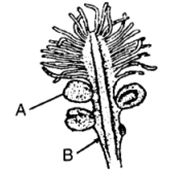
Which part of Cycas is shown in the given figure?
A
Male cone
B
Female cone
C
Microsporophyll
D
Megasporophyll
Solution
(D) The given figure represents a megasporophyll of Cycas.
In Cycas,the female reproductive structures are not organized into compact cones like in Pinus.
Instead,the megasporophylls are loosely arranged and bear ovules (labeled as $A$) on their margins.
Label $B$ points to the stalk of the megasporophyll.
Therefore,the correct option is $D$.
In Cycas,the female reproductive structures are not organized into compact cones like in Pinus.
Instead,the megasporophylls are loosely arranged and bear ovules (labeled as $A$) on their margins.
Label $B$ points to the stalk of the megasporophyll.
Therefore,the correct option is $D$.
0 likes
View Solution288
MediumMCQ
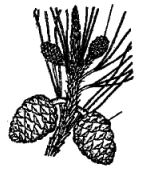
Which of the following is true for the plant shown in the given figure?
A
Pollination by wind
B
Heterosporous
C
Ovule is anatropous
D
Both $(A)$ and $(B)$
Solution
(D) The plant shown in the figure is $Pinus$,which belongs to the group Gymnosperms.
Gymnosperms are heterosporous,meaning they produce two types of spores: microspores and megaspores.
Pollination in Gymnosperms,including $Pinus$,occurs exclusively through the wind (anemophily).
Since both statements $(A)$ and $(B)$ are correct,the correct option is $(D)$.
Gymnosperms are heterosporous,meaning they produce two types of spores: microspores and megaspores.
Pollination in Gymnosperms,including $Pinus$,occurs exclusively through the wind (anemophily).
Since both statements $(A)$ and $(B)$ are correct,the correct option is $(D)$.
0 likes
View Solution289
MediumMCQ
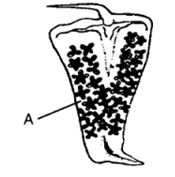
Identify the part labeled '$A$' in the given figure.
A
Microsporophyll
B
Microsporangium
C
Megasporangium
D
Ovule
Solution
(B) The given figure represents a microsporophyll of a gymnosperm (like Cycas).
In gymnosperms,the microsporangia are borne on microsporophylls.
The structure labeled '$A$' represents the microsporangia (pollen sacs) which contain the microspores.
Therefore,the correct option is $B$.
In gymnosperms,the microsporangia are borne on microsporophylls.
The structure labeled '$A$' represents the microsporangia (pollen sacs) which contain the microspores.
Therefore,the correct option is $B$.
0 likes
View Solution290
EasyMCQ
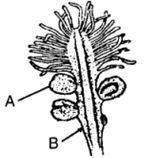
Identify the part labeled as '$A$' in the given figure.
A
Megasporophyll
B
Female cone
C
Megasporangium
D
Microspore
Solution
(C) The provided figure represents a longitudinal section of a female cone of Cycas.
In this structure,'$A$' points to the megasporangium (also known as the ovule),which is borne on the megasporophyll.
Therefore,the correct label for '$A$' is the megasporangium.
In this structure,'$A$' points to the megasporangium (also known as the ovule),which is borne on the megasporophyll.
Therefore,the correct label for '$A$' is the megasporangium.
0 likes
View Solution291
EasyMCQ
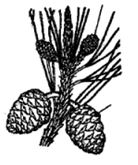
Identify the plant shown in the given figure.
A
Cycas
B
Pinus
C
Thuja
D
Araucaria
Solution
(B) The figure shows a branch of $Pinus$ (pine tree).
Key identifying features include the presence of needle-like leaves and woody female cones,which are characteristic of the genus $Pinus$ within the division Gymnospermae.
Key identifying features include the presence of needle-like leaves and woody female cones,which are characteristic of the genus $Pinus$ within the division Gymnospermae.
0 likes
View Solution292
EasyMCQ
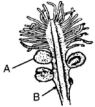
Identify the part labeled '$B$' in the given figure.
A
Megasporangium
B
Megasporophyll
C
Male cone
D
Microsporangium
Solution
(B) The provided figure represents a female cone of Cycas.
In this structure,'$A$' points to the megasporangium (ovule),while '$B$' points to the megasporophyll,which is the leaf-like structure bearing the megasporangia.
In this structure,'$A$' points to the megasporangium (ovule),while '$B$' points to the megasporophyll,which is the leaf-like structure bearing the megasporangia.
0 likes
View Solution293
DifficultMCQ
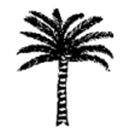
Identify the given gymnosperm plant.
A
Cycas
B
Pinus
C
Thuja
D
Araucaria
Solution
(A) The image shows a plant with an unbranched,columnar stem and a crown of pinnately compound leaves at the top,which is characteristic of the genus $Cycas$.
$Cycas$ is a well-known gymnosperm that typically exhibits this palm-like appearance.
$Pinus$,$Thuja$,and $Araucaria$ are branched gymnosperms and do not match the morphology shown in the image.
$Cycas$ is a well-known gymnosperm that typically exhibits this palm-like appearance.
$Pinus$,$Thuja$,and $Araucaria$ are branched gymnosperms and do not match the morphology shown in the image.
0 likes
View Solution294
EasyMCQ
Mycorrhiza is defined as:
A
Symbiotic association between fungi and algae
B
Symbiotic association between fungi and gymnosperms
C
Symbiotic association between fungi and roots of higher plants
D
Symbiotic association between bacteria and yeast
Solution
(C) Mycorrhiza is a symbiotic association between a fungus and the roots of higher plants (such as gymnosperms and many angiosperms).
In this association,the fungus helps the plant in the absorption of essential nutrients like phosphorus from the soil,while the plant provides carbohydrates and shelter to the fungus.
Therefore,the correct option is $C$.
In this association,the fungus helps the plant in the absorption of essential nutrients like phosphorus from the soil,while the plant provides carbohydrates and shelter to the fungus.
Therefore,the correct option is $C$.
0 likes
View Solution295
MediumMCQ
Plants in which seeds develop on sporophylls and are not enclosed by fruits are classified as -
A
Angiosperms
B
Bryophytes
C
Pteridophytes
D
Gymnosperms
Solution
(D) In $Gymnosperms$, the ovules are not enclosed by any ovary wall and remain exposed, both before and after fertilization. The seeds that develop post-fertilization are not covered, i.e., are naked. These seeds develop on the surface of structures called sporophylls, which are arranged spirally along an axis to form lax or compact strobili or cones. Therefore, the correct classification for such plants is $Gymnosperms$.
0 likes
View Solution296
EasyMCQ
Conifers are associated with which of the following?
A
Bryophytes
B
Gymnosperms
C
Angiosperms
D
Pteridophytes
Solution
(B) Conifers belong to the group $Gymnosperms$.
$Gymnosperms$ are plants in which the ovules are not enclosed by any ovary wall and remain exposed,both before and after fertilization.
Conifers are medium-sized to tall trees or shrubs that typically bear cones (strobili) and needle-like leaves.
Examples include $Pinus$ and $Cedrus$.
$Gymnosperms$ are plants in which the ovules are not enclosed by any ovary wall and remain exposed,both before and after fertilization.
Conifers are medium-sized to tall trees or shrubs that typically bear cones (strobili) and needle-like leaves.
Examples include $Pinus$ and $Cedrus$.
0 likes
View Solution297
MediumMCQ
Assertion $A$: Gymnosperms occupy an intermediate position between Pteridophytes and Angiosperms. Reason $R$: In Gymnosperms,the ovules are naked and develop into naked seeds after fertilization. Which option is correct for Assertion $A$ and Reason $R$?
A
$A$ and $R$ are both true and $R$ is the correct explanation of $A$.
B
$A$ and $R$ are both true but $R$ is not the correct explanation of $A$.
C
$A$ is true and $R$ is false.
D
$A$ and $R$ are both false.
Solution
(A) Assertion $A$ is true because Gymnosperms show evolutionary characteristics that bridge the gap between the vascular cryptogams (Pteridophytes) and the flowering plants (Angiosperms).
Reason $R$ is also true because the defining characteristic of Gymnosperms is that their ovules are not enclosed by any ovary wall and remain exposed both before and after fertilization,resulting in naked seeds.
Since the evolutionary position of Gymnosperms is directly linked to their reproductive structure (naked seeds),$R$ is the correct explanation of $A$.
Reason $R$ is also true because the defining characteristic of Gymnosperms is that their ovules are not enclosed by any ovary wall and remain exposed both before and after fertilization,resulting in naked seeds.
Since the evolutionary position of Gymnosperms is directly linked to their reproductive structure (naked seeds),$R$ is the correct explanation of $A$.
0 likes
View Solution298
MediumMCQ
Which of the following statements is $NOT$ consistent with gymnosperms?
A
They possess foliage leaves and scale leaves.
B
Male and female cones are arranged on the axis.
C
Ovules are not enclosed by an ovary wall.
D
Sporophylls are homosporous.
Solution
(D) Gymnosperms are heterosporous plants,meaning they produce two types of spores: microspores and megaspores. These spores are produced in microsporangia and megasporangia,respectively,which are borne on sporophylls. Therefore,the statement that sporophylls are homosporous is incorrect. Gymnosperms are characterized by having naked seeds (ovules not enclosed by an ovary wall),the presence of foliage and scale leaves,and the arrangement of reproductive structures into cones (strobili).
0 likes
View Solution299
MediumMCQ
Assertion $(A)$: The scale leaves of $Araucaria$ are small and brown.
Reason $(R)$: The gametophyte stage of $Araucaria$ is long-lived and subterranean.
Which option is correct for Assertion $(A)$ and Reason $(R)$?
Reason $(R)$: The gametophyte stage of $Araucaria$ is long-lived and subterranean.
Which option is correct for Assertion $(A)$ and Reason $(R)$?
A
$A$ and $R$ are both true,and $R$ is the correct explanation of $A$.
B
$A$ and $R$ are both true,but $R$ is not the correct explanation of $A$.
C
$A$ is true,but $R$ is false.
D
$A$ is false,but $R$ is true.
Solution
(C) $Araucaria$ is a genus of evergreen coniferous trees in the family $Araucariaceae$.
In $Araucaria$,the scale leaves are indeed small,brown,and often dry or membranous,which is a characteristic feature of many gymnosperms.
Therefore,Assertion $(A)$ is true.
However,$Araucaria$ is a gymnosperm,and in gymnosperms,the sporophyte is the dominant,long-lived,and independent phase.
The gametophyte phase is highly reduced,dependent on the sporophyte,and not subterranean.
Therefore,Reason $(R)$ is false.
Thus,the correct option is $C$.
In $Araucaria$,the scale leaves are indeed small,brown,and often dry or membranous,which is a characteristic feature of many gymnosperms.
Therefore,Assertion $(A)$ is true.
However,$Araucaria$ is a gymnosperm,and in gymnosperms,the sporophyte is the dominant,long-lived,and independent phase.
The gametophyte phase is highly reduced,dependent on the sporophyte,and not subterranean.
Therefore,Reason $(R)$ is false.
Thus,the correct option is $C$.
0 likes
View Solution300
MediumMCQ
What is absent in $Gymnosperms$?
A
Ovary
B
Ovule
C
Spores
D
Vascular tissues
Solution
(A) $Gymnosperms$ are plants in which the ovules are not enclosed by any ovary wall and remain exposed,both before and after fertilization.
Since they lack an ovary,they do not produce fruits.
Therefore,the ovary is absent in $Gymnosperms$.
Since they lack an ovary,they do not produce fruits.
Therefore,the ovary is absent in $Gymnosperms$.
0 likes
View SolutionPlant Kingdom — Gymnosperms (General) · Frequently Asked Questions
1Are these Plant Kingdom questions useful for JEE and NEET?
Yes. All questions in this section are mapped to JEE Main and NEET exam patterns. Previous year questions from JEE Main, NEET, GUJCET and state-level exams are included with full solutions.
2Can I switch to Hindi or Gujarati for these questions?
Yes. Use the language tabs in the hero section or the sidebar to view the same questions and solutions in English, Hindi or Gujarati.
3How do I generate a question paper from this subtopic?
Use the Vedclass Exam Paper Generator — select the chapter and subtopic, set difficulty, and generate Sets A, B, C, D automatically. First 3 chapters of every subject are free.
Vedclass Products
For Students
Vedclass Test Series
Mock tests in real JEE/NEET style with performance analysis. 5-day free trial.
Start Free TrialFor Teachers
Exam Paper Generator
Generate Set A/B/C/D papers from this chapter in 2 minutes. 3 chapters free.
Try FreeFor Institutes
Online Exam Module
Live online exams with unlimited students, 360° analytics & white-label branding.
See DemoFor Teachers & Institutes
Generate a Plant Kingdom Exam Paper in 2 Minutes
Select subtopic & difficulty — Sets A, B, C, D auto-generated with No Repeat logic.
First 3 chapters of every subject are free — no payment required.