
A English
Gymnosperms (General) Questions in English
Class 11 Biology · Plant Kingdom · Gymnosperms (General)
483+
Questions
English
Language
100%
With Solutions
Showing 33 of 483 questions in English
451
MediumMCQ
Which of the following plants possess naked seeds?
A
Bryophytes
B
Gymnosperms
C
Pteridophytes
D
Angiosperms
Solution
(B) Gymnosperms are plants in which the ovules are not enclosed by any ovary wall and remain exposed,both before and after fertilization. The seeds that develop post-fertilization are not covered,i.e.,they are naked. Therefore,the correct option is $B$.
0 likes
View Solution452
MediumMCQ
Coralloid roots have a symbiotic association with
A
Photosynthetic green algae
B
Nitrogen-fixing cyanobacteria
C
Fungus
D
Photosynthetic brown algae
Solution
(B) Coralloid roots are specialized roots found in the genus $Cycas$ (a gymnosperm). These roots show a symbiotic association with nitrogen-fixing cyanobacteria,such as $Anabaena$ or $Nostoc$. These bacteria reside in the cortical cells of the coralloid roots and help in the fixation of atmospheric nitrogen,which is beneficial for the plant.
0 likes
View Solution453
EasyMCQ
The cones bearing microsporophylls are known as
A
Male strobili
B
Macrosporangiate
C
Female strobili
D
Both $(b)$ and $(c)$
Solution
(A) In gymnosperms,the cones or strobili that bear microsporophylls (which contain microsporangia) are called male strobili or male cones. These structures produce microspores,which develop into male gametophytes.
0 likes
View Solution454
MediumMCQ
$A$ member of $Plantae$ having endospermic,perispermic,polycotyledonous,and winged seeds is also related to:
A
Sulphur shower
B
Largest ovule
C
Double fertilization
D
Placentation
Solution
(A) $Pinus$ is a gymnosperm that exhibits the following characteristics:
- It produces endospermic seeds (seeds containing food storage tissue).
- It has perispermic seeds (remnants of nucellus persist in the seed).
- It is polycotyledonous (having more than two cotyledons).
- It possesses winged seeds for wind dispersal.
- $Pinus$ is also famous for the phenomenon of 'sulphur shower',which occurs when massive amounts of yellow pollen grains are released into the air,creating a cloud-like appearance.
- It produces endospermic seeds (seeds containing food storage tissue).
- It has perispermic seeds (remnants of nucellus persist in the seed).
- It is polycotyledonous (having more than two cotyledons).
- It possesses winged seeds for wind dispersal.
- $Pinus$ is also famous for the phenomenon of 'sulphur shower',which occurs when massive amounts of yellow pollen grains are released into the air,creating a cloud-like appearance.
0 likes
View Solution455
MediumMCQ
Which one constitutes the dominant vegetation in colder regions?
A
Monocots
B
Dicots
C
Legumes
D
Gymnosperms
Solution
(D) Gymnosperms are the dominant vegetation in colder regions because they are well-adapted to harsh,cold climates. Their needle-like leaves,thick cuticles,and sunken stomata help reduce water loss,and their seeds are naked (not enclosed in fruits),which allows them to survive in environments where conditions for seed development within a fruit might be unfavorable.
0 likes
View Solution456
MediumMCQ
How many generations are present in the seed of a gymnosperm?
A
$2$
B
$3$
C
$1$
D
$4$
Solution
(B) The seed of a gymnosperm consists of three distinct generations:
$(a)$ Parental sporophyte: Represented by the seed coat,which is diploid $(2n)$.
$(b)$ Female gametophyte: Represented by the endosperm (nutritive tissue),which is haploid $(n)$.
$(c)$ New plant: Represented by the embryo,which is the next sporophytic generation and is diploid $(2n)$.
$(a)$ Parental sporophyte: Represented by the seed coat,which is diploid $(2n)$.
$(b)$ Female gametophyte: Represented by the endosperm (nutritive tissue),which is haploid $(n)$.
$(c)$ New plant: Represented by the embryo,which is the next sporophytic generation and is diploid $(2n)$.
0 likes
View Solution457
MediumMCQ
$A$ : Endosperm in $Cycas$ is haploid in nature.
$R$ : $Cycas$ roots show association with oxyphotobacteria.
$R$ : $Cycas$ roots show association with oxyphotobacteria.
A
Assertion and Reason both are correct and Reason is the correct explanation of Assertion.
B
Assertion and Reason both are correct but Reason is not the correct explanation of Assertion.
C
Assertion is correct,but Reason is incorrect.
D
Both Assertion and Reason are incorrect.
Solution
(A) In $Cycas$ (a gymnosperm),the endosperm is formed before fertilization from the female gametophyte,making it haploid $(n)$.
$Cycas$ roots exhibit a specialized structure called coralloid roots,which contain cyanobacteria (also known as oxyphotobacteria like $Anabaena$ or $Nostoc$) that help in nitrogen fixation.
Both statements are scientifically accurate.
$Cycas$ roots exhibit a specialized structure called coralloid roots,which contain cyanobacteria (also known as oxyphotobacteria like $Anabaena$ or $Nostoc$) that help in nitrogen fixation.
Both statements are scientifically accurate.
0 likes
View Solution458
MediumMCQ
$A$: Microspores and megaspores are produced in the same lax in gymnosperms.
$R$: Lax represents a compact strobilus which bears microsporophyll and megasporophyll.
$R$: Lax represents a compact strobilus which bears microsporophyll and megasporophyll.
A
Assertion and Reason both are correct and Reason is the correct explanation of Assertion.
B
Assertion and Reason both are correct but Reason is not the correct explanation of Assertion.
C
Assertion is correct,but Reason is incorrect.
D
Both Assertion and Reason are incorrect.
Solution
(D) In gymnosperms,the term 'lax' is not standard terminology; however,the question refers to the strobilus (cone).
Gymnosperms are generally heterosporous,producing microspores and megaspores.
In many gymnosperms (like $Pinus$),male and female strobili are produced on the same plant (monoecious),but they are distinct structures.
In $Cycas$,male and female cones are produced on different plants (dioecious).
Since microspores and megaspores are produced in separate microsporangiate and megasporangiate strobili,the assertion that they are produced in the 'same lax' is incorrect.
Therefore,both the Assertion and the Reason are incorrect.
Gymnosperms are generally heterosporous,producing microspores and megaspores.
In many gymnosperms (like $Pinus$),male and female strobili are produced on the same plant (monoecious),but they are distinct structures.
In $Cycas$,male and female cones are produced on different plants (dioecious).
Since microspores and megaspores are produced in separate microsporangiate and megasporangiate strobili,the assertion that they are produced in the 'same lax' is incorrect.
Therefore,both the Assertion and the Reason are incorrect.
0 likes
View Solution459
MediumMCQ
Gymnosperms lack which of the following structures?
A
Tracheids
B
Vessels
C
Xylem
D
Phloem
Solution
(B) Gymnosperms lack vessels in their xylem tissue. Vessels are also absent in most pteridophytes. Their tracheary elements comprise only tracheids. Flowering plants (angiosperms) possess both vessels and tracheids,but vessels are the characteristic feature of angiosperms.
0 likes
View Solution460
MediumMCQ
$Cycas$ and $Ginkgo$ are considered connecting links between which two plant groups?
A
Bryophytes and pteridophytes
B
Pteridophytes and gymnosperms
C
Gymnosperms and angiosperms
D
Thallophyta and bryophyta
Solution
(B) Connecting links are organisms that exhibit characteristics of two different taxonomic groups. $Cycas$ and $Ginkgo$ are primitive gymnosperms that possess certain features of pteridophytes,such as flagellated motile sperms and circinate vernation in young leaves. Therefore,they are considered connecting links between pteridophytes and gymnosperms.
0 likes
View Solution461
EasyMCQ
The recently discovered anti-cancer drug is obtained from:
A
Taxus
B
Tagetes
C
Tamarix
D
Thea
Solution
(A) The anti-cancer drug known as $Taxol$ is obtained from the bark of the $Taxus$ tree (commonly known as the Yew tree).
$Taxus$ is a genus of gymnosperms.
$Taxol$ is widely used in chemotherapy for the treatment of various cancers,particularly breast cancer and ovarian cancer.
$Taxus$ is a genus of gymnosperms.
$Taxol$ is widely used in chemotherapy for the treatment of various cancers,particularly breast cancer and ovarian cancer.
0 likes
View Solution462
MediumMCQ
What is the relationship between the seeds of Cycas and its coralloid roots?
A
Commensalism
B
Parasitism
C
Amensalism
D
Mutualism
Solution
(D) In $Cycas$, the coralloid roots are specialized root structures that grow upwards and branch dichotomously. These roots contain cyanobacteria (such as $Anabaena$ or $Nostoc$) in their cortical cells. The cyanobacteria fix atmospheric nitrogen for the plant, while the plant provides shelter and nutrients to the cyanobacteria. This mutually beneficial interaction is known as $Mutualism$ (or symbiosis).
0 likes
View Solution463
MediumMCQ
Select the correct option for the tallest plants among the following groups:
Gymnosperms $\quad\quad$ Angiosperms
Gymnosperms $\quad\quad$ Angiosperms
A
Sequoia $\quad\quad$ Banyan
B
Banyan $\quad\quad$ Sequoia
C
Sequoia $\quad\quad$ Eucalyptus
D
Eucalyptus $\quad\quad$ Sequoia
Solution
(C) The tallest gymnosperm is the giant redwood tree,known as $Sequoia$ $sempervirens$.
Among angiosperms,some species of $Eucalyptus$ are considered the tallest flowering plants.
Therefore,the correct pair is $Sequoia$ for gymnosperms and $Eucalyptus$ for angiosperms.
Among angiosperms,some species of $Eucalyptus$ are considered the tallest flowering plants.
Therefore,the correct pair is $Sequoia$ for gymnosperms and $Eucalyptus$ for angiosperms.
0 likes
View Solution464
MediumMCQ
The characteristics of $Gymnosperms$ are similar to which type of plants?
A
Hydrophytes
B
Xerophytes
C
Mesophytes
D
Halophytes
Solution
(B) $Gymnosperms$ are plants that are well-adapted to survive in harsh environmental conditions.
Many $Gymnosperms$ (like $Pinus$ and $Cycas$) possess features such as needle-like leaves,thick cuticles,and sunken stomata to reduce water loss.
These adaptations are characteristic of $Xerophytes$,which are plants adapted to survive in dry or arid environments.
Many $Gymnosperms$ (like $Pinus$ and $Cycas$) possess features such as needle-like leaves,thick cuticles,and sunken stomata to reduce water loss.
These adaptations are characteristic of $Xerophytes$,which are plants adapted to survive in dry or arid environments.
0 likes
View Solution465
MediumMCQ
Select the correct option based on the stem characteristics:
Branched stem $\quad\quad\quad$ Unbranched stem
Branched stem $\quad\quad\quad$ Unbranched stem
A
$Pinus, Cedrus$ $\quad\quad\quad$ $Cycas$
B
$Cycas$ $\quad\quad\quad$ $Pinus, Cedrus$
C
$Pinus$ $\quad\quad\quad$ $Cycas, Cedrus$
D
$Cycas, Cedrus$ $\quad\quad\quad$ $Pinus$
Solution
(A) In the group $Gymnosperms$,the stem characteristics vary among different genera.
$1$. $Cycas$ typically possesses an unbranched,columnar stem that is often covered with persistent leaf bases.
$2$. $Pinus$ and $Cedrus$ possess branched stems.
Therefore,the correct pairing is: Branched stem $(Pinus, Cedrus)$ and Unbranched stem $(Cycas)$.
$1$. $Cycas$ typically possesses an unbranched,columnar stem that is often covered with persistent leaf bases.
$2$. $Pinus$ and $Cedrus$ possess branched stems.
Therefore,the correct pairing is: Branched stem $(Pinus, Cedrus)$ and Unbranched stem $(Cycas)$.
0 likes
View Solution466
MediumMCQ
The leaves of conifers are adapted to withstand extreme environments by having:
A
Needle-like shape
B
Thick cuticle
C
Sunken stomata
D
All of the above
Solution
(D) Conifers are gymnosperms that are well-adapted to survive in harsh,cold,or dry environments.
Their leaves exhibit several xerophytic adaptations:
$1$. Needle-like shape: This reduces the surface area,which minimizes water loss through transpiration.
$2$. Thick cuticle: $A$ waxy,thick layer on the leaf surface prevents excessive water loss and protects against environmental stress.
$3$. Sunken stomata: Stomata are located in pits (sunken) to reduce the rate of transpiration by creating a humid microenvironment around the pore.
Therefore,all these features are present in conifers.
Their leaves exhibit several xerophytic adaptations:
$1$. Needle-like shape: This reduces the surface area,which minimizes water loss through transpiration.
$2$. Thick cuticle: $A$ waxy,thick layer on the leaf surface prevents excessive water loss and protects against environmental stress.
$3$. Sunken stomata: Stomata are located in pits (sunken) to reduce the rate of transpiration by creating a humid microenvironment around the pore.
Therefore,all these features are present in conifers.
0 likes
View Solution467
MediumMCQ
Choose the correct option for Gymnosperms.
Fertilization $\quad\quad$ Endosperm
Fertilization $\quad\quad$ Endosperm
A
Double $\quad\quad$ Haploid
B
Double $\quad\quad$ Triploid
C
Single $\quad\quad$ Haploid
D
Single $\quad\quad$ Triploid
Solution
(C) In Gymnosperms,fertilization is simple (single fertilization) as they lack the double fertilization process characteristic of Angiosperms.
The endosperm in Gymnosperms is formed before fertilization from the female gametophyte,making it haploid $(n)$.
Therefore,the correct combination is Single fertilization and Haploid endosperm.
The endosperm in Gymnosperms is formed before fertilization from the female gametophyte,making it haploid $(n)$.
Therefore,the correct combination is Single fertilization and Haploid endosperm.
0 likes
View Solution468
EasyMCQ
Seeds of $..........$ do not germinate without the presence of mycorrhiza.
A
Cycas
B
Groundnut
C
Pinus
D
Banyan
Solution
(C) Mycorrhiza is a symbiotic association between a fungus and the roots of higher plants.
In the case of $Pinus$ (pine trees),the seeds are obligately dependent on mycorrhizal fungi for germination.
The fungal hyphae provide the necessary nutrients and water,which the seeds cannot absorb efficiently on their own from the soil.
Therefore,without the presence of mycorrhiza,$Pinus$ seeds fail to germinate.
In the case of $Pinus$ (pine trees),the seeds are obligately dependent on mycorrhizal fungi for germination.
The fungal hyphae provide the necessary nutrients and water,which the seeds cannot absorb efficiently on their own from the soil.
Therefore,without the presence of mycorrhiza,$Pinus$ seeds fail to germinate.
0 likes
View Solution469
MediumMCQ
Given below are two statements: One labelled as Assertion $A$ and the other labelled as Reason $R$:
Assertion $A$: In gymnosperms,the pollen grains are released from the microsporangium and carried by air currents.
Reason $R$: Air currents carry the pollen grains to the mouth of the archegonia where the male gametes are discharged and pollen tube is not formed.
In the light of the above statements,choose the correct answer from the options given below:
Assertion $A$: In gymnosperms,the pollen grains are released from the microsporangium and carried by air currents.
Reason $R$: Air currents carry the pollen grains to the mouth of the archegonia where the male gametes are discharged and pollen tube is not formed.
In the light of the above statements,choose the correct answer from the options given below:
A
$A$ is false but $R$ is true
B
Both $A$ and $R$ are true and $R$ is the correct explanation of $A$
C
Both $A$ and $R$ are true but $R$ is $NOT$ the correct explanation of $A$
D
$A$ is true but $R$ is false
Solution
(D) Assertion $A$ is true because in gymnosperms,pollination is anemophilous (wind-pollinated),and pollen grains are released from the microsporangium to be carried by air currents.
Reason $R$ is false because,in gymnosperms,a pollen tube is indeed formed. The pollen grains reach the opening of the ovules,where they germinate to form a pollen tube that grows towards the archegonia to discharge the male gametes.
Reason $R$ is false because,in gymnosperms,a pollen tube is indeed formed. The pollen grains reach the opening of the ovules,where they germinate to form a pollen tube that grows towards the archegonia to discharge the male gametes.
0 likes
View Solution470
MediumMCQ
Which one of the following is the characteristic feature of gymnosperms?
A
Seeds are enclosed in fruits.
B
Seeds are naked.
C
Seeds are absent.
D
Gymnosperms have flowers for reproduction.
Solution
(B) The term $Gymnosperms$ is derived from the Greek words $gymnos$ (meaning naked) and $sperma$ (meaning seed).
In $Gymnosperms$,the ovules are not enclosed by any ovary wall and remain exposed,both before and after fertilization.
Consequently,the seeds that develop post-fertilization are not covered,which is why they are referred to as 'naked seeds'.
In contrast,$Angiosperms$ have seeds enclosed within fruits.
In $Gymnosperms$,the ovules are not enclosed by any ovary wall and remain exposed,both before and after fertilization.
Consequently,the seeds that develop post-fertilization are not covered,which is why they are referred to as 'naked seeds'.
In contrast,$Angiosperms$ have seeds enclosed within fruits.
0 likes
View Solution471
MediumMCQ
Which of the following is a dioecious gymnosperm?
A
Marchantia
B
Pinus
C
Cycas
D
Selaginella
Solution
(C) dioecious plant is one where male and female reproductive organs are present on separate individuals.
$1$. $Marchantia$ is a bryophyte (liverwort),not a gymnosperm.
$2$. $Pinus$ is a monoecious gymnosperm,meaning both male and female cones are present on the same plant.
$3$. $Cycas$ is a dioecious gymnosperm,where male and female cones are produced on separate plants.
$4$. $Selaginella$ is a pteridophyte,not a gymnosperm.
Therefore,the correct answer is $Cycas$.
$1$. $Marchantia$ is a bryophyte (liverwort),not a gymnosperm.
$2$. $Pinus$ is a monoecious gymnosperm,meaning both male and female cones are present on the same plant.
$3$. $Cycas$ is a dioecious gymnosperm,where male and female cones are produced on separate plants.
$4$. $Selaginella$ is a pteridophyte,not a gymnosperm.
Therefore,the correct answer is $Cycas$.
0 likes
View Solution472
EasyMCQ
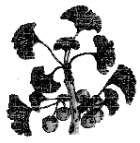
Mark the correct statement with respect to the plant given below-
A
It is heterosporous
B
It has seed inside the fruit
C
It is a moss
D
It is a fern
Solution
(A) The plant shown in the image is $Ginkgo$ $biloba$,which is a gymnosperm.
Gymnosperms are plants in which the ovules are not enclosed by any ovary wall and remain exposed,both before and after fertilization.
Since they are gymnosperms,they are heterosporous,meaning they produce two kinds of spores: microspores and megaspores.
They do not produce fruits,as fruits are characteristic of angiosperms.
They are neither mosses (bryophytes) nor ferns (pteridophytes).
Therefore,the correct statement is that it is heterosporous.
Gymnosperms are plants in which the ovules are not enclosed by any ovary wall and remain exposed,both before and after fertilization.
Since they are gymnosperms,they are heterosporous,meaning they produce two kinds of spores: microspores and megaspores.
They do not produce fruits,as fruits are characteristic of angiosperms.
They are neither mosses (bryophytes) nor ferns (pteridophytes).
Therefore,the correct statement is that it is heterosporous.
0 likes
View Solution473
EasyMCQ
$A$ transverse section of a plant organ shows vessels but does not show companion cells. This organ may belong to:
A
Yucca
B
Ephedra
C
Pinus
D
Maize
Solution
(B) The presence of vessels is a characteristic feature of angiosperms,but they are generally absent in gymnosperms. However,$Ephedra$ is an exceptional gymnosperm that possesses vessels in its xylem. Companion cells are specialized cells associated with sieve tubes in the phloem of angiosperms. Since $Ephedra$ is a gymnosperm,it lacks companion cells (it has albuminous cells instead). Therefore,an organ showing vessels but lacking companion cells belongs to $Ephedra$.
0 likes
View Solution474
MediumMCQ
Select the false statement.
A
Ectomycorrhizal association is found in the roots of Pinus.
B
$BGA$ like Nostoc and Anabaena are found in the coralloid roots of Cycas.
C
In conifers,the needle-like leaves reduce the surface area. It is a xerophytic adaptation.
D
In Gymnosperms,ovules are covered by the ovary wall.
Solution
(D) The correct answer is $D$. In Gymnosperms,the ovules are naked,meaning they are not enclosed by any ovary wall or fruit wall. This is the defining characteristic of the group Gymnospermae (Gymnos = naked,sperma = seed).
Option $A$ is true: $Pinus$ roots show a symbiotic association with fungi known as ectomycorrhiza.
Option $B$ is true: $Cycas$ roots show a specialized association with nitrogen-fixing cyanobacteria $(BGA)$ like $Nostoc$ and $Anabaena$ in their coralloid roots.
Option $C$ is true: Conifers possess needle-like leaves with a thick cuticle and sunken stomata to reduce water loss,which is a xerophytic adaptation.
Option $A$ is true: $Pinus$ roots show a symbiotic association with fungi known as ectomycorrhiza.
Option $B$ is true: $Cycas$ roots show a specialized association with nitrogen-fixing cyanobacteria $(BGA)$ like $Nostoc$ and $Anabaena$ in their coralloid roots.
Option $C$ is true: Conifers possess needle-like leaves with a thick cuticle and sunken stomata to reduce water loss,which is a xerophytic adaptation.
0 likes
View Solution475
MediumMCQ
Female gametophyte in Gymnosperm is found in $:-$
A
Ovule
B
Pollen grain
C
Microsporangia
D
Ovary
Solution
(A) In Gymnosperms,the female gametophyte is multicellular and is retained within the megasporangium,which is commonly known as the ovule.
Unlike Angiosperms,Gymnosperms do not have an ovary,and their ovules are naked (not enclosed by an ovary wall).
The female gametophyte in Gymnosperms bears two or more archegonia (female sex organs).
Therefore,the correct location for the female gametophyte is the ovule.
Unlike Angiosperms,Gymnosperms do not have an ovary,and their ovules are naked (not enclosed by an ovary wall).
The female gametophyte in Gymnosperms bears two or more archegonia (female sex organs).
Therefore,the correct location for the female gametophyte is the ovule.
0 likes
View Solution476
MediumMCQ
Which of the following plants produce seeds but not flowers?
A
Maize
B
Pulses
C
Peepal
D
Pinus
Solution
(D) Plants that produce seeds but lack flowers are known as $Gymnosperms$.
$Gymnosperms$ are naked-seeded plants where the ovules are not enclosed by any ovary wall and remain exposed both before and after fertilization.
$Maize$,$Pulses$,and $Peepal$ are $Angiosperms$ (flowering plants) where seeds are enclosed within fruits.
$Pinus$ is a $Gymnosperm$ that produces seeds in structures called cones or strobili,but it does not produce flowers.
$Gymnosperms$ are naked-seeded plants where the ovules are not enclosed by any ovary wall and remain exposed both before and after fertilization.
$Maize$,$Pulses$,and $Peepal$ are $Angiosperms$ (flowering plants) where seeds are enclosed within fruits.
$Pinus$ is a $Gymnosperm$ that produces seeds in structures called cones or strobili,but it does not produce flowers.
0 likes
View Solution477
MediumMCQ
In gymnosperms,male gametes are discharged near the mouth of archegonia by:
A
Air current
B
Water
C
Pollen tube
D
$1$ and $2$ both
Solution
(C) In gymnosperms,the male gametes are non-motile (in most advanced gymnosperms) or motile (in primitive ones like Cycas and Ginkgo).
Regardless of their motility,the pollen grain germinates to form a pollen tube.
The pollen tube grows through the tissue of the nucellus and reaches the micropyle of the ovule.
Finally,the pollen tube discharges the male gametes near the mouth of the archegonia to facilitate fertilization.
Regardless of their motility,the pollen grain germinates to form a pollen tube.
The pollen tube grows through the tissue of the nucellus and reaches the micropyle of the ovule.
Finally,the pollen tube discharges the male gametes near the mouth of the archegonia to facilitate fertilization.
0 likes
View Solution478
EasyMCQ
In gymnosperms,male gametes are discharged near the mouth of archegonia by:
A
Air current
B
Water
C
Pollen tube
D
$1$ and $2$ both
Solution
(C) In gymnosperms,the pollen grain germinates to form a pollen tube.
This pollen tube grows through the tissue of the nucellus and reaches the micropyle of the ovule.
The male gametes are carried by the pollen tube and are discharged near the mouth of the archegonia to facilitate fertilization.
This pollen tube grows through the tissue of the nucellus and reaches the micropyle of the ovule.
The male gametes are carried by the pollen tube and are discharged near the mouth of the archegonia to facilitate fertilization.
0 likes
View Solution479
EasyMCQ
Assertion :- Gymnosperms do not produce fruit.
Reason :- Ovules of gymnosperms are not enclosed by any ovary wall.
Reason :- Ovules of gymnosperms are not enclosed by any ovary wall.
A
Both Assertion & Reason are True & the Reason is a correct explanation of the Assertion.
B
Both Assertion & Reason are True but Reason is not a correct explanation of the Assertion.
C
Assertion is True but the Reason is False.
D
Both Assertion & Reason are False.
Solution
(A) Gymnosperms are plants in which the ovules are not enclosed by any ovary wall and remain exposed, both before and after fertilization.
Since fruits are formed from the ovary wall after fertilization, the absence of an ovary wall in gymnosperms means they do not produce true fruits.
Therefore, the Assertion that gymnosperms do not produce fruit is true, and the Reason that ovules are not enclosed by an ovary wall is the correct explanation for this phenomenon.
Since fruits are formed from the ovary wall after fertilization, the absence of an ovary wall in gymnosperms means they do not produce true fruits.
Therefore, the Assertion that gymnosperms do not produce fruit is true, and the Reason that ovules are not enclosed by an ovary wall is the correct explanation for this phenomenon.
0 likes
View Solution480
EasyMCQ
Coralloid roots of $Cycas$ are associated with $:-$
A
$N_2$-fixing cyanobacteria
B
Root hair and root cap
C
Food and water conduction
D
Fungi
Solution
(A) In $Cycas$,specialized roots known as coralloid roots are formed.
These roots are apogeotropic (grow upwards) and dichotomously branched.
They contain a symbiotic association with nitrogen-fixing cyanobacteria,such as $Anabaena$ and $Nostoc$,which reside in the cortical region of the root.
This association helps the plant in nitrogen fixation.
These roots are apogeotropic (grow upwards) and dichotomously branched.
They contain a symbiotic association with nitrogen-fixing cyanobacteria,such as $Anabaena$ and $Nostoc$,which reside in the cortical region of the root.
This association helps the plant in nitrogen fixation.
0 likes
View Solution481
EasyMCQ
Male and female cones both are present in the same plant in $:-$
A
Cycas
B
Pinus
C
Mango
D
Equisetum
Solution
(B) In $Pinus$,both male and female cones are produced on the same plant body,which means it is a monoecious plant.
$Cycas$ is dioecious,meaning male and female cones are produced on separate plants.
$Mango$ is an angiosperm and does not produce cones.
$Equisetum$ is a pteridophyte that produces strobili or cones,but it is not the standard example for monoecious cone-bearing plants in the context of gymnosperms compared to $Pinus$.
$Cycas$ is dioecious,meaning male and female cones are produced on separate plants.
$Mango$ is an angiosperm and does not produce cones.
$Equisetum$ is a pteridophyte that produces strobili or cones,but it is not the standard example for monoecious cone-bearing plants in the context of gymnosperms compared to $Pinus$.
0 likes
View Solution482
EasyMCQ
During which geological period did the order $Gnetales$ of gymnosperms evolve?
A
Cretaceous
B
Jurassic
C
Triassic
D
Permian
Solution
(A) The order $Gnetales$,which comprises the genera $Gnetum$,$Ephedra$,and $Welwitschia$,is considered one of the most advanced groups of gymnosperms.
Fossil evidence suggests that this group evolved and diversified significantly during the $Cretaceous$ period.
Fossil evidence suggests that this group evolved and diversified significantly during the $Cretaceous$ period.
0 likes
View Solution483
MediumMCQ
In which one of the following,the ovules are not enclosed by an ovary wall and remain exposed?
A
$(1)$ Pinus
B
$(2)$ Wolffia
C
$(3)$ Funaria
D
$(4)$ Selaginella
Solution
(A) Gymnosperms are plants in which the ovules are not enclosed by any ovary wall and remain exposed both before and after fertilization.
$Pinus$ is a gymnosperm.
$Wolffia$ is an angiosperm,where ovules are enclosed within an ovary.
$Funaria$ is a bryophyte,which does not produce seeds or ovules.
$Selaginella$ is a pteridophyte,which does not produce seeds or ovules.
Therefore,option $(1)$ is correct.
$Pinus$ is a gymnosperm.
$Wolffia$ is an angiosperm,where ovules are enclosed within an ovary.
$Funaria$ is a bryophyte,which does not produce seeds or ovules.
$Selaginella$ is a pteridophyte,which does not produce seeds or ovules.
Therefore,option $(1)$ is correct.
0 likes
View SolutionPlant Kingdom — Gymnosperms (General) · Frequently Asked Questions
1Are these Plant Kingdom questions useful for JEE and NEET?
Yes. All questions in this section are mapped to JEE Main and NEET exam patterns. Previous year questions from JEE Main, NEET, GUJCET and state-level exams are included with full solutions.
2Can I switch to Hindi or Gujarati for these questions?
Yes. Use the language tabs in the hero section or the sidebar to view the same questions and solutions in English, Hindi or Gujarati.
3How do I generate a question paper from this subtopic?
Use the Vedclass Exam Paper Generator — select the chapter and subtopic, set difficulty, and generate Sets A, B, C, D automatically. First 3 chapters of every subject are free.
Vedclass Products
For Students
Vedclass Test Series
Mock tests in real JEE/NEET style with performance analysis. 5-day free trial.
Start Free TrialFor Teachers
Exam Paper Generator
Generate Set A/B/C/D papers from this chapter in 2 minutes. 3 chapters free.
Try FreeFor Institutes
Online Exam Module
Live online exams with unlimited students, 360° analytics & white-label branding.
See DemoFor Teachers & Institutes
Generate a Plant Kingdom Exam Paper in 2 Minutes
Select subtopic & difficulty — Sets A, B, C, D auto-generated with No Repeat logic.
First 3 chapters of every subject are free — no payment required.