
A English
Gymnosperms (General) Questions in English
Class 11 Biology · Plant Kingdom · Gymnosperms (General)
483+
Questions
English
Language
100%
With Solutions
Showing 49 of 483 questions in English
401
MediumMCQ
Conifers are adapted to tolerate extreme environmental conditions because of ..........
A
Broad,thick leaves
B
Superficial stomata
C
Thick cuticle
D
Presence of vessels
Solution
(C) Conifers (Gymnosperms) are well-adapted to survive in extreme environmental conditions such as low temperature and water scarcity.
One of their key xerophytic adaptations is the presence of a thick,waxy cuticle on their needle-like leaves.
This thick cuticle helps in reducing the rate of transpiration,thereby preventing excessive water loss.
Additionally,they possess sunken stomata,which further aid in water conservation.
Therefore,the correct option is $C$.
One of their key xerophytic adaptations is the presence of a thick,waxy cuticle on their needle-like leaves.
This thick cuticle helps in reducing the rate of transpiration,thereby preventing excessive water loss.
Additionally,they possess sunken stomata,which further aid in water conservation.
Therefore,the correct option is $C$.
0 likes
View Solution402
MediumMCQ
Select the correct statement.
A
$Salvinia$,$Ginkgo$ and $Pinus$ are gymnosperms.
B
$Sequoia$ is one of the tallest tree species.
C
Leaves of gymnosperms are not adapted to withstand extreme environments.
D
Gymnosperms are homosporous and heterosporous.
Solution
(B) $1$. $Salvinia$ is a pteridophyte,not a gymnosperm. Thus,option $A$ is incorrect.
$2$. $Sequoia$ (redwood) is known as one of the tallest tree species,making option $B$ the correct statement.
$3$. Gymnosperm leaves are well-adapted to withstand extreme temperatures,humidity,and wind (e.g.,needle-like leaves in conifers reduce surface area). Thus,option $C$ is incorrect.
$4$. Gymnosperms are heterosporous; they produce haploid microspores and megaspores. They are not homosporous. Thus,option $D$ is incorrect.
$2$. $Sequoia$ (redwood) is known as one of the tallest tree species,making option $B$ the correct statement.
$3$. Gymnosperm leaves are well-adapted to withstand extreme temperatures,humidity,and wind (e.g.,needle-like leaves in conifers reduce surface area). Thus,option $C$ is incorrect.
$4$. Gymnosperms are heterosporous; they produce haploid microspores and megaspores. They are not homosporous. Thus,option $D$ is incorrect.
0 likes
View Solution403
EasyMCQ
Which is the main water-conducting element in gymnosperms?
A
Vessels
B
Xylem fibers
C
Transfusion tissue
D
Tracheids
Solution
(D) In gymnosperms,the xylem lacks vessels (tracheae),which are the primary water-conducting elements in angiosperms. Instead,tracheids are the main water-conducting elements in gymnosperms. Tracheids are elongated,tube-like cells with thick,lignified walls and tapering ends that facilitate the transport of water and minerals.
0 likes
View Solution404
MediumMCQ
Which of the following is a living fossil?
A
$Pinus$ $longifolia$
B
$Dalbergia$ $sissoo$
C
$Mirabilis$ $jalapa$
D
$Ginkgo$ $biloba$
Solution
(D) living fossil is an extant taxon that closely resembles related species known only from the fossil record.
$Ginkgo$ $biloba$,also known as the maidenhair tree,is a unique species of gymnosperm with no close living relatives.
It has remained virtually unchanged for millions of years,making it a classic example of a living fossil.
$Ginkgo$ $biloba$,also known as the maidenhair tree,is a unique species of gymnosperm with no close living relatives.
It has remained virtually unchanged for millions of years,making it a classic example of a living fossil.
0 likes
View Solution405
MediumMCQ
Which of the following statements is $correct$?
A
Stems are usually unbranched in both $Cycas$ and $Cedrus$.
B
$Selaginella$ is heterosporous, while $Salvinia$ is homosporous.
C
Horsetails are gymnosperms.
D
Ovules are not enclosed by ovary wall in gymnosperms.
Solution
(D) $1$. $Cycas$ has an unbranched stem, but $Cedrus$ has a branched stem. Thus, option $A$ is incorrect.
$2$. Both $Selaginella$ and $Salvinia$ are heterosporous. Thus, option $B$ is incorrect.
$3$. Horsetails (Equisetum) are pteridophytes, not gymnosperms. Thus, option $C$ is incorrect.
$4$. Gymnosperms are plants in which the ovules are not enclosed by any ovary wall and remain exposed, both before and after fertilization. Thus, option $D$ is correct.
$2$. Both $Selaginella$ and $Salvinia$ are heterosporous. Thus, option $B$ is incorrect.
$3$. Horsetails (Equisetum) are pteridophytes, not gymnosperms. Thus, option $C$ is incorrect.
$4$. Gymnosperms are plants in which the ovules are not enclosed by any ovary wall and remain exposed, both before and after fertilization. Thus, option $D$ is correct.
0 likes
View Solution406
EasyMCQ
Winged pollen grains are present in
A
$Pinus$
B
Mustard
C
Mango
D
$Cycas$
Solution
(A) Winged pollen grains are a characteristic feature of $Pinus$ (a gymnosperm).
These wings are formed by the expansion of the exine (outer layer of the pollen wall) and help in the dispersal of pollen grains by wind (anemophily).
$Cycas$,Mustard,and Mango do not possess winged pollen grains.
These wings are formed by the expansion of the exine (outer layer of the pollen wall) and help in the dispersal of pollen grains by wind (anemophily).
$Cycas$,Mustard,and Mango do not possess winged pollen grains.
0 likes
View Solution407
MediumMCQ
$Pinus$ seeds cannot germinate and establish without fungal association. This is because
A
its embryo is immature
B
it has obligate association with mycorrhizae
C
it has a very hard seed coat
D
its seeds contain inhibitors that prevent germination
Solution
(B) $Pinus$ exhibits an obligate symbiotic association with fungi known as mycorrhizae.
This association is essential for the plant because the fungal hyphae help in the absorption of water and mineral nutrients from the soil,which the $Pinus$ roots are unable to do efficiently on their own.
Without this association,the $Pinus$ seedling cannot obtain sufficient nutrients to germinate and establish itself in the environment.
Therefore,the correct option is $B$.
This association is essential for the plant because the fungal hyphae help in the absorption of water and mineral nutrients from the soil,which the $Pinus$ roots are unable to do efficiently on their own.
Without this association,the $Pinus$ seedling cannot obtain sufficient nutrients to germinate and establish itself in the environment.
Therefore,the correct option is $B$.
0 likes
View Solution408
MediumMCQ
Phloem in gymnosperms lacks:
A
Albuminous cells and sieve cells
B
Sieve tubes only
C
Companion cells only
D
Both sieve tubes and companion cells
Solution
(D) In gymnosperms,the phloem is composed of sieve cells and albuminous cells. Unlike angiosperms,gymnosperms do not possess sieve tubes and companion cells. Instead,they have sieve cells which are less specialized than sieve tubes,and albuminous cells which perform functions analogous to companion cells. Therefore,the correct answer is $D$.
0 likes
View Solution409
MediumMCQ
Which of the following is found in the algal zone of $Cycas$ coralloid roots?
A
Blue-green algae
B
Red algae
C
Diatoms
D
Brown algae
Solution
(A) The coralloid roots of $Cycas$ contain a specialized region known as the algal zone.
This zone is inhabited by symbiotic blue-green algae (cyanobacteria),such as $Anabaena$ and $Nostoc$.
This is a mutualistic relationship where the algae receive shelter and nutrients from the $Cycas$ plant,while the $Cycas$ plant benefits from the nitrogen-fixing capabilities of the algae.
This zone is inhabited by symbiotic blue-green algae (cyanobacteria),such as $Anabaena$ and $Nostoc$.
This is a mutualistic relationship where the algae receive shelter and nutrients from the $Cycas$ plant,while the $Cycas$ plant benefits from the nitrogen-fixing capabilities of the algae.
0 likes
View Solution410
EasyMCQ
Coralloid roots of $Cycas$ are distinguished from angiosperm roots by
A
absence of pith
B
having xylem tissue
C
absence of algal zone
D
presence of algal zone
Solution
(D) In $Cycas$,coralloid roots are bluish-green in color and contain blue-green algae (cyanobacteria like $Anabaena$ or $Nostoc$) within their cortical region.
This specific feature,known as the algal zone,is unique to the coralloid roots of $Cycas$ and is absent in the roots of angiosperms.
This specific feature,known as the algal zone,is unique to the coralloid roots of $Cycas$ and is absent in the roots of angiosperms.
0 likes
View Solution411
MediumMCQ
Assertion : Conifer trees produce a large quantity of wind borne pollen grains.
Reason : The pollen grains have wings.
Reason : The pollen grains have wings.
A
If both Assertion and Reason are correct and the Reason is a correct explanation of the Assertion.
B
If both Assertion and Reason are correct but Reason is not a correct explanation of the Assertion.
C
If the Assertion is correct but Reason is incorrect.
D
If both the Assertion and Reason are incorrect.
Solution
(A) In $Pinus$, a conifer tree, microspores are produced by microsporogenesis in the microsporangium.
Each microsporangium has an inner nourishing layer known as the tapetum.
$A$ large number of dusty and two-winged microspores (pollen grains) are produced.
On maturity, the microsporangium wall bursts, and microspores are released into the air, which is often referred to as a "shower of sulphur."
These pollen grains are dispersed by wind specifically due to the presence of wings, which provide buoyancy.
Therefore, the presence of wings is the reason why they are efficiently wind-borne in large quantities.
Each microsporangium has an inner nourishing layer known as the tapetum.
$A$ large number of dusty and two-winged microspores (pollen grains) are produced.
On maturity, the microsporangium wall bursts, and microspores are released into the air, which is often referred to as a "shower of sulphur."
These pollen grains are dispersed by wind specifically due to the presence of wings, which provide buoyancy.
Therefore, the presence of wings is the reason why they are efficiently wind-borne in large quantities.
0 likes
View Solution412
MediumMCQ
Assertion: $Ginkgo biloba$ is a living fossil.
Reason: Organisms which have persisted and remained unchanged for the past several million years while their relatives disappeared.
Reason: Organisms which have persisted and remained unchanged for the past several million years while their relatives disappeared.
A
If both Assertion and Reason are correct and the Reason is a correct explanation of the Assertion.
B
If both Assertion and Reason are correct but Reason is not a correct explanation of the Assertion.
C
If the Assertion is correct but Reason is incorrect.
D
If both the Assertion and Reason are incorrect.
Solution
(A) $Ginkgo biloba$ belongs to the order $Ginkgoales$, which evolved during the $Jurassic$ period.
It is considered a living fossil because it has persisted and remained unchanged for millions of years while its close relatives have gone extinct.
Therefore, the Assertion is correct, and the Reason provides a valid explanation for why it is classified as a living fossil.
It is considered a living fossil because it has persisted and remained unchanged for millions of years while its close relatives have gone extinct.
Therefore, the Assertion is correct, and the Reason provides a valid explanation for why it is classified as a living fossil.
0 likes
View Solution413
Easy
Describe the important characteristics of gymnosperms.
Solution
(N/A) Important features of gymnosperms:
$(a)$ The term gymnosperm refers to plants with naked seeds (gymnos - naked,sperma - seeds),i.e.,the seeds of these plants are not enclosed in fruits.
$(b)$ The plant body ranges from medium to tall trees and shrubs. The giant redwood tree $Sequoia$ is one of the tallest trees in the world.
$(c)$ The root system consists of tap roots. The coralloid roots present in $Cycas$ are associated with nitrogen-fixing cyanobacteria.
$(d)$ The stem can be branched (as in $Pinus$ and $Cedrus$) or unbranched (as in $Cycas$).
$(e)$ The leaves can be simple (as in $Pinus$) or compound (pinnate in $Cycas$). The leaves are needle-like,with a thick cuticle and sunken stomata. These adaptations help in preventing water loss.
$(f)$ Gymnosperms are heterosporous. They produce two kinds of spores: microspores and megaspores.
$(a)$ The term gymnosperm refers to plants with naked seeds (gymnos - naked,sperma - seeds),i.e.,the seeds of these plants are not enclosed in fruits.
$(b)$ The plant body ranges from medium to tall trees and shrubs. The giant redwood tree $Sequoia$ is one of the tallest trees in the world.
$(c)$ The root system consists of tap roots. The coralloid roots present in $Cycas$ are associated with nitrogen-fixing cyanobacteria.
$(d)$ The stem can be branched (as in $Pinus$ and $Cedrus$) or unbranched (as in $Cycas$).
$(e)$ The leaves can be simple (as in $Pinus$) or compound (pinnate in $Cycas$). The leaves are needle-like,with a thick cuticle and sunken stomata. These adaptations help in preventing water loss.
$(f)$ Gymnosperms are heterosporous. They produce two kinds of spores: microspores and megaspores.
0 likes
View Solution414
Easy
Give common characteristics of Gymnosperms plants.
Solution
(N/A) $\rightarrow$ Gymnosperms are plants that range from the smallest to the tallest sizes.
$\rightarrow$ $Sequoia$ is one of the tallest redwood trees.
$\rightarrow$ Gymnosperms are plants in which the ovules are not enclosed by any ovary wall and remain exposed,both before and after fertilization.
$\rightarrow$ The seeds that develop post-fertilization are not covered,i.e.,they are naked.
$\rightarrow$ The plant body is a sporophyte,which is differentiated into root,stem,and leaves.
$\rightarrow$ Leaves are of two types: $(i)$ compound leaves and $(ii)$ simple leaves.
$\rightarrow$ They are always green,perennial trees or shrubs. They show characteristics of xerophytic plants.
$\rightarrow$ Roots are normally taproots. In some species,there is a fungal association in the form of mycorrhiza (e.g.,$Pinus$). In others (e.g.,$Cycas$),specialized coralloid roots are associated with $N_2$-fixing cyanobacteria.
$\rightarrow$ Stems are unbranched (e.g.,$Cycas$) or branched (e.g.,$Pinus$,$Cedrus$).
$\rightarrow$ In $Cycas$,the pinnate leaves persist for a few years.
$\rightarrow$ The leaves in gymnosperms are well-adapted to withstand extremes of temperature,humidity,and wind.
$\rightarrow$ In conifers,the needle-like leaves reduce the surface area. Their thick cuticle and sunken stomata help to reduce water loss.
$\rightarrow$ $Sequoia$ is one of the tallest redwood trees.
$\rightarrow$ Gymnosperms are plants in which the ovules are not enclosed by any ovary wall and remain exposed,both before and after fertilization.
$\rightarrow$ The seeds that develop post-fertilization are not covered,i.e.,they are naked.
$\rightarrow$ The plant body is a sporophyte,which is differentiated into root,stem,and leaves.
$\rightarrow$ Leaves are of two types: $(i)$ compound leaves and $(ii)$ simple leaves.
$\rightarrow$ They are always green,perennial trees or shrubs. They show characteristics of xerophytic plants.
$\rightarrow$ Roots are normally taproots. In some species,there is a fungal association in the form of mycorrhiza (e.g.,$Pinus$). In others (e.g.,$Cycas$),specialized coralloid roots are associated with $N_2$-fixing cyanobacteria.
$\rightarrow$ Stems are unbranched (e.g.,$Cycas$) or branched (e.g.,$Pinus$,$Cedrus$).
$\rightarrow$ In $Cycas$,the pinnate leaves persist for a few years.
$\rightarrow$ The leaves in gymnosperms are well-adapted to withstand extremes of temperature,humidity,and wind.
$\rightarrow$ In conifers,the needle-like leaves reduce the surface area. Their thick cuticle and sunken stomata help to reduce water loss.
0 likes
View Solution415
Easy
Explain the life cycle in Gymnosperms.
Solution
(N/A) $\rightarrow$ Gymnosperms are heterosporous; they produce haploid microspores and megaspores.
$\rightarrow$ These two kinds of spores are produced within sporangia.
$\rightarrow$ Spores are borne on sporophylls,which are arranged spirally along an axis to form lax or compact strobili or cones.
$\rightarrow$ The strobili bearing microsporophylls and microsporangia are called microsporangiate or male strobili.
$\rightarrow$ The microspores develop into a male gametophytic generation which is highly reduced. This reduced gametophyte is called a pollen grain.
$\rightarrow$ The cones bearing megasporophylls with ovules or megasporangia are called macrosporangiate or female strobili.
$\rightarrow$ In $Pinus$,the male and female cones or strobili may be borne on the same tree. In $Cycas$,male cones and megasporophylls are borne on different trees.
$\rightarrow$ The megaspore mother cell is differentiated from one of the cells of the nucellus. The nucellus is protected by envelopes,and the composite structure is called an ovule.
$\rightarrow$ The ovules are borne on megasporophylls,which may be clustered to form female cones.
$\rightarrow$ One of the megaspores enclosed within the megasporangium (nucellus) develops into a multicellular female gametophyte that bears two or more archegonia (female sex organs).
$\rightarrow$ The multicellular female gametophyte is retained within the megasporangium.
$\rightarrow$ In gymnosperms,the male and female gametophytes do not have an independent free-living existence.
$\rightarrow$ They remain within the sporangia retained on the sporophytes. The pollen grain is released from the microsporangium.
$\rightarrow$ Pollination: The pollen tube carrying the male gametes grows towards the archegonia in the ovules and discharges its contents near the mouth of the archegonia.
$\rightarrow$ Following fertilization,the zygote develops into an embryo and the ovules develop into seeds. These seeds are not covered (naked).
$\rightarrow$ These two kinds of spores are produced within sporangia.
$\rightarrow$ Spores are borne on sporophylls,which are arranged spirally along an axis to form lax or compact strobili or cones.
$\rightarrow$ The strobili bearing microsporophylls and microsporangia are called microsporangiate or male strobili.
$\rightarrow$ The microspores develop into a male gametophytic generation which is highly reduced. This reduced gametophyte is called a pollen grain.
$\rightarrow$ The cones bearing megasporophylls with ovules or megasporangia are called macrosporangiate or female strobili.
$\rightarrow$ In $Pinus$,the male and female cones or strobili may be borne on the same tree. In $Cycas$,male cones and megasporophylls are borne on different trees.
$\rightarrow$ The megaspore mother cell is differentiated from one of the cells of the nucellus. The nucellus is protected by envelopes,and the composite structure is called an ovule.
$\rightarrow$ The ovules are borne on megasporophylls,which may be clustered to form female cones.
$\rightarrow$ One of the megaspores enclosed within the megasporangium (nucellus) develops into a multicellular female gametophyte that bears two or more archegonia (female sex organs).
$\rightarrow$ The multicellular female gametophyte is retained within the megasporangium.
$\rightarrow$ In gymnosperms,the male and female gametophytes do not have an independent free-living existence.
$\rightarrow$ They remain within the sporangia retained on the sporophytes. The pollen grain is released from the microsporangium.
$\rightarrow$ Pollination: The pollen tube carrying the male gametes grows towards the archegonia in the ovules and discharges its contents near the mouth of the archegonia.
$\rightarrow$ Following fertilization,the zygote develops into an embryo and the ovules develop into seeds. These seeds are not covered (naked).
0 likes
View Solution416
EasyMCQ
What are the common characteristics of Gymnosperms?
A
Presence of naked seeds,lack of flowers,and vascular tissue.
B
Presence of fruits,flowers,and double fertilization.
C
Absence of vascular tissue and presence of motile gametes.
D
Presence of seeds enclosed within fruits.
Solution
(A) Gymnosperms are plants in which the ovules are not enclosed by any ovary wall and remain exposed,both before and after fertilization.
They are characterized by the following features:
$1$. The seeds that develop post-fertilization are not covered,i.e.,they are naked.
$2$. They do not produce flowers or fruits.
$3$. They possess well-developed vascular tissues (xylem and phloem).
$4$. They are heterosporous,producing haploid microspores and megaspores.
$5$. The plant body is differentiated into roots,stems,and leaves.
They are characterized by the following features:
$1$. The seeds that develop post-fertilization are not covered,i.e.,they are naked.
$2$. They do not produce flowers or fruits.
$3$. They possess well-developed vascular tissues (xylem and phloem).
$4$. They are heterosporous,producing haploid microspores and megaspores.
$5$. The plant body is differentiated into roots,stems,and leaves.
0 likes
View Solution417
Easy
What are mycorrhiza and coralloid roots? Explain.
Solution
(N/A) Mycorrhiza and coralloid roots are examples of symbiotic associations in plants.
$1$. Mycorrhiza: It is a symbiotic association between a fungus and the roots of higher plants (e.g.,Pinus). The fungal hyphae help in the absorption of water and minerals from the soil,while the plant provides carbohydrates to the fungus.
$2$. Coralloid roots: These are specialized,branched,coral-like roots found in some gymnosperms,such as Cycas. These roots are associated with nitrogen-fixing cyanobacteria (e.g.,Anabaena or Nostoc),which help the plant in nitrogen fixation.
$1$. Mycorrhiza: It is a symbiotic association between a fungus and the roots of higher plants (e.g.,Pinus). The fungal hyphae help in the absorption of water and minerals from the soil,while the plant provides carbohydrates to the fungus.
$2$. Coralloid roots: These are specialized,branched,coral-like roots found in some gymnosperms,such as Cycas. These roots are associated with nitrogen-fixing cyanobacteria (e.g.,Anabaena or Nostoc),which help the plant in nitrogen fixation.
0 likes
View Solution418
Easy
Give information about the reproductive organs of Gymnosperms.
Solution
(N/A) Gymnosperms are heterosporous,meaning they produce two types of spores: microspores and megaspores.
$1$. These spores are produced within sporangia that are borne on sporophylls.
$2$. Sporophylls are arranged spirally along an axis to form lax or compact strobili or cones.
$3$. The strobili bearing microsporophylls and microsporangia are called male strobili or male cones.
$4$. The strobili bearing megasporophylls with ovules or megasporangia are called female strobili or female cones.
$5$. The male gametophyte is highly reduced and is confined to a limited number of cells,known as pollen grains.
$6$. The female gametophyte is also reduced and is retained within the megasporangium (ovule).
$1$. These spores are produced within sporangia that are borne on sporophylls.
$2$. Sporophylls are arranged spirally along an axis to form lax or compact strobili or cones.
$3$. The strobili bearing microsporophylls and microsporangia are called male strobili or male cones.
$4$. The strobili bearing megasporophylls with ovules or megasporangia are called female strobili or female cones.
$5$. The male gametophyte is highly reduced and is confined to a limited number of cells,known as pollen grains.
$6$. The female gametophyte is also reduced and is retained within the megasporangium (ovule).
0 likes
View Solution419
Medium
Give scientific reasons: Cone-bearing plants possess pointed,thick-cuticled leaves.
Solution
(N/A) Cone-bearing plants (Gymnosperms) are typically adapted to environments with limited water availability,such as cold or dry regions.
$1$. The pointed,needle-like shape of the leaves reduces the surface area,which minimizes the rate of transpiration (water loss).
$2$. The presence of a thick cuticle acts as a waxy,waterproof layer that prevents excessive evaporation of water from the leaf surface.
$3$. Additionally,these plants often possess sunken stomata,which further help in conserving water by creating a humid microenvironment around the stomatal pore,thereby reducing the diffusion of water vapor.
$1$. The pointed,needle-like shape of the leaves reduces the surface area,which minimizes the rate of transpiration (water loss).
$2$. The presence of a thick cuticle acts as a waxy,waterproof layer that prevents excessive evaporation of water from the leaf surface.
$3$. Additionally,these plants often possess sunken stomata,which further help in conserving water by creating a humid microenvironment around the stomatal pore,thereby reducing the diffusion of water vapor.
0 likes
View Solution420
MediumMCQ
What is the biological importance of the following structures in gymnosperms?
$(i)$ Mycorrhiza in roots
$(ii)$ Coralloid roots
$(i)$ Mycorrhiza in roots
$(ii)$ Coralloid roots
A
Nutrient absorption and nitrogen fixation
B
Photosynthesis and water storage
C
Reproduction and seed dispersal
D
Structural support and protection
Solution
(A) $(i)$ In gymnospermic plants like $Pinus$,the roots have a symbiotic fungal association known as mycorrhiza,which helps in the absorption of water and minerals.
$(ii)$ In plants like $Cycas$,specialized roots called coralloid roots develop,which are associated with $N_2$-fixing cyanobacteria (like $Anabaena$ or $Nostoc$) to help in nitrogen fixation.
$(ii)$ In plants like $Cycas$,specialized roots called coralloid roots develop,which are associated with $N_2$-fixing cyanobacteria (like $Anabaena$ or $Nostoc$) to help in nitrogen fixation.
0 likes
View Solution421
Medium
Each plant or group of plants has some phylogenetic significance in relation to evolution. $Cycas$,one of the few living members of gymnosperms,is called the 'relic of the past'. Can you establish a phylogenetic relationship of $Cycas$ with any other group of plants that justifies the above statement?
Solution
(N/A) $\rightarrow$ $Cycas$ is considered a 'relic of the past' because it is an evergreen plant that resembles a palm tree. It possesses unbranched stems and large compound leaves. It shows specific developmental relationships with $Pteridophytes$. Its evolutionary characteristics that justify this are as follows:
$(i)$ Slow growth.
$(ii)$ Shedding of seeds while the embryo is still underdeveloped.
$(iii)$ Less primary growth and $Monoxylic$ wood.
$(iv)$ Leaf-like $Megasporophylls$.
$(v)$ Presence of flagellated (motile) male gametes,even though a pollen tube is present.
$(vi)$ Persistent nature.
$(vii)$ $Circinate$ $ptychis$ (coiling of young leaves) similar to ferns.
$(viii)$ The arrangement of microspores is primitive.
$(i)$ Slow growth.
$(ii)$ Shedding of seeds while the embryo is still underdeveloped.
$(iii)$ Less primary growth and $Monoxylic$ wood.
$(iv)$ Leaf-like $Megasporophylls$.
$(v)$ Presence of flagellated (motile) male gametes,even though a pollen tube is present.
$(vi)$ Persistent nature.
$(vii)$ $Circinate$ $ptychis$ (coiling of young leaves) similar to ferns.
$(viii)$ The arrangement of microspores is primitive.
0 likes
View Solution422
Medium
In which plant will you look for mycorrhiza and coralloid roots? Also,explain what these terms mean.
Solution
(N/A) $\rightarrow$ Mycorrhiza: Roots in some genera have a fungal association known as Mycorrhiza (Mycos = fungi,Rize = roots).
$\rightarrow$ Fungi form a colony either outside or inside the cells of the host plant. They help in the absorption of nutrients from the soil. This association is commonly seen in conifers like $Pinus$,$Cedrus$,$Abies$,and $Picea$.
$\rightarrow$ Coralloid Roots: These are observed in $Cycas$. They arise from the basal part of the plant and grow upwards from the soil. They are branched and greenish in color. $A$ colony of blue-green algae,such as $Anabaena$ and $Nostoc$,is found in their cortex,which maintains a symbiotic relationship with the coralloid roots.
$\rightarrow$ Fungi form a colony either outside or inside the cells of the host plant. They help in the absorption of nutrients from the soil. This association is commonly seen in conifers like $Pinus$,$Cedrus$,$Abies$,and $Picea$.
$\rightarrow$ Coralloid Roots: These are observed in $Cycas$. They arise from the basal part of the plant and grow upwards from the soil. They are branched and greenish in color. $A$ colony of blue-green algae,such as $Anabaena$ and $Nostoc$,is found in their cortex,which maintains a symbiotic relationship with the coralloid roots.
0 likes
View Solution423
Medium
What are the characteristic differences found in the vascular tissue of gymnosperms and angiosperms?
Solution
(N/A) The primary differences in the vascular tissues of gymnosperms and angiosperms are as follows:
| Gymnosperms | Angiosperms |
| $(i)$ Xylem tissue lacks true vessels. | $(i)$ Xylem tissue contains true vessels. |
| $(ii)$ Phloem tissue lacks companion cells (they have albuminous cells instead). | $(ii)$ Phloem tissue possesses companion cells. |
0 likes
View Solution424
Medium
Is $Pinus$ an evergreen tree? Comment.
Solution
(N/A) $\Rightarrow$ Evergreen refers to plants that retain their leaves throughout all four seasons,whereas deciduous trees shed their leaves during winter or dry seasons.
$\Rightarrow$ $Pinus$,a member of the gymnosperms,is an evergreen tree. While many plants shed their leaves in extremely cold environments to enter a dormant state,$Pinus$ is structurally adapted to survive.
$\Rightarrow$ $Pinus$ possesses features such as a thick bark,needle-like leaves,and sunken stomata,which significantly reduce the rate of transpiration.
$\Rightarrow$ Even in cold regions with limited water availability,snowfall,and low temperatures,$Pinus$ continues to perform photosynthesis and produce food. Because it does not shed its needles,it remains green throughout the year,confirming that it is an evergreen plant.
$\Rightarrow$ $Pinus$,a member of the gymnosperms,is an evergreen tree. While many plants shed their leaves in extremely cold environments to enter a dormant state,$Pinus$ is structurally adapted to survive.
$\Rightarrow$ $Pinus$ possesses features such as a thick bark,needle-like leaves,and sunken stomata,which significantly reduce the rate of transpiration.
$\Rightarrow$ Even in cold regions with limited water availability,snowfall,and low temperatures,$Pinus$ continues to perform photosynthesis and produce food. Because it does not shed its needles,it remains green throughout the year,confirming that it is an evergreen plant.
0 likes
View Solution425
MediumMCQ
Which plant's roots form a mycorrhizal association that is essential for its growth?
A
Pinus
B
Cycas
C
Orchid
D
Leguminous plants
Solution
(A) The roots of $Pinus$ (a gymnosperm) form a symbiotic association with fungi,known as mycorrhiza. This association is obligate,meaning the plant cannot germinate or grow without the presence of these specific fungal partners,which help in the absorption of water and minerals from the soil.
0 likes
View Solution426
EasyMCQ
Which of the following statements is incorrect about gymnosperms?
A
Their seeds are not covered
B
They are heterosporous
C
Male and female gametophytes are free living
D
Most of them have narrow leaves with thick cuticle
Solution
(C) Gymnosperms are characterized by naked seeds,meaning they are not enclosed within an ovary wall.
They are heterosporous,producing two types of spores: microspores and megaspores.
Unlike bryophytes and pteridophytes,the male and female gametophytes in gymnosperms do not have an independent,free-living existence; they remain within the sporangia retained on the sporophytes.
Therefore,the statement that male and female gametophytes are free-living is incorrect.
They are heterosporous,producing two types of spores: microspores and megaspores.
Unlike bryophytes and pteridophytes,the male and female gametophytes in gymnosperms do not have an independent,free-living existence; they remain within the sporangia retained on the sporophytes.
Therefore,the statement that male and female gametophytes are free-living is incorrect.
0 likes
View Solution427
MediumMCQ
The giant redwood tree $(Sequoia)$ is a/an:
A
Angiosperm
B
Fern
C
Pteridophyte
D
Gymnosperm
Solution
(D) The giant redwood tree $(Sequoia)$ belongs to the group $Gymnosperms$.
$Sequoia$ is one of the tallest and most massive tree species on Earth.
$Gymnosperms$ are plants in which the ovules are not enclosed by any ovary wall and remain exposed,both before and after fertilization.
$Sequoia$ is one of the tallest and most massive tree species on Earth.
$Gymnosperms$ are plants in which the ovules are not enclosed by any ovary wall and remain exposed,both before and after fertilization.
0 likes
View Solution428
EasyMCQ
'Chilgoza', a gymnospermic seed that is eaten as a dry fruit, is produced by:
A
$Pinus roxburghii$
B
$Pinus gerardiana$
C
$Ginkgo biloba$
D
$Cedrus deodara$
Solution
(B) Chilgoza is a well-known edible seed obtained from the gymnosperm plant $Pinus gerardiana$. It is commonly consumed as a dry fruit and is rich in nutrients. $Pinus roxburghii$ is known for producing resin, $Ginkgo biloba$ is a living fossil, and $Cedrus deodara$ is a timber-yielding tree.
0 likes
View Solution429
MediumMCQ
In $Pinus$,the male cone bears a large number of:
A
Ligules
B
Anthers
C
Microsporophylls
D
Megasporophylls
Solution
(C) In $Pinus$,each male cone consists of an elongated axis,bearing a number of spirally arranged microsporophylls.
On the underside of each microsporophyll,two microsporangia develop and get filled with microspores (pollen grains).
On the underside of each microsporophyll,two microsporangia develop and get filled with microspores (pollen grains).
0 likes
View Solution430
MediumMCQ
Gymnosperms produce neither flower nor fruit because they do not possess
A
Embryo
B
Ovary
C
Ovule
D
Seed
Solution
(B) Gymnosperms are characterized by having naked seeds.
They lack an ovary,which is the structure that develops into a fruit after fertilization in angiosperms.
Since they do not have an ovary,they cannot produce fruits.
Additionally,they do not produce flowers as they lack the specialized reproductive structures found in angiosperms.
They lack an ovary,which is the structure that develops into a fruit after fertilization in angiosperms.
Since they do not have an ovary,they cannot produce fruits.
Additionally,they do not produce flowers as they lack the specialized reproductive structures found in angiosperms.
0 likes
View Solution431
EasyMCQ
$Cycas \ revoluta$ is popularly known as:
A
Date palm
B
Sago palm
C
Sea palm
D
Royal palm
Solution
(B) $Cycas \ revoluta$ is popularly known as sago palm. Sago (sabudana) is a starch obtained from the stems and seeds of various species of cycads,including $Cycas \ revoluta$.
0 likes
View Solution432
EasyMCQ
Which is the source of turpentine oil?
A
Gymnospermic wood
B
Angiospermic wood
C
Gymnospermic seed
D
Angiospermic seed
Solution
(A) Turpentine oil is obtained from the resin of coniferous trees,particularly from the genus $Pinus$.
Old $Pinus$ stumps are still being distilled to some degree as a source of turpentine and resin.
Since $Pinus$ belongs to the group Gymnosperms,the source is gymnospermic wood.
Old $Pinus$ stumps are still being distilled to some degree as a source of turpentine and resin.
Since $Pinus$ belongs to the group Gymnosperms,the source is gymnospermic wood.
0 likes
View Solution433
MediumMCQ
Coralloid roots are found in
A
Bryophytes
B
Pteridophytes
C
Gymnosperms
D
Angiosperms
Solution
(C) Coralloid roots are specialized roots developed in the genus $Cycas$,which belongs to the group Gymnosperms.
These roots are negatively geotropic,dichotomously branched,and apogeotropic.
They contain an algal zone in the cortex.
This algal zone houses blue-green algae (cyanobacteria) such as $Nostoc$ and $Anabaena$,which live in a symbiotic association with the plant to fix atmospheric nitrogen.
These roots are negatively geotropic,dichotomously branched,and apogeotropic.
They contain an algal zone in the cortex.
This algal zone houses blue-green algae (cyanobacteria) such as $Nostoc$ and $Anabaena$,which live in a symbiotic association with the plant to fix atmospheric nitrogen.
0 likes
View Solution434
MediumMCQ
In gymnosperms,the roots are generally
A
Respiratory root
B
Prop root
C
Tap root
D
Adventitious root
Solution
(C) In gymnosperms,the primary root commonly grows to become a thick central root,known as the tap root system. This system may or may not have thick lateral roots (branches) arising from it.
0 likes
View Solution435
MediumMCQ
Ovules are borne on
A
Microsporophyll
B
Megasporophyll
C
Macrosporophyll
D
Both $(a)$ and $(c)$
Solution
(B) In gymnosperms,the ovules are borne on megasporophylls.
In the genus $Cycas$,the ovules develop on individual leaf-like megasporophylls,which is considered a primitive arrangement.
In other cycads,the ovules are borne on megasporophylls organized into megastrobili (female cones).
Microsporophylls are the structures that bear microsporangia,which produce microspores.
In the genus $Cycas$,the ovules develop on individual leaf-like megasporophylls,which is considered a primitive arrangement.
In other cycads,the ovules are borne on megasporophylls organized into megastrobili (female cones).
Microsporophylls are the structures that bear microsporangia,which produce microspores.
0 likes
View Solution436
MediumMCQ
Which of the following gymnospermic coralloid roots are associated with $N_{2}$-fixing cyanobacteria?
A
Pinus
B
Cycas
C
Cedrus
D
Ginkgo
Solution
(B) Coralloid roots are specialized roots found in the genus $Cycas$.
These roots are apogeotropic (grow upwards) and dichotomously branched.
In the cortex of these roots,there is a specific region known as the algal zone.
This algal zone provides a habitat for symbiotic nitrogen-fixing cyanobacteria,such as $Nostoc$ and $Anabaena$,which help in the fixation of atmospheric nitrogen.
These roots are apogeotropic (grow upwards) and dichotomously branched.
In the cortex of these roots,there is a specific region known as the algal zone.
This algal zone provides a habitat for symbiotic nitrogen-fixing cyanobacteria,such as $Nostoc$ and $Anabaena$,which help in the fixation of atmospheric nitrogen.
0 likes
View Solution437
MediumMCQ
In gymnosperms,the ovule is naked because
A
Ovary wall is absent
B
Integuments are absent
C
Perianth is absent
D
Nucellus is absent
Solution
(A) In gymnosperms,the term 'gymnos' means naked and 'sperma' means seed.
These plants are characterized by the presence of ovules that are not enclosed by any ovary wall.
Unlike angiosperms,where the ovule develops inside an ovary which later matures into a fruit,gymnosperms lack an ovary wall,leaving the seeds exposed or 'naked' both before and after fertilization.
These plants are characterized by the presence of ovules that are not enclosed by any ovary wall.
Unlike angiosperms,where the ovule develops inside an ovary which later matures into a fruit,gymnosperms lack an ovary wall,leaving the seeds exposed or 'naked' both before and after fertilization.
0 likes
View Solution438
MediumMCQ
In gymnosperms,during pollination,pollen grains are released from the microsporangium and transferred to:
A
Opening of the ovule
B
Archegonia
C
Ovary
D
Stigma
Solution
(A) In gymnosperms,the ovules are naked,meaning they are not enclosed by an ovary wall.
During pollination,pollen grains are released from the microsporangium and carried by air currents to reach the opening of the ovule (micropyle).
Once the pollen grain lands on the opening of the ovule,it germinates and forms a pollen tube that grows towards the archegonia to deliver the male gametes for fertilisation.
During pollination,pollen grains are released from the microsporangium and carried by air currents to reach the opening of the ovule (micropyle).
Once the pollen grain lands on the opening of the ovule,it germinates and forms a pollen tube that grows towards the archegonia to deliver the male gametes for fertilisation.
0 likes
View Solution439
EasyMCQ
In gymnosperms,one of the megaspores develops into a multicellular structure called... that bears two or more archegonia.
A
Male gametophyte
B
Female gamete
C
Female gametophyte
D
Male gametophyte
Solution
(C) In gymnosperms,the megaspore mother cell undergoes meiosis to form four megaspores. One of these megaspores develops into a multicellular structure known as the female gametophyte. This female gametophyte is retained within the megasporangium and bears two or more archegonia,which are the female sex organs.
0 likes
View Solution440
MediumMCQ
In gymnosperms,the leaves are well-adapted to withstand extremes of temperature,humidity,and wind. What are the xeric characters in conifers?
A
Needle-like leaves
B
Thick cuticle
C
Sunken stomata
D
All of these
Solution
(D) In gymnosperms,the leaves are well-adapted to withstand extremes of temperature,humidity,and wind.
These features are xeromorphic adaptations because they reduce the surface area available for transpiration.
Key xeromorphic adaptations in conifers include:
$1$. Needle-like leaves: Reduce the surface area to minimize water loss.
$2$. Thick cuticle: $A$ waxy layer that prevents excessive evaporation.
$3$. Sunken stomata: Stomata located in pits to reduce water loss by transpiration.
$4$. Other features: Sclerified epidermal cells,a sclerotic hypodermis,tightly packed mesophyll,and centrally located vascular tissue.
These features are xeromorphic adaptations because they reduce the surface area available for transpiration.
Key xeromorphic adaptations in conifers include:
$1$. Needle-like leaves: Reduce the surface area to minimize water loss.
$2$. Thick cuticle: $A$ waxy layer that prevents excessive evaporation.
$3$. Sunken stomata: Stomata located in pits to reduce water loss by transpiration.
$4$. Other features: Sclerified epidermal cells,a sclerotic hypodermis,tightly packed mesophyll,and centrally located vascular tissue.
0 likes
View Solution441
EasyMCQ
Cycas stem shows:
A
Porous wood
B
Manoxylic wood
C
Pycnoxylic wood
D
Ring porous wood
Solution
(B) The stem of $Cycas$ contains a large amount of parenchyma cells interspersed with secondary xylem tracheids. Due to the presence of abundant parenchyma and less developed xylem,this type of wood is soft and is known as $Manoxylic$ wood.
0 likes
View Solution442
MediumMCQ
Resin duct of gymnospermous stem is an example of:
A
Lysigenous cavity
B
Schizogenous cavity
C
Schizolysigenous cavity
D
None of these
Solution
(B) Schizogenous (from Greek 'schizein' meaning to split) cavities are formed by the separation of cells from one another due to the splitting of their common walls.
These cavities form an inter-communicating system that allows gases and liquids to diffuse easily between different parts of the plant body.
Most resin ducts in gymnosperms and oil ducts (e.g.,in sunflower) are classic examples of schizogenous cavities.
These cavities form an inter-communicating system that allows gases and liquids to diffuse easily between different parts of the plant body.
Most resin ducts in gymnosperms and oil ducts (e.g.,in sunflower) are classic examples of schizogenous cavities.
0 likes
View Solution443
MediumMCQ
Roots in some gymnospermic genera have fungal association in the form of $A$ in $B$. Here,$A$ and $B$ refer to:
A
$A$-mycorrhiza; $B$-$Pinus$
B
$A$-mycorrhiza; $B$-$Cycas$
C
$A$-lichen; $B$-$Pinus$
D
$A$-lichen; $B$-$Cycas$
Solution
(A) In some gymnosperms,the roots have a symbiotic fungal association known as mycorrhiza.
Specifically,in the genus $Pinus$,the roots are associated with fungal hyphae to form mycorrhiza,which helps in the absorption of water and minerals.
Therefore,$A$ refers to mycorrhiza and $B$ refers to $Pinus$.
Specifically,in the genus $Pinus$,the roots are associated with fungal hyphae to form mycorrhiza,which helps in the absorption of water and minerals.
Therefore,$A$ refers to mycorrhiza and $B$ refers to $Pinus$.
0 likes
View Solution444
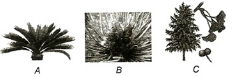
MediumMCQ
The correct names of gymnospermic plants $A, B$ and $C$ shown in the figure below are:
A
$A$-Cycas,$B$-Pinus,$C$-Ginkgo
B
$A$-Cycas,$B$-Ginkgo,$C$-Pinus
C
$A$-Ginkgo,$B$-Cycas,$C$-Pinus
D
$A$-Pinus,$B$-Cycas,$C$-Ginkgo
Solution
(A) Based on the standard $NCERT$ textbook diagrams for Gymnosperms:
$A$ represents $Cycas$,which is characterized by a palm-like appearance with a crown of pinnate leaves.
$B$ represents $Pinus$,which shows the typical coniferous,evergreen habit with needle-like leaves.
$C$ represents $Ginkgo$ (specifically $Ginkgo$ $biloba$),which is identified by its fan-shaped leaves.
Therefore,the correct sequence is $A$-Cycas,$B$-Pinus,$C$-Ginkgo.
$A$ represents $Cycas$,which is characterized by a palm-like appearance with a crown of pinnate leaves.
$B$ represents $Pinus$,which shows the typical coniferous,evergreen habit with needle-like leaves.
$C$ represents $Ginkgo$ (specifically $Ginkgo$ $biloba$),which is identified by its fan-shaped leaves.
Therefore,the correct sequence is $A$-Cycas,$B$-Pinus,$C$-Ginkgo.
0 likes
View Solution445
MediumMCQ
In gymnosperms,the microspores develop into a male gametophyte generation which:
A
Is highly reduced and confined to only a limited number of cells
B
Is highly developed
C
Has an independent life
D
Both $(a)$ and $(c)$
Solution
(A) In gymnosperms,microspores develop into a male gametophytic generation,which is highly reduced and is confined to only a limited number of cells.
This reduced gametophyte is known as a pollen grain.
Its development takes place within the microsporangia.
This reduced gametophyte is known as a pollen grain.
Its development takes place within the microsporangia.
0 likes
View Solution446
MediumMCQ
Consider the following statements regarding gymnosperms and choose the correct option.
$I.$ In gymnosperms,the male and female gametophytes have an independent existence.
$II.$ The multicellular female gametophyte is retained within the megasporangium.
$III.$ The gymnosperms are heterosporous.
Of these statements:
$I.$ In gymnosperms,the male and female gametophytes have an independent existence.
$II.$ The multicellular female gametophyte is retained within the megasporangium.
$III.$ The gymnosperms are heterosporous.
Of these statements:
A
$I$ and $II$ are true but $III$ is false
B
$I$ and $III$ are true but $II$ is false
C
$II$ and $III$ are false but $I$ is true
D
$II$ and $III$ are true but $I$ is false
Solution
(D) Statement $I$ is false because in gymnosperms,the male and female gametophytes do not have an independent free-living existence; they remain within the sporangia retained on the sporophytes.
Statement $II$ is true because the multicellular female gametophyte is retained within the megasporangium.
Statement $III$ is true because gymnosperms produce two kinds of spores,microspores and megaspores,making them heterosporous.
Therefore,statements $II$ and $III$ are true,while statement $I$ is false.
Statement $II$ is true because the multicellular female gametophyte is retained within the megasporangium.
Statement $III$ is true because gymnosperms produce two kinds of spores,microspores and megaspores,making them heterosporous.
Therefore,statements $II$ and $III$ are true,while statement $I$ is false.
0 likes
View Solution447
MediumMCQ
The first seeded plants are the
A
Bryophytes
B
Gymnosperms
C
Algae
D
Pteridophytes
Solution
(B) Gymnosperms are considered the first seeded plants in the evolutionary history of plants. Unlike Pteridophytes,which produce spores,Gymnosperms produce naked seeds that are not enclosed within an ovary.
0 likes
View Solution448
MediumMCQ
Gymnosperms have
A
Tap root system
B
Seeds enclosed within the fruit
C
Rhizoids
D
Branched stems always
Solution
(A) Gymnosperms are characterized by the presence of a tap root system. In some genera,like $Pinus$,the roots have a fungal association in the form of mycorrhiza,while in $Cycas$,specialized roots called coralloid roots are associated with $N_2$-fixing cyanobacteria.
0 likes
View Solution449
MediumMCQ
Which of the following has both the male and female cones on the same plant body?
A
Cycas
B
Ginkgo
C
Eucalyptus
D
Pinus
Solution
(D) In $Pinus$,both male and female cones are borne on the same plant body,which is why it is referred to as a monoecious plant.
In contrast,$Cycas$ is dioecious,meaning male and female cones are produced on separate plants.
In contrast,$Cycas$ is dioecious,meaning male and female cones are produced on separate plants.
0 likes
View SolutionPlant Kingdom — Gymnosperms (General) · Frequently Asked Questions
1Are these Plant Kingdom questions useful for JEE and NEET?
Yes. All questions in this section are mapped to JEE Main and NEET exam patterns. Previous year questions from JEE Main, NEET, GUJCET and state-level exams are included with full solutions.
2Can I switch to Hindi or Gujarati for these questions?
Yes. Use the language tabs in the hero section or the sidebar to view the same questions and solutions in English, Hindi or Gujarati.
3How do I generate a question paper from this subtopic?
Use the Vedclass Exam Paper Generator — select the chapter and subtopic, set difficulty, and generate Sets A, B, C, D automatically. First 3 chapters of every subject are free.
Vedclass Products
For Students
Vedclass Test Series
Mock tests in real JEE/NEET style with performance analysis. 5-day free trial.
Start Free TrialFor Teachers
Exam Paper Generator
Generate Set A/B/C/D papers from this chapter in 2 minutes. 3 chapters free.
Try FreeFor Institutes
Online Exam Module
Live online exams with unlimited students, 360° analytics & white-label branding.
See DemoFor Teachers & Institutes
Generate a Plant Kingdom Exam Paper in 2 Minutes
Select subtopic & difficulty — Sets A, B, C, D auto-generated with No Repeat logic.
First 3 chapters of every subject are free — no payment required.