
A English
Gymnosperms (General) Questions in English
Class 11 Biology · Plant Kingdom · Gymnosperms (General)
483+
Questions
English
Language
100%
With Solutions
Showing 50 of 483 questions in English
301
EasyMCQ
Assertion $(A)$: Gymnosperms lack true fruits.
Reason $(R)$: Gymnosperms lack an ovary.
Which option is correct for Assertion $(A)$ and Reason $(R)$?
Reason $(R)$: Gymnosperms lack an ovary.
Which option is correct for Assertion $(A)$ and Reason $(R)$?
A
$A$ and $R$ are both true,and $R$ is the correct explanation of $A$.
B
$A$ and $R$ are both true,but $R$ is not the correct explanation of $A$.
C
$A$ is true,but $R$ is false.
D
$A$ is false,but $R$ is true.
Solution
(A) In Gymnosperms,the ovules are not enclosed by any ovary wall and remain exposed both before and after fertilization.
Since fruits are developed from the ovary after fertilization,the absence of an ovary in Gymnosperms results in the absence of true fruits.
Therefore,both Assertion $(A)$ and Reason $(R)$ are true,and $R$ is the correct explanation of $A$.
Since fruits are developed from the ovary after fertilization,the absence of an ovary in Gymnosperms results in the absence of true fruits.
Therefore,both Assertion $(A)$ and Reason $(R)$ are true,and $R$ is the correct explanation of $A$.
0 likes
View Solution302
EasyMCQ
In which plant group are the sporophylls arranged on a central axis to form distinct compact structures called strobili or cones?
A
Angiosperms
B
Bryophytes
C
Pteridophytes
D
Gymnosperms
Solution
(D) In $Gymnosperms$,the sporophylls are spirally arranged along an axis to form lax or compact strobili or cones.
These structures are characteristic of the group $Gymnosperms$ (e.g.,$Pinus$).
$Angiosperms$ produce flowers,$Bryophytes$ lack true vascular tissues and cones,and while some $Pteridophytes$ (like $Selaginella$ and $Equisetum$) form strobili,the term is most characteristically associated with the reproductive morphology of $Gymnosperms$ in the context of general plant classification.
These structures are characteristic of the group $Gymnosperms$ (e.g.,$Pinus$).
$Angiosperms$ produce flowers,$Bryophytes$ lack true vascular tissues and cones,and while some $Pteridophytes$ (like $Selaginella$ and $Equisetum$) form strobili,the term is most characteristically associated with the reproductive morphology of $Gymnosperms$ in the context of general plant classification.
0 likes
View Solution303
MediumMCQ
Assertion $(A)$: $Pinus$ is known as a gymnosperm.
Reason $(R)$: $Pinus$ has naked ovules that are not enclosed by an ovary.
Reason $(R)$: $Pinus$ has naked ovules that are not enclosed by an ovary.
A
$A$ and $R$ are both true,and $R$ is the correct explanation of $A$.
B
$A$ and $R$ are both true,but $R$ is not the correct explanation of $A$.
C
$A$ is true,but $R$ is false.
D
$A$ is false,but $R$ is true.
Solution
(A) Gymnosperms are plants in which the ovules are not enclosed by any ovary wall and remain exposed,both before and after fertilization.
$Pinus$ belongs to the group Gymnosperms.
Since the ovules are naked (not enclosed by an ovary),the definition of gymnosperms is satisfied.
Therefore,both Assertion $(A)$ and Reason $(R)$ are true,and $R$ is the correct explanation of $A$.
$Pinus$ belongs to the group Gymnosperms.
Since the ovules are naked (not enclosed by an ovary),the definition of gymnosperms is satisfied.
Therefore,both Assertion $(A)$ and Reason $(R)$ are true,and $R$ is the correct explanation of $A$.
0 likes
View Solution304
EasyMCQ
Plants in which seeds are produced on megasporophylls and are not enclosed by fruits are included in which group?
A
Angiosperms
B
Bryophytes
C
Pteridophytes
D
Gymnosperms
Solution
(D) The plants in which the ovules are not enclosed by any ovary wall and remain exposed,both before and after fertilization,are known as Gymnosperms.
Since the seeds are not covered by fruits,they are called 'naked-seeded' plants.
These seeds develop on the surface of megasporophylls,which are arranged to form compact structures called strobili or cones.
Since the seeds are not covered by fruits,they are called 'naked-seeded' plants.
These seeds develop on the surface of megasporophylls,which are arranged to form compact structures called strobili or cones.
0 likes
View Solution305
MediumMCQ
Which phase is dominant in gymnosperms?
A
Gametophytic
B
Sporophytic
C
Both gametophytic and sporophytic
D
Isogametophytic
Solution
(B) In gymnosperms,the plant body is differentiated into roots,stems,and leaves. The main plant body is diploid and represents the sporophytic phase. The gametophytic phase is highly reduced and dependent on the sporophyte. Therefore,the sporophytic phase is the dominant phase in the life cycle of gymnosperms.
0 likes
View Solution306
EasyMCQ
In which group of plants is pollination exclusively carried out by wind?
A
Bryophytes
B
Pteridophytes
C
Gymnosperms
D
Angiosperms
Solution
(C) In $Gymnosperms$,the ovules are naked and not enclosed by any ovary wall. Pollination is exclusively carried out by wind $(anemophily)$. The pollen grains are released from the microsporangia and are carried by air currents to reach the opening of the ovules.
0 likes
View Solution307
MediumMCQ
Which group of plants is predominantly found in coniferous forests?
A
Bryophytes
B
Pteridophytes
C
Gymnosperms
D
Angiosperms
Solution
(C) Coniferous forests are characterized by the presence of cone-bearing trees,which belong to the group $Gymnosperms$. These plants are well-adapted to cold climates and are the dominant vegetation in such regions. Therefore,the correct option is $C$.
0 likes
View Solution308
MediumMCQ
In which of the following plants does the endosperm form before fertilization?
A
Bryophytes
B
Pteridophytes
C
Angiosperms
D
Gymnosperms
Solution
(D) In $Gymnosperms$, the endosperm is a haploid $(n)$ tissue formed as a result of the development of the female gametophyte. This process occurs before fertilization. In contrast, in $Angiosperms$, the endosperm is typically triploid $(3n)$ and is formed after fertilization through the process of double fertilization (specifically, the fusion of one male gamete with two polar nuclei, known as triple fusion).
0 likes
View Solution309
EasyMCQ
What is the approximate height of $Sequoia$?
A
$10,000 \ cm$
B
$15,000 \ cm$
C
$13,000 \ cm$
D
$17,400 \ cm$
Solution
(A) $Sequoia$ is a genus of redwood coniferous trees. It is one of the tallest tree species on Earth. The height of $Sequoia$ is approximately $100 \ m$ to $120 \ m$. Since $1 \ m = 100 \ cm$,the height in centimeters is $100 \ m \times 100 \ cm/m = 10,000 \ cm$ to $12,000 \ cm$. Among the given options,$10,000 \ cm$ is the most appropriate approximate value.
0 likes
View Solution310
MediumMCQ
Which plant has a sporophytic phase differentiated into root,stem,and leaves?
A
Bryophytes
B
Algae
C
Lichens
D
Gymnosperms
Solution
(D) In the plant kingdom,the sporophytic plant body is differentiated into true roots,stems,and leaves in Pteridophytes,Gymnosperms,and Angiosperms. Among the given options,Gymnosperms possess a well-differentiated sporophytic plant body. Bryophytes have a thalloid body,Algae lack true roots,stems,and leaves,and Lichens are a symbiotic association between algae and fungi,not a single plant group with such differentiation.
0 likes
View Solution311
EasyMCQ
To which division does $Zamia pygmaea$ belong?
A
Gymnosperms
B
Angiosperms
C
Monocots
D
Dicots
Solution
(A) $Zamia pygmaea$ is a species of cycad, which is a group of seed-producing plants.
Cycads belong to the division $Gymnospermae$ (Gymnosperms).
Gymnosperms are plants in which the ovules are not enclosed by any ovary wall and remain exposed both before and after fertilization.
Cycads belong to the division $Gymnospermae$ (Gymnosperms).
Gymnosperms are plants in which the ovules are not enclosed by any ovary wall and remain exposed both before and after fertilization.
0 likes
View Solution312
MediumMCQ
Which of the following describes the leaf type in Gymnosperms?
A
Simple leaf
B
Isophyllous
C
Dimorphic
D
Common leaf
Solution
(C) Gymnosperms are characterized by the presence of dimorphic leaves. In many gymnosperms,such as $Pinus$,the plant produces two types of leaves: foliage leaves (green,needle-like) and scale leaves (small,brown,and non-photosynthetic). This condition of having two distinct forms of leaves is known as dimorphism.
0 likes
View Solution313
EasyMCQ
Which of the following plants does not have seeds enclosed within an ovary?
A
Wheat
B
Cycas
C
Maize
D
Onion
Solution
(B) Plants that do not have seeds enclosed within an ovary are known as Gymnosperms.
In Gymnosperms,the ovules are not enclosed by any ovary wall and remain exposed both before and after fertilization.
Among the given options,Wheat,Maize,and Onion are Angiosperms (flowering plants) where seeds are enclosed within fruits (ovaries).
Cycas belongs to the group Gymnosperms,therefore its seeds are naked and not enclosed within an ovary.
In Gymnosperms,the ovules are not enclosed by any ovary wall and remain exposed both before and after fertilization.
Among the given options,Wheat,Maize,and Onion are Angiosperms (flowering plants) where seeds are enclosed within fruits (ovaries).
Cycas belongs to the group Gymnosperms,therefore its seeds are naked and not enclosed within an ovary.
0 likes
View Solution314
EasyMCQ
Which is the tallest tree in the world?
A
Sequoia pygmaea
B
Anthoceros
C
Sequoia sempervirens
D
Pygmaea zamia
Solution
(C) The tallest tree in the world is $Sequoia \text{ } sempervirens$, commonly known as the coast redwood. It belongs to the family $Cupressaceae$ and is a gymnosperm. These trees can reach heights of over $115 \text{ } m$.
0 likes
View Solution315
MediumMCQ
In which of the following plants does single fertilization occur?
A
Pinus
B
Equisetum
C
Maize
D
Anthoceros
Solution
(A) Single fertilization is a characteristic feature of Gymnosperms.
In Gymnosperms,the pollen tube releases male gametes into the archegonium,where one male gamete fuses with the egg cell to form a zygote.
Unlike Angiosperms,there is no double fertilization or triple fusion.
Among the given options,$Pinus$ is a Gymnosperm,while $Equisetum$ is a Pteridophyte,$Maize$ is an Angiosperm,and $Anthoceros$ is a Bryophyte.
Therefore,$Pinus$ exhibits single fertilization.
In Gymnosperms,the pollen tube releases male gametes into the archegonium,where one male gamete fuses with the egg cell to form a zygote.
Unlike Angiosperms,there is no double fertilization or triple fusion.
Among the given options,$Pinus$ is a Gymnosperm,while $Equisetum$ is a Pteridophyte,$Maize$ is an Angiosperm,and $Anthoceros$ is a Bryophyte.
Therefore,$Pinus$ exhibits single fertilization.
0 likes
View Solution316
MediumMCQ
In $Gymnosperms$ (specifically $Pinus$),which of the following statements correctly describes the foliage and scale leaves?
A
Foliage leaves are small and green,while scale leaves are large and brown.
B
Foliage leaves are large and green,while scale leaves are small and brown.
C
Foliage leaves are large and brown,while scale leaves are dry and brown.
D
Foliage leaves are small and brown,while scale leaves are large and green.
Solution
(B) In $Gymnosperms$ like $Pinus$,the stem bears two types of leaves:
$1$. $Foliage$ $leaves$: These are the needle-like,green,photosynthetic leaves that are relatively large and persistent.
$2$. $Scale$ $leaves$: These are small,thin,membranous,and brown-colored structures that protect the young buds.
Therefore,foliage leaves are large and green,while scale leaves are small and brown.
$1$. $Foliage$ $leaves$: These are the needle-like,green,photosynthetic leaves that are relatively large and persistent.
$2$. $Scale$ $leaves$: These are small,thin,membranous,and brown-colored structures that protect the young buds.
Therefore,foliage leaves are large and green,while scale leaves are small and brown.
0 likes
View Solution317
MediumMCQ
Plants in which seeds are produced on megasporophylls and are not enclosed by fruits are included in ........
A
Angiosperms
B
Bryophytes
C
Pteridophytes
D
Gymnosperms
Solution
(D) Gymnosperms are plants in which the ovules are not enclosed by any ovary wall and remain exposed,both before and after fertilization. The seeds that develop post-fertilization are not covered,i.e.,they are naked. These seeds are produced on the surface of megasporophylls (modified leaves). Therefore,the correct answer is Gymnosperms.
0 likes
View Solution318
EasyMCQ
The tallest living tree in the world is ........
A
Wolffia
B
Zamia
C
Sequoia
D
Anthoceros
Solution
(C) The tallest living tree species in the world is $Sequoia$ $sempervirens$,commonly known as the coast redwood. It belongs to the group of gymnosperms. $Wolffia$ is the smallest flowering plant,$Zamia$ is a small gymnosperm,and $Anthoceros$ is a bryophyte.
0 likes
View Solution319
EasyMCQ
Plants that bear open or naked seeds are known as ........
A
Thallophytes
B
Bryophytes
C
Pteridophytes
D
Gymnosperms
Solution
(D) Plants that produce naked seeds,meaning the seeds are not enclosed within an ovary or fruit,are classified as $Gymnosperms$. The term $Gymnosperm$ is derived from the Greek words $gymnos$ (naked) and $sperma$ (seed). Therefore,the correct option is $D$.
0 likes
View Solution320
EasyMCQ
Which gymnosperm possesses a subterranean tuberous stem?
A
Sequoia sempervirens
B
Cycas
C
Zamia pygmaea
D
Bennettites
Solution
(C) Zamia pygmaea is a species of cycad that is known for having a subterranean tuberous stem.
It is considered one of the smallest gymnosperms in the world.
Unlike many other gymnosperms that have tall,woody trunks,this plant remains largely underground,with only its leaves emerging above the soil surface.
It is considered one of the smallest gymnosperms in the world.
Unlike many other gymnosperms that have tall,woody trunks,this plant remains largely underground,with only its leaves emerging above the soil surface.
0 likes
View Solution321
MediumMCQ
Which plant group has a sporophytic phase differentiated into root, stem, and leaves?
A
Bryophytes
B
Thallophytes
C
Lichens
D
Gymnosperms
Solution
(D) The plant body of $Gymnosperms$ is a sporophyte, which is well-differentiated into true roots, stems, and leaves.
$Bryophytes$ (Option $A$) have a thalloid body and lack true roots, stems, and leaves.
$Thallophytes$ (Option $B$) have a simple, undifferentiated thallus body.
$Lichens$ (Option $C$) are a symbiotic association between algae and fungi and do not possess true roots, stems, or leaves.
Therefore, $Gymnosperms$ is the correct answer.
$Bryophytes$ (Option $A$) have a thalloid body and lack true roots, stems, and leaves.
$Thallophytes$ (Option $B$) have a simple, undifferentiated thallus body.
$Lichens$ (Option $C$) are a symbiotic association between algae and fungi and do not possess true roots, stems, or leaves.
Therefore, $Gymnosperms$ is the correct answer.
0 likes
View Solution322
MediumMCQ
Which of the following describes the leaf type in Gymnosperms?
A
Simple leaves
B
Compound leaves
C
Dimorphic leaves
D
Both simple and compound leaves
Solution
(D) In Gymnosperms,the leaves are well-adapted to withstand extreme temperature,humidity,and wind.
In conifers,needle-like leaves reduce the surface area.
The leaves in Gymnosperms can be simple or compound.
For example,in Cycas,the pinnate leaves persist for a few years.
Therefore,Gymnosperms exhibit both simple and compound leaf types.
In conifers,needle-like leaves reduce the surface area.
The leaves in Gymnosperms can be simple or compound.
For example,in Cycas,the pinnate leaves persist for a few years.
Therefore,Gymnosperms exhibit both simple and compound leaf types.
0 likes
View Solution323
MediumMCQ
Where are the megasporophylls located?
A
In male cones
B
In female cones
C
In megasporangia
D
In microsporangia
Solution
(B) In gymnosperms,the reproductive structures are organized into cones or strobili.
Male cones or male strobili bear microsporophylls,which contain microsporangia.
Female cones or female strobili bear megasporophylls,which contain ovules or megasporangia.
Therefore,megasporophylls are located in the female cones.
Male cones or male strobili bear microsporophylls,which contain microsporangia.
Female cones or female strobili bear megasporophylls,which contain ovules or megasporangia.
Therefore,megasporophylls are located in the female cones.
0 likes
View Solution324
EasyMCQ
In which plants does pollination occur exclusively through wind?
A
Bryophytes
B
Pteridophytes
C
Gymnosperms
D
Angiosperms
Solution
(C) Pollination is the process of transfer of pollen grains from the anther to the stigma of a pistil.
In $Gymnosperms$,the ovules are naked and not enclosed by any ovary wall.
Pollination in $Gymnosperms$ occurs exclusively through wind (anemophily).
In contrast,$Bryophytes$ and $Pteridophytes$ require water for fertilization (zooidogamy),and $Angiosperms$ exhibit a wide variety of pollination mechanisms including biotic (insects,birds,bats) and abiotic (wind,water) agents.
In $Gymnosperms$,the ovules are naked and not enclosed by any ovary wall.
Pollination in $Gymnosperms$ occurs exclusively through wind (anemophily).
In contrast,$Bryophytes$ and $Pteridophytes$ require water for fertilization (zooidogamy),and $Angiosperms$ exhibit a wide variety of pollination mechanisms including biotic (insects,birds,bats) and abiotic (wind,water) agents.
0 likes
View Solution325
MediumMCQ
In which plant group is the endosperm formed before fertilization (pre-fertilization)?
A
Angiosperms
B
Gymnosperms
C
Bryophytes
D
Pteridophytes
Solution
(B) In $Gymnosperms$, the endosperm is a haploid tissue formed by the development of the female gametophyte before fertilization. This is a characteristic feature of $Gymnosperms$. In contrast, in $Angiosperms$, the endosperm is formed after fertilization through the process of triple fusion (syngamy and vegetative fertilization), resulting in a triploid $(3n)$ tissue.
0 likes
View Solution326
MediumMCQ
Which of the following statements is $NOT$ consistent with gymnosperms?
A
The ovules are not enclosed by any ovary wall.
B
Male and female cones are arranged on the central axis.
C
They possess foliage leaves and scale leaves.
D
The sporophylls are homosporous.
Solution
(D) Gymnosperms are heterosporous plants,meaning they produce two types of spores: microspores and megaspores.
These spores are produced in microsporangia and megasporangia,which are borne on sporophylls (microsporophylls and megasporophylls).
Therefore,the statement that 'the sporophylls are homosporous' is incorrect and not consistent with the characteristics of gymnosperms.
Other options like the absence of an ovary wall (naked seeds),the presence of cones,and the existence of foliage and scale leaves are characteristic features of gymnosperms.
These spores are produced in microsporangia and megasporangia,which are borne on sporophylls (microsporophylls and megasporophylls).
Therefore,the statement that 'the sporophylls are homosporous' is incorrect and not consistent with the characteristics of gymnosperms.
Other options like the absence of an ovary wall (naked seeds),the presence of cones,and the existence of foliage and scale leaves are characteristic features of gymnosperms.
0 likes
View Solution327
MediumMCQ
Statement $S$: $Thuja$ is a pre-fertilization plant.
Statement $R$: In $Thuja$,the endosperm is formed after fertilization.
Statement $R$: In $Thuja$,the endosperm is formed after fertilization.
A
$S$ and $R$ are both true,and $R$ is the correct explanation of $S$.
B
$S$ and $R$ are both true,but $R$ is not the correct explanation of $S$.
C
$S$ is true and $R$ is false.
D
$S$ is false and $R$ is true.
Solution
(C) $Thuja$ belongs to the group Gymnosperms.
In Gymnosperms,the endosperm is a haploid tissue formed before fertilization by the process of megasporogenesis and subsequent development of the female gametophyte.
Therefore,statement $S$ is true because the development of the female gametophyte (which contains the endosperm) occurs before fertilization.
Statement $R$ is false because the endosperm in Gymnosperms is a pre-fertilization product,unlike in Angiosperms where it is formed after fertilization (post-fertilization) via triple fusion.
Thus,$S$ is true and $R$ is false.
In Gymnosperms,the endosperm is a haploid tissue formed before fertilization by the process of megasporogenesis and subsequent development of the female gametophyte.
Therefore,statement $S$ is true because the development of the female gametophyte (which contains the endosperm) occurs before fertilization.
Statement $R$ is false because the endosperm in Gymnosperms is a pre-fertilization product,unlike in Angiosperms where it is formed after fertilization (post-fertilization) via triple fusion.
Thus,$S$ is true and $R$ is false.
0 likes
View Solution328
MediumMCQ
In which of the following aspects do Gymnosperms differ from Angiosperms?
A
Endosperm formation occurs before fertilization.
B
Formation of pollen tube.
C
Formation of ovules.
D
None of these.
Solution
(A) In $Gymnosperms$,the endosperm is a haploid $(n)$ tissue formed before fertilization as a result of the development of the female gametophyte.
In contrast,in $Angiosperms$,the endosperm is a triploid $(3n)$ tissue formed after fertilization through the process of double fertilization (specifically,the fusion of one male gamete with two polar nuclei).
Therefore,the pre-fertilization formation of endosperm is a distinct characteristic that differentiates $Gymnosperms$ from $Angiosperms$.
In contrast,in $Angiosperms$,the endosperm is a triploid $(3n)$ tissue formed after fertilization through the process of double fertilization (specifically,the fusion of one male gamete with two polar nuclei).
Therefore,the pre-fertilization formation of endosperm is a distinct characteristic that differentiates $Gymnosperms$ from $Angiosperms$.
0 likes
View Solution329
EasyMCQ
Which is the tallest tree?
A
Sequoia
B
Cycas
C
Pinus
D
Araucaria
Solution
(A) The giant redwood tree,$Sequoia$ $sempervirens$,is known as the tallest tree species in the world.
It belongs to the group of gymnosperms.
These trees can reach heights of over $100 \ m$.
It belongs to the group of gymnosperms.
These trees can reach heights of over $100 \ m$.
0 likes
View Solution330
MediumMCQ
Identify the incorrect pair for Gymnosperms among the following:
A
Gymnosperms - Homosporous
B
Microsporangia - Stamen
C
Megasporangia - Pistil
D
Cone - Unisexual
Solution
(A) Gymnosperms are heterosporous,meaning they produce two types of spores: microspores and megaspores. Therefore,the statement 'Gymnosperms - Homosporous' is incorrect.
Microsporangia are associated with male structures (microsporophylls),and megasporangia are associated with female structures (megasporophylls).
Cones (strobili) in gymnosperms are typically unisexual,meaning male and female cones are separate.
Microsporangia are associated with male structures (microsporophylls),and megasporangia are associated with female structures (megasporophylls).
Cones (strobili) in gymnosperms are typically unisexual,meaning male and female cones are separate.
0 likes
View Solution331
EasyMCQ
Which of the following is a living fossil?
A
Pinus
B
Cycas
C
Selaginella
D
Metasequoia
Solution
(B) living fossil is an extant taxon that closely resembles related species known only from the fossil record.
Among the given options,$Cycas$ is widely recognized as a living fossil because it has remained morphologically unchanged for millions of years.
$Pinus$ is a common conifer,$Selaginella$ is a pteridophyte,and $Metasequoia$ is also a gymnosperm,but $Cycas$ is the most classic example of a living fossil among these choices.
Among the given options,$Cycas$ is widely recognized as a living fossil because it has remained morphologically unchanged for millions of years.
$Pinus$ is a common conifer,$Selaginella$ is a pteridophyte,and $Metasequoia$ is also a gymnosperm,but $Cycas$ is the most classic example of a living fossil among these choices.
0 likes
View Solution332
MediumMCQ
Where are plant species taller than $Eucalyptus$ found?
A
Australia
B
England
C
Canada
D
India
Solution
(C) $Eucalyptus$ is known as one of the tallest tree species in the world,often reaching heights of over $100 \ m$. However,the tallest living trees on Earth are the Coast Redwoods $(Sequoia \ sempervirens)$,which are found in the temperate rainforests of North America,specifically in California,$USA$. Since the options provided are countries,and $Sequoia$ species are native to North America,the question refers to the geographical distribution of such giant trees. Among the given choices,the context of such tall gymnosperms is historically associated with regions like North America,but if we strictly evaluate the options provided in the context of global biodiversity,the question is often framed to highlight that $Eucalyptus$ (an Angiosperm) is tall,but Gymnosperms like $Sequoia$ are taller. Since $Sequoia$ is not explicitly listed,we identify the region where such massive trees thrive.
0 likes
View Solution333
MediumMCQ
In which of the following is the gametophytic phase reduced,short-lived,and limited to the production of gametes?
A
Volvox
B
Spirogyra
C
Cycas
D
Riccia
Solution
(C) In $Cycas$ (a gymnosperm),the plant body is a sporophyte $(2n)$. The gametophytic phase is highly reduced and short-lived,consisting of only a few cells,and is entirely dependent on the sporophyte for nutrition and protection. It is limited to the production of gametes (pollen grains and ovules). In contrast,algae like $Volvox$ and $Spirogyra$ have a dominant gametophytic phase,and bryophytes like $Riccia$ also have a dominant gametophytic phase.
0 likes
View Solution334
EasyMCQ
In gymnosperms,pollination occurs by which of the following?
A
Water
B
Animals
C
Wind
D
Insects
Solution
(C) In gymnosperms,the ovules are not enclosed by any ovary wall and remain exposed both before and after fertilization. Pollination in gymnosperms is primarily anemophilous,which means it occurs through the agency of wind. The pollen grains are released from the microsporangia and are carried by air currents to the ovules.
0 likes
View Solution335
MediumMCQ
In which of the following aspects do Gymnosperms differ from Angiosperms?
A
Endosperm is formed before fertilization.
B
Formation of pollen tube.
C
Formation of ovules.
D
Formation of seeds.
Solution
(A) In Gymnosperms,the endosperm is a haploid $(n)$ tissue formed before fertilization as a result of the development of the female gametophyte.
In contrast,in Angiosperms,the endosperm is a triploid $(3n)$ tissue formed after fertilization through the process of double fertilization (specifically,the fusion of one male gamete with two polar nuclei).
Therefore,the pre-fertilization development of endosperm is a characteristic feature that distinguishes Gymnosperms from Angiosperms.
In contrast,in Angiosperms,the endosperm is a triploid $(3n)$ tissue formed after fertilization through the process of double fertilization (specifically,the fusion of one male gamete with two polar nuclei).
Therefore,the pre-fertilization development of endosperm is a characteristic feature that distinguishes Gymnosperms from Angiosperms.
0 likes
View Solution336
MediumMCQ
Which of the following statements is correct?
A
In Pinus,the endosperm is formed after fertilization.
B
Cycas lacks a false fruit.
C
In Thuja,the sporophylls are arranged in the form of cones on the central axis.
D
Araucaria is homosporous.
Solution
(C) In $Pinus$,the endosperm is haploid and formed before fertilization. $Cycas$ is a gymnosperm and does not produce true fruits,but the term 'false fruit' is typically associated with angiosperms. $Thuja$ belongs to the family Cupressaceae,where sporophylls are arranged in cones (strobili) on the central axis. $Araucaria$ is heterosporous,not homosporous. Therefore,the statement regarding $Thuja$ is correct.
0 likes
View Solution337
EasyMCQ
Statement $S$: $Sequoia$ $sempervirens$ is an example of an angiosperm.
Statement $R$: $Eucalyptus$ is the tallest tree in the world.
Statement $R$: $Eucalyptus$ is the tallest tree in the world.
A
$S$ and $R$ are both true,and $R$ is the correct explanation of $S$.
B
$S$ and $R$ are both true,but $R$ is not the correct explanation of $S$.
C
$S$ is true and $R$ is false.
D
$S$ and $R$ are both false.
Solution
(D) Statement $S$ is false because $Sequoia$ $sempervirens$ (Redwood) is a gymnosperm,not an angiosperm.
Statement $R$ is false because $Sequoia$ $sempervirens$ is considered one of the tallest trees in the world,while $Eucalyptus$ is a very tall angiosperm,but not the tallest tree overall.
Statement $R$ is false because $Sequoia$ $sempervirens$ is considered one of the tallest trees in the world,while $Eucalyptus$ is a very tall angiosperm,but not the tallest tree overall.
0 likes
View Solution338
EasyMCQ
What types of leaves are found in gymnosperms?
A
Simple
B
Scale
C
Needle-like
D
All of the above
Solution
(D) Gymnosperms are plants in which the ovules are not enclosed by any ovary wall and remain exposed both before and after fertilization.
In gymnosperms,the leaves are well-adapted to withstand extreme temperature,humidity,and wind.
They exhibit various forms of leaves:
$1$. Simple leaves: These are common in many species.
$2$. Scale leaves: These are small,reduced leaves often found on the stem.
$3$. Needle-like leaves: These are characteristic of conifers (e.g.,$Pinus$) to reduce surface area and minimize water loss.
Therefore,all the mentioned types of leaves are found in gymnosperms.
In gymnosperms,the leaves are well-adapted to withstand extreme temperature,humidity,and wind.
They exhibit various forms of leaves:
$1$. Simple leaves: These are common in many species.
$2$. Scale leaves: These are small,reduced leaves often found on the stem.
$3$. Needle-like leaves: These are characteristic of conifers (e.g.,$Pinus$) to reduce surface area and minimize water loss.
Therefore,all the mentioned types of leaves are found in gymnosperms.
0 likes
View Solution339
EasyMCQ
In which forms are gymnosperms found?
A
Shrubs
B
Trees
C
Climbers
D
Both $(A)$ and $(B)$
Solution
(D) Gymnosperms are plants in which the ovules are not enclosed by any ovary wall and remain exposed both before and after fertilization.
They include medium-sized trees or tall trees and shrubs.
They do not typically exhibit the climber habit.
Therefore,gymnosperms are found in the form of shrubs and trees.
They include medium-sized trees or tall trees and shrubs.
They do not typically exhibit the climber habit.
Therefore,gymnosperms are found in the form of shrubs and trees.
0 likes
View Solution340
EasyMCQ
What is the ploidy level of the gametophytic stage in gymnosperms?
A
Haploid
B
Diploid
C
Triploid
D
All $(A), (B)$ and $(C)$
Solution
(A) In gymnosperms,the plant body is a sporophyte,which is diploid $(2n)$.
The gametophytic stage is represented by the pollen grains (male gametophyte) and the embryo sac (female gametophyte).
Gametophytes are formed after meiosis,making them haploid $(n)$ in nature.
Therefore,the gametophytic stage in gymnosperms is haploid.
The gametophytic stage is represented by the pollen grains (male gametophyte) and the embryo sac (female gametophyte).
Gametophytes are formed after meiosis,making them haploid $(n)$ in nature.
Therefore,the gametophytic stage in gymnosperms is haploid.
0 likes
View Solution341
EasyMCQ
What is the dominant phase of gymnosperms?
A
Sporophyte
B
Gametophyte
C
Both $(A)$ and $(B)$
D
Heterosporous
Solution
(A) In gymnosperms,the plant body is differentiated into roots,stems,and leaves. The main plant body is the sporophyte,which is diploid $(2n)$. The gametophyte generation is highly reduced and dependent on the sporophyte. Therefore,the dominant phase in the life cycle of gymnosperms is the sporophyte.
0 likes
View Solution342
MediumMCQ
What is the ploidy level of the sporophytic phase in gymnosperms?
A
Haploid
B
Diploid
C
Triploid
D
All $(A), (B),$ and $(C)$
Solution
(B) In the life cycle of gymnosperms,the plant body represents the sporophyte generation. The sporophyte is the dominant phase and is diploid $(2n)$ in nature. It produces spores through meiosis,which then develop into the gametophytic generation. Therefore,the sporophytic phase is diploid.
0 likes
View Solution343
MediumMCQ
In gymnosperms,the sporophytic phase is represented by which of the following?
A
Plant body
B
Complete body
C
Thallus
D
None of these
Solution
(A) In gymnosperms,the plant body is differentiated into roots,stems,and leaves. This dominant,diploid,and independent phase is known as the sporophyte. Therefore,the sporophytic phase is represented by the plant body.
0 likes
View Solution344
EasyMCQ
The microsporophyll of a gymnosperm is homologous to which organ of an angiosperm?
A
Stamen
B
Stigma
C
Pollen grain
D
Pistil
Solution
(A) In gymnosperms,the male reproductive structure consists of microsporophylls,which bear microsporangia containing microspores.
In angiosperms,the male reproductive organ is the stamen,which consists of an anther (microsporangium) and a filament.
Therefore,the microsporophyll of a gymnosperm is homologous to the stamen of an angiosperm,as both are responsible for the production of microspores (pollen grains).
In angiosperms,the male reproductive organ is the stamen,which consists of an anther (microsporangium) and a filament.
Therefore,the microsporophyll of a gymnosperm is homologous to the stamen of an angiosperm,as both are responsible for the production of microspores (pollen grains).
0 likes
View Solution345
MediumMCQ
When is the endosperm formed in gymnosperms?
A
After fertilization
B
Along with fertilization
C
Before fertilization
D
All of the above
Solution
(C) In gymnosperms,the endosperm is a haploid $(n)$ tissue formed by the repeated division of the megaspore. This process occurs before fertilization. Unlike angiosperms,where the endosperm is formed after fertilization through triple fusion,the gymnosperm endosperm is a product of the female gametophyte and is independent of the fertilization process.
0 likes
View Solution346
EasyMCQ
What type of fertilization occurs in gymnosperms?
A
Single
B
Double
C
Both $(A)$ and $(B)$
D
Triple
Solution
(A) In gymnosperms,the fertilization process involves the fusion of one male gamete with the egg cell to form a zygote. This is known as single fertilization. Unlike angiosperms,gymnosperms do not exhibit double fertilization or triple fusion. Therefore,the correct answer is single fertilization.
0 likes
View Solution347
MediumMCQ
What is the nature of the ovule in gymnosperms?
A
Orthotropous
B
Hypogynous
C
Anatropous
D
Amphitropous
Solution
(A) In gymnosperms,the ovules are typically $orthotropous$ (also known as $atropous$).
In an $orthotropous$ ovule,the micropyle,chalaza,and funicle lie in a straight vertical line.
This is considered the most primitive type of ovule.
Therefore,the correct option is $A$.
In an $orthotropous$ ovule,the micropyle,chalaza,and funicle lie in a straight vertical line.
This is considered the most primitive type of ovule.
Therefore,the correct option is $A$.
0 likes
View Solution348
EasyMCQ
Identify the plant shown in the given figure.
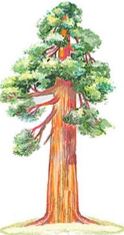
A
Zamia
B
Sequoia
C
Eucalyptus
D
Cycas
Solution
(B) The figure shows a giant redwood tree,which is scientifically known as $Sequoia$.
$Sequoia$ is one of the tallest tree species and belongs to the group of gymnosperms.
It is a characteristic example of a gymnosperm often cited in $NCERT$ biology textbooks.
$Sequoia$ is one of the tallest tree species and belongs to the group of gymnosperms.
It is a characteristic example of a gymnosperm often cited in $NCERT$ biology textbooks.
0 likes
View Solution349
EasyMCQ
What is the height of the plant shown in the given figure?
A
$150$ cm
B
$150$ feet
C
$150$ meters
D
$150$ kilometers
Solution
(C) The figure shows a giant redwood tree,known as Sequoia,which is one of the tallest tree species.
According to the $NCERT$ textbook,the giant redwood tree (Sequoia) can reach a height of up to $100$ to $120$ meters,and in some cases,it is often cited as reaching heights around $100$ meters or more.
Among the given options,$150$ meters is the most appropriate approximation for the height of such a massive gymnosperm.
According to the $NCERT$ textbook,the giant redwood tree (Sequoia) can reach a height of up to $100$ to $120$ meters,and in some cases,it is often cited as reaching heights around $100$ meters or more.
Among the given options,$150$ meters is the most appropriate approximation for the height of such a massive gymnosperm.
0 likes
View Solution350
MediumMCQ
Which plant is shown in the given figure?
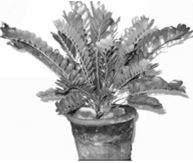
A
Sequoia
B
Zamia
C
Cycas
D
Pinus
Solution
(C) The figure shows a plant with pinnately compound leaves arranged in a crown-like structure,which is characteristic of the genus $Cycas$. $Cycas$ is a well-known gymnosperm often used as an ornamental plant. Therefore,the correct option is $C$.
0 likes
View SolutionPlant Kingdom — Gymnosperms (General) · Frequently Asked Questions
1Are these Plant Kingdom questions useful for JEE and NEET?
Yes. All questions in this section are mapped to JEE Main and NEET exam patterns. Previous year questions from JEE Main, NEET, GUJCET and state-level exams are included with full solutions.
2Can I switch to Hindi or Gujarati for these questions?
Yes. Use the language tabs in the hero section or the sidebar to view the same questions and solutions in English, Hindi or Gujarati.
3How do I generate a question paper from this subtopic?
Use the Vedclass Exam Paper Generator — select the chapter and subtopic, set difficulty, and generate Sets A, B, C, D automatically. First 3 chapters of every subject are free.
Vedclass Products
For Students
Vedclass Test Series
Mock tests in real JEE/NEET style with performance analysis. 5-day free trial.
Start Free TrialFor Teachers
Exam Paper Generator
Generate Set A/B/C/D papers from this chapter in 2 minutes. 3 chapters free.
Try FreeFor Institutes
Online Exam Module
Live online exams with unlimited students, 360° analytics & white-label branding.
See DemoFor Teachers & Institutes
Generate a Plant Kingdom Exam Paper in 2 Minutes
Select subtopic & difficulty — Sets A, B, C, D auto-generated with No Repeat logic.
First 3 chapters of every subject are free — no payment required.