
A English
Algae (General) Questions in English
Class 11 Biology · Plant Kingdom · Algae (General)
526+
Questions
English
Language
100%
With Solutions
Showing 50 of 526 questions in English
401
EasyMCQ
Floridean starch has a structure similar to:
A
Laminarin and cellulose
B
Starch and cellulose
C
Amylopectin and glycogen
D
Mannitol and algin
Solution
(C) Floridean starch is the stored food material found in Rhodophyceae (red algae).
Its chemical structure is very similar to amylopectin and glycogen,as it is a branched polysaccharide composed of glucose units linked by $\alpha-1,4$ and $\alpha-1,6$ glycosidic bonds.
Its chemical structure is very similar to amylopectin and glycogen,as it is a branched polysaccharide composed of glucose units linked by $\alpha-1,4$ and $\alpha-1,6$ glycosidic bonds.
0 likes
View Solution402
EasyMCQ
Which of the following pairs consists of unicellular algae?
A
Chlorella and Spirulina
B
Laminaria and Sargassum
C
Gelidium and Gracilaria
D
Anabaena and Volvox
Solution
(A) Chlorella is a unicellular green alga. Spirulina is a unicellular cyanobacterium (often referred to as blue-green algae). Both are widely used as food supplements due to their high protein content. In contrast,Laminaria and Sargassum are multicellular brown algae,Gelidium and Gracilaria are multicellular red algae,and while Volvox is a colonial green alga,Anabaena is a filamentous cyanobacterium.
0 likes
View Solution403
EasyMCQ
The structure of Floridean starch is similar to:
A
Starch and cellulose
B
Amylopectin and glycogen
C
Mannitol and algin
D
Laminarin and cellulose
Solution
(B) Floridean starch is the stored food material found in Red Algae (Rhodophyceae).
Its structure is very similar to amylopectin and glycogen,as it is a branched polysaccharide composed of glucose units.
Therefore,the correct option is $B$.
Its structure is very similar to amylopectin and glycogen,as it is a branched polysaccharide composed of glucose units.
Therefore,the correct option is $B$.
0 likes
View Solution404
MediumMCQ
Which of the following pairs represents unicellular algae?
A
Laminaria and Sargassum
B
Chlorella and Spirulina
C
Anabaena and Volvox
D
Gelidium and Gracilaria
Solution
(B) Unicellular algae are organisms that consist of a single cell.
$Chlorella$ is a well-known unicellular green alga.
$Spirulina$ is a unicellular cyanobacterium (often studied under algae in general contexts due to its photosynthetic nature).
$Laminaria$ and $Sargassum$ are multicellular brown algae.
$Volvox$ is a colonial alga.
$Gelidium$ and $Gracilaria$ are multicellular red algae.
Therefore,the correct pair is $Chlorella$ and $Spirulina$.
$Chlorella$ is a well-known unicellular green alga.
$Spirulina$ is a unicellular cyanobacterium (often studied under algae in general contexts due to its photosynthetic nature).
$Laminaria$ and $Sargassum$ are multicellular brown algae.
$Volvox$ is a colonial alga.
$Gelidium$ and $Gracilaria$ are multicellular red algae.
Therefore,the correct pair is $Chlorella$ and $Spirulina$.
0 likes
View Solution405
EasyMCQ
In which of the following organisms are isogametes produced?
A
Most animals
B
Gymnosperms
C
Algae
D
Angiosperms
Solution
(C) Isogametes are gametes that are morphologically and physiologically similar,making it impossible to distinguish them as male or female.
In many species of algae,such as $Cladophora$ and $Ulothrix$,the gametes produced are isogametes.
Most animals,gymnosperms,and angiosperms typically produce heterogametes,where male and female gametes are distinct in size and structure.
In many species of algae,such as $Cladophora$ and $Ulothrix$,the gametes produced are isogametes.
Most animals,gymnosperms,and angiosperms typically produce heterogametes,where male and female gametes are distinct in size and structure.
0 likes
View Solution406
MediumMCQ
Which of the following types of algae is most likely to be found in the deepest waters?
A
Red algae
B
Green algae
C
Brown algae
D
All of the above
Solution
(A) Red algae (Rhodophyceae) contain the pigment phycoerythrin,which allows them to absorb blue light. Blue light penetrates the deepest into the water column compared to other wavelengths of light. Therefore,red algae are capable of performing photosynthesis at greater depths than green or brown algae.
0 likes
View Solution407
EasyMCQ
Phycoerythrin is the major pigment in
A
Brown algae
B
Red algae
C
Blue green algae
D
Green algae
Solution
(B) Phycoerythrin is a red-colored accessory pigment found in Rhodophyceae,commonly known as red algae. It masks the green color of chlorophyll $a$ and gives these algae their characteristic red appearance.
0 likes
View Solution408
MediumMCQ
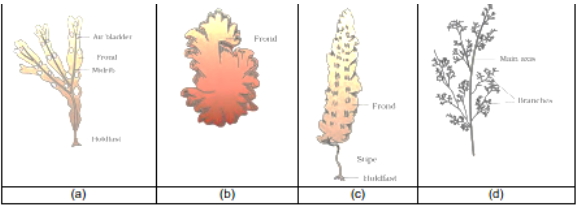
Identify the algae shown in the given diagrams $(a)$,$(b)$,$(c)$,and $(d)$.
A
$(a)$ - Laminaria,$(b)$ - Porphyra,$(c)$ - Fucus,$(d)$ - Polysiphonia
B
$(a)$ - Polysiphonia,$(b)$ - Laminaria,$(c)$ - Porphyra,$(d)$ - Fucus
C
$(a)$ - Fucus,$(b)$ - Porphyra,$(c)$ - Laminaria,$(d)$ - Polysiphonia
D
$(a)$ - Fucus,$(b)$ - Laminaria,$(c)$ - Porphyra,$(d)$ - Polysiphonia
Solution
(C) Based on the provided diagrams from the $NCERT$ textbook:
$(a)$ represents $Fucus$,which is a brown alga characterized by air bladders,a midrib,and a holdfast.
$(b)$ represents $Porphyra$,which is a red alga.
$(c)$ represents $Laminaria$,which is a brown alga showing a distinct frond,stipe,and holdfast.
$(d)$ represents $Polysiphonia$,which is a red alga showing a filamentous,branched structure.
Therefore,the correct sequence is $(a)$ - $Fucus$,$(b)$ - $Porphyra$,$(c)$ - $Laminaria$,$(d)$ - $Polysiphonia$.
$(a)$ represents $Fucus$,which is a brown alga characterized by air bladders,a midrib,and a holdfast.
$(b)$ represents $Porphyra$,which is a red alga.
$(c)$ represents $Laminaria$,which is a brown alga showing a distinct frond,stipe,and holdfast.
$(d)$ represents $Polysiphonia$,which is a red alga showing a filamentous,branched structure.
Therefore,the correct sequence is $(a)$ - $Fucus$,$(b)$ - $Porphyra$,$(c)$ - $Laminaria$,$(d)$ - $Polysiphonia$.
0 likes
View Solution409
MediumMCQ
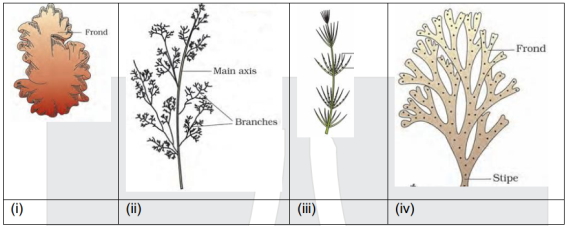
Identify the diagrams shown below:
A
$(i)$ - Porphyra,$(ii)$ - Polysiphonia,$(iii)$ - Chara,$(iv)$ - Dictyota
B
$(i)$ - Polysiphonia,$(ii)$ - Porphyra,$(iii)$ - Chara,$(iv)$ - Ectocarpus
C
$(i)$ - Laminaria,$(ii)$ - Polysiphonia,$(iii)$ - Chlamydomonas,$(iv)$ - Fucus
D
$(i)$ - Dictyota,$(ii)$ - Polysiphonia,$(iii)$ - Chara,$(iv)$ - Porphyra
Solution
(A) Based on the provided diagrams from the $NCERT$ textbook:
$(i)$ represents $Porphyra$,which is a red alga with a leafy thallus.
$(ii)$ represents $Polysiphonia$,which is a filamentous red alga.
$(iii)$ represents $Chara$,a green alga that shows a complex,plant-like structure.
$(iv)$ represents $Dictyota$,a brown alga characterized by a flattened,dichotomously branched thallus.
Therefore,the correct sequence is $(i) - Porphyra, (ii) - Polysiphonia, (iii) - Chara, (iv) - Dictyota$.
$(i)$ represents $Porphyra$,which is a red alga with a leafy thallus.
$(ii)$ represents $Polysiphonia$,which is a filamentous red alga.
$(iii)$ represents $Chara$,a green alga that shows a complex,plant-like structure.
$(iv)$ represents $Dictyota$,a brown alga characterized by a flattened,dichotomously branched thallus.
Therefore,the correct sequence is $(i) - Porphyra, (ii) - Polysiphonia, (iii) - Chara, (iv) - Dictyota$.
0 likes
View Solution410
EasyMCQ
Seaweeds are an important source of
A
Chlorine
B
Fluorine
C
Iodine
D
All of these
Solution
(C) Seaweeds,particularly members of brown algae known as kelps,are a rich and primary source of iodine. Examples include genera such as $Laminaria$,$Macrocystis$,and $Fucus$.
0 likes
View Solution411
MediumMCQ
In brown algae,the brown colour is due to the presence of:
A
Carotenoids
B
Fucoxanthin
C
Phycoerythrin
D
Chlorophyll
Solution
(B) Brown algae (Phaeophyceae) vary in colour from olive green to various shades of brown depending upon the amount of the xanthophyll pigment,$Fucoxanthin$,present in them. $Fucoxanthin$ is the dominant accessory pigment that masks the green colour of chlorophyll $a$ and $c$.
0 likes
View Solution412
MediumMCQ
Green algae contain:
A
Chlorophyll-$a$ and $b$
B
Starch
C
Carotenoids
D
All of these
Solution
(D) Green algae (Chlorophyceae) contain chlorophyll-$a$ and chlorophyll-$b$ as the primary photosynthetic pigments.
They also contain carotenoids,which are accessory pigments.
These pigments are located in the grana of the chloroplast,similar to land plants.
Additionally,the reserve food material in green algae is stored in the form of starch.
They also contain carotenoids,which are accessory pigments.
These pigments are located in the grana of the chloroplast,similar to land plants.
Additionally,the reserve food material in green algae is stored in the form of starch.
0 likes
View Solution413
EasyMCQ
The red colour of 'Red Sea' is due to which of the following algae?
A
Chlamydomonas
B
Anabaena
C
Microcystis
D
Trichodesmium
Solution
(D) The 'Red Sea' gets its characteristic red colour due to the presence of a cyanobacterium (blue-green algae) known as $Trichodesmium$ $erythreum$. This organism contains a red pigment that blooms in the water,giving it a reddish appearance.
0 likes
View Solution414
MediumMCQ
Floridean starch is the reserve food material in which of the following?
A
Rhodophyceae
B
Phaeophyceae
C
Chlorophyceae
D
Xanthophyceae
Solution
(A) The reserve food material in different classes of algae is as follows:
$1$. Rhodophyceae (Red algae): Floridean starch.
$2$. Phaeophyceae (Brown algae): Laminarin and mannitol.
$3$. Chlorophyceae (Green algae): Starch.
Therefore,floridean starch is the characteristic reserve food material of Rhodophyceae.
$1$. Rhodophyceae (Red algae): Floridean starch.
$2$. Phaeophyceae (Brown algae): Laminarin and mannitol.
$3$. Chlorophyceae (Green algae): Starch.
Therefore,floridean starch is the characteristic reserve food material of Rhodophyceae.
0 likes
View Solution415
MediumMCQ
Which of the following is an incorrect characteristic of brown algae?
A
Chlorophyll-$a$ and $b$ are present
B
They remain attached to the substratum
C
Chlorophyll-$a$ and $c$ are present
D
Presence of fucoxanthin
Solution
(A) Brown algae (Phaeophyceae) contain chlorophyll-$a$,chlorophyll-$c$,carotenoids,and xanthophylls.
Fucoxanthin is the specific xanthophyll pigment responsible for the brown color in these algae.
Chlorophyll-$b$ is absent in brown algae; it is a characteristic pigment of green algae (Chlorophyceae).
Therefore,the statement that chlorophyll-$a$ and $b$ are present in brown algae is incorrect.
Fucoxanthin is the specific xanthophyll pigment responsible for the brown color in these algae.
Chlorophyll-$b$ is absent in brown algae; it is a characteristic pigment of green algae (Chlorophyceae).
Therefore,the statement that chlorophyll-$a$ and $b$ are present in brown algae is incorrect.
0 likes
View Solution416
MediumMCQ
$Acetabularia$ is a:
A
Single-celled marine green alga
B
Multicelled marine green alga
C
Single-celled freshwater green alga
D
Multicelled freshwater green alga
Solution
(A) $Acetabularia$ is a genus of single-celled marine green algae belonging to the class $Chlorophyceae$.
It is famous for its large size and for being a model organism in cell biology experiments,particularly those conducted by Joachim $H$ämmerling to demonstrate the role of the nucleus in controlling cellular morphogenesis.
It is famous for its large size and for being a model organism in cell biology experiments,particularly those conducted by Joachim $H$ämmerling to demonstrate the role of the nucleus in controlling cellular morphogenesis.
0 likes
View Solution417
MediumMCQ
The algae used in space research is
A
Cephaleuros
B
Gelidium
C
Chlorella
D
Gracilaria
Solution
(C) $Chlorella$ is a unicellular green alga that is used in space research for oxygen regeneration and air purification. It consumes carbon dioxide produced by astronauts and releases oxygen through photosynthesis,making it ideal for closed-loop life support systems in space ships.
0 likes
View Solution418
EasyMCQ
Which of the following is known as pond silk?
A
Spirogyra
B
Ulothrix
C
Nostoc
D
Anabaena
Solution
(A) The cells of $Spirogyra$ are longer than their breadth. The cell wall is two-layered. The inner wall is made up of cellulose and the outer of pectose. When pectose comes in contact with water,it makes the filament slimy or slippery. Hence,this alga is commonly called pond silk.
0 likes
View Solution419
MediumMCQ
Storage bodies,pyrenoids in the chloroplast contain
A
Protein and starch
B
Carbohydrate and protein
C
Polysaccharide and protein
D
Starch and lipid
Solution
(A) Green algae store food in the form of starch in specialized structures called pyrenoids located in the chloroplast.
Each pyrenoid consists of a central protein core and a surrounding starch sheath.
Each pyrenoid consists of a central protein core and a surrounding starch sheath.
0 likes
View Solution420
MediumMCQ
Kelp (branched form) and Sargassum (filamentous form) belong to:
A
Green algae
B
Brown algae
C
Red algae
D
Blue-green algae
Solution
(B) Brown algae (Phaeophyceae) show great variation in size and form.
They range from simple branched,filamentous forms (e.g.,Ectocarpus) to profusely branched forms as represented by kelps,which may reach a height of $100 \, m$.
Sargassum is a well-known genus of brown algae.
The giant brown algae are called kelps.
Therefore,both Kelp and Sargassum belong to the class Phaeophyceae,commonly known as brown algae.
They range from simple branched,filamentous forms (e.g.,Ectocarpus) to profusely branched forms as represented by kelps,which may reach a height of $100 \, m$.
Sargassum is a well-known genus of brown algae.
The giant brown algae are called kelps.
Therefore,both Kelp and Sargassum belong to the class Phaeophyceae,commonly known as brown algae.
0 likes
View Solution421
MediumMCQ
Agar-agar is obtained from
A
Chlorella
B
Spirogyra
C
Ulothrix
D
Gelidium
Solution
(D) Agar-agar is a gelatinous substance obtained from certain species of red algae (Rhodophyceae),primarily $Gelidium$ and $Gracilaria$.
These algae are commercially important because they produce agar,which is widely used in laboratories as a culture medium for growing microorganisms and in the food industry for thickening and stabilizing products.
These algae are commercially important because they produce agar,which is widely used in laboratories as a culture medium for growing microorganisms and in the food industry for thickening and stabilizing products.
0 likes
View Solution422
MediumMCQ
Fusion of morphologically dissimilar gametes,which may be motile or non-motile is known as:
A
Oogamy
B
Isogamy
C
Anisogamy
D
Zoogamy
Solution
(C) The fusion of morphologically dissimilar gametes,which may be motile or non-motile,is called $ANISOGAMY$.
In $OOGAMY$,there is a fusion of dissimilar gametes where the female gamete is usually larger and non-motile,while the male gamete is smaller and motile.
In $ISOGAMY$,there is a fusion of morphologically similar gametes (motile or non-motile).
Therefore,the correct term for the fusion of morphologically dissimilar gametes is $ANISOGAMY$.
In $OOGAMY$,there is a fusion of dissimilar gametes where the female gamete is usually larger and non-motile,while the male gamete is smaller and motile.
In $ISOGAMY$,there is a fusion of morphologically similar gametes (motile or non-motile).
Therefore,the correct term for the fusion of morphologically dissimilar gametes is $ANISOGAMY$.
0 likes
View Solution423
MediumMCQ
$Chlamydomonas$,$Volvox$,$Ulothrix$,$Spirogyra$ and $Chara$ are examples of:
A
Class-$Chlorophyceae$ (green algae)
B
Class-$Phaeophyceae$ (brown algae)
C
Class-$Rhodophyceae$ (red algae)
D
Class-$Cyanophyceae$ (blue-green algae) and $Chlorophyceae$
Solution
(A) $Chlamydomonas$,$Volvox$,$Ulothrix$,$Spirogyra$,and $Chara$ are well-known examples of the class-$Chlorophyceae$,commonly referred to as green algae.
These organisms possess chlorophyll $a$ and $b$ as their primary photosynthetic pigments,which gives them their characteristic green color.
These organisms possess chlorophyll $a$ and $b$ as their primary photosynthetic pigments,which gives them their characteristic green color.
0 likes
View Solution424
MediumMCQ
In algae,sexual reproduction takes place through the fusion of two
A
Spores
B
Fragments
C
Gametes
D
Zoospores
Solution
(C) Sexual reproduction involves the formation of gametes and their fusion during the process called fertilisation.
Depending upon the structure and behavior of gametes,there are different types of sexual reproduction:
$(i)$ Isogamy: Fusion of morphologically alike gametes which look and behave similarly.
$(ii)$ Anisogamy: Fusion of morphologically dissimilar gametes,which may be motile or non-motile.
$(iii)$ Oogamy: Fusion of a large non-motile egg or ovum with a smaller motile sperm (except in Rhodophyceae).
Since all these processes involve the fusion of gametes,the correct answer is Gametes.
Depending upon the structure and behavior of gametes,there are different types of sexual reproduction:
$(i)$ Isogamy: Fusion of morphologically alike gametes which look and behave similarly.
$(ii)$ Anisogamy: Fusion of morphologically dissimilar gametes,which may be motile or non-motile.
$(iii)$ Oogamy: Fusion of a large non-motile egg or ovum with a smaller motile sperm (except in Rhodophyceae).
Since all these processes involve the fusion of gametes,the correct answer is Gametes.
0 likes
View Solution425
MediumMCQ
The body structure of green algae may be
A
Colonial
B
Unicellular
C
Filamentous
D
All of these
Solution
(D) Members of the class $Chlorophyceae$,commonly known as green algae,exhibit a diverse range of body structures. They can be unicellular (e.g.,$Chlamydomonas$),colonial (e.g.,$Volvox$),or filamentous (e.g.,$Ulothrix$ and $Spirogyra$). Therefore,all the given options are correct.
0 likes
View Solution426
MediumMCQ
From which of the following algae,agar-agar is commercially extracted?
$I.$ Gracilaria $II.$ Fucus $III.$ Sargassum $IV.$ Gelidium $V.$ Turbinaria
$I.$ Gracilaria $II.$ Fucus $III.$ Sargassum $IV.$ Gelidium $V.$ Turbinaria
A
$III$ and $V$
B
$II$ and $III$
C
$IV$ and $V$
D
$I$ and $IV$
Solution
(D) Agar-agar is a gelatinous substance commercially extracted from red algae,specifically $Gelidium$ and $Gracilaria$.
It is widely used in laboratories for solidifying culture media.
Additionally,it serves as a stabilizer or thickener in the food industry for products like jellies,puddings,creams,cheese,and bakery items.
It is widely used in laboratories for solidifying culture media.
Additionally,it serves as a stabilizer or thickener in the food industry for products like jellies,puddings,creams,cheese,and bakery items.
0 likes
View Solution427
MediumMCQ
In algae,asexual reproduction occurs by the production of different types of spores. The most common type of spore is
A
Aplanospore
B
Endospore
C
Zoospore
D
Oospore
Solution
(C) Algae reproduce asexually by the production of different types of spores.
The most common type of spore is the $Zoospore$.
$Zoospores$ are motile,flagellated structures that germinate to give rise to a new plant body.
The most common type of spore is the $Zoospore$.
$Zoospores$ are motile,flagellated structures that germinate to give rise to a new plant body.
0 likes
View Solution428
MediumMCQ
Haplontic life cycle is followed by:
A
Algae
B
Bryophytes
C
Gymnosperms
D
Pteridophytes
Solution
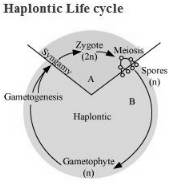
(A) In a haplontic life cycle,the dominant,photosynthetic phase is the free-living gametophyte $(n)$.
The zygote $(2n)$ is the only diploid stage,which undergoes meiosis to produce haploid spores $(n)$.
These spores divide mitotically to form the gametophyte.
This type of life cycle is characteristic of many algae,such as $Volvox$ and $Spirogyra$,and some species of $Chlamydomonas$.
The zygote $(2n)$ is the only diploid stage,which undergoes meiosis to produce haploid spores $(n)$.
These spores divide mitotically to form the gametophyte.
This type of life cycle is characteristic of many algae,such as $Volvox$ and $Spirogyra$,and some species of $Chlamydomonas$.
0 likes
View Solution429
EasyMCQ
Carrageenin,a jelly-like substance,is obtained from:
A
Chondrus
B
Fucus
C
Sargassum
D
Ulothrix
Solution
(A) Carrageenin is a phycocolloid,which is a polysaccharide extracted from the cell walls of certain red algae (Rhodophyceae).
Specifically,it is commercially obtained from the red alga known as $Chondrus$ $crispus$,commonly referred to as Irish moss.
Specifically,it is commercially obtained from the red alga known as $Chondrus$ $crispus$,commonly referred to as Irish moss.
0 likes
View Solution430
MediumMCQ
Laminarin and mannitol of class-$Phaeophyceae$ (brown algae) are:
A
Proteins
B
Complex carbohydrates
C
Lipoproteins
D
Fat
Solution
(B) In class-$Phaeophyceae$ (brown algae),the food is stored as complex carbohydrates,in the forms of laminarin or mannitol.
Laminarin is a polysaccharide (a type of carbohydrate),and mannitol is a sugar alcohol derived from mannose.
Laminarin is a polysaccharide (a type of carbohydrate),and mannitol is a sugar alcohol derived from mannose.
0 likes
View Solution431
MediumMCQ
In which of the following,all listed genera belong to the same class of algae?
A
Chara,Fucus,Polysiphonia
B
Volvox,Spirogyra,Chlamydomonas
C
Porphyra,Ectocarpus,Ulothrix
D
Sargassum,Laminaria,Gracillaria
Solution
(B) $Volvox$,$Spirogyra$,and $Chlamydomonas$ are all green algae belonging to the class $Chlorophyceae$.
0 likes
View Solution432
MediumMCQ
Algae include unicellular forms like $A$,filamentous forms like $B$,and colonial forms like $C$. Here $A, B$,and $C$ refer to:
A
$A-Chlamydomonas, B-Volvox, C-Ulothrix$
B
$A-Ulothrix, B-Volvox, C-Chlamydomonas$
C
$A-Volvox, B-Ulothrix, C-Chlamydomonas$
D
$A-Chlamydomonas, B-Ulothrix, C-Volvox$
Solution
(D) Algae exhibit a wide range of body forms.
$1$. Unicellular forms: These are single-celled organisms,for example,$Chlamydomonas$.
$2$. Filamentous forms: These consist of cells arranged in a thread-like structure,for example,$Ulothrix$ and $Spirogyra$.
$3$. Colonial forms: These consist of groups of individuals living together in a colony,for example,$Volvox$.
Therefore,$A$ refers to $Chlamydomonas$,$B$ refers to $Ulothrix$,and $C$ refers to $Volvox$.
$1$. Unicellular forms: These are single-celled organisms,for example,$Chlamydomonas$.
$2$. Filamentous forms: These consist of cells arranged in a thread-like structure,for example,$Ulothrix$ and $Spirogyra$.
$3$. Colonial forms: These consist of groups of individuals living together in a colony,for example,$Volvox$.
Therefore,$A$ refers to $Chlamydomonas$,$B$ refers to $Ulothrix$,and $C$ refers to $Volvox$.
0 likes
View Solution433
EasyMCQ
Calcium encrustation and larvicidal properties are present in
A
Chara
B
Oscillatoria
C
Diatoms
D
Caulerpa
Solution
(A) $Chara$ is a green alga that belongs to the class $Charophyceae$. It is known for its characteristic calcium carbonate deposits on its surface,which is referred to as calcium encrustation. Additionally,$Chara$ is known to possess larvicidal properties,meaning it can kill mosquito larvae,and is often used in biological control to reduce mosquito populations in stagnant water bodies.
0 likes
View Solution434
MediumMCQ
Consider the following statements:
$I$. They reproduce asexually by non-motile spores and sexually by non-motile gametes.
$II$. In this class,sexual reproduction is oogamous and accompanied by complex post-fertilisation developments.
$III$. The common members are $Polysiphonia$,$Porphyra$,$Gracilaria$ and $Gelidium$.
The above characteristics belong to which class of algae?
$I$. They reproduce asexually by non-motile spores and sexually by non-motile gametes.
$II$. In this class,sexual reproduction is oogamous and accompanied by complex post-fertilisation developments.
$III$. The common members are $Polysiphonia$,$Porphyra$,$Gracilaria$ and $Gelidium$.
The above characteristics belong to which class of algae?
A
Chlorophyceae
B
Phaeophyceae
C
Both $(a)$ and $(b)$
D
Rhodophyceae
Solution
(D) The given characteristics describe the class $Rhodophyceae$ (Red Algae).
$1$. $Rhodophyceae$ members reproduce asexually by non-motile spores and sexually by non-motile gametes.
$2$. Sexual reproduction is oogamous,and it is characterized by complex post-fertilization developments.
$3$. Common examples of this class include $Polysiphonia$,$Porphyra$,$Gracilaria$,and $Gelidium$.
$1$. $Rhodophyceae$ members reproduce asexually by non-motile spores and sexually by non-motile gametes.
$2$. Sexual reproduction is oogamous,and it is characterized by complex post-fertilization developments.
$3$. Common examples of this class include $Polysiphonia$,$Porphyra$,$Gracilaria$,and $Gelidium$.
0 likes
View Solution435
MediumMCQ
Oogamous means:
A
Fusion between female and male gametes. Both are similar in size.
B
Fusion between one large female gamete and a smaller non-motile male gamete.
C
Fusion between one large female gamete and a smaller motile male gamete.
D
Fusion between one smaller female gamete and a large motile male gamete.
Solution
(C) Oogamy is a form of sexual reproduction involving the fusion of a large,non-motile female gamete (egg or ovum) with a smaller,motile male gamete (sperm).
These gametes differ both morphologically and physiologically.
This process is observed in various algae such as $Chlamydomonas$,$Fucus$,$Chara$,and $Volvox$.
These gametes differ both morphologically and physiologically.
This process is observed in various algae such as $Chlamydomonas$,$Fucus$,$Chara$,and $Volvox$.
0 likes
View Solution436
MediumMCQ
Consider the following statements:
$I.$ In red algae,vegetative reproduction takes place by fragmentation.
$II.$ In red algae,the food is stored as floridean starch,which is very similar to amylopectin and glycogen in structure.
$III.$ The cell wall of red algae consists of chitin.
Which of the statements given above are correct?
$I.$ In red algae,vegetative reproduction takes place by fragmentation.
$II.$ In red algae,the food is stored as floridean starch,which is very similar to amylopectin and glycogen in structure.
$III.$ The cell wall of red algae consists of chitin.
Which of the statements given above are correct?
A
$I$ and $II$
B
$I$ and $III$
C
$II$ and $III$
D
All of these
Solution
(A) Statement $I$ is correct: In red algae (Rhodophyceae),vegetative reproduction occurs primarily through fragmentation.
Statement $II$ is correct: The stored food material in red algae is floridean starch,which is structurally very similar to amylopectin and glycogen.
Statement $III$ is incorrect: The cell wall of red algae is composed of cellulose,pectic compounds,and phycocolloids (such as agar and carrageenan),not chitin. Chitin is typically found in the cell walls of fungi.
Therefore,statements $I$ and $II$ are correct.
Statement $II$ is correct: The stored food material in red algae is floridean starch,which is structurally very similar to amylopectin and glycogen.
Statement $III$ is incorrect: The cell wall of red algae is composed of cellulose,pectic compounds,and phycocolloids (such as agar and carrageenan),not chitin. Chitin is typically found in the cell walls of fungi.
Therefore,statements $I$ and $II$ are correct.
0 likes
View Solution437
MediumMCQ
Read carefully the given statements about algae and choose the correct option.
$I$. The plant body is thalloid.
$II$. Mainly aquatic.
$III$. Reproduction takes place by vegetative,asexual,and sexual methods.
$IV$. Volvox and Ulothrix are the colonial forms of algae.
$I$. The plant body is thalloid.
$II$. Mainly aquatic.
$III$. Reproduction takes place by vegetative,asexual,and sexual methods.
$IV$. Volvox and Ulothrix are the colonial forms of algae.
A
$I, II$ and $III$
B
$II, III$ and $IV$
C
$I, III$ and $IV$
D
$I, II, III$ and $IV$
Solution
(A) Algae are chlorophyll-bearing,simple,thalloid,autotrophic,and largely aquatic organisms.
Statement $I$ is correct: The plant body of algae is thalloid,meaning it is not differentiated into roots,stems,and leaves.
Statement $II$ is correct: Most algae are aquatic (both fresh water and marine).
Statement $III$ is correct: Algae reproduce by vegetative (fragmentation),asexual (various types of spores),and sexual (fusion of gametes) methods.
Statement $IV$ is incorrect: While $Volvox$ is a colonial form,$Ulothrix$ is a filamentous form of algae. Therefore,the correct statements are $I, II,$ and $III$.
Statement $I$ is correct: The plant body of algae is thalloid,meaning it is not differentiated into roots,stems,and leaves.
Statement $II$ is correct: Most algae are aquatic (both fresh water and marine).
Statement $III$ is correct: Algae reproduce by vegetative (fragmentation),asexual (various types of spores),and sexual (fusion of gametes) methods.
Statement $IV$ is incorrect: While $Volvox$ is a colonial form,$Ulothrix$ is a filamentous form of algae. Therefore,the correct statements are $I, II,$ and $III$.
0 likes
View Solution438
EasyMCQ
Which of the following is an algal parasite?
A
Volvox
B
Ulothrix
C
Porphyra
D
Cephaleuros
Solution
(D) $Cephaleuros$ is a genus of green algae that acts as a parasite. It is well-known for causing the disease known as 'red rust' in economically important crops such as tea and coffee.
0 likes
View Solution439
MediumMCQ
Which of the following is not correctly matched?
A
Chlamydomonas - Unicellular flagellated
B
Laminaria - Flattened leaf-like thallus
C
Chlorella - Unicellular non-flagellated
D
Volvox - Colonial form,non-flagellated
Solution
(D) Volvox is a freshwater green alga. It exists in colonies known as coenobium,which are surrounded by a gelatinous layer. Each cell in the colony is pyriform (pear-shaped) and possesses two long,similar,and smooth flagella. Therefore,the statement that Volvox is non-flagellated is incorrect.
0 likes
View Solution440
MediumMCQ
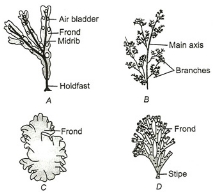
Identify the given figures of algae and select the correct option.
A
$A-Volvox, B-Chlamydomonas, C-Chara, D-Porphyra$
B
$A-Fucus, B-Polysiphonia, C-Porphyra, D-Dictyota$
C
$A-Fucus, B-Dictyota, C-Porphyra, D-Polysiphonia$
D
$A-Dictyota, B-Porphyra, C-Fucus, D-Polysiphonia$
Solution
(C) Based on the $NCERT$ textbook diagrams for the chapter 'Plant Kingdom':
$A$ represents $Fucus$,a brown alga characterized by air bladders,a midrib,and a holdfast.
$B$ represents $Dictyota$,a brown alga with a distinct main axis and branches.
$C$ represents $Porphyra$,a red alga with a leaf-like frond.
$D$ represents $Polysiphonia$,a red alga showing a branched thallus structure with a stipe and fronds.
Therefore,the correct sequence is $A-Fucus, B-Dictyota, C-Porphyra, D-Polysiphonia$.
$A$ represents $Fucus$,a brown alga characterized by air bladders,a midrib,and a holdfast.
$B$ represents $Dictyota$,a brown alga with a distinct main axis and branches.
$C$ represents $Porphyra$,a red alga with a leaf-like frond.
$D$ represents $Polysiphonia$,a red alga showing a branched thallus structure with a stipe and fronds.
Therefore,the correct sequence is $A-Fucus, B-Dictyota, C-Porphyra, D-Polysiphonia$.
0 likes
View Solution441
MediumMCQ
Consider the following statements regarding reproduction in class-$Chlorophyceae$.
$I.$ Asexual reproduction is mainly by flagellated zoospores produced in zoosporangia.
$II.$ The sexual reproduction shows considerable variation in the type and formation of sex cells and it may be isogamous,anisogamous and oogamous.
Which of the statements given above are correct?
$I.$ Asexual reproduction is mainly by flagellated zoospores produced in zoosporangia.
$II.$ The sexual reproduction shows considerable variation in the type and formation of sex cells and it may be isogamous,anisogamous and oogamous.
Which of the statements given above are correct?
A
Only $I$
B
Only $II$
C
$I$ and $II$
D
None of these
Solution
(C) In class-$Chlorophyceae$,asexual reproduction occurs mainly through flagellated zoospores that are produced within structures called zoosporangia.
Sexual reproduction in this class exhibits significant variation in the type and formation of sex cells (gametes).
It can be classified into three types: isogamous (gametes are similar in structure),anisogamous (gametes are dissimilar in size),and oogamous (large non-motile egg and small motile sperm).
Therefore,both statement $I$ and statement $II$ are correct.
Sexual reproduction in this class exhibits significant variation in the type and formation of sex cells (gametes).
It can be classified into three types: isogamous (gametes are similar in structure),anisogamous (gametes are dissimilar in size),and oogamous (large non-motile egg and small motile sperm).
Therefore,both statement $I$ and statement $II$ are correct.
0 likes
View Solution442
MediumMCQ
Most algal genera are haplontic,but some of them such as $A$,$B$,and $C$ are haplo-diplontic. Here $A$,$B$,and $C$ refer to:
A
$A-Ectocarpus, B-Polysiphonia, C-Kelps$
B
$A-Volvox, B-Spirogyra, C-Kelps$
C
$A-Spirogyra, B-Polysiphonia, C-Ectocarpus$
D
$A-Volvox, B-Kelps, C-Ectocarpus$
Solution
(A) In the plant kingdom,most algae exhibit a haplontic life cycle,where the dominant phase is the haploid gametophyte.
However,certain algae exhibit a haplo-diplontic life cycle,where both haploid and diploid phases are multicellular and often free-living.
Examples of such algae include $Ectocarpus$,$Polysiphonia$,and various species of $Kelps$ (large brown algae).
Therefore,the correct set representing haplo-diplontic algae is $A-Ectocarpus, B-Polysiphonia, C-Kelps$.
However,certain algae exhibit a haplo-diplontic life cycle,where both haploid and diploid phases are multicellular and often free-living.
Examples of such algae include $Ectocarpus$,$Polysiphonia$,and various species of $Kelps$ (large brown algae).
Therefore,the correct set representing haplo-diplontic algae is $A-Ectocarpus, B-Polysiphonia, C-Kelps$.
0 likes
View Solution443
MediumMCQ
Plants which are not differentiated into roots,stems,and leaves are:
A
Algae
B
Gymnosperms
C
Pteridophytes
D
Angiosperms
Solution
(A) Plants that lack a well-differentiated body structure,such as roots,stems,and leaves,are known as thallophytes.
Algae belong to the group Thallophyta,which is characterized by a simple,undifferentiated plant body called a thallus.
In contrast,Pteridophytes,Gymnosperms,and Angiosperms possess well-differentiated plant bodies with true roots,stems,and leaves.
Algae belong to the group Thallophyta,which is characterized by a simple,undifferentiated plant body called a thallus.
In contrast,Pteridophytes,Gymnosperms,and Angiosperms possess well-differentiated plant bodies with true roots,stems,and leaves.
0 likes
View Solution444
MediumMCQ
The cell wall of $Spirogyra$ is composed of:
A
Peptidoglycan
B
Pectin
C
Cellulose
D
Both $(b)$ and $(c)$
Solution
(D) The cell wall of $Spirogyra$ (a green alga) consists of an inner layer of cellulose and an outer layer of pectin. Therefore,both cellulose and pectin are present in its cell wall structure.
0 likes
View Solution445
MediumMCQ
Kelps are massive
A
Brown algae
B
Amphibious plants
C
Flowering plants
D
Plants with naked seeds
Solution
(A) Kelps belong to the class $Phaeophyceae$,which are commonly known as brown algae. They are known for their massive size and can reach heights of up to $100 \ m$.
0 likes
View Solution446
MediumMCQ
Laminarin is the stored food in
A
Dictyota
B
Volvox
C
Polysiphonia
D
Chlamydomonas
Solution
(A) Laminarin and mannitol are the characteristic stored food materials found in Phaeophyceae,commonly known as brown algae.
Among the given options,$Dictyota$ belongs to the class Phaeophyceae (brown algae).
$Volvox$ and $Chlamydomonas$ are green algae (Chlorophyceae),which store food as starch.
$Polysiphonia$ is a red alga (Rhodophyceae),which stores food as floridean starch.
Among the given options,$Dictyota$ belongs to the class Phaeophyceae (brown algae).
$Volvox$ and $Chlamydomonas$ are green algae (Chlorophyceae),which store food as starch.
$Polysiphonia$ is a red alga (Rhodophyceae),which stores food as floridean starch.
0 likes
View Solution447
MediumMCQ
In $Gracilaria$,sexual reproduction is
A
Isogamous
B
Anisogamous
C
Oogamous
D
Both $(a)$ and $(b)$
Solution
(C) Sexual reproduction in red algae $(Rhodophyceae)$ is oogamous.
$Gracilaria$ and $Gelidium$ are examples of red algae that exhibit oogamous sexual reproduction.
$Gracilaria$ and $Gelidium$ are examples of red algae that exhibit oogamous sexual reproduction.
0 likes
View Solution448
EasyMCQ
$Ectocarpus$ is:
A
Unicellular green algae
B
Filamentous brown algae
C
Branched red algae
D
Colonial green algae
Solution
(B) $Ectocarpus$ is a type of brown algae $(Phaeophyceae)$ that exhibits a branched,filamentous body structure.
0 likes
View Solution449
MediumMCQ
In algae,the photosynthetic pigments are present in
A
Pyrenoids
B
Cell wall
C
Chloroplast
D
Vacuole
Solution
(C) In algae,the photosynthetic pigments are contained within specialized organelles called chloroplasts. These organelles are the sites of photosynthesis,where light energy is captured by pigments such as chlorophyll to synthesize organic compounds.
0 likes
View Solution450
MediumMCQ
Haplontic life cycle is represented by
A
Volvox
B
Cycas
C
Selaginella
D
Salvinia
Solution
(A) In a haplontic life cycle,the sporophytic generation is represented only by the one-celled zygote. There are no free-living sporophytes. Meiosis in the zygote results in haploid spores,which divide to form the gametophyte. The dominant photosynthetic phase in such plants is the free-living gametophyte. This pattern is characteristic of many algae,such as $Volvox$ and $Spirogyra$.
0 likes
View SolutionPlant Kingdom — Algae (General) · Frequently Asked Questions
1Are these Plant Kingdom questions useful for JEE and NEET?
Yes. All questions in this section are mapped to JEE Main and NEET exam patterns. Previous year questions from JEE Main, NEET, GUJCET and state-level exams are included with full solutions.
2Can I switch to Hindi or Gujarati for these questions?
Yes. Use the language tabs in the hero section or the sidebar to view the same questions and solutions in English, Hindi or Gujarati.
3How do I generate a question paper from this subtopic?
Use the Vedclass Exam Paper Generator — select the chapter and subtopic, set difficulty, and generate Sets A, B, C, D automatically. First 3 chapters of every subject are free.
Vedclass Products
For Students
Vedclass Test Series
Mock tests in real JEE/NEET style with performance analysis. 5-day free trial.
Start Free TrialFor Teachers
Exam Paper Generator
Generate Set A/B/C/D papers from this chapter in 2 minutes. 3 chapters free.
Try FreeFor Institutes
Online Exam Module
Live online exams with unlimited students, 360° analytics & white-label branding.
See DemoFor Teachers & Institutes
Generate a Plant Kingdom Exam Paper in 2 Minutes
Select subtopic & difficulty — Sets A, B, C, D auto-generated with No Repeat logic.
First 3 chapters of every subject are free — no payment required.