
A English
Algae (General) Questions in English
Class 11 Biology · Plant Kingdom · Algae (General)
526+
Questions
English
Language
100%
With Solutions
Showing 49 of 526 questions in English
351
EasyMCQ
Pyrenoids are centers for the formation of . . . . . . .
A
Porphyra
B
Enzymes
C
Fats
D
Starch
Solution
(D) Pyrenoids are specialized proteinaceous structures found in the chloroplasts of many algae,such as $Chlamydomonas$ and $Spirogyra$.
They act as centers for the storage and formation of starch.
Therefore,the correct option is $D$.
They act as centers for the storage and formation of starch.
Therefore,the correct option is $D$.
0 likes
View Solution352
MediumMCQ
In $Ulothrix$ / $Spirogyra$,the reduction division (meiosis) occurs at the time of:
A
Gamete formation
B
Zoospore formation
C
Zygospore germination
D
Vegetative reproduction
Solution
(C) In $Ulothrix$ and $Spirogyra$,the plant body is haploid $(n)$.
Sexual reproduction involves the fusion of two gametes to form a diploid $(2n)$ zygote.
Since the organism is haploid,the zygote must undergo meiosis (reduction division) to restore the haploid state.
This process occurs during the germination of the zygospore $(2n)$,which results in the formation of haploid zoospores or new filaments.
Sexual reproduction involves the fusion of two gametes to form a diploid $(2n)$ zygote.
Since the organism is haploid,the zygote must undergo meiosis (reduction division) to restore the haploid state.
This process occurs during the germination of the zygospore $(2n)$,which results in the formation of haploid zoospores or new filaments.
0 likes
View Solution353
EasyMCQ
The chloroplast of $Chlamydomonas$ is . . . . . . .
A
Stellate
B
Cup-shaped
C
Collar-shaped
D
Spiral
Solution
(B) $Chlamydomonas$ is a unicellular green alga belonging to the class $Chlorophyceae$.
It is characterized by the presence of a single,large,cup-shaped chloroplast that occupies a significant portion of the cell.
This chloroplast contains a pyrenoid,which is a center for starch storage.
It is characterized by the presence of a single,large,cup-shaped chloroplast that occupies a significant portion of the cell.
This chloroplast contains a pyrenoid,which is a center for starch storage.
0 likes
View Solution354
MediumMCQ
In $Chlorophyceae$,sexual reproduction occurs by .............
A
Isogamy and Anisogamy
B
Isogamy,Anisogamy,and Oogamy
C
Oogamy only
D
Anisogamy and Oogamy
Solution
(B) In $Chlorophyceae$ (green algae),sexual reproduction shows considerable variation in the type and formation of sex cells.
It may be isogamous,anisogamous,or oogamous.
$1$. Isogamous: Fusion of morphologically similar gametes (e.g.,$Ulothrix$).
$2$. Anisogamous: Fusion of morphologically dissimilar gametes (e.g.,$Eudorina$).
$3$. Oogamous: Fusion of a large non-motile female gamete and a small motile male gamete (e.g.,$Volvox$,$Spirogyra$ is an exception as it is isogamous but non-motile).
Therefore,all three types of sexual reproduction are observed in $Chlorophyceae$.
It may be isogamous,anisogamous,or oogamous.
$1$. Isogamous: Fusion of morphologically similar gametes (e.g.,$Ulothrix$).
$2$. Anisogamous: Fusion of morphologically dissimilar gametes (e.g.,$Eudorina$).
$3$. Oogamous: Fusion of a large non-motile female gamete and a small motile male gamete (e.g.,$Volvox$,$Spirogyra$ is an exception as it is isogamous but non-motile).
Therefore,all three types of sexual reproduction are observed in $Chlorophyceae$.
0 likes
View Solution355
MediumMCQ
The absence of chlorophyll in the lowermost cells of $Ulothrix$ indicates:
A
Functional attachment
B
Tissue formation
C
Cellular differentiation
D
Beginning of division of labor
Solution
(D) In $Ulothrix$,the lowermost cell is modified into a specialized structure called a holdfast. This cell lacks chlorophyll because its primary function is to attach the filament to a substrate,not to perform photosynthesis. This specialization of a specific cell for a particular function (attachment) rather than the general function of the organism (photosynthesis) represents the beginning of the division of labor within a multicellular organism.
0 likes
View Solution356
EasyMCQ
Agar is commercially obtained from $..........$.
A
Red algae
B
Green algae
C
Brown algae
D
Blue-green algae
Solution
(A) Agar is a gelatinous substance that is commercially obtained from certain species of marine red algae (Rhodophyceae),specifically $Gelidium$ and $Gracilaria$. It is widely used in laboratories as a culture medium for growing microorganisms and in the food industry as a thickening agent.
0 likes
View Solution357
MediumMCQ
The characteristic feature of brown algae is the presence of ..........
A
Phycocyanin
B
Phycoerythrin
C
Fucoxanthin
D
Haematochrome
Solution
(C) Brown algae,belonging to the class $Phaeophyceae$,are characterized by the presence of specific pigments that give them their distinct brown color.
These algae contain chlorophyll $a$,$c$,and carotenoids,specifically the xanthophyll pigment known as $Fucoxanthin$.
$Fucoxanthin$ masks the green color of chlorophyll,resulting in shades ranging from olive green to brown.
Phycocyanin and Phycoerythrin are characteristic pigments of red and blue-green algae,respectively.
These algae contain chlorophyll $a$,$c$,and carotenoids,specifically the xanthophyll pigment known as $Fucoxanthin$.
$Fucoxanthin$ masks the green color of chlorophyll,resulting in shades ranging from olive green to brown.
Phycocyanin and Phycoerythrin are characteristic pigments of red and blue-green algae,respectively.
0 likes
View Solution358
MediumMCQ
Ulothrix filaments produce . . . . . . .
A
Isogametes
B
Anisogametes
C
Oogametes
D
Basidiospores
Solution
(A) Ulothrix is a genus of filamentous green algae. In Ulothrix,sexual reproduction occurs through the fusion of flagellated gametes that are morphologically similar. Such gametes are known as isogametes. Therefore,Ulothrix filaments produce isogametes.
0 likes
View Solution359
MediumMCQ
$Ulothrix$ can be described as:
A
$A$ non-motile colonial alga lacking zoospores.
B
$A$ filamentous alga lacking a flagellated reproductive stage.
C
$A$ membranous alga producing zoospores.
D
$A$ filamentous alga with a flagellated reproductive stage.
Solution
(D) $Ulothrix$ is a genus of non-branching filamentous green algae.
It is found in fresh and marine water.
The life cycle of $Ulothrix$ includes a motile reproductive stage where it produces flagellated zoospores and gametes.
Since it possesses flagellated reproductive cells,it is classified as a filamentous alga with a flagellated reproductive stage.
It is found in fresh and marine water.
The life cycle of $Ulothrix$ includes a motile reproductive stage where it produces flagellated zoospores and gametes.
Since it possesses flagellated reproductive cells,it is classified as a filamentous alga with a flagellated reproductive stage.
0 likes
View Solution360
MediumMCQ
$A$ research student collects and observes some algae. The cells contain both chlorophyll $a, b, c$ and chlorophyll $d$,in addition to phycoerythrin. This alga belongs to:
A
Rhodophyceae
B
Bacillariophyceae
C
Chlorophyceae
D
Phaeophyceae
Solution
(A) The presence of phycoerythrin is a characteristic feature of red algae,which belong to the class Rhodophyceae.
Red algae typically contain chlorophyll $a$ and $d$,along with phycoerythrin (a red pigment) and phycocyanin.
While the question mentions chlorophyll $a, b, c$ and $d$,the presence of the accessory pigment phycoerythrin is the diagnostic feature for Rhodophyceae.
Therefore,the correct classification is Rhodophyceae.
Red algae typically contain chlorophyll $a$ and $d$,along with phycoerythrin (a red pigment) and phycocyanin.
While the question mentions chlorophyll $a, b, c$ and $d$,the presence of the accessory pigment phycoerythrin is the diagnostic feature for Rhodophyceae.
Therefore,the correct classification is Rhodophyceae.
0 likes
View Solution361
MediumMCQ
Sexual reproduction in $Spirogyra$ is considered an advanced feature because it shows:
A
Physiologically differentiated reproductive organs
B
Motile gametes of different sizes
C
Motile gametes of similar sizes
D
Morphologically distinct sex organs
Solution
(A) In $Spirogyra$,sexual reproduction occurs through conjugation. Although the gametes are morphologically similar (isogamous),they are physiologically differentiated into male $(+)$ and female $(-)$ strains. This physiological differentiation is considered an evolutionary advancement over simple vegetative or asexual reproduction,as it introduces genetic recombination while maintaining the simplicity of the thalloid body structure.
0 likes
View Solution362
EasyMCQ
The free-living,nitrogen-fixing cyanobacterium which also forms a symbiotic association with the water fern $Azolla$ is.......
A
Tolypothrix
B
Chlorella
C
Nostoc
D
Anabaena
Solution
(D) The cyanobacterium $Anabaena$ $azollae$ is a free-living nitrogen-fixing organism.
It also forms a symbiotic relationship with the water fern $Azolla$ by residing in the leaf cavities of the fern.
In this association,$Anabaena$ provides fixed nitrogen to the fern,while the fern provides shelter and nutrients to the cyanobacterium.
It also forms a symbiotic relationship with the water fern $Azolla$ by residing in the leaf cavities of the fern.
In this association,$Anabaena$ provides fixed nitrogen to the fern,while the fern provides shelter and nutrients to the cyanobacterium.
0 likes
View Solution363
MediumMCQ
If you are asked to classify various algae into different groups,which of the following characteristics would you choose?
A
Type of pigments present in the cell
B
Form of stored food in the cell
C
Structural organization of the thallus
D
Chemical composition of the cell wall
Solution
(A, B, C, D) Algae are primarily classified into three main classes: $Chlorophyceae$ (green algae),$Phaeophyceae$ (brown algae),and $Rhodophyceae$ (red algae).
This classification is based on several key criteria:
$1$. The type of photosynthetic pigments present (e.g.,Chlorophyll $a, b, c, d$,Fucoxanthin,Phycoerythrin).
$2$. The chemical composition of the cell wall (e.g.,Cellulose,Algin,Carrageenin).
$3$. The form of stored food (e.g.,Starch,Mannitol,Laminarin,Floridean starch).
Since all the options provided $(A, B, C, D)$ are valid criteria used for the classification of algae,the question implies selecting the most comprehensive set of criteria. In the context of standard biological classification,all these features are utilized.
This classification is based on several key criteria:
$1$. The type of photosynthetic pigments present (e.g.,Chlorophyll $a, b, c, d$,Fucoxanthin,Phycoerythrin).
$2$. The chemical composition of the cell wall (e.g.,Cellulose,Algin,Carrageenin).
$3$. The form of stored food (e.g.,Starch,Mannitol,Laminarin,Floridean starch).
Since all the options provided $(A, B, C, D)$ are valid criteria used for the classification of algae,the question implies selecting the most comprehensive set of criteria. In the context of standard biological classification,all these features are utilized.
0 likes
View Solution364
MediumMCQ
Mannitol is the stored food in $..........$.
A
Chara
B
Porphyra
C
Fucus
D
Gracilaria
Solution
(C) In algae, the stored food material varies among different classes.
$1$. $Chara$ belongs to Chlorophyceae (green algae), where food is stored as starch.
$2$. $Porphyra$ and $Gracilaria$ belong to Rhodophyceae (red algae), where food is stored as floridean starch.
$3$. $Fucus$ belongs to Phaeophyceae (brown algae). In brown algae, food is stored in the form of complex carbohydrates, specifically mannitol and laminarin.
Therefore, mannitol is the stored food in $Fucus$.
$1$. $Chara$ belongs to Chlorophyceae (green algae), where food is stored as starch.
$2$. $Porphyra$ and $Gracilaria$ belong to Rhodophyceae (red algae), where food is stored as floridean starch.
$3$. $Fucus$ belongs to Phaeophyceae (brown algae). In brown algae, food is stored in the form of complex carbohydrates, specifically mannitol and laminarin.
Therefore, mannitol is the stored food in $Fucus$.
0 likes
View Solution365
EasyMCQ
The cell wall of algae is made up of . . . . . . .
A
Cellulose,galactans,mannans
B
Hemicellulose,pectins,proteins
C
Pectins,cellulose,proteins
D
Cellulose,hemicellulose,pectins
Solution
(A) The cell wall of algae is composed of cellulose,galactans,and mannans,along with minerals like calcium carbonate in some species.
This composition is a characteristic feature of algal cell walls,distinguishing them from the cell walls of higher plants,which are primarily composed of cellulose,hemicellulose,and pectins.
This composition is a characteristic feature of algal cell walls,distinguishing them from the cell walls of higher plants,which are primarily composed of cellulose,hemicellulose,and pectins.
0 likes
View Solution366
MediumMCQ
Archegoniophore is absent in .......
A
Chara
B
Adiantum
C
Funaria
D
Marchantia
Solution
(A) The archegoniophore is a specialized stalk-like structure that bears the archegonia (female sex organs) in certain bryophytes like $Marchantia$.
$Chara$ is an alga,and it does not possess archegoniophores; instead,it has sex organs called oogonia and antheridia.
$Adiantum$ is a pteridophyte,which does not produce archegoniophores.
$Funaria$ is a moss (bryophyte) that produces archegonia at the tips of the leafy gametophyte,but it does not develop a specialized stalk-like structure known as an archegoniophore.
However,in the context of typical biology questions regarding the presence of archegoniophores,$Marchantia$ is the classic example where they are present. Among the given options,$Chara$ (an alga) is the most distinct organism that lacks archegonia entirely,but $Funaria$ is also a bryophyte that lacks an archegoniophore. Given the standard curriculum,$Chara$ is the correct answer as it is an alga and lacks archegonia,while $Marchantia$ is the primary example of a plant with archegoniophores.
$Chara$ is an alga,and it does not possess archegoniophores; instead,it has sex organs called oogonia and antheridia.
$Adiantum$ is a pteridophyte,which does not produce archegoniophores.
$Funaria$ is a moss (bryophyte) that produces archegonia at the tips of the leafy gametophyte,but it does not develop a specialized stalk-like structure known as an archegoniophore.
However,in the context of typical biology questions regarding the presence of archegoniophores,$Marchantia$ is the classic example where they are present. Among the given options,$Chara$ (an alga) is the most distinct organism that lacks archegonia entirely,but $Funaria$ is also a bryophyte that lacks an archegoniophore. Given the standard curriculum,$Chara$ is the correct answer as it is an alga and lacks archegonia,while $Marchantia$ is the primary example of a plant with archegoniophores.
0 likes
View Solution367
MediumMCQ
Which of the following algae can be used as food by humans?
A
Ulothrix
B
Chlorella
C
Spirogyra
D
Polysiphonia
Solution
(B) Many species of marine algae,such as $Porphyra$,$Laminaria$,and $Sargassum$,are among the $70$ species of marine algae used as food.
$Chlorella$ is a unicellular green alga that is rich in proteins and is used as a food supplement by space travelers.
Therefore,$Chlorella$ is the correct answer.
$Chlorella$ is a unicellular green alga that is rich in proteins and is used as a food supplement by space travelers.
Therefore,$Chlorella$ is the correct answer.
0 likes
View Solution368
MediumMCQ
Which of the following is incorrect regarding Chara?
A
Oogonium at the top and globule at the bottom
B
Globule and nucule are present on the same plant
C
Antheridium at the top and oogonium at the bottom
D
Globule as the male reproductive structure
Solution
(C) Chara is a monoecious green alga. Its male reproductive structure is called the globule (antheridium) and the female reproductive structure is called the nucule (oogonium). In Chara,the nucule (oogonium) is always situated at the top,and the globule (antheridium) is situated below it. Therefore,the statement that the antheridium is at the top and the oogonium is at the bottom is incorrect.
0 likes
View Solution369
MediumMCQ
Which of the following produces isogamous and non-flagellated gametes?
A
Sargassum
B
Ectocarpus
C
Ulothrix
D
Spirogyra
Solution
(D) In $Spirogyra$, sexual reproduction occurs through conjugation. The gametes produced are isogamous (morphologically similar) and non-flagellated (non-motile).
$Ulothrix$ produces isogamous and flagellated gametes.
$Ectocarpus$ shows isogamy, anisogamy, and oogamy with flagellated gametes.
$Sargassum$ exhibits oogamy.
$Ulothrix$ produces isogamous and flagellated gametes.
$Ectocarpus$ shows isogamy, anisogamy, and oogamy with flagellated gametes.
$Sargassum$ exhibits oogamy.
0 likes
View Solution370
MediumMCQ
Which of the following statements is incorrect?
A
Algae increase the level of dissolved $O_2$ in their immediate environment.
B
Algin is obtained from red algae and carrageenan from brown algae.
C
Agar-agar is obtained from Gelidium and Gracilaria.
D
Laminaria and Sargassum are used as food.
Solution
(B) The correct statement is that algin is obtained from brown algae (Phaeophyceae) and carrageenan is obtained from red algae (Rhodophyceae).
Option $B$ states the reverse,making it the incorrect statement.
Algae are photosynthetic and release $O_2$ into the water,increasing dissolved oxygen levels.
$Gelidium$ and $Gracilaria$ are red algae used to produce agar.
Many species of $Laminaria$ and $Sargassum$ are consumed as food by humans.
Option $B$ states the reverse,making it the incorrect statement.
Algae are photosynthetic and release $O_2$ into the water,increasing dissolved oxygen levels.
$Gelidium$ and $Gracilaria$ are red algae used to produce agar.
Many species of $Laminaria$ and $Sargassum$ are consumed as food by humans.
0 likes
View Solution371
MediumMCQ
Which of the following is an example of a colonial alga?
A
Chlorella
B
Volvox
C
Ulothrix
D
Spirogyra
Solution
(B) Algae are classified based on their body organization.
$1$. $Chlorella$ is a unicellular alga.
$2$. $Volvox$ is a colonial alga,where individual cells are organized into a spherical colony.
$3$. $Ulothrix$ and $Spirogyra$ are filamentous algae.
Therefore,$Volvox$ is the correct example of a colonial alga.
$1$. $Chlorella$ is a unicellular alga.
$2$. $Volvox$ is a colonial alga,where individual cells are organized into a spherical colony.
$3$. $Ulothrix$ and $Spirogyra$ are filamentous algae.
Therefore,$Volvox$ is the correct example of a colonial alga.
0 likes
View Solution372
MediumMCQ
Zygotic meiosis is a characteristic of .........
A
Marchantia
B
Fucus
C
Funaria
D
Chlamydomonas
Solution
(D) In the life cycle of many algae,such as $Chlamydomonas$,the dominant phase is haploid $(n)$.
When these organisms reproduce sexually,they produce gametes that fuse to form a diploid $(2n)$ zygote.
This zygote undergoes meiosis immediately to produce haploid zoospores,which then develop into new haploid individuals.
This process is known as zygotic meiosis,which is a characteristic feature of haplontic life cycles found in organisms like $Chlamydomonas$ and $Volvox$.
When these organisms reproduce sexually,they produce gametes that fuse to form a diploid $(2n)$ zygote.
This zygote undergoes meiosis immediately to produce haploid zoospores,which then develop into new haploid individuals.
This process is known as zygotic meiosis,which is a characteristic feature of haplontic life cycles found in organisms like $Chlamydomonas$ and $Volvox$.
0 likes
View Solution373
MediumMCQ
In Hammerling's nucleocytoplasmic experiments,$Acetabularia$ is used,which is a:
A
Unicellular fungus
B
Multicellular fungus
C
Unicellular,uninucleate green alga
D
Unicellular,multinucleate green alga
Solution
(C) $Acetabularia$ is a genus of single-celled green algae that is famous for its large size and complex shape.
It is a unicellular organism that contains only one nucleus,which is located in the rhizoid (base).
Joachim Hammerling used $Acetabularia$ in his experiments to demonstrate the influence of the nucleus on the development and morphology of the cell,proving that the nucleus controls cellular activities.
It is a unicellular organism that contains only one nucleus,which is located in the rhizoid (base).
Joachim Hammerling used $Acetabularia$ in his experiments to demonstrate the influence of the nucleus on the development and morphology of the cell,proving that the nucleus controls cellular activities.
0 likes
View Solution374
EasyMCQ
In oogamy,fertilization involves:
A
$A$ small non-motile female gamete and a large motile male gamete.
B
$A$ large non-motile female gamete and a small motile male gamete.
C
$A$ large non-motile female gamete and a small non-motile male gamete.
D
$A$ large motile female gamete and a small non-motile male gamete.
Solution
(B) Oogamy is a form of anisogamy where the female gamete is large and non-motile (egg or ovum),while the male gamete is small and motile (sperm or antherozoid).
This type of sexual reproduction is common in many algae,bryophytes,pteridophytes,and all seed plants.
This type of sexual reproduction is common in many algae,bryophytes,pteridophytes,and all seed plants.
0 likes
View Solution375
EasyMCQ
What are pyrenoids composed of?
A
$A$ central protein core surrounded by a starch sheath.
B
$A$ central protein core surrounded by a lipid sheath.
C
$A$ central starch core surrounded by a protein sheath.
D
$A$ central nucleic acid core surrounded by a protein sheath.
Solution
(A) Pyrenoids are storage bodies found in the chloroplasts of algae.
They typically consist of a central core of protein,which is the site of the enzyme RuBisCO,surrounded by a sheath of starch.
Therefore,they are composed of a central protein core and a starch sheath.
They typically consist of a central core of protein,which is the site of the enzyme RuBisCO,surrounded by a sheath of starch.
Therefore,they are composed of a central protein core and a starch sheath.
0 likes
View Solution376
MediumMCQ
Reduced vascular tissue,mechanical tissue,and cuticle are characteristics of which of the following?
A
Mesophytes
B
Epiphytes
C
Hydrophytes
D
Xerophytes
Solution
(C) Hydrophytes are plants that are adapted to live in aquatic environments.
Since water is abundantly available in their habitat,they do not require extensive vascular tissue for water transport.
Furthermore,because the surrounding water provides buoyancy,they do not need significant mechanical tissue for support.
Additionally,a thick cuticle is not required to prevent water loss,as they live in a water-rich environment.
Therefore,reduced vascular tissue,mechanical tissue,and cuticle are characteristic features of $Hydrophytes$.
Since water is abundantly available in their habitat,they do not require extensive vascular tissue for water transport.
Furthermore,because the surrounding water provides buoyancy,they do not need significant mechanical tissue for support.
Additionally,a thick cuticle is not required to prevent water loss,as they live in a water-rich environment.
Therefore,reduced vascular tissue,mechanical tissue,and cuticle are characteristic features of $Hydrophytes$.
0 likes
View Solution377
DifficultMCQ
$(i)$ Green algae occur in fresh water,brackish water,and salt water.
$(ii)$ Habitat of Brown algae: fresh water (rare),brackish water,and salt water.
$(iii)$ Some red algae are found in fresh water,mostly occur in salt water,and some are in brackish water.
$(iv)$ Most of the red algae are multicellular.
$(v)$ Red algae may occur in both well-lighted regions close to the water surface and also at great depths in oceans where light penetration is little.
$(vi)$ The cell wall of red algae consists of cellulose $+$ agar.
$(vii)$ $2-8$,equal and apical flagella in green algae.
$(ii)$ Habitat of Brown algae: fresh water (rare),brackish water,and salt water.
$(iii)$ Some red algae are found in fresh water,mostly occur in salt water,and some are in brackish water.
$(iv)$ Most of the red algae are multicellular.
$(v)$ Red algae may occur in both well-lighted regions close to the water surface and also at great depths in oceans where light penetration is little.
$(vi)$ The cell wall of red algae consists of cellulose $+$ agar.
$(vii)$ $2-8$,equal and apical flagella in green algae.
A
All are correct
B
All are false
C
$(i)$ and $(vi)$ are correct
D
$(ii), (iii)$ and $(v)$ are correct
Solution
(A) All the given statements $(i)$ through $(vii)$ regarding the characteristics and habitats of algae are scientifically correct.
- Green algae $(Chlorophyceae)$ are found in diverse habitats including fresh,brackish,and salt water.
- Brown algae $(Phaeophyceae)$ are mostly marine,with rare occurrences in fresh water.
- Red algae $(Rhodophyceae)$ are predominantly marine but also occur in fresh and brackish water.
- Red algae are mostly multicellular and exhibit a wide range of distribution from surface waters to great depths.
- The cell wall of red algae is composed of cellulose,pectin,and phycocolloids like agar.
- Green algae typically possess $2-8$ equal,apical flagella.
- Green algae $(Chlorophyceae)$ are found in diverse habitats including fresh,brackish,and salt water.
- Brown algae $(Phaeophyceae)$ are mostly marine,with rare occurrences in fresh water.
- Red algae $(Rhodophyceae)$ are predominantly marine but also occur in fresh and brackish water.
- Red algae are mostly multicellular and exhibit a wide range of distribution from surface waters to great depths.
- The cell wall of red algae is composed of cellulose,pectin,and phycocolloids like agar.
- Green algae typically possess $2-8$ equal,apical flagella.
0 likes
View Solution378
DifficultMCQ
Consider the following statements regarding the major pigments and stored food in the different groups of algae and choose the correct option:
$(i)$ In Chlorophyceae,the stored food material is starch and the major pigments are chlorophyll $-a$ and $d$.
$(ii)$ In Phaeophyceae,laminarin is the stored food and major pigments are chlorophyll $-a$ and $b$.
$(iii)$ In Rhodophyceae,floridean starch is the stored food and the major pigments are chlorophyll $-a, d$ and phycoerythrin.
$(i)$ In Chlorophyceae,the stored food material is starch and the major pigments are chlorophyll $-a$ and $d$.
$(ii)$ In Phaeophyceae,laminarin is the stored food and major pigments are chlorophyll $-a$ and $b$.
$(iii)$ In Rhodophyceae,floridean starch is the stored food and the major pigments are chlorophyll $-a, d$ and phycoerythrin.
A
$(i)$ is correct,but $(ii)$ and $(iii)$ are incorrect.
B
$(i)$ and $(ii)$ are correct,but $(iii)$ is incorrect.
C
$(i)$ and $(iii)$ are correct,but $(ii)$ is incorrect.
D
$(iii)$ is correct,but $(i)$ and $(ii)$ are incorrect.
Solution
(D) Statement $(i)$ is incorrect because in Chlorophyceae,the major pigments are chlorophyll $-a$ and $b$,not $a$ and $d$.
Statement $(ii)$ is incorrect because in Phaeophyceae,the major pigments are chlorophyll $-a, c$ and fucoxanthin,not $a$ and $b$.
Statement $(iii)$ is correct because in Rhodophyceae,the stored food is floridean starch and the major pigments are chlorophyll $-a, d$ and phycoerythrin.
Therefore,only statement $(iii)$ is correct.
Statement $(ii)$ is incorrect because in Phaeophyceae,the major pigments are chlorophyll $-a, c$ and fucoxanthin,not $a$ and $b$.
Statement $(iii)$ is correct because in Rhodophyceae,the stored food is floridean starch and the major pigments are chlorophyll $-a, d$ and phycoerythrin.
Therefore,only statement $(iii)$ is correct.
0 likes
View Solution379
MediumMCQ
Assertion : Red algae contribute to the production of coral reefs.
Reason : Some red algae secrete and deposit calcium carbonate over their walls.
Reason : Some red algae secrete and deposit calcium carbonate over their walls.
A
If both Assertion and Reason are correct and the Reason is a correct explanation of the Assertion.
B
If both Assertion and Reason are correct but Reason is not a correct explanation of the Assertion.
C
If the Assertion is correct but Reason is incorrect.
D
If both the Assertion and Reason are incorrect.
Solution
(A) Red algae,specifically members of the order $Corallinales$,are known as coralline algae.
These algae secrete and deposit calcium carbonate $(CaCO_3)$ in their cell walls,which makes them hard and stony.
These calcareous deposits contribute significantly to the formation of coral reefs and limestone deposits in marine environments.
Therefore,the Reason correctly explains why red algae contribute to the production of coral reefs.
These algae secrete and deposit calcium carbonate $(CaCO_3)$ in their cell walls,which makes them hard and stony.
These calcareous deposits contribute significantly to the formation of coral reefs and limestone deposits in marine environments.
Therefore,the Reason correctly explains why red algae contribute to the production of coral reefs.
0 likes
View Solution380
MediumMCQ
Assertion : Members of Phaeophyceae vary in colour from olive green to various shades of brown.
Reason : Phaeophyceae possess chlorophyll $a, c$,carotenoids and xanthophylls.
Reason : Phaeophyceae possess chlorophyll $a, c$,carotenoids and xanthophylls.
A
If both Assertion and Reason are correct and the Reason is a correct explanation of the Assertion.
B
If both Assertion and Reason are correct but Reason is not a correct explanation of the Assertion.
C
If the Assertion is correct but Reason is incorrect.
D
If both the Assertion and Reason are incorrect.
Solution
(A) Phaeophyceae (brown algae) possess chlorophyll $a, c$,carotenoids,and xanthophylls (specifically fucoxanthin).
These pigments are responsible for the characteristic colour of these algae.
The variation in colour from olive green to various shades of brown depends upon the amount of xanthophyll pigments (fucoxanthin) present in the cells.
Therefore,both the Assertion and the Reason are correct,and the Reason is the correct explanation of the Assertion.
These pigments are responsible for the characteristic colour of these algae.
The variation in colour from olive green to various shades of brown depends upon the amount of xanthophyll pigments (fucoxanthin) present in the cells.
Therefore,both the Assertion and the Reason are correct,and the Reason is the correct explanation of the Assertion.
0 likes
View Solution381
Medium
What is the basis of classification of algae?
Solution
(N/A) Algae are classified into three main classes: $Chlorophyceae$,$Phaeophyceae$,and $Rhodophyceae$. These divisions are based on the following factors:
$(a)$ Major photosynthetic pigments present
$(b)$ Form of stored food
$(c)$ Cell wall composition
$(d)$ Number of flagella and position of insertion
$1$. $Chlorophyceae$ (Green algae): Major pigments are chlorophyll $a$ and $b$; stored food is starch; cell wall is made of cellulose; flagella are $2-8$,equal,and apical.
$2$. $Phaeophyceae$ (Brown algae): Major pigments are chlorophyll $a, c$ and fucoxanthin; stored food is mannitol and laminarin; cell wall is made of cellulose and algin; flagella are $2$,unequal,and lateral.
$3$. $Rhodophyceae$ (Red algae): Major pigments are chlorophyll $a, d$ and phycoerythrin; stored food is floridean starch; cell wall is made of cellulose,pectin,and polysulphate esters; flagella are absent.
$(a)$ Major photosynthetic pigments present
$(b)$ Form of stored food
$(c)$ Cell wall composition
$(d)$ Number of flagella and position of insertion
$1$. $Chlorophyceae$ (Green algae): Major pigments are chlorophyll $a$ and $b$; stored food is starch; cell wall is made of cellulose; flagella are $2-8$,equal,and apical.
$2$. $Phaeophyceae$ (Brown algae): Major pigments are chlorophyll $a, c$ and fucoxanthin; stored food is mannitol and laminarin; cell wall is made of cellulose and algin; flagella are $2$,unequal,and lateral.
$3$. $Rhodophyceae$ (Red algae): Major pigments are chlorophyll $a, d$ and phycoerythrin; stored food is floridean starch; cell wall is made of cellulose,pectin,and polysulphate esters; flagella are absent.
0 likes
View Solution382
Medium
Write a note on the general characteristics and types of algae.
Solution
(N/A) $\Rightarrow$ Habitat: Algae are primarily aquatic organisms,found in both fresh water and marine environments.
$\Rightarrow$ They also occur in diverse habitats such as moist stones,soils,and wood.
$\Rightarrow$ Some algae exist in association with fungi (as lichens) and animals (e.g.,on sloth bears).
$\Rightarrow$ Structure: Algae are chlorophyll-bearing,simple,thalloid,and autotrophic organisms.
$\Rightarrow$ The form and size of algae are highly variable:
$\Rightarrow$ $Chlamydomonas$ represents unicellular microscopic forms.
$\Rightarrow$ $Volvox$ represents colonial forms.
$\Rightarrow$ $Ulothrix$ and $Spirogyra$ represent filamentous forms.
$\Rightarrow$ Some marine forms,such as kelps,form massive plant bodies.
$\Rightarrow$ Reproduction in Algae: Algae reproduce by vegetative,asexual,and sexual methods.
$\Rightarrow$ Vegetative reproduction occurs by fragmentation,where each fragment develops into a new thallus.
$\Rightarrow$ Asexual reproduction occurs through the production of different types of spores,the most common being zoospores,which are flagellated and motile.
$\Rightarrow$ Sexual reproduction involves the fusion of two gametes. These can be flagellated and similar in size (isogamous,e.g.,$Chlamydomonas$),non-flagellated but similar in size (isogamous,e.g.,$Spirogyra$),dissimilar in size (anisogamous,e.g.,some species of $Chlamydomonas$),or a large non-motile female gamete fused with a smaller motile male gamete (oogamous,e.g.,$Volvox, Fucus$).
$\Rightarrow$ Importance: Algae perform at least half of the total carbon dioxide fixation on Earth through photosynthesis and increase dissolved oxygen levels in their environment.
$\Rightarrow$ They also occur in diverse habitats such as moist stones,soils,and wood.
$\Rightarrow$ Some algae exist in association with fungi (as lichens) and animals (e.g.,on sloth bears).
$\Rightarrow$ Structure: Algae are chlorophyll-bearing,simple,thalloid,and autotrophic organisms.
$\Rightarrow$ The form and size of algae are highly variable:
$\Rightarrow$ $Chlamydomonas$ represents unicellular microscopic forms.
$\Rightarrow$ $Volvox$ represents colonial forms.
$\Rightarrow$ $Ulothrix$ and $Spirogyra$ represent filamentous forms.
$\Rightarrow$ Some marine forms,such as kelps,form massive plant bodies.
$\Rightarrow$ Reproduction in Algae: Algae reproduce by vegetative,asexual,and sexual methods.
$\Rightarrow$ Vegetative reproduction occurs by fragmentation,where each fragment develops into a new thallus.
$\Rightarrow$ Asexual reproduction occurs through the production of different types of spores,the most common being zoospores,which are flagellated and motile.
$\Rightarrow$ Sexual reproduction involves the fusion of two gametes. These can be flagellated and similar in size (isogamous,e.g.,$Chlamydomonas$),non-flagellated but similar in size (isogamous,e.g.,$Spirogyra$),dissimilar in size (anisogamous,e.g.,some species of $Chlamydomonas$),or a large non-motile female gamete fused with a smaller motile male gamete (oogamous,e.g.,$Volvox, Fucus$).
$\Rightarrow$ Importance: Algae perform at least half of the total carbon dioxide fixation on Earth through photosynthesis and increase dissolved oxygen levels in their environment.
0 likes
View Solution383
Medium
Write a note on Chlorophyceae.
Solution
(N/A) The members of Chlorophyceae are commonly called green algae.
Structure and characteristics:
- The plant body may be unicellular,colonial,or filamentous.
- They are usually grass green due to the dominance of pigments chlorophyll $a$ and $b$.
- The pigments are localized in definite chloroplasts. The chloroplasts may be discoid,plate-like,reticulate,cup-shaped,spiral,or ribbon-shaped in different species.
- Most of the members have one or more storage bodies called pyrenoids located in the chloroplasts. Pyrenoids contain protein besides starch.
- Green algae usually have a rigid cell wall made of an inner layer of cellulose and an outer layer of pectose.
Reproduction in green algae:
- Vegetative reproduction usually takes place by fragmentation or by the formation of different types of spores.
- Asexual reproduction is by flagellated zoospores produced in zoosporangia.
- Sexual reproduction shows considerable variation in the type and formation of sex cells and it may be isogamous,anisogamous,or oogamous.
- Examples: $Chlamydomonas$,$Volvox$,$Ulothrix$,$Spirogyra$,and $Chara$ are commonly found green algae.
Structure and characteristics:
- The plant body may be unicellular,colonial,or filamentous.
- They are usually grass green due to the dominance of pigments chlorophyll $a$ and $b$.
- The pigments are localized in definite chloroplasts. The chloroplasts may be discoid,plate-like,reticulate,cup-shaped,spiral,or ribbon-shaped in different species.
- Most of the members have one or more storage bodies called pyrenoids located in the chloroplasts. Pyrenoids contain protein besides starch.
- Green algae usually have a rigid cell wall made of an inner layer of cellulose and an outer layer of pectose.
Reproduction in green algae:
- Vegetative reproduction usually takes place by fragmentation or by the formation of different types of spores.
- Asexual reproduction is by flagellated zoospores produced in zoosporangia.
- Sexual reproduction shows considerable variation in the type and formation of sex cells and it may be isogamous,anisogamous,or oogamous.
- Examples: $Chlamydomonas$,$Volvox$,$Ulothrix$,$Spirogyra$,and $Chara$ are commonly found green algae.
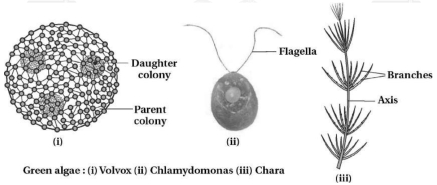
0 likes
View Solution384
Medium
Write a note on Phaeophyceae.
Solution
(N/A) $\rightarrow$ The members of Phaeophyceae are commonly known as brown algae.
$\rightarrow$ Habitat: They are primarily found in marine habitats.
$\rightarrow$ Size and shape: They show great variation in size and form,ranging from simple branched,filamentous forms (e.g.,$Ectocarpus$) to profusely branched forms like Kelps,which may reach a height of $100 \ m$.
$\rightarrow$ Pigmentation: They possess chlorophyll $a, c$,carotenoids,and xanthophylls. Their color varies from olive green to various shades of brown depending upon the amount of the xanthophyll pigment,fucoxanthin,present in them.
$\rightarrow$ Stored food: Food is stored as complex carbohydrates,in the forms of laminarin or mannitol.
$\rightarrow$ Cell structure: The vegetative cells have a cellulosic wall,usually covered on the outside by a gelatinous coating of algin. The protoplast contains plastids,a centrally located vacuole,and a nucleus.
$\rightarrow$ Plant body: The plant body is usually attached to the substratum by a holdfast,and has a stalk,the stipe,and a leaf-like photosynthetic organ,the frond.
$\rightarrow$ Reproduction:
$\rightarrow$ Vegetative reproduction: Takes place by fragmentation.
$\rightarrow$ Asexual reproduction: In most brown algae,it occurs by biflagellate zoospores that are pear-shaped and have two unequal laterally attached flagella.
$\rightarrow$ Sexual reproduction: It may be isogamous,anisogamous,or oogamous.
$\rightarrow$ Habitat: They are primarily found in marine habitats.
$\rightarrow$ Size and shape: They show great variation in size and form,ranging from simple branched,filamentous forms (e.g.,$Ectocarpus$) to profusely branched forms like Kelps,which may reach a height of $100 \ m$.
$\rightarrow$ Pigmentation: They possess chlorophyll $a, c$,carotenoids,and xanthophylls. Their color varies from olive green to various shades of brown depending upon the amount of the xanthophyll pigment,fucoxanthin,present in them.
$\rightarrow$ Stored food: Food is stored as complex carbohydrates,in the forms of laminarin or mannitol.
$\rightarrow$ Cell structure: The vegetative cells have a cellulosic wall,usually covered on the outside by a gelatinous coating of algin. The protoplast contains plastids,a centrally located vacuole,and a nucleus.
$\rightarrow$ Plant body: The plant body is usually attached to the substratum by a holdfast,and has a stalk,the stipe,and a leaf-like photosynthetic organ,the frond.
$\rightarrow$ Reproduction:
$\rightarrow$ Vegetative reproduction: Takes place by fragmentation.
$\rightarrow$ Asexual reproduction: In most brown algae,it occurs by biflagellate zoospores that are pear-shaped and have two unequal laterally attached flagella.
$\rightarrow$ Sexual reproduction: It may be isogamous,anisogamous,or oogamous.
0 likes
View Solution385
Medium
Write a note on Rhodophyceae.
Solution
(N/A) $\rightarrow$ The members of Rhodophyceae are commonly called red algae because of the predominance of the red pigment,$r$-phycoerythrin in their body.
$\rightarrow$ Habitat: Majority of the red algae are marine with greater concentrations found in warmer areas.
$\rightarrow$ They occur in both well-lighted regions close to the surface of water and also at great depths in oceans where relatively little light penetrates.
$\rightarrow$ Body structure: The red thalli of most of the red algae are multicellular. Some of them have complex body organisation.
$\rightarrow$ Stored food: The food is stored as floridean starch which is very similar to amylopectin and glycogen in structure.
$\rightarrow$ Reproduction:
$\rightarrow$ Vegetative reproduction: The red algae usually reproduce vegetatively by fragmentation.
$\rightarrow$ Asexual reproduction: They reproduce asexually by non-motile spores.
$\rightarrow$ Sexual reproduction: The red algae usually reproduce by gametes. Sexual reproduction is oogamous and accompanied by complex post-fertilisation developments.
$\rightarrow$ Common members are $Polysiphonia$,$Porphyra$,$Gracilaria$ and $Gelidium$.
$\rightarrow$ Habitat: Majority of the red algae are marine with greater concentrations found in warmer areas.
$\rightarrow$ They occur in both well-lighted regions close to the surface of water and also at great depths in oceans where relatively little light penetrates.
$\rightarrow$ Body structure: The red thalli of most of the red algae are multicellular. Some of them have complex body organisation.
$\rightarrow$ Stored food: The food is stored as floridean starch which is very similar to amylopectin and glycogen in structure.
$\rightarrow$ Reproduction:
$\rightarrow$ Vegetative reproduction: The red algae usually reproduce vegetatively by fragmentation.
$\rightarrow$ Asexual reproduction: They reproduce asexually by non-motile spores.
$\rightarrow$ Sexual reproduction: The red algae usually reproduce by gametes. Sexual reproduction is oogamous and accompanied by complex post-fertilisation developments.
$\rightarrow$ Common members are $Polysiphonia$,$Porphyra$,$Gracilaria$ and $Gelidium$.
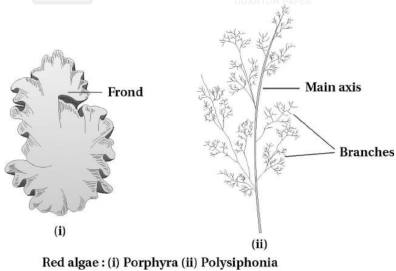
0 likes
View Solution386
Medium
Mention the classes of Algae and their main characteristics.
Solution
(N/A) The algae are primarily divided into three main classes based on their pigments and other characteristics. The details are summarized in the table below:
| Class | Common Name | Major Pigments | Stored Food | Cell Wall | Flagellar Number $\&$ Position | Habitat |
|---|---|---|---|---|---|---|
| Chlorophyceae | Green algae | Chlorophyll $a, b$ | Starch | Cellulose | $2-8$,equal,apical | Fresh water,brackish water,salt water |
| Phaeophyceae | Brown algae | Chlorophyll $a, c$,Fucoxanthin | Mannitol,Laminarin | Cellulose and Algin | $2$,unequal,lateral | Fresh water (rare),brackish water,salt water |
| Rhodophyceae | Red algae | Chlorophyll $a, d$,Phycoerythrin | Floridean starch | Cellulose,Pectin,and Polysulphate esters | Absent | Fresh water (some),brackish water,salt water (mostly) |
0 likes
View Solution387
MediumMCQ
Mention the major classes of algae.
A
Chlorophyceae,Phaeophyceae,and Rhodophyceae
B
Bryophyta,Pteridophyta,and Gymnosperms
C
Cyanophyceae,Bacillariophyceae,and Euglenophyceae
D
Myxophyceae,Chlorophyceae,and Phaeophyceae
Solution
(A) Algae are primarily classified into three major classes based on their pigment composition,storage products,and cell wall structure:
$1$. $Chlorophyceae$ (Green algae): They contain chlorophyll $a$ and $b$ and store food as starch.
$2$. $Phaeophyceae$ (Brown algae): They contain chlorophyll $a, c$,and fucoxanthin,storing food as mannitol or laminarin.
$3$. $Rhodophyceae$ (Red algae): They contain chlorophyll $a, d$,and phycoerythrin,storing food as floridean starch.
$1$. $Chlorophyceae$ (Green algae): They contain chlorophyll $a$ and $b$ and store food as starch.
$2$. $Phaeophyceae$ (Brown algae): They contain chlorophyll $a, c$,and fucoxanthin,storing food as mannitol or laminarin.
$3$. $Rhodophyceae$ (Red algae): They contain chlorophyll $a, d$,and phycoerythrin,storing food as floridean starch.
0 likes
View Solution388
Medium
What are the uses of algae?
Solution
(N/A) $\rightarrow$ Algae are useful to humans in many ways.
$\rightarrow$ At least half of the total carbon dioxide fixation on Earth is carried out by algae through photosynthesis.
$\rightarrow$ Being photosynthetic,they increase the level of dissolved oxygen in their immediate environment.
$\rightarrow$ They are of paramount importance as primary producers of energy-rich compounds,which form the basis of the food cycles of all aquatic animals.
$\rightarrow$ Many species of $Porphyra$,$Laminaria$,and $Sargassum$ are among the $70$ species of marine algae used as food.
$\rightarrow$ Certain marine brown and red algae produce large amounts of hydrocolloids (water-holding substances),e.g.,algin (brown algae) and carrageen (red algae),which are used commercially.
$\rightarrow$ Agar,a commercial product obtained from $Gelidium$ and $Gracilaria$,is used to grow microbes and in the preparation of ice creams and jellies.
$\rightarrow$ $Chlorella$ and $Spirulina$ are unicellular algae,rich in proteins,and are used as food supplements even by space travelers.
$\rightarrow$ At least half of the total carbon dioxide fixation on Earth is carried out by algae through photosynthesis.
$\rightarrow$ Being photosynthetic,they increase the level of dissolved oxygen in their immediate environment.
$\rightarrow$ They are of paramount importance as primary producers of energy-rich compounds,which form the basis of the food cycles of all aquatic animals.
$\rightarrow$ Many species of $Porphyra$,$Laminaria$,and $Sargassum$ are among the $70$ species of marine algae used as food.
$\rightarrow$ Certain marine brown and red algae produce large amounts of hydrocolloids (water-holding substances),e.g.,algin (brown algae) and carrageen (red algae),which are used commercially.
$\rightarrow$ Agar,a commercial product obtained from $Gelidium$ and $Gracilaria$,is used to grow microbes and in the preparation of ice creams and jellies.
$\rightarrow$ $Chlorella$ and $Spirulina$ are unicellular algae,rich in proteins,and are used as food supplements even by space travelers.
0 likes
View Solution389
Medium
Give common characteristics of green algae or Chlorophyceae.
Solution
(N/A) $\rightarrow$ Structure and characteristics:
$\rightarrow$ The plant body may be unicellular,colonial,or filamentous.
$\rightarrow$ They are usually grass green due to the dominance of pigments chlorophyll $a$ and $b$.
$\rightarrow$ The pigments are localized in definite chloroplasts. The chloroplasts may be discoid,plate-like,reticulate,cup-shaped,spiral,or ribbon-shaped in different species.
$\rightarrow$ Most of the members have one or more storage bodies called pyrenoids located in the chloroplasts.
$\rightarrow$ Pyrenoids contain protein besides starch.
$\rightarrow$ Green algae usually have a rigid cell wall made of an inner layer of cellulose and an outer layer of pectose.
$\rightarrow$ The plant body may be unicellular,colonial,or filamentous.
$\rightarrow$ They are usually grass green due to the dominance of pigments chlorophyll $a$ and $b$.
$\rightarrow$ The pigments are localized in definite chloroplasts. The chloroplasts may be discoid,plate-like,reticulate,cup-shaped,spiral,or ribbon-shaped in different species.
$\rightarrow$ Most of the members have one or more storage bodies called pyrenoids located in the chloroplasts.
$\rightarrow$ Pyrenoids contain protein besides starch.
$\rightarrow$ Green algae usually have a rigid cell wall made of an inner layer of cellulose and an outer layer of pectose.
0 likes
View Solution390
MediumMCQ
How does reproduction occur in Phaeophyceae?
A
Vegetative reproduction only
B
Vegetative,asexual,and sexual reproduction
C
Asexual reproduction only
D
Sexual reproduction only
Solution
(B) In $Phaeophyceae$ (brown algae),reproduction occurs through three methods:
$1$. Vegetative reproduction: It takes place by fragmentation.
$2$. Asexual reproduction: It occurs by biflagellate zoospores that are pear-shaped and have two laterally attached unequal flagella.
$3$. Sexual reproduction: It can be isogamous,anisogamous,or oogamous. The gametes are pyriform (pear-shaped) and bear two laterally attached flagella.
$1$. Vegetative reproduction: It takes place by fragmentation.
$2$. Asexual reproduction: It occurs by biflagellate zoospores that are pear-shaped and have two laterally attached unequal flagella.
$3$. Sexual reproduction: It can be isogamous,anisogamous,or oogamous. The gametes are pyriform (pear-shaped) and bear two laterally attached flagella.
0 likes
View Solution391
Easy
Give common characteristics of red algae.
Solution
(N/A) $\rightarrow$ Majority of the red algae are marine with greater concentrations found in warmer areas.
$\rightarrow$ They occur in both well-lighted regions close to the surface of water and also at great depths in oceans where relatively little light penetrates.
$\rightarrow$ Body structure: The thalli of most of the red algae are multicellular. Some of them have complex body organization.
$\rightarrow$ Stored food: The food is stored as floridean starch,which is very similar to amylopectin and glycogen in structure.
$\rightarrow$ They occur in both well-lighted regions close to the surface of water and also at great depths in oceans where relatively little light penetrates.
$\rightarrow$ Body structure: The thalli of most of the red algae are multicellular. Some of them have complex body organization.
$\rightarrow$ Stored food: The food is stored as floridean starch,which is very similar to amylopectin and glycogen in structure.
0 likes
View Solution392
Easy
Describe the types of reproduction in red algae (Rhodophyceae).
Solution
(N/A) Red algae,belonging to the class $Rhodophyceae$,exhibit three main modes of reproduction:
$1$. Vegetative reproduction: This occurs primarily through fragmentation of the thallus.
$2$. Asexual reproduction: This takes place through the formation of non-motile spores. Since red algae lack flagella at all stages of their life cycle,they produce non-motile spores such as monospores,neutral spores,and tetraspores.
$3$. Sexual reproduction: This is of the oogamous type. It involves complex post-fertilization developments. The male sex organ is called the spermatangium,which produces non-motile male gametes known as spermatium. The female sex organ is called the carpogonium,which possesses a receptive neck-like structure called the trichogyne.
$1$. Vegetative reproduction: This occurs primarily through fragmentation of the thallus.
$2$. Asexual reproduction: This takes place through the formation of non-motile spores. Since red algae lack flagella at all stages of their life cycle,they produce non-motile spores such as monospores,neutral spores,and tetraspores.
$3$. Sexual reproduction: This is of the oogamous type. It involves complex post-fertilization developments. The male sex organ is called the spermatangium,which produces non-motile male gametes known as spermatium. The female sex organ is called the carpogonium,which possesses a receptive neck-like structure called the trichogyne.
0 likes
View Solution393
Medium
Algae are known to reproduce asexually by a variety of spores under different environmental conditions. Name these spores and the conditions under which they are produced.
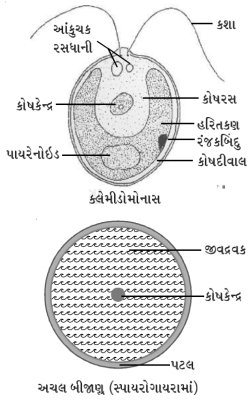
Solution
(N/A) Algae reproduce asexually by a variety of spores under different environmental conditions.
These spores and the conditions under which they are produced are as follows:
$(a)$ Zoospores: These are flagellated,motile spores. They are produced under favourable conditions.
$(b)$ Aplanospores: These are thin-walled,non-motile spores. They are produced under unfavourable conditions.
$(c)$ Hypnospores: These are thick-walled spores that help the organism survive during highly unfavourable conditions.
$(d)$ Akinetes: These are thick-walled,non-motile resting spores formed from vegetative cells,typically under unfavourable conditions.
These spores and the conditions under which they are produced are as follows:
$(a)$ Zoospores: These are flagellated,motile spores. They are produced under favourable conditions.
$(b)$ Aplanospores: These are thin-walled,non-motile spores. They are produced under unfavourable conditions.
$(c)$ Hypnospores: These are thick-walled spores that help the organism survive during highly unfavourable conditions.
$(d)$ Akinetes: These are thick-walled,non-motile resting spores formed from vegetative cells,typically under unfavourable conditions.
0 likes
View Solution394
MediumMCQ
Apart from chlorophyll,algae have several other pigments in their chloroplasts. Which pigments are found in blue-green algae $(BGA)$,red algae,and brown algae,that are responsible for their characteristic colours?
A
Blue-green: Phycocyanin; Red: Phycoerythrin; Brown: Fucoxanthin
B
Blue-green: Phycoerythrin; Red: Phycocyanin; Brown: Fucoxanthin
C
Blue-green: Fucoxanthin; Red: Phycoerythrin; Brown: Phycocyanin
D
Blue-green: Chlorophyll $c$; Red: Chlorophyll $d$; Brown: Chlorophyll $b$
Solution
(A) The characteristic colours of algae are due to the presence of specific accessory pigments in addition to chlorophylls.
$1$. Blue-green algae ($BGA$ or Cyanobacteria) contain phycocyanin,which gives them their characteristic blue-green colour.
$2$. Red algae (Rhodophyceae) contain a large amount of r-phycoerythrin,which masks the green colour of chlorophyll and imparts a red appearance.
$3$. Brown algae (Phaeophyceae) contain high levels of fucoxanthin,a xanthophyll pigment that provides their characteristic brown colour.
Therefore,the correct pigments are: Blue-green: Phycocyanin; Red: Phycoerythrin; Brown: Fucoxanthin.
$1$. Blue-green algae ($BGA$ or Cyanobacteria) contain phycocyanin,which gives them their characteristic blue-green colour.
$2$. Red algae (Rhodophyceae) contain a large amount of r-phycoerythrin,which masks the green colour of chlorophyll and imparts a red appearance.
$3$. Brown algae (Phaeophyceae) contain high levels of fucoxanthin,a xanthophyll pigment that provides their characteristic brown colour.
Therefore,the correct pigments are: Blue-green: Phycocyanin; Red: Phycoerythrin; Brown: Fucoxanthin.
0 likes
View Solution395
Medium
Give differences: Brown Algae (Phaeophyceae) and Red Algae (Rhodophyceae).
Solution
(N/A)
| Brown Algae (Phaeophyceae) | Red Algae (Rhodophyceae) |
|---|---|
| $(1)$ Main pigments are chlorophyll-$a, c$ and fucoxanthin. | $(1)$ Main pigments are chlorophyll-$a, d$ and phycoerythrin. |
| $(2)$ Stored food is in the form of mannitol and laminarin. | $(2)$ Stored food is in the form of floridean starch. |
| $(3)$ Cell wall is composed of cellulose and algin. | $(3)$ Cell wall is composed of cellulose,pectin,and polysulphate esters. |
| $(4)$ Example: $Sargassum$. | $(4)$ Example: $Polysiphonia$. |
0 likes
View Solution396
Medium
Give scientific reasons: Algae are the most important primary producers.
Solution
(N/A) $\rightarrow$ At least half of the total carbon dioxide fixation on the earth is carried out by algae through photosynthesis.
Being photosynthetic,they increase the level of dissolved oxygen in their immediate environment.
They form the basis of food cycles for aquatic animals.
Many marine algae are used as food,and they also produce commercial products such as Algin and Carrageen.
Being photosynthetic,they increase the level of dissolved oxygen in their immediate environment.
They form the basis of food cycles for aquatic animals.
Many marine algae are used as food,and they also produce commercial products such as Algin and Carrageen.
0 likes
View Solution397
MediumMCQ
Define the following terms:
$(i)$ Anisogamous
$(ii)$ Oogamous
$(i)$ Anisogamous
$(ii)$ Oogamous
A
Anisogamous: Fusion of two gametes dissimilar in size.
B
Oogamous: Fusion of a large non-motile female gamete and a small motile male gamete.
C
Both $(i)$ and $(ii)$ are types of sexual reproduction.
D
None of the above.
Solution
(B) $(i)$ Anisogamous: This is a type of sexual reproduction involving the fusion of two gametes that are morphologically dissimilar in size (e.g.,in some species of Chlamydomonas).
$(ii)$ Oogamous: This is a type of sexual reproduction where fusion occurs between one large,non-motile (static) female gamete and a small,motile (flagellated) male gamete (e.g.,Volvox,Fucus).
$(ii)$ Oogamous: This is a type of sexual reproduction where fusion occurs between one large,non-motile (static) female gamete and a small,motile (flagellated) male gamete (e.g.,Volvox,Fucus).
0 likes
View Solution398
EasyMCQ
Provide the answers for the following analogy-based questions:
$(i)$ Flagellated : Zoospore :: Non-flagellated : ........
$(ii)$ Volvox : Colonial :: Spirogyra : .....
$(i)$ Flagellated : Zoospore :: Non-flagellated : ........
$(ii)$ Volvox : Colonial :: Spirogyra : .....
A
Aplanospore,Filamentous
B
Zygospore,Unicellular
C
Akinete,Colonial
D
Hypnospore,Thalloid
Solution
(A) $(i)$ In algae,zoospores are motile,flagellated asexual spores. Conversely,non-flagellated,non-motile asexual spores are known as aplanospores.
$(ii)$ Volvox is a colonial form of green algae. Spirogyra is a filamentous form of green algae,consisting of unbranched chains of cells.
$(ii)$ Volvox is a colonial form of green algae. Spirogyra is a filamentous form of green algae,consisting of unbranched chains of cells.
0 likes
View Solution399
EasyMCQ
Food is stored as floridean starch in Rhodophyceae. Mannitol is the reserve food material of which group of algae?
A
Chlorophyceae
B
Phaeophyceae
C
Rhodophyceae
D
Cyanophyceae
Solution
(B) In members of the class Phaeophyceae (brown algae),the stored food material is complex carbohydrates,which may be in the form of laminarin or mannitol. Therefore,mannitol is the reserve food material found in Phaeophyceae.
0 likes
View SolutionPlant Kingdom — Algae (General) · Frequently Asked Questions
1Are these Plant Kingdom questions useful for JEE and NEET?
Yes. All questions in this section are mapped to JEE Main and NEET exam patterns. Previous year questions from JEE Main, NEET, GUJCET and state-level exams are included with full solutions.
2Can I switch to Hindi or Gujarati for these questions?
Yes. Use the language tabs in the hero section or the sidebar to view the same questions and solutions in English, Hindi or Gujarati.
3How do I generate a question paper from this subtopic?
Use the Vedclass Exam Paper Generator — select the chapter and subtopic, set difficulty, and generate Sets A, B, C, D automatically. First 3 chapters of every subject are free.
Vedclass Products
For Students
Vedclass Test Series
Mock tests in real JEE/NEET style with performance analysis. 5-day free trial.
Start Free TrialFor Teachers
Exam Paper Generator
Generate Set A/B/C/D papers from this chapter in 2 minutes. 3 chapters free.
Try FreeFor Institutes
Online Exam Module
Live online exams with unlimited students, 360° analytics & white-label branding.
See DemoFor Teachers & Institutes
Generate a Plant Kingdom Exam Paper in 2 Minutes
Select subtopic & difficulty — Sets A, B, C, D auto-generated with No Repeat logic.
First 3 chapters of every subject are free — no payment required.