
A English
Algae (General) Questions in English
Class 11 Biology · Plant Kingdom · Algae (General)
526+
Questions
English
Language
100%
With Solutions
Showing 50 of 526 questions in English
451
MediumMCQ
An alga which exhibits a diplontic life cycle is
A
Spirogyra
B
Fucus
C
Polysiphonia
D
Ulothrix
Solution
(B) In a diplontic life cycle,the diploid sporophyte is the dominant,photosynthetic,and independent phase of the plant.
- The gametophytic phase is represented by the single to few-celled haploid gametophyte.
- Among the given options,$Fucus$ is a brown alga that exhibits a diplontic life cycle.
- $Spirogyra$,$Ulothrix$,and $Polysiphonia$ exhibit haplontic or haplo-diplontic life cycles.
- The gametophytic phase is represented by the single to few-celled haploid gametophyte.
- Among the given options,$Fucus$ is a brown alga that exhibits a diplontic life cycle.
- $Spirogyra$,$Ulothrix$,and $Polysiphonia$ exhibit haplontic or haplo-diplontic life cycles.
0 likes
View Solution452
MediumMCQ
The thallus organisation of $Volvox$ is
A
Multicellular and coccoid
B
Colonial and nonflagellate
C
Unicellular
D
Colonial and motile
Solution
(D) $Volvox$ is a green alga that exists as a colony of cells.
Each colony is spherical and consists of hundreds to thousands of cells embedded in a gelatinous matrix.
These cells possess flagella,which allow the entire colony to move through the water,making it colonial and motile.
Each colony is spherical and consists of hundreds to thousands of cells embedded in a gelatinous matrix.
These cells possess flagella,which allow the entire colony to move through the water,making it colonial and motile.
0 likes
View Solution453
MediumMCQ
Brown algae are quite common in
A
Fresh water habitats
B
Tropical sea water
C
Temperate sea water
D
Both $(b)$ and $(c)$
Solution
(C) Brown algae (Phaeophyceae) exhibit a great variation in size and form. They range from simple branched,filamentous forms to profusely branched forms. They are primarily marine organisms and are found in great abundance in temperate sea water,although some species can also be found in tropical regions.
0 likes
View Solution454
MediumMCQ
Algae with floridean starch as reserve food material is also characterised by
A
Presence of chlorophyll $b$
B
Stacked thylakoids
C
Nonsulphated phycocolloids
D
Nonflagellate nature
Solution
(D) Red algae (Rhodophyceae) store food as floridean starch,which is very similar to amylopectin and glycogen in structure.
They are also characterized by the complete absence of flagella at any stage of their life cycle,making them nonflagellate.
They are also characterized by the complete absence of flagella at any stage of their life cycle,making them nonflagellate.
0 likes
View Solution455
MediumMCQ
$100$ zygospores,alternating with empty cells in Spirogyra,are formed under ................. conjugation and the total number of daughter filaments formed will be ..........................
A
Scalariform,$400$
B
Lateral,$100$
C
Lateral,$400$
D
Scalariform,$100$
Solution
(B) In Spirogyra,conjugation is of two types: lateral and scalariform.
Lateral conjugation occurs between adjacent cells of the same filament,resulting in empty cells alternating with zygospores.
Scalariform conjugation occurs between cells of two different filaments,resulting in zygospores in one of the filaments while the other becomes empty.
Since the question specifies that zygospores alternate with empty cells within the same filament,it refers to lateral conjugation.
Each zygospore undergoes meiosis to produce $4$ haploid nuclei. Out of these $4$ nuclei,$3$ degenerate and only $1$ remains functional to form a germ tube,which develops into a new daughter filament.
Therefore,$100$ zygospores will produce $100$ new daughter filaments.
Lateral conjugation occurs between adjacent cells of the same filament,resulting in empty cells alternating with zygospores.
Scalariform conjugation occurs between cells of two different filaments,resulting in zygospores in one of the filaments while the other becomes empty.
Since the question specifies that zygospores alternate with empty cells within the same filament,it refers to lateral conjugation.
Each zygospore undergoes meiosis to produce $4$ haploid nuclei. Out of these $4$ nuclei,$3$ degenerate and only $1$ remains functional to form a germ tube,which develops into a new daughter filament.
Therefore,$100$ zygospores will produce $100$ new daughter filaments.

0 likes
View Solution456
EasyMCQ
Algin is a phycocolloid,obtained from the cell wall of
A
Macrocystis and Porphyridium
B
Mastigocladus and Laminaria
C
Microcystis and Nereocystis
D
Macrocystis and Fucus
Solution
(D) Algin is a phycocolloid (hydrocolloid) found in the cell wall of brown algae (Phaeophyceae).
Examples of brown algae that produce algin include $Macrocystis$,$Fucus$,and $Laminaria$.
Therefore,among the given options,$Macrocystis$ and $Fucus$ are the correct representatives.
Examples of brown algae that produce algin include $Macrocystis$,$Fucus$,and $Laminaria$.
Therefore,among the given options,$Macrocystis$ and $Fucus$ are the correct representatives.
0 likes
View Solution457
EasyMCQ
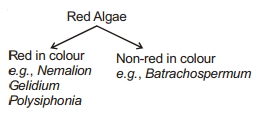
Which of the following is a red alga that is not red?
A
Nemalion
B
Polysiphonia
C
Gelidium
D
Batrachospermum
Solution
(D) Red algae (Rhodophyceae) typically appear red due to the presence of the pigment $r$-phycoerythrin. However,some species do not exhibit a red color. Among the given options,$Batrachospermum$ is a freshwater red alga that appears bluish-green or violet-brown rather than red. Therefore,it is a red alga that is not red.
0 likes
View Solution458
EasyMCQ
In $Chlorophyceae$,the flagella are:
A
Tinsel type
B
Whiplash type
C
Whiplash and tinsel type
D
Basal tinsel,apical whiplash type
Solution
(B) In $Chlorophyceae$ (green algae),the flagella are of the whiplash type. These flagella are typically equal in number and apical in position.
0 likes
View Solution459
EasyMCQ
Which of the following are useful for curing goitre?
A
Sea kelps
B
Diatoms
C
Red algae
D
Porphyra
Solution
(A) Sea kelps are rich sources of iodine $(I_2)$ and bromine $(Br_2)$. Iodine is an essential trace element required for the synthesis of thyroid hormones,and its deficiency leads to goitre. Therefore,sea kelps are useful for curing goitre.
0 likes
View Solution460
MediumMCQ
Non-motile gametes are characteristically found in
A
Cyanophyta
B
Rhodophyta
C
Phaeophyta
D
Chlorophyta
Solution
(B) In the division $Rhodophyta$ (red algae),the life cycle is characterized by the complete absence of flagellated stages. Both male and female gametes are non-motile. The male gamete is known as a spermatium,which is carried by water currents to the female reproductive organ,the carpogonium. Therefore,non-motile gametes are a characteristic feature of $Rhodophyta$.
0 likes
View Solution461
EasyMCQ
The female sex organ in red algae is flask-shaped and is known as
A
Trichogyne
B
Carpogonium
C
Spermatium
D
Archegonium
Solution
(B) In red algae (Rhodophyceae),the female sex organ is a specialized structure called the carpogonium. It is flask-shaped and consists of a swollen basal portion containing the egg and an elongated neck-like structure known as the trichogyne,which receives the male gametes (spermatia).
0 likes
View Solution462
MediumMCQ
Some characters of algae are given below:
$a.$ Floridean starch
$b.$ Sulphated phycocolloids in cell wall
$c.$ Alginic acid
$d.$ Trumpet hypha
$e.$ Haplodiplontic life cycle
$f.$ Isomorphic alternation of generation
$g.$ Fucoxanthin
$h.$ Phycoerythrin
$i.$ Zygotic meiosis
$j.$ Two anterior flagella
Which of the given set of characters belongs to $Laminaria$?
$a.$ Floridean starch
$b.$ Sulphated phycocolloids in cell wall
$c.$ Alginic acid
$d.$ Trumpet hypha
$e.$ Haplodiplontic life cycle
$f.$ Isomorphic alternation of generation
$g.$ Fucoxanthin
$h.$ Phycoerythrin
$i.$ Zygotic meiosis
$j.$ Two anterior flagella
Which of the given set of characters belongs to $Laminaria$?
A
$a, b, e, f, h$
B
$c, d, e, g$
C
$b, c, d, e, f, g, i$
D
$c, d, e, f, g, i$
Solution
(B) $Laminaria$ is a member of Phaeophyceae (brown algae).
Its characteristic features include:
- $c.$ Alginic acid (present in the cell wall of brown algae).
- $d.$ Trumpet hyphae (specialized cells found in the medulla of large brown algae like $Laminaria$).
- $e.$ Haplodiplontic life cycle (common in most brown algae).
- $g.$ Fucoxanthin (the pigment responsible for the brown color).
Therefore,the correct set is $c, d, e, g$.
Its characteristic features include:
- $c.$ Alginic acid (present in the cell wall of brown algae).
- $d.$ Trumpet hyphae (specialized cells found in the medulla of large brown algae like $Laminaria$).
- $e.$ Haplodiplontic life cycle (common in most brown algae).
- $g.$ Fucoxanthin (the pigment responsible for the brown color).
Therefore,the correct set is $c, d, e, g$.
0 likes
View Solution463
MediumMCQ
$A$ : Thallophytes are non-vascular,non-archegoniate and non-cormophytic plants.
$R$ : Thallophytes lack vascular bundles,archegonia and differentiated plant body.
$R$ : Thallophytes lack vascular bundles,archegonia and differentiated plant body.
A
Assertion and Reason both are correct and Reason is the correct explanation of Assertion.
B
Assertion and Reason both are correct but Reason is not the correct explanation of Assertion.
C
Assertion is correct,but Reason is incorrect.
D
Both Assertion and Reason are incorrect.
Solution
(A) Thallophytes (primarily Algae) are characterized by a simple,undifferentiated plant body known as a thallus.
They lack specialized vascular tissues ($Xylem$ and $Phloem$),which makes them non-vascular.
They do not possess archegonia (female sex organs found in Bryophytes,Pteridophytes,and Gymnosperms),making them non-archegoniate.
They lack a true root,stem,and leaf system,which makes them non-cormophytic.
Since the Reason accurately explains the structural characteristics that define the Thallophytes mentioned in the Assertion,both are correct and the Reason is the correct explanation.
They lack specialized vascular tissues ($Xylem$ and $Phloem$),which makes them non-vascular.
They do not possess archegonia (female sex organs found in Bryophytes,Pteridophytes,and Gymnosperms),making them non-archegoniate.
They lack a true root,stem,and leaf system,which makes them non-cormophytic.
Since the Reason accurately explains the structural characteristics that define the Thallophytes mentioned in the Assertion,both are correct and the Reason is the correct explanation.
0 likes
View Solution464
MediumMCQ
$A$: Pyrenoids may or may not be surrounded by a sheath of starch plates in algae.
$R$: In higher plants,these are replaced by amyloplasts.
$R$: In higher plants,these are replaced by amyloplasts.
A
Assertion and Reason both are correct and Reason is the correct explanation of Assertion.
B
Assertion and Reason both are correct but Reason is not the correct explanation of Assertion.
C
Assertion is correct,but Reason is incorrect.
D
Both Assertion and Reason are incorrect.
Solution
(B) Pyrenoids are proteinaceous storage bodies found in the chloroplasts of many algae. They often contain starch,which may be present as a sheath around the protein core. In higher plants,specialized plastids called amyloplasts are responsible for the storage of starch,effectively serving a similar storage function as pyrenoids in algae. Therefore,both the Assertion and the Reason are scientifically correct statements.
0 likes
View Solution465
MediumMCQ
$A$ : Sexual reproduction shows considerable variation in the type and formation of sex cells in members of $Chlorophyceae$.
$R$ : It may be isogamous,anisogamous and oogamous.
$R$ : It may be isogamous,anisogamous and oogamous.
A
Assertion and Reason both are correct and Reason is the correct explanation of Assertion.
B
Assertion and Reason both are correct but Reason is not the correct explanation of Assertion.
C
Assertion is correct,but Reason is incorrect.
D
Both Assertion and Reason are incorrect.
Solution
(A) In $Chlorophyceae$ (green algae),sexual reproduction exhibits significant diversity. It can occur through the fusion of gametes that are similar in size (isogamous),dissimilar in size (anisogamous),or through the fusion of a large non-motile female gamete and a smaller motile male gamete (oogamous). Since the variation in the type and formation of sex cells is directly explained by the occurrence of these three modes of reproduction,the Reason correctly explains the Assertion.
0 likes
View Solution466
MediumMCQ
Isogamous condition with non-flagellated gametes is found in:
A
Spirogyra
B
Volvox
C
Fucus
D
Chlamydomonas
Solution
(A) Isogamy refers to the fusion of morphologically similar gametes.
In $Spirogyra$,the gametes are non-flagellated (non-motile) and morphologically similar,representing a condition of isogamy.
$Volvox$ and $Fucus$ exhibit oogamy (fusion of large non-motile egg and small motile sperm).
$Chlamydomonas$ exhibits isogamy,but its gametes are flagellated (motile).
In $Spirogyra$,the gametes are non-flagellated (non-motile) and morphologically similar,representing a condition of isogamy.
$Volvox$ and $Fucus$ exhibit oogamy (fusion of large non-motile egg and small motile sperm).
$Chlamydomonas$ exhibits isogamy,but its gametes are flagellated (motile).
0 likes
View Solution467
EasyMCQ
The most common asexual structure produced in algae is:
A
Thick-walled
B
Multicellular
C
Flagellated
D
Produced in chains
Solution
(C) The most common asexual reproductive structures in algae are zoospores. Zoospores are microscopic,motile structures that possess flagella,which allow them to swim in water to find suitable conditions for germination.
0 likes
View Solution468
MediumMCQ
Chara possesses:
A
Sex organs above nodes
B
Multicellular and jacketed sex organs
C
D
Both $(b)$ & $(c)$
Solution
(D) Chara is a green alga that exhibits a complex reproductive structure.
It possesses multicellular and jacketed sex organs, which is a characteristic feature.
The male sex organ is known as the Globule $( male )$, and the female sex organ is known as the Nucule $( female )$.
Therefore, both statements $(b)$ and $(c)$ are correct.
It possesses multicellular and jacketed sex organs, which is a characteristic feature.
The male sex organ is known as the Globule $( male )$, and the female sex organ is known as the Nucule $( female )$.
Therefore, both statements $(b)$ and $(c)$ are correct.
0 likes
View Solution469
MediumMCQ
$A$: Most of the species of $Chara$ are monoecious but show cross-fertilization.
$R$: The plant body shows protandrous condition.
$R$: The plant body shows protandrous condition.
A
Assertion and Reason both are correct and Reason is the correct explanation of Assertion.
B
Assertion and Reason both are correct but Reason is not the correct explanation of Assertion.
C
Assertion is correct,but Reason is incorrect.
D
Both Assertion and Reason are incorrect.
Solution
(A) In $Chara$,the plant body is monoecious,meaning both male (antheridium) and female (oogonium) sex organs are present on the same plant.
However,$Chara$ exhibits a condition known as protandry,where the male sex organs (antheridia) mature earlier than the female sex organs (oogonia).
Because the male gametes are released before the female gametes are ready for fertilization,self-fertilization is prevented,and the plant undergoes cross-fertilization.
Therefore,both the Assertion and the Reason are correct,and the Reason is the correct explanation for the Assertion.
However,$Chara$ exhibits a condition known as protandry,where the male sex organs (antheridia) mature earlier than the female sex organs (oogonia).
Because the male gametes are released before the female gametes are ready for fertilization,self-fertilization is prevented,and the plant undergoes cross-fertilization.
Therefore,both the Assertion and the Reason are correct,and the Reason is the correct explanation for the Assertion.
0 likes
View Solution470
MediumMCQ
$A$ : $Fucus$,a brown alga shows oogamy.
$R$ : Female gamete is quite large as compared to the male gamete.
$R$ : Female gamete is quite large as compared to the male gamete.
A
Assertion and Reason both are correct and Reason is the correct explanation of Assertion.
B
Assertion and Reason both are correct but Reason is not the correct explanation of Assertion.
C
Assertion is correct,but Reason is incorrect.
D
Both Assertion and Reason are incorrect.
Solution
(A) $Fucus$ is a genus of brown algae (Phaeophyceae) that exhibits oogamy.
Oogamy is a form of sexual reproduction where a large,non-motile (or less motile) female gamete (egg) fuses with a smaller,motile male gamete (sperm/antherozoid).
Since the female gamete is significantly larger and non-motile compared to the male gamete,the definition of oogamy is satisfied.
Therefore,both the Assertion and the Reason are correct,and the Reason provides the correct explanation for why $Fucus$ exhibits oogamy.
Oogamy is a form of sexual reproduction where a large,non-motile (or less motile) female gamete (egg) fuses with a smaller,motile male gamete (sperm/antherozoid).
Since the female gamete is significantly larger and non-motile compared to the male gamete,the definition of oogamy is satisfied.
Therefore,both the Assertion and the Reason are correct,and the Reason provides the correct explanation for why $Fucus$ exhibits oogamy.
0 likes
View Solution471
MediumMCQ
$A$ : In $Volvox$,heterogametes are formed in the sexual life cycle.
$R$ : Non-motile gametes are transferred by water.
$R$ : Non-motile gametes are transferred by water.
A
Assertion and Reason both are correct and Reason is the correct explanation of Assertion.
B
Assertion and Reason both are correct but Reason is not the correct explanation of Assertion.
C
Assertion is correct,but Reason is incorrect.
D
Both Assertion and Reason are incorrect.
Solution
(C) $Volvox$ is an alga that exhibits oogamy,which is a type of heterogamy where the male gamete is small and motile (flagellated) and the female gamete is large and non-motile.
Since the male gametes are motile and swim to reach the female gamete,the statement that non-motile gametes are transferred by water is incorrect.
Therefore,the Assertion is correct,but the Reason is incorrect.
Since the male gametes are motile and swim to reach the female gamete,the statement that non-motile gametes are transferred by water is incorrect.
Therefore,the Assertion is correct,but the Reason is incorrect.
0 likes
View Solution472
MediumMCQ
Match Column $I$ with Column $II$ and choose the correct option:
| Column $I$ | Column $II$ |
|---|---|
| $a.$ Shallowest depth | $(i)$ Green algae |
| $b.$ Intermediate depth | $(ii)$ Brown algae |
| $c.$ Greatest depth | $(iii)$ Red algae |
A
$a(i), b(ii), c(iii)$
B
$a(i), b(iii), c(ii)$
C
$a(ii), b(i), c(iii)$
D
$a(ii), b(iii), c(i)$
Solution
(A) The distribution of algae in the ocean depends on the penetration of light at different depths.
$1.$ Green algae (Chlorophyceae) are found at the shallowest depths because they require high light intensity for photosynthesis.
$2.$ Brown algae (Phaeophyceae) are found at intermediate depths.
$3.$ Red algae (Rhodophyceae) are found at the greatest depths because they can perform photosynthesis even in low light conditions using their accessory pigments (phycoerythrin).
Therefore,the correct matching is $a(i), b(ii), c(iii)$.
$1.$ Green algae (Chlorophyceae) are found at the shallowest depths because they require high light intensity for photosynthesis.
$2.$ Brown algae (Phaeophyceae) are found at intermediate depths.
$3.$ Red algae (Rhodophyceae) are found at the greatest depths because they can perform photosynthesis even in low light conditions using their accessory pigments (phycoerythrin).
Therefore,the correct matching is $a(i), b(ii), c(iii)$.
0 likes
View Solution473
MediumMCQ
Which of the following algae produce carrageen?
A
Green algae
B
Brown algae
C
Red algae
D
Blue-green algae
Solution
(C) Carrageen is a type of phycocolloid,which is a gelatinous substance extracted from the cell walls of certain marine algae.
Specifically,carrageen is obtained from the cell walls of red algae (Rhodophyceae).
These substances are widely used in the food and pharmaceutical industries as thickening and stabilizing agents.
Therefore,the correct option is $C$.
Specifically,carrageen is obtained from the cell walls of red algae (Rhodophyceae).
These substances are widely used in the food and pharmaceutical industries as thickening and stabilizing agents.
Therefore,the correct option is $C$.
0 likes
View Solution474
MediumMCQ
In which of the following algae is mannitol stored as reserve food material?
A
Gracilaria
B
Ectocarpus
C
Volvox
D
Ulothrix
Solution
(B) The reserve food material in algae varies according to the class:
$1$. Phaeophyceae (Brown algae) store food as complex carbohydrates,usually in the form of mannitol or laminarin.
$2$. Ectocarpus belongs to the class Phaeophyceae.
$3$. Gracilaria belongs to Rhodophyceae (Red algae),which stores food as floridean starch.
$4$. Volvox and Ulothrix belong to Chlorophyceae (Green algae),which store food as starch.
$1$. Phaeophyceae (Brown algae) store food as complex carbohydrates,usually in the form of mannitol or laminarin.
$2$. Ectocarpus belongs to the class Phaeophyceae.
$3$. Gracilaria belongs to Rhodophyceae (Red algae),which stores food as floridean starch.
$4$. Volvox and Ulothrix belong to Chlorophyceae (Green algae),which store food as starch.
0 likes
View Solution475
DifficultMCQ
Hydrocolloid carrageen is obtained from:
A
Phaeophyceae and Rhodophyceae
B
Rhodophyceae only
C
Phaeophyceae only
D
Chlorophyceae and Phaeophyceae
Solution
(B) Hydrocolloids are water-holding substances.
Carrageen is a specific type of hydrocolloid obtained from the cell wall of red algae,which belong to the class $Rhodophyceae$.
Brown algae $(Phaeophyceae)$ produce algin,while red algae $(Rhodophyceae)$ produce carrageen.
Therefore,the correct option is $B$.
Carrageen is a specific type of hydrocolloid obtained from the cell wall of red algae,which belong to the class $Rhodophyceae$.
Brown algae $(Phaeophyceae)$ produce algin,while red algae $(Rhodophyceae)$ produce carrageen.
Therefore,the correct option is $B$.
0 likes
View Solution476
MediumMCQ
Which of the following is incorrectly matched?
A
Ullothrix - Mannitol
B
Porphyra - Floridean Starch
C
Volvox - Starch
D
Ectocarpus - Fucoxanthin
Solution
(A) $Ullothrix$ is a green alga (Chlorophyceae),and its stored food is starch,not mannitol. Mannitol is the stored food in brown algae (Phaeophyceae).
$Porphyra$ is a red alga (Rhodophyceae),and its stored food is Floridean starch,which is correctly matched.
$Volvox$ is a green alga (Chlorophyceae),and its stored food is starch,which is correctly matched.
$Ectocarpus$ is a brown alga (Phaeophyceae),and it contains the pigment Fucoxanthin,which is correctly matched.
Therefore,the incorrect match is $Ullothrix - Mannitol$.
$Porphyra$ is a red alga (Rhodophyceae),and its stored food is Floridean starch,which is correctly matched.
$Volvox$ is a green alga (Chlorophyceae),and its stored food is starch,which is correctly matched.
$Ectocarpus$ is a brown alga (Phaeophyceae),and it contains the pigment Fucoxanthin,which is correctly matched.
Therefore,the incorrect match is $Ullothrix - Mannitol$.
0 likes
View Solution477
MediumMCQ
What is the habitat of algae?
A
Moist stones,soils,and wood
B
Symbiotic association with fungi
C
On polar bears
D
All of the above
Solution
(D) Algae are chlorophyll-bearing,simple,thalloid,autotrophic,and largely aquatic organisms.
They occur in a variety of habitats:
$1$. They are found in moist stones,soils,and wood.
$2$. Some algae form symbiotic associations with fungi (e.g.,lichens) and animals (e.g.,on sloth bears).
$3$. They are also found in marine and freshwater environments.
Therefore,all the given options represent habitats or associations where algae can be found.
They occur in a variety of habitats:
$1$. They are found in moist stones,soils,and wood.
$2$. Some algae form symbiotic associations with fungi (e.g.,lichens) and animals (e.g.,on sloth bears).
$3$. They are also found in marine and freshwater environments.
Therefore,all the given options represent habitats or associations where algae can be found.
0 likes
View Solution478
MediumMCQ
Select the incorrect statement for algae.
A
Chlorophyll-bearing
B
Simple,root,stem,and leaf-bearing
C
Autotrophic
D
Largely aquatic
Solution
(B) Algae are chlorophyll-bearing,simple,thalloid,autotrophic,and largely aquatic organisms.
They do not possess true roots,stems,or leaves; instead,their plant body is a thallus.
Therefore,the statement that they are 'root,stem,and leaf-bearing' is incorrect.
They do not possess true roots,stems,or leaves; instead,their plant body is a thallus.
Therefore,the statement that they are 'root,stem,and leaf-bearing' is incorrect.
0 likes
View Solution479
MediumMCQ
Match the following columns:
| Column-$I$ | Column-$II$ |
| $P$. Unicellular | $I$. Volvox |
| $Q$. Colonial | $II$. Chlamydomonas |
| $R$. Filamentous | $III$. Ulothrix and Spirogyra |
| $S$. Massive plant body | $IV$. Kelp |
A
$(P-II), (Q-I), (R-IV), (S-III)$
B
$(P-I), (Q-II), (R-IV), (S-III)$
C
$(P-I), (Q-II), (R-III), (S-IV)$
D
$(P-II), (Q-I), (R-III), (S-IV)$
Solution
(D) The correct matching is based on the body forms of algae:
$P$. Unicellular: $Chlamydomonas$ is a unicellular green alga $(P-II)$.
$Q$. Colonial: $Volvox$ forms spherical colonies $(Q-I)$.
$R$. Filamentous: $Ulothrix$ and $Spirogyra$ have a filamentous body structure $(R-III)$.
$S$. Massive plant body: Kelps are large, massive brown algae $(S-IV)$.
Therefore, the correct sequence is $(P-II), (Q-I), (R-III), (S-IV)$.
$P$. Unicellular: $Chlamydomonas$ is a unicellular green alga $(P-II)$.
$Q$. Colonial: $Volvox$ forms spherical colonies $(Q-I)$.
$R$. Filamentous: $Ulothrix$ and $Spirogyra$ have a filamentous body structure $(R-III)$.
$S$. Massive plant body: Kelps are large, massive brown algae $(S-IV)$.
Therefore, the correct sequence is $(P-II), (Q-I), (R-III), (S-IV)$.
1 likes
View Solution480
MediumMCQ
How does asexual reproduction occur in algae?
A
By fragmentation
B
By spore formation
C
By fusion of gametes
D
All of the above
Solution
(D) Asexual reproduction in algae commonly occurs by the production of different types of spores,the most common being zoospores. These are flagellated (motile) and on germination give rise to new plants. Fragmentation is also a common method of vegetative reproduction in algae,where the thallus breaks into fragments,each of which grows into a new individual. Fusion of gametes is a characteristic of sexual reproduction,not asexual reproduction. Therefore,both fragmentation and spore formation are modes of asexual/vegetative reproduction in algae.
0 likes
View Solution481
MediumMCQ
Match the following columns:
| Column-$I$ | Column-$II$ |
|---|---|
| $P$. Oogamous | $I$. Spirogyra,Chlamydomonas |
| $Q$. Anisogamous | $II$. Volvox,Fucus |
| $R$. Isogamous | $III$. Some species of Chlamydomonas |
A
$(P-I), (Q-II), (R-III)$
B
$(P-II), (Q-III), (R-I)$
C
$(P-III), (Q-II), (R-I)$
D
$(P-I), (Q-III), (R-II)$
Solution
(B) In algae,sexual reproduction occurs through the fusion of two gametes. These gametes can be flagellated (similar in size) or non-flagellated (similar in size) as in $Isogamous$ (e.g.,$Spirogyra$,$Chlamydomonas$).
Anisogamous reproduction involves the fusion of two gametes dissimilar in size,as seen in some species of $Chlamydomonas$.
Oogamous reproduction involves the fusion of one large,non-motile (static) female gamete and a smaller,motile male gamete,as seen in $Volvox$ and $Fucus$.
Therefore,the correct matching is: $P-II, Q-III, R-I$.
Anisogamous reproduction involves the fusion of two gametes dissimilar in size,as seen in some species of $Chlamydomonas$.
Oogamous reproduction involves the fusion of one large,non-motile (static) female gamete and a smaller,motile male gamete,as seen in $Volvox$ and $Fucus$.
Therefore,the correct matching is: $P-II, Q-III, R-I$.
0 likes
View Solution482
MediumMCQ
Select the incorrect statement regarding algae.
A
At least a half of the total carbon dioxide fixation on earth is carried out by algae through photosynthesis.
B
They increase the level of dissolved oxygen in their immediate environment.
C
They are primary producers in food chains.
D
They are the basis of the food cycles of all aquatic animals.
Solution
(A) Algae are photosynthetic organisms that play a crucial role in the ecosystem.
$1$. Algae perform at least $50\%$ of the total carbon dioxide fixation on Earth through photosynthesis,not $20\%$. Therefore,option $A$ is incorrect.
$2$. Being photosynthetic,they release oxygen into the water,increasing the level of dissolved oxygen in their immediate environment.
$3$. They serve as primary producers,forming the base of food chains for all aquatic animals.
Thus,the statement in option $A$ is factually incorrect.
$1$. Algae perform at least $50\%$ of the total carbon dioxide fixation on Earth through photosynthesis,not $20\%$. Therefore,option $A$ is incorrect.
$2$. Being photosynthetic,they release oxygen into the water,increasing the level of dissolved oxygen in their immediate environment.
$3$. They serve as primary producers,forming the base of food chains for all aquatic animals.
Thus,the statement in option $A$ is factually incorrect.
0 likes
View Solution483
MediumMCQ
Hydrocolloids are obtained from red algae and brown algae,respectively,as:
A
Algin,Carrageen
B
Carrageen,Algin
C
Algin,Carotene
D
Carotene,Algin
Solution
(B) Hydrocolloids are water-holding substances.
Red algae (Rhodophyceae) produce carrageen.
Brown algae (Phaeophyceae) produce algin.
Therefore,the correct sequence is Carrageen from red algae and Algin from brown algae.
Red algae (Rhodophyceae) produce carrageen.
Brown algae (Phaeophyceae) produce algin.
Therefore,the correct sequence is Carrageen from red algae and Algin from brown algae.
0 likes
View Solution484
MediumMCQ
Agar,which is used in the growth of microorganisms and in the preparation of ice creams and jellies,is obtained from:
A
Gelidium
B
Gracilaria
C
Chlorella
D
Both $A$ and $B$
Solution
(D) Agar is a commercial product obtained from certain marine red algae.
Specifically,the red algae $Gelidium$ and $Gracilaria$ are the primary sources used to extract agar.
Agar is widely used in laboratories as a culture medium for the growth of microorganisms and in the food industry for the preparation of ice creams and jellies.
Therefore,both $Gelidium$ and $Gracilaria$ are correct sources.
Specifically,the red algae $Gelidium$ and $Gracilaria$ are the primary sources used to extract agar.
Agar is widely used in laboratories as a culture medium for the growth of microorganisms and in the food industry for the preparation of ice creams and jellies.
Therefore,both $Gelidium$ and $Gracilaria$ are correct sources.
0 likes
View Solution485
MediumMCQ
Chlorophyceae,Phaeophyceae,and Rhodophyceae are examples of which taxonomic category?
A
Species
B
Class
C
Division
D
Phylum
Solution
(B) In the classification of the plant kingdom,the suffix '-phyceae' is used to denote a $Class$.
Chlorophyceae (green algae),Phaeophyceae (brown algae),and Rhodophyceae (red algae) are the three major classes under the division Thallophyta (Algae).
Therefore,these are examples of the taxonomic category $Class$.
Chlorophyceae (green algae),Phaeophyceae (brown algae),and Rhodophyceae (red algae) are the three major classes under the division Thallophyta (Algae).
Therefore,these are examples of the taxonomic category $Class$.
0 likes
View Solution486
MediumMCQ
Match the following columns:
| Column-$I$ | Column-$II$ |
| $P$. Phaeophyceae | $I$. Red algae |
| $Q$. Chlorophyceae | $II$. Brown algae |
| $R$. Rhodophyceae | $III$. Green algae |
A
$(P-II), (Q-III), (R-I)$
B
$(P-I), (Q-III), (R-II)$
C
$(P-III), (Q-I), (R-II)$
D
$(P-II), (Q-I), (R-III)$
Solution
(A) The classification of algae is based on their pigments and stored food:
$1$. Phaeophyceae are commonly known as brown algae due to the presence of fucoxanthin.
$2$. Chlorophyceae are commonly known as green algae due to the dominance of chlorophyll $a$ and $b$.
$3$. Rhodophyceae are commonly known as red algae due to the presence of phycoerythrin.
Therefore, the correct matching is: $P-II, Q-III, R-I$.
$1$. Phaeophyceae are commonly known as brown algae due to the presence of fucoxanthin.
$2$. Chlorophyceae are commonly known as green algae due to the dominance of chlorophyll $a$ and $b$.
$3$. Rhodophyceae are commonly known as red algae due to the presence of phycoerythrin.
Therefore, the correct matching is: $P-II, Q-III, R-I$.
0 likes
View Solution487
MediumMCQ
Select the incorrect option for Chlorophyceae.
A
The plant body may be unicellular,colonial,or filamentous.
B
They appear green due to the dominance of chlorophyll $a$ and $c$.
C
Pigments are localized in definite chloroplasts.
D
They are commonly called green algae.
Solution
(B) The members of Chlorophyceae (green algae) contain chlorophyll $a$ and $b$ as the primary photosynthetic pigments. Option $B$ mentions chlorophyll $c$,which is incorrect because chlorophyll $c$ is found in Phaeophyceae (brown algae). Therefore,option $B$ is the incorrect statement.
0 likes
View Solution488
MediumMCQ
State the location and composition of pyrenoids.
A
Cytoplasm - Protein,Lipid
B
Cytoplasm - Protein,Starch
C
Chloroplast - Protein,Lipid
D
Chloroplast - Protein,Starch
Solution
(D) Pyrenoids are specialized storage bodies found in the chloroplasts of many algae.
They are composed of a central core of protein surrounded by starch plates.
Therefore,the correct location is the chloroplast,and the composition is protein and starch.
They are composed of a central core of protein surrounded by starch plates.
Therefore,the correct location is the chloroplast,and the composition is protein and starch.
0 likes
View Solution489
MediumMCQ
Select the correct option for the cell wall of green algae.
A
Inner layer of cellulose,outer layer of pectose
B
Inner layer of pectose,outer layer of cellulose
C
Inner layer of mannitol,outer layer of cellulose
D
Inner layer of cellulose,outer layer of mannitol
Solution
(A) The members of Chlorophyceae (green algae) have a rigid cell wall.
This cell wall is made up of an inner layer of cellulose and an outer layer of pectose.
Cellulose provides structural strength,while the outer pectose layer is gelatinous in nature.
This cell wall is made up of an inner layer of cellulose and an outer layer of pectose.
Cellulose provides structural strength,while the outer pectose layer is gelatinous in nature.
0 likes
View Solution490
MediumMCQ
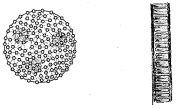
Identify the algae shown in the given figure.
A
Chlamydomonas,Volvox
B
Chara,Chlamydomonas
C
Ulothrix,Volvox
D
Volvox,Ulothrix
Solution
(D) The figure on the left shows a colonial form of green algae known as $Volvox$. It consists of a spherical colony of numerous cells.
The figure on the right shows a filamentous form of green algae known as $Ulothrix$.
Therefore,the correct identification is $Volvox$ and $Ulothrix$.
The figure on the right shows a filamentous form of green algae known as $Ulothrix$.
Therefore,the correct identification is $Volvox$ and $Ulothrix$.
0 likes
View Solution491
MediumMCQ
Match the following columns:
| Column-$I$ | Column-$II$ |
| $P$. Chlorophyceae | $I$. $2$, unequal lateral flagella |
| $Q$. Phaeophyceae | $II$. Flagella absent |
| $R$. Rhodophyceae | $III$. $2-8$, equal apical flagella |
A
$(P-III), (Q-II), (R-I)$
B
$(P-III), (Q-I), (R-II)$
C
$(P-I), (Q-II), (R-III)$
D
$(P-II), (Q-I), (R-III)$
Solution
(B) The classification of algae based on flagellar characteristics is as follows:
$1$. Chlorophyceae $(P)$: They possess $2-8$ equal flagella which are apical in position. Thus, $P-III$.
$2$. Phaeophyceae $(Q)$: They possess $2$ unequal flagella which are lateral in position. Thus, $Q-I$.
$3$. Rhodophyceae $(R)$: They are characterized by the complete absence of flagella in their life cycle. Thus, $R-II$.
Therefore, the correct matching is $(P-III), (Q-I), (R-II)$.
$1$. Chlorophyceae $(P)$: They possess $2-8$ equal flagella which are apical in position. Thus, $P-III$.
$2$. Phaeophyceae $(Q)$: They possess $2$ unequal flagella which are lateral in position. Thus, $Q-I$.
$3$. Rhodophyceae $(R)$: They are characterized by the complete absence of flagella in their life cycle. Thus, $R-II$.
Therefore, the correct matching is $(P-III), (Q-I), (R-II)$.
0 likes
View Solution492
MediumMCQ
Select the odd one out.
A
Laminaria
B
Fucus
C
Chara
D
Dictyota
Solution
(C) The organisms listed are all algae.
$Laminaria$,$Fucus$,and $Dictyota$ belong to the class $Phaeophyceae$ (brown algae).
$Chara$ belongs to the class $Chlorophyceae$ (green algae).
Therefore,$Chara$ is the odd one out.
$Laminaria$,$Fucus$,and $Dictyota$ belong to the class $Phaeophyceae$ (brown algae).
$Chara$ belongs to the class $Chlorophyceae$ (green algae).
Therefore,$Chara$ is the odd one out.
0 likes
View Solution493
MediumMCQ
Which of the following statements are applicable to brown algae?
$(I)$ They contain pigments like chlorophyll $a$,chlorophyll $c$,carotenoids,and xanthophylls.
$(II)$ They vary in color from olive green to various shades of brown.
$(III)$ Food is stored as complex carbohydrates,in the form of laminarin or mannitol.
$(IV)$ The cell wall is composed of cellulose and algin.
$(V)$ The cell wall is covered on the outside by a gelatinous coating of algin.
$(I)$ They contain pigments like chlorophyll $a$,chlorophyll $c$,carotenoids,and xanthophylls.
$(II)$ They vary in color from olive green to various shades of brown.
$(III)$ Food is stored as complex carbohydrates,in the form of laminarin or mannitol.
$(IV)$ The cell wall is composed of cellulose and algin.
$(V)$ The cell wall is covered on the outside by a gelatinous coating of algin.
A
$(I), (II), (III), (IV)$
B
$(II), (III), (IV), (V)$
C
$(I), (II), (III), (IV), (V)$
D
$(I), (II), (IV), (V)$
Solution
(B) Brown algae (Phaeophyceae) exhibit the following characteristics:
$(I)$ They contain chlorophyll $a$,$c$,carotenoids,and xanthophylls (specifically fucoxanthin). Statement $(I)$ is incorrect because it mentions chlorophyll $d$ instead of $c$.
$(II)$ They vary in color from olive green to various shades of brown depending upon the amount of the xanthophyll pigment,fucoxanthin,present in them. This is correct.
$(III)$ Food is stored as complex carbohydrates,which may be in the form of laminarin or mannitol. This is correct.
$(IV)$ The cell wall is composed of cellulose and is covered on the outside by a gelatinous coating of algin. This is correct.
$(V)$ The cell wall is covered on the outside by a gelatinous coating of algin. This is correct.
Therefore,statements $(II), (III), (IV),$ and $(V)$ are correct.
$(I)$ They contain chlorophyll $a$,$c$,carotenoids,and xanthophylls (specifically fucoxanthin). Statement $(I)$ is incorrect because it mentions chlorophyll $d$ instead of $c$.
$(II)$ They vary in color from olive green to various shades of brown depending upon the amount of the xanthophyll pigment,fucoxanthin,present in them. This is correct.
$(III)$ Food is stored as complex carbohydrates,which may be in the form of laminarin or mannitol. This is correct.
$(IV)$ The cell wall is composed of cellulose and is covered on the outside by a gelatinous coating of algin. This is correct.
$(V)$ The cell wall is covered on the outside by a gelatinous coating of algin. This is correct.
Therefore,statements $(II), (III), (IV),$ and $(V)$ are correct.
0 likes
View Solution494
MediumMCQ
Identify the correct match regarding the structure of algae.
A
Holdfast - Attaches to the substratum
B
Stipe - Connects the holdfast and the frond
C
Frond - Performs photosynthesis
D
All of the above
Solution
(D) The body of algae (specifically brown algae) consists of three main parts:
$1$. Holdfast: This part serves to attach the algae to a rock or other substratum.
$2$. Stipe: This is a stalk-like structure that connects the holdfast to the frond.
$3$. Frond: This is a leaf-like photosynthetic organ that performs the function of food production.
Therefore,all the given options are correct.
$1$. Holdfast: This part serves to attach the algae to a rock or other substratum.
$2$. Stipe: This is a stalk-like structure that connects the holdfast to the frond.
$3$. Frond: This is a leaf-like photosynthetic organ that performs the function of food production.
Therefore,all the given options are correct.
0 likes
View Solution495
MediumMCQ
Which type of algae possesses pear-shaped gametes?
A
Green algae
B
Red algae
C
Brown algae
D
All of the above
Solution
(C) Brown algae (Phaeophyceae) are characterized by the presence of pear-shaped (pyriform) gametes.
These gametes typically have two laterally attached flagella.
In contrast,green algae and red algae generally do not exhibit this specific pear-shaped morphology for their gametes.
These gametes typically have two laterally attached flagella.
In contrast,green algae and red algae generally do not exhibit this specific pear-shaped morphology for their gametes.
0 likes
View Solution496
MediumMCQ
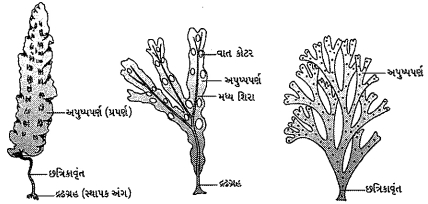
Identify the algae given below.
A
Fucus,Laminaria,Dictyota
B
Dictyota,Laminaria,Fucus
C
Laminaria,Fucus,Dictyota
D
Dictyota,Fucus,Laminaria
Solution
(C) The provided image shows three different types of brown algae (Phaeophyceae) as described in the $NCERT$ textbook:
$1$. The first figure on the left is $Laminaria$.
$2$. The middle figure is $Fucus$.
$3$. The third figure on the right is $Dictyota$.
Therefore,the correct sequence is Laminaria,Fucus,Dictyota.
$1$. The first figure on the left is $Laminaria$.
$2$. The middle figure is $Fucus$.
$3$. The third figure on the right is $Dictyota$.
Therefore,the correct sequence is Laminaria,Fucus,Dictyota.
0 likes
View Solution497
MediumMCQ
Which is the dominant pigment in Rhodophyceae?
A
Chlorophyll $a$
B
Chlorophyll $c$
C
Chlorophyll $d$
D
$r$-phycoerythrin
Solution
(D) Rhodophyceae,commonly known as red algae,contain chlorophyll $a$ and $d$ as photosynthetic pigments. However,the characteristic red color is due to the predominance of the water-soluble red pigment $r$-phycoerythrin. This pigment masks the green color of chlorophyll,giving the algae their distinct red appearance.
0 likes
View Solution498
EasyMCQ
Which algae are found at greater depths in the oceans?
A
Green algae
B
Brown algae
C
Red algae
D
All types of algae are found at great depths
Solution
(C) Red algae (Rhodophyceae) are found at greater depths in the oceans compared to green and brown algae.
This is because red algae contain the pigment phycoerythrin,which can absorb blue light that penetrates deeper into the water column.
Green and brown algae are typically found in shallower waters where more sunlight is available for photosynthesis.
This is because red algae contain the pigment phycoerythrin,which can absorb blue light that penetrates deeper into the water column.
Green and brown algae are typically found in shallower waters where more sunlight is available for photosynthesis.
0 likes
View Solution499
MediumMCQ
Match the following columns:
| Column-$I$ | Column-$II$ |
|---|---|
| $P$. Green Algae | $I$. Ulothrix,Spirogyra |
| $Q$. Red Algae | $II$. Gracilaria,Gelidium |
| $R$. Brown Algae | $III$. Ectocarpus,Sargassum |
A
$(P-II), (Q-III), (R-I)$
B
$(P-I), (Q-III), (R-II)$
C
$(P-III), (Q-II), (R-I)$
D
$(P-I), (Q-II), (R-III)$
Solution
(D) The classification of algae is based on their pigments and stored food materials:
$1$. Green Algae (Chlorophyceae) include organisms like $Ulothrix$ and $Spirogyra$. Thus,$P-I$.
$2$. Red Algae (Rhodophyceae) include organisms like $Gracilaria$ and $Gelidium$. Thus,$Q-II$.
$3$. Brown Algae (Phaeophyceae) include organisms like $Ectocarpus$ and $Sargassum$. Thus,$R-III$.
Therefore,the correct matching is $(P-I), (Q-II), (R-III)$.
$1$. Green Algae (Chlorophyceae) include organisms like $Ulothrix$ and $Spirogyra$. Thus,$P-I$.
$2$. Red Algae (Rhodophyceae) include organisms like $Gracilaria$ and $Gelidium$. Thus,$Q-II$.
$3$. Brown Algae (Phaeophyceae) include organisms like $Ectocarpus$ and $Sargassum$. Thus,$R-III$.
Therefore,the correct matching is $(P-I), (Q-II), (R-III)$.
0 likes
View Solution500
MediumMCQ
Which of the following groups reproduces sexually by non-motile gametes?
A
Green algae
B
Red algae
C
Brown algae
D
All of the above
Solution
(B) In the kingdom $Plantae$,specifically within the algae group,the members of $Rhodophyceae$ (Red algae) are characterized by the absence of flagellated or motile stages in their life cycle.
They reproduce sexually by non-motile gametes.
In contrast,Green algae $(Chlorophyceae)$ and Brown algae $(Phaeophyceae)$ typically produce motile (flagellated) gametes or zoospores.
They reproduce sexually by non-motile gametes.
In contrast,Green algae $(Chlorophyceae)$ and Brown algae $(Phaeophyceae)$ typically produce motile (flagellated) gametes or zoospores.
0 likes
View SolutionPlant Kingdom — Algae (General) · Frequently Asked Questions
1Are these Plant Kingdom questions useful for JEE and NEET?
Yes. All questions in this section are mapped to JEE Main and NEET exam patterns. Previous year questions from JEE Main, NEET, GUJCET and state-level exams are included with full solutions.
2Can I switch to Hindi or Gujarati for these questions?
Yes. Use the language tabs in the hero section or the sidebar to view the same questions and solutions in English, Hindi or Gujarati.
3How do I generate a question paper from this subtopic?
Use the Vedclass Exam Paper Generator — select the chapter and subtopic, set difficulty, and generate Sets A, B, C, D automatically. First 3 chapters of every subject are free.
Vedclass Products
For Students
Vedclass Test Series
Mock tests in real JEE/NEET style with performance analysis. 5-day free trial.
Start Free TrialFor Teachers
Exam Paper Generator
Generate Set A/B/C/D papers from this chapter in 2 minutes. 3 chapters free.
Try FreeFor Institutes
Online Exam Module
Live online exams with unlimited students, 360° analytics & white-label branding.
See DemoFor Teachers & Institutes
Generate a Plant Kingdom Exam Paper in 2 Minutes
Select subtopic & difficulty — Sets A, B, C, D auto-generated with No Repeat logic.
First 3 chapters of every subject are free — no payment required.