
A English
Algae (General) Questions in English
Class 11 Biology · Plant Kingdom · Algae (General)
526+
Questions
English
Language
100%
With Solutions
Showing 26 of 526 questions in English
501
MediumMCQ
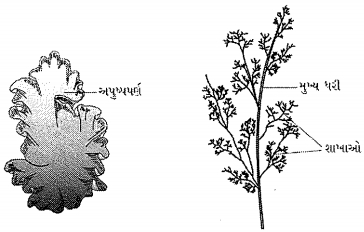
Identify the given red algae.
A
$Gracilaria$ $\quad\quad$ $Gelidium$
B
$Gelidium$ $\quad\quad$ $Gracilaria$
C
$Polysiphonia$ $\quad\quad$ $Porphyra$
D
$Porphyra$ $\quad\quad$ $Polysiphonia$
Solution
(D) The provided image shows two types of red algae (Rhodophyceae).
$1$. The left image represents $Porphyra$,which has a thalloid,leaf-like structure.
$2$. The right image represents $Polysiphonia$,which has a branched,filamentous structure.
Therefore,the correct identification is $Porphyra$ and $Polysiphonia$ respectively.
$1$. The left image represents $Porphyra$,which has a thalloid,leaf-like structure.
$2$. The right image represents $Polysiphonia$,which has a branched,filamentous structure.
Therefore,the correct identification is $Porphyra$ and $Polysiphonia$ respectively.
0 likes
View Solution502
EasyMCQ
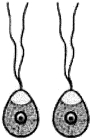
Identify the gametes shown in the given figure and select the correct option.
A
Isogametes of Cladophora
B
Isogametes of Fucus
C
Isogametes of Human
D
Isogametes of Yeast
Solution
(A) The figure shows two morphologically similar gametes,which are flagellated. These are known as isogametes. In the alga $Cladophora$,the gametes are isogametes,meaning they are identical in appearance. $Fucus$ shows oogamy (large non-motile egg and small motile sperm). Humans show oogamy. Yeast does not produce such flagellated isogametes in this context. Therefore,the correct option is $A$.
0 likes
View Solution503
MediumMCQ
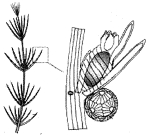
Select the correct option for the given plant.
A
Chara - Monoecious plant
B
Chara - Dioecious plant
C
Marchantia - Monoecious plant
D
Marchantia - Dioecious plant
Solution
(A) The image shows the plant $Chara$,which is a green alga. In $Chara$,the male sex organ (antheridium or globule) and the female sex organ (oogonium or nucule) are present on the same plant body. Therefore,$Chara$ is a monoecious plant.
In contrast,$Marchantia$ is a liverwort that is dioecious,meaning the male and female sex organs are present on separate plant bodies (thalli).
In contrast,$Marchantia$ is a liverwort that is dioecious,meaning the male and female sex organs are present on separate plant bodies (thalli).
0 likes
View Solution504
MediumMCQ
Which of the following algae is most likely to be found in the deepest waters of the ocean?
A
Green algae
B
Brown algae
C
Red algae
D
All of the above
Solution
(C) The penetration of light into the ocean decreases with depth.
Green algae $(Chlorophyceae)$ contain chlorophyll $a$ and $b$ and are typically found in shallow waters.
Brown algae $(Phaeophyceae)$ contain chlorophyll $a, c$ and fucoxanthin,allowing them to survive at moderate depths.
Red algae $(Rhodophyceae)$ contain chlorophyll $a, d$ and the pigment phycoerythrin.
Phycoerythrin is capable of absorbing blue and green light,which are the wavelengths that penetrate the deepest into the ocean water.
Therefore,red algae are adapted to survive in the deepest waters where other algae cannot.
Green algae $(Chlorophyceae)$ contain chlorophyll $a$ and $b$ and are typically found in shallow waters.
Brown algae $(Phaeophyceae)$ contain chlorophyll $a, c$ and fucoxanthin,allowing them to survive at moderate depths.
Red algae $(Rhodophyceae)$ contain chlorophyll $a, d$ and the pigment phycoerythrin.
Phycoerythrin is capable of absorbing blue and green light,which are the wavelengths that penetrate the deepest into the ocean water.
Therefore,red algae are adapted to survive in the deepest waters where other algae cannot.
0 likes
View Solution505
EasyMCQ
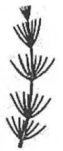
Read the following statements and identify the characters related to the alga shown in the diagram:
$(a)$ It is a member of Chlorophyceae
$(b)$ Food is stored in the form of starch
$(c)$ It is a monoecious plant showing oogonium and antheridium
$(d)$ Food is stored in the form of laminarin or mannitol
$(e)$ It shows dominance of pigments chlorophyll $a, c$ and Fucoxanthin.
Choose the correct answer from the options given below:
$(a)$ It is a member of Chlorophyceae
$(b)$ Food is stored in the form of starch
$(c)$ It is a monoecious plant showing oogonium and antheridium
$(d)$ Food is stored in the form of laminarin or mannitol
$(e)$ It shows dominance of pigments chlorophyll $a, c$ and Fucoxanthin.
Choose the correct answer from the options given below:
A
$(a)$ and $(b)$ only
B
$(a), (b)$ and $(c)$ only
C
$(a), (c)$ and $(d)$ only
D
$(c), (d)$ and $(e)$ only
Solution
(B) The diagram shows the green alga $Chara$.
$Chara$ belongs to the class Chlorophyceae.
Key characteristics of Chlorophyceae include:
$1$. They are commonly called green algae.
$2$. The plant body is usually grass green due to the dominance of pigments chlorophyll $a$ and $b$.
$3$. Food is stored in the form of starch.
$4$. $Chara$ is a monoecious plant,meaning it bears both male (antheridium) and female (oogonium) sex organs on the same plant body.
Evaluating the statements:
$(a)$ It is a member of Chlorophyceae: Correct.
$(b)$ Food is stored in the form of starch: Correct.
$(c)$ It is a monoecious plant showing oogonium and antheridium: Correct.
$(d)$ Food is stored in the form of laminarin or mannitol: Incorrect (this is characteristic of Phaeophyceae).
$(e)$ It shows dominance of pigments chlorophyll $a, c$ and Fucoxanthin: Incorrect (this is characteristic of Phaeophyceae).
Therefore,statements $(a), (b),$ and $(c)$ are correct.
$Chara$ belongs to the class Chlorophyceae.
Key characteristics of Chlorophyceae include:
$1$. They are commonly called green algae.
$2$. The plant body is usually grass green due to the dominance of pigments chlorophyll $a$ and $b$.
$3$. Food is stored in the form of starch.
$4$. $Chara$ is a monoecious plant,meaning it bears both male (antheridium) and female (oogonium) sex organs on the same plant body.
Evaluating the statements:
$(a)$ It is a member of Chlorophyceae: Correct.
$(b)$ Food is stored in the form of starch: Correct.
$(c)$ It is a monoecious plant showing oogonium and antheridium: Correct.
$(d)$ Food is stored in the form of laminarin or mannitol: Incorrect (this is characteristic of Phaeophyceae).
$(e)$ It shows dominance of pigments chlorophyll $a, c$ and Fucoxanthin: Incorrect (this is characteristic of Phaeophyceae).
Therefore,statements $(a), (b),$ and $(c)$ are correct.
0 likes
View Solution506
MediumMCQ
Read the following statements and choose the set of correct statements: In the members of Phaeophyceae,
$A$. Asexual reproduction occurs usually by biflagellate zoospores.
$B$. Sexual reproduction is by oogamous method only.
$C$. Stored food is in the form of carbohydrates which is either mannitol or laminarin.
$D$. The major pigments found are chlorophyll $a$,$c$ and carotenoids and xanthophyll.
$E$. Vegetative cells have a cellulosic wall,usually covered on the outside by gelatinous coating of algin.
Choose the correct answer from the options given below:
$A$. Asexual reproduction occurs usually by biflagellate zoospores.
$B$. Sexual reproduction is by oogamous method only.
$C$. Stored food is in the form of carbohydrates which is either mannitol or laminarin.
$D$. The major pigments found are chlorophyll $a$,$c$ and carotenoids and xanthophyll.
$E$. Vegetative cells have a cellulosic wall,usually covered on the outside by gelatinous coating of algin.
Choose the correct answer from the options given below:
A
$B, C, D$ and $E$ only
B
$A, C, D$ and $E$ only
C
$A, B, C$ and $E$ only
D
$A, B, C$ and $D$ only
Solution
(B) In members of Phaeophyceae (brown algae),asexual reproduction occurs by biflagellate zoospores that are pear-shaped and have two laterally attached flagella.
Sexual reproduction in Phaeophyceae can be isogamous,anisogamous,or oogamous. Therefore,statement $B$ is incorrect as it claims it is oogamous only.
Stored food is in the form of complex carbohydrates,usually mannitol or laminarin. Thus,statement $C$ is correct.
The major pigments present are chlorophyll $a$,$c$,carotenoids,and xanthophylls (like fucoxanthin). Thus,statement $D$ is correct.
Vegetative cells have a cellulosic wall,which is usually covered on the outside by a gelatinous coating of algin. Thus,statement $E$ is correct.
Therefore,the correct set of statements is $A, C, D$ and $E$.
Sexual reproduction in Phaeophyceae can be isogamous,anisogamous,or oogamous. Therefore,statement $B$ is incorrect as it claims it is oogamous only.
Stored food is in the form of complex carbohydrates,usually mannitol or laminarin. Thus,statement $C$ is correct.
The major pigments present are chlorophyll $a$,$c$,carotenoids,and xanthophylls (like fucoxanthin). Thus,statement $D$ is correct.
Vegetative cells have a cellulosic wall,which is usually covered on the outside by a gelatinous coating of algin. Thus,statement $E$ is correct.
Therefore,the correct set of statements is $A, C, D$ and $E$.
0 likes
View Solution507
MediumMCQ
Which of the following organisms cannot fix nitrogen?
$A.$ Azotobacter
$B.$ Oscillatoria
$C.$ Anabaena
$D.$ Volvox
$E.$ Nostoc
Choose the correct answer from the options given below:
$A.$ Azotobacter
$B.$ Oscillatoria
$C.$ Anabaena
$D.$ Volvox
$E.$ Nostoc
Choose the correct answer from the options given below:
A
$A$ only
B
$D$ only
C
$B$ only
D
$E$ only
Solution
(B) $Azotobacter$ is a free-living nitrogen-fixing bacterium.
$Oscillatoria$,$Anabaena$,and $Nostoc$ are cyanobacteria capable of fixing atmospheric nitrogen due to the presence of specialized cells called heterocysts or through other nitrogen-fixing mechanisms.
$Volvox$ is a green alga (Chlorophyta) that does not possess the nitrogenase enzyme complex required for nitrogen fixation.
Therefore,only $Volvox$ $(D)$ cannot fix nitrogen.
$Oscillatoria$,$Anabaena$,and $Nostoc$ are cyanobacteria capable of fixing atmospheric nitrogen due to the presence of specialized cells called heterocysts or through other nitrogen-fixing mechanisms.
$Volvox$ is a green alga (Chlorophyta) that does not possess the nitrogenase enzyme complex required for nitrogen fixation.
Therefore,only $Volvox$ $(D)$ cannot fix nitrogen.
0 likes
View Solution508
EasyMCQ
How many of the following algae belong to the category of red algae?
Polysiphonia,Gelidium,Laminaria,Spirogyra,Porphyra,Fucus,Chlamydomonas,Polytrichum
Polysiphonia,Gelidium,Laminaria,Spirogyra,Porphyra,Fucus,Chlamydomonas,Polytrichum
A
$2$
B
$3$
C
$4$
D
$5$
Solution
(B) To identify the red algae (Rhodophyceae) from the given list:
$1$. $Polysiphonia$: Red algae.
$2$. $Gelidium$: Red algae.
$3$. $Laminaria$: Brown algae (Phaeophyceae).
$4$. $Spirogyra$: Green algae (Chlorophyceae).
$5$. $Porphyra$: Red algae.
$6$. $Fucus$: Brown algae (Phaeophyceae).
$7$. $Chlamydomonas$: Green algae (Chlorophyceae).
$8$. $Polytrichum$: Bryophyte (not an alga).
The red algae in the list are $Polysiphonia$,$Gelidium$,and $Porphyra$.
Therefore,there are $3$ red algae in the given list.
$1$. $Polysiphonia$: Red algae.
$2$. $Gelidium$: Red algae.
$3$. $Laminaria$: Brown algae (Phaeophyceae).
$4$. $Spirogyra$: Green algae (Chlorophyceae).
$5$. $Porphyra$: Red algae.
$6$. $Fucus$: Brown algae (Phaeophyceae).
$7$. $Chlamydomonas$: Green algae (Chlorophyceae).
$8$. $Polytrichum$: Bryophyte (not an alga).
The red algae in the list are $Polysiphonia$,$Gelidium$,and $Porphyra$.
Therefore,there are $3$ red algae in the given list.
0 likes
View Solution509
MediumMCQ
In brown algae,asexual spores are $:-$
A
Pear-shaped and have two unequal flagella
B
Pear-shaped and have two unequal cilia
C
Oval-shaped and have two unequal flagella
D
Comma-shaped and biflagellate
Solution
(A) In brown algae (Phaeophyceae),asexual reproduction occurs through biflagellate zoospores.
These zoospores are pear-shaped (pyriform) in structure.
They possess two unequal laterally attached flagella.
Therefore,the correct description is that they are pear-shaped and have two unequal flagella.
These zoospores are pear-shaped (pyriform) in structure.
They possess two unequal laterally attached flagella.
Therefore,the correct description is that they are pear-shaped and have two unequal flagella.
0 likes
View Solution510
MediumMCQ
In the members of Phaeophyceae,which part of the body functions as the photosynthetic part?
A
Rhizoids
B
Stipe
C
Holdfast
D
Frond
Solution
(D) The plant body of Phaeophyceae (brown algae) is usually attached to the substratum by a holdfast and has a stalk,the stipe,and a leaf-like photosynthetic organ called the frond.
Therefore,the frond is the part that performs photosynthesis.
Therefore,the frond is the part that performs photosynthesis.
0 likes
View Solution511
MediumMCQ
Which of the following hydrocolloids is obtained from brown algae?
A
Alginic acid
B
Carrageen
C
Agar agar
D
Both $A$ and $B$
Solution
(A) Hydrocolloids are water-holding substances.
$1$. Algin is a hydrocolloid obtained from brown algae (Phaeophyceae).
$2$. Carrageen is a hydrocolloid obtained from red algae (Rhodophyceae).
$3$. Agar-agar is obtained from Gelidium and Gracilaria,which are red algae.
Therefore,only Alginic acid is obtained from brown algae.
$1$. Algin is a hydrocolloid obtained from brown algae (Phaeophyceae).
$2$. Carrageen is a hydrocolloid obtained from red algae (Rhodophyceae).
$3$. Agar-agar is obtained from Gelidium and Gracilaria,which are red algae.
Therefore,only Alginic acid is obtained from brown algae.
0 likes
View Solution512
MediumMCQ
Which of the following is not related to the thallus of members of $Phaeophyceae$?
A
Lamina
B
Stipe
C
Holdfast
D
Archegonium
Solution
(D) The plant body of $Phaeophyceae$ (brown algae) is typically differentiated into three parts:
$1$. $Holdfast$: Attaches the plant to the substratum.
$2$. $Stipe$: $A$ stalk-like structure.
$3$. $Lamina$ (or $Frond$): $A$ leaf-like photosynthetic organ.
$Archegonium$ is a female sex organ found in $Bryophytes$,$Pteridophytes$,and $Gymnosperms$,but it is not a part of the vegetative thallus structure of $Phaeophyceae$.
$1$. $Holdfast$: Attaches the plant to the substratum.
$2$. $Stipe$: $A$ stalk-like structure.
$3$. $Lamina$ (or $Frond$): $A$ leaf-like photosynthetic organ.
$Archegonium$ is a female sex organ found in $Bryophytes$,$Pteridophytes$,and $Gymnosperms$,but it is not a part of the vegetative thallus structure of $Phaeophyceae$.
0 likes
View Solution513
MediumMCQ
The members of $Rhodophyceae$ are commonly called Red algae because of the:
A
They are found in greater concentrations of warmer areas of the ocean.
B
They have floridean starch as a stored food.
C
Predominance of $r-phycoerythrin$ in their body.
D
They show complex post-fertilization developments.
Solution
(C) The members of $Rhodophyceae$ are commonly known as red algae because of the predominance of the red pigment $r-phycoerythrin$ in their body.
This pigment masks the green color of chlorophyll $a$ and $d$,giving them their characteristic red appearance.
While they also store food as floridean starch and exhibit complex post-fertilization developments,these are not the reasons for their common name.
This pigment masks the green color of chlorophyll $a$ and $d$,giving them their characteristic red appearance.
While they also store food as floridean starch and exhibit complex post-fertilization developments,these are not the reasons for their common name.
0 likes
View Solution514
MediumMCQ
Which one of the following shows similarity with blue-green algae on the basis of photosynthetic pigments?
A
Red algae
B
Green algae
C
Brown algae
D
Eubacteria
Solution
(A) Blue-green algae (Cyanobacteria) are prokaryotic organisms that contain chlorophyll $a$ and phycobilins (like phycocyanin and phycoerythrin) as their primary photosynthetic pigments.
Red algae (Rhodophyceae) also contain chlorophyll $a$ and phycobilins (specifically phycoerythrin),which gives them their characteristic red color.
Because both groups share these specific accessory pigments,red algae show the greatest similarity to blue-green algae in terms of pigment composition.
Red algae (Rhodophyceae) also contain chlorophyll $a$ and phycobilins (specifically phycoerythrin),which gives them their characteristic red color.
Because both groups share these specific accessory pigments,red algae show the greatest similarity to blue-green algae in terms of pigment composition.
0 likes
View Solution515
EasyMCQ
Complex post-fertilization development is seen in which algae?
A
Green algae
B
Brown algae
C
Yellow-green algae
D
Red algae
Solution
(D) Complex post-fertilization development is a characteristic feature of the class $Rhodophyceae$,commonly known as red algae.
In these organisms,after the fusion of male and female gametes,the zygote undergoes a series of complex developmental stages to form carposporophytes,which eventually produce carpospores.
This process is unique to red algae and is not observed in green algae $(Chlorophyceae)$ or brown algae $(Phaeophyceae)$.
In these organisms,after the fusion of male and female gametes,the zygote undergoes a series of complex developmental stages to form carposporophytes,which eventually produce carpospores.
This process is unique to red algae and is not observed in green algae $(Chlorophyceae)$ or brown algae $(Phaeophyceae)$.
0 likes
View Solution516
MediumMCQ
Zygotic meiosis is characteristic of $:$
A
Marchantia
B
Funaria
C
Fucus
D
Volvox
Solution
(D) In the life cycle of many algae,the zygote undergoes meiosis to produce haploid spores,which then germinate to form the haploid plant body. This type of life cycle is known as haplontic life cycle. $Volvox$ is a green alga that exhibits a haplontic life cycle,where zygotic meiosis occurs. In contrast,$Fucus$ exhibits a diplontic life cycle,while $Marchantia$ and $Funaria$ (bryophytes) exhibit a diplohaplontic (haplo-diplontic) life cycle.
0 likes
View Solution517
MediumMCQ
Oogamy with non-motile gametes occurs in
A
Fucus
B
Polysiphonia
C
Gelidium
D
$2$ and $3$ both
Solution
(D) Oogamy is a type of sexual reproduction where a large,non-motile female gamete (egg) is fertilized by a smaller,motile or non-motile male gamete.
In the class Rhodophyceae (Red Algae),such as $Polysiphonia$ and $Gelidium$,sexual reproduction is oogamous,and both the male and female gametes are non-motile.
$Fucus$ (a brown alga) also exhibits oogamy,but its male gametes are motile (flagellated).
Therefore,$Polysiphonia$ and $Gelidium$ are the correct examples of oogamy with non-motile gametes.
In the class Rhodophyceae (Red Algae),such as $Polysiphonia$ and $Gelidium$,sexual reproduction is oogamous,and both the male and female gametes are non-motile.
$Fucus$ (a brown alga) also exhibits oogamy,but its male gametes are motile (flagellated).
Therefore,$Polysiphonia$ and $Gelidium$ are the correct examples of oogamy with non-motile gametes.
0 likes
View Solution518
EasyMCQ
Laminarin and mannitol are stored food of $:-$
A
Red algae
B
Brown algae
C
Green algae
D
Golden algae
Solution
(B) In $Phaeophyceae$ (commonly known as brown algae),the food is stored as complex carbohydrates,which may be in the form of laminarin or mannitol.
$Rhodophyceae$ (red algae) store food as floridean starch.
$Chlorophyceae$ (green algae) store food as starch.
Therefore,the correct option is $B$.
$Rhodophyceae$ (red algae) store food as floridean starch.
$Chlorophyceae$ (green algae) store food as starch.
Therefore,the correct option is $B$.
0 likes
View Solution519
EasyMCQ
Match the Column-$I$ with Column-$II$:
Choose the correct answer from the options given below:
| Column-$I$ | Column-$II$ |
|---|---|
| $(a)$ Zoospores | $(i)$ Fusion between one large non-motile female gamete and a smaller motile male gamete. |
| $(b)$ Isogamous | $(ii)$ Flagellated (motile) asexual spores. |
| $(c)$ Anisogamous | $(iii)$ Gametes can be flagellated and similar in size. |
| $(d)$ Oogamous | $(iv)$ Fusion of two gametes dissimilar in size. |
Choose the correct answer from the options given below:
A
$(a) \rightarrow (ii), (b) \rightarrow (iii), (c) \rightarrow (iv), (d) \rightarrow (i)$
B
$(a) \rightarrow (i), (b) \rightarrow (ii), (c) \rightarrow (iii), (d) \rightarrow (iv)$
C
$(a) \rightarrow (iii), (b) \rightarrow (ii), (c) \rightarrow (i), (d) \rightarrow (iv)$
D
$(a) \rightarrow (iv), (b) \rightarrow (iii), (c) \rightarrow (ii), (d) \rightarrow (i)$
Solution
(A) The correct matches are as follows:
$(a)$ Zoospores are flagellated (motile) asexual spores,so $(a) \rightarrow (ii)$.
$(b)$ Isogamous refers to the fusion of gametes that are similar in size,which can be flagellated or non-flagellated,so $(b) \rightarrow (iii)$.
$(c)$ Anisogamous refers to the fusion of two gametes that are dissimilar in size,so $(c) \rightarrow (iv)$.
$(d)$ Oogamous refers to the fusion between one large non-motile female gamete and a smaller motile male gamete,so $(d) \rightarrow (i)$.
Therefore,the correct sequence is $(a) \rightarrow (ii), (b) \rightarrow (iii), (c) \rightarrow (iv), (d) \rightarrow (i)$.
$(a)$ Zoospores are flagellated (motile) asexual spores,so $(a) \rightarrow (ii)$.
$(b)$ Isogamous refers to the fusion of gametes that are similar in size,which can be flagellated or non-flagellated,so $(b) \rightarrow (iii)$.
$(c)$ Anisogamous refers to the fusion of two gametes that are dissimilar in size,so $(c) \rightarrow (iv)$.
$(d)$ Oogamous refers to the fusion between one large non-motile female gamete and a smaller motile male gamete,so $(d) \rightarrow (i)$.
Therefore,the correct sequence is $(a) \rightarrow (ii), (b) \rightarrow (iii), (c) \rightarrow (iv), (d) \rightarrow (i)$.
0 likes
View Solution520
MediumMCQ
Assertion : Volvox,Ulothrix,Spirogyra and Chara are members of Chlorophyceae.
Reason : Usually they have a rigid cell wall made of an inner layer of cellulose and an outer layer of pectose.
Reason : Usually they have a rigid cell wall made of an inner layer of cellulose and an outer layer of pectose.
A
Both Assertion & Reason are True & the Reason is a correct explanation of the Assertion.
B
Both Assertion & Reason are True but Reason is not a correct explanation of the Assertion.
C
Assertion is True but the Reason is False.
D
Both Assertion & Reason are False.
Solution
(A) The Assertion is True: $Volvox$,$Ulothrix$,$Spirogyra$,and $Chara$ are all green algae belonging to the class $Chlorophyceae$.
The Reason is True: Members of $Chlorophyceae$ typically possess a rigid cell wall consisting of an inner layer of cellulose and an outer layer of pectose.
Conclusion: Since the cell wall composition is a defining characteristic of the class $Chlorophyceae$ to which these organisms belong,the Reason correctly explains the Assertion.
The Reason is True: Members of $Chlorophyceae$ typically possess a rigid cell wall consisting of an inner layer of cellulose and an outer layer of pectose.
Conclusion: Since the cell wall composition is a defining characteristic of the class $Chlorophyceae$ to which these organisms belong,the Reason correctly explains the Assertion.
0 likes
View Solution521
MediumMCQ
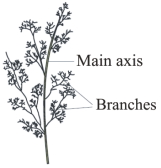
Which of the following statements are true regarding the figure given below?
$(i)$ It shows oogamy and post-fertilization development.
$(ii)$ Male gamete is small and motile.
$(iii)$ Stored food is floridean starch.
$(iv)$ Pectin,cellulose,and polysulphate esters are present in the cell wall.
$(i)$ It shows oogamy and post-fertilization development.
$(ii)$ Male gamete is small and motile.
$(iii)$ Stored food is floridean starch.
$(iv)$ Pectin,cellulose,and polysulphate esters are present in the cell wall.
A
All four
B
Only $(i), (ii) \& (iv)$
C
$(i) \& (iv)$ only
D
Only $(i), (iii) \& (iv)$
Solution
(D) The figure represents *Polysiphonia*,which is a member of Rhodophyceae (Red algae).
$(i)$ Rhodophyceae exhibit oogamy and complex post-fertilization development. This statement is true.
$(ii)$ In Rhodophyceae,male gametes are non-motile. Therefore,this statement is false.
$(iii)$ The stored food in Rhodophyceae is floridean starch,which is very similar to amylopectin and glycogen in structure. This statement is true.
$(iv)$ The cell wall of red algae is composed of cellulose,pectin,and phycocolloids (polysulphate esters). This statement is true.
Thus,statements $(i), (iii),$ and $(iv)$ are correct.
$(i)$ Rhodophyceae exhibit oogamy and complex post-fertilization development. This statement is true.
$(ii)$ In Rhodophyceae,male gametes are non-motile. Therefore,this statement is false.
$(iii)$ The stored food in Rhodophyceae is floridean starch,which is very similar to amylopectin and glycogen in structure. This statement is true.
$(iv)$ The cell wall of red algae is composed of cellulose,pectin,and phycocolloids (polysulphate esters). This statement is true.
Thus,statements $(i), (iii),$ and $(iv)$ are correct.
0 likes
View Solution522
MediumMCQ
Isogamous type of sexual reproduction occurs in $:-$
A
$Ulothrix$ & $Spirogyra$
B
$Spirogyra$ & $Fucus$
C
$Chlamydomonas$ & $Volvox$
D
$Chlamydomonas$ & $Fucus$
Solution
(A) Sexual reproduction in algae is classified based on the nature of the gametes involved.
$1$. Isogamy: Fusion of two gametes which are similar in size and appearance (e.g.,$Ulothrix$,$Spirogyra$).
$2$. Anisogamy: Fusion of two gametes dissimilar in size (e.g.,some species of $Chlamydomonas$).
$3$. Oogamy: Fusion of one large,non-motile female gamete and a smaller,motile male gamete (e.g.,$Volvox$,$Fucus$).
Therefore,$Ulothrix$ and $Spirogyra$ exhibit isogamous sexual reproduction.
$1$. Isogamy: Fusion of two gametes which are similar in size and appearance (e.g.,$Ulothrix$,$Spirogyra$).
$2$. Anisogamy: Fusion of two gametes dissimilar in size (e.g.,some species of $Chlamydomonas$).
$3$. Oogamy: Fusion of one large,non-motile female gamete and a smaller,motile male gamete (e.g.,$Volvox$,$Fucus$).
Therefore,$Ulothrix$ and $Spirogyra$ exhibit isogamous sexual reproduction.
0 likes
View Solution523
EasyMCQ
Phycoerythrin and floridean starch are found in
A
brown algae
B
blue-green algae
C
red algae
D
green algae
Solution
(C) red algae.
Phycoerythrin is a characteristic accessory photosynthetic pigment found in red algae $(Rhodophyceae)$,which gives them their red color.
Floridean starch is the stored food material in red algae,which is structurally very similar to amylopectin and glycogen.
Phycoerythrin is a characteristic accessory photosynthetic pigment found in red algae $(Rhodophyceae)$,which gives them their red color.
Floridean starch is the stored food material in red algae,which is structurally very similar to amylopectin and glycogen.
0 likes
View Solution524
EasyMCQ
The plant body having holdfast,stipe and frond is a characteristic of
A
Laminaria
B
Volvox
C
Gelidium
D
Porphyra
Solution
(A) $Laminaria$.
$Phaeophyceae$ (brown algae) typically possess a plant body differentiated into a root-like structure called a holdfast,a stem-like stalk called a stipe,and leaf-like photosynthetic organs called fronds.
$Laminaria$ is a well-known genus of brown algae belonging to the class $Phaeophyceae$.
$Phaeophyceae$ (brown algae) typically possess a plant body differentiated into a root-like structure called a holdfast,a stem-like stalk called a stipe,and leaf-like photosynthetic organs called fronds.
$Laminaria$ is a well-known genus of brown algae belonging to the class $Phaeophyceae$.
0 likes
View Solution525
EasyMCQ
Which class of algae reproduces asexually by non-motile spores and sexually by non-motile gametes?
A
Rhodophyceae
B
Phaeophyceae
C
Chlorophyceae
D
Cyanophyceae
Solution
(A) The correct answer is $A$ (Rhodophyceae).
In the class $Rhodophyceae$ (red algae),asexual reproduction occurs through various types of non-motile spores.
Sexual reproduction is exclusively oogamous,involving non-motile gametes.
In contrast,$Chlorophyceae$ and $Phaeophyceae$ typically produce motile spores and gametes (flagellated) during their life cycles.
In the class $Rhodophyceae$ (red algae),asexual reproduction occurs through various types of non-motile spores.
Sexual reproduction is exclusively oogamous,involving non-motile gametes.
In contrast,$Chlorophyceae$ and $Phaeophyceae$ typically produce motile spores and gametes (flagellated) during their life cycles.
0 likes
View Solution526
EasyMCQ
Which one of the following is an example of a chlorophyllous thallophyte?
A
Volvariella
B
Spirogyra
C
Nephrolepis
D
Gnetum
Solution
(B) - $Spirogyra$.
$Spirogyra$ is a chlorophyllous thallophyte because it belongs to the group of green algae,which possess chlorophyll pigments for the process of photosynthesis.
$Volvariella$ is a fungus (non-chlorophyllous),$Nephrolepis$ is a pteridophyte,and $Gnetum$ is a gymnosperm.
$Spirogyra$ is a chlorophyllous thallophyte because it belongs to the group of green algae,which possess chlorophyll pigments for the process of photosynthesis.
$Volvariella$ is a fungus (non-chlorophyllous),$Nephrolepis$ is a pteridophyte,and $Gnetum$ is a gymnosperm.
0 likes
View SolutionPlant Kingdom — Algae (General) · Frequently Asked Questions
1Are these Plant Kingdom questions useful for JEE and NEET?
Yes. All questions in this section are mapped to JEE Main and NEET exam patterns. Previous year questions from JEE Main, NEET, GUJCET and state-level exams are included with full solutions.
2Can I switch to Hindi or Gujarati for these questions?
Yes. Use the language tabs in the hero section or the sidebar to view the same questions and solutions in English, Hindi or Gujarati.
3How do I generate a question paper from this subtopic?
Use the Vedclass Exam Paper Generator — select the chapter and subtopic, set difficulty, and generate Sets A, B, C, D automatically. First 3 chapters of every subject are free.
Vedclass Products
For Students
Vedclass Test Series
Mock tests in real JEE/NEET style with performance analysis. 5-day free trial.
Start Free TrialFor Teachers
Exam Paper Generator
Generate Set A/B/C/D papers from this chapter in 2 minutes. 3 chapters free.
Try FreeFor Institutes
Online Exam Module
Live online exams with unlimited students, 360° analytics & white-label branding.
See DemoFor Teachers & Institutes
Generate a Plant Kingdom Exam Paper in 2 Minutes
Select subtopic & difficulty — Sets A, B, C, D auto-generated with No Repeat logic.
First 3 chapters of every subject are free — no payment required.