
A English
Algae (General) Questions in English
Class 11 Biology · Plant Kingdom · Algae (General)
526+
Questions
English
Language
100%
With Solutions
Showing 50 of 526 questions in English
301
MediumMCQ
Which is the dominant and active phase in the alternation of generations in algae?
A
Sporophyte
B
Gametophyte
C
Zygote
D
Both $(A)$ and $(B)$
Solution
(B) In algae,the life cycle is predominantly haplontic.
In a haplontic life cycle,the main,free-living,and photosynthetic phase is the haploid gametophyte.
The diploid sporophyte is represented only by the one-celled zygote,which undergoes meiosis to produce haploid spores.
Therefore,the gametophyte is the dominant and active phase.
In a haplontic life cycle,the main,free-living,and photosynthetic phase is the haploid gametophyte.
The diploid sporophyte is represented only by the one-celled zygote,which undergoes meiosis to produce haploid spores.
Therefore,the gametophyte is the dominant and active phase.
0 likes
View Solution302
EasyMCQ
In the alternation of generations in algae,which phase is considered the secondary and resting stage?
A
Sporophyte
B
Gametophyte
C
Heterogametophyte
D
Both $(A)$ and $(B)$
Solution
(A) In the life cycle of many algae,the haploid gametophyte is the dominant,photosynthetic,and independent phase,representing the primary stage.
Conversely,the diploid sporophyte is often reduced,short-lived,or represented by a single-celled zygote,which acts as a resting stage to survive unfavorable conditions.
Therefore,the sporophyte is considered the secondary and resting stage in the alternation of generations for many algae.
Conversely,the diploid sporophyte is often reduced,short-lived,or represented by a single-celled zygote,which acts as a resting stage to survive unfavorable conditions.
Therefore,the sporophyte is considered the secondary and resting stage in the alternation of generations for many algae.
0 likes
View Solution303
EasyMCQ
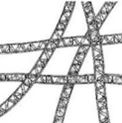
Identify the plant shown in the given figure.
A
Volvox
B
Chlamydomonas
C
Spirogyra
D
Nostoc
Solution
(C) The given figure shows filamentous green algae with characteristic spiral-shaped chloroplasts. This is a diagnostic feature of the genus $Spirogyra$.
$Volvox$ is a colonial green alga.
$Chlamydomonas$ is a unicellular green alga.
$Nostoc$ is a filamentous blue-green alga (cyanobacteria) that forms colonies surrounded by a mucilaginous sheath.
Therefore,the correct option is $C$.
$Volvox$ is a colonial green alga.
$Chlamydomonas$ is a unicellular green alga.
$Nostoc$ is a filamentous blue-green alga (cyanobacteria) that forms colonies surrounded by a mucilaginous sheath.
Therefore,the correct option is $C$.
0 likes
View Solution304
EasyMCQ
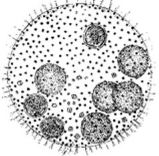
Identify the plant shown in the given figure.
A
Nostoc
B
Spirogyra
C
Volvox
D
Sargassum
Solution
(C) The given figure shows a colonial form of green algae known as $Volvox$.
It consists of a spherical colony of numerous cells,where individual cells are arranged in a hollow sphere.
Inside the colony,daughter colonies are often visible,which are formed through asexual reproduction.
Therefore,the correct option is $C$.
It consists of a spherical colony of numerous cells,where individual cells are arranged in a hollow sphere.
Inside the colony,daughter colonies are often visible,which are formed through asexual reproduction.
Therefore,the correct option is $C$.
0 likes
View Solution305
MediumMCQ
Which of the following plants are non-embryophytes?
A
Bryophytes,Pteridophytes
B
Thallophytes
C
Gymnosperms,Angiosperms
D
Monocots,Dicots
Solution
(B) Embryophytes are plants that produce an embryo during their life cycle. This group includes Bryophytes,Pteridophytes,Gymnosperms,and Angiosperms. Thallophytes,which primarily include algae,do not form an embryo after fertilization. Therefore,Thallophytes are considered non-embryophytes.
0 likes
View Solution306
MediumMCQ
Which of the following algae is a blue-green alga?
A
Nostoc
B
Chlamydomonas
C
Spirogyra
D
Sargassum
Solution
(A) Blue-green algae,also known as cyanobacteria,are photosynthetic prokaryotes.
$Nostoc$ is a well-known genus of cyanobacteria (blue-green algae).
$Chlamydomonas$ and $Spirogyra$ are green algae (Chlorophyceae),which are eukaryotes.
$Sargassum$ is a brown alga (Phaeophyceae),which is also a eukaryote.
Therefore,the correct option is $A$.
$Nostoc$ is a well-known genus of cyanobacteria (blue-green algae).
$Chlamydomonas$ and $Spirogyra$ are green algae (Chlorophyceae),which are eukaryotes.
$Sargassum$ is a brown alga (Phaeophyceae),which is also a eukaryote.
Therefore,the correct option is $A$.
0 likes
View Solution307
EasyMCQ
An example of a colonial alga is
A
Volvox
B
Ulothrix
C
Spirogyra
D
Chlorella
Solution
(A) $Volvox$ is a green alga that forms spherical colonies. Each colony consists of a large number of cells embedded in a gelatinous matrix. These colonies are known as coenobia. In contrast,$Ulothrix$ is filamentous,$Spirogyra$ is also filamentous,and $Chlorella$ is a unicellular alga.
0 likes
View Solution308
MediumMCQ
Which one of the following statements is wrong?
A
Algae increase the level of dissolved oxygen in the immediate environment.
B
Algin is obtained from red algae,and carrageenan from brown algae.
C
Agar-agar is obtained from Gelidium and Gracilaria.
D
Laminaria and Sargassum are used as food.
Solution
(B) is the incorrect statement. Algin (alginic acid) is obtained from the cell walls of brown algae (Phaeophyceae),while carrageenan is obtained from red algae (Rhodophyceae). Therefore,the statement claiming Algin is from red algae and carrageenan from brown algae is false.
0 likes
View Solution309
MediumMCQ
Which one of the following statements is wrong?
A
Chlorella and Spirulina are used as space food.
B
Mannitol is stored food in Rhodophyceae.
C
Algin and carrageenan are products of algae.
D
Agar-agar is obtained from Gelidium and Gracilaria.
Solution
(B) The correct answer is $B$.
In Phaeophyceae (brown algae),food is stored as complex carbohydrates,usually in the form of laminarin or mannitol.
In Rhodophyceae (red algae),food is stored as floridean starch,which is very similar to amylopectin and glycogen in structure.
Therefore,the statement that mannitol is stored food in Rhodophyceae is incorrect.
In Phaeophyceae (brown algae),food is stored as complex carbohydrates,usually in the form of laminarin or mannitol.
In Rhodophyceae (red algae),food is stored as floridean starch,which is very similar to amylopectin and glycogen in structure.
Therefore,the statement that mannitol is stored food in Rhodophyceae is incorrect.
0 likes
View Solution310
MediumMCQ
Male gametes are flagellated in
A
Ectocarpus
B
Spirogyra
C
Polysiphonia
D
Anabaena
Solution
(A) $Ectocarpus$ produces biflagellate gametes.
$Anabaena$ is a cyanobacterium and does not reproduce sexually.
$Spirogyra$ produces non-flagellated male gametes during conjugation,where the entire cell content functions as a gamete.
$Polysiphonia$ also produces non-flagellated spermatia.
$Anabaena$ is a cyanobacterium and does not reproduce sexually.
$Spirogyra$ produces non-flagellated male gametes during conjugation,where the entire cell content functions as a gamete.
$Polysiphonia$ also produces non-flagellated spermatia.
0 likes
View Solution311
MediumMCQ
Which one of the following is wrong about $Chara$?
A
Upper oogonium and lower round antheridium
B
Globule and nucule present on the same plant
C
Upper antheridium and lower oogonium
D
Globule is male reproductive structure
Solution
(C) $Chara$ exhibits highly advanced oogamy.
In $Chara$,the sex organs are complex and distinct.
The male reproductive structure is called the $globule$ $(antheridium)$,and the female reproductive structure is called the $nucule$ $(oogonium)$.
These structures are borne at the nodes of the branches.
The $nucule$ is always situated at a higher position (upper side) than the $globule$ (lower side) on the same plant.
Therefore,the statement that the upper structure is the $antheridium$ and the lower is the $oogonium$ is incorrect.
In $Chara$,the sex organs are complex and distinct.
The male reproductive structure is called the $globule$ $(antheridium)$,and the female reproductive structure is called the $nucule$ $(oogonium)$.
These structures are borne at the nodes of the branches.
The $nucule$ is always situated at a higher position (upper side) than the $globule$ (lower side) on the same plant.
Therefore,the statement that the upper structure is the $antheridium$ and the lower is the $oogonium$ is incorrect.
0 likes
View Solution312
MediumMCQ
Select the wrong statement.
A
In Oomycetes,female gamete is smaller and motile,while male gamete is larger and non-motile.
B
Chlamydomonas exhibits both isogamy and anisogamy and Fucus shows oogamy.
C
Isogametes are similar in structure,function and behaviour.
D
Anisogametes differ either in structure,function or behaviour.
Solution
(A) : In Oomycetes,like other oogamous organisms,the female gamete is large and non-motile,while the male gamete is small and motile. Therefore,the statement in option $(a)$ is incorrect as it describes the opposite condition.
0 likes
View Solution313
MediumMCQ
Isogamous condition with non-flagellated gametes is found in
A
Volvox
B
Fucus
C
Chlamydomonas
D
Spirogyra
Solution
(D) : $Spirogyra$ exhibits isogamy where the gametes are similar in size and non-flagellated (non-motile).
$Volvox$ and $Fucus$ exhibit oogamy,where a large,non-motile female gamete fuses with a smaller,motile male gamete.
$Chlamydomonas$ species can show isogamy,anisogamy,or oogamy,but their gametes are typically flagellated (motile).
$Volvox$ and $Fucus$ exhibit oogamy,where a large,non-motile female gamete fuses with a smaller,motile male gamete.
$Chlamydomonas$ species can show isogamy,anisogamy,or oogamy,but their gametes are typically flagellated (motile).
0 likes
View Solution314
MediumMCQ
The monoecious plant of $Chara$ shows the occurrence of:
A
upper antheridium and lower oogonium on the same plant
B
upper oogonium and lower antheridium on the same plant
C
antheridiophore and archegoniophore on the same plant
D
stamen and carpel on the same plant
Solution
(B) The correct answer is $B$.
$Chara$ is a monoecious plant,meaning both male and female sex organs are present on the same individual plant.
The male sex organ is called the $antheridium$ (or $globule$),and the female sex organ is called the $oogonium$ (or $nucule$).
In $Chara$,these reproductive structures are borne at the nodes of the branches.
The $oogonium$ is positioned towards the upper side,while the $antheridium$ is positioned towards the lower side on the same plant.
$Chara$ is a monoecious plant,meaning both male and female sex organs are present on the same individual plant.
The male sex organ is called the $antheridium$ (or $globule$),and the female sex organ is called the $oogonium$ (or $nucule$).
In $Chara$,these reproductive structures are borne at the nodes of the branches.
The $oogonium$ is positioned towards the upper side,while the $antheridium$ is positioned towards the lower side on the same plant.
0 likes
View Solution315
MediumMCQ
The cell wall of algae is composed of:
A
cellulose,galactans and mannans
B
hemicellulose,pectins and proteins
C
pectins,cellulose and proteins
D
cellulose,hemicellulose and pectins
Solution
(A) The correct answer is $A$.
Most eukaryotic algae possess a well-defined cell wall primarily composed of cellulose and other carbohydrates such as galactans and mannans.
These chemical components vary significantly among different algal groups,often including substances like xylan,alginic acid,silica,agar,pectin,and carrageenin.
In contrast,the cell wall of blue-green algae (cyanobacteria,which are prokaryotes) is composed of peptidoglycans (muropeptides),which are distinct from the cellulose-based walls of eukaryotic algae.
Most eukaryotic algae possess a well-defined cell wall primarily composed of cellulose and other carbohydrates such as galactans and mannans.
These chemical components vary significantly among different algal groups,often including substances like xylan,alginic acid,silica,agar,pectin,and carrageenin.
In contrast,the cell wall of blue-green algae (cyanobacteria,which are prokaryotes) is composed of peptidoglycans (muropeptides),which are distinct from the cellulose-based walls of eukaryotic algae.
0 likes
View Solution316
MediumMCQ
Mannitol is the stored food in
A
Porphyra
B
Fucus
C
Gracillaria
D
Chara
Solution
(B) The correct answer is $B$.
$Fucus$ is a brown alga,which belongs to the Class $Phaeophyceae$.
In brown algae,the stored food material is complex carbohydrates,usually in the form of laminarin or mannitol.
$Porphyra$ and $Gracillaria$ are red algae (Class $Rhodophyceae$),where food is stored as floridean starch.
$Chara$ is a green alga (Class $Chlorophyceae$),where food is stored as starch.
$Fucus$ is a brown alga,which belongs to the Class $Phaeophyceae$.
In brown algae,the stored food material is complex carbohydrates,usually in the form of laminarin or mannitol.
$Porphyra$ and $Gracillaria$ are red algae (Class $Rhodophyceae$),where food is stored as floridean starch.
$Chara$ is a green alga (Class $Chlorophyceae$),where food is stored as starch.
0 likes
View Solution317
MediumMCQ
If you are asked to classify the various algae into distinct groups,which of the following characters should you choose?
A
Nature of stored food materials in the cell
B
Structural organization of thallus
C
Chemical composition of the cell wall
D
Types of pigments present in the cell
Solution
(D) : Algae are a group of chlorophyllous,non-vascular plants with a thallose plant body. Different algae show different pigments present in the cell,such as chlorophyll $a, b$,xanthophylls,carotenes,etc. These pigments provide the primary basis for the classification of various groups of algae into different classes. For example,members of Chlorophyceae possess chlorophyll $a$ and $b$,Phaeophyceae contains fucoxanthin,and Rhodophyceae contains $r$-phycoerythrin.
0 likes
View Solution318
MediumMCQ
Which one of the following shows isogamy with non-flagellated gametes?
A
Sargassum
B
Ectocarpus
C
Ulothrix
D
Spirogyra
Solution
(D) : Sexual reproduction in algae occurs through the fusion of two gametes.
In $Spirogyra$, the gametes are similar in size (isogamy) and are non-flagellated (non-motile).
$Sargassum$ shows oogamy.
$Ectocarpus$ shows isogamy with flagellated gametes.
$Ulothrix$ shows isogamy with flagellated gametes.
In $Spirogyra$, the gametes are similar in size (isogamy) and are non-flagellated (non-motile).
$Sargassum$ shows oogamy.
$Ectocarpus$ shows isogamy with flagellated gametes.
$Ulothrix$ shows isogamy with flagellated gametes.
0 likes
View Solution319
EasyMCQ
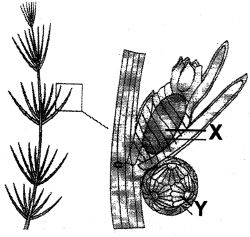
Identify $X$ and $Y$ in the given figure.
A
$X-$ oogonium,$Y-$ antheridium
B
$X-$ antheridium,$Y-$ oogonium
C
$X-$ oogonium,$Y-$ carpel
D
$X-$ antheridium,$Y-$ stamen
Solution
(A) The given figure represents the green alga $Chara$.
In $Chara$,the sex organs are multicellular and jacketed.
The upper,oval-shaped structure is the female sex organ,known as the oogonium $(X)$.
The lower,spherical structure is the male sex organ,known as the antheridium $(Y)$.
In $Chara$,the sex organs are multicellular and jacketed.
The upper,oval-shaped structure is the female sex organ,known as the oogonium $(X)$.
The lower,spherical structure is the male sex organ,known as the antheridium $(Y)$.
0 likes
View Solution320
MediumMCQ
Which algae is likely to be found in the deepest water?
A
Brown algae
B
Red algae
C
Green algae
D
None of the above
Solution
(B) Red algae (Rhodophyceae) are typically found in the deepest waters.
This is because they contain the pigment phycoerythrin,which allows them to absorb blue light,the wavelength that penetrates the deepest into the water column.
Green algae and brown algae are generally found in shallower waters where red and yellow light are more abundant.
This is because they contain the pigment phycoerythrin,which allows them to absorb blue light,the wavelength that penetrates the deepest into the water column.
Green algae and brown algae are generally found in shallower waters where red and yellow light are more abundant.
0 likes
View Solution321
MediumMCQ
Which of the following organisms exhibits a diplontic life cycle pattern?
A
Fucus algae
B
Bryophytes
C
Pteridophytes
D
Spirogyra
Solution
(A) In a diplontic life cycle,the diploid sporophyte is the dominant,photosynthetic,and independent phase of the plant. The gametophytic phase is represented by the single to few-celled haploid gametophyte.
$1$. $Fucus$ (a brown alga) is a classic example of an organism that exhibits a diplontic life cycle.
$2$. Bryophytes and Pteridophytes exhibit a haplodiplontic life cycle.
$3$. $Spirogyra$ exhibits a haplontic life cycle.
Therefore,the correct option is $A$.
$1$. $Fucus$ (a brown alga) is a classic example of an organism that exhibits a diplontic life cycle.
$2$. Bryophytes and Pteridophytes exhibit a haplodiplontic life cycle.
$3$. $Spirogyra$ exhibits a haplontic life cycle.
Therefore,the correct option is $A$.
0 likes
View Solution322
MediumMCQ
In Rhodophyceae,stored food is available as:
A
Mannitol
B
Laminarin
C
Floridean starch
D
Glycogen
Solution
(C) In $Rhodophyceae$ (red algae),the food is stored as $Floridean$ $starch$.
$Floridean$ $starch$ is very similar to $amylopectin$ and $glycogen$ in structure.
$Mannitol$ and $laminarin$ are stored food materials in $Phaeophyceae$ (brown algae).
$Glycogen$ is the stored food in animals and fungi.
$Floridean$ $starch$ is very similar to $amylopectin$ and $glycogen$ in structure.
$Mannitol$ and $laminarin$ are stored food materials in $Phaeophyceae$ (brown algae).
$Glycogen$ is the stored food in animals and fungi.
0 likes
View Solution323
MediumMCQ
Its cell wall is made up of cellulose and algin.
A
Phaeophyceae
B
Basidiomycetes
C
Chlorophyceae
D
Ascomycetes
Solution
(A) The members of the class $Phaeophyceae$ (brown algae) possess a cell wall that is composed of an inner layer of cellulose and an outer gelatinous coating of phycocolloids,specifically algin. $Chlorophyceae$ (green algae) have cell walls made of cellulose and pectose. $Basidiomycetes$ and $Ascomycetes$ are fungi,and their cell walls are composed of chitin.
0 likes
View Solution324
MediumMCQ
In which of the following algae is a haplodiplontic life cycle observed?
A
Polysiphonia
B
Volvox
C
Some species of Chlamydomonas
D
Spirogyra
Solution
(A) haplodiplontic life cycle involves an alternation between a multicellular haploid $(n)$ gametophyte and a multicellular diploid $(2n)$ sporophyte.
Among the algae,this pattern is characteristic of Ectocarpus,Polysiphonia,and Kelps.
$Volvox$ and $Spirogyra$ exhibit a haplontic life cycle,where the dominant phase is the haploid gametophyte and the zygote is the only diploid stage.
Some species of $Chlamydomonas$ also exhibit a haplontic life cycle.
Therefore,$Polysiphonia$ is the correct answer.
Among the algae,this pattern is characteristic of Ectocarpus,Polysiphonia,and Kelps.
$Volvox$ and $Spirogyra$ exhibit a haplontic life cycle,where the dominant phase is the haploid gametophyte and the zygote is the only diploid stage.
Some species of $Chlamydomonas$ also exhibit a haplontic life cycle.
Therefore,$Polysiphonia$ is the correct answer.
0 likes
View Solution325
MediumMCQ
The stored food in Polysiphonia is:
A
Floridean starch
B
Pyrenoids
C
Pectose
D
Mannitol
Solution
(A) $Polysiphonia$ is a genus of red algae (Rhodophyceae).
In red algae,the food is stored as Floridean starch,which is very similar to amylopectin and glycogen in structure.
In red algae,the food is stored as Floridean starch,which is very similar to amylopectin and glycogen in structure.
0 likes
View Solution326
MediumMCQ
$Ectocarpus$ and $Dictyota$ are examples of:
A
$Rhodophyceae$
B
$Phaeophyceae$
C
$Chlorophyceae$
D
$Chlorophyceae$ and $Phaeophyceae$ respectively
Solution
(B) $Ectocarpus$ and $Dictyota$ are members of the class $Phaeophyceae$ (brown algae).
$Phaeophyceae$ are characterized by the presence of chlorophyll $a$,$c$,carotenoids,and xanthophylls (specifically fucoxanthin),which give them their characteristic brown color.
Other common examples of $Phaeophyceae$ include $Laminaria$,$Sargassum$,and $Fucus$.
$Phaeophyceae$ are characterized by the presence of chlorophyll $a$,$c$,carotenoids,and xanthophylls (specifically fucoxanthin),which give them their characteristic brown color.
Other common examples of $Phaeophyceae$ include $Laminaria$,$Sargassum$,and $Fucus$.
0 likes
View Solution327
MediumMCQ
Agar,which is required for the synthesis of ice cream and jelly,is obtained from:
A
Algin and Carrageenan
B
Carrageenan and Gelidium
C
Gracilaria and Algin
D
Gelidium and Gracilaria
Solution
(D) Agar is a commercial product obtained from certain marine red algae.
It is widely used in the preparation of ice creams and jellies.
The two primary sources of agar are the red algae species $Gelidium$ and $Gracilaria$.
Therefore,the correct option is $D$.
It is widely used in the preparation of ice creams and jellies.
The two primary sources of agar are the red algae species $Gelidium$ and $Gracilaria$.
Therefore,the correct option is $D$.
0 likes
View Solution328
MediumMCQ
Which of the following is a unicellular and small alga?
A
Porphyra
B
Fucus
C
Dictyota
D
Chlamydomonas
Solution
(D) Chlamydomonas is a well-known example of a unicellular green alga.
It is microscopic and typically found in freshwater environments.
In contrast,Porphyra,Fucus,and Dictyota are multicellular algae belonging to the group of brown or red algae.
It is microscopic and typically found in freshwater environments.
In contrast,Porphyra,Fucus,and Dictyota are multicellular algae belonging to the group of brown or red algae.
0 likes
View Solution329
MediumMCQ
Which of the following is correct for Chlorophyceae?
A
Gelatinous layer surrounds the cellulosic cell wall.
B
Mannitol layer surrounds the cellulosic cell wall.
C
Pectose layer surrounds the cell wall.
D
Laminarin is available as stored food.
Solution
(A) Chlorophyceae (green algae) typically have a rigid cell wall made of an inner layer of cellulose and an outer layer of pectose.
Option $A$ is correct because the cell wall of green algae consists of an inner layer of cellulose and an outer layer of pectose,which often forms a gelatinous coating.
Option $B$ and $D$ are characteristics of Phaeophyceae (brown algae),where mannitol and laminarin are common storage products.
Option $C$ is partially correct in description but $A$ is the standard $NCERT$ description for the cell wall composition of Chlorophyceae.
Option $A$ is correct because the cell wall of green algae consists of an inner layer of cellulose and an outer layer of pectose,which often forms a gelatinous coating.
Option $B$ and $D$ are characteristics of Phaeophyceae (brown algae),where mannitol and laminarin are common storage products.
Option $C$ is partially correct in description but $A$ is the standard $NCERT$ description for the cell wall composition of Chlorophyceae.
0 likes
View Solution330
MediumMCQ
Select the correct option from the given list regarding algal classes and their stored food materials:
$(1)$ Rhodophyceae - Pyrenoids
$(2)$ Phaeophyceae - Laminarin
$(3)$ Bryophytes - Mannitol
$(4)$ Chlorophyceae - Floridean starch
$(1)$ Rhodophyceae - Pyrenoids
$(2)$ Phaeophyceae - Laminarin
$(3)$ Bryophytes - Mannitol
$(4)$ Chlorophyceae - Floridean starch
A
$1$ and $4$
B
$2$ and $3$
C
Only $2$
D
$3$ and $4$
Solution
(C) Let us analyze the food storage in different algal groups:
$(1)$ Rhodophyceae (Red algae) store food as Floridean starch,not Pyrenoids. Pyrenoids are proteinaceous bodies found in Chlorophyceae.
$(2)$ Phaeophyceae (Brown algae) store food as complex carbohydrates like Laminarin or Mannitol. This statement is correct.
$(3)$ Bryophytes are land plants,not algae,and they do not store food as Mannitol. This statement is incorrect.
$(4)$ Chlorophyceae (Green algae) store food as Starch,not Floridean starch. This statement is incorrect.
Therefore,only statement $(2)$ is correct.
$(1)$ Rhodophyceae (Red algae) store food as Floridean starch,not Pyrenoids. Pyrenoids are proteinaceous bodies found in Chlorophyceae.
$(2)$ Phaeophyceae (Brown algae) store food as complex carbohydrates like Laminarin or Mannitol. This statement is correct.
$(3)$ Bryophytes are land plants,not algae,and they do not store food as Mannitol. This statement is incorrect.
$(4)$ Chlorophyceae (Green algae) store food as Starch,not Floridean starch. This statement is incorrect.
Therefore,only statement $(2)$ is correct.
0 likes
View Solution331
MediumMCQ
Which of the following algae are used as food supplements by space travellers?
A
Gellidium
B
Chlorella and Spirulina
C
Algin and Carrageen
D
Chlamydomonas and Spirogyra
Solution
(B) Chlorella and Spirulina are unicellular algae that are rich in proteins.
Due to their high nutritional value and ability to produce oxygen through photosynthesis,they are used as food supplements by space travellers.
Due to their high nutritional value and ability to produce oxygen through photosynthesis,they are used as food supplements by space travellers.
0 likes
View Solution332
EasyMCQ
Which of the following shapes is not found in the chloroplasts of Chlorophyceae?
A
Discoid
B
Triangle shape
C
Ribbon-shaped
D
Cup-shaped
Solution
(B) In the class Chlorophyceae (green algae),chloroplasts exhibit a wide variety of shapes. These include discoid,plate-like,reticulate,cup-shaped,spiral,and ribbon-shaped forms. However,a 'triangle' shape is not a characteristic or reported shape for chloroplasts in Chlorophyceae. Therefore,the correct answer is $B$.
0 likes
View Solution333
MediumMCQ
Choose the correct pair.
A
Unicellular algae - kelps
B
Colonial algae - Chlamydomonas
C
Filamentous algae - Ulothrix
D
Isogamous reproduction - Fucus
Solution
(C) $1$. Kelps are massive,multicellular brown algae,not unicellular.
$2$. Chlamydomonas is a unicellular green alga,not colonial (Volvox is colonial).
$3$. Ulothrix is a filamentous green alga,which is a correct pairing.
$4$. Fucus exhibits oogamous reproduction,not isogamous (Ectocarpus or Ulothrix exhibit isogamy).
Therefore,the correct pair is $C$.
$2$. Chlamydomonas is a unicellular green alga,not colonial (Volvox is colonial).
$3$. Ulothrix is a filamentous green alga,which is a correct pairing.
$4$. Fucus exhibits oogamous reproduction,not isogamous (Ectocarpus or Ulothrix exhibit isogamy).
Therefore,the correct pair is $C$.
0 likes
View Solution334
MediumMCQ
Which statement is correct for $Chlorophyceae$?
A
Chlorophyll $a$ and $b$ both are absent.
B
Food is stored in pyrenoids.
C
Vegetative reproduction does not occur.
D
Chloroplast is only spiral-shaped.
Solution
(B) In $Chlorophyceae$ (green algae),the following characteristics are observed:
$1$. They contain chlorophyll $a$ and $b$ as photosynthetic pigments.
$2$. Food is stored in the form of starch,and the storage bodies are called pyrenoids,which are located in the chloroplasts.
$3$. Vegetative reproduction occurs by fragmentation or by the formation of different types of spores.
$4$. Chloroplasts can be of various shapes such as discoid,plate-like,reticulate,cup-shaped,spiral,or ribbon-shaped.
Therefore,the statement 'Food stored in pyrenoids' is correct.
$1$. They contain chlorophyll $a$ and $b$ as photosynthetic pigments.
$2$. Food is stored in the form of starch,and the storage bodies are called pyrenoids,which are located in the chloroplasts.
$3$. Vegetative reproduction occurs by fragmentation or by the formation of different types of spores.
$4$. Chloroplasts can be of various shapes such as discoid,plate-like,reticulate,cup-shaped,spiral,or ribbon-shaped.
Therefore,the statement 'Food stored in pyrenoids' is correct.
0 likes
View Solution335
MediumMCQ
......... is an example of $Phaeophyceae$.
A
$Polysiphonia$
B
$Chara$
C
$Gracilaria$
D
$Sargassum$
Solution
(D) $Phaeophyceae$ are commonly known as brown algae.
$Sargassum$,$Ectocarpus$,$Dictyota$,$Laminaria$,and $Fucus$ are common examples of $Phaeophyceae$.
$Polysiphonia$ and $Gracilaria$ belong to $Rhodophyceae$ (red algae).
$Chara$ belongs to $Chlorophyceae$ (green algae).
Therefore,the correct option is $D$.
$Sargassum$,$Ectocarpus$,$Dictyota$,$Laminaria$,and $Fucus$ are common examples of $Phaeophyceae$.
$Polysiphonia$ and $Gracilaria$ belong to $Rhodophyceae$ (red algae).
$Chara$ belongs to $Chlorophyceae$ (green algae).
Therefore,the correct option is $D$.
0 likes
View Solution336
MediumMCQ
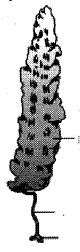
Identify the figure shown below.
A
Porphyra
B
Laminaria
C
Volvox
D
Pinus
Solution
(B) The figure represents $Laminaria$,which is a genus of large brown algae (Phaeophyceae).
It is characterized by a holdfast,a stipe,and a large leaf-like frond.
$Porphyra$ is a red alga,$Volvox$ is a colonial green alga,and $Pinus$ is a gymnosperm.
It is characterized by a holdfast,a stipe,and a large leaf-like frond.
$Porphyra$ is a red alga,$Volvox$ is a colonial green alga,and $Pinus$ is a gymnosperm.
0 likes
View Solution337
MediumMCQ
Which pigment is present in red algae in higher proportion?
A
r-phycoerythrin
B
Xanthophyll
C
Chlorophyll
D
Carotenoids
Solution
(A) Red algae,belonging to the class $Rhodophyceae$,are characterized by the presence of the red pigment $r-phycoerythrin$ in large amounts.
This pigment masks the green color of chlorophyll $a$,giving these algae their characteristic red appearance.
Therefore,$r-phycoerythrin$ is the dominant pigment found in red algae.
This pigment masks the green color of chlorophyll $a$,giving these algae their characteristic red appearance.
Therefore,$r-phycoerythrin$ is the dominant pigment found in red algae.
0 likes
View Solution338
MediumMCQ
What is $Chlamydomonas$?
A
Types of chloroplast
B
Algae
C
Chlorophyll
D
Organelle
Solution
(B) $Chlamydomonas$ is a genus of unicellular green algae. It belongs to the class $Chlorophyceae$ and is commonly found in stagnant water,damp soil,and freshwater environments. It is characterized by its flagella,which allow for motility,and a cup-shaped chloroplast.
0 likes
View Solution339
MediumMCQ
Which of the following is correct regarding $Porphyra$ and $Laminaria$?
A
One is a fungus and the other is a member of the plant kingdom.
B
One is an alga and the other is an angiosperm plant.
C
One is a lichen and the other is an alga.
D
Both are algae used as food.
Solution
(D) $Porphyra$ and $Laminaria$ are both members of the group Phaeophyceae and Rhodophyceae (marine algae) respectively.
Many species of marine algae such as $Porphyra$,$Laminaria$,and $Sargassum$ are among the $70$ species of marine algae used as food.
Therefore,both are algae that are consumed as food sources.
Many species of marine algae such as $Porphyra$,$Laminaria$,and $Sargassum$ are among the $70$ species of marine algae used as food.
Therefore,both are algae that are consumed as food sources.
0 likes
View Solution340
MediumMCQ
In $Spirogyra$,gametes are:
A
non-flagellated but similar in size
B
flagellated and similar in size
C
non-flagellated and dissimilar in size
D
flagellated but dissimilar in size
Solution
(A) $Spirogyra$ is a green alga that reproduces sexually through a process called conjugation.
In this process,the gametes are non-flagellated (non-motile).
These gametes are morphologically similar in size and shape,a condition known as isogamy.
Therefore,the gametes in $Spirogyra$ are non-flagellated and similar in size.
In this process,the gametes are non-flagellated (non-motile).
These gametes are morphologically similar in size and shape,a condition known as isogamy.
Therefore,the gametes in $Spirogyra$ are non-flagellated and similar in size.
0 likes
View Solution341
EasyMCQ
Agar is obtained from which algae?
A
Gelidium
B
Nostoc
C
Chlamydomonas
D
Ulothrix
Solution
(A) Agar is a polysaccharide used in culture media for growing microbes and in the preparation of ice creams and jellies.
It is commercially obtained from marine red algae,specifically $Gelidium$ and $Gracilaria$.
$Nostoc$ is a cyanobacterium,while $Chlamydomonas$ and $Ulothrix$ are green algae.
It is commercially obtained from marine red algae,specifically $Gelidium$ and $Gracilaria$.
$Nostoc$ is a cyanobacterium,while $Chlamydomonas$ and $Ulothrix$ are green algae.
0 likes
View Solution342
MediumMCQ
Which of the following organisms exhibits a haplontic life cycle?
A
Fucus
B
Spirogyra
C
Wheat
D
Funaria
Solution
(B) In a haplontic life cycle,the dominant phase is the free-living gametophyte $(n)$. The zygote $(2n)$ is the only diploid stage,which undergoes meiosis immediately to form haploid spores.
$Spirogyra$ is a green alga that exhibits a haplontic life cycle.
$Fucus$ exhibits a diplontic life cycle.
$Wheat$ (an angiosperm) exhibits a diplontic life cycle.
$Funaria$ (a bryophyte) exhibits a haplo-diplontic life cycle.
$Spirogyra$ is a green alga that exhibits a haplontic life cycle.
$Fucus$ exhibits a diplontic life cycle.
$Wheat$ (an angiosperm) exhibits a diplontic life cycle.
$Funaria$ (a bryophyte) exhibits a haplo-diplontic life cycle.
0 likes
View Solution343
MediumMCQ
Which alga is used by space travellers as a food supplement?
A
Cephaleuros
B
Gelidium
C
Chlorella
D
Gracilaria
Solution
(C) Chlorella is a unicellular green alga that is rich in proteins and vitamins. Due to its high nutritional value and ability to perform photosynthesis efficiently,it is used by space travellers as a food supplement.
0 likes
View Solution344
MediumMCQ
Identify the figure.
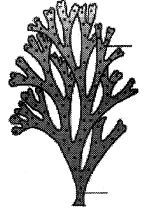
A
Pinus
B
Dictyota
C
Fucus
D
Porphyra
Solution
(B) The provided figure shows the thallus of the brown alga $Dictyota$.
$Dictyota$ is a genus of marine brown algae characterized by its dichotomously branched,flat,ribbon-like thallus.
In contrast,$Pinus$ is a gymnosperm,$Fucus$ is a brown alga with a different morphology (often having air bladders),and $Porphyra$ is a red alga with a leaf-like thallus.
Therefore,the correct identification is $Dictyota$.
$Dictyota$ is a genus of marine brown algae characterized by its dichotomously branched,flat,ribbon-like thallus.
In contrast,$Pinus$ is a gymnosperm,$Fucus$ is a brown alga with a different morphology (often having air bladders),and $Porphyra$ is a red alga with a leaf-like thallus.
Therefore,the correct identification is $Dictyota$.
0 likes
View Solution345
MediumMCQ
What is correct for $Porphyra$ and $Laminaria$?
A
One is fungi and another is a member of the plant kingdom.
B
One is algae and another is an angiosperm plant.
C
One is lichen and another is algae.
D
Both are algae used as food.
Solution
(D) Both $Porphyra$ and $Laminaria$ are marine algae belonging to the group Phaeophyceae (brown algae) and Rhodophyceae (red algae) respectively.
Many species of marine algae,such as $Porphyra$,$Laminaria$,and $Sargassum$,are used as food by many nations.
Therefore,the correct statement is that both are algae used as food.
Many species of marine algae,such as $Porphyra$,$Laminaria$,and $Sargassum$,are used as food by many nations.
Therefore,the correct statement is that both are algae used as food.
0 likes
View Solution346
MediumMCQ
$A$ research student collected a certain alga and found that its cells contained both chlorophyll $a$ and chlorophyll $d$,as well as phycoerythrin. The alga belongs to:
A
Rhodophyceae
B
Bacillariophyceae
C
$(A)$ and $(B)$ are correct
D
Phaeophyceae
Solution
(A) The presence of chlorophyll $a$,chlorophyll $d$,and the accessory pigment phycoerythrin is a characteristic feature of the class Rhodophyceae (red algae).
Phycoerythrin is responsible for the characteristic red color of these algae.
Chlorophyll $d$ is specifically found in red algae,distinguishing them from other algal groups.
Therefore,the alga belongs to Rhodophyceae.
Phycoerythrin is responsible for the characteristic red color of these algae.
Chlorophyll $d$ is specifically found in red algae,distinguishing them from other algal groups.
Therefore,the alga belongs to Rhodophyceae.
0 likes
View Solution347
EasyMCQ
The cell wall of algae is composed of:
A
Cellulose,suberin,mannans,and calcium carbonate.
B
Cellulose,galactans,pectins,and lignin.
C
Cellulose,galactans,mannans,and calcium carbonate.
D
Cellulose,lignin,protein,and hemicellulose.
Solution
(C) According to the $NCERT$ textbook,the cell wall of algae is composed of cellulose,galactans,mannans,and minerals like calcium carbonate. Therefore,option $C$ is the correct answer.
0 likes
View Solution348
MediumMCQ
Galactans and mannans are found in
A
Cell membrane
B
Outer membrane of mitochondria
C
Cell wall of algae
D
Cell wall of fungi
Solution
(C) The cell wall of algae is composed of cellulose,galactans,mannans,and minerals like calcium carbonate.
These polysaccharides are structural components that provide rigidity and support to the algal cell wall.
In contrast,fungal cell walls are primarily composed of chitin,and plant cell walls are composed of cellulose,hemicellulose,and pectins.
These polysaccharides are structural components that provide rigidity and support to the algal cell wall.
In contrast,fungal cell walls are primarily composed of chitin,and plant cell walls are composed of cellulose,hemicellulose,and pectins.
0 likes
View Solution349
EasyMCQ
The product of conjugation in $Spirogyra$ or fertilization in $Chlamydomonas$ is .....
A
Zygospore
B
Zoospore
C
Oospore
D
Carpospore
Solution
(A) In $Spirogyra$,sexual reproduction occurs through conjugation,where two filaments fuse to form a diploid zygote. This zygote develops a thick wall to become a resting spore known as a $Zygospore$. Similarly,in $Chlamydomonas$,the fusion of gametes (fertilization) results in the formation of a diploid zygote,which also develops into a $Zygospore$ to survive unfavorable conditions. Therefore,the product of these processes is a $Zygospore$.
0 likes
View Solution350
MediumMCQ
In which of the following plants is the sporophytic generation represented only by the zygote?
A
Pinus
B
Selaginella
C
Chlamydomonas
D
Dryopteris
Solution
(C) In $Chlamydomonas$, the life cycle is haplontic.
In a haplontic life cycle, the dominant, photosynthetic phase is the free-living gametophyte $(n)$.
The sporophyte generation $(2n)$ is represented only by the single-celled zygote, which undergoes meiosis to produce haploid spores.
$Pinus$ (gymnosperm), $Selaginella$ (pteridophyte), and $Dryopteris$ (pteridophyte) exhibit diplontic or haplo-diplontic life cycles where the sporophyte is the dominant, multicellular phase.
In a haplontic life cycle, the dominant, photosynthetic phase is the free-living gametophyte $(n)$.
The sporophyte generation $(2n)$ is represented only by the single-celled zygote, which undergoes meiosis to produce haploid spores.
$Pinus$ (gymnosperm), $Selaginella$ (pteridophyte), and $Dryopteris$ (pteridophyte) exhibit diplontic or haplo-diplontic life cycles where the sporophyte is the dominant, multicellular phase.
0 likes
View SolutionPlant Kingdom — Algae (General) · Frequently Asked Questions
1Are these Plant Kingdom questions useful for JEE and NEET?
Yes. All questions in this section are mapped to JEE Main and NEET exam patterns. Previous year questions from JEE Main, NEET, GUJCET and state-level exams are included with full solutions.
2Can I switch to Hindi or Gujarati for these questions?
Yes. Use the language tabs in the hero section or the sidebar to view the same questions and solutions in English, Hindi or Gujarati.
3How do I generate a question paper from this subtopic?
Use the Vedclass Exam Paper Generator — select the chapter and subtopic, set difficulty, and generate Sets A, B, C, D automatically. First 3 chapters of every subject are free.
Vedclass Products
For Students
Vedclass Test Series
Mock tests in real JEE/NEET style with performance analysis. 5-day free trial.
Start Free TrialFor Teachers
Exam Paper Generator
Generate Set A/B/C/D papers from this chapter in 2 minutes. 3 chapters free.
Try FreeFor Institutes
Online Exam Module
Live online exams with unlimited students, 360° analytics & white-label branding.
See DemoFor Teachers & Institutes
Generate a Plant Kingdom Exam Paper in 2 Minutes
Select subtopic & difficulty — Sets A, B, C, D auto-generated with No Repeat logic.
First 3 chapters of every subject are free — no payment required.