
A English
Photoperiodism and Vernalization Questions in English
Class 11 Biology · Plant Growth and Development · Photoperiodism and Vernalization
203+
Questions
English
Language
100%
With Solutions
Showing 50 of 203 questions in English
151
EasyMCQ
An example of a short-day plant is:
A
Wheat
B
Maize
C
Chrysanthemum
D
Radish
Solution
(C) Short-day plants generally require a light period of less than $12$ hours (i.e.,$8-10$ hours) and a continuous dark period of about $14-16$ hours for subsequent flowering.
Most winter-flowering plants belong to this category,such as Chrysanthemum,Xanthium (cocklebur),Dahlia,rice,sugarcane,potato,tobacco,and soybean $(Glycine \; max)$.
Most winter-flowering plants belong to this category,such as Chrysanthemum,Xanthium (cocklebur),Dahlia,rice,sugarcane,potato,tobacco,and soybean $(Glycine \; max)$.
0 likes
View Solution152
EasyMCQ
Winter varieties of wheat and barley are planted in
A
Spring season
B
Winter season
C
Autumn season
D
Summer season
Solution
(C) Winter varieties of wheat and barley are planted in autumn. This allows them to receive the stimulus of cold temperatures during the winter,which is essential for their transition to the reproductive phase (flowering) and subsequent seed production in the spring season. This process is known as vernalization.
0 likes
View Solution153
EasyMCQ
Examples of plants which require vernalization is/are:
A
Pea
B
Beet
C
Cabbage
D
All of these
Solution
(D) Vernalization is the process of shortening the juvenile phase and promoting flowering by exposure to low temperatures.
Common examples of plants that require vernalization include winter varieties of cereals like wheat,rye,and barley,as well as biennial plants such as beet,cabbage,and carrot.
Other examples include pea,henbane,viola,clover,and Chrysanthemum.
Since pea,beet,and cabbage are all known to respond to low-temperature treatment to induce flowering,the correct answer is 'All of these'.
Common examples of plants that require vernalization include winter varieties of cereals like wheat,rye,and barley,as well as biennial plants such as beet,cabbage,and carrot.
Other examples include pea,henbane,viola,clover,and Chrysanthemum.
Since pea,beet,and cabbage are all known to respond to low-temperature treatment to induce flowering,the correct answer is 'All of these'.
0 likes
View Solution154
MediumMCQ
Vernalisation can be reversed by
A
Application of high temperature
B
Application of auxin
C
Application of low temperature
D
Application of gibberellins
Solution
(A) The low temperature required for vernalisation is usually $0^{\circ}C - 5^{\circ}C$.
If this low temperature treatment is immediately followed by a very high temperature (approximately $40^{\circ}C$),the effect of vernalisation is nullified or lost.
This phenomenon of reversing the effect of vernalisation is known as devernalisation.
If this low temperature treatment is immediately followed by a very high temperature (approximately $40^{\circ}C$),the effect of vernalisation is nullified or lost.
This phenomenon of reversing the effect of vernalisation is known as devernalisation.
0 likes
View Solution155
EasyMCQ
Stimulus of vernalisation is perceived by
A
Shoot tips
B
Mature tissues
C
Embryo tips
D
Both $(A)$ and $(C)$
Solution
(D) The stimulus of vernalization is perceived by the meristematic cells of the plant.
These cells are actively dividing and are found in regions such as the shoot apex,embryo tip,root apex,and developing leaves.
Since both shoot tips and embryo tips contain these meristematic cells,they are the primary sites for perceiving the cold stimulus required for vernalization.
Therefore,the correct answer is $(D)$.
These cells are actively dividing and are found in regions such as the shoot apex,embryo tip,root apex,and developing leaves.
Since both shoot tips and embryo tips contain these meristematic cells,they are the primary sites for perceiving the cold stimulus required for vernalization.
Therefore,the correct answer is $(D)$.
0 likes
View Solution156
MediumMCQ
Florigen results in the conversion of
A
Reproductive bud $\rightarrow$ Vegetative bud
B
Shoot apex $\rightarrow$ Flowering bud
C
Root apex $\rightarrow$ Reproductive bud
D
Vegetative bud $\rightarrow$ Lateral shoot
Solution
(B) Florigen is a hypothetical hormonal substance responsible for the induction of flowering in plants.
It is synthesized in the leaves and then migrates to the shoot apices.
Upon reaching the shoot apex,it induces the transformation of the vegetative shoot apex into a flowering bud (floral primordium),thereby initiating the reproductive phase.
It is synthesized in the leaves and then migrates to the shoot apices.
Upon reaching the shoot apex,it induces the transformation of the vegetative shoot apex into a flowering bud (floral primordium),thereby initiating the reproductive phase.
0 likes
View Solution157
EasyMCQ
Which type of plants can blossom throughout the year?
A
Long day plants
B
Short-long day plants
C
Short-day plants
D
Day neutral plants
Solution
(D) Day neutral plants are those in which there is no correlation between exposure to light duration and the induction of flowering.
These plants can flower throughout the year regardless of the photoperiod,as their flowering is not dependent on the length of the day or night.
These plants can flower throughout the year regardless of the photoperiod,as their flowering is not dependent on the length of the day or night.
0 likes
View Solution158
EasyMCQ
Which of the following is an example of a short-day plant?
A
Tobacco
B
Sugarbeet
C
Wheat
D
Radish
Solution
(A) Short-day plants $(SDP)$ are plants that flower only when the day length is shorter than a critical period.
Tobacco $(Nicotiana tabacum)$ is a classic example of a short-day plant.
Sugarbeet, wheat, and radish are examples of long-day plants $(LDP)$.
Tobacco $(Nicotiana tabacum)$ is a classic example of a short-day plant.
Sugarbeet, wheat, and radish are examples of long-day plants $(LDP)$.
0 likes
View Solution159
MediumMCQ
Most of the winter flowering plants belong to
A
Short long day plants
B
Long day plants
C
Short day plants
D
Day neutral plants
Solution
(C) Photoperiodism is the physiological response of plants to the relative lengths of light and dark periods. Winter flowering plants bloom when the days are shorter and the nights are longer. These plants are classified as Short Day Plants $(SDP)$ because they require a photoperiod shorter than a critical duration to flower. Since winter days are naturally shorter,these plants are adapted to flower during this season.
0 likes
View Solution160
EasyMCQ
Cucumber and tomato are the examples of
A
Day neutral plants
B
Short day plants
C
Long day plants
D
Long short day plants
Solution
(A) Photoperiodism is the physiological response of plants to the relative lengths of light and dark periods.
Plants are categorized based on their flowering response to photoperiods.
Cucumber $(Cucumis \text{ } sativus)$ and tomato $(Solanum \text{ } lycopersicum)$ are examples of day-neutral plants.
Day-neutral plants are those in which flowering is not dependent on the duration of light exposure, allowing them to flower throughout the year regardless of the photoperiod.
Plants are categorized based on their flowering response to photoperiods.
Cucumber $(Cucumis \text{ } sativus)$ and tomato $(Solanum \text{ } lycopersicum)$ are examples of day-neutral plants.
Day-neutral plants are those in which flowering is not dependent on the duration of light exposure, allowing them to flower throughout the year regardless of the photoperiod.
0 likes
View Solution161
EasyMCQ
The site of perception of light in plants for flowering is
A
Stems
B
Roots
C
Leaves
D
Fruits
Solution
(C) The phenomenon of photoperiodism involves the response of plants to the relative lengths of light and dark periods. The site of perception of the light/dark duration for the induction of flowering is the leaves. Once the leaves perceive the stimulus,a hormonal substance (florigen) is synthesized and transported to the shoot apices to induce flowering.
0 likes
View Solution162
EasyMCQ
The hormonal substance which migrates from leaves to shoot apices to induce flowering is
A
Dormin
B
Zeatin
C
Kinetin
D
Florigen
Solution
(D) Florigen is a hypothetical hormone that is synthesized in the leaves and migrates to the shoot apices to induce flowering.
It plays a crucial role in the process of photoperiodism,where plants respond to the relative lengths of day and night to initiate the transition from vegetative growth to reproductive growth.
It plays a crucial role in the process of photoperiodism,where plants respond to the relative lengths of day and night to initiate the transition from vegetative growth to reproductive growth.
0 likes
View Solution163
EasyMCQ
Some plants like sugarbeet and cabbage require low temperature for flowering. This phenomenon is called:
A
Photoperiodism
B
Parthenocarpy
C
Vernalisation
D
Abscission
Solution
(C) Vernalisation is the phenomenon where flowering in plants is promoted by exposure to low temperatures. Plants like sugarbeet,cabbage,and carrots are biennial plants that require a cold treatment to transition from the vegetative phase to the reproductive (flowering) phase.
0 likes
View Solution164
MediumMCQ
Which of the following is incorrect about vernalisation?
A
It prevents precocious reproductive development
B
It is observed in winter variety of wheat
C
Flowering is stimulated by low temperature
D
It is the resting stage of seeds
Solution
(D) Vernalisation is a process where flowering is promoted by exposure to low temperatures. It prevents precocious reproductive development late in the growing season,enabling the plant to have sufficient time to reach maturity. It is commonly observed in winter varieties of wheat,barley,and rye. It is not the resting stage of seeds; rather,it is a physiological response to cold treatment.
0 likes
View Solution165
EasyMCQ
During vernalisation,the stimulus of low temperature is perceived by
A
Stem apex
B
Leaves
C
Roots
D
Bark
Solution
(A) Vernalisation is the process of inducing flowering by exposure to low temperatures. The stimulus of low temperature is perceived by the meristematic cells,specifically the shoot apex (stem apex) of the plant.
0 likes
View Solution166
MediumMCQ
For flowering,the critical dark period should always be exceeded in
A
Long day plants
B
Short day plants
C
Day neutral plants
D
All types of plants
Solution
(B) Short day plants $(SDP)$ require a continuous dark period that must exceed a specific critical duration to induce flowering. If this dark period is interrupted by a flash of light,flowering will not occur. Conversely,long day plants require a dark period shorter than the critical duration.
0 likes
View Solution167
MediumMCQ
Which of the following statements does not characterize photoperiodism?
A
Mediated by florigen hormone
B
Conversion of shoot apex into reproductive apex
C
Red light is stimulatory in $SDP$,$LDP$ and $DNP$ for flowering
D
Photoperiodic stimulus is perceived by mature leaf
Solution
(C) Photoperiodism is the physiological response of plants to the relative lengths of light and dark periods.
$1$. It involves the conversion of the vegetative shoot apex into a reproductive apex to initiate flowering.
$2$. The photoperiodic stimulus is perceived by the mature leaves,which then produce a floral hormone called florigen that is transported to the shoot apex.
$3$. The statement that 'Red light is stimulatory in $SDP$,$LDP$ and $DNP$ for flowering' is incorrect because the response to light quality and duration varies significantly between Short Day Plants $(SDP)$,Long Day Plants $(LDP)$,and Day Neutral Plants $(DNP)$. Specifically,$SDP$ are inhibited by long nights being interrupted by red light,whereas $LDP$ are often stimulated by it.
$1$. It involves the conversion of the vegetative shoot apex into a reproductive apex to initiate flowering.
$2$. The photoperiodic stimulus is perceived by the mature leaves,which then produce a floral hormone called florigen that is transported to the shoot apex.
$3$. The statement that 'Red light is stimulatory in $SDP$,$LDP$ and $DNP$ for flowering' is incorrect because the response to light quality and duration varies significantly between Short Day Plants $(SDP)$,Long Day Plants $(LDP)$,and Day Neutral Plants $(DNP)$. Specifically,$SDP$ are inhibited by long nights being interrupted by red light,whereas $LDP$ are often stimulated by it.
0 likes
View Solution168
DifficultMCQ
$A$ hypothetical 'florigen' could be produced prematurely in a long-day plant by exposing it to:
A
Shortening the light period
B
Red light during the night
C
Extending the dark period
D
Far-red light
Solution
(B) Long-day plants $(LDP)$ require a critical day length to flower. The flowering response is mediated by the phytochrome system. In $LDP$,the active form of phytochrome,$P_{fr}$,promotes flowering. During the night,$P_{fr}$ is converted back to $P_r$. By exposing the plant to red light during the dark period,$P_r$ is converted back to $P_{fr}$,thereby maintaining high levels of $P_{fr}$ and triggering the production of the hypothetical flowering hormone,'florigen',even if the natural day length is short.
0 likes
View Solution169
MediumMCQ
All given statements are correct with respect to photoperiodism,except:
A
Discovered by Garner and Allard in a variety of tobacco
B
Stimulus is received by young leaves
C
Florigen is the hypothetical hormone produced in response to stimulus
D
Florigen is transported to bud through phloem
Solution
(B) The correct answer is $B$. Photoperiodic stimulus is primarily perceived by the mature leaves of the plant,not the young leaves.
$A$: Garner and Allard discovered photoperiodism in $1920$ while studying the Maryland Mammoth variety of tobacco.
$C$: Florigen is a hypothetical flowering hormone that is synthesized in the leaves in response to the appropriate photoperiod.
$D$: Once synthesized,this hormone is transported from the leaves to the shoot apical meristem (bud) via the phloem to initiate flowering.
$A$: Garner and Allard discovered photoperiodism in $1920$ while studying the Maryland Mammoth variety of tobacco.
$C$: Florigen is a hypothetical flowering hormone that is synthesized in the leaves in response to the appropriate photoperiod.
$D$: Once synthesized,this hormone is transported from the leaves to the shoot apical meristem (bud) via the phloem to initiate flowering.
0 likes
View Solution170
MediumMCQ
Which of the following pairs is mismatched?
A
Triticum aestivum - $LDP$
B
Zea mays - $DNP$
C
Glycine max - $SDP$
D
Raphanus sativus - $SLDP$
Solution
(D) Photoperiodism classifies plants based on their response to the duration of light exposure.
$Triticum$ $aestivum$ (wheat) is a Long Day Plant $(LDP)$.
$Zea$ $mays$ (maize) is a Day Neutral Plant $(DNP)$.
$Glycine$ $max$ (soybean) is a Short Day Plant $(SDP)$.
$Raphanus$ $sativus$ (radish) is a Long Day Plant $(LDP)$,not a Short Long Day Plant $(SLDP)$.
Therefore,the pair $Raphanus$ $sativus - SLDP$ is mismatched.
$Triticum$ $aestivum$ (wheat) is a Long Day Plant $(LDP)$.
$Zea$ $mays$ (maize) is a Day Neutral Plant $(DNP)$.
$Glycine$ $max$ (soybean) is a Short Day Plant $(SDP)$.
$Raphanus$ $sativus$ (radish) is a Long Day Plant $(LDP)$,not a Short Long Day Plant $(SLDP)$.
Therefore,the pair $Raphanus$ $sativus - SLDP$ is mismatched.
0 likes
View Solution171
MediumMCQ
Which is not a requirement of vernalisation?
A
Aerobic condition
B
Moisture
C
Low temperature
D
Differentiated tissues
Solution
(D) Vernalisation is the process of inducing flowering by exposure to low temperatures.
It requires active metabolic processes,which necessitate the presence of oxygen (aerobic condition) and water (moisture).
Vernalisation occurs specifically in meristematic tissues (such as shoot apices or embryos),not in fully differentiated tissues.
Therefore,differentiated tissues are not a requirement for the process to occur.
It requires active metabolic processes,which necessitate the presence of oxygen (aerobic condition) and water (moisture).
Vernalisation occurs specifically in meristematic tissues (such as shoot apices or embryos),not in fully differentiated tissues.
Therefore,differentiated tissues are not a requirement for the process to occur.
0 likes
View Solution172
MediumMCQ
$A$: Only bud or embryo can be vernalized.
$R$: Vernalization requires dividing cells.
$R$: Vernalization requires dividing cells.
A
Assertion and Reason both are correct and Reason is the correct explanation of Assertion.
B
Assertion and Reason both are correct but Reason is not the correct explanation of Assertion.
C
Assertion is correct,but Reason is incorrect.
D
Both Assertion and Reason are incorrect.
Solution
(A) Vernalization is the process of inducing flowering by low-temperature treatment.
This process specifically requires the presence of actively dividing cells,such as those found in the shoot apical meristem of buds or in the embryo of seeds.
Since buds and embryos contain these meristematic tissues capable of division,they are the sites where vernalization occurs.
Therefore,both the Assertion and the Reason are correct,and the Reason provides the correct explanation for the Assertion.
This process specifically requires the presence of actively dividing cells,such as those found in the shoot apical meristem of buds or in the embryo of seeds.
Since buds and embryos contain these meristematic tissues capable of division,they are the sites where vernalization occurs.
Therefore,both the Assertion and the Reason are correct,and the Reason provides the correct explanation for the Assertion.
0 likes
View Solution173
MediumMCQ
$A$: Phytochrome,a protein,has a regulatory function.
$R$: Various morphogenetic processes are regulated by it.
$R$: Various morphogenetic processes are regulated by it.
A
Assertion and Reason both are correct and Reason is the correct explanation of Assertion.
B
Assertion and Reason both are correct but Reason is not the correct explanation of Assertion.
C
Assertion is correct,but Reason is incorrect.
D
Both Assertion and Reason are incorrect.
Solution
(A) Phytochrome is a light-sensitive pigment protein that acts as a photoreceptor in plants.
It plays a crucial role in regulating various morphogenetic processes,such as seed germination,stem elongation,leaf expansion,and flowering (photoperiodism) in short-day and long-day plants.
Since phytochrome acts as a regulatory molecule that controls these developmental processes,both the Assertion and the Reason are correct,and the Reason provides the correct explanation for the Assertion.
It plays a crucial role in regulating various morphogenetic processes,such as seed germination,stem elongation,leaf expansion,and flowering (photoperiodism) in short-day and long-day plants.
Since phytochrome acts as a regulatory molecule that controls these developmental processes,both the Assertion and the Reason are correct,and the Reason provides the correct explanation for the Assertion.
0 likes
View Solution174
MediumMCQ
$A$: Soyabean and sugarbeet flower when they are exposed to a photoperiod shorter than the critical period.
$R$: Most winter-flowering plants are $LDP$.
$R$: Most winter-flowering plants are $LDP$.
A
Assertion and Reason both are correct and Reason is the correct explanation of Assertion.
B
Assertion and Reason both are correct but Reason is not the correct explanation of Assertion.
C
Assertion is correct,but Reason is incorrect.
D
Both Assertion and Reason are incorrect.
Solution
(D) $1$. Soyabean is a Short Day Plant $(SDP)$,which requires a photoperiod shorter than the critical duration to flower.
$2$. Sugarbeet is a Long Day Plant $(LDP)$,which requires a photoperiod longer than the critical duration to flower. Therefore,the Assertion is incorrect because sugarbeet does not flower under short photoperiods.
$3$. Most winter-flowering plants are Short Day Plants $(SDP)$,not $LDP$. Therefore,the Reason is also incorrect.
$4$. Since both statements are factually wrong,the correct option is $D$.
$2$. Sugarbeet is a Long Day Plant $(LDP)$,which requires a photoperiod longer than the critical duration to flower. Therefore,the Assertion is incorrect because sugarbeet does not flower under short photoperiods.
$3$. Most winter-flowering plants are Short Day Plants $(SDP)$,not $LDP$. Therefore,the Reason is also incorrect.
$4$. Since both statements are factually wrong,the correct option is $D$.
0 likes
View Solution175
EasyMCQ
The site of perception of light in plants during photoperiodism is:
A
Shoot apex
B
Stem
C
Axillary bud
D
Leaf
Solution
(D) Photoperiodism is the physiological reaction of organisms to the length of night or a dark period.
In plants,the site of perception of light/dark duration is the leaf.
Although the floral induction occurs at the shoot apex,the light stimulus is perceived by the leaves,which then produce a hormonal substance (florigen) that travels to the shoot apex to initiate flowering.
In plants,the site of perception of light/dark duration is the leaf.
Although the floral induction occurs at the shoot apex,the light stimulus is perceived by the leaves,which then produce a hormonal substance (florigen) that travels to the shoot apex to initiate flowering.
0 likes
View Solution176
Medium
Write a short note on Photoperiodism.
Solution
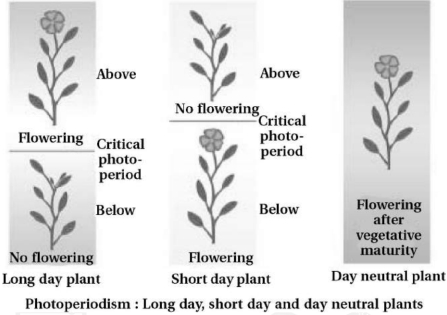
(N/A) Photoperiodism is the physiological response of plants to the relative lengths of light and dark periods.
$1$. Some plants require a periodic exposure to light to induce flowering. These plants are able to measure the duration of exposure to light.
$2$. Based on the requirement of light duration relative to a critical duration,plants are categorized as:
- Long Day Plants: Require light exposure for a period exceeding a well-defined critical duration.
- Short Day Plants: Must be exposed to light for a period less than the critical duration.
- Day-neutral Plants: There is no correlation between the duration of light exposure and the induction of flowering.
$3$. The critical duration varies for different plants. It is now known that the duration of the dark period is equally important as the light period.
$4$. Flowering in certain plants depends on a combination of light and dark exposures and their relative durations.
$5$. While shoot apices modify themselves into flowering apices,they cannot perceive photoperiods themselves. The site of perception of light/dark duration is the leaves.
$6$. It is hypothesized that a hormonal substance is responsible for flowering,which migrates from the leaves to the shoot apices to induce flowering when the plant is exposed to the necessary inductive photoperiod.
$1$. Some plants require a periodic exposure to light to induce flowering. These plants are able to measure the duration of exposure to light.
$2$. Based on the requirement of light duration relative to a critical duration,plants are categorized as:
- Long Day Plants: Require light exposure for a period exceeding a well-defined critical duration.
- Short Day Plants: Must be exposed to light for a period less than the critical duration.
- Day-neutral Plants: There is no correlation between the duration of light exposure and the induction of flowering.
$3$. The critical duration varies for different plants. It is now known that the duration of the dark period is equally important as the light period.
$4$. Flowering in certain plants depends on a combination of light and dark exposures and their relative durations.
$5$. While shoot apices modify themselves into flowering apices,they cannot perceive photoperiods themselves. The site of perception of light/dark duration is the leaves.
$6$. It is hypothesized that a hormonal substance is responsible for flowering,which migrates from the leaves to the shoot apices to induce flowering when the plant is exposed to the necessary inductive photoperiod.
0 likes
View Solution177
Medium
Write a short note on vernalisation.
Solution
(N/A) There are plants for which flowering is either quantitatively or qualitatively dependent on exposure to low temperature.
This phenomenon is termed vernalisation.
It prevents precocious reproductive development late in the growing season and enables the plant to have sufficient time to reach maturity.
Vernalisation refers specifically to the promotion of flowering by a period of low temperature.
- Some important food plants,such as wheat,barley,and rye,have two kinds of varieties: winter and spring varieties.
The 'spring' varieties are normally planted in the spring and come to flower and produce grain before the end of the growing season.
Winter varieties,however,if planted in spring,would normally fail to flower or produce mature grain within a single growing season.
Hence,they are planted in autumn.
They germinate,and over winter come out as small seedlings,resume growth in the spring,and are harvested usually around mid-summer.
Another example of vernalisation is seen in biennial plants.
Biennials are monocarpic plants that normally flower and die in the second season.
Sugarbeet,cabbages,and carrots are some of the common biennials.
- Subjecting the biennial plant to a cold treatment stimulates a subsequent photoperiodic flowering response.
This phenomenon is termed vernalisation.
It prevents precocious reproductive development late in the growing season and enables the plant to have sufficient time to reach maturity.
Vernalisation refers specifically to the promotion of flowering by a period of low temperature.
- Some important food plants,such as wheat,barley,and rye,have two kinds of varieties: winter and spring varieties.
The 'spring' varieties are normally planted in the spring and come to flower and produce grain before the end of the growing season.
Winter varieties,however,if planted in spring,would normally fail to flower or produce mature grain within a single growing season.
Hence,they are planted in autumn.
They germinate,and over winter come out as small seedlings,resume growth in the spring,and are harvested usually around mid-summer.
Another example of vernalisation is seen in biennial plants.
Biennials are monocarpic plants that normally flower and die in the second season.
Sugarbeet,cabbages,and carrots are some of the common biennials.
- Subjecting the biennial plant to a cold treatment stimulates a subsequent photoperiodic flowering response.
0 likes
View Solution178
Medium
Differentiate between Phototropism and Photoperiodism.
Solution
(N/A)
| Phototropism | Photoperiodism |
| $(1)$ The tropic movements that occur in response to a unilateral external light stimulus are known as phototropism or heliotropism. | $(1)$ It is the phenomenon of the response of plants to the relative duration of light and darkness,primarily for flowering. |
| $(2)$ The direction of this movement is determined by the direction of the external light stimulus. | $(2)$ Based on the duration of light exposure,plants are categorized into long-day plants,short-day plants,and day-neutral plants. |
0 likes
View Solution179
Medium
Differentiate between Short Day Plants $(SDP)$ and Long Day Plants $(LDP)$.
Solution
(N/A)
| Short Day Plants $(SDP)$ | Long Day Plants $(LDP)$ |
|---|---|
| $(1)$ They are known as $SDP$. | $(1)$ They are known as $LDP$. |
| $(2)$ They require a relatively short daylight period and a continuous dark period of about $14-16$ hours for flowering. | $(2)$ They require a longer daylight period ($14-16$ hours) in a $24$-hour cycle for flowering. |
| $(3)$ In $SDP$,the dark period is critical and must be continuous. | $(3)$ In $LDP$,the light period is critical for the induction of flowering. |
| $(4)$ Examples include sugarcane,tobacco,soybean,and $Xanthium$. | $(4)$ Examples include sugar beet,lettuce,oat,radish,and wheat. |
0 likes
View Solution180
Medium
Differentiate between Photoperiodism and Vernalization.
Solution
(N/A)
| Photoperiodism | Vernalization |
| $(1)$ Photoperiodism is the flowering response of plants to the relative duration of light and dark periods in a diurnal cycle. | $(1)$ Vernalization is the promotion of flowering by a period of low temperature (chilling treatment). |
| $(2)$ The stimulus is perceived by the leaves. | $(2)$ The stimulus is perceived by the shoot apical meristems,embryos,or leaves. |
| $(3)$ It involves the production of a hypothetical hormone called florigen. | $(3)$ It involves the production of a hypothetical hormone called vernalin. |
| $(4)$ It is primarily concerned with the timing of flowering based on day length. | $(4)$ It is primarily concerned with preventing precocious reproductive development late in the growing season. |
0 likes
View Solution181
Medium
Give scientific reasons: Some plants flower in summer and some flower in winters.
Solution
(N/A) The flowering response in plants is regulated by a phenomenon known as photoperiodism.
Photoperiodism is the physiological reaction of organisms to the length of day or night.
Plants are classified based on their photoperiodic requirements:
$1$. Long-day plants: These plants flower when the day length exceeds a critical duration (e.g.,summer-flowering plants).
$2$. Short-day plants: These plants flower when the day length is shorter than a critical duration (e.g.,winter-flowering plants).
$3$. Day-neutral plants: These plants flower regardless of the day length.
Therefore,the seasonal flowering is an adaptation to the specific light duration required for the transition from vegetative growth to reproductive growth.
Photoperiodism is the physiological reaction of organisms to the length of day or night.
Plants are classified based on their photoperiodic requirements:
$1$. Long-day plants: These plants flower when the day length exceeds a critical duration (e.g.,summer-flowering plants).
$2$. Short-day plants: These plants flower when the day length is shorter than a critical duration (e.g.,winter-flowering plants).
$3$. Day-neutral plants: These plants flower regardless of the day length.
Therefore,the seasonal flowering is an adaptation to the specific light duration required for the transition from vegetative growth to reproductive growth.
0 likes
View Solution182
Medium
Give scientific reasons: It is appropriate to call a short-day plant a long-night plant.
Solution
(N/A) The flowering in short-day plants is not primarily controlled by the length of the light period,but rather by the length of the dark period.
These plants require a continuous and uninterrupted dark period that exceeds a certain critical duration to initiate the flowering process.
If this long dark period is interrupted by even a brief flash of light,the plants fail to flower.
Therefore,it is scientifically more accurate to refer to them as long-night plants.
These plants require a continuous and uninterrupted dark period that exceeds a certain critical duration to initiate the flowering process.
If this long dark period is interrupted by even a brief flash of light,the plants fail to flower.
Therefore,it is scientifically more accurate to refer to them as long-night plants.
0 likes
View Solution183
Easy
Define/Explain: Day-neutral plant.
Solution
(N/A) Day-neutral plants are those that do not have any specific requirement for day length (photoperiod) to initiate flowering. Their flowering is not influenced by the duration of light or darkness,and they can flower throughout the year regardless of the season.
0 likes
View Solution184
Medium
Define/Explain: Photoperiodism.
Solution
(N/A) Photoperiodism is defined as the physiological response of plants to the relative lengths of light and dark periods. It is a developmental response to the duration of light exposure,which significantly influences the process of flowering in many plant species.
0 likes
View Solution185
Easy
Define/Explain: Long-day plants.
Solution
(N/A) Long-day plants are those plants that require a longer duration of light exposure,typically exceeding a critical photoperiod,to initiate the flowering process. These plants flower when the day length is longer than their critical day length. Examples include $Wheat$,$Poppy$,$Oat$,and $Beet$.
0 likes
View Solution186
Easy
Define/Explain: Short-day plants.
Solution
(N/A) Short-day plants are those plants that require a relatively short period of light (photoperiod) and a continuous dark period for flowering. If the light period exceeds a certain critical duration,these plants will not flower. Examples include chrysanthemum and tobacco.
0 likes
View Solution187
Medium
Define/Explain: Vernalization.
Solution
(N/A) Vernalization is the process where the flowering of a plant is promoted by exposing it to a specific low temperature for a definite period of time. This treatment ensures better and earlier germination of seeds and leads to earlier flowering in the plants that develop from them. It is an artificial method used to shorten the vegetative period of plants.
0 likes
View Solution188
Medium
Classify the following plants into Long Day Plants $(LDP)$, Short Day Plants $(SDP)$, and Day Neutral Plants $(DNP)$: Xanthium, Henbane $(Hyoscyamus \text{ } niger)$, Spinach, Rice, Strawberry, Bryophyllum, Sunflower, Tomato, Maize.
Solution
(N/A) The classification of the given plants based on their photoperiodic response is as follows:
$1$. Xanthium: Short Day Plant $(SDP)$
$2$. Henbane $(Hyoscyamus \text{ } niger)$: Long Day Plant $(LDP)$
$3$. Spinach: Long Day Plant $(LDP)$
$4$. Rice: Short Day Plant $(SDP)$
$5$. Strawberry: Short Day Plant $(SDP)$
$6$. Bryophyllum: Long-Short Day Plant $(LSDP)$
$7$. Sunflower: Day Neutral Plant $(DNP)$
$8$. Tomato: Day Neutral Plant $(DNP)$
$9$. Maize: Day Neutral Plant $(DNP)$
$1$. Xanthium: Short Day Plant $(SDP)$
$2$. Henbane $(Hyoscyamus \text{ } niger)$: Long Day Plant $(LDP)$
$3$. Spinach: Long Day Plant $(LDP)$
$4$. Rice: Short Day Plant $(SDP)$
$5$. Strawberry: Short Day Plant $(SDP)$
$6$. Bryophyllum: Long-Short Day Plant $(LSDP)$
$7$. Sunflower: Day Neutral Plant $(DNP)$
$8$. Tomato: Day Neutral Plant $(DNP)$
$9$. Maize: Day Neutral Plant $(DNP)$
0 likes
View Solution189
Medium
$Nicotiana$ $tabacum$,a short-day plant,fails to flower when exposed to a light duration longer than its critical period. Explain.
Solution
(N/A) Short-day plants are those that flower only when the photoperiod (duration of light exposure) is shorter than a specific critical duration. Since $Nicotiana$ $tabacum$ is a short-day plant,it requires a light period shorter than its critical threshold to initiate the flowering process. When exposed to light for a duration exceeding this critical period,the physiological conditions required for floral induction are not met,thus preventing flowering.
0 likes
View Solution190
MediumMCQ
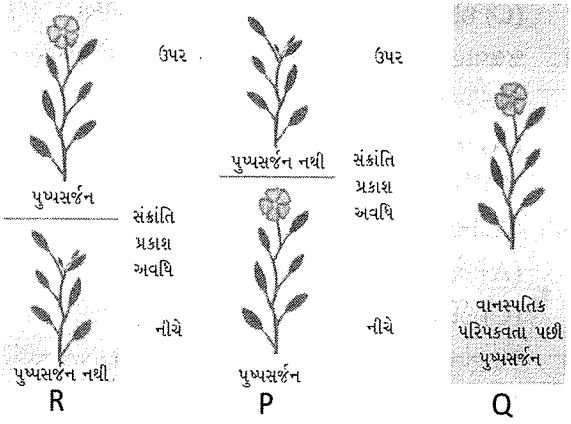
Select the correct option based on the given diagram.
A
$P$ - Long-day plant,$Q$ - Short-day plant,$R$ - Day-neutral plant
B
$P$ - Day-neutral plant,$Q$ - Short-day plant,$R$ - Long-day plant
C
$P$ - Short-day plant,$Q$ - Day-neutral plant,$R$ - Long-day plant
D
$P$ - Long-day plant,$Q$ - Day-neutral plant,$R$ - Short-day plant
Solution
(C) Based on the provided diagram:
$1$. $P$ shows flowering when the light duration is below the critical photoperiod. This is characteristic of a Short-day plant.
$2$. $Q$ shows flowering regardless of the light duration after reaching vegetative maturity. This is characteristic of a Day-neutral plant.
$3$. $R$ shows flowering only when the light duration is above the critical photoperiod. This is characteristic of a Long-day plant.
Therefore,$P$ is a Short-day plant,$Q$ is a Day-neutral plant,and $R$ is a Long-day plant.
$1$. $P$ shows flowering when the light duration is below the critical photoperiod. This is characteristic of a Short-day plant.
$2$. $Q$ shows flowering regardless of the light duration after reaching vegetative maturity. This is characteristic of a Day-neutral plant.
$3$. $R$ shows flowering only when the light duration is above the critical photoperiod. This is characteristic of a Long-day plant.
Therefore,$P$ is a Short-day plant,$Q$ is a Day-neutral plant,and $R$ is a Long-day plant.
0 likes
View Solution191
EasyMCQ
Some plants require a period of light greater than a critical duration for flowering. Such plants are called $..............$.
A
Short-day plants
B
Long-day plants
C
Day-neutral plants
D
All of the above
Solution
(B) Plants are classified based on their response to the duration of light exposure,known as photoperiodism.
$1$. Long-day plants $(LDP)$ require a light duration longer than a critical photoperiod to flower.
$2$. Short-day plants $(SDP)$ require a light duration shorter than a critical photoperiod to flower.
$3$. Day-neutral plants $(DNP)$ do not show any correlation between flowering and light duration.
Therefore,plants requiring light greater than a critical duration are called long-day plants.
$1$. Long-day plants $(LDP)$ require a light duration longer than a critical photoperiod to flower.
$2$. Short-day plants $(SDP)$ require a light duration shorter than a critical photoperiod to flower.
$3$. Day-neutral plants $(DNP)$ do not show any correlation between flowering and light duration.
Therefore,plants requiring light greater than a critical duration are called long-day plants.
0 likes
View Solution192
EasyMCQ
In some plants,flowering is induced by exposure to low temperatures,either quantitatively or qualitatively. This phenomenon is known as $........$.
A
Vernalization
B
Photoperiodism
C
Seed germination
D
Seed dormancy
Solution
(A) Vernalization is the phenomenon where the flowering of plants is promoted by a period of exposure to low temperatures.
It prevents precocious reproductive development late in the growing season and enables the plant to have sufficient time to reach maturity.
This process is crucial for many biennial and perennial plants to transition from the vegetative phase to the reproductive phase.
It prevents precocious reproductive development late in the growing season and enables the plant to have sufficient time to reach maturity.
This process is crucial for many biennial and perennial plants to transition from the vegetative phase to the reproductive phase.
0 likes
View Solution193
EasyMCQ
In some plants,flowering is induced only when the duration of light exposure is less than a critical duration. Such plants are called $...............$.
A
Short-day plants
B
Long-day plants
C
Day-neutral plants
D
All of the above
Solution
(A) Photoperiodism is the physiological response of plants to the relative lengths of light and dark periods.
Plants that require a light exposure duration shorter than a critical photoperiod to flower are known as Short-day plants.
Long-day plants require a light exposure duration longer than a critical photoperiod.
Day-neutral plants do not show any correlation between exposure to light duration and induction of flowering.
Therefore,the correct answer is Short-day plants.
Plants that require a light exposure duration shorter than a critical photoperiod to flower are known as Short-day plants.
Long-day plants require a light exposure duration longer than a critical photoperiod.
Day-neutral plants do not show any correlation between exposure to light duration and induction of flowering.
Therefore,the correct answer is Short-day plants.
0 likes
View Solution194
MediumMCQ
Select the incorrect option regarding vernalization.
A
It delays the process of reproductive development.
B
It provides sufficient time for the plant to reach maturity.
C
Vernalization induces flowering at high temperatures.
D
Vernalization can be induced in wheat,barley,and rye.
Solution
(C) Vernalization is the process where flowering is induced by exposure to prolonged periods of low temperature.
Option $C$ is incorrect because vernalization specifically requires low temperatures to promote flowering,not high temperatures.
It helps in shortening the vegetative period and allows the plant to reach maturity faster,rather than delaying reproductive development.
It is commonly observed in winter varieties of crops like wheat,barley,and rye.
Option $C$ is incorrect because vernalization specifically requires low temperatures to promote flowering,not high temperatures.
It helps in shortening the vegetative period and allows the plant to reach maturity faster,rather than delaying reproductive development.
It is commonly observed in winter varieties of crops like wheat,barley,and rye.
0 likes
View Solution195
EasyMCQ
There are many plants that do not show any correlation between exposure to light duration and the induction of flowering. Such plants are called $..........$.
A
Short-day plants
B
Long-day plants
C
Day-neutral plants
D
All of the above
Solution
(C) Plants that do not require a specific photoperiod for the induction of flowering are known as $Day-neutral$ plants. These plants flower regardless of the duration of light exposure. In contrast,$Short-day$ plants require a light period shorter than a critical duration,and $Long-day$ plants require a light period longer than a critical duration to flower. Therefore,the correct answer is $Day-neutral$ plants.
0 likes
View Solution196
EasyMCQ
In some plants, flowering depends on the relative duration of light and dark periods. This response of plants to periods of day/night is called $......$.
A
Vernalization
B
Photoperiodism
C
Germination
D
Seed dormancy
Solution
(B) The phenomenon where the flowering of plants is regulated by the relative duration of light and dark periods is known as $Photoperiodism$.
Plants are classified into short-day plants, long-day plants, and day-neutral plants based on their response to these light periods.
$Vernalization$ refers to the promotion of flowering by a period of low temperature.
$Germination$ is the process by which an organism grows from a seed or spore.
$Seed \text{ } dormancy$ is a state in which seeds are prevented from germinating even under favorable environmental conditions.
Plants are classified into short-day plants, long-day plants, and day-neutral plants based on their response to these light periods.
$Vernalization$ refers to the promotion of flowering by a period of low temperature.
$Germination$ is the process by which an organism grows from a seed or spore.
$Seed \text{ } dormancy$ is a state in which seeds are prevented from germinating even under favorable environmental conditions.
0 likes
View Solution197
MediumMCQ
What happens if winter-growing plant species are sown in the spring season?
A
Flowering does not occur,but fruiting occurs.
B
Flowering occurs,but fruiting does not occur.
C
Both flowering and fruiting occur.
D
Neither flowering nor fruiting occurs.
Solution
(D) Winter-growing plant species are known as $Winter$ $Annuals$ or $Long$ $Day$ $Plants$ that require a period of low temperature to induce flowering,a process known as $Vernalization$.
If these plants are sown in the spring season,they do not receive the necessary cold treatment required for the transition from the vegetative phase to the reproductive phase.
Consequently,the plant remains in the vegetative state and fails to produce flowers.
Since flowering is a prerequisite for fruiting,the absence of flowers leads to the absence of fruits as well.
Therefore,neither flowering nor fruiting occurs.
If these plants are sown in the spring season,they do not receive the necessary cold treatment required for the transition from the vegetative phase to the reproductive phase.
Consequently,the plant remains in the vegetative state and fails to produce flowers.
Since flowering is a prerequisite for fruiting,the absence of flowers leads to the absence of fruits as well.
Therefore,neither flowering nor fruiting occurs.
0 likes
View Solution198
EasyMCQ
During the photoperiodic induction,$........$ is translocated from leaves to shoot buds to induce flowering.
A
Florigen
B
Phylogen
C
$ABA$
D
$2,4-D$
Solution
(A) Photoperiodism is the physiological response of plants to the relative lengths of light and dark periods.
It is observed that the perception of the photoperiodic stimulus occurs in the leaves.
From the leaves,a chemical substance known as $Florigen$ is translocated to the shoot apices (shoot buds) to induce the transition from vegetative growth to reproductive growth (flowering).
Therefore,$Florigen$ is the hypothetical hormone responsible for flowering.
It is observed that the perception of the photoperiodic stimulus occurs in the leaves.
From the leaves,a chemical substance known as $Florigen$ is translocated to the shoot apices (shoot buds) to induce the transition from vegetative growth to reproductive growth (flowering).
Therefore,$Florigen$ is the hypothetical hormone responsible for flowering.
0 likes
View Solution199
EasyMCQ
To induce early flowering in plants, pre-treatment of seeds or seedlings is done at . . . . . . $1-6^{\circ} C$ temperature.
A
$1-6$
B
$10-13$
C
$14-20$
D
$20-30$
Solution
(A) Vernalization is the process of inducing early flowering in plants by exposing their seeds or seedlings to low temperatures. This treatment is typically performed at a temperature range of $1-6^{\circ} C$ for a duration of one to one and a half months.
0 likes
View Solution200
EasyMCQ
Given below are two statements.
Statement $I$: If the long dark period is interrupted by a brief flash of light,short day plants will not flower.
Statement $II$: When the long dark period is interrupted by a brief flash of light,long day plants can flower.
In the light of above statements,choose the most appropriate answer from the options given below:
Statement $I$: If the long dark period is interrupted by a brief flash of light,short day plants will not flower.
Statement $II$: When the long dark period is interrupted by a brief flash of light,long day plants can flower.
In the light of above statements,choose the most appropriate answer from the options given below:
A
Both statement $I$ and statement $II$ are correct.
B
Both statement $I$ and statement $II$ are incorrect.
C
Statement $I$ is correct but statement $II$ is incorrect.
D
Statement $I$ is incorrect but statement $II$ is correct.
Solution
(A) Photoperiodism is the physiological response of plants to the relative lengths of light and dark periods.
Short Day Plants $(SDP)$ require a continuous dark period longer than a critical duration to flower. If this dark period is interrupted by a brief flash of light,the flowering is inhibited. Thus,Statement $I$ is correct.
Long Day Plants $(LDP)$ require a dark period shorter than a critical duration to flower. If the long dark period is interrupted by a brief flash of light,the effective dark period is shortened,which promotes flowering in $LDP$. Thus,Statement $II$ is correct.
Therefore,both statements are correct.
Short Day Plants $(SDP)$ require a continuous dark period longer than a critical duration to flower. If this dark period is interrupted by a brief flash of light,the flowering is inhibited. Thus,Statement $I$ is correct.
Long Day Plants $(LDP)$ require a dark period shorter than a critical duration to flower. If the long dark period is interrupted by a brief flash of light,the effective dark period is shortened,which promotes flowering in $LDP$. Thus,Statement $II$ is correct.
Therefore,both statements are correct.
0 likes
View SolutionPlant Growth and Development — Photoperiodism and Vernalization · Frequently Asked Questions
1Are these Plant Growth and Development questions useful for JEE and NEET?
Yes. All questions in this section are mapped to JEE Main and NEET exam patterns. Previous year questions from JEE Main, NEET, GUJCET and state-level exams are included with full solutions.
2Can I switch to Hindi or Gujarati for these questions?
Yes. Use the language tabs in the hero section or the sidebar to view the same questions and solutions in English, Hindi or Gujarati.
3How do I generate a question paper from this subtopic?
Use the Vedclass Exam Paper Generator — select the chapter and subtopic, set difficulty, and generate Sets A, B, C, D automatically. First 3 chapters of every subject are free.
Vedclass Products
For Students
Vedclass Test Series
Mock tests in real JEE/NEET style with performance analysis. 5-day free trial.
Start Free TrialFor Teachers
Exam Paper Generator
Generate Set A/B/C/D papers from this chapter in 2 minutes. 3 chapters free.
Try FreeFor Institutes
Online Exam Module
Live online exams with unlimited students, 360° analytics & white-label branding.
See DemoFor Teachers & Institutes
Generate a Plant Growth and Development Exam Paper in 2 Minutes
Select subtopic & difficulty — Sets A, B, C, D auto-generated with No Repeat logic.
First 3 chapters of every subject are free — no payment required.