
A English
Photoperiodism and Vernalization Questions in English
Class 11 Biology · Plant Growth and Development · Photoperiodism and Vernalization
203+
Questions
English
Language
100%
With Solutions
Showing 48 of 203 questions in English
101
EasyMCQ
Flowering of plants by exposure to low temperature is called
A
Vernalisation
B
Parthenocarpy
C
Bolting
D
Plasticity
Solution
(A) Vernalisation is the process where the flowering of plants is promoted by exposure to low temperatures.
It prevents precocious reproductive development late in the growing season and enables the plant to have sufficient time to reach maturity.
Parthenocarpy refers to the development of fruit without fertilization.
Bolting is the internode elongation just prior to flowering in rosette plants.
Plasticity refers to the ability of plants to follow different pathways in response to the environment or phases of life.
It prevents precocious reproductive development late in the growing season and enables the plant to have sufficient time to reach maturity.
Parthenocarpy refers to the development of fruit without fertilization.
Bolting is the internode elongation just prior to flowering in rosette plants.
Plasticity refers to the ability of plants to follow different pathways in response to the environment or phases of life.
0 likes
View Solution102
MediumMCQ
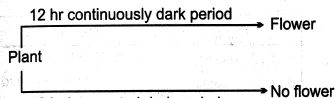
In which category will you place this plant based on the provided experimental results? Choose the correct option.
A
Short Day Plant
B
Long Day Plant
C
Day Neutral Plant
D
None
Solution
(A) The experimental results show that the plant flowers when exposed to a $12 \ hr$ continuous dark period.
Short Day Plants $(SDP)$ require a dark period longer than a critical duration to flower.
Since the plant flowers under a $12 \ hr$ dark period,it indicates that this duration is sufficient to meet its critical dark period requirement.
Therefore,this plant is categorized as a Short Day Plant.
Short Day Plants $(SDP)$ require a dark period longer than a critical duration to flower.
Since the plant flowers under a $12 \ hr$ dark period,it indicates that this duration is sufficient to meet its critical dark period requirement.
Therefore,this plant is categorized as a Short Day Plant.
0 likes
View Solution103
MediumMCQ
Subjecting the growing of which plant to a cold treatment stimulates subsequent photoperiodic flowering response?
A
Monocarpic
B
Bicarpic
C
$A$ and $B$ both
D
Polycarpic
Solution
(A) The phenomenon where flowering is promoted by a period of low temperature is known as Vernalization.
This process is particularly significant in many biennial and some monocarpic plants.
Biennial plants are monocarpic plants that normally flower and die in the second season.
By subjecting these plants to cold treatment,the transition from the vegetative phase to the flowering phase is accelerated.
Therefore,monocarpic plants (including biennials) show a stimulated flowering response after cold treatment.
This process is particularly significant in many biennial and some monocarpic plants.
Biennial plants are monocarpic plants that normally flower and die in the second season.
By subjecting these plants to cold treatment,the transition from the vegetative phase to the flowering phase is accelerated.
Therefore,monocarpic plants (including biennials) show a stimulated flowering response after cold treatment.
0 likes
View Solution104
EasyMCQ
Phytochrome is involved in:
A
Phototropism
B
Photorespiration
C
Photoperiodism
D
Geotropism
Solution
(C) Phytochrome is a pigment found in plants that acts as a photoreceptor. It is primarily involved in sensing light quality and duration,which regulates various developmental processes such as flowering,seed germination,and stem elongation. Specifically,phytochrome plays a crucial role in $Photoperiodism$,which is the physiological reaction of organisms to the length of day or night. Therefore,the correct answer is $Photoperiodism$.
0 likes
View Solution105
EasyMCQ
Which chemical is associated with flowering?
A
Gibberellin
B
Kinetin
C
Florigen
D
$IBA$
Solution
(C) Florigen is a hypothetical hormone or signaling molecule that is believed to be responsible for inducing flowering in plants. It is synthesized in the leaves in response to photoperiodic stimuli and then transported to the shoot apical meristem to initiate the transition from vegetative growth to reproductive growth (flowering).
0 likes
View Solution106
EasyMCQ
The phenomenon where flowering is dependent on exposure to low temperatures is known as:
A
Cryotherapy
B
Cryogenics
C
Cryoscopy
D
Vernalization
Solution
(D) Vernalization is the process by which flowering is induced or promoted by exposure to low temperatures for a specific period. This ensures that plants flower only during the favorable season. It is a physiological response to cold treatment,commonly observed in winter varieties of wheat,barley,and rye.
0 likes
View Solution107
MediumMCQ
In short-day plants,flowering is induced by:
A
$A$ photoperiod shorter than $12$ hours
B
$A$ photoperiod shorter than a critical length and a long uninterrupted night
C
$A$ long night
D
$A$ short photoperiod and an interrupted long night
Solution
(B) Short-day plants $(SDP)$ require a photoperiod shorter than a critical duration to flower.
Additionally,they require a long,continuous,and uninterrupted dark period (night) to trigger the flowering response.
If the dark period is interrupted by even a brief flash of light,the flowering process is inhibited.
Therefore,the correct condition is a photoperiod shorter than the critical length and a long uninterrupted night.
Additionally,they require a long,continuous,and uninterrupted dark period (night) to trigger the flowering response.
If the dark period is interrupted by even a brief flash of light,the flowering process is inhibited.
Therefore,the correct condition is a photoperiod shorter than the critical length and a long uninterrupted night.
0 likes
View Solution108
MediumMCQ
If a tree in North India flowers three times a year (in October,January,and July),it is considered to be:
A
Photosensitive but temperature-insensitive
B
Temperature-sensitive but photo-insensitive
C
Both photo and temperature-sensitive
D
Both photo and temperature-insensitive
Solution
(D) Plants that flower multiple times a year regardless of the specific photoperiod (day length) are known as day-neutral plants. Since the tree flowers in October,January,and July in North India,it experiences vastly different day lengths and temperatures during these months. Because it flowers consistently despite these environmental variations,it is considered to be both photo-insensitive and temperature-insensitive. Therefore,it is a day-neutral plant that does not rely on specific environmental triggers like photoperiod or vernalization to initiate flowering.
0 likes
View Solution109
MediumMCQ
What is the effect on phytochrome in plants following continuous red light exposure?
A
The amount of phytochrome decreases.
B
Phytochrome is wasted.
C
The synthesis of phytochrome increases.
D
The degradation and synthesis of phytochrome occur in a balanced amount.
Solution
(D) Phytochrome exists in two interconvertible forms: $Pr$ (inactive form,absorbs red light) and $Pfr$ (active form,absorbs far-red light).
When a plant is exposed to continuous red light,the $Pr$ form is converted into the $Pfr$ form.
However,the $Pfr$ form is unstable and undergoes degradation or reversion back to $Pr$.
In a state of continuous red light,the plant maintains a dynamic equilibrium where the rate of synthesis of $Pr$ and the rate of degradation/conversion of $Pfr$ reach a steady state,ensuring the plant can continue to respond to light stimuli.
When a plant is exposed to continuous red light,the $Pr$ form is converted into the $Pfr$ form.
However,the $Pfr$ form is unstable and undergoes degradation or reversion back to $Pr$.
In a state of continuous red light,the plant maintains a dynamic equilibrium where the rate of synthesis of $Pr$ and the rate of degradation/conversion of $Pfr$ reach a steady state,ensuring the plant can continue to respond to light stimuli.
0 likes
View Solution110
EasyMCQ
Which of the following pigments absorbs red and far-red light?
A
Cytochrome
B
Phytochrome
C
Xanthophyll
D
Carotene
Solution
(B) Phytochrome is a proteinaceous pigment found in plants that acts as a photoreceptor. It exists in two interconvertible forms: $P_r$ (which absorbs red light at $660 \ nm$) and $P_{fr}$ (which absorbs far-red light at $730 \ nm$). This pigment plays a crucial role in photomorphogenesis,including seed germination,stem elongation,and flowering.
0 likes
View Solution111
EasyMCQ
The physiological response of organisms to the duration of light and darkness is known as:
A
Phototropism
B
Photoperiodism
C
Phototaxis
D
Vernalization
Solution
(B) The physiological response of plants to the relative lengths of light and dark periods is called $Photoperiodism$.
$Phototropism$ refers to the growth of a plant in response to a light direction.
$Phototaxis$ is the movement of an organism in response to light.
$Vernalization$ is the induction of a plant's flowering process by exposure to the prolonged cold of winter.
Therefore,the correct answer is $Photoperiodism$.
$Phototropism$ refers to the growth of a plant in response to a light direction.
$Phototaxis$ is the movement of an organism in response to light.
$Vernalization$ is the induction of a plant's flowering process by exposure to the prolonged cold of winter.
Therefore,the correct answer is $Photoperiodism$.
0 likes
View Solution112
EasyMCQ
Which proteinaceous pigment controls the light-dependent activities in plants?
A
Phytochrome
B
Chlorophyll
C
Anthocyanin
D
Carotenoids
Solution
(A) Phytochrome is a proteinaceous pigment that acts as a photoreceptor in plants.
It exists in two interconvertible forms: $P_r$ (which absorbs red light) and $P_{fr}$ (which absorbs far-red light).
It plays a crucial role in light-dependent developmental processes such as photoperiodism,seed germination,and flowering.
It exists in two interconvertible forms: $P_r$ (which absorbs red light) and $P_{fr}$ (which absorbs far-red light).
It plays a crucial role in light-dependent developmental processes such as photoperiodism,seed germination,and flowering.
0 likes
View Solution113
EasyMCQ
Which of the following is a long-day plant?
A
Tobacco
B
Glycine max
C
Mirabilis jalapa
D
Spinach
Solution
(D) Photoperiodism is the physiological reaction of organisms to the length of night or a dark period. Plants are classified based on their response to photoperiods into three categories: Long-day plants,Short-day plants,and Day-neutral plants.
$1$. Long-day plants $(LDP)$ flower when the day length exceeds a critical duration. Examples include Spinach ($Spinacia$ $oleracea$),Wheat,and Radish.
$2$. Short-day plants $(SDP)$ flower when the day length is shorter than a critical duration. Examples include Tobacco and Glycine max (Soybean).
$3$. Day-neutral plants flower regardless of the day length. An example is Mirabilis jalapa.
Therefore,Spinach is a long-day plant.
$1$. Long-day plants $(LDP)$ flower when the day length exceeds a critical duration. Examples include Spinach ($Spinacia$ $oleracea$),Wheat,and Radish.
$2$. Short-day plants $(SDP)$ flower when the day length is shorter than a critical duration. Examples include Tobacco and Glycine max (Soybean).
$3$. Day-neutral plants flower regardless of the day length. An example is Mirabilis jalapa.
Therefore,Spinach is a long-day plant.
0 likes
View Solution114
MediumMCQ
$A$ group of plants shows flowering in a $12$ hour day and $12$ hour night cycle. When the night phase of another group of the same plants is interrupted by a brief flash of light, flowering does not occur. In which of the following groups would you place these plants?
A
Long-day plants
B
Short-day plants
C
Day-neutral plants
D
Dark-neutral plants
Solution
(B) The plants described are $Short-day$ $plants$ $(SDP)$.
$SDP$ require a continuous dark period longer than a critical duration to flower.
When the dark period is interrupted by a brief flash of light, the physiological process required for flowering is inhibited.
Since the interruption of the night phase prevents flowering, these plants are classified as $Short-day$ $plants$.
$SDP$ require a continuous dark period longer than a critical duration to flower.
When the dark period is interrupted by a brief flash of light, the physiological process required for flowering is inhibited.
Since the interruption of the night phase prevents flowering, these plants are classified as $Short-day$ $plants$.
0 likes
View Solution115
MediumMCQ
At which wavelength is light absorbed by the phytochrome in the $P_r$ form (in $, nm$)?
A
$660$
B
$730$
C
$620$
D
$640$
Solution
(A) Phytochrome exists in two interconvertible forms: $P_r$ and $P_{fr}$.
$P_r$ is the inactive form of phytochrome that absorbs red light.
The absorption peak for the $P_r$ form is approximately $660 \, nm$.
Upon absorbing red light,$P_r$ is converted into the active $P_{fr}$ form.
Conversely,the $P_{fr}$ form absorbs far-red light at approximately $730 \, nm$ to convert back into the $P_r$ form.
Therefore,the correct wavelength for the $P_r$ form is $660 \, nm$.
$P_r$ is the inactive form of phytochrome that absorbs red light.
The absorption peak for the $P_r$ form is approximately $660 \, nm$.
Upon absorbing red light,$P_r$ is converted into the active $P_{fr}$ form.
Conversely,the $P_{fr}$ form absorbs far-red light at approximately $730 \, nm$ to convert back into the $P_r$ form.
Therefore,the correct wavelength for the $P_r$ form is $660 \, nm$.
0 likes
View Solution116
EasyMCQ
Phytochrome is a ......
A
Lipoprotein
B
Chromoprotein
C
Flavoprotein
D
Glycoprotein
Solution
(B) Phytochrome is a light-sensitive pigment found in plants that acts as a photoreceptor.
Chemically,it is a chromoprotein,which consists of a protein part and a light-absorbing pigment molecule called a chromophore.
It plays a crucial role in various plant developmental processes such as flowering,seed germination,and stem elongation by sensing red and far-red light.
Chemically,it is a chromoprotein,which consists of a protein part and a light-absorbing pigment molecule called a chromophore.
It plays a crucial role in various plant developmental processes such as flowering,seed germination,and stem elongation by sensing red and far-red light.
0 likes
View Solution117
EasyMCQ
What is the response of various organisms to the duration of light and dark periods called?
A
Phototropism
B
Phototaxis
C
Vernalization
D
Photoperiodism
Solution
(D) The response of plants to periods of day and night (light and dark) is known as $Photoperiodism$.
$Phototropism$ is the growth of an organism in response to a light stimulus.
$Phototaxis$ is the movement of an organism in response to light.
$Vernalization$ is the induction of a plant's flowering process by exposure to the prolonged cold of winter.
$Phototropism$ is the growth of an organism in response to a light stimulus.
$Phototaxis$ is the movement of an organism in response to light.
$Vernalization$ is the induction of a plant's flowering process by exposure to the prolonged cold of winter.
0 likes
View Solution118
EasyMCQ
What is the site of perception of photoperiod necessary for the induction of flowering in plants?
A
Lateral buds
B
Pulvinus
C
Shoot apex
D
Leaves
Solution
(D) The site of perception of light or dark duration (photoperiod) is the leaves.
Although the flowering occurs at the shoot apex,the hormonal signal (florigen) is synthesized in the leaves upon exposure to the appropriate photoperiod and then translocated to the shoot apex to induce flowering.
Therefore,the leaves are considered the primary site of perception for photoperiodic stimuli.
Although the flowering occurs at the shoot apex,the hormonal signal (florigen) is synthesized in the leaves upon exposure to the appropriate photoperiod and then translocated to the shoot apex to induce flowering.
Therefore,the leaves are considered the primary site of perception for photoperiodic stimuli.
0 likes
View Solution119
MediumMCQ
Assertion: Dark period plays a more important part in flowering than the light period.
Reason: Flowering occurs in short-day plants if the dark period is interrupted by a light break.
Reason: Flowering occurs in short-day plants if the dark period is interrupted by a light break.
A
If both Assertion and Reason are correct and the Reason is a correct explanation of the Assertion.
B
If both Assertion and Reason are correct but Reason is not a correct explanation of the Assertion.
C
If the Assertion is correct but Reason is incorrect.
D
If both the Assertion and Reason are incorrect.
Solution
(C) It has been demonstrated that flowering in plants is more of a response to the dark period than to the light period.
In short-day plants $(SDP)$,the plants can flower in complete darkness if supplied with exogenous nutrients.
Flowering is inhibited in $SDP$ if the dark period,which is essential for flowering,is interrupted by a flash of light.
Therefore,the Reason is incorrect because a light break during the dark period prevents flowering in short-day plants,rather than inducing it.
In short-day plants $(SDP)$,the plants can flower in complete darkness if supplied with exogenous nutrients.
Flowering is inhibited in $SDP$ if the dark period,which is essential for flowering,is interrupted by a flash of light.
Therefore,the Reason is incorrect because a light break during the dark period prevents flowering in short-day plants,rather than inducing it.
0 likes
View Solution120
MediumMCQ
Assertion: Photomodulation of flowering is a phytochrome regulated process.
Reason: Active form of phytochrome $(P_{FR})$ directly induces floral induction in shoot buds.
Reason: Active form of phytochrome $(P_{FR})$ directly induces floral induction in shoot buds.
A
If both Assertion and Reason are correct and the Reason is a correct explanation of the Assertion.
B
If both Assertion and Reason are correct but Reason is not a correct explanation of the Assertion.
C
If the Assertion is correct but Reason is incorrect.
D
If both the Assertion and Reason are incorrect.
Solution
(A) The Assertion is correct because phytochrome is a photoreceptor pigment that regulates various developmental processes,including flowering,in response to light.
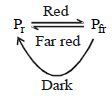
The Reason is also correct. Phytochrome exists in two interconvertible forms: $P_R$ (inactive) and $P_{FR}$ (active). When exposed to red light,$P_R$ is converted to $P_{FR}$. The $P_{FR}$ form is the physiologically active form that migrates to the nucleus or interacts with signaling pathways to induce floral development in shoot buds.
Since the active form $P_{FR}$ is the specific component of the phytochrome system that triggers the flowering response,the Reason correctly explains the Assertion.
The Reason is also correct. Phytochrome exists in two interconvertible forms: $P_R$ (inactive) and $P_{FR}$ (active). When exposed to red light,$P_R$ is converted to $P_{FR}$. The $P_{FR}$ form is the physiologically active form that migrates to the nucleus or interacts with signaling pathways to induce floral development in shoot buds.
Since the active form $P_{FR}$ is the specific component of the phytochrome system that triggers the flowering response,the Reason correctly explains the Assertion.
0 likes
View Solution121
MediumMCQ
Assertion $(A)$: Vernalization is acceleration of subsequent flowering by low temperature treatment.
Reason $(R)$: Site of vernalization is apical meristem.
Reason $(R)$: Site of vernalization is apical meristem.
A
If both Assertion and Reason are correct and the Reason is a correct explanation of the Assertion.
B
If both Assertion and Reason are correct but Reason is not a correct explanation of the Assertion.
C
If the Assertion is correct but Reason is incorrect.
D
If both the Assertion and Reason are incorrect.
Solution
(A) Vernalization is the process of inducing or accelerating flowering in plants by exposing them to low temperatures. This phenomenon was first described by $T.D.$ Lysenko in $1928$.
The Assertion is correct because vernalization specifically refers to the promotion of flowering through cold treatment.
The Reason is also correct because the perception of the cold stimulus occurs primarily in the apical meristem (shoot apex) of the plant,where it triggers the production of a hypothetical flowering hormone called vernalin.
Since the Reason correctly identifies the site where the process described in the Assertion occurs,it serves as a valid explanation.
The Assertion is correct because vernalization specifically refers to the promotion of flowering through cold treatment.
The Reason is also correct because the perception of the cold stimulus occurs primarily in the apical meristem (shoot apex) of the plant,where it triggers the production of a hypothetical flowering hormone called vernalin.
Since the Reason correctly identifies the site where the process described in the Assertion occurs,it serves as a valid explanation.
0 likes
View Solution122
MediumMCQ
Assertion $(A)$: Vernalization is the acceleration of subsequent flowering by low-temperature treatment.
Reason $(R)$: The site of vernalization is the apical meristem.
Reason $(R)$: The site of vernalization is the apical meristem.
A
If both Assertion and Reason are correct and the Reason is a correct explanation of the Assertion.
B
If both Assertion and Reason are correct but the Reason is not a correct explanation of the Assertion.
C
If the Assertion is correct but the Reason is incorrect.
D
If both the Assertion and Reason are incorrect.
Solution
(B) Vernalization is a process where the flowering of plants is promoted or accelerated by exposing them to a period of low temperature.
This process ensures that plants flower during a favorable season.
The term 'vernalization' was coined by $T.D.$ Lysenko in $1928$.
It is believed that a hypothetical hormone called 'vernalin' is produced in the plant as a result of this cold treatment,which triggers flowering.
The perception of the cold stimulus occurs primarily in the actively dividing cells,specifically the apical meristem of the shoot or the embryo.
Since both the Assertion and the Reason are scientifically accurate,but the Reason explains the location of the process rather than the mechanism of acceleration,the correct choice is $B$.
This process ensures that plants flower during a favorable season.
The term 'vernalization' was coined by $T.D.$ Lysenko in $1928$.
It is believed that a hypothetical hormone called 'vernalin' is produced in the plant as a result of this cold treatment,which triggers flowering.
The perception of the cold stimulus occurs primarily in the actively dividing cells,specifically the apical meristem of the shoot or the embryo.
Since both the Assertion and the Reason are scientifically accurate,but the Reason explains the location of the process rather than the mechanism of acceleration,the correct choice is $B$.
0 likes
View Solution123
Medium
What do you understand by photoperiodism and vernalisation? Describe their significance.
Solution
(N/A) Photoperiodism refers to the response of plants with respect to the duration of light (i.e.,period of day and night). On the basis of its response to the duration of light,a plant is classified as a short-day plant,a long-day plant,or a day-neutral plant.
Short-day plants flower when they are exposed to light for a period less than the critical day-length (e.g.,Chrysanthemum).
Long-day plants flower when they are exposed to light for a period more than the critical day-length (e.g.,radish).
When no marked correlation is observed between the duration of exposure to light and the flowering response,plants are termed as day-neutral plants (e.g.,tomato).
It is hypothesised that the hormonal substance responsible for flowering is formed in the leaves,subsequently migrating to the shoot apices and modifying them into flowering apices. Photoperiodism helps in studying the response of flowering in various crop plants with respect to the duration of exposure to light.
Vernalisation is the cold-induced flowering in plants. In some plants (such as the winter varieties of wheat and rye and biennials such as carrot and cabbage),exposure to low temperature is necessary for flowering to be induced. The winter varieties of rye and wheat are planted in autumn. They remain in the seedling stage during winters and flower during summers. However,when these varieties are sown in spring,they fail to flower. Similar response is seen in cabbage and radish. Vernalisation helps in shortening the period of growth and enables the plant to flower at the appropriate time.
Short-day plants flower when they are exposed to light for a period less than the critical day-length (e.g.,Chrysanthemum).
Long-day plants flower when they are exposed to light for a period more than the critical day-length (e.g.,radish).
When no marked correlation is observed between the duration of exposure to light and the flowering response,plants are termed as day-neutral plants (e.g.,tomato).
It is hypothesised that the hormonal substance responsible for flowering is formed in the leaves,subsequently migrating to the shoot apices and modifying them into flowering apices. Photoperiodism helps in studying the response of flowering in various crop plants with respect to the duration of exposure to light.
Vernalisation is the cold-induced flowering in plants. In some plants (such as the winter varieties of wheat and rye and biennials such as carrot and cabbage),exposure to low temperature is necessary for flowering to be induced. The winter varieties of rye and wheat are planted in autumn. They remain in the seedling stage during winters and flower during summers. However,when these varieties are sown in spring,they fail to flower. Similar response is seen in cabbage and radish. Vernalisation helps in shortening the period of growth and enables the plant to flower at the appropriate time.
0 likes
View Solution124
MediumMCQ
'Both a short day plant and a long day plant can flower simultaneously in a given place'. Explain.
A
They are day-neutral plants.
B
They are exposed to the same light intensity.
C
They are exposed to their respective critical photoperiods.
D
They are grown in a greenhouse.
Solution
(C) The flowering response in plants is regulated by the duration of light exposure,a phenomenon known as photoperiodism.
Short-day plants $(SDP)$ require a light period shorter than a critical duration to flower.
Long-day plants $(LDP)$ require a light period longer than a critical duration to flower.
If a given location provides the specific critical photoperiod required by both types of plants,they can flower simultaneously.
Therefore,the simultaneous flowering is possible if both plants receive their respective required photoperiods.
Short-day plants $(SDP)$ require a light period shorter than a critical duration to flower.
Long-day plants $(LDP)$ require a light period longer than a critical duration to flower.
If a given location provides the specific critical photoperiod required by both types of plants,they can flower simultaneously.
Therefore,the simultaneous flowering is possible if both plants receive their respective required photoperiods.
0 likes
View Solution125
Medium
Would a defoliated plant respond to a photoperiodic cycle? Why?
Solution
(NO) defoliated plant will not respond to the photoperiodic cycle.
It is hypothesized that the hormonal substance responsible for flowering is synthesized in the leaves. This substance subsequently migrates to the shoot apices and modifies them into flowering apices.
Therefore,in the absence of leaves,the perception of light does not occur,and the plant fails to respond to the photoperiodic stimulus.
It is hypothesized that the hormonal substance responsible for flowering is synthesized in the leaves. This substance subsequently migrates to the shoot apices and modifies them into flowering apices.
Therefore,in the absence of leaves,the perception of light does not occur,and the plant fails to respond to the photoperiodic stimulus.
0 likes
View Solution126
Medium
Describe $(1)$ Photoperiodism.
Solution
(N/A) Photoperiodism is the physiological response of plants to the relative lengths of light and dark periods.
It is a developmental response to the duration of light exposure,which is crucial for the transition from vegetative growth to flowering.
Based on their photoperiodic requirements,plants are classified into three categories:
$1$. Long-day plants: These require a longer duration of light than a critical period to flower.
$2$. Short-day plants: These require a shorter duration of light than a critical period to flower.
$3$. Day-neutral plants: These do not show any correlation between exposure to light duration and the induction of flowering.
The site of perception of light/dark duration is the leaves,which synthesize a hormonal substance that migrates to the shoot apices to induce flowering.
It is a developmental response to the duration of light exposure,which is crucial for the transition from vegetative growth to flowering.
Based on their photoperiodic requirements,plants are classified into three categories:
$1$. Long-day plants: These require a longer duration of light than a critical period to flower.
$2$. Short-day plants: These require a shorter duration of light than a critical period to flower.
$3$. Day-neutral plants: These do not show any correlation between exposure to light duration and the induction of flowering.
The site of perception of light/dark duration is the leaves,which synthesize a hormonal substance that migrates to the shoot apices to induce flowering.
0 likes
View Solution127
Medium
Write a short note on: $(1)$ Vernalisation.
Solution
(N/A) Vernalisation is the process by which the flowering of a plant is promoted by exposure to a period of low temperature.
It prevents precocious reproductive development late in the growing season and enables the plant to have sufficient time to reach maturity.
Many food plants,such as wheat,barley,and rye,have two kinds of varieties: winter and spring varieties.
The 'spring' variety is normally planted in the spring and comes to flower and produces grain before the end of the growing season.
'Winter' varieties,if planted in spring,would normally fail to flower or produce mature grain within a span of a flowering season.
Hence,they are planted in autumn,germinate,and come out as small seedlings during winter.
They resume growth in the spring and are harvested around mid-summer.
Vernalisation thus refers to the specifically promoted flowering by a period of low temperature.
It prevents precocious reproductive development late in the growing season and enables the plant to have sufficient time to reach maturity.
Many food plants,such as wheat,barley,and rye,have two kinds of varieties: winter and spring varieties.
The 'spring' variety is normally planted in the spring and comes to flower and produces grain before the end of the growing season.
'Winter' varieties,if planted in spring,would normally fail to flower or produce mature grain within a span of a flowering season.
Hence,they are planted in autumn,germinate,and come out as small seedlings during winter.
They resume growth in the spring and are harvested around mid-summer.
Vernalisation thus refers to the specifically promoted flowering by a period of low temperature.
0 likes
View Solution128
Medium
Explain the role of light in flowering.
Solution
(N/A) In many plants,a specific duration of light is required to induce or promote flowering. This phenomenon is known as photoperiodism.
Plants have the ability to measure the duration of light exposure.
For example,some plants,known as long-day plants,require exposure to light for a duration exceeding a critical period to flower.
Conversely,other plants,known as short-day plants,require exposure to light for a duration less than a critical period to flower.
Some plants,called day-neutral plants,are not affected by the duration of light exposure for flowering.
Plants have the ability to measure the duration of light exposure.
For example,some plants,known as long-day plants,require exposure to light for a duration exceeding a critical period to flower.
Conversely,other plants,known as short-day plants,require exposure to light for a duration less than a critical period to flower.
Some plants,called day-neutral plants,are not affected by the duration of light exposure for flowering.
0 likes
View Solution129
Medium
Give scientific reasons:
$(1)$ Photoperiodism is essential for flowering in plants.
$(2)$ Abscission (leaf fall,flower fall,fruit fall) increases the vitality of plants.
$(1)$ Photoperiodism is essential for flowering in plants.
$(2)$ Abscission (leaf fall,flower fall,fruit fall) increases the vitality of plants.
Solution
(N/A) $(1)$ Photoperiodism and flowering are closely linked. For example,in long-day plants,if the dark period is interrupted,or in short-day plants,if the light period is interrupted,the flowering response is inhibited. Furthermore,the pigment phytochrome is responsible for sensing these light periods to trigger flowering.
$(2)$ Plants possess specific abscission layers. The process of shedding leaves,flowers,and fruits is known as abscission. This process helps in maintaining hormonal balance within the plant. After the shedding of old or damaged parts,the plant initiates the growth of new structures. This renewal process increases the overall vitality of the plant. During this phase,hormones like auxins,gibberellins,and cytokinins are involved,where the regulation of auxin levels promotes new growth and enhances plant longevity.
$(2)$ Plants possess specific abscission layers. The process of shedding leaves,flowers,and fruits is known as abscission. This process helps in maintaining hormonal balance within the plant. After the shedding of old or damaged parts,the plant initiates the growth of new structures. This renewal process increases the overall vitality of the plant. During this phase,hormones like auxins,gibberellins,and cytokinins are involved,where the regulation of auxin levels promotes new growth and enhances plant longevity.
0 likes
View Solution130
Easy
Define the following terms:
$(1)$ Development
$(2)$ Light period
$(1)$ Development
$(2)$ Light period
Solution
(N/A) $(1)$ Development is a term that includes all changes that an organism goes through during its life cycle from germination of the seed to senescence.
$(2)$ Light period (Photoperiod) refers to the duration of light exposure that an organism,particularly a plant,receives,which influences various physiological processes such as flowering.
$(2)$ Light period (Photoperiod) refers to the duration of light exposure that an organism,particularly a plant,receives,which influences various physiological processes such as flowering.
0 likes
View Solution131
Medium
Nicotiana tabacum,a short-day plant,when exposed to more than the critical period of light,fails to flower. Explain.
Solution
(N/A) Photoperiodism is the physiological response of plants to the relative lengths of light and dark periods.
$Nicotiana$ $tabacum$ is classified as a short-day plant $(SDP)$.
Short-day plants require a light period shorter than a certain critical duration to induce flowering.
If these plants are exposed to a light period longer than their critical day length,the flowering process is inhibited.
This occurs because the plant requires a specific duration of uninterrupted darkness to synthesize the flowering hormone,often referred to as florigen.
Exposure to light beyond the critical limit disrupts this dark-period requirement,thereby preventing the transition from vegetative growth to reproductive flowering.
$Nicotiana$ $tabacum$ is classified as a short-day plant $(SDP)$.
Short-day plants require a light period shorter than a certain critical duration to induce flowering.
If these plants are exposed to a light period longer than their critical day length,the flowering process is inhibited.
This occurs because the plant requires a specific duration of uninterrupted darkness to synthesize the flowering hormone,often referred to as florigen.
Exposure to light beyond the critical limit disrupts this dark-period requirement,thereby preventing the transition from vegetative growth to reproductive flowering.
0 likes
View Solution132
Medium
On germination,a seed first produces shoots with leaves,and flowers appear later.
$(A)$ Why do you think this happens?
$(B)$ How is this advantageous to the plant?
$(A)$ Why do you think this happens?
$(B)$ How is this advantageous to the plant?
Solution
(N/A) As soon as a seed germinates,the plant enters a vegetative growth phase. During this phase,the plant perceives light stimuli (photoperiodism) and synthesizes florigen,a hypothetical flowering hormone,which eventually induces the transition to the reproductive phase.
$(B)$ This vegetative growth period is advantageous because it allows the plant to accumulate sufficient biomass,develop a robust root and shoot system,and reach physiological maturity. This ensures the plant has enough energy and structural integrity to support the development of reproductive structures like flowers,fruits,and seeds,thereby increasing the chances of successful reproduction.
$(B)$ This vegetative growth period is advantageous because it allows the plant to accumulate sufficient biomass,develop a robust root and shoot system,and reach physiological maturity. This ensures the plant has enough energy and structural integrity to support the development of reproductive structures like flowers,fruits,and seeds,thereby increasing the chances of successful reproduction.
0 likes
View Solution133
Easy
Fill in the blanks:
$(1)$ ........ initiate rooting.
$(2)$ The pigment involved in photo-perception in flowering plants is ........
$(1)$ ........ initiate rooting.
$(2)$ The pigment involved in photo-perception in flowering plants is ........
Solution
(A) $(1)$ Auxins are the plant hormones that initiate rooting in stem cuttings.
$(2)$ Phytochrome is the pigment involved in photo-perception (photoperiodism) in flowering plants.
$(2)$ Phytochrome is the pigment involved in photo-perception (photoperiodism) in flowering plants.
0 likes
View Solution134
Medium
Some varieties of wheat are known as spring wheat while others are called winter wheat. The former variety is sown and planted in spring and is harvested by the end of the same season. However,winter varieties,if planted in spring,fail to flower or produce mature grains within a span of a flowering season. Explain,why?
Solution
(D) Some annual food plants,such as wheat,do not flower unless they experience a low temperature. They remain vegetative during spring (a warm period) but grow further to bear flowers and fruits only after receiving low temperatures (in winter).
The low temperature in winter prevents precocious reproductive development in autumn,thus enabling the plant to reach vegetative maturity before the reproductive phase.
Thus,when spring varieties are planted in spring,they flower and bear fruits prior to the end of the growing season. However,if winter varieties are planted in spring,they fail to flower and produce mature grains before the end of the growing season,as they could not perceive the low temperature of winter. This phenomenon is known as $Vernalization$.
The low temperature in winter prevents precocious reproductive development in autumn,thus enabling the plant to reach vegetative maturity before the reproductive phase.
Thus,when spring varieties are planted in spring,they flower and bear fruits prior to the end of the growing season. However,if winter varieties are planted in spring,they fail to flower and produce mature grains before the end of the growing season,as they could not perceive the low temperature of winter. This phenomenon is known as $Vernalization$.
0 likes
View Solution135
Medium
It is known that some varieties of wheat are sown in autumn but are harvested around next mid-summer.
$(A)$ What could be the probable reason for this?
$(B)$ What term is used for this promotion of flowering under low temperature?
$(C)$ Which plant hormone can replace the cold treatment?
$(A)$ What could be the probable reason for this?
$(B)$ What term is used for this promotion of flowering under low temperature?
$(C)$ Which plant hormone can replace the cold treatment?
Solution
(B) Annual winter wheat plants require a full growing season to complete their vegetative growth before initiating flowers and fruits. By sowing in autumn,they are exposed to low temperatures throughout the winter,which is essential for them to reach vegetative maturity. They resume growth in spring and produce flowers and grains by mid-summer.
$(B)$ The process of using chilling or cold treatment to promote or accelerate flowering is called vernalisation. It shortens the juvenile or vegetative phase,thereby hastening the transition to the reproductive phase. This stimulus is perceived specifically by meristematic cells,such as the shoot tip,embryo tip,root apex,and developing leaves.
$(C)$ Gibberellic acid $(GA)$ treatment can replace the cold treatment and induce early flowering by reducing the vegetative growth period in many long-day plants.
$(B)$ The process of using chilling or cold treatment to promote or accelerate flowering is called vernalisation. It shortens the juvenile or vegetative phase,thereby hastening the transition to the reproductive phase. This stimulus is perceived specifically by meristematic cells,such as the shoot tip,embryo tip,root apex,and developing leaves.
$(C)$ Gibberellic acid $(GA)$ treatment can replace the cold treatment and induce early flowering by reducing the vegetative growth period in many long-day plants.
0 likes
View Solution136
Easy
Analogy type questions:
$(1)$ Coconut milk : Zeatin : : $ABA$ : ...............
$(2)$ Phenolic acid : Seed dormancy : : Cold treatment : ...............
$(1)$ Coconut milk : Zeatin : : $ABA$ : ...............
$(2)$ Phenolic acid : Seed dormancy : : Cold treatment : ...............
Solution
(A) $(1)$ Stress. $ABA$ (Abscisic acid) is known as a stress hormone because it increases the tolerance of plants to various kinds of stresses.
$(2)$ Vernalization. Cold treatment is a method used to induce flowering in plants,a process known as vernalization.
$(2)$ Vernalization. Cold treatment is a method used to induce flowering in plants,a process known as vernalization.
0 likes
View Solution137
MediumMCQ
Which of the following factors exclusively affects reproduction in seasonal breeders,both plants and animals?
A
Water
B
Temperature
C
Photoperiod
D
All of these
Solution
(C) Photoperiodism is the physiological reaction of organisms to the length of day or night.
It occurs in both plants and animals.
It is defined as the developmental responses of organisms to the relative lengths of light and dark periods.
Photoperiod exclusively affects the reproduction in seasonal breeders,as these organisms rely on specific day lengths to trigger their reproductive cycles.
It occurs in both plants and animals.
It is defined as the developmental responses of organisms to the relative lengths of light and dark periods.
Photoperiod exclusively affects the reproduction in seasonal breeders,as these organisms rely on specific day lengths to trigger their reproductive cycles.
0 likes
View Solution138
EasyMCQ
$SDP$ is also called:
A
Short night plant
B
Long night plant
C
Intermediate night plant
D
None of these
Solution
(B) Short day plants $(SDP)$ are also known as long night plants because they require a continuous or critical dark period for flowering to occur.
0 likes
View Solution139
EasyMCQ
Photoperiodism was first studied by
A
Garner and Allard
B
Darwin
C
$FW$ Went
D
Cousins
Solution
(A) Photoperiodism is the physiological response of plants to the relative lengths of light and dark periods. It was first studied and described by $W.W.$ Garner and $H.A.$ Allard in $1920$ while working on tobacco plants $(Nicotiana \, tabacum)$.
0 likes
View Solution140
MediumMCQ
$A$ long-day plant will show flowering when the critical photoperiod duration is as follows:
Duration of light period $= A$
Duration of dark period $= B$
Duration of light period $= A$
Duration of dark period $= B$
A
$A=13, B=11$
B
$A=11, B=13$
C
$A=12, B=12$
D
$A=10, B=14$
Solution
(A) Long-day plants $(LDP)$ flower only when they are exposed to a light period longer than a certain critical duration.
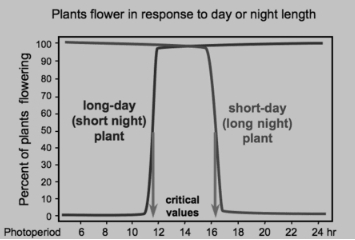
Based on the provided graph,the critical photoperiod for the long-day plant is approximately $12$ hours.
Therefore,for flowering to occur in a long-day plant,the duration of the light period $(A)$ must be greater than the critical value (i.e.,$A > 12$ hours).
Among the given options,$A=13$ hours and $B=11$ hours satisfies the condition where the light period is longer than the critical photoperiod.
Based on the provided graph,the critical photoperiod for the long-day plant is approximately $12$ hours.
Therefore,for flowering to occur in a long-day plant,the duration of the light period $(A)$ must be greater than the critical value (i.e.,$A > 12$ hours).
Among the given options,$A=13$ hours and $B=11$ hours satisfies the condition where the light period is longer than the critical photoperiod.
0 likes
View Solution141
EasyMCQ
Vernalization is done at
A
Lower temperature
B
Low light intensity
C
Higher temperature
D
High light intensity
Solution
(A) The term vernalization was introduced by $Lysenko$.
$Chouard$ defined it as the acquisition of the ability to produce flowers by low temperature treatment.
Vernalization is affected by two factors: water and oxygen.
In the absence of proper water and $O_2$ content,the chilling treatment becomes ineffective.
$Chouard$ defined it as the acquisition of the ability to produce flowers by low temperature treatment.
Vernalization is affected by two factors: water and oxygen.
In the absence of proper water and $O_2$ content,the chilling treatment becomes ineffective.
0 likes
View Solution142
MediumMCQ
Florigen is produced in the region of
A
Leaves
B
Fruit
C
Root
D
Trunk
Solution
(A) Florigen is a hypothetical hormone that has not yet been chemically isolated. It is synthesized in the leaves in response to specific photoperiodic conditions. Once produced,it is transported to the shoot apical meristems (growing points) to induce flowering. It specifically triggers the transition from vegetative growth to reproductive growth (flowering) without directly inhibiting or stimulating overall plant growth.
0 likes
View Solution143
EasyMCQ
Effect of photoperiod on growth and development of plants,especially on flowering,is called
A
Vernalisation
B
Photoperiodism
C
Heterophylly
D
Phototaxis
Solution
(B) The effect of photoperiod on the growth and development of plants,particularly on the induction of flowering,is known as photoperiodism.
This phenomenon was first studied by Garner and Allard in $1920$.
This phenomenon was first studied by Garner and Allard in $1920$.
0 likes
View Solution144
EasyMCQ
The site of perception of light for photoperiodism is:
A
Root
B
Shoot
C
Leaves
D
Meristem
Solution
(C) Photoperiodic stimulus is perceived by the fully developed leaves of the plant.
Research by Knott $(1934)$ demonstrated that even a single leaf or a small portion of a leaf (as little as $1/8$ of the total leaf area) is sufficient to perceive the photoperiodic stimulus and initiate the flowering response.
Research by Knott $(1934)$ demonstrated that even a single leaf or a small portion of a leaf (as little as $1/8$ of the total leaf area) is sufficient to perceive the photoperiodic stimulus and initiate the flowering response.
0 likes
View Solution145
MediumMCQ
If a plant needs $10$ hours of darkness to flower,identify the condition under which it will flower:
$I.$ $14$ hours day period
$II.$ $10$ hours dark period
$III.$ $9 \frac{1}{2}$ hours dark period
$IV.$ $9$ hours dark period
Choose the correct option:
$I.$ $14$ hours day period
$II.$ $10$ hours dark period
$III.$ $9 \frac{1}{2}$ hours dark period
$IV.$ $9$ hours dark period
Choose the correct option:
A
$I$ and $III$
B
$II$ and $III$
C
$I$ and $IV$
D
$I$ and $II$
Solution
(D) The plant described is a Short Day Plant $(SDP)$ because it requires a minimum of $10$ hours of darkness to flower.
This $10$ hours is known as the critical dark period.
For flowering to occur,the plant must be exposed to a dark period equal to or greater than the critical dark period.
Condition $II$ provides exactly $10$ hours of darkness,which meets the requirement.
Conditions $III$ and $IV$ provide less than $10$ hours of darkness,so the plant will not flower under these conditions.
Therefore,the plant will flower under condition $II$.
This $10$ hours is known as the critical dark period.
For flowering to occur,the plant must be exposed to a dark period equal to or greater than the critical dark period.
Condition $II$ provides exactly $10$ hours of darkness,which meets the requirement.
Conditions $III$ and $IV$ provide less than $10$ hours of darkness,so the plant will not flower under these conditions.
Therefore,the plant will flower under condition $II$.
0 likes
View Solution146
EasyMCQ
Which one is a short-day plant?
A
Brassica campestris
B
Raphanus sativus
C
Glycine max
D
Papaver somniferum
Solution
(C) Short-day plants are those that flower when the day length is shorter than a critical period. Among the given options,$Glycine \ max$ (soybean) is a classic example of a short-day plant. $Brassica \ campestris$,$Raphanus \ sativus$,and $Papaver \ somniferum$ are generally considered long-day plants.
0 likes
View Solution147
EasyMCQ
Photoperiodism was first observed in
A
Potato
B
Maryland Mammoth
C
Four $O$'clock
D
Evening primrose
Solution
(B) Garner and Allard $(1920)$ first observed photoperiodism in 'Maryland Mammoth',a variety of tobacco ($Nicotiana$ $tabacum$).
They discovered that this plant could be induced to flower in summer by reducing the duration of light exposure through artificial darkening.
Conversely,it could be kept in a vegetative state during winter by providing supplemental light.
This discovery established the concept of photoperiodism,which is the response of plants to the relative lengths of light and dark periods.
They discovered that this plant could be induced to flower in summer by reducing the duration of light exposure through artificial darkening.
Conversely,it could be kept in a vegetative state during winter by providing supplemental light.
This discovery established the concept of photoperiodism,which is the response of plants to the relative lengths of light and dark periods.
0 likes
View Solution148
MediumMCQ
Which of the following is/are example/s of long day plant?
$I.$ Tomato
$II.$ Maize
$III.$ Rice
$IV.$ Radish
Choose the correct option accordingly.
$I.$ Tomato
$II.$ Maize
$III.$ Rice
$IV.$ Radish
Choose the correct option accordingly.
A
$I$ and $II$
B
$III$ and $IV$
C
Only $IV$
D
$I, II$ and $III$
Solution
(C) $LDP$ (Long Day Plant): These plants flower when they receive a photoperiod longer than the critical photoperiod. Examples include henbane,wheat,oat,beet,spinach,radish,and lettuce.
$SDP$ (Short Day Plant): These plants flower when the photoperiod is shorter than the critical period. Most winter plants are $SDP$,e.g.,potato,bean,tobacco,rice,and sugarcane.
$DNP$ (Day Neutral Plant): These plants can blossom throughout the year regardless of the photoperiod. Examples include tomato,maize,cotton,and pepper.
Among the given options,only $IV$ (Radish) is a long day plant. Therefore,the correct option is $C$.
$SDP$ (Short Day Plant): These plants flower when the photoperiod is shorter than the critical period. Most winter plants are $SDP$,e.g.,potato,bean,tobacco,rice,and sugarcane.
$DNP$ (Day Neutral Plant): These plants can blossom throughout the year regardless of the photoperiod. Examples include tomato,maize,cotton,and pepper.
Among the given options,only $IV$ (Radish) is a long day plant. Therefore,the correct option is $C$.
0 likes
View SolutionPlant Growth and Development — Photoperiodism and Vernalization · Frequently Asked Questions
1Are these Plant Growth and Development questions useful for JEE and NEET?
Yes. All questions in this section are mapped to JEE Main and NEET exam patterns. Previous year questions from JEE Main, NEET, GUJCET and state-level exams are included with full solutions.
2Can I switch to Hindi or Gujarati for these questions?
Yes. Use the language tabs in the hero section or the sidebar to view the same questions and solutions in English, Hindi or Gujarati.
3How do I generate a question paper from this subtopic?
Use the Vedclass Exam Paper Generator — select the chapter and subtopic, set difficulty, and generate Sets A, B, C, D automatically. First 3 chapters of every subject are free.
Vedclass Products
For Students
Vedclass Test Series
Mock tests in real JEE/NEET style with performance analysis. 5-day free trial.
Start Free TrialFor Teachers
Exam Paper Generator
Generate Set A/B/C/D papers from this chapter in 2 minutes. 3 chapters free.
Try FreeFor Institutes
Online Exam Module
Live online exams with unlimited students, 360° analytics & white-label branding.
See DemoFor Teachers & Institutes
Generate a Plant Growth and Development Exam Paper in 2 Minutes
Select subtopic & difficulty — Sets A, B, C, D auto-generated with No Repeat logic.
First 3 chapters of every subject are free — no payment required.