
A English
C4 Questions in English
Class 11 Biology · Photosynthesis in Higher Plants · C4
261+
Questions
English
Language
100%
With Solutions
Showing 50 of 261 questions in English
201
MediumMCQ
The net requirement of assimilatory power for the formation of $6$ hexose molecules in a maize plant is:
A
$72 \text{ ATP}, 48 \text{ NADPH}$
B
$90 \text{ ATP}, 60 \text{ NADPH}$
C
$108 \text{ ATP}, 72 \text{ NADPH}$
D
$180 \text{ ATP}, 72 \text{ NADPH}$
Solution
(D) Maize is a $C_4$ plant.
In $C_4$ plants,the synthesis of one molecule of hexose (glucose) requires $30 \text{ ATP}$ and $12 \text{ NADPH}$.
To calculate the requirement for $6$ hexose molecules,we multiply these values by $6$:
$\text{ATP requirement} = 6 \times 30 = 180 \text{ ATP}$.
$\text{NADPH requirement} = 6 \times 12 = 72 \text{ NADPH}$.
Therefore,the total requirement is $180 \text{ ATP}$ and $72 \text{ NADPH}$.
In $C_4$ plants,the synthesis of one molecule of hexose (glucose) requires $30 \text{ ATP}$ and $12 \text{ NADPH}$.
To calculate the requirement for $6$ hexose molecules,we multiply these values by $6$:
$\text{ATP requirement} = 6 \times 30 = 180 \text{ ATP}$.
$\text{NADPH requirement} = 6 \times 12 = 72 \text{ NADPH}$.
Therefore,the total requirement is $180 \text{ ATP}$ and $72 \text{ NADPH}$.
0 likes
View Solution202
EasyMCQ
The type of carbon dioxide fixation seen in many succulent plant species is
A
$C_{4}-$ pathway
B
$C_{2}-$ pathway
C
$CAM-$ pathway
D
$C_{3}-$ pathway
Solution
(C) $CAM-$ pathway (Crassulacean Acid Metabolism) is a mechanism of photosynthesis involving double fixation of carbon dioxide.
This process occurs in succulent plants belonging to families like Crassulaceae,Cactaceae,and Euphorbiaceae,which are typically found in dry habitats.
In these plants,the stomata remain closed during the daytime to prevent water loss and open only at night to take in $CO_{2}$.
This process occurs in succulent plants belonging to families like Crassulaceae,Cactaceae,and Euphorbiaceae,which are typically found in dry habitats.
In these plants,the stomata remain closed during the daytime to prevent water loss and open only at night to take in $CO_{2}$.
0 likes
View Solution203
MediumMCQ
$PEP$ carboxylase has an advantage over $RuBisCo$. The advantage is:
A
$RuBisCo$ combines with $O_{2}$ but $PEP$ carboxylase does not.
B
$RuBisCo$ combines with $NO_{2}$ but $PEP$ carboxylase does not.
C
$RuBisCo$ conserves energy but $PEP$ carboxylase does not.
D
$PEP$ carboxylase is present in both mesophyll cells and bundle sheath cells but $RuBisCo$ is not.
Solution
(A) $PEP$ carboxylase ($PEP$ case) has a significant advantage over $RuBisCo$ because $PEP$ carboxylase does not bind with oxygen $(O_{2})$.
$RuBisCo$ has an affinity for both $CO_{2}$ and $O_{2}$. When it binds with $O_{2}$,it initiates photorespiration.
Photorespiration is a wasteful process that consumes energy and releases $CO_{2}$ without producing sugars,thereby decreasing the overall photosynthetic yield.
Since $PEP$ carboxylase is insensitive to $O_{2}$,it ensures efficient carbon fixation even in the presence of oxygen.
$RuBisCo$ has an affinity for both $CO_{2}$ and $O_{2}$. When it binds with $O_{2}$,it initiates photorespiration.
Photorespiration is a wasteful process that consumes energy and releases $CO_{2}$ without producing sugars,thereby decreasing the overall photosynthetic yield.
Since $PEP$ carboxylase is insensitive to $O_{2}$,it ensures efficient carbon fixation even in the presence of oxygen.
0 likes
View Solution204
MediumMCQ
Which of the following statements regarding $C_{4}$-plants is false?
A
The primary $CO_{2}$ acceptor is a $5$-carbon molecule
B
The initial carboxylation reaction occurs in Mesophyll
C
The leaves that fix $CO_{2}$ have two cell types
D
The Mesophyll cells lack Rubisco enzyme
Solution
(A) In $C_{4}$ plants,the primary $CO_{2}$ acceptor is a $3$-carbon compound,phosphoenolpyruvate $(PEP)$,which is present in the mesophyll cells.
Since the primary acceptor is a $3$-carbon molecule,option $A$ is false.
The initial carboxylation reaction occurs in the mesophyll cells using the enzyme $PEP$ carboxylase.
$C_{4}$ plants exhibit Kranz anatomy,meaning their leaves contain two types of photosynthetic cells: mesophyll cells and bundle sheath cells.
Mesophyll cells in $C_{4}$ plants lack the enzyme Rubisco,which is instead found in the bundle sheath cells.
Since the primary acceptor is a $3$-carbon molecule,option $A$ is false.
The initial carboxylation reaction occurs in the mesophyll cells using the enzyme $PEP$ carboxylase.
$C_{4}$ plants exhibit Kranz anatomy,meaning their leaves contain two types of photosynthetic cells: mesophyll cells and bundle sheath cells.
Mesophyll cells in $C_{4}$ plants lack the enzyme Rubisco,which is instead found in the bundle sheath cells.
0 likes
View Solution205
MediumMCQ
Which of the following characteristics out of $I, II, III, IV$ are exhibited by $C_{4}$ plants?
$I$. Kranz anatomy
$II$. Oxaloacetic acid
$III$. Large bundle sheath cells
$IV$. Found only in desert area
$I$. Kranz anatomy
$II$. Oxaloacetic acid
$III$. Large bundle sheath cells
$IV$. Found only in desert area
A
$I, II$ and $III$
B
$I, II$ and $IV$
C
$II, III$ and $IV$
D
$III, I$ and $IV$
Solution
(A) $C_{4}$ plants exhibit specific anatomical and biochemical features.
$I$. Kranz anatomy: They possess a specialized leaf anatomy where mesophyll cells surround the bundle sheath cells.
$II$. Oxaloacetic acid: The primary $CO_{2}$ acceptor is phosphoenolpyruvate $(PEP)$,which forms the $4$-carbon compound oxaloacetic acid $(OAA)$ in mesophyll cells.
$III$. Large bundle sheath cells: These cells are large and contain numerous chloroplasts,which is a hallmark of Kranz anatomy.
$IV$. Found only in desert area: This is incorrect; while $C_{4}$ plants are adapted to high temperatures and light intensities,they are found in various tropical and subtropical regions,not just deserts.
Therefore,characteristics $I, II,$ and $III$ are correct.
$I$. Kranz anatomy: They possess a specialized leaf anatomy where mesophyll cells surround the bundle sheath cells.
$II$. Oxaloacetic acid: The primary $CO_{2}$ acceptor is phosphoenolpyruvate $(PEP)$,which forms the $4$-carbon compound oxaloacetic acid $(OAA)$ in mesophyll cells.
$III$. Large bundle sheath cells: These cells are large and contain numerous chloroplasts,which is a hallmark of Kranz anatomy.
$IV$. Found only in desert area: This is incorrect; while $C_{4}$ plants are adapted to high temperatures and light intensities,they are found in various tropical and subtropical regions,not just deserts.
Therefore,characteristics $I, II,$ and $III$ are correct.
0 likes
View Solution206
MediumMCQ
During the $C_{4}$-cycle,the acids formed are:
$I$. Picric acid
$II$. $OAA$ (Oxaloacetic acid)
$III$. Malic acid
$IV$. Aspartic acid
Select the correct option.
$I$. Picric acid
$II$. $OAA$ (Oxaloacetic acid)
$III$. Malic acid
$IV$. Aspartic acid
Select the correct option.
A
$I, II, III$ and $IV$
B
$II, III$ and $IV$
C
$I, IV$ and $II$
D
$I, III$ and $IV$
Solution
(B) In the $C_{4}$-cycle,the primary $CO_{2}$ fixation product is $OAA$ (Oxaloacetic acid),which is a $4$-carbon acid formed in the mesophyll cells.
This $OAA$ is subsequently converted into other $4$-carbon acids such as malic acid or aspartic acid.
Picric acid is not involved in the $C_{4}$-cycle.
Therefore,the acids formed during the $C_{4}$-cycle are $OAA$ $(II)$,malic acid $(III)$,and aspartic acid $(IV)$.
This $OAA$ is subsequently converted into other $4$-carbon acids such as malic acid or aspartic acid.
Picric acid is not involved in the $C_{4}$-cycle.
Therefore,the acids formed during the $C_{4}$-cycle are $OAA$ $(II)$,malic acid $(III)$,and aspartic acid $(IV)$.
0 likes
View Solution207
MediumMCQ
$I.$ They have special leaf anatomy. $II.$ They tolerate high temperature.
$III.$ Lack photorespiration. $IV.$ Greater productivity of biomass.
These are the probable characters of:
$III.$ Lack photorespiration. $IV.$ Greater productivity of biomass.
These are the probable characters of:
A
$C_{2}$-plant
B
$C_{3}$-plant
C
$C_{4}$-plant
D
Any plant
Solution
(C) $C_{4}$-plants exhibit several specialized adaptations to optimize photosynthesis in tropical environments.
$1$. Special leaf anatomy: They possess $Kranz$ anatomy,where mesophyll cells surround bundle sheath cells.
$2$. High temperature tolerance: They are adapted to thrive in warmer climates compared to $C_{3}$-plants.
$3$. Lack of photorespiration: By concentrating $CO_{2}$ in the bundle sheath cells,they effectively eliminate the wasteful process of photorespiration.
$4$. Greater productivity: Due to the absence of photorespiration and efficient carbon fixation,they show higher biomass production.
$1$. Special leaf anatomy: They possess $Kranz$ anatomy,where mesophyll cells surround bundle sheath cells.
$2$. High temperature tolerance: They are adapted to thrive in warmer climates compared to $C_{3}$-plants.
$3$. Lack of photorespiration: By concentrating $CO_{2}$ in the bundle sheath cells,they effectively eliminate the wasteful process of photorespiration.
$4$. Greater productivity: Due to the absence of photorespiration and efficient carbon fixation,they show higher biomass production.
0 likes
View Solution208
MediumMCQ
Chloroplasts without grana are known to occur in
A
Bundle-sheath cells of $C_{3}$-plants
B
Mesophyll cells of $C_{4}$-plants
C
Bundle-sheath cells of $C_{4}$-plants
D
Mesophyll cells of all plants
Solution
(C) $C_{4}$-plants exhibit Kranz anatomy,which involves dimorphic chloroplasts: granal and agranal.
In $C_{4}$-plants,the mesophyll cells contain granal chloroplasts,which possess well-developed thylakoids stacked into grana.
Conversely,the bundle-sheath cells of $C_{4}$-plants contain agranal chloroplasts,meaning they lack grana,and thylakoids exist only as stroma lamellae.
This structural adaptation allows for the efficient separation of the light-dependent reactions and the Calvin cycle.
In $C_{4}$-plants,the mesophyll cells contain granal chloroplasts,which possess well-developed thylakoids stacked into grana.
Conversely,the bundle-sheath cells of $C_{4}$-plants contain agranal chloroplasts,meaning they lack grana,and thylakoids exist only as stroma lamellae.
This structural adaptation allows for the efficient separation of the light-dependent reactions and the Calvin cycle.
0 likes
View Solution209
MediumMCQ
Malic acid or aspartic acid and oxaloacetic acid both are found in
A
Mesophyll cell
B
Bundle sheath cell
C
Guard cell
D
Subsidiary cell
Solution
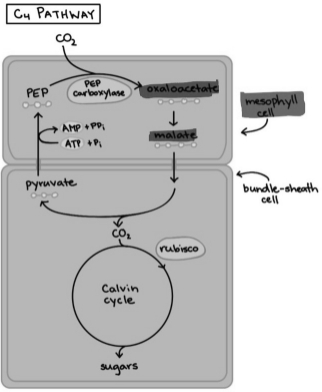
(A) In $C_4$ plants,the primary $CO_2$ fixation occurs in the mesophyll cells.
$CO_2$ combines with phosphoenolpyruvate $(PEP)$ to form a $4$-carbon compound called oxaloacetic acid $(OAA)$ with the help of the enzyme $PEP$ carboxylase.
This oxaloacetic acid is then converted into other $4$-carbon compounds like malic acid or aspartic acid within the same mesophyll cells.
These $4$-carbon acids are then transported to the bundle sheath cells for further processing in the Calvin cycle.
Therefore,both oxaloacetic acid and malic acid/aspartic acid are found in the mesophyll cells.
$CO_2$ combines with phosphoenolpyruvate $(PEP)$ to form a $4$-carbon compound called oxaloacetic acid $(OAA)$ with the help of the enzyme $PEP$ carboxylase.
This oxaloacetic acid is then converted into other $4$-carbon compounds like malic acid or aspartic acid within the same mesophyll cells.
These $4$-carbon acids are then transported to the bundle sheath cells for further processing in the Calvin cycle.
Therefore,both oxaloacetic acid and malic acid/aspartic acid are found in the mesophyll cells.
0 likes
View Solution210
MediumMCQ
The $C_{4}$-plants are photosynthetically more efficient than $C_{3}$-plants because
A
The carbon dioxide compensation point is more
B
Carbon dioxide generated during photorespiration is trapped and recycled through $PEP$ carboxylase
C
The carbon dioxide efflux is not prevented
D
They have more chloroplasts
Solution
(B) $C_{4}$-plants are more efficient because they possess a mechanism to minimize photorespiration. In $C_{4}$-plants,the enzyme $PEP$ carboxylase fixes $CO_{2}$ in mesophyll cells,which has a high affinity for $CO_{2}$ and does not bind with $O_{2}$. This process pumps $CO_{2}$ into the bundle sheath cells,creating a high concentration of $CO_{2}$ around the enzyme $RuBisCO$. This high concentration effectively suppresses the oxygenase activity of $RuBisCO$,thereby preventing photorespiration and ensuring higher photosynthetic efficiency compared to $C_{3}$-plants.
0 likes
View Solution211
MediumMCQ
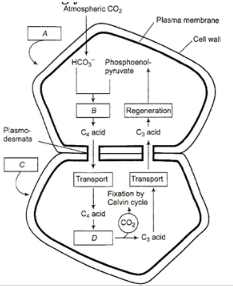
Identify $A, B, C$ and $D$ in the given figure and choose the correct option accordingly.
A
$A$-Mesophyll cell,$B$-Fixation,$C$-Bundle sheath cell,$D$-Decarboxylation
B
$A$-Mesophyll cell,$B$-Decarboxylation,$C$-Bundle sheath cell,$D$-Fixation
C
$A$-Chloroplast,$B$-Decarboxylation,$C$-Bundle sheath cell,$D$-Fixation
D
$A$-Chloroplast,$B$-Fixation,$C$-Bundle sheath cell,$D$-Fixation
Solution
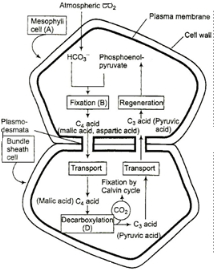
(A) In the $C_{4}$ pathway (Hatch and Slack pathway),the process occurs in two types of cells: mesophyll cells and bundle sheath cells.
$1$. In the mesophyll cell $(A)$,atmospheric $CO_{2}$ is fixed into a $C_{4}$ acid by the enzyme $PEP$ carboxylase. This step is called Fixation $(B)$.
$2$. The $C_{4}$ acid is then transported to the bundle sheath cell $(C)$.
$3$. In the bundle sheath cell,the $C_{4}$ acid undergoes Decarboxylation $(D)$ to release $CO_{2}$ for the Calvin cycle.
$1$. In the mesophyll cell $(A)$,atmospheric $CO_{2}$ is fixed into a $C_{4}$ acid by the enzyme $PEP$ carboxylase. This step is called Fixation $(B)$.
$2$. The $C_{4}$ acid is then transported to the bundle sheath cell $(C)$.
$3$. In the bundle sheath cell,the $C_{4}$ acid undergoes Decarboxylation $(D)$ to release $CO_{2}$ for the Calvin cycle.
0 likes
View Solution212
DifficultMCQ
As compared to a $C_{3}$-plant,how many additional molecules of $ATP$ are needed for the net production of one molecule of hexose sugar by $C_{4}$-plants?
A
$2$
B
$6$
C
$0$
D
$12$
Solution
(D) In $C_{3}$ plants,the synthesis of one molecule of glucose $(C_{6}H_{12}O_{6})$ requires $18$ $ATP$ and $12$ $NADPH$ molecules.
In $C_{4}$ plants,an additional $CO_{2}$ fixation cycle (the $C_{4}$ cycle) occurs to concentrate $CO_{2}$ in the bundle sheath cells.
This $C_{4}$ cycle requires $2$ additional $ATP$ molecules per $CO_{2}$ molecule fixed to regenerate phosphoenolpyruvate $(PEP)$.
Since $6$ molecules of $CO_{2}$ are required to produce one molecule of hexose sugar,the total additional $ATP$ required is $6 \times 2 = 12$ $ATP$ molecules.
Therefore,$C_{4}$ plants require $30$ $ATP$ $(18 + 12)$ and $12$ $NADPH$ for the synthesis of one glucose molecule.
In $C_{4}$ plants,an additional $CO_{2}$ fixation cycle (the $C_{4}$ cycle) occurs to concentrate $CO_{2}$ in the bundle sheath cells.
This $C_{4}$ cycle requires $2$ additional $ATP$ molecules per $CO_{2}$ molecule fixed to regenerate phosphoenolpyruvate $(PEP)$.
Since $6$ molecules of $CO_{2}$ are required to produce one molecule of hexose sugar,the total additional $ATP$ required is $6 \times 2 = 12$ $ATP$ molecules.
Therefore,$C_{4}$ plants require $30$ $ATP$ $(18 + 12)$ and $12$ $NADPH$ for the synthesis of one glucose molecule.
0 likes
View Solution213
MediumMCQ
Which of the following statements is not true regarding the $C_4$ plants?
A
They show Kranz anatomy
B
Decarboxylation process occurs in bundle sheath cells
C
Granal chloroplast is present in bundle sheath cells
D
$PEP$case enzyme activity occurs in mesophyll cells
Solution
(C) $C_4$ plants exhibit a specialized leaf anatomy known as Kranz anatomy.
In these plants,the bundle sheath cells contain large,agranal chloroplasts (lacking grana),which are adapted for the Calvin cycle.
Therefore,the statement that granal chloroplasts are present in bundle sheath cells is incorrect.
In these plants,the bundle sheath cells contain large,agranal chloroplasts (lacking grana),which are adapted for the Calvin cycle.
Therefore,the statement that granal chloroplasts are present in bundle sheath cells is incorrect.
0 likes
View Solution214
MediumMCQ
In $C_4$ plants,the first stable product of $CO_2$ fixation is:
A
$OAA$
B
$RuBP$
C
$3-PGA$
D
Malic acid
Solution
(A) In $C_4$ plants,the primary $CO_2$ acceptor is phosphoenolpyruvate $(PEP)$,which combines with $CO_2$ in the presence of $PEP$ carboxylase to form a $4$-carbon compound called Oxaloacetic acid $(OAA)$.
This $OAA$ is the first stable product formed during the $C_4$ photosynthetic pathway.
This $OAA$ is the first stable product formed during the $C_4$ photosynthetic pathway.
0 likes
View Solution215
MediumMCQ
In $C_4$ plants,sugar is produced in
A
Bundle sheath cells
B
Mesophyll cells
C
Palisade leaf cells
D
Spongy mesophyll
Solution
(A) In $C_4$ plants,the initial carbon fixation occurs in the mesophyll cells to form oxaloacetate,which is then converted to malate or aspartate.
These compounds are transported to the bundle sheath cells.
In the bundle sheath cells,decarboxylation occurs,releasing $CO_2$ for the Calvin cycle.
Therefore,the actual synthesis of sugar (glucose) via the Calvin cycle takes place exclusively in the bundle sheath cells.
These compounds are transported to the bundle sheath cells.
In the bundle sheath cells,decarboxylation occurs,releasing $CO_2$ for the Calvin cycle.
Therefore,the actual synthesis of sugar (glucose) via the Calvin cycle takes place exclusively in the bundle sheath cells.
0 likes
View Solution216
MediumMCQ
Which one of the following is a $C_4$ plant?
A
Papaya
B
Potato
C
Maize
D
Pea
Solution
(C) $C_4$ plants are adapted to high temperatures and high light intensities. Maize ($Zea$ $mays$),sugarcane,and sorghum are classic examples of $C_4$ plants. In these plants,the primary $CO_2$ acceptor is phosphoenolpyruvate $(PEP)$,and the first stable product is a four-carbon compound,oxaloacetic acid $(OAA)$.
0 likes
View Solution217
MediumMCQ
The $CO_2$ fixation during the Hatch and Slack pathway occurs in
A
Large thick-walled cells
B
Mesophyll cells
C
Vascular bundles
D
Bundle sheath cell cytoplasm
Solution
(B) The $C_4$ pathway,also known as the Hatch and Slack pathway,involves two types of photosynthetic cells: mesophyll cells and bundle sheath cells.
In the mesophyll cells,the primary $CO_2$ fixation occurs. The enzyme $PEP$ carboxylase $(PEPCase)$ captures $CO_2$ and converts it into a $4$-carbon compound called oxaloacetate $(OAA)$.
Therefore,the initial fixation of $CO_2$ takes place in the mesophyll cells.
In the mesophyll cells,the primary $CO_2$ fixation occurs. The enzyme $PEP$ carboxylase $(PEPCase)$ captures $CO_2$ and converts it into a $4$-carbon compound called oxaloacetate $(OAA)$.
Therefore,the initial fixation of $CO_2$ takes place in the mesophyll cells.
0 likes
View Solution218
EasyMCQ
'Kranz' anatomy of leaves is found in
A
$C_4$ plants
B
$C_3$ plants
C
$CAM$ plants
D
All plants
Solution
(A) Kranz anatomy is a specialized structure found in the leaves of $C_4$ plants.
In this anatomy,the mesophyll cells are arranged in a ring-like manner around the bundle sheath cells.
This arrangement helps in concentrating $CO_2$ around the enzyme $RuBisCO$,thereby minimizing photorespiration and increasing photosynthetic efficiency.
In this anatomy,the mesophyll cells are arranged in a ring-like manner around the bundle sheath cells.
This arrangement helps in concentrating $CO_2$ around the enzyme $RuBisCO$,thereby minimizing photorespiration and increasing photosynthetic efficiency.
0 likes
View Solution219
MediumMCQ
The enzyme required for the $CO_2$ fixation in the $C_4$ cycle is
A
$PEP$ carboxylase
B
$RuBP$ oxygenase
C
$RuBP$ carboxylase
D
$PGA$ dehydrogenase
Solution
(A) In the $C_4$ cycle,the primary $CO_2$ fixation occurs in the mesophyll cells.
This process is catalyzed by the enzyme Phosphoenolpyruvate $(PEP)$ carboxylase,also known as $PEP$ carboxylase.
This enzyme has a high affinity for $CO_2$ and does not show oxygenase activity,making it highly efficient for $CO_2$ fixation.
This process is catalyzed by the enzyme Phosphoenolpyruvate $(PEP)$ carboxylase,also known as $PEP$ carboxylase.
This enzyme has a high affinity for $CO_2$ and does not show oxygenase activity,making it highly efficient for $CO_2$ fixation.
0 likes
View Solution220
MediumMCQ
$RuBisCO$ in $C_4$ plants shows minimum oxygenase activity due to
A
Abundance of $RuBisCO$
B
Formation of $C_4$ acid
C
Decarboxylation of $C_4$ acid
D
Cyclic photophosphorylation
Solution
(C) In $C_4$ plants,the $C_4$ acid (malic acid or aspartic acid) is transported to the bundle sheath cells.
Inside the bundle sheath cells,this $C_4$ acid undergoes decarboxylation to release $CO_2$.
This process increases the intracellular concentration of $CO_2$ around the $RuBisCO$ enzyme.
High $CO_2$ concentration ensures that $RuBisCO$ functions primarily as a carboxylase rather than an oxygenase,thereby minimizing photorespiration.
Inside the bundle sheath cells,this $C_4$ acid undergoes decarboxylation to release $CO_2$.
This process increases the intracellular concentration of $CO_2$ around the $RuBisCO$ enzyme.
High $CO_2$ concentration ensures that $RuBisCO$ functions primarily as a carboxylase rather than an oxygenase,thereby minimizing photorespiration.
0 likes
View Solution221
MediumMCQ
The primary acceptor of $CO_2$ in $C_4$ plants is
A
$RuBP$
B
Phosphoenol pyruvic acid $(PEP)$
C
$OAA$
D
Malic acid
Solution
(B) In the mesophyll cells of $C_4$ plants,the primary acceptor of atmospheric $CO_2$ is Phosphoenol pyruvic acid $(PEP)$,which is a $3$-carbon compound.
This reaction is catalyzed by the enzyme $PEP$ carboxylase $(PEPCase)$.
This reaction is catalyzed by the enzyme $PEP$ carboxylase $(PEPCase)$.
0 likes
View Solution222
MediumMCQ
$PEP$case and $RuBisCO$ in $C_4$ plants are present respectively in
A
Cytoplasm and thylakoids
B
Stroma and cytoplasm
C
Stroma and thylakoids
D
Cytoplasm and stroma
Solution
(D) In $C_4$ plants,the initial carbon fixation occurs in the mesophyll cells where the enzyme $PEP$case (Phosphoenolpyruvate carboxylase) is located in the cytoplasm.
After the formation of $C_4$ acids,they are transported to the bundle sheath cells.
In the bundle sheath cells,the $C_4$ acids are broken down to release $CO_2$,which is then fixed by the enzyme $RuBisCO$ (Ribulose$-1,5-$bisphosphate carboxylase-oxygenase) located in the stroma of the chloroplasts.
After the formation of $C_4$ acids,they are transported to the bundle sheath cells.
In the bundle sheath cells,the $C_4$ acids are broken down to release $CO_2$,which is then fixed by the enzyme $RuBisCO$ (Ribulose$-1,5-$bisphosphate carboxylase-oxygenase) located in the stroma of the chloroplasts.
0 likes
View Solution223
MediumMCQ
Plants like sugarcane show high productivity and high efficiency of $CO_2$ fixation,because of
A
Absence of photorespiration
B
$EMP$ pathway
C
Calvin cycle
D
$TCA$ cycle
Solution
(A) Sugarcane is a $C_4$ plant.
$C_4$ plants are highly efficient in $CO_2$ fixation because they lack photorespiration,a wasteful process that occurs in $C_3$ plants.
In $C_4$ plants,the enzyme $PEP$ carboxylase fixes $CO_2$ into a $4$-carbon compound,which prevents the oxygenation of $RuBP$ and thus avoids the loss of fixed carbon.
$C_4$ plants are highly efficient in $CO_2$ fixation because they lack photorespiration,a wasteful process that occurs in $C_3$ plants.
In $C_4$ plants,the enzyme $PEP$ carboxylase fixes $CO_2$ into a $4$-carbon compound,which prevents the oxygenation of $RuBP$ and thus avoids the loss of fixed carbon.
0 likes
View Solution224
MediumMCQ
The $CO_2$ concentration at which $C_4$ plants show saturation is about (in $ppm$)
A
$360$
B
$380$
C
$450$
D
$500$
Solution
(A) $C_4$ plants show saturation at $CO_2$ concentrations of about $360$ $ppm$.
This is because $C_4$ plants have a more efficient mechanism for $CO_2$ fixation (via $PEP$ carboxylase) compared to $C_3$ plants.
$C_3$ plants show saturation at $450$ $ppm$ to $500$ $ppm$ of $CO_2$.
This is because $C_4$ plants have a more efficient mechanism for $CO_2$ fixation (via $PEP$ carboxylase) compared to $C_3$ plants.
$C_3$ plants show saturation at $450$ $ppm$ to $500$ $ppm$ of $CO_2$.
0 likes
View Solution225
MediumMCQ
Choose the correct sequence of steps involved in the $C_4$ cycle.
A
$CO_2$ fixation $\rightarrow$ Regeneration $\rightarrow$ Transport
B
$CO_2$ fixation $\rightarrow$ Recarboxylation $\rightarrow$ Decarboxylation
C
Transport $\rightarrow$ Regeneration $\rightarrow$ $CO_2$ fixation
D
$CO_2$ fixation $\rightarrow$ Transport $\rightarrow$ Decarboxylation
Solution
(D) The $C_4$ cycle involves the following steps:
$1$. $CO_2$ fixation: $CO_2$ is fixed in the mesophyll cells by the enzyme $PEP$ carboxylase to form a $4$-carbon compound (oxaloacetate).
$2$. Transport: This $4$-carbon compound is transported from the mesophyll cells to the bundle sheath cells.
$3$. Decarboxylation: In the bundle sheath cells,the $4$-carbon compound undergoes decarboxylation to release $CO_2$ for the Calvin cycle.
Therefore,the correct sequence is $CO_2$ fixation $\rightarrow$ Transport $\rightarrow$ Decarboxylation.
$1$. $CO_2$ fixation: $CO_2$ is fixed in the mesophyll cells by the enzyme $PEP$ carboxylase to form a $4$-carbon compound (oxaloacetate).
$2$. Transport: This $4$-carbon compound is transported from the mesophyll cells to the bundle sheath cells.
$3$. Decarboxylation: In the bundle sheath cells,the $4$-carbon compound undergoes decarboxylation to release $CO_2$ for the Calvin cycle.
Therefore,the correct sequence is $CO_2$ fixation $\rightarrow$ Transport $\rightarrow$ Decarboxylation.
0 likes
View Solution226
MediumMCQ
Sorghum and sugarcane plants show saturation at about
A
$50\%$ of full sunlight
B
$10\%$ of full sunlight
C
$360$ $ppm$ of $CO_2$
D
$500$ $ppm$ of $CO_2$
Solution
(A) Both sugarcane and Sorghum are $C_4$ plants.
$C_4$ plants do not show saturation at low light intensities.
They respond to higher light intensities and show saturation at about $50\%$ of full sunlight.
In contrast,$C_3$ plants show saturation at about $10\%$ of full sunlight.
$C_4$ plants do not show saturation at low light intensities.
They respond to higher light intensities and show saturation at about $50\%$ of full sunlight.
In contrast,$C_3$ plants show saturation at about $10\%$ of full sunlight.
0 likes
View Solution227
MediumMCQ
$CO_2$ concentrating steps are found in
A
Rice
B
Sugarcane
C
Wheat
D
Tomato
Solution
(B) $CO_2$ concentrating mechanisms,also known as the $C_4$ pathway or Hatch-Slack pathway,are adaptations to minimize photorespiration.
In these plants,$CO_2$ is initially fixed in mesophyll cells into a $4$-carbon compound (oxaloacetate),which is then converted to malate or aspartate.
This malate is transported to bundle sheath cells,where it undergoes decarboxylation to release high concentrations of $CO_2$ around the enzyme $RuBisCO$.
Among the given options,Sugarcane is a $C_4$ plant,while Rice,Wheat,and Tomato are $C_3$ plants.
In these plants,$CO_2$ is initially fixed in mesophyll cells into a $4$-carbon compound (oxaloacetate),which is then converted to malate or aspartate.
This malate is transported to bundle sheath cells,where it undergoes decarboxylation to release high concentrations of $CO_2$ around the enzyme $RuBisCO$.
Among the given options,Sugarcane is a $C_4$ plant,while Rice,Wheat,and Tomato are $C_3$ plants.
0 likes
View Solution228
MediumMCQ
Kranz anatomy is concerned with
A
Having peripheral reticulum in chloroplast of bundle sheath
B
Presence of distinct bundle sheath surrounded by concentric ring of mesophyll cells
C
Dimorphic chloroplast
D
Large vacuole in mesophyll cells
Solution
(B) Kranz anatomy is a characteristic feature of $C_4$ plants. In this anatomy,the bundle sheath cells are arranged in a ring around the vascular bundles,and these are further surrounded by a concentric ring of mesophyll cells. This arrangement allows for the efficient separation of the light-dependent reactions and the Calvin cycle.
0 likes
View Solution229
MediumMCQ
In $C_4$ plants,mesophyll cells and bundle sheath cells are specialised to perform respectively:
A
Light reaction and dark reaction
B
Dark reaction and light reaction
C
Light reaction and photorespiration
D
Photorespiration and dark reaction
Solution
(A) In $C_4$ plants,the process of photosynthesis is divided between two different cell types to minimize photorespiration.
$1$. Mesophyll cells: These cells contain chloroplasts that perform the light-dependent reactions (light reaction) to produce $ATP$ and $NADPH$.
$2$. Bundle sheath cells: These cells contain chloroplasts that perform the Calvin cycle (dark reaction) where $CO_2$ is fixed into sugars.
Therefore,mesophyll cells perform the light reaction and bundle sheath cells perform the dark reaction.
$1$. Mesophyll cells: These cells contain chloroplasts that perform the light-dependent reactions (light reaction) to produce $ATP$ and $NADPH$.
$2$. Bundle sheath cells: These cells contain chloroplasts that perform the Calvin cycle (dark reaction) where $CO_2$ is fixed into sugars.
Therefore,mesophyll cells perform the light reaction and bundle sheath cells perform the dark reaction.
0 likes
View Solution230
MediumMCQ
Agranal chloroplasts are found in
A
Mesophyll of pea leaves
B
Bundle sheath of mango leaves
C
Mesophyll of maize leaves
D
Bundle sheath of sugarcane leaves
Solution
(D) Agranal chloroplasts are characterized by the absence of grana (thylakoid stacks).
These are typically found in the bundle sheath cells of $C_4$ plants.
Sugarcane is a classic example of a $C_4$ plant,where the bundle sheath cells contain chloroplasts that lack grana,allowing for the efficient operation of the Calvin cycle without the light-dependent reactions occurring in the same compartment.
These are typically found in the bundle sheath cells of $C_4$ plants.
Sugarcane is a classic example of a $C_4$ plant,where the bundle sheath cells contain chloroplasts that lack grana,allowing for the efficient operation of the Calvin cycle without the light-dependent reactions occurring in the same compartment.
0 likes
View Solution231
MediumMCQ
Find the odd one out with respect to double carboxylation.
A
Zea mays
B
Sugarcane
C
Pisum sativum
D
Sorghum
Solution
(C) Double carboxylation is a characteristic feature of $C_4$ plants, where $CO_2$ is fixed twice: first in the mesophyll cells by $PEP$ carboxylase and then in the bundle sheath cells by $RuBisCO$.
$Zea \text{ } mays$, $Sugarcane$, and $Sorghum$ are examples of $C_4$ plants.
$Pisum \text{ } sativum$ (pea) is a $C_3$ plant, which performs single carboxylation.
Therefore, $Pisum \text{ } sativum$ is the odd one.
$Zea \text{ } mays$, $Sugarcane$, and $Sorghum$ are examples of $C_4$ plants.
$Pisum \text{ } sativum$ (pea) is a $C_3$ plant, which performs single carboxylation.
Therefore, $Pisum \text{ } sativum$ is the odd one.
0 likes
View Solution232
MediumMCQ
In $C_4$ plants,the bundle sheath cells
A
Have thin walls to facilitate gaseous exchange
B
Have large intercellular spaces
C
Are rich in $PEP$ carboxylase
D
Have a high density of chloroplasts
Solution
(D) In $C_4$ plants,the leaves exhibit a specialized anatomy known as $Kranz$ anatomy. In this arrangement,the bundle sheath cells are large,thick-walled,and contain a high density of chloroplasts. These chloroplasts are typically agranal (lacking grana) and are specialized for the $Calvin$ cycle,which occurs in the bundle sheath cells to prevent photorespiration.
0 likes
View Solution233
MediumMCQ
$C_4$ plants are less efficient at low temperatures due to:
A
Low $O_2$ affinity of $PEP$case
B
Cold sensitivity of $PEP$ synthetase enzyme
C
Reduced rate of decarboxylation of organic acids
D
High energy requirement for $CO_2$ fixation
Solution
(B) $C_4$ plants are adapted to high-temperature environments and have an optimum temperature range of $30-40^{\circ}C$.
At low temperatures,the enzyme $PEP$ synthetase (pyruvate phosphate dikinase),which is responsible for regenerating $PEP$ (phosphoenolpyruvate),becomes cold-sensitive and its activity decreases significantly.
This inhibition of the $PEP$ regeneration cycle limits the overall rate of $CO_2$ fixation in $C_4$ plants,making them less efficient compared to $C_3$ plants in cooler climates.
At low temperatures,the enzyme $PEP$ synthetase (pyruvate phosphate dikinase),which is responsible for regenerating $PEP$ (phosphoenolpyruvate),becomes cold-sensitive and its activity decreases significantly.
This inhibition of the $PEP$ regeneration cycle limits the overall rate of $CO_2$ fixation in $C_4$ plants,making them less efficient compared to $C_3$ plants in cooler climates.
0 likes
View Solution234
MediumMCQ
$C_4$ plants can tolerate saline conditions due to
A
Occurrence of organic acids
B
Absence of photorespiration
C
Presence of $PEP$ synthetase enzyme
D
Presence of $PEP$ carboxylase enzyme
Solution
(A) $C_4$ plants are known for their ability to tolerate saline conditions and water stress.
This tolerance is primarily attributed to the accumulation of organic acids within their cells.
The accumulation of these organic acids helps in maintaining osmotic balance,which allows the plants to survive in high-salinity environments.
This tolerance is primarily attributed to the accumulation of organic acids within their cells.
The accumulation of these organic acids helps in maintaining osmotic balance,which allows the plants to survive in high-salinity environments.
0 likes
View Solution235
MediumMCQ
Which group of plants are not benefitted by $CO_2$ fertilisation effect?
A
Plants requiring $3$ $ATP$ per $CO_2$ fixation
B
Plants with Kranz anatomy
C
Plants having high rate of photorespiration
D
Plants having single carboxylation
Solution
(B) $C_4$ plants are not significantly benefitted by the $CO_2$ fertilisation effect because they have a mechanism to concentrate $CO_2$ around the enzyme $RuBisCO$. These plants possess $Kranz$ anatomy,which allows them to maintain high levels of $CO_2$ in bundle sheath cells,effectively suppressing photorespiration. Since $C_4$ plants are already saturated with $CO_2$ at current atmospheric levels,an increase in $CO_2$ concentration does not enhance their photosynthetic rate as much as it does for $C_3$ plants.
0 likes
View Solution236
MediumMCQ
Identify the reaction for which the $C_4$ plants require some extra $ATP$ molecules in comparison to $C_3$ plants.
A
Conversion of $PEP$ to $OAA$
B
Conversion of Pyruvate to $PEP$
C
Conversion of Malate to Oxaloacetate
D
Conversion of $PEP$ to Malate
Solution
(B) In $C_4$ plants,the $CO_2$ fixation process involves the regeneration of Phosphoenolpyruvate $(PEP)$ from Pyruvate. This regeneration process is energy-intensive and requires the conversion of $ATP$ to $AMP$,which effectively consumes two $ATP$ equivalents. This extra energy expenditure is necessary to maintain the $CO_2$ concentrating mechanism in the bundle sheath cells,which is absent in $C_3$ plants.
0 likes
View Solution237
MediumMCQ
$A$: In $C_4$ plants,chloroplasts of bundle sheath cells are granal.
$R$: $PS$ $II$ is mostly found in the appressed part of the granum.
$R$: $PS$ $II$ is mostly found in the appressed part of the granum.
A
Assertion and Reason both are correct and Reason is the correct explanation of Assertion.
B
Assertion and Reason both are correct but Reason is not the correct explanation of Assertion.
C
Assertion is correct,but Reason is incorrect.
D
Both Assertion and Reason are incorrect.
Solution
(C) In $C_4$ plants,the bundle sheath cells contain chloroplasts that are agranal (lacking grana) because they lack $PS$ $II$. Therefore,the Assertion is incorrect.
$PS$ $II$ is indeed primarily located in the appressed regions of the thylakoid membranes within the grana. Therefore,the Reason is correct.
Thus,the correct choice is $C$.
$PS$ $II$ is indeed primarily located in the appressed regions of the thylakoid membranes within the grana. Therefore,the Reason is correct.
Thus,the correct choice is $C$.
0 likes
View Solution238
MediumMCQ
$A$: Dark acidification occurs in $CAM$ plants.
$R$: Organic acids are decarboxylated during night.
$R$: Organic acids are decarboxylated during night.
A
Assertion and Reason both are correct and Reason is the correct explanation of Assertion.
B
Assertion and Reason both are correct but Reason is not the correct explanation of Assertion.
C
Assertion is correct,but Reason is incorrect.
D
Both Assertion and Reason are incorrect.
Solution
(C) In $CAM$ (Crassulacean Acid Metabolism) plants,stomata open at night to take in $CO_2$,which is fixed into organic acids like malic acid. This process is known as dark acidification.
During the day,these organic acids are decarboxylated to release $CO_2$ for the Calvin cycle.
Therefore,the Assertion is correct,but the Reason is incorrect because decarboxylation occurs during the day,not at night.
During the day,these organic acids are decarboxylated to release $CO_2$ for the Calvin cycle.
Therefore,the Assertion is correct,but the Reason is incorrect because decarboxylation occurs during the day,not at night.
0 likes
View Solution239
MediumMCQ
$A$: Tropical plants are more efficient in $CO_2$ utilization.
$R$: $C_3$ plants ensure that $RuBisCO$ functions as carboxylase,minimizing oxygenase activity.
$R$: $C_3$ plants ensure that $RuBisCO$ functions as carboxylase,minimizing oxygenase activity.
A
Assertion and Reason both are correct and Reason is the correct explanation of Assertion.
B
Assertion and Reason both are correct but Reason is not the correct explanation of Assertion.
C
Assertion is correct,but Reason is incorrect.
D
Both Assertion and Reason are incorrect.
Solution
(C) : Tropical plants (mostly $C_4$ plants) are more efficient in $CO_2$ utilization because they have a mechanism to concentrate $CO_2$ around the $RuBisCO$ enzyme,which minimizes photorespiration.
$R$: $C_3$ plants do not have a specialized mechanism to minimize oxygenase activity of $RuBisCO$. In $C_3$ plants,$RuBisCO$ often functions as an oxygenase when $CO_2$ levels are low or temperature is high,leading to photorespiration. Therefore,the Reason is incorrect because $C_3$ plants are specifically known for their inability to fully prevent oxygenase activity compared to $C_4$ plants.
$R$: $C_3$ plants do not have a specialized mechanism to minimize oxygenase activity of $RuBisCO$. In $C_3$ plants,$RuBisCO$ often functions as an oxygenase when $CO_2$ levels are low or temperature is high,leading to photorespiration. Therefore,the Reason is incorrect because $C_3$ plants are specifically known for their inability to fully prevent oxygenase activity compared to $C_4$ plants.
0 likes
View Solution240
MediumMCQ
The first stable product of $CO_{2}$ fixation in sorghum is:
A
Pyruvic acid
B
Oxaloacetic acid
C
Succinic acid
D
Phosphoglyceric acid
Solution
(B) Sorghum is a $C_{4}$ plant.
In $C_{4}$ plants,the primary $CO_{2}$ acceptor is Phosphoenolpyruvate $(PEP)$,which is a $3$-carbon compound.
This reaction is catalyzed by the enzyme $PEP$ carboxylase.
The first stable product formed during the $C_{4}$ cycle is Oxaloacetic acid $(OAA)$,which is a $4$-carbon compound.
Therefore,the correct option is $B$.
In $C_{4}$ plants,the primary $CO_{2}$ acceptor is Phosphoenolpyruvate $(PEP)$,which is a $3$-carbon compound.
This reaction is catalyzed by the enzyme $PEP$ carboxylase.
The first stable product formed during the $C_{4}$ cycle is Oxaloacetic acid $(OAA)$,which is a $4$-carbon compound.
Therefore,the correct option is $B$.
0 likes
View Solution241
MediumMCQ
The $C_{4}$ plants are twice as efficient as $C_{3}$ plants in terms of fixing $CO_{2}$ but lose only $........$ as much water as $C_{3}$ plants for the same amount of $CO_{2}$ fixed.
A
one-fourth
B
half
C
twice
D
four times
Solution
(B) $C_{4}$ plants are twice as efficient as $C_{3}$ plants in terms of fixing $CO_{2}$.
This means that for the same amount of $CO_{2}$ fixed,$C_{4}$ plants lose only half as much water as $C_{3}$ plants.
This efficiency is due to the $C_{4}$ pathway,which minimizes photorespiration and allows for better water-use efficiency.
This means that for the same amount of $CO_{2}$ fixed,$C_{4}$ plants lose only half as much water as $C_{3}$ plants.
This efficiency is due to the $C_{4}$ pathway,which minimizes photorespiration and allows for better water-use efficiency.
0 likes
View Solution242
Medium
Some of these terms/chemicals are associated with the $C_{4}$ cycle. Explain.
$(a)$ Hatch-Slack pathway
$(b)$ Calvin cycle
$(c)$ $PEP$ carboxylase
$(d)$ Bundle sheath cells
$(a)$ Hatch-Slack pathway
$(b)$ Calvin cycle
$(c)$ $PEP$ carboxylase
$(d)$ Bundle sheath cells
Solution
(A-D) Hatch-Slack pathway: The $C_{4}$ pathway is an alternative carbon fixation process found in certain plants. It was discovered by $M. D. Hatch$ and $C. R. Slack$,hence it is named the Hatch-Slack pathway.
$(b)$ Calvin cycle: In $C_{4}$ plants,the Calvin cycle occurs specifically within the bundle sheath cells. This is where $CO_{2}$ is finally fixed into glucose via the enzyme $RuBisCO$.
$(c)$ $PEP$ carboxylase: This is the primary $CO_{2}$ fixing enzyme found in the mesophyll cells of $C_{4}$ plants. It catalyzes the reaction between $CO_{2}$ and phosphoenolpyruvate $(PEP)$ to form the $4-C$ compound oxaloacetic acid $(OAA)$.
$(d)$ Bundle sheath cells: These are large,specialized parenchymatous cells arranged in layers around the vascular bundles of $C_{4}$ plant leaves. They contain large numbers of chloroplasts (often agranal) and are the site where the Calvin cycle takes place.
$(b)$ Calvin cycle: In $C_{4}$ plants,the Calvin cycle occurs specifically within the bundle sheath cells. This is where $CO_{2}$ is finally fixed into glucose via the enzyme $RuBisCO$.
$(c)$ $PEP$ carboxylase: This is the primary $CO_{2}$ fixing enzyme found in the mesophyll cells of $C_{4}$ plants. It catalyzes the reaction between $CO_{2}$ and phosphoenolpyruvate $(PEP)$ to form the $4-C$ compound oxaloacetic acid $(OAA)$.
$(d)$ Bundle sheath cells: These are large,specialized parenchymatous cells arranged in layers around the vascular bundles of $C_{4}$ plant leaves. They contain large numbers of chloroplasts (often agranal) and are the site where the Calvin cycle takes place.
0 likes
View Solution243
MediumMCQ
Given below are two statements:
Statement $I$: The primary $CO_{2}$ acceptor in $C_{4}$ plants is phosphoenolpyruvate $(PEP)$ and is found in the mesophyll cells.
Statement $II$: Mesophyll cells of $C_{4}$ plants lack $RuBisCo$ enzyme.
In the light of the above statements,choose the correct answer from the options given below:
Statement $I$: The primary $CO_{2}$ acceptor in $C_{4}$ plants is phosphoenolpyruvate $(PEP)$ and is found in the mesophyll cells.
Statement $II$: Mesophyll cells of $C_{4}$ plants lack $RuBisCo$ enzyme.
In the light of the above statements,choose the correct answer from the options given below:
A
Both Statement $I$ and Statement $II$ are incorrect.
B
Statement $I$ is correct but Statement $II$ is incorrect.
C
Statement $I$ is incorrect but Statement $II$ is correct.
D
Both Statement $I$ and Statement $II$ are correct.
Solution
(D) Statement $I$ is correct: In $C_{4}$ plants,the primary $CO_{2}$ acceptor is a $3$-carbon molecule called phosphoenolpyruvate $(PEP)$,which is present in the mesophyll cells.
Statement $II$ is correct: The mesophyll cells of $C_{4}$ plants lack the enzyme $RuBisCo$. The $RuBisCo$ enzyme is exclusively present in the bundle sheath cells of $C_{4}$ plants,where the Calvin cycle occurs.
Therefore,both statements are correct.
Statement $II$ is correct: The mesophyll cells of $C_{4}$ plants lack the enzyme $RuBisCo$. The $RuBisCo$ enzyme is exclusively present in the bundle sheath cells of $C_{4}$ plants,where the Calvin cycle occurs.
Therefore,both statements are correct.
0 likes
View Solution244
MediumMCQ
What is the role of large bundle sheath cells found around the vascular bundles in $C_{4}$ plants?
A
To increase the number of chloroplasts for the operation of the Calvin cycle
B
To enable the plant to tolerate high temperatures
C
To protect the vascular tissue from high light intensity
D
To provide the site for the photorespiratory pathway
Solution
(A) In $C_{4}$ plants,the leaves exhibit a special anatomy called Kranz anatomy.
Large bundle sheath cells are present around the vascular bundles.
These cells contain a large number of chloroplasts,which are essential for the operation of the Calvin cycle.
By concentrating $CO_{2}$ in these cells,the plant minimizes photorespiration and ensures efficient carbon fixation,allowing the plant to thrive in high-temperature and high-light environments.
Large bundle sheath cells are present around the vascular bundles.
These cells contain a large number of chloroplasts,which are essential for the operation of the Calvin cycle.
By concentrating $CO_{2}$ in these cells,the plant minimizes photorespiration and ensures efficient carbon fixation,allowing the plant to thrive in high-temperature and high-light environments.
0 likes
View Solution245
MediumMCQ
Select the correct option regarding $C_4$ plants compared to $C_3$ plants.
A
$C_4$ plants have higher productivity than $C_3$ plants.
B
$C_4$ plants lose only half the amount of water as $C_3$ plants for the same amount of $CO_2$ fixed.
C
In $C_4$ plants,Rubisco functions more efficiently as a carboxylase compared to $C_3$ plants.
D
All of the above.
Solution
(D) $C_4$ plants are evolutionarily adapted to high-temperature and high-light environments.
$1$. Productivity: Due to the absence of photorespiration,$C_4$ plants show higher biomass production and productivity compared to $C_3$ plants.
$2$. Water Use Efficiency: $C_4$ plants are more efficient in water usage. They fix the same amount of $CO_2$ while losing only about half the water that $C_3$ plants lose through transpiration.
$3$. Rubisco Efficiency: In $C_4$ plants,the $CO_2$ concentration mechanism (Kranz anatomy) ensures that the concentration of $CO_2$ around the enzyme Rubisco is high,which minimizes the oxygenase activity of Rubisco and maximizes its carboxylase activity,making it more efficient than in $C_3$ plants.
Therefore,all the given statements are correct.
$1$. Productivity: Due to the absence of photorespiration,$C_4$ plants show higher biomass production and productivity compared to $C_3$ plants.
$2$. Water Use Efficiency: $C_4$ plants are more efficient in water usage. They fix the same amount of $CO_2$ while losing only about half the water that $C_3$ plants lose through transpiration.
$3$. Rubisco Efficiency: In $C_4$ plants,the $CO_2$ concentration mechanism (Kranz anatomy) ensures that the concentration of $CO_2$ around the enzyme Rubisco is high,which minimizes the oxygenase activity of Rubisco and maximizes its carboxylase activity,making it more efficient than in $C_3$ plants.
Therefore,all the given statements are correct.
0 likes
View Solution246
MediumMCQ
Identify the location of $RuBisCO$ in $C_4$ plants.
A
Chloroplasts of mesophyll cells
B
Mitochondria of mesophyll cells
C
Chloroplasts of bundle sheath cells
D
Mitochondria of bundle sheath cells
Solution
(C) In $C_4$ plants,the process of photosynthesis is divided between two different cell types: mesophyll cells and bundle sheath cells.
$1$. In mesophyll cells,the primary $CO_2$ fixation occurs via the enzyme $PEP$ carboxylase,forming a $4$-carbon compound $(OAA)$.
$2$. This $4$-carbon compound is transported to the bundle sheath cells.
$3$. In the bundle sheath cells,the $4$-carbon compound is decarboxylated to release $CO_2$,which then enters the Calvin cycle.
$4$. The enzyme $RuBisCO$ (Ribulose$-1,5-$bisphosphate carboxylase-oxygenase) is exclusively present in the chloroplasts of the bundle sheath cells to facilitate the Calvin cycle,thereby avoiding photorespiration.
$1$. In mesophyll cells,the primary $CO_2$ fixation occurs via the enzyme $PEP$ carboxylase,forming a $4$-carbon compound $(OAA)$.
$2$. This $4$-carbon compound is transported to the bundle sheath cells.
$3$. In the bundle sheath cells,the $4$-carbon compound is decarboxylated to release $CO_2$,which then enters the Calvin cycle.
$4$. The enzyme $RuBisCO$ (Ribulose$-1,5-$bisphosphate carboxylase-oxygenase) is exclusively present in the chloroplasts of the bundle sheath cells to facilitate the Calvin cycle,thereby avoiding photorespiration.
0 likes
View Solution247
MediumMCQ
The first stable product of the $C_4$ pathway is $........$.
A
$PGA$
B
$RuBP$
C
$PEP$
D
$OAA$
Solution
(D) In the $C_4$ pathway,the primary $CO_2$ acceptor is Phosphoenolpyruvate $(PEP)$,a $3$-carbon compound.
$CO_2$ fixation occurs in the mesophyll cells,where $PEP$ combines with $CO_2$ in the presence of the enzyme $PEP$ carboxylase $(PEPCase)$.
This reaction results in the formation of a $4$-carbon compound called Oxaloacetic acid $(OAA)$.
$OAA$ is the first stable product formed in the $C_4$ cycle.
$CO_2$ fixation occurs in the mesophyll cells,where $PEP$ combines with $CO_2$ in the presence of the enzyme $PEP$ carboxylase $(PEPCase)$.
This reaction results in the formation of a $4$-carbon compound called Oxaloacetic acid $(OAA)$.
$OAA$ is the first stable product formed in the $C_4$ cycle.
0 likes
View Solution248
MediumMCQ
Kranz anatomy is a characteristic feature of $.............$.
A
$C_3$ plants
B
$C_4$ plants
C
$C_2$ plants
D
All of the above
Solution
(B) Kranz anatomy is a specialized structure found in the leaves of $C_4$ plants (such as maize or sugarcane).
In this anatomy,the mesophyll cells are arranged in a ring-like manner around the bundle sheath cells.
This arrangement helps in concentrating $CO_2$ around the enzyme $RuBisCO$,thereby minimizing photorespiration and increasing the efficiency of photosynthesis.
In this anatomy,the mesophyll cells are arranged in a ring-like manner around the bundle sheath cells.
This arrangement helps in concentrating $CO_2$ around the enzyme $RuBisCO$,thereby minimizing photorespiration and increasing the efficiency of photosynthesis.
0 likes
View Solution249
MediumMCQ
Identify the location of the light reaction and the Calvin cycle in $C_4$ plants.
A
Light reaction - Grana of mesophyll chloroplasts
Calvin cycle - Stroma of mesophyll chloroplasts
Calvin cycle - Stroma of mesophyll chloroplasts
B
Light reaction - Grana of bundle sheath chloroplasts
Calvin cycle - Stroma of bundle sheath chloroplasts
Calvin cycle - Stroma of bundle sheath chloroplasts
C
Light reaction - Grana of mesophyll chloroplasts
Calvin cycle - Stroma of bundle sheath chloroplasts
Calvin cycle - Stroma of bundle sheath chloroplasts
D
Light reaction - Grana of bundle sheath chloroplasts
Calvin cycle - Stroma of mesophyll chloroplasts
Calvin cycle - Stroma of mesophyll chloroplasts
Solution
(C) In $C_4$ plants,the process of photosynthesis is spatially separated into two different cell types to minimize photorespiration.
$1$. The light-dependent reaction occurs in the chloroplasts of the mesophyll cells,specifically within the grana,where $ATP$ and $NADPH$ are produced.
$2$. The Calvin cycle (dark reaction) occurs in the chloroplasts of the bundle sheath cells,specifically within the stroma,where $CO_2$ is fixed into sugars using the $ATP$ and $NADPH$ generated in the mesophyll cells.
$1$. The light-dependent reaction occurs in the chloroplasts of the mesophyll cells,specifically within the grana,where $ATP$ and $NADPH$ are produced.
$2$. The Calvin cycle (dark reaction) occurs in the chloroplasts of the bundle sheath cells,specifically within the stroma,where $CO_2$ is fixed into sugars using the $ATP$ and $NADPH$ generated in the mesophyll cells.
0 likes
View Solution250
MediumMCQ
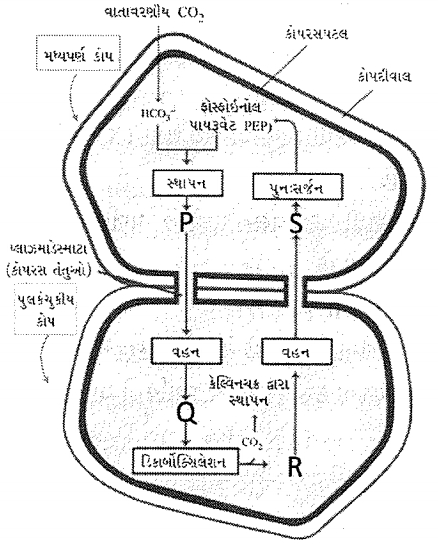
The following figure represents the Hatch and Slack pathway. Identify $P, Q, R$ and $S$.
A
$P: C_4 \text{ acid}, Q: C_3 \text{ acid}, R: C_4 \text{ acid}, S: C_3 \text{ acid}$
B
$P: C_3 \text{ acid}, Q: C_4 \text{ acid}, R: C_3 \text{ acid}, S: C_3 \text{ acid}$
C
$P: C_4 \text{ acid}, Q: C_4 \text{ acid}, R: C_3 \text{ acid}, S: C_3 \text{ acid}$
D
$P: C_3 \text{ acid}, Q: C_3 \text{ acid}, R: C_4 \text{ acid}, S: C_4 \text{ acid}$
Solution
(C) In the Hatch and Slack pathway ($C_4$ cycle):
$1$. In the mesophyll cells, $CO_2$ is fixed by $PEP$ to form a $C_4$ acid (e.g., oxaloacetate or malate/aspartate), which is represented by $P$.
$2$. This $C_4$ acid is transported to the bundle sheath cells, represented by $Q$.
$3$. In the bundle sheath cells, decarboxylation occurs, releasing $CO_2$ for the Calvin cycle and leaving behind a $C_3$ acid (e.g., pyruvate), represented by $R$.
$4$. This $C_3$ acid is transported back to the mesophyll cells, where it is converted back into $PEP$ (regeneration), represented by $S$.
Therefore, $P$ is a $C_4$ acid, $Q$ is a $C_4$ acid, $R$ is a $C_3$ acid, and $S$ is a $C_3$ acid.
$1$. In the mesophyll cells, $CO_2$ is fixed by $PEP$ to form a $C_4$ acid (e.g., oxaloacetate or malate/aspartate), which is represented by $P$.
$2$. This $C_4$ acid is transported to the bundle sheath cells, represented by $Q$.
$3$. In the bundle sheath cells, decarboxylation occurs, releasing $CO_2$ for the Calvin cycle and leaving behind a $C_3$ acid (e.g., pyruvate), represented by $R$.
$4$. This $C_3$ acid is transported back to the mesophyll cells, where it is converted back into $PEP$ (regeneration), represented by $S$.
Therefore, $P$ is a $C_4$ acid, $Q$ is a $C_4$ acid, $R$ is a $C_3$ acid, and $S$ is a $C_3$ acid.
0 likes
View SolutionPhotosynthesis in Higher Plants — C4 · Frequently Asked Questions
1Are these Photosynthesis in Higher Plants questions useful for JEE and NEET?
Yes. All questions in this section are mapped to JEE Main and NEET exam patterns. Previous year questions from JEE Main, NEET, GUJCET and state-level exams are included with full solutions.
2Can I switch to Hindi or Gujarati for these questions?
Yes. Use the language tabs in the hero section or the sidebar to view the same questions and solutions in English, Hindi or Gujarati.
3How do I generate a question paper from this subtopic?
Use the Vedclass Exam Paper Generator — select the chapter and subtopic, set difficulty, and generate Sets A, B, C, D automatically. First 3 chapters of every subject are free.
Vedclass Products
For Students
Vedclass Test Series
Mock tests in real JEE/NEET style with performance analysis. 5-day free trial.
Start Free TrialFor Teachers
Exam Paper Generator
Generate Set A/B/C/D papers from this chapter in 2 minutes. 3 chapters free.
Try FreeFor Institutes
Online Exam Module
Live online exams with unlimited students, 360° analytics & white-label branding.
See DemoFor Teachers & Institutes
Generate a Photosynthesis in Higher Plants Exam Paper in 2 Minutes
Select subtopic & difficulty — Sets A, B, C, D auto-generated with No Repeat logic.
First 3 chapters of every subject are free — no payment required.