
A English
C4 Questions in English
Class 11 Biology · Photosynthesis in Higher Plants · C4
261+
Questions
English
Language
100%
With Solutions
Showing 50 of 261 questions in English
151
MediumMCQ
In sugarcane,when $14CO_2$ is fixed into malic acid,which enzyme is responsible for the fixation of $CO_2$?
A
Fructose phosphatase
B
Ribulose bisphosphate carboxylase
C
Phosphoenolpyruvate carboxylase
D
Ribulose phosphate kinase
Solution
(C) Sugarcane is a $C_4$ plant. In $C_4$ plants,the primary fixation of $CO_2$ occurs in the mesophyll cells. The enzyme responsible for this initial carboxylation is $Phosphoenolpyruvate$ $(PEP)$ carboxylase. This enzyme catalyzes the reaction between $CO_2$ (or $HCO_3^-$) and $PEP$ to form oxaloacetic acid $(OAA)$,which is subsequently converted into malic acid or aspartic acid. Therefore,the correct enzyme is $PEP$ carboxylase.
0 likes
View Solution152
MediumMCQ
$C_4$ plants are more efficient in photosynthesis because they obtain more $CO_2$ due to:
A
Effective $CO_2$ pumping in bundle sheath cells.
B
Rubisco in $C_4$ plants is more efficient for $CO_2$.
C
The primary product of $CO_2$ fixation is a four-carbon acid.
D
The primary fixation of $CO_2$ is mediated by $PEP$ carboxylase.
Solution
(D) $C_4$ plants are highly efficient in photosynthesis because they possess a specialized mechanism to concentrate $CO_2$ around the enzyme Rubisco.
In $C_4$ plants,the primary fixation of $CO_2$ occurs in the mesophyll cells,where $PEP$ carboxylase $(PEPCase)$ acts as the primary carboxylating enzyme.
$PEPCase$ has a very high affinity for $CO_2$ and,unlike Rubisco,it does not show oxygenase activity.
This enzyme fixes $CO_2$ into a four-carbon compound (oxaloacetate),which is then transported to the bundle sheath cells.
In the bundle sheath cells,this compound is decarboxylated to release a high concentration of $CO_2$,which is then utilized by Rubisco for the Calvin cycle.
This mechanism minimizes photorespiration and ensures efficient carbon fixation even at low $CO_2$ concentrations.
In $C_4$ plants,the primary fixation of $CO_2$ occurs in the mesophyll cells,where $PEP$ carboxylase $(PEPCase)$ acts as the primary carboxylating enzyme.
$PEPCase$ has a very high affinity for $CO_2$ and,unlike Rubisco,it does not show oxygenase activity.
This enzyme fixes $CO_2$ into a four-carbon compound (oxaloacetate),which is then transported to the bundle sheath cells.
In the bundle sheath cells,this compound is decarboxylated to release a high concentration of $CO_2$,which is then utilized by Rubisco for the Calvin cycle.
This mechanism minimizes photorespiration and ensures efficient carbon fixation even at low $CO_2$ concentrations.
0 likes
View Solution153
MediumMCQ
How many additional $ATP$ molecules are required for the synthesis of one molecule of hexose sugar in $C_4$ plants compared to $C_3$ plants?
A
$2$
B
$6$
C
$12$
D
$0$
Solution
(B) In $C_3$ plants,the synthesis of one molecule of glucose $(C_6H_{12}O_6)$ requires $18$ $ATP$ and $12$ $NADPH$.
In $C_4$ plants,an additional $ATP$ is required per $CO_2$ molecule fixed to regenerate phosphoenolpyruvate $(PEP)$ from pyruvate.
Since $6$ molecules of $CO_2$ are required to synthesize one molecule of hexose sugar,$6$ additional $ATP$ molecules are consumed in $C_4$ plants compared to $C_3$ plants.
Therefore,the total $ATP$ required for $C_4$ plants is $18 + 6 = 24$ $ATP$.
In $C_4$ plants,an additional $ATP$ is required per $CO_2$ molecule fixed to regenerate phosphoenolpyruvate $(PEP)$ from pyruvate.
Since $6$ molecules of $CO_2$ are required to synthesize one molecule of hexose sugar,$6$ additional $ATP$ molecules are consumed in $C_4$ plants compared to $C_3$ plants.
Therefore,the total $ATP$ required for $C_4$ plants is $18 + 6 = 24$ $ATP$.
0 likes
View Solution154
MediumMCQ
In the leaves of $C_4$ plants,in which cells does the formation of malic acid occur during $CO_2$ fixation?
A
Bundle sheath cells
B
Phloem cells
C
Epidermal cells
D
Mesophyll cells
Solution
(D) In $C_4$ plants,the process of $CO_2$ fixation occurs in two stages in two different types of cells.
$1$. The primary $CO_2$ fixation occurs in the mesophyll cells,where $CO_2$ is accepted by Phosphoenolpyruvate $(PEP)$ to form a $4$-carbon compound called Oxaloacetic acid $(OAA)$.
$2$. This $OAA$ is then converted into malic acid (or aspartic acid) in the mesophyll cells themselves.
$3$. The malic acid is then transported to the bundle sheath cells,where it undergoes decarboxylation to release $CO_2$ for the Calvin cycle.
Therefore,the formation of malic acid takes place in the mesophyll cells.
$1$. The primary $CO_2$ fixation occurs in the mesophyll cells,where $CO_2$ is accepted by Phosphoenolpyruvate $(PEP)$ to form a $4$-carbon compound called Oxaloacetic acid $(OAA)$.
$2$. This $OAA$ is then converted into malic acid (or aspartic acid) in the mesophyll cells themselves.
$3$. The malic acid is then transported to the bundle sheath cells,where it undergoes decarboxylation to release $CO_2$ for the Calvin cycle.
Therefore,the formation of malic acid takes place in the mesophyll cells.
0 likes
View Solution155
MediumMCQ
$C_4$ plants are more efficient at photosynthesis than $C_3$ plants because........
A
They have a larger leaf area.
B
Their mesophyll cells contain more chloroplasts.
C
Of the presence of a thin cuticle layer.
D
Of the lower rate of photorespiration.
Solution
(D) $C_4$ plants are more efficient than $C_3$ plants primarily because they lack photorespiration.
In $C_3$ plants,the enzyme $RuBisCO$ acts as an oxygenase under high $O_2$ concentrations,leading to photorespiration,which results in the loss of fixed carbon and energy.
$C_4$ plants have evolved a specialized anatomy called $Kranz$ anatomy,which separates the initial $CO_2$ fixation (in mesophyll cells) from the Calvin cycle (in bundle sheath cells).
This mechanism increases the concentration of $CO_2$ around the $RuBisCO$ enzyme in the bundle sheath cells,effectively suppressing the oxygenase activity of $RuBisCO$ and thereby minimizing photorespiration.
In $C_3$ plants,the enzyme $RuBisCO$ acts as an oxygenase under high $O_2$ concentrations,leading to photorespiration,which results in the loss of fixed carbon and energy.
$C_4$ plants have evolved a specialized anatomy called $Kranz$ anatomy,which separates the initial $CO_2$ fixation (in mesophyll cells) from the Calvin cycle (in bundle sheath cells).
This mechanism increases the concentration of $CO_2$ around the $RuBisCO$ enzyme in the bundle sheath cells,effectively suppressing the oxygenase activity of $RuBisCO$ and thereby minimizing photorespiration.
0 likes
View Solution156
MediumMCQ
$A$ plant in your garden avoids photorespiration,has improved water-use efficiency,shows a high rate of photosynthesis at high temperatures,and has improved nitrogen-use efficiency. To which physiological group would you classify this plant?
A
$C_4$
B
$CAM$
C
Nitrogen fixer
D
$C_3$
Solution
(A) The characteristics described,such as the absence of photorespiration,high water-use efficiency,high photosynthetic rate at high temperatures,and improved nitrogen-use efficiency,are the hallmark features of $C_4$ plants.
$C_4$ plants possess a specialized anatomy called Kranz anatomy,which allows them to concentrate $CO_2$ around the enzyme $RuBisCO$,thereby minimizing photorespiration.
These adaptations make $C_4$ plants highly efficient in tropical and arid environments compared to $C_3$ plants.
$C_4$ plants possess a specialized anatomy called Kranz anatomy,which allows them to concentrate $CO_2$ around the enzyme $RuBisCO$,thereby minimizing photorespiration.
These adaptations make $C_4$ plants highly efficient in tropical and arid environments compared to $C_3$ plants.
0 likes
View Solution157
EasyMCQ
Phosphoenolpyruvate $(PEP)$ is the primary $CO_2$ acceptor in .......
A
$C_3$ plants
B
$C_4$ plants
C
$C_2$ plants
D
$C_3$ and $C_4$ plants
Solution
(B) In $C_4$ plants,the primary $CO_2$ acceptor is a $3$-carbon molecule called Phosphoenolpyruvate $(PEP)$.
This reaction occurs in the mesophyll cells and is catalyzed by the enzyme $PEP$ carboxylase $(PEPCase)$.
In contrast,$C_3$ plants use Ribulose $1,5$-bisphosphate $(RuBP)$ as the primary $CO_2$ acceptor.
Therefore,the correct option is $B$.
This reaction occurs in the mesophyll cells and is catalyzed by the enzyme $PEP$ carboxylase $(PEPCase)$.
In contrast,$C_3$ plants use Ribulose $1,5$-bisphosphate $(RuBP)$ as the primary $CO_2$ acceptor.
Therefore,the correct option is $B$.
0 likes
View Solution158
EasyMCQ
The family in which many plants are $C_4$ type is:
A
Malvaceae
B
Solanaceae
C
Cruciferae
D
Gramineae
Solution
(D) $C_4$ cycle occurs in $1500$ species of $19$ angiospermic families. Most of these plants are monocots,which primarily belong to the families Gramineae (Poaceae) and Cyperaceae.
0 likes
View Solution159
MediumMCQ
Assertion: $C_4$ pathway of $CO_2$ fixation is found in some tropical plants.
Reason: In this pathway,$CO_2$ is fixed by $3C$ compound.
Reason: In this pathway,$CO_2$ is fixed by $3C$ compound.
A
If both Assertion and Reason are correct and the Reason is a correct explanation of the Assertion.
B
If both Assertion and Reason are correct but Reason is not a correct explanation of the Assertion.
C
If the Assertion is correct but Reason is incorrect.
D
If both the Assertion and Reason are incorrect.
Solution
(C) The Assertion is correct because the $C_4$ pathway is an evolutionary adaptation found in many tropical plants to minimize photorespiration.
The Reason is incorrect because,in the $C_4$ pathway,the primary $CO_2$ acceptor is a $3$-carbon compound called Phosphoenolpyruvate $(PEP)$,but the $CO_2$ is fixed into a $4$-carbon compound called Oxaloacetic acid $(OAA)$. The statement 'fixed by $3C$ compound' is misleading as it implies the product is $3C$,whereas the fixation process involves the $3C$ acceptor to form a $4C$ stable product.
The Reason is incorrect because,in the $C_4$ pathway,the primary $CO_2$ acceptor is a $3$-carbon compound called Phosphoenolpyruvate $(PEP)$,but the $CO_2$ is fixed into a $4$-carbon compound called Oxaloacetic acid $(OAA)$. The statement 'fixed by $3C$ compound' is misleading as it implies the product is $3C$,whereas the fixation process involves the $3C$ acceptor to form a $4C$ stable product.
0 likes
View Solution160
MediumMCQ
Assertion : $Amaranthus$ and sugarcane are called as Hatch and Slack plants.
Reason : One glucose is formed by fixation of $6 \,CO_2$ in the plants.
Reason : One glucose is formed by fixation of $6 \,CO_2$ in the plants.
A
If both Assertion and Reason are correct and the Reason is a correct explanation of the Assertion.
B
If both Assertion and Reason are correct but Reason is not a correct explanation of the Assertion.
C
If the Assertion is correct but Reason is incorrect.
D
If both the Assertion and Reason are incorrect.
Solution
(A) $Amaranthus$ $sp.$ and sugarcane are $C_4$ plants,which are also known as Hatch and Slack plants because they follow the Hatch-Slack pathway (or $C_4$ cycle).
In the $C_4$ cycle,the fixation of $CO_2$ occurs twice. To produce one molecule of glucose $(C_6H_{12}O_6)$,$6$ molecules of $CO_2$ must be fixed through the Calvin cycle,which is integrated with the $C_4$ pathway. Thus,the statement that one glucose is formed by the fixation of $6 \,CO_2$ is correct.
In the $C_4$ cycle,the fixation of $CO_2$ occurs twice. To produce one molecule of glucose $(C_6H_{12}O_6)$,$6$ molecules of $CO_2$ must be fixed through the Calvin cycle,which is integrated with the $C_4$ pathway. Thus,the statement that one glucose is formed by the fixation of $6 \,CO_2$ is correct.
0 likes
View Solution161
EasyMCQ
In Hatch and Slack pathway,the primary $CO_2$ acceptor is
A
Oxaloacetic acid
B
Phosphoglyceric acid
C
Phosphoenol pyruvate
D
Rubisco
Solution
(C) The Hatch and Slack pathway,also known as the $C_4$ cycle,occurs in $C_4$ plants.
In this pathway,the primary $CO_2$ acceptor is a $3$-carbon molecule called Phosphoenol pyruvate $(PEP)$.
This reaction is catalyzed by the enzyme $PEP$ carboxylase $(PEPCase)$ in the mesophyll cells,resulting in the formation of a $4$-carbon compound,Oxaloacetic acid $(OAA)$.
In this pathway,the primary $CO_2$ acceptor is a $3$-carbon molecule called Phosphoenol pyruvate $(PEP)$.
This reaction is catalyzed by the enzyme $PEP$ carboxylase $(PEPCase)$ in the mesophyll cells,resulting in the formation of a $4$-carbon compound,Oxaloacetic acid $(OAA)$.
0 likes
View Solution162
Easy
By looking at a plant externally,can you tell whether a plant is $C_{3}$ or $C_{4}$? Why and how?
Solution
(N/A) No,one cannot distinguish whether a plant is $C_{3}$ or $C_{4}$ simply by observing its external morphological features.
$C_{4}$ plants possess a unique leaf anatomy known as $Kranz$ anatomy,which involves the presence of bundle sheath cells surrounding the vascular bundles.
This anatomical difference is internal and can only be observed at the cellular level using a microscope.
External appearance does not reveal these internal structural arrangements.
For instance,both wheat and maize are grasses,but wheat is a $C_{3}$ plant,whereas maize is a $C_{4}$ plant.
$C_{4}$ plants possess a unique leaf anatomy known as $Kranz$ anatomy,which involves the presence of bundle sheath cells surrounding the vascular bundles.
This anatomical difference is internal and can only be observed at the cellular level using a microscope.
External appearance does not reveal these internal structural arrangements.
For instance,both wheat and maize are grasses,but wheat is a $C_{3}$ plant,whereas maize is a $C_{4}$ plant.
0 likes
View Solution163
Easy
By looking at which internal structure of a plant can you tell whether a plant is $C_{3}$ or $C_{4}$? Explain.
Solution
(N/A) The leaves of $C_{4}$ plants exhibit a specialized internal structure known as $Kranz$ anatomy,which distinguishes them from $C_{3}$ plants.
In $Kranz$ anatomy,the vascular bundles are surrounded by a ring of large,specialized cells called bundle-sheath cells.
These bundle-sheath cells contain a high density of chloroplasts,possess thick walls,and lack intercellular spaces.
Furthermore,these cells are impervious to gaseous exchange,which helps in maintaining a high concentration of $CO_{2}$ around the enzyme $RuBisCO$.
This unique anatomical arrangement minimizes photorespiration and enhances the photosynthetic efficiency of $C_{4}$ plants compared to $C_{3}$ plants.
In $Kranz$ anatomy,the vascular bundles are surrounded by a ring of large,specialized cells called bundle-sheath cells.
These bundle-sheath cells contain a high density of chloroplasts,possess thick walls,and lack intercellular spaces.
Furthermore,these cells are impervious to gaseous exchange,which helps in maintaining a high concentration of $CO_{2}$ around the enzyme $RuBisCO$.
This unique anatomical arrangement minimizes photorespiration and enhances the photosynthetic efficiency of $C_{4}$ plants compared to $C_{3}$ plants.
0 likes
View Solution164
Easy
Even though a very few cells in a $C_{4}$ plant carry out the biosynthetic-Calvin pathway,yet they are highly productive. Can you discuss why?
Solution
(N/A) The productivity of a plant is measured by the rate at which it photosynthesizes. The amount of carbon dioxide present in a plant is directly proportional to the rate of photosynthesis.
$C_{4}$ plants have a mechanism for increasing the concentration of carbon dioxide in the bundle-sheath cells.
In $C_{4}$ plants,the Calvin cycle occurs exclusively in the bundle-sheath cells.
The $C_{4}$ acid (malic acid or aspartic acid) formed in the mesophyll cells is transported to the bundle-sheath cells,where it is broken down to release $CO_{2}$.
This high concentration of $CO_{2}$ ensures that the enzyme $RuBisCO$ functions primarily as a carboxylase rather than an oxygenase.
This mechanism effectively prevents photorespiration,which would otherwise waste energy and carbon,thereby significantly increasing the overall rate of photosynthesis and productivity.
$C_{4}$ plants have a mechanism for increasing the concentration of carbon dioxide in the bundle-sheath cells.
In $C_{4}$ plants,the Calvin cycle occurs exclusively in the bundle-sheath cells.
The $C_{4}$ acid (malic acid or aspartic acid) formed in the mesophyll cells is transported to the bundle-sheath cells,where it is broken down to release $CO_{2}$.
This high concentration of $CO_{2}$ ensures that the enzyme $RuBisCO$ functions primarily as a carboxylase rather than an oxygenase.
This mechanism effectively prevents photorespiration,which would otherwise waste energy and carbon,thereby significantly increasing the overall rate of photosynthesis and productivity.
0 likes
View Solution165
Easy
$RuBisCo$ is an enzyme that acts both as a carboxylase and oxygenase. Why do you think $RuBisCo$ carries out more carboxylation in $C_{4}$ plants?
Solution
(N/A) The enzyme $RuBisCo$ is absent from the mesophyll cells of $C_{4}$ plants. It is present in the bundle-sheath cells surrounding the vascular bundles.
In $C_{4}$ plants,the Calvin cycle occurs in the bundle-sheath cells.
The primary $CO_{2}$ acceptor in the mesophyll cells is phosphoenol pyruvate $(PEP)$,a three-carbon compound.
It is converted into the four-carbon compound oxaloacetic acid $(OAA)$.
$OAA$ is further converted into malic acid or aspartic acid.
These acids are transported to the bundle-sheath cells,where they undergo decarboxylation,releasing $CO_{2}$.
This high concentration of $CO_{2}$ around $RuBisCo$ ensures that it functions primarily as a carboxylase rather than an oxygenase,thereby minimizing photorespiration.
In $C_{4}$ plants,the Calvin cycle occurs in the bundle-sheath cells.
The primary $CO_{2}$ acceptor in the mesophyll cells is phosphoenol pyruvate $(PEP)$,a three-carbon compound.
It is converted into the four-carbon compound oxaloacetic acid $(OAA)$.
$OAA$ is further converted into malic acid or aspartic acid.
These acids are transported to the bundle-sheath cells,where they undergo decarboxylation,releasing $CO_{2}$.
This high concentration of $CO_{2}$ around $RuBisCo$ ensures that it functions primarily as a carboxylase rather than an oxygenase,thereby minimizing photorespiration.
0 likes
View Solution166
Medium
Describe the $C_4$ pathway.
Solution
(N/A) Plants adapted to dry tropical regions utilize the $C_4$ pathway.
These plants have $C_4$ oxaloacetic acid as the primary $CO_2$ fixation product. They utilize the $C_3$ pathway or the Calvin cycle as the main biosynthetic pathway. Key characteristics of $C_4$ plants include:
$(1)$ $C_4$ plants possess a specialized leaf anatomy and can tolerate higher temperatures.
$(2)$ They exhibit a positive response to high light intensities.
$(3)$ They lack the process of photorespiration.
$(4)$ They demonstrate greater biomass productivity.
$(5)$ In a vertical section of the leaves,mesophyll cells are arranged in a specific pattern.
$(6)$ Large cells surrounding the vascular bundles are called bundle sheath cells,and this arrangement is known as 'Kranz' anatomy.
$(7)$ 'Kranz' means 'wreath',reflecting the circular arrangement of cells.
$(8)$ The bundle sheath may consist of several layers around the vascular bundles.
$(9)$ These cells are characterized by numerous chloroplasts,thick walls impervious to gaseous exchange,and no intercellular spaces.
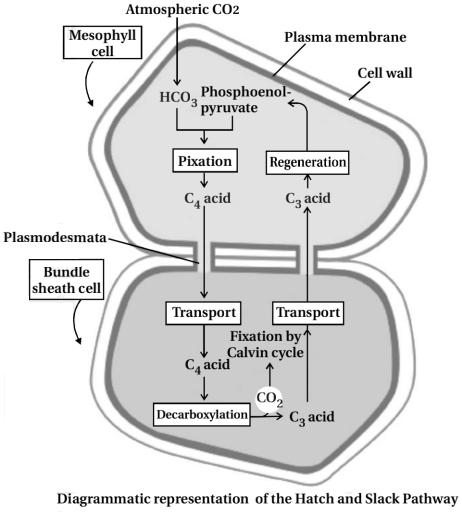
The pathway is also known as the Hatch and Slack pathway. It is a cyclic process consisting of the following steps:
Step $1$: Atmospheric $CO_2$ enters mesophyll cells where the primary $CO_2$ acceptor is a $3$-carbon molecule,phosphoenolpyruvate $(PEP)$. The enzyme responsible is $PEP$ carboxylase $(PEPcase)$. The $C_4$ acid,oxaloacetic acid $(OAA)$,is formed: $CO_2 + PEP \xrightarrow{PEPcase} OAA$.
Step $2$: $OAA$ is converted into other $4$-carbon compounds like malic acid or aspartic acid in the mesophyll,which are then transported to the bundle sheath cells. Here,these $C_4$ acids are broken down to release $CO_2$ and a $3$-carbon molecule (pyruvic acid).
Step $3$: The $3$-carbon molecule is transported back to the mesophyll,where it is converted back to $PEP$ in the presence of $ATP$,completing the cycle.
Step $4$: The $CO_2$ released in the bundle sheath cells enters the $C_3$ or Calvin pathway. The bundle sheath cells are rich in $RuBisCO$ but lack $PEPcase$. Thus,the Calvin pathway remains the basic mechanism for sugar formation in both $C_3$ and $C_4$ plants.
These plants have $C_4$ oxaloacetic acid as the primary $CO_2$ fixation product. They utilize the $C_3$ pathway or the Calvin cycle as the main biosynthetic pathway. Key characteristics of $C_4$ plants include:
$(1)$ $C_4$ plants possess a specialized leaf anatomy and can tolerate higher temperatures.
$(2)$ They exhibit a positive response to high light intensities.
$(3)$ They lack the process of photorespiration.
$(4)$ They demonstrate greater biomass productivity.
$(5)$ In a vertical section of the leaves,mesophyll cells are arranged in a specific pattern.
$(6)$ Large cells surrounding the vascular bundles are called bundle sheath cells,and this arrangement is known as 'Kranz' anatomy.
$(7)$ 'Kranz' means 'wreath',reflecting the circular arrangement of cells.
$(8)$ The bundle sheath may consist of several layers around the vascular bundles.
$(9)$ These cells are characterized by numerous chloroplasts,thick walls impervious to gaseous exchange,and no intercellular spaces.
The pathway is also known as the Hatch and Slack pathway. It is a cyclic process consisting of the following steps:
Step $1$: Atmospheric $CO_2$ enters mesophyll cells where the primary $CO_2$ acceptor is a $3$-carbon molecule,phosphoenolpyruvate $(PEP)$. The enzyme responsible is $PEP$ carboxylase $(PEPcase)$. The $C_4$ acid,oxaloacetic acid $(OAA)$,is formed: $CO_2 + PEP \xrightarrow{PEPcase} OAA$.
Step $2$: $OAA$ is converted into other $4$-carbon compounds like malic acid or aspartic acid in the mesophyll,which are then transported to the bundle sheath cells. Here,these $C_4$ acids are broken down to release $CO_2$ and a $3$-carbon molecule (pyruvic acid).
Step $3$: The $3$-carbon molecule is transported back to the mesophyll,where it is converted back to $PEP$ in the presence of $ATP$,completing the cycle.
Step $4$: The $CO_2$ released in the bundle sheath cells enters the $C_3$ or Calvin pathway. The bundle sheath cells are rich in $RuBisCO$ but lack $PEPcase$. Thus,the Calvin pathway remains the basic mechanism for sugar formation in both $C_3$ and $C_4$ plants.
0 likes
View Solution167
Medium
Explain: Where is the Hatch-Slack pathway seen?
Solution
(N/A) The Hatch-Slack pathway,also known as the $C_{4}$ pathway,is observed in plants that are adapted to dry tropical regions.
These plants have $C_{4}$ oxaloacetic acid as the first $CO_{2}$ fixation product. They utilize the $C_{3}$ pathway or the Calvin cycle as the main biosynthetic pathway.
Internal characteristics of $C_{4}$ plant leaves:
$(1)$ $C_{4}$ plants possess a special type of leaf anatomy and can tolerate higher temperatures.
$(2)$ They show a positive response to high light intensities.
$(3)$ They lack a process called photorespiration.
$(4)$ They exhibit greater biomass productivity.
$(5)$ In a vertical section of the leaves,mesophyll cells are seen arranged in a specific pattern.
$(6)$ The particularly large cells around the vascular bundles of $C_{4}$ plants are called bundle sheath cells,and the leaves with such anatomy are said to have 'Kranz' anatomy.
$(7)$ Here,'Kranz' means 'wreath' and reflects the arrangement of cells.
$(8)$ The bundle sheath may consist of several layers around the vascular bundles.
$(9)$ These cells are characterized by having a large number of chloroplasts,thick walls impervious to gaseous exchange,and no intercellular spaces.
$(10)$ If we cut a section of the leaves of $C_{4}$ plants like maize or sorghum,we can observe the Kranz anatomy and the distribution of mesophyll cells.
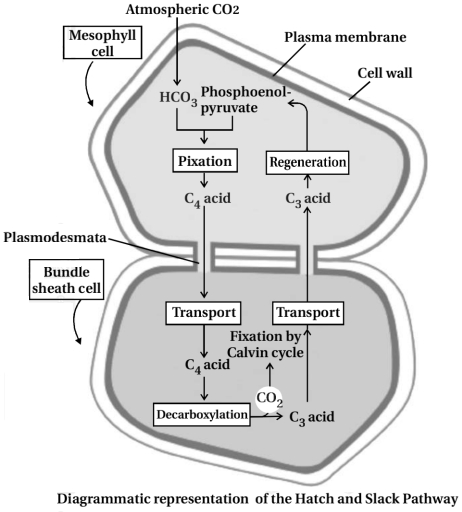
Stages of the $C_{4}$ pathway:
Step $1$: Atmospheric $CO_{2}$ enters the mesophyll cells where the primary $CO_{2}$ acceptor is a $3-$carbon molecule,phosphoenolpyruvate $(PEP)$. The enzyme responsible for this $CO_{2}$ fixation is $PEP$ carboxylase $(PEPcase)$. The mesophyll cells lack $RuBisCO$. The $C_{4}$ acid $OAA$ is formed: $CO_{2} + PEP \xrightarrow{PEPcase} OAA$.
Step $2$: $OAA$ forms other $4-$carbon compounds like malic acid or aspartic acid in the mesophyll cells,which are transported to the bundle sheath cells. In the bundle sheath cells,these $C_{4}$ acids are broken down to release $CO_{2}$ and a $3-$carbon molecule (pyruvic acid).
Step $3$: The $3-$carbon molecule is transported back to the mesophyll where it is converted to $PEP$ again in the presence of $ATP$,thus completing the cycle.
Step $4$: The $CO_{2}$ released in the bundle sheath cells enters the $C_{3}$ or Calvin pathway. The bundle sheath cells are rich in the enzyme Ribulose bisphosphate carboxylase-oxygenase $(RuBisCO)$ but lack $PEPcase$.
These plants have $C_{4}$ oxaloacetic acid as the first $CO_{2}$ fixation product. They utilize the $C_{3}$ pathway or the Calvin cycle as the main biosynthetic pathway.
Internal characteristics of $C_{4}$ plant leaves:
$(1)$ $C_{4}$ plants possess a special type of leaf anatomy and can tolerate higher temperatures.
$(2)$ They show a positive response to high light intensities.
$(3)$ They lack a process called photorespiration.
$(4)$ They exhibit greater biomass productivity.
$(5)$ In a vertical section of the leaves,mesophyll cells are seen arranged in a specific pattern.
$(6)$ The particularly large cells around the vascular bundles of $C_{4}$ plants are called bundle sheath cells,and the leaves with such anatomy are said to have 'Kranz' anatomy.
$(7)$ Here,'Kranz' means 'wreath' and reflects the arrangement of cells.
$(8)$ The bundle sheath may consist of several layers around the vascular bundles.
$(9)$ These cells are characterized by having a large number of chloroplasts,thick walls impervious to gaseous exchange,and no intercellular spaces.
$(10)$ If we cut a section of the leaves of $C_{4}$ plants like maize or sorghum,we can observe the Kranz anatomy and the distribution of mesophyll cells.
Stages of the $C_{4}$ pathway:
Step $1$: Atmospheric $CO_{2}$ enters the mesophyll cells where the primary $CO_{2}$ acceptor is a $3-$carbon molecule,phosphoenolpyruvate $(PEP)$. The enzyme responsible for this $CO_{2}$ fixation is $PEP$ carboxylase $(PEPcase)$. The mesophyll cells lack $RuBisCO$. The $C_{4}$ acid $OAA$ is formed: $CO_{2} + PEP \xrightarrow{PEPcase} OAA$.
Step $2$: $OAA$ forms other $4-$carbon compounds like malic acid or aspartic acid in the mesophyll cells,which are transported to the bundle sheath cells. In the bundle sheath cells,these $C_{4}$ acids are broken down to release $CO_{2}$ and a $3-$carbon molecule (pyruvic acid).
Step $3$: The $3-$carbon molecule is transported back to the mesophyll where it is converted to $PEP$ again in the presence of $ATP$,thus completing the cycle.
Step $4$: The $CO_{2}$ released in the bundle sheath cells enters the $C_{3}$ or Calvin pathway. The bundle sheath cells are rich in the enzyme Ribulose bisphosphate carboxylase-oxygenase $(RuBisCO)$ but lack $PEPcase$.
0 likes
View Solution168
Medium
Mention important matters for $C_4$ plants.
Solution
(N/A) In $C_4$ plants,photorespiration does not occur.
This is because they possess a mechanism that increases the concentration of $CO_2$ at the enzyme site.
This occurs when the $C_4$ acid from the mesophyll cells is broken down in the bundle sheath cells to release $CO_2$.
This process results in increasing the intracellular concentration of $CO_2$.
In turn,this ensures that the $RuBisCO$ enzyme functions primarily as a carboxylase,thereby minimizing its oxygenase activity.
Consequently,the productivity of $C_4$ plants is significantly higher than that of $C_3$ plants.
This is because they possess a mechanism that increases the concentration of $CO_2$ at the enzyme site.
This occurs when the $C_4$ acid from the mesophyll cells is broken down in the bundle sheath cells to release $CO_2$.
This process results in increasing the intracellular concentration of $CO_2$.
In turn,this ensures that the $RuBisCO$ enzyme functions primarily as a carboxylase,thereby minimizing its oxygenase activity.
Consequently,the productivity of $C_4$ plants is significantly higher than that of $C_3$ plants.
0 likes
View Solution169
Medium
Describe the internal anatomy of $C_{4}$ plants.
Solution
(N/A) The internal anatomy of $C_{4}$ plant leaves is characterized by the following features:
$(1)$ $C_{4}$ plants possess a special type of leaf anatomy that allows them to tolerate higher temperatures.
$(2)$ They exhibit a positive response to high light intensities.
$(3)$ They lack the process known as photorespiration.
$(4)$ They demonstrate greater biomass productivity compared to $C_{3}$ plants.
$(5)$ In a vertical section of the leaf,two types of photosynthetic cells are observed: mesophyll cells and bundle sheath cells.
$(6)$ The particularly large cells surrounding the vascular bundles in $C_{4}$ plants are called bundle sheath cells,and this specific arrangement is known as 'Kranz' anatomy.
$(7)$ The term 'Kranz' means 'wreath' and reflects the circular arrangement of these cells around the vascular bundle.
$(8)$ The bundle sheath may consist of several layers of cells surrounding the vascular bundles.
$(9)$ These cells are characterized by a large number of chloroplasts,thick walls that are impervious to gaseous exchange,and the absence of intercellular spaces.
$(10)$ The absence of intercellular spaces in the bundle sheath prevents the leakage of $CO_{2}$ and maintains a high concentration of $CO_{2}$ for the Calvin cycle.
$(1)$ $C_{4}$ plants possess a special type of leaf anatomy that allows them to tolerate higher temperatures.
$(2)$ They exhibit a positive response to high light intensities.
$(3)$ They lack the process known as photorespiration.
$(4)$ They demonstrate greater biomass productivity compared to $C_{3}$ plants.
$(5)$ In a vertical section of the leaf,two types of photosynthetic cells are observed: mesophyll cells and bundle sheath cells.
$(6)$ The particularly large cells surrounding the vascular bundles in $C_{4}$ plants are called bundle sheath cells,and this specific arrangement is known as 'Kranz' anatomy.
$(7)$ The term 'Kranz' means 'wreath' and reflects the circular arrangement of these cells around the vascular bundle.
$(8)$ The bundle sheath may consist of several layers of cells surrounding the vascular bundles.
$(9)$ These cells are characterized by a large number of chloroplasts,thick walls that are impervious to gaseous exchange,and the absence of intercellular spaces.
$(10)$ The absence of intercellular spaces in the bundle sheath prevents the leakage of $CO_{2}$ and maintains a high concentration of $CO_{2}$ for the Calvin cycle.
0 likes
View Solution170
Medium
Define the following terms:
$(1)$ Photorespiration
$(2)$ Bundle sheath
$(1)$ Photorespiration
$(2)$ Bundle sheath
Solution
(N/A) $(1)$ Photorespiration: It is a light-dependent process occurring in chloroplasts where the enzyme $RuBisCO$ acts as an oxygenase instead of a carboxylase,leading to the consumption of $O_2$ and the release of $CO_2$ without the production of $ATP$ or $NADPH$.
$(2)$ Bundle sheath: These are specialized layers of cells (parenchymatous or sclerenchymatous) that surround the vascular bundles in the leaves of plants,particularly prominent in $C_4$ plants where they are the site of the Calvin cycle.
$(2)$ Bundle sheath: These are specialized layers of cells (parenchymatous or sclerenchymatous) that surround the vascular bundles in the leaves of plants,particularly prominent in $C_4$ plants where they are the site of the Calvin cycle.
0 likes
View Solution171
Easy
Define the following terms:
$(1)$ Kranz anatomy
$(2)$ Photo-oxidation
$(1)$ Kranz anatomy
$(2)$ Photo-oxidation
Solution
(N/A) $(1)$ In $C_4$ plants,the bundle sheath cells are arranged in a ring-like structure around the vascular bundles. This specific leaf anatomy is known as Kranz anatomy (where 'Kranz' means 'wreath').
$(2)$ Photo-oxidation refers to the process where,under conditions of insufficient $CO_2$ concentration,the light energy absorbed by chlorophyll cannot be fully utilized for photosynthesis. This excess energy leads to the oxidative destruction or decomposition of chlorophyll molecules.
$(2)$ Photo-oxidation refers to the process where,under conditions of insufficient $CO_2$ concentration,the light energy absorbed by chlorophyll cannot be fully utilized for photosynthesis. This excess energy leads to the oxidative destruction or decomposition of chlorophyll molecules.
0 likes
View Solution172
Easy
Identify the location and function of the following structures:
$(1)$ Chloroplast
$(2)$ Cells of Bundle sheath
$(1)$ Chloroplast
$(2)$ Cells of Bundle sheath
Solution
(N/A) $(1)$ Location: Found in the periphery of mesophyll cells in a leaf.
Function: Site of photosynthesis.
$(2)$ Location: Surrounding the vascular bundle (specifically in $C_4$ plants/monocot leaves).
Function: Involved in the $C_4$ cycle and carbon fixation.
Function: Site of photosynthesis.
$(2)$ Location: Surrounding the vascular bundle (specifically in $C_4$ plants/monocot leaves).
Function: Involved in the $C_4$ cycle and carbon fixation.
0 likes
View Solution173
Easy
Provide the full names for the following abbreviations:
$(1)$ $PEP$
$(2)$ $PEPcase$
$(1)$ $PEP$
$(2)$ $PEPcase$
Solution
(N/A) $(1)$ $PEP$ stands for Phosphoenolpyruvate.
$(2)$ $PEPcase$ stands for Phosphoenolpyruvate carboxylase.
$(2)$ $PEPcase$ stands for Phosphoenolpyruvate carboxylase.
0 likes
View Solution174
MediumMCQ
Succulents are known to keep their stomata closed during the day to check transpiration. How do they meet their photosynthetic $CO_2$ requirements?
A
They take up $CO_2$ at night and store it as malic acid.
B
They perform photosynthesis at night.
C
They use $CO_2$ produced by respiration during the day.
D
They absorb $CO_2$ through their roots.
Solution
(A) Succulents,which are xerophytic plants,grow in environments where water is scarce. To prevent excessive water loss through transpiration,they keep their stomata closed during the day.
These plants utilize a specialized metabolic pathway known as Crassulacean Acid Metabolism $(CAM)$.
During the night,when the temperature is lower and humidity is higher,the stomata open,allowing $CO_2$ to enter. This $CO_2$ is fixed into organic acids,primarily malic acid,which is a $4$-carbon compound.
During the day,the stomata remain closed to conserve water. The stored malic acid is decarboxylated to release $CO_2$ internally,which then enters the Calvin cycle within the photosynthetic cells to facilitate photosynthesis.
These plants utilize a specialized metabolic pathway known as Crassulacean Acid Metabolism $(CAM)$.
During the night,when the temperature is lower and humidity is higher,the stomata open,allowing $CO_2$ to enter. This $CO_2$ is fixed into organic acids,primarily malic acid,which is a $4$-carbon compound.
During the day,the stomata remain closed to conserve water. The stored malic acid is decarboxylated to release $CO_2$ internally,which then enters the Calvin cycle within the photosynthetic cells to facilitate photosynthesis.
0 likes
View Solution175
Easy
In what kind of plants do you come across 'Kranz' anatomy? To which conditions are those plants better adapted? How are these plants better adapted than the plants,which lack this anatomy?
Solution
(N/A) $\Rightarrow$ 'Kranz' anatomy is observed in $C_{4}$ plants. The leaves of these plants exhibit two types of chloroplasts.
$\Rightarrow$ Grana-containing chloroplasts: These are present in mesophyll cells. These chloroplasts contain well-developed grana. They are capable of fixing $CO_{2}$ even at low concentrations. They contain the enzyme $PEP$ carboxylase,which fixes $CO_{2}$ to form a $C_{4}$ compound called $OAA$ (Oxaloacetic Acid).
$\Rightarrow$ Agranul chloroplasts: These are found in bundle sheath cells,where the $C_{3}$ pathway and the enzyme $RuBisCO$ are present.
$\Rightarrow$ $C_{4}$ plants can efficiently absorb $CO_{2}$ even when its atmospheric concentration is low.
$\Rightarrow$ Consequently,the rate of photosynthesis is higher in $C_{4}$ plants. Even when stomata are closed or water is scarce,they can continue photosynthesis by utilizing stored water and efficient $CO_{2}$ fixation.
$\Rightarrow$ Furthermore,$PEP$ carboxylase is insensitive to $O_{2}$,meaning photorespiration does not occur in $C_{4}$ plants.
$\Rightarrow$ Thus,$C_{4}$ plants are better adapted to tropical and arid (desert) regions.
$\Rightarrow$ Grana-containing chloroplasts: These are present in mesophyll cells. These chloroplasts contain well-developed grana. They are capable of fixing $CO_{2}$ even at low concentrations. They contain the enzyme $PEP$ carboxylase,which fixes $CO_{2}$ to form a $C_{4}$ compound called $OAA$ (Oxaloacetic Acid).
$\Rightarrow$ Agranul chloroplasts: These are found in bundle sheath cells,where the $C_{3}$ pathway and the enzyme $RuBisCO$ are present.
$\Rightarrow$ $C_{4}$ plants can efficiently absorb $CO_{2}$ even when its atmospheric concentration is low.
$\Rightarrow$ Consequently,the rate of photosynthesis is higher in $C_{4}$ plants. Even when stomata are closed or water is scarce,they can continue photosynthesis by utilizing stored water and efficient $CO_{2}$ fixation.
$\Rightarrow$ Furthermore,$PEP$ carboxylase is insensitive to $O_{2}$,meaning photorespiration does not occur in $C_{4}$ plants.
$\Rightarrow$ Thus,$C_{4}$ plants are better adapted to tropical and arid (desert) regions.
0 likes
View Solution176
Medium
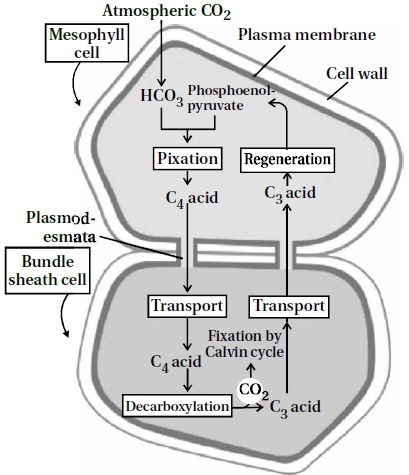
Observe the diagram and answer the following:
$(a)$ Which group of plants exhibit these two types of cells?
$(b)$ What is the first product of the $C_4$ cycle?
$(c)$ Which enzymes are present in bundle sheath cells and mesophyll cells?
$(a)$ Which group of plants exhibit these two types of cells?
$(b)$ What is the first product of the $C_4$ cycle?
$(c)$ Which enzymes are present in bundle sheath cells and mesophyll cells?
Solution
(N/A) Plants that exhibit these two types of cells (mesophyll and bundle sheath) are known as $C_4$ plants. Examples include plants from the Poaceae family,such as sugarcane and maize.
$(b)$ The first stable product of the $C_4$ cycle is a $4$-carbon compound called Oxaloacetic Acid $(OAA)$.
$(c)$ In mesophyll cells,the enzyme $PEP$ carboxylase $(PEPCase)$ is present,which fixes atmospheric $CO_2$ into $OAA$. In bundle sheath cells,the enzyme $RuBisCO$ (Ribulose$-1,5-$bisphosphate carboxylase-oxygenase) is present,which performs the Calvin cycle to fix $CO_2$ into $3$-carbon $PGA$ (Phosphoglyceric acid).
$(b)$ The first stable product of the $C_4$ cycle is a $4$-carbon compound called Oxaloacetic Acid $(OAA)$.
$(c)$ In mesophyll cells,the enzyme $PEP$ carboxylase $(PEPCase)$ is present,which fixes atmospheric $CO_2$ into $OAA$. In bundle sheath cells,the enzyme $RuBisCO$ (Ribulose$-1,5-$bisphosphate carboxylase-oxygenase) is present,which performs the Calvin cycle to fix $CO_2$ into $3$-carbon $PGA$ (Phosphoglyceric acid).
0 likes
View Solution177
MediumMCQ
Suppose $Euphorbia$ and $Maize$ are grown in the tropical area. Which one of them is more efficient in terms of photosynthetic activity?
A
$Euphorbia$
B
$Maize$
C
Both are equally efficient
D
None of the above
Solution
(B) $Maize$ is a $C_{4}$ plant,which is more efficient in terms of photosynthetic activity. $C_{4}$ plants are better adapted to tropical environments because they can perform photosynthesis efficiently at higher temperatures,higher light intensities,and lower concentrations of $CO_{2}$,while minimizing photorespiration.
0 likes
View Solution178
MediumMCQ
Suppose $Euphorbia$ and $Maize$ are grown in the tropical area. What differences do you think are there in their leaf anatomy?
A
Both show Kranz anatomy.
B
Maize shows Kranz anatomy,while $Euphorbia$ does not.
C
$Euphorbia$ shows Kranz anatomy,while $Maize$ does not.
D
Neither shows Kranz anatomy.
Solution
(B) $Maize$ is a $C_{4}$ plant and exhibits Kranz anatomy in its leaf. In $Maize$,the mesophyll cells contain chloroplasts with grana,while the bundle sheath cells contain large,granaless chloroplasts.
$Euphorbia$ (specifically most species) is a $C_{3}$ plant and does not possess the specialized Kranz anatomy characteristic of $C_{4}$ plants.
$Euphorbia$ (specifically most species) is a $C_{3}$ plant and does not possess the specialized Kranz anatomy characteristic of $C_{4}$ plants.
0 likes
View Solution179
MediumMCQ
Under what conditions are $C_4$ plants superior to $C_3$ plants?
A
High $CO_2$ concentration and low temperature
B
Low $CO_2$ concentration and high temperature
C
High $CO_2$ concentration and high temperature
D
Low $CO_2$ concentration and low temperature
Solution
(B) $C_4$ plants are superior to $C_3$ plants under conditions of low $CO_2$ concentration and high temperature.
$(i)$ $C_4$ plants possess a specialized anatomy called Kranz anatomy,which allows them to concentrate $CO_2$ around the enzyme RuBisCO,minimizing photorespiration.
$(ii)$ They utilize the enzyme $PEP$ carboxylase,which has a high affinity for $CO_2$ and is insensitive to $O_2$,preventing the wasteful process of photorespiration that occurs in $C_3$ plants.
$(iii)$ Because they avoid photorespiration,$C_4$ plants maintain high photosynthetic efficiency even in hot and dry environments where $CO_2$ levels might be limiting.
$(i)$ $C_4$ plants possess a specialized anatomy called Kranz anatomy,which allows them to concentrate $CO_2$ around the enzyme RuBisCO,minimizing photorespiration.
$(ii)$ They utilize the enzyme $PEP$ carboxylase,which has a high affinity for $CO_2$ and is insensitive to $O_2$,preventing the wasteful process of photorespiration that occurs in $C_3$ plants.
$(iii)$ Because they avoid photorespiration,$C_4$ plants maintain high photosynthetic efficiency even in hot and dry environments where $CO_2$ levels might be limiting.
0 likes
View Solution180
Medium
What special anatomical features are displayed by leaves of $C_4$ plants? How do they provide an advantage over the structure of $C_3$ plants?
Solution
(N/A) $C_4$ plants exhibit a unique leaf anatomy known as $Kranz$ anatomy.
In $Kranz$ anatomy,the bundle sheath cells form several layers around the vascular bundles,characterized by a large number of chloroplasts,thick walls impervious to gaseous exchange,and no intercellular spaces.
$C_4$ plants possess two types of chloroplasts: agranal chloroplasts in bundle sheath cells and granal chloroplasts in mesophyll cells.
This structure provides an advantage by minimizing photorespiration,which is a wasteful process common in $C_3$ plants.
The bundle sheath cells maintain a high concentration of $CO_2$ around the enzyme $RuBisCO$,ensuring it functions as a carboxylase rather than an oxygenase.
Consequently,$C_4$ plants are more efficient in photosynthesis under high temperatures and high light intensities compared to $C_3$ plants.
In $Kranz$ anatomy,the bundle sheath cells form several layers around the vascular bundles,characterized by a large number of chloroplasts,thick walls impervious to gaseous exchange,and no intercellular spaces.
$C_4$ plants possess two types of chloroplasts: agranal chloroplasts in bundle sheath cells and granal chloroplasts in mesophyll cells.
This structure provides an advantage by minimizing photorespiration,which is a wasteful process common in $C_3$ plants.
The bundle sheath cells maintain a high concentration of $CO_2$ around the enzyme $RuBisCO$,ensuring it functions as a carboxylase rather than an oxygenase.
Consequently,$C_4$ plants are more efficient in photosynthesis under high temperatures and high light intensities compared to $C_3$ plants.
0 likes
View Solution181
MediumMCQ
Why does not photorespiration take place in $C_4$ plants?
A
Because they lack $RuBisCO$ enzyme.
B
Because they have a mechanism that increases the concentration of $CO_2$ at the enzyme site.
C
Because they perform photosynthesis only at night.
D
Because they do not have bundle sheath cells.
Solution
(B) In $C_4$ plants,the process of photosynthesis involves a specialized anatomy known as Kranz anatomy.
The mechanism in these plants increases the concentration of $CO_2$ at the enzyme site within the bundle sheath cells.
By concentrating $CO_2$ around the $RuBisCO$ enzyme,the oxygenase activity of $RuBisCO$ is minimized,and $O_2$ is prevented from binding to the enzyme.
Consequently,the competitive binding of $O_2$ to $RuBisCO$ is avoided,which effectively eliminates the possibility of photorespiration.
The mechanism in these plants increases the concentration of $CO_2$ at the enzyme site within the bundle sheath cells.
By concentrating $CO_2$ around the $RuBisCO$ enzyme,the oxygenase activity of $RuBisCO$ is minimized,and $O_2$ is prevented from binding to the enzyme.
Consequently,the competitive binding of $O_2$ to $RuBisCO$ is avoided,which effectively eliminates the possibility of photorespiration.
0 likes
View Solution182
EasyMCQ
Which of the following statements is incorrect?
A
$RuBisCO$ action requires $ATP$ and $NADPH$
B
$RuBisCO$ is a bifunctional enzyme
C
In $C_{4}$ plants,the site of $RuBisCO$ activity is mesophyll cell
D
The substrate molecule for $RuBisCO$ activity is a $5$-carbon compound
Solution
(C) In $C_{4}$ plants,the primary carboxylation occurs in mesophyll cells via $PEP$ carboxylase,but the Calvin cycle,where $RuBisCO$ functions,occurs exclusively in the bundle sheath cells. Therefore,the statement that $RuBisCO$ activity occurs in mesophyll cells of $C_{4}$ plants is incorrect.
0 likes
View Solution183
MediumMCQ
$C_{4}$ pathway is advantageous over $C_{3}$ pathway in plants because it
A
Occurs in relatively low $CO_{2}$ concentration
B
Uses more amount of water
C
Occurs in relatively low $O_{2}$ concentration
D
Is less efficient in energy utilisation
Solution
(A) $C_{4}$ plants are more advantageous than $C_{3}$ plants because they can efficiently fix carbon even in low $CO_{2}$ concentrations.
In hot and dry conditions,plants close their stomata to prevent water loss,which leads to a decrease in internal $CO_{2}$ levels.
$C_{3}$ plants suffer from photorespiration under these conditions because $RuBisCO$ acts as an oxygenase,leading to the loss of $RuBP$ and inhibition of the Calvin cycle.
$C_{4}$ plants possess a specialized anatomy called $Kranz$ anatomy and a $PEP$ carboxylase enzyme that has a high affinity for $CO_{2}$,allowing them to maintain photosynthesis even when $CO_{2}$ levels are low.
In hot and dry conditions,plants close their stomata to prevent water loss,which leads to a decrease in internal $CO_{2}$ levels.
$C_{3}$ plants suffer from photorespiration under these conditions because $RuBisCO$ acts as an oxygenase,leading to the loss of $RuBP$ and inhibition of the Calvin cycle.
$C_{4}$ plants possess a specialized anatomy called $Kranz$ anatomy and a $PEP$ carboxylase enzyme that has a high affinity for $CO_{2}$,allowing them to maintain photosynthesis even when $CO_{2}$ levels are low.
0 likes
View Solution184
MediumMCQ
In which of the following is phosphorylation absent?
A
Glycolysis
B
Krebs cycle
C
$C_{4}$ cycle
D
$ETS$
Solution
(C) Phosphorylation is a process involving the addition of a phosphate group to an organic molecule,such as the conversion of $ADP$ to $ATP$.
In Glycolysis,substrate-level phosphorylation occurs.
In the Krebs cycle,substrate-level phosphorylation occurs (conversion of succinyl-$CoA$ to succinate).
In the $ETS$ (Electron Transport System),oxidative phosphorylation occurs.
However,the $C_{4}$ cycle (Hatch-Slack pathway) is a carbon fixation pathway that does not involve phosphorylation as a direct step in its cycle reactions; it consumes $ATP$ produced elsewhere but does not perform phosphorylation itself.
In Glycolysis,substrate-level phosphorylation occurs.
In the Krebs cycle,substrate-level phosphorylation occurs (conversion of succinyl-$CoA$ to succinate).
In the $ETS$ (Electron Transport System),oxidative phosphorylation occurs.
However,the $C_{4}$ cycle (Hatch-Slack pathway) is a carbon fixation pathway that does not involve phosphorylation as a direct step in its cycle reactions; it consumes $ATP$ produced elsewhere but does not perform phosphorylation itself.
0 likes
View Solution185
MediumMCQ
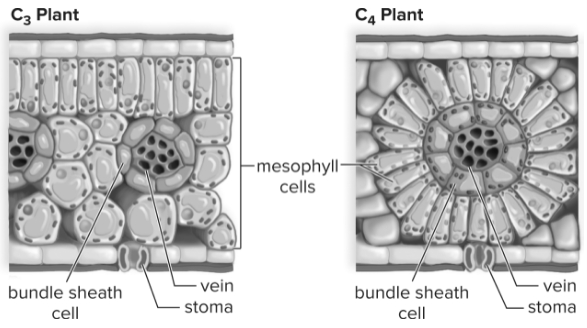
Bundle sheath cells surrounding vascular tissue in leaves are:
A
Parenchymatous cells
B
Sclerenchymatous cells
C
Chlorenchymatous cells
D
All of these
Solution
(D) In leaves,each vascular bundle is surrounded by a layer of cells known as the bundle sheath.
These cells are primarily parenchymatous in nature.
In many plants,especially those exhibiting $C_4$ photosynthesis,these cells contain numerous chloroplasts,making them chlorenchymatous as well.
Since they are parenchymatous and often contain chloroplasts (chlorenchymatous),the most accurate description covering their fundamental nature is parenchymatous,but they are also chlorenchymatous. Given the options,both $A$ and $C$ are correct,but since they are fundamentally parenchymatous cells that perform photosynthesis,they are often referred to as chlorenchymatous. However,in the context of standard biology questions,they are parenchymatous cells that may be chlorenchymatous. If forced to choose the most encompassing answer,they are parenchymatous cells.
These cells are primarily parenchymatous in nature.
In many plants,especially those exhibiting $C_4$ photosynthesis,these cells contain numerous chloroplasts,making them chlorenchymatous as well.
Since they are parenchymatous and often contain chloroplasts (chlorenchymatous),the most accurate description covering their fundamental nature is parenchymatous,but they are also chlorenchymatous. Given the options,both $A$ and $C$ are correct,but since they are fundamentally parenchymatous cells that perform photosynthesis,they are often referred to as chlorenchymatous. However,in the context of standard biology questions,they are parenchymatous cells that may be chlorenchymatous. If forced to choose the most encompassing answer,they are parenchymatous cells.
0 likes
View Solution186
EasyMCQ
The stomata in $CAM$ plants open during
A
Day
B
Night
C
Day and night
D
Always closed
Solution
(B) $CAM$ plants are adapted to survive in arid and hot environments. To minimize water loss through transpiration,their stomata remain closed during the day and open only at night. This type of stomatal movement is known as scotoactive. During the night,these plants take up $CO_{2}$ and store it as organic acids. This stored $CO_{2}$ is then released and used for photosynthesis during the day while the stomata remain closed.
0 likes
View Solution187
MediumMCQ
Presence of bundle sheath is a characteristic of
A
Xerophytic plants
B
Members of grass family
C
$C_{4}$-plants
D
$C_{3}$-plants
Solution
(C) $C_{4}$-plants exhibit a specialized leaf anatomy known as Kranz anatomy.
In this anatomy,the vascular bundles are surrounded by a ring of bundle sheath cells.
These bundle sheath cells are large and contain numerous chloroplasts.
Unlike mesophyll cells,the chloroplasts in bundle sheath cells typically lack grana.
This structural arrangement is a key adaptation for efficient carbon fixation in plants like sugarcane,maize,and sorghum.
In this anatomy,the vascular bundles are surrounded by a ring of bundle sheath cells.
These bundle sheath cells are large and contain numerous chloroplasts.
Unlike mesophyll cells,the chloroplasts in bundle sheath cells typically lack grana.
This structural arrangement is a key adaptation for efficient carbon fixation in plants like sugarcane,maize,and sorghum.
0 likes
View Solution188
MediumMCQ
Sunken stomata are usually found in
A
$C_{3}$ plants
B
$CAM$ plants
C
Insectivorous plants
D
Phanerogams
Solution
(B) Sunken stomata are a characteristic adaptation in $CAM$ (Crassulacean Acid Metabolism) plants,which are often xerophytes.
These stomata are situated in deep pits below the surface of the epidermis.
This structural arrangement helps in reducing the rate of transpiration by creating a humid microclimate around the stomatal pore,thereby conserving water in arid environments.
These stomata are situated in deep pits below the surface of the epidermis.
This structural arrangement helps in reducing the rate of transpiration by creating a humid microclimate around the stomatal pore,thereby conserving water in arid environments.
0 likes
View Solution189
MediumMCQ
In a $CAM$-plant,the concentration of organic acid
A
Increases during the day
B
Decreases or increases during the day
C
Increases during night
D
Decreases during any time
Solution
(C) In $CAM$-plants,carbon dioxide enters the leaf and is fixed to oxaloacetic acid,which is then converted to malic acid at night when stomata are open.
This malic acid is stored in the vacuoles of cells during the night.
Therefore,in $CAM$-plants,the concentration of organic acids increases during the night due to their accumulation.
This malic acid is stored in the vacuoles of cells during the night.
Therefore,in $CAM$-plants,the concentration of organic acids increases during the night due to their accumulation.
0 likes
View Solution190
MediumMCQ
Which of the following statements is false in the case of $C_4$-plants?
A
$CO_2$ acceptor is RuBisCo in mesophyll cells
B
Carboxylation occurs in mesophyll cells
C
Leaves have two cell types
D
Mesophyll cells lack RuBisCo
Solution
(A) $C_4$-plants exhibit a specialized leaf anatomy known as Kranz anatomy,which consists of bundle sheath cells and mesophyll cells.
In $C_4$-plants,the primary $CO_2$ acceptor is phosphoenolpyruvate $(PEP)$,a $3$-carbon molecule,not RuBisCo.
RuBisCo is absent in the mesophyll cells of $C_4$-plants and is instead found in the bundle sheath cells.
Carboxylation occurs in the mesophyll cells where $PEP$ carboxylase fixes $CO_2$ into oxaloacetate.
Therefore,the statement that the $CO_2$ acceptor is RuBisCo in mesophyll cells is false.
In $C_4$-plants,the primary $CO_2$ acceptor is phosphoenolpyruvate $(PEP)$,a $3$-carbon molecule,not RuBisCo.
RuBisCo is absent in the mesophyll cells of $C_4$-plants and is instead found in the bundle sheath cells.
Carboxylation occurs in the mesophyll cells where $PEP$ carboxylase fixes $CO_2$ into oxaloacetate.
Therefore,the statement that the $CO_2$ acceptor is RuBisCo in mesophyll cells is false.
0 likes
View Solution191
MediumMCQ
In $C_{4}$-plants,the RuBisCO enzyme is present in:
A
Mesophyll cell
B
Bundle sheath cell
C
Epidermal cell
D
Companion cell
Solution
(B) In $C_{4}$ plants,the primary $CO_{2}$ fixation occurs in the mesophyll cells,where the enzyme $PEP$ carboxylase is present,but RuBisCO is absent.
The $C_{4}$ acid formed is transported to the bundle sheath cells.
In the bundle sheath cells,the $C_{4}$ acid is broken down to release $CO_{2}$,which then enters the Calvin cycle.
Therefore,the RuBisCO enzyme is exclusively present in the bundle sheath cells of $C_{4}$ plants to facilitate the Calvin cycle.
The $C_{4}$ acid formed is transported to the bundle sheath cells.
In the bundle sheath cells,the $C_{4}$ acid is broken down to release $CO_{2}$,which then enters the Calvin cycle.
Therefore,the RuBisCO enzyme is exclusively present in the bundle sheath cells of $C_{4}$ plants to facilitate the Calvin cycle.
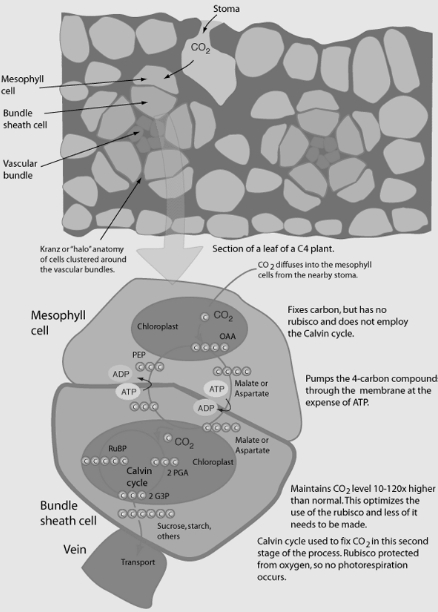
0 likes
View Solution192
MediumMCQ
Bundle sheath cells are rich in which enzyme?
A
$PEP$ carboxylase
B
Malate dehydrogenase
C
Phosphofructokinase
D
RuBisCo
Solution
(D) In $C_{4}$ plants,the bundle sheath cells are the site of the $C_{3}$ cycle (Calvin cycle).
These cells contain a high concentration of the enzyme $RuBisCo$ (Ribulose$-1,5-$bisphosphate carboxylase-oxygenase),which is essential for the fixation of $CO_{2}$ during the Calvin cycle.
In contrast,$PEP$ carboxylase is primarily found in the mesophyll cells of $C_{4}$ plants.
These cells contain a high concentration of the enzyme $RuBisCo$ (Ribulose$-1,5-$bisphosphate carboxylase-oxygenase),which is essential for the fixation of $CO_{2}$ during the Calvin cycle.
In contrast,$PEP$ carboxylase is primarily found in the mesophyll cells of $C_{4}$ plants.
0 likes
View Solution193
EasyMCQ
$CO_{2}$-fixation $C_{4}$ pathway was proposed by:
A
Benson and associates
B
Arnon and associates
C
Rouhani et al.
D
Hatch et al.
Solution
(D) The $C_{4}$ pathway of $CO_{2}$ fixation,also known as the $C_{4}$ cycle or the Hatch-Slack pathway,was discovered and proposed by $M. D. Hatch$ and $C. R. Slack$ in $1966$. This pathway is an adaptation found in certain plants to minimize photorespiration and increase photosynthetic efficiency in high-temperature and high-light environments.
0 likes
View Solution194
EasyMCQ
The first product of $CO_{2}$ fixation in $C_{4}$ pathway is
A
Oxaloacetic acid
B
$RuBP$
C
$PGA$
D
Inorganic acid
Solution
(A) In the $C_{4}$ pathway,the primary $CO_{2}$ acceptor is phosphoenolpyruvate $(PEP)$,which is a $3$-carbon molecule.
This reaction is catalyzed by the enzyme $PEP$ carboxylase.
The first stable product formed after $CO_{2}$ fixation is a $4$-carbon compound called oxaloacetic acid $(OAA)$.
Therefore,the correct option is $A$.
This reaction is catalyzed by the enzyme $PEP$ carboxylase.
The first stable product formed after $CO_{2}$ fixation is a $4$-carbon compound called oxaloacetic acid $(OAA)$.
Therefore,the correct option is $A$.
0 likes
View Solution195
MediumMCQ
In Hatch and Slack pathway,
A
Chloroplasts are of same type
B
Kranz anatomy occurs where mesophyll have small chloroplasts whereas bundle sheath have granal chloroplasts
C
Kranz anatomy occurs where mesophyll have small chloroplasts whereas bundle sheath have larger agranal chloroplasts
D
Kranz anatomy where mesophyll cells are diffused
Solution
(C) $C_{4}$ plants exhibit 'Kranz' anatomy.
In this anatomy,vascular bundles are surrounded by bundle sheath cells.
The chloroplasts in these plants are dimorphic.
The bundle sheath cells contain large,agranal chloroplasts (lacking grana) which are often rich in starch grains.
In contrast,the mesophyll cells contain smaller,granal chloroplasts.
Therefore,the correct description is that mesophyll cells have small chloroplasts,while bundle sheath cells have larger agranal chloroplasts.
In this anatomy,vascular bundles are surrounded by bundle sheath cells.
The chloroplasts in these plants are dimorphic.
The bundle sheath cells contain large,agranal chloroplasts (lacking grana) which are often rich in starch grains.
In contrast,the mesophyll cells contain smaller,granal chloroplasts.
Therefore,the correct description is that mesophyll cells have small chloroplasts,while bundle sheath cells have larger agranal chloroplasts.
0 likes
View Solution196
EasyMCQ
Primary acceptor of $CO_{2}$ in $C_{4}$-cycle is
A
$PGA$
B
$PEP$
C
$RuBP$
D
$OAA$
Solution
(B) In $C_{4}$ plants, the initial fixation of carbon dioxide occurs in the mesophyll cells.
The primary acceptor of $CO_{2}$ is phosphoenol pyruvate $(PEP)$.
It combines with carbon dioxide in the presence of the enzyme $PEP$ carboxylase to form oxaloacetic acid $(OAA)$.
The reaction is as follows:
$PEP + CO_{2} + H_{2}O \xrightarrow{PEP \text{ carboxylase}} \text{Oxaloacetic acid} + H_{3}PO_{4}$
The primary acceptor of $CO_{2}$ is phosphoenol pyruvate $(PEP)$.
It combines with carbon dioxide in the presence of the enzyme $PEP$ carboxylase to form oxaloacetic acid $(OAA)$.
The reaction is as follows:
$PEP + CO_{2} + H_{2}O \xrightarrow{PEP \text{ carboxylase}} \text{Oxaloacetic acid} + H_{3}PO_{4}$
0 likes
View Solution197
MediumMCQ
In $C_{4}$-pathway,the first product identified was
A
$3-PGA$
B
$OAA$
C
$2-PGA$
D
$1,3-DPGA$
Solution
(B) In plants,$CO_{2}$ assimilation during photosynthesis occurs primarily through two pathways:
$(i)$ $C_{3}$ pathway: In these plants,the first stable product of $CO_{2}$ fixation is a $3$-carbon acid,$3$-phosphoglyceric acid $(3-PGA)$.
$(ii)$ $C_{4}$ pathway: In these plants,the first stable product of $CO_{2}$ fixation is a $4$-carbon acid,oxaloacetic acid $(OAA)$.
Therefore,in the $C_{4}$ pathway,the first product identified is $OAA$.
$(i)$ $C_{3}$ pathway: In these plants,the first stable product of $CO_{2}$ fixation is a $3$-carbon acid,$3$-phosphoglyceric acid $(3-PGA)$.
$(ii)$ $C_{4}$ pathway: In these plants,the first stable product of $CO_{2}$ fixation is a $4$-carbon acid,oxaloacetic acid $(OAA)$.
Therefore,in the $C_{4}$ pathway,the first product identified is $OAA$.
0 likes
View Solution198
MediumMCQ
In $C_{4}$-plants,the bundle sheath cells
A
Have a high density of chloroplasts
B
Are rich in $PEP$ carboxylase
C
Have a large number of $RuBisCO$
D
Are large-sized and contain transferase
Solution
(C) In $C_{4}$-plants,the bundle sheath cells are characterized by having a large number of chloroplasts that are typically agranal (lacking grana). These cells are the primary site for the Calvin cycle,and therefore,they contain a large amount of the enzyme $RuBisCO$ (Ribulose$-1,5-$bisphosphate carboxylase-oxygenase) to facilitate carbon fixation.
0 likes
View Solution199
MediumMCQ
What happens to $C_{4}$ acid in the bundle sheath cells?
A
Aspartic acid is deaminated
B
Malic acid decarboxylated
C
Either $(a)$ or $(b)$
D
Both $(a)$ and $(b)$
Solution
(D) In $C_{4}$ plants,the $C_{4}$ acids (malic acid or aspartic acid) formed in the mesophyll cells are transported to the bundle sheath cells.
In the bundle sheath cells,these $C_{4}$ acids undergo decarboxylation to release $CO_{2}$ and a $3$-carbon molecule.
Specifically,malic acid is decarboxylated to form pyruvic acid and $CO_{2}$,while aspartic acid is first converted to oxaloacetic acid and then to malic acid,or it undergoes deamination to form pyruvic acid.
Therefore,both processes can occur depending on the specific pathway taken by the $C_{4}$ acid in the bundle sheath cells.
In the bundle sheath cells,these $C_{4}$ acids undergo decarboxylation to release $CO_{2}$ and a $3$-carbon molecule.
Specifically,malic acid is decarboxylated to form pyruvic acid and $CO_{2}$,while aspartic acid is first converted to oxaloacetic acid and then to malic acid,or it undergoes deamination to form pyruvic acid.
Therefore,both processes can occur depending on the specific pathway taken by the $C_{4}$ acid in the bundle sheath cells.
0 likes
View Solution200
MediumMCQ
In $CAM$-plants,carbon dioxide required for photosynthesis enters the plant body during
A
Day time through the lenticels
B
Night through the stomata,which are kept open
C
Day time when the stomata are open
D
Night when the hydathodes are open
Solution
(B) $CAM$ (Crassulacean Acid Metabolism) plants are adapted to arid environments.
In $CAM$-plants,the stomata open at night to minimize water loss through transpiration.
This allows the entry of atmospheric carbon dioxide into the leaves.
The carbon dioxide is converted into malic acid (a four-carbon compound) and stored in the vacuoles.
During the day,the stomata remain closed to prevent water loss.
The stored malic acid is then transported to the chloroplasts,where it undergoes decarboxylation to release carbon dioxide,which is then fixed by the Calvin cycle.
In $CAM$-plants,the stomata open at night to minimize water loss through transpiration.
This allows the entry of atmospheric carbon dioxide into the leaves.
The carbon dioxide is converted into malic acid (a four-carbon compound) and stored in the vacuoles.
During the day,the stomata remain closed to prevent water loss.
The stored malic acid is then transported to the chloroplasts,where it undergoes decarboxylation to release carbon dioxide,which is then fixed by the Calvin cycle.
0 likes
View SolutionPhotosynthesis in Higher Plants — C4 · Frequently Asked Questions
1Are these Photosynthesis in Higher Plants questions useful for JEE and NEET?
Yes. All questions in this section are mapped to JEE Main and NEET exam patterns. Previous year questions from JEE Main, NEET, GUJCET and state-level exams are included with full solutions.
2Can I switch to Hindi or Gujarati for these questions?
Yes. Use the language tabs in the hero section or the sidebar to view the same questions and solutions in English, Hindi or Gujarati.
3How do I generate a question paper from this subtopic?
Use the Vedclass Exam Paper Generator — select the chapter and subtopic, set difficulty, and generate Sets A, B, C, D automatically. First 3 chapters of every subject are free.
Vedclass Products
For Students
Vedclass Test Series
Mock tests in real JEE/NEET style with performance analysis. 5-day free trial.
Start Free TrialFor Teachers
Exam Paper Generator
Generate Set A/B/C/D papers from this chapter in 2 minutes. 3 chapters free.
Try FreeFor Institutes
Online Exam Module
Live online exams with unlimited students, 360° analytics & white-label branding.
See DemoFor Teachers & Institutes
Generate a Photosynthesis in Higher Plants Exam Paper in 2 Minutes
Select subtopic & difficulty — Sets A, B, C, D auto-generated with No Repeat logic.
First 3 chapters of every subject are free — no payment required.