
A English
C4 Questions in English
Class 11 Biology · Photosynthesis in Higher Plants · C4
261+
Questions
English
Language
100%
With Solutions
Showing 46 of 261 questions in English
101
MediumMCQ
The chloroplasts present in the bundle sheath cells of $C_4$ plants are . . . . . . .
A
large and agranal
B
large and granal
C
small and agranal
D
small and granal
Solution
(A) In $C_4$ plants,the leaves exhibit $Kranz$ anatomy. The bundle sheath cells are large and contain numerous chloroplasts. These chloroplasts are typically agranal (lacking well-developed grana) and are specialized for the $Calvin$ cycle,while the mesophyll cells contain smaller,granal chloroplasts specialized for the light-dependent reactions.
0 likes
View Solution102
EasyMCQ
The $C_4$ pathway (Hatch and Slack cycle) is found in which of the following plants?
A
Amaranthus
B
Atriplex rosea
C
Saccharum
D
All of the above
Solution
(D) The $C_4$ pathway,also known as the Hatch and Slack cycle,is a carbon fixation pathway found in certain plants adapted to high temperatures and high light intensity.
Plants that exhibit this pathway are known as $C_4$ plants.
Examples of $C_4$ plants include Amaranthus,Atriplex rosea,and Saccharum (sugarcane).
Since all the given options are examples of $C_4$ plants,the correct answer is $D$.
Plants that exhibit this pathway are known as $C_4$ plants.
Examples of $C_4$ plants include Amaranthus,Atriplex rosea,and Saccharum (sugarcane).
Since all the given options are examples of $C_4$ plants,the correct answer is $D$.
0 likes
View Solution103
MediumMCQ
In the mesophyll cells of $CAM$ plants,$CO_2$ fixation during the day occurs via:
A
$RuBP$ - oxygenase
B
$PEP$ - carboxylase
C
$RuBP$ - carboxylase
D
Both $RuBP$ - carboxylase and $PEP$ - carboxylase
Solution
(C) In $CAM$ (Crassulacean Acid Metabolism) plants,$CO_2$ fixation occurs in two stages.
During the night,$CO_2$ is fixed by $PEP$ carboxylase to form oxaloacetate,which is then converted to malic acid and stored in the vacuole.
During the day,the stored malic acid is decarboxylated to release $CO_2$ inside the cell.
This released $CO_2$ is then fixed by the $RuBP$ carboxylase (Rubisco) enzyme in the Calvin cycle.
Therefore,the $CO_2$ fixation that occurs during the day in the mesophyll cells is mediated by $RuBP$ carboxylase.
During the night,$CO_2$ is fixed by $PEP$ carboxylase to form oxaloacetate,which is then converted to malic acid and stored in the vacuole.
During the day,the stored malic acid is decarboxylated to release $CO_2$ inside the cell.
This released $CO_2$ is then fixed by the $RuBP$ carboxylase (Rubisco) enzyme in the Calvin cycle.
Therefore,the $CO_2$ fixation that occurs during the day in the mesophyll cells is mediated by $RuBP$ carboxylase.
0 likes
View Solution104
MediumMCQ
Who first demonstrated the $C_4$ pathway?
A
Hatch and Slack
B
Robert Hill
C
Hans Krebs
D
Melvin Calvin
Solution
(A) The $C_4$ pathway,also known as the Hatch-Slack pathway,was first described by $M$.$D$. Hatch and $C$.$R$. Slack in $1966$. They discovered this photosynthetic pathway in sugarcane plants,which allows these plants to fix carbon dioxide efficiently even in high-temperature and high-light conditions.
0 likes
View Solution105
MediumMCQ
Kranz anatomy is a characteristic feature of the leaves of ..........
A
Wheat
B
Sugarcane
C
Mustard
D
Potato
Solution
(B) Kranz anatomy is a specialized structure found in the leaves of $C_4$ plants. In these plants,the mesophyll cells are arranged in a ring around the bundle sheath cells. Sugarcane is a classic example of a $C_4$ plant,whereas wheat,mustard,and potato are $C_3$ plants. Therefore,the correct option is $B$.
0 likes
View Solution106
MediumMCQ
Bundle sheath cells:
A
are rich in $PEP$ carboxylase
B
lack $RuBisCO$
C
lack both $RuBisCO$ and $PEP$ carboxylase
D
are rich in $RuBisCO$
Solution
(D) $C_4$ plants exhibit $Kranz$ anatomy. In $Kranz$ anatomy,the mesophyll is undifferentiated,and its cells are arranged in concentric layers around the vascular bundles. The vascular bundles are surrounded by large bundle sheath cells,which are arranged in a wreath-like manner in one or more layers. In $C_4$ plants,there are two carboxylation reactions: the first occurs in the mesophyll chloroplasts and the second in the bundle sheath chloroplasts. $RuBisCO$ is present in the bundle sheath chloroplasts,where the $C_3$ cycle (Calvin cycle) takes place.
0 likes
View Solution107
MediumMCQ
Phosphoenol pyruvate $(PEP)$ is the primary $CO_2$ acceptor in
A
$C_4$ plants
B
$C_2$ plants
C
$C_3$ and $C_4$ plants
D
$C_3$ plants
Solution
(A) In $C_4$ plants,the primary $CO_2$ acceptor is a $3$-carbon molecule called Phosphoenol pyruvate $(PEP)$.
This reaction occurs in the mesophyll cells and is catalyzed by the enzyme $PEP$ carboxylase $(PEPCase)$.
In contrast,$C_3$ plants use Ribulose $1,5$-bisphosphate $(RuBP)$ as the primary $CO_2$ acceptor.
Therefore,the correct option is $(A)$.
This reaction occurs in the mesophyll cells and is catalyzed by the enzyme $PEP$ carboxylase $(PEPCase)$.
In contrast,$C_3$ plants use Ribulose $1,5$-bisphosphate $(RuBP)$ as the primary $CO_2$ acceptor.
Therefore,the correct option is $(A)$.
0 likes
View Solution108
MediumMCQ
$A$ plant in your garden avoids photorespiratory losses,has improved water use efficiency,shows high rates of photosynthesis at high temperatures,and has improved efficiency of nitrogen utilisation. In which of the following physiological groups would you assign this plant?
A
$CAM$
B
Nitrogen fixer
C
$C_3$
D
$C_4$
Solution
(D) The correct answer is $(d) C_4$ plants.
$C_4$ plants are specifically adapted to minimize photorespiration because they possess a specialized anatomy called Kranz anatomy,which separates the initial $CO_2$ fixation from the Calvin cycle.
These plants show high rates of photosynthesis even at high temperatures.
They exhibit improved water use efficiency compared to $C_3$ plants because they can fix $CO_2$ even when stomata are partially closed.
Additionally,$C_4$ plants have a higher nitrogen-use efficiency because they require less Rubisco enzyme to fix the same amount of carbon compared to $C_3$ plants.
$C_4$ plants are specifically adapted to minimize photorespiration because they possess a specialized anatomy called Kranz anatomy,which separates the initial $CO_2$ fixation from the Calvin cycle.
These plants show high rates of photosynthesis even at high temperatures.
They exhibit improved water use efficiency compared to $C_3$ plants because they can fix $CO_2$ even when stomata are partially closed.
Additionally,$C_4$ plants have a higher nitrogen-use efficiency because they require less Rubisco enzyme to fix the same amount of carbon compared to $C_3$ plants.
0 likes
View Solution109
MediumMCQ
$CAM$ helps the plants in
A
conserving water
B
secondary growth
C
disease resistance
D
reproduction
Solution
(A) $CAM$ (Crassulacean Acid Metabolism) is a specialized photosynthetic pathway adapted by plants in arid environments.
In this process,stomata open at night to take up $CO_2$,which is fixed into malic acid.
During the day,stomata remain closed to minimize transpiration,and the stored malic acid is decarboxylated to release $CO_2$ for the Calvin cycle.
This mechanism is crucial for water conservation in desert plants,as it prevents excessive water loss through evaporation during the hot daylight hours.
In this process,stomata open at night to take up $CO_2$,which is fixed into malic acid.
During the day,stomata remain closed to minimize transpiration,and the stored malic acid is decarboxylated to release $CO_2$ for the Calvin cycle.
This mechanism is crucial for water conservation in desert plants,as it prevents excessive water loss through evaporation during the hot daylight hours.
0 likes
View Solution110
MediumMCQ
In $Kranz$ anatomy,the bundle sheath cells have
A
thin walls,many intercellular spaces and no chloroplasts
B
thick walls,no intercellular spaces and large number of chloroplasts
C
thin walls,no intercellular spaces and several chloroplasts
D
thick walls,many intercellular spaces and few chloroplasts.
Solution
(B) $C_4$ plants are adapted to dry tropical regions and exhibit higher biomass productivity. They possess a specialized leaf anatomy known as $Kranz$ anatomy.
In this anatomy,the bundle sheath cells form several layers around the vascular bundles.
These cells are characterized by having a large number of chloroplasts,thick walls that are impervious to gaseous exchange,and the absence of intercellular spaces.
In this anatomy,the bundle sheath cells form several layers around the vascular bundles.
These cells are characterized by having a large number of chloroplasts,thick walls that are impervious to gaseous exchange,and the absence of intercellular spaces.
0 likes
View Solution111
MediumMCQ
Study the pathway given below. In which of the following options are the correct words for all the three blanks $A$,$B$,and $C$ indicated?
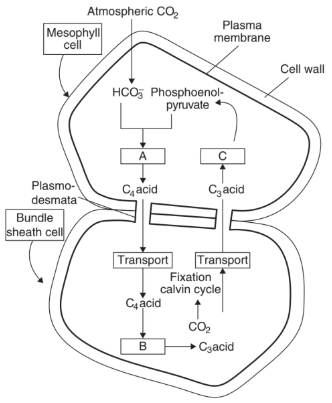
A
Decarboxylation $\rightarrow$ Reduction $\rightarrow$ Regeneration
B
Fixation $\rightarrow$ Transamination $\rightarrow$ Regeneration
C
Fixation $\rightarrow$ Decarboxylation $\rightarrow$ Regeneration
D
Carboxylation $\rightarrow$ Decarboxylation $\rightarrow$ Reduction
Solution
(C) The given pathway represents the $C_4$ cycle (Hatch-Slack pathway).
$A$ represents the primary fixation of $CO_2$ in the mesophyll cells,where $PEP$ (Phosphoenolpyruvate) combines with $CO_2$ to form a $C_4$ acid (Oxaloacetate).
$B$ represents the decarboxylation step in the bundle sheath cells,where the $C_4$ acid releases $CO_2$ to enter the Calvin cycle and converts into a $C_3$ acid.
$C$ represents the regeneration of $PEP$ from the $C_3$ acid in the mesophyll cells to continue the cycle.
Therefore,the correct sequence is Fixation $\rightarrow$ Decarboxylation $\rightarrow$ Regeneration.
$A$ represents the primary fixation of $CO_2$ in the mesophyll cells,where $PEP$ (Phosphoenolpyruvate) combines with $CO_2$ to form a $C_4$ acid (Oxaloacetate).
$B$ represents the decarboxylation step in the bundle sheath cells,where the $C_4$ acid releases $CO_2$ to enter the Calvin cycle and converts into a $C_3$ acid.
$C$ represents the regeneration of $PEP$ from the $C_3$ acid in the mesophyll cells to continue the cycle.
Therefore,the correct sequence is Fixation $\rightarrow$ Decarboxylation $\rightarrow$ Regeneration.
0 likes
View Solution112
MediumMCQ
Kranz anatomy is one of the characteristics of the leaves of
A
potato
B
wheat
C
sugarcane
D
mustard
Solution
(C) The correct answer is $C$.
Kranz anatomy is a specialized leaf structure found in $C_4$ plants.
In this anatomy,the mesophyll cells are undifferentiated and arranged in concentric layers around the vascular bundles.
The vascular bundles are surrounded by large bundle sheath cells,which are arranged in a wreath-like manner (the word 'Kranz' means wreath in German).
Examples of $C_4$ plants that exhibit Kranz anatomy include sugarcane,maize,and sorghum.
Kranz anatomy is a specialized leaf structure found in $C_4$ plants.
In this anatomy,the mesophyll cells are undifferentiated and arranged in concentric layers around the vascular bundles.
The vascular bundles are surrounded by large bundle sheath cells,which are arranged in a wreath-like manner (the word 'Kranz' means wreath in German).
Examples of $C_4$ plants that exhibit Kranz anatomy include sugarcane,maize,and sorghum.
0 likes
View Solution113
MediumMCQ
The $C_4$ plants are photosynthetically more efficient than $C_3$ plants because
A
the $CO_2$ efflux is not prevented
B
they have more chloroplasts
C
the $CO_2$ compensation point is more
D
$CO_2$ generated during photorespiration is trapped and recycled through $PEP$ carboxylase.
Solution
(B) $C_4$ plants are photosynthetically more efficient than $C_3$ plants because they possess a specialized leaf anatomy known as Kranz anatomy,which includes two types of chloroplasts: bundle sheath chloroplasts and mesophyll chloroplasts.
These plants operate a dicarboxylic acid cycle (Hatch-Slack pathway) in addition to the Calvin cycle.
The primary $CO_2$ acceptor molecule,phosphoenolpyruvate $(PEP)$,is present in mesophyll cells and has a very high affinity for $CO_2$,even at low concentrations.
This mechanism effectively minimizes photorespiration,as the $CO_2$ concentration around the enzyme $RuBisCO$ is kept high,making them more efficient.
These plants operate a dicarboxylic acid cycle (Hatch-Slack pathway) in addition to the Calvin cycle.
The primary $CO_2$ acceptor molecule,phosphoenolpyruvate $(PEP)$,is present in mesophyll cells and has a very high affinity for $CO_2$,even at low concentrations.
This mechanism effectively minimizes photorespiration,as the $CO_2$ concentration around the enzyme $RuBisCO$ is kept high,making them more efficient.
0 likes
View Solution114
MediumMCQ
In leaves of $C_4$ plants,malic acid synthesis during $CO_2$ fixation occurs in:
A
bundle sheath
B
guard cells
C
epidermal cells
D
mesophyll cells
Solution
(D) : $C_4$ plants exhibit $Kranz$ anatomy,where the mesophyll is undifferentiated and arranged in concentric layers around the vascular bundles. These bundles are surrounded by large bundle sheath cells in a wreath-like manner.
In these plants,the initial fixation of $CO_2$ occurs in the mesophyll cells.
The primary acceptor,phosphoenolpyruvate $(PEP)$,combines with $CO_2$ to form oxaloacetic acid $(OAA)$,which is subsequently reduced to malic acid.
Malic acid is then translocated to the bundle sheath cells for further decarboxylation.
In these plants,the initial fixation of $CO_2$ occurs in the mesophyll cells.
The primary acceptor,phosphoenolpyruvate $(PEP)$,combines with $CO_2$ to form oxaloacetic acid $(OAA)$,which is subsequently reduced to malic acid.
Malic acid is then translocated to the bundle sheath cells for further decarboxylation.
0 likes
View Solution115
MediumMCQ
In the leaves of $C_4$ plants,malic acid formation during $CO_2$ fixation occurs in the cells of
A
bundle sheath
B
phloem
C
epidermis
D
mesophyll
Solution
(D) In $C_4$ plants,the process of $CO_2$ fixation occurs in two stages involving two different cell types.
$1$. The primary $CO_2$ fixation occurs in the mesophyll cells,where $CO_2$ is accepted by Phosphoenolpyruvate $(PEP)$ to form a $4$-carbon compound,oxaloacetic acid $(OAA)$.
$2$. This $OAA$ is then converted into malic acid (or aspartic acid) in the mesophyll cells.
$3$. Malic acid is then transported to the bundle sheath cells,where it undergoes decarboxylation to release $CO_2$ for the Calvin cycle.
Therefore,the formation of malic acid occurs in the mesophyll cells.
$1$. The primary $CO_2$ fixation occurs in the mesophyll cells,where $CO_2$ is accepted by Phosphoenolpyruvate $(PEP)$ to form a $4$-carbon compound,oxaloacetic acid $(OAA)$.
$2$. This $OAA$ is then converted into malic acid (or aspartic acid) in the mesophyll cells.
$3$. Malic acid is then transported to the bundle sheath cells,where it undergoes decarboxylation to release $CO_2$ for the Calvin cycle.
Therefore,the formation of malic acid occurs in the mesophyll cells.
0 likes
View Solution116
MediumMCQ
Which of the following is not correct for $C_4$ plants?
A
They have Kranz anatomy in their leaves.
B
Primary $CO_2$ acceptor is phosphoenol pyruvate $(PEP)$.
C
Bundle sheath cells are rich in an enzyme $PEP$ case but lack $RuBisCO$.
D
Malic acid or aspartic acid is formed in mesophyll cells.
Solution
(C) In $C_4$ plants,the primary $CO_2$ acceptor is phosphoenol pyruvate $(PEP)$ in mesophyll cells.
Kranz anatomy is a characteristic feature of $C_4$ plants.
In mesophyll cells,$CO_2$ is fixed into $4$-carbon organic acids like malic acid or aspartic acid.
However,the statement that bundle sheath cells are rich in $PEP$ carboxylase but lack $RuBisCO$ is incorrect.
In reality,bundle sheath cells are rich in $RuBisCO$ but lack $PEP$ carboxylase,which is why the Calvin cycle occurs in the bundle sheath cells of $C_4$ plants.
Kranz anatomy is a characteristic feature of $C_4$ plants.
In mesophyll cells,$CO_2$ is fixed into $4$-carbon organic acids like malic acid or aspartic acid.
However,the statement that bundle sheath cells are rich in $PEP$ carboxylase but lack $RuBisCO$ is incorrect.
In reality,bundle sheath cells are rich in $RuBisCO$ but lack $PEP$ carboxylase,which is why the Calvin cycle occurs in the bundle sheath cells of $C_4$ plants.
0 likes
View Solution117
MediumMCQ
The evolution of $C_4$ photosynthetic system is probably one of the strategies for
A
More synthesis of glucose
B
Maximizing the availability of $CO_2$
C
Maximizing $CO_2$ fixation
D
More synthesis of RuBisco
Solution
(B) The $C_4$ photosynthetic pathway evolved as an adaptation to minimize photorespiration in plants living in hot and dry environments.
In $C_3$ plants,the enzyme $RuBisCO$ can bind to both $CO_2$ and $O_2$. When it binds to $O_2$,photorespiration occurs,which is a wasteful process.
$C_4$ plants have a specialized anatomy called Kranz anatomy,which separates the initial $CO_2$ fixation from the Calvin cycle.
By concentrating $CO_2$ around the $RuBisCO$ enzyme in the bundle sheath cells,$C_4$ plants effectively minimize photorespiration and maximize the availability of $CO_2$ for the Calvin cycle.
Therefore,the primary strategy of the $C_4$ system is to maximize the availability of $CO_2$ at the site of the enzyme $RuBisCO$.
In $C_3$ plants,the enzyme $RuBisCO$ can bind to both $CO_2$ and $O_2$. When it binds to $O_2$,photorespiration occurs,which is a wasteful process.
$C_4$ plants have a specialized anatomy called Kranz anatomy,which separates the initial $CO_2$ fixation from the Calvin cycle.
By concentrating $CO_2$ around the $RuBisCO$ enzyme in the bundle sheath cells,$C_4$ plants effectively minimize photorespiration and maximize the availability of $CO_2$ for the Calvin cycle.
Therefore,the primary strategy of the $C_4$ system is to maximize the availability of $CO_2$ at the site of the enzyme $RuBisCO$.
0 likes
View Solution118
MediumMCQ
Identify the correct characters of bundle sheath cells in $C_4$ plants from the following list:
$1.$ Thick walls.
$2.$ Intercellular spaces are present.
$3.$ Impervious to gaseous exchange.
$4.$ Contain grana.
$5.$ Contain thylakoids.
$1.$ Thick walls.
$2.$ Intercellular spaces are present.
$3.$ Impervious to gaseous exchange.
$4.$ Contain grana.
$5.$ Contain thylakoids.
A
$2, 4$
B
$1, 2, 3$
C
$1, 3, 5$
D
$2, 3, 5$
Solution
(C) In $C_4$ plants,bundle sheath cells exhibit specific anatomical features known as Kranz anatomy.
$1.$ They have thick,lignified walls,which makes them impervious to gaseous exchange (Statement $1$ and $3$ are correct).
$2.$ They lack intercellular spaces to maintain the high $CO_2$ concentration required for the Calvin cycle (Statement $2$ is incorrect).
$3.$ The chloroplasts in bundle sheath cells are large and agranal,meaning they lack grana,although they do contain thylakoids (Statement $4$ is incorrect,and Statement $5$ is correct).
Therefore,the correct characteristics are $1, 3,$ and $5$.
$1.$ They have thick,lignified walls,which makes them impervious to gaseous exchange (Statement $1$ and $3$ are correct).
$2.$ They lack intercellular spaces to maintain the high $CO_2$ concentration required for the Calvin cycle (Statement $2$ is incorrect).
$3.$ The chloroplasts in bundle sheath cells are large and agranal,meaning they lack grana,although they do contain thylakoids (Statement $4$ is incorrect,and Statement $5$ is correct).
Therefore,the correct characteristics are $1, 3,$ and $5$.
0 likes
View Solution119
MediumMCQ
The enzyme which fixes $CO_2$ in $C_4$ plants is
A
Hydrogenase
B
$PEP$ carboxylase
C
Reductase
D
$RuBP$ carboxylase
Solution
(B) In $C_4$ plants,the primary $CO_2$ fixation occurs in the mesophyll cells.
$CO_2$ is initially accepted by a $3$-carbon compound called Phosphoenolpyruvate $(PEP)$.
The enzyme responsible for this carboxylation reaction is $PEP$ carboxylase (also known as $PEPCase$).
This reaction results in the formation of a $4$-carbon compound,Oxaloacetic acid $(OAA)$,which is why these plants are called $C_4$ plants.
While $RuBP$ carboxylase $(RuBisCO)$ is also present in $C_4$ plants,it functions in the bundle sheath cells during the Calvin cycle,not for the initial fixation of atmospheric $CO_2$.
$CO_2$ is initially accepted by a $3$-carbon compound called Phosphoenolpyruvate $(PEP)$.
The enzyme responsible for this carboxylation reaction is $PEP$ carboxylase (also known as $PEPCase$).
This reaction results in the formation of a $4$-carbon compound,Oxaloacetic acid $(OAA)$,which is why these plants are called $C_4$ plants.
While $RuBP$ carboxylase $(RuBisCO)$ is also present in $C_4$ plants,it functions in the bundle sheath cells during the Calvin cycle,not for the initial fixation of atmospheric $CO_2$.
0 likes
View Solution120
MediumMCQ
Which one is correct for $C_4$ plants regarding the enzymes and cycles in Mesophyll and Bundle sheath cells respectively?
A
$PEP$ carboxylase ($C_4$ cycle) $-$ $RuBisCO$ ($C_3$ cycle)
B
$PEP$ carboxylase (Calvin cycle) $-$ $RuBisCO$ ($C_4$ cycle)
C
$RuBisCO$ ($C_4$ cycle) $-$ $PEP$ carboxylase ($C_3$ cycle)
D
$RuBisCO$ ($C_2$ cycle) $-$ $PEP$ carboxylase ($C_3$ cycle)
Solution
(A) In $C_4$ plants,the process of photosynthesis is divided between two types of cells: Mesophyll cells and Bundle sheath cells.
$1$. In Mesophyll cells,the primary $CO_2$ fixation occurs via the $PEP$ carboxylase enzyme,which initiates the $C_4$ cycle.
$2$. In Bundle sheath cells,the $CO_2$ released from the $C_4$ acid is fixed by the $RuBisCO$ enzyme,which operates the $C_3$ cycle (Calvin cycle).
Therefore,the correct sequence is $PEP$ carboxylase ($C_4$ cycle) in Mesophyll cells and $RuBisCO$ ($C_3$ cycle) in Bundle sheath cells.
$1$. In Mesophyll cells,the primary $CO_2$ fixation occurs via the $PEP$ carboxylase enzyme,which initiates the $C_4$ cycle.
$2$. In Bundle sheath cells,the $CO_2$ released from the $C_4$ acid is fixed by the $RuBisCO$ enzyme,which operates the $C_3$ cycle (Calvin cycle).
Therefore,the correct sequence is $PEP$ carboxylase ($C_4$ cycle) in Mesophyll cells and $RuBisCO$ ($C_3$ cycle) in Bundle sheath cells.
0 likes
View Solution121
MediumMCQ
Which process is required for the formation of oxaloacetic acid from phosphoenol pyruvic acid?
A
Decarboxylation
B
Reduction
C
Phosphorylation
D
Carboxylation
Solution
(D) In the $C_4$ pathway (Hatch-Slack cycle),the primary $CO_2$ acceptor is phosphoenolpyruvate $(PEP)$,a $3$-carbon compound.
$PEP$ combines with $CO_2$ in the presence of the enzyme $PEP$ carboxylase to form oxaloacetic acid $(OAA)$,which is a $4$-carbon compound.
Since a $CO_2$ molecule is added to the $3$-carbon $PEP$ to form the $4$-carbon $OAA$,this process is known as carboxylation.
$PEP$ combines with $CO_2$ in the presence of the enzyme $PEP$ carboxylase to form oxaloacetic acid $(OAA)$,which is a $4$-carbon compound.
Since a $CO_2$ molecule is added to the $3$-carbon $PEP$ to form the $4$-carbon $OAA$,this process is known as carboxylation.
0 likes
View Solution122
MediumMCQ
Sugarcane has the highest $CO_2$ fixation capacity among all because it follows:
A
Calvin cycle
B
$EMP$ pathway
C
Hatch-Slack pathway
D
$TCA$ cycle
Solution
(C) Sugarcane is a $C_4$ plant.
$C_4$ plants are more efficient in $CO_2$ fixation compared to $C_3$ plants because they possess the $C_4$ photosynthetic pathway,also known as the Hatch-Slack pathway.
This pathway minimizes photorespiration by concentrating $CO_2$ around the enzyme $RuBisCO$ in the bundle sheath cells.
Therefore,option $C$ is the correct answer.
$C_4$ plants are more efficient in $CO_2$ fixation compared to $C_3$ plants because they possess the $C_4$ photosynthetic pathway,also known as the Hatch-Slack pathway.
This pathway minimizes photorespiration by concentrating $CO_2$ around the enzyme $RuBisCO$ in the bundle sheath cells.
Therefore,option $C$ is the correct answer.
0 likes
View Solution123
MediumMCQ
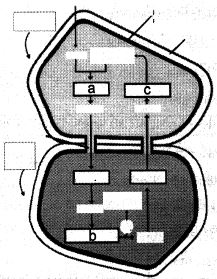
Choose the correct option for $a, b, c$ in the given diagram of the $C_4$ pathway.
$a - b - c$
$a - b - c$
A
Decarboxylation $-$ reduction $-$ regeneration
B
Fixation $-$ transamination $-$ regeneration
C
Fixation $-$ decarboxylation $-$ regeneration
D
Carboxylation $-$ decarboxylation $-$ reduction
Solution
(C) The provided diagram represents the $C_4$ photosynthetic pathway (Hatch-Slack pathway).
$1$. In the mesophyll cells,$CO_2$ is fixed by $PEP$ carboxylase to form oxaloacetate,which is then converted into malate or aspartate. This step is represented by '$a$' (Fixation).
$2$. These $C_4$ acids are transported to the bundle sheath cells,where they undergo decarboxylation to release $CO_2$ for the Calvin cycle. This step is represented by '$b$' (Decarboxylation).
$3$. The remaining $C_3$ acid is transported back to the mesophyll cells,where it is converted back into $PEP$ to continue the cycle. This step is represented by '$c$' (Regeneration).
Therefore,the correct sequence is Fixation $(a)$,Decarboxylation $(b)$,and Regeneration $(c)$.
$1$. In the mesophyll cells,$CO_2$ is fixed by $PEP$ carboxylase to form oxaloacetate,which is then converted into malate or aspartate. This step is represented by '$a$' (Fixation).
$2$. These $C_4$ acids are transported to the bundle sheath cells,where they undergo decarboxylation to release $CO_2$ for the Calvin cycle. This step is represented by '$b$' (Decarboxylation).
$3$. The remaining $C_3$ acid is transported back to the mesophyll cells,where it is converted back into $PEP$ to continue the cycle. This step is represented by '$c$' (Regeneration).
Therefore,the correct sequence is Fixation $(a)$,Decarboxylation $(b)$,and Regeneration $(c)$.
0 likes
View Solution124
MediumMCQ
In the Hatch-Slack pathway,which enzyme is used for the fixation of $CO_2$?
A
Carbonic anhydrase
B
$RuBP$ oxygenase
C
$PEP$ carboxylase
D
$RuBP$ carboxylase oxygenase
Solution
(C) The Hatch-Slack pathway is another name for the $C_4$ cycle.
In this pathway,the primary $CO_2$ acceptor is Phosphoenolpyruvate $(PEP)$.
The enzyme responsible for the fixation of $CO_2$ in the mesophyll cells of $C_4$ plants is $PEP$ carboxylase $(PEPCase)$.
This enzyme has a high affinity for $CO_2$ and does not show oxygenase activity,making it highly efficient for carbon fixation.
In this pathway,the primary $CO_2$ acceptor is Phosphoenolpyruvate $(PEP)$.
The enzyme responsible for the fixation of $CO_2$ in the mesophyll cells of $C_4$ plants is $PEP$ carboxylase $(PEPCase)$.
This enzyme has a high affinity for $CO_2$ and does not show oxygenase activity,making it highly efficient for carbon fixation.
0 likes
View Solution125
MediumMCQ
For the observation of $Kranz$ anatomy,which plant is useful?
A
Maize and $Cycas$
B
$Cycas$ and $Pinus$
C
Maize and sugarcane
D
Sugarcane and $Pinus$
Solution
(C) $Kranz$ anatomy is a characteristic feature of $C_4$ plants.
In this anatomy,the mesophyll cells are arranged in a ring-like manner around the bundle sheath cells.
$C_4$ plants include monocots like maize,sugarcane,and sorghum.
$Cycas$ and $Pinus$ are gymnosperms and do not exhibit $Kranz$ anatomy.
Therefore,maize and sugarcane are the correct examples of plants that show $Kranz$ anatomy.
In this anatomy,the mesophyll cells are arranged in a ring-like manner around the bundle sheath cells.
$C_4$ plants include monocots like maize,sugarcane,and sorghum.
$Cycas$ and $Pinus$ are gymnosperms and do not exhibit $Kranz$ anatomy.
Therefore,maize and sugarcane are the correct examples of plants that show $Kranz$ anatomy.
0 likes
View Solution126
MediumMCQ
Which was the first stable product in the light-dependent reaction of $C_4$ plants?
A
Malic acid
B
Oxaloacetic acid
C
$3-PGA$
D
$PGAL$
Solution
(B) In $C_4$ plants,the primary $CO_2$ acceptor is Phosphoenolpyruvate $(PEP)$.
This reaction is catalyzed by the enzyme $PEP$ carboxylase in the mesophyll cells.
The first stable product formed after the fixation of $CO_2$ is a $4$-carbon compound called Oxaloacetic acid $(OAA)$.
Therefore,the correct option is $B$.
This reaction is catalyzed by the enzyme $PEP$ carboxylase in the mesophyll cells.
The first stable product formed after the fixation of $CO_2$ is a $4$-carbon compound called Oxaloacetic acid $(OAA)$.
Therefore,the correct option is $B$.
0 likes
View Solution127
MediumMCQ
$A-$ In $C_4$ plants,carboxylation takes place in the chloroplasts of mesophyll cells and bundle sheath cells.
$R -$ In $C_3$ plants,$CO_2$ fixation occurs in mesophyll cells and bundle sheath cells.
$R -$ In $C_3$ plants,$CO_2$ fixation occurs in mesophyll cells and bundle sheath cells.
A
$A$ and $R$ are true.
B
$A$ is true but $R$ is false.
C
$A$ and $R$ are false.
D
$A$ is false but $R$ is true.
Solution
(B) Assertion $(A)$: In $C_4$ plants,the primary carboxylation occurs in the mesophyll cells (catalyzed by $PEP$ carboxylase),and the secondary carboxylation occurs in the bundle sheath cells (catalyzed by $RuBisCO$). Thus,the statement is true.
Reason $(R)$: In $C_3$ plants,the entire process of $CO_2$ fixation (carboxylation) occurs exclusively in the mesophyll cells. Bundle sheath cells in $C_3$ plants do not contain chloroplasts capable of the Calvin cycle. Thus,the statement is false.
Therefore,$A$ is true but $R$ is false.
Reason $(R)$: In $C_3$ plants,the entire process of $CO_2$ fixation (carboxylation) occurs exclusively in the mesophyll cells. Bundle sheath cells in $C_3$ plants do not contain chloroplasts capable of the Calvin cycle. Thus,the statement is false.
Therefore,$A$ is true but $R$ is false.
0 likes
View Solution128
MediumMCQ
Enzyme $RuBisCO$ acts as both a carboxylase and an oxygenase. Why is it said that $RuBisCO$ in $C_4$ plants performs more carboxylation?
A
More sites are present for the attachment of $CO_2$.
B
Kranz anatomy is present in $C_4$ plants.
C
$C_4$ plants are found in the equatorial region.
D
$A$ higher number of chloroplasts are present in $C_4$ plants.
Solution
(B) The enzyme $RuBisCO$ has an affinity for both $CO_2$ and $O_2$. In $C_3$ plants,$RuBisCO$ often binds with $O_2$ leading to photorespiration,which reduces photosynthetic efficiency.
In $C_4$ plants,the specialized $Kranz$ anatomy creates a mechanism to increase the concentration of $CO_2$ around the $RuBisCO$ enzyme.
Specifically,the $C_4$ pathway (Hatch-Slack pathway) fixes $CO_2$ into a $4$-carbon compound in the mesophyll cells,which is then transported to the bundle sheath cells.
In the bundle sheath cells,this compound is broken down to release $CO_2$,creating a high $CO_2$ concentration environment.
This high concentration of $CO_2$ ensures that $RuBisCO$ functions primarily as a carboxylase rather than an oxygenase,thereby minimizing photorespiration and maximizing carboxylation.
In $C_4$ plants,the specialized $Kranz$ anatomy creates a mechanism to increase the concentration of $CO_2$ around the $RuBisCO$ enzyme.
Specifically,the $C_4$ pathway (Hatch-Slack pathway) fixes $CO_2$ into a $4$-carbon compound in the mesophyll cells,which is then transported to the bundle sheath cells.
In the bundle sheath cells,this compound is broken down to release $CO_2$,creating a high $CO_2$ concentration environment.
This high concentration of $CO_2$ ensures that $RuBisCO$ functions primarily as a carboxylase rather than an oxygenase,thereby minimizing photorespiration and maximizing carboxylation.
0 likes
View Solution129
MediumMCQ
Kranz anatomy is found in ............
A
Flower
B
Seed
C
Leaf
D
Stem
Solution
(C) Kranz anatomy is a specialized structure found in the leaves of $C_4$ plants (such as maize,sugarcane,and sorghum).
In this anatomy,the mesophyll cells are arranged in a ring-like manner around the bundle sheath cells.
This arrangement facilitates the efficient fixation of $CO_2$ and minimizes photorespiration.
Therefore,the correct answer is $C$ (Leaf).
In this anatomy,the mesophyll cells are arranged in a ring-like manner around the bundle sheath cells.
This arrangement facilitates the efficient fixation of $CO_2$ and minimizes photorespiration.
Therefore,the correct answer is $C$ (Leaf).
0 likes
View Solution130
MediumMCQ
In the first phase of the $C_4$ pathway:
A
$CO_2$ binds with $PEP$.
B
$CO_2$ binds with $PGA$.
C
$CO_2$ binds with $RuBP$.
D
$CO_2$ binds with $OAA$.
Solution
(A) In the $C_4$ pathway,the primary $CO_2$ acceptor is a $3$-carbon molecule called Phosphoenolpyruvate $(PEP)$.
This reaction occurs in the mesophyll cells.
The enzyme $PEP$ carboxylase $(PEPCase)$ catalyzes the fixation of atmospheric $CO_2$ into $PEP$ to form a $4$-carbon compound,Oxaloacetic acid $(OAA)$.
Therefore,the first step involves the binding of $CO_2$ with $PEP$.
This reaction occurs in the mesophyll cells.
The enzyme $PEP$ carboxylase $(PEPCase)$ catalyzes the fixation of atmospheric $CO_2$ into $PEP$ to form a $4$-carbon compound,Oxaloacetic acid $(OAA)$.
Therefore,the first step involves the binding of $CO_2$ with $PEP$.
0 likes
View Solution131
MediumMCQ
Choose the incorrect statement regarding bundle sheath cells.
A
Bundle sheath cells have thick walls that are impervious to gaseous exchange and lack intercellular spaces.
B
'Kranz' anatomy is found in bundle sheath cells.
C
They possess thylakoids,but they are not arranged into grana.
D
Carbon fixation occurs in bundle sheath cells.
Solution
(A) In $C_4$ plants,the bundle sheath cells are characterized by several features:
$1$. They have thick walls that are impervious to gaseous exchange and lack intercellular spaces.
$2$. The 'Kranz' anatomy refers to the specific leaf structure where bundle sheath cells form several layers around the vascular bundles.
$3$. The chloroplasts in bundle sheath cells are large and agranal (they possess thylakoids,but they are not arranged into grana).
$4$. Carbon fixation occurs in the mesophyll cells (via $PEP$ carboxylase) and the Calvin cycle occurs in the bundle sheath cells.
Option $A$ is incorrect because it states that bundle sheath cells have intercellular spaces,whereas they are actually characterized by the absence of intercellular spaces.
$1$. They have thick walls that are impervious to gaseous exchange and lack intercellular spaces.
$2$. The 'Kranz' anatomy refers to the specific leaf structure where bundle sheath cells form several layers around the vascular bundles.
$3$. The chloroplasts in bundle sheath cells are large and agranal (they possess thylakoids,but they are not arranged into grana).
$4$. Carbon fixation occurs in the mesophyll cells (via $PEP$ carboxylase) and the Calvin cycle occurs in the bundle sheath cells.
Option $A$ is incorrect because it states that bundle sheath cells have intercellular spaces,whereas they are actually characterized by the absence of intercellular spaces.
0 likes
View Solution132
MediumMCQ
Which is the first stable product of the $C_4$ pathway?
A
$RuBP$
B
$PGA$
C
$PEP$
D
$OAA$
Solution
(D) In the $C_4$ pathway (Hatch-Slack cycle),the primary $CO_2$ acceptor is Phosphoenolpyruvate $(PEP)$,a $3$-carbon compound.
$CO_2$ is fixed by the enzyme $PEP$ carboxylase to form Oxaloacetic acid $(OAA)$,which is a $4$-carbon compound.
$OAA$ is the first stable product formed in the $C_4$ cycle.
Therefore,the correct option is $D$.
$CO_2$ is fixed by the enzyme $PEP$ carboxylase to form Oxaloacetic acid $(OAA)$,which is a $4$-carbon compound.
$OAA$ is the first stable product formed in the $C_4$ cycle.
Therefore,the correct option is $D$.
0 likes
View Solution133
MediumMCQ
Choose the incorrect pair.
A
Cell type in which the Calvin cycle takes place in $C_3$ plants - one.
B
Cell type in which the Calvin cycle takes place in $C_4$ plants - two.
C
First product in $C_3$ plant - $PGA$.
D
First $CO_2$ acceptor in $C_4$ plant - $RuBP$.
Solution
(D) In $C_3$ plants, the Calvin cycle occurs only in the mesophyll cells (one cell type).
In $C_4$ plants, the Calvin cycle occurs in the bundle sheath cells, while the initial $CO_2$ fixation occurs in the mesophyll cells (two cell types).
The first stable product of the Calvin cycle in $C_3$ plants is $3$-phosphoglyceric acid $(PGA)$.
In $C_4$ plants, the primary $CO_2$ acceptor is phosphoenolpyruvate $(PEP)$, not $RuBP$. $RuBP$ is the primary $CO_2$ acceptor in $C_3$ plants.
Therefore, the pair "First $CO_2$ acceptor in $C_4$ plant - $RuBP$" is incorrect.
In $C_4$ plants, the Calvin cycle occurs in the bundle sheath cells, while the initial $CO_2$ fixation occurs in the mesophyll cells (two cell types).
The first stable product of the Calvin cycle in $C_3$ plants is $3$-phosphoglyceric acid $(PGA)$.
In $C_4$ plants, the primary $CO_2$ acceptor is phosphoenolpyruvate $(PEP)$, not $RuBP$. $RuBP$ is the primary $CO_2$ acceptor in $C_3$ plants.
Therefore, the pair "First $CO_2$ acceptor in $C_4$ plant - $RuBP$" is incorrect.
0 likes
View Solution134
MediumMCQ
In sorghum grass,the first $CO_2$ acceptor is .....,the first product is .......,and the productivity is ...... .
A
$RuBP, PGA,$ high
B
$RuBP, OAA,$ normal
C
$PEP, OAA,$ high
D
$PEP, PGA,$ normal
Solution
(C) Sorghum is a $C_4$ plant.
In $C_4$ plants,the primary $CO_2$ acceptor is Phosphoenolpyruvate $(PEP)$,which is a $3$-carbon compound.
The first stable product formed in the mesophyll cells is Oxaloacetic acid $(OAA)$,which is a $4$-carbon compound.
$C_4$ plants are known for their high photosynthetic efficiency and productivity compared to $C_3$ plants because they lack photorespiration.
In $C_4$ plants,the primary $CO_2$ acceptor is Phosphoenolpyruvate $(PEP)$,which is a $3$-carbon compound.
The first stable product formed in the mesophyll cells is Oxaloacetic acid $(OAA)$,which is a $4$-carbon compound.
$C_4$ plants are known for their high photosynthetic efficiency and productivity compared to $C_3$ plants because they lack photorespiration.
0 likes
View Solution135
MediumMCQ
Choose the incorrect sentence (for $C_4$ plants).
A
The particularly large cells around the vascular bundles of the $C_4$ pathway plants are called bundle sheath cells.
B
The light reaction takes place in mesophyll cells while $CO_2$ fixation occurs in bundle sheath cells.
C
In $C_4$ plants,bundle sheath cells have thick walls,impervious to gaseous exchange and lack intercellular spaces.
D
The chloroplasts in mesophyll cells exhibit grana organization.
Solution
(B) In $C_4$ plants,the primary $CO_2$ fixation occurs in the mesophyll cells via the enzyme $PEP$ carboxylase to form oxaloacetate. The $CO_2$ is then transported to the bundle sheath cells,where the Calvin cycle occurs. Therefore,the statement that $CO_2$ fixation occurs in bundle sheath cells is incorrect,as the initial fixation happens in the mesophyll cells. Option $B$ is the incorrect statement.
0 likes
View Solution136
MediumMCQ
Choose the correct statements regarding $C_4$ plants:
$(1)$ $C_4$ plants do not tolerate higher temperatures.
$(2)$ $C_4$ plants show a response to high light intensities.
$(3)$ $C_4$ plants lack a process called photorespiration.
$(4)$ Productivity of $C_4$ plants is less than $C_3$ plants.
$(5)$ $C_4$ acid $OAA$ is formed in the mesophyll cells.
$(1)$ $C_4$ plants do not tolerate higher temperatures.
$(2)$ $C_4$ plants show a response to high light intensities.
$(3)$ $C_4$ plants lack a process called photorespiration.
$(4)$ Productivity of $C_4$ plants is less than $C_3$ plants.
$(5)$ $C_4$ acid $OAA$ is formed in the mesophyll cells.
A
$1, 4$
B
$1, 3, 5$
C
$2, 3, 5$
D
$3, 4, 5$
Solution
(C) Let's analyze each statement:
$(1)$ Incorrect: $C_4$ plants are adapted to high temperatures and show higher productivity at higher temperatures compared to $C_3$ plants.
$(2)$ Correct: $C_4$ plants show a positive response to high light intensities and do not show saturation at lower light levels.
$(3)$ Correct: $C_4$ plants lack photorespiration because they have a mechanism to increase the concentration of $CO_2$ at the enzyme site (Rubisco),which minimizes the oxygenase activity of Rubisco.
$(4)$ Incorrect: $C_4$ plants have higher productivity than $C_3$ plants due to the absence of photorespiration and efficient $CO_2$ fixation.
$(5)$ Correct: The primary $CO_2$ fixation occurs in the mesophyll cells where $PEP$ carboxylase fixes $CO_2$ into a $4$-carbon compound called Oxaloacetic acid $(OAA)$.
Therefore,statements $(2), (3),$ and $(5)$ are correct.
$(1)$ Incorrect: $C_4$ plants are adapted to high temperatures and show higher productivity at higher temperatures compared to $C_3$ plants.
$(2)$ Correct: $C_4$ plants show a positive response to high light intensities and do not show saturation at lower light levels.
$(3)$ Correct: $C_4$ plants lack photorespiration because they have a mechanism to increase the concentration of $CO_2$ at the enzyme site (Rubisco),which minimizes the oxygenase activity of Rubisco.
$(4)$ Incorrect: $C_4$ plants have higher productivity than $C_3$ plants due to the absence of photorespiration and efficient $CO_2$ fixation.
$(5)$ Correct: The primary $CO_2$ fixation occurs in the mesophyll cells where $PEP$ carboxylase fixes $CO_2$ into a $4$-carbon compound called Oxaloacetic acid $(OAA)$.
Therefore,statements $(2), (3),$ and $(5)$ are correct.
0 likes
View Solution137
MediumMCQ
Select the incorrect match for the $C_4$ cycle.
A
Primary $CO_2$ fixation product - $PGA$
B
Site for initial carboxylation - mesophyll cells
C
Primary $CO_2$ acceptor - $PEP$
D
Plant - maize
Solution
(A) In the $C_4$ cycle (Hatch-Slack pathway),the primary $CO_2$ fixation product is a $4$-carbon compound called Oxaloacetic acid $(OAA)$,not $PGA$.
$PGA$ (Phosphoglyceric acid) is the primary $CO_2$ fixation product in the $C_3$ cycle (Calvin cycle).
Therefore,option $A$ is the incorrect match.
- The site for initial carboxylation is the mesophyll cells.
- The primary $CO_2$ acceptor is $PEP$ (Phosphoenolpyruvate).
- Maize is a classic example of a $C_4$ plant.
$PGA$ (Phosphoglyceric acid) is the primary $CO_2$ fixation product in the $C_3$ cycle (Calvin cycle).
Therefore,option $A$ is the incorrect match.
- The site for initial carboxylation is the mesophyll cells.
- The primary $CO_2$ acceptor is $PEP$ (Phosphoenolpyruvate).
- Maize is a classic example of a $C_4$ plant.
0 likes
View Solution138
MediumMCQ
Which plant responds to higher temperature and shows a higher rate of photosynthesis?
A
Sorghum
B
Bean
C
Wheat
D
Rice
Solution
(A) Plants are categorized into $C_3$ and $C_4$ types based on their photosynthetic pathways.
$C_4$ plants,such as $Sorghum$ and $Maize$,are adapted to high-temperature environments and high light intensities.
These plants have a specialized anatomy called $Kranz$ anatomy,which minimizes photorespiration.
Because they lack significant photorespiration,$C_4$ plants maintain a higher rate of photosynthesis even at higher temperatures compared to $C_3$ plants like $Wheat$,$Rice$,and $Bean$.
$C_4$ plants,such as $Sorghum$ and $Maize$,are adapted to high-temperature environments and high light intensities.
These plants have a specialized anatomy called $Kranz$ anatomy,which minimizes photorespiration.
Because they lack significant photorespiration,$C_4$ plants maintain a higher rate of photosynthesis even at higher temperatures compared to $C_3$ plants like $Wheat$,$Rice$,and $Bean$.
0 likes
View Solution139
MediumMCQ
The stomata of $CAM$ plants are .........
A
never open.
B
always open.
C
open during the day and closed at night.
D
open at night and closed during the day.
Solution
(D) $CAM$ stands for $\text{Crassulacean Acid Metabolism}$.
$CAM$ plants are adapted to arid environments where water conservation is critical.
To minimize water loss through transpiration, these plants keep their stomata closed during the hot, dry day.
They open their stomata at night to take in $CO_2$, which is then fixed into organic acids and stored for use in photosynthesis during the following day.
$CAM$ plants are adapted to arid environments where water conservation is critical.
To minimize water loss through transpiration, these plants keep their stomata closed during the hot, dry day.
They open their stomata at night to take in $CO_2$, which is then fixed into organic acids and stored for use in photosynthesis during the following day.
0 likes
View Solution140
MediumMCQ
Which crop provides the highest net primary productivity of $2-4 \ kg/m^2$ from solar energy?
A
Wheat
B
Sugarcane
C
Rice
D
Millet
Solution
(B) Sugarcane $(Saccharum \ officinarum)$ is a $C_4$ plant that exhibits high photosynthetic efficiency.
It is known for having one of the highest net primary productivity rates among agricultural crops,often reaching $2-4 \ kg/m^2$ per year.
This high productivity is due to the $C_4$ pathway,which minimizes photorespiration and allows the plant to maintain high rates of carbon fixation even under high light intensity and temperature conditions.
It is known for having one of the highest net primary productivity rates among agricultural crops,often reaching $2-4 \ kg/m^2$ per year.
This high productivity is due to the $C_4$ pathway,which minimizes photorespiration and allows the plant to maintain high rates of carbon fixation even under high light intensity and temperature conditions.
0 likes
View Solution141
MediumMCQ
In $C_4$ plants,where does the $Calvin$ cycle take place?
A
In the bundle sheath chloroplasts located in the stroma
B
In the bundle sheath chloroplasts of the grana
C
In the mesophyll chloroplasts of the grana
D
In the mesophyll chloroplasts of the stroma
Solution
(A) In $C_4$ plants,the $Calvin$ cycle occurs exclusively in the bundle sheath cells.
These cells contain chloroplasts that are specialized for the $Calvin$ cycle,as they lack grana (agranal chloroplasts) and are rich in $RuBisCO$ enzyme.
The initial $CO_2$ fixation occurs in the mesophyll cells,forming a $4$-carbon compound $(OAA)$,which is then transported to the bundle sheath cells for the $Calvin$ cycle.
These cells contain chloroplasts that are specialized for the $Calvin$ cycle,as they lack grana (agranal chloroplasts) and are rich in $RuBisCO$ enzyme.
The initial $CO_2$ fixation occurs in the mesophyll cells,forming a $4$-carbon compound $(OAA)$,which is then transported to the bundle sheath cells for the $Calvin$ cycle.
0 likes
View Solution142
MediumMCQ
What is the primary $CO_2$ acceptor in $C_4$ plants?
A
Phosphoenolpyruvate $(PEP)$
B
Ribulose $1,5$-bisphosphate $(RuBP)$
C
Oxaloacetic acid $(OAA)$
D
Phosphoglyceric acid $(PGA)$
Solution
(A) In $C_4$ plants,the primary $CO_2$ acceptor is a $3$-carbon molecule called Phosphoenolpyruvate $(PEP)$.
This reaction is catalyzed by the enzyme $PEP$ carboxylase $(PEPCase)$ in the mesophyll cells.
The $CO_2$ combines with $PEP$ to form a $4$-carbon compound,Oxaloacetic acid $(OAA)$,which is the first stable product of the $C_4$ cycle.
This reaction is catalyzed by the enzyme $PEP$ carboxylase $(PEPCase)$ in the mesophyll cells.
The $CO_2$ combines with $PEP$ to form a $4$-carbon compound,Oxaloacetic acid $(OAA)$,which is the first stable product of the $C_4$ cycle.
0 likes
View Solution143
EasyMCQ
Kranz anatomy is found in which of the following?
A
$C_4$ plants
B
$C_3$ plants
C
$C_2$ plants
D
$CAM$ plants
Solution
(A) Kranz anatomy is a specialized structure found in the leaves of $C_4$ plants (such as maize,sugarcane,and sorghum).
In this anatomy,the mesophyll cells are arranged in a ring-like manner around the bundle sheath cells.
This structural arrangement facilitates the $C_4$ photosynthetic pathway,which helps in minimizing photorespiration and increasing the efficiency of carbon fixation in high-temperature and high-light conditions.
In this anatomy,the mesophyll cells are arranged in a ring-like manner around the bundle sheath cells.
This structural arrangement facilitates the $C_4$ photosynthetic pathway,which helps in minimizing photorespiration and increasing the efficiency of carbon fixation in high-temperature and high-light conditions.
0 likes
View Solution144
MediumMCQ
Which enzyme catalyzes $CO_2$ fixation in $C_4$ plants?
A
$RuBP$ carboxylase
B
$PEP$ carboxylase
C
Carbonic anhydrase
D
Carboxydismutase
Solution
(B) In $C_4$ plants,the primary $CO_2$ fixation occurs in the mesophyll cells.
The enzyme responsible for this initial fixation is $PEP$ carboxylase (Phosphoenolpyruvate carboxylase).
This enzyme catalyzes the reaction between $CO_2$ and $PEP$ (a $3$-carbon compound) to form oxaloacetic acid $(OAA)$,which is a $4$-carbon compound.
$RuBP$ carboxylase (Rubisco) is involved in the Calvin cycle within the bundle sheath cells,but the initial fixation in $C_4$ plants is mediated by $PEP$ carboxylase.
The enzyme responsible for this initial fixation is $PEP$ carboxylase (Phosphoenolpyruvate carboxylase).
This enzyme catalyzes the reaction between $CO_2$ and $PEP$ (a $3$-carbon compound) to form oxaloacetic acid $(OAA)$,which is a $4$-carbon compound.
$RuBP$ carboxylase (Rubisco) is involved in the Calvin cycle within the bundle sheath cells,but the initial fixation in $C_4$ plants is mediated by $PEP$ carboxylase.
0 likes
View Solution145
EasyMCQ
Which of the following is a $C_4$ plant?
A
Papaya
B
Pea
C
Potato
D
Maize
Solution
(D) $C_4$ plants are those that utilize the $C_4$ dicarboxylic acid pathway for carbon fixation.
Examples of $C_4$ plants include maize (corn),sugarcane,sorghum,and crabgrass.
Papaya,pea,and potato are examples of $C_3$ plants,which use the Calvin cycle ($C_3$ pathway) as the primary method for carbon fixation.
Therefore,maize is the correct answer.
Examples of $C_4$ plants include maize (corn),sugarcane,sorghum,and crabgrass.
Papaya,pea,and potato are examples of $C_3$ plants,which use the Calvin cycle ($C_3$ pathway) as the primary method for carbon fixation.
Therefore,maize is the correct answer.
0 likes
View Solution146
EasyMCQ
Who discovered the $C_4$ cycle?
A
Hatch and Slack
B
Calvin
C
Hill
D
Arnon
Solution
(A) The $C_4$ cycle,also known as the $C_4$ photosynthetic pathway or the Hatch-Slack pathway,was discovered by $M$.$D$. Hatch and $C$.$R$. Slack in $1966$.
This pathway is an adaptation found in certain plants to minimize photorespiration and increase photosynthetic efficiency in hot and dry environments.
This pathway is an adaptation found in certain plants to minimize photorespiration and increase photosynthetic efficiency in hot and dry environments.
0 likes
View SolutionPhotosynthesis in Higher Plants — C4 · Frequently Asked Questions
1Are these Photosynthesis in Higher Plants questions useful for JEE and NEET?
Yes. All questions in this section are mapped to JEE Main and NEET exam patterns. Previous year questions from JEE Main, NEET, GUJCET and state-level exams are included with full solutions.
2Can I switch to Hindi or Gujarati for these questions?
Yes. Use the language tabs in the hero section or the sidebar to view the same questions and solutions in English, Hindi or Gujarati.
3How do I generate a question paper from this subtopic?
Use the Vedclass Exam Paper Generator — select the chapter and subtopic, set difficulty, and generate Sets A, B, C, D automatically. First 3 chapters of every subject are free.
Vedclass Products
For Students
Vedclass Test Series
Mock tests in real JEE/NEET style with performance analysis. 5-day free trial.
Start Free TrialFor Teachers
Exam Paper Generator
Generate Set A/B/C/D papers from this chapter in 2 minutes. 3 chapters free.
Try FreeFor Institutes
Online Exam Module
Live online exams with unlimited students, 360° analytics & white-label branding.
See DemoFor Teachers & Institutes
Generate a Photosynthesis in Higher Plants Exam Paper in 2 Minutes
Select subtopic & difficulty — Sets A, B, C, D auto-generated with No Repeat logic.
First 3 chapters of every subject are free — no payment required.