
A English
Eye Questions in English
Class 11 Biology · Neural Control and Coordination · Eye
315+
Questions
English
Language
100%
With Solutions
Showing 50 of 315 questions in English
151
MediumMCQ
What is the function of the vitreous humor?
A
Transparent nutrition
B
Maintain intraocular pressure
C
Retina
D
Both cornea and lens
Solution
(B) The vitreous humor is a clear,gel-like substance that fills the space between the lens and the retina of the eyeball.
Its primary functions include maintaining the shape of the eyeball and maintaining intraocular pressure,which helps keep the retina in place against the choroid.
Its primary functions include maintaining the shape of the eyeball and maintaining intraocular pressure,which helps keep the retina in place against the choroid.
0 likes
View Solution152
EasyMCQ
Rhodopsin is a component of ....
A
Cornea
B
Choroid
C
Rods
D
Cones
Solution
(C) Rhodopsin,also known as visual purple,is a biological pigment found in the rods of the retina. It is a $G$-protein-coupled receptor that is extremely sensitive to light,enabling vision in low-light conditions (scotopic vision). Cones,on the other hand,contain photopsins which are responsible for color vision and function in bright light.
0 likes
View Solution153
MediumMCQ
The light-sensitive pigment is .....
A
Same in all eyes
B
Different in all eyes
C
Same in the eyes of all vertebrates
D
Red in all eyes
Solution
(C) The light-sensitive pigments in the eyes of vertebrates are known as photopigments. These consist of an opsin (a protein) and retinal (an aldehyde of vitamin $A$). In all vertebrates,the light-sensitive pigment responsible for vision in dim light is rhodopsin,which is chemically similar across different vertebrate species. Therefore,the fundamental nature of these photopigments is consistent across all vertebrates.
0 likes
View Solution154
EasyMCQ
The eye defect $Astigmatism$ can be corrected by using:
A
Convex lens
B
Concave lens
C
Cylindrical lens
D
Surgery
Solution
(C) $Astigmatism$ is a common vision condition that causes blurred vision. It occurs when the cornea or lens has an irregular shape,preventing light from focusing properly on the retina. This defect is corrected by using a cylindrical lens,which compensates for the uneven curvature of the cornea or lens.
0 likes
View Solution155
EasyMCQ
The image formed on the retina of the eye is ....
A
Erect and real
B
Erect and virtual
C
Inverted and real
D
Inverted and virtual
Solution
(C) The human eye acts like a convex lens.
When light rays from an object enter the eye,they are refracted by the cornea and the lens.
This refraction causes the light rays to converge on the retina.
Due to the nature of the convex lens,the image formed on the retina is always inverted (upside down) and real.
The brain then processes these signals to perceive the image as upright.
When light rays from an object enter the eye,they are refracted by the cornea and the lens.
This refraction causes the light rays to converge on the retina.
Due to the nature of the convex lens,the image formed on the retina is always inverted (upside down) and real.
The brain then processes these signals to perceive the image as upright.
0 likes
View Solution156
EasyMCQ
The size of the pupil is controlled by the:
A
Aqueous humor
B
Vitreous humor
C
Ciliary muscles
D
Iris
Solution
(D) The pupil is the aperture in the center of the iris.
Its size is regulated by the contraction and relaxation of the smooth muscles present in the iris.
When light intensity is high,the circular muscles of the iris contract,making the pupil smaller.
When light intensity is low,the radial muscles of the iris contract,making the pupil larger.
Therefore,the iris controls the amount of light entering the eye by adjusting the size of the pupil.
Its size is regulated by the contraction and relaxation of the smooth muscles present in the iris.
When light intensity is high,the circular muscles of the iris contract,making the pupil smaller.
When light intensity is low,the radial muscles of the iris contract,making the pupil larger.
Therefore,the iris controls the amount of light entering the eye by adjusting the size of the pupil.
0 likes
View Solution157
EasyMCQ
How many oblique and rectus muscles are present for the movement of the eyeball in various directions within the eye orbit?
A
Two
B
Four
C
Six
D
Eight
Solution
(C) The movement of the eyeball within the eye orbit is controlled by $6$ extraocular muscles. These consist of $4$ rectus muscles (superior,inferior,medial,and lateral rectus) and $2$ oblique muscles (superior and inferior oblique). Therefore,the total number of muscles responsible for the movement of the eyeball is $6$.
0 likes
View Solution158
EasyMCQ
The small portion of the retina that contains only cones is called.....
A
Macula lutea
B
Fovea centralis
C
Blind spot
D
All of the above
Solution
(B) The $Fovea$ $centralis$ is a small,central pit in the retina of the eye where visual acuity is highest.
It is a thinned-out portion of the retina that contains only cones,which are responsible for color vision and high-resolution detail.
In contrast,the $Macula$ $lutea$ is a yellowish pigmented spot surrounding the $Fovea$,and the $Blind$ $spot$ is the area where the optic nerve exits the eye,containing no photoreceptors.
It is a thinned-out portion of the retina that contains only cones,which are responsible for color vision and high-resolution detail.
In contrast,the $Macula$ $lutea$ is a yellowish pigmented spot surrounding the $Fovea$,and the $Blind$ $spot$ is the area where the optic nerve exits the eye,containing no photoreceptors.
0 likes
View Solution159
EasyMCQ
Which of the following is responsible for color vision?
A
Cones
B
Rods
C
Rods and Cones
D
Choroid
Solution
(A) The human eye contains two types of photoreceptor cells in the retina: rods and cones.
$1$. Rods are responsible for scotopic vision (vision in low light) and do not perceive color.
$2$. Cones are responsible for photopic vision (vision in bright light) and color vision.
$3$. Therefore,cones are the specific photoreceptors responsible for detecting color.
$1$. Rods are responsible for scotopic vision (vision in low light) and do not perceive color.
$2$. Cones are responsible for photopic vision (vision in bright light) and color vision.
$3$. Therefore,cones are the specific photoreceptors responsible for detecting color.
0 likes
View Solution160
MediumMCQ
Night blindness is caused by the deficiency of which of the following?
A
Hypermetropia
B
Myopia
C
Defective cornea
D
Deficiency of rhodopsin in rods
Solution
(D) Night blindness,also known as nyctalopia,is a condition where an individual has difficulty seeing in low light or darkness.
In the human eye,the rod cells are responsible for vision in dim light (scotopic vision).
These rod cells contain a light-sensitive pigment called rhodopsin (visual purple).
Rhodopsin is a derivative of Vitamin $A$.
$A$ deficiency of Vitamin $A$ leads to a reduced synthesis of rhodopsin in the rod cells,which impairs the ability to see in dim light,resulting in night blindness.
In the human eye,the rod cells are responsible for vision in dim light (scotopic vision).
These rod cells contain a light-sensitive pigment called rhodopsin (visual purple).
Rhodopsin is a derivative of Vitamin $A$.
$A$ deficiency of Vitamin $A$ leads to a reduced synthesis of rhodopsin in the rod cells,which impairs the ability to see in dim light,resulting in night blindness.
0 likes
View Solution161
EasyMCQ
The mucoprotein found in the vitreous humor is...
A
Albumin
B
Vitrein
C
Globulin
D
Lysozyme
Solution
(B) The vitreous humor is a transparent,jelly-like substance that fills the space between the lens and the retina of the eye. It is composed primarily of water,collagen fibers,and a specific mucoprotein known as $Vitrein$. This protein contributes to the gel-like consistency of the vitreous body.
0 likes
View Solution162
MediumMCQ
Owls can move freely during the night because they possess:
A
Adapted pupils
B
Only cones in the retina
C
Only rods in the retina
D
Vitamin $A$ deficiency
Solution
(C) Owls are nocturnal birds that are active during the night.
Their eyes are specialized for low-light vision.
The retina of an owl contains a very high density of rod cells,which are photoreceptor cells sensitive to low levels of light (scotopic vision).
Unlike cone cells,which are responsible for color vision and function in bright light,rod cells allow the owl to perceive movement and shapes in near-total darkness.
Therefore,the presence of a large number of rod cells in the retina is the primary reason they can navigate effectively at night.
Their eyes are specialized for low-light vision.
The retina of an owl contains a very high density of rod cells,which are photoreceptor cells sensitive to low levels of light (scotopic vision).
Unlike cone cells,which are responsible for color vision and function in bright light,rod cells allow the owl to perceive movement and shapes in near-total darkness.
Therefore,the presence of a large number of rod cells in the retina is the primary reason they can navigate effectively at night.
0 likes
View Solution163
EasyMCQ
The aqueous humor and vitreous humor are separated by the .....
A
Cornea
B
Conjunctiva
C
Lens
D
All of these
Solution
(C) The human eye contains two main chambers filled with fluid.
$1$. The anterior chamber,located between the cornea and the lens,is filled with aqueous humor.
$2$. The posterior chamber,located between the lens and the retina,is filled with vitreous humor.
Therefore,the lens acts as the physical structure that separates the aqueous humor from the vitreous humor.
$1$. The anterior chamber,located between the cornea and the lens,is filled with aqueous humor.
$2$. The posterior chamber,located between the lens and the retina,is filled with vitreous humor.
Therefore,the lens acts as the physical structure that separates the aqueous humor from the vitreous humor.
0 likes
View Solution164
MediumMCQ
The transduction of light into nerve impulses is a:
A
Mechanical process
B
Physical process
C
Chemical process
D
Biochemical process
Solution
(D) The transduction of light into nerve impulses occurs in the retina of the eye. When light strikes the photoreceptor cells (rods and cones),it causes the dissociation of retinal from opsin. This structural change in the opsin protein leads to changes in membrane permeability and the generation of action potentials. Since this involves a series of chemical reactions triggered by light,it is classified as a biochemical process.
0 likes
View Solution165
EasyMCQ
The focal length of the lens in the human eye is controlled by the:
A
Vitreous humor
B
Ciliary muscles
C
Sclera muscles
D
Pupil
Solution
(B) The human eye contains a crystalline lens that is held in place by suspensory ligaments attached to the $Ciliary$ muscles.
These muscles change the shape of the lens, thereby altering its curvature and focal length.
This process is known as accommodation, which allows the eye to focus on objects at varying distances.
Therefore, the correct option is $B$.
These muscles change the shape of the lens, thereby altering its curvature and focal length.
This process is known as accommodation, which allows the eye to focus on objects at varying distances.
Therefore, the correct option is $B$.
0 likes
View Solution166
EasyMCQ
The optic nerve is the:
A
$5^{th}$ cranial nerve
B
$2^{nd}$ cranial nerve
C
$7^{th}$ cranial nerve
D
$9^{th}$ cranial nerve
Solution
(B) The human body has $12$ pairs of cranial nerves.
These nerves are numbered based on their position of origin from the brain.
The $1^{st}$ cranial nerve is the olfactory nerve,and the $2^{nd}$ cranial nerve is the optic nerve,which is responsible for transmitting visual information from the retina to the brain.
These nerves are numbered based on their position of origin from the brain.
The $1^{st}$ cranial nerve is the olfactory nerve,and the $2^{nd}$ cranial nerve is the optic nerve,which is responsible for transmitting visual information from the retina to the brain.
0 likes
View Solution167
EasyMCQ
The aperture that regulates the entry of light into the eye is called the ....
A
Iris
B
Pupil
C
Blind spot
D
Sclera
Solution
(B) The $Pupil$ is the circular aperture present in the center of the $Iris$. The $Iris$ is a pigmented and opaque structure that controls the diameter and size of the $Pupil$, thereby regulating the amount of light entering the eye.
0 likes
View Solution168
EasyMCQ
The common eye defect that occurs in old age is .......
A
Glaucoma
B
Hypermetropia
C
Presbyopia
D
Myopia
Solution
(C) The common eye defect that occurs in old age is known as $Presbyopia$.
This condition is caused by the gradual loss of flexibility of the lens and the weakening of the ciliary muscles,which makes it difficult for the eye to focus on nearby objects.
It is often corrected using bifocal lenses.
This condition is caused by the gradual loss of flexibility of the lens and the weakening of the ciliary muscles,which makes it difficult for the eye to focus on nearby objects.
It is often corrected using bifocal lenses.
0 likes
View Solution169
MediumMCQ
The lens and retina of the vertebrate eye are derived from:
A
Mesoderm
B
Ectoderm
C
Endoderm
D
Partly from ectoderm and partly from endoderm
Solution
(B) The development of the vertebrate eye involves different embryonic layers.
$1$. The lens of the eye is derived from the surface ectoderm.
$2$. The retina of the eye is derived from the neural ectoderm (an outgrowth of the diencephalon).
Since both the surface ectoderm and the neural ectoderm are components of the ectodermal germ layer,the correct answer is that both are derived from the ectoderm.
$1$. The lens of the eye is derived from the surface ectoderm.
$2$. The retina of the eye is derived from the neural ectoderm (an outgrowth of the diencephalon).
Since both the surface ectoderm and the neural ectoderm are components of the ectodermal germ layer,the correct answer is that both are derived from the ectoderm.
0 likes
View Solution170
MediumMCQ
Which pigment helps some nocturnal animals to see during the night?
A
Hemoglobin
B
Porphyrin
C
Guanine
D
Heparin
Solution
(C) The correct answer is $C$.
$Guanine$ is a crystalline substance found in the $tapetum$ $lucidum$ of the eyes of many nocturnal animals.
This layer acts as a retroreflector, reflecting light back through the retina to increase the amount of light available to the photoreceptors.
This mechanism significantly enhances night vision in these animals.
$Guanine$ is a crystalline substance found in the $tapetum$ $lucidum$ of the eyes of many nocturnal animals.
This layer acts as a retroreflector, reflecting light back through the retina to increase the amount of light available to the photoreceptors.
This mechanism significantly enhances night vision in these animals.
0 likes
View Solution171
MediumMCQ
The ability to distinguish between different colors is possible in:
A
All vertebrates
B
Almost all mammals
C
Humans only
D
Birds only
Solution
(C) The ability to distinguish between different colors is primarily associated with the presence of cone cells in the retina of the eye. Among vertebrates,this trait is well-developed in primates (including humans) and many birds. However,among mammals,the ability to perceive color is quite limited,with most mammals being colorblind or having very poor color vision. Therefore,the statement that color distinction is possible in 'almost all mammals' is scientifically incorrect. Among the given options,the most accurate context in biological studies regarding color vision is that it is a characteristic feature found in humans and some other primates,but it is not a universal trait for all mammals.
0 likes
View Solution172
MediumMCQ
The fovea (central pit in the $Macula\, lutea$) is the point where visual acuity is the highest. In the fovea:
A
Only rods are densely packed.
B
Only cones are densely packed.
C
Both rods and cones are densely packed.
D
Cones are present in maximum numbers.
Solution
(B) The $Macula\, lutea$ is a yellowish pigmented spot on the retina with a central pit called the fovea.
In the fovea,the retina is thinned out,and it contains only cones,which are densely packed.
Because it lacks rods and has a high density of cones,the fovea provides the sharpest and most detailed vision (highest visual acuity).
Therefore,the correct statement is that only cones are densely packed in the fovea.
In the fovea,the retina is thinned out,and it contains only cones,which are densely packed.
Because it lacks rods and has a high density of cones,the fovea provides the sharpest and most detailed vision (highest visual acuity).
Therefore,the correct statement is that only cones are densely packed in the fovea.
0 likes
View Solution173
EasyMCQ
The pigment found in the rods of the eye is ....
A
Retinal
B
Melanin
C
Rhodopsin
D
Keratin
Solution
(C) The rods and cones are the photoreceptor cells present in the retina of the eye.
$1$. Rods contain a purplish-red protein pigment called Rhodopsin (also known as visual purple).
$2$. Rhodopsin is a derivative of Vitamin $A$ and is responsible for vision in dim light (scotopic vision).
$3$. Cones contain iodopsin and are responsible for color vision and vision in bright light.
Therefore,the correct option is $C$.
$1$. Rods contain a purplish-red protein pigment called Rhodopsin (also known as visual purple).
$2$. Rhodopsin is a derivative of Vitamin $A$ and is responsible for vision in dim light (scotopic vision).
$3$. Cones contain iodopsin and are responsible for color vision and vision in bright light.
Therefore,the correct option is $C$.
0 likes
View Solution174
EasyMCQ
During the night,when light intensity is low,light is detected by .....
A
Rods
B
Cones
C
Lens
D
Both rods and cones
Solution
(A) The human retina contains two types of photoreceptor cells: rods and cones.
$1$. Rods are specialized for scotopic vision,which is vision in low light conditions (night vision).
$2$. Cones are specialized for photopic vision,which is vision in bright light conditions,and they are responsible for color perception.
$3$. Since the question specifies low light intensity (night),the correct photoreceptors are rods.
$1$. Rods are specialized for scotopic vision,which is vision in low light conditions (night vision).
$2$. Cones are specialized for photopic vision,which is vision in bright light conditions,and they are responsible for color perception.
$3$. Since the question specifies low light intensity (night),the correct photoreceptors are rods.
0 likes
View Solution175
EasyMCQ
Iodopsin is associated with .......
A
Brain
B
Spinal cord
C
Cones
D
Kidney
Solution
(C) Iodopsin is a photopigment found in the cone cells of the retina in the human eye.
It is responsible for color vision and functions primarily in bright light conditions.
There are three types of iodopsins,each sensitive to different wavelengths of light corresponding to red,green,and blue colors.
Therefore,iodopsin is associated with cones.
It is responsible for color vision and functions primarily in bright light conditions.
There are three types of iodopsins,each sensitive to different wavelengths of light corresponding to red,green,and blue colors.
Therefore,iodopsin is associated with cones.
0 likes
View Solution176
EasyMCQ
Which cranial nerve innervates the lateral rectus muscle of the eye?
A
Oculomotor nerve
B
Trochlear nerve
C
Abducens nerve
D
Spinal accessory nerve
Solution
(C) The lateral rectus muscle of the eye is responsible for the abduction of the eyeball (moving it away from the midline).
This muscle is innervated by the $VI$ cranial nerve,which is known as the $Abducens$ nerve.
- The $Oculomotor$ nerve $(III)$ innervates most other extrinsic eye muscles.
- The $Trochlear$ nerve $(IV)$ innervates the superior oblique muscle.
- The $Spinal$ $accessory$ nerve $(XI)$ controls muscles of the neck and shoulders.
Therefore,the correct option is $C$.
This muscle is innervated by the $VI$ cranial nerve,which is known as the $Abducens$ nerve.
- The $Oculomotor$ nerve $(III)$ innervates most other extrinsic eye muscles.
- The $Trochlear$ nerve $(IV)$ innervates the superior oblique muscle.
- The $Spinal$ $accessory$ nerve $(XI)$ controls muscles of the neck and shoulders.
Therefore,the correct option is $C$.
0 likes
View Solution177
EasyMCQ
The space of the vitreous chamber is located .........
A
Behind the lens
B
In front of the lens
C
Between the choroid and the sclera
D
None of these
Solution
(A) The human eye is divided into two main chambers by the lens.
$1$. The aqueous chamber is the space between the cornea and the lens,which is filled with aqueous humor.
$2$. The vitreous chamber is the space between the lens and the retina,which is filled with a transparent gel called vitreous humor.
Therefore,the vitreous chamber is located behind the lens.
$1$. The aqueous chamber is the space between the cornea and the lens,which is filled with aqueous humor.
$2$. The vitreous chamber is the space between the lens and the retina,which is filled with a transparent gel called vitreous humor.
Therefore,the vitreous chamber is located behind the lens.
0 likes
View Solution178
EasyMCQ
The vitreous humor is a jelly-like substance found in the posterior part of the ........
A
Eye
B
Ear
C
Nose
D
Heart
Solution
(A) The vitreous humor is a transparent,jelly-like substance that fills the space between the lens and the retina of the eye. This space is known as the vitreous chamber,which is located in the posterior part of the eyeball. Therefore,the correct answer is the eye.
0 likes
View Solution179
EasyMCQ
To correct the defect of myopia (nearsightedness),a person should use a ....
A
Convex lens
B
Concave lens
C
Plane lens
D
None of these
Solution
(B) Myopia,also known as nearsightedness,is a vision condition in which people can see close objects clearly,but objects farther away appear blurred.
This occurs because the light rays focus in front of the retina instead of directly on it.
To correct this defect,a concave lens is used to diverge the incoming light rays before they enter the eye,allowing them to focus correctly on the retina.
This occurs because the light rays focus in front of the retina instead of directly on it.
To correct this defect,a concave lens is used to diverge the incoming light rays before they enter the eye,allowing them to focus correctly on the retina.
0 likes
View Solution180
MediumMCQ
In humans,presbyopia is an eye defect that occurs with aging,in which ....
A
the lens becomes smaller.
B
the lens becomes larger.
C
the lens becomes more concave.
D
the lens becomes more spherical.
Solution
(D) Presbyopia is a common age-related vision defect where the eye gradually loses the ability to focus on nearby objects.
This occurs because the crystalline lens loses its elasticity and becomes more rigid and spherical over time.
As the lens becomes more spherical,its ability to change shape (accommodation) decreases,making it difficult to focus on close-up objects.
This occurs because the crystalline lens loses its elasticity and becomes more rigid and spherical over time.
As the lens becomes more spherical,its ability to change shape (accommodation) decreases,making it difficult to focus on close-up objects.
0 likes
View Solution181
MediumMCQ
The retina of a vertebrate eye contains ....
A
Neurons and synapses
B
Rods,cones,neurons,and synapses
C
Rods,cones,and synapses
D
Rods and cones
Solution
(B) The retina of a vertebrate eye is a complex,multi-layered tissue that acts as the light-sensitive part of the eye.
It contains photoreceptor cells known as rods and cones,which are responsible for detecting light and color.
Furthermore,these photoreceptors synapse with bipolar cells,which in turn synapse with ganglion cells (neurons).
Therefore,the retina contains rods,cones,neurons (bipolar and ganglion cells),and the synapses between these various cell types.
It contains photoreceptor cells known as rods and cones,which are responsible for detecting light and color.
Furthermore,these photoreceptors synapse with bipolar cells,which in turn synapse with ganglion cells (neurons).
Therefore,the retina contains rods,cones,neurons (bipolar and ganglion cells),and the synapses between these various cell types.
0 likes
View Solution182
EasyMCQ
The condition of 'miosis' of the pupil refers to:
A
Decrease in the diameter of the pupil
B
Increase in the diameter of the pupil
C
Decrease in the retinal field
D
Contraction of the eyeball
Solution
(A) Miosis is a medical term that refers to the excessive constriction of the pupil of the eye.
When the circular muscles of the iris contract,the pupil size decreases,which is known as miosis.
Conversely,the dilation or increase in the diameter of the pupil is known as mydriasis.
Therefore,the correct option is $A$.
When the circular muscles of the iris contract,the pupil size decreases,which is known as miosis.
Conversely,the dilation or increase in the diameter of the pupil is known as mydriasis.
Therefore,the correct option is $A$.
0 likes
View Solution183
MediumMCQ
Myopia (near-sightedness) in the human eye is a defect in which the image is formed...
A
behind the retina and is corrected by using a convex lens.
B
behind the retina and is corrected by using a concave lens.
C
in front of the retina and is corrected by using a concave lens.
D
in front of the retina and is corrected by using a convex lens.
Solution
(C) Myopia,also known as near-sightedness,is a vision defect where a person can see nearby objects clearly but cannot see distant objects distinctly.
In this condition,the light rays from a distant object focus in front of the retina rather than on the retina itself.
This happens because the eyeball becomes too long or the lens becomes too curved.
To correct this defect,a concave lens (diverging lens) is used to diverge the incoming light rays before they enter the eye,allowing the image to focus correctly on the retina.
In this condition,the light rays from a distant object focus in front of the retina rather than on the retina itself.
This happens because the eyeball becomes too long or the lens becomes too curved.
To correct this defect,a concave lens (diverging lens) is used to diverge the incoming light rays before they enter the eye,allowing the image to focus correctly on the retina.
0 likes
View Solution184
EasyMCQ
Ciliary muscles are found in the ........
A
Thickened part of the choroid and iris in the eyeball
B
Inside the pharynx to regulate tension in the eyeball
C
Between the ribs to assist in the process of respiration
D
At the base of cilia in ciliated epithelium
Solution
(A) The ciliary body is a part of the eye that includes the ciliary muscle. It is formed by the thickening of the choroid layer of the eyeball. The ciliary muscles are responsible for changing the shape of the lens to focus light on the retina,a process known as accommodation.
0 likes
View Solution185
EasyMCQ
The purplish-red pigment rhodopsin contained in the rod-type photoreceptor cells of the human eye is a derivative of
A
vitamin $B_1$
B
vitamin $C$
C
vitamin $D$
D
vitamin $A$
Solution
(D) : Vitamin $A$ (retinol) is a fat-soluble vitamin that cannot be synthesized by mammals and other vertebrates and must be provided in the diet.
It is a crucial constituent of the visual pigment rhodopsin,which is found in the rod cells of the retina.
Deficiency of vitamin $A$ affects the eyes,leading to conditions such as night blindness (nyctalopia).
It is a crucial constituent of the visual pigment rhodopsin,which is found in the rod cells of the retina.
Deficiency of vitamin $A$ affects the eyes,leading to conditions such as night blindness (nyctalopia).
0 likes
View Solution186
MediumMCQ
Good vision depends on adequate intake of carotene-rich food. Select the best option from the following statements:
$(1)$ Vitamin $A$ derivatives are formed from carotene.
$(2)$ The photopigments are embedded in the membrane discs of the inner segment.
$(3)$ Retinal is a derivative of vitamin $A$.
$(4)$ Retinal is a light-absorbing part of all the visual photopigments.
$(1)$ Vitamin $A$ derivatives are formed from carotene.
$(2)$ The photopigments are embedded in the membrane discs of the inner segment.
$(3)$ Retinal is a derivative of vitamin $A$.
$(4)$ Retinal is a light-absorbing part of all the visual photopigments.
A
$(1), (3)$ and $(4)$
B
$(1)$ and $(3)$
C
$(2), (3)$ and $(4)$
D
$(1)$ and $(2)$
Solution
(A) Statement $(1)$ is correct because carotene is a precursor to vitamin $A$.
Statement $(2)$ is incorrect because photopigments are embedded in the membrane discs of the outer segment,not the inner segment.
Statement $(3)$ is correct because retinal is an aldehyde derivative of vitamin $A$.
Statement $(4)$ is correct because retinal is the light-absorbing component of all visual photopigments (rhodopsin/iodopsin).
However,looking at the provided options,the most accurate combination regarding the specific biological role of carotene and vitamin $A$ derivatives in vision is $(1), (3)$ and $(4)$. Since the provided solution was $(b)$,but $(4)$ is scientifically correct,the best choice is $(A)$.
Statement $(2)$ is incorrect because photopigments are embedded in the membrane discs of the outer segment,not the inner segment.
Statement $(3)$ is correct because retinal is an aldehyde derivative of vitamin $A$.
Statement $(4)$ is correct because retinal is the light-absorbing component of all visual photopigments (rhodopsin/iodopsin).
However,looking at the provided options,the most accurate combination regarding the specific biological role of carotene and vitamin $A$ derivatives in vision is $(1), (3)$ and $(4)$. Since the provided solution was $(b)$,but $(4)$ is scientifically correct,the best choice is $(A)$.
0 likes
View Solution187
MediumMCQ
Choose the correct statement.
A
Nociceptors respond to changes in pressure.
B
Meissner's corpuscles are thermoreceptors.
C
Photoreceptors in the human eye are depolarised during darkness and become hyperpolarised in response to the light stimulus.
D
Receptors do not produce graded potentials.
Solution
(C) The correct statement is $C$.
Photoreceptors in the human eye are unique because they are the only type of sensory cells that are relatively depolarised (about $-35 \ mV$) when at rest (i.e.,in the dark),and they become hyperpolarised (to about $-70 \ mV$) in response to an adequate light stimulus.
Nociceptors respond to potentially damaging stimuli that result in pain,not pressure.
Meissner's corpuscles are a type of mechanoreceptor responsible for touch sensitivity,not thermoreception.
Receptors generally produce graded potentials known as receptor potentials.
Photoreceptors in the human eye are unique because they are the only type of sensory cells that are relatively depolarised (about $-35 \ mV$) when at rest (i.e.,in the dark),and they become hyperpolarised (to about $-70 \ mV$) in response to an adequate light stimulus.
Nociceptors respond to potentially damaging stimuli that result in pain,not pressure.
Meissner's corpuscles are a type of mechanoreceptor responsible for touch sensitivity,not thermoreception.
Receptors generally produce graded potentials known as receptor potentials.
0 likes
View Solution188
EasyMCQ
Photosensitive compound in human eye is made up of
A
opsin and retinol
B
transducin and retinene
C
guanosine and retinol
D
opsin and retinal
Solution
(D) The correct answer is $D$.
In the human eye,the rods contain a photosensitive pigment known as rhodopsin.
Rhodopsin is a conjugated protein composed of two parts: a protein component called opsin and a light-absorbing pigment called retinal.
Retinal is an aldehyde derivative of vitamin $A$.
When light strikes the rhodopsin,it causes the dissociation of retinal from opsin,which triggers the nerve impulse.
In the human eye,the rods contain a photosensitive pigment known as rhodopsin.
Rhodopsin is a conjugated protein composed of two parts: a protein component called opsin and a light-absorbing pigment called retinal.
Retinal is an aldehyde derivative of vitamin $A$.
When light strikes the rhodopsin,it causes the dissociation of retinal from opsin,which triggers the nerve impulse.
0 likes
View Solution189
EasyMCQ
In the mammalian eye, the 'fovea' is the center of the visual field, where
A
only rods are present
B
more rods than cones are found
C
high density of cones occur, but has no rods
D
the optic nerve leaves the eye.
Solution
(C) : $A$ small oval, yellowish area of the retina lying exactly opposite the center of the cornea is named the $macula \, lutea$ or yellow spot, which has at its middle a shallow depression, the $fovea \, centralis$. The $fovea \, centralis$ has cone cells only. It is devoid of rods and blood vessels. The $fovea \, centralis$ is the place of most distinct vision.
0 likes
View Solution190
MediumMCQ
Which one of the following statements is not correct?
A
Retinal is the light absorbing portion of visual photo pigments.
B
In retina the rods have the photopigment rhodopsin while cones have three different photopigments.
C
Retinal is a derivative of vitamin $C$.
D
Rhodopsin is the purplish red protein present in rods only.
Solution
(C) The correct answer is $C$. Retinal is an aldehyde derivative of vitamin $A$,not vitamin $C$. Vitamin $A$ (retinol) is essential for the synthesis of retinal,which combines with opsin (a protein) to form photopigments like rhodopsin in the rods of the retina. Therefore,the statement that retinal is a derivative of vitamin $C$ is scientifically incorrect.
0 likes
View Solution191
MediumMCQ
Parts $A, B, C$ and $D$ of the human eye are shown in the diagram. Select the option which gives correct identification along with its functions/characteristics.
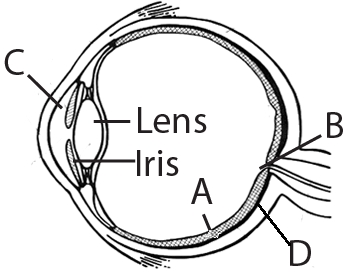
A
$C$ - Aqueous chamber - Reflects the light which does not pass through the lens.
B
$D$ - Choroid - Its anterior part forms ciliary body.
C
$A$ - Retina - Contains photoreceptors $i.e.$,rods and cones.
D
$B$ - Blind spot - Has only a few rods and cones.
Solution
(C) The correct option is $C$.
In the given figure:
$A$ is the retina,which is the innermost layer of the eyeball and contains photoreceptors,namely rods and cones,responsible for vision.
$B$ is the blind spot,the point where optic nerves leave the eye and retinal blood vessels enter it; it contains no photoreceptor cells.
$C$ is the aqueous chamber,which is the space between the cornea and the lens,filled with aqueous humor.
$D$ is the sclera,the outermost layer of the eyeball,which maintains the shape of the eyeball and protects the inner layers.
In the given figure:
$A$ is the retina,which is the innermost layer of the eyeball and contains photoreceptors,namely rods and cones,responsible for vision.
$B$ is the blind spot,the point where optic nerves leave the eye and retinal blood vessels enter it; it contains no photoreceptor cells.
$C$ is the aqueous chamber,which is the space between the cornea and the lens,filled with aqueous humor.
$D$ is the sclera,the outermost layer of the eyeball,which maintains the shape of the eyeball and protects the inner layers.
0 likes
View Solution192
MediumMCQ
Cornea transplant in humans is almost never rejected. This is because
A
it is composed of enucleated cells
B
it is a non-living layer
C
its cells are least penetrable by bacteria
D
it has no blood supply.
Solution
(D) The correct answer is $D$. The cornea is the transparent anterior part of the eye that helps in focusing light. It is avascular,meaning it has no direct blood supply. Because the immune system's cells (like lymphocytes) travel through the blood to identify and attack foreign tissues,the lack of blood vessels in the cornea prevents the immune system from easily detecting or rejecting the transplanted tissue.
0 likes
View Solution193
MediumMCQ
Which one of the following is the correct difference between rod cells and cone cells of our retina?
A
Overall function $\Rightarrow$ Vision in poor light $\Rightarrow$ Colour vision and detailed vision in bright light
B
Distribution $\Rightarrow$ More concentrated in centre of retina $\Rightarrow$ Evenly distributed all over retina
C
Visual acuity $\Rightarrow$ High $\Rightarrow$ Low
D
Visual pigment $\Rightarrow$ Iodopsin $\Rightarrow$ Rhodopsin
Solution
(A) The correct answer is $A$.
$1$. Rod cells are photoreceptor cells in the retina that contain the pigment rhodopsin. They are highly sensitive to light and are essential for vision in dim light (scotopic vision).
$2$. Cone cells are photoreceptor cells responsible for colour vision and high-resolution (detailed) vision in bright light (photopic vision). They contain the pigment iodopsin.
$3$. Regarding option $A$: Rod cells function in poor light,while cone cells are specialized for colour and detailed vision in bright light. This is the correct functional distinction.
$4$. Option $B$ is incorrect because cone cells are concentrated in the fovea (centre of the retina),while rods are more abundant in the periphery.
$5$. Option $C$ is incorrect because cones provide high visual acuity,whereas rods provide low visual acuity.
$6$. Option $D$ is incorrect because rods contain rhodopsin and cones contain iodopsin,making the order reversed.
$1$. Rod cells are photoreceptor cells in the retina that contain the pigment rhodopsin. They are highly sensitive to light and are essential for vision in dim light (scotopic vision).
$2$. Cone cells are photoreceptor cells responsible for colour vision and high-resolution (detailed) vision in bright light (photopic vision). They contain the pigment iodopsin.
$3$. Regarding option $A$: Rod cells function in poor light,while cone cells are specialized for colour and detailed vision in bright light. This is the correct functional distinction.
$4$. Option $B$ is incorrect because cone cells are concentrated in the fovea (centre of the retina),while rods are more abundant in the periphery.
$5$. Option $C$ is incorrect because cones provide high visual acuity,whereas rods provide low visual acuity.
$6$. Option $D$ is incorrect because rods contain rhodopsin and cones contain iodopsin,making the order reversed.
0 likes
View Solution194
EasyMCQ
Macula lutea is part of
A
Brain
B
Eyes
C
Ear
D
None of the above
Solution
(B) The $Macula$ $\text{ } lutea$ is an oval-shaped pigmented area near the center of the retina of the human eye.
It is responsible for sharp, detailed central vision.
Therefore, it is a part of the eye.
It is responsible for sharp, detailed central vision.
Therefore, it is a part of the eye.
0 likes
View Solution195
MediumMCQ
Select the correct option based on the given sentences regarding the mechanism of vision:
$(I)$ Light rays in the visible wavelength are focused on the retina through the cornea and lens.
$(II)$ It generates impulses in rods and cones.
$(III)$ Photosensitive pigment is composed of an opsin (protein) and retinal (an aldehyde of vitamin $A$).
$(IV)$ Light induces the dissociation of retinal and opsin.
$(V)$ This process causes a change in membrane permeability,as a result,potential differences are generated in the photoreceptor cells.
$(I)$ Light rays in the visible wavelength are focused on the retina through the cornea and lens.
$(II)$ It generates impulses in rods and cones.
$(III)$ Photosensitive pigment is composed of an opsin (protein) and retinal (an aldehyde of vitamin $A$).
$(IV)$ Light induces the dissociation of retinal and opsin.
$(V)$ This process causes a change in membrane permeability,as a result,potential differences are generated in the photoreceptor cells.
A
$I, II, III$ and $IV$
B
$I, II, III$ and $V$
C
$I, II, IV$ and $V$
D
$II, III, IV$ and $V$
Solution
(B) The mechanism of vision involves the following steps:
$(I)$ Light rays in the visible wavelength are focused on the retina through the cornea and lens. This is correct.
$(II)$ Light energy generates potential differences (impulses) in the photoreceptor cells (rods and cones). This is correct.
$(III)$ The photosensitive pigments (photopigments) in humans are composed of opsin (a protein) and retinal (an aldehyde of vitamin $A$). This is correct.
$(IV)$ Light induces the dissociation of retinal from opsin,resulting in changes in the structure of the opsin. The statement says 'association',which is incorrect; it should be 'dissociation'.
$(V)$ This structural change in opsin causes membrane permeability changes,leading to the generation of potential differences in the photoreceptor cells. This is correct.
Therefore,statements $(I, II, III,$ and $V)$ are correct.
$(I)$ Light rays in the visible wavelength are focused on the retina through the cornea and lens. This is correct.
$(II)$ Light energy generates potential differences (impulses) in the photoreceptor cells (rods and cones). This is correct.
$(III)$ The photosensitive pigments (photopigments) in humans are composed of opsin (a protein) and retinal (an aldehyde of vitamin $A$). This is correct.
$(IV)$ Light induces the dissociation of retinal from opsin,resulting in changes in the structure of the opsin. The statement says 'association',which is incorrect; it should be 'dissociation'.
$(V)$ This structural change in opsin causes membrane permeability changes,leading to the generation of potential differences in the photoreceptor cells. This is correct.
Therefore,statements $(I, II, III,$ and $V)$ are correct.
0 likes
View Solution196
MediumMCQ
Select the incorrect pair.
A
Eyes - Orbits (sockets of the skull)
B
External layer - composed of dense connective tissue
C
Middle layer - contains many blood vessels.
D
Retina - It contains connective tissue,bipolar cells,and cilia.
Solution
(D) The human eye is located in the sockets of the skull called orbits. This is a correct statement.
The external layer of the eye is composed of dense connective tissue and is called the sclera. This is a correct statement.
The middle layer of the eye is the choroid,which is bluish in color and contains many blood vessels. This is a correct statement.
The retina is the innermost layer of the eye and contains three layers of neural cells from inside to outside: ganglion cells,bipolar cells,and photoreceptor cells (rods and cones). It does not contain cilia. Therefore,the statement regarding the retina is incorrect.
The external layer of the eye is composed of dense connective tissue and is called the sclera. This is a correct statement.
The middle layer of the eye is the choroid,which is bluish in color and contains many blood vessels. This is a correct statement.
The retina is the innermost layer of the eye and contains three layers of neural cells from inside to outside: ganglion cells,bipolar cells,and photoreceptor cells (rods and cones). It does not contain cilia. Therefore,the statement regarding the retina is incorrect.
0 likes
View Solution197
EasyMCQ
Identify the part of the eye concerned with the following two sentences in the given figure. Which alphabet is used to indicate this part?
$1$. It is the coloured visible part of the eye.
$2$. It is a pigmented and opaque structure.
$1$. It is the coloured visible part of the eye.
$2$. It is a pigmented and opaque structure.
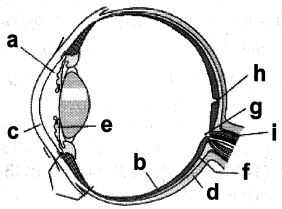
A
$f$
B
$a$
C
$h$
D
$e$
Solution
(B) The description provided refers to the iris.
$1$. The iris is the visible,coloured portion of the eye that surrounds the pupil.
$2$. It is a pigmented and opaque structure that controls the diameter and size of the pupil,thereby regulating the amount of light reaching the retina.
In the provided figure,the alphabet '$a$' points to the iris.
$1$. The iris is the visible,coloured portion of the eye that surrounds the pupil.
$2$. It is a pigmented and opaque structure that controls the diameter and size of the pupil,thereby regulating the amount of light reaching the retina.
In the provided figure,the alphabet '$a$' points to the iris.
0 likes
View Solution198
EasyMCQ
It contains derivatives of vitamin $- A$.
A
Iodopsin
B
Scotopsin
C
Eosin
D
Rhodopsin
Solution
(D) The visual purple pigment,Rhodopsin,is found in the rod cells of the retina.
It is a conjugated protein consisting of a protein called Scotopsin and a derivative of vitamin $- A$ called Retinal.
When light falls on the retina,Rhodopsin dissociates into Scotopsin and Retinal,which triggers the nerve impulses for vision.
Therefore,Rhodopsin contains derivatives of vitamin $- A$.
It is a conjugated protein consisting of a protein called Scotopsin and a derivative of vitamin $- A$ called Retinal.
When light falls on the retina,Rhodopsin dissociates into Scotopsin and Retinal,which triggers the nerve impulses for vision.
Therefore,Rhodopsin contains derivatives of vitamin $- A$.
0 likes
View Solution199
EasyMCQ
What is a characteristic feature of the human cornea?
A
It is secreted by the conjunctiva and glands.
B
It is the lacrimal gland that secretes tears.
C
Blood circulation is absent in the cornea.
D
In old age,it becomes hardened and white.
Solution
(C) The human cornea is a transparent,avascular structure,meaning it lacks blood vessels. This absence of blood circulation is a critical adaptation that allows light to pass through the eye without obstruction,ensuring clear vision. Nutrients and oxygen are supplied to the cornea primarily through the aqueous humor and the tear film.
0 likes
View Solution200
EasyMCQ
Our paired eyes are located in sockets of the skull called
A
Orbits
B
Cornea
C
Iris
D
Lens
Solution
(A) The human eyes are situated in the skull in depressions or cavities known as orbits.
These bony sockets provide protection and support to the eyeballs.
Cornea,iris,and lens are parts of the eye itself,not the skull sockets.
These bony sockets provide protection and support to the eyeballs.
Cornea,iris,and lens are parts of the eye itself,not the skull sockets.
0 likes
View SolutionNeural Control and Coordination — Eye · Frequently Asked Questions
1Are these Neural Control and Coordination questions useful for JEE and NEET?
Yes. All questions in this section are mapped to JEE Main and NEET exam patterns. Previous year questions from JEE Main, NEET, GUJCET and state-level exams are included with full solutions.
2Can I switch to Hindi or Gujarati for these questions?
Yes. Use the language tabs in the hero section or the sidebar to view the same questions and solutions in English, Hindi or Gujarati.
3How do I generate a question paper from this subtopic?
Use the Vedclass Exam Paper Generator — select the chapter and subtopic, set difficulty, and generate Sets A, B, C, D automatically. First 3 chapters of every subject are free.
Vedclass Products
For Students
Vedclass Test Series
Mock tests in real JEE/NEET style with performance analysis. 5-day free trial.
Start Free TrialFor Teachers
Exam Paper Generator
Generate Set A/B/C/D papers from this chapter in 2 minutes. 3 chapters free.
Try FreeFor Institutes
Online Exam Module
Live online exams with unlimited students, 360° analytics & white-label branding.
See DemoFor Teachers & Institutes
Generate a Neural Control and Coordination Exam Paper in 2 Minutes
Select subtopic & difficulty — Sets A, B, C, D auto-generated with No Repeat logic.
First 3 chapters of every subject are free — no payment required.