
A English
Mix Examples- Neural Control and Coordination Questions in English
Class 11 Biology · Neural Control and Coordination · Mix Examples- Neural Control and Coordination
57+
Questions
English
Language
100%
With Solutions
Showing 50 of 57 questions in English
1
MediumMCQ
Feeling of thirst is due to
A
Fever
B
Exercise
C
Fall in glucose level
D
All of the above
Solution
(D) The feeling of thirst is a physiological response to dehydration or increased blood plasma osmolarity.
$(a)$ Fever leads to increased body temperature and fluid loss through sweating and respiration,causing thirst.
$(b)$ Exercise causes loss of water and electrolytes through sweat,leading to increased blood plasma concentration,which triggers the thirst center in the hypothalamus.
$(c)$ $A$ significant fall in glucose levels can also influence metabolic signals that contribute to the sensation of thirst.
Since all these factors contribute to the body's need for water,the correct answer is $(d)$.
$(a)$ Fever leads to increased body temperature and fluid loss through sweating and respiration,causing thirst.
$(b)$ Exercise causes loss of water and electrolytes through sweat,leading to increased blood plasma concentration,which triggers the thirst center in the hypothalamus.
$(c)$ $A$ significant fall in glucose levels can also influence metabolic signals that contribute to the sensation of thirst.
Since all these factors contribute to the body's need for water,the correct answer is $(d)$.
0 likes
View Solution2
MediumMCQ
Injury to the $Vagus$ nerve ($CN$ $X$) in humans is not likely to affect which of the following?
A
Pancreatic secretion
B
Cardiac movements
C
Tongue movements
D
Gastrointestinal movements
Solution
(C) The $Vagus$ nerve ($CN$ $X$) is a major component of the parasympathetic nervous system and regulates visceral functions,including heart rate ($Cardiac$ $movements$),gastrointestinal motility ($Gastrointestinal$ $movements$),and glandular secretions such as $Pancreatic$ $secretion$.
The $Tongue$ $movements$ are primarily controlled by the $Hypoglossal$ nerve ($CN$ $XII$).
Therefore,injury to the $Vagus$ nerve would not affect the movements of the tongue.
The $Tongue$ $movements$ are primarily controlled by the $Hypoglossal$ nerve ($CN$ $XII$).
Therefore,injury to the $Vagus$ nerve would not affect the movements of the tongue.
0 likes
View Solution3
MediumMCQ
Which of the following is an odd nerve?
A
Optic
B
Oculomotor
C
Olfactory
D
Auditory
Solution
(B) The $Oculomotor$ nerve is a motor nerve,whereas the $Optic$,$Olfactory$,and $Auditory$ nerves are sensory in function. Therefore,$Oculomotor$ is the odd one out.
0 likes
View Solution4
MediumMCQ
Match the following:
$A.$ Reflex action $1.$ Involuntary action
$B.$ Multipolar $2.$ Neuron
$C.$ $Na^+$ and $K^+$ ions $3.$ Parasympathetic nervous system
$D.$ Increases secretion of saliva and digestive juices $4.$ Reflex action
$E.$ Knee jerk $5.$ Active transport
The correct sequence for $A, B, C, D, E$ is:
$A.$ Reflex action $1.$ Involuntary action
$B.$ Multipolar $2.$ Neuron
$C.$ $Na^+$ and $K^+$ ions $3.$ Parasympathetic nervous system
$D.$ Increases secretion of saliva and digestive juices $4.$ Reflex action
$E.$ Knee jerk $5.$ Active transport
The correct sequence for $A, B, C, D, E$ is:
A
$4, 2, 5, 3, 1$
B
$1, 4, 3, 5, 2$
C
$2, 4, 3, 5, 1$
D
$2, 3, 5, 1, 4$
Solution
(A) $A.$ Reflex action is an involuntary action $(4)$.
$B.$ Multipolar is a type of neuron $(2)$.
$C.$ $Na^+$ and $K^+$ ions are transported across the membrane via active transport $(5)$.
$D.$ Parasympathetic nervous system increases the secretion of saliva and digestive juices $(3)$.
$E.$ Knee jerk is a classic example of a reflex action $(1)$.
Therefore,the correct sequence is $A-4, B-2, C-5, D-3, E-1$.
$B.$ Multipolar is a type of neuron $(2)$.
$C.$ $Na^+$ and $K^+$ ions are transported across the membrane via active transport $(5)$.
$D.$ Parasympathetic nervous system increases the secretion of saliva and digestive juices $(3)$.
$E.$ Knee jerk is a classic example of a reflex action $(1)$.
Therefore,the correct sequence is $A-4, B-2, C-5, D-3, E-1$.
0 likes
View Solution5
MediumMCQ
Which of the following is an example of the action of the autonomous nervous system?
A
Knee-jerk response
B
Pupillary reflex
C
Swallowing of food
D
Peristalsis of the intestines
Solution
(D) The autonomous nervous system $(ANS)$ regulates and coordinates involuntary activities within the body.
$ANS$ controls functions such as heart rate,homeostasis,body temperature,breathing,gut peristalsis,and the secretion of glands.
Among the given options,peristalsis of the intestines is a classic example of an involuntary process controlled by the $ANS$.
Knee-jerk response is a somatic reflex,while pupillary reflex and swallowing involve complex neural pathways including cranial nerves.
$ANS$ controls functions such as heart rate,homeostasis,body temperature,breathing,gut peristalsis,and the secretion of glands.
Among the given options,peristalsis of the intestines is a classic example of an involuntary process controlled by the $ANS$.
Knee-jerk response is a somatic reflex,while pupillary reflex and swallowing involve complex neural pathways including cranial nerves.
0 likes
View Solution6
MediumMCQ
You are watching a horror movie and you notice that your heart is beating fast and mouth is dry. This is due to:
A
Fight-or-flight response
B
Autonomic nervous system
C
Sympathetic nervous system
D
Both $(a)$ and $(c)$
Solution
(D) When you are in a stressful situation like watching a horror movie, the body triggers the $\text{fight-or-flight}$ response.
This response is primarily mediated by the $\text{sympathetic nervous system}$.
The $\text{sympathetic nervous system}$ stimulates the release of adrenaline, which increases the heart rate and inhibits salivary gland secretion, leading to a dry mouth.
Since the $\text{fight-or-flight}$ response is the physiological outcome driven by the $\text{sympathetic nervous system}$, both options are correct.
This response is primarily mediated by the $\text{sympathetic nervous system}$.
The $\text{sympathetic nervous system}$ stimulates the release of adrenaline, which increases the heart rate and inhibits salivary gland secretion, leading to a dry mouth.
Since the $\text{fight-or-flight}$ response is the physiological outcome driven by the $\text{sympathetic nervous system}$, both options are correct.
0 likes
View Solution7
MediumMCQ
Match the following:
Receptors | Stimuli
$A.$ Statoreceptors | $1.$ Frequencies of vibrations
$B.$ Gustatory receptors | $2.$ Hunger and thirst
$C.$ Enteroreceptors | $3.$ Taste
$D.$ Mechanoreceptors | $4.$ Equilibrium
The correct pairing sequence is:
Receptors | Stimuli
$A.$ Statoreceptors | $1.$ Frequencies of vibrations
$B.$ Gustatory receptors | $2.$ Hunger and thirst
$C.$ Enteroreceptors | $3.$ Taste
$D.$ Mechanoreceptors | $4.$ Equilibrium
The correct pairing sequence is:
A
$A-4, B-3, C-2, D-1$
B
$A-4, B-1, C-2, D-3$
C
$A-4, B-2, C-1, D-3$
D
$A-3, B-4, C-1, D-2$
Solution
(A) $A.$ Statoreceptors are sensory receptors that detect changes in equilibrium and balance.
$B.$ Gustatory receptors are specialized cells located in the taste buds that detect chemical stimuli related to taste.
$C.$ Enteroreceptors (or interoceptors) are sensory receptors that detect internal stimuli within the body,such as hunger,thirst,and blood pressure.
$D.$ Mechanoreceptors are sensory receptors that respond to mechanical pressure or distortion,such as frequencies of vibrations or touch.
Therefore,the correct matching sequence is $A-4, B-3, C-2, D-1$.
$B.$ Gustatory receptors are specialized cells located in the taste buds that detect chemical stimuli related to taste.
$C.$ Enteroreceptors (or interoceptors) are sensory receptors that detect internal stimuli within the body,such as hunger,thirst,and blood pressure.
$D.$ Mechanoreceptors are sensory receptors that respond to mechanical pressure or distortion,such as frequencies of vibrations or touch.
Therefore,the correct matching sequence is $A-4, B-3, C-2, D-1$.
0 likes
View Solution8
MediumMCQ
If the $III^{rd}$ cranial nerve (oculomotor nerve) is damaged,it will lead to:
A
Loss of accommodation
B
Dilation of pupil
C
Loss of ocular movements
D
All of these
Solution
(D) The $III^{rd}$ cranial nerve is the oculomotor nerve.
It is responsible for controlling most of the extrinsic eye muscles,which manage ocular movements.
It also carries parasympathetic fibers that control the constriction of the pupil (sphincter pupillae) and the ciliary muscles responsible for accommodation.
Therefore,damage to this nerve results in the loss of ocular movements,dilation of the pupil (due to loss of parasympathetic control),and loss of accommodation.
It is responsible for controlling most of the extrinsic eye muscles,which manage ocular movements.
It also carries parasympathetic fibers that control the constriction of the pupil (sphincter pupillae) and the ciliary muscles responsible for accommodation.
Therefore,damage to this nerve results in the loss of ocular movements,dilation of the pupil (due to loss of parasympathetic control),and loss of accommodation.
0 likes
View Solution9
EasyMCQ
$ECT$ is
A
An apparatus for epilepsy
B
$A$ drug which acts as sedative
C
Shock treatment
D
Artificial organ for human
Solution
(C) $ECT$ stands for Electroconvulsive Therapy.
It is a medical treatment most commonly used in patients with severe major depression or bipolar disorder that has not responded to other treatments.
It involves a brief electrical stimulation of the brain while the patient is under anesthesia,which is why it is commonly referred to as shock treatment.
It is a medical treatment most commonly used in patients with severe major depression or bipolar disorder that has not responded to other treatments.
It involves a brief electrical stimulation of the brain while the patient is under anesthesia,which is why it is commonly referred to as shock treatment.
0 likes
View Solution10
MediumMCQ
Neurosis is characterised by
A
Madness
B
Prolonged emotional reaction to a stress
C
Pain in the head
D
Fits of convulsions
Solution
(B) Neurosis is a class of functional mental disorders involving distress but neither delusions nor hallucinations,whereby behavior is not outside socially acceptable norms.
It is characterized by a prolonged emotional reaction to a stressor,such as anxiety,hysteria,obsessional neurosis,or reactive depression.
It is characterized by a prolonged emotional reaction to a stressor,such as anxiety,hysteria,obsessional neurosis,or reactive depression.
0 likes
View Solution11
MediumMCQ
Trembling,depression,fear,and phobia are signs of:
A
Epilepsy
B
Parkinson's disease
C
Mental sickness
D
Alzheimer's disease
Solution
(C) Trembling (tremors),depression,fear,and phobia are clinical manifestations associated with mental health disorders.
While some neurological conditions like Parkinson's disease involve tremors,the combination of depression,fear,and phobia is characteristic of general mental sickness or psychological disorders.
Therefore,the most appropriate category among the given options is mental sickness.
While some neurological conditions like Parkinson's disease involve tremors,the combination of depression,fear,and phobia is characteristic of general mental sickness or psychological disorders.
Therefore,the most appropriate category among the given options is mental sickness.
0 likes
View Solution12
MediumMCQ
In epilepsy,a seizure is characterized by:
A
Warming cry
B
Fit of convulsions
C
Loss of consciousness
D
All of the above
Solution
(D) Epilepsy is a neurological disorder characterized by recurrent,unprovoked seizures.
$A$ seizure in epilepsy typically involves a combination of symptoms including:
$1$. $A$ 'warming cry' or aura,which is a sensory warning sign before the seizure.
$2$. $A$ fit of convulsions,which involves involuntary muscle contractions and shaking.
$3$. Loss of consciousness or altered awareness during the event.
Therefore,all the listed options are associated with the clinical presentation of an epileptic seizure.
$A$ seizure in epilepsy typically involves a combination of symptoms including:
$1$. $A$ 'warming cry' or aura,which is a sensory warning sign before the seizure.
$2$. $A$ fit of convulsions,which involves involuntary muscle contractions and shaking.
$3$. Loss of consciousness or altered awareness during the event.
Therefore,all the listed options are associated with the clinical presentation of an epileptic seizure.
0 likes
View Solution13
MediumMCQ
Melanin and Lewy bodies occur in the neurons in case of
A
Huntington's chorea
B
Alzheimer's disease
C
Paralysis agitans
D
All the above
Solution
(C) Paralysis agitans,commonly known as Parkinson's disease,is a neurodegenerative disorder.
It is characterized by the loss of dopaminergic neurons in the substantia nigra of the brain.
$A$ hallmark pathological feature of this disease is the presence of Lewy bodies,which are abnormal aggregates of protein (primarily alpha-synuclein) that develop inside nerve cells.
Additionally,the neurons in the substantia nigra typically contain neuromelanin,and the degeneration of these pigmented neurons is a key feature of the disease.
It is characterized by the loss of dopaminergic neurons in the substantia nigra of the brain.
$A$ hallmark pathological feature of this disease is the presence of Lewy bodies,which are abnormal aggregates of protein (primarily alpha-synuclein) that develop inside nerve cells.
Additionally,the neurons in the substantia nigra typically contain neuromelanin,and the degeneration of these pigmented neurons is a key feature of the disease.
0 likes
View Solution14
MediumMCQ
In the eye of an insect,a mosaic image is formed in .........
A
dim light
B
bright light
C
ocelli
D
none of these
Solution
(B) In insects,the compound eye consists of numerous ommatidia.
In bright light,each ommatidium receives light only from a small area of the visual field,resulting in a mosaic image.
This is known as apposition image formation,which provides high resolution in bright light conditions.
In bright light,each ommatidium receives light only from a small area of the visual field,resulting in a mosaic image.
This is known as apposition image formation,which provides high resolution in bright light conditions.
0 likes
View Solution15
MediumMCQ
In humans,if the abducens nerve is damaged,which of the following functions will be affected?
A
Swallowing
B
Neck movement
C
Tongue movement
D
Eyeball movement
Solution
(D) The $VI$ cranial nerve is known as the abducens nerve.
It is a motor nerve that innervates the lateral rectus muscle of the eye.
The primary function of the lateral rectus muscle is to move the eyeball laterally (abduction).
Therefore,damage to the abducens nerve results in the inability to move the eyeball outward,affecting eyeball movement.
It is a motor nerve that innervates the lateral rectus muscle of the eye.
The primary function of the lateral rectus muscle is to move the eyeball laterally (abduction).
Therefore,damage to the abducens nerve results in the inability to move the eyeball outward,affecting eyeball movement.
0 likes
View Solution16
MediumMCQ
Stimulation of the sympathetic nervous system causes ....
A
Constriction of blood vessels and high blood pressure
B
Dilation of bronchioles and pupils
C
Erection of hair (piloerection)
D
All of the above
Solution
(D) The sympathetic nervous system is responsible for the '$fight-or-flight$' response.
$1$. It causes vasoconstriction of blood vessels,which increases blood pressure.
$2$. It leads to the dilation of bronchioles to increase airflow and dilation of pupils to improve vision.
$3$. It causes the contraction of arrector pili muscles,leading to the erection of hair (piloerection).
Therefore,all the given options are correct effects of sympathetic nervous system stimulation.
$1$. It causes vasoconstriction of blood vessels,which increases blood pressure.
$2$. It leads to the dilation of bronchioles to increase airflow and dilation of pupils to improve vision.
$3$. It causes the contraction of arrector pili muscles,leading to the erection of hair (piloerection).
Therefore,all the given options are correct effects of sympathetic nervous system stimulation.
0 likes
View Solution17
MediumMCQ
The $Facial$ nerve is:
A
Motor
B
Sensory
C
Mixed (Motor and Sensory)
D
None of these
Solution
(C) The $Facial$ nerve (Cranial nerve $VII$) is a mixed nerve.
It contains motor fibers that control the muscles of facial expression and sensory fibers that provide taste sensation from the anterior two-thirds of the tongue.
It contains motor fibers that control the muscles of facial expression and sensory fibers that provide taste sensation from the anterior two-thirds of the tongue.
0 likes
View Solution18
EasyMCQ
You are watching a horror movie and notice that your heart rate increases and your mouth becomes dry. What is the reason for this?
A
Fight-or-flight response
B
Autonomic nervous system
C
Sympathetic nervous system
D
Both $A$ and $C$
Solution
(D) When watching a horror movie, the body perceives a stressful or threatening situation.
This triggers the $Sympathetic$ $\text{nervous system}$, which is responsible for the $Fight-or-flight$ $\text{response}$.
Activation of the $Sympathetic$ $\text{nervous system}$ leads to physiological changes such as an increased heart rate and inhibition of salivary gland secretion, causing a dry mouth.
Since both the $Fight-or-flight$ $\text{response}$ and the $Sympathetic$ $\text{nervous system}$ are involved in this reaction, the correct answer is $D$.
This triggers the $Sympathetic$ $\text{nervous system}$, which is responsible for the $Fight-or-flight$ $\text{response}$.
Activation of the $Sympathetic$ $\text{nervous system}$ leads to physiological changes such as an increased heart rate and inhibition of salivary gland secretion, causing a dry mouth.
Since both the $Fight-or-flight$ $\text{response}$ and the $Sympathetic$ $\text{nervous system}$ are involved in this reaction, the correct answer is $D$.
0 likes
View Solution19
MediumMCQ
Where is postganglionic sympathetic cholinergic innervation found?
A
Heart
B
Stomach
C
Sweat glands
D
Intestine
Solution
(C) In the sympathetic nervous system,most postganglionic neurons are adrenergic,meaning they release norepinephrine.
However,there is a notable exception: the postganglionic sympathetic neurons that innervate the sweat glands are cholinergic,meaning they release acetylcholine $(ACh)$ as their neurotransmitter.
This allows the sympathetic nervous system to regulate body temperature through the stimulation of sweat production.
However,there is a notable exception: the postganglionic sympathetic neurons that innervate the sweat glands are cholinergic,meaning they release acetylcholine $(ACh)$ as their neurotransmitter.
This allows the sympathetic nervous system to regulate body temperature through the stimulation of sweat production.
0 likes
View Solution20
MediumMCQ
Which of the following is $NOT$ under the control of the $Vagus$ nerve?
A
Gastrointestinal motility
B
Respiratory movements
C
Salivation
D
None of the above
Solution
(D) The $Vagus$ nerve (Cranial nerve $X$) is a major component of the parasympathetic nervous system.
It plays a crucial role in regulating gastrointestinal motility,respiratory movements,and the secretion of digestive juices,including saliva.
Since all the listed options ($A$,$B$,and $C$) are regulated by the $Vagus$ nerve,the correct answer is $D$.
It plays a crucial role in regulating gastrointestinal motility,respiratory movements,and the secretion of digestive juices,including saliva.
Since all the listed options ($A$,$B$,and $C$) are regulated by the $Vagus$ nerve,the correct answer is $D$.
0 likes
View Solution21
MediumMCQ
Read the following statements:
$(A)$ The neural system provides an organized network for point-to-point connections.
$(B)$ The endocrine system provides chemical integration through hormones.
$(C)$ The neural system is very simple in lower invertebrates.
$(D)$ Neurons can detect and receive stimuli but cannot conduct them.
How many of the above statements are incorrect?
$(A)$ The neural system provides an organized network for point-to-point connections.
$(B)$ The endocrine system provides chemical integration through hormones.
$(C)$ The neural system is very simple in lower invertebrates.
$(D)$ Neurons can detect and receive stimuli but cannot conduct them.
How many of the above statements are incorrect?
A
$4$
B
$3$
C
$2$
D
$1$
Solution
(D) Statement $(A)$ is correct: The neural system provides an organized network for point-to-point connections for quick coordination.
Statement $(B)$ is correct: The endocrine system provides chemical integration through hormones.
Statement $(C)$ is correct: The neural system is very simple in lower invertebrates (e.g.,Hydra has a nerve net).
Statement $(D)$ is incorrect: Neurons are specialized cells that can detect,receive,and conduct nerve impulses.
Therefore,only one statement $(D)$ is incorrect.
Statement $(B)$ is correct: The endocrine system provides chemical integration through hormones.
Statement $(C)$ is correct: The neural system is very simple in lower invertebrates (e.g.,Hydra has a nerve net).
Statement $(D)$ is incorrect: Neurons are specialized cells that can detect,receive,and conduct nerve impulses.
Therefore,only one statement $(D)$ is incorrect.
0 likes
View Solution22
MediumMCQ
Which of the following actions does not occur in humans after sympathetic stimulation?
A
Increased heart rate
B
Dilation of bronchioles
C
Micturition
D
Ejaculation
Solution
(C) The sympathetic nervous system is responsible for the '$fight-or-flight$' response.
It prepares the body for stressful situations by increasing heart rate,dilating bronchioles to improve oxygen intake,and stimulating ejaculation.
Micturition (urination) is primarily controlled by the parasympathetic nervous system,which promotes bladder contraction and relaxation of the internal urethral sphincter.
Therefore,sympathetic stimulation inhibits micturition rather than causing it.
It prepares the body for stressful situations by increasing heart rate,dilating bronchioles to improve oxygen intake,and stimulating ejaculation.
Micturition (urination) is primarily controlled by the parasympathetic nervous system,which promotes bladder contraction and relaxation of the internal urethral sphincter.
Therefore,sympathetic stimulation inhibits micturition rather than causing it.
0 likes
View Solution23
MediumMCQ
$I.$ The endocrine system provides chemical integration through hormones.
$II.$ The neural system provides an organized network of point-to-point connections for quick coordination.
$III.$ The neural organization is very complex in lower invertebrates.
$IV.$ The human neural system includes $CNS$ and $PNS$.
Select the correct statements.
$II.$ The neural system provides an organized network of point-to-point connections for quick coordination.
$III.$ The neural organization is very complex in lower invertebrates.
$IV.$ The human neural system includes $CNS$ and $PNS$.
Select the correct statements.
A
Only $I$
B
$I$ and $II$
C
$I, II$ and $IV$
D
$I$ and $III$
Solution
(C) $I.$ Correct: The endocrine system uses hormones for chemical signaling and integration.
$II.$ Correct: The neural system provides rapid,point-to-point connections for quick coordination.
$III.$ Incorrect: The neural organization is very simple in lower invertebrates (e.g.,Hydra has a nerve net),not complex.
$IV.$ Correct: The human neural system is divided into the Central Neural System $(CNS)$ and the Peripheral Neural System $(PNS)$.
Therefore,statements $I, II,$ and $IV$ are correct.
$II.$ Correct: The neural system provides rapid,point-to-point connections for quick coordination.
$III.$ Incorrect: The neural organization is very simple in lower invertebrates (e.g.,Hydra has a nerve net),not complex.
$IV.$ Correct: The human neural system is divided into the Central Neural System $(CNS)$ and the Peripheral Neural System $(PNS)$.
Therefore,statements $I, II,$ and $IV$ are correct.
0 likes
View Solution24
MediumMCQ
Match the following:
| Column-$I$ | Column-$II$ |
|---|---|
| $(a)$ Unipolar neurons | $(1)$ Amygdala and Hippocampus |
| $(b)$ Limbic system | $(2)$ Centre for control of body temperature |
| $(c)$ Hypothalamus | $(3)$ Embryonic stage |
A
$(a-1), (b-3), (c-2)$
B
$(a-3), (b-1), (c-2)$
C
$(a-2), (b-1), (c-3)$
D
$(a-3), (b-2), (c-1)$
Solution
(B) Unipolar neurons are typically found in the embryonic stage of development.
$(b)$ The limbic system consists of complex structures including the amygdala and hippocampus,which are involved in emotional responses and memory.
$(c)$ The hypothalamus is the primary centre for the control of body temperature,hunger,and thirst.
Therefore,the correct matching is $(a-3), (b-1), (c-2)$.
$(b)$ The limbic system consists of complex structures including the amygdala and hippocampus,which are involved in emotional responses and memory.
$(c)$ The hypothalamus is the primary centre for the control of body temperature,hunger,and thirst.
Therefore,the correct matching is $(a-3), (b-1), (c-2)$.
0 likes
View Solution25
MediumMCQ
The medulla contains centers which control
A
Respiration
B
Cardiovascular reflexes
C
$A$ and $B$ are correct
D
$A$ and $B$ are incorrect
Solution
(C) The medulla oblongata is a part of the hindbrain.
It contains centers that regulate vital involuntary functions.
Specifically,the respiratory rhythm center is located in the medulla,which controls respiration.
Additionally,the medulla contains centers for cardiovascular reflexes,which regulate heart rate and blood pressure.
Therefore,both $A$ and $B$ are correct.
It contains centers that regulate vital involuntary functions.
Specifically,the respiratory rhythm center is located in the medulla,which controls respiration.
Additionally,the medulla contains centers for cardiovascular reflexes,which regulate heart rate and blood pressure.
Therefore,both $A$ and $B$ are correct.
0 likes
View Solution26
MediumMCQ
When we move from darkness into bright light,we cannot see for a short time,but after a while,our vision becomes normal. This is an example of ..........
A
Accommodation
B
Adaptation
C
Aberration
D
Photoperiodism
Solution
(B) When moving from a dark environment to a bright one,the photoreceptor cells (rods and cones) in the retina require time to adjust to the sudden change in light intensity. This process is known as sensory adaptation. Specifically,the photopigments in the rods,which are highly sensitive to low light,are bleached by bright light,and the cones take over to provide vision in bright light. This adjustment period is a classic example of adaptation.
0 likes
View Solution27
MediumMCQ
Which of the following functions is affected when the $abducens$ nerve is injured in humans?
A
Movement of the eyeball
B
Movement of the tongue
C
Swallowing
D
Movement of the neck
Solution
(A) The $abducens$ nerve (Cranial nerve $VI$) is a motor nerve that innervates the lateral rectus muscle of the eye.
This muscle is responsible for the outward movement (abduction) of the eyeball.
If the $abducens$ nerve is injured,the lateral rectus muscle becomes paralyzed,leading to an inability to move the eye laterally,which results in double vision $(diplopia)$ and an inward deviation of the eye.
This muscle is responsible for the outward movement (abduction) of the eyeball.
If the $abducens$ nerve is injured,the lateral rectus muscle becomes paralyzed,leading to an inability to move the eye laterally,which results in double vision $(diplopia)$ and an inward deviation of the eye.
0 likes
View Solution28
MediumMCQ
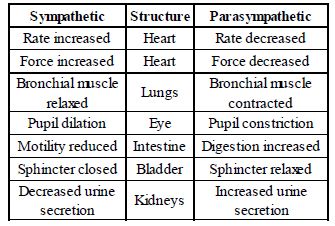
Given below is a table comparing the effects of sympathetic and parasympathetic nervous system for four features. Which one feature is correctly described?
A
Feature: Salivary glands,Sympathetic nervous system: Stimulates secretion,Parasympathetic nervous system: Inhibits secretion
B
Feature: Pupil of the eye,Sympathetic nervous system: Dilate,Parasympathetic nervous system: Constricts
C
Feature: Heart rate,Sympathetic nervous system: Decrease,Parasympathetic nervous system: Increase
D
Feature: Intestinal motility,Sympathetic nervous system: Stimulates,Parasympathetic nervous system: Inhibits
Solution
(B) The sympathetic nervous system prepares the body for 'fight or flight' responses,which includes dilating the pupils,increasing heart rate,and inhibiting intestinal motility.
In contrast,the parasympathetic nervous system promotes 'rest and digest' activities,which includes constricting the pupils,decreasing heart rate,and stimulating intestinal motility.
Comparing the given options:
Option $A$ is incorrect because the sympathetic system inhibits salivary secretion,while the parasympathetic system stimulates it.
Option $B$ is correct because the sympathetic nervous system causes pupil dilation,and the parasympathetic nervous system causes pupil constriction.
Option $C$ is incorrect because the sympathetic system increases heart rate,while the parasympathetic system decreases it.
Option $D$ is incorrect because the sympathetic system inhibits intestinal motility,while the parasympathetic system stimulates it.
In contrast,the parasympathetic nervous system promotes 'rest and digest' activities,which includes constricting the pupils,decreasing heart rate,and stimulating intestinal motility.
Comparing the given options:
Option $A$ is incorrect because the sympathetic system inhibits salivary secretion,while the parasympathetic system stimulates it.
Option $B$ is correct because the sympathetic nervous system causes pupil dilation,and the parasympathetic nervous system causes pupil constriction.
Option $C$ is incorrect because the sympathetic system increases heart rate,while the parasympathetic system decreases it.
Option $D$ is incorrect because the sympathetic system inhibits intestinal motility,while the parasympathetic system stimulates it.
0 likes
View Solution29
Medium
Briefly describe the structure of the following:
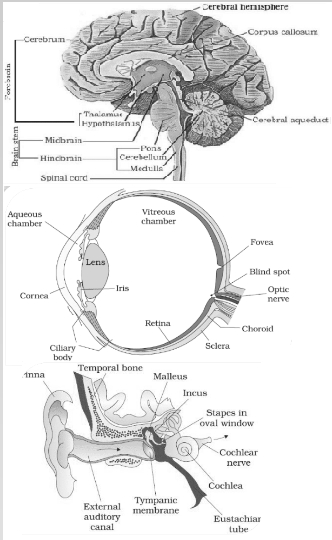
$(a)$ Brain
$(b)$ Eye
$(c)$ Ear
$(a)$ Brain
$(b)$ Eye
$(c)$ Ear
Solution
(N/A) Brain
The brain is the main coordinating centre of the body. It is a part of the nervous system that controls and monitors every organ of the body. It is well protected by cranial meninges,which consist of an outer layer called dura mater,a thin middle layer called arachnoid,and an inner layer called pia mater. It is divided into three regions: forebrain,midbrain,and hindbrain.
Forebrain: It is the main thinking part of the brain. It consists of the cerebrum,thalamus,and hypothalamus.
Cerebrum: It is the largest part of the brain and constitutes about four-fifths of its weight. The two cerebral hemispheres are joined by a tract of nerve fibres known as the corpus callosum. The hemispheres are covered by a layer of cells known as the cerebral cortex or grey matter. The cerebrum has sensory regions known as association areas that receive sensory impulses from various receptors,as well as motor regions that control the movement of various muscles. The innermost part of the cerebrum is known as the white matter.
Thalamus: It is the main centre of coordination for sensory and motor signalling and is wrapped by the cerebrum.
Hypothalamus: It lies at the base of the thalamus and contains centres that regulate body temperature and the urge for eating and drinking. Some regions of the cerebrum,along with the hypothalamus,are involved in the regulation of sexual behaviour and emotional reactions such as excitement,pleasure,and fear.
Midbrain: It is located between the thalamus region of the forebrain and the pons region of the hindbrain. The dorsal surface of the midbrain consists of four round lobes called corpora quadrigemina. $A$ canal known as the cerebral aqueduct passes through the midbrain. The midbrain is concerned with the sense of sight and hearing.
Hindbrain: It consists of three regions: pons,cerebellum,and medulla oblongata.
Pons: It is a band of nerve fibres that lies between the medulla oblongata and the midbrain. It connects the lateral parts of the cerebellar hemispheres.
Cerebellum: It is a large and well-developed part of the hindbrain located below the posterior sides of the cerebral hemispheres and above the medulla oblongata. It is responsible for maintaining the posture and equilibrium of the body.
Medulla Oblongata: It is the posterior and simplest part of the brain,located beneath the cerebellum. Its lower end extends as the spinal cord and leaves the skull through the foramen magnum.
$(b)$ Eye
The eye is a spherical structure consisting of three layers:
$(i)$ The outer layer is composed of the sclera and cornea. The sclera is an opaque tissue known as the white of the eye,composed of dense connective tissue. The cornea is the transparent anterior portion that lacks blood vessels and is nourished by lymph.
$(ii)$ The middle layer is vascular and contains the choroid,ciliary body,and iris. The choroid lies next to the sclera and contains numerous blood vessels. The ciliary body is the thickened anterior portion of the choroid containing ciliary muscles. The iris is the thin,coloured,visible partition at the junction of the sclera and cornea.
$(c)$ Ear
The ear is the sense organ for hearing and equilibrium. It consists of $3$ portions: external ear,middle ear,and internal ear.
External Ear: It consists of the pinna,external auditory meatus,and tympanic membrane. The pinna collects sound vibrations. The external auditory meatus is a tubular passage. The tympanic membrane is a thin membrane separating the middle ear from the external ear.
Middle Ear: It is an air-filled tympanic cavity connected to the pharynx through the eustachian tube,which helps equalize air pressure. It contains three ear ossicles: malleus,incus,and stapes.
Internal Ear: It is also known as the labyrinth,divided into bony and membranous labyrinths. The bony labyrinth is filled with perilymph,while the membranous labyrinth is filled with endolymph. It includes the vestibular apparatus (utriculus,sacculus,and semi-circular canals) for balance and the cochlea for hearing,which contains the organ of Corti.
The brain is the main coordinating centre of the body. It is a part of the nervous system that controls and monitors every organ of the body. It is well protected by cranial meninges,which consist of an outer layer called dura mater,a thin middle layer called arachnoid,and an inner layer called pia mater. It is divided into three regions: forebrain,midbrain,and hindbrain.
Forebrain: It is the main thinking part of the brain. It consists of the cerebrum,thalamus,and hypothalamus.
Cerebrum: It is the largest part of the brain and constitutes about four-fifths of its weight. The two cerebral hemispheres are joined by a tract of nerve fibres known as the corpus callosum. The hemispheres are covered by a layer of cells known as the cerebral cortex or grey matter. The cerebrum has sensory regions known as association areas that receive sensory impulses from various receptors,as well as motor regions that control the movement of various muscles. The innermost part of the cerebrum is known as the white matter.
Thalamus: It is the main centre of coordination for sensory and motor signalling and is wrapped by the cerebrum.
Hypothalamus: It lies at the base of the thalamus and contains centres that regulate body temperature and the urge for eating and drinking. Some regions of the cerebrum,along with the hypothalamus,are involved in the regulation of sexual behaviour and emotional reactions such as excitement,pleasure,and fear.
Midbrain: It is located between the thalamus region of the forebrain and the pons region of the hindbrain. The dorsal surface of the midbrain consists of four round lobes called corpora quadrigemina. $A$ canal known as the cerebral aqueduct passes through the midbrain. The midbrain is concerned with the sense of sight and hearing.
Hindbrain: It consists of three regions: pons,cerebellum,and medulla oblongata.
Pons: It is a band of nerve fibres that lies between the medulla oblongata and the midbrain. It connects the lateral parts of the cerebellar hemispheres.
Cerebellum: It is a large and well-developed part of the hindbrain located below the posterior sides of the cerebral hemispheres and above the medulla oblongata. It is responsible for maintaining the posture and equilibrium of the body.
Medulla Oblongata: It is the posterior and simplest part of the brain,located beneath the cerebellum. Its lower end extends as the spinal cord and leaves the skull through the foramen magnum.
$(b)$ Eye
The eye is a spherical structure consisting of three layers:
$(i)$ The outer layer is composed of the sclera and cornea. The sclera is an opaque tissue known as the white of the eye,composed of dense connective tissue. The cornea is the transparent anterior portion that lacks blood vessels and is nourished by lymph.
$(ii)$ The middle layer is vascular and contains the choroid,ciliary body,and iris. The choroid lies next to the sclera and contains numerous blood vessels. The ciliary body is the thickened anterior portion of the choroid containing ciliary muscles. The iris is the thin,coloured,visible partition at the junction of the sclera and cornea.
$(c)$ Ear
The ear is the sense organ for hearing and equilibrium. It consists of $3$ portions: external ear,middle ear,and internal ear.
External Ear: It consists of the pinna,external auditory meatus,and tympanic membrane. The pinna collects sound vibrations. The external auditory meatus is a tubular passage. The tympanic membrane is a thin membrane separating the middle ear from the external ear.
Middle Ear: It is an air-filled tympanic cavity connected to the pharynx through the eustachian tube,which helps equalize air pressure. It contains three ear ossicles: malleus,incus,and stapes.
Internal Ear: It is also known as the labyrinth,divided into bony and membranous labyrinths. The bony labyrinth is filled with perilymph,while the membranous labyrinth is filled with endolymph. It includes the vestibular apparatus (utriculus,sacculus,and semi-circular canals) for balance and the cochlea for hearing,which contains the organ of Corti.
0 likes
View Solution30
Difficult
Compare the following: (Any two)
$(a)$ Central neural system $(CNS)$ and Peripheral neural system $(PNS)$
$(b)$ Resting potential and action potential
$(c)$ Choroid and retina
$(a)$ Central neural system $(CNS)$ and Peripheral neural system $(PNS)$
$(b)$ Resting potential and action potential
$(c)$ Choroid and retina
Solution
(A-D) Central neural system $(CNS)$ and Peripheral neural system $(PNS)$
$(b)$ Resting potential and action potential
$(c)$ Choroid and retina
| $(1)$ Central neural system $(CNS)$ is the main coordinating centre of the body. | $(1)$ Peripheral neural system $(PNS)$ is not the main coordinating centre of the body. |
| $(2)$ It includes the brain and spinal cord. | $(2)$ It includes cranial and spinal nerves that connect the central nervous system to different parts of the body. |
$(b)$ Resting potential and action potential
| $(1)$ Resting potential is the potential difference across the nerve fibre when there is no conduction of nerve impulse. | $(1)$ Action potential is the potential difference across the nerve fibre when there is conduction of nerve impulse. |
| $(2)$ The membrane is more permeable to $K^+$ ions than to $Na^+$ ions. | $(2)$ The membrane is more permeable to $Na^+$ ions than to $K^+$ ions. |
$(c)$ Choroid and retina
| $(1)$ Choroid is the middle vascular layer of the eye. | $(1)$ Retina is the innermost nervous coat of the eye. |
| $(2)$ It contains numerous blood vessels that provide nutrients and oxygen to the retina and other tissues. | $(2)$ It contains photoreceptor cells, rods and cones, that are associated with twilight and colour vision respectively. |
0 likes
View Solution31
Difficult
Explain the following processes:
$(a)$ Polarisation of the membrane of a nerve fibre
$(b)$ Depolarisation of the membrane of a nerve fibre
$(c)$ Conduction of a nerve impulse along a nerve fibre
$(d)$ Transmission of a nerve impulse across a chemical synapse
$(a)$ Polarisation of the membrane of a nerve fibre
$(b)$ Depolarisation of the membrane of a nerve fibre
$(c)$ Conduction of a nerve impulse along a nerve fibre
$(d)$ Transmission of a nerve impulse across a chemical synapse
Solution
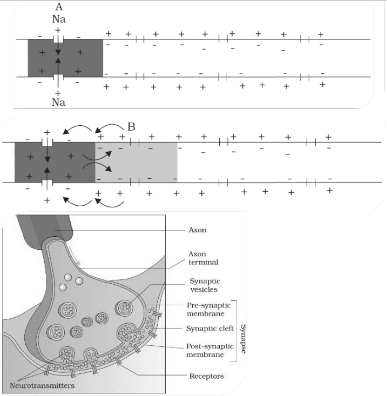
(N/A) During the resting state,the concentration of $K^+$ ions is higher inside the axoplasm,while the concentration of $Na^+$ ions is higher outside. Due to the selective permeability of the membrane,$K^+$ ions diffuse out faster than $Na^+$ ions move in. Consequently,the outer surface of the axonal membrane becomes positively charged,and the inner surface becomes negatively charged. This state is called polarisation.
$(b)$ When a stimulus is applied to a site on the polarised membrane,the permeability to $Na^+$ ions increases significantly. $Na^+$ ions rapidly influx into the axoplasm,causing the inner side of the membrane to become positively charged and the outer side to become negatively charged. This reversal of polarity is known as depolarisation.
$(c)$ Nerve impulses are conducted differently in myelinated and non-myelinated fibres. In myelinated fibres,the myelin sheath acts as an insulator,restricting ionic exchange to the nodes of Ranvier. Consequently,the action potential 'jumps' from one node to the next,a process called saltatory conduction,which is much faster. In non-myelinated fibres,the ionic exchange and depolarisation occur continuously along the entire length of the membrane.
$(d)$ $A$ chemical synapse is the junction between the axon terminal of one neuron and the dendrite of the next. When an action potential reaches the axon terminal,it triggers synaptic vesicles to fuse with the pre-synaptic membrane,releasing neurotransmitters (e.g.,acetylcholine) into the synaptic cleft. These neurotransmitters bind to specific receptors on the post-synaptic membrane,opening ion channels and generating a new action potential in the next neuron. The enzyme acetylcholinesterase then breaks down the neurotransmitter to terminate the signal and allow the membrane to repolarise.
$(b)$ When a stimulus is applied to a site on the polarised membrane,the permeability to $Na^+$ ions increases significantly. $Na^+$ ions rapidly influx into the axoplasm,causing the inner side of the membrane to become positively charged and the outer side to become negatively charged. This reversal of polarity is known as depolarisation.
$(c)$ Nerve impulses are conducted differently in myelinated and non-myelinated fibres. In myelinated fibres,the myelin sheath acts as an insulator,restricting ionic exchange to the nodes of Ranvier. Consequently,the action potential 'jumps' from one node to the next,a process called saltatory conduction,which is much faster. In non-myelinated fibres,the ionic exchange and depolarisation occur continuously along the entire length of the membrane.
$(d)$ $A$ chemical synapse is the junction between the axon terminal of one neuron and the dendrite of the next. When an action potential reaches the axon terminal,it triggers synaptic vesicles to fuse with the pre-synaptic membrane,releasing neurotransmitters (e.g.,acetylcholine) into the synaptic cleft. These neurotransmitters bind to specific receptors on the post-synaptic membrane,opening ion channels and generating a new action potential in the next neuron. The enzyme acetylcholinesterase then breaks down the neurotransmitter to terminate the signal and allow the membrane to repolarise.
0 likes
View Solution32
Medium
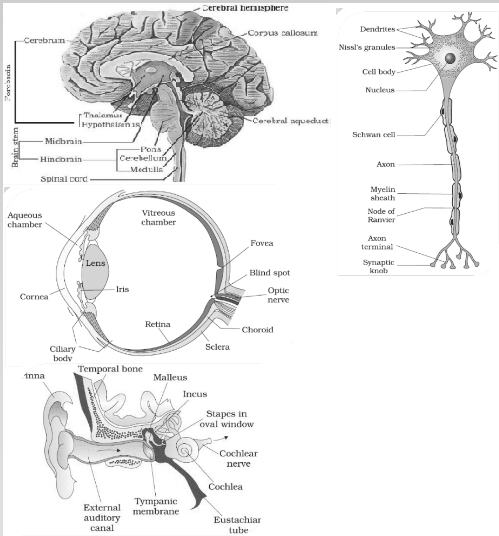
Draw labelled diagrams of the following:
$(a)$ Neuron
$(b)$ Brain
$(c)$ Eye
$(d)$ Ear
$(a)$ Neuron
$(b)$ Brain
$(c)$ Eye
$(d)$ Ear
Solution
(N/A) The diagrams for the requested structures are as follows:
$(a)$ Neuron: $A$ nerve cell consists of a cell body (cyton) with dendrites,a nucleus,Nissl's granules,an axon,myelin sheath,nodes of Ranvier,and synaptic knobs.
$(b)$ Brain: The human brain is divided into the forebrain (cerebrum,thalamus,hypothalamus),midbrain,and hindbrain (pons,cerebellum,medulla),connected to the spinal cord.
$(c)$ Eye: The human eye structure includes the cornea,aqueous chamber,lens,iris,ciliary body,retina,choroid,sclera,fovea,blind spot,and optic nerve.
$(d)$ Ear: The human ear consists of the pinna,external auditory canal,tympanic membrane,middle ear ossicles (malleus,incus,stapes),oval window,cochlea,cochlear nerve,and Eustachian tube.
$(a)$ Neuron: $A$ nerve cell consists of a cell body (cyton) with dendrites,a nucleus,Nissl's granules,an axon,myelin sheath,nodes of Ranvier,and synaptic knobs.
$(b)$ Brain: The human brain is divided into the forebrain (cerebrum,thalamus,hypothalamus),midbrain,and hindbrain (pons,cerebellum,medulla),connected to the spinal cord.
$(c)$ Eye: The human eye structure includes the cornea,aqueous chamber,lens,iris,ciliary body,retina,choroid,sclera,fovea,blind spot,and optic nerve.
$(d)$ Ear: The human ear consists of the pinna,external auditory canal,tympanic membrane,middle ear ossicles (malleus,incus,stapes),oval window,cochlea,cochlear nerve,and Eustachian tube.
0 likes
View Solution33
Medium
Give a brief account of
$(a)$ Mechanism of synaptic transmission
$(b)$ Mechanism of vision
$(c)$ Mechanism of hearing
$(a)$ Mechanism of synaptic transmission
$(b)$ Mechanism of vision
$(c)$ Mechanism of hearing
Solution
(N/A) nerve impulse is transmitted from one neuron to another through junctions called synapses,which are formed by the membranes of a pre-synaptic neuron and a post-synaptic neuron,which may or may not be separated by a synaptic cleft. There are two types of synapses: electrical synapses and chemical synapses.
At electrical synapses,the membranes of pre- and post-synaptic neurons are in very close proximity,so electrical current can flow directly from one neuron into the other. Transmission across electrical synapses is very similar to impulse conduction along a single axon and is faster than chemical synapses,though it is rare in the human body.
At a chemical synapse,the membranes are separated by a fluid-filled space called the synaptic cleft. Chemicals called neurotransmitters are involved in the transmission of impulses.
$(b)$ Light rays in the visible wavelength are focused on the retina through the cornea and lens,generating impulses in rods and cones. The photosensitive compounds (photopigments) in human eyes are composed of opsin (a protein) and retinal (an aldehyde of vitamin $A$). Light induces the dissociation of retinal from opsin,resulting in changes in the structure of opsin. This causes membrane permeability changes,generating potential differences in the photoreceptor cells. This produces a signal that generates action potentials in the ganglion cells through the bipolar cells. These impulses are transmitted by the optic nerves to the visual cortex of the brain,where they are analyzed and the image is recognized based on memory and experience.
$(c)$ The external ear receives sound waves and directs them to the eardrum (tympanic membrane). The eardrum vibrates in response to sound waves,and these vibrations are transmitted through the ear ossicles to the oval window. The vibrations are passed through the oval window into the fluid of the cochlea,where they generate waves in the lymphs. These waves induce a ripple in the basilar membrane. The movements of the basilar membrane bend the hair cells,pressing them against the tectorial membrane,thereby generating nerve impulses in the associated afferent neurons. These impulses are transmitted by the auditory nerves to the auditory cortex of the brain,where they are analyzed and the sound is recognized.
At electrical synapses,the membranes of pre- and post-synaptic neurons are in very close proximity,so electrical current can flow directly from one neuron into the other. Transmission across electrical synapses is very similar to impulse conduction along a single axon and is faster than chemical synapses,though it is rare in the human body.
At a chemical synapse,the membranes are separated by a fluid-filled space called the synaptic cleft. Chemicals called neurotransmitters are involved in the transmission of impulses.
$(b)$ Light rays in the visible wavelength are focused on the retina through the cornea and lens,generating impulses in rods and cones. The photosensitive compounds (photopigments) in human eyes are composed of opsin (a protein) and retinal (an aldehyde of vitamin $A$). Light induces the dissociation of retinal from opsin,resulting in changes in the structure of opsin. This causes membrane permeability changes,generating potential differences in the photoreceptor cells. This produces a signal that generates action potentials in the ganglion cells through the bipolar cells. These impulses are transmitted by the optic nerves to the visual cortex of the brain,where they are analyzed and the image is recognized based on memory and experience.
$(c)$ The external ear receives sound waves and directs them to the eardrum (tympanic membrane). The eardrum vibrates in response to sound waves,and these vibrations are transmitted through the ear ossicles to the oval window. The vibrations are passed through the oval window into the fluid of the cochlea,where they generate waves in the lymphs. These waves induce a ripple in the basilar membrane. The movements of the basilar membrane bend the hair cells,pressing them against the tectorial membrane,thereby generating nerve impulses in the associated afferent neurons. These impulses are transmitted by the auditory nerves to the auditory cortex of the brain,where they are analyzed and the sound is recognized.
0 likes
View Solution34
Difficult
Explain the following:
$(a)$ Role of $Na ^{+}$ in the generation of action potential
$(b)$ Mechanism of generation of light-induced impulse in the retina.
$(c)$ Mechanism through which a sound produces a nerve impulse in the inner ear.
$(a)$ Role of $Na ^{+}$ in the generation of action potential
$(b)$ Mechanism of generation of light-induced impulse in the retina.
$(c)$ Mechanism through which a sound produces a nerve impulse in the inner ear.
Solution
(N/A) The action potential is determined by $Na ^{+}$ ions. The $Na ^{+}$ channels,which are closed in the resting state,open and cause the inflow of $Na ^{+}$ ions by diffusion into the axoplasm. The electrical potential of the membrane changes from $-70 \, mV$ towards zero,and the membrane is said to be depolarized.
$(b)$ The photopigments of the retina are photosensitive compounds composed of retinal and opsin. Light induces the dissociation of retinal from opsin,which changes the structure of the opsin. This generates an action potential in the bipolar neurons. These impulses are transmitted by the optic nerves to the visual cortex of the brain,where the neural impulses are analyzed and the image is recognized.
$(c)$ When sound waves strike the eardrum,they are transmitted to the inner ear by the ear ossicles. The vibrations pass through the oval window into the fluid of the cochlea,generating waves in the lymph. These waves induce a ripple in the basilar membrane,which bends the hair cells,pressing them against the tectorial membrane. As a result,nerve impulses are generated in the associated afferent neurons and transmitted to the auditory cortex of the brain via the auditory nerves,where the impulses are analyzed and the sound is recognized.
$(b)$ The photopigments of the retina are photosensitive compounds composed of retinal and opsin. Light induces the dissociation of retinal from opsin,which changes the structure of the opsin. This generates an action potential in the bipolar neurons. These impulses are transmitted by the optic nerves to the visual cortex of the brain,where the neural impulses are analyzed and the image is recognized.
$(c)$ When sound waves strike the eardrum,they are transmitted to the inner ear by the ear ossicles. The vibrations pass through the oval window into the fluid of the cochlea,generating waves in the lymph. These waves induce a ripple in the basilar membrane,which bends the hair cells,pressing them against the tectorial membrane. As a result,nerve impulses are generated in the associated afferent neurons and transmitted to the auditory cortex of the brain via the auditory nerves,where the impulses are analyzed and the sound is recognized.
0 likes
View Solution35
Medium
Differentiate between: (Any four)
$(a)$ Myelinated and non-myelinated axons
$(b)$ Dendrites and axons
$(c)$ Rods and cones
$(d)$ Thalamus and Hypothalamus
$(e)$ Cerebrum and Cerebellum
$(a)$ Myelinated and non-myelinated axons
$(b)$ Dendrites and axons
$(c)$ Rods and cones
$(d)$ Thalamus and Hypothalamus
$(e)$ Cerebrum and Cerebellum
Solution
(A) Myelinated and non-myelinated axons
$(b)$ Dendrites and axons
$(c)$ Rods and cones
$(d)$ Thalamus and Hypothalamus
$(e)$ Cerebrum and Cerebellum
| Myelinated axons | Non-myelinated axons |
| These appear whitish in colour. | These appear greyish in colour. |
| Myelin sheath is present. | Myelin sheath is absent. |
| Nodes of Ranvier are present at intervals. | Nodes of Ranvier are absent. |
| Transmission of nerve impulse is faster. | Transmission of nerve impulse is slower. |
$(b)$ Dendrites and axons
| Dendrites | Axons |
| These conduct impulses towards the cell body. | These conduct impulses away from the cell body. |
| Usually shorter and branched. | Usually longer and single. |
| Dendrites are always non-myelinated. | Axons can be myelinated or non-myelinated. |
$(c)$ Rods and cones
| Rods | Cones |
| Sensitive to dim light (scotopic vision). | Sensitive to bright light (photopic vision). |
| Contain rhodopsin pigment. | Contain iodopsin pigment. |
| Do not perceive colours. | Responsible for colour vision. |
$(d)$ Thalamus and Hypothalamus
| Thalamus | Hypothalamus |
| Major coordinating centre for sensory and motor signalling. | Major centre for regulation of body temperature,thirst,and hunger. |
| Does not secrete hormones. | Secretes releasing and inhibiting hormones. |
$(e)$ Cerebrum and Cerebellum
| Cerebrum | Cerebellum |
| Part of the forebrain. | Part of the hindbrain. |
| Controls voluntary actions and intelligence. | Maintains posture,balance,and equilibrium. |
0 likes
View Solution36
Medium
Distinguish between (Any four):
$(a)$ Afferent neurons and Efferent neurons
$(b)$ Impulse conduction in a myelinated nerve fibre and an unmyelinated nerve fibre
$(c)$ Aqueous humour and vitreous humour
$(d)$ Blind spot and Yellow spot
$(e)$ Cranial nerves and Spinal nerves
$(a)$ Afferent neurons and Efferent neurons
$(b)$ Impulse conduction in a myelinated nerve fibre and an unmyelinated nerve fibre
$(c)$ Aqueous humour and vitreous humour
$(d)$ Blind spot and Yellow spot
$(e)$ Cranial nerves and Spinal nerves
Solution
(N/A) Afferent neurons and Efferent neurons
$(b)$ Impulse conduction in a myelinated nerve fibre and an unmyelinated nerve fibre
$(c)$ Aqueous humour and vitreous humour
$(d)$ Blind spot and Yellow spot
$(e)$ Cranial nerves and Spinal nerves
| Afferent neurons | Efferent neurons |
| They conduct impulses towards the central neural system. | They conduct impulses away from the central neural system. |
| They provide stimulus and evoke senses. | They result in the response by the effectors. |
| They are sensory in nature. | They are motor in nature. |
| These take information from the receptors. | These take information to the effectors. |
$(b)$ Impulse conduction in a myelinated nerve fibre and an unmyelinated nerve fibre
| Impulse conduction in a myelinated nerve fibre | Impulse conduction in an unmyelinated nerve fibre |
| Depolarisation occurs only at the nodes of Ranvier. | Depolarisation occurs along the entire length of the nerve fibre. |
| Action potential jumps from one node of Ranvier to another (saltatory conduction). | Action potential travels continuously along the entire length. |
| Conduction is faster. | Conduction is slower. |
| Less energy is required. | More energy is required. |
$(c)$ Aqueous humour and vitreous humour
| Aqueous humour | Vitreous humour |
| It is a watery and transparent fluid. | It is a thick, jelly-like transparent fluid. |
| It is present between the lens and cornea. | It is present between the lens and retina. |
| It is continuously secreted and drained. | It is not replaced. |
| It provides nourishment to the lens and cornea. | It maintains the shape of the eyeball. |
$(d)$ Blind spot and Yellow spot
| Blind spot | Yellow spot (Macula lutea) |
| Point on the retina where the optic nerve exits. | Small area on the retina at the posterior pole. |
| Photoreceptor cells are absent. | Contains a high density of cones. |
| Insensitive to light. | Sensitive to bright light and color. |
| No image is formed. | Sharpest image is formed. |
$(e)$ Cranial nerves and Spinal nerves
| Cranial nerves | Spinal nerves |
| They originate from the brain. | They originate from the spinal cord. |
| There are $12$ pairs. | There are $31$ pairs. |
| Can be sensory, motor, or mixed. | They are all mixed in nature. |
0 likes
View Solution37
Medium
Identify the location and function of the following structures:
$(1)$ Cone cells
$(2)$ Ear ossicles
$(1)$ Cone cells
$(2)$ Ear ossicles
Solution
(N/A) $(1)$ Location: Present in the retina of the eye,specifically in the fovea region.
Function: Responsible for high-acuity vision,sensing bright light,and color vision.
$(2)$ Location: Located in the middle ear cavity.
Function: These three small bones (malleus,incus,and stapes) act as a mechanical lever system to amplify and transmit sound vibrations from the tympanic membrane to the oval window of the inner ear.
Function: Responsible for high-acuity vision,sensing bright light,and color vision.
$(2)$ Location: Located in the middle ear cavity.
Function: These three small bones (malleus,incus,and stapes) act as a mechanical lever system to amplify and transmit sound vibrations from the tympanic membrane to the oval window of the inner ear.
0 likes
View Solution38
EasyMCQ
Complete the statement by selecting the appropriate match among the following.
| Column-$I$ | Column-$II$ |
|---|---|
| $(a)$ Resting potential | $(i)$ Chemicals involved in the transmission of impulses at synapses. |
| $(b)$ Nerve impulse | $(ii)$ Gap between the presynaptic and postsynaptic neurons. |
| $(c)$ Synaptic cleft | $(iii)$ Electrical potential difference across the resting neural membrane. |
| $(d)$ Neurotransmitters | $(iv)$ An electrical wave-like response of a neuron to a stimulation. |
A
$a-iii, b-iv, c-ii, d-i$
B
$a-i, b-ii, c-iii, d-iv$
C
$a-iv, b-iii, c-i, d-ii$
D
$a-ii, b-i, c-iv, d-iii$
Solution
(A) The correct matching is as follows:
$(a)$ Resting potential: $(iii)$ Electrical potential difference across the resting neural membrane. This is the state where the neuron is not conducting an impulse.
$(b)$ Nerve impulse: $(iv)$ An electrical wave-like response of a neuron to a stimulation. This is the action potential traveling along the axon.
$(c)$ Synaptic cleft: $(ii)$ Gap between the presynaptic and postsynaptic neurons. This is the physical space at the synapse.
$(d)$ Neurotransmitters: $(i)$ Chemicals involved in the transmission of impulses at synapses. These chemicals are released into the synaptic cleft to propagate the signal.
Therefore,the correct sequence is $a-iii, b-iv, c-ii, d-i$.
$(a)$ Resting potential: $(iii)$ Electrical potential difference across the resting neural membrane. This is the state where the neuron is not conducting an impulse.
$(b)$ Nerve impulse: $(iv)$ An electrical wave-like response of a neuron to a stimulation. This is the action potential traveling along the axon.
$(c)$ Synaptic cleft: $(ii)$ Gap between the presynaptic and postsynaptic neurons. This is the physical space at the synapse.
$(d)$ Neurotransmitters: $(i)$ Chemicals involved in the transmission of impulses at synapses. These chemicals are released into the synaptic cleft to propagate the signal.
Therefore,the correct sequence is $a-iii, b-iv, c-ii, d-i$.
0 likes
View Solution39
Medium
Neural system and computers share certain common features. Comment in five lines.
Solution
(N/A) $1$. Both systems function by receiving, processing, and storing information from the environment or input devices.
$2$. They utilize electrical signals for transmission; neurons use action potentials, while computers use binary electronic pulses.
$3$. Both possess a memory storage mechanism: the brain uses synaptic plasticity and long-term potentiation, while computers use $RAM$ and hard drives.
$4$. Both systems operate based on logical decision-making processes to generate specific outputs or responses.
$5$. Both are highly complex networks where individual units (neurons or transistors) work together to perform sophisticated computational tasks.
$2$. They utilize electrical signals for transmission; neurons use action potentials, while computers use binary electronic pulses.
$3$. Both possess a memory storage mechanism: the brain uses synaptic plasticity and long-term potentiation, while computers use $RAM$ and hard drives.
$4$. Both systems operate based on logical decision-making processes to generate specific outputs or responses.
$5$. Both are highly complex networks where individual units (neurons or transistors) work together to perform sophisticated computational tasks.
0 likes
View Solution40
MediumMCQ
Choose the correct option:
$(1)$ The saccule and utricle contain a projecting ridge called the $ \text{crista} / \text{macula} $.
$(2)$ The space between the cornea and the lens is called the $ \text{aqueous chamber} / \text{vitreous chamber} $.
$(1)$ The saccule and utricle contain a projecting ridge called the $ \text{crista} / \text{macula} $.
$(2)$ The space between the cornea and the lens is called the $ \text{aqueous chamber} / \text{vitreous chamber} $.
A
$(1) \text{macula}, (2) \text{aqueous chamber}$
B
$(1) \text{crista}, (2) \text{vitreous chamber}$
C
$(1) \text{macula}, (2) \text{vitreous chamber}$
D
$(1) \text{crista}, (2) \text{aqueous chamber}$
Solution
(A) $(1)$ The saccule and utricle contain a projecting ridge known as the $ \text{macula} $. The $ \text{crista} $ is found in the ampulla of the semicircular canals.
$(2)$ The space between the cornea and the lens is filled with aqueous humor and is called the $ \text{aqueous chamber} $. The space between the lens and the retina is called the $ \text{vitreous chamber} $.
$(2)$ The space between the cornea and the lens is filled with aqueous humor and is called the $ \text{aqueous chamber} $. The space between the lens and the retina is called the $ \text{vitreous chamber} $.
0 likes
View Solution41
MediumMCQ
One of the examples of the action of the autonomous nervous system is
A
Knee-jerk response
B
Pupillary reflex
C
Swallowing of food
D
Peristalsis of the intestines
Solution
(D) The autonomous nervous system $(ANS)$ controls involuntary visceral functions. Peristalsis of the intestines is an involuntary movement of the smooth muscles in the digestive tract,which is regulated by the autonomic nervous system. Knee-jerk response and pupillary reflex are somatic reflex actions,while swallowing is a complex process involving both voluntary and involuntary control.
0 likes
View Solution42
MediumMCQ
The mechanism of neural coordination involves:
A
Transmission of nerve impulse
B
Impulse conduction across a synapse
C
Physiology of reflex action
D
All of the above
Solution
(D) The neural system is composed of neurons and is responsible for the transmission of nerve impulses.
This process includes the transmission of impulses from the pre-synaptic neuron to the post-synaptic neuron across a synapse.
Additionally,the neural system governs the physiology of reflex actions,which are rapid,involuntary responses to stimuli.
Therefore,all the mentioned processes are integral parts of the mechanism of neural coordination.
This process includes the transmission of impulses from the pre-synaptic neuron to the post-synaptic neuron across a synapse.
Additionally,the neural system governs the physiology of reflex actions,which are rapid,involuntary responses to stimuli.
Therefore,all the mentioned processes are integral parts of the mechanism of neural coordination.
0 likes
View Solution43
MediumMCQ
Read the following statements.
$I.$ Preganglionic nerve fibres of $III, VII, IX$ and $X$ cranial nerves are a part of the parasympathetic nervous system.
$II.$ $V, VII, IX$ and $X$ cranial nerves are mixed nerves.
$III.$ Trochlear nerves are the largest cranial nerves.
$IV.$ Abducens nerves are motor nerves and originate from the Gasserian ganglia.
Which of the above statements are correct?
$I.$ Preganglionic nerve fibres of $III, VII, IX$ and $X$ cranial nerves are a part of the parasympathetic nervous system.
$II.$ $V, VII, IX$ and $X$ cranial nerves are mixed nerves.
$III.$ Trochlear nerves are the largest cranial nerves.
$IV.$ Abducens nerves are motor nerves and originate from the Gasserian ganglia.
Which of the above statements are correct?
A
$I$ and $IV$
B
$I$ and $II$
C
$II$ and $III$
D
$I$ and $III$
Solution
(B) Statement $I$ is correct: The parasympathetic nervous system includes preganglionic fibres from cranial nerves $III$ (oculomotor),$VII$ (facial),$IX$ (glossopharyngeal),and $X$ (vagus).
Statement $II$ is correct: The trigeminal $(V)$,facial $(VII)$,glossopharyngeal $(IX)$,and vagus $(X)$ nerves are mixed nerves,containing both sensory and motor fibres.
Statement $III$ is incorrect: The trigeminal nerve $(V)$ is the largest cranial nerve,not the trochlear nerve $(IV)$.
Statement $IV$ is incorrect: The abducens nerve $(VI)$ is a motor nerve,but it originates from the pons,not the Gasserian (trigeminal) ganglia.
Statement $II$ is correct: The trigeminal $(V)$,facial $(VII)$,glossopharyngeal $(IX)$,and vagus $(X)$ nerves are mixed nerves,containing both sensory and motor fibres.
Statement $III$ is incorrect: The trigeminal nerve $(V)$ is the largest cranial nerve,not the trochlear nerve $(IV)$.
Statement $IV$ is incorrect: The abducens nerve $(VI)$ is a motor nerve,but it originates from the pons,not the Gasserian (trigeminal) ganglia.
0 likes
View Solution44
MediumMCQ
By which nervous system and of what type,the blood is supplied into visceral organs?
A
Sympathetic nervous system,voluntary
B
Sympathetic nervous system,involuntary
C
Parasympathetic nervous system,involuntary
D
Both $SNS$ and $PNS$,involuntary
Solution
(D) The blood supply to visceral organs is regulated by the autonomic nervous system,which consists of the sympathetic nervous system $(SNS)$ and the parasympathetic nervous system $(PNS)$.
These systems operate involuntarily,meaning they function without conscious control to maintain homeostasis,such as regulating blood pressure and blood flow through the blood vessels.
These systems operate involuntarily,meaning they function without conscious control to maintain homeostasis,such as regulating blood pressure and blood flow through the blood vessels.
0 likes
View Solution45
MediumMCQ
Glucose and oxygen are required by the brain for a constant supply of energy to control the functions of our body organs. What will be the consequences if the brain is deprived of oxygen and glucose?
$I.$ Brain deprived of oxygen for just $5$ minutes will get permanently damaged.
$II.$ Glucose is important in the nerve impulse conduction.
$III.$ One side of the brain is unable to know what the other side is doing when it is deprived of oxygen.
$IV.$ Mental confusion will result if the brain is deprived of glucose.
$I.$ Brain deprived of oxygen for just $5$ minutes will get permanently damaged.
$II.$ Glucose is important in the nerve impulse conduction.
$III.$ One side of the brain is unable to know what the other side is doing when it is deprived of oxygen.
$IV.$ Mental confusion will result if the brain is deprived of glucose.
A
$I$ and $II$
B
$III$ and $IV$
C
$I$ and $IV$
D
$II$ and $IV$
Solution
(C) The brain controls the functions of our body organs and provides cognitive abilities such as learning,reasoning,and memory.
For such activities,the brain requires a large and constant energy supply.
The brain accounts for $20\%$ of the body's total $O_2$ consumption and $5\%$ of its total blood glucose consumption.
If the brain is deprived of $O_2$ for just $5$ minutes,it sustains permanent damage.
If the brain is deprived of glucose,it leads to mental confusion.
Therefore,statements $I$ and $IV$ are correct.
For such activities,the brain requires a large and constant energy supply.
The brain accounts for $20\%$ of the body's total $O_2$ consumption and $5\%$ of its total blood glucose consumption.
If the brain is deprived of $O_2$ for just $5$ minutes,it sustains permanent damage.
If the brain is deprived of glucose,it leads to mental confusion.
Therefore,statements $I$ and $IV$ are correct.
0 likes
View Solution46
MediumMCQ
Which of the following is/are controlled by the human brain?
$(a)$. Balance of the body
$(b)$. Circadian rhythm of the body
$(c)$. Human behaviour
$(d)$. Functioning of heart and kidneys
$(a)$. Balance of the body
$(b)$. Circadian rhythm of the body
$(c)$. Human behaviour
$(d)$. Functioning of heart and kidneys
A
$Only \; d$
B
$a \; and \; d$
C
$a, b \; and \; c$
D
$a, b, c, d$
Solution
(D) The human brain is the central information processing organ of our body and acts as the 'command and control system'.
It controls the following functions:
$(a)$. Balance of the body: The cerebellum, a part of the hindbrain, is responsible for maintaining the balance and posture of the body.
$(b)$. Circadian rhythm of the body: The pineal gland, which is located on the dorsal side of the forebrain, secretes melatonin, which helps in maintaining the $24$-hour (diurnal) rhythm of our body.
$(c)$. Human behaviour: The limbic system and the cerebral cortex are involved in the regulation of sexual behaviour, expression of emotional reactions (e.g., excitement, pleasure, rage, and fear), and motivation.
$(d)$. Functioning of heart and kidneys: The medulla oblongata, a part of the hindbrain, contains centres which control respiration, cardiovascular reflexes, and gastric secretions. It also regulates the autonomic nervous system, which influences the functioning of the heart and kidneys.
Since all the given options are controlled by the human brain, the correct answer is $(d)$.
It controls the following functions:
$(a)$. Balance of the body: The cerebellum, a part of the hindbrain, is responsible for maintaining the balance and posture of the body.
$(b)$. Circadian rhythm of the body: The pineal gland, which is located on the dorsal side of the forebrain, secretes melatonin, which helps in maintaining the $24$-hour (diurnal) rhythm of our body.
$(c)$. Human behaviour: The limbic system and the cerebral cortex are involved in the regulation of sexual behaviour, expression of emotional reactions (e.g., excitement, pleasure, rage, and fear), and motivation.
$(d)$. Functioning of heart and kidneys: The medulla oblongata, a part of the hindbrain, contains centres which control respiration, cardiovascular reflexes, and gastric secretions. It also regulates the autonomic nervous system, which influences the functioning of the heart and kidneys.
Since all the given options are controlled by the human brain, the correct answer is $(d)$.

0 likes
View Solution47
MediumMCQ
$A$: Postganglionic nerve fibers of the parasympathetic nervous system have acetylcholine,while the sympathetic nervous system has adrenaline (epinephrine) as the neurotransmitter.
$R$: The sympathetic nervous system inhibits intestinal peristalsis,while the parasympathetic nervous system stimulates peristalsis.
$R$: The sympathetic nervous system inhibits intestinal peristalsis,while the parasympathetic nervous system stimulates peristalsis.
A
Assertion and Reason both are correct and Reason is the correct explanation of Assertion.
B
Assertion and Reason both are correct but Reason is not the correct explanation of Assertion.
C
Assertion is correct,but Reason is incorrect.
D
Both Assertion and Reason are incorrect.
Solution
(A) In the parasympathetic nervous system,postganglionic neurons release acetylcholine as the neurotransmitter.
In the sympathetic nervous system,postganglionic neurons release adrenaline (epinephrine) as the neurotransmitter.
Therefore,the Assertion is correct.
The sympathetic nervous system acts to inhibit intestinal peristalsis to conserve energy during stress,whereas the parasympathetic nervous system stimulates peristalsis to aid in digestion.
Therefore,the Reason is also correct and provides a functional explanation for the physiological differences mediated by these neurotransmitters.
Thus,both are correct and the Reason is the correct explanation of the Assertion.
In the sympathetic nervous system,postganglionic neurons release adrenaline (epinephrine) as the neurotransmitter.
Therefore,the Assertion is correct.
The sympathetic nervous system acts to inhibit intestinal peristalsis to conserve energy during stress,whereas the parasympathetic nervous system stimulates peristalsis to aid in digestion.
Therefore,the Reason is also correct and provides a functional explanation for the physiological differences mediated by these neurotransmitters.
Thus,both are correct and the Reason is the correct explanation of the Assertion.
0 likes
View Solution48
MediumMCQ
Select the correct option for the visceral nervous system.
A
It is a part of the peripheral nervous system.
B
It consists of the whole complex of nerves,fibers,ganglia,and plexuses.
C
It transmits impulses from the central nervous system to the visceral organs and from the visceral organs to the central nervous system.
D
All of the above.
Solution
(D) The visceral nervous system is a part of the peripheral nervous system $(PNS)$.
It comprises the whole complex of nerves,fibers,ganglia,and plexuses by which impulses travel from the central nervous system $(CNS)$ to the viscera and from the viscera to the $CNS$.
Therefore,all the given statements are correct.
It comprises the whole complex of nerves,fibers,ganglia,and plexuses by which impulses travel from the central nervous system $(CNS)$ to the viscera and from the viscera to the $CNS$.
Therefore,all the given statements are correct.
0 likes
View Solution49
EasyMCQ
Regulation and coordination by cells = $P$
Regulation and coordination by chemicals = $Q$
Select the correct option for $P$ and $Q$.
$\quad\quad \quad P\quad\quad\quad Q$
Regulation and coordination by chemicals = $Q$
Select the correct option for $P$ and $Q$.
$\quad\quad \quad P\quad\quad\quad Q$
A
Nervous system $\quad$ Endocrine system
B
Endocrine system $\quad$ Nervous system
C
Digestive system $\quad$ Endocrine system
D
Endocrine system $\quad$ Digestive system
Solution
(A) $1$. The nervous system provides point-to-point rapid coordination among organs by using electrical impulses (nerve impulses) generated by neurons (cells).
$2$. The endocrine system provides chemical coordination and integration through hormones,which are chemical messengers secreted by endocrine glands.
$3$. Therefore,$P$ (regulation by cells/neurons) corresponds to the Nervous system,and $Q$ (regulation by chemicals/hormones) corresponds to the Endocrine system.
$4$. The correct option is $A$.
$2$. The endocrine system provides chemical coordination and integration through hormones,which are chemical messengers secreted by endocrine glands.
$3$. Therefore,$P$ (regulation by cells/neurons) corresponds to the Nervous system,and $Q$ (regulation by chemicals/hormones) corresponds to the Endocrine system.
$4$. The correct option is $A$.
0 likes
View Solution50
MediumMCQ
Read the following statements :-
$(A)$ Sympathetic nervous system accelerates heart beat rate.
$(B)$ The junction between the axon of one neuron and the sarcolemma of a muscle is known as a neuromuscular junction,not a synapse.
$(C)$ The midbrain integrates visual,auditory,and tactile inputs.
$(D)$ The limbic system consists of fiber tracts that interconnect different regions of the brain and is primarily involved in the regulation of sexual behavior,expression of emotional reactions,and motivation,rather than controlling movement.
Choose the option from given below which includes correct statements.
$(A)$ Sympathetic nervous system accelerates heart beat rate.
$(B)$ The junction between the axon of one neuron and the sarcolemma of a muscle is known as a neuromuscular junction,not a synapse.
$(C)$ The midbrain integrates visual,auditory,and tactile inputs.
$(D)$ The limbic system consists of fiber tracts that interconnect different regions of the brain and is primarily involved in the regulation of sexual behavior,expression of emotional reactions,and motivation,rather than controlling movement.
Choose the option from given below which includes correct statements.
A
$(A), (B)$ and $(C)$ only
B
$(B)$ and $(D)$ only
C
$(A)$ and $(C)$ only
D
$(B), (C)$ and $(D)$ only
Solution
(C) Statement $(A)$ is correct: The sympathetic nervous system releases norepinephrine,which increases the heart rate.
Statement $(B)$ is incorrect: The junction between the axon of a neuron and the sarcolemma of a muscle fiber is called a neuromuscular junction (or motor end plate),whereas a synapse is the junction between two neurons.
Statement $(C)$ is correct: The midbrain contains centers for visual and auditory reflexes and integrates these sensory inputs.
Statement $(D)$ is incorrect: The limbic system (along with the hypothalamus) is involved in the regulation of sexual behavior,expression of emotional reactions (e.g.,excitement,pleasure,rage,and fear),and motivation. Movement control is primarily the function of the cerebellum and basal ganglia.
Therefore,only statements $(A)$ and $(C)$ are correct.
Statement $(B)$ is incorrect: The junction between the axon of a neuron and the sarcolemma of a muscle fiber is called a neuromuscular junction (or motor end plate),whereas a synapse is the junction between two neurons.
Statement $(C)$ is correct: The midbrain contains centers for visual and auditory reflexes and integrates these sensory inputs.
Statement $(D)$ is incorrect: The limbic system (along with the hypothalamus) is involved in the regulation of sexual behavior,expression of emotional reactions (e.g.,excitement,pleasure,rage,and fear),and motivation. Movement control is primarily the function of the cerebellum and basal ganglia.
Therefore,only statements $(A)$ and $(C)$ are correct.
0 likes
View SolutionNeural Control and Coordination — Mix Examples- Neural Control and Coordination · Frequently Asked Questions
1Are these Neural Control and Coordination questions useful for JEE and NEET?
Yes. All questions in this section are mapped to JEE Main and NEET exam patterns. Previous year questions from JEE Main, NEET, GUJCET and state-level exams are included with full solutions.
2Can I switch to Hindi or Gujarati for these questions?
Yes. Use the language tabs in the hero section or the sidebar to view the same questions and solutions in English, Hindi or Gujarati.
3How do I generate a question paper from this subtopic?
Use the Vedclass Exam Paper Generator — select the chapter and subtopic, set difficulty, and generate Sets A, B, C, D automatically. First 3 chapters of every subject are free.
Vedclass Products
For Students
Vedclass Test Series
Mock tests in real JEE/NEET style with performance analysis. 5-day free trial.
Start Free TrialFor Teachers
Exam Paper Generator
Generate Set A/B/C/D papers from this chapter in 2 minutes. 3 chapters free.
Try FreeFor Institutes
Online Exam Module
Live online exams with unlimited students, 360° analytics & white-label branding.
See DemoFor Teachers & Institutes
Generate a Neural Control and Coordination Exam Paper in 2 Minutes
Select subtopic & difficulty — Sets A, B, C, D auto-generated with No Repeat logic.
First 3 chapters of every subject are free — no payment required.