
A English
Central Neural System Questions in English
Class 11 Biology · Neural Control and Coordination · Central Neural System
450+
Questions
English
Language
100%
With Solutions
Showing 50 of 450 questions in English
351
MediumMCQ
Find out the correct statement.
A
The $PNS$ is the site of information processing and control.
B
All the nerves of the body associated with the $PNS$ comprise the $CNS$.
C
The autonomic neural system relays impulses from the $CNS$ to the involuntary organs of the body.
D
The $CNS$ is divided into two divisions called sympathetic neural system and parasympathetic neural system.
Solution
(C) The $CNS$ (Central Nervous System) is the site of information processing and control.
$CNS$ and $PNS$ (Peripheral Nervous System) collectively constitute the nervous system.
The autonomic neural system is a part of the $PNS$ that relays impulses from the $CNS$ to the involuntary organs and smooth muscles of the body.
The autonomic neural system is further classified into the sympathetic neural system and the parasympathetic neural system.
$CNS$ and $PNS$ (Peripheral Nervous System) collectively constitute the nervous system.
The autonomic neural system is a part of the $PNS$ that relays impulses from the $CNS$ to the involuntary organs and smooth muscles of the body.
The autonomic neural system is further classified into the sympathetic neural system and the parasympathetic neural system.
0 likes
View Solution352
MediumMCQ
Which of the following meninges is in contact with the brain tissue?
A
Duramater
B
Arachnoid
C
Piamater
D
No meninx is in contact with the brain tissue
Solution
(C) The meninges are the three protective membranes that cover the brain and spinal cord.
$1$. $Duramater$ is the outermost, tough, fibrous layer.
$2$. $Arachnoid$ $mater$ is the middle, web-like layer.
$3$. $Piamater$ is the innermost, delicate layer that is in direct contact with the brain tissue and follows its contours closely.
Therefore, the correct option is $C$.
$1$. $Duramater$ is the outermost, tough, fibrous layer.
$2$. $Arachnoid$ $mater$ is the middle, web-like layer.
$3$. $Piamater$ is the innermost, delicate layer that is in direct contact with the brain tissue and follows its contours closely.
Therefore, the correct option is $C$.
0 likes
View Solution353
MediumMCQ
All of the following are parts of the forebrain,except:
A
Cerebellum
B
Corpus callosum
C
Association areas
D
Hypothalamus
Solution
(A) The forebrain consists of the cerebrum,thalamus,and hypothalamus.
$1$. The cerebrum contains association areas which are responsible for complex functions like intersensory associations,memory,and communication.
$2$. The corpus callosum is a tract of nerve fibers that connects the two cerebral hemispheres.
$3$. The hypothalamus is located at the base of the thalamus and controls body temperature,urge for eating,and drinking.
$4$. The cerebellum is a part of the hindbrain,not the forebrain. Therefore,the correct answer is $A$.
$1$. The cerebrum contains association areas which are responsible for complex functions like intersensory associations,memory,and communication.
$2$. The corpus callosum is a tract of nerve fibers that connects the two cerebral hemispheres.
$3$. The hypothalamus is located at the base of the thalamus and controls body temperature,urge for eating,and drinking.
$4$. The cerebellum is a part of the hindbrain,not the forebrain. Therefore,the correct answer is $A$.
0 likes
View Solution354
MediumMCQ
The association areas are present in the
A
Cerebral cortex
B
Corpus callosum
C
Amygdala
D
Hypothalamus
Solution
(A) The cerebral cortex is composed of three main regions:
$(a)$ Sensory areas
$(b)$ Motor areas
$(c)$ Association areas.
Association areas are large regions of the cerebral cortex that are neither clearly sensory nor motor in function. They are responsible for complex functions like intersensory associations,memory,and communication.
$(a)$ Sensory areas
$(b)$ Motor areas
$(c)$ Association areas.
Association areas are large regions of the cerebral cortex that are neither clearly sensory nor motor in function. They are responsible for complex functions like intersensory associations,memory,and communication.
0 likes
View Solution355
MediumMCQ
The association areas are not responsible for
A
Intersensory associations
B
Communication
C
Regulation of sexual behaviour
D
Memory
Solution
(C) The association areas of the cerebral cortex are responsible for complex functions such as intersensory associations,memory,and communication. The regulation of sexual behaviour is primarily controlled by the limbic system,which includes structures like the amygdala and hippocampus.
0 likes
View Solution356
MediumMCQ
The limbic system is formed by
A
The hypothalamus,amygdala,and hippocampus
B
Hypothalamus,amygdala,and limbic system
C
Corpora quadrigemina and hippocampus
D
Midbrain and hindbrain
Solution
(A) The limbic system,or the limbic lobe,is a complex set of structures located on both sides of the thalamus. It is primarily composed of the amygdala,hippocampus,hypothalamus,and associated structures like the septal nuclei and cingulate gyrus. It plays a crucial role in regulating emotional responses,memory,and motivation.
0 likes
View Solution357
MediumMCQ
The part of the human brain located between the thalamus/hypothalamus and the pons is:
A
Forebrain
B
Midbrain
C
Hindbrain
D
Vestibular apparatus
Solution
(B) The midbrain is located between the thalamus of the forebrain and the pons of the hindbrain. It acts as a relay center for auditory and visual information.
0 likes
View Solution358
MediumMCQ
The canal passing through the midbrain is called
A
Medulla oblongata
B
Cerebral aqueduct
C
Eustachian tube
D
Aqueous chamber
Solution
(B) The midbrain does not contain a ventricle. Instead,it contains a narrow canal known as the cerebral aqueduct or iter.
This canal connects the $III^{rd}$ ventricle (diencephalon) to the $IV^{th}$ ventricle (hindbrain).
This canal connects the $III^{rd}$ ventricle (diencephalon) to the $IV^{th}$ ventricle (hindbrain).
0 likes
View Solution359
MediumMCQ
Which part is involved in the movement of the head to locate and detect the source of a sound?
A
Superior colliculi
B
Inferior colliculi
C
Pons
D
Medulla oblongata
Solution
(B) The $Inferior$ $\text{colliculi}$ are present on the dorsal wall of the midbrain as the lower two rounded swellings.
They receive auditory impulses from the ears and coordinate with the muscles of the head to control auditory reflexes, such as turning the head toward the source of a sound.
They receive auditory impulses from the ears and coordinate with the muscles of the head to control auditory reflexes, such as turning the head toward the source of a sound.
0 likes
View Solution360
MediumMCQ
Which part of the brain acts like a defense castle,controls moods,and plays an important role in emotional behavior,such as aggression and remembering fear?
A
Hippocampus
B
Amygdala
C
Limbic system
D
Thalamus
Solution
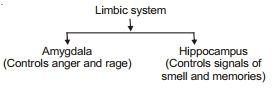
(B) The limbic system,along with the hypothalamus,is involved in the regulation of sexual behavior,expression of emotional reactions (e.g.,excitement,pleasure,rage,fear,and motivation),and control of motivation.
Within the limbic system,the amygdala is specifically responsible for processing emotional responses,particularly aggression,rage,and the memory of fear. It acts as a center for emotional regulation.
Within the limbic system,the amygdala is specifically responsible for processing emotional responses,particularly aggression,rage,and the memory of fear. It acts as a center for emotional regulation.
0 likes
View Solution361
EasyMCQ
The link between paracoel and diocoel is through
A
Foramina Luschka
B
Foramina Magendie
C
Foramen of Monro
D
Aqueduct of Sylvius
Solution
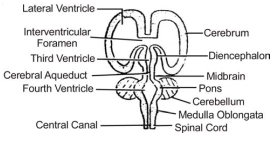
(C) The paracoel (lateral ventricles) and the diocoel (third ventricle) are connected by the Foramen of Monro,also known as the interventricular foramen.
$1$. Paracoel: Refers to the lateral ventricles located within the cerebral hemispheres.
$2$. Diocoel: Refers to the third ventricle located within the diencephalon.
$3$. Foramen of Monro: This narrow channel allows cerebrospinal fluid $(CSF)$ to flow from the lateral ventricles into the third ventricle.
$1$. Paracoel: Refers to the lateral ventricles located within the cerebral hemispheres.
$2$. Diocoel: Refers to the third ventricle located within the diencephalon.
$3$. Foramen of Monro: This narrow channel allows cerebrospinal fluid $(CSF)$ to flow from the lateral ventricles into the third ventricle.
0 likes
View Solution362
EasyMCQ
The function of the choroid plexus is
A
To produce lymph
B
To produce blood
C
To produce cerebrospinal fluid
D
To produce endolymph
Solution
(C) The choroid plexus is a network of blood vessels and ependymal cells located in the ventricles of the brain. Its primary function is to produce cerebrospinal fluid $(CSF)$,which cushions the brain and spinal cord,provides nutrients,and removes waste products.
0 likes
View Solution363
EasyMCQ
The branched tree-like structure present in the cerebellum is known as:
A
Arborial
B
Areole
C
Arbor vitae
D
Archenteron
Solution
(C) The branched, tree-like structure present in the cerebellum is known as $Arbor \text{ } vitae$.
It is formed by the arrangement of white matter (myelinated axons) surrounded by grey matter (neuronal cell bodies), which creates a distinct branching pattern resembling a tree.
It is formed by the arrangement of white matter (myelinated axons) surrounded by grey matter (neuronal cell bodies), which creates a distinct branching pattern resembling a tree.
0 likes
View Solution364
EasyMCQ
The vomiting centre is situated in
A
Cerebrum
B
Cerebellum
C
Medulla
D
Hypothalamus
Solution
(C) The vomiting centre is a collection of neurons located in the medulla oblongata of the brainstem. It coordinates the complex reflex of vomiting by receiving signals from various parts of the body,including the gastrointestinal tract and the chemoreceptor trigger zone.
0 likes
View Solution365
EasyMCQ
The end of the spinal cord is known as:
A
Cauda equina
B
Conus terminalis
C
Filum terminalis
D
Funiculus
Solution
(B) The tapered, lower end of the spinal cord is called the $Conus terminalis$.
$Filum terminale$ is a fibrous strand of pia mater that extends from the $Conus terminalis$ to the coccyx.
$Cauda equina$ refers to the bundle of spinal nerve roots that arise from the lower part of the spinal cord and occupy the vertebral canal below the $Conus terminalis$.
$Funiculus$ refers to the columns of white matter in the spinal cord.
$Filum terminale$ is a fibrous strand of pia mater that extends from the $Conus terminalis$ to the coccyx.
$Cauda equina$ refers to the bundle of spinal nerve roots that arise from the lower part of the spinal cord and occupy the vertebral canal below the $Conus terminalis$.
$Funiculus$ refers to the columns of white matter in the spinal cord.
0 likes
View Solution366
EasyMCQ
Paralysis of jaw muscles is due to loss of function of which cranial nerve?
A
$III$
B
$V$
C
$VII$
D
$X$
Solution
(B) The trigeminal nerve ($V^{th}$ cranial nerve) is responsible for the motor innervation of the muscles of mastication (jaw muscles).
Loss of function of the trigeminal nerve results in paralysis of these muscles,leading to an inability to chew properly.
Loss of function of the trigeminal nerve results in paralysis of these muscles,leading to an inability to chew properly.
0 likes
View Solution367
EasyMCQ
Which of the following cranial nerves in man is both sensory and motor?
A
Optic
B
Olfactory
C
Trigeminal
D
Auditory
Solution
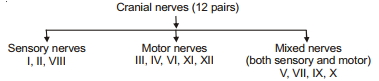
(C) Cranial nerves are classified based on their function into sensory,motor,and mixed nerves.
$1$. Sensory nerves: These carry sensory information to the brain (e.g.,$I$ - Olfactory,$II$ - Optic,$VIII$ - Auditory).
$2$. Motor nerves: These carry motor commands from the brain to muscles or glands (e.g.,$III$ - Oculomotor,$IV$ - Trochlear,$VI$ - Abducens,$XI$ - Accessory,$XII$ - Hypoglossal).
$3$. Mixed nerves: These contain both sensory and motor fibers (e.g.,$V$ - Trigeminal,$VII$ - Facial,$IX$ - Glossopharyngeal,$X$ - Vagus).
Among the given options,the Trigeminal nerve $(V)$ is a mixed nerve,meaning it is both sensory and motor.
$1$. Sensory nerves: These carry sensory information to the brain (e.g.,$I$ - Olfactory,$II$ - Optic,$VIII$ - Auditory).
$2$. Motor nerves: These carry motor commands from the brain to muscles or glands (e.g.,$III$ - Oculomotor,$IV$ - Trochlear,$VI$ - Abducens,$XI$ - Accessory,$XII$ - Hypoglossal).
$3$. Mixed nerves: These contain both sensory and motor fibers (e.g.,$V$ - Trigeminal,$VII$ - Facial,$IX$ - Glossopharyngeal,$X$ - Vagus).
Among the given options,the Trigeminal nerve $(V)$ is a mixed nerve,meaning it is both sensory and motor.
0 likes
View Solution368
EasyMCQ
The smallest cranial nerve of the body is:
A
Trigeminal
B
Abducens
C
Ophthalmic
D
Trochlear
Solution
(D) The trochlear nerve $(IV)$ is the smallest cranial nerve in the human body. It is a motor nerve that innervates the superior oblique muscle of the eye. In contrast,the vagus nerve $(X)$ is the largest cranial nerve.
0 likes
View Solution369
EasyMCQ
The fourth cranial nerve of man is
A
Abducens
B
Trochlear
C
Auditory
D
Oculomotor
Solution
(B) The cranial nerves in humans are numbered based on their origin from the brain. The fourth cranial nerve is the Trochlear nerve,which is responsible for innervating the superior oblique muscle of the eye.
| Abducens | $VI^{th}$ cranial nerve |
| Trochlear | $IV^{th}$ cranial nerve |
| Auditory | $VIII^{th}$ cranial nerve |
| Oculomotor | $III^{rd}$ cranial nerve |
0 likes
View Solution370
EasyMCQ
The number of spinal nerves in humans is (in $pairs$)
A
$31$
B
$62$
C
$12$
D
$24$
Solution
(A) In humans, there are $31$ pairs of spinal nerves that emerge from the spinal cord.
These nerves are categorized based on the region of the vertebral column: $8$ cervical, $12$ thoracic, $5$ lumbar, $5$ sacral, and $1$ coccygeal pair.
Therefore, the total number of spinal nerves is $31$ pairs, which equals $62$ individual nerves.
These nerves are categorized based on the region of the vertebral column: $8$ cervical, $12$ thoracic, $5$ lumbar, $5$ sacral, and $1$ coccygeal pair.
Therefore, the total number of spinal nerves is $31$ pairs, which equals $62$ individual nerves.
0 likes
View Solution371
MediumMCQ
After drinking alcohol,a person walks clumsily because the alcohol affects his:
A
Cerebellum
B
Cerebrum
C
Medulla oblongata
D
Spinal cord
Solution
(A) Alcoholism is the dependency of a person on the regular consumption of alcohol.
Alcohol primarily affects the $Cerebellum$,which is the part of the brain responsible for maintaining body balance,posture,and muscle coordination.
When the $Cerebellum$ is impaired by alcohol,the person loses muscle coordination,leading to a staggering gait (clumsy walking) and incoherent speech.
Alcohol primarily affects the $Cerebellum$,which is the part of the brain responsible for maintaining body balance,posture,and muscle coordination.
When the $Cerebellum$ is impaired by alcohol,the person loses muscle coordination,leading to a staggering gait (clumsy walking) and incoherent speech.
0 likes
View Solution372
Medium
Name the cranial meninges.
Solution
(N/A) The cranial meninges are the three protective membranes covering the brain:
$(1)$ Dura mater: The outermost,tough,and fibrous layer.
$(2)$ Arachnoid mater: The middle,thin,and web-like layer.
$(3)$ Pia mater: The innermost,delicate layer that is in direct contact with the brain tissue.
$(1)$ Dura mater: The outermost,tough,and fibrous layer.
$(2)$ Arachnoid mater: The middle,thin,and web-like layer.
$(3)$ Pia mater: The innermost,delicate layer that is in direct contact with the brain tissue.
0 likes
View Solution373
EasyMCQ
How many parts of the brain are observed?
A
One
B
Two
C
Three
D
Four
Solution
(C) The human brain is divided into three main parts:
$(a)$ Forebrain (Prosencephalon)
$(b)$ Midbrain (Mesencephalon)
$(c)$ Hindbrain (Rhombencephalon)
$(a)$ Forebrain (Prosencephalon)
$(b)$ Midbrain (Mesencephalon)
$(c)$ Hindbrain (Rhombencephalon)
0 likes
View Solution374
EasyMCQ
What are the parts of the forebrain?
A
Cerebrum,Thalamus,Hypothalamus
B
Midbrain,Pons,Medulla
C
Cerebellum,Pons,Medulla
D
Thalamus,Hypothalamus,Cerebellum
Solution
(A) The forebrain (prosencephalon) is the anterior part of the brain.
It consists of three main regions:
$(i)$ Cerebrum: The largest part of the brain responsible for higher functions like thought and memory.
$(ii)$ Thalamus: $A$ major coordinating center for sensory and motor signaling.
$(iii)$ Hypothalamus: Located at the base of the thalamus,it controls body temperature,urge for eating and drinking,and regulates hormone secretion from the pituitary gland.
It consists of three main regions:
$(i)$ Cerebrum: The largest part of the brain responsible for higher functions like thought and memory.
$(ii)$ Thalamus: $A$ major coordinating center for sensory and motor signaling.
$(iii)$ Hypothalamus: Located at the base of the thalamus,it controls body temperature,urge for eating and drinking,and regulates hormone secretion from the pituitary gland.
0 likes
View Solution375
EasyMCQ
What is grey matter?
A
$A$ collection of myelinated nerve fibers.
B
The cerebral cortex containing cell bodies of neurons.
C
The white-colored region of the spinal cord.
D
$A$ type of glial cell found in the brain.
Solution
(B) The cerebral cortex is referred to as the grey matter due to its greyish appearance.
It contains an abundance of cell bodies,dendrites,and unmyelinated axons of neurons,which give it a characteristic grey color.
In contrast,the inner part of the brain consists of myelinated axons,which appear white and are known as white matter.
It contains an abundance of cell bodies,dendrites,and unmyelinated axons of neurons,which give it a characteristic grey color.
In contrast,the inner part of the brain consists of myelinated axons,which appear white and are known as white matter.
0 likes
View Solution376
Medium
What are association areas?
Solution
(N/A) The cerebral cortex contains motor areas,sensory areas,and large regions that are neither clearly sensory nor motor in function. These regions are called association areas. They are responsible for complex functions like intersensory associations,memory,and communication.
0 likes
View Solution377
EasyMCQ
What is white matter?
A
The outer layer of the cerebral cortex.
B
The inner part of the cerebral hemisphere consisting of myelinated nerve fibres.
C
The grey-colored region of the brain.
D
The protective membrane covering the brain.
Solution
(B) The fibres of the tracts are covered with the myelin sheath,which constitutes the inner part of the cerebral hemisphere.
These myelinated fibres give an opaque white appearance to this layer,and hence,it is called the white matter.
These myelinated fibres give an opaque white appearance to this layer,and hence,it is called the white matter.
0 likes
View Solution378
MediumMCQ
What is the limbic system?
A
$A$ part of the brain stem
B
$A$ complex structure formed by the inner parts of cerebral hemispheres and associated deep structures
C
$A$ system responsible only for motor coordination
D
$A$ network of nerves in the spinal cord
Solution
(B) The inner parts of the cerebral hemispheres and a group of associated deep structures like the amygdala,hippocampus,etc.,form a complex structure called the limbic system.
This system,along with the hypothalamus,is involved in the regulation of sexual behavior,expression of emotional reactions (e.g.,excitement,pleasure,rage,and fear),and motivation.
This system,along with the hypothalamus,is involved in the regulation of sexual behavior,expression of emotional reactions (e.g.,excitement,pleasure,rage,and fear),and motivation.
0 likes
View Solution379
EasyMCQ
How is the brain stem formed?
A
Midbrain and forebrain
B
Midbrain and hindbrain
C
Forebrain and hindbrain
D
Cerebrum and cerebellum
Solution
(B) The brain stem is the stalk-like portion of the brain that connects the cerebrum with the spinal cord.
It is formed by the midbrain,pons,and medulla oblongata.
Since the pons and medulla oblongata are parts of the hindbrain,the brain stem is collectively formed by the midbrain and the hindbrain.
It is formed by the midbrain,pons,and medulla oblongata.
Since the pons and medulla oblongata are parts of the hindbrain,the brain stem is collectively formed by the midbrain and the hindbrain.
0 likes
View Solution380
MediumMCQ
What are the functions of the medulla oblongata?
A
Regulation of body temperature
B
Control of respiration,cardiovascular reflexes,and gastric secretions
C
Coordination of muscular activities
D
Regulation of sexual behavior
Solution
(B) The medulla oblongata is a vital part of the brainstem. It contains several autonomic centers that regulate involuntary life-sustaining functions. Specifically,it contains centers that control respiration,cardiovascular reflexes (such as heart rate and blood pressure),and gastric secretions.
0 likes
View Solution381
MediumMCQ
The central nervous system $(CNS)$ consists of ........
A
Afferent fibers and efferent fibers
B
Brain and spinal cord
C
Somatic neural system and autonomic neural system
D
Sympathetic neural system and parasympathetic neural system
Solution
(B) The human neural system is divided into two parts: the central neural system $(CNS)$ and the peripheral neural system $(PNS)$.
The central neural system $(CNS)$ includes the brain and the spinal cord and is the site of information processing and control.
The peripheral neural system $(PNS)$ comprises all the nerves of the body associated with the $CNS$ (brain and spinal cord).
Therefore,the correct option is $B$.
The central neural system $(CNS)$ includes the brain and the spinal cord and is the site of information processing and control.
The peripheral neural system $(PNS)$ comprises all the nerves of the body associated with the $CNS$ (brain and spinal cord).
Therefore,the correct option is $B$.
0 likes
View Solution382
EasyMCQ
Match the following columns regarding the cranial meninges:
| Column-$I$ | Column-$II$ |
|---|---|
| $P$. Pia mater | $I$. Thin and vascular |
| $Q$. Arachnoid mater | $II$. Thin,transparent,avascular |
| $R$. Dura mater | $III$. Thick,tough |
A
$(P-I), (Q-II), (R-III)$
B
$(P-III), (Q-II), (R-I)$
C
$(P-II), (Q-I), (R-III)$
D
$(P-III), (Q-I), (R-II)$
Solution
(A) The cranial meninges consist of three layers:
$1$. $P$. Pia mater: It is the innermost layer,which is thin and highly vascular.
$2$. $Q$. Arachnoid mater: It is the middle layer,which is thin,transparent,and avascular.
$3$. $R$. Dura mater: It is the outermost layer,which is thick and tough.
Therefore,the correct matching is $(P-I), (Q-II), (R-III)$.
$1$. $P$. Pia mater: It is the innermost layer,which is thin and highly vascular.
$2$. $Q$. Arachnoid mater: It is the middle layer,which is thin,transparent,and avascular.
$3$. $R$. Dura mater: It is the outermost layer,which is thick and tough.
Therefore,the correct matching is $(P-I), (Q-II), (R-III)$.
0 likes
View Solution383
EasyMCQ
Into how many main parts is the human brain divided?
A
$2$
B
$3$
C
$4$
D
$5$
Solution
(B) The human brain is anatomically and functionally divided into $3$ main parts:
$1$. Forebrain (Prosencephalon)
$2$. Midbrain (Mesencephalon)
$3$. Hindbrain (Rhombencephalon)
Therefore,the correct option is $B$.
$1$. Forebrain (Prosencephalon)
$2$. Midbrain (Mesencephalon)
$3$. Hindbrain (Rhombencephalon)
Therefore,the correct option is $B$.
0 likes
View Solution384
MediumMCQ
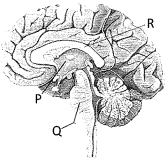
The following diagram shows a sagittal section of the human brain. Identify $P, Q$ and $R$.
A
$P$: Hypothalamus,$Q$: Pons,$R$: Cerebral hemisphere
B
$P$: Thalamus,$Q$: Pons,$R$: Corpus callosum
C
$P$: Thalamus,$Q$: Medulla oblongata,$R$: Corpus callosum
D
$P$: Hypothalamus,$Q$: Medulla oblongata,$R$: Cerebral hemisphere
Solution
(B) In the provided sagittal section of the human brain:
$1$. $P$ points to the Thalamus,which is a major coordinating center for sensory and motor signaling.
$2$. $Q$ points to the Pons,which is part of the brainstem and contains fiber tracts that interconnect different regions of the brain.
$3$. $R$ points to the Corpus callosum,which is a tract of nerve fibers that connects the two cerebral hemispheres.
Therefore,the correct identification is $P$: Thalamus,$Q$: Pons,$R$: Corpus callosum.
$1$. $P$ points to the Thalamus,which is a major coordinating center for sensory and motor signaling.
$2$. $Q$ points to the Pons,which is part of the brainstem and contains fiber tracts that interconnect different regions of the brain.
$3$. $R$ points to the Corpus callosum,which is a tract of nerve fibers that connects the two cerebral hemispheres.
Therefore,the correct identification is $P$: Thalamus,$Q$: Pons,$R$: Corpus callosum.
0 likes
View Solution385
EasyMCQ
Which of the following parts is not a part of the forebrain?
A
Cerebellum
B
Thalamus
C
Hypothalamus
D
Cerebrum
Solution
(A) The human brain is divided into three main parts: Forebrain,Midbrain,and Hindbrain.
$1$. The Forebrain consists of the Cerebrum,Thalamus,and Hypothalamus.
$2$. The Midbrain connects the forebrain to the hindbrain.
$3$. The Hindbrain consists of the Pons,Medulla oblongata,and Cerebellum.
Therefore,the Cerebellum is a part of the hindbrain,not the forebrain.
$1$. The Forebrain consists of the Cerebrum,Thalamus,and Hypothalamus.
$2$. The Midbrain connects the forebrain to the hindbrain.
$3$. The Hindbrain consists of the Pons,Medulla oblongata,and Cerebellum.
Therefore,the Cerebellum is a part of the hindbrain,not the forebrain.
0 likes
View Solution386
EasyMCQ
The left and right cerebral hemispheres are connected by a tract of nerve fibers,which is called the ...... .
A
Corpus luteum
B
Corpus callosum
C
Corpus albicans
D
All of the above
Solution
(B) The human brain consists of two cerebral hemispheres,the left and the right. These two hemispheres are connected by a large tract of nerve fibers known as the $Corpus \ callosum$. This structure allows for communication and coordination between the two hemispheres. $Corpus \ luteum$ and $Corpus \ albicans$ are structures related to the female reproductive system,specifically the ovary.
0 likes
View Solution387
MediumMCQ
The layer of cells which covers the cerebral hemispheres is called .......
A
Cerebral cortex
B
Cerebral medulla
C
Thalamus
D
Hypothalamus
Solution
(A) The cerebral hemispheres are covered by a layer of cells which is referred to as the cerebral cortex.
It is composed of grey matter,which gives it a greyish appearance.
The cerebral cortex contains motor areas,sensory areas,and large regions that are neither clearly sensory nor motor in function,known as association areas.
It is composed of grey matter,which gives it a greyish appearance.
The cerebral cortex contains motor areas,sensory areas,and large regions that are neither clearly sensory nor motor in function,known as association areas.
0 likes
View Solution388
MediumMCQ
What is the function of the association areas present in the cerebral cortex?
A
Intersensory associations
B
Memory
C
Communication
D
All of the above
Solution
(D) The cerebral cortex contains large regions that are neither clearly sensory nor motor in function. These regions are called association areas.
These areas are responsible for complex functions such as intersensory associations,memory,and communication.
Therefore,all the given options are correct functions of the association areas.
These areas are responsible for complex functions such as intersensory associations,memory,and communication.
Therefore,all the given options are correct functions of the association areas.
0 likes
View Solution389
MediumMCQ
The cerebral cortex is referred to as the ....... due to its ....... appearance.
A
grey,grey matter
B
yellow,yellow matter
C
white,white matter
D
red,red matter
Solution
(A) The cerebral cortex is the outer layer of the cerebrum. It contains cell bodies of neurons, which give it a greyish appearance. Therefore, it is commonly referred to as the grey matter $ (\text{grey matter}) $.
0 likes
View Solution390
MediumMCQ
What types of areas are present in the cerebral cortex?
A
Motor areas
B
Sensory areas
C
Association areas
D
All of the above
Solution
(D) The cerebral cortex is the outer layer of the cerebrum,which is highly folded to increase its surface area. It contains three main types of functional areas:
$1$. Motor areas: These control voluntary muscle movements.
$2$. Sensory areas: These receive and process sensory information from various parts of the body.
$3$. Association areas: These are large regions that are neither clearly sensory nor motor in function. They are responsible for complex functions like intersensory associations,memory,and communication.
$1$. Motor areas: These control voluntary muscle movements.
$2$. Sensory areas: These receive and process sensory information from various parts of the body.
$3$. Association areas: These are large regions that are neither clearly sensory nor motor in function. They are responsible for complex functions like intersensory associations,memory,and communication.
0 likes
View Solution391
MediumMCQ
The inner part of the cerebral hemisphere is called the ........ due to its ........ appearance.
A
grey,grey matter
B
yellow,yellow matter
C
white,white matter
D
red,red matter
Solution
(C) The cerebral hemispheres are composed of an outer layer called the cerebral cortex and an inner layer. The cerebral cortex is composed of grey matter (due to the concentration of neuron cell bodies),while the inner part of the cerebral hemisphere is composed of axons covered with myelin sheaths. Because myelin is a fatty substance that appears white,this inner region is referred to as white matter.
0 likes
View Solution392
MediumMCQ
Select the incorrect statement regarding the $Thalamus$.
A
It is a structure wrapped by the $Cerebrum$.
B
It also acts as an endocrine gland.
C
It is the major coordinating center for sensory and motor signaling.
D
It is a part of the $Forebrain$.
Solution
(B) The $Thalamus$ is a major structure of the $Forebrain$ (specifically the $Diencephalon$).
It acts as a major coordinating center for sensory and motor signaling,relaying information to the $Cerebral$ cortex.
It is surrounded by the $Cerebrum$.
However,the $Thalamus$ does not act as an endocrine gland; the $Pituitary$ gland and $Hypothalamus$ are the primary endocrine components in the brain. Therefore,the statement that it acts as an endocrine gland is incorrect.
It acts as a major coordinating center for sensory and motor signaling,relaying information to the $Cerebral$ cortex.
It is surrounded by the $Cerebrum$.
However,the $Thalamus$ does not act as an endocrine gland; the $Pituitary$ gland and $Hypothalamus$ are the primary endocrine components in the brain. Therefore,the statement that it acts as an endocrine gland is incorrect.
0 likes
View Solution393
MediumMCQ
The limbic lobe or limbic system is $=........$
A
Amygdala $+$ Hippocampus
B
Amygdala $+$ Hippocampus $+$ Thalamus
C
Hippocampus $+$ Thalamus
D
Cerebrum $+$ Hippocampus $+$ Thalamus
Solution
(A) The inner parts of the cerebral hemispheres and a group of associated deep structures like the amygdala and hippocampus form a complex structure called the limbic lobe or limbic system.
It is involved in the regulation of sexual behavior,expression of emotional reactions (e.g.,excitement,pleasure,rage,and fear),and motivation.
Therefore,the limbic system consists of the amygdala and the hippocampus along with other associated structures.
It is involved in the regulation of sexual behavior,expression of emotional reactions (e.g.,excitement,pleasure,rage,and fear),and motivation.
Therefore,the limbic system consists of the amygdala and the hippocampus along with other associated structures.
0 likes
View Solution394
EasyMCQ
The brain stem consists of $......$
A
Midbrain $+$ Forebrain
B
Midbrain $+$ Hindbrain
C
Forebrain $+$ Hindbrain
D
Forebrain $+$ Midbrain $+$ Hindbrain
Solution
(B) The brain stem is the posterior part of the brain that connects the cerebrum with the spinal cord.
It is formed by the midbrain,pons,and medulla oblongata.
Since the pons and medulla oblongata are parts of the hindbrain,the brain stem is composed of the midbrain and the hindbrain (excluding the cerebellum).
It is formed by the midbrain,pons,and medulla oblongata.
Since the pons and medulla oblongata are parts of the hindbrain,the brain stem is composed of the midbrain and the hindbrain (excluding the cerebellum).
0 likes
View Solution395
MediumMCQ
The limbic lobe or limbic system,along with $.......$,regulates sexual behavior,the expression of emotional reactions,and motivation.
A
Cerebrum
B
Hypothalamus
C
Thalamus
D
Medulla oblongata
Solution
(B) The limbic system is a complex set of structures in the brain. It consists of the inner parts of the cerebral hemispheres,such as the amygdala and hippocampus,along with the hypothalamus. Together,these structures are involved in the regulation of sexual behavior,the expression of emotional reactions (e.g.,excitement,pleasure,rage,and fear),and motivation.
0 likes
View Solution396
MediumMCQ
The $........$ passes through the midbrain.
A
Cerebral aqueduct
B
Fourth ventricle
C
Eustachian tube
D
Cerebrospinal canal
Solution
(A) The midbrain is located between the thalamus/hypothalamus of the forebrain and the pons of the hindbrain. $A$ canal called the cerebral aqueduct passes through the midbrain. This canal connects the third ventricle (in the diencephalon) to the fourth ventricle (in the hindbrain),allowing the flow of cerebrospinal fluid $(CSF)$.
0 likes
View Solution397
MediumMCQ
The $........$ part of the midbrain mainly consists of four rounded swellings called corpora quadrigemina.
A
Dorsal
B
Ventral
C
Lateral
D
Anterior
Solution
(A) The midbrain is located between the thalamus/hypothalamus of the forebrain and the pons of the hindbrain. $A$ canal called the cerebral aqueduct passes through the midbrain. The dorsal portion of the midbrain consists mainly of four rounded swellings called corpora quadrigemina. Therefore,the correct option is $A$.
0 likes
View Solution398
MediumMCQ
Select the incorrect option regarding the medulla oblongata.
A
The medulla oblongata is connected to the spinal cord.
B
The medulla oblongata controls respiratory and cardiovascular reflexes.
C
The medulla oblongata is a part of the forebrain.
D
The medulla oblongata controls gastric secretions.
Solution
(C) The medulla oblongata is a part of the hindbrain,not the forebrain. It contains centers which control respiration,cardiovascular reflexes,and gastric secretions. It also connects the brain to the spinal cord.
0 likes
View Solution399
MediumMCQ
The ......... consists of fiber tracts that interconnect different regions of the brain.
A
Pons
B
Medulla oblongata
C
Cerebellum
D
Midbrain
Solution
(A) The $Pons$ is a part of the hindbrain located above the $Medulla$ $oblongata$.
It contains fiber tracts that act as a bridge,interconnecting different regions of the brain,such as the cerebral cortex and the cerebellum.
Therefore,the correct answer is $A$.
It contains fiber tracts that act as a bridge,interconnecting different regions of the brain,such as the cerebral cortex and the cerebellum.
Therefore,the correct answer is $A$.
0 likes
View Solution400
MediumMCQ
The parts of the human brain that help in the regulation of sexual behaviour,expression of excitement,pleasure,rage,fear,etc.,are:
A
Corpus callosum and thalamus
B
Limbic system and hypothalamus
C
Corpora quadrigemina and hippocampus
D
Brain stem and epithalamus
Solution
(B) Option $B$ is the correct answer because the limbic system,along with the hypothalamus,regulates sexual behaviour,the expression of excitement,pleasure,rage,fear,etc.
Option $A$,$C$,and $D$ are incorrect because:
$1$. Corpora quadrigemina is a part of the midbrain consisting of four round swellings.
$2$. Corpus callosum is a tract of nerve fibres that connects the right and left cerebral hemispheres.
$3$. Thalamus is a major coordinating centre in the forebrain for sensory and motor signalling.
$4$. The midbrain,pons,and medulla oblongata together form the brain stem.
Option $A$,$C$,and $D$ are incorrect because:
$1$. Corpora quadrigemina is a part of the midbrain consisting of four round swellings.
$2$. Corpus callosum is a tract of nerve fibres that connects the right and left cerebral hemispheres.
$3$. Thalamus is a major coordinating centre in the forebrain for sensory and motor signalling.
$4$. The midbrain,pons,and medulla oblongata together form the brain stem.
0 likes
View SolutionNeural Control and Coordination — Central Neural System · Frequently Asked Questions
1Are these Neural Control and Coordination questions useful for JEE and NEET?
Yes. All questions in this section are mapped to JEE Main and NEET exam patterns. Previous year questions from JEE Main, NEET, GUJCET and state-level exams are included with full solutions.
2Can I switch to Hindi or Gujarati for these questions?
Yes. Use the language tabs in the hero section or the sidebar to view the same questions and solutions in English, Hindi or Gujarati.
3How do I generate a question paper from this subtopic?
Use the Vedclass Exam Paper Generator — select the chapter and subtopic, set difficulty, and generate Sets A, B, C, D automatically. First 3 chapters of every subject are free.
Vedclass Products
For Students
Vedclass Test Series
Mock tests in real JEE/NEET style with performance analysis. 5-day free trial.
Start Free TrialFor Teachers
Exam Paper Generator
Generate Set A/B/C/D papers from this chapter in 2 minutes. 3 chapters free.
Try FreeFor Institutes
Online Exam Module
Live online exams with unlimited students, 360° analytics & white-label branding.
See DemoFor Teachers & Institutes
Generate a Neural Control and Coordination Exam Paper in 2 Minutes
Select subtopic & difficulty — Sets A, B, C, D auto-generated with No Repeat logic.
First 3 chapters of every subject are free — no payment required.