
A English
Central Neural System Questions in English
Class 11 Biology · Neural Control and Coordination · Central Neural System
450+
Questions
English
Language
100%
With Solutions
Showing 48 of 450 questions in English
251
EasyMCQ
What does the $Corpus$ $callosum$ connect?
A
Two cerebral hemispheres
B
Optic lobes
C
Two olfactory lobes
D
Optic chiasma
Solution
(A) The $Corpus$ $callosum$ is a thick band of nerve fibers that connects the two cerebral hemispheres of the brain.
It facilitates communication between the left and right hemispheres,allowing for the coordination of information and integrated brain function.
It facilitates communication between the left and right hemispheres,allowing for the coordination of information and integrated brain function.
0 likes
View Solution252
EasyMCQ
The forebrain develops from which of the following?
A
Diencephalon and Cerebrum
B
Diencephalon and Cerebellum
C
Diencephalon and Medulla oblongata
D
Diencephalon and Pons
Solution
(A) The forebrain (prosencephalon) in vertebrates develops into two main parts during embryonic development: the diencephalon and the telencephalon (which gives rise to the cerebrum). Therefore,the forebrain consists of the diencephalon and the cerebrum.
0 likes
View Solution253
MediumMCQ
Destruction of the anterior horn cells of the spinal cord would result in loss of
A
commissural impulses
B
integrating impulses
C
sensory impulses
D
voluntary motor impulses.
Solution
(D) The anterior horns of the spinal cord contain the cell bodies of lower motor neurons.
These neurons send their axons through the anterior (ventral) roots to innervate skeletal muscles.
These cells are essential for both voluntary movements and reflex activities of the muscles they supply.
If the anterior horn motor cells are destroyed,the motor signals cannot reach the muscles,leading to a loss of voluntary motor control and muscle paralysis.
These neurons send their axons through the anterior (ventral) roots to innervate skeletal muscles.
These cells are essential for both voluntary movements and reflex activities of the muscles they supply.
If the anterior horn motor cells are destroyed,the motor signals cannot reach the muscles,leading to a loss of voluntary motor control and muscle paralysis.
0 likes
View Solution254
MediumMCQ
Which of the following regions of the brain is incorrectly paired with its function?
A
Corpus callosum $\Rightarrow$ communication between the left and right cerebral cortices
B
Cerebrum $\Rightarrow$ calculation and contemplation
C
Medulla oblongata $\Rightarrow$ homeostatic control
D
Cerebellum $\Rightarrow$ language comprehension
Solution
(D) : Language comprehension is a function of the cerebrum.
Cerebellum coordinates and controls rapid muscular activities such as running,typing,etc.
Although it does not initiate such voluntary movements,it is an important center for coordinating movements and for controlling posture and balance.
Cerebellum's function is almost exclusively motor; however,it is also implicated in some forms of learning.
Cerebellum coordinates and controls rapid muscular activities such as running,typing,etc.
Although it does not initiate such voluntary movements,it is an important center for coordinating movements and for controlling posture and balance.
Cerebellum's function is almost exclusively motor; however,it is also implicated in some forms of learning.
0 likes
View Solution255
MediumMCQ
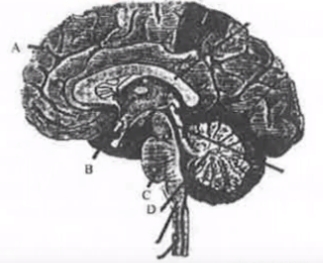
$A$ sagittal section of the human brain is shown here. Identify at least two labels from $A-D$.
A
$C$ - Midbrain,$D$ - Cerebellum
B
$A$ - Cerebrum,$C$ - Pons
C
$B$ - Corpus callosum,$D$ - Medulla
D
$A$ - Cerebral hemispheres,$B$ - Cerebellum
Solution
(B) Based on the provided sagittal section of the human brain:
$A$ represents the Cerebral hemisphere (part of the forebrain).
$B$ represents the Thalamus (part of the forebrain).
$C$ represents the Pons varolii (part of the hindbrain).
$D$ represents the Cerebellum (part of the hindbrain).
Therefore,option $B$ correctly identifies $A$ as the Cerebrum (Cerebral hemisphere) and $C$ as the Pons.
$A$ represents the Cerebral hemisphere (part of the forebrain).
$B$ represents the Thalamus (part of the forebrain).
$C$ represents the Pons varolii (part of the hindbrain).
$D$ represents the Cerebellum (part of the hindbrain).
Therefore,option $B$ correctly identifies $A$ as the Cerebrum (Cerebral hemisphere) and $C$ as the Pons.
0 likes
View Solution256
MediumMCQ
The human hindbrain comprises three parts, one of which is
A
spinal cord
B
corpus callosum
C
cerebellum
D
hypothalamus
Solution
(C) The human brain is the anterior-most part of the central nervous system. It is divided into three main parts: forebrain, midbrain, and hindbrain. The hindbrain consists of three specific structures: the $pons$, the $cerebellum$, and the $medulla$ (also known as the $medulla$ $oblongata$). Therefore, the $cerebellum$ is a part of the hindbrain.
0 likes
View Solution257
MediumMCQ
Which nervous system can increase the rate of heart beat?
A
Central nervous system
B
Parasympathetic nervous system
C
Autonomic nervous system
D
$A$ and $B$ both
Solution
(C) The heart rate is regulated by the autonomic nervous system $(ANS)$.
Specifically,the sympathetic nervous system,which is a division of the $ANS$,increases the heart rate and the strength of ventricular contraction.
In contrast,the parasympathetic nervous system decreases the heart rate.
Therefore,the autonomic nervous system is the correct category that includes the sympathetic division responsible for increasing the heart rate.
Specifically,the sympathetic nervous system,which is a division of the $ANS$,increases the heart rate and the strength of ventricular contraction.
In contrast,the parasympathetic nervous system decreases the heart rate.
Therefore,the autonomic nervous system is the correct category that includes the sympathetic division responsible for increasing the heart rate.
0 likes
View Solution258
MediumMCQ
Which of the following parts contains centers that control respiration, cardiovascular reflexes, and gastric secretions?
A
Cerebral aqueduct
B
Pons
C
Cerebellum
D
Medulla
Solution
(D) The $Medulla$ $oblongata$ is the posterior part of the brainstem that connects to the spinal cord.
It contains vital centers that regulate essential autonomic functions.
Specifically, the $Medulla$ contains the respiratory rhythm center, cardiovascular centers (regulating heart rate and blood pressure), and centers for gastric secretions and other reflexes like vomiting, coughing, and sneezing.
Therefore, the correct option is $D$.
It contains vital centers that regulate essential autonomic functions.
Specifically, the $Medulla$ contains the respiratory rhythm center, cardiovascular centers (regulating heart rate and blood pressure), and centers for gastric secretions and other reflexes like vomiting, coughing, and sneezing.
Therefore, the correct option is $D$.
0 likes
View Solution259
MediumMCQ
The brain stem consists of:
A
Medulla,pons,cerebellum
B
Cerebellum,hypothalamus,midbrain
C
Pons,medulla,and midbrain
D
$A$ and $B$ both
Solution
(C) The brain stem is the posterior part of the brain that connects the cerebrum with the spinal cord.
It is composed of three main structures:
$1$. Midbrain
$2$. Pons
$3$. Medulla oblongata
The cerebellum is part of the hindbrain but is not considered a component of the brain stem.
It is composed of three main structures:
$1$. Midbrain
$2$. Pons
$3$. Medulla oblongata
The cerebellum is part of the hindbrain but is not considered a component of the brain stem.
0 likes
View Solution260
MediumMCQ
Association areas are responsible for complex functions like:
A
Intersensory association
B
Memory
C
Communication
D
All of the above
Solution
(D) The cerebral cortex contains large regions that are neither clearly sensory nor motor in function. These regions are called association areas.
Association areas are responsible for complex functions such as intersensory association,memory,and communication.
Therefore,all the given options are correct.
Association areas are responsible for complex functions such as intersensory association,memory,and communication.
Therefore,all the given options are correct.
0 likes
View Solution261
DifficultMCQ
Identify the correct pair regarding the parts of the brain and their functions:
A
Hypothalamus $-$ Regulation of sexual behavior and expression of emotional reactions
B
Association area of Cerebrum $-$ Memory,communication,and intersensory association
C
Hypothalamus and Limbic system $-$ Body temperature,urge for eating and drinking
D
Myelin sheath $-$ Passes impulse to another neuron
Solution
(C) The correct pair is $C$.
$1$. The Hypothalamus and the Limbic system together are responsible for the regulation of body temperature,the urge for eating,and drinking.
$2$. Option $A$ is incorrect because the expression of emotional reactions is primarily a function of the Limbic system.
$3$. Option $B$ is partially correct but often listed as distinct functions; however,$C$ is the most accurate description of the combined functional unit.
$4$. Option $D$ is incorrect because the Myelin sheath acts as an insulator to increase the speed of nerve impulse conduction,not to pass impulses between neurons.
$1$. The Hypothalamus and the Limbic system together are responsible for the regulation of body temperature,the urge for eating,and drinking.
$2$. Option $A$ is incorrect because the expression of emotional reactions is primarily a function of the Limbic system.
$3$. Option $B$ is partially correct but often listed as distinct functions; however,$C$ is the most accurate description of the combined functional unit.
$4$. Option $D$ is incorrect because the Myelin sheath acts as an insulator to increase the speed of nerve impulse conduction,not to pass impulses between neurons.
0 likes
View Solution262
MediumMCQ
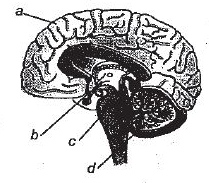
$A$ sagittal section of the human brain is shown here. Identify the correct labels from $a-d$.
A
$a-$ Cerebral hemispheres,$b-$ Cerebellum
B
$c-$ Midbrain,$d-$ Cerebellum
C
$a-$ Cerebrum,$c-$ Pons
D
$b-$ Corpus callosum,$d-$ Medulla
Solution
(C) Based on the sagittal section of the human brain provided in the image:
$a$ points to the Cerebrum (specifically the cerebral cortex/hemisphere).
$b$ points to the Hypothalamus.
$c$ points to the Pons.
$d$ points to the Medulla oblongata.
Evaluating the options:
Option $A$: $a$ is Cerebral hemisphere (Correct),but $b$ is not Cerebellum (Incorrect).
Option $B$: $c$ is Midbrain (Incorrect,it is Pons),$d$ is Cerebellum (Incorrect,it is Medulla).
Option $C$: $a$ is Cerebrum (Correct) and $c$ is Pons (Correct).
Option $D$: $b$ is Corpus callosum (Incorrect,it is Hypothalamus),$d$ is Medulla (Correct).
Therefore,option $C$ is the correct choice.
$a$ points to the Cerebrum (specifically the cerebral cortex/hemisphere).
$b$ points to the Hypothalamus.
$c$ points to the Pons.
$d$ points to the Medulla oblongata.
Evaluating the options:
Option $A$: $a$ is Cerebral hemisphere (Correct),but $b$ is not Cerebellum (Incorrect).
Option $B$: $c$ is Midbrain (Incorrect,it is Pons),$d$ is Cerebellum (Incorrect,it is Medulla).
Option $C$: $a$ is Cerebrum (Correct) and $c$ is Pons (Correct).
Option $D$: $b$ is Corpus callosum (Incorrect,it is Hypothalamus),$d$ is Medulla (Correct).
Therefore,option $C$ is the correct choice.
0 likes
View Solution263
EasyMCQ
The vomiting reflex action is controlled by the vomit center located in which part of the brain?
A
Where cardiovascular reflex centers are located
B
Where the center for body temperature is located
C
Where melatonin is secreted
D
Corpora quadrigemina
Solution
(A) The vomiting center is located in the medulla oblongata of the brain stem.
This region also contains the cardiovascular reflex centers and respiratory rhythm centers.
Therefore,the vomiting center is located in the same part where cardiovascular reflex centers are found.
This region also contains the cardiovascular reflex centers and respiratory rhythm centers.
Therefore,the vomiting center is located in the same part where cardiovascular reflex centers are found.
0 likes
View Solution264
MediumMCQ
Read the following statements carefully and select the correct option.
$I.$ The medulla is connected to the spinal cord.
$II.$ Medulla contains controlling centers for respiration,cardiovascular reflexes and gastric secretion.
$III.$ Cerebellum has very convoluted surface in order to provide the additional space for more neurons.
$I.$ The medulla is connected to the spinal cord.
$II.$ Medulla contains controlling centers for respiration,cardiovascular reflexes and gastric secretion.
$III.$ Cerebellum has very convoluted surface in order to provide the additional space for more neurons.
A
Only $I$
B
Only $I$ and $III$
C
Only $III$
D
$I, II, III$
Solution
(D) Statement $I$ is correct: The medulla oblongata of the brain is connected to the spinal cord.
Statement $II$ is correct: The medulla contains centers which control respiration,cardiovascular reflexes,and gastric secretions.
Statement $III$ is correct: The cerebellum has a very convoluted surface (folia) to provide additional space for more neurons,allowing for increased processing capacity.
Since all three statements are correct,the correct option is $D$.
Statement $II$ is correct: The medulla contains centers which control respiration,cardiovascular reflexes,and gastric secretions.
Statement $III$ is correct: The cerebellum has a very convoluted surface (folia) to provide additional space for more neurons,allowing for increased processing capacity.
Since all three statements are correct,the correct option is $D$.
0 likes
View Solution265
MediumMCQ
Association areas of the brain are
A
Always sensory areas
B
Always motor areas
C
Large regions that are neither sensory nor motor areas
D
None of the above
Solution
(C) The cerebral cortex contains motor areas,sensory areas,and large regions that are neither clearly sensory nor motor in function. These regions are called association areas. Association areas are responsible for complex functions like intersensory associations,memory,and communication.
0 likes
View Solution266
MediumMCQ
The $Pons$ of the brain connects the:
A
cerebellum and medulla
B
cerebrum and cerebellum
C
spinal cord with the brain
D
two cerebral hemispheres
Solution
(A) The $Pons$ is a part of the $Hindbrain$ located above the $Medulla$ and below the $Midbrain$.
It consists of fiber tracts that interconnect different regions of the brain.
Specifically,the $Pons$ contains nerve fibers that connect the two lobes of the $Cerebellum$ and also links the $Cerebellum$ with the $Medulla$ and the $Cerebrum$.
Among the given options,the $Pons$ serves as a bridge that connects the $Cerebellum$ and the $Medulla$ (along with other parts of the brainstem).
It consists of fiber tracts that interconnect different regions of the brain.
Specifically,the $Pons$ contains nerve fibers that connect the two lobes of the $Cerebellum$ and also links the $Cerebellum$ with the $Medulla$ and the $Cerebrum$.
Among the given options,the $Pons$ serves as a bridge that connects the $Cerebellum$ and the $Medulla$ (along with other parts of the brainstem).
0 likes
View Solution267
MediumMCQ
What is correct for the association area of the cerebral cortex?
A
Intersensory association,memory,and communication.
B
Memory,emotional reaction,and reflex action.
C
Biological clock,sexual behavior,and memory.
D
Communication,biological clock,and intersensory communication.
Solution
(A) The cerebral cortex contains large regions that are neither clearly sensory nor motor in function. These regions are called association areas.
Association areas are responsible for complex functions such as intersensory associations,memory,and communication.
Therefore,option $A$ is the correct description of the functions of the association areas.
Association areas are responsible for complex functions such as intersensory associations,memory,and communication.
Therefore,option $A$ is the correct description of the functions of the association areas.
0 likes
View Solution268
MediumMCQ
Choose the correct sequence for cranial meninges. (Outer to inner)
A
Arachnoid $\rightarrow$ Dura mater $\rightarrow$ Pia mater
B
Dura mater $\rightarrow$ Arachnoid $\rightarrow$ Pia mater
C
Pia mater $\rightarrow$ Arachnoid $\rightarrow$ Dura mater
D
Dura mater $\rightarrow$ Pia mater $\rightarrow$ Arachnoid
Solution
(B) The human brain is protected by three layers of connective tissue known as cranial meninges.
$1$. The outermost layer is the Dura mater,which is a tough,fibrous membrane.
$2$. The middle layer is the Arachnoid mater,which is a thin,web-like structure.
$3$. The innermost layer is the Pia mater,which is a delicate,vascular membrane that closely adheres to the brain tissue.
Therefore,the correct sequence from outer to inner is Dura mater $\rightarrow$ Arachnoid mater $\rightarrow$ Pia mater.
$1$. The outermost layer is the Dura mater,which is a tough,fibrous membrane.
$2$. The middle layer is the Arachnoid mater,which is a thin,web-like structure.
$3$. The innermost layer is the Pia mater,which is a delicate,vascular membrane that closely adheres to the brain tissue.
Therefore,the correct sequence from outer to inner is Dura mater $\rightarrow$ Arachnoid mater $\rightarrow$ Pia mater.
0 likes
View Solution269
EasyMCQ
The cerebral hemispheres are connected by a tract of nerve fibres called.....
A
Hypothalamus
B
Association areas
C
Corpora quadrigemina
D
Corpus callosum
Solution
(D) The human brain consists of two cerebral hemispheres.
These two hemispheres are connected to each other by a large,$C$-shaped tract of white matter (nerve fibres) known as the $Corpus \ callosum$.
This structure allows for communication between the left and right hemispheres,facilitating the integration of sensory,motor,and cognitive information.
These two hemispheres are connected to each other by a large,$C$-shaped tract of white matter (nerve fibres) known as the $Corpus \ callosum$.
This structure allows for communication between the left and right hemispheres,facilitating the integration of sensory,motor,and cognitive information.
0 likes
View Solution270
MediumMCQ
Association areas of the brain are responsible for:
$a.$ Memory
$b.$ Communication
$c.$ Blood pressure
$a.$ Memory
$b.$ Communication
$c.$ Blood pressure
A
$b$ and $c$
B
$c$ and $a$
C
only $c$
D
$a$ and $b$
Solution
(D) The cerebral cortex contains motor areas,sensory areas,and large regions that are neither clearly sensory nor motor in function. These regions are called association areas.
Association areas are responsible for complex functions like intersensory associations,memory,and communication.
Blood pressure is regulated by the medulla oblongata,not the association areas of the cerebral cortex.
Therefore,$a$ (Memory) and $b$ (Communication) are the correct functions associated with these areas.
Association areas are responsible for complex functions like intersensory associations,memory,and communication.
Blood pressure is regulated by the medulla oblongata,not the association areas of the cerebral cortex.
Therefore,$a$ (Memory) and $b$ (Communication) are the correct functions associated with these areas.
0 likes
View Solution271
MediumMCQ
Corpora quadrigemina is a part of......
A
Midbrain
B
Corpus callosum
C
Retina
D
Hindbrain
Solution
(A) The $Corpora$ $quadrigemina$ are four rounded swellings (lobes) located on the dorsal portion of the midbrain $(mesencephalon)$.
These consist of two superior colliculi and two inferior colliculi.
The superior colliculi are involved in visual reflexes, while the inferior colliculi are involved in auditory reflexes.
Therefore, the correct answer is the midbrain.
These consist of two superior colliculi and two inferior colliculi.
The superior colliculi are involved in visual reflexes, while the inferior colliculi are involved in auditory reflexes.
Therefore, the correct answer is the midbrain.
0 likes
View Solution272
MediumMCQ
Brain stem is formed by .........
A
Fore brain and hind brain
B
Fore brain and mid brain
C
Fore brain,mid brain and hind brain
D
Mid brain and hind brain
Solution
(D) The brain stem is a collective term for the structures that connect the cerebrum to the spinal cord.
It consists of three main parts: the midbrain,the pons,and the medulla oblongata.
The midbrain is part of the brain stem,while the pons and medulla oblongata are parts of the hindbrain.
Therefore,the brain stem is formed by the midbrain and the hindbrain (specifically the pons and medulla).
It consists of three main parts: the midbrain,the pons,and the medulla oblongata.
The midbrain is part of the brain stem,while the pons and medulla oblongata are parts of the hindbrain.
Therefore,the brain stem is formed by the midbrain and the hindbrain (specifically the pons and medulla).
0 likes
View Solution273
MediumMCQ
The cerebral cortex is referred to as the grey matter due to its greyish appearance. The ........... are concentrated here giving the colour.
A
Axons
B
Neuron cell bodies
C
Dendrites
D
Synaptic cleft
Solution
(B) The cerebral cortex is the outermost layer of the cerebrum. It is composed of neuronal cell bodies,dendrites,and unmyelinated axons. The high concentration of neuron cell bodies,which lack the white,fatty myelin sheath,gives this region a greyish appearance,hence it is called grey matter. In contrast,the inner part of the cerebrum consists mainly of myelinated axons,which appear white due to the myelin sheath,and is therefore called white matter.
0 likes
View Solution274
EasyMCQ
Which of the following cranial nerves controls the heart rate?
A
$X$
B
$IX$
C
$VIII$
D
$VI$
Solution
(A) The $X$ cranial nerve is known as the Vagus nerve. It is a major component of the parasympathetic nervous system and plays a crucial role in regulating the heart rate by slowing it down. The Vagus nerve provides parasympathetic innervation to the heart,specifically targeting the sinoatrial $(SA)$ node and the atrioventricular $(AV)$ node.
0 likes
View Solution275
EasyMCQ
The third ventricle of the brain is called:
A
Metacoel
B
Rhinocoele
C
Paracoel
D
Diocoel
Solution
(D) The brain contains several interconnected cavities known as ventricles,which are filled with cerebrospinal fluid $(CSF)$.
$(1)$ The first and second ventricles are the lateral ventricles,located in the cerebral hemispheres,and are called paracoels.
$(2)$ The third ventricle is located in the diencephalon and is known as the diocoel.
$(3)$ The fourth ventricle is located in the hindbrain (medulla oblongata) and is known as the metacoel.
$(4)$ Rhinocoele refers to the cavities within the olfactory lobes.
Therefore,the third ventricle is the diocoel.
$(1)$ The first and second ventricles are the lateral ventricles,located in the cerebral hemispheres,and are called paracoels.
$(2)$ The third ventricle is located in the diencephalon and is known as the diocoel.
$(3)$ The fourth ventricle is located in the hindbrain (medulla oblongata) and is known as the metacoel.
$(4)$ Rhinocoele refers to the cavities within the olfactory lobes.
Therefore,the third ventricle is the diocoel.
0 likes
View Solution276
EasyMCQ
The $Vagus$ nerve is the $...$ cranial nerve.
A
$X$
B
$IX$
C
$VII$
D
$V$
Solution
(A) The $Vagus$ nerve is the $10th$ cranial nerve,denoted as $X$ in Roman numerals. It is the longest cranial nerve and plays a crucial role in the parasympathetic nervous system,regulating heart rate,gastrointestinal peristalsis,and sweating.
0 likes
View Solution277
MediumMCQ
The $CNS$ is primarily composed of:
A
Motor neurons and sensory neurons
B
Sensory neurons and interneurons
C
Interneurons
D
Motor neurons and interneurons
Solution
(C) The Central Nervous System $(CNS)$ consists of the brain and the spinal cord.
Within the $CNS$,the primary functional units responsible for processing information and connecting sensory and motor pathways are interneurons (also known as association neurons).
While the $CNS$ receives input from sensory neurons and sends output via motor neurons,the actual structure of the $CNS$ itself is predominantly composed of interneurons that integrate these signals.
Within the $CNS$,the primary functional units responsible for processing information and connecting sensory and motor pathways are interneurons (also known as association neurons).
While the $CNS$ receives input from sensory neurons and sends output via motor neurons,the actual structure of the $CNS$ itself is predominantly composed of interneurons that integrate these signals.
0 likes
View Solution278
EasyMCQ
In mammals,the sympathetic nerves originate from the ........ region.
A
Sacral
B
Cervical
C
Thoraco-lumbar
D
$III, VII, IX$ and $X$ cranial nerves
Solution
(C) The autonomic nervous system is divided into the sympathetic and parasympathetic nervous systems.
$1$. The sympathetic nervous system originates from the thoraco-lumbar region of the spinal cord,specifically from the $T_1$ to $L_2$ segments.
$2$. The parasympathetic nervous system originates from the cranial nerves $(III, VII, IX, X)$ and the sacral region $(S_2-S_4)$ of the spinal cord.
Therefore,the sympathetic nerves originate from the thoraco-lumbar region.
$1$. The sympathetic nervous system originates from the thoraco-lumbar region of the spinal cord,specifically from the $T_1$ to $L_2$ segments.
$2$. The parasympathetic nervous system originates from the cranial nerves $(III, VII, IX, X)$ and the sacral region $(S_2-S_4)$ of the spinal cord.
Therefore,the sympathetic nerves originate from the thoraco-lumbar region.
0 likes
View Solution279
MediumMCQ
The sympathetic nervous system stimulates $.............$.
A
Heartbeat
B
Secretion of digestive juices
C
Saliva secretion
D
All of the above
Solution
(A) The sympathetic nervous system is part of the autonomic nervous system that prepares the body for 'fight-or-flight' responses.
It increases the heart rate (heartbeat) to pump more blood to muscles.
Conversely,it inhibits the digestive system,including the secretion of digestive juices and saliva,to divert energy toward physical activity.
Therefore,among the given options,only the heartbeat is stimulated by the sympathetic nervous system.
It increases the heart rate (heartbeat) to pump more blood to muscles.
Conversely,it inhibits the digestive system,including the secretion of digestive juices and saliva,to divert energy toward physical activity.
Therefore,among the given options,only the heartbeat is stimulated by the sympathetic nervous system.
0 likes
View Solution280
EasyMCQ
Which cranial nerve has the largest number of branches?
A
Facial nerve
B
Trigeminal nerve
C
Vagus nerve
D
None of the above
Solution
(C) The $Vagus$ nerve (Cranial nerve $X$) is the longest and most widely distributed cranial nerve.
It originates from the medulla oblongata and extends down into the chest and abdomen.
It has the largest number of branches,providing parasympathetic innervation to the heart,lungs,and most of the digestive tract.
It originates from the medulla oblongata and extends down into the chest and abdomen.
It has the largest number of branches,providing parasympathetic innervation to the heart,lungs,and most of the digestive tract.
0 likes
View Solution281
MediumMCQ
Injury to the $Vagus$ nerve in humans is $NOT$ likely to affect which of the following?
A
Tongue movements
B
Gastrointestinal movements
C
Pancreatic secretion
D
Heart rate
Solution
(A) The $Vagus$ nerve (Cranial nerve $X$) is a key component of the parasympathetic nervous system.
It innervates the heart,lungs,and the digestive tract (including the stomach and intestines) and regulates functions like heart rate,gastrointestinal motility,and glandular secretions (such as pancreatic secretion).
Tongue movements are primarily controlled by the $Hypoglossal$ nerve (Cranial nerve $XII$).
Therefore,injury to the $Vagus$ nerve will not affect tongue movements.
It innervates the heart,lungs,and the digestive tract (including the stomach and intestines) and regulates functions like heart rate,gastrointestinal motility,and glandular secretions (such as pancreatic secretion).
Tongue movements are primarily controlled by the $Hypoglossal$ nerve (Cranial nerve $XII$).
Therefore,injury to the $Vagus$ nerve will not affect tongue movements.
0 likes
View Solution282
MediumMCQ
Which of the following is a function of the autonomic nervous system?
A
Swallowing of food
B
Pupillary reflex
C
Peristalsis of the intestine
D
Knee-jerk reflex
Solution
(C) The autonomic nervous system $(ANS)$ controls involuntary visceral functions of the body.
$A$. Swallowing is a somatic reflex involving skeletal muscles.
$B$. Pupillary reflex is a cranial reflex.
$C$. Peristalsis is the involuntary contraction and relaxation of the muscles of the intestine,which is regulated by the autonomic nervous system.
$D$. Knee-jerk reflex is a spinal somatic reflex.
$A$. Swallowing is a somatic reflex involving skeletal muscles.
$B$. Pupillary reflex is a cranial reflex.
$C$. Peristalsis is the involuntary contraction and relaxation of the muscles of the intestine,which is regulated by the autonomic nervous system.
$D$. Knee-jerk reflex is a spinal somatic reflex.
0 likes
View Solution283
EasyMCQ
The human hindbrain consists of three parts. Which of the following is one of them?
A
Spinal cord
B
Corpus callosum
C
Cerebellum
D
Hypothalamus
Solution
(C) The human brain is divided into three main parts: forebrain,midbrain,and hindbrain.
The hindbrain consists of three distinct structures: $Pons$,$Medulla$ $oblongata$,and $Cerebellum$.
$Spinal$ $cord$ is part of the central nervous system but not the brain.
$Corpus$ $callosum$ is a tract of nerve fibers connecting the two cerebral hemispheres.
$Hypothalamus$ is a part of the forebrain.
Therefore,$Cerebellum$ is the correct part of the hindbrain.
The hindbrain consists of three distinct structures: $Pons$,$Medulla$ $oblongata$,and $Cerebellum$.
$Spinal$ $cord$ is part of the central nervous system but not the brain.
$Corpus$ $callosum$ is a tract of nerve fibers connecting the two cerebral hemispheres.
$Hypothalamus$ is a part of the forebrain.
Therefore,$Cerebellum$ is the correct part of the hindbrain.
0 likes
View Solution284
MediumMCQ
What will be lost if the anterior horn cells of the spinal cord are destroyed?
A
Integrative impulses
B
Sensory impulses
C
Voluntary motor impulses
D
Commissural impulses
Solution
(C) The spinal cord consists of grey matter in the center,which is divided into horns. The $anterior$ (ventral) horns contain the cell bodies of motor neurons. These neurons are responsible for transmitting signals from the central nervous system to the skeletal muscles,which control voluntary movements. Therefore,if the anterior horn cells are destroyed,the transmission of voluntary motor impulses is lost,leading to paralysis of the associated muscles.
0 likes
View Solution285
MediumMCQ
Which of the following structures or regions is incorrectly paired with its function?
A
Corpus callosum : band of fibers connecting left and right cerebral hemispheres
B
Medulla oblongata: Controls respiration and cardiovascular reflexes
C
Hypothalamus: Production of releasing hormones and regulation of temperature,hunger and thirst
D
Limbic system: Consists of fibre tracts that interconnect different regions of brain; controls movement.
Solution
(D) The $Limbic$ $system$ is a complex structure in the brain involved in the regulation of sexual behavior,expression of emotional reactions (e.g.,excitement,pleasure,rage,and fear),and motivation. It does not control voluntary movement; voluntary movement is primarily controlled by the motor cortex and the cerebellum. Therefore,the pairing in option $D$ is incorrect. All other options correctly describe the functions of the respective brain structures.
0 likes
View Solution286
EasyMCQ
Hearing impairment affects which part of the brain?
A
Frontal lobe
B
Parietal lobe
C
Temporal lobe
D
Cerebellum
Solution
(C) The forebrain is the largest part of the brain,consisting of two halves called cerebral hemispheres,which are separated by longitudinal fissures.
Each cerebral hemisphere is divided into four lobes: the frontal lobe,parietal lobe,temporal lobe,and occipital lobe.
The temporal lobe contains the auditory cortex,which is responsible for processing sensory information related to hearing and smell.
Therefore,hearing impairment is associated with the temporal lobe.
The frontal lobe is concerned with voluntary movements and personality.
The parietal lobe processes general sensations like temperature,touch,pressure,pain,and proprioception.
The occipital lobe contains centers for visual sense.
Each cerebral hemisphere is divided into four lobes: the frontal lobe,parietal lobe,temporal lobe,and occipital lobe.
The temporal lobe contains the auditory cortex,which is responsible for processing sensory information related to hearing and smell.
Therefore,hearing impairment is associated with the temporal lobe.
The frontal lobe is concerned with voluntary movements and personality.
The parietal lobe processes general sensations like temperature,touch,pressure,pain,and proprioception.
The occipital lobe contains centers for visual sense.
0 likes
View Solution287
MediumMCQ
Assertion : The brain stem contains centres for controlling activities.
Reason : Brain stem is very sensitive.
Reason : Brain stem is very sensitive.
A
If both Assertion and Reason are correct and the Reason is a correct explanation of the Assertion.
B
If both Assertion and Reason are correct but Reason is not a correct explanation of the Assertion.
C
If the Assertion is correct but Reason is incorrect.
D
If both the Assertion and Reason are incorrect.
Solution
(C) The brain stem consists of the midbrain,pons,and medulla oblongata.
It acts as a vital connection between the brain and the spinal cord.
It contains centers that control many involuntary vital activities such as respiration,cardiovascular reflexes,and gastric secretions.
Therefore,the Assertion is correct.
However,the statement that the brain stem is 'very sensitive' is a vague and scientifically inaccurate description of its function or physiological property in this context.
Thus,the Reason is incorrect.
It acts as a vital connection between the brain and the spinal cord.
It contains centers that control many involuntary vital activities such as respiration,cardiovascular reflexes,and gastric secretions.
Therefore,the Assertion is correct.
However,the statement that the brain stem is 'very sensitive' is a vague and scientifically inaccurate description of its function or physiological property in this context.
Thus,the Reason is incorrect.
0 likes
View Solution288
MediumMCQ
Assertion : The cerebellum is related to skillful voluntary movements and involuntary activities like body balance,equilibrium,etc.
Reason : It is a part of the hindbrain and is situated behind the pons.
Reason : It is a part of the hindbrain and is situated behind the pons.
A
If both Assertion and Reason are correct and the Reason is a correct explanation of the Assertion.
B
If both Assertion and Reason are correct but Reason is not a correct explanation of the Assertion.
C
If the Assertion is correct but Reason is incorrect.
D
If both the Assertion and Reason are incorrect.
Solution
(B) The cerebellum is a part of the hindbrain,located dorsally to the medulla oblongata and the pons.
It plays a crucial role in maintaining posture,equilibrium,and muscle tone.
While the cerebellum coordinates voluntary movements (making them smooth and precise),it does not initiate them; rather,it refines them.
Since the cerebellum is indeed a part of the hindbrain and is located behind the pons,the reason correctly explains the anatomical position,though the assertion focuses on its functional role. Both statements are scientifically accurate.
It plays a crucial role in maintaining posture,equilibrium,and muscle tone.
While the cerebellum coordinates voluntary movements (making them smooth and precise),it does not initiate them; rather,it refines them.
Since the cerebellum is indeed a part of the hindbrain and is located behind the pons,the reason correctly explains the anatomical position,though the assertion focuses on its functional role. Both statements are scientifically accurate.
0 likes
View Solution289
Medium
Write short notes on the following: (Any four)
$(a)$ Neural coordination $(b)$ Forebrain $(c)$ Midbrain $(d)$ Hindbrain $(e)$ Retina
$(a)$ Neural coordination $(b)$ Forebrain $(c)$ Midbrain $(d)$ Hindbrain $(e)$ Retina
Solution
(A-D) The process through which two or more organs interact and complement the functions of one another through the neural system is called neural coordination. All physiological processes in the body are closely linked and dependent upon each other. The neural system and the endocrine system jointly coordinate and integrate all activities of the organs so that they function in a synchronised fashion. The neural system provides an organised network of point-to-point connections for quick coordination. The endocrine system provides chemical integration through hormones.
$(b)$ The forebrain consists of the cerebrum,thalamus,and hypothalamus. The cerebrum forms the major part of the human brain. $A$ deep cleft divides the cerebrum longitudinally into two halves,termed as the left and right cerebral hemispheres. These hemispheres are connected by a tract of nerve fibres called the corpus callosum. The layer of cells covering the cerebral hemisphere is called the cerebral cortex,which is thrown into prominent folds. The cerebral cortex is referred to as the grey matter due to its greyish appearance. It contains motor areas,sensory areas,and large association areas responsible for complex functions like intersensory associations,memory,and communication. Fibres of the tracts covered with the myelin sheath constitute the inner part of the cerebral hemisphere,giving an opaque white appearance,hence called white matter. Thalamus is a region at the centre of the forebrain,acting as a coordination centre for sensory and motor signalling. The hypothalamus lies at the base of the thalamus and contains centres that control body temperature,hunger,thirst,and emotions.
$(c)$ The midbrain is located between the thalamus/hypothalamus of the forebrain and the pons of the hindbrain. $A$ canal called the cerebral aqueduct passes through the midbrain. The dorsal portion of the midbrain consists mainly of four round swellings called corpora quadrigemina. The midbrain and hindbrain form the brain stem.
$(d)$ The hindbrain comprises the pons,cerebellum,and medulla. The pons consists of fibre tracts that interconnect different regions of the brain. The cerebellum has a very convoluted surface to provide additional space for many more neurons. The medulla is connected to the spinal cord and contains centres that control respiration,cardiovascular reflexes,and gastric secretions.
$(e)$ The retina is the innermost layer of the eye,containing three layers of neural cells - from inside to outside - ganglion cells,bipolar cells,and photoreceptor cells. There are two types of photoreceptor cells: rods and cones. Daylight vision and colour vision are functions of cones,while twilight vision is the function of rods. Light enters through the cornea and lens,and images are formed on the retina.
$(b)$ The forebrain consists of the cerebrum,thalamus,and hypothalamus. The cerebrum forms the major part of the human brain. $A$ deep cleft divides the cerebrum longitudinally into two halves,termed as the left and right cerebral hemispheres. These hemispheres are connected by a tract of nerve fibres called the corpus callosum. The layer of cells covering the cerebral hemisphere is called the cerebral cortex,which is thrown into prominent folds. The cerebral cortex is referred to as the grey matter due to its greyish appearance. It contains motor areas,sensory areas,and large association areas responsible for complex functions like intersensory associations,memory,and communication. Fibres of the tracts covered with the myelin sheath constitute the inner part of the cerebral hemisphere,giving an opaque white appearance,hence called white matter. Thalamus is a region at the centre of the forebrain,acting as a coordination centre for sensory and motor signalling. The hypothalamus lies at the base of the thalamus and contains centres that control body temperature,hunger,thirst,and emotions.
$(c)$ The midbrain is located between the thalamus/hypothalamus of the forebrain and the pons of the hindbrain. $A$ canal called the cerebral aqueduct passes through the midbrain. The dorsal portion of the midbrain consists mainly of four round swellings called corpora quadrigemina. The midbrain and hindbrain form the brain stem.
$(d)$ The hindbrain comprises the pons,cerebellum,and medulla. The pons consists of fibre tracts that interconnect different regions of the brain. The cerebellum has a very convoluted surface to provide additional space for many more neurons. The medulla is connected to the spinal cord and contains centres that control respiration,cardiovascular reflexes,and gastric secretions.
$(e)$ The retina is the innermost layer of the eye,containing three layers of neural cells - from inside to outside - ganglion cells,bipolar cells,and photoreceptor cells. There are two types of photoreceptor cells: rods and cones. Daylight vision and colour vision are functions of cones,while twilight vision is the function of rods. Light enters through the cornea and lens,and images are formed on the retina.
0 likes
View Solution290
Easy
Answer the following:
$(a)$ Which part of the ear determines the pitch of a sound?
$(b)$ Which part of the human brain is the most developed?
$(c)$ Which part of our central neural system acts as a master clock?
$(a)$ Which part of the ear determines the pitch of a sound?
$(b)$ Which part of the human brain is the most developed?
$(c)$ Which part of our central neural system acts as a master clock?
Solution
(N/A) The $Cochlea$ is responsible for determining the pitch of a sound by analyzing the frequency of vibrations.
$(b)$ The $Cerebrum$ is the most developed part of the human brain,responsible for higher-order functions like thinking,memory,and reasoning.
$(c)$ The $Hypothalamus$ acts as the master clock of the body,regulating circadian rhythms and various homeostatic processes.
$(b)$ The $Cerebrum$ is the most developed part of the human brain,responsible for higher-order functions like thinking,memory,and reasoning.
$(c)$ The $Hypothalamus$ acts as the master clock of the body,regulating circadian rhythms and various homeostatic processes.
0 likes
View Solution291
Medium
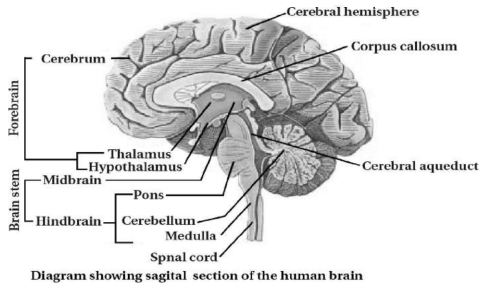
Draw a neat and labelled diagram of the human brain. Mention its various parts and functions.
Solution
(N/A) The brain is the central information processing organ of our body and acts as the 'command and control system'.
Functions of the brain:
It controls voluntary movements,balance of the body,functioning of vital involuntary organs (e.g.,lungs,heart,kidneys),thermoregulation,hunger and thirst,circadian ($24$-hour) rhythms of our body,activities of several endocrine glands,and human behaviour.
It is also the site for processing vision,hearing,speech,memory,intelligence,emotions,and thoughts.
The human brain is well protected by the skull.
It is covered by $3$ cranial meninges:
$(1)$ Dura mater - outer layer
$(2)$ Arachnoid - middle thin layer
$(3)$ Pia mater - inner layer (which is in contact with brain tissue)
The brain can be divided into three major parts:
$(a)$ Forebrain
$(b)$ Midbrain
$(c)$ Hindbrain
Functions of the brain:
It controls voluntary movements,balance of the body,functioning of vital involuntary organs (e.g.,lungs,heart,kidneys),thermoregulation,hunger and thirst,circadian ($24$-hour) rhythms of our body,activities of several endocrine glands,and human behaviour.
It is also the site for processing vision,hearing,speech,memory,intelligence,emotions,and thoughts.
The human brain is well protected by the skull.
It is covered by $3$ cranial meninges:
$(1)$ Dura mater - outer layer
$(2)$ Arachnoid - middle thin layer
$(3)$ Pia mater - inner layer (which is in contact with brain tissue)
The brain can be divided into three major parts:
$(a)$ Forebrain
$(b)$ Midbrain
$(c)$ Hindbrain
0 likes
View Solution292
Medium
Write a short note on the Forebrain.
Solution
(N/A) The forebrain consists of three main regions:
$(i)$ Cerebrum $(ii)$ Thalamus $(iii)$ Hypothalamus.
$(i)$ Cerebrum: It forms the major part of the human brain. $A$ deep cleft divides the cerebrum longitudinally into two halves,which are termed as the left and right cerebral hemispheres.
The hemispheres are connected by a tract of nerve fibres called corpus callosum.
The layer of cells which covers the cerebral hemisphere is called the cerebral cortex and is thrown into prominent folds (Gyri,Sulci,and Fissures).
The cerebral cortex is referred to as the grey matter due to its greyish appearance. The neuron cell bodies are concentrated here,giving it this colour.
The cerebral cortex contains motor areas,sensory areas,and large regions that are neither clearly sensory nor motor in function. These regions are called association areas. They are responsible for complex functions like intersensory associations,memory,and communication.
Fibres of the tracts are covered with the myelin sheath,which constitutes the inner part of the cerebral hemisphere. They give an opaque white appearance to the layer and hence,are called the white matter.
$(ii)$ Thalamus: The cerebrum wraps around a structure called the thalamus. It is a major coordinating centre for sensory and motor signaling.
$(iii)$ Hypothalamus: It lies at the base of the thalamus. It contains a number of centres which control body temperature,and the urge for eating and drinking.
Hypothalamus also contains several groups of neurosecretory cells,which secrete hormones called hypothalamic hormones.
Limbic System: The inner parts of cerebral hemispheres and a group of associated deep structures like amygdala,hippocampus,etc.,form a complex structure called the limbic system.
It is involved in the regulation of sexual behaviour,expression of emotional reactions (e.g.,excitement,pleasure,rage,fear,and motivation).
$(i)$ Cerebrum $(ii)$ Thalamus $(iii)$ Hypothalamus.
$(i)$ Cerebrum: It forms the major part of the human brain. $A$ deep cleft divides the cerebrum longitudinally into two halves,which are termed as the left and right cerebral hemispheres.
The hemispheres are connected by a tract of nerve fibres called corpus callosum.
The layer of cells which covers the cerebral hemisphere is called the cerebral cortex and is thrown into prominent folds (Gyri,Sulci,and Fissures).
The cerebral cortex is referred to as the grey matter due to its greyish appearance. The neuron cell bodies are concentrated here,giving it this colour.
The cerebral cortex contains motor areas,sensory areas,and large regions that are neither clearly sensory nor motor in function. These regions are called association areas. They are responsible for complex functions like intersensory associations,memory,and communication.
Fibres of the tracts are covered with the myelin sheath,which constitutes the inner part of the cerebral hemisphere. They give an opaque white appearance to the layer and hence,are called the white matter.
$(ii)$ Thalamus: The cerebrum wraps around a structure called the thalamus. It is a major coordinating centre for sensory and motor signaling.
$(iii)$ Hypothalamus: It lies at the base of the thalamus. It contains a number of centres which control body temperature,and the urge for eating and drinking.
Hypothalamus also contains several groups of neurosecretory cells,which secrete hormones called hypothalamic hormones.
Limbic System: The inner parts of cerebral hemispheres and a group of associated deep structures like amygdala,hippocampus,etc.,form a complex structure called the limbic system.
It is involved in the regulation of sexual behaviour,expression of emotional reactions (e.g.,excitement,pleasure,rage,fear,and motivation).
0 likes
View Solution293
Medium
Give information regarding the location and components of the midbrain.
Solution
(N/A) Location: The midbrain is located between the thalamus/hypothalamus of the forebrain and the pons of the hindbrain.
- $A$ canal called the cerebral aqueduct passes through the midbrain.
- Structure: The dorsal portion of the midbrain consists mainly of four round lobes called corpora quadrigemina. The midbrain and hindbrain together form the brain stem.
- $A$ canal called the cerebral aqueduct passes through the midbrain.
- Structure: The dorsal portion of the midbrain consists mainly of four round lobes called corpora quadrigemina. The midbrain and hindbrain together form the brain stem.
0 likes
View Solution294
Medium
Provide information regarding the hindbrain.
Solution
(N/A) The hindbrain comprises the $Pons$, $Cerebellum$, and $Medulla \text{ } oblongata$.
$Pons$: Consists of fibre tracts that interconnect different regions of the brain.
$Cerebellum$: Has a very convoluted surface to provide additional space for many more neurons.
$Medulla \text{ } oblongata$: Contains centres which control respiration, cardiovascular reflexes, and gastric secretions.
$Pons$: Consists of fibre tracts that interconnect different regions of the brain.
$Cerebellum$: Has a very convoluted surface to provide additional space for many more neurons.
$Medulla \text{ } oblongata$: Contains centres which control respiration, cardiovascular reflexes, and gastric secretions.
0 likes
View Solution295
EasyMCQ
State the functions of the human brain.
A
Processing sensory information
B
Regulation of homeostasis
C
Control of voluntary and involuntary movements
D
All of the above
Solution
(D) The human brain is the central information processing organ of our body and acts as the 'command and control system'.
$1$. It processes sensory information received from various sense organs.
$2$. It regulates homeostasis,including body temperature,hunger,and thirst.
$3$. It controls voluntary movements (e.g.,walking,writing) and involuntary movements (e.g.,heartbeat,respiration).
$4$. It is the site for processing vision,hearing,speech,memory,intelligence,emotions,and thoughts.
Therefore,all the listed functions are performed by the brain.
$1$. It processes sensory information received from various sense organs.
$2$. It regulates homeostasis,including body temperature,hunger,and thirst.
$3$. It controls voluntary movements (e.g.,walking,writing) and involuntary movements (e.g.,heartbeat,respiration).
$4$. It is the site for processing vision,hearing,speech,memory,intelligence,emotions,and thoughts.
Therefore,all the listed functions are performed by the brain.
0 likes
View Solution296
Easy
Differentiate between the Central Neural System $(CNS)$ and the Peripheral Neural System $(PNS)$.
Solution
(N/A) The Central Neural System $(CNS)$ and the Peripheral Neural System $(PNS)$ differ in the following ways:
$1$. Composition: The $CNS$ consists of the brain and the spinal cord,which act as the command and control centers. The $PNS$ comprises all the nerves of the body associated with the $CNS$ (cranial nerves and spinal nerves).
$2$. Function: The $CNS$ is responsible for information processing and decision-making. The $PNS$ is responsible for relaying information between the $CNS$ and the rest of the body.
$3$. Protection: The $CNS$ is protected by the skull and the vertebral column. The $PNS$ lacks such bony protection.
$1$. Composition: The $CNS$ consists of the brain and the spinal cord,which act as the command and control centers. The $PNS$ comprises all the nerves of the body associated with the $CNS$ (cranial nerves and spinal nerves).
$2$. Function: The $CNS$ is responsible for information processing and decision-making. The $PNS$ is responsible for relaying information between the $CNS$ and the rest of the body.
$3$. Protection: The $CNS$ is protected by the skull and the vertebral column. The $PNS$ lacks such bony protection.
0 likes
View Solution297
Medium
Distinguish between:
$(1)$ Sensory nerve and Motor nerve.
$(2)$ Corpus callosum and Ciliary body.
$(1)$ Sensory nerve and Motor nerve.
$(2)$ Corpus callosum and Ciliary body.
Solution
(N/A) $(1)$ Sensory nerve: These nerves carry nerve impulses from sensory organs or tissues to the $C.N.S.$ (Central Nervous System).
Motor nerve: These nerves carry nerve impulses from the $C.N.S.$ to effector organs like muscles or glands.
$(2)$ Corpus callosum: It is a tract of nerve fibres that connects the two cerebral hemispheres.
Ciliary body: The choroid layer becomes thick in the anterior $1/3$ part of the eyeball to form the ciliary body,which holds the lens in place.
Motor nerve: These nerves carry nerve impulses from the $C.N.S.$ to effector organs like muscles or glands.
$(2)$ Corpus callosum: It is a tract of nerve fibres that connects the two cerebral hemispheres.
Ciliary body: The choroid layer becomes thick in the anterior $1/3$ part of the eyeball to form the ciliary body,which holds the lens in place.
0 likes
View Solution298
Easy
Name the structures involved in the protection of the brain.
Solution
(N/A) The brain is protected by several structures to ensure its safety from mechanical injury:
$1$. The $Cranium$ (skull): $A$ bony box that provides a hard,protective covering for the brain.
$2$. $Cranial$ $Meninges$: Three layers of connective tissue membranes that surround the brain. These include the outer $Dura$ $mater$,the middle $Arachnoid$ $mater$,and the inner $Pia$ $mater$.
$3$. $Cerebrospinal$ $Fluid$ $(CSF)$: This fluid is present between the meninges and within the brain cavities (ventricles). It acts as a shock absorber and cushions the brain against mechanical impacts.
$1$. The $Cranium$ (skull): $A$ bony box that provides a hard,protective covering for the brain.
$2$. $Cranial$ $Meninges$: Three layers of connective tissue membranes that surround the brain. These include the outer $Dura$ $mater$,the middle $Arachnoid$ $mater$,and the inner $Pia$ $mater$.
$3$. $Cerebrospinal$ $Fluid$ $(CSF)$: This fluid is present between the meninges and within the brain cavities (ventricles). It acts as a shock absorber and cushions the brain against mechanical impacts.
0 likes
View SolutionNeural Control and Coordination — Central Neural System · Frequently Asked Questions
1Are these Neural Control and Coordination questions useful for JEE and NEET?
Yes. All questions in this section are mapped to JEE Main and NEET exam patterns. Previous year questions from JEE Main, NEET, GUJCET and state-level exams are included with full solutions.
2Can I switch to Hindi or Gujarati for these questions?
Yes. Use the language tabs in the hero section or the sidebar to view the same questions and solutions in English, Hindi or Gujarati.
3How do I generate a question paper from this subtopic?
Use the Vedclass Exam Paper Generator — select the chapter and subtopic, set difficulty, and generate Sets A, B, C, D automatically. First 3 chapters of every subject are free.
Vedclass Products
For Students
Vedclass Test Series
Mock tests in real JEE/NEET style with performance analysis. 5-day free trial.
Start Free TrialFor Teachers
Exam Paper Generator
Generate Set A/B/C/D papers from this chapter in 2 minutes. 3 chapters free.
Try FreeFor Institutes
Online Exam Module
Live online exams with unlimited students, 360° analytics & white-label branding.
See DemoFor Teachers & Institutes
Generate a Neural Control and Coordination Exam Paper in 2 Minutes
Select subtopic & difficulty — Sets A, B, C, D auto-generated with No Repeat logic.
First 3 chapters of every subject are free — no payment required.