
A English
Central Neural System Questions in English
Class 11 Biology · Neural Control and Coordination · Central Neural System
450+
Questions
English
Language
100%
With Solutions
Showing 50 of 450 questions in English
301
EasyMCQ
Our reactions like aggressive behavior,use of abusive words,restlessness,etc.,are regulated by the brain. Name the parts involved.
A
Limbic system and hypothalamus
B
Cerebellum and medulla oblongata
C
Thalamus and pons
D
Corpus callosum and cerebrum
Solution
(A) The $Limbic$ $system$ (or $Limbic$ $lobe$) along with the $hypothalamus$ is responsible for the regulation of sexual behavior,expression of emotional reactions (e.g.,excitement,pleasure,rage,fear,and aggressive behavior),and motivation.
These structures work together to process emotional responses and maintain homeostasis in response to environmental stimuli.
These structures work together to process emotional responses and maintain homeostasis in response to environmental stimuli.
0 likes
View Solution302
EasyMCQ
What do grey and white matter in the brain represent?
A
Grey matter consists of myelinated axons,while white matter consists of cell bodies.
B
Grey matter consists of neuronal cell bodies,while white matter consists of myelinated axons.
C
Grey matter consists of glial cells,while white matter consists of neurons.
D
Grey matter consists of dendrites,while white matter consists of synapses.
Solution
(B) In the central nervous system,the brain tissue is divided into two distinct types based on appearance and composition:
$1$. Grey matter: This region primarily contains neuronal cell bodies,dendrites,and unmyelinated axons. It is the site where information processing occurs.
$2$. White matter: This region primarily contains myelinated axons. The myelin sheath,which is a fatty substance,gives this tissue its white appearance. White matter acts as the communication network,connecting different areas of grey matter to facilitate signal transmission.
$1$. Grey matter: This region primarily contains neuronal cell bodies,dendrites,and unmyelinated axons. It is the site where information processing occurs.
$2$. White matter: This region primarily contains myelinated axons. The myelin sheath,which is a fatty substance,gives this tissue its white appearance. White matter acts as the communication network,connecting different areas of grey matter to facilitate signal transmission.
0 likes
View Solution303
MediumMCQ
If someone receives a blow on the back of the neck, what would be the effect on the person's $CNS$?
A
The person will die instantly.
B
The person will lose their memory.
C
The person will have impaired vision.
D
The person will have difficulty in breathing.
Solution
(A) The back of the neck contains the $Medulla \text{ } Oblongata$, which is a part of the $Hindbrain$ and is a vital component of the $CNS$.
The $Medulla \text{ } Oblongata$ contains centers that control involuntary functions such as respiration, cardiovascular activity, and gastric secretions.
A severe blow to the back of the neck can damage the $Medulla \text{ } Oblongata$, leading to the failure of these vital centers, which often results in immediate death.
The $Medulla \text{ } Oblongata$ contains centers that control involuntary functions such as respiration, cardiovascular activity, and gastric secretions.
A severe blow to the back of the neck can damage the $Medulla \text{ } Oblongata$, leading to the failure of these vital centers, which often results in immediate death.
0 likes
View Solution304
Easy
Name the parts of the human forebrain and indicate their respective functions.
Solution
(N/A) The human forebrain consists of three main parts:
$1$. $Cerebrum$: It is the largest part of the brain. It is responsible for thinking,reasoning,memory,intelligence,and controlling voluntary movements.
$2$. $Thalamus$: It acts as a major relay station for sensory information (except smell) to the cerebral cortex.
$3$. $Hypothalamus$: It lies at the base of the thalamus and contains centers which control body temperature,urge for eating and drinking,and it also produces neurosecretory hormones that regulate the pituitary gland.
$1$. $Cerebrum$: It is the largest part of the brain. It is responsible for thinking,reasoning,memory,intelligence,and controlling voluntary movements.
$2$. $Thalamus$: It acts as a major relay station for sensory information (except smell) to the cerebral cortex.
$3$. $Hypothalamus$: It lies at the base of the thalamus and contains centers which control body temperature,urge for eating and drinking,and it also produces neurosecretory hormones that regulate the pituitary gland.
0 likes
View Solution305
EasyMCQ
Select the correct option:
$(1)$ The $Hypothalamus$ / $Thalamus$ controls body temperature,hunger,and thirst.
$(2)$ $Bipolar$ neurons are found in the embryonic stage / $Cerebral$ $cortex$.
$(1)$ The $Hypothalamus$ / $Thalamus$ controls body temperature,hunger,and thirst.
$(2)$ $Bipolar$ neurons are found in the embryonic stage / $Cerebral$ $cortex$.
A
$(1)$ $Hypothalamus$,$(2)$ Embryonic stage
B
$(1)$ $Thalamus$,$(2)$ $Cerebral$ $cortex$
C
$(1)$ $Hypothalamus$,$(2)$ $Cerebral$ $cortex$
D
$(1)$ $Thalamus$,$(2)$ Embryonic stage
Solution
(A) $(1)$ The $Hypothalamus$ is the part of the brain that regulates essential homeostatic functions,including body temperature,hunger,and thirst.
$(2)$ $Bipolar$ neurons are characterized by having one axon and one dendrite. They are typically found in the retina of the eye and the embryonic stage of development,whereas the $Cerebral$ $cortex$ contains multipolar neurons.
$(2)$ $Bipolar$ neurons are characterized by having one axon and one dendrite. They are typically found in the retina of the eye and the embryonic stage of development,whereas the $Cerebral$ $cortex$ contains multipolar neurons.
0 likes
View Solution306
EasyMCQ
What is included in the $CNS$?
A
Brain and nerves
B
Brain and spinal cord
C
Spinal cord and nerves
D
Brain and sensory organs
Solution
(B) The $CNS$ (Central Nervous System) is the primary processing unit of the human body.
It consists of two main components: the brain,which acts as the control center,and the spinal cord,which serves as the main pathway for information transmission between the brain and the rest of the body.
It consists of two main components: the brain,which acts as the control center,and the spinal cord,which serves as the main pathway for information transmission between the brain and the rest of the body.
0 likes
View Solution307
MediumMCQ
What is included in the autonomic neural system?
A
Sympathetic neural system only
B
Parasympathetic neural system only
C
Both sympathetic and parasympathetic neural systems
D
Somatic neural system
Solution
(C) The autonomic neural system is a part of the peripheral neural system.
It is responsible for transmitting impulses from the $CNS$ to the involuntary organs and smooth muscles of the body.
It consists of two main divisions: the sympathetic neural system and the parasympathetic neural system.
It is responsible for transmitting impulses from the $CNS$ to the involuntary organs and smooth muscles of the body.
It consists of two main divisions: the sympathetic neural system and the parasympathetic neural system.
0 likes
View Solution308
EasyMCQ
What is the full form of $CNS$?
A
Central Nervous System
B
Cardiac Nervous System
C
Central Neural System
D
Cranial Nervous System
Solution
(A) The full form of $CNS$ is $Central \ Nervous \ System$.
It consists of the brain and the spinal cord,which act as the main control center for the body.
It consists of the brain and the spinal cord,which act as the main control center for the body.
0 likes
View Solution309
EasyMCQ
The cavity in the region of diencephalon in the brain of rabbit is called
A
Lateral ventricle
B
Third ventricle
C
Foramen of monro
D
Iter
Solution
(B) The diencephalon (thalamencephalon) is a small and narrow part of the forebrain.
Its roof consists of the anterior choroid plexus,and its floor consists of the hypothalamus.
The pineal body is present dorsally,and the pituitary gland is present ventrally upon the infundibulum.
The cavity within the diencephalon is known as the diocoel or the third ventricle.
Its roof consists of the anterior choroid plexus,and its floor consists of the hypothalamus.
The pineal body is present dorsally,and the pituitary gland is present ventrally upon the infundibulum.
The cavity within the diencephalon is known as the diocoel or the third ventricle.
0 likes
View Solution310
EasyMCQ
The cerebral hemispheres of a rat are connected by:
A
Corpus luteum
B
Corpus callosum
C
Corpus albicans
D
Corpus spongiosum
Solution
(B) The $Corpus \text{ callosum}$ is a thick band of nerve fibers that connects the two cerebral hemispheres of the brain in mammals, including rats, allowing for communication between the two sides.
0 likes
View Solution311
MediumMCQ
The cardiac centre is present in:
A
Medulla oblongata
B
Cerebrum
C
Pons
D
Epithalamus
Solution
(A) special neural centre in the medulla oblongata can moderate cardiac function through the Autonomic Nervous System $(ANS)$. The medulla oblongata is known as the cardiac centre.
0 likes
View Solution312
MediumMCQ
The brain acts as the $A$ and $B$ system.
Here,$A$ and $B$ refer to:
Here,$A$ and $B$ refer to:
A
Command; control
B
Voluntary; involuntary
C
Compound; voluntary
D
Control; involuntary
Solution
(A) The human brain acts as the command and control system of the body.
It is responsible for processing information,regulating physiological functions,and coordinating voluntary and involuntary movements.
It is responsible for processing information,regulating physiological functions,and coordinating voluntary and involuntary movements.
0 likes
View Solution313
MediumMCQ
Which of the following is not related to the autonomic nervous system?
A
Peristalsis
B
Digestion
C
Excretion
D
Memory and learning
Solution
(D) The autonomic nervous system regulates involuntary bodily functions such as peristalsis,digestion,and excretion. Memory and learning are higher-order cognitive functions controlled by the cerebrum of the forebrain,which is part of the central nervous system.
0 likes
View Solution314
EasyMCQ
Number of spinal nerves in rabbit is (in $pairs$)
A
$27$
B
$31$
C
$37$
D
$47$
Solution
(C) Spinal nerves originate from the spinal cord (gray matter).
In rabbits, there are $37$ pairs of spinal nerves.
In contrast, humans possess $31$ pairs of spinal nerves.
In rabbits, there are $37$ pairs of spinal nerves.
In contrast, humans possess $31$ pairs of spinal nerves.
0 likes
View Solution315
EasyMCQ
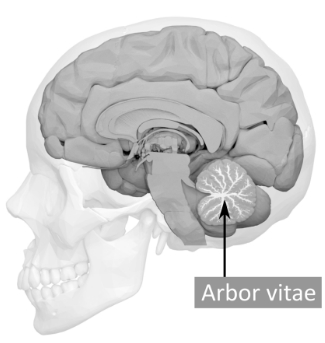
Arbor vitae is composed of
A
Grey matter
B
White matter
C
Both $(a)$ and $(b)$
D
None of these
Solution
(B) The arbor vitae (Latin for "tree of life") is the cerebellar white matter, so called for its branched, tree-like appearance.
It is present in both cerebellar hemispheres.
It consists of myelinated axons that bring sensory and motor information to and from the cerebellum.
It is present in both cerebellar hemispheres.
It consists of myelinated axons that bring sensory and motor information to and from the cerebellum.
0 likes
View Solution316
MediumMCQ
The choroid plexus functions to produce:
A
Lymph
B
Endolymph
C
Cerebrospinal fluid
D
All of these
Solution
(C) The $Diencephalon$ is a small,unpaired,and median squarish part of the forebrain. Its dorsal wall,known as the $epithalamus$,along with the overlying $pia-arachnoid$ matter,forms highly vascular internal folds or tufts that are invaginated into the $diocoel$. This dorsal wall is referred to as the anterior $choroid$ $plexus$. From the blood capillaries of this $plexus$,a specific amount of plasma fluid continuously oozes out to form the $Cerebrospinal$ $fluid$ $(CSF)$.
0 likes
View Solution317
EasyMCQ
Which of the following is correct for the pairs of cervical nerves and number of cervical vertebrae respectively?
A
$8$ and $7$
B
$16$ and $7$
C
$7$ and $7$
D
$7$ and $16$
Solution
(A) In humans,there are $31$ pairs of spinal nerves. These include $8$ pairs of cervical nerves,$12$ pairs of thoracic nerves,$5$ pairs of lumbar nerves,$5$ pairs of sacral nerves,and $1$ pair of coccygeal nerves.
The cervical vertebrae are the bones located in the neck region. In almost all mammals,including humans,the number of cervical vertebrae is constant at $7$,regardless of the length of the neck.
The cervical vertebrae are the bones located in the neck region. In almost all mammals,including humans,the number of cervical vertebrae is constant at $7$,regardless of the length of the neck.
0 likes
View Solution318
MediumMCQ
The tract of nerve fibres which connects the cerebral hemispheres is:
A
Corpus luteum
B
Corpus callosum
C
Corpora quadrigemina
D
Cerebral aqueduct
Solution
(B) The cerebrum forms the major part of the human brain.
It is divided longitudinally into two halves,known as the left and right cerebral hemispheres,by a deep cleft.
These two hemispheres are connected by a tract of nerve fibres called the $Corpus \ callosum$.
It is divided longitudinally into two halves,known as the left and right cerebral hemispheres,by a deep cleft.
These two hemispheres are connected by a tract of nerve fibres called the $Corpus \ callosum$.
0 likes
View Solution319
MediumMCQ
The central information processing organ of our body is
A
Heart
B
Spinal cord
C
Brain
D
All of the above
Solution
(C) The brain acts as the command control system of the body. It is responsible for the processing of information,control of voluntary movements,balance of the body,functioning of vital involuntary organs,thermoregulation,hunger and thirst,circadian rhythms,activities of several endocrine glands,and human behavior. Therefore,the brain is the central information processing organ of our body.
0 likes
View Solution320
MediumMCQ
The medulla contains centres which control:
A
Respiration
B
Cardiovascular reflexes
C
Gastric secretions
D
All of the above
Solution
(D) The medulla,also known as the medulla oblongata,is a vital part of the brainstem. It contains several autonomic control centres that regulate essential life functions. Specifically,the medulla contains centres that control respiration,cardiovascular reflexes,and gastric secretions. Therefore,all the listed options are correct.
0 likes
View Solution321
MediumMCQ
Association areas are regions found in
A
Cerebrum
B
Cerebral cortex
C
Cerebellum
D
Diencephalon
Solution
(B) Association areas are large regions of the cerebral cortex that are neither clearly sensory nor motor in function.
These areas are responsible for complex functions like intersensory associations,memory,and communication.
These areas are responsible for complex functions like intersensory associations,memory,and communication.
0 likes
View Solution322
EasyMCQ
Which of the following nerves is a purely motor nerve?
A
Vagus
B
Facial
C
Abducens
D
Trigeminal
Solution
(C) Cranial nerves originate from the brain. These nerves are classified as motor,sensory,or mixed types.
Abducens ($VI^{th}$ cranial nerve) is a purely motor nerve. It carries motor impulses from the brain to the lateral rectus muscle of the eye,which is responsible for the outward movement of the eyeball.
Vagus $(X^{th})$,facial $(VII^{th})$,and trigeminal $(V^{th})$ nerves are mixed cranial nerves,meaning they perform both sensory and motor functions.
Abducens ($VI^{th}$ cranial nerve) is a purely motor nerve. It carries motor impulses from the brain to the lateral rectus muscle of the eye,which is responsible for the outward movement of the eyeball.
Vagus $(X^{th})$,facial $(VII^{th})$,and trigeminal $(V^{th})$ nerves are mixed cranial nerves,meaning they perform both sensory and motor functions.
0 likes
View Solution323
MediumMCQ
Inside the skull,the brain is covered by
A
Arachnoid
B
Cranial meninges
C
Piamater
D
Duramater
Solution
(B) The human brain is well protected by the skull. Inside the skull,the brain is covered by cranial meninges,which consist of three layers: an outer layer called duramater,a very thin middle layer called arachnoid,and an inner layer called piamater.
0 likes
View Solution324
EasyMCQ
Which of the following is a part of the midbrain of a rabbit?
A
Diencephalon
B
Cerebrum
C
Corpora quadrigemina
D
None of these
Solution
(C) The midbrain $(mesencephalon)$ of a rabbit consists of two pairs of spherical optic lobes known as $Corpora$ $quadrigemina$. These are located dorsally behind the pineal body. These lobes function primarily as reflex centers for visual and auditory sensations.
0 likes
View Solution325
MediumMCQ
Memory is the responsibility of
A
Grey matter
B
White matter
C
Cerebrum
D
Cerebellum
Solution
(C) The cerebrum consists of a pair of the largest lobes known as cerebral hemispheres.
These hemispheres account for $80 \%$ of the total brain weight.
The cerebrum is responsible for controlling all voluntary activities of the body.
It serves as the center for memory,willpower,intelligence,reasoning,and learning.
These hemispheres account for $80 \%$ of the total brain weight.
The cerebrum is responsible for controlling all voluntary activities of the body.
It serves as the center for memory,willpower,intelligence,reasoning,and learning.
0 likes
View Solution326
MediumMCQ
The forebrain develops into
A
Diencephalon and pons
B
Diencephalon and medulla
C
Diencephalon and cerebrum
D
Diencephalon and cerebellum
Solution
(C) The forebrain,also known as the $Prosencephalon$,forms the largest part of the human brain.
It primarily consists of three main regions: the olfactory lobes,the cerebral hemispheres (cerebrum),and the diencephalon.
Therefore,the forebrain develops into the cerebrum and the diencephalon.
It primarily consists of three main regions: the olfactory lobes,the cerebral hemispheres (cerebrum),and the diencephalon.
Therefore,the forebrain develops into the cerebrum and the diencephalon.
0 likes
View Solution327
EasyMCQ
The olfactory smell area is present in:
A
Frontal lobe
B
Parietal lobe
C
Temporal lobe
D
Occipital lobe
Solution
(C) The olfactory cortex,which is responsible for the sense of smell,is located in the temporal lobe of the human brain.
0 likes
View Solution328
MediumMCQ
The inner part of the cerebral cortex is referred to as:
A
White matter
B
Grey matter
C
Both $(a)$ and $(b)$
D
Non-myelinated nerve fibres
Solution
(A) The cerebrum forms the major part of the human brain. $A$ deep cleft divides the cerebrum longitudinally into two halves,termed as the left and right cerebral hemispheres.
The layer of cells that covers the cerebral hemisphere is called the cerebral cortex,which is composed of grey matter due to the concentration of neuron cell bodies.
The inner part of the cerebral hemisphere is composed of axons covered with myelin sheaths,which gives it an opaque white appearance; hence,it is referred to as white matter.
The layer of cells that covers the cerebral hemisphere is called the cerebral cortex,which is composed of grey matter due to the concentration of neuron cell bodies.
The inner part of the cerebral hemisphere is composed of axons covered with myelin sheaths,which gives it an opaque white appearance; hence,it is referred to as white matter.
0 likes
View Solution329
EasyMCQ
Brain stem is formed by
A
Midbrain and forebrain
B
Forebrain and hindbrain
C
Midbrain and hindbrain
D
All of the above
Solution
(C) The brain stem is a collective term for the structures that connect the cerebrum to the spinal cord.
It consists of the midbrain,the pons,and the medulla oblongata.
The midbrain is located between the thalamus/hypothalamus of the forebrain and the pons of the hindbrain.
The hindbrain comprises the pons,cerebellum,and medulla.
Therefore,the midbrain and the hindbrain (specifically the pons and medulla) together form the brain stem.
It consists of the midbrain,the pons,and the medulla oblongata.
The midbrain is located between the thalamus/hypothalamus of the forebrain and the pons of the hindbrain.
The hindbrain comprises the pons,cerebellum,and medulla.
Therefore,the midbrain and the hindbrain (specifically the pons and medulla) together form the brain stem.
0 likes
View Solution330
EasyMCQ
The band of fibre which joins the $corpora \text{ } quadrigemina$ to the cerebellum is called:
A
Pons Varolii
B
Valve of Vieussens
C
Corpus callosum
D
Corpus striatum
Solution
(B) The $Valve \text{ } of \text{ } Vieussens$ (also known as the superior medullary velum) is a thin, transparent lamina of white matter that connects the $corpora \text{ } quadrigemina$ (the four optic lobes) of the midbrain to the cerebellum.
0 likes
View Solution331
EasyMCQ
Which part of the brain converts short-term memory into long-term memory?
A
Medulla oblongata
B
Reticular system
C
Hippocampus
D
Thalamus
Solution
(C) The $Hippocampus$ is a critical structure in the brain responsible for the consolidation of information from short-term memory (working memory) to long-term memory.
It is located in the temporal lobe and is named after the Greek word for seahorse due to its curved shape.
Damage to the $Hippocampus$ often results in an inability to form new long-term memories.
It is located in the temporal lobe and is named after the Greek word for seahorse due to its curved shape.
Damage to the $Hippocampus$ often results in an inability to form new long-term memories.
0 likes
View Solution332
MediumMCQ
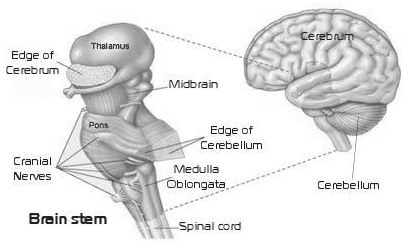
Which of the following statements are correct about the midbrain?
$(I)$. Located between the thalamus/hypothalamus of the forebrain and pons of the hindbrain
$(II)$. $A$ canal named cerebral aqueduct passes through it
$(III)$. The dorsal part consists of $4$ lobes called corpora quadrigemina
Choose the correct option
$(I)$. Located between the thalamus/hypothalamus of the forebrain and pons of the hindbrain
$(II)$. $A$ canal named cerebral aqueduct passes through it
$(III)$. The dorsal part consists of $4$ lobes called corpora quadrigemina
Choose the correct option
A
$(I)$ and $(II)$
B
$(II)$ and $(III)$
C
$(I)$ and $(III)$
D
$(I), (II)$ and $(III)$
Solution
(D) The midbrain is located between the thalamus/hypothalamus of the forebrain and the pons of the hindbrain.
$A$ canal called the cerebral aqueduct passes through the midbrain.
The dorsal portion of the midbrain consists of four round swellings (lobes) called corpora quadrigemina.
Since all three statements $(I), (II),$ and $(III)$ are correct,the correct option is $(D)$.
$A$ canal called the cerebral aqueduct passes through the midbrain.
The dorsal portion of the midbrain consists of four round swellings (lobes) called corpora quadrigemina.
Since all three statements $(I), (II),$ and $(III)$ are correct,the correct option is $(D)$.
0 likes
View Solution333
EasyMCQ
$31$ pairs of spinal nerves are known in humans. Select the option which shows their correct classification into different groups.
A
Cervical $-1$ pair,thoracic $-8$ pairs,lumbar $-12$ pairs,sacral $-5$ pairs,coccygeal $-5$ pairs
B
Cervical $-8$ pairs,thoracic $-12$ pairs,lumbar $-5$ pairs,sacral $-5$ pairs,coccygeal $-1$ pair
C
Cervical $-5$ pairs,thoracic $-5$ pairs,lumbar $-5$ pairs,sacral $-8$ pairs,coccygeal $-1$ pair
D
Cervical $-5$ pairs,thoracic $-8$ pairs,lumbar $-5$ pairs,sacral $-12$ pairs,coccygeal $-1$ pair
Solution
(B) There are $31$ pairs of spinal nerves in humans.
These are classified into five groups based on the region of the vertebral column from which they emerge:
$1$. Cervical nerves: $8$ pairs
$2$. Thoracic nerves: $12$ pairs
$3$. Lumbar nerves: $5$ pairs
$4$. Sacral nerves: $5$ pairs
$5$. Coccygeal nerves: $1$ pair
Therefore,the correct classification is $8$ cervical,$12$ thoracic,$5$ lumbar,$5$ sacral,and $1$ coccygeal pair.
These are classified into five groups based on the region of the vertebral column from which they emerge:
$1$. Cervical nerves: $8$ pairs
$2$. Thoracic nerves: $12$ pairs
$3$. Lumbar nerves: $5$ pairs
$4$. Sacral nerves: $5$ pairs
$5$. Coccygeal nerves: $1$ pair
Therefore,the correct classification is $8$ cervical,$12$ thoracic,$5$ lumbar,$5$ sacral,and $1$ coccygeal pair.
0 likes
View Solution334
MediumMCQ
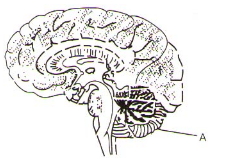
In the given diagram,what does '$A$' represent?
A
Pons Varolii
B
Cerebellum
C
Medulla oblongata
D
Midbrain
Solution
(B) The cerebellum consists of two lateral cerebellar hemispheres. $A$ cross-section of the cerebellar hemisphere shows a branching tree-like arrangement of grey and white matter called the arbor vitae.
It is the second-largest part of the brain.
It helps control body posture,maintenance of muscle tone,coordination of voluntary muscular activities,and equilibrium of the body.
It is the second-largest part of the brain.
It helps control body posture,maintenance of muscle tone,coordination of voluntary muscular activities,and equilibrium of the body.
0 likes
View Solution335
MediumMCQ
Which part of the brain is involved in loss of control when a person drinks alcohol?
A
Cerebellum
B
Cerebrum
C
Medulla oblongata
D
Pons Varolii
Solution
(A) Alcohol consumption primarily affects the $Cerebellum$ region of the brain.
This region is responsible for maintaining balance,posture,and motor coordination.
When alcohol interferes with the $Cerebellum$,it results in a clumsy gait,loss of motor coordination,and impaired physical control,which significantly affects activities like walking or driving.
This region is responsible for maintaining balance,posture,and motor coordination.
When alcohol interferes with the $Cerebellum$,it results in a clumsy gait,loss of motor coordination,and impaired physical control,which significantly affects activities like walking or driving.
0 likes
View Solution336
EasyMCQ
The correct sequence of meninges of the brain from outside to inside is:
A
duramater $\rightarrow$ arachnoid $\rightarrow$ piamater
B
arachnoid $\rightarrow$ duramater $\rightarrow$ piamater
C
piamater $\rightarrow$ duramater $\rightarrow$ arachnoid
D
duramater $\rightarrow$ piamater $\rightarrow$ arachnoid
Solution
(A) Meninges are the connective tissue membranes that protect the central nervous system.
They consist of three layers:
$1$. Duramater: The outermost,tough fibrous layer.
$2$. Arachnoid: The middle,web-like layer.
$3$. Piamater: The innermost,delicate layer in direct contact with the brain tissue.
Therefore,the sequence from outside to inside is duramater $\rightarrow$ arachnoid $\rightarrow$ piamater.
They consist of three layers:
$1$. Duramater: The outermost,tough fibrous layer.
$2$. Arachnoid: The middle,web-like layer.
$3$. Piamater: The innermost,delicate layer in direct contact with the brain tissue.
Therefore,the sequence from outside to inside is duramater $\rightarrow$ arachnoid $\rightarrow$ piamater.
0 likes
View Solution337
MediumMCQ
Functions of association areas in the cerebral cortex include:
A
Intersensory associations
B
Memory
C
Communication
D
All of the above
Solution
(D) The cerebral cortex contains motor areas,sensory areas,and large regions that are neither clearly sensory nor motor in function. These regions are called association areas. These areas are responsible for complex functions such as intersensory associations,memory,and communication.
0 likes
View Solution338
MediumMCQ
Cerebellum is concerned with the
A
Contraction of voluntary muscles
B
Coordinating and regulation muscles tone
C
Maintaining posture orientation and equilibrium of body
D
All of the above
Solution
(D) The cerebellum, often referred to as the $ \text{'little brain'} $, is a highly developed structure that accounts for approximately $ 1/8 $ of the total brain mass.
It is situated beneath the posterior cerebral hemispheres and above the medulla oblongata. It serves as the second-largest part of the brain.
The primary functions of the cerebellum include:
$1$. Coordinating voluntary movements initiated by the cerebrum.
$2$. Regulating muscle tone.
$3$. Maintaining body posture, orientation, and equilibrium.
Since all these functions are performed by the cerebellum, the correct answer is $ D $.
It is situated beneath the posterior cerebral hemispheres and above the medulla oblongata. It serves as the second-largest part of the brain.
The primary functions of the cerebellum include:
$1$. Coordinating voluntary movements initiated by the cerebrum.
$2$. Regulating muscle tone.
$3$. Maintaining body posture, orientation, and equilibrium.
Since all these functions are performed by the cerebellum, the correct answer is $ D $.
0 likes
View Solution339
MediumMCQ
Brain controls the
A
Voluntary movements
B
Balance of the body
C
Functioning of vital involuntary organs
D
All of the above
Solution
(D) Brain acts as the command and control system and it controls the voluntary movements, balance of the body, functioning of vital involuntary organs $(e.g., \text{lungs, heart, kidneys, etc.})$, thermoregulation, hunger and thirst, circadian $(24 \text{ hours})$ rhythms of our body, activities of several endocrine glands, and human behavior.
It is the site for processing of vision, hearing, speech, memory, intelligence, emotions, and thoughts.
It is the site for processing of vision, hearing, speech, memory, intelligence, emotions, and thoughts.
0 likes
View Solution340
MediumMCQ
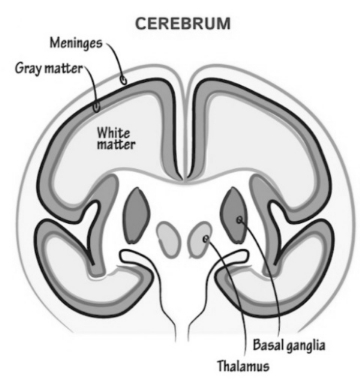
Which of the following statements are correct about the cortex of the cerebrum? Choose the correct codes given below:
$(I)$. It consists of grey matter.
$(II)$. It shows prominent folds.
$(III)$. It consists of white matter.
$(IV)$. It contains motor areas,sensory areas,and association areas.
$(I)$. It consists of grey matter.
$(II)$. It shows prominent folds.
$(III)$. It consists of white matter.
$(IV)$. It contains motor areas,sensory areas,and association areas.
A
$(I)$ and $(II)$
B
$(II)$ and $(III)$
C
$(I), (II)$ and $(IV)$
D
$(II), (III)$ and $(IV)$
Solution
(C) The cerebral cortex is the outer layer of the cerebrum,which consists of grey matter. This layer is highly folded to form sulci and gyri,which increases the surface area.
The inner part of the cerebral hemisphere consists of white matter,which is composed of myelinated nerve fibers.
The cerebral cortex contains motor areas,sensory areas,and large regions that are neither clearly sensory nor motor in function; these are called association areas.
Therefore,statements $(I), (II),$ and $(IV)$ are correct.
The inner part of the cerebral hemisphere consists of white matter,which is composed of myelinated nerve fibers.
The cerebral cortex contains motor areas,sensory areas,and large regions that are neither clearly sensory nor motor in function; these are called association areas.
Therefore,statements $(I), (II),$ and $(IV)$ are correct.
0 likes
View Solution341
EasyMCQ
Which brain structure in rabbit is directly related to vision?
A
Corpus albicans
B
Hippocampal lobe
C
Corpus callosum
D
Corpora quadrigemina
Solution
(D) The dorsal surface of the $midbrain$ in mammals,including rabbits,contains four rounded swellings collectively known as the $corpora$ $quadrigemina$.
These consist of two superior colliculi and two inferior colliculi.
The $superior$ $colliculi$ are the primary centers responsible for processing visual reflexes and coordinating visual information.
These consist of two superior colliculi and two inferior colliculi.
The $superior$ $colliculi$ are the primary centers responsible for processing visual reflexes and coordinating visual information.
0 likes
View Solution342
EasyMCQ
Which of the following cranial nerves is present in rabbit but absent in frog?
A
Glossopharyngeal
B
Hypoglossal
C
Olfactory
D
Optic
Solution
(B) Amphibians,such as frogs,possess $10$ pairs of cranial nerves.
In contrast,mammals,such as rabbits,possess $12$ pairs of cranial nerves.
The $11^{th}$ (accessory) and $12^{th}$ (hypoglossal) cranial nerves are present in mammals but are absent in amphibians.
In contrast,mammals,such as rabbits,possess $12$ pairs of cranial nerves.
The $11^{th}$ (accessory) and $12^{th}$ (hypoglossal) cranial nerves are present in mammals but are absent in amphibians.
0 likes
View Solution343
EasyMCQ
The cerebellum of the brain is responsible for:
A
The maintenance of equilibrium and posture
B
Olfactory functions
C
Controlling optic functions
D
All of the above
Solution
(A) The cerebellum is a part of the hindbrain located at the back of the skull. Its primary function is to coordinate voluntary muscle movements and maintain body balance,equilibrium,and posture. Olfactory functions are controlled by the olfactory bulb,and optic functions are primarily processed in the occipital lobe of the cerebrum. Therefore,the correct option is $A$.
0 likes
View Solution344
EasyMCQ
The cavity in the region of $Diencephalon$ in the brain of a rabbit is called:
A
Iter
B
Third ventricle
C
Lateral ventricle
D
Foramen of Monro
Solution
(B) The $Diencephalon$ is the region of the forebrain that encloses a fluid-filled cavity known as the $Diocoel$ or the $Third$ $ventricle$.
0 likes
View Solution345
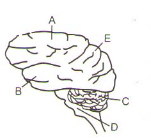
MediumMCQ
In the diagram of the lateral view of the human brain,parts are indicated by alphabets. Choose the answer in which these alphabets have been correctly matched with the part which they indicate.
A
$A-$ Temporal lobe ; $B-$ Parietal lobe ; $C-$ Cerebellum ; $D-$ Medulla oblongata ; $E-$ Frontal lobe
B
$A-$ Frontal lobe ; $B-$ Temporal lobe ; $C-$ Cerebrum ; $D-$ Medulla oblongata ; $E-$ Occipital lobe
C
$A-$ Temporal lobe ; $B-$ Parietal lobe ; $C-$ Cerebrum ; $D-$ Medulla oblongata ; $E-$ Frontal lobe
D
$A-$ Frontal lobe ; $B-$ Temporal lobe ; $C-$ Cerebellum ; $D-$ Medulla oblongata ; $E-$ Parietal lobe
Solution
(D) Based on the anatomical structure of the human brain:
$A$ points to the Frontal lobe.
$B$ points to the Temporal lobe.
$C$ points to the Cerebellum.
$D$ points to the Medulla oblongata.
$E$ points to the Parietal lobe.
Therefore,the correct matching is $A-$ Frontal lobe,$B-$ Temporal lobe,$C-$ Cerebellum,$D-$ Medulla oblongata,$E-$ Parietal lobe.
$A$ points to the Frontal lobe.
$B$ points to the Temporal lobe.
$C$ points to the Cerebellum.
$D$ points to the Medulla oblongata.
$E$ points to the Parietal lobe.
Therefore,the correct matching is $A-$ Frontal lobe,$B-$ Temporal lobe,$C-$ Cerebellum,$D-$ Medulla oblongata,$E-$ Parietal lobe.
0 likes
View Solution346
MediumMCQ
Read the following statements carefully and select the correct option:
$I.$ The medulla is connected to the spinal cord.
$II.$ Medulla contains controlling centres for respiration,cardiovascular reflexes and gastric secretion.
$III.$ Cerebellum has a very convoluted surface in order to provide the additional space for more neurons.
$I.$ The medulla is connected to the spinal cord.
$II.$ Medulla contains controlling centres for respiration,cardiovascular reflexes and gastric secretion.
$III.$ Cerebellum has a very convoluted surface in order to provide the additional space for more neurons.
A
$I$ and $II$
B
$II$ and $III$
C
$I$ and $III$
D
$I, II$ and $III$
Solution
(A) Statement $I$ is correct: The medulla oblongata of the brain is connected to the spinal cord.
Statement $II$ is correct: The medulla contains centres which control respiration,cardiovascular reflexes,and gastric secretions.
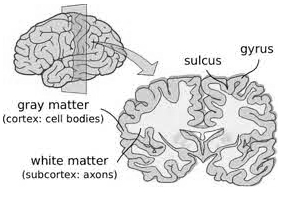
Statement $III$ is incorrect: It is the cerebrum (not the cerebellum) that has a highly convoluted surface with sulci and gyri to provide additional space for more neurons. The cerebellum has a surface with grooves and ridges called folia.
Statement $II$ is correct: The medulla contains centres which control respiration,cardiovascular reflexes,and gastric secretions.
Statement $III$ is incorrect: It is the cerebrum (not the cerebellum) that has a highly convoluted surface with sulci and gyri to provide additional space for more neurons. The cerebellum has a surface with grooves and ridges called folia.
0 likes
View Solution347
MediumMCQ
Different cranial nerves with their respective functions are given below. Choose the correct option from the codes given below.
| Name | Function |
| $I.$ Hypoglossal | Hearing equilibrium |
| $II.$ Glossopharyngeal | Movements of pharynx,larynx,neck,and shoulder |
| $III.$ Pathetic (Trochlear) | Rotation of eyeball |
| $IV.$ Oculomotor | Movement of eyeball |
A
$I$ and $II$
B
$II$ and $IV$
C
$III$ and $IV$
D
$I, II, III$ and $IV$
Solution
(C) Let's analyze the functions of the given cranial nerves:
$1$. $I.$ Hypoglossal nerve: It is a motor nerve that controls the muscles of the tongue. The function 'Hearing equilibrium' is incorrect (this is the function of the Vestibulocochlear nerve).
$2$. $II.$ Glossopharyngeal nerve: It is involved in swallowing and salivation. The function 'Movements of pharynx,larynx,neck,and shoulder' is incorrect (this is the function of the Accessory nerve).
$3$. $III.$ Pathetic (Trochlear) nerve: It controls the superior oblique muscle,which is involved in the rotation of the eyeball. This is correct.
$4$. $IV.$ Oculomotor nerve: It controls most of the extrinsic muscles of the eyeball,facilitating its movement. This is correct.
Therefore,$III$ and $IV$ are correctly matched.
$1$. $I.$ Hypoglossal nerve: It is a motor nerve that controls the muscles of the tongue. The function 'Hearing equilibrium' is incorrect (this is the function of the Vestibulocochlear nerve).
$2$. $II.$ Glossopharyngeal nerve: It is involved in swallowing and salivation. The function 'Movements of pharynx,larynx,neck,and shoulder' is incorrect (this is the function of the Accessory nerve).
$3$. $III.$ Pathetic (Trochlear) nerve: It controls the superior oblique muscle,which is involved in the rotation of the eyeball. This is correct.
$4$. $IV.$ Oculomotor nerve: It controls most of the extrinsic muscles of the eyeball,facilitating its movement. This is correct.
Therefore,$III$ and $IV$ are correctly matched.
0 likes
View Solution348
MediumMCQ
Along with hypothalamus,limbic system is involved in the
$I.$ thermoregulation
$II.$ regulation of sexual behavior
$III.$ expression of emotional reactions (e.g.,excitement,pleasure,rage and fear)
$IV.$ memory
Choose the correct option
$I.$ thermoregulation
$II.$ regulation of sexual behavior
$III.$ expression of emotional reactions (e.g.,excitement,pleasure,rage and fear)
$IV.$ memory
Choose the correct option
A
All except $I$
B
All except $II$
C
All except $III$
D
All except $IV$
Solution
(A) The correct option is $A$ (All except $I$).
The limbic system,along with the hypothalamus,is involved in the regulation of sexual behavior,the expression of emotional reactions (e.g.,excitement,pleasure,rage,and fear),and motivation.
Thermoregulation is primarily controlled by the hypothalamus,not the limbic system.
Memory is also associated with the limbic system,particularly the hippocampus,which is a key component of this system.
The limbic system,along with the hypothalamus,is involved in the regulation of sexual behavior,the expression of emotional reactions (e.g.,excitement,pleasure,rage,and fear),and motivation.
Thermoregulation is primarily controlled by the hypothalamus,not the limbic system.
Memory is also associated with the limbic system,particularly the hippocampus,which is a key component of this system.
0 likes
View Solution349
EasyMCQ
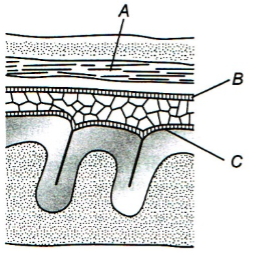
The given diagram shows the meninges of the human brain. Identify $A$ to $C$.
A
$A-$ Pia mater,$B-$ Arachnoid membrane,$C-$ Dura mater
B
$A-$ Dura mater,$B-$ Arachnoid membrane,$C-$ Pia mater
C
$A-$ Arachnoid membrane,$B-$ Pia mater,$C-$ Dura mater
D
$A-$ Arachnoid membrane,$B-$ Dura mater,$C-$ Pia mater
Solution
(B) $A-$ Dura mater: It is the outermost meninx. It is thick,tough,and lines the cranial cavity.
$B-$ Arachnoid membrane: It is the middle meninx. It is thin and non-vascular.
$C-$ Pia mater: It is the innermost meninx. It is very thin,highly vascular,and closely covers the brain.
$B-$ Arachnoid membrane: It is the middle meninx. It is thin and non-vascular.
$C-$ Pia mater: It is the innermost meninx. It is very thin,highly vascular,and closely covers the brain.
0 likes
View Solution350
MediumMCQ
Given is the diagram of the human brain. Identify $A, B, C$ and $D$ correctly.
A
$A-$ Forebrain,$B-$ Brain stem,$C-$ Corpus callosum,$D-$ Cerebral aqueduct
B
$A-$ Forebrain,$B-$ Brain stem,$C-$ Cerebral aqueduct,$D-$ Corpus callosum
C
$A-$ Forebrain,$B-$ Cerebral hemisphere,$C-$ Corpus callosum,$D-$ Cerebral aqueduct
D
$A-$ Forebrain,$B-$ Brain stem,$C-$ Cerebral aqueduct,$D-$ Corpus luteum
Solution
(A) $A-$ Forebrain,$B-$ Brain stem,$C-$ Corpus callosum,$D-$ Cerebral aqueduct.
Forebrain consists of the cerebrum,thalamus,and hypothalamus.
The brain stem is collectively formed by the midbrain,pons,and medulla oblongata.
The cerebrum is divided longitudinally into two cerebral hemispheres.
These hemispheres are connected by a tract of nerve fibers called the corpus callosum.
The cerebral aqueduct is a canal that passes through the midbrain.
Forebrain consists of the cerebrum,thalamus,and hypothalamus.
The brain stem is collectively formed by the midbrain,pons,and medulla oblongata.
The cerebrum is divided longitudinally into two cerebral hemispheres.
These hemispheres are connected by a tract of nerve fibers called the corpus callosum.
The cerebral aqueduct is a canal that passes through the midbrain.
0 likes
View SolutionNeural Control and Coordination — Central Neural System · Frequently Asked Questions
1Are these Neural Control and Coordination questions useful for JEE and NEET?
Yes. All questions in this section are mapped to JEE Main and NEET exam patterns. Previous year questions from JEE Main, NEET, GUJCET and state-level exams are included with full solutions.
2Can I switch to Hindi or Gujarati for these questions?
Yes. Use the language tabs in the hero section or the sidebar to view the same questions and solutions in English, Hindi or Gujarati.
3How do I generate a question paper from this subtopic?
Use the Vedclass Exam Paper Generator — select the chapter and subtopic, set difficulty, and generate Sets A, B, C, D automatically. First 3 chapters of every subject are free.
Vedclass Products
For Students
Vedclass Test Series
Mock tests in real JEE/NEET style with performance analysis. 5-day free trial.
Start Free TrialFor Teachers
Exam Paper Generator
Generate Set A/B/C/D papers from this chapter in 2 minutes. 3 chapters free.
Try FreeFor Institutes
Online Exam Module
Live online exams with unlimited students, 360° analytics & white-label branding.
See DemoFor Teachers & Institutes
Generate a Neural Control and Coordination Exam Paper in 2 Minutes
Select subtopic & difficulty — Sets A, B, C, D auto-generated with No Repeat logic.
First 3 chapters of every subject are free — no payment required.