
A English
Role of Macro and Micro-nutrients Questions in English
Class 11 Biology · Mineral Nutrition · Role of Macro and Micro-nutrients
320+
Questions
English
Language
100%
With Solutions
Showing 50 of 320 questions in English
251
MediumMCQ
Match the following concerning essential elements and their functions in plants:
Select the correct option:
| Element | Function |
|---|---|
| $(a)$ Iron | $(i)$ Photolysis of water |
| $(b)$ Zinc | $(ii)$ Pollen germination |
| $(c)$ Boron | $(iii)$ Required for chlorophyll biosynthesis |
| $(d)$ Manganese | $(iv)$ $IAA$ biosynthesis |
Select the correct option:
A
$(iv), (i), (ii), (iii)$
B
$(ii), (i), (iv), (iii)$
C
$(iv), (iii), (ii), (i)$
D
$(iii), (iv), (ii), (i)$
Solution
(D) The correct matching is as follows:
$(a)$ Iron: Required for chlorophyll biosynthesis $(iii)$.
$(b)$ Zinc: Required for $IAA$ (Indole$-3-$acetic acid) biosynthesis $(iv)$.
$(c)$ Boron: Essential for pollen germination $(ii)$.
$(d)$ Manganese: Essential for the photolysis of water during photosynthesis $(i)$.
Therefore,the correct sequence is $(a-iii, b-iv, c-ii, d-i)$,which corresponds to option $(D)$.
$(a)$ Iron: Required for chlorophyll biosynthesis $(iii)$.
$(b)$ Zinc: Required for $IAA$ (Indole$-3-$acetic acid) biosynthesis $(iv)$.
$(c)$ Boron: Essential for pollen germination $(ii)$.
$(d)$ Manganese: Essential for the photolysis of water during photosynthesis $(i)$.
Therefore,the correct sequence is $(a-iii, b-iv, c-ii, d-i)$,which corresponds to option $(D)$.
0 likes
View Solution252
MediumMCQ
Match the essential elements in plants with their respective functions:
Choose the correct option:
$(a)\quad(b)\quad(c)\quad(d)$
| $(a)$ Iron | $(i)$ Photolysis of water |
| $(b)$ Zinc | $(ii)$ Pollen germination |
| $(c)$ Boron | $(iii)$ Required for chlorophyll biosynthesis |
| $(d)$ Manganese | $(iv)$ $IAA$ biosynthesis |
Choose the correct option:
$(a)\quad(b)\quad(c)\quad(d)$
A
$(ii)\quad(i)\quad(iv)\quad(iii)$
B
$(iv)\quad(iii)\quad(ii)\quad(i)$
C
$(iii)\quad(iv)\quad(ii)\quad(i)$
D
$(iv)\quad(i)\quad(ii)\quad(iii)$
Solution
(C) The correct matching is as follows:
$(a)$ Iron $(Fe)$: It is essential for the formation of chlorophyll and is a component of ferredoxin and cytochromes. Thus,$(a)-(iii)$.
$(b)$ Zinc $(Zn)$: It is required for the synthesis of auxin ($IAA$ - Indole$-3-$acetic acid). Thus,$(b)-(iv)$.
$(c)$ Boron $(B)$: It plays a crucial role in pollen germination,tube growth,and carbohydrate translocation. Thus,$(c)-(ii)$.
$(d)$ Manganese $(Mn)$: It is involved in the photolysis of water during photosynthesis. Thus,$(d)-(i)$.
Therefore,the correct sequence is $(a)-(iii), (b)-(iv), (c)-(ii), (d)-(i)$.
$(a)$ Iron $(Fe)$: It is essential for the formation of chlorophyll and is a component of ferredoxin and cytochromes. Thus,$(a)-(iii)$.
$(b)$ Zinc $(Zn)$: It is required for the synthesis of auxin ($IAA$ - Indole$-3-$acetic acid). Thus,$(b)-(iv)$.
$(c)$ Boron $(B)$: It plays a crucial role in pollen germination,tube growth,and carbohydrate translocation. Thus,$(c)-(ii)$.
$(d)$ Manganese $(Mn)$: It is involved in the photolysis of water during photosynthesis. Thus,$(d)-(i)$.
Therefore,the correct sequence is $(a)-(iii), (b)-(iv), (c)-(ii), (d)-(i)$.
0 likes
View Solution253
EasyMCQ
Which of the following elements helps in maintaining the structure of ribosomes?
A
Molybdenum
B
Magnesium
C
Zinc
D
Copper
Solution
(B) Magnesium $(Mg^{2+})$ ions play a crucial role in maintaining the structural integrity of ribosomes.
They help in the association of the two ribosomal subunits ($60S$ and $40S$ in eukaryotes,or $50S$ and $30S$ in prokaryotes) to form a functional $80S$ or $70S$ ribosome,respectively.
They help in the association of the two ribosomal subunits ($60S$ and $40S$ in eukaryotes,or $50S$ and $30S$ in prokaryotes) to form a functional $80S$ or $70S$ ribosome,respectively.
0 likes
View Solution254
EasyMCQ
Which of the following is a microelement?
A
$Ca$
B
$Mg$
C
$Mn$
D
$S$
Solution
(C) $Mn$ stands for manganese.
Microelements (or trace elements) are required by plants in very small amounts (less than $10 \text{ mmol kg}^{-1}$ of dry matter).
$Ca$ (calcium), $Mg$ (magnesium), and $S$ (sulfur) are macronutrients, whereas $Mn$ (manganese) is a micronutrient.
Microelements (or trace elements) are required by plants in very small amounts (less than $10 \text{ mmol kg}^{-1}$ of dry matter).
$Ca$ (calcium), $Mg$ (magnesium), and $S$ (sulfur) are macronutrients, whereas $Mn$ (manganese) is a micronutrient.
0 likes
View Solution255
EasyMCQ
Which group represents micronutrients?
A
$Mn, Zn, Fe, B, Cl, Ni$
B
$C, S, O, N, K, Ca$
C
$Ca, Mg, K, S, P$
D
$C, H, Fe, Mn, Cu, Mo$
Solution
(A) Micronutrients are essential elements required by plants in very small amounts (less than $10 \ mmol \ kg^{-1}$ of dry matter).
These elements are crucial for various physiological and metabolic processes in plants.
The essential micronutrients include Iron $(Fe)$,Manganese $(Mn)$,Zinc $(Zn)$,Boron $(B)$,Copper $(Cu)$,Molybdenum $(Mo)$,Chlorine $(Cl)$,and Nickel $(Ni)$.
Therefore,the group $Mn, Zn, Fe, B, Cl, Ni$ represents micronutrients.
These elements are crucial for various physiological and metabolic processes in plants.
The essential micronutrients include Iron $(Fe)$,Manganese $(Mn)$,Zinc $(Zn)$,Boron $(B)$,Copper $(Cu)$,Molybdenum $(Mo)$,Chlorine $(Cl)$,and Nickel $(Ni)$.
Therefore,the group $Mn, Zn, Fe, B, Cl, Ni$ represents micronutrients.
0 likes
View Solution256
MediumMCQ
Micronutrients are:
A
As important as macronutrients but are required in small amounts.
B
Less important than macronutrients.
C
Called micro as they play only a minor role in plant nutrition.
D
None of the above.
Solution
(A) Both macronutrients and micronutrients are essential for plant growth and development.
They are equally important for the plant's metabolic processes.
The distinction between them is based solely on the quantity required by the plant.
Macronutrients are required in large amounts (generally $ > 10 \text{ mmol kg}^{-1}$ of dry matter), while micronutrients are required in very small amounts (generally $ < 10 \text{ mmol kg}^{-1}$ of dry matter).
They are equally important for the plant's metabolic processes.
The distinction between them is based solely on the quantity required by the plant.
Macronutrients are required in large amounts (generally $ > 10 \text{ mmol kg}^{-1}$ of dry matter), while micronutrients are required in very small amounts (generally $ < 10 \text{ mmol kg}^{-1}$ of dry matter).
0 likes
View Solution257
EasyMCQ
Which of the following is one of the components of $ATP$?
A
Potassium
B
Phosphorus
C
Magnesium
D
Manganese
Solution
(B) $ATP$ stands for Adenosine Triphosphate.
It is the primary energy currency of the cell.
The chemical structure of $ATP$ consists of an adenine base,a ribose sugar,and three phosphate groups.
Therefore,phosphorus is an essential component of $ATP$.
Essential elements are categorized based on their functions:
$(i)$ Structural components of biomolecules (e.g.,$C, H, O, N$).
$(ii)$ Components of energy-related chemical compounds (e.g.,phosphorus in $ATP$).
$(iii)$ Elements that activate or inhibit enzymes (e.g.,$Mg^{2+}$).
$(iv)$ Elements that alter the osmotic potential of a cell (e.g.,$K^+$).
It is the primary energy currency of the cell.
The chemical structure of $ATP$ consists of an adenine base,a ribose sugar,and three phosphate groups.
Therefore,phosphorus is an essential component of $ATP$.
Essential elements are categorized based on their functions:
$(i)$ Structural components of biomolecules (e.g.,$C, H, O, N$).
$(ii)$ Components of energy-related chemical compounds (e.g.,phosphorus in $ATP$).
$(iii)$ Elements that activate or inhibit enzymes (e.g.,$Mg^{2+}$).
$(iv)$ Elements that alter the osmotic potential of a cell (e.g.,$K^+$).
0 likes
View Solution258
EasyMCQ
Which of the following is not considered a trace element (micronutrient) in plants?
A
$Mo$
B
$Cu$
C
$Mn$
D
$K$
Solution
(D) Essential elements required by plants in small amounts (less than $10 \ mmol \ kg^{-1}$ of dry matter) are known as micronutrients or trace elements.
These include Iron $(Fe)$,Manganese $(Mn)$,Copper $(Cu)$,Molybdenum $(Mo)$,Zinc $(Zn)$,Boron $(B)$,Chlorine $(Cl)$,and Nickel $(Ni)$.
Potassium $(K)$ is a macronutrient because it is required in large quantities for plant growth and development.
Therefore,$K$ is not a trace element.
These include Iron $(Fe)$,Manganese $(Mn)$,Copper $(Cu)$,Molybdenum $(Mo)$,Zinc $(Zn)$,Boron $(B)$,Chlorine $(Cl)$,and Nickel $(Ni)$.
Potassium $(K)$ is a macronutrient because it is required in large quantities for plant growth and development.
Therefore,$K$ is not a trace element.
0 likes
View Solution259
MediumMCQ
Name the minerals responsible for maintaining cation-anion balance in the plant cells.
A
$K^{+}$ and $Fe^{3+}$
B
$Cl^{-}$ and $K^{+}$
C
$Ca^{2+}$ and $Mg^{2+}$
D
$Cl^{-}$ and $Mg^{2+}$
Solution
(B) The minerals responsible for maintaining the cation-anion balance in plant cells are $Cl^{-}$ (chloride ion) and $K^{+}$ (potassium ion).
$1$. Function of $Cl^{-}$: It is essential for the photolysis of water during photosynthesis and plays a crucial role in maintaining the solute concentration and ionic balance within the cell.
$2$. Function of $K^{+}$: Potassium is vital for regulating the opening and closing of stomata by altering the osmotic potential of guard cells. Together with $Cl^{-}$,it helps in maintaining the electrochemical gradient and ionic balance across cell membranes.
$1$. Function of $Cl^{-}$: It is essential for the photolysis of water during photosynthesis and plays a crucial role in maintaining the solute concentration and ionic balance within the cell.
$2$. Function of $K^{+}$: Potassium is vital for regulating the opening and closing of stomata by altering the osmotic potential of guard cells. Together with $Cl^{-}$,it helps in maintaining the electrochemical gradient and ionic balance across cell membranes.
0 likes
View Solution260
EasyMCQ
Sulphur is found as a constituent in which of the following amino acids?
A
Cysteine
B
Methionine
C
Both $(A)$ and $(B)$
D
None of the above
Solution
(C) Plants obtain sulphur primarily in the form of sulphate $(SO_4^{2-})$.
Sulphur is a structural component of two essential amino acids: cysteine and methionine.
Additionally,it is a key constituent of several coenzymes,vitamins (such as thiamine,biotin,and coenzyme $A$),and ferredoxin.
Sulphur is a structural component of two essential amino acids: cysteine and methionine.
Additionally,it is a key constituent of several coenzymes,vitamins (such as thiamine,biotin,and coenzyme $A$),and ferredoxin.
0 likes
View Solution261
EasyMCQ
Which of the following are considered as the roles of iron $(Fe)$ in plants?
$I.$ Important constituent of cytochrome
$II.$ Activator of catalase
$III.$ Essential for chlorophyll synthesis
Choose the correct option
$I.$ Important constituent of cytochrome
$II.$ Activator of catalase
$III.$ Essential for chlorophyll synthesis
Choose the correct option
A
Only $I$
B
Only $III$
C
Only $II$
D
All of these
Solution
(D) Iron $(Fe)$ plays several critical roles in plants:
$1$. It is an important constituent of cytochromes and ferredoxin,which are involved in electron transport.
$2$. It acts as an activator for the enzyme catalase.
$3$. It is essential for the biosynthesis of chlorophyll.
Since all three statements are correct,the correct option is $D$.
$1$. It is an important constituent of cytochromes and ferredoxin,which are involved in electron transport.
$2$. It acts as an activator for the enzyme catalase.
$3$. It is essential for the biosynthesis of chlorophyll.
Since all three statements are correct,the correct option is $D$.
0 likes
View Solution262
EasyMCQ
Name the essential element that is considered a component of energy-related chemical compounds like chlorophyll.
A
Magnesium
B
Phosphorus
C
Manganese
D
Potassium
Solution
(A) Essential elements are components of energy-related chemical compounds in plants.
Magnesium $(Mg^{2+})$ is a central component of the chlorophyll molecule, which is essential for photosynthesis.
Phosphorus $(P)$ is a component of energy-rich compounds like $ATP$ $(Adenosine Triphosphate)$.
Since the question specifically mentions chlorophyll, the correct element is Magnesium.
Magnesium $(Mg^{2+})$ is a central component of the chlorophyll molecule, which is essential for photosynthesis.
Phosphorus $(P)$ is a component of energy-rich compounds like $ATP$ $(Adenosine Triphosphate)$.
Since the question specifically mentions chlorophyll, the correct element is Magnesium.
0 likes
View Solution263
EasyMCQ
Minerals involved in redox reactions in plant cells are
A
$N, Cu$
B
$Fe, Cu$
C
$Ca, Fe$
D
$Na, Cu$
Solution
(B) $Fe$ (Iron) is an essential component of proteins involved in electron transfer,such as ferredoxin and cytochromes. It undergoes reversible oxidation from $Fe^{2+}$ to $Fe^{3+}$ during electron transport.
$Cu$ (Copper) is essential for overall plant metabolism. Similar to iron,it is associated with specific enzymes involved in redox reactions and is reversibly oxidized from $Cu^+$ to $Cu^{2+}$.
$Cu$ (Copper) is essential for overall plant metabolism. Similar to iron,it is associated with specific enzymes involved in redox reactions and is reversibly oxidized from $Cu^+$ to $Cu^{2+}$.
0 likes
View Solution264
MediumMCQ
Plants growing near the nuclear test sites take up and accumulate which of the following elements?
A
Gold
B
Selenium
C
Strontium
D
All of these
Solution
(C) Plants growing near nuclear test sites are known to absorb and accumulate radioactive isotopes from the soil. Specifically,radioactive $Strontium-90$ is a common byproduct of nuclear testing that is taken up by plants because it chemically mimics calcium. While some other plants are known as hyperaccumulators for elements like gold or selenium,in the context of nuclear test sites,the accumulation of radioactive strontium is the most significant biological concern.
0 likes
View Solution265
MediumMCQ
Read the functions given below and identify the concerned nutrient.
$I.$ Activator of catalase
$II.$ Important constituent of cytochrome
$III.$ Important constituent of proteins involved in $ETS$
$IV.$ Essential for chlorophyll synthesis
$I.$ Activator of catalase
$II.$ Important constituent of cytochrome
$III.$ Important constituent of proteins involved in $ETS$
$IV.$ Essential for chlorophyll synthesis
A
$Mo$
B
$Fe$
C
$Cu$
D
$Ca$
Solution
(B) The correct answer is $Fe$ (Iron).
$Fe$ plays several critical roles in plants:
$1.$ It acts as an activator for the enzyme catalase.
$2.$ It is a vital constituent of cytochromes,which are heme-containing proteins.
$3.$ It is an essential component of proteins involved in the Electron Transport System $(ETS)$,such as ferredoxin and cytochromes.
$4.$ It is required for the biosynthesis of chlorophyll,even though it is not a structural component of the chlorophyll molecule itself.
$Fe$ plays several critical roles in plants:
$1.$ It acts as an activator for the enzyme catalase.
$2.$ It is a vital constituent of cytochromes,which are heme-containing proteins.
$3.$ It is an essential component of proteins involved in the Electron Transport System $(ETS)$,such as ferredoxin and cytochromes.
$4.$ It is required for the biosynthesis of chlorophyll,even though it is not a structural component of the chlorophyll molecule itself.
0 likes
View Solution266
EasyMCQ
Which of the following minerals activate the enzymes involved in respiration?
A
Nitrogen and phosphorus
B
Magnesium and manganese
C
Potassium and calcium
D
Sulfur and iron
Solution
(B) Magnesium $(Mg^{2+})$ acts as an activator for several enzymes involved in respiration and photosynthesis,and it is also essential for the synthesis of $DNA$ and $RNA$. Manganese $(Mn^{2+})$ is another essential mineral that activates many enzymes involved in photosynthesis,respiration,and nitrogen metabolism.
0 likes
View Solution267
EasyMCQ
Which of the following is/are not an essential micro-nutrient?
A
Boron
B
Nickel and cadmium
C
Molybdenum
D
Zinc
Solution
(B) Essential nutrients are those required by plants for their metabolic processes and growth.
Boron,Molybdenum,and Zinc are classified as essential micro-nutrients.
Nickel is considered an essential micro-nutrient for some plants (like urease activity),but Cadmium is a toxic heavy metal and is not required for plant growth.
Therefore,Nickel and Cadmium are not considered essential micro-nutrients in the context of standard plant physiology.
Boron,Molybdenum,and Zinc are classified as essential micro-nutrients.
Nickel is considered an essential micro-nutrient for some plants (like urease activity),but Cadmium is a toxic heavy metal and is not required for plant growth.
Therefore,Nickel and Cadmium are not considered essential micro-nutrients in the context of standard plant physiology.
0 likes
View Solution268
EasyMCQ
$Ca^{2+}$ is an essential element in plants. The major function it performs is
A
Selective permeability of the cell membrane
B
Maintenance of the cell turgidity
C
Energy transfer
D
Increases hardness of the cell wall
Solution
(D) One of the major functions of $Ca^{2+}$ (calcium ion) is to increase the hardness of the cell wall,specifically by forming calcium pectate in the middle lamella.
Other important functions include:
$(i)$ Organization of the mitotic spindle during cell division.
$(ii)$ Regulation of meristematic activity.
$(iii)$ Involvement in metabolic processes.
$(iv)$ Prevention of mineral and organic acid toxicity.
$(v)$ Acting as a secondary messenger for various hormonal signals.
Other important functions include:
$(i)$ Organization of the mitotic spindle during cell division.
$(ii)$ Regulation of meristematic activity.
$(iii)$ Involvement in metabolic processes.
$(iv)$ Prevention of mineral and organic acid toxicity.
$(v)$ Acting as a secondary messenger for various hormonal signals.
0 likes
View Solution269
MediumMCQ
Match the following columns:
| Column-$I$ | Column-$II$ |
| $(A)$ Water splitting reaction | $(1)$ Boron |
| $(B)$ Uptake and utilisation of $Ca^{2+}$ | $(2)$ Copper |
| $(C)$ Synthesis of auxin | $(3)$ $Cl^-$ |
| $(D)$ Redox reaction | $(4)$ Zinc |
A
$A \rightarrow 1, B \rightarrow 3, C \rightarrow 2, D \rightarrow 4$
B
$A \rightarrow 3, B \rightarrow 1, C \rightarrow 4, D \rightarrow 2$
C
$A \rightarrow 2, B \rightarrow 3, C \rightarrow 1, D \rightarrow 4$
D
$A \rightarrow 4, B \rightarrow 2, C \rightarrow 1, D \rightarrow 3$
Solution
(B) The correct matches are as follows:
- $(A)$ Water splitting reaction: This process requires $Cl^-$ ions (along with $Mn^{2+}$) for the photolysis of water during photosynthesis.
- $(B)$ Uptake and utilisation of $Ca^{2+}$: Boron is essential for the uptake and utilization of calcium ions.
- $(C)$ Synthesis of auxin: Zinc is required for the synthesis of the plant growth hormone auxin (indole$-3-$acetic acid).
- $(D)$ Redox reaction: Copper is involved in various redox reactions, particularly in the electron transport chain (e.g., plastocyanin).
Therefore, the correct sequence is $A \rightarrow 3, B \rightarrow 1, C \rightarrow 4, D \rightarrow 2$.
- $(A)$ Water splitting reaction: This process requires $Cl^-$ ions (along with $Mn^{2+}$) for the photolysis of water during photosynthesis.
- $(B)$ Uptake and utilisation of $Ca^{2+}$: Boron is essential for the uptake and utilization of calcium ions.
- $(C)$ Synthesis of auxin: Zinc is required for the synthesis of the plant growth hormone auxin (indole$-3-$acetic acid).
- $(D)$ Redox reaction: Copper is involved in various redox reactions, particularly in the electron transport chain (e.g., plastocyanin).
Therefore, the correct sequence is $A \rightarrow 3, B \rightarrow 1, C \rightarrow 4, D \rightarrow 2$.
0 likes
View Solution270
EasyMCQ
Potassium is required by which of the following regions of plants?
$I.$ Meristematic tissues
$II.$ Buds
$III.$ Leaves
$IV.$ Root tips
$I.$ Meristematic tissues
$II.$ Buds
$III.$ Leaves
$IV.$ Root tips
A
Only $I$
B
$I$ and $IV$
C
$II$ and $IV$
D
All of these
Solution
(D) Potassium is absorbed by plants in the form of $K^+$ ions.
It is an essential macronutrient required in large quantities for various physiological processes.
Potassium is highly mobile and is required in abundant quantities in metabolically active regions of the plant,such as meristematic tissues,buds,leaves,and root tips.
Therefore,all the listed regions require potassium for growth and development.
It is an essential macronutrient required in large quantities for various physiological processes.
Potassium is highly mobile and is required in abundant quantities in metabolically active regions of the plant,such as meristematic tissues,buds,leaves,and root tips.
Therefore,all the listed regions require potassium for growth and development.
0 likes
View Solution271
MediumMCQ
The deficiencies of micronutrients not only affect the growth of plants but also vital functions,such as photosynthetic and mitochondrial electron flow. Among the list given below,which group of three elements shall affect most,both photosynthetic and mitochondrial electron transport?
A
$Cu, Mn$ and $Fe$
B
$Co, Ni$ and $Mo$
C
$Mn, Co$ and $Ca$
D
$Ca, K$ and $Na$
Solution
(A) The elements $Cu$ (Copper),$Mn$ (Manganese),and $Fe$ (Iron) are essential components of various electron transport chain complexes.
$Fe$ is a critical component of cytochromes and ferredoxin,which are involved in both photosynthetic and mitochondrial electron transport.
$Cu$ is a component of plastocyanin in photosynthesis and cytochrome $c$ oxidase in the mitochondrial electron transport chain.
$Mn$ is essential for the water-splitting complex in photosystem $II$ during photosynthesis and acts as a cofactor for several enzymes in respiration.
Therefore,the deficiency of these three elements significantly impacts both photosynthetic and mitochondrial electron transport processes.
$Fe$ is a critical component of cytochromes and ferredoxin,which are involved in both photosynthetic and mitochondrial electron transport.
$Cu$ is a component of plastocyanin in photosynthesis and cytochrome $c$ oxidase in the mitochondrial electron transport chain.
$Mn$ is essential for the water-splitting complex in photosystem $II$ during photosynthesis and acts as a cofactor for several enzymes in respiration.
Therefore,the deficiency of these three elements significantly impacts both photosynthetic and mitochondrial electron transport processes.
0 likes
View Solution272
MediumMCQ
Mark the statements as true/false by choosing the correct option from the set $(I-IV)$ given below:
$I.$ Magnesium is a constituent of chlorophyll and helps to maintain the ribosome structure.
$II.$ Calcium is needed during the formation of mitotic spindle.
$III.$ Magnesium is essential for the photolysis of water.
$IV.$ Zinc helps in sugar translocation.
$I.$ Magnesium is a constituent of chlorophyll and helps to maintain the ribosome structure.
$II.$ Calcium is needed during the formation of mitotic spindle.
$III.$ Magnesium is essential for the photolysis of water.
$IV.$ Zinc helps in sugar translocation.
A
$I-$True,$II-$True,$III-$False,$IV-$False
B
$I-$False,$II-$True,$III-$False,$IV-$True
C
$I-$True,$II-$False,$III-$True,$IV-$False
D
$I-$False,$II-$False,$III-$True,$IV-$True
Solution
(A) $I.$ True: Magnesium is a central constituent of the chlorophyll molecule and is also involved in maintaining the structure of ribosomes.
$II.$ True: Calcium is required for the formation of the mitotic spindle during cell division.
$III.$ False: Manganese and Chloride ions are essential for the photolysis of water,not Magnesium.
$IV.$ False: Boron is involved in sugar translocation,whereas Zinc is primarily required for the synthesis of auxin.
$II.$ True: Calcium is required for the formation of the mitotic spindle during cell division.
$III.$ False: Manganese and Chloride ions are essential for the photolysis of water,not Magnesium.
$IV.$ False: Boron is involved in sugar translocation,whereas Zinc is primarily required for the synthesis of auxin.
0 likes
View Solution273
MediumMCQ
Which of the following is true regarding manganese toxicity in plants?
A
Induction of deficiencies of iron,magnesium,and calcium
B
Appearance of brown spots surrounded by chlorotic veins
C
Inhibition of $Ca^{2+}$ ions translocation in the shoot apex
D
All of the above
Solution
(D) The prominent symptom of manganese toxicity is the appearance of brown spots surrounded by chlorotic veins.
It is important to know that manganese competes with iron and magnesium for uptake by plants and with magnesium for binding with enzymes.
Manganese also inhibits calcium translocation in the shoot apex.
Therefore,an excess of manganese may induce deficiencies of iron,magnesium,and calcium.
It is important to know that manganese competes with iron and magnesium for uptake by plants and with magnesium for binding with enzymes.
Manganese also inhibits calcium translocation in the shoot apex.
Therefore,an excess of manganese may induce deficiencies of iron,magnesium,and calcium.
0 likes
View Solution274
MediumMCQ
$Mg^{2+}$ is an activator of:
$I.$ Alcohol dehydrogenase
$II.$ Nitrogenase
$III.$ Ribulose bisphosphate carboxylase oxygenase
$IV.$ Phosphoenol pyruvate carboxylase
Choose the correct option.
$I.$ Alcohol dehydrogenase
$II.$ Nitrogenase
$III.$ Ribulose bisphosphate carboxylase oxygenase
$IV.$ Phosphoenol pyruvate carboxylase
Choose the correct option.
A
Only $III$
B
Only $I$
C
Only $IV$
D
$III$ and $IV$
Solution
(D) $Mg^{2+}$ (Magnesium ion) acts as an essential cofactor or activator for several key enzymes involved in photosynthesis.
Specifically,it activates:
$1.$ Ribulose bisphosphate carboxylase oxygenase (RuBisCO),which is the primary enzyme for carbon fixation in the Calvin cycle.
$2.$ Phosphoenol pyruvate carboxylase (PEPCase),which is the primary enzyme for carbon fixation in $C_4$ plants.
Therefore,both $III$ and $IV$ are correct.
Specifically,it activates:
$1.$ Ribulose bisphosphate carboxylase oxygenase (RuBisCO),which is the primary enzyme for carbon fixation in the Calvin cycle.
$2.$ Phosphoenol pyruvate carboxylase (PEPCase),which is the primary enzyme for carbon fixation in $C_4$ plants.
Therefore,both $III$ and $IV$ are correct.
0 likes
View Solution275
EasyMCQ
$A$ macronutrient is
A
Manganese
B
Zinc
C
Iron
D
Magnesium
Solution
(D) Plants require $17$ essential elements for their growth and development.
These are classified into macronutrients and micronutrients based on their quantitative requirements.
Macronutrients are present in plant tissues in large amounts (in excess of $10 \text{ mmol kg}^{-1}$ of dry matter).
These include Carbon, Hydrogen, Oxygen, Nitrogen, Phosphorus, Sulphur, Potassium, Calcium, and Magnesium.
Manganese, Zinc, and Iron are classified as micronutrients because they are required in very small amounts.
Therefore, Magnesium is a macronutrient.
These are classified into macronutrients and micronutrients based on their quantitative requirements.
Macronutrients are present in plant tissues in large amounts (in excess of $10 \text{ mmol kg}^{-1}$ of dry matter).
These include Carbon, Hydrogen, Oxygen, Nitrogen, Phosphorus, Sulphur, Potassium, Calcium, and Magnesium.
Manganese, Zinc, and Iron are classified as micronutrients because they are required in very small amounts.
Therefore, Magnesium is a macronutrient.
0 likes
View Solution276
EasyMCQ
Select the odd one out from the following with respect to macronutrients.
A
Nitrogen
B
Phosphorus
C
Iron
D
Sulphur
Solution
(C) Plants require nutrients in large quantities known as macronutrients,which include Carbon,Hydrogen,Oxygen,Nitrogen,Phosphorus,Sulphur,Potassium,Calcium,and Magnesium.
Iron is required by plants in small amounts,hence it is classified as a micronutrient.
Therefore,Iron is the odd one out.
Iron is required by plants in small amounts,hence it is classified as a micronutrient.
Therefore,Iron is the odd one out.
0 likes
View Solution277
MediumMCQ
Select the incorrect statement with respect to micronutrients.
A
Become toxic in excess
B
Involved in activation of enzymes
C
Involved in building of protoplasmic constituents
D
Concentration is less than $10 \ mmol \ kg^{-1}$ of dry matter
Solution
(C) Micronutrients are required in small amounts (less than $10 \ mmol \ kg^{-1}$ of dry matter).
They are often involved in the activation of enzymes and can become toxic if present in excess.
However,they are not involved in building protoplasmic constituents.
Protoplasmic elements (such as $C, H, O, N, P, S$) are required in larger quantities (macronutrients) to form the structural components of protoplasm.
They are often involved in the activation of enzymes and can become toxic if present in excess.
However,they are not involved in building protoplasmic constituents.
Protoplasmic elements (such as $C, H, O, N, P, S$) are required in larger quantities (macronutrients) to form the structural components of protoplasm.
0 likes
View Solution278
EasyMCQ
The major function of trace elements is to act as
A
Constituent of hormones
B
Constituent of amino acids
C
Constituent of chlorophyll
D
Cofactor of enzymes
Solution
(D) Trace elements,also known as micronutrients,are required in very small amounts by plants and animals.
Their primary biological role is to serve as cofactors for enzymes,which are essential for catalyzing various biochemical reactions.
$N$ (Nitrogen) is a major constituent of amino acids and hormones.
$Mg$ (Magnesium) is a central constituent of the chlorophyll molecule.
Their primary biological role is to serve as cofactors for enzymes,which are essential for catalyzing various biochemical reactions.
$N$ (Nitrogen) is a major constituent of amino acids and hormones.
$Mg$ (Magnesium) is a central constituent of the chlorophyll molecule.
0 likes
View Solution279
MediumMCQ
Select the incorrect match.
A
$Mn$ - Photolysis of water
B
$Ca$ - Synthesis of middle lamella
C
$P$ - Component of $ATP$
D
$Zn$ - Constituent of coenzyme $A$
Solution
(D) $Mn$ is essential for the photolysis of water during photosynthesis.
$Ca$ is required for the formation of calcium pectate in the middle lamella.
$P$ is a vital component of $ATP$, nucleic acids, and cell membranes.
$Zn$ is involved in the activation of enzymes like alcohol dehydrogenase and carboxylases, whereas Sulphur $(S)$ is a constituent of coenzyme $A$, vitamins (thiamine, biotin), and ferredoxin.
Therefore, the match "$Zn$ - Constituent of coenzyme $A$" is incorrect.
$Ca$ is required for the formation of calcium pectate in the middle lamella.
$P$ is a vital component of $ATP$, nucleic acids, and cell membranes.
$Zn$ is involved in the activation of enzymes like alcohol dehydrogenase and carboxylases, whereas Sulphur $(S)$ is a constituent of coenzyme $A$, vitamins (thiamine, biotin), and ferredoxin.
Therefore, the match "$Zn$ - Constituent of coenzyme $A$" is incorrect.
0 likes
View Solution280
EasyMCQ
Which of the following groups of elements are mobile?
A
$N, P, K$
B
$Ca, Mg, S$
C
$Ca, S, Fe$
D
$Ca, N, P$
Solution
(A) Elements that are mobile in plants can be translocated from older,senescing tissues to younger,developing tissues.
$N$,$P$,and $K$ are considered highly mobile elements in plants.
Therefore,the group containing $N, P, K$ represents mobile elements.
$N$,$P$,and $K$ are considered highly mobile elements in plants.
Therefore,the group containing $N, P, K$ represents mobile elements.
0 likes
View Solution281
MediumMCQ
The anion-cation balance in plant cells is maintained by essential elements like:
A
Potassium
B
Calcium
C
Sodium
D
Iron
Solution
(A) The anion-cation balance in plant cells is primarily maintained by essential elements such as $K^{+}$,$Cl^{-}$,$NO_{3}^{-}$,and $SO_{4}^{2-}$.
Specifically,$K^{+}$ plays a crucial role in maintaining the turgidity of guard cells and regulating the osmotic potential within the cell,which is essential for the anion-cation balance.
Specifically,$K^{+}$ plays a crucial role in maintaining the turgidity of guard cells and regulating the osmotic potential within the cell,which is essential for the anion-cation balance.
0 likes
View Solution282
EasyMCQ
Which enzyme is activated by zinc?
A
Nitrate reductase
B
Nitrogenase
C
Alcohol dehydrogenase
D
Catalase
Solution
(C) Zinc $(Zn^{2+})$ acts as a cofactor for various enzymes.
Specifically,it activates alcohol dehydrogenase,which is an enzyme that facilitates the interconversion between alcohols and aldehydes or ketones with the reduction of $NAD^+$ to $NADH$.
It also stabilizes the binding of substrates to the enzyme.
Specifically,it activates alcohol dehydrogenase,which is an enzyme that facilitates the interconversion between alcohols and aldehydes or ketones with the reduction of $NAD^+$ to $NADH$.
It also stabilizes the binding of substrates to the enzyme.

0 likes
View Solution283
EasyMCQ
Which of the following is a component of nitrogenase and nitrate reductase?
A
$Mo$
B
$Mn$
C
$Co$
D
$N$
Solution
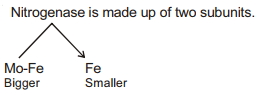
(A) The enzyme nitrogenase,which is responsible for biological nitrogen fixation,is a $Mo-Fe$ protein.
Similarly,nitrate reductase,an enzyme involved in the reduction of nitrate to nitrite in plants,also requires molybdenum $(Mo)$ as a crucial cofactor for its activity.
Therefore,molybdenum is a common essential component for both nitrogenase and nitrate reductase enzymes.
Similarly,nitrate reductase,an enzyme involved in the reduction of nitrate to nitrite in plants,also requires molybdenum $(Mo)$ as a crucial cofactor for its activity.
Therefore,molybdenum is a common essential component for both nitrogenase and nitrate reductase enzymes.
0 likes
View Solution284
EasyMCQ
An immobile element present in plant tissues is
A
$N$
B
$P$
C
$Ca$
D
$K$
Solution
(C) Elements that are structural components of the cell,such as $Ca$ (calcium),are immobile in plant tissues. Because they cannot be remobilized from older leaves to younger developing tissues,their deficiency symptoms first appear in the younger leaves.
0 likes
View Solution285
MediumMCQ
The essential element that activates enzymes $Rubisco$ and $PEPCase$ is also:
A
Needed in the activity of pyruvic acid decarboxylase
B
Helps in carbohydrate translocation
C
Essential for water splitting reactions
D
Forms constituents of the phytol tail of chlorophyll
Solution
(A) $Mg^{2+}$ is the essential element that activates the enzymes $Rubisco$ and $PEPCase$ (Phosphoenolpyruvate carboxylase).
$(1)$ $Mg^{2+}$ is also required for the activity of pyruvic acid decarboxylase,where it is present in the active site. This enzyme catalyzes the decarboxylation of pyruvic acid into acetaldehyde and $CO_2$.
$(2)$ $Mn^{2+}$ is essential for water-splitting reactions in photosynthesis.
$(3)$ Boron $(B)$ is involved in the translocation of carbohydrates.
$(4)$ Magnesium $(Mg)$ is a constituent of the chlorophyll ring structure,not the phytol tail.
$(1)$ $Mg^{2+}$ is also required for the activity of pyruvic acid decarboxylase,where it is present in the active site. This enzyme catalyzes the decarboxylation of pyruvic acid into acetaldehyde and $CO_2$.
$(2)$ $Mn^{2+}$ is essential for water-splitting reactions in photosynthesis.
$(3)$ Boron $(B)$ is involved in the translocation of carbohydrates.
$(4)$ Magnesium $(Mg)$ is a constituent of the chlorophyll ring structure,not the phytol tail.
0 likes
View Solution286
EasyMCQ
Which of the following is not a physiological role of potassium?
A
Maintain anion-cation balance in cells
B
Maintain turgidity of cells
C
Help in opening and closing of stomata
D
Synthesize auxins
Solution
(D) Potassium $(K^+)$ plays a crucial role in maintaining the anion-cation balance in cells,regulating the turgidity of cells,and controlling the opening and closing of stomata.
Auxin synthesis is primarily facilitated by Zinc $(Zn)$.
Therefore,the synthesis of auxins is not a physiological role of potassium.
Auxin synthesis is primarily facilitated by Zinc $(Zn)$.
Therefore,the synthesis of auxins is not a physiological role of potassium.
0 likes
View Solution287
EasyMCQ
An element involved in the metabolism of urea is:
A
$Na$
B
$Si$
C
$Ni$
D
$Zn$
Solution
(C) Nickel $(Ni)$ is an essential micronutrient that acts as a cofactor for the enzyme urease.
Urease is responsible for the hydrolysis of urea into ammonia and carbon dioxide,which is a critical step in nitrogen metabolism in plants and various microorganisms.
Urease is responsible for the hydrolysis of urea into ammonia and carbon dioxide,which is a critical step in nitrogen metabolism in plants and various microorganisms.
0 likes
View Solution288
EasyMCQ
The mineral present in cytochrome is commonly:
A
$Fe$
B
$Mn$
C
$Mo$
D
$Mg$
Solution
(A) Cytochromes are iron-containing hemoproteins that act as electron carriers in the electron transport chain. The central metal ion in the heme group of cytochromes is iron $(Fe)$, which undergoes reversible oxidation and reduction $(Fe^{2+} \leftrightarrow Fe^{3+})$ during electron transfer. Therefore, iron is an essential constituent of cytochromes.
0 likes
View Solution289
EasyMCQ
Boron takes part in
A
Photosynthesis
B
Activation of enzymes involved in respiration
C
Transport of carbohydrates through phloem
D
Nitrogen metabolism
Solution
(C) Boron is essential for the translocation of carbohydrates through the phloem.
Potassium is primarily involved in photosynthesis and the activation of various enzymes in respiration.
Molybdenum $(Mo)$ is a key component for nitrogen metabolism.
Potassium is primarily involved in photosynthesis and the activation of various enzymes in respiration.
Molybdenum $(Mo)$ is a key component for nitrogen metabolism.
0 likes
View Solution290
MediumMCQ
Which group of micronutrients is required for mitochondrial and photosynthetic electron transport?
A
$Ca, K, Na$
B
$Cu, Fe$
C
$Co, Ni$
D
$N, P, K$
Solution
(B) Both $Cu$ (Copper) and $Fe$ (Iron) are essential micronutrients involved in electron transport chains.
$Fe$ is a key component of cytochromes and iron-sulfur proteins in both mitochondrial respiration and photosynthetic electron transport.
$Cu$ is a component of plastocyanin in photosynthesis and cytochrome $c$ oxidase (complex $IV$) in mitochondrial respiration,where it undergoes redox reactions $(Cu^+ \leftrightarrow Cu^{2+})$.
$Fe$ is a key component of cytochromes and iron-sulfur proteins in both mitochondrial respiration and photosynthetic electron transport.
$Cu$ is a component of plastocyanin in photosynthesis and cytochrome $c$ oxidase (complex $IV$) in mitochondrial respiration,where it undergoes redox reactions $(Cu^+ \leftrightarrow Cu^{2+})$.
0 likes
View Solution291
MediumMCQ
Which is not a true statement regarding macronutrients?
A
Forms plant structure
B
Usually become toxic in excess
C
No role in electron transfer
D
Develop osmotic potential
Solution
(B) Macronutrients are required in large amounts by plants. They are involved in the formation of plant structures (e.g.,$C, H, O, N$),development of osmotic potential (e.g.,$K^+$),and some play a role in electron transfer (e.g.,$Mg^{2+}$ in chlorophyll). Micronutrients,not macronutrients,are the ones that usually become toxic when present in excess amounts. Therefore,the statement that macronutrients usually become toxic in excess is incorrect.
0 likes
View Solution292
MediumMCQ
Choose the correct statement regarding micronutrients.
A
Become toxic in excess
B
Little role in protoplasmic structure
C
No role in enzyme activation
D
Both $(A)$ and $(B)$
Solution
(D) Micronutrients are required in small amounts by plants.
Excess of micronutrients can lead to toxicity,which interferes with the uptake of other essential elements.
They have a very limited role in the formation of protoplasmic structures compared to macronutrients.
Therefore,both statements $(A)$ and $(B)$ are correct.
Excess of micronutrients can lead to toxicity,which interferes with the uptake of other essential elements.
They have a very limited role in the formation of protoplasmic structures compared to macronutrients.
Therefore,both statements $(A)$ and $(B)$ are correct.
0 likes
View Solution293
MediumMCQ
Minerals associated with redox reactions are
A
$N, Cu$
B
$Fe, Cu$
C
$Fe, K$
D
$Mn, Mo$
Solution
(B) Minerals like $Fe$ (Iron),$Cu$ (Copper),$Zn$ (Zinc),$Ni$ (Nickel),and $Mo$ (Molybdenum) are essential components of various enzymes and proteins involved in redox reactions.
Specifically,$Fe$ is a component of ferredoxin and cytochromes,while $Cu$ is a component of plastocyanin,both of which are critical for electron transport in photosynthesis and respiration.
Therefore,among the given options,$Fe$ and $Cu$ are the primary minerals associated with redox reactions.
Specifically,$Fe$ is a component of ferredoxin and cytochromes,while $Cu$ is a component of plastocyanin,both of which are critical for electron transport in photosynthesis and respiration.
Therefore,among the given options,$Fe$ and $Cu$ are the primary minerals associated with redox reactions.
0 likes
View Solution294
EasyMCQ
Minerals which maintain cation-anion balance in cells are
A
$Cl, K$
B
$Fe, Cu$
C
$K, P$
D
$Ca, Fe$
Solution
(A) Potassium $(K^+)$ and Chloride $(Cl^-)$ ions are essential for maintaining the cation-anion balance within the cells. Potassium acts as the primary cation,while Chloride acts as the primary anion to regulate the osmotic pressure and electrical neutrality of the cell.
0 likes
View Solution295
EasyMCQ
Which of the following groups of elements are mobile?
A
$Fe, Ca, B$
B
$Cl, K$
C
$B, K, N$
D
$Ca, Mg, P$
Solution
(B) Elements that are actively mobilized within the plant are known as mobile elements. These include $N, P, K,$ and $Mg$.
$\rightarrow$ Because these elements are mobile,they are transported from older,mature tissues to younger,developing tissues.
$\rightarrow$ Consequently,deficiency symptoms for these elements are first observed in the older,mature parts of the plant.
$\rightarrow$ Because these elements are mobile,they are transported from older,mature tissues to younger,developing tissues.
$\rightarrow$ Consequently,deficiency symptoms for these elements are first observed in the older,mature parts of the plant.
0 likes
View Solution296
EasyMCQ
Which of the following elements are required for chlorophyll synthesis?
A
$Fe$ and $Mg$
B
$Mo$ and $Ca$
C
$Cu$ and $Ca$
D
$Ca$ and $K$
Solution
(A) $Mg$ is a central constituent of the chlorophyll molecule,forming the core of the porphyrin ring. $Fe$ (Iron) is essential for the synthesis of chlorophyll,as it acts as a cofactor for enzymes involved in the biosynthetic pathway of chlorophyll.
0 likes
View Solution297
EasyMCQ
Which is not a trace element?
A
$Mn$
B
$Cu$
C
$Mo$
D
$K$
Solution
(D) Essential elements are classified into two categories based on their quantitative requirements: macronutrients and micronutrients (trace elements).
$K$ (Potassium) is a macronutrient because it is required by plants in large amounts.
$Mn$ (Manganese),$Cu$ (Copper),and $Mo$ (Molybdenum) are micronutrients,which are required in very small amounts (trace amounts).
$K$ (Potassium) is a macronutrient because it is required by plants in large amounts.
$Mn$ (Manganese),$Cu$ (Copper),and $Mo$ (Molybdenum) are micronutrients,which are required in very small amounts (trace amounts).
0 likes
View Solution298
EasyMCQ
Tryptophan synthesis,carboxylase activity,and little leaf of plants are all associated with:
A
$Zn$
B
$B$
C
$Ca$
D
$Cu$
Solution
(A) Zinc $(Zn)$ is an essential micronutrient for plants. It is required for the synthesis of tryptophan,which is a precursor for the plant hormone auxin (indole$-3-$acetic acid). Zinc also acts as a cofactor for various enzymes,including carbonic anhydrase (a carboxylase). $A$ deficiency of zinc leads to the 'little leaf' disease,where leaves become small and deformed.
0 likes
View Solution299
EasyMCQ
Which mineral is a component of $CoA$,$Fd$ (ferredoxin),thiamine,and lipoic acid?
A
$Mn$
B
$Fe$
C
$S$
D
$Ca$
Solution
(C) Sulfur $(S)$ is an essential mineral that acts as a structural component in several important biological molecules.
It is a key constituent of amino acids like cysteine and methionine,which are essential for protein structure.
Furthermore,sulfur is present in several coenzymes and vitamins,including Coenzyme $A$ $(CoA)$,ferredoxin $(Fd)$,thiamine (Vitamin $B_1$),biotin,and lipoic acid.
Therefore,the correct answer is $S$.
It is a key constituent of amino acids like cysteine and methionine,which are essential for protein structure.
Furthermore,sulfur is present in several coenzymes and vitamins,including Coenzyme $A$ $(CoA)$,ferredoxin $(Fd)$,thiamine (Vitamin $B_1$),biotin,and lipoic acid.
Therefore,the correct answer is $S$.
0 likes
View Solution300
EasyMCQ
Plants need one of the following for $ATP$ formation.
A
$N$ and $P$
B
$N$ and $Cu$
C
$N$ and $Ca$
D
$K$
Solution
(A) Plants require both Nitrogen $(N)$ and Phosphorus $(P)$ for the formation of $ATP$. Phosphorus is a key component of the $ATP$ molecule (Adenosine Triphosphate),while Nitrogen is an essential structural component of the adenine base and the amino acids that form the enzymes involved in energy metabolism.
0 likes
View SolutionMineral Nutrition — Role of Macro and Micro-nutrients · Frequently Asked Questions
1Are these Mineral Nutrition questions useful for JEE and NEET?
Yes. All questions in this section are mapped to JEE Main and NEET exam patterns. Previous year questions from JEE Main, NEET, GUJCET and state-level exams are included with full solutions.
2Can I switch to Hindi or Gujarati for these questions?
Yes. Use the language tabs in the hero section or the sidebar to view the same questions and solutions in English, Hindi or Gujarati.
3How do I generate a question paper from this subtopic?
Use the Vedclass Exam Paper Generator — select the chapter and subtopic, set difficulty, and generate Sets A, B, C, D automatically. First 3 chapters of every subject are free.
Vedclass Products
For Students
Vedclass Test Series
Mock tests in real JEE/NEET style with performance analysis. 5-day free trial.
Start Free TrialFor Teachers
Exam Paper Generator
Generate Set A/B/C/D papers from this chapter in 2 minutes. 3 chapters free.
Try FreeFor Institutes
Online Exam Module
Live online exams with unlimited students, 360° analytics & white-label branding.
See DemoFor Teachers & Institutes
Generate a Mineral Nutrition Exam Paper in 2 Minutes
Select subtopic & difficulty — Sets A, B, C, D auto-generated with No Repeat logic.
First 3 chapters of every subject are free — no payment required.