
A English
Appendicular skeleton Questions in English
Class 11 Biology · Locomotion and Movement · Appendicular skeleton
132+
Questions
English
Language
100%
With Solutions
Showing 32 of 132 questions in English
101
EasyMCQ
Colles' fracture is associated with
A
Femur
B
Ulna
C
Humerus
D
Radius
Solution
(D) fracture of the distal end of the $Radius$ bone,in which the distal fragment is displaced posteriorly,is known as Colles' fracture. This type of injury typically occurs when a person falls on an outstretched hand.
0 likes
View Solution102
MediumMCQ
Number of tarsals,metatarsals and phalanges in human skeleton is
A
$7, 5, 14$
B
$8, 5, 14$
C
$9, 5, 14$
D
$5, 6, 7$
Solution
(A) In the human skeleton,each hindlimb (leg) consists of $30$ bones.
The bones of the hindlimb are as follows:
$1$. Femur (thigh bone): $1$ per leg ($2$ total).
$2$. Patella (kneecap): $1$ per leg ($2$ total).
$3$. Tibia and Fibula (shank bones): $2$ per leg ($4$ total).
$4$. Tarsals (ankle bones): $7$ per leg ($14$ total).
$5$. Metatarsals (sole bones): $5$ per leg ($10$ total).
$6$. Phalanges (digits): $14$ per leg ($28$ total).
Therefore,for a single limb,the number of tarsals is $7$,metatarsals is $5$,and phalanges is $14$.
The bones of the hindlimb are as follows:
$1$. Femur (thigh bone): $1$ per leg ($2$ total).
$2$. Patella (kneecap): $1$ per leg ($2$ total).
$3$. Tibia and Fibula (shank bones): $2$ per leg ($4$ total).
$4$. Tarsals (ankle bones): $7$ per leg ($14$ total).
$5$. Metatarsals (sole bones): $5$ per leg ($10$ total).
$6$. Phalanges (digits): $14$ per leg ($28$ total).
Therefore,for a single limb,the number of tarsals is $7$,metatarsals is $5$,and phalanges is $14$.
0 likes
View Solution103
MediumMCQ
Bones of the limbs along with their girdles constitute the
A
Appendicular skeleton
B
Axial skeleton
C
Apex skeleton
D
Axis skeleton
Solution
(A) The human skeletal system is divided into two parts: the axial skeleton and the appendicular skeleton.
The axial skeleton consists of the skull,vertebral column,ribs,and sternum.
The appendicular skeleton consists of the bones of the limbs along with their respective girdles (pectoral and pelvic girdles).
The pectoral girdle supports the forelimbs,and the pelvic girdle supports the hindlimbs.
The appendicular skeleton is composed of $126$ bones in total.
The axial skeleton consists of the skull,vertebral column,ribs,and sternum.
The appendicular skeleton consists of the bones of the limbs along with their respective girdles (pectoral and pelvic girdles).
The pectoral girdle supports the forelimbs,and the pelvic girdle supports the hindlimbs.
The appendicular skeleton is composed of $126$ bones in total.
0 likes
View Solution104
MediumMCQ
Scapula is a triangular bone situated
A
Dorsal part of thorax between $2^{nd}$ and $7^{th}$ ribs
B
Ventral part of thorax between $2^{nd}$ and $7^{th}$ ribs
C
Medial part of thorax between $2^{nd}$ and $7^{th}$ ribs
D
None of the above
Solution
(A) The scapula is a large,triangular,flat bone located in the dorsal part of the thorax between the $2^{nd}$ and $7^{th}$ ribs.
Its dorsal surface features a slightly elevated ridge known as the spine,which projects as a flat,expanded process called the acromion.
The clavicle articulates with the acromion.
Below the acromion,there is a depression called the glenoid cavity,which articulates with the head of the humerus to form the shoulder joint.
The clavicle is a long,slender bone with two curvatures,commonly referred to as the collar bone.
Its dorsal surface features a slightly elevated ridge known as the spine,which projects as a flat,expanded process called the acromion.
The clavicle articulates with the acromion.
Below the acromion,there is a depression called the glenoid cavity,which articulates with the head of the humerus to form the shoulder joint.
The clavicle is a long,slender bone with two curvatures,commonly referred to as the collar bone.
0 likes
View Solution105
MediumMCQ
Sigmoid notch is present in
A
Femur
B
Radius-ulna
C
Tibia-fibula
D
Humerus
Solution
(B) The forearm consists of two bones: the inner $Radius$ and the outer $Ulna$. The $Ulna$ is longer and thicker. At the elbow joint,the $Ulna$ projects beyond the $Radius$ as an $Olecranon$ process. This process contains a deep,subterminal $Sigmoid$ notch,which articulates with the $Trochlea$ of the $Humerus$ to form a hinge joint.
0 likes
View Solution106
MediumMCQ
The head of the humerus articulates with the . . . . . . cavity.
A
Glenoid
B
Acetabulum
C
Foramen magnum
D
Obturator foramen
Solution
(A) The head of the humerus bone articulates with the glenoid cavity of the scapula to form the shoulder joint.
This is a ball-and-socket type of synovial joint that allows for a wide range of movement.
This is a ball-and-socket type of synovial joint that allows for a wide range of movement.
0 likes
View Solution107
MediumMCQ
The longest bone of the thigh is
A
Phalanges
B
Tarsal
C
Femur
D
Metatarsal
Solution
(C) The longest bone of the human body,located in the thigh,is the $Femur$. It is also the strongest and heaviest bone in the human skeleton.
0 likes
View Solution108
MediumMCQ
Match the following:
| Column $I$ | Column $II$ |
|---|---|
| $(a)$ Tarsal | $(i) \; 14$ |
| $(b)$ Phalanges | $(ii) \; 1$ |
| $(c)$ Metatarsal | $(iii) \; 7$ |
| $(d)$ Femur | $(iv) \; 5$ |
A
$a(iii), b(i), c(iv), d(ii)$
B
$a(i), b(ii), c(iii), d(iv)$
C
$a(ii), b(iii), c(iv), d(i)$
D
$a(iv), b(i), c(iii), d(ii)$
Solution
(A) The correct matches are as follows:
$(a)$ Tarsal: These are the ankle bones,numbering $7$ per limb.
$(b)$ Phalanges: These are the toe bones,numbering $14$ per limb.
$(c)$ Metatarsal: These are the bones of the sole,numbering $5$ per limb.
$(d)$ Femur: This is the thigh bone,which is the longest bone in the body,numbering $1$ per limb.
Therefore,the correct sequence is $a(iii), b(i), c(iv), d(ii)$.
$(a)$ Tarsal: These are the ankle bones,numbering $7$ per limb.
$(b)$ Phalanges: These are the toe bones,numbering $14$ per limb.
$(c)$ Metatarsal: These are the bones of the sole,numbering $5$ per limb.
$(d)$ Femur: This is the thigh bone,which is the longest bone in the body,numbering $1$ per limb.
Therefore,the correct sequence is $a(iii), b(i), c(iv), d(ii)$.
0 likes
View Solution109
EasyMCQ
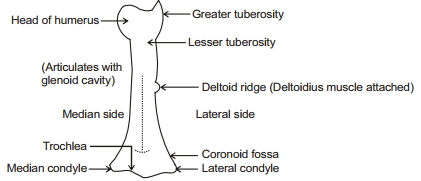
Deltoid ridge is found in which one of the following bones?
A
Radius
B
Tibia
C
Femur
D
Humerus
Solution
(D) The deltoid ridge (also known as the deltoid tuberosity) is a roughened,$V$-shaped area located on the lateral surface of the shaft of the humerus bone. It serves as the site of attachment for the deltoid muscle,which is responsible for the abduction of the arm at the shoulder joint. Therefore,the correct option is $D$.
0 likes
View Solution110
EasyMCQ
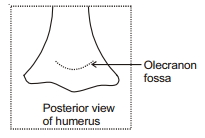
Olecranon fossa is present in which of the following bones?
A
Radius
B
Ulna
C
Humerus
D
Femur
Solution
(C) The olecranon fossa is a deep triangular depression found on the posterior surface of the distal end of the humerus bone.
It accommodates the olecranon process of the ulna during the extension of the forearm at the elbow joint.
It accommodates the olecranon process of the ulna during the extension of the forearm at the elbow joint.
0 likes
View Solution111
MediumMCQ
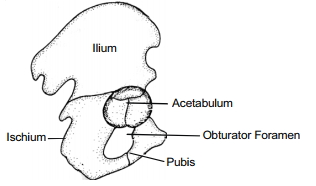
Obturator foramen is enclosed between
A
Ilium,ischium and pubis
B
Ischium and pubis
C
Ilium and ischium
D
Ilium and pubis
Solution
(B) The coxal bone (hip bone) is formed by the fusion of three bones: ilium,ischium,and pubis.
The obturator foramen is a large opening in the hip bone,which is located between the ischium and the pubis bones.
While the ilium,ischium,and pubis fuse to form the acetabulum,the obturator foramen specifically lies between the ischium and the pubis.
The obturator foramen is a large opening in the hip bone,which is located between the ischium and the pubis bones.
While the ilium,ischium,and pubis fuse to form the acetabulum,the obturator foramen specifically lies between the ischium and the pubis.
0 likes
View Solution112
EasyMCQ
Which of the following bones are involved in the formation of the acetabulum?
A
$a$ and $b$ only
B
$b$ and $c$ only
C
$a$ and $c$ only
D
$a, b$ and $c$
Solution
(D) The acetabulum is a cup-shaped socket located on the lateral surface of the hip bone (coxal bone). It is formed by the fusion of three bones: the ilium,the ischium,and the pubis. These three bones meet at the acetabulum to provide a socket for the head of the femur,forming the hip joint.
0 likes
View Solution113
MediumMCQ
Mark the odd one with respect to girdle bones.
A
Clavicle
B
Ischium
C
Ileum
D
Pubis
Solution
(C) The girdle bones are part of the appendicular skeleton,which includes the pectoral and pelvic girdles.
$Clavicle$ is a bone of the pectoral girdle.
$Ischium$ and $Pubis$ are bones of the pelvic girdle.
$Ileum$ is a part of the small intestine in the digestive system,not a bone.
$Clavicle$ is a bone of the pectoral girdle.
$Ischium$ and $Pubis$ are bones of the pelvic girdle.
$Ileum$ is a part of the small intestine in the digestive system,not a bone.
0 likes
View Solution114
MediumMCQ
$A$: Tibia is stronger and is present medially,whereas fibula is the outer and slender bone of the lower leg or shank.
$R$: Tibia has a sharp crest in the shaft and a projection on the inner side of the ankle called the lateral malleolus.
$R$: Tibia has a sharp crest in the shaft and a projection on the inner side of the ankle called the lateral malleolus.
A
Assertion and Reason both are correct and Reason is the correct explanation of Assertion.
B
Assertion and Reason both are correct but Reason is not the correct explanation of Assertion.
C
Assertion is correct,but Reason is incorrect.
D
Both Assertion and Reason are incorrect.
Solution
(C) The Assertion is correct: The tibia is the larger,stronger,and medial bone of the lower leg,while the fibula is the thinner,lateral bone.
The Reason is incorrect: The projection on the inner side of the ankle is called the medial malleolus,which is part of the tibia. The lateral malleolus is the projection on the outer side of the ankle,which is part of the fibula. Therefore,the statement in the Reason is factually wrong.
The Reason is incorrect: The projection on the inner side of the ankle is called the medial malleolus,which is part of the tibia. The lateral malleolus is the projection on the outer side of the ankle,which is part of the fibula. Therefore,the statement in the Reason is factually wrong.
0 likes
View Solution115
MediumMCQ
What is the common name of the collar bone?
A
Scapula
B
Clavicle
C
Sternum
D
Humerus
Solution
(B) The collar bone is scientifically known as the $Clavicle$.
It is a long,slender bone with two curvatures that connects the sternum to the scapula,forming part of the pectoral girdle.
It is a long,slender bone with two curvatures that connects the sternum to the scapula,forming part of the pectoral girdle.
0 likes
View Solution116
MediumMCQ
Match the following columns:
| Column-$I$ | Column-$II$ (Number of bones) |
| $P$. Arm | $I$. $8$ |
| $Q$. Forearm | $II$. $5$ |
| $R$. Wrist | $III$. $14$ |
| $S$. Palm | $IV$. $1$ |
| $T$. Digits | $V$. $2$ |
A
$(P-IV), (Q-I), (R-V), (S-II), (T-III)$
B
$(P-V), (Q-IV), (R-I), (S-II), (T-III)$
C
$(P-IV), (Q-V), (R-I), (S-II), (T-III)$
D
$(P-IV), (Q-V), (R-I), (S-II), (T-II)$
Solution
(C) The bones of the human arm (forelimb) are categorized as follows:
$P$. Arm (Humerus): $1$ bone $(IV)$
$Q$. Forearm (Radius and Ulna): $2$ bones $(V)$
$R$. Wrist (Carpals): $8$ bones $(I)$
$S$. Palm (Metacarpals): $5$ bones $(II)$
$T$. Digits (Phalanges): $14$ bones $(III)$
Therefore,the correct matching is $(P-IV), (Q-V), (R-I), (S-II), (T-III)$.
$P$. Arm (Humerus): $1$ bone $(IV)$
$Q$. Forearm (Radius and Ulna): $2$ bones $(V)$
$R$. Wrist (Carpals): $8$ bones $(I)$
$S$. Palm (Metacarpals): $5$ bones $(II)$
$T$. Digits (Phalanges): $14$ bones $(III)$
Therefore,the correct matching is $(P-IV), (Q-V), (R-I), (S-II), (T-III)$.
0 likes
View Solution117
MediumMCQ
Which is the longest bone in the human body?
A
Sternum
B
Femur
C
Fibula
D
Vertebra
Solution
(B) The $Femur$,also known as the thigh bone,is the longest,heaviest,and strongest bone in the human body. It extends from the hip to the knee and supports the weight of the body during movement.
0 likes
View Solution118
MediumMCQ
Which shape is this bone?
A
Tarsal
B
Carpal
C
Cup-shaped
D
Humerus
Solution
(C) The question refers to the shape of a specific bone. Among the options,the 'Cup-shaped' description typically refers to the acetabulum of the pelvic girdle,which forms a socket for the head of the femur. However,if referring to a specific bone like the patella or a sesamoid bone,'Cup-shaped' is the most descriptive morphological term provided in the options compared to the names of specific bones (Tarsal,Carpal,Humerus).
0 likes
View Solution119
MediumMCQ
Match the following columns:
| Column-$I$ (Bone region) | Column-$II$ (Number of bones) |
| $P$. Thigh | $I$. $7$ |
| $Q$. Shank | $II$. $14$ |
| $R$. Knee cap | $III$. $1$ (Long bone) |
| $S$. Ankle | $IV$. $2$ |
| $T$. Metatarsals | $V$. $1$ (Cup-shaped) |
| $U$. Phalanges | $VI$. $5$ |
A
$(P-III), (Q-IV), (R-V), (S-I), (T-VI), (U-II)$
B
$(P-II), (Q-IV), (R-V), (S-I), (T-VI), (U-II)$
C
$(P-II), (Q-V), (R-I), (S-VI), (T-II), (U-IV)$
D
$(P-IV), (Q-II), (R-II), (S-VI), (T-V), (U-I)$
Solution
(A) The correct matching is as follows:
$P$. Thigh: Contains the femur,which is $1$ long bone per leg $(III)$.
$Q$. Shank: Contains the tibia and fibula,which are $2$ bones per leg $(IV)$.
$R$. Knee cap: Contains the patella,which is $1$ cup-shaped bone per leg $(V)$.
$S$. Ankle: Contains $7$ tarsal bones per leg $(I)$.
$T$. Metatarsals: Contains $5$ bones per leg $(VI)$.
$U$. Phalanges: Contains $14$ bones per leg $(II)$.
Therefore,the correct sequence is $(P-III, Q-IV, R-V, S-I, T-VI, U-II)$.
$P$. Thigh: Contains the femur,which is $1$ long bone per leg $(III)$.
$Q$. Shank: Contains the tibia and fibula,which are $2$ bones per leg $(IV)$.
$R$. Knee cap: Contains the patella,which is $1$ cup-shaped bone per leg $(V)$.
$S$. Ankle: Contains $7$ tarsal bones per leg $(I)$.
$T$. Metatarsals: Contains $5$ bones per leg $(VI)$.
$U$. Phalanges: Contains $14$ bones per leg $(II)$.
Therefore,the correct sequence is $(P-III, Q-IV, R-V, S-I, T-VI, U-II)$.
0 likes
View Solution120
MediumMCQ
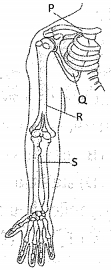
Which of the following bones form the pectoral girdle?
A
$P$ and $Q$
B
$Q$ and $R$
C
$P$ and $S$
D
$Q$ and $S$
Solution
(A) In the provided diagram,the labels represent the following bones:
$P$ represents the clavicle (collar bone).
$Q$ represents the scapula (shoulder blade).
$R$ represents the humerus (bone of the upper arm).
$S$ represents the radius/ulna (bones of the forearm).
The pectoral girdle consists of two bones: the clavicle $(P)$ and the scapula $(Q)$.
Therefore,the correct answer is $P$ and $Q$.
$P$ represents the clavicle (collar bone).
$Q$ represents the scapula (shoulder blade).
$R$ represents the humerus (bone of the upper arm).
$S$ represents the radius/ulna (bones of the forearm).
The pectoral girdle consists of two bones: the clavicle $(P)$ and the scapula $(Q)$.
Therefore,the correct answer is $P$ and $Q$.
0 likes
View Solution121
MediumMCQ
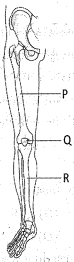
The figure below shows the right pelvic girdle and the bones of the hind limb. Identify the bones labeled $P, Q,$ and $R$.
A
Femur, Patella, Tibia
B
Femur, Patella, Fibula
C
Femur, Patella, Fibula
D
Femur, Patella, Tibia
Solution
(B) In the given diagram of the human hind limb:
$P$ represents the Femur, which is the thigh bone and the longest bone in the body.
$Q$ represents the Patella, which is the knee cap bone.
$R$ represents the Fibula, which is the thinner, lateral bone of the lower leg.
Therefore, the correct identification is $P = \text{Femur}$, $Q = \text{Patella}$, and $R = \text{Fibula}$.
$P$ represents the Femur, which is the thigh bone and the longest bone in the body.
$Q$ represents the Patella, which is the knee cap bone.
$R$ represents the Fibula, which is the thinner, lateral bone of the lower leg.
Therefore, the correct identification is $P = \text{Femur}$, $Q = \text{Patella}$, and $R = \text{Fibula}$.
0 likes
View Solution122
MediumMCQ
The glenoid cavity articulates with the ..... to form a joint.
A
Femur
B
Sternum
C
Radius
D
Humerus
Solution
(D) The glenoid cavity is a shallow,pyriform articular surface located on the lateral angle of the scapula.
It articulates with the head of the humerus to form the glenohumeral joint,which is a ball-and-socket joint.
This joint allows for a wide range of movement of the arm.
It articulates with the head of the humerus to form the glenohumeral joint,which is a ball-and-socket joint.
This joint allows for a wide range of movement of the arm.
0 likes
View Solution123
MediumMCQ
Which bone has two curvatures?
A
Rib
B
Pectoral girdle
C
Clavicle
D
Scapula
Solution
(C) The $Clavicle$ (also known as the collarbone) is a long,slender bone that connects the arm to the trunk of the body. It is characterized by having two distinct curvatures: a medial curvature that is convex anteriorly and a lateral curvature that is concave anteriorly. This $S$-shaped structure helps in transmitting forces from the upper limb to the axial skeleton.
0 likes
View Solution124
MediumMCQ
If the pelvic bones do not fuse,how many bones are present in an adult human?
A
$206$
B
$210$
C
$213$
D
$212$
Solution
(B) In a typical adult human,the pelvic girdle consists of two coxal bones. Each coxal bone is formed by the fusion of three bones: the ilium,ischium,and pubis.
In the embryonic stage,these three bones are separate. By adulthood,they fuse to form a single coxal bone on each side.
If these bones do not fuse,each side would consist of $3$ separate bones instead of $1$.
Therefore,the total count would increase by $2$ bones on each side (total $4$ additional bones).
Standard adult human skeleton = $206$ bones.
If fusion does not occur,the total = $206 + 4 = 210$ bones.
In the embryonic stage,these three bones are separate. By adulthood,they fuse to form a single coxal bone on each side.
If these bones do not fuse,each side would consist of $3$ separate bones instead of $1$.
Therefore,the total count would increase by $2$ bones on each side (total $4$ additional bones).
Standard adult human skeleton = $206$ bones.
If fusion does not occur,the total = $206 + 4 = 210$ bones.
0 likes
View Solution125
MediumMCQ
Select the correct option from the following.
A
Pectoral girdle - Scapula,Clavicle
B
Pelvic girdle - Femur
C
Rib cage - Cervical vertebrae
D
Palm - Carpals
Solution
(A) The human skeletal system is divided into the axial and appendicular skeleton.
$1$. The Pectoral girdle consists of the Scapula and Clavicle,which support the upper limbs. Thus,option $A$ is correct.
$2$. The Pelvic girdle consists of two coxal bones; the Femur is the bone of the thigh,not part of the girdle itself.
$3$. The Rib cage consists of ribs and the sternum; cervical vertebrae are part of the vertebral column.
$4$. The palm consists of metacarpals,while carpals form the wrist.
$1$. The Pectoral girdle consists of the Scapula and Clavicle,which support the upper limbs. Thus,option $A$ is correct.
$2$. The Pelvic girdle consists of two coxal bones; the Femur is the bone of the thigh,not part of the girdle itself.
$3$. The Rib cage consists of ribs and the sternum; cervical vertebrae are part of the vertebral column.
$4$. The palm consists of metacarpals,while carpals form the wrist.
0 likes
View Solution126
EasyMCQ
Which is the part of the pectoral girdle?
A
Glenoid cavity
B
Sternum
C
Ilium
D
Acetabulum
Solution
(A) The pectoral girdle (shoulder girdle) consists of two bones: the clavicle and the scapula.
Each scapula is a large,triangular,flat bone situated in the dorsal part of the thorax between the $2^{nd}$ and $7^{th}$ ribs.
The scapula has a slightly elevated ridge called the spine,which projects as a flat,expanded process called the acromion.
Below the acromion is a depression called the glenoid cavity,which articulates with the head of the humerus to form the shoulder joint.
$Ilium$ and $Acetabulum$ are parts of the pelvic girdle,while the $Sternum$ is a bone of the axial skeleton.
Each scapula is a large,triangular,flat bone situated in the dorsal part of the thorax between the $2^{nd}$ and $7^{th}$ ribs.
The scapula has a slightly elevated ridge called the spine,which projects as a flat,expanded process called the acromion.
Below the acromion is a depression called the glenoid cavity,which articulates with the head of the humerus to form the shoulder joint.
$Ilium$ and $Acetabulum$ are parts of the pelvic girdle,while the $Sternum$ is a bone of the axial skeleton.
0 likes
View Solution127
EasyMCQ
Which type of bones are included in the appendicular skeleton?
A
Skull & Ribs
B
Skull & Sternum
C
Limbs & Girdles
D
Only vertebral column
Solution
(C) The human skeletal system is divided into two main parts: the axial skeleton and the appendicular skeleton.
$1$. The axial skeleton consists of $80$ bones,which include the skull,vertebral column,sternum,and ribs.
$2$. The appendicular skeleton consists of $126$ bones,which include the bones of the limbs (forelimbs and hindlimbs) and the girdles (pectoral and pelvic girdles).
Therefore,the correct option is $C$.
$1$. The axial skeleton consists of $80$ bones,which include the skull,vertebral column,sternum,and ribs.
$2$. The appendicular skeleton consists of $126$ bones,which include the bones of the limbs (forelimbs and hindlimbs) and the girdles (pectoral and pelvic girdles).
Therefore,the correct option is $C$.
0 likes
View Solution128
EasyMCQ
Scapula is a large triangular flat bone situated in the dorsal part of the thorax between
A
The second and fifth ribs
B
The second and seventh ribs
C
The third and sixth ribs
D
The third and eighth ribs
Solution
(B) The scapula is a large,triangular,flat bone located in the dorsal part of the thorax.
It extends between the level of the $2^{nd}$ and $7^{th}$ ribs.
This bone is part of the pectoral girdle and provides attachment points for various muscles that facilitate the movement of the upper limb.
It extends between the level of the $2^{nd}$ and $7^{th}$ ribs.
This bone is part of the pectoral girdle and provides attachment points for various muscles that facilitate the movement of the upper limb.
0 likes
View Solution129
MediumMCQ
Choose the correct option $:-$
$(a)$ First seven pairs of ribs are called true ribs.
$(b)$ Sternum is a large triangular bone that is situated at the ventral part of the thorax.
$(c)$ Scapula has a slightly elevated ridge called the spine which projects as a flat,expanded process called the acromion.
$(d)$ Below the acromion is a depression called the glenoid cavity which articulates with the head of the humerus.
$(a)$ First seven pairs of ribs are called true ribs.
$(b)$ Sternum is a large triangular bone that is situated at the ventral part of the thorax.
$(c)$ Scapula has a slightly elevated ridge called the spine which projects as a flat,expanded process called the acromion.
$(d)$ Below the acromion is a depression called the glenoid cavity which articulates with the head of the humerus.
A
only $a, b$ and $c$
B
only $a$ and $c$
C
only $b, c$ and $d$
D
Only $a$
Solution
(B) Statement $(a)$ is correct: The first seven pairs of ribs are attached directly to the sternum and are known as true ribs.
Statement $(b)$ is incorrect: The sternum is a flat bone on the ventral midline of the thorax,not the dorsal part.
Statement $(c)$ is correct: The scapula contains a prominent ridge called the spine,which extends into a flattened process known as the acromion.
Statement $(d)$ is incorrect: The glenoid cavity articulates with the head of the humerus,not the femur. The femur articulates with the acetabulum of the pelvic girdle.
Statement $(b)$ is incorrect: The sternum is a flat bone on the ventral midline of the thorax,not the dorsal part.
Statement $(c)$ is correct: The scapula contains a prominent ridge called the spine,which extends into a flattened process known as the acromion.
Statement $(d)$ is incorrect: The glenoid cavity articulates with the head of the humerus,not the femur. The femur articulates with the acetabulum of the pelvic girdle.
0 likes
View Solution130
MediumMCQ
The pelvic girdle consists of:
A
Ilium only
B
Ilium and ischium only
C
Ischium and pubis only
D
Ilium,ischium and pubis
Solution
(D) The pelvic girdle is a part of the appendicular skeleton.
It is composed of two coxal bones (hip bones).
Each coxal bone is formed by the fusion of three bones: the ilium,the ischium,and the pubis.
These three bones fuse together to form the acetabulum,which is the socket for the head of the femur.
It is composed of two coxal bones (hip bones).
Each coxal bone is formed by the fusion of three bones: the ilium,the ischium,and the pubis.
These three bones fuse together to form the acetabulum,which is the socket for the head of the femur.
0 likes
View Solution131
MediumMCQ
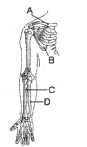
Identify the bones labeled $A, B, C,$ and $D$ in the given diagram of the human pectoral girdle and arm:
A
$A \rightarrow$ Scapula,$B \rightarrow$ Clavicle,$C \rightarrow$ Radius,$D \rightarrow$ Ulna
B
$A \rightarrow$ Clavicle,$B \rightarrow$ Scapula,$C \rightarrow$ Radius,$D \rightarrow$ Ulna
C
$A \rightarrow$ Coxal bone,$B \rightarrow$ Sacrum,$C \rightarrow$ Ulna,$D \rightarrow$ Radius
D
$A \rightarrow$ Clavicle,$B \rightarrow$ Scapula,$C \rightarrow$ Ulna,$D \rightarrow$ Radius
Solution
(B) Based on the anatomical structure of the human pectoral girdle and upper limb:
$A$ points to the Clavicle (collar bone),which is a long,slender bone connecting the sternum to the scapula.
$B$ points to the Scapula (shoulder blade),a large,triangular bone located on the dorsal side of the thorax.
$C$ points to the Radius,which is the lateral bone of the forearm (on the thumb side).
$D$ points to the Ulna,which is the medial bone of the forearm (on the little finger side).
Therefore,the correct identification is $A \rightarrow$ Clavicle,$B \rightarrow$ Scapula,$C \rightarrow$ Radius,$D \rightarrow$ Ulna.
$A$ points to the Clavicle (collar bone),which is a long,slender bone connecting the sternum to the scapula.
$B$ points to the Scapula (shoulder blade),a large,triangular bone located on the dorsal side of the thorax.
$C$ points to the Radius,which is the lateral bone of the forearm (on the thumb side).
$D$ points to the Ulna,which is the medial bone of the forearm (on the little finger side).
Therefore,the correct identification is $A \rightarrow$ Clavicle,$B \rightarrow$ Scapula,$C \rightarrow$ Radius,$D \rightarrow$ Ulna.
0 likes
View Solution132
MediumMCQ
Each coxal bone is formed by the fusion of $:-$
A
$2$ bones
B
$3$ bones
C
$1$ bone
D
$4$ bones
Solution
(B) Each coxal bone (hip bone) is formed by the fusion of three bones: the $ilium$,$ischium$,and $pubis$.
These three bones fuse together to form a single coxal bone in adults.
Therefore,the correct answer is $3$ bones.
These three bones fuse together to form a single coxal bone in adults.
Therefore,the correct answer is $3$ bones.
0 likes
View SolutionLocomotion and Movement — Appendicular skeleton · Frequently Asked Questions
1Are these Locomotion and Movement questions useful for JEE and NEET?
Yes. All questions in this section are mapped to JEE Main and NEET exam patterns. Previous year questions from JEE Main, NEET, GUJCET and state-level exams are included with full solutions.
2Can I switch to Hindi or Gujarati for these questions?
Yes. Use the language tabs in the hero section or the sidebar to view the same questions and solutions in English, Hindi or Gujarati.
3How do I generate a question paper from this subtopic?
Use the Vedclass Exam Paper Generator — select the chapter and subtopic, set difficulty, and generate Sets A, B, C, D automatically. First 3 chapters of every subject are free.
Vedclass Products
For Students
Vedclass Test Series
Mock tests in real JEE/NEET style with performance analysis. 5-day free trial.
Start Free TrialFor Teachers
Exam Paper Generator
Generate Set A/B/C/D papers from this chapter in 2 minutes. 3 chapters free.
Try FreeFor Institutes
Online Exam Module
Live online exams with unlimited students, 360° analytics & white-label branding.
See DemoFor Teachers & Institutes
Generate a Locomotion and Movement Exam Paper in 2 Minutes
Select subtopic & difficulty — Sets A, B, C, D auto-generated with No Repeat logic.
First 3 chapters of every subject are free — no payment required.